Search Results: "ag"

19 May 2007

Axel Beckert: autossh vs TCP resetter

LUG-Camp 2007 in Interlaken is nearly over, and I’m reading my mail as usual using ssh, screen and mutt on the server. But the ssh connection resets every few minutes. According to the LUSC people (who are running the gateway) some script kiddie is running a TCP resetter somewhere in the network. I remembered that I read about autossh in the Debian package list once a while and that it sounded cool but I had no use for it yet. Until now. I’m writing this over the same crashing ssh connection and I’m typing without taking big notice of the quite often occurring connection resets:
autossh noone.org -t 'screen -rd'
It just works. :-)

Jose Carlos Garcia Sogo: Too many wireless networks

In the image below you can see that NetworkManager is finding 16 wireless networks in my house neighbourhood. And for the ESSID I know that there are some others, that are not running today. I don't know how many networks can the spec hold at the same time, but for sure we are near to channel saturation.

Network Manager showing available networks

Jan Wagner: Pimp my T5725

Yesterday my ordered HP Thin Client T5725 arrived. The clue is, Debian sarge is and no moving parts (no noise) are inside. It’s a really nice thin client and it can be used as Surfstation out of the box. There is also a “HP Connection Administrator” which can manage ‘Citrix‘, ‘rdesktop‘ and ‘XDMCP‘ connections.
After taking a short overview, I decided to update to etch. This was a kind tricky, cause packages did need to update in correct order to save the HP packages. Due the switch from Xfree to xorg with etch, the graphical frontend for configuring the X server didn’t work anymore, but in my environment this is no issue.
So now I’m really happy with a HP Thin Client and bleeding edge software on it, for xdmcp use. ;) , , , ,

Adam Rosi-Kessel: More adventures in language acquistion

Esther turned two recently. She’s come a long way in language acquisition since January. Now she is a rich source of linguistics grammaticality problem sets:
Me: Do you want a hug?
Esther: Yes. Me: Big hug or little hug?
Esther: None hug.
And, this morning:
Me: What’s better, music or rugula?
Esther: Rugula and music.
(Note that “rugula” is not actually the longest word in her vocabulary — that would probably be “arboretum.”) Our household’s technology focus is also apparent: any small hook-like device is an “email.” For example, a bluetooth headset and a refrigerator hook magnet are both emails. Shorthand for “another book” is “i-book.”

Julien Valroff: New 16:10 wide screen

acer-al2002w.jpgI have purchased a new screen, and I have chosen an Acer AL2002W, mainly because of its low price. It is a 20″ wide screen, with a native resolution of 1680×1050 @60Hz. For now, it seems to be good value for money, and working with this screen is very confortable (I previously used a standard 4:3 17″ screen at 1280×1024). While configuring Xorg was painless (with both free nv and proprietary nvidia drivers), I still haven’t managed to get the framebuffer working with the native resolution of the screen. As vesafb doesn’t seem to be able to use a 1680×1050 resolution (hwinfo --framebuffer only gives 4:3 modes), I have tried to patch my kernel with vesafb-tng, which haven’t yield better results. While nvidiafb allows me to get a 1680×1050 framebuffer, it conflicts with proprietary nvidia driver, preventing it from being loaded. With the free nv driver, I can’t have the display centered both in console and in X (they both use the same mode, and the screen is able to stroe user modes at the condition the new display information habe 1Khz difference for horizontal frequency or 1Hz for vertical frequency or the syn signal polarities are different from the default modes). By the way, I have noticed that two of my laptops have the same Intel 915 video chipset, and one only is able to have a 1280×800 framebuffer (using the undocumented vga=0x362 code). I can’t understand the reason of this difference.

Ross Burton: Tasks 0.5

Tasks 0.5 is now released. This release has features a port to OpenMoko and several bug fixes. More information, screeenshots, and tarballs can be downloaded from the Pimlico site. There are no packages yet, but I hope to have those online shortly.

Evan Prodromou: 29 Flor al CCXV

Busy day yesterday; the first day of RoCoCoCamp, and the first day seeing a lot of friends and friendly faces from out of town. I was out of bed at 6AM yesterday. I stopped at St. Viateur Bagel on Mont Royal and got 10 dozen bagels -- enough for our expected crowd. I got to SAT at about 8AM, just in time to start the coffee machines. The big percolators I rented for the event require about an hour to make coffee, so if people were going to be coming in at 9AM, I really wanted to get them started by 8. Alain Bernardeau from computation.to got there soon after, and set up the spare computers his organization is lending us. Brandon Sanders, Mark Dilley and Nathan R also came in early, looking for work to do. I got them all into the job of setting up the food for breakfast. By 9AM we were trucking along, and I figured I'd go try a cup of joe, which should be ready. But all I got from the carafe was cold water. The percolators draw so much current that they'd blown a circuit. Guillaume, the SAT tech, and I tried about 8 different ways to keep them running, but nothing worked. Finally he put them on the 220V industrial circuit, which they didn't blow. Awesome, but at 9:30AM, with almost everyone there, we had no expectation of coffee for another hour. Yikes! But by the time people started filtering into the circle for starting the event proper, coffee was rolling and I was much relieved. Our facilitator, Deborah Hartmann, gave a great bilingual introduction to Open Space Technology and got the ball rolling. I always have a moment of dread during the beginning of a Open Space event: what if this is the time that Open Space doesn't work? But it did, again, which is great. The first session I went to was Zach Copley's, about consensus-supporting software features. Brandon Sanders had some great cases from AboutUs's adult content policy. We shared a lot of Wikitravel's culture, too. I also stopped in to talk about Wikitravel:RDF with Reini Urban, who was demoing Semantic MediaWiki. It's a neat project, and it's a different tack than I've taken with Wikitravel. I'd like to see the two approaches harmonized at some time in the future. Lunch came quickly, and we had far too much to eat. I spent a lot of time talking to Simon Law about possibly using Open Space in some way for BarCampMontreal. I think it's a good idea -- it's growing to a point where our current format is straining under the load. We also talked about ubiquitous wikis and the cool browser Amaya, where Web pages are in edit mode by default. It's a good idea. After lunch I had a chance to hang out with Earle Martin of Open Guides and talk about wiki and the geospatial web. Mark Jarowski of Wikevent was there, and together we've decided to hammer out a RDF vocabulary for exchanging RDF data about business listings. It's the kind of productive talk I like having. I also spent some time with Jack Herrick talking about wiki entrepreneurship. Jack had a prepared presentation about wikiHow's business experience, which was really great, and provided a great case study for talking about commercialization of wikis in general. With Angela Beesley and Ray King around us, we had most of the interesting wiki content businesses represented. Pretty neat. It was a really productive first day, but by the time we got around to 5PM I was exhausted. Maj, Zach, Mark, Niko and I all went to our new house at 4690 rue Pontiac to meet Allegra and their two daughters, No ma and baby Anoushka. We got pizza and had beers and sat on our new couch and had a good old time. Technorati's rocococamp tag shows a lot of other positive responses on the Web: Matt Forsythe's sketches from RoCoCoCamp, NathanR's continuing paranoia, CITIZENShift (which quotes me, when I was talking about wiki entrepreneurship), and Patrick Tanguay.
 
I'm off to SAT again this morning. Should be a fun one, and I hope to get a little more time to myself before the event starts today. tags:

Wouter Verhelst: Updating Debian/m68k patches for gcc 4.2

In a perfect world, software would work perfectly. Unfortunately... well, you know the drill. Since GCC 4.2 is upcoming, our resident GCC guy doko asked me to find someone to have a look at updating the Debian patches for GCC 4.1 so that they'd apply. Since I need to learn about GCC anyway for the Debian/ColdFire project (which nobody seems to be working on except for me), I started looking into it myself. The procedure is simple enough: uncomment lines in debian/rules.patch, and fix those m68k-specific patches that break. The first one was easy. debian/patches/m68k-gc.dpatch has been integrated upstream, so is no longer necessary. The second one was slightly more involved. But only slightly so; the patch tried to change libffi/src/m68k/sysv.S, which had received some three extra lines that conditionally add a .note.GNU-stack section. These three lines weren't there at first; but the .S file was otherwise entirely unchanged, so fixing this was rather easy. The next one is, uh, pretty hard. gcc/config/m68k/m68k.md is a file of 7k LOC in the GCC-specific "RTL" pseudo-assembly language, which I'm not at all familiar with. Yet, anyway. As a bonus, the first hunk in this file which fails to apply does so because that bit of this code has been changed rather significantly from GCC 4.1 to 4.2. Meaning:
  1. I need to figure out how this RTL code works
  2. I need to figure out what this particular RTL code block does
  3. I need to figure out what the point of this particular patch was
  4. I need to figure out how to write a patch (in RTL) which semantically does the same thing as what the original patch was doing. Without breaking the changes between 4.1 and 4.2
Wish me luck. At least the first two parts are almost finished; after skimming through chapters 12 and 14 of gccint.info, this hugging code almost makes sense to me. (oh, and if that last link doesn't make any sense to you, ask me for my fortune file at debconf) (which is in less than a month! whee! excitement!)

Junichi Uekawa: grub2 install on MacBook try 2.

It was actually very easy.First update-grub call didn't create grub.cfg.One catch is that it creates files in '/' of EFI partition, which is against the standard.It went as far as showing a menu of kernels, and then errored out with'error: unknown filesystem'.

Joey Hess: today is

Today is tilt at windmills day. Alternatively, for Debian developers, it's check your package's Recommends to make sure they're sane[1] day. I did both.
[1] The 'Recommends' field should list packages that would be found together with this one in all but unusual installations.

Jose Carlos Garcia Sogo: Apple drop

Or how online media can affect shares markets. Reading Enrique Dans' blog I have found an interesting entry on how a wrong piece of news published in an online medium made Apple shares to drop more than 4% in 6 mins. The history starts when Engadget published a false ticket talking about a delay in iPhone and Lepard releases. A supposed real internal mail from Apple was leaked to them, stating that delay. Actually that was a hoax. A spoofed mail that trespassed Apple mail servers and was delivered to a bunch of Apple employees, one of them leaking it to Engadget. About one hour and a half later, Apple sent another mail to their employees stating the untruth of the previus mail, and Engadget quickly published a rectification. But, in the meantime, the word spread fast and shares drop the 4% percent I mentioned before and with a lot of volume, which is an important signal for brokers that something is going wrong and that you have to sell your shares, increasing the effect in a snow ball way. The shares price drop meant Apple's market capitalization was 4 billion less (as US billions here) in 6 minutes. Information is crucial nowadays. But the speed at which it spreads is even more important.

Apple Market Cap drop

18 May 2007

Michael Prokop: grml 1.0, grml64 0.1 and grml-small 0.4

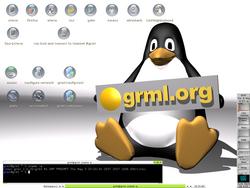
Screenshot of grml 1.0 It’s done. grml 1.0 is available. New features? Tons of them. 8-) Just check out the official release notes for grml 1.0. Need grml for a x86_64 system? No problem, grml64 0.1 is waiting for you. You are used to grml-small? Check out grml-small 0.4. You want to know what are my favourite features of the new release? Besides the updated kernel, libc, X.org and the 109 new packages? For example I love grml-debootstrap’s feature of installing a plain Debian with one single command (no further keypress!). I love playing with ZFS on Linux using zfs-fuse. I like the possibility to generate an OpenOffice document out of my existing asciidoc documentation using docbook2odf. I’ll present the new release at the grml booth of grazer linuxdays on 19th of may and will give a (german) talk about grml on the event as well. Hope to see you there. ;-)

Nico Golde: grml-1.0 released


3 1/2 years after mika registered grml.org it's done. Congratulations! HURRAY!!!11!1!!
grml provides more than 2500 software packages! Excluding library stuff, more than 1700 packages remain. We don't ship KDE and OpenOffice, but more than 800 packages which Knoppix does not provide. You'll get sysadmins favourite tools, security- and network-related software, data recovery- and forensic-tools, LaTeX, many editors, shells, and of course many texttools.

grml provides several scripts and utils which make life easier. zsh is configured with the completion mechanism. grml-x is a wrapper for configuring and using the X window system. grml-crypt is a program that provides an easy wrapper arround cryptsetup, mkfs, losetup and mount. grml-vpn is a program to establish encrypted communication channels in a network, and so on...


Grml 1.0 release name Meilenschwein was just released.

I am tired of sitting in front of my PC for today, that's why I just link to the:
release announcement.

Eddy Petrișor: Debconf7, here I come

Since I never got managed to reemit my credit card, I was forced to reserve my plane ticket to DebConf7 via phone.

The good news is that, this time I was able to find e-car.ro which apparently has some better search engine since I still found some cheaper (not much) flights than I did in January (I have a printout of the flight I thought of initially).

The price now is NOT a lot bigger than the one I found in January. Back then it was about 400 , now I'll have to pay around 425 [*]. Is not the same set of flights, but I don't mind.

So, now I have these flights:
I would have liked to have a wider window at return, between the flights, but, although there was some flight that left from AMS at 13:00, it was not possible to couple with that flight and keep a low fare :-( . So, my visit to Amsterdam must wait for another occasion.

So,
  1. if anybody else will be on any of these flights, I would welcome company.
  2. Helooooo, DebConf
Now I'll just have to have the confirmation mail and go myself to do the payment at e-car. Fortunately e-car is somewhere in the center of Bucharest, in the Roman Plaza (Pia a Roman ).

[*] If this sounds like a contradiction with the previous, is not. Now I found some of the previousely found flights and some new cheaper ones (all "now" prices), but since the booking is done later, all "now" prices are bigger than "January" prices. So if I had done the same booking back in January, I would have payed less; but back then I didn't found the flights I booked now.

Russell Coker: SE Linux in Debian

I have now got a Debian Xen domU running the strict SE Linux policy that can boot in enforcing mode. I expect that tomorrow I will have it working with full functionality and that I will be able to run another SE Linux Play Machine in the near future. After getting the strict policy working I want to build a Debian kernel with CONFIG_AUDITSYSCALL and an audit package so that I can audit system calls that an application makes and also so that the auditd can collect the SE Linux log messages. Other people have talked about packaging audit for Debian, hopefully one of them will do it first and save me the effort, but it shouldn’t be too difficult to do if they don’t. Then I need to investigate some options for training people about SE Linux. As I don’t currently have the bandwidth for serving large files I’m thinking of basing some SE Linux training on Xen images from the jailtime.org repository. My rough plan at the moment is to have people download Xen images, run through them while consulting a web page, and ask questions on an IRC channel. I’m not sure what the demand will be for this but some web pages teaching people about SE Linux will be a useful resource even if the IRC based training doesn’t work out. Another thing I want to do is to get PolyInstantiated Directories working in Debian. The pam_namespace.so module needed for this is written for a more recent version of PAM, so I might just work on merging the Debian patches with the latest upstream PAM instead of back-porting the module to the ancient Debian PAM.

Russell Coker: PC prices drop again!

A few weeks ago Dell advertised new laptops for $849AU, this was a significant development but I didn’t get around to blogging about it. Now I have just discovered that they have a special deal for $799AU for a laptop including delivery! This is an amazing deal and gives you an AMD Sempron 3500 CPU (not a really fast CPU and only 32bit, but it’s faster than the 1.7GHz Pentium-M that is currently satisfying all my requirements for portable computing), 512M of RAM, an 80G hard drive and a 1280×800 display. It’s far from a high-end laptop (having a lower screen resolution and less RAM than my 3yo Thinkpad) but it will suffice for most things you might want to do on the move apart from running Xen. The exciting thing about this is that as it’s so cheap that most people will probably choose it in preference to a desktop system - the cheapest desktop system that Dell currently offers as a package is $898. The cheap desktop has a dual-core Athlon64, 1G of RAM, and a 160G hard drive. But for most tasks other than games such things aren’t really required. Also a local PC company Suntrom has advertised a new Lenovo Thinkpad with a Celeron-M 1.5GHz, 256M of RAM, 1024×768 display, and a 40G hard drive for $799. The Thinkpad has considerably less compute power than the Dell laptop, but it is a bit cheaper. If Lenovo has maintained the Thinkpad quality (while IBM owned the brand Thinkpad was the Rolls-Royce of laptops) then it would probably be the better choice. On many occasions I have heard people say that they want a laptop computer to save space. When a desktop machine cost $1200 and a laptop cost $3500 that idea was ridiculous. But now that a laptop appears to be the cheapest system in the Dell range on sale in Australia that would be quite a reasonable criteria for purchases. Of course the extra sales of laptops will help fund further laptop technology developments (such as flash storage) that will be of use to those of us who are serious about computing and use laptops they way that they were intended.

MJ Ray: Server setup: Samba

What I learnt this morning while installing Samba so that an out-of-ink Microsoft PC could print on a toner-full laser attached to a GNU/Linux workstation: Firstly, the manual authors seem to prefer to document CUPS. I don't understand why. Surely if one has CUPS installed already, a Microsoft PC can print to it as a network printer without Samba? I installed Samba because I want to print without replacing lpr and breaking things that print from the workstation already. Secondly, if you ytpo smb.conf badly enough, then smbd will sulk. Particularly passwd-related options. To persuade it to give useful error messages, smbd -F -S -i seems the magic combination. If you don't put -i, it decides that you really meant it to daemonise, despite the other options. Thirdly, it doesn't break it if Microsoft Windows puts "unable to connect" or another strange message on its Printers window. I'm not sure what that message really means. Finally and most importantly, if the nobody user is not allowed to print, make sure Samba is sending the print job as a different user that is allowed to print. That's the "guest account" option in the printer config.

MJ Ray: Installing a complex perl web application

I've been smashing my head against this brick wall for a while and can't decide: is it possible to use MakeMaker or one of the other perl installers to install some modules and some cgi-bin scripts in one action? How? Update: Tincho writes in How to recognise different types of trees from quite a long way away: About installing a complex perl web application
"In a nutshell, if you only want to process modules and CGIs, you can do it with MakeMaker"
Unfortunately, I think I have lots of templates and images, so I guess I really do need to do something sick and twisted if I want to use MakeMaker. Is there some web application that does this already? What's long, red, has four wheels and eats grass?

Next.

Previous.