Search Results: "ms"

31 January 2021

Sean Whitton: gemini:// space

Recently I have become curious about the Gemini Project and the content that people have made available to be retrieved over the gemini:// protocol. I m not convinced by the arguments for not just using http, and mostly it s just that I typically find more things that I am interested in casually reading through on people s gemlogs than I would on, say, reddit, and similar aggregators. But presumably advocates of gemini:// and the text/gemini format would argue that it s various respects in which it differs from the web that makes geminispace conducive to the production of the sort of content you find there. So I m remaining open minded about the possibility that having a completely separate protocol is important, and not just an annoyance because rss2email doesn t work and I had to spend time writing gmi2email. I now have a games console at home for the first time in some years, which I bought in response to the ongoing pandemic, and one thing that I have noticed is that using it feels like being offline in a way that playing games on a regular computer never would. It has a WiFi connection but it doesn t have a web browser, and I am glad that using it provides an opportunity to be disconnected from the usual streams of information. And perhaps something similar ought to be said in favour of how the Gemini project does not just use http. There is, perhaps, a positive psychological effect induced by making the boundary between text/gemini and the web as hard as it is made by using gemini:// rather than http. Something about which I find myself much more sceptical is how the specification for gemini:// and text/gemini is not extensible. Advocates of Gemini have this idea that they can t include, say, a version number in the protocol, because the extensibility of the web is what has led to the problems they think it has, so they want to make it impossible. Now on the one hand perhaps the people behind Gemini are in the best position that anyone is in to come up with a spec which they will finalise and render effectively unchangeable, because a lot of them have been using Gopher for decades, and so they have enough experience to be able to say exactly what Gopher is missing, and be confident that they ve not missed anything. But on the other hand, Gemini is one technological piece in attempts to make a version of the Internet which is healthier for humans the so-called small Internet movement and maybe there will be new ideas about how the small Internet should be which would benefit from a new version of the Gemini specification. So it seems risky to lock-in to one version. Comments on Hacker News.

Chris Lamb: Free software activities in January 2021

Here is my monthly update covering what I have been doing in the free software world during January 2021 (previous month):

Reproducible Builds One of the original promises of open source software is that distributed peer review and transparency of process results in enhanced end-user security. However, whilst anyone may inspect the source code of free and open source software for malicious flaws, almost all software today is distributed as pre-compiled binaries. This allows nefarious third-parties to compromise systems by injecting malicious code into ostensibly secure software during the various compilation and distribution processes. The motivation behind the Reproducible Builds effort is to ensure no flaws have been introduced during this compilation process by promising identical results are always generated from a given source, thus allowing multiple third-parties to come to a consensus on whether a build was compromised. This month, I:
I also made the following changes to diffoscope, our in-depth and content-aware diff utility that can locate and diagnose reproducibility issues, releasing version 164, version 165 and version 166 as well as triaging and merging many contributions from others:

Debian Uploads Debian LTS This month I worked 18 hours on Debian Long Term Support (LTS) and 12 hours on its sister Extended LTS project. You can find out more about the project via the following video:

John Goerzen: The Hidden Drawbacks of P2P (And a Defense of Signal)

Not long ago, I posted a roundup of secure messengers with off-the-grid capabilities. Some conversation followed, which led me to consider some of the problems with P2P protocols. P2P and Privacy Brave adopting IPFS has driven a lot of buzz lately. IPFS is essentially a decentralized, distributed web. This concept has a lot of promise. But take a look at the IPFS privacy document. Some things to highlight: So in this case, you have traded giving information about what you request to specific sites to giving it to potentially hundreds of untrusted peers, some of which may be logging this for nefarious purposes. Worse, you have a durable PeerID that can be used for tracking and tied to your IP address a data collector s dream. This PeerID, combined with DHT requests and the CIDs (Content ID) of the things you host (implying you viewed them in the past), can be used to establish a picture of what you are requesting now and requested recently. Similar can be said from everything like Scuttlebutt to GNU Jami; any service that operates on a P2P basis will likely reveal your IP, and tie your identity to it (and your IP address history). In some cases, as with Jami, this would be limited to friends you add; in others, as with Scuttlebutt and IPFS, it could be revealed to anyone. The advantages of P2P are undeniable and profound, but few are effectively addressing the privacy implications. The one I know of that is, Briar, routes all traffic over Tor; every node is reached by a Tor onion service. Federation: somewhat better In a federated model, every client connects to a server, and there are many servers participating in a federation with each other. Matrix and Mastodon are examples of a federated model. In this scenario, only one server your own homeserver can track you by IP. End-to-end encryption is certainly possible in a federated model, and Matrix supports it. This does give a third party (the specific server you use) knowledge of your IP, but that knowledge can be significantly limited. A downside of this approach is that if your particular homeserver is down, you are unable to communicate. Truly decentralized P2P solutions don t have that problem thought they do have a related one, which is that clients communicating with each other must both be online simultaneously in order for messages to be transmitted, and this can be a real challenge for mobile devices. Centralization and Signal Signal is centralized; it has one central server farm, and if it is down, you can t communicate or choose any other server, either. We saw it go down recently after Elon Musk mentioned it. Still, I recommend Signal for the general public. Here s why. Signal brings encryption and privacy to meet people where they re at, not the other way around. People don t have to choose a server, it can automatically recognize contacts that use Signal, it has emojis, attachments, secure voice and video calling, and (aside from the Musk incident), it all just works. It feels like, and is, a polished, modern experience with the bells and whistles people are used to. I m a huge fan of Matrix (aka Element) and even run my own instance. It has huge promise. But it is Not. There. Yet. Why do I saw this about Matrix? Again, I love MAtrix. I use it every day to interact with Matrix, IRC, Slack, and Discord channels. It has a ton of promise. But would I count on it to carry a my car s broken down and I m stranded message? No. How about some of the other options out there? I mentioned Briar above. It s fantastic and its offline options are novel and promising. But in common usage, it can t deliver a message unless both devices are online simultaneously, and doesn t run on iOS (though both are being worked on). It also can t send photos or do voice or video calling. Some of these same limitations apply to most of the other Signal alternatives also. either that, or they are encryption-optional, or terribly hard to set up and use. I recently mentioned Status, which shows a ton of promise, but has no voice or video calling capabilities. Scuttlebutt is a fantastic protocol with extremely difficult onboarding (lengthy process, error-prone finding a pub, multi-GB initial download, etc.) And many of these leak IP addresses as discussed above. So Signal gives people: If you are going to tell someone, it s so EASY to get your texts away from Facebook and AT&T , then Signal is the thing you ve got to point them to. It may not be in two years, but for now, it is. Do not let the perfect be the enemy of the good. It advances the status quo without harming usability, which nothing else does yet. I am aware of all of the very legitimate criticisms of Signal. They are real and they are why I am excited that there are so many alternatives with promise, some of which I use actively. Let us technical people use, debug, contribute to, and evangelize the alternatives. And while we re doing that, tell Grandma to contact us on Signal.

30 January 2021

Junichi Uekawa: I wanted to learn about audio spectrograms of instruments.

I wanted to learn about audio spectrograms of instruments. I wrote a web app because I could. Not sure if I should be fine-tuning some of the axes yet because I haven't looked at many actual waveforms to know if this is useful. But here is the web app. Handles the default input only, and discovered that my electric piano sound is not picked up via USB C and maybe I need to add some configuration option.

Reproducible Builds (diffoscope): diffoscope 166 released

The diffoscope maintainers are pleased to announce the release of diffoscope version 166. This version includes the following changes:
[ Chris Lamb ]
* New features and bugfixes:
  - Explicitly remove our top-level temporary directory.
    (Closes: #981123, reproducible-builds/diffoscope#234)
  - Increase fuzzy matching threshold to 130 ensure that we show more
    differences. (Closes: reproducible-builds/diffoscope#232)
  - Save our sys.argv in our top-level temporary directory in case it
    helps debug current/errant temporary directories.
  - Prefer to use "magic.Magic" over the "magic.open" compatibility
    interface. (Closes: reproducible-builds/diffoscope#236)
  - Reduce fuzzy threshold to 110 to prevent some test failures.
    (Closes: reproducible-builds/diffoscope#233)
* Output improvements:
  - Show fuzzyness amount in percentage terms, not out of the
    rather-arbitrary "400".
  - Improve the logging of fuzzy matching.
  - Print the free space in our temporary directory when we create it, not
    from within diffoscope.main.
* Codebase improvements:
  - Tidy the diffoscopecomparators.utils.fuzzy module.
  - Update my copyright years.
  - Clarify the grammar of a comment.
  - Clarify in a comment that __del__ is not always called, so temporary
    directories are not neccessary removed the *moment* they go out of scope.
[ Conrad Ratschan ]
* Fix U-Boot Flattened Image Tree ("FIT") image detection for larger image
  files. (MR: reproducible-builds/diffoscope!75)
You find out more by visiting the project homepage.

29 January 2021

Jamie McClelland: So... is Signal good or bad?

After Facebook updated their Whatsapp privacy policy, and a certain rich capitalist who doesn't like Facebook for reasons different then mine told the world to use Signal, Signal's downloads went up by 4,200%. As often happens when something becomes popular, the criticisms start to fly! For the record, I currently think promoting Signal is an important tactical strategy for the left. [I also think we should promote and install federated chat apps like conversations and element and delta chat whereever it is possible.] Here are some of the main criticisms I hear that I think are a distraction: Here are some criticisms that I think are nuanced: These last two are not exactly two sides of the same coin, but they are related. How Signal manages to balance privacy and protection from abuse will be the real test as to whether promoting Signal continues to be a useful strategy for the left.

Jonathan McDowell: Working better with an online whiteboard

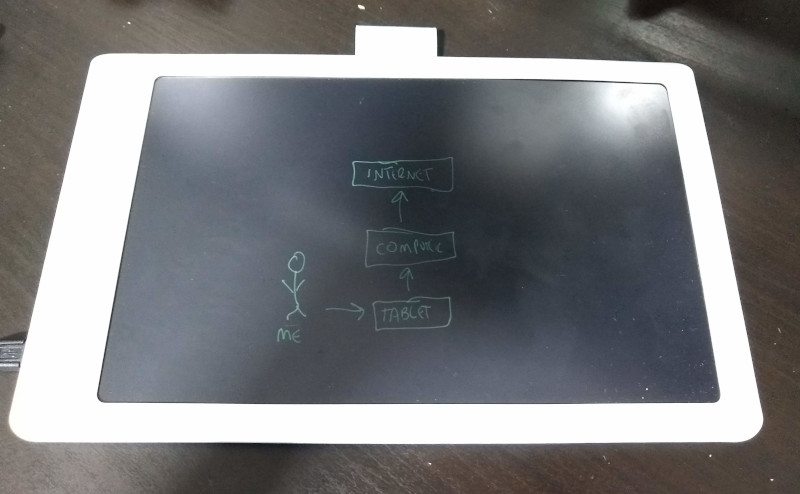
LCD Writing Tablet One of the challenges I find about being fully remote is that one of the ways I think while I explain things is I draw diagrams. I m not artistic in any manner (my brothers got that skillset), but a set of boxes and lines and some text scribbled as I talk really helps. I do think even for myself, which is obviously as easy to replicate at home as in the office; I have plenty of paper and a whiteboard in my study. It s not so easy when having a design discussion with someone remotely. Doodling with a mouse doesn t quite work; my art skills are bad enough without then factoring in the fact it s not a pen-like device I m using to do it. I ve previously tried a proper graphics tablet, but there s a disconnect between where you are writing and where the output appears. That makes doing things like labelling within a diagram, or going back to draw an update, quite difficult. Or it does if you re me anyway. The modern solution is probably a laptop with a stylus capable touchscreen, but I ve shied away from such things because I don t want fingerprints all over my screen and don t want to pay extra for something I haven t previously thought I d use. An alternative is a tablet with a stylus capable screen, but those turn out to be premium models these days (remember when resistive was the cheap option because no one wanted to use the stylus?) and mine doesn t support it. You can get capacitive styli (styluses?) but then when you lean on the tablet it all gets confused. When I m due a technology refresh of my laptop or tablet I ll perhaps factor such things in, but what to do now, when I m not entirely sure how much usage I ll get out of such a device and thus can t justify a major expense on it? Buy a random thing from the internet, of course! It turns out there are a range of LCD writing tablets out there, which let you scribble on a screen and then erase it at the press of a button. An electronic etch-a-sketch, as it were. Most of them don t count as smart , with power only needed for the erase, but there appears to have been a device called the Boogie Board Sync in the past which offered some ability to save things. Searching around I found the NEWYES 10 Bluetooth Archive Writing Tablet from BangGood. Which looked like it had enough smarts to be able to send the images over bluetooth and therefore might be hackable in some manner. At 45 it seemed a reasonable punt, so I ordered one. It arrived within 2 weeks and I was surprised to find that when plugged in as a USB device it actually presented as a tablet. So much for a hackery requirement! It was detected by the kernel fine:
kernel dmesg output
usb 1-1.2: new full-speed USB device number 19 using xhci_hcd
usb 1-1.2: New USB device found, idVendor=6161, idProduct=4d15, bcdDevice=30.00
usb 1-1.2: New USB device strings: Mfr=5, Product=6, SerialNumber=0
usb 1-1.2: Product: LetSketch
usb 1-1.2: Manufacturer: LetSketch
hid-generic 0003:6161:4D15.0010: hiddev0,hidraw4: USB HID v1.11 Device [LetSketch LetSketch] on usb-0000:00:14.0-1.2/input0
input: LetSketch LetSketch as /devices/pci0000:00/0000:00:14.0/usb1/1-1/1-1.2/1-1.2:1.1/0003:6161:4D15.0011/input/input35
hid-generic 0003:6161:4D15.0011: input,hidraw5: USB HID v1.11 Device [LetSketch LetSketch] on usb-0000:00:14.0-1.2/input1
lsusb output
Bus 001 Device 016: ID 6161:4d15  
Device Descriptor:
  bLength                18
  bDescriptorType         1
  bcdUSB               1.00
  bDeviceClass            0 
  bDeviceSubClass         0 
  bDeviceProtocol         0 
  bMaxPacketSize0        64
  idVendor           0x6161 
  idProduct          0x4d15 
  bcdDevice           30.00
  iManufacturer           5 LetSketch
  iProduct                6 LetSketch
  iSerial                 0 
  bNumConfigurations      1
  Configuration Descriptor:
    bLength                 9
    bDescriptorType         2
    wTotalLength       0x003b
    bNumInterfaces          2
    bConfigurationValue     1
    iConfiguration          0 
    bmAttributes         0xa0
      (Bus Powered)
      Remote Wakeup
    MaxPower              480mA
    Interface Descriptor:
      bLength                 9
      bDescriptorType         4
      bInterfaceNumber        0
      bAlternateSetting       0
      bNumEndpoints           1
      bInterfaceClass         3 Human Interface Device
      bInterfaceSubClass      1 Boot Interface Subclass
      bInterfaceProtocol      2 Mouse
      iInterface              0 
        HID Device Descriptor:
          bLength                 9
          bDescriptorType        33
          bcdHID               1.11
          bCountryCode            0 Not supported
          bNumDescriptors         1
          bDescriptorType        34 Report
          wDescriptorLength      18
         Report Descriptors: 
           ** UNAVAILABLE **
      Endpoint Descriptor:
        bLength                 7
        bDescriptorType         5
        bEndpointAddress     0x81  EP 1 IN
        bmAttributes            3
          Transfer Type            Interrupt
          Synch Type               None
          Usage Type               Data
        wMaxPacketSize     0x0010  1x 16 bytes
        bInterval               2
    Interface Descriptor:
      bLength                 9
      bDescriptorType         4
      bInterfaceNumber        1
      bAlternateSetting       0
      bNumEndpoints           1
      bInterfaceClass         3 Human Interface Device
      bInterfaceSubClass      1 Boot Interface Subclass
      bInterfaceProtocol      2 Mouse
      iInterface              0 
        HID Device Descriptor:
          bLength                 9
          bDescriptorType        33
          bcdHID               1.11
          bCountryCode            0 Not supported
          bNumDescriptors         1
          bDescriptorType        34 Report
          wDescriptorLength      83
         Report Descriptors: 
           ** UNAVAILABLE **
      Endpoint Descriptor:
        bLength                 7
        bDescriptorType         5
        bEndpointAddress     0x82  EP 2 IN
        bmAttributes            3
          Transfer Type            Interrupt
          Synch Type               None
          Usage Type               Data
        wMaxPacketSize     0x0010  1x 16 bytes
        bInterval               2
Device Status:     0x0003
  Self Powered
  Remote Wakeup Enabled
Nice. X wasn t happy though:
non-working Xorg log
(II) config/udev: Adding input device LetSketch LetSketch (/dev/input/event8)
(**) LetSketch LetSketch: Applying InputClass "libinput tablet catchall"
(II) Using input driver 'libinput' for 'LetSketch LetSketch'
(II) systemd-logind: got fd for /dev/input/event8 13:72 fd 34 paused 0
(**) LetSketch LetSketch: always reports core events
(**) Option "Device" "/dev/input/event8"
(**) Option "_source" "server/udev"
(II) event8  - LetSketch LetSketch: is tagged by udev as: Tablet
(EE) event8  - LetSketch LetSketch: libinput bug: missing tablet capabilities: resolution. Ignoring this device.
(II) event8  - LetSketch LetSketch: device is a tablet
(II) event8  - failed to create input device '/dev/input/event8'.
(EE) libinput: LetSketch LetSketch: Failed to create a device for /dev/input/event8
(EE) PreInit returned 2 for "LetSketch LetSketch"
(II) UnloadModule: "libinput"
I ended up digging into the libinput source to figure out what was going on here, and it turned out to be the fact there was no report of the physical size of the tablet, so no indication of what the resolution was. That s solvable with an entry in the udev hwdb for evdev devices, so I sent a patch upstream and with that applied (or just dropped into /etc/udev/hwdb.d/61-evdev-local.hwdb and then running systemd-hwdb update and replugging the device) everything looks much happier:
working Xorg log
(II) config/udev: Adding input device LetSketch LetSketch (/dev/input/event8)
(**) LetSketch LetSketch: Applying InputClass "libinput tablet catchall"
(II) Using input driver 'libinput' for 'LetSketch LetSketch'
(II) systemd-logind: got fd for /dev/input/event8 13:72 fd 86 paused 0
(**) LetSketch LetSketch: always reports core events
(**) Option "Device" "/dev/input/event8"
(**) Option "_source" "server/udev"
(II) event8  - LetSketch LetSketch: is tagged by udev as: Tablet
(II) event8  - LetSketch LetSketch: tablet 'LetSketch LetSketch' unknown to libwacom
(II) event8  - LetSketch LetSketch: device is a tablet
(II) event8  - LetSketch LetSketch: device removed
(**) Option "config_info" "udev:/sys/devices/pci0000:00/0000:00:08.1/0000:04:00.3/usb1/1-1/1-1.2/1-1.2:1.1/0003:6161:4D15.000A/input/input24/event8"
(II) XINPUT: Adding extended input device "LetSketch LetSketch" (type: TABLET, id 20)
(II) event8  - LetSketch LetSketch: is tagged by udev as: Tablet
(II) event8  - LetSketch LetSketch: tablet 'LetSketch LetSketch' unknown to libwacom
(II) event8  - LetSketch LetSketch: device is a tablet
(II) libinput: LetSketch LetSketch: needs a virtual subdevice
(**) LetSketch LetSketch Pen (0): Applying InputClass "libinput tablet catchall"
(II) Using input driver 'libinput' for 'LetSketch LetSketch Pen (0)'
(II) systemd-logind: returning pre-existing fd for /dev/input/event8 13:72
(**) LetSketch LetSketch Pen (0): always reports core events
(**) Option "Device" "/dev/input/event8"
(**) Option "_source" "_driver/libinput"
(II) libinput: LetSketch LetSketch Pen (0): is a virtual subdevice
(**) Option "config_info" "udev:/sys/devices/pci0000:00/0000:00:08.1/0000:04:00.3/usb1/1-1/1-1.2/1-1.2:1.1/0003:6161:4D15.000A/input/input24/event8"
(II) XINPUT: Adding extended input device "LetSketch LetSketch Pen (0)" (type: STYLUS, id 21)
(**) Option "AccelerationScheme" "none"
(**) LetSketch LetSketch Pen (0): (accel) selected scheme none/0
(**) LetSketch LetSketch Pen (0): (accel) acceleration factor: 2.000
(**) LetSketch LetSketch Pen (0): (accel) acceleration threshold: 4
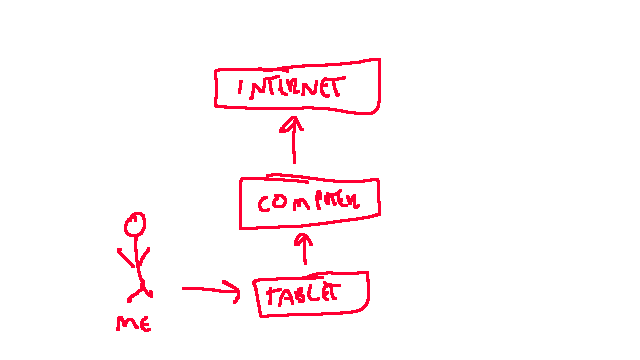
The only additional piece I ve done is tie the tablet to a single screen, so I can then full screen whichever whiteboard system I m using on that screen and have it map to the tablet - haven t worked out how to tie it to just the application window yet, but the fullscreen approach works fine, using my smaller laptop screen. To do that I use xinput list to figure out the ID of the tablet and then xinput map-to-output 23 eDP-1 to map it to the eDP-1 output (the internal laptop screen), assuming the ID that comes out of the list is 23. But is it any good? Well, the quality of the screen isn t fantastic - no fine art or anything here - but the tablet part seems fine (complete with some pressure sensitivity) and the fact I can see what I ve drawn where I m trying to draw something new makes it a lot more useful for me. I ve had a play with just screen sharing the GIMP and doodling in that, but equally work has an O365 subscription and the Microsoft Whiteboard turns out to be pretty good without anyone I m sharing with needing to install anything. Of course my artistic skills are still dreadful, but I have actually managed to use it for drawing out a couple of things while discussing them, so I m considering that a win. Saved Tablet image

27 January 2021

Russ Allbery: Review: A Deadly Education

Review: A Deadly Education, by Naomi Novik
Series: The Scholomance #1
Publisher: Del Rey
Copyright: 2020
ISBN: 0-593-12849-4
Format: Kindle
Pages: 319
Some children are born with magic, which grows as they mature. Magic attracts maleficaria: extremely deadly magical beasts that want to feast on that magic. Having innate magical ability is therefore a recipe for endless attacks from monsters and a death at a young age. This was true even for the enclaves, which are the rich, gated communities of the magical world. Hence, the Scholomance. This is a boarding school for magic users placed in the Void and protected against maleficaria as completely as possible while still letting the students graduate and leave after their senior year. Students are sent there via a teleportation spell with a weight allowance, taught magic by automated systems and magical artifacts, and left on their own to make alliances and survive. Or not survive; protected as well as possible still means that there are maleficaria everywhere, sneaking past the wards of the graduation hall and looking for snacks. The school sends cleansing fire through the halls at certain times; the rest of the time, the students either learn enough magic to defeat maleficaria themselves, form alliances with those who can, or die to feed the magic of the school. Enter Galadriel, or El as she prefers. She's not an enclave kid; she's the grumpy, misfit daughter of a hippie mother whose open-hearted devotion to healing and giving away her abilities make her the opposite of the jealously guarded power structures of the enclaves. El has no resources other than what she can muster on her own. She also has her mother's ethics, which means that although she has an innate talent for malia, drawing magic from the death of other living things, she forces herself to build her mana through rigorously ethical means. Like push-ups. Or, worse, crochet. At the start of the book, El is in her third year of four, and significantly more of her classmates are alive than normally would be. That's because of her classmate, Orion Lake, who has made a full-time hobby of saving everyone from maleficaria. His unique magical ability frees him from the constraints of mana or malia that everyone else is subject to, and he uses that to be a hero, surrounded by adoring fans. And El is thoroughly sick of it. This book is so good in so many different ways that I don't know where to start. Obviously, A Deadly Education is a twist on the boarding school novel, both the traditional and the magical kind. This is not a genre in which I'm that well-read, but even with my lack of familiarity, I noticed so many things Novik does to improve the genre tropes, starting with not making the heroic character with the special powers the protagonist. And getting rid of all the adults, which leaves way more space for rich social dynamics between the kids (complex and interesting ones that are entangled with the social dynamics outside of the school, not some simplistic Lord of the Flies take). Going alone anywhere in the school is dangerous, as is sitting at the bad tables in the cafeteria, so social cliques become a matter of literal life and death. And the students aren't just trying to survive; the ones who aren't part of enclaves are jockeying for invitations or trying to build the power to help their family and allies form their own. El is the first-person narrator of the story and she's wonderful. She's grumpy, cynical, and sarcastic, which is often good for first-person narrators, but she also has a core of ethics from her mother, and from her own decisions, that gives her so much depth. She is the type of person who knows exactly how much an ethical choice will cost her and how objectively stupid it is, and then will make it anyway out of sheer stubbornness and refuse to take credit for it. I will happily read books about characters like El until the end of time. Her mother never appears in this book, and yet she's such a strong presence because El's relationship with her matters, to both El and to the book. El could not be more unlike her mother in both personality and in magical focus, and she's exasperated by the sheer impracticality of some of her mother's ideals. And yet there's a core of love and understanding beneath that, a level at which El completely understands her mother's goals, and El relies on it even when she doesn't realize she's doing so. I don't think I've ever read a portrayal of a mother-daughter relationship this good where one of the parties isn't even present. And I haven't even gotten to the world-building, and the level to which Novik chases down and explores all the implications of this ridiculous murder machine of a school. I will offer this caveat: If you poke at the justification for creating this school in the way it was built, it's going to teeter a lot. That society thought this school was the best solution to its child mortality problem is just something you have to roll with. But once you accept that, the implications are handled so very well. The school is an inhuman character in its own right, with exasperating rules that the students learn and warn each other about. It tries to distract you with rare spellbooks or artifact materials because it's trying to kill you. The language tapes whisper horrific stories of your death. The back wall of your room is a window to the Void, from which you can demand spellbooks. You'll even get them in languages that you understand, for a generous definition of understand that may have involved glancing at one page of text, so be careful not to do that! The school replaces all of the adult teachers in the typical boarding school novel and is so much more interesting than any of them because it adds the science fiction thrill of setting as character. The world-building does mean a lot of infodumping, so be prepared for that. El likes to explain things, tell stories, and over-analyze her life, and reading this book is a bit like reading the journal of a teenage girl. For me, El's voice is so strong, authentic, stubborn, and sarcastically funny that I scarcely noticed the digressions into background material. And the relationships! Some of the turns will be predictable, since of course El's stubborn ethics will be (eventually) rewarded by the story, but the dynamic that develops between El and Orion is something special. It takes a lot to make me have sympathy with the chosen one boy hero, but Novik pulls it off without ever losing sight of the dynamics of class and privilege that are also in play. And the friendships El develops almost accidentally by being stubbornly herself are just wonderful, and the way she navigates them made me respect her even more. The one negative thing I will say about this book is that I don't think Novik quite nailed the climax. Some of this is probably because this is the first book of a series and Novik wanted to hold some social developments in reserve, but I thought El got a bit sidelined and ended up along for the ride in an action-movie sequence. Still, it's a minor quibble, and it's clear from the very end of the book that El is going to get more attention and end up in a different social position in the next book. This was a wholly engrossing and enjoyable story with a satisfying climax and only the barb of a cliffhanger in the very last line. It's the best SFF novel published in 2020 that I've read so far (yes, even better than Network Effect). Highly recommended, and I hope it gets award recognition this year. Followed by The Last Graduate (not yet published at the time of this review). Rating: 9 out of 10

26 January 2021

Thomas Lange: Making Debian available

This is the subject of an interesting thread on the debian-devel mailing list. It started with ".. The current policy of hiding other versions of Debian is limiting the adoption of your OS by people like me.." It seems that this user managed to contact us developers and give us some important information how we can improve the user experience. The following discussion shows that all our users need non-free firmware to get their wireless network cards run. Do we provide such installation images for our users? Sure. We build them regularly, host them on our servers, we also sign the hash sum with our official signing key. But we hide them very well and still call them unofficial. Why? I would like to have a more positive name for those images. Ubuntu has the HWE (Hardware Enablement) kernel. Maybe Debian firmware enablement images? We should better promote the images that fits best for our users. BTW, the URL for all these useful images is https://cdimage.debian.org/cdimage/unofficial/non-free/images-including-firmware/ Since I'm not using the Debian installer or live image often, I thought my own installation tool would already do better. In FAI , I install the package firmware-linux-nonfree if I need some nonfree firmware. But it appears that this package does not depend on any WiFi firmware package. Oops. So, I've filed a bug report #980758 and propose to add another meta package that depends on a list of firmware packages for WiFi cards. I've now added a workaround to the FAIme service. You can now generate fully automated customized installation images including nonfree firmware for the stable and testing release. The stable release images can also use a newer kernel and firmware from backports. All other package are still from stable. Another useful image variant in my opinion. Debian FAIme

Russ Allbery: Review: The City We Became

Review: The City We Became, by N.K. Jemisin
Series: The Great Cities Trilogy #1
Publisher: Orbit
Copyright: March 2020
ISBN: 0-316-50985-X
Format: Kindle
Pages: 449
At an unpredictable point after a city has accumulated enough history, character, and sense of itself, it is born as a living creature. It selects an avatar who both embodies the city and helps it be born. But in that moment of birth, a city is at its most vulnerable, and that is when the Enemy attacks. The birth of cities and the Enemy attacks have happened for millennia, so the cities that have survived the process have developed a system. The most recently born goes to assist the avatar with the birthing process and help fight off Enemy attacks. But the process has become riskier and the last two cities have failed to be born, snuffed out in natural disasters despite that support. Now, it's New York City's turn. It selects its avatar and survives the initial assault with the help of S o Paulo. But something still goes wrong, and it is severely injured in the process. Complicating matters, now there are five more avatars, one for each borough, who will have to unite to fight off the Enemy. And, for the first time, the Enemy has taken human form and is attacking with reason and manipulation and intelligence, not just force. The City We Became has a great premise: take the unique sense of place that defines a city and turn it into a literalized character in a fantasy novel. The avatars are people who retain their own lives and understanding (with one exception that I'll get to in a moment), but gain an awareness of the city they represent. They can fight and repair their city through sympathetic magic and metaphor made real. The prelude that introduces this concept (adapted from Jemisin's earlier short story "The City Born Great") got too gonzo for me, but once Jemisin settles into the main story and introduces avatars with a bit more distance from the city they represent, the premise clicked. The execution, on the other hand, I thought was strained. The biggest problem is that the premise requires an ensemble cast of five borough avatars, the primary avatar, S o Paulo, and the Enemy. That's already a lot, but for the story to work each avatar has to be firmly grounded in their own unique experience of New York, which adds family members, colleagues, and roommates. That's too much to stuff into one novel, which means characters get short shrift. For example, Padmini, the avatar of Queens, gets a great introductory scene and a beautiful bit of characterization that made her one of my favorite characters, but then all but disappears for the remainder of the book. She's in the scenes, but not in a way that matters. Brooklyn and Aislyn get moments of deep characterization, but there's so much else going on that they felt rushed. And what ever happened to Manny's roommate? The bulk of the characterization in this book goes to Broncha, the Bronx avatar, a Lenape woman and a tough-as-nails administrator of a community art museum and maker space. The dynamics between her and her co-workers, her mentorship of Veneza, and her early encounters with the Woman in White are my favorite parts of the book. I thought she and Brooklyn were a useful contrast: two very different ways of finding a base of power in the city without letting go of one's ideals. But before we get to Broncha, we first meet Manny, the Manhattan avatar. Thematically, I thought what Jemisin did here was extremely clever. Manny's past is essentially erased at the start of the book, so he's making sense of this world in the same way the reader is. It makes him a useful reader insert character and parallels the typical tourist experience of arriving in Manhattan and trying to use it to make sense of New York. He's disconnected from the rest of the city because he's the dangerous newcomer with power but not a lot of understanding, which works with my model of the political dynamics of Manhattan. Unfortunately, he's not an interesting person. I appreciated what was happening at the metaphorical layer, but Manny veers between action hero and exposition prompt, and his amnesia meant I never got enough sense of him as a character to care that much about what happened to him. I thought his confrontation with the Woman in White near the start of the book, which establishes the major villain of the book, felt clunky and forced compared to her later encounters with the other characters. The Woman in White, though, is a great villain. It's clear from earlier on that the Enemy is Lovecraftian, but the Woman in White mixes mad scientist glee, manic enthusiasm, and a child-like amusement at the weirdness of humanity into the more typical tropes of tentacles, corruption, and horrific creatures. One of my qualms about reading this book is that I'm not a horror fan and don't enjoy the mental images of unspeakable monsters, but the Woman in White puts such a fascinating spin on them that I enjoyed the scenes in which she appeared. I think the book was at its best when she was trying to psychologically manipulate the characters or attack them with corrupted but pre-existing power structures. I was less interested when it turned into an action-movie fight against animated monsters. The other place Jemisin caught me by surprise is too much of a spoiler to describe in detail (and skip the next paragraph in its entirety if you want to avoid all spoilers): Jemisin didn't take the moral conflict of the book in the direction I was expecting. This book is more interested in supporting the people who are already acting ethically than in redeeming people who make bad choices. That produces a deus ex machina ending that's a bit abrupt, but I appreciated the ethical stance. Overall, I thought the premise was great but the execution was unsteady and a bit overstuffed. There are some great characters and some great scenes, but to me they felt disjointed and occasionally rushed. You also need to enjoy characters taking deep pride in the feel of a specific place and advocating for it with the vigor of a sports rivalry, along with loving descriptions of metaphors turned into magical waves of force. But, if you can roll with that, there are moments of real awe. Jemisin captured for me the joy that comes from a deeply grounded sense of connection to a place. Recommended, albeit with caveats, if you're in the mood for reading about people who love the city they live in. This is the first book of a planned trilogy and doesn't resolve the main conflict, but it reaches a satisfying conclusion. The title of the next book has not yet been announced at the time of this review. Rating: 7 out of 10

25 January 2021

Martin-Éric Racine: Help needed: clean up and submit KMS driver for Geode LX to LKML

Ever since X.org switched to rootless operation, the days of the Geode X.org driver have been numbered. The old codebase dates back from Geode's early days at Cyrix, was then updated by NSC to add support for their new GX2 architecture, from which AMD dropped GX1 support and added support for their new LX architecture. To put it mildly, that codebase is a serious mess. However, at least the LX code comes with plenty of niceties, such as being able to detect when it runs on an OLPC XO-1 and to probe DCC pins to determine the optimal display resolution on other hardware. This still doesn't make the codebase cruft-free. Anyhow, most Linux distributions have dropped support for anything older than i686 with PAE, which essentially means that the GX2 code is just for show. Debian is one of very few distributions whose x86-32 port still ships with i686 without PAE. In fact, the lowest common denominator kernel on i386 is configured for Geode (LX). A while back, someone had started working on a KMS driver for the Geode LX. Through word of mouth, I got my hands on a copy of their Git tree. The driver worked reasonably well, but the codebase needs some polishing before it could be included in the Linux kernel tree. Hence this call for help: Is there anyone with good experience of the LKML coding standards who would be willing to clean up the driver's code and submit the patch to the LKML?

Russ Allbery: Review: Laziness Does Not Exist

Review: Laziness Does Not Exist, by Devon Price
Publisher: Atria Books
Copyright: January 2021
ISBN: 1-9821-4013-5
Format: Kindle
Pages: 216
The premise of Laziness Does Not Exist is in the title: Laziness as a moral failing does not exist. It is a misunderstanding of other problems with physical or psychological causes, a belief system that is used to extract unsustainable amounts of labor, an excuse to withdraw our empathy, and a justification for not solving social problems. Price refers to this as the Laziness Lie, which they define with three main tenets:
  1. Your worth is your productivity.
  2. You cannot trust your own feelings and limits.
  3. There is always more you could be doing.
This book (an expansion of a Medium article) makes the case against all three tenets using the author's own burnout-caused health problems as the starting argument. They then apply that analysis to work, achievements, information overload, relationships, and social pressure. In each case, Price's argument is to prioritize comfort and relaxation, listen to your body and your limits, and learn who you are rather than who the Laziness Lie is trying to push you to be. The reader reaction to a book like this will depend on where the reader is in thinking about the problem. That makes reviewing a challenge, since it's hard to simulate a reader with a different perspective. For myself, I found the content unobjectionable, but largely repetitive of other things I've read. The section on relationships in particular will be very familiar to Captain Awkward readers, just not as pointed. Similarly, the chapter on information overload is ground already covered by Digital Minimalism, among other books. That doesn't make this a bad book, but it's more of a survey, so if you're already well-read on this topic you may not get much out of it. The core assertion is aggressive in part to get the reader to argue with it and thus pay attention, but I still came away convinced that laziness is not a useful word. The symptoms that cause us to call ourselves lazy procrastination, burnout, depression, or executive function problems, for example are better understood without the weight of moral reproach that laziness carries. I do think there is another meaning of laziness that Price doesn't cover, since they are aiming this book exclusively at people who are feeling guilty about possibly being lazy, and we need some term for people who use their social power to get other people to do all their work for them. But given how much the concept of laziness is used to attack and belittle the hard-working or exhausted, I'm happy to replace "laziness" with "exploitation" when talking about that behavior. This is a profoundly kind and gentle book. Price's goal is to help people be less hard on themselves and to take opportunities to relax without guilt. But that also means that it stays in the frame of psychological analysis and self-help, and only rarely strays into political or economic commentary. That means it's more useful for taking apart internalized social programming, but less useful for thinking about the broader political motives of those who try to convince us to work endlessly and treat all problems as personal responsibilities rather than political failures. For that, I think Anne Helen Peterson's Can't Even is the more effective book. Price also doesn't delve much into history, and I now want to read a book on the origin of a work ethic as a defining moral trait. One truly lovely thing about this book is that it's quietly comfortable with human variety of gender and sexuality in a way that's never belabored but that's obvious from the examples that Price uses. Laziness Does Not Exist felt more inclusive in that way, and to some extent on economic class, than Can't Even. I was in the mood for a book that takes apart the political, social, and economic motivations behind convincing people that they have to constantly strive to not be lazy, so the survey nature of this book and its focus on self-help made it not the book for me. It also felt a bit repetitive despite its slim length, and the chapter structure didn't click for me. But it's not a bad book, and I suspect it will be the book that someone else needs to read. Rating: 6 out of 10

Iustin Pop: Raspbian/Raspberry PI OS with initrd

Background While Raspbian, ahem, Raspberry PI OS is mostly Debian, the biggest difference is the kernel, both in terms of code and packaging. The packaging is weird since it needs to deal with the fact that there s no bootloader per se, the firmware parses /boot/config.txt and depending on the setting of 64bit and/or kernel line, it loads a specific file. Normally, one of kernel7.img, kernel7l.img or kernel8.img. While this configuration file supports an initrd, it doesn t have a clean way to associate an initrd with a kernel, but rather you have to (like for the actual kernel) settle on a hard-coded initrd name. Due to this, the normal way of using an initrd doesn t work, and one has to do two things:
  • enable building initrd s at all
  • settle on the naming for the initrd
  • ensure the initrd is updated correctly
There are quite a few of forum threads about this, but there s no official support for this. The best link I found was this Stack Exchange post, which goes most of the way, but fails at the third point above.

My trivial solution Instead of naming tricks the above post suggests, I settled on having a fixed name. It risks boot failure when the kernel architecture will change, which could be worked around with hard-coded kernel too, but I haven t done that yet. First, enable initrd creation/update in /etc/default/raspberrypi-kernel, like the post says. Uncomment INITRD=yes, but not the RPI_INITRD. This will enable creating/updating the initrd when the kernel package is installed and/or other packages trigger it via hooks. Second, naming: choose an initrd name. I have simply this in my config.txt:
initramfs initrd.img followkernel
So the value is fully hard-coded, and the actual work is done in the next part. Last, add an initramfs-hook in (e.g.) /etc/initramfs/post-update.d/rpi-initrd. Note that, by default (unless other packages have created it), the /etc/initramfs directory doesn t exist. It s not the confusingly-named /etc/initramfs-tools/ directory, which is related to building the initrd, but rather to doing things with the (already built) initrd. This directory is briefly explain in the Debian kernel-handbook guide. This is my contents:
#!/bin/bash

ABI="$1"
INITRD="$2"
BOOTDIR="$(dirname "$INITRD")"

# Note: the match below _must_ be synced with the boot kernel
if [[ "$ABI" == *-v8+ ]]; then
        echo "Building v8l+ image, updating top initrd"
        cp -p "$INITRD" "$BOOTDIR/initrd.img"
fi
This script seems to me much simpler, so in principle less chance of bugs, than all the renaming and editing config.txt I saw in that stack exchange post. As far as I know, all one needs to care about is to sync the ABI passed to this hook with the kernel one is running, and since there is only one kernel version installed at a time on Raspbian (as there s no versioning in the kernel names), this should work correctly. With this hook, the update also works correctly when packages trigger initrd updates, not only when new kernels are installed. Note that the cp there is needed since the book partition is FAT, so no symbolic links/hard links allowed. Happy initrd ing!

24 January 2021

Enrico Zini: Miscellaneous news links

Some curious news. Here's a scam that targets terrorists: The Doomsday Scam. On the general topic of scams, a List of confidence tricks. Then two news involving bread: And a last one about how people needed to rename human genes to work around Excel bugsfeatures:

22 January 2021

Robert McQueen: Launching Endless OS Foundation

Passion Led Us Here

How our for-profit company became a nonprofit, to better tackle the digital divide. Originally posted on the Endless OS Foundation blog.

An 8-year journey to a nonprofit On the 1st of April 2020, our for-profit Endless Mobile officially became a nonprofit as the Endless OS Foundation. Our launch as a nonprofit just as the global pandemic took hold was, predictably, hardly noticed, but for us the timing was incredible: as the world collectively asked What can we do to help others in need? , we framed our mission statement and launched our .org with the same very important question in mind. Endless always had a social impact mission at its heart, and the challenges related to students, families, and communities falling further into the digital divide during COVID-19 brought new urgency and purpose to our team s decision to officially step in the social welfare space.
On April 1st 2020, our for-profit Endless Mobile officially became a nonprofit as the Endless OS Foundation, focused on the #DigitalDivide.
Our updated status was a long time coming: we began our transformation to a nonprofit organization in late 2019 with the realization that the true charter and passions of our team would be greatly accelerated without the constraints of for-profit goals, investors and sales strategies standing in the way of our mission of digital access and equity for all. But for 8 years we made a go of it commercially, headquartered in Silicon Valley and framing ourselves as a tech startup with access to the venture capital and partnerships on our doorstep. We believed that a successful commercial channel would be the most efficient way to scale the impact of bringing computer devices and access to communities in need. We still believe this we ve just learned through our experience that we don t have the funding to enter the computer and OS marketplace head-on. With the social impact goal first, and the hope of any revenue a secondary goal, we have had many successes in those 8 years bridging the digital divide throughout the world, from Brazil, to Kenya, and the USA. We ve learned a huge amount which will go on to inform our strategy as a nonprofit.
Endless always had a social impact mission at its heart. COVID-19 brought new urgency and purpose to our team s decision to officially step in the social welfare space.
Our unique perspective One thing we learned as a for-profit is that the OS and technology we ve built has some unique properties which are hugely impactful as a working solution to digital equity barriers. And our experience deploying in the field around the world for 8 years has left us uniquely informed via many iterations and incremental improvements.
Endless OS designer in discussion with prospective user
With this knowledge in-hand, we ve been refining our strategy throughout 2020 and now starting to focus on what it really means to become an effective nonprofit and make that impact. In many ways it is liberating to abandon the goals and constraints of being a for-profit entity, and in other ways it s been a challenging journey for me and the team to adjust our way of thinking and let these for-profit notions and models go. Previously we exclusively built and sold a product that defined our success; and any impact we achieved was a secondary consequence of that success and seen through that lens. Now our success is defined purely in terms of social impact, and through our actions, those positive impacts can be made with or without our product . That means that we may develop and introduce technology to solve a problem, but it is equally as valid to find another organization s existing offering and design a way to increase that positive impact and scale.
We develop technology to solve access equity issues, but it s equally as valid to find another organization s offering and partner in a way that increases their positive impact.
The analogy to Free and Open Source Software is very strong while Endless has always used and contributed to a wide variety of FOSS projects, we ve also had a tension where we ve been trying to hold some pieces back and capture value such as our own application or content ecosystem, our own hardware platform necessarily making us competitors to other organisations even though they were hoping to achieve the same things as us. As a nonprofit we can let these ideas go and just pick the best partners and technologies to help the people we re trying to reach.
School kids writing on paper
Digital equity 4 barriers we need to overcome In future, our decisions around which projects to build or engage with will revolve around 4 barriers to digital equity, and how our Endless OS, Endless projects, or our partners offerings can help to solve them. We define these 4 equity barriers as: barriers to devices, barriers to connectivity, barriers to literacy in terms of your ability to use the technology, and barriers to engagement in terms of whether using the system is rewarding and worthwhile.
We define the 4 digital equity barriers we exist to impact as:
1. barriers to devices
2. barriers to connectivity
3. barriers to literacy
4. barriers to engagement
It doesn t matter who makes the solutions that break these barriers; what matters is how we assist in enabling people to use technology to gain access to the education and opportunities these barriers block. Our goal therefore is to simply ensure that solutions exist building them ourselves and with partners such as the FOSS community and other nonprofits proving them with real-world deployments, and sharing our results as widely as possible to allow for better adoption globally. If we define our goal purely in terms of whether people are using Endless OS, we are effectively restricting the reach and scale of our solutions to the audience we can reach directly with Endless OS downloads, installs and propagation. Conversely, partnerships that scale impact are a win-win-win for us, our partners, and the communities we all serve. Engineering impact Our Endless engineering roots and capabilities feed our unique ability to build and deploy all of our solutions, and the practical experience of deploying them gives us evidence and credibility as we advocate for their use. Either activity would be weaker without the other.
Our engineering roots and capabilities feed our unique ability to build and deploy digital divide solutions.
Our partners in various engineering communities will have already seen our change in approach. Particularly, with GNOME we are working hard to invest in upstream and reconcile the long-standing differences between our experience and GNOME. If successful, many more people can benefit from our work than just users of Endless OS. We re working with Learning Equality on Kolibri to build a better app experience for Linux desktop users and bring content publishers into our ecosystem for the first time, and we ve also taken our very own Hack, the immersive and fun destination for kids learning to code, released it for non-Endless systems on Flathub, and made it fully open-source.
Planning tasks with sticky notes on a whiteboard
What s next for our OS? What then is in store for the future of Endless OS, the place where we have invested so much time and planning through years of iterations? For the immediate future, we need the capacity to deploy everything we ve built all at once, to our partners. We built an OS that we feel is very unique and valuable, containing a number of world-firsts: first production OS shipped with OSTree, first Flatpak-only desktop, built-in support for updating OS and apps from USBs, while still providing a great deal of reliability and convenience for deployments in offline and educational-safe environments with great apps and content loaded on every system. However, we need to find a way to deliver this Linux-based experience in a more efficient way, and we d love to talk if you have ideas about how we can do this, perhaps as partners. Can the idea of Endless OS evolve to become a spec that is provided by different platforms in the future, maybe remixes of Debian, Fedora, openSUSE or Ubuntu? Build, Validate, Advocate Beyond the OS, the Endless OS Foundation has identified multiple programs to help underserved communities, and in each case we are adopting our build, validate, advocate strategy. This approach underpins all of our projects: can we build the technology (or assist in the making), will a community in-need validate it by adoption, and can we inspire others by telling the story and advocating for its wider use?
We are adopting a build, validate, advocate strategy.
1. build the technology (or assist in the making)
2. validate by community adoption
3. advocate for its wider use
As examples, we have just launched the Endless Key (link) as an offline solution for students during the COVID-19 at-home distance learning challenges. This project is also establishing a first-ever partnership of well-known online educational brands to reach an underserved offline audience with valuable learning resources. We are developing a pay-as-you-go platform and new partnerships that will allow families to own laptops via micro-payments that are built directly into the operating system, even if they cannot qualify for standard retail financing. And during the pandemic, we ve partnered with Teach For America to focus on very practical digital equity needs in the USA s urban and rural communities. One part of the world-wide digital divide solution We are one solution provider for the complex matrix of issues known collectively as the #DigitalDivide, and these issues will not disappear after the pandemic. Digital equity was an issue long before COVID-19, and we are not so naive to think it can be solved by any single institution, or by the time the pandemic recedes. It will take time and a coalition of partnerships to win. We are in for the long-haul and we are always looking for partners, especially now as we are finding our feet in the nonprofit world. We d love to hear from you, so please feel free to reach out to me I m ramcq on IRC, RocketChat, Twitter, LinkedIn or rob@endlessos.org.

Enrico Zini: Exploring nspawn for CIs

This post is part of a series about trying to setup a gitlab runner based on systemd-nspawn. I published the polished result as nspawn-runner on GitHub. Here I try to figure out possible ways of invoking nspawn for the prepare, run, and cleanup steps of gitlab custom runners. The results might be useful invocations beyond Gitlab's scope of application. I begin with a chroot which will be the base for our build environments:
debootstrap --variant=minbase --include=git,build-essential buster workdir
Fully ephemeral nspawn This would be fantastic: set up a reusable chroot, mount readonly, run the CI in a working directory mounted on tmpfs. It sets up quickly, it cleans up after itself, and it would make prepare and cleanup noops:
mkdir workdir/var/lib/gitlab-runner
systemd-nspawn --read-only --directory workdir --tmpfs /var/lib/gitlab-runner "$@"
However, run gets run multiple times, so I need the side effects of run to persist inside the chroot between runs. Also, if the CI uses a large amount of disk space, tmpfs may get into trouble. nspawn with overlay Federico used --overlay to keep the base chroot readonly while allowing persistent writes on a temporary directory on the filesystem. Note that using --overlay requires systemd and systemd-container from buster-backports because of systemd bug #3847. Example:
mkdir -p tmp-overlay
systemd-nspawn --quiet -D workdir \
  --overlay=" pwd /workdir: pwd /tmp-overlay:/"
I can run this twice, and changes in the file system will persist between systemd-nspawn executions. Great! However, any process will be killed at the end of each execution. machinectl I can give a name to systemd-nspawn invocations using --machine, and it allows me to run multiple commands during the machine lifespan using machinectl and systemd-run. In theory machinectl can also fully manage chroots and disk images in /var/lib/machines, but I haven't found a way with machinectl to start multiple machines sharing the same underlying chroot. It's ok, though: I managed to do that with systemd-nspawn invocations. I can use the --machine=name argument to systemd-nspawn to make it visible to machinectl. I can use the --boot argument to systemd-nspawn to start enough infrastructure inside the container to allow machinectl to interact with it. This gives me any number of persistent and named running systems, that share the same underlying chroot, and can cleanup after themselves. I can run commands in any of those systems as I like, and their side effects persist until a system is stopped. The chroot needs systemd and dbus for machinectl to be able to interact with it:
debootstrap --variant=minbase --include=git,systemd,systemd,build-essential buster workdir
Let's boot the machine:
mkdir -p overlay
systemd-nspawn --quiet -D workdir \
    --overlay=" pwd /workdir: pwd /overlay:/"
    --machine=test --boot
Let's try machinectl:
# machinectl list
MACHINE CLASS     SERVICE        OS     VERSION ADDRESSES
test    container systemd-nspawn debian 10      -
1 machines listed.
# machinectl shell --quiet test /bin/ls -la /
total 60
[ ]
To run commands, rather than machinectl shell, I need to use systemd-run --wait --pipe --machine=name, otherwise machined won't forward the exit code. The result however is pretty good, with working stdin/stdout/stderr redirection and forwarded exit code. Good, I'm getting somewhere. The terminal where I ran systemd-nspawn is currently showing a nice getty for the booted system, which is cute, and not what I want for the setup process of a CI. Spawning machines without needing a terminal machinectl uses /lib/systemd/system/systemd-nspawn@.service to start machines. I suppose there's limited magic in there: start systemd-nspawn as a service, use --machine to give it a name, and machinectl manages it as if it started it itself. What if, instead of installing a unit file for each CI run, I try to do the same thing with systemd-run?
systemd-run \
  -p 'KillMode=mixed' \
  -p 'Type=notify' \
  -p 'RestartForceExitStatus=133' \
  -p 'SuccessExitStatus=133' \
  -p 'Slice=machine.slice' \
  -p 'Delegate=yes' \
  -p 'TasksMax=16384' \
  -p 'WatchdogSec=3min' \
  systemd-nspawn --quiet -D  pwd /workdir \
    --overlay=" pwd /workdir: pwd /overlay:/"
    --machine=test --boot
It works! I can interact with it using machinectl, and fine tune DevicePolicy as needed to lock CI machines down. This setup has a race condition where if I try to run a command inside the machine in the short time window before the machine has finished booting, it fails:
# systemd-run [ ] systemd-nspawn [ ] ; machinectl --quiet shell test /bin/ls -la /
Failed to get shell PTY: Protocol error
# machinectl shell test /bin/ls -la /
Connected to machine test. Press ^] three times within 1s to exit session.
total 60
[ ]
systemd-nspawn has the option --notify-ready=yes that solves exactly this problem:
# systemd-run [ ] systemd-nspawn [ ] --notify-ready=yes ; machinectl --quiet shell test /bin/ls -la /
Running as unit: run-r5a405754f3b740158b3d9dd5e14ff611.service
total 60
[ ]
On nspawn's side, I should now have all I need. Next steps My next step will be wrapping it all together in a gitlab runner.

21 January 2021

Russell Coker: Links January 2021

Krebs on Security has an informative article about web notifications and how they are being used for spamming and promoting malware [1]. He also includes links for how to permanently disable them. If nothing else clicking no on each new site that wants to send notifications is annoying. Michael Stapelberg wrote an insightful posts about inefficiencies in the Debian development processes [2]. While I agree with most of his assessment of Debian issues I am not going to decrease my involvement in Debian. Of the issues he mentions the 2 that seem to have the best effort to reward ratio are improvements to mailing list archives (to ideally make it practical to post to lists without subscribing and read responses in the archives) and the issues of forgetting all the complexities of the development process which can be alleviated by better Wiki pages. In my Debian work I ve contributed more to the Wiki in recent times but not nearly as much as I should. Jacobin has an insightful article Ending Poverty in the United States Would Actually Be Pretty Easy [3]. Mark Brown wrote an interesting blog post about the Rust programming language [4]. He links to a couple of longer blog posts about it. Rust has some great features and I ve been meaning to learn it. Scientific America has an informative article about research on the spread of fake news and memes [5]. Something to consider when using social media. Bruce Schneier wrote an insightful blog post on whether there should be limits on persuasive technology [6]. Jonathan Dowland wrote an interesting blog post about git rebasing and lab books [7]. I think it s an interesting thought experiment to compare the process of developing code worthy of being committed to a master branch of a VCS to the process of developing a Ph.D thesis. CBS has a disturbing article about the effect of Covid19 on people s lungs [8]. Apparently it usually does more lung damage than long-term smoking and even 70%+ of people who don t have symptoms of the disease get significant lung damage. People who live in heavily affected countries like the US now have to worry that they might have had the disease and got lung damage without knowing it. Russ Allbery wrote an interesting review of the book Because Internet about modern linguistics [9]. The topic is interesting and I might read that book at some future time (I have many good books I want to read). Jonathan Carter wrote an interesting blog post about CentOS Streams and why using a totally free OS like Debian is going to be a better option for most users [10]. Linus has slammed Intel for using ECC support as a way of segmenting the market between server and desktop to maximise profits [11]. It would be nice if a company made a line of Ryzen systems with ECC RAM support, but most manufacturers seem to be in on the market segmentation scam. Russ Allbery wrote an interesting review of the book Can t Even about millenials as the burnout generation and the blame that the corporate culture deserves for this [12].

20 January 2021

Raphaël Hertzog: Freexian s report about Debian Long Term Support, December 2020

A Debian LTS logo Like each month, have a look at the work funded by Freexian s Debian LTS offering. Debian project funding In December, we put aside 2100 EUR to fund Debian projects. The first project proposal (a tracker.debian.org improvement for the security team) was received and quickly approved by the paid contributors, then we opened a request for bids and the bid winner was announced today (it was easy, we had only one candidate). Hopefully this first project will be completed until our next report. We re looking forward to receive more projects from various Debian teams! Learn more about the rationale behind this initiative in this article. Debian LTS contributors In December, 12 contributors have been paid to work on Debian LTS, their reports are available: Evolution of the situation December was a quiet month as we didn t have a team meeting nor any other unusual activity and we released 43 DLAs. The security tracker currently lists 30 packages with a known CVE and the dla-needed.txt file has 25 packages needing an update. This month we are pleased to welcome Deveryware as new sponsor! Thanks to our sponsors Sponsors that joined recently are in bold.

19 January 2021

John Goerzen: Roundup of Secure Messengers with Off-The-Grid Capabilities (Distributed/Mesh Messengers)

Amid all the conversation about Signal, and the debate over decentralization, one thing has often not been raised: all of these things require an Internet connection. Of course, you might say. Internet is everywhere these days. Well, not so much, and it turns out there are some very good reasons that people might want messengers that work offline. Here are some examples: How do they work? These all use some form of local radio signal. Some, such as Briar, may use short-range Bluetooth and Wifi, while others use radios such as LoRa that can reach several miles with low power. I ve written quite a bit about LoRa before, and its unique low-speed but extreme-distance radio capabilities even on low power. One common thread through these is that most of them are Android-only, though many are compatible with F-Droid and privacy-enhanced Android distributions. Every item on this list uses full end-to-end encryption (E2EE). Let s dive on in. Briar Of all the options mentioned here, Briar is the one that bridges the traditional Internet-based approach with alternative options the best. It offers three ways for distributing data: As far as I can tell, there is no centralized server in Briar at all. Your account , such as it is, lives entirely within your device; if you wipe your device, you will have to make a new account and re-establish contacts. The use of Tor is also neat to see; it ensures that an adversary can t tell, just from that, that you re using Briar at all, though of course timing analysis may still be possible (and Bluetooth and Wifi uses may reval some of who is communicating). Briar features several types of messages (detailed in the manual), which really are just different spins on communication, which they liken to metaphors people are familiar with: By default, Briar raises an audible notification for incoming messages of all types. This is configurable for each type. Blogs have a way to reblog (even a built-in RSS reader to facilitate that), but framed a different way, they are broadcast messages. They could, for instance, be useful for a send help message to everyone (assuming that people haven t all shut off notifications of blogs due to others using them different ways). Briar s how it works page has an illustration specifically of how blogs are distributed. I m unclear on some of the details, and to what extent this applies to other kinds of messages, but one thing that you can notice from this is that a person A could write a broadcast message without Internet access, person B could receive it via Bluetooth or whatever, and then when person B gets Internet access again, the post could be distributed more widely. However, it doesn t appear that Briar is really a full mesh, since only known contacts in the distribution path for the message would repeat it. There are some downsides to Briar. One is that, since an account is fully localized to a device, one must have a separate account for each device. That can lead to contacts having to pick a specific device to send a message to. There is an online indicator, which may help, but it s definitely not the kind of seamless experience you get from Internet-only messengers. Also, it doesn t support migrating to a new phone, live voice/video calls, or attachments, but attachments are in the works. All in all, a solid communicator, and is the only one on this list that works 100% with the hardware everyone already has. While Bluetooth and Wifi have far more limited range than the other entries, there is undeniably convenience in not needing any additional hardware, and it may be particularly helpful when extra bags/pockets aren t available. Also, Briar is fully Open Source. Meshtastic Meshtastic is a radio-first LoRa mesh project. What do I mean by radio-first? Well, basically cell phones are how you interact with Meshtastic, but they are optional. The hardware costs about $30 and the batteries last about 8 days. Range between nodes is a few miles in typical conditions (up to 11km / 7mi in ideal conditions), but nodes act as repeaters, so it is quite conceivable to just drop a node in the middle if you and contacts will be far apart. The project estimates that around 2000 nodes are in operation, and the network is stronger the more nodes are around. The getting started site describes how to build one. Most Meshtastic device builds have a screen and some buttons. They can be used independently from the Android app to display received messages, distance and bearing to other devices (assuming both have a GPS enabled), etc. This video is an introduction showing it off, this one goes over the hardware buttons. So even if your phone is dead, you can at least know where your friends are. Incidentally, the phone links up to the radio board using Bluetooth, and can provide a location source if you didn t include one in your build. There are ideas about solar power for Meshtastic devices, too. Meshtastic doesn t, as far as I know, have an option for routing communication over the Internet, but the devices appear to be very thoughtfully-engineered and easy enough to put together. This one is definitely on my list to try. Ripple-based devices This is based on the LoRa Mesh Radio Instructables project, and is similar in concept to Meshtastic. It uses similar hardware, a similar app, but also has an option with a QWERTY hardware keyboard available, for those that want completely phone-free operation while still being able to send messages. There are a number of related projects posted at Instructables: a GPS tracker, some sensors, etc. These are variations on the same basic concept. These use the Ripple firmware, which is not open source, so I haven t pursued it further. GoTenna For people that want less of a DIY model, and don t mind proprietary solutions, there are two I ll mention. The first is GoTenna Mesh, which is LoRa-based and sells units for $90 each. However, there are significant community concerns about the longevity of the project, as GoTenna has re-focused on government and corporate work. The Android app hasn t been updated in 6 monnths despite a number of reviews citing issues, and the iOS app is also crusty. Beartooth Even more expensive at $125 each is the Beartooth. Also a proprietary option, I haven t looked into it more, but they are specifically targetting backwoods types of markets. Do not use: Bridgefy Bridgefy was briefly prominent since it was used during the Hong Kong protests. However, numerous vulnerabilities have been demonstrated, and the developers have said they are re-working the app to address them. I wouldn t recommend it for now. Alternatives: GMRS handhelds In the USA, GMRS voice handhelds are widely available. Although a license is required, it is simple (no exam) and cheap ($35) and extends to a whole family. GMRS radios also interoperate with FRS radios, which require no license and share some frequencies, but are limited to lower power (though are often sufficient). Handheld GMRS radios that use up to 5W of power are readily available. A voice signal is a lot harder to carry for a long distance than a very low-bandwidth digital one, so even with much more power you will probably not get the same kind of range you will with something like Meshtastic, and they don t come with any kind of security or encryption at all. However, for basic communication, they are often a useful tool.

Russ Allbery: Review: The Secret Barrister

Review: The Secret Barrister, by The Secret Barrister
Publisher: Picador
Copyright: 2018
Printing: 2019
ISBN: 1-5098-4115-6
Format: Kindle
Pages: 344
The Secret Barrister is a survey and critique of the criminal legal system of England and Wales. The author is an anonymous barrister who writes a legal blog of the same name (which I have not read). A brief and simplified primer for those who, like me, are familiar with the US legal system but not the English one: A barrister is a lawyer who argues cases in court, as distinct from a solicitor who does all the other legal work (and may make limited court appearances). If you need criminal legal help in England and Wales, you hire a solicitor, and they are your primary source of legal advise. If your case goes to court, your solicitor will generally (not always) refer the work of arguing your case before a judge and jury to a barrister and "instruct" them in the details of your argument. The job of the barrister is then to handle the courtroom trial, offer trial-specific legal advice, and translate your defense (or the crown's prosecution) into persuasive courtroom arguments. Unlike the United States, with its extremely sharp distinction between prosecutors and criminal defense attorneys, criminal barristers in England and Wales argue both prosecutions and defenses depending on who hires them. (That said, the impression I got from this book is that the creation of the Crown Prosecution Service is moving England closer to the US model and more prosecutions are now handled by barristers employed directly by the CPS, whom I assume do not take defense cases.) Barristers follow the cab-rank rule, which means that, like a taxicab, they are professionally obligated to represent people on a first-come, first-serve basis and are not allowed to pick and choose clients. (Throughout, I'm referencing the legal system of England and Wales because the author restricts his comments to it. Presumably this is because the Scottish and Northern Irish? legal systems are different yet again in ways I do not know.) If details like this sound surprising, you can see the appeal of this book to me. It's easy, in the US, to have a vast ignorance about the legal systems of other countries or even the possibility of different systems, which makes it hard to see how our system could be improved. I had a superficial assumption that since US law started as English common law, the US and English legal systems would be substantially similar. And they are to an extent; they're both adversarial rather than inquisitorial, for example (more on that in a moment). But the current system of criminal prosecution evolved long after US independence and thus evolved differently despite similar legal foundations. Those differences are helpful for this American to ponder the road not taken and the impact of our respective choices. That said, explaining the criminal legal system to Americans isn't the author's purpose. The first fifty pages are that beginner's overview, since apparently even folks who live in England are confused by the ubiquity of US legal dramas (not that those are very accurate representations of the US legal system either). The rest of the book, and its primary purpose, is an examination of the system's failings, starting with the magistrates' courts (which often use lay judges and try what in the US would be called misdemeanors, although as discussed in this book their scope is expanding). Other topics include problems with bail, how prosecution is structured, how victims and witnesses are handled, legal aid, sentencing, and the absurd inadequacy of compensation for erroneous convictions. The most useful part of this book for me, apart from the legal system introduction, was the two chapters the author spends arguing first for and then against replacing an adversarial system with an inquisitorial system (the French criminal justice system, for example). When one is as depressed about the state of one's justice system as both I and the author are, something radically different sounds appealing. The author first makes a solid case for the inquisitorial system and then tries to demolish it, still favoring the adversarial system, and I liked that argument construction. The argument in favor of an adversarial system is solid and convincing, but it's also depressing. It's the argument of someone who has seen the corruption, sloppiness, and political motivations in an adversarial system and fears what would happen if they were able to run rampant under a fig leaf of disinterested objectivity. I can't disagree, particularly when starting from an adversarial system, but this argument feels profoundly cynical. It reminds me of the libertarian argument for capitalism: humans are irredeemably awful, greed and self-interest are the only reliable or universal human motives, and therefore the only economic system that can work is one based on and built to harness greed, because expecting any positive characteristics from humans collectively is hopelessly naive. The author of this book is not quite that negative in their argument for an adversarial system, but it's essentially the same reasoning: the only way a system can be vaguely honest is if it's constantly questioned and attacked. It can never be trusted to be objective on its own terms. I wish the author had spent more time on the obvious counter-argument: when the system is designed for adversarial combat, it normalizes and even valorizes every dirty tactic that might result in a victory. The system reinforces our worst impulses, not to mention grinding up and destroying people who cannot afford their own dirty tricks. The author proposes several explanations for the problems they see in the criminal legal system, including "tough on crime" nonsense from politicians that sounds familiar to this American reader. Most problems, though, they trace back to lack of funding: of the police, of the courts, of the prosecutors, and of legal aid. I don't know enough about English politics to have an independent opinion on this argument, but the stories of outsourcing to the lowest bidder, overworked civil servants, ridiculously low compensation rates, flawed metrics like conviction rates, and headline-driven political posturing that doesn't extend to investing in necessary infrastructure like better case-tracking systems sounds depressingly familiar. This is one of those books where I appreciated the content but not the writing. It's not horrible, but the sentences are ponderous and strained and the author is a bit too fond of two-dollar words. They also have a dramatic and self-deprecating way of describing their own work that I suspect they thought was funny but that I found grating. By the end of this book, I was irritated enough that I can't recommend it. But the content was interesting, even the critique of a political system that isn't mine, and it prompted some new thoughts on the difficulties of creating a fair justice system. If you can deal with the author's writing style, you may also enjoy it. Rating: 6 out of 10

Next.

Previous.