Search Results: "he"

12 May 2023

Holger Levsen: 20230512-Debian-Reunion-Hamburg-2023

Small reminder for the Debian Reunion Hamburg 2023 from May 23 to 30 As in previous years there will be a rather small Debian Reunion Hamburg 2023 event taking place from May 23rd until the 30th (with the 29th being a public holiday in Germany and elsewhere). We'll have days of hacking (inside and outside), a day trip and a small cheese & wine party, as well as daily standup meetings to learn what others are doing, and there shall also be talks and workshops. At the moment there are even still some beds on site available and the CfP is still open! For more information on all of this: please check the above wiki page! May the force be with you.

Dirk Eddelbuettel: crc32c 0.0.2 on CRAN: Build Fixes

A first follow-up to the initial announcement just days ago of the new crc32c package. The package offers cyclical checksum with parity in hardware-accelerated form on (recent enough) intel cpus as well as on arm64. This follow-up was needed because I missed, when switching to a default static library build, that newest compilers would complain if -fPIC was not set. gcc-12 on my box was happy, gcc-13 on recent Fedora as used at CRAN was not. A second error was assuming that saying SystemRequirements: cmake would suffice. But hold on whippersnapper: macOS always has a surprise for you! As described at the end of the appropriate section in Writing R Extensions, on that OS you have to go the basement, open four cupboards, rearrange three shelves and then you get to use it. And then in doing so (from an added configure script) I failed to realize Windows needed a fallback. Gee. The NEWS entry for this (as well the initial release) follows.

Changes in version 0.0.2 (2023-05-11)
  • Explicitly set cmake property for position-independent code
  • Help macOS find its cmake binary as detailed also in WRE
  • Help Windows with a non-conditional Makevars.win pointing at cmake
  • Add more badges to README.md

Changes in version 0.0.1 (2023-05-07)
  • Initial release version and CRAN upload

If you like this or other open-source work I do, you can now sponsor me at GitHub.

This post by Dirk Eddelbuettel originated on his Thinking inside the box blog. Please report excessive re-aggregation in third-party for-profit settings.

Valhalla's Things: I hate proprietary software

Posted on May 12, 2023
Even when it s \m/. Years ago I watched my SO play Br tal Legend and of course loved it, but I ve been only using used computers for a long time, and none of them was really able to run modern games. Admittedly, he told me that I could use his computer to play the game while he wasn t home (and I do have an account on that computer, that I ve sporadically used to do computationally intensive stuff, but always remotely), but it was a hassle, and I never did. This year, however, he gifted me a shiny new CPU and motherboard, and among other things that meant games from this century! The first thing I ve spent time on was 0ad (which admittedly already worked on one of the old computers, as long as the map wasn t too big), but now it was time to play basically the one recent proprietary game I had been wanting to play. So, this afternoon I started by trying to copy the installer (it was bought from an humble bundle, I don t have steam) from the home server to my PC, and the home server froze. Ok, I could copy it through something else than git annex (or from the offline hard disk backup, as I did). Then I tried to run the installer, which resulted in the really helpful error message:
bash: ./BrutalLegend-Linux-2013-05-07-setup.bin: cannot execute: required file not found
ok, then surely ldd can help:
not a dynamic executable
maybe it doesn t like being a symlink (remember, git annex), but no, that wasn t the problem. ah! maybe file can help, and indeed:
BrutalLegend-Linux-2013-05-07-setup.bin: ELF 32-bit LSB executable
argh. Why does proprietary software hate us? Oh, well, https://wiki.debian.org/Multiarch/HOWTO , dpkg --add-architecture i386 followed by apt update and apt install libc6-i386 and the installer started. Of course this didn t mean that the game could run, but at least it was spitting out the right error messages, and I could quickly see what the other missing packages were:
apt install lib32z1 libbz2-1.0:i386 libgl1:i386 libglu1-mesa:i386
and the game started! and no. audio. I often play games with no audio, because I can t wear headphones, but here the soundtrack is basically 50% of the reason one would play this game. Back when my SO had played the game audio was still through pulseaudio, while now I m using pipewire (and I wasn t sure that the game wasn t old enough to be wanting to use alsa), so I started to worry a bit. And this time, there was no error message to help, but some googling (on searx) and trial and error gave me this list of packages:
apt install pipewire-audio libpipewire-0.3-0:i386 libpulse0:i386 pipewire-alsa:i386
and that was it! the game started AND I could hear music! And then it was time for dinner, and I couldn t play. (You may notice that this post has been posted quite some time after dinner. Most of this time wasn t spent writing the post.) Anyway, as soon as I ve defeated and crushed Doviculus I m going back to 0ad. or maybe wesnoth. or some other Free Software and frustration-free game.

11 May 2023

Simon Josefsson: Streamlined NTRU Prime sntrup761 goes to IETF

The OpenSSH project added support for a hybrid Streamlined NTRU Prime post-quantum key encapsulation method sntrup761 to strengthen their X25519-based default in their version 8.5 released on 2021-03-03. While there has been a lot of talk about post-quantum crypto generally, my impression has been that there has been a slowdown in implementing and deploying them in the past two years. Why is that? Regardless of the answer, we can try to collaboratively change things, and one effort that appears strangely missing are IETF documents for these algorithms. Building on some earlier work that added X25519/X448 to SSH, writing a similar document was relatively straight-forward once I had spent a day reading OpenSSH and TinySSH source code to understand how it worked. While I am not perfectly happy with how the final key is derived from the sntrup761/X25519 secrets it is a SHA512 call on the concatenated secrets I think the construct deserves to be better documented, to pave the road for increased confidence or better designs. Also, reusing the RFC5656 4 structs makes for a worse specification (one unnecessary normative reference), but probably a simpler implementation. I have published draft-josefsson-ntruprime-ssh-00 here. Credit here goes to Jan Moj of TinySSH that designed the earlier sntrup4591761x25519-sha512@tinyssh.org in 2018, Markus Friedl who added it to OpenSSH in 2019, and Damien Miller that changed it to sntrup761 in 2020. Does anyone have more to add to the history of this work? Once I had sharpened my xml2rfc skills, preparing a document describing the hybrid construct between the sntrup761 key-encapsulation mechanism and the X25519 key agreement method in a non-SSH fashion was easy. I do not know if this work is useful, but it may serve as a reference for further study. I published draft-josefsson-ntruprime-hybrid-00 here. Finally, how about a IETF document on the base Streamlined NTRU Prime? Explaining all the details, and especially the math behind it would be a significant effort. I started doing that, but realized it is a subjective call when to stop explaining things. If we can t assume that the reader knows about lattice math, is a document like this the best place to teach it? I settled for the most minimal approach instead, merely giving an introduction to the algorithm, included SageMath and C reference implementations together with test vectors. The IETF audience rarely understands math, so I think it is better to focus on the bits on the wire and the algorithm interfaces. Everything here was created by the Streamlined NTRU Prime team, I merely modified it a bit hoping I didn t break too much. I have now published draft-josefsson-ntruprime-streamlined-00 here. I maintain the IETF documents on my ietf-ntruprime GitLab page, feel free to open merge requests or raise issues to help improve them. To have confidence in the code was working properly, I ended up preparing a branch with sntrup761 for the GNU-project Nettle and have submitted it upstream for review. I had the misfortune of having to understand and implement NIST s DRBG-CTR to compute the sntrup761 known-answer tests, and what a mess it is. Why does a deterministic random generator support re-seeding? Why does it support non-full entropy derivation? What s with the key size vs block size confusion? What s with the optional parameters? What s with having multiple algorithm descriptions? Luckily I was able to extract a minimal but working implementation that is easy to read. I can t locate DRBG-CTR test vectors, anyone? Does anyone have sntrup761 test vectors that doesn t use DRBG-CTR? One final reflection on publishing known-answer tests for an algorithm that uses random data: are the test vectors stable over different ways to implement the algorithm? Just consider of some optimization moved one randomness-extraction call before another, then wouldn t the output be different? Are there other ways to verify correctness of implementations? As always, happy hacking!

Shirish Agarwal: India Press freedom, Profiteering, AMD issues in the wild.

India Press Freedom Just about a week back, India again slipped in the Freedom index, this time falling to 161 out of 180 countries. The RW again made lot of noise as they cannot fathom why it has been happening so. A recent news story gives some idea. Every year NCRB (National Crime Records Bureau) puts out its statistics of crimes happening across the country. The report is in public domain. Now according to report shared, around 40k women from Gujarat alone disappeared in the last five years. This is a state where BJP has been ruling for the last 30 odd years. When this report became viral, almost all national newspapers the news was censored/blacked out. For e.g. check out newindianexpress.com, likewise TOI and other newspapers, the news has been 404. The only place that you can get that news is in minority papers like siasat. But the story didn t remain till there. While the NCW (National Commission of Women) pointed out similar stuff happening in J&K, Gujarat Police claimed they got almost 39k women back. Now ideally, it should have been in NCRB data as an addendum as the report can be challenged. But as this news was made viral, nobody knows the truth or false in the above. What BJP has been doing is whenever they get questioned, they try to muddy the waters like that. And most of the time, such news doesn t make to court so the party gets a freebie in a sort as they are not legally challenged. Even if somebody asks why didn t Gujarat Police do it as NCRB report is jointly made with the help of all states, and especially with BJP both in Center and States, they cannot give any excuse. The only excuse you see or hear is whataboutism unfortunately

Profiteering on I.T. Hardware I was chatting with a friend yesterday who is an enthusiast like me but has been more alert about what has been happening in the CPU, motherboard, RAM world. I was simply shocked to hear the prices of motherboards which are three years old, even a middling motherboard. For e.g. the last time I bought a mobo, I spent about 6k but that was for an ATX motherboard. Most ITX motherboards usually sold for around INR 4k/- or even lower. I remember Via especially as their mobos were even cheaper around INR 1.5-2k/-. Even before pandemic, many motherboard manufacturers had closed down shop leaving only a few in the market. As only a few remained, prices started going higher. The pandemic turned it to a seller s market overnight as most people were stuck at home and needed good rigs for either work or leisure or both. The manufacturers of CPU, motherboards, GPU s, Powersupply (SMPS) named their prices and people bought it. So in 2023, high prices remained while warranty periods started coming down. Governments also upped customs and various other duties. So all are in hand in glove in the situation. So as shared before, what I have been offered is a 4 year motherboard with a CPU of that time. I haven t bought it nor do I intend to in short-term future but extremely disappointed with the state of affairs

AMD Issues It s just been couple of hard weeks apparently for AMD. The first has been the TPM (Trusted Platform Module) issue that was shown by couple of security researchers. From what is known, apparently with $200 worth of tools and with sometime you can hack into somebody machine if you have physical access. Ironically, MS made a huge show about TPM and also made it sort of a requirement if a person wanted to have Windows 11. I remember Matthew Garett sharing about TPM and issues with Lenovo laptops. While AMD has acknowledged the issue, its response has been somewhat wishy-washy. But this is not the only issue that has been plaguing AMD. There have been reports of AMD chips literally exploding and again AMD issuing a somewhat wishy-washy response.  Asus though made some changes but is it for Zen4 or only 5 parts, not known. Most people are expecting a recession in I.T. hardware this year as well as next year due to high prices. No idea if things will change, if ever

10 May 2023

Charles Plessy: Upvote to patch Firefox to render Markdown

I previously wrote that when Firefox receives a file whose media type is text/markdown, it prompts the user to download it, whereas other browsers display rendered results. Now it is possible to upvote a proposal on connect.mozilla.org asking that Firefox renders Markdown by default.

Freexian Collaborators: Debian Contributions: DEP-17, Debian Reimbursements Web App, and more! (by Utkarsh Gupta, Stefano Rivera)

Contributing to Debian is part of Freexian s mission. This article covers the latest achievements of Freexian and their collaborators. All of this is made possible by organizations subscribing to our Long Term Support contracts and consulting services.

DEP-17 progress, by Helmut and Emilio We posted a proposal for modifying dpkg to better cope with directory aliasing. After an initial period of silence, the discussion took off, but was mostly diverted to a competing proposal by Luca Boccassi: Do not change dpkg at all, but still move all files affected by aliasing to their canonical location and thus removing the bad effects of aliasing. We facilitated this discussion and performed extensive analysis of this and competing proposals highlighting resulting problems and proposing solutions or workarounds. We performed a detailed analysis of how aliasing affects usage of dpkg-divert, dpkg-statoverride and update-alternatives. Details are available on the debian-dpkg mailinglist thread.

Debian Reimbursements Web App Progress, by Stefano Rivera In a project funded by Freexian s Project Funding initiative, Stefano made some more progress on the Debian Reimbursements Web App. The full workflow can now be exercised, completing the first milestone of the project, the Working Prototype.

DebConf Bursary Team, by Utkarsh Gupta Utkarsh started to prep the bursary team work, gearing up for DebConf, happening in India in September 2023. To learn more about the bursaries team, head to https://wiki.debian.org/Teams/DebConf/Bursaries. For learning how to apply for bursaries, visit https://debconf23.debconf.org/about/bursaries.

Miscellaneous contributions
  • Stefano attended several DebConf planning meetings, and did some work on the DebConf 23 website.
  • Stefano updated distro-info-data to include the release date of Debian bullseye, and added the next Ubuntu release, Mantic Minotour. This required a round of updates to all the stable releases, LTS, and ELTS.
  • Helmut sent patches for 13 cross build failures and filed 104 RC bugs for missing Breaks and Replaces.

9 May 2023

C.J. Collier: Instructions for installing Proxmox onto the Qotom device

These instructions are for qotom devices Q515P and Q1075GE. You can order one from Amazon or directly from Cherry Ni <export03@qotom.com>. Instructions are for those coming from Windows. Prerequisites: To find your windows network details, run the following command at the command prompt:
netsh interface ip show addresses
Here s my output:
PS C:\Users\cjcol> netsh interface ip show addresses "Wi-Fi"
Configuration for interface "Wi-Fi"
    DHCP enabled:                         Yes
    IP Address:                           172.16.79.53
    Subnet Prefix:                        172.16.79.0/24 (mask 255.255.255.0)
    Default Gateway:                      172.16.79.1
    Gateway Metric:                       0
    InterfaceMetric:                      50
Did you follow the instructions linked above in the prerequisites section? If not, take a moment to do so now.
Open Rufus and select the proxmox iso which you downloaded. You may be warned that Rufus will be acting as dd.
Don t forget to select the USB drive that you want to write the image to. In my example, the device is creatively called NO_LABEL .
You may be warned that re-imaging the USB disk will result in the previous data on the USB disk being lost.
Once the process is complete, the application will indicate that it is complete.
You should now have a USB disk with the Proxmox installer image on it. Place the USB disk into one of the blue, USB-3.0, USB-A slots on the Qotom device so that the system can read the installer image from it at full speed. The Proxmox installer requires a keyboard, video and mouse. Please attach these to the device along with inserting the USB disk you just created. Press the power button on the Qotom device. Press the F11 key repeatedly until you see the AMI BIOS menu. Press F11 a couple more times. You ll be presented with a boot menu. One of the options will launch the Proxmox installer. By trial and error, I found that the correct boot menu option was UEFI OS Once you select the correct option, you will be presented with a menu that looks like this. Select the default option and install. During the install, you will be presented with an option of the block device to install to. I think there s only a single block device in this celeron, but if there are more than one, I prefer the smaller one for the ProxMox OS. I also make a point to limit the size of the root filesystem to 16G. I think it will take up the entire volume group if you don t set a limit. Okay, I ll do another install and select the correct filesystem. If you read this far and want me to add some more screenshots and better instructions, leave a comment.

Dirk Eddelbuettel: crc32c 0.0.1 on CRAN: New Package

Happy to announce a new package: crc32c. This arose out of a user request to add crc32c (which is related to but differnt from crc32 without the trailing c) to my digest package. Which I did (for now in a branch), using the software-fallback version of crc32c from the reference implementation by Google at their crc32c repo. However, the Google repo also offers hardware-accelerated versions and switches at run-time. So I pondered a little about how to offer the additional performance without placing a dependency burden on all users of digest. Lo and behold, I think I found a solution by reusing what R offers. First off, the crc32c package wraps the Google repo cleanly and directly. We include all the repo code but not the logging or benchmarking code. This keeps external dependencies down to just cmake. Which while still rare in the CRAN world is at least not entirely uncommon. So now each time you build the crc32c R package, the upstream hardware detection is added transparently thanks in part to cmake. We build libcrc32c.a as a static library and include it in the R package and its own shared library. And we added exporting of three key functions, directly at the C level, along with exporting one C level function of package that other packages can call. The distinction matters. The second step of offering a function R can call (also from other packages) is used and documented. By means of an Imports: statement to instantiate the package providing the functionality, the client package obtains access to a compiled functions its R code can then call. A number of other R packages use this. But what is less well known is that we can do the same with C level functions. Again, it takes an imports statement but once that is done we can call C to C . Which is quite nice. I am working currently on the branch in digest which motivated this, and it can import the automagically hardware-accelerated functionality on the suitable hardware. Stay tuned for a change in digest. I also won and lost the CRAN lottery for once: the package made it through the new package checks without any revisions. Only to then immediately fail on the CRAN machines using gcc-13 as a -fPIC was seen as missing when making the shared library. Even though both my CI and the r-universe builds were all green. Ah well. So a 0.0.2 release will be coming in a day or two. If you like this or other open-source work I do, you can now sponsor me at GitHub.

This post by Dirk Eddelbuettel originated on his Thinking inside the box blog. Please report excessive re-aggregation in third-party for-profit settings.

8 May 2023

Paul Tagliamonte: Open to work!

I decided to leave my job (Principal Software Engineer) after 4 years. I have no idea what I want to do next, so I ve been having loads of chats to try and work that out. I like working in mission focused organizations, working to fix problems across the stack, from interpersonal down to the operating system. I enjoy going where I m rare , places that don t always get the most attention. At my last job, I most enjoyed working to drive engineering standards for all products across the company, mentoring engineers across all teams and seniority levels, and serving as an advisor for senior leadership as we grew the engineering team from 3 to 150 people. If you have a role that you think I d like to hear about, I d love to hear about it at jobs pault.ag (where the is an @ sign).

7 May 2023

Thorsten Alteholz: My Debian Activities in April 2023

FTP master This month I accepted 103 and rejected 11 packages. The overall number of packages that got accepted was 103. Debian LTS This was my hundred-sixth month that I did some work for the Debian LTS initiative, started by Raphael Hertzog at Freexian. This month my all in all workload has been 14h. During that time I uploaded: I also continued to work on ring in Buster and Bullseye, where some new CVEs appeared. Debian ELTS This month was the fifty seventh ELTS month. Unfortunately I couldn t use up all my allocated hours and I was only able to continue my work on openssl1.0. I plan to do an upload in May. Debian Astro Due to a change in numpy the planetary-system-stacker stopped working. I created a patch and uploaded a new package. Meanwhile it already arrived in testing and I could analyse some pictures of the sun again. Other stuff Looking at my notes, there is nothing to be reported here.

6 May 2023

Reproducible Builds: Reproducible Builds in April 2023

Welcome to the April 2023 report from the Reproducible Builds project! In these reports we outline the most important things that we have been up to over the past month. And, as always, if you are interested in contributing to the project, please visit our Contribute page on our website.

General news Trisquel is a fully-free operating system building on the work of Ubuntu Linux. This month, Simon Josefsson published an article on his blog titled Trisquel is 42% Reproducible!. Simon wrote:
The absolute number may not be impressive, but what I hope is at least a useful contribution is that there actually is a number on how much of Trisquel is reproducible. Hopefully this will inspire others to help improve the actual metric.
Simon wrote another blog post this month on a new tool to ensure that updates to Linux distribution archive metadata (eg. via apt-get update) will only use files that have been recorded in a globally immutable and tamper-resistant ledger. A similar solution exists for Arch Linux (called pacman-bintrans) which was announced in August 2021 where an archive of all issued signatures is publically accessible.
Joachim Breitner wrote an in-depth blog post on a bootstrap-capable GHC, the primary compiler for the Haskell programming language. As a quick background to what this is trying to solve, in order to generate a fully trustworthy compile chain, trustworthy root binaries are needed and a popular approach to address this problem is called bootstrappable builds where the core idea is to address previously-circular build dependencies by creating a new dependency path using simpler prerequisite versions of software. Joachim takes an somewhat recursive approach to the problem for Haskell, leading to the inadvertently humourous question: Can I turn all of GHC into one module, and compile that? Elsewhere in the world of bootstrapping, Janneke Nieuwenhuizen and Ludovic Court s wrote a blog post on the GNU Guix blog announcing The Full-Source Bootstrap, specifically:
[ ] the third reduction of the Guix bootstrap binaries has now been merged in the main branch of Guix! If you run guix pull today, you get a package graph of more than 22,000 nodes rooted in a 357-byte program something that had never been achieved, to our knowledge, since the birth of Unix.
More info about this change is available on the post itself, including:
The full-source bootstrap was once deemed impossible. Yet, here we are, building the foundations of a GNU/Linux distro entirely from source, a long way towards the ideal that the Guix project has been aiming for from the start. There are still some daunting tasks ahead. For example, what about the Linux kernel? The good news is that the bootstrappable community has grown a lot, from two people six years ago there are now around 100 people in the #bootstrappable IRC channel.

Michael Ablassmeier created a script called pypidiff as they were looking for a way to track differences between packages published on PyPI. According to Micahel, pypidiff uses diffoscope to create reports on the published releases and automatically pushes them to a GitHub repository. This can be seen on the pypi-diff GitHub page (example).
Eleuther AI, a non-profit AI research group, recently unveiled Pythia, a collection of 16 Large Language Model (LLMs) trained on public data in the same order designed specifically to facilitate scientific research. According to a post on MarkTechPost:
Pythia is the only publicly available model suite that includes models that were trained on the same data in the same order [and] all the corresponding data and tools to download and replicate the exact training process are publicly released to facilitate further research.
These properties are intended to allow researchers to understand how gender bias (etc.) can affected by training data and model scale.
Back in February s report we reported on a series of changes to the Sphinx documentation generator that was initiated after attempts to get the alembic Debian package to build reproducibly. Although Chris Lamb was able to identify the source problem and provided a potential patch that might fix it, James Addison has taken the issue in hand, leading to a large amount of activity resulting in a proposed pull request that is waiting to be merged.
WireGuard is a popular Virtual Private Network (VPN) service that aims to be faster, simpler and leaner than other solutions to create secure connections between computing devices. According to a post on the WireGuard developer mailing list, the WireGuard Android app can now be built reproducibly so that its contents can be publicly verified. According to the post by Jason A. Donenfeld, the F-Droid project now does this verification by comparing their build of WireGuard to the build that the WireGuard project publishes. When they match, the new version becomes available. This is very positive news.
Author and public speaker, V. M. Brasseur published a sample chapter from her upcoming book on corporate open source strategy which is the topic of Software Bill of Materials (SBOM):
A software bill of materials (SBOM) is defined as a nested inventory for software, a list of ingredients that make up software components. When you receive a physical delivery of some sort, the bill of materials tells you what s inside the box. Similarly, when you use software created outside of your organisation, the SBOM tells you what s inside that software. The SBOM is a file that declares the software supply chain (SSC) for that specific piece of software. [ ]

Several distributions noticed recent versions of the Linux Kernel are no longer reproducible because the BPF Type Format (BTF) metadata is not generated in a deterministic way. This was discussed on the #reproducible-builds IRC channel, but no solution appears to be in sight for now.

Community news On our mailing list this month: Holger Levsen gave a talk at foss-north 2023 in Gothenburg, Sweden on the topic of Reproducible Builds, the first ten years. Lastly, there were a number of updates to our website, including:
  • Chris Lamb attempted a number of ways to try and fix literal : .lead appearing in the page [ ][ ][ ], made all the Back to who is involved links italics [ ], and corrected the syntax of the _data/sponsors.yml file [ ].
  • Holger Levsen added his recent talk [ ], added Simon Josefsson, Mike Perry and Seth Schoen to the contributors page [ ][ ][ ], reworked the People page a little [ ] [ ], as well as fixed spelling of Arch Linux [ ].
Lastly, Mattia Rizzolo moved some old sponsors to a former section [ ] and Simon Josefsson added Trisquel GNU/Linux. [ ]

Debian
  • Vagrant Cascadian reported on the Debian s build-essential package set, which was inspired by how close we are to making the Debian build-essential set reproducible and how important that set of packages are in general . Vagrant mentioned that: I have some progress, some hope, and I daresay, some fears . [ ]
  • Debian Developer Cyril Brulebois (kibi) filed a bug against snapshot.debian.org after they noticed that there are many missing dinstalls that is to say, the snapshot service is not capturing 100% of all of historical states of the Debian archive. This is relevant to reproducibility because without the availability historical versions, it is becomes impossible to repeat a build at a future date in order to correlate checksums. .
  • 20 reviews of Debian packages were added, 21 were updated and 5 were removed this month adding to our knowledge about identified issues. Chris Lamb added a new build_path_in_line_annotations_added_by_ruby_ragel toolchain issue. [ ]
  • Mattia Rizzolo announced that the data for the stretch archive on tests.reproducible-builds.org has been archived. This matches the archival of stretch within Debian itself. This is of some historical interest, as stretch was the first Debian release regularly tested by the Reproducible Builds project.

Upstream patches The Reproducible Builds project detects, dissects and attempts to fix as many currently-unreproducible packages as possible. We endeavour to send all of our patches upstream where appropriate. This month, we wrote a large number of such patches, including:

diffoscope development diffoscope version 241 was uploaded to Debian unstable by Chris Lamb. It included contributions already covered in previous months as well a change by Chris Lamb to add a missing raise statement that was accidentally dropped in a previous commit. [ ]

Testing framework The Reproducible Builds project operates a comprehensive testing framework (available at tests.reproducible-builds.org) in order to check packages and other artifacts for reproducibility. In April, a number of changes were made, including:
  • Holger Levsen:
    • Significant work on a new Documented Jenkins Maintenance (djm) script to support logged maintenance of nodes, etc. [ ][ ][ ][ ][ ][ ]
    • Add the new APT repo url for Jenkins itself with a new signing key. [ ][ ]
    • In the Jenkins shell monitor, allow 40 GiB of files for diffoscope for the Debian experimental distribution as Debian is frozen around the release at the moment. [ ]
    • Updated Arch Linux testing to cleanup leftover files left in /tmp/archlinux-ci/ after three days. [ ][ ][ ]
    • Mark a number of nodes hosted by Oregon State University Open Source Lab (OSUOSL) as online and offline. [ ][ ][ ]
    • Update the node health checks to detect failures to end schroot sessions. [ ]
    • Filter out another duplicate contributor from the contributor statistics. [ ]
  • Mattia Rizzolo:


If you are interested in contributing to the Reproducible Builds project, please visit our Contribute page on our website. However, you can get in touch with us via:

5 May 2023

Dima Kogan: mrcal 2.3 released!

Today I released mrcal 2.3 (the release notes are available here). Once again, in the code there are lots of useful improvements, but nothing major. The big update in this release is the documentation. Much of it was improved and extended, especially practical guides in the how-to-calibrate page and the recipes. Major updates are imminent. I'm about to merge the cross-projection uncertainty branch and the triangulated-points-in-the-solver branch to study chessboard-less calibrations and structure from motion. Neither of these are novel, but mrcal's improved lens models and uncertainty propagation will hopefully produce better results.

Shirish Agarwal: CAT-6, AMD 5600G, Dealerships closing down, TRAI-caller and privacy.

CAT-6 patch cord & ONU Few months back I was offered a fibre service. Most of the service offering has been using Chinese infrastructure including the ONU (Optical Network Unit). Wikipedia doesn t have a good page on ONU hence had to rely on third-party sites. FS (a name I don t really know) has some (good basic info. on ONU and how it s part and parcel of the whole infrastructure. I also got an ONT (Optical Network Terminal) but it seems to be very basic and mostly dumb. I used the old CAT-6 cable ( a decade old) to connect them and it worked for couple of months. Had to change it, first went to know if a higher cable solution offered themselves. CAT-7 is there but not backward compatible. CAT-8 is the next higher version but apparently it s expensive and also not easily bought. I did quite a few tests on CAT-6 and the ONU and it conks out at best 1 mbps which is still far better than what I am used to. CAT-8 are either not available or simply too expensive for home applications atm. A good summary of CAT-8 and what they stand for can be found here. The networking part is hopeless as most consumer facing CPU s and motherboards don t even offer 10 mbps, so asking anything more is just overkill without any benefit. Which does bring me to the next question, something that I may do in a few months or a year down the road. Just to clarify they may say it is 100 mbps or even 1 Gbps but that s plain wrong.

AMD APU, Asus Motherboard & Dealerships I had been thinking of an AMD APU, could wait a while but sooner or later would have to get one. I got quoted an AMD Ryzen 3 3200G with an Asus A320 Motherboard for around 14k which kinda looked steep to me. Quite a few hardware dealers whom I had traded, consulted over years simply shut down. While there are new people, it s much more harder now to make relationships (due to deafness) rather than before. The easiest to share which was also online was pcpartpicker.com that had an Indian domain now no longer available. The number of offline brick and mortar PC business has also closed quite a bit. There are a few new ones but it takes time and the big guys have made more of a killing. I was shocked quite a bit. Came home and browsed a bit and was hit by this. Both AMD and Intel PC business has taken a beating. AMD a bit more as Intel still holds part of the business segment as traditionally been theirs. There have been proofs and allegations of bribing in the past (do remember the EU Antitrust case against Intel for monopoly) but Intel s own cutting corners with the Spectre and Meltdown flaws hasn t helped its case, nor the suits themselves. AMD on the other hand under expertise of Lisa Su has simply grown strength by strength. Inflation and Profiteering by other big companies has made the outlook for both AMD and Intel a bit lackluster. AMD is supposed to show Zen5 chips in a few days time and the rumor mill has been ongoing. Correction Not few days but 2025. Personally, I would be happy with maybe a Ryzen 5600G with an Asus motherboard. My main motive whenever I buy an APU is not to hit beyond 65 TDP. It s kinda middle of the road. As far as what I could read this year and next year we could have AM4+ or something like those updates, AM5 APU s, CPU s and boards are slated to be launched in 2025. I did see pcpricetracker and it does give idea of various APU prices although have to say pcpartpicker was much intuitive to work with than the above. I just had my system cleaned couple of months so touchwood I should be able to use it for another couple of years or more before I have to get one of these APU s and do hope they are worth it. My idea is to use that not only for testing various softwares but also delve a bit into VR if that s possible. I did read a bit about deafness and VR as well. A good summary can be found here. I am hopeful that there may be few people in the community who may look and respond to that. It s crucial.

TRAI-caller, Privacy 101& Element. While most of us in Debian and FOSS communities do engage in privacy, lots of times it s frustrating. I m always looking for videos that seek to share that view why Privacy is needed by individuals and why Governments and other parties hate it. There are a couple of basic Youtube Videos that does explain the same quite practically.
Now why am I sharing the above. It isn t that people do not privacy and how we hold it dear. I share it because GOI just today blocked Element. While it may be trivial for us to workaround the issues, it does tell what GOI is doing. And it still acts as if surprised why it s press ranking is going to pits. Even our Women Wrestlers have been protesting for a week to just file an FIR (First Information Report) . And these are women who have got medals for the country. More than half of these organizations, specifically the women wrestling team don t have POSH which is a mandatory body supposed to be in every organization. POSH stands for Prevention of Sexual Harassment at Workplace. The gentleman concerned is a known rowdy/Goon hence it took almost a week of protest to do the needful  I do try not to report because right now every other day we see somewhere or the other the Govt. curtailing our rights and most people are mute  Signing out, till later

Jonathan Dowland: sidebar dividers for mutt

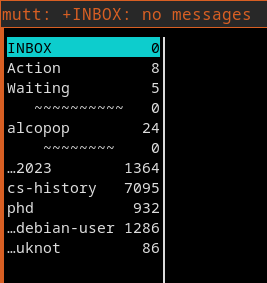
I wanted to start using (neo)mutt's sidebar and I wanted a way of separating groups of mail folders in the list. To achieve that I interleaved a couple of fake "divider" folder names. It looks like this:
  Screenshot of neomutt with sidebar   Screenshot of neomutt with sidebar
This was spurred on by an attempt to revamp my personal organisation. I've been using mutt for at least 20 years (these days neomutt), which, by default, does not show you a list of mail folders all the time. The default view is an index of your default mailbox, from which you can view a mail (pager view), switch to a mailbox, or do a bunch of other things, some of which involve showing a list of mailboxes. But the list is not omnipresent. That's somewhat of a feature, if you believe that you don't need to see that list until you are actually planning to pick from it. There's an old and widespread "sidebar" patch for mutt (which neomutt ships out of the box). It reserves a portion of the left-hand side of the terminal to render a list of mailboxes. It felt superfluous to me so I never really thought to use it, until now: I wanted to make my Inbox functional again, and to achieve that, I needed to move mail out of it which was serving as a placeholder for a particular Action, or as a reminder that I was Waiting on a response. What was stopping me was a feeling I'd forget to check other mailboxes. So, I need to have them up in my face all the time to remind me. Key for me, to make it useful, is to control the ordering of mailboxes and to divide them up using the interleaved fake mailboxes. The key configuration is therefore
set sidebar_sort_method = 'unsorted'
mailboxes =INBOX =Action =Waiting
mailboxes '=   ~~~~~~~~' # divider
...
My groupings, for what it's worth, are: the key functional mailboxes (INBOX/Action/Waiting) come first; last, is reference ('2023' is the name of my current Archive folder; the other folders listed are project-specific reference and the two mailing lists I still directly subscribe to). Sandwiched in between is currently a single mailbox which is for a particular project for which it makes sense to have a separate mailbox. Once that's gone, so will that middle section. For my work mail I do something similar, but the groupings are
  1. INBOX/Action/Waiting
  2. Reference (Sent Mail, Starred Mail)
  3. More reference (internal mailing lists I need to closely monitor)
  4. Even more reference (less important mailing lists)
As with everything, these approaches are under constant review.

Valhalla's Things: Hiking Slippers

Posted on May 5, 2023
image When I travel for a few days I don t usually1 bring any other shoe than the ones I m wearing, plus some kind of slippers for use inside hotel / B&B rooms. It s good for not carrying useless weight, but it always leave me with a vague feeling of what if my only shoes break , followed by on a Sunday, when the shops are closed . So I started to think in the general direction of hiking sandals, shoes that are designed to be worn when resting, and lightweight to carry, but are a passable substitute for regular shoes in case of an accident to the main ones, maybe with the help of an extra pair of socks2 (or when crossing fords, but that s not really a usecase I have). My requirements are easier than the ones for real hiking sandals, since I m only going to be walking on paved streets (or at most easy unpaved ones), and the weight considerations are a thing, but not as strict as if I had to carry these on my back while hiking many hours in a day. My first attempt was a pair of hiking sandals from things I already had in my stash, with vibram soles, neoprene padding and polyester webbing. After a couple fixes they sort of worked, but they had a few big issues.
  • While comfortable when worn, the neoprene made the sandals hard to make, as it tended to deform while being assembled.
  • Polyester webbing is slippery. Some strips of hot glue in strategical places helped, but they weren t perfect and in time they are peeling off.
  • Most importantly, to make the sandals stable enough to wear while walking I had to add a strap around the ankle that needs closing: this makes it a bit of a hassle to use the sandals, say, when waking up in the middle of the night for metabolic reasons.
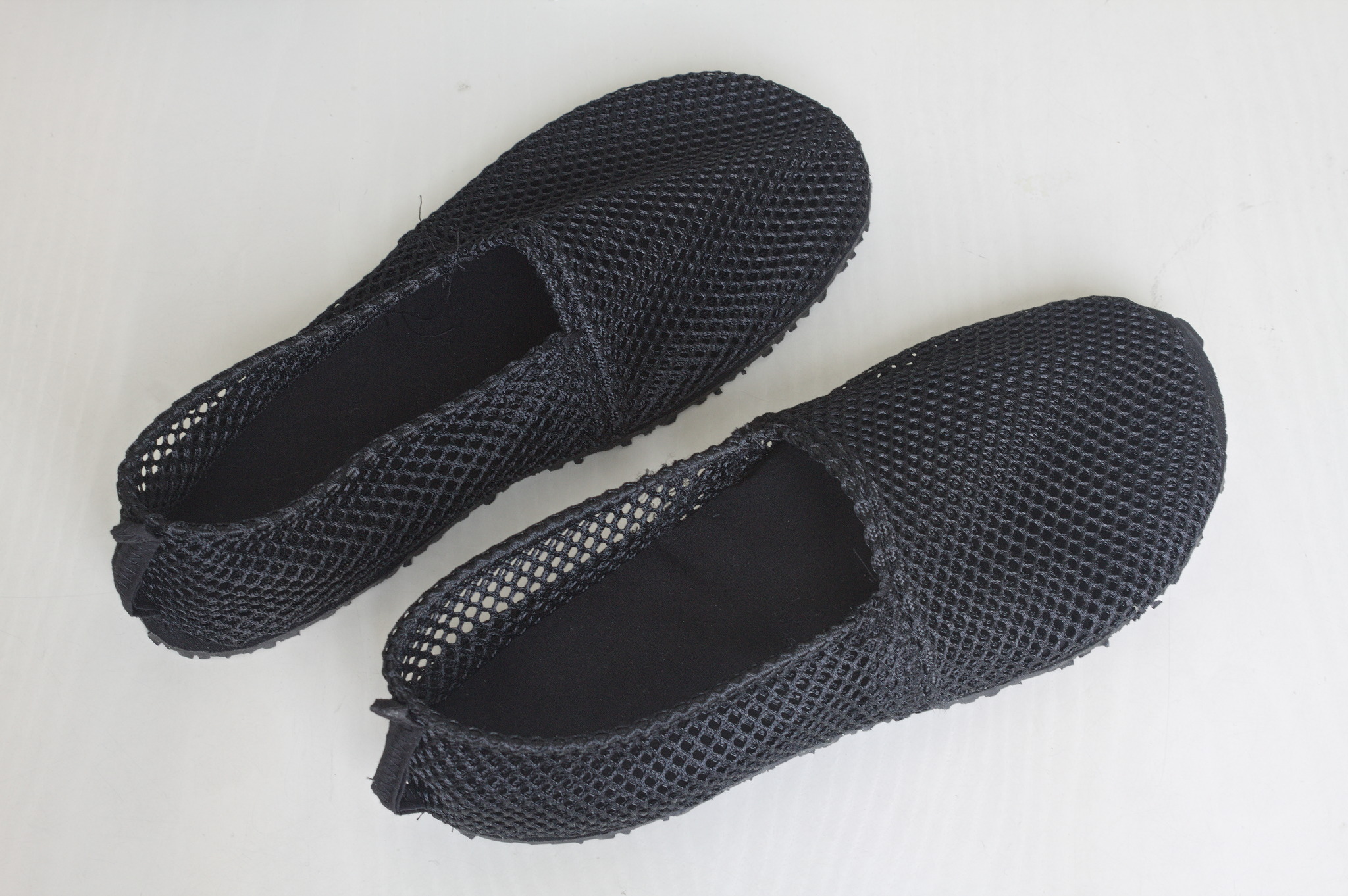
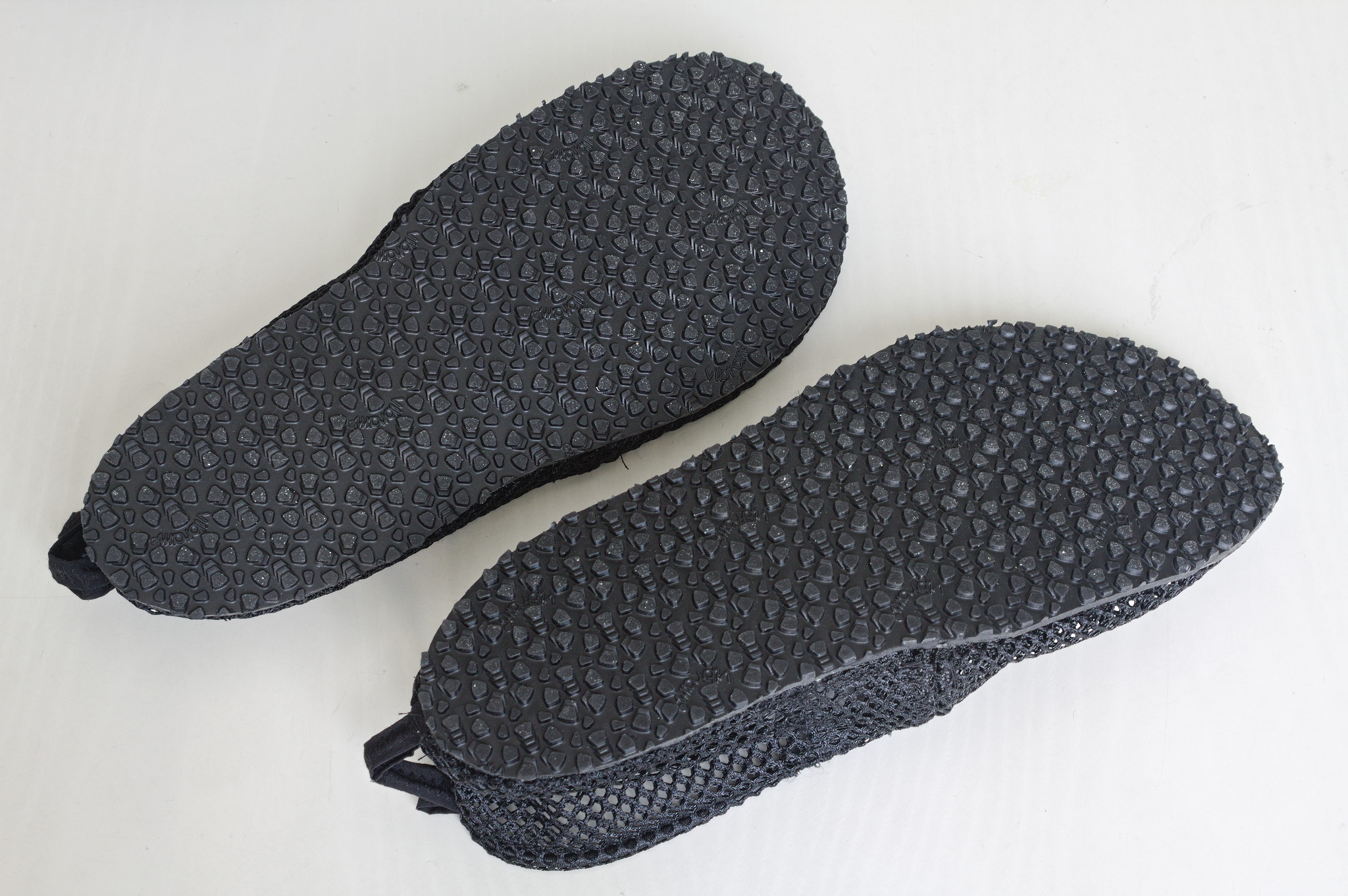
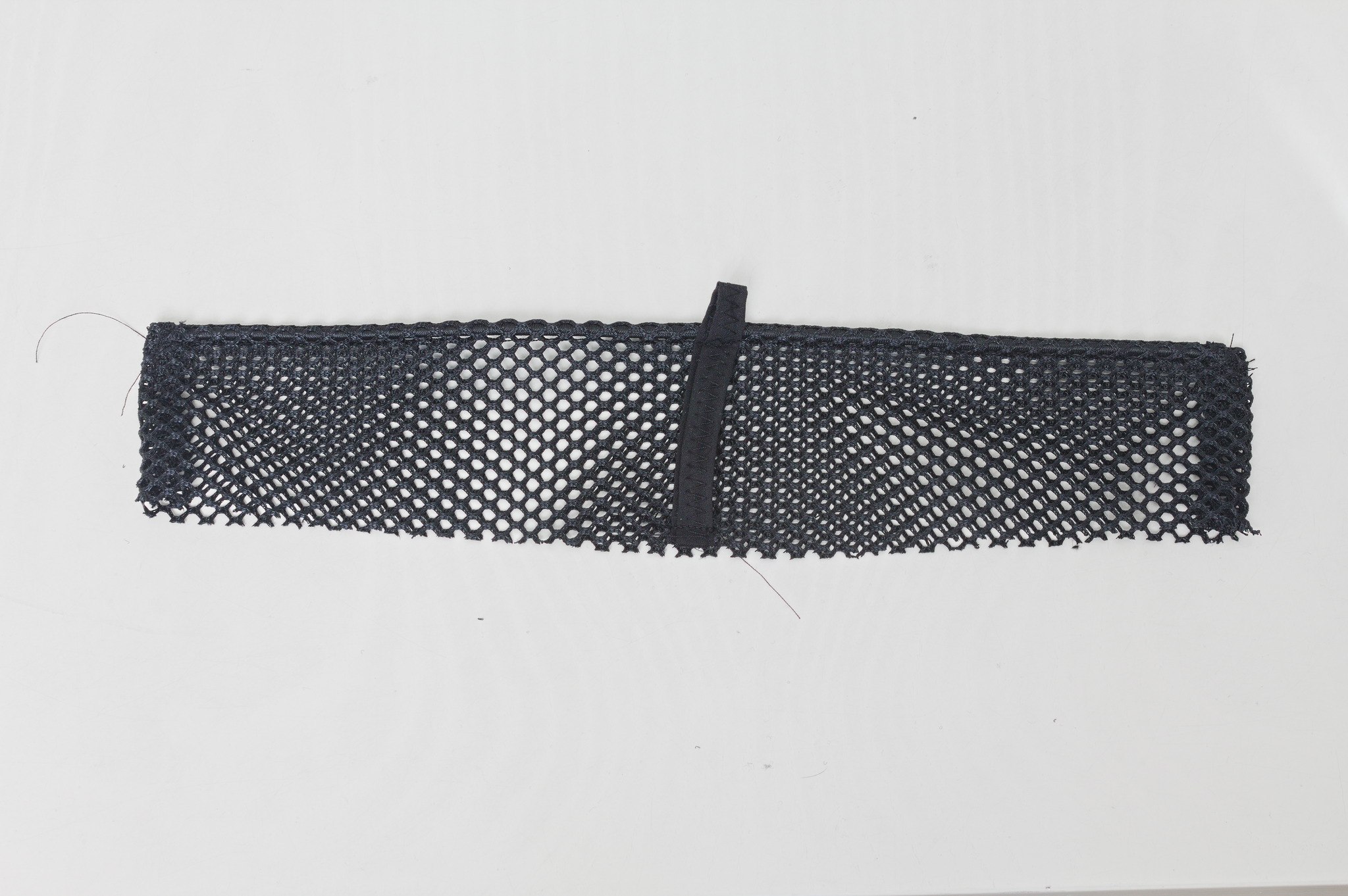
And then, one day I made my linen slippers, and that lead me to think again about the problem: what if I made a pair of slippers with a rubber sole, technical materials and maybe uppers made of net, so that they would be lightweight, breathable and possibly even still suitable in case I ever need to cross a ford. This was also readily attainable from the stash: some polycotton for the sole lining, elastic mesh for the uppers, EVA foam for padding and vibram soles. I decided to assemble most of them by machine, and it was quick and painless (possibly also thanks to the elasticity of the mesh) image For the soles I may have gone a bit overboard with the vibram claw, but:
  • I already had it in the stash;
  • if I need to wear them on an unpaved road, they are going to be suitable;
  • why not?
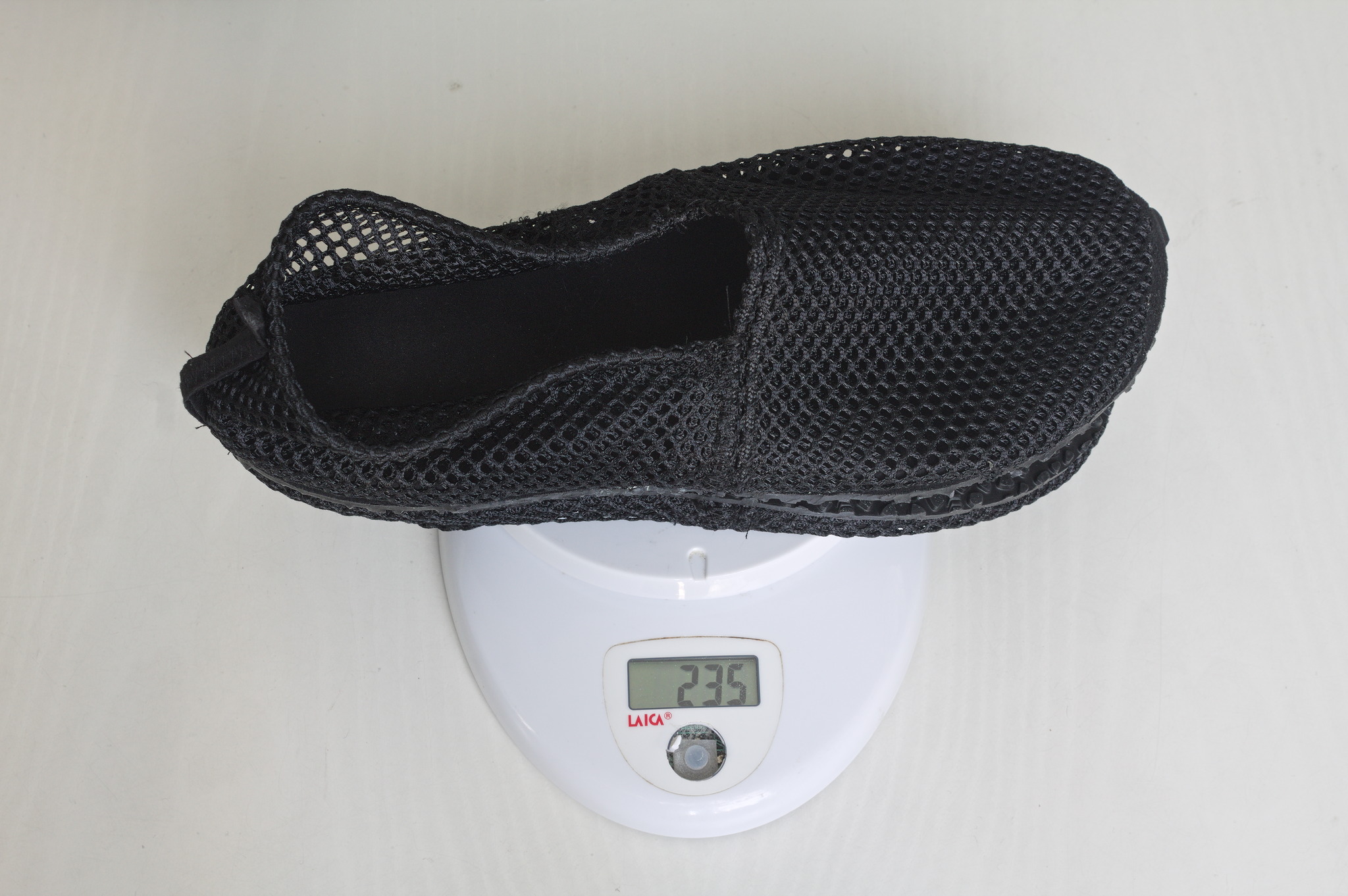
The soles were glued to the slippers rather than being sewn, as I don t think there is a reasonable way to sew these soles; I hope it won t cause durability issues later on (if it does, there will be an update) the slippers on a kitchen scale As for the finished weight, at 235 g for the pair I thought I could do better, but apparently shoes are considered ultralight if they are around 500 g? Using just one layer of mesh rather than two would probably help, but it would have required a few changes to the pattern, and anyway I don t really to carry them around all day. image I ve also added a loop of fabric (polycotton) to the centre back to be able to hang the slippers to the backpack when wet or dirty; a bit of narrow webbing may have been better, but I didn t have any in my stash. The pattern is the same as that used for the linen slippers, and of course it s released as #FreeSoftWear. I ve worn these for a few days around the home and they worked just fine, except for the fact that I had to re-glue the sole in a few places (but I suspect it was glued badly in the first place, since the other sole had no issues). Right now I have no plans to travel, so I don t know how much I will be able to test these in the next few months, but sooner or later I will (or I ll keep wearing them at home after I ve thoroughly tested the linen ones), and if there are issues I will post them here on the blog (and add a link to this post).

  1. the exception would be when I m also bringing some kind of costume, and even there it s not always true.
  2. and one should always carry an extra pair of clean socks, as they are useful for so many things, as Pratchett reminds us.

Reproducible Builds (diffoscope): diffoscope 242 released

The diffoscope maintainers are pleased to announce the release of diffoscope version 242. This version includes the following changes:
* If the binwalk Python module is not available, ensure the user knows they
  may be missing more differences in, for example, concatenated .cpio
  archives.
* Factor out routine to generate a human-readable comments when
  Python modules are missing.
You find out more by visiting the project homepage.

4 May 2023

Matthew Garrett: Twitter's e2ee DMs are better than nothing

(Edit 2023-05-10: This has now launched for a subset of Twitter users. The code that existed to notify users that device identities had changed does not appear to have been enabled - as a result, in its current form, Twitter can absolutely MITM conversations and read your messages)

Elon Musk appeared on an interview with Tucker Carlson last month, with one of the topics being the fact that Twitter could be legally compelled to hand over users' direct messages to government agencies since they're held on Twitter's servers and aren't encrypted. Elon talked about how they were in the process of implementing proper encryption for DMs that would prevent this - "You could put a gun to my head and I couldn't tell you. That's how it should be."

tl;dr - in the current implementation, while Twitter could subvert the end-to-end nature of the encryption, it could not do so without users being notified. If any user involved in a conversation were to ignore that notification, all messages in that conversation (including ones sent in the past) could then be decrypted. This isn't ideal, but it still seems like an improvement over having no encryption at all. More technical discussion follows.

For context: all information about Twitter's implementation here has been derived from reverse engineering version 9.86.0 of the Android client and 9.56.1 of the iOS client (the current versions at time of writing), and the feature hasn't yet launched. While it's certainly possible that there could be major changes in the protocol between now launch, Elon has asserted that they plan to launch the feature this week so it's plausible that this reflects what'll ship.

For it to be impossible for Twitter to read DMs, they need to not only be encrypted, they need to be encrypted with a key that's not available to Twitter. This is what's referred to as "end-to-end encryption", or e2ee - it means that the only components in the communication chain that have access to the unencrypted data are the endpoints. Even if the message passes through other systems (and even if it's stored on other systems), those systems do not have access to the keys that would be needed to decrypt the data.

End-to-end encrypted messengers were initially popularised by Signal, but the Signal protocol has since been incorporated into WhatsApp and is probably much more widely used there. Millions of people per day are sending messages to each other that pass through servers controlled by third parties, but those third parties are completely unable to read the contents of those messages. This is the scenario that Elon described, where there's no degree of compulsion that could cause the people relaying messages to and from people to decrypt those messages afterwards.

But for this to be possible, both ends of the communication need to be able to encrypt messages in a way the other end can decrypt. This is usually performed using AES, a well-studied encryption algorithm with no known significant weaknesses. AES is a form of what's referred to as a symmetric encryption, one where encryption and decryption are performed with the same key. This means that both ends need access to that key, which presents us with a bootstrapping problem. Until a shared secret is obtained, there's no way to communicate securely, so how do we generate that shared secret? A common mechanism for this is something called Diffie Hellman key exchange, which makes use of asymmetric encryption. In asymmetric encryption, an encryption key can be split into two components - a public key and a private key. Both devices involved in the communication combine their private key and the other party's public key to generate a secret that can only be decoded with access to the private key. As long as you know the other party's public key, you can now securely generate a shared secret with them. Even a third party with access to all the public keys won't be able to identify this secret. Signal makes use of a variation of Diffie-Hellman called Extended Triple Diffie-Hellman that has some desirable properties, but it's not strictly necessary for the implementation of something that's end-to-end encrypted.

Although it was rumoured that Twitter would make use of the Signal protocol, and in fact there are vestiges of code in the Twitter client that still reference Signal, recent versions of the app have shipped with an entirely different approach that appears to have been written from scratch. It seems simple enough. Each device generates an asymmetric keypair using the NIST P-256 elliptic curve, along with a device identifier. The device identifier and the public half of the key are uploaded to Twitter using a new API endpoint called /1.1/keyregistry/register. When you want to send an encrypted DM to someone, the app calls /1.1/keyregistry/extract_public_keys with the IDs of the users you want to communicate with, and gets back a list of their public keys. It then looks up the conversation ID (a numeric identifier that corresponds to a given DM exchange - for a 1:1 conversation between two people it doesn't appear that this ever changes, so if you DMed an account 5 years ago and then DM them again now from the same account, the conversation ID will be the same) in a local database to retrieve a conversation key. If that key doesn't exist yet, the sender generates a random one. The message is then encrypted with the conversation key using AES in GCM mode, and the conversation key is then put through Diffie-Hellman with each of the recipients' public device keys. The encrypted message is then sent to Twitter along with the list of encrypted conversation keys. When each of the recipients' devices receives the message it checks whether it already has a copy of the conversation key, and if not performs its half of the Diffie-Hellman negotiation to decrypt the encrypted conversation key. One it has the conversation key it decrypts it and shows it to the user.

What would happen if Twitter changed the registered public key associated with a device to one where they held the private key, or added an entirely new device to a user's account? If the app were to just happily send a message with the conversation key encrypted with that new key, Twitter would be able to decrypt that and obtain the conversation key. Since the conversation key is tied to the conversation, not any given pair of devices, obtaining the conversation key means you can then decrypt every message in that conversation, including ones sent before the key was obtained.

(An aside: Signal and WhatsApp make use of a protocol called Sesame which involves additional secret material that's shared between every device a user owns, hence why you have to do that QR code dance whenever you add a new device to your account. I'm grossly over-simplifying how clever the Signal approach is here, largely because I don't understand the details of it myself. The Signal protocol uses something called the Double Ratchet Algorithm to implement the actual message encryption keys in such a way that even if someone were able to successfully impersonate a device they'd only be able to decrypt messages sent after that point even if they had encrypted copies of every previous message in the conversation)

How's this avoided? Based on the UI that exists in the iOS version of the app, in a fairly straightforward way - each user can only have a single device that supports encrypted messages. If the user (or, in our hypothetical, a malicious Twitter) replaces the device key, the client will generate a notification. If the user pays attention to that notification and verifies with the recipient through some out of band mechanism that the device has actually been replaced, then everything is fine. But, if any participant in the conversation ignores this warning, the holder of the subverted key can obtain the conversation key and decrypt the entire history of the conversation. That's strictly worse than anything based on Signal, where such impersonation would simply not work, but even in the Twitter case it's not possible for someone to silently subvert the security.

So when Elon says Twitter wouldn't be able to decrypt these messages even if someone held a gun to his head, there's a condition applied to that - it's true as long as nobody fucks up. This is clearly better than the messages just not being encrypted at all in the first place, but overall it's a weaker solution than Signal. If you're currently using Twitter DMs, should you turn on encryption? As long as the limitations aren't too limiting, definitely! Should you use this in preference to Signal or WhatsApp? Almost certainly not. This seems like a genuine incremental improvement, but it'd be easy to interpret what Elon says as providing stronger guarantees than actually exist.

comment count unavailable comments

Holger Levsen: 20230504-Debian-Reunion-Hamburg-2023

Small reminder for the Debian Reunion Hamburg 2023 from May 23 to 30 As in previous years there will be a rather small Debian Reunion Hamburg 2023 event taking place from May 23rd until the 30th (with the 29th being a public holiday in Germany and elsewhere). We'll have days of hacking (inside and outside), a day trip and a small cheese & wine party, as well as daily standup meetings to learn what others are doing, and there shall also be talks and workshops. At the moment there are even still some beds on site available! For more information on all of this: please check the above wiki page! May the force be with you.

Ben Hutchings: Debian LTS work, March/April 2023

In March and April I worked a total of 28 hours for Freexian's Debian LTS initiative, out of a maximum of 48 hours. I updated the linux (4.19) package to the latest stable and stable-rt updates, and uploaded it at the end of April. I merged the latest bullseye security update into the linux-5.10 package and uploaded that at the same time.
Next.

Previous.