Search Results: "ag"

24 May 2007

Eddy Petrișor: Dear lazyweb, how can I customize ...

Dear layweb, I know that somebody from the kernel team (iirc) posted an article/mail about how to make a customized version of the Debian linux-image package, but I can't find it anymore.

For short, I want to produce a slightly modified linux-image-2.6.18-4-amd64 package. Which is the right source I want?

Is

apt-get source linux-image-2.6.18-4-amd64

what I want or is it

apt-get install linux-source-2.6.18
?

I am confused. Help would be appreciated.

Eddy Petrișor: DebConf7 plane ticket 2

I forgot to say, I payed for it yesterday. Now I have to buy another suitcase since the one I bought 2 years ago was ruined by the people which do the luggage handling on the Otopeni port, when I returned from Spain in September last year.

Simon Richter: Mixing different C libraries

At work, I have to build a large DLL that is compiled partially on Borland CBuilder and partially on Visual Studio. Besides being stinking huge since I have to link against two standard libraries and Borland's annoying tendency to still link against their standard library dynamically despite my explicit request for no external dependencies, this is actually working quite well. Obviously, since stuff would fail otherwise if I brought a DLL compiled with Borland into a process with Microsoft runtime (which people do commonly). In principle, this also works under Linux, with precisely the same constraints (do not free() memory another module allocated for you, etc.). The C library may not assume it is the only one using memory management primitives like brk and mmap anyway, so multiple libcs in the same process should just work. The only things causing trouble here are libraries reexporting interfaces and asymmetric allocators. The former can be caught by a static header check, the latter by valgrind (in theory).

Isaac Clerencia: As I expected

Almost a year ago I wrote this:
I ve thought about blogging about the books I read, although I m not sure if I ll manage to do it.
Although blogging about a book requires far less time than actually reading the book, I haven’t managed to do it, not that I actually believed I would be able to do it in the first place. I had thought that I would at least write a raw list of the books I’ve read in these ten months as closure for the “blogging about books” thing. In no particular order, and probably missing some of them:

Alastair McKinstry: Preprocessor abuse : chapter 2 of lots.

Those who program C are used to seeing function / subroutine definitions in header files. Not so in Fortran, there people use the C pre-processor to put Header files in subroutine definitions. Don't try this at home, folks. Again, names changed to protect the afflicted ...
subroutine  funmame( param1,
	      param2, param3,
#ifdef FOO32
	     foo, bar,
#endif
	      param7, param8, 
#include "basarg.h"
	     )
Remarkably, basarg.h included:
	C Comment.
	param5, param6,
#ifdef SOMETHING
        param10, param20,
#endif
There were in fact dozens of parameters in basarg.h.. And even a higher.h that included basarg.h but had more parameters ... Tags , , ,

Peter Makholm: inotify: procmail for IMAP folders

Moving mail to an IMAP folder is easy. Often easier than “pipe the mail through this command” or even “forward the mail with all headers to this address”. But what magic can you use to get something done with the mail after moving it to the correct IMAP folder? Using Courier IMAP and thus Mairdirs I came up with the following shell snippet:
cd $MAILDIR
inotifywait -m -q -e CREATE --format %f cur  
  while read mail ; do
        [ -f cur/$mail ] && $HOME/bin/process_mail < cur/$mail > /dev/null ;
        [ -f cur/$mail ] && rm cur/$mail ;
  done
It’s is not completely race condition free. cur/$mail can get renamed and will then be reprocessed. Interesting note: mail is moved from $MAILDIR/tmp to $MAILDIR/cur by link/unlink so the inotify-event is CREATE and not the expected MOVED_TO. Any better solution?

Alastair McKinstry: Comment-free code

Often looking through old code you find yourself wishing for more comments, or even more correct comments. Rarely, less comments. But looking at some code I'm debugging at the moment at work I found the following bizarre idiom (details changed to protect the afflicted) ...
#ifdef DOC
C  Some fortran comments.
C  Yes, ordinary comments, nothing fancy like preprocessor directives, but if you want
C  your code without a paragraph explaining what it does, you can just preprocess it
C  and remove it.
C 
C Perhaps they'd expected that their fellow developers would write essays in the
C source code that would make it hard to follow, but then, you'd still need to edit
C the full source code to debug and develop it, right?
C
#endif
Tags , , ,

Julien Danjou: Help needed for DeFuBu

I'm currently quite busy and I don't have time to manage a vote for the DeFuBu contest. I am already 2 months late for this. I am hereby requesting some help to organise the vote. I have a list of people/bug number and you should only put this formatted and find people to vote for, and then calculate the ranking. I'll do the rest. So please contact me if you have some spare time. :-)

Michal &#268;iha&#345;: goText supports Czech Vodafone

goText (Java apllication for your phone to send messages onver GPRS) has just received support to send messages to Czech Vodafone network. It is using public SMS gateway, the only drawback is that you have to detect captcha used on this page. But it still is cheaper than sending regullar SMS :-). To use this service, add following URL to your goText services:
http://www.gotext.org/pub/cz-vodafone.php

John Goerzen: Debian Developers 7 Years Ago

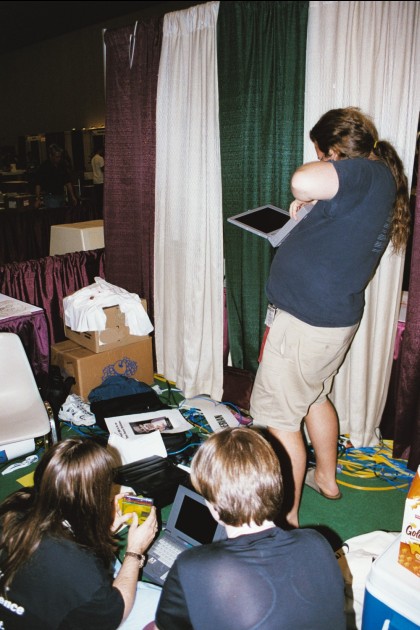
Today while looking for something else, I stumbled across a DVD with the "last archive" of my old personal website. On it were a number of photos from the 2000 Annual Linux Conference in Atlanta, and the Debian developers that were there. These were posted in public for several years.

I've now posted all of them on flickr, preserving the original captions.

Here's the obligatory sample:

20001018-01-06.jpg

That's Joey Hess, using what I think was his Vaio. Most acrobatic keyboardist ever. Probably the only person that could write Perl with one hand comfortably.

What else can you see? The best of show award that Debian won that is now in my basement due to a complicated series of events, the Debian machines that were being shown off at the show, Sean Perry and Manoj, the photo with long-term corrupted caption, and of course, numerous shots of Branden.

I know the size stinks. It was scanned at a web resolution for 2000. I do still have the negatives somewhere and will post the rest of them, in higher res, when I find them.

Click here to view the full set.

Kartik Mistry: LDTP Tutorial

* LDTP (aka Linux Desktop Testing Project) has published nice tutorial in PDF format. You can get it here till my ldtp-doc package is in NEW (Package has odt format only). Currently, package can be found on usual mentors repository.

Adam Rosi-Kessel: Christopher Hitchens vs. God

Christopher Hitchens goes to war against religion–on a recent episode of Radio Open Source: “Religion does not say that there is a mystery. Religion says there is an answer to a mystery.” It’s an interesting observation, but, I think, wrong. For a hyper-rationalist, Hitchens resorts to a lot of irrational attacks. If nothing else, his caustic approach is probably not winning many converts. Although he refuses to admit it, I think his problem is really with fundamentalists, not with religion. By taking such a polemical approach, though, he is probably selling more books. Check out his appearance on the show, as well as the follow-up on a later show (and comments). Radio Open Source is a rare example of a successful melding of old and new media. Often traditional media efforts to create a web-based “community” around an existing show fall flat. Open Source was started as a multimedia show, though, and maybe that’s why it works.

23 May 2007

Luk Claes: BSP l10n

Last weekend we organised a Bug Squashing Party where more than 70 packages got fixed. Personally I fixed more than half of these :-) I noticed two unexpected things. Some maintainers were not aware that in a BSP with uploads to DELAYED-0 they should mark bugs pending or comment in the BTS if they don't want people to work on these bugs. Next some NMUers only fixed RC bugs even if there could be translations included or updated. Anyway the BSP was very successfull though I hope even more people will be involved in the next one ;-)

Mike Hommey: Mozilla feature request response time

Eddy has been exposing some of the long standing feature requests for Mozilla. They have a huge record or such requests. My favourites: And these requests are only a small subset… On the other hand, I’m amazed the 1.8.1 branch (the one for Firefox 2.0) is ABI compatible with 1.8.0 (Firefox 1.5). I’m currently running epiphany with a pre-release of libxul 1.8.1.3 (coming soon in sid), and it works flawlessly (so far), without rebuilding epiphany.
I must say I’m impressed, especially when I look back at how 1.7.x releases were.

Martin-&#201;ric Racine: Bidding farewell to 32-bit computing

A number of recent events reminded me of how much time has passed since I started using Linux. Among these, the retirement of several 32-bit CPU architectures from the list of supported platforms on Debian and Ubuntu. The first architecture to fall was m68k. Release Managers at Debian proposed to drop support for m68k after Sarge, which indeed happened: Etch was released earlier this month and, for the very first time in Debian history, without m68k support. Granted, a number of dedicated developers are working on porting the GNU toolchain to Coldfire (an embedded platform that supports about 80% of the m68k instruction set) and good chances are that they will succeed but, let's not fool ourselves: m68k is gone. Around the same time, Ubuntu dropped support for PowerPC, just before releasing Feisty. Granted, there is still some PPC64 hardware being manufactured, but this is on the server side and thus getting farther away from the desktop market that constitutes Ubuntu's core business. Of course, given the plethora of 32-bit PPC hardware in circulation, in the form of second-hand Power Macs, the platform still has some lifespan left but, again, let's not fool ourselves: PowerPC is gone too. And now, a message sent to Debian mailing lists suggested that, as of Linux kernel 2.6.21, support for 32-bit SPARC was broken and, due to an insufficient developer interest for maintaining the GNU toolchain, 32-bit SPARC was likely to be dropped for the Lenny release. Yup, we really cannot fool ourselves: support for 32-bit architectures really is gone. Not surprisingly, my own computer collection has followed a similar trend: this morning, my beloved PA-RISC host left for the home of a happy computer hobbyist who had won the online auction on it. My Atari TT030 is likely to follow a similar route fairly soon. Ditto for the exotic Atari Stacy sitting besides it ...and let's not mention the huge stack of Pentium II and K6 desktop hardware sitting in the corner. Looking back, I'm glad to have shared so many brilliant years with 32-bit hardware. The variety of CPU architectures and hardware designs was quite a learning experience. This being said, life goes on and my current needs are fully covered by my Linutop and by my aging ThinkPad. Thank you for all those years, 32-bit computers. Enjoy a well-deserved rest in bit heaven.

MJ Ray: Co-op: National AGM, Whistleblower, Food Miles online discussion

Rounding off AGM season, Sam reports on the national AGM with a second part and also mentions more on the food retail ethical policy. While considering food retail ethics, did you see last night's BBC Whistleblower programme about dodgy practices at Tesco and Sainsburys? I don't believe the claims that this isn't widespread. I've not bought much fresh stuff from them since a friend told me about discovering some of those tricks during his time working in two of those stores. Most of the time, I buy fresh from small independents, but I'm not going to link them here because I don't like their web sites. I'm glad the co-operative food wasn't on the BBC show, but I wonder how good our labelling is at showing the source. It can't be that bad, as I've been able to choose not to buy co-op's Kent-sourced Cheddar since moving to Somerset, as I mentioned in the Food Miles topic of the Climate Doctor Online Discussion yesterday (members only link). I was quite talkative in that, but hopefully not too much. It's not a very lively "live" discussion, because there's no way to see new contributions as they come in or discuss things privately. It's like a web discussion board from 1996, but less accessible.

MJ Ray: Leukemia Research Weston-super-Mare Bikeathon: Organiser Feedback

I'm rather surprised to find that Liz RADFORD comments:
"As my first year as organiser of this ride, I would like to thank you and everyone who came out for us. It was a great day and looks like we raised over 10,000! As Leukemia is the most common form of cancer in Childen I get a bit over-enthusiastic sometimes when I see so many people joining in doing so much good and prehaps see the event through rose tinted specs. I hope you enjoyed it and the legs are better now, the hill is a real challenge. One question for you. Was it something you enjoyed enough to do again or do you think a flat route along the front Sand Bay and Wick would serve us better at bringing riders back each year? Your comments appreciated. Liz X Also check out www.UKeventphotos.com"
10k. That's a great result! I think I'd do it again and I think the initial hill has its uses - it's a bit of an unusual challenge and strings the field out. I didn't have any congestion problems until the first checkpoint after we merged with the short route. If you're looking for changes, I'd put that Somerset Avenue checkpoint somewhere with more space and reroute a quieter way around Worle, maybe up Walford Avenue with the split to the Ebdon loop at Riverbank. UKeventphotos.com only shows me the first page of the gallery - clicking "Next results" dumps me back at the search front page. I think they need to learn how to make accessible web sites (my work offers advice...). I'm glad I took my own camera and I'm sorry if their bad web site limits the amount LRF gets from photographs.

MJ Ray: Samba, CUPS, Printing (CUPS direct HOWTO)

Going back to connecting to CUPS directly, Sam Morris commented:
"http://www.owlfish.com/thoughts/winipp-cups-2003-07-20.html has instructions that I have used in the past. Use "Add Printer", select "Connect to a printer on the Internet..." and enter the printer's URL (e.g., http://192.168.0.1:631/printers/someprinter). When asked for the driver choose the Generic Manufacturer and the "MS Publisher Imagesetter" printer."
Interesting. I always used Apple LaserWriter. Is the MS Publisher one better?

Michal &#268;iha&#345;: Ukolovnik 0.7

New version of simple todo manager called Ukolovnik has been just released. Version 0.7 comes with following changes:

Kai Hendry: Web operating systems

My new office I’ve been struggling for a tagline for Webconverger. The previous tagline “Webconverger is a free, up-to-date Web browser kiosk live system”, was a bit of a mouth full. Now, I’ve decided that a “Web operating system” best describes Webconverger. Webconverger isn’t just a “kiosk”... The reason why I didn’t call Webconverger a Web operating system initially, was because I didn’t want to confuse anyone. Hannux on Cyworld with HY roundgothic You see I’ve read blogs which talk about Web desktops or rather Web applications that emulate desktops, “operating systems”. I think for such Web applications, I’ll call them Web desktops, to be called an operating system is just abuse. Calling Web desktops “operating systems” tarnishes the good name of operating systems, when silly Web applications emulate broken dead WIMP win32 environments. I can’t be the only one that hates Windows. I’m not talking about Microsoft Windows. I am talking about overlapping Windows windows. :) So I have a little fight on my hands with Wikipedia and the entry on Web operating systems. Hopefully someone agrees with me that Webconverger is a Web OS. Sidenote: I’m in the process of releasing the Debian-live etch based Webconverger 2.15 (download) which features a new textless progress bar and reset feature.

Next.

Previous.