Search Results: "zed"

28 November 2009

Bernd Zeimetz: the ganneff way of becoming a debian package maintainer

Once there was a project called Debian and a Ganneff.... (unfortunately in German only....)
22:20 < cb> Das ist doch voll die Arbeit Maintainer zu werden :-). Ich geb
gew nschte Pakete immer nur weiter an einen der da sowieso schon den Kernel
betreut :-)
22:21 < Ganneff> es is nur viel arbeit wenn du keinen schimmer hast
22:22 < cb> ja ich hab nur das seepferdchen *g*
22:22 < Obilan> Knusper: ja sicher ist es das
22:22 < Knusper> kopf -> tisch
22:22 < cb> Knusper, wenn du die verwaisten pakete findest siehst du auf
der gleichen seite auch die links wie man maintainer wird
22:22 < Knusper> die hab ich gefunden
22:22 < cb> zumindest hab ich das das letzte mal dort gesehen
22:24 < Ganneff> wnpp?
22:24 < Knusper> aber man brauch dann schon leute, die einen "hoffieren"
22:26 < Ganneff> du brauchst erstmal die ahnung nen paket zu bauen.
22:26 < Ganneff> dazu siehe new maint guide
22:26 < Ganneff> dann brauchste nen sponsor. dazu gehe zur mentors liste
22:26 < Ganneff> dann machste mit dem eh weng rum (also normal so
paketuploads via dem)
22:26 < Ganneff> und hast da halt schon dein maintenance krams.
22:27 < Ganneff> irgendwann is der sponsor angekotzt von dir und dem
laufenden arbeit generieren
22:27 < Ganneff> der tritt dich dann dass du mal DM anf ngst.
22:27 < Ganneff> das machste dann, und jemand anders tritt dir deine pakete
als dmua zurecht, nachdem du in nem keyring irgendwo steckst.
22:27 < Ganneff> und dann kannste denn krampf selbst hochladen. aber nix
andres.
22:27 < Ganneff> irgendwann willste was andres. und willst das auch noch
ohne son doofen sponsor
22:28 < Ganneff> dann versuchste dich an DD
22:28 < Knusper> ahhhhhh
22:28 < Ganneff> dazu musste dir nen advocate suchen
22:28 < Ganneff> der is  blicherweise einer dem du vorher im prozess
laufend auf den wecker fielst
22:28 < Ganneff> und er deswegen den nm leutz sagt "oh gott, befreit mich
bloss von dem"
22:28 < Ganneff> die machen das dann, aber sie wollen dir mal etwas
schmerzen zur ckgeben
22:28 < Ganneff> desdewegen wirste viele fragen beantworten m ssen
22:29 < Ganneff> und wie beim t v das auto musste hier deine pakete nochmal
vorstellen und checken lassen
22:29 < Ganneff> und dann nochmal fragen beantworten
22:29 < Knusper> thx...
22:29 < Ganneff> irgendwann gehst du dann mit den antworten den nm leuten
so auf den geist dass die dem frontdesk sagen "meine kacke, den wolle mehr
nit mehr sehen, schickts den dochma zu den DAMs, die hamms verdient"
22:30 < Ganneff> und die machen das dann meist. ausser sie m gen dich nich.
dann darfste nochma fragen beantworten
22:30 < Ganneff> bei den dams darfste nur warten. die testen deine geduld
22:30 < Ganneff> irgendwann langweilen die sich aber
22:30 < Ganneff> und dann kriegste pl tzlich mail
22:30 < Ganneff> OH MEIN GOTT. EIN NEUER DD.
22:30 < Ganneff> ende
22:30 < Ganneff> kapitel 2:
22:30 < cb> sch ne beschreibung
22:30 < Ganneff> du machst ne zeit als dd rum
22:30 < Knusper> LOL
22:30 < Ganneff> votest durch die gegend
22:30 < Ganneff> l dst pakete umher
22:30 < Ganneff> machst bugs in stable
22:30 < Ganneff> gibts dem security team arbeit
22:31 < Ganneff> sprich - du gehst allen auf den sack. denn das is was ein
dd macht. muss ja schliesslich auch spass machen.
22:31 < Ganneff> aber irgendwann, also irgendwann, da wird das langweilig
22:31 < Ganneff> und dann verschwindeste mal ne zeit.
22:31 < Ganneff> weil du weisst - da gibts noch son team. das brauch auch
arbeit
22:31 < Ganneff> die suchen so leute die weggehen und sich verstecken
22:31 < Ganneff> nennt sich mia. die suchen.
22:31 < Ganneff> vielleicht finden die dich ja auch.
22:32 < Ganneff> dann kommste zur ck und machst mal wieder etwas arbeit f r
security/stable/sonstwen
22:32 < Ganneff> oder nicht, aber das is langweilig, da fliegste einfach.
22:32 < Ganneff> wennde dann gar keinen bock mehr hast und ne l ngre pause
willst
22:32 < Ganneff> dann gehste und machst eien auf emeritus
22:32 < Ganneff> das sind die rentner, die alten s cke, die sich
zur cklehnen und  ber die versuche der neuen lachen die sich grad von den
sponsoren qu len lassen
22:33 < Ganneff> ende kap. 2, ich hab keinen bock mehr. (jaja, emeritus)
Cheers to #debian.de on freenode :-)

Lior Kaplan: A simple world without license hell


Linux Journal reports about Sun re-licensing its past contributions to the xorg project to its default license, which is very short and simple:
Permission is hereby granted, free of charge, to any person obtaining a
copy of this software and associated documentation files (the Software ),
to deal in the Software without restriction, including without limitation
the rights to use, copy, modify, merge, publish, distribute, sublicense,
and/or sell copies of the Software, and to permit persons to whom the
Software is furnished to do so, subject to the following conditions: The above copyright notice and this permission notice (including the next
paragraph) shall be included in all copies or substantial portions of the
Software. THE SOFTWARE IS PROVIDED AS IS , WITHOUT WARRANTY OF ANY KIND, EXPRESS OR IMPLIED, INCLUDING BUT NOT LIMITED TO THE WARRANTIES OF MERCHANTABILITY, FITNESS FOR A PARTICULAR PURPOSE AND NONINFRINGEMENT. IN NO EVENT SHALL THE AUTHORS OR COPYRIGHT HOLDERS BE LIABLE FOR ANY CLAIM, DAMAGES OR OTHER LIABILITY, WHETHER IN AN ACTION OF CONTRACT, TORT OR OTHERWISE, ARISING FROM, OUT OF OR IN CONNECTION WITH THE SOFTWARE OR THE USE OR OTHER DEALINGS IN THE SOFTWARE.
I wish most projects would use familiar licenses, instead of creating the license hell which already includes GPL compatible licenses, non GPL compatible licenses, apache style licenses, BSD/MIT licenses, private licenses (each company must have it s own license) and a few others as categorized at http://www.opensource.org/licenses/category . And of course dual or triple licensing which for most people doesn t make their life easier. See how many licenses there are to compare: http://en.wikipedia.org/wiki/Comparison_of_free_software_licenses Sun s re-licensing is a step forward for a simpler life for the xorg project. It s usually hard enough to make sure you track all the copyright info of files in a project, and having a different license to each file just makes things harder. This isn t the first time Sun helps to solve a licensing issue. It began in 2005 with retiring the Sun Industry Standards Source License (SISSL) which led to remove Openoffice.org dual license. It continued (2005) to solving some license issues with Java that we couldn t even have it in Debian s non-free In 2007 Sun started releasing most of java in GPL to help OpenJDK and IcedTea which now makes java available in main (lets not forget that there were a few free software projects already half way through like gcj, GNU classpath and others). So Thank you Sun for helping free software. I think that resolving licensing issues are very important for free software community, and for Sun itself by using free software. It s specially important to fix such issues if and before the company changes owners. Posted in Debian GNU/Linux, Free software applications, Free software licenses Tagged: free software, Java, Sun

Andrew Pollock: [life] Thinking about moving

Our lease runs out at the end of January, and we're thinking about moving to a bigger place. In the four years we've been here (yeah, we just crossed the four year mark the other day) we've often thought about trying to buy as well. We go through these phases where we really feel like buying, then we run the numbers and run screaming back to the warm bosom of renting. A couple of months ago we had the most serious foray into buying. We'd just checked out the models for Mondrian and we really liked the floorplan for Bleu, and found the price to be the least breathtaking of anything we'd looked at in the Bay Area. I got as far as talking to mortgage brokers and running the numbers, and the things that killed it for us were the property taxes and homeowners association fees. The monthly repayments would have been doable, but it'd have really been a ball and chain. We're over here to see the country as much as anything else, and if the mortgage is going to be a significant impedance on our ability to travel, then there isn't really any point in doing it. So we sadly passed up on Mondrian. The three bedroom townhouses in our current complex are going for around the $2500 a month mark, which is a pretty serious jump on what we're paying now for our two bedroom one, so Sarah's been scouring Craigslist for anything better. She found a 2 bedroom plus loft condo being rented privately in Mountain View, which we took at look at on Wednesday. The immediately downsides are it's older (the kitchen and bathroom are really a bit dated) and has no data cabling (this is something I've really loved about our current place) and no microwave oven included. The upsides are it's significantly bigger (about 500 square feet larger), the kitchen has heaps of cupboards, it has a washer and dryer, a lock-up garage, a small, fairly private yard (the rent includes a gardener), and it has what looks like a communal garden bed (the thing that really caught my eye were the compost bins). So I think overall, as long as we can live with the kitchen and bathroom, it's going to be an improvement on where we are now. The windows are all double glazed, so it should be fairly well insulated. It's got a gas furnace and gas hot water, and I think the landlord pays for the water, so I think the utilities would at best come out the same as what we're paying here. We've decided to put an application in for it and see what happens. The landlord is living overseas, so we're dealing with a real estate agent for the letting. Apparently we'd be paying the rent via PayPal or something. He's got a home warranty arrangement for maintenance, which sounds like it'll be pretty good. Meanwhile, Sarah was scouring Redfin and found a house nearby that is for sale (a short sale), which is pretty reasonably priced. We've called up a real estate agent, and we're taking a look at it tomorrow, just because we can.

26 November 2009

Tore S. Bekkedal: Wardialling for the 21st century

The story behind it My SPA2102 Recently, I decided to set up a subscription with a VoIP provider, Phonzo, here in Norway. On their webpage, Phonzo advertised a VoIP service which actually gave you the SIP information and allowed the user to connect their own equipment to this service. That s really cool , I thought. I can play with Asterisk on the PSTN now! . They also advertised an offer with rent of a Linksys SPA2102 included, at a very affordable rate. Now, I suspected that the box might be locked as I d heard they were with some providers so I searched all over their webpage for any hint that it might be. None was to be found and since they included the specific model designation of the adapter rather than mentioning a generic Analogue Telephone Adapter , I basically assumed it wouldn t be crippled. But when it did arrive (impeccable delivery time, and telephony worked out of the box, btw), I found to my dismay that the box was indeed locked. So I sent a polite email to customer service, saying basically that I know this is a matter mostly interesting to enthusiasts, but they ve advertised an SPA2102 , and what I have receieved is a crippled SPA2102 . They basically replied It says rent , so it belongs to us. I replied Renting does not exempt you from marketing laws; you ve sold me something else than what I paid for . I got the reply: We can t open it, it contains sensitive information and it s not crippled, it s optimized for Phonzo service[sic] (!). Yeah, that s really what they said. A few more emails back and forth, and nothing of value came forth. When I received a letter from customer service saying Stop your nonsense, we re providing you a service and the adapter is a part of it I realized I wasn t getting anywhere there. I ve sent an email to the address in the SSL certificate (who also seems to be one of the founders) hoping I d get in touch with someone of relevance, but I don t have great hopes. (There s a copy of the correspondance in Norwegian, if you re interested.) So over to my plan B. The Linksys SPA2102 has two interfaces for an administrator: The first is the HTTP interface bog-standard, with an admin password. The second is the Interactive Voice Response menu you know the kind, Press 1 for x, 2 for y, . Now, this menu has several different options, including one to enable HTTP access on the WAN port . By default, this option is set to False, and changing it requires an administrator password. But how do you enter an alphanumeric password on a DTMF dialpad? Aha the admin passnumber is derived from the admin password! The mapping is 1=1, [2ABCabc] = 2, [3DEFdef] = 3, , (everything else) = 0. This reduces the keyspace quite dramatically! So basically, what I ve done is kludged together a shell script which tries the different combinations and sounds them out using a software DTMF tone generator, with earphones serving as acoustic couplers. (For now, I ve skipped numbers containing a 1 . The number 1 only represents itself, and thus its value is quite low.) It then tries port 80 on its WAN IP every 100 attempts to see if a passnumber has succeeded. The shellscript is accessible here: http://simula.gunkies.org/~toresbe/dtmfbruteforce.bash. The phone adapter has two lines, but the second one is locked by Phonzo however, it is not possible to disable the IVR menu on this thing, so I have full use of the box while this is happening. (It nearly goes without saying that I ve spoofed the DNS so it connects to my Asterisk box. :) ) I m now averaging about one passkey per second. According to my calculations of each passkey representing the number of symbols per digit raised to the power of the number of digits, I am trying 16807 passwords per second and will be trying 117649 passwords per second when I get to six digits. I have a quite technical readership so please do correct me in the comments if I ve made an error in either the calculations or anywhere else. If there are any Phonzo users out there with an SPA2102, I would very much appreciate it if you contacted me brute force works a whole lot better when it s parallelized. I am currently at #302362. I have not yet been contacted by anyone in the same situation.

Luca Bruno: Inkscape 0.47 is out!


After over a year of intensive development and refactoring, Inkscape 0.47 is out. This version of the SVG-based vector graphics editor brings improved performance and tons of new features, some of which are as follows: Timed autosave, Spiro splines, Auto-smooth nodes, Eraser tool, New modes in Tweak tool, Snapping toolbar & greater snapping abilities, New Live Path Effects (including Envelope), A huge collection of preset filters, New cairo-based PS and EPS export, Spell checker, Many new extensions, Optimized SVG code options, and much more. Additionally, it would be wrong to not mention the hundreds of bug fixes as well. Check out the full release notes for more information about what has changed, enjoy the screenshots, or just jump right to install it. Release Notes:
http://wiki.inkscape.org/wiki/index.php/ReleaseNotes047

25 November 2009

Lucas Nussbaum: Re: Ubuntu Bugs

(Context: Michal iha complains about bugs filed in Ubuntu not being looked at nor forwarded to Debian or upstream) Michal, I think that your complaint is caused by a misunderstanding of how package maintenance happens in Ubuntu. I ll try to clarify it, based on what I understand (if you know better than me, don t hesitate to comment). The part of Canonical maintaining the distribution is organized into teams (full list here), like Kernel, Foundations, Desktop, Mobile, Server, etc. Most of those teams have mirror-teams in the community, like the Ubuntu Desktop team. Those teams take care of subsets of packages in Ubuntu, of relevance to the respective teams. (This is orthogonal to package upload rights, which are managed with the Ubuntu Core Development Team, and the Ubuntu Development Team ; there s a proposal to change that so that package upload rights are based on the first set of teams). However, there are some packages (probably more than 70% of the packages in Ubuntu, including main+universe) that are of no interest to any particular team. Those packages are maintained on a best-effort basis by all the Ubuntu developers (inside the loosely defined MOTU team), and focus is usually on not diverging from Debian, to make their work as easy as possible. It s very similar to what we do in Debian with orphaned packages: sometimes, important bugs get fixed, because someone complained loudly enough or a developer ran into the bug and did a QA upload ; but usually, we don t really do any bug triaging. Of course, there are some packages in Ubuntu that are not maintained by any core team, but still have someone that cares about them. They are more the exception than the rule. So, yes, obviously, you will run into packages with lots of untriaged bugs, sometimes even with patches. And those bugs and patches are rarely being forwarded manually to Debian, simply because nobody cares about those packages in Ubuntu. In an ideal world, with infinite resources, this would not happen, of course. But realistically, this is not going to change anytime soon. There s a link on the PTS to the bugs of your packages in Ubuntu. The idea is to allow an easy access to the bugs reported in Ubuntu, which are likely to be also relevant to the Debian package. You should probably feel welcomed to triage the bugs against your package in ubuntu, if it makes it easier for you to monitor them. There s some noise in the Ubuntu bugs, of course, but more and more often, by looking at the Ubuntu bugs, I find important bugs in my Debian packages that are not even reported in Debian yet.

Gunnar Wolf: Source format 3.0 (quilt) for teh win!

My Debian QA page shows what I consider to be a huge amount of packages I am currently uploader for 207 packages. Why so many? There are many factors The main one is group maintenance (I'm directly responsible only for 19; of course, this should not mean I disregard the rest of them), the second one is regularity. By far, most of my source packages (177) match lib.*perl, followed by lib.*ruby with 20. Anyway A strong factor that allows the pkg-perl group to be successful in maintaining 1411 packages is the regularity of the task: Packaging Perl modules is usually as easy as running dh-make-perl on them (of course, not taking away the merit of packaging the few strange corner cases In Ruby-land, the landscape is quite different. The developer community is quite anchored in agile worldviews, which go beyond coding practices and all the way over to confronting the way most Free Software projects distribute their work. I have previously ranted presented informed and opinionated blog posts on this topic Ruby culture dictates the distribution via Ruby Gems, which are for many reasons not Debian friendly. Besides Gems, most projects have adopted Git for development tracking and are hosted under Github That's why I came up with Githubredir, which basically presents an uscan-friendly listing of tags for a given project. But if you develop in Git, you might want to split a project in its constituent parts for easier organization, without meaning that each subproject should be an independent project by itself, right? After all, that's what Git submodules are for. That's what happened with a great PDF generating library for Ruby, Prawn. Thing is, the three parts of the main project are required for the project to be built. Anyway, that was a great reason to move the package over to the new dpkg 3.0 (quilt) source format. And, yes, it is a straightforward move! If you have not yet done so, take a look at Raphael Hertzog' explanation+FAQ wiki page. It just works, and makes many things way easier. There are still some wrinkles in my packaging, like where I'm getting the orig tarballs from As the submodules are not presently tagged in any way, I was only able to download a snapshot of their respective current master branches. This is suboptimal, I know, but I have talked to the upstream author, and he confirms that for the next major version (which should not be long in coming) the tags will be synchronized, and things will be even cleaner. PS- I love Hpricot. To get the numbers for my QA page, I just had to get three dirty but useful arrays:
  1. require 'hpricot'
  2. require 'open-uri'
  3. url = 'http://qa.debian.org/developer.php?login=gwolf&comaint=yes'
  4. doc = Hpricot(open(url))
  5. tot = ( (doc / 'table' )[1]/'tr').map row
  6. (row%'td' % 'a').inner_html rescue nil .select i i
  7. team = ( (doc / 'table' )[1]/'tr').map row
  8. (row%'td' % 'span.uploader' % 'a').inner_html rescue nil .
  9. select i i
  10. mine = ( (doc / 'table' )[1]/'tr').map row
  11. (row%'td' % 'span:not(.uploader)' % 'a').inner_html rescue nil .
  12. select i i

And work from the three very simple lists there i.e. tot.select pkg pkg =~ /lib.*perl/ .size gives me 177.

Kees Cook: missing kernel features in ARM

As more attention is given to the ARM ports of Linux, I m hoping someone (maybe me if I learn a bunch) will be able to implement some upstream kernel features that are implemented only on x86 so far: Stack is already randomized, it should be easy to do the rest! ;)

24 November 2009

Tim Retout: Delayed gratification

I've been slacking on the RC bugs front. :) Let's see, my last blog post was on Monday 16th, so I'm late... The DELAYED queue is a wonderful mechanism for reducing the amount of busy waiting that needs to happen for NMUs; you don't have to remember to come back and upload several days later. For non-DDs, it takes a bit more co-ordination between you and your sponsor, unfortunately - do you send the NMUdiff to the bug before you get sponsorship, and risk having to change it? And then revisit the bug to give notice again once it does get sponsored? Or leave it until after upload, which might reduce the amount of notice you're actually giving the maintainer (if, say, your mentor is in a different timezone)? I've been opting for the first approach, but it doesn't have the same fire-and-forget quality of the real thing.

Lucas Nussbaum: UDS Lucid

I m back from Dallas, where I was invited at the Ubuntu Developer Summit for Lucid. I spent a great week there ; the event was extremely well organized (by organizing them every 6 months, you are probably able to gather a lot of experience!). Of course, after all I had heard about people hugging each other all the time in the Ubuntu community, I was a bit worried, especially with the flu spreading! But there are lots of fantastic people around Ubuntu, and it was a very nice opportunity to be able to meet them all. Since it was my first UDS (I was at FOSSCAMP in Prague a few years ago, but didn t stay for UDS back then), I was not really sure of what to expect. I was very pleasantly surprised. UDS vs Debconf UDS is very different from Debconf. In Debconf, we do three different kind of things: In UDS, the main focus is on the third point: most of the sessions are about discussing what will be implemented for the next release. All of the relevant developers are in the same room to discuss possible problems, and the outcome of each session is usually a detailed plan, with a list of action items. It s a very nice way to ensure that changes are well thought, and allows making large-scale changes in Ubuntu very easily (you don t spend weeks arguing about them on mailing lists). Of course, it s probably also helped by the fact that there s a company behind Ubuntu, with a set of large teams (kernel, foundations, desktop, etc), which helps transfering trust (not everybody feel like they have to participate in each discussion, even when they affect the whole distribution: the team in charge is trusted by the rest of the project). On the other hand (yeah, let s be negative for a while) it doesn t really help spreading information between Ubuntu developers: it s often a bit difficult to get the global view of what is happening inside Ubuntu, especially since lots of things are discussed on IRC. Collaboration between Debian and Ubuntu During the week, I mainly was interested on collaboration between Debian and Ubuntu. There s a strong focus on doing the right thing wrt Debian (and also other upstreams). Then, of course, Ubuntu also has an agenda, which sometimes requires moving very fast on some things, or making compromises between technical purity and pragmatism. But the willingness to have common foundations between Debian Squeeze and Ubuntu Lucid will surely benefit both distros. Quality Assurance On the QA front, I am planning to do archive rebuilds for Ubuntu as well (fixing FTBFS is an easy way to start contributing to Ubuntu or Debian, and having those bugs fixed in Lucid would benefit Debian as well, by having patches already prepared). I also had a session with the QA team, where I gave an overview of what we are doing in the Debian QA group, to discuss opportunities for collaboration. The Ubuntu QA team focuses more on testing (with automated or manual testing) and bug triaging than archive quality that part is left to the MOTUs and the release managers. (About MOTUs, I liked how what they do was described as long-tail maintenance, landscape gardening or terraforming. That gives a good idea of what it s about). Ultimate Debian Database On the Ultimate Debian Database front, I did a plenary talk to try to demonstrate how UDD could be useful to Ubuntu as well, and, with Jorge Castro, we examined some metrics of Ubuntu s giving back to Debian. I also talked with the Launchpad team to try to resolve my long standing pretty please provide an export of Ubuntu bugs, so I can easily import them in UDD! issue. Ubuntu and ARM ARM netbooks and smartbooks (mix between netbooks and smartphones) are coming, and Ubuntu is clearly very well positioned to play an important role on that market. There was a whole track about ARM support, with lots of changes that will be done for Lucid. Let s all hope that Ubuntu-powered ARM netbooks win that market, so we don t reproduce the failures of the non-ARM netbooks. Distributed Development James Westby has been working on a set of tools to be able to work on Ubuntu packaging using bzr. The point is not to store the canonical source for Ubuntu packages in bzr (well, at least it s not the plan yet), but to provide a set of branches to make it easier to merge or cherry-pick from Debian. The resulting workflow looks extremely nice, with lots of syntaxic sugar. And even better, he assured me that his code is portable to Git ;)
Using his work, merging Ubuntu-specific changes in a new version of a Debian package basically means pulling from lp:ubuntu/foopkg, merging from lp:debian/sid/foopkg, and you are done!
As a bonus, we (Debian) would get bzr branches with the history of packages (kind of bzr-powered snapshots.debian.org).
James project is not completely ready yet, but should be very soon. It s already basically usable, apparently. Conclusion Ubuntu has clearly gone a very long way since 2004. Everything looks very well organized and polished, and gives the impression of a big machine that nothing can stop. With Cloud Computing and now ARM netbooks, Ubuntu has proven to be able to adapt to the current trends and attract a lot of visibility. It is great news for Free Software, but also proposes an interesting challenge to Debian: of course, it s nice that a Debian-based distro is in that position, but will Debian manage to stay relevant, or are we just going to be the technically-pure distro without many users that serves as a package supermarket for Ubuntu?

23 November 2009

Jorge Salamero Sanz: New ebox-radius module available

Since I came back from Dublin I had pending to release the new ebox-radius module. This new module for eBox Platform 1.2 brings integration of eBox LDAP users with FreeRADIUS allowing the deployment of WPA/WPA2 EAP wireless authentication using eBox. In fact is very simple as seen on the screenshot, you can choose whether all the users are able authenticate or just a group of them and the NAS clients that can query the RADIUS server.
ebox-radius

ebox-radius

This module is still in beta, but packages for Hardy are available from my PPA so you can try it in your eBox 1.2, a version for eBox 1.3 will be released very soon. FreeRADIUS packages where self builded because of #266299, I hope this can be fixed very soon, see Debian, EAP, and the OpenSSL and GPL incompatibility. If you give it a try, please give us feedback on the forum or the mailing lists.

22 November 2009

Patrick Schoenfeld: Rest in Peace, grandma.

A few weeks ago I've visited my grandma, because she and my grandpa had birthday.
We also did it, because we figured that it might be the last chance to see her alive.
It was a hard time for us. Because she wasn't the person I knew, the person with whom I argued so often when I was a young boy, the person who showed me the beauty of cooking. She were lying in her bed, barely realizing us, not really able to do conversation. As soon as we went away from her bed she was calling for one of us, repeating the name of the person she was calling for every few seconds. Most of the time she called for my grandpa, but another time it was me she was calling. I then stood there, next to her bed, not really able to talk, because she wasn't and I didn't know what to say.
And then I had a talk to my grandpa. Although he looked visibly aged, he still seemed to be in a good constitution. But while talking to him I realized that he was tired. He told me that his woman was asking him eight times a day which day it was and such things. He told me and my cousin that he fears the day when she is gone. It was hard. I mean.. I knew it, I knew that it would break his heart when she's gone, but in my memorization he has never been a guy who would have spoken it out. I know that both had good and bad times together. Their was always that joke about them, that they can't do with each other but not without each other either. But now, the very imagination that this might be true, caused frighten in me.
Yesterday I got a call from my mother, telling me, that it seems that she decided that she will go, so she drove to my grandparents. A few hours later she called me again and said to me that it is over. Slept in, in silence. No pulse anymore. But the first thing I replied was: Can you take care for grandpa? Its not that I don't sorrow, but I knew it were better for her. She had a life with ups and downs, she had a man who loved her more then anything else. But she wasn't able to live or enjoy her last days I think. And now I'm afraid about the living, the one whose heart supposedly just broke. I hope he will be able to enjoy his last years anyway. Because he is a good man, has always been and I think he deserves it.

Grandma, we will miss you. Rest in Peace.

Joey Hess: building a day

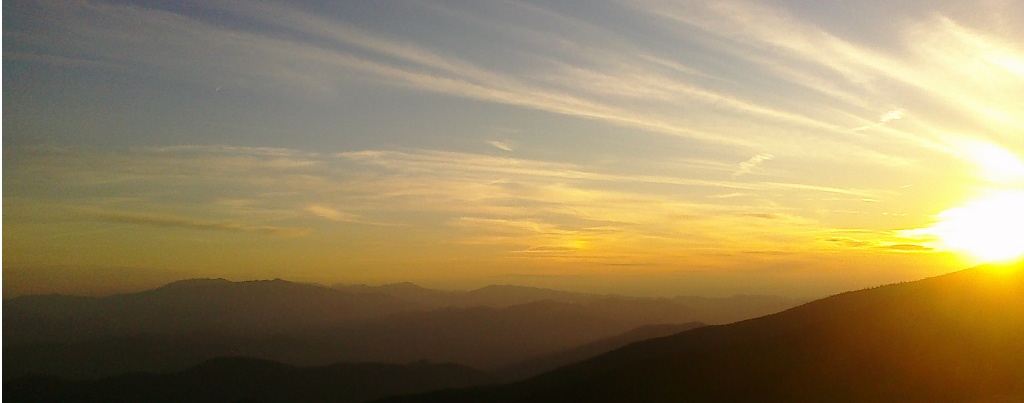
The difficulty with living on the Joey sleep schedule as the year wanes is finding enough daylight to have a satisfying day. The plan was to hike in the mountains, but my inbox said otherwise. Ugly new debhelper bugs. Looking at the hard one, I felt as if someone from 30 years ago was trying to take my day away. Why does make(1) not provide a way to discover which targets exist in a makefile? My hack to workaround that historical oversight was breaking, and make was nearly fork-bombing the system in the process. This seemed likely to eat my weekend -- I was very glad to find a quick, ugly workaround. By then it was 2:00. I'd not get to the mountain pass til after 3:00, which was pushing it. Almost stayed home, but it was such a nice sunny day, perfect weather. So I headed out. Spent half an hour along the way talking with an old woman about a well (long story), but reached the Roan with nearly two hours of daylight. And it was sublime. I realized I'd never stayed up there for sunset, so I hunkered down on a rock, finished checking my email (left over from the earlier hurry), and then spent half an hour chatting on the phone with my dad, as the sun inched down a finger at a time. When it went behind the other peak, and mist crept up the valleys below, it got cold and I hurried down. Reached the car in deep dusk, and coasted down the mountian while listening to a BBS nostalgia piece on the radio. On the way home, pulled in at the Ridgewood BBQ, and am sitting on the porch in the cold with about 50 other people, waiting for a seat (hopefully before it closes), and blogging. I accomplished everything I wanted to today, including getting something significant done, hiking, and spending quiet time on top of the world. Though only just, and feeling I was running late the whole time. Nice thing about the Joey schedule though, is I will have seven more hours of quiet time before sleep.
20 November 2009

Antti-Juhani Kaijanaho: Socialized vaccination a narrative

Such was the scene I arrived at on Wednesday last week at the municipal health center at Kyll , Jyv skyl , Finland. A queue extended a hundred meters beyond the door. It was not hard to guess what it was about, as it had been announced that the pandemic influenza A/H1N1 vaccine would be administered there to people in specific risk groups from 10 am to 3:30 pm. I should explain here the Finnish health care setup. There are three parallel systems a comprehensive public health care system maintained by the municipalities to standards set by the state, a network of private for-profit health care providers, and a national foundation dedicated to university student health care. Employers are required by law to provide a minimal level of health care to their employees, and most of them also provide, free of charge to the employees, access to near-comprehensive general-practice-level care; most employers buy this service from the for-profit providers. The public system suffers from resource starvation at the general-practice level but provides excellent care in the central hospitals that handle the difficult cases. Anyway, the H1N1 vaccine is only available through the public system and through the foundation free of charge if you qualify for the vaccine, and no amount of money buys it for you in this country if you don t. Thus, I and many others, normally cared by the employee services, found ourselves queuing up at a public health care institute. And clearly, the public health care system was overwhelmed on that first day. When I entered the queue, its tail was a traffic hazard. Fortunately, the queue moved faster than new people arrived thereafter, and the hazard ended. The queue moved surprisingly fast it took me one hour to advance the 100 meters to the door. Even so, this was a failure in the system there is no good reason to have people with underlying illnesses (and we all had them, to qualify for the vaccine) stand around in freezing cold weather for an hour! Once, a nurse came and asked us if any of us was 63 years old or older. Apparently no-one was, since no-one was asked to leave (they will be vaccinated later). Later, another nurse asked everyone in the queue outside to show their KELA cards KELA is the national health insurance system, and its card carries information about extra coverage one qualifies for due to underlying illnesses. Eventually, I reached the door. Two guards stopped anyone who tried to enter directly, sidestepping the queue, and let in only those who had legitimate business other than vaccination. The main hall was full of people, and I quickly realized that the queue took a full circle inside the hall to reach the multiplexing point. It took me another hour to slowly advance my way though the hall. At the multiplexing point, I was asked to wait a bit, and then I was assigned a vaccination room and a waiting number. Some twenty minutes later I was called in. The vaccination room I was assigned to was a nurse s office. Two nurses were there, one who would administer the vaccine, and another at the computer, to keep a record. I gave them my KELA card, and shed my coat and my outer shirt, and bared my left shoulder. I was quickly given the pandemic vaccine; there was no question I was qualified for it, not with my obesity being obvious. Then they asked what my diagnosis was. Prmarily I m here because of my obesity, I said. But I also have paroxysmal atrial fibrillation. That s not what your KELA card says, accused the nurse at the computer. The diagnosis is so new, I countered. There has been no time to do the paperwork for KELA. (And indeed, I later learned, it would come up in my next checkup in the spring.) They stared at each other. I can show you my prescriptions, I said, making no move for them. Stares. I stared back. Do you want the seasonal vaccine or not? asked the nurse with the injectors. I lauged briefly. I might as well. It had, honestly, never crossed my mind that I might qualify. She injected me on my right shoulder. You should stay in out there for ten minutes. I picked up my clothes and found the cafeteria with coffee and pastry. Then the real fun started. Next day, I woke with horrible upper back pain. The thermometer showed mild fever; but since i didn t have any respiratory symptoms, I decided to go to work. In the evening, turning in bed was excruciatingly painful. It took days for the pain to subside. I left the building three hours after I arrived at the end of the queue. What? You think that s excessive? So do I and many others; queuing feels so Soviet Union! But honestly, while it did take time, it worked. I am vaccinated; are you?

Gunnar Wolf: EDUSOL almost over - Some highlights

Whew! Is it karma or what? What makes me get involved in two horribly complex, two-week-long conferences, year after year? Of course, both (DebConf and EDUSOL) are great fun to be part of, and both have greatly influenced both my skills and interests. Anyway, this is the fifth year we hold EDUSOL. Tomorrow we will bring the two weeks of activities to an end, hold the last two videoconferences, and finally declare it a done deal. I must anticipate the facts and call it a success, as it clearly will be recognized as such. One of the most visible although we insist, not the core activities of the Encounter are the videoconferences. They are certainly among the most complex. And the videoconferences' value is greatly enhanced because, even if they are naturally a synchronous activity (it takes place at a given point in time), they live on after they are held: I do my best effort to publish them as soon as possible (less than one day off), and they are posted to their node, from where comments can continue. This was the reason, i.e., why we decided to move at the last minute tomorrow's conference: Due to a misunderstanding, Beatriz Busaniche (a good friend of ours and a very reknown Argentinian Free Software promotor, from Via Libre) thought her talk would be held today, and we had programmed her for tomorrow. No worries - We held it today, and it is already online for whoever wants to take part :-) So, I don't want to hold this any longer (I will link to the two conferences that I'm still missing from this same entry). Here is the list of (and links to) videoconferences we have held.
Tuesday 2009-11-17
Wednesday 2009-11-18
Thursday 2009-11-19
Friday 2009-11-20
As two last notes: Regarding the IRC interaction photos I recently talked about, we did a very kewl thing: Take over 2000 consecutive photos and put them together on a stack. Flip them one at a time. What do you get? But of course A very fun to view and interesting interaction video! We have to hand-update it and it is a bit old right now, but nevertheless, it is very interesting as it is. Finally... I must publicly say I can be quite an asshole. And yes, I know I talked this over privately with the affected people and they hold no grudge against me... But still - yesterday we had an IRC talk about NING Latin American Moodlers, by Luc a Osuna (Venezuela) and Maryel Mendiola (Mexico). One of the points they raised was they were working towards (and promoting) a Moodle certification. And... Yes, I recognize I cannot hear the mention of the certification word without jumping and saying certifications are overrated. Well, but being tired, and not being really thoughtful... I should have known where to stop, where it was enough of a point made. I ended up making Maryel and Luc a feel attacked during their own presentation, and that should have never happened. A public and heartfelt apology to them :-(

18 November 2009

Jan Wagner: dkms rocks or how to get the Intel 82576 GBit NIC running on Lenny

We ordered a couple of the new HP DL160 G6, cause they can be equipped with a lot of RAM. Unfortunately it s always the same with HP and the bandnew ProLiant 100 series the driver for the NICs is missing/too old in the latest stable debian release. The DL160 G6 is shipped with a Intel 82576 GBit NIC, which isn t recognized by Lenny, see also #522922.
I installed the system with another NIC installed (not really, but this is a way it works :) and wanted to get free the PCI-X slot again. So I did backport dkms and downloaded the latest igb driver. A short look into /usr/share/doc/dkms/HOWTO.Debian did advice me the way to create the DKMS driver package. Just after a couple of minutes I did roll out the igb-dkms_2.0.6_all.deb to the target maschine(s).
On the target systems I just installed dkms, the DKMS package and appropriate linux-headers and sim, salabim there was the interfaces. :)

Benjamin Mako Hill: Antifeatures

In preparation for LCA, I'm going to be giving my new Antifeatures talk a few times to smaller local audiences. The first is going to be today in Boston (apologies for the late notice!) at Northeastern University at 11:45 and it's being hosted by the ACM chapter there. The second one will be at my alma mater Hampshire College in Amherst this Friday. A draft flier (ignore the unpluralized "antifeatue") is below. /copyrighteous/images/hampshire_talk_2009_flyer-small.png

16 November 2009

Asheesh Laroia: Choosing something to work in Free Software is hard

Debian is primiarly organized into mostly one-person "projects," namely packaging a piece of software. But in the past few days on Planet Debian, there has been discussion about how existing packages in Debian need more help. Tim Retout wrote:
There's a huge role for non-DDs to play in getting fixes into Debian, but as far as I remember, the emphasis of the mentors documentation is on packaging rather than bug fixing.
I think this is a serious problem across Free Software. Open source contributors are grouped into projects. If you're burning out on what you're working on lately, or you are looking to become a new contributor, it's hard to know what projects need your help. As someone who knows Python and Debian packaging, it would be nice to be able to search Debian for Python-language packages that need help. I also think that Tim hit on a really important social point later in his post:
It seems to me that the mentor relationship works better when DDs get to know particular people
Tim's right that personal relationships make a big difference. I got serious about my NM application when I asked someone I already knew to sponsor my packages. But not everyone can be so lucky as to have a Debian Developer as a friend. And many projects aren't as friendly as Debian; there's no official mentorship available. I think that we need to start paying a lot more attention to personal relationships all across Free Software. (I'm working on a web tool in this space. Join me in #openhatch on irc.freenode.net to discuss it, or just stay tuned until I write it up tomorrow.)

John Goerzen: Droid Review Update

It s now been nearly a week since I started using the Droid, and I have some updates from my initial review. Browser First, I, like many reviewers, complained about the lack of multi-touch in the browser, thinking it inferior to the iPhone/iPod Touch as a result. I think I, and all those other reviewers, were mistaken. The great part about the Droid browser is that I can just double-tap on the content column, and it automatically zooms in to the width of that column (hiding left/right navigation or whatever else may be there). Moreover, the Droid browser also seems to render these columns narrower than the iPhone/Touch browser does. So some websites aren t viewable on the iPhone even in landscape mode without horizontal scrolling, but work great on the Droid even in portrait. Perhaps multi-touch pinching is missed in the map, but the utility of it seems far less important now that I ve played with it some. Vibration I complained that the shortcut on the lock screen puts the device into silent mode, with no corresponding shortcut to put it in vibrate mode. That s true, but there s another annoyance: if you enable a lock pattern the Droid version of a power-on password even the shortcut to silent mode is gone. Doh. Now you have to unlock the device before you can put it on silent or vibrate. Cool Stuff in Settings There s some nifty stuff in settings that some reviewers seem to have missed. You can see what services are running, and kill any of them. Even niftier, in the about the device screen, it can show you what s using battery power, and how much. It lists apps, cell modem, wifi, OS, etc. It would be nice if the iPod Touch, with its worse battery life, had this feature; my Android, at least, doesn t seem to really need it, as the battery life is fine. I also appreciate that just about everything on the Droid has more options than on the iPhone/Touch. I was in the Wifi menu on Terah s iPod Touch today, trying to figure out where the rest of the settings where. Then I realized they aren t anywhere; the iPod Touch doesn t have those as configurable options. Consistency and Duplication I get rather annoyed with UIs or devices put similar functionality multiple places. The Droid has a habit of doing this sometimes. Here s an example. Say you want to remove an app. You can, as I did, go to Settings, then Applications, and remove it from there. But later, I was wondering how you can rate applications. I noticed a Downloads screen available from the menu in the Market. That s where you rate it. You can remove apps from there too. Strangely, removing apps from the Downloads screen asks you why you re removing it, but the other screen doesn t. Wonder why that is? Camera I did check out the camera. I have very little experience using cell phone cameras. So I guess I ll say the Droid s camera is far better than the Blackberry Pearl s and far worse than my Digital Rebel. Compared to the Digital Rebel, or even an ancient 35mm camera, it s terrible. Maybe it s typical for a cell phone, and I guess it works in a pinch. I wouldn t rely on it for anything I want a print of.

15 November 2009

Andre Luis Lopes: Fighting temptations : How to convince yourself not to buy when you want to

I m widely know (by my peers, not globaly know, as you may guess) for being a well controlated person when it comes to spending my sacred and beloved money. Actually, I m so well controlated that I m sometimes seen as someone who hates to spend money. Sometimes I m almost convinced that people thinking that way about me are right, but then I get back to my conscious mind and realize that they think like this because people tend not to agree with what they don t practice and, generally speaking, society has been continuosly teaching them to become as consumists as possible. Obviously, I m not completely protected against consumism, as I m human and have as much desires as anyone else, but I think I m doing well on keeping myself from being taken to the path which lead us to bit the bullet and spend our money on something. What contributes to this control also demonstrates how we re used to learn better only from mistakes, as I already spent too much money on things which I initially thought I desperately needed, but which after I realized weren t actually all that much needed after all. I have been trying to avoid wasting money on an e-book reader for months. At the beggining it was a piece of cake, as there wasn t a real option (mind you that I live in Brazil, not in the USA or some other so called first world country). However, in the last few months, the scenario has been changing and it seems that these days there are actually some options available. I have been researching privately about options for months and have become well aware of all the advantages and disavantages of all the options available today. Sorry, I won t be pointing the right option to you, as your best option probably will be different from mine and recommending things isn t the point of this post. Technically speaking, the options available today seems to provide me with what I need. There are no doubts that almost any of them would be good (but not all of them would be the right ) choices and actually would represent a real improvement over the current situation. So, one might ask, why not go ahead and just buy the damn thing ? For most of the people out there, it would seem to be the right thing to do, as I would be doing conscious and well researched purchase after all. Well, I would be doing something good for myself for sure, but the government actually would need to show me some respect and prove me they have some respect for me as well. Amazon, for example, is shipping the Kindle for other countries and Brazil is one of them. I would surely just go ahead and buy it the day the shipment was announced and that was almost what I did. What prevented me from doing so was the insane/absurd takes government is applying on anything one wants to import from another country. Even after converting the price from dollars to the local currency (reais), the price is something like three to four times higher that the original price in the origin country. It s insanely prohibitive for the vast majority of citizens and one could wonder why this is so when this is a device used basically for reading. Mind you that the government has big tax reductions for importing books, for example, which are seen as culture related items and so get to win some advantages over other non-culture related items. To summarize it all, if you want to convince yourself how not to spend money on something, even when you really want to, just do the math regarding the amount of the taxes you would need to pay and I assure you there will be no regrets when latter you think why you did not bought it.

Next.

Previous.
