Search Results: "will"

26 May 2020

Russ Allbery: Review: The Ten Thousand Doors of January

Review: The Ten Thousand Doors of January, by Alix E. Harrow
Publisher: Redhook
Copyright: September 2019
ISBN: 0-316-42198-7
Format: Kindle
Pages: 373
In 1901, at the age of seven, January found a Door. It was barely more than a frame in a ruined house in a field in Kentucky, but she wrote a story about opening it, and then did.
Once there was a brave and temeraryous (sp?) girl who found a Door. It was a magic Door that's why it has a capital D. She opened the Door.
The Door led to a bluff over the sea and above a city, a place very far from Kentucky, and she almost stayed, but she came back through the Door when her guardian, Mr. Locke, called. The adventure cost her a diary, several lectures, days of being locked in her room, and the remnants of her strained relationship with her father. When she went back, the frame of the Door was burned to the ground. That was the end of Doors for January for some time, and the continuation of a difficult childhood. She was cared for by her father's employer as a sort of exotic pet, dutifully attempting to obey, grateful for Mr. Locke's protection, and convinced that he was occasionally sneaking her presents through a box in the Pharaoh Room out of some hidden kindness. Her father appeared rarely, said little, and refused to take her with him. Three things helped: the grocery boy who smuggled her stories, an intimidating black woman sent by her father to replace her nurse, and her dog.
Once upon a time there was a good girl who met a bad dog, and they became the very best of friends. She and her dog were inseparable from that day forward.
I will give you a minor spoiler that I would have preferred to have had, since it would have saved me some unwarranted worry and some mental yelling at the author: The above story strains but holds. January's adventure truly starts the day before her seventeenth birthday, when she finds a book titled The Ten Thousand Doors in the box in the Pharaoh Room. As you may have guessed from the title, The Ten Thousand Doors of January is a portal fantasy, but it's the sort of portal fantasy that is more concerned with the portal itself than the world on the other side of it. (Hello to all of you out there who, like me, have vivid memories of the Wood between the Worlds.) It's a book about traveling and restlessness and the possibility of escape, about the ability to return home again, and about the sort of people who want to close those doors because the possibility of change created by people moving around freely threatens the world they have carefully constructed. Structurally, the central part of the book is told by interleaving chapters of January's tale with chapters from The Ten Thousand Doors. That book within a book starts with the framing of a scholarly treatment but quickly becomes a biography of a woman: Adelaide Lee Larson, a half-wild farm girl who met her true love at the threshold of a Door and then spent much of her life looking for him. I am not a very observant reader for plot details, particularly for books that I'm enjoying. I read books primarily for the emotional beats and the story structure, and often miss rather obvious story clues. (I'm hopeless at guessing the outcomes of mysteries.) Therefore, when I say that there are many things January is unaware of that are obvious to the reader, that's saying a lot. Even more clues were apparent when I skimmed the first chapter again, and a more observant reader would probably have seen them on the first read. Right down to Mr. Locke's name, Harrow is not very subtle about the moral shape of this world. That can make the early chapters of the book frustrating. January is being emotionally (and later physically) abused by the people who have power in her life, but she's very deeply trapped by false loyalty and lack of external context. Winning free of that is much of the story of the book, and at times it has the unpleasantness of watching someone make excuses for her abuser. At other times it has the unpleasantness of watching someone be abused. But this is the place where I thought the nested story structure worked marvelously. January escapes into the story of The Ten Thousand Doors at the worst moments of her life, and the reader escapes with her. Harrow uses the desire to switch scenes back to the more adventurous and positive story to construct and reinforce the emotional structure of the book. For me, it worked extremely well. It helps that the ending is glorious. The payoff is worth all the discomfort and tension-building in the first half of the book. Both The Ten Thousand Doors and the surrounding narrative reach deeply satisfying conclusions, ones that are entangled but separate in just the ways that they need to be. January's abilities, actions, and decisions at the end of the book were just the outcome that I needed but didn't entirely guess in advance. I could barely put down the last quarter of this story and loved every moment of the conclusion. This is the sort of book that can be hard to describe in a review because its merits don't rest on an original twist or easily-summarized idea. The elements here are all elements found in other books: portal fantasy, the importance of story-telling, coming of age, found family, irrepressible and indomitable characters, and the battle of the primal freedom of travel and discovery and belief against the structural forces that keep rulers in place. The merits of this book are in the small details: the way that January's stories are sparse and rare and sometimes breathtaking, the handling of tattoos, the construction of other worlds with a few deft strokes, and the way Harrow embraces the emotional divergence between January's life and Adelaide's to help the reader synchronize the emotional structure of their reading experience with January's.
She writes a door of blood and silver. The door opens just for her.
The Ten Thousand Doors of January is up against a very strong slate for both the Nebula and the Hugo this year, and I suspect it may be edged out by other books, although I wouldn't be unhappy if it won. (It probably has a better shot at the Nebula than the Hugo.) But I will be stunned if Harrow doesn't walk away with the Mythopoeic Award. This seems like exactly the type of book that award was created for. This is an excellent book, one of the best I've read so far this year. Highly recommended. Rating: 9 out of 10

25 May 2020

Elana Hashman: Beef and broccoli

Beef and broccoli is one of my favourite easy weeknight meals. It's savoury, it's satisfying, it's mercifully quick, and so, so delicious. The recipe here is based on this one but with a few simplifications and modifications. The ingredients are basically the same, but the technique is a little different. Oh, and I include some fermented black beans because they're yummy :3 and Serves 3. Active time: 20-30m. Total time: 30m. Ingredients: For the marinade: For the sauce: For the rice: Recipe:
  1. Begin by preparing the rice: combine rice, water, and salt in a small saucepan and bring to a boil. Once it reaches a boil, cover and reduce to a simmer for 20 minutes. Then turn off the heat and let it rest.
  2. Mix the marinade in a bowl large enough to hold the meat.
  3. Thinly slice the beef. Place slices in the marinade bowl and toss to evenly coat.
  4. Start heating a wok or similar pan on medium-high to high heat. This will ensure you get a good sear.
  5. Prep the garlic, black beans, and broccoli. If you use frozen broccoli, you can save some time here :)
  6. Combine the ingredients for the sauce and mix well to ensure the corn starch doesn't form any lumps.
  7. By this point the beef should have been marinating for about 10-15m. Add a tablespoon of neutral cooking oil (like canola or soy) to the meat, give it one more toss to ensure it's thoroughly coated, then add a layer of meat to the dry pan. You may need to sear in batches. On high heat, cooking will take 1-2 minutes per side, ensuring each is nicely browned. Once the strips are cooked, remove from the pan and set aside.
  8. While the beef is cooking, steam the broccoli until it's almost (but not quite) cooked through. I typically do this by putting it in a large bowl, adding 2 tbsp water, covering it and microwaving: 3 minutes on high if frozen, 1 minutes on high if fresh, pausing halfway through to stir.
  9. Once all the beef is cooked and set aside, spray the pan or add oil to coat and add the garlic and black bean (if using). Stir and cook for 30-60 seconds until fragrant.
  10. When the garlic is ready, give the sauce a quick stir and add it to the pan, using it to deglaze. Once there are no more bits stuck to the bottom and the sauce is thick to your liking, add the broccoli and beef to the pan. Mix until thoroughly coated in sauce and heated through. Taste and adjust seasoning (salt, pepper, soy, etc.) if necessary.
  11. Fluff the rice and serve. Enjoy!
But I am a vegetarian??? Seitan can substitute for the beef relatively easily. Finding a substitute for oyster sauce is a little bit trickier, especially since it's the star ingredient. You can buy vegetarian or vegan oyster sauce (they're usually mushroom-based), but I have no idea how good they taste. You can also try making it at home! If you do, let me know how it turns out?

Bits from Debian: DebConf20 registration is open!

DebConf20 banner We are happy to announce that registration for DebConf20 is now open. The event will take place from August 23rd to 29th, 2020 at the University of Haifa, in Israel, and will be preceded by DebCamp, from August 16th to 22nd. Although the Covid-19 situation is still rather fluid, as of now, Israel seems to be on top of the situation. Days with less than 10 new diagnosed infections are becoming common and businesses and schools are slowly reopening. As such, we are hoping that, at least as far as regulations go, we will be able to hold an in-person conference. There is more (and up to date) information at the conference's FAQ. Which means, barring a second wave, that there is reason to hope that the conference can go forward. For that, we need your help. We need to know, assuming health regulations permit it, how many people intend to attend. This year probably more than ever before, prompt registration is very important to us. If after months of staying at home you feel that rubbing elbows with fellow Debian Developers is precisely the remedy that will salvage 2020, then we ask that you do register as soon as possible. Sadly, things are still not clear enough for us to make a final commitment to holding an in-person conference, but knowing how many people intend to attend will be a great help in making that decision. The deadline for deciding on postponing, cancelling or changing the format of the conference is June 8th. To register for DebConf20, please visit our website and log into the registration system and fill out the form. You can always edit or cancel your registration, but please note that the last day to confirm or cancel is July 26th, 2020 23:59:59 UTC. We cannot guarantee availability of accommodation, food and swag for unconfirmed registrations. We do suggest that attendees begin making travel arrangements as soon as possible, of course. Please bear in mind that most air carriers allow free cancellations and changes. Any questions about registrations should be addressed to registration@debconf.org. Bursary for travel, accomodation and meals In an effort to widen the diversity of DebConf attendees, the Debian Project allocates a part of the financial resources obtained through sponsorships to pay for bursaries (travel, accommodation, and/or meals) for participants who request this support when they register. As resources are limited, we will examine the requests and decide who will receive the bursaries. They will be destined: Giving a talk, organizing an event or helping during DebConf20 is taken into account when deciding upon your bursary, so please mention them in your bursary application. For more information about bursaries, please visit Applying for a Bursary to DebConf Attention: deadline to apply for bursaries using the registration form before May 31st, 2019 23:59:59 UTC. This deadline is necessary in order to the organisers to have some time to analyze the requests. To register for the Conference, either with or without a bursary request, please visit: https://debconf20.debconf.org/register Participation to DebConf20 is conditional to your respect of our Code of Conduct. We require you to read, understand and abide by this code. DebConf would not be possible without the generous support of all our sponsors, especially our Platinum Sponsor Lenovo and Gold Sponsors deepin and Matanel Foundation. DebConf20 is still accepting sponsors; if you are interested, or think you know of others who would be willing to help, please get in touch!

Russ Allbery: Review: The Last Emperox

Review: The Last Emperox, by John Scalzi
Series: Interdependency #3
Publisher: Tor
Copyright: April 2020
ISBN: 0-7653-8917-7
Format: Kindle
Pages: 318
This is the conclusion of the Interdependency trilogy, which is a single story told in three books. Start with The Collapsing Empire. You don't want to read this series out of order. All the pieces and players are in place, the causes and timeline of the collapse of the empire she is accidentally ruling are now clear, and Cardenia Wu-Patrick knows who her friends and enemies are. What she doesn't know is what she can do about it. Her enemies, unfettered Cardenia's ethics or desire to save the general population, have the advantage of clearer and more achievable goals. If they survive and, almost as important, remain in power, who cares what happens to everyone else? As with The Consuming Fire, the politics may feel a bit too on-the-nose for current events, this time for the way that some powerful people are handling (or not handling) the current pandemic. Also as with The Consuming Fire, Scalzi's fast-moving story, likable characters, banter, and occasional humorous descriptions prevent those similarities from feeling heavy or didactic. This is political wish fulfillment to be sure, but it doesn't try to justify itself or linger too much on its improbabilities. It's a good story about entertaining people trying (mostly) to save the world with a combination of science and political maneuvering. I picked up The Last Emperox as a palate cleanser after reading Gideon the Ninth, and it provided exactly what I was looking for. That gave me an opportunity to think about what Scalzi does in his writing, why his latest novel was one of my first thoughts for a palate cleanser, and why I react to his writing the way that I do. Scalzi isn't a writer about whom I have strong opinions. In my review of The Collapsing Empire, I compared his writing to the famous description of Asimov as the "default voice" of science fiction, but that's not quite right. He has a distinct and easily-recognizable style, heavy on banter and light-hearted description. But for me his novels are pleasant, reliable entertainment that I forget shortly after reading them. They don't linger or stand out, even though I enjoy them while I'm reading them. That's my reaction. Others clearly do not have that reaction, fully engage with his books, and remember them vividly. That indicates to me that there's something his writing is doing that leaves substantial room for difference of personal taste and personal reaction to the story, and the sharp contrast between The Last Emperox and Gideon the Ninth helped me put my finger on part of it. I don't feel like Scalzi's books try to tell me how to feel about the story. There's a moment in The Last Emperox where Cardenia breaks down crying over an incredibly difficult decision that she's made, one that the readers don't find out about until later. In another book, there would be considerably more emotional build-up to that moment, or at least some deep analysis of it later once the decision is revealed. In this book, it's only a handful of paragraphs and then a few pages of processing later, primarily in dialogue, and less focused on the emotions of the characters than on the forward-looking decisions they've made to deal with those emotions. The emotion itself is subtext. Many other authors would try to pull the reader into those moments and make them feel what the characters are feeling. Scalzi just relates them, and leaves the reader free to feel what they choose to feel. I don't think this is a flaw (or a merit) in Scalzi's writing; it's just a difference, and exactly the difference that made me reach for this book as an emotional break after a book that got its emotions all over the place. Calling Scalzi's writing emotionally relaxing isn't quite right, but it gives me space to choose to be emotionally relaxed if I want to be. I can pick the level of my engagement. If I want to care about these characters and agonize over their decisions, there's enough information here to mull over and use to recreate their emotional states. If I just want to read a story about some interesting people and not care too much about their hopes and dreams, I can choose to do that instead, and the book won't fight me. That approach lets me sidle up on the things that I care about and think about them at my leisure, or leave them be. This approach makes Scalzi's books less intense than other novels for me. This is where personal preference comes in. I read books in large part to engage emotionally with the characters, and I therefore appreciate books that do a lot of that work for me. Scalzi makes me do the work myself, and the result is not as effective for me, or as memorable. I think this may be part of what I and others are picking up on when we say that Scalzi's writing is reminiscent of classic SF from decades earlier. It used to be common for SF to not show any emotional vulnerability in the main characters, and to instead focus on the action plot and the heroics and martial virtues. This is not what Scalzi is doing, to be clear; he has a much better grasp of character and dialogue than most classic SF, adds considerable light-hearted humor, and leaves clear clues and hooks for a wide range of human emotions in the story. But one can read Scalzi in that tone if one wants to, since the emotional hooks do not grab hard at the reader and dig in. By comparison, you cannot read Gideon the Ninth without grappling with the emotions of the characters. The book will not let you. I think this is part of why Scalzi is so consistent for me. If you do not care deeply about Gideon Nav, you will not get along with Gideon the Ninth, and not everyone will. But several main characters in The Last Emperox (Mance and to some extent Cardenia) did little or nothing for me emotionally, and it didn't matter. I liked Kiva and enjoyed watching her strategically smash her way through social conventions, but it was easy to watch her from a distance and not get too engrossed in her life or her thoughts. The plot trundled along satisfyingly, regardless. That lack of emotional involvement precludes, for me, a book becoming the sort of work that I will rave about and try to press into other people's hands, but it also makes it comfortable and gentle and relaxing in a way that a more emotionally fraught book could not be. This is a long-winded way to say that this was a satisfying conclusion to a space opera trilogy that I enjoyed reading, will recommend mildly to others, and am already forgetting the details of. If you liked the first two books, this is an appropriate and fun conclusion with a few new twists and a satisfying amount of swearing (mostly, although not entirely, from Kiva). There are a few neat (albeit not horribly original) bits of world-building, a nice nod to and subversion of Asimov, a fair bit of political competency wish fulfillment (which I didn't find particularly believable but also didn't mind being unbelievable), and one enjoyable "oh no she didn't" moment. If you like the thing that Scalzi is doing, you will enjoy this book. Rating: 8 out of 10

24 May 2020

Dirk Eddelbuettel: #3 T^4: Customizing The Shell

The third video (following the announcement, the shell colors) one as well as last week s shell prompt one, is up in the stil new T^4 series of video lightning talks with tips, tricks, tools, and toys. Today we cover customizing the shell some more.

The slides are here. This repo at GitHub support the series: use it to open issues for comments, criticism, suggestions, or feedback. If you like this or other open-source work I do, you can now sponsor me at GitHub. For the first year, GitHub will match your contributions.

This post by Dirk Eddelbuettel originated on his Thinking inside the box blog. Please report excessive re-aggregation in third-party for-profit settings.

Holger Levsen: 20200523-i3statusbar

new i3 statusbar
  96%   192.168.x.y     5+4+1 Qubes (80 avail/5 sys/16 tpl)   77G   4495M/15596M   11%   50 C 2955  dos y cuarto    
- and soon, with Qubes 4.1, it will become this colorful too :) That depends on whether fonts-symbola and/or fonts-noto-color-emoji are being available.

23 May 2020

Dirk Eddelbuettel: RcppSimdJson 0.0.5: Updated Upstream

A new RcppSimdJson release with updated upstream simdjson code just arrived on CRAN. RcppSimdJson wraps the fantastic and genuinely impressive simdjson library by Daniel Lemire and collaborators. Via some very clever algorithmic engineering to obtain largely branch-free code, coupled with modern C++ and newer compiler instructions, it results in parsing gigabytes of JSON parsed per second which is quite mindboggling. The best-case performance is faster than CPU speed as use of parallel SIMD instructions and careful branch avoidance can lead to less than one cpu cycle use per byte parsed; see the video of the recent talk by Daniel Lemire at QCon (which was also voted best talk). This release brings updated upstream code (thanks to Brendan Knapp) plus a new example and minimal tweaks. The full NEWS entry follows.

Changes in version 0.0.5 (2020-05-23)
  • Add parseExample from earlier upstream announcement (Dirk).
  • Synced with upstream (Brendan in #12) closing #11).
  • Updated example parseExample to API changes (Brendan).

Courtesy of CRANberries, there is also a diffstat report for this release. For questions, suggestions, or issues please use the issue tracker at the GitHub repo. If you like this or other open-source work I do, you can now sponsor me at GitHub. For the first year, GitHub will match your contributions.

This post by Dirk Eddelbuettel originated on his Thinking inside the box blog. Please report excessive re-aggregation in third-party for-profit settings.

Reproducible Builds (diffoscope): diffoscope 145 released

The diffoscope maintainers are pleased to announce the release of diffoscope version 145. This version includes the following changes:
[ Chris Lamb ]
* Improvements:
  - Add support for Apple Xcode mobile provisioning .mobilepovision files.
    (Closes: reproducible-builds/diffoscope#113)
  - Add support for printing the signatures via apksigner(1).
    (Closes: reproducible-builds/diffoscope#121)
  - Use SHA256 over MD5 when generating page names for the HTML directory
    presenter, validate checksums for files referenced in .changes files
    using SHA256 too, and move to using SHA256 in "Too much input for diff"
    output too. (Closes: reproducible-builds/diffoscope#124)
  - Don't leak the full path of the temporary directory in "Command [..]
    exited with 1".  (Closes: reproducible-builds/diffoscope#126)
  - Identify "iOS App Zip archive data" files as .zip files.
    (Closes: reproducible-builds/diffoscope#116)
* Bug fixes:
  - Correct "differences" typo in the ApkFile handler.
    (Closes: reproducible-builds/diffoscope#127)
* Reporting/output improvements:
  - Never emit the same id="foo" TML anchor reference twice, otherwise
    identically-named parts will not be able to linked to via "#foo".
    (Closes: reproducible-builds/diffoscope#120)
  - Never emit HTML with empty "id" anchor lements as it is not possible to
    link to "#" (vs "#foo"). We use "#top" as a fallback value so it will
    work for the top-level parent container.
  - Clarify the message when we cannot find the "debian" Python module.
  - Clarify "Command [..] failed with exit code" to remove duplicate "exited
    with exit" but also to note that diffoscope is interpreting this as an
    error.
  - Add descriptions for the 'fallback' Debian module file types.
  - Rename the --debugger command-line argument to --pdb.
* Testsuite improvements:
  - Prevent CI (and runtime) apksigner test failures due to lack of
    binfmt_misc on Salsa CI and elsewhere.
* Codebase improvements:
  - Initially add a pair of comments to tidy up a slightly abstraction level
    violating code in diffoscope.comparators.mising_file and the
    .dsc/.buildinfo file handling, but replace this later by by inlining
    MissingFile's special handling of deb822 to prevent leaking through
    abstraction layers in the first place.
  - Use a BuildinfoFile (etc.) regardless of whether the associated files
    such as the orig.tar.gz and the .deb are present, but don't treat them as
    actual containers. (Re: reproducible-builds/diffoscope#122)
  - Rename the "Openssl" command class to "OpenSSLPKCS7" to accommodate other
    commands with this prefix.
  - Wrap a docstring across multiple lines, drop an inline pprint import and
    comment the HTMLPrintContext class, etc.
[ Emanuel Bronshtein ]
* Avoid build-cache in building the released Docker image.
  (Closes: reproducible-builds/diffoscope#123)
[ Holger Levsen ]
* Wrap long lines in older changelog entries.
You find out more by visiting the project homepage.

19 May 2020

Junichi Uekawa: After much investigation I decided to write a very simple page for getUserMedia.

After much investigation I decided to write a very simple page for getUserMedia. When I am performing music I provide audio in line input with all echo and noise and other concerns resolved. The idea is that I can cast the tab to video conferencing software and conferencing software will hopefully not reduce noise or echo. here. If the video conferencing software is reducing noise or echo from a tab, I will ask, why is it doing so?

18 May 2020

Fran ois Marier: Displaying client IP address using Apache Server-Side Includes

If you use a Dynamic DNS setup to reach machines which are not behind a stable IP address, you will likely have a need to probe these machines' public IP addresses. One option is to use an insecure service like Oracle's http://checkip.dyndns.com/ which echoes back your client IP, but you can also do this on your own server if you have one. There are multiple options to do this, like writing a CGI or PHP script, but those are fairly heavyweight if that's all you need mod_cgi or PHP for. Instead, I decided to use Apache's built-in Server-Side Includes.

Apache configuration Start by turning on the include filter by adding the following in /etc/apache2/conf-available/ssi.conf:
AddType text/html .shtml
AddOutputFilter INCLUDES .shtml
and making that configuration file active:
a2enconf ssi
Then, find the vhost file where you want to enable SSI and add the following options to a Location or Directory section:
<Location /ssi_files>
    Options +IncludesNOEXEC
    SSLRequireSSL
    Header set Content-Security-Policy: "default-src 'none'"
    Header set X-Content-Type-Options: "nosniff"
</Location>
before adding the necessary modules:
a2enmod headers
a2enmod include
and restarting Apache:
apache2ctl configtest && systemctl restart apache2.service
Create an shtml page With the web server ready to process SSI instructions, the following HTML blurb can be used to display the client IP address:
<!--#echo var="REMOTE_ADDR" -->
or any other built-in variable. Note that you don't need to write a valid HTML for the variable to be substituted and so the above one-liner is all I use on my server.

Security concerns The first thing to note is that the configuration section uses the IncludesNOEXEC option in order to disable arbitrary command execution via SSI. In addition, you can also make sure that the cgi module is disabled since that's a dependency of the more dangerous side of SSI:
a2dismod cgi
Of course, if you rely on this IP address to be accurate, for example because you'll be putting it in your DNS, then you should make sure that you only serve this page over HTTPS, which can be enforced via the SSLRequireSSL directive. I included two other headers in the above vhost config (Content-Security-Policy and X-Content-Type-Options) in order to limit the damage that could be done in case a malicious file was accidentally dropped in that directory. Finally, I suggest making sure that only the root user has writable access to the directory which has server-side includes enabled:
$ ls -la /var/www/ssi_includes/
total 12
drwxr-xr-x  2 root     root     4096 May 18 15:58 .
drwxr-xr-x 16 root     root     4096 May 18 15:40 ..
-rw-r--r--  1 root     root        0 May 18 15:46 index.html
-rw-r--r--  1 root     root       32 May 18 15:58 whatsmyip.shtml

Arturo Borrero Gonz lez: A better Toolforge: upgrading the Kubernetes cluster

Logos This post was originally published in the Wikimedia Tech blog, and is authored by Arturo Borrero Gonzalez and Brooke Storm. One of the most successful and important products provided by the Wikimedia Cloud Services team at the Wikimedia Foundation is Toolforge. Toolforge is a platform that allows users and developers to run and use a variety of applications that help the Wikimedia movement and mission from the technical point of view in general. Toolforge is a hosting service commonly known in the industry as a Platform as a Service (PaaS). Toolforge is powered by two different backend engines, Kubernetes and GridEngine. This article focuses on how we made a better Toolforge by integrating a newer version of Kubernetes and, along with it, some more modern workflows. The starting point in this story is 2018. Yes, two years ago! We identified that we could do better with our Kubernetes deployment in Toolforge. We were using a very old version, v1.4. Using an old version of any software has more or less the same consequences everywhere: you lack security improvements and some modern key features. Once it was clear that we wanted to upgrade our Kubernetes cluster, both the engineering work and the endless chain of challenges started. It turns out that Kubernetes is a complex and modern technology, which adds some extra abstraction layers to add flexibility and some intelligence to a very old systems engineering need: hosting and running a variety of applications. Our first challenge was to understand what our use case for a modern Kubernetes was. We were particularly interested in some key features: Soon enough we faced another Kubernetes native challenge: the documentation. For a newcomer, learning and understanding how to adapt Kubernetes to a given use case can be really challenging. We identified some baffling patterns in the docs. For example, different documentation pages would assume you were using different Kubernetes deployments (Minikube vs kubeadm vs a hosted service). We are running Kubernetes like you would on bare-metal (well, in CloudVPS virtual machines), and some documents directly referred to ours as a corner case. During late 2018 and early 2019, we started brainstorming and prototyping. We wanted our cluster to be reproducible and easily rebuildable, and in the Technology Department at the Wikimedia Foundation, we rely on Puppet for that. One of the first things to decide was how to deploy and build the cluster while integrating with Puppet. This is not as simple as it seems because Kubernetes itself is a collection of reconciliation loops, just like Puppet is. So we had to decide what to put directly in Kubernetes and what to control and make visible through Puppet. We decided to stick with kubeadm as the deployment method, as it seems to be the more upstream-standardized tool for the task. We had to make some interesting decisions by trial and error, like where to run the required etcd servers, what the kubeadm init file would look like, how to proxy and load-balance the API on our bare-metal deployment, what network overlay to choose, etc. If you take a look at our public notes, you can get a glimpse of the number of decisions we had to make. Our Kubernetes wasn t going to be a generic cluster, we needed a Toolforge Kubernetes service. This means we don t use some of the components, and also, we add some additional pieces and configurations to it. By the second half of 2019, we were working full-speed on the new Kubernetes cluster. We already had an idea of what we wanted and how to do it. There were a couple of important topics for discussions, for example: We will describe in detail the final state of those pieces in another blog post, but each of the topics required several hours of engineering time, research, tests, and meetings before reaching a point in which we were comfortable with moving forward. By the end of 2019 and early 2020, we felt like all the pieces were in place, and we started thinking about how to migrate the users, the workloads, from the old cluster to the new one. This migration plan mostly materialized in a Wikitech page which contains concrete information for our users and the community. The interaction with the community was a key success element. Thanks to our vibrant and involved users, we had several early adopters and beta testers that helped us identify early flaws in our designs. The feedback they provided was very valuable for us. Some folks helped solve technical problems, helped with the migration plan or even helped make some design decisions. Worth noting that some of the changes that were presented to our users were not easy to handle for them, like new quotas and usage limits. Introducing new workflows and deprecating old ones is always a risky operation. Even though the migration procedure from the old cluster to the new one was fairly simple, there were some rough edges. We helped our users navigate them. A common issue was a webservice not being able to run in the new cluster due to stricter quota limiting the resources for the tool. Another example is the new Ingress layer failing to properly work with some webservices s particular options. By March 2020, we no longer had anything running in the old Kubernetes cluster, and the migration was completed. We then started thinking about another step towards making a better Toolforge, which is introducing the toolforge.org domain. There is plenty of information about the change to this new domain in Wikitech News. The community wanted a better Toolforge, and so do we, and after almost 2 years of work, we have it! All the work that was done represents the commitment of the Wikimedia Foundation to support the technical community and how we really want to pursue technical engagement in general in the Wikimedia movement. In a follow-up post we will present and discuss more in-depth about some technical details of the new Kubernetes cluster, stay tuned! This post was originally published in the Wikimedia Tech blog, and is authored by Arturo Borrero Gonzalez and Brooke Storm.

Russell Coker: A Good Time to Upgrade PCs

PC hardware just keeps getting cheaper and faster. Now that so many people have been working from home the deficiencies of home PCs are becoming apparent. I ll give Australian prices and URLs in this post, but I think that similar prices will be available everywhere that people read my blog. From MSY (parts list PDF ) [1] 120G SATA SSDs are under $50 each. 120G is more than enough for a basic workstation, so you are looking at $42 or so for fast quiet storage or $84 or so for the same with RAID-1. Being quiet is a significant luxury feature and it s also useful if you are going to be in video conferences. For more serious storage NVMe starts at around $100 per unit, I think that $124 for a 500G Crucial NVMe is the best low end option (paying $95 for a 250G Kingston device doesn t seem like enough savings to be worth it). So that s $248 for 500G of very fast RAID-1 storage. There s a Samsung 2TB NVMe device for $349 which is good if you need more storage, it s interesting to note that this is significantly cheaper than the Samsung 2TB SSD which costs $455. I wonder if SATA SSD devices will go away in the future, it might end up being SATA for slow/cheap spinning media and M.2 NVMe for solid state storage. The SATA SSD devices are only good for use in older systems that don t have M.2 sockets on the motherboard. It seems that most new motherboards have one M.2 socket on the motherboard with NVMe support, and presumably support for booting from NVMe. But dual M.2 sockets is rare and the price difference is significantly greater than the cost of a PCIe M.2 card to support NVMe which is $14. So for NVMe RAID-1 it seems that the best option is a motherboard with a single NVMe socket (starting at $89 for a AM4 socket motherboard the current standard for AMD CPUs) and a PCIe M.2 card. One thing to note about NVMe is that different drivers are required. On Linux this means means building a new initrd before the migration (or afterwards when booted from a recovery image) and on Windows probably means a fresh install from special installation media with NVMe drivers. All the AM4 motherboards seem to have RADEON Vega graphics built in which is capable of 4K resolution at a stated refresh of around 24Hz. The ones that give detail about the interfaces say that they have HDMI 1.4 which means a maximum of 30Hz at 4K resolution if you have the color encoding that suits text (IE for use other than just video). I covered this issue in detail in my blog post about DisplayPort and 4K resolution [2]. So a basic AM4 motherboard won t give great 4K display support, but it will probably be good for a cheap start. $89 for motherboard, $124 for 500G NVMe, $344 for a Ryzen 5 3600 CPU (not the cheapest AM4 but in the middle range and good value for money), and $99 for 16G of RAM (DDR4 RAM is cheaper than DDR3 RAM) gives the core of a very decent system for $656 (assuming you have a working system to upgrade and peripherals to go with it). Currently Kogan has 4K resolution monitors starting at $329 [3]. They probably won t be the greatest monitors but my experience of a past cheap 4K monitor from Kogan was that it is quite OK. Samsung 4K monitors started at about $400 last time I could check (Kogan currently has no stock of them and doesn t display the price), I d pay an extra $70 for Samsung, but the Kogan branded product is probably good enough for most people. So you are looking at under $1000 for a new system with fast CPU, DDR4 RAM, NVMe storage, and a 4K monitor if you already have the case, PSU, keyboard, mouse, etc. It seems quite likely that the 4K video hardware on a cheap AM4 motherboard won t be that great for games and it will definitely be lacking for watching TV documentaries. Whether such deficiencies are worth spending money on a PCIe video card (starting at $50 for a low end card but costing significantly more for 3D gaming at 4K resolution) is a matter of opinion. I probably wouldn t have spent extra for a PCIe video card if I had 4K video on the motherboard. Not only does using built in video save money it means one less fan running (less background noise) and probably less electricity use too. My Plans I currently have a workstation with 2*500G SATA SSDs in a RAID-1 array, 16G of RAM, and a i5-2500 CPU (just under 1/4 the speed of the Ryzen 5 3600). If I had hard drives then I would definitely buy a new system right now. But as I have SSDs that work nicely (quiet and fast enough for most things) and almost all machines I personally use have SSDs (so I can t get a benefit from moving my current SSDs to another system) I would just get CPU, motherboard, and RAM. So the question is whether to spend $532 for more than 4* the CPU performance. At the moment I ll wait because I ll probably get a free system with DDR4 RAM in the near future, while it probably won t be as fast as a Ryzen 5 3600, it should be at least twice as fast as what I currently have.

17 May 2020

Dirk Eddelbuettel: #2 T^4: Customizing The Shell Prompt

The second video (following the announcement and last week s shell colors) is up in the stil new T^4 series of video lightning talks with tips, tricks, tools, and toys. Today we cover customizing shell prompts.

The slides are available here. Next week we likely continue on shell customization with aliases. This repo at GitHub support the series: use it to open issues for comments, criticism, suggestions, or feedback. If you like this or other open-source work I do, you can now sponsor me at GitHub. For the first year, GitHub will match your contributions.

This post by Dirk Eddelbuettel originated on his Thinking inside the box blog. Please report excessive re-aggregation in third-party for-profit settings.

Russ Allbery: krb5-strength 3.2

krb5-strength provides password strength checking for Kerberos KDCs (either MIT or Heimdal), and also provides a password history implementation for Heimdal. This release adds a check-only mode to the heimdal-history command to interrogate history without modifying it and increases the default hash iterations used when storing old passwords. explicit_bzero is now used, where available, to clear the memory used for passwords after processing. krb5-strength can now optionally be built without CrackLib support at all, if you only want to use the word list, edit distance, or length and character class rules. It's been a few years since the previous release, so this release also updates all the portability code, overhauls valgrind testing, and now passes tests when built with system CrackLib (by skipping tests for passwords that are rejected by the stronger rules of the embedded CrackLib fork). You can get the latest release from the krb5-strength distribution page. New packages will be uploaded to Debian unstable shortly (as soon as a Perl transition completes enough to make the package buildable in unstable).

Dirk Eddelbuettel: RcppArmadillo 0.9.880.1.0

armadillo image Armadillo is a powerful and expressive C++ template library for linear algebra aiming towards a good balance between speed and ease of use with a syntax deliberately close to a Matlab. RcppArmadillo integrates this library with the R environment and language and is widely used by (currently) 719 other packages on CRAN. Conrad released a new upstream version 9.880.1 of Armadillo on Friday which I packaged and tested as usual (result log here in the usual repo). The R package also sports a new OpenMP detection facility once again motivated by macOS which changed its setup yet again. Changes in the new release are noted below.

Changes in RcppArmadillo version 0.9.880.1.0 (2020-05-15)
  • Upgraded to Armadillo release 9.880.1 (Roasted Mocha Detox)
    • expanded qr() to optionally use pivoted decomposition
    • updated physical constants to NIST 2018 CODATA values
    • added ARMA_DONT_USE_CXX11_MUTEX confguration option to disable use of std::mutex
  • OpenMP capability is tested explicitly (Kevin Ushey and Dirk in #294, #295, and #296 all fixing #290).

Courtesy of CRANberries, there is a diffstat report relative to previous release. More detailed information is on the RcppArmadillo page. Questions, comments etc should go to the rcpp-devel mailing list off the R-Forge page. If you like this or other open-source work I do, you can now sponsor me at GitHub. For the first year, GitHub will match your contributions.

This post by Dirk Eddelbuettel originated on his Thinking inside the box blog. Please report excessive re-aggregation in third-party for-profit settings.

Erich Schubert: Contact Tracing Apps are Useless

Some people believe that automatic contact tracing apps will help contain the Coronavirus epidemic. They won t. Sorry to bring the bad news, but IT and mobile phones and artificial intelligence will not solve every problem. In my opinion, those that promise to solve these things with artificial intelligence / mobile phones / apps / your-favorite-buzzword are at least overly optimistic and blinder Aktionismus (*), if not naive, detachted from reality, or fraudsters that just want to get some funding. (*) there does not seem to be an English word for this doing something just for the sake of doing something, without thinking about whether it makes sense to do so Here are the reasons why it will not work:
  1. Signal quality. Forget detecting proximity with Bluetooth Low Energy. Yes, there are attempts to use BLE beacons for indoor positioning. But these use that you can learn fingerprints of which beacons are visible at which points, combined with additional information such as movement sensors and history (you do not teleport around in a building). BLE signals and antennas apparently tend to be very prone to orientation differences, signal reflections, and of course you will not have the idealized controlled environment used in such prototypes. The contacts have a single device, and they move this is not comparable to indoor positioning. I strongly doubt you can tell whether you are close to someone, or not.
  2. Close vs. protection. The app cannot detect protection in place. Being close to someone behind a plexiglass window or even a solid wall is very different from being close otherwise. You will get a lot of false contacts this way. That neighbor that you have never seen living in the appartment above will likely be considered a close contact of yours, as you sleep next to each other every day
  3. Low adoption rates. Apparently even in technology affine Singapore, fewer than 20% of people installed the app. That does not even mean they use it regularly. In Austria, the number is apparently below 5%, and people complain that it does not detect contact But in order for this approach to work, you will need Chinese-style mass surveillance that literally puts you in prison if you do not install the app.
  4. False alerts. Because of these issues, you will get false alerts, until you just do not care anymore.
  5. False sense of security. Honestly: the app does not pretect you at all. All it tries to do is to make the tracing of contacts easier. It will not tell you reliably if you have been infected (as mentioned above, too many false positives, too few users) nor that you are relatively safe (too few contacts included, too slow testing and reporting). It will all be on the quality of about 10 days ago you may or may not have contact with someone that tested positive, please contact someone to expose more data to tell you that it is actually another false alert .
  6. Trust. In Germany, the app will be operated by T-Systems and SAP. Not exactly two companies that have a lot of fans SAP seems to be one of the most hated software around. Neither company is known for caring about privacy much, but they are prototypical for business first . Its trust the cat to keep the cream. Yes, I know they want to make it open-source. But likely only the client, and you will still have to trust that the binary in the app stores is actually built from this source code, and not from a modified copy. As long as the name T-Systems and SAP are associated to the app, people will not trust it. Plus, we all know that the app will be bad, given the reputation of these companies at making horrible software systems
  7. Too late. SAP and T-Systems want to have the app ready in mid June. Seriously, this must be a joke? It will be very buggy in the beginning (because it is SAP!) and it will not be working reliably before end of July. There will not be a substantial user before fall. But given the low infection rates in Germany, nobody will bother to install it anymore, because the perceived benefit is 0 one the infection rates are low.
  8. Infighting. You may remember that there was the discussion before that there should be a pan-european effort. Except that in the end, everybody fought everybody else, countries went into different directions and they all broke up. France wanted a centralized systems, while in Germany people pointed out that the users will not accept this and only a distributed system will have a chance. That failed effort was known as Pan-European Privacy-Preserving Proximity Tracing (PEPP-PT) vs. Decentralized Privacy-Preserving Proximity Tracing (DP-3T) , and it turned out to have become a big clusterfuck . And that is just the tip of the iceberg.
Iceleand, probably the country that handled the Corona crisis best (they issued a travel advisory against Austria, when they were still happily spreading the virus at apres-ski; they massively tested, and got the infections down to almost zero within 6 weeks), has been experimenting with such an app. Iceland as a fairly close community managed to have almost 40% of people install their app. So did it help? No: The technology is more or less I wouldn t say useless [ ] it wasn t a game changer for us. The contact tracing app is just a huge waste of effort and public money. And pretty much the same applies to any other attempts to solve this with IT. There is a lot of buzz about solving the Corona crisis with artificial intelligence: bullshit! That is just naive. Do not speculate about magic power of AI. Get the data, understand the data, and you will see it does not help. Because its real data. Its dirty. Its late. Its contradicting. Its incomplete. It is all what AI currently can not handle well. This is not image recognition. You have no labels. Many of the attempts in this direction already fail at the trivial 7-day seasonality you observe in the data For example, the widely known John Hopkins Has the curve flattened trend has a stupid, useless indicator based on 5 day averages. And hence you get the weekly up and downs due to weekends. They show pretty up and down indicators. But these are affected mostly by the day of the week. And nobody cares. Notice that they currently even have big negative infections in their plots? There is no data on when someone was infected. Because such data simply does not exist. What you have is data when someone tested positive (mostly), when someone reported symptons (sometimes, but some never have symptoms!), and when someone dies (but then you do not know if it was because of Corona, because of other issues that became just worse because of Corona, or hit by a car without any relation to Corona). The data that we work with is incredibly delayed, yet we pretend it is live . Stop reading tea leaves. Stop pretending AI can save the world from Corona.

16 May 2020

Norbert Preining: Upgrading AMD Radeon 5700 to 5700 XT via BIOS

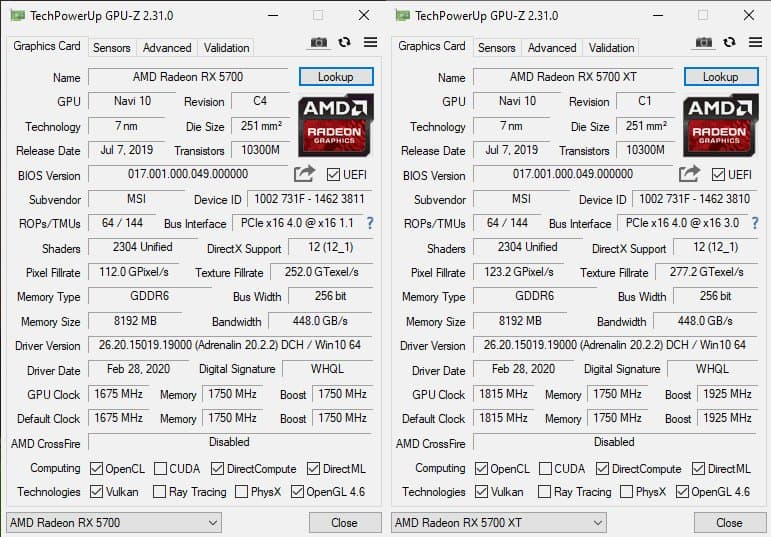
Having recently switched from NVIDIA to AMD graphic cards, in particular a RX 5700, I found out that I can get myself a free upgrade to the RX 5700 XT variant without paying one Yen, by simply flashing a compatible 5700 XT BIOS onto the 5700 card. Not that this is something new, a detailed explanation can be found here.
The same article also gives a detailed technical explanation on the difference between the two cards. The 5700 variant has less stream processors (2304 against 2560 in the XT variant), and lower power limits and clock speeds. Other than this they are based on the exact same chip layout (Navi 10), and with the same amount and type of memory 8 GB GDDR6. Flashing the XT BIOS onto the plain 5700 will not changes the number of stream processors, but power limits and clock speeds are raised to the same level of the 5700 XT, providing approximately a 7% gain without any over-clocking and over-powering, and potentially more by raising voltage etc. Detailed numbers can be found in the linked article above. The first step in this free upgrade is to identify ones own card correctly, best with device id and subsystem id, and then find the correct BIOS. Lots of BIOS dumps are provided in the BIOS database (link already restricting to 5700 XT BIOS). I used CPU-Z (Windows program) to determine this items, see image on the right (click to enlarge). In my case I got 1002 731F - 1462 3811 for the complete device id. The card is a MSI RX 5700 8 GB Mech OC, so I found the following alternative BIOS for MSI RX 5700 XT 8 GB Mech OC. Unfortunately, it seems that MSI is distinguishing 5700 and 5700 XT by their device id, because the XT variant gives 1002 731F - 1462 3810 for the complete device id, meaning that the last digit is 1 off compared to mine (3811 versus 3810). And indeed, trying to flash this video BIOS the normal way (using the Windows version ended in a warning that the subsystem id is different. A bit of search led to a thread in the TechPowerup Fora and this post explaining how to force the flashing in this case. Disclaimer: The following might brick your graphic card, you are doing this on your own risk! Necessary software: I did all the flashing and checking under Windows, but only because I realized too late that there is a fully uptodate flashing program for Linux that exhibits the same functionality. Also, I didn t know how to get the device id since the current AMD ROCm tools seem not to provide this data. If you are lucky and the device ids for your card are the same for both 5700 and 5700 XT variants, then you can use the graphical client (amdvbflashWin.exe), but if there is a difference, the command line is necessary. After unpacking the AMD Flash program and getting the correct BIOS rom file, the steps taken on Windows are (the very same steps can be taken on Linux): This should succeed in both cases. After that shutdown and restart your computer and you should be greeted with a RT 5700 XT card, without twisting a single screw. Starting Windows for the first time gave some flickering, because the driver for the new card was installed. On Linux the system auto-detects the card and everything works out of the box. Very smooth. Finally, a word of warning: Don t do these kind of things if you are not ready to pay the prize of a bricked GPU card in case something goes wrong! Everything is on your own risk! Let me close with a before/after image, most of the fields are identical, but the default/gpu clocks both at normal as well as boost levels see a considerable improvement

Lucas Kanashiro: Quarantine times

After quite some time without publishing anything here, I decided to share the latest events. It is a hard time for most of us but with all this time at home, one can also do great things. I would like to start with the wonderful idea the Debian Brasil community had! Why not create an online Debian related conference to keep people s minds busy and also share knowledge? After brainstorming, we came up with our online conference called #FiqueEmCasaUseDebian (in English it would be #StayHomeUseDebian). It started on May 3rd and will last until May 30th (yes, one month)! Every weekday, we have one online talk at night and on every Saturday, a Debian packaging workshop. The feedback so far has been awesome and the Brazilian Debian community is reaching out to more people than usual at our regular conferences (as you might have imagined, Brazil is huge and it is hard to bring people at the same place). At the end of the month, we will have the first MiniDebConf online and I hope it will be as successful as our experience here in Brazil. Another thing that deserves a highlight is the fact that I became an Ubuntu Core Developer this month; yay! After 9 months of working almost daily on the Ubuntu Server, I was able to get my upload rights to the Ubuntu archive. I was tired of asking for sponsorship, and probably my peers were tired of me too. I could spend more time here complaining about the Brazilian government but I think it isn t worth it. Let s try to do something useful instead!

14 May 2020

Iustin Pop: New internet provider

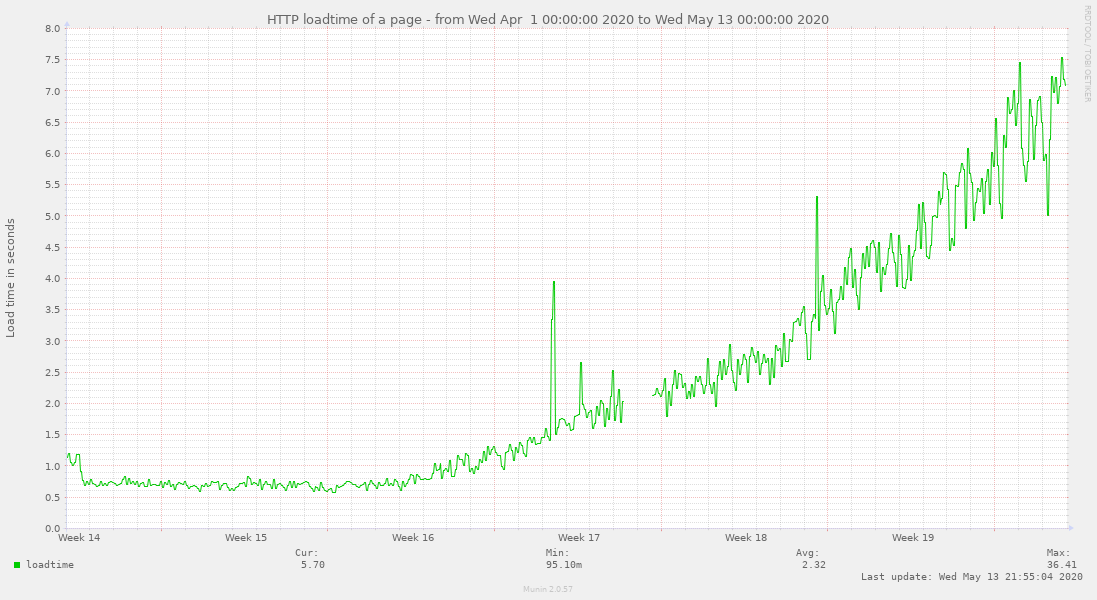
Note: all this is my personal experience, on my personal machines, and I don t claim it to be the absolute truth. Also, I don t directly call out names, although if you live in Switzerland it s pretty easy to guess who the old provider is from some hints. For a long time, I wanted to move away from my current (well, now past) provider, for a multitude of reasons. The main being that the company is very classic company, with classic support system, that doesn t work very well - I had troubles with their billing system that left me out cold without internet for 15 days, but for the recent few years, they were mostly OK, and changing to a different provider would have meant me routing a really long Ethernet cable around the apartment, so I kept postponing it. Yes, self-inflicted pain, I know. Until the entire work-from-home thing, when the usually stable connection start degrading in a very linear fashion day-by-day (this is a graph that basically reflects download bandwidth):
1+ month download bandwidth test 1+ month download bandwidth test
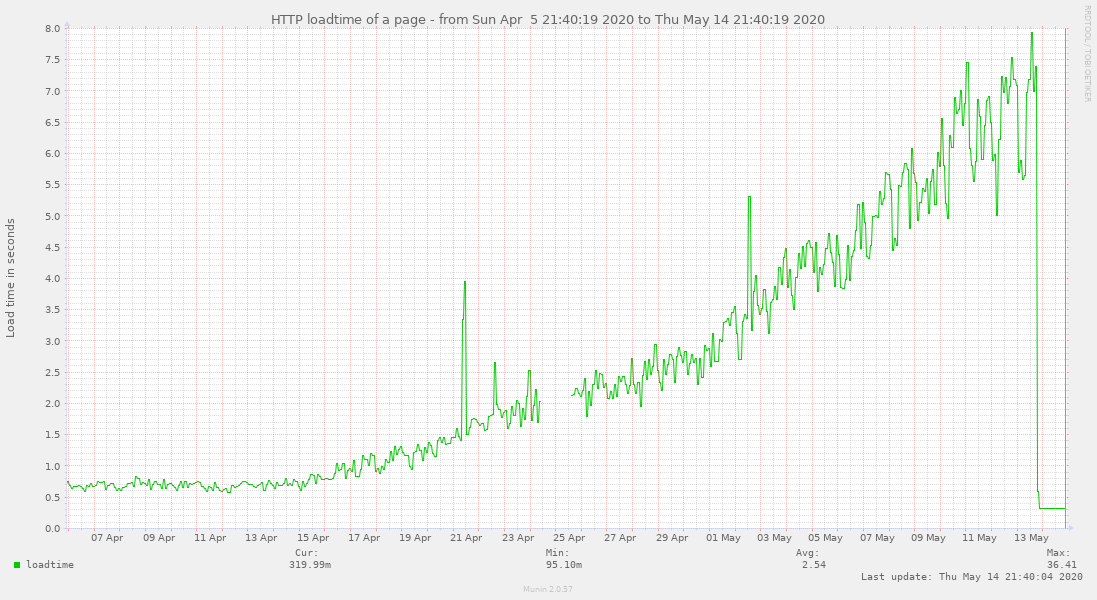
At first, I didn t realise this, as even 100Mbps is still fast enough. But once the connection went below (I believe) 50Mbps, it became visible in day to day work. And since I work daily from home yeah. Not fun. So I started doing speedtest.net - and oh my, ~20Mbps was a good result, usually 12-14Mbps. On a wired connection. On a connection that officially is supposed to be 600Mbps down. The upload speed was spot on, so I didn t think it was my router, but: Nothing helped. Once in a blue moon, speedtest would give me 100Mbps, but like once every two days, then it would be back and showing 8Mbps. Eight! It ended up as even apt update was tediously slow, and kernel downloads took ages The official instructions for dealing with bad internet are a joke: And the best part: If you are not satisfied with the results, read our internet optimisation guide. If you are still not happy, use our community forums or our social platforms. Given that it was a decline over 3-weeks, that I don t know of any computer component that would degrade this steadily but not throw any other errors, and that my upload speed was all good, I assumed it s the provider. Maybe I was wrong, but I wanted to do this anyway for a long while, so I went through the find how to route cable, check if other provider socket is good, order service, etc. dance, and less than a week later, I had the other connection. Now, of course, bandwidth works as expected:
1+ month updated bandwidth test 1+ month updated bandwidth test
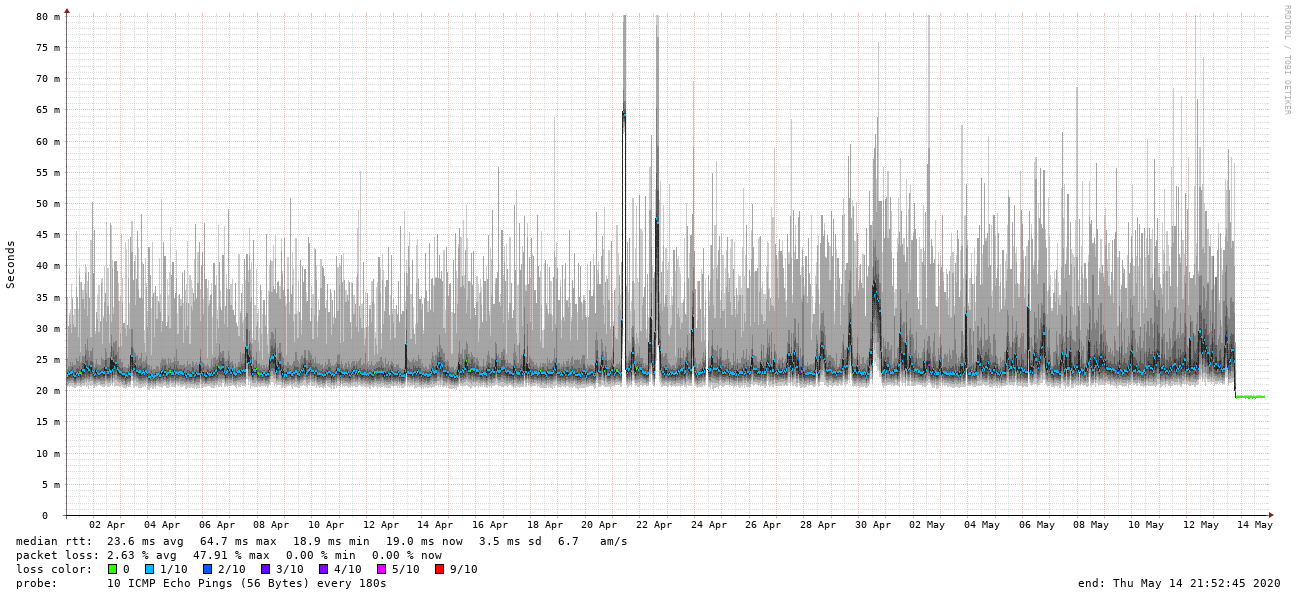
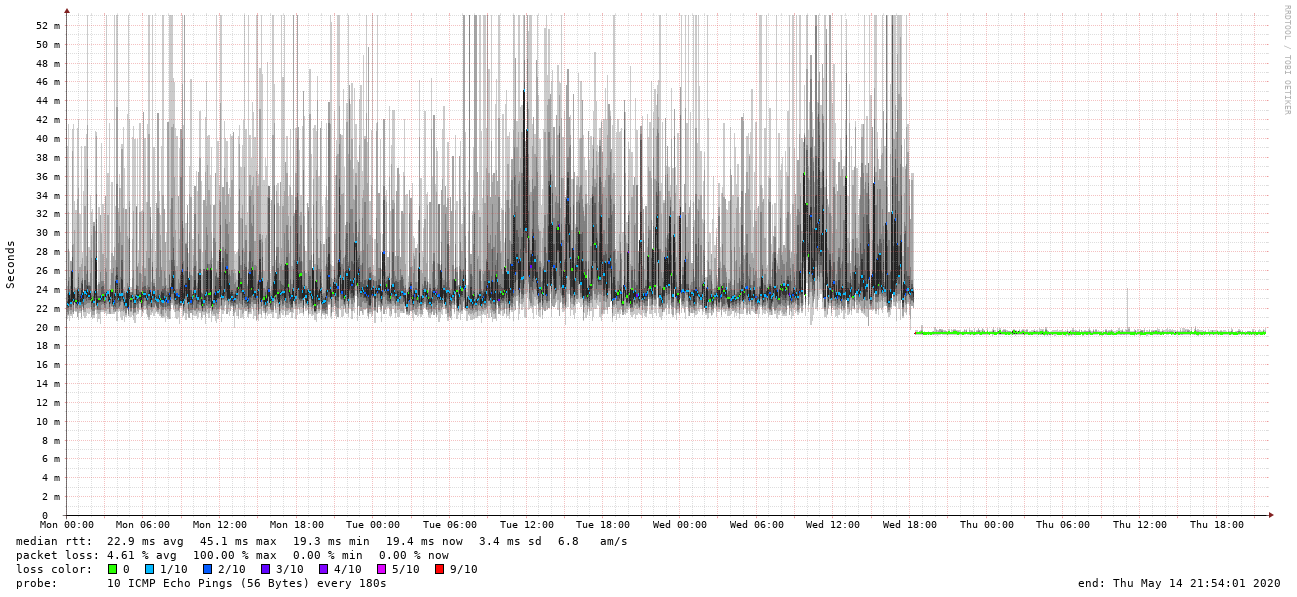
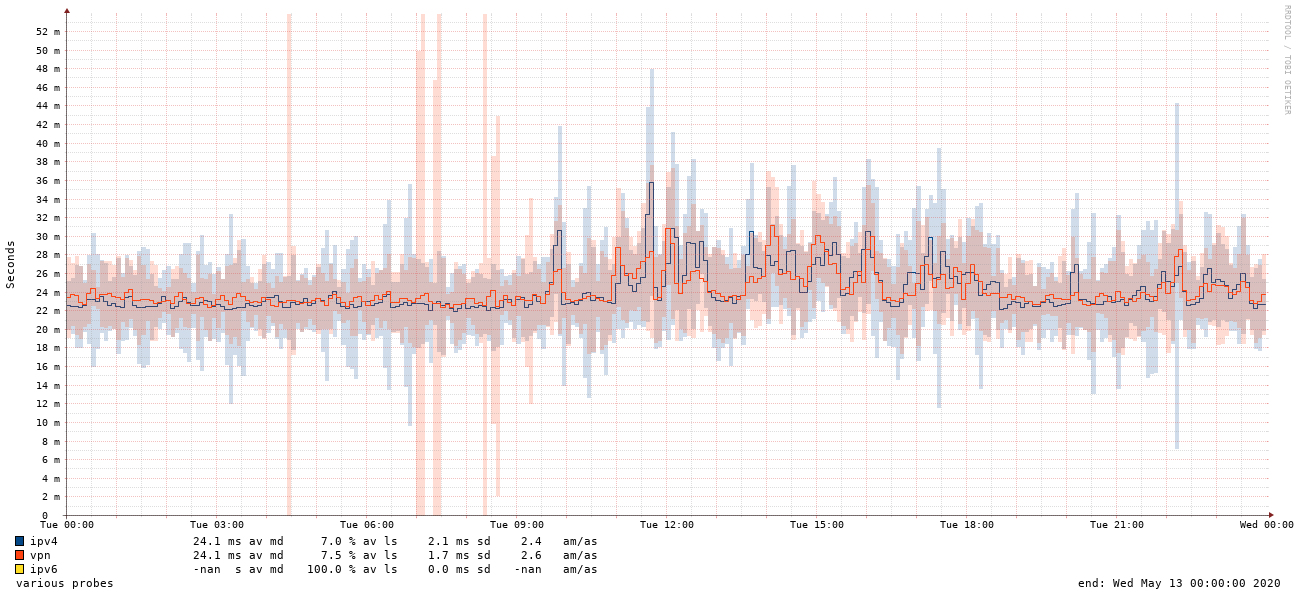
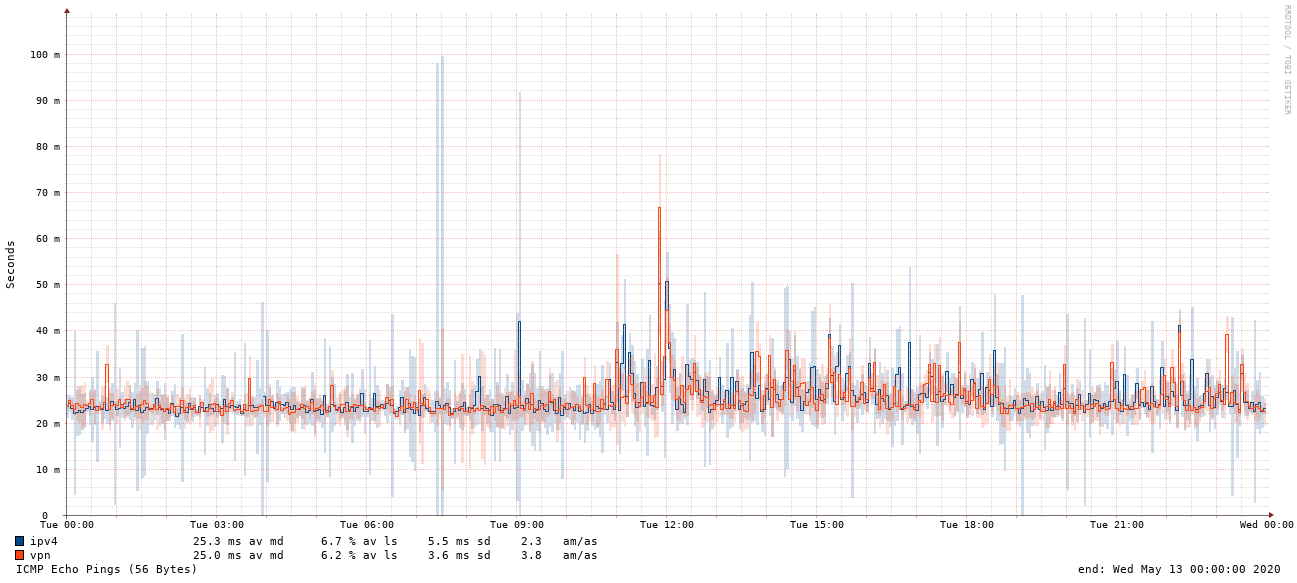
Both download and upload are fine (the graph above is just download). Latency is also much better, towards many parts of the internet that matter. But what is shocking is the difference in jitter to some external hosts I care about. On the previous provider, a funny thing was that both outgoing and incoming pings had both more jitter and packet loss when done directly (IPv4 to IPv4) than when done over a VPN. This doesn t make sense, since VPN is just overhead over IPv4, but the graphs show it, and what I think happens is that a VPN flow is cached in the provider s routers, whereas a simple ping packet not. But, the fact that there s enough jitter for a ping to a not-very-far host doesn t make me happy. Examples, outgoing:
Outgoing smokeping to public IPv4 Outgoing smokeping to public IPv4
Outgoing smokeping over VPN Outgoing smokeping over VPN
And incoming:
Incoming smokeping to public IPv4 Incoming smokeping to public IPv4
Incoming smokeping over VPN Incoming smokeping over VPN
Both incoming and outgoing show this weirdness - more packet loss and more jitter over VPN. Again, this is not a problem in practice, or not much, but makes me wonder what other shenanigans happen behind the scenes. You can also see clearly when the work from home traffic entered the picture and started significantly degrading my connection, even over the magically better VPN connection. Switching to this week s view shows the (in my opinion) dramatic improvement in consistency of the connection:
Outgoing current week smokeping to public IPv4 Outgoing current week smokeping to public IPv4
Outgoing current week smokeping over VPN Outgoing current week smokeping over VPN
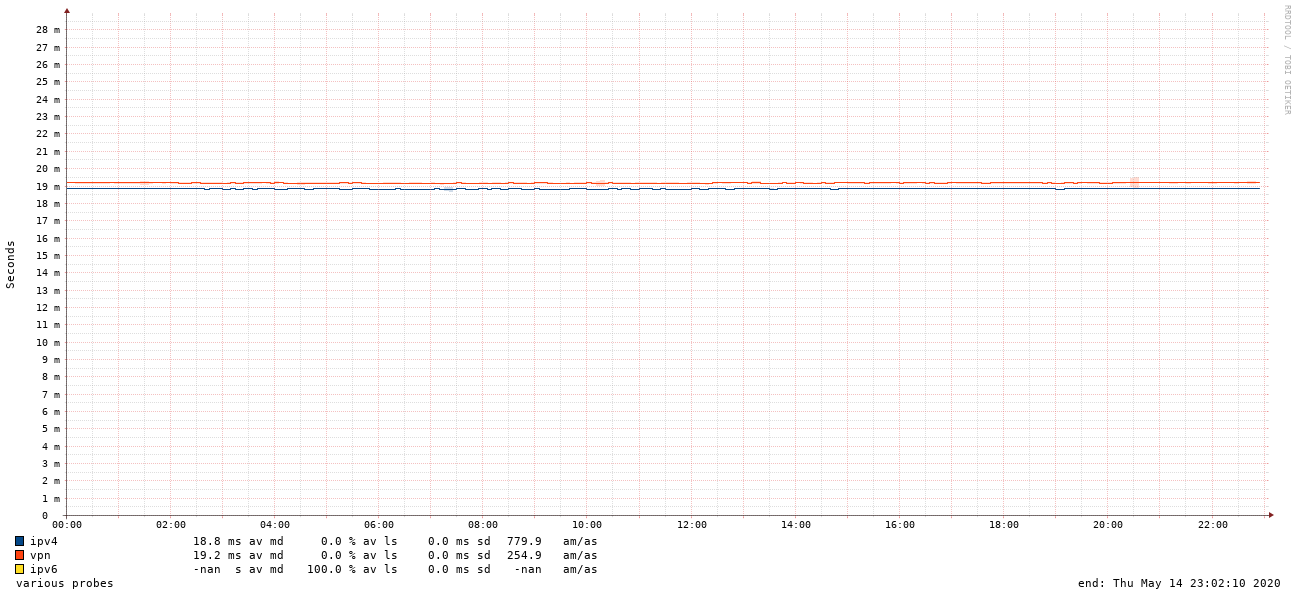
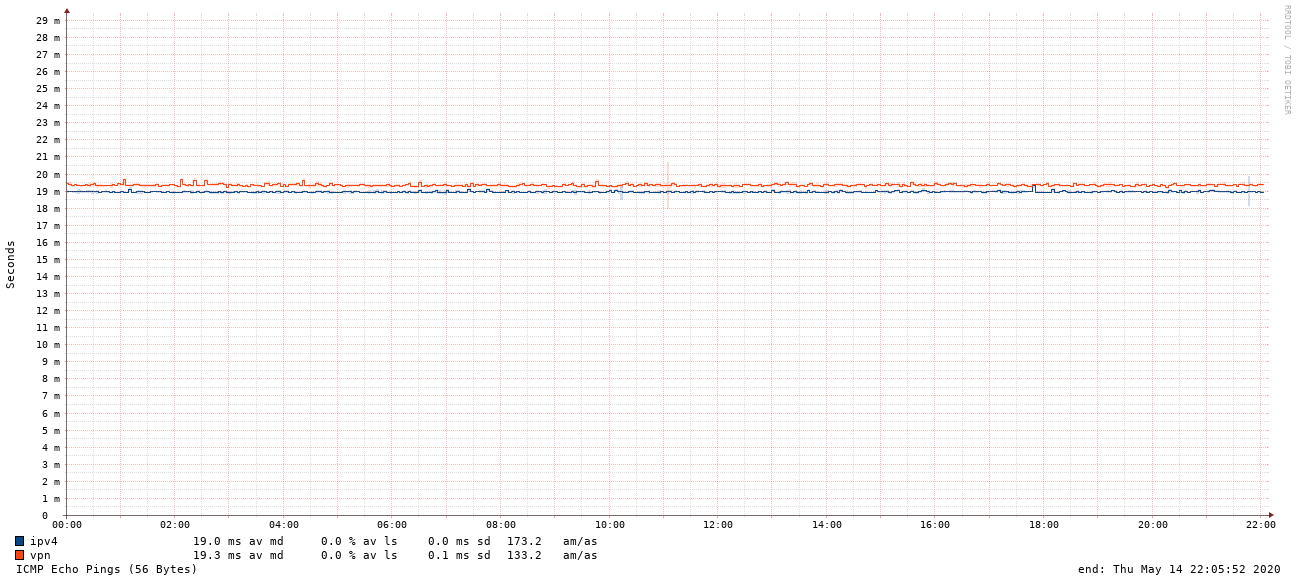
No more packet loss, no more jitter. You can also see my VPN being temporarily down during provider switchover because my firewall was not quite correct for a moment. And the last drill down, at high resolution, one day before and one day after switchover. Red is VPN, blue is plain IPv4, yellow is the missing IPv6 connection :) Incoming old:
Incoming 1-day smokeping, old provider Incoming 1-day smokeping, old provider
and new:
Incoming 1-day smokeping, new provider Incoming 1-day smokeping, new provider
Outgoing old:
Outgoing 1-day smokeping, old provider Outgoing 1-day smokeping, old provider
and new:
Outgoing 1-day smokeping, new provider Outgoing 1-day smokeping, new provider
This is what I expect, ping-over-VPN should of course be slower than plain ping. Note that incoming and outgoing have slightly different consistency, but that is fine for me :) The endpoints doing the two tests are different, so this is expected. Reading the legend on the graphs for the incoming connection (similar story for outgoing): So to my previous provider: it can be done better. Or at least, allow people easier ways to submit performance issue problems. For me, the moral of the story is that I should have switched a couple of years ago, instead of being lazy. And that I m curious to see how IPv6 traffic will differ, if at all :) Take care, everyone! And thanks for looking at these many graphs :)

13 May 2020

Mike Gabriel: Q: Remote Support Framework for the GNU/Linux Desktop?

TL;DR; For those (admins) of you who run GNU/Linux on staff computers: How do you organize your graphical remote support in your company? Get in touch, share your expertise and experiences. Researching on FLOSS based Linux Desktops When bringing GNU/Linux desktops to a generic folk of productive office users on a large scale, graphical remote support is a key feature when organizing helpdesk support teams' workflows. In a research project that I am currently involved in, we investigate the different available remote support technologies (VNC screen mirroring, ScreenCasts, etc.) and the available frameworks that allow one to provide a remote support infrastructure 100% on-premise. In this research project we intend to find FLOSS solutions for everything required for providing a large scale GNU/Linux desktop to end users, but we likely will have to recommend non-free solutions, if a FLOSS approach is not available for certain demands. Depending on the resulting costs, bringing forth a new software solution instead of dumping big money in subscription contracts for non-free software is seen as a possible alternative. As a member of the X2Go upstream team and maintainer of several remote desktop related tools and frameworks in Debian, I'd consider myself as sort of in-the-topic. The available (as FLOSS) underlying technologies for plumbing a remote support framework are pretty much clear (x11vnc, recent pipewire-related approaches in Wayland compositors, browser-based screencasting). However, I still lack a good spontaneous answer to the question: "How to efficiently software-side organize a helpdesk scenario for 10.000+ users regarding graphical remote support?". Framework for Remote Desktop in Webbrowsers In fact, in the context of my X2Go activities, I am currently planning to put together a Django-based framework for running X2Go sessions in a web browser. The framework that we will come up with (two developers have already been hired for an initial sprint in July 2020) will be designed to be highly pluggable and it will probably be easy to add remote support / screen sharing features further on. And still, I walk around with the question in mind: Do I miss anything? Is there anything already out there that provides a remote support solution as 100% FLOSS, that has enterprise grade, that up-scales well, that has a modern UI design, etc. Something that I simply haven't come across, yet? Looking forward to Your Feedback Please get in touch (OFTC/Freenode IRC, Telegram, Email), if you can fill the gap and feel like sharing your ideas and experiences. light+love
Mike

Next.

Previous.