Russ Allbery: Review: Oathblood
| Series: | Vows and Honor #3 |
| Publisher: | DAW |
| Copyright: | April 1998 |
| ISBN: | 0-88677-773-9 |
| Format: | Mass market |
| Pages: | 394 |
| Series: | Vows and Honor #3 |
| Publisher: | DAW |
| Copyright: | April 1998 |
| ISBN: | 0-88677-773-9 |
| Format: | Mass market |
| Pages: | 394 |
lookup()
ignore tracks without URI.volume command.feature/gst1 branch is complete as far as I know. There are no known
regressions from Mopidy 1.1.2. PR
#1419 is hopefully the last
iteration of the pull request and GStreamer 1.x support will land in Mopidy
1.2.
A problem of interpretation?
December 14th, 1900 is known as the date of birth of quantum physics. In fact, that day Max Planck presented his report to the German Physical Society in Berlin, in which he argued that the exchange of energy in the phenomena of emission and absorption of electromagnetic radiation occurs in discrete form, not in continuous form as claimed by electromagnetic classic theory.
It was like opening a door to a new universe, that of subatomic particles. In a few decades it was learned that the basis of the strength of the real world around us (people, objects, plants, animals, etc.) is a joyful swarm of tiny particles distributed in clouds of probability, essentially surrounded by empty space. A shocking and apparently incomprehensible reality for the man of the 900: how could that still solid rock actually contain billions of microscopic objects in motion?
With the passing of the years, the road was covered deeper and deeper, revealing ever smaller particles for which new unknown names were coined: Leptons, Gluons, Quarks, Neutrinos, Fermions, Bosons, and so on until
<Read More >
Address space layout
randomization
helps to protect against buffer overflow attacks as it becomes harder for an
attacker to turn a programming error into an exploitable security hole. The
first implementation for Linux is 15 years old. Support in mainline kernel and
toolchains have been available for a good while now. But to work, ASLR also
needs executables to be built as position
independent. And
as Hanno B ck from the fuzzing project gently
reminded me at 32C3, almost no
executables in Debian are built as such, while it is now the default in
Windows, Mac OS X,
OpenBSD, and
Fedora to name
just a few other systems.
PIE has the reputation of having a performance hit. While true, especially for
register constrained architectures like i386, it makes a difference only for
the executable itself, not any shared library it uses as they are already
built as position independent. Also, several optimizations have been made since
the early days. GCC 5 will reuse the PIC
hard register (which is also good for libraries). On amd64, GCC 5 and binutils
2.26 will do copy
relocations.
More improvements for i386 are being
worked on.
I sincerly believe that users are way more likely to notice a compromised
system than a slightly slower one.
debian/rules:
export DEB_BUILD_MAINT_OPTIONS = hardening=+all
You can even test if a package supports all hardening flags without any changes
running DEB_BUILD_OPTIONS=hardening=+all dpkg-buildpackage. Running lintian
or
hardening-check
can then tell you if the protections have been successfully enabled.
pie and
bindnow. Could we turn them by default and do
binNMUs instead of requiring actions from
maintainers?
I guess the question boils down to: how many packages would require a
(one-liner) change to turn off the pie or bindnow features if they were on by
default?
To get the beginning of an answer, I took the top 502
(according to popcon installations) source
packages shipping non-position independent executables. I've try to rebuild them
enabling all hardening flags through DEB_BUILD_OPTIONS.
Out of 49 packages3:
acpi, bc, bind9, bsd-mailx, bsdmainutils, bzip2, cpio, cron, debianutils, diffutils, dpkg, file, fontconfig, gettext, glib2.0, glibc, gnupg, gzip, hostname, ifupdown, iputils, logrotate, m4, mutt, nano, net-tools, netcat, netkit-ftp, netkit-telnet, os-prober, pam, util-linux.discover, mawk, mlocate, patch.*-static or GRUB: bash, busybox, coreutils, e2fsprogs, grub2, insserv, iptables, kbd, ncurses, newt, openssl, pciutils, perl.DEB_BUILD_OPTIONS=hardening=+all in the environment. Any takers?
SELECT packages.source, MAX(popcon.insts) AS insts
FROM lintian, popcon, packages
WHERE lintian.tag = 'hardening-no-pie'
AND lintian.package_arch = 'amd64'
AND popcon.package = lintian.package
AND packages.package = popcon.package
AND packages.distribution = 'debian'
AND packages.release = 'sid'
GROUP BY packages.source
ORDER BY MAX(popcon.insts) DESC
LIMIT 50;
#ooni IRC channel. Tor also works fine, and could be a great way
to avoid the global surveillance system described later in this
article.
Nevertheless, it still remains to be seen how the internet is censored
in the "real" Cuban internet, outside of the tourist designated
areas - hopefully future visitors or locals can expand on this using
the tools mentioned above, using the regular internet.
Usual care should be taken when using any workaround tools, mentioned
in this post or not, as different regimes over the world have accused,
detained, tortured and killed sometimes for the mere fact of using or
distributing circumvention tools. For example, a Russian developer
was arrested and detained in 2001 by United States' FBI for
exposing vulnerabilities in the Adobe e-books copy protection
mechanisms. Similarly, people distributing Tor and other tools have
been arrested during the period prior to the revolution in Tunisia.
--- 10.0.0.1 ping statistics ---
163 packets transmitted, 31 received, 80% packet loss, time 162391ms
rtt min/avg/max/mdev = 133.700/2669.535/64188.027/11257.336 ms, pipe 65
Still, it allowed me to login to my home server through SSH using
Mosh to workaround the reliability issues.
Every once in a while, mosh would get stuck and keep on trying to send
packets to probe the server, which would clog the connection even
more. So I regularly had to restart the whole stack using these
commands:
killall iodine # stop DNS tunnel
nmcli n off # turn off wifi to change MAC address
macchanger -A wlan0 # change MAC address
nmcli n on # turn wifi back on
sleep 3 # wait for wifi to settle
iodine-client-start # restart DNS tunnel
The Koumbit Wiki has good instructions on
how to setup a DNS tunnel. I am wondering if such a public service
could be of use for Cubans, although I am not sure how it could be
deployed only for Cubans, and what kind of traffic it could
support... The fact is that iodine does require a server to
operate, and that server must be run on the outside of the censored
perimeter, something that Cubans may not be able to afford in the
first place.
Another possible way to save money with the captive portal would be to
write something that automates connecting and disconnecting from the
portal. You would feed that program a list of credentials and it would
connect to the portal only on demand, and disconnect as soon as no
traffic goes through. There are details on the implementation of the
captive portal below that may help future endeavours in that field.
Wifi_Memories_Jibacoa which, for anyone that cares to research, will
give them a location of about 20 square meters where I was located
when connected (there is only one access point in the whole hotel).
Finally, the central portal also knows my MAC address,
a unique identifier for the computer I am using which also reveals
which brand of computer I am using (Mac, Lenovo, etc). While this
address can be changed, very few people know that, let alone how.
This led me to question whether I would be allowed back in Cuba (or
even allowed out!) after publishing this blog post, as it is obvious
that I can be easily identified based on the time this article was
published, my name and other details. Hopefully the Cuban government
will either not notice or not care, but this can be a tricky
situation, obviously. I have heard that Cuban prisons are not the best
hangout place in Cuba, to say the least...
[1034]anarcat@angela:cuba$ speedtest
Retrieving speedtest.net configuration...
Retrieving speedtest.net server list...
Testing from Empresa de Telecomunicaciones de Cuba (152.206.92.146)...
Selecting best server based on latency...
Hosted by LIME (George Town) [391.78 km]: 317.546 ms
Testing download speed........................................
Download: 1.01 Mbits/s
Testing upload speed..................................................
Upload: 1.00 Mbits/s
Latency to the rest of the world is of couse slow:
--- koumbit.org ping statistics ---
122 packets transmitted, 120 received, 1,64% packet loss, time 18731,6ms
rtt min/avg/max/sdev = 127,457/156,097/725,211/94,688 ms
--- google.com ping statistics ---
122 packets transmitted, 121 received, 0,82% packet loss, time 19371,4ms
rtt min/avg/max/sdev = 132,517/160,095/724,971/93,273 ms
--- redcta.org.ar ping statistics ---
122 packets transmitted, 120 received, 1,64% packet loss, time 40748,6ms
rtt min/avg/max/sdev = 303,035/339,572/965,092/97,503 ms
--- ccc.de ping statistics ---
122 packets transmitted, 72 received, 40,98% packet loss, time 19560,2ms
rtt min/avg/max/sdev = 244,266/271,670/594,104/61,933 ms
Interestingly, Koumbit is actually the closest host in the above
test. It could be that Canadian hosts are less affected by bandwidth
problems compared to US hosts because of the embargo.
traceroute to koumbit.net (199.58.80.33), 30 hops max, 60 byte packets
1 10.156.41.1 (10.156.41.1) 9.724 ms 9.472 ms 9.405 ms
2 192.168.134.137 (192.168.134.137) 16.089 ms 15.612 ms 15.509 ms
3 172.31.252.113 (172.31.252.113) 15.350 ms 15.805 ms 15.358 ms
4 pos6-0-0-agu-cr-1.mpls.enet.cu (172.31.253.197) 15.286 ms 14.832 ms 14.405 ms
5 172.31.252.29 (172.31.252.29) 13.734 ms 13.685 ms 14.485 ms
6 200.0.16.130 (200.0.16.130) 14.428 ms 11.393 ms 10.977 ms
7 200.0.16.74 (200.0.16.74) 10.738 ms 10.019 ms 10.326 ms
8 ix-11-3-1-0.tcore1.TNK-Toronto.as6453.net (64.86.33.45) 108.577 ms 108.449 ms
Let's take this apart line by line:
1 10.156.41.1 (10.156.41.1) 9.724 ms 9.472 ms 9.405 ms
This is my local gateway, probably the hotel's wifi router.
2 192.168.134.137 (192.168.134.137) 16.089 ms 15.612 ms 15.509 ms
This is likely not very far from the local gateway, probably still in
Cuba. It in one bit away from the captive portal IP address (see
below) so it is very likely related to the captive portal implementation.
3 172.31.252.113 (172.31.252.113) 15.350 ms 15.805 ms 15.358 ms
4 pos6-0-0-agu-cr-1.mpls.enet.cu (172.31.253.197) 15.286 ms 14.832 ms 14.405 ms
5 172.31.252.29 (172.31.252.29) 13.734 ms 13.685 ms 14.485 ms
All those are withing RFC 1918 space. Interestingly, the Cuban
DNS servers resolve one of those private IPs as within Cuban
space, on line #4. That line is interesting because it reveals the
potential use of MPLS.
6 200.0.16.130 (200.0.16.130) 14.428 ms 11.393 ms 10.977 ms
7 200.0.16.74 (200.0.16.74) 10.738 ms 10.019 ms 10.326 ms
Those two lines are the only ones that actually reveal that the route
belongs in Cuba at all. Both IPs are in a tiny (/24, or 256 IP
addresses) network allocated to ETECSA, the state telco
in Cuba:
inetnum: 200.0.16/24
status: allocated
aut-num: N/A
owner: EMPRESA DE TELECOMUNICACIONES DE CUBA S.A. (IXP CUBA)
ownerid: CU-CUBA-LACNIC
responsible: Rafael L pez Guerra
address: Ave. Independencia y 19 Mayo, s/n,
address: 10600 - La Habana - CH
country: CU
phone: +53 7 574242 []
owner-c: JOQ
tech-c: JOQ
abuse-c: JEM52
inetrev: 200.0.16/24
nserver: NS1.NAP.ETECSA.NET
nsstat: 20160123 AA
nslastaa: 20160123
nserver: NS2.NAP.ETECSA.NET
nsstat: 20160123 AA
nslastaa: 20160123
created: 20030512
changed: 20140610
Then the last hop:
8 ix-11-3-1-0.tcore1.TNK-Toronto.as6453.net (64.86.33.45) 108.577 ms 108.449 ms 108.257 ms
...interestingly, lands directly in Toronto, in this case going later
to Koumbit but that is the first hop that varies according to the
destination, hops 1-7 being a common trunk to all external
communications. It's also interesting that this shoves a good 90
milliseconds extra in latency, showing that a significant distance and
number of equipment crossed. Yet a single hop is crossed, not showing
the intermediate step of the Venezuelan link or any other links for
that matter. Something obscure is going on there...
Also interesting to note is the traceroute to the redirection host,
which is only one hop away:
traceroute to 192.168.134.138 (192.168.134.138), 30 hops max, 60 byte packets
1 192.168.134.138 (192.168.134.138) 6.027 ms 5.698 ms 5.596 ms
Even though it is not the gateway:
$ ip route
default via 10.156.41.1 dev wlan0 proto static metric 1024
10.156.41.0/24 dev wlan0 proto kernel scope link src 10.156.41.4
169.254.0.0/16 dev wlan0 scope link metric 1000
This means a very close coordination between the different access
points and the captive portal system. Finally, note that there seems
to be only three peers to the Cuban internet:
Teleglobe, formerly Canadian, now owned by the Indian
[[!wiki Tata group]], and Telef nica, the Spanish Telco
that colonized most of Latin America's internet, all the way down to
Argentina. This is confirmed by my traceroutes, which show traffic to
Koumbit going through Tata and Google's going through Telef nica.
190.6.81.230 in the hotel.
Accessing http://1.1.1.1/ gives you a status page which allows you
to disconnect from the portal. It actually redirects you to
https://192.168.134.138/logout.user. That is also a
self-signed, but different certificate. That
certificate actually reveals the implication of Gemtek which is a
"world-leading provider of Wireless Broadband solutions, offering a
wide range of solutions from residential to business". It is somewhat
unclear if the implication of Gemtek here is deliberate or a
misconfiguration on the part of Cuban officials, especially since the
certificate is self-signed and was issued in 2002. It could be,
however, a trace of the supposed involvement of China in the
development of Cuba's networking systems, although Gemtek is based in
Taiwan, and not in the China mainland.
That IP, in turn, redirects you to the same portal but in a page that
shows you the statistics:
https://www.portal-wifi-temas.nauta.cu/?mac=0024D1717D18&script=logout.user&remain_time=00%3A55%3A52&session_time=00%3A04%3A08&username=151003576287&clientip=10.156.41.21&nasid=Wifi_Memories_Jibacoa&r=ac%2Fpopup
Notice how you see the MAC address of the machine in the URL
(randomized, this is not my MAC address), along
with the remaining time, session time, client IP and the Wifi access
point ESSID. There may be some potential in defrauding the session
time there, I haven't tested it directly.
Hitting Actualizar redirects you back to the IP address, which
redirects you to the right URL on the portal. The "real" logout is at:
http://192.168.134.138/logout.user?cmd=logout
The login is performed against
https://www.portal-wifi-temas.nauta.cu/index.php?r=ac/login with a
referer of:
https://www.portal-wifi-temas.nauta.cu/?&nasid=Wifi_Memories_Jibacoa&nasip=192.168.134.138&clientip=10.156.41.21&mac=EC:55:F9:C5:F2:55&ourl=http%3a%2f%2fgoogle.ca%2f&sslport=443&lang=en-US%2cen%3bq%3d0.8&lanip=10.156.41.1
Again, notice the information revealed to the central portal.
www.portal-wifi-temas.nauta.cu, 190.6.81.230)192.168.134.138)10.156.41.1)2.4.21 and 2.4.31. Now, to
find out which version of Linux it is running is way more challenging,
and it is possible it is just some custom Linux distribution. Indeed,
the webserver shows up as G4200.GSI.2.22.0155 and the SSH server is
running OpenSSH 3.0.2p1, which is basically prehistoric (2002!)
which corroborates the idea that this is some Gemtek embedded device.
The fact that those devices are running 14 years old software should
be a concern to the people responsible for those networks. There is,
for example, a remote root vulnerability that affects that
specific version of OpenSSH, among
many other vulnerabilities.
15100, the
following digits being 3576 or 4595, presumably depending on the
"batch" that was sent to different hotels, which seems to be batches
of 1000 cards. You can also correlate the UID with the date at which
the card was issued. For example, 15100357XXX cards are all valid
until 19/03/2017, and 151004595XXX cards are all valid until
23/03/2017. Here's the list of UIDs I have seen:
151004595313
151004595974
151003576287
151003576105
151003576097
The passwords, on the other hand, do seem fairly random (although my
sample size is small). Interestingly, those passwords are also 12
digits long, which is about as strong as a seven-letter password
(mixed uppercase and lowercase). If there are no rate-limiting
provisions on that captive portal, it could be possible to guess
those passwords, since you have free rein on accessing those
routers. Depending on the performance of the routers, you could be
lucky and find a working password for free...
After an usually long hiatus, the RcppExamples package has been updated once more: a new version 0.1.7 is now on CRAN.
The RcppExamples provides a handful of short examples detailing by concrete working examples how to set up basic R data structures in C++. In this version, essentially all files (C++, R as well as manual pages) were refreshed, along with the usual set of small changes to bring the package to current R CMD check standards.
A NEWS extract follows:
Changes in RcppExamples version 0.1.7 (2016-01-23)Courtesy of CRANberries, there is also a diffstat report for the most recent release.
- All examples were updated to use Rcpp Attributes and (where possible) use
const &interfaces.- Updated
DESCRIPTIONfor currentR CMD checkstandards- The Rcpp package is now imported rather than depended upon.
- Added
README.mdas well as.travis.yml.- Also updated and refreshed all manual pages and R files.
This post by Dirk Eddelbuettel originated on his Thinking inside the box blog. Please report excessive re-aggregation in third-party for-profit settings.
While I'm not convinced that encrypting everything by default is
necessarily a good idea, it is certainly true that encryption has its
uses. Unfortunately, for the longest time getting an SSL certificate
from a CA was quite a hassle -- and then I'm not even mentioning the
fact that it would cost money, too. In that light, the letsencrypt
project is a useful alternative: rather than having to dabble with
emails or webforms, letsencrypt does everything by way of a few scripts.
Also, the letsencrypt CA is free to use, in contrast to many other
certificate authorities.
Of course, once you start scripting, it's easy to overdo it. When you go
to the letsencrypt website and try to install their stuff, they point
you to a "letsencrypt-auto" thing, which starts installing a python
virtualenv and loads of other crap, just so we can talk to a server
and get a certificate properly signed. I'm sure that makes sense for
some people, and I'm also sure it makes some things significantly
easier, but honestly, I think it's a bit overkill. Luckily, there is
also a regular letsencrypt script that doesn't do all the virtualenv
stuff, and which is already packaged for
Debian, so
installing that gets us rid of the overkill bits. It's not in stable,
but it is an arch:all package. Unfortunately, not all dependencies are
available in Jessie, but backporting it turned out to be not too complicated.
Once the client is installed, you need to get it to obtain a
certificate, and you need to have the certificate be activated for your
webserver. By default, the letsencrypt client will update your server
configuration for you, and run a temporary webserver, and do a whole lot
of other things that I would rather not see it do. The good news,
though, is that you can switch all that off. If you're willing to let it
write a few files to your DocumentRoot, it can do the whole thing
without any change to your system:
letsencrypt certonly -m <your mailaddress> --accept-tos --webroot -w \
/path/to/DocumentRoot -d example.com -d www.example.com
In that command, the -m option (with mail address) and the
--accept-tos option are only required the first time you ever run
letsencrypt. Doing so creates an account for you at letsencrypt.org,
without which you cannot get any certificates. The --accept-tos
option specifies that you accept their terms of
service, which you might want to
read first before blindly accepting.
If all goes well, letsencrypt will tell you that it wrote your account
information and some certificates somewhere under /etc/letsencrypt.
All that's left is to update your webserver configuration so that the
certificates are actually used. No, I won't tell you how that's done --
if you need that information, it's probably better if you just use the
apache or nginx plugin of letsencrypt, which updates your webserver's
configuration automatically. But if you already know how to do so, and
prefer to maintain your configuration by yourself, then it's good to
know that it is at least possible.
Since we specified two -d parameters, the certificate you get from the
letsencrypt CA will have subjectAlternativeName fields, allowing you to
use them for more than one domain name. I specified example.com
and www.example.com as the valid names, but there is nothing in
letsencrypt requiring that the domain names you specify share a
suffix; so yes, it is certainly possible to have multiple domains on a
single certificate, if you want that.
Finally, you need to ensure that your certificates are renewed before
they expire. The easiest way to do that is to add a cronjob, which runs
letsencrypt again; only this time, you'll need slightly different
options:
letsencrypt certonly --renew-by-default --webroot -w \
/path/to/DocumentRoot -d domain.name.tld -d www.domain.name.tld
The --renew-by-default option tells letsencrypt that you want to
renew your certificates, not create new ones. If you specify this, the
old certificate will be revoked, and a new one will be generated, again
with three months validity. The symlinks under /etc/letsencrypt/live
will be updated, so if your webserver's configuration uses those as the
path to your certificates, you don't need to update any configuration
files (although you may need to restart your webserver). You'll also
notice that the -m and --accept-tos options are not specified this
time around; this is because those are only required when you want to
create an account -- once that step has been taken, letsencrypt will
read the necessary information from its configuration files (and
creating a new account for every renewal is just silly).
With that, you now have a working, browser-trusted, certificate.
Update: fix mistake about installing on Jessie. It's possible (I've
done so), but it's been a while and I forgot that I had to recompile
several of letsencrypt's dependencies in order for it to be
installable.

The phone company logs provide a register of locations to check out
when one want to figure out what the tracked person was doing. It is
unavailable for most of us, but provided to selected government
officials, company staff, those illegally buying information from
unfaithful servants and crackers stealing the information. But the
public information can be collected and analysed, and a free software
tool to do so is called
Creepy or Cree.py. I
discovered it when I read
an
article about Creepy in the Norwegian newspaper Aftenposten i
November 2014, and decided to check if it was available in Debian.
The python program was in Debian, but
the version in
Debian was completely broken and practically unmaintained. I
uploaded a new version which did not work quite right, but did not
have time to fix it then. This Christmas I decided to finally try to
get Creepy operational in Debian. Now a fixed version is available in
Debian unstable and testing, and almost all Debian specific patches
are now included
upstream.
The Creepy program visualises geolocation information fetched from
Twitter, Instagram, Flickr and Google+, and allow one to get a
complete picture of every social media message posted recently in a
given area, or track the movement of a given individual across all
these services. Earlier it was possible to use the search API of at
least some of these services without identifying oneself, but these
days it is impossible. This mean that to use Creepy, you need to
configure it to log in as yourself on these services, and provide
information to them about your search interests. This should be taken
into account when using Creepy, as it will also share information
about yourself with the services.
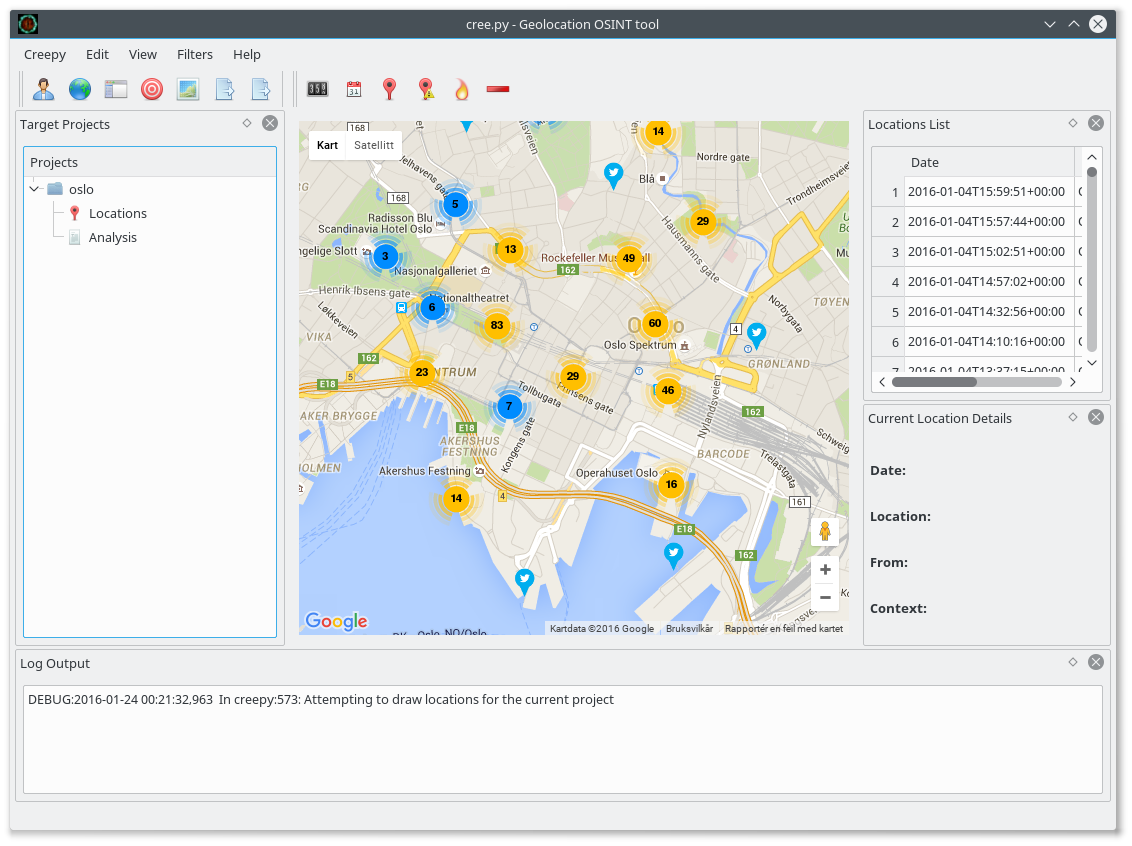
The picture above show the twitter messages sent from (or at least
geotagged with a position from) the city centre of Oslo, the capital
of Norway. One useful way to use Creepy is to first look at
information tagged with an area of interest, and next look at all the
information provided by one or more individuals who was in the area.
I tested it by checking out which celebrity provide their location in
twitter messages by checkout out who sent twitter messages near a
Norwegian TV station, and next could track their position over time,
making it possible to locate their home and work place, among other
things. A similar technique have been
used
to locate Russian soldiers in Ukraine, and it is both a powerful
tool to discover lying governments, and a useful tool to help people
understand the value of the private information they provide to the
public.
The package is not trivial to backport to Debian Stable/Jessie, as
it depend on several python modules currently missing in Jessie (at
least python-instagram, python-flickrapi and
python-requests-toolbelt).
(I have uploaded
the image to
screenshots.debian.net and licensed it under the same terms as the
Creepy program in Debian.)
A new minor release of RcppEigen is now on CRAN and in Debian. It primarily upgrades to the recent 3.2.7 release of Eigen -- thanks once again to fine work by Yixuan Qiu. We also have one additonal PR by Alexey Stukalow who ensured that the fastLm() example will work fine with when the Intel MKL is used.
The NEWS file entry follows.
Changes in RcppEigen version 0.3.2.7.0 (2016-01-18)Courtesy of CRANberries, there is also a diffstat report for the most recent release.
- Updated to version 3.2.7 of Eigen
- The fastLm example will not include the Lapack header if MKL is defined (thanks to PR #25 by Alexey Stukalow)
This post by Dirk Eddelbuettel originated on his Thinking inside the box blog. Please report excessive re-aggregation in third-party for-profit settings.
Bradley White from the upstream CCTZ team prepared some more changes in CCTZ itself -- so a new RcppCCTZ version got to CRAN the other day catching up with these changes.
CCTZ is a C++ library for translating between absolute and civil times using the rules of a time zone. It requires only a proper C++11 compiler and the standard IANA time zone data base which standard Unix, Linux, OS X, ... computers tend to have in /usr/share/zoneinfo. RcppCCTZ connects this library to R by relying on Rcpp.
Changes in this version are summarized here:
Changes in version 0.0.3 (2016-01-17)We also have a diff to the previous version thanks to CRANberries. More details, issue tickets etc at the GitHub repository.
- Synchronized with
CCTZupstream.
This post by Dirk Eddelbuettel originated on his Thinking inside the box blog. Please report excessive re-aggregation in third-party for-profit settings.
Version 6 of git-annex, released last week, adds a major new feature;
support for unlocked large files that can be edited as usual and committed
using regular git commands.
For example:
git init
git annex init --version=6
mv ~/foo.iso .
git add foo.iso
git commit -m "added hundreds of megabytes to git annex (not git)"
git remote add origin ssh://sever/dir
git annex sync origin --content # uploads foo.iso
Compare that with how git-annex has worked from the beginning, where
git annex add is used to add a file, and then the file is locked,
preventing further modifications of it. That is still a very useful way to
use git-annex for many kinds of files, and is still supported of course.
Indeed, you can easily switch files back and forth between being locked and
unlocked.
This new unlocked file mode uses git's smudge/clean filters, and I was
busy developing it all through December. It started out playing
catch-up with git-lfs somewhat, but
has significantly surpassed it now in several ways.
So, if you had tried git-annex before, but found it didn't meet your needs,
you may want to give it another look now.
.git/lfs/objects/.
One of the main reasons git-annex used locked files, from the very
beginning, was to avoid that second copy. A second local copy of a large
file can be too expensive to put up with. When I added unlocked files in
git-annex v6, I found it needed a second copy of them, same as git-lfs
does. That's the default behavior. But, I decided to complicate
git-annex with a config setting:
git config annex.thin true
git annex fix
Run those two commands, and now only one copy is needed for unlocked files!
How's it work? Well, it comes down to hard links. But there is a tradeoff here,
which is why this is not the default: When you edit a file, no local backup is
preserved of its old content. So you have to make sure to let git-annex
upload files to another repository before editing them or the old version
could get lost. So it's a tradeoff, and maybe it could be improved.
(Only thin out a file after a copy has been uploaded?)
This adds a small amount of complexity to git-annex, but I feel it's well
worth it to let unlocked files use half the disk space. If the git-lfs
developers are reading this, that would probably be my first suggestion
for a feature to consider adding to git-lfs. I hope for more opportunities
to catch-up to git-lfs in turn.
If you have more sources listed in /etc/apt/sources.list.d/, run the sed commands for these too. The sed command is assuming your are using the ftp.debian.org Debian mirror. Adjust the command (or just edit the file manually) to match your mirror. This work in Debian Jessie and later. Note that tools like apt-file only recently started using the apt transport system, and do not work with these tor+http URLs. For apt-file you need the version currently in experimental, which need a recent apt version currently only in unstable. So if you need a working apt-file, this is not for you. Another advantage from this change is that your machine will start using Tor regularly and at fairly random intervals (every time you update the package lists or upgrade or install a new package), thus masking other Tor traffic done from the same machine. Using Tor will become normal for the machine in question. On Freedombox, APT is set up by default to use apt-transport-tor when Tor is enabled. It would be great if it was the default on any Debian system.apt install apt-transport-tor sed -i 's% http://ftp.debian.org/%tor+http://vwakviie2ienjx6t.onion/%' /etc/apt/sources.list sed -i 's% http% tor+http%' /etc/apt/sources.list
What happened in the reproducible
builds effort between January 3rd and January 9th 2016:
--fix-autoload-date option (on by default) to take autoload dates from changelog.
Lunar updated and sent the patch adding the generation of .buildinfo to dpkg.
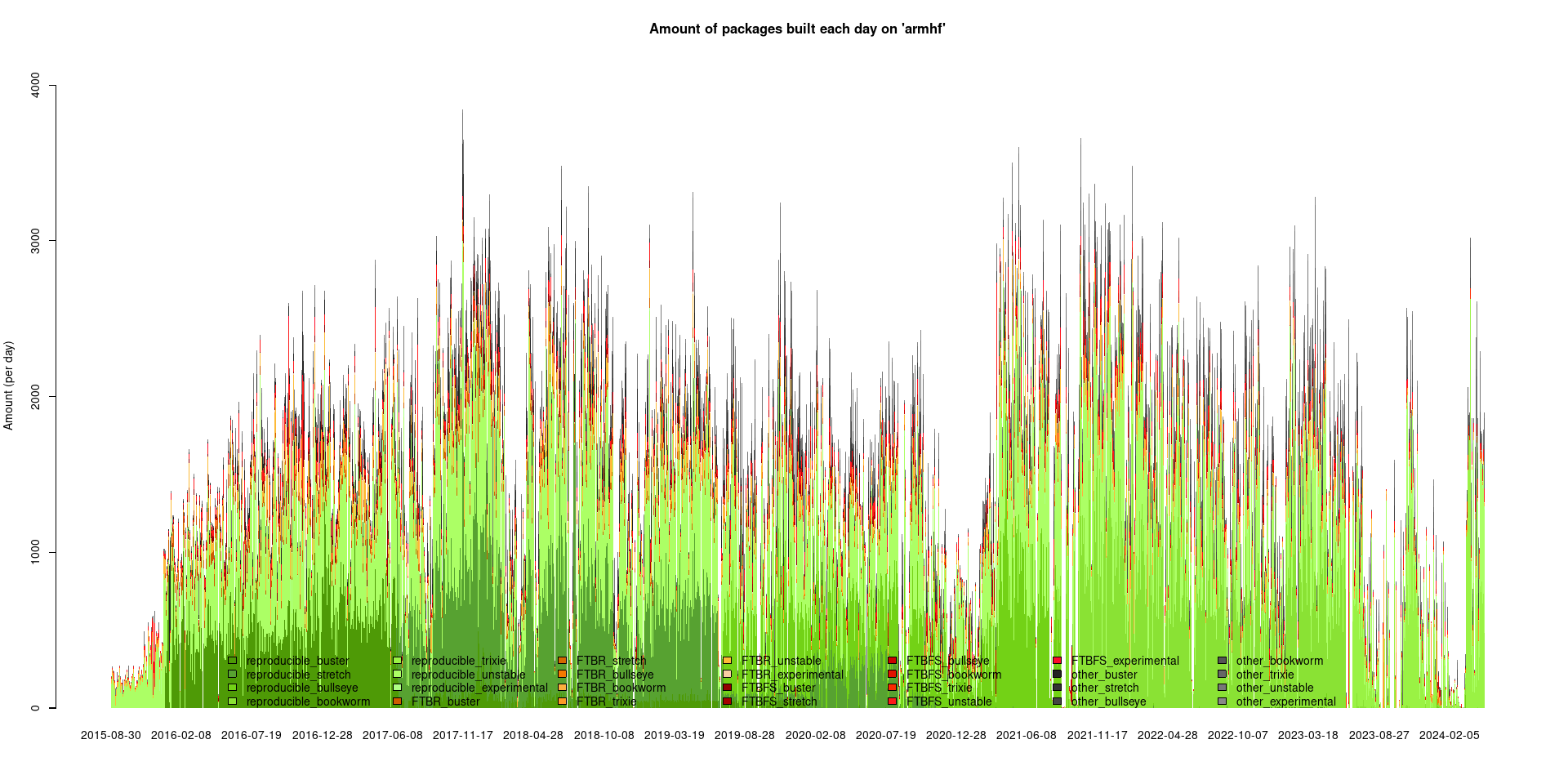
SOURCE_DATE_EPOCH in the build system.SOURCE_DATE_EPOCH in the build system.armhf build nodes provided by Vagrant Cascadian. This added 7 more armhf builder jobs. We now run around 900 tests of armhf packages each day. (h01ger)
The footer of each page now indicates by which Jenkins jobs build it. (h01ger)
While the details about how to join the set of paid contributors have always been public (here) we did not advertise this fact very much outside of the people already interested in LTS (and thus subscribed to debian-lts@lists.debian.org). But right now we would like to have a few more paid contributors on board and I m thus posting this call for volunteers.
Who can apply?
You need to meet those requirements:
One comment Liked this article? Click here. My blog is Flattr-enabled.
Since moving to Japan, I got more and more interested in history, especially the recent history of the 20th century. The book I just finished, Ian Buruma (Wiki, home page) Wages of Guilt Memories of War in Germany and Japan (Independent, NYRB), has been a revelation for me. As an Austrian living in Japan, I am experiencing the discrepancy between these two countries with respect to their treatment of war legacy practically daily, and many of my blog entries revolve around the topic of Japanese non-reconciliation.
Willy Brandt went down on his knees in the Warsaw ghetto, after a functioning democracy had been established in the Federal Republic of Germany, not before. But Japan, shielded from the evil world, has grown into an Oskar Matzerath: opportunistic, stunted, and haunted by demons, which it tries to ignore by burying them in the sand, like Oskar s drum.
Ian Buruma, Wages of Guilt, Clearing Up the Ruins
The comparison of Germany and Japan with respect to their recent history as laid out in Buruma s book throws a spotlight on various aspects of the psychology of German and Japanese population, while at the same time not falling into the easy trap of explaining everything with difference in the guilt culture. A book of great depth and broad insights everyone having even the slightest interest in these topics should read.
This difference between (West) German and Japanese textbooks is not just a matter of detail; it shows a gap in perception.Only thinking about giving a halfway full account of this book is something impossible for me. The sheer amount of information, both on the German and Japanese side, is impressive. His incredible background (studies of Chinese literature and Japanese movie!) and long years as journalist, editor, etc, enriches the book with facets normally not available: In particular his knowledge of both the German and Japanese movie history, and the reflection of history in movies, were complete new aspects for me (see my recent post (in Japanese)). The book is comprised of four parts: The first with the chapters War Against the West and Romance of the Ruins; the second with the chapters Auschwitz, Hiroshima, and Nanking; the third with History on Trial, Textbook Resistance, and Memorials, Museums, and Monuments; and the last part with A Normal Country, Two Normal Towns, and Clearing Up the Ruins. Let us look at the chapters in turn:
Ian Buruma, Wages of Guilt, Romance of the Ruins
What is so convenient in the cases of Germany and Japan is that pacifism happens to be a high-minded way to dull the pain of historical guilt. Or, conversely, if one wallows in it, pacifism turns national guilt into a virtue, almost a mark of superiority, when compared to the complacency of other nations.
Hitler s doom and the emperor s speech, the end of one symbol and the odd continuity of another. Whatever their symbolic differences, both would be associated forever with ruins ruined cities, ruined people, ruined ideals.
Here the past had fossilized into something monumental or, as Adorno would have put it, museal.
The problem with this quasi-religious view of history is that it makes it hard to discuss past events in anything but nonsecular terms. Visions of absolute evil are unique, and they are beyond human explanation or even comprehension. To explain is hubristic and amoral. If this is true of Auschwitz, it is even more true of Hiroshima. The irony is that while there can be no justification for Auschwitz unless one believes in Hitler s murderous ideology, the case for Hiroshima is at least open to debate. The A-bomb might have saved lives; it might have shortened the war. But such arguments are incompatible with the Hiroshima spirit.
Yet the question remains whether the raping and killing of thousands of women, and the massacre of thousands, perhaps hundreds of thousands, of other unarmed people, in the course of six weeks, can still be called extreme conduct in the heat of battle. The question is pertinent, particularly when such extreme violence is justified by an ideology which teaches the aggressors that killing an inferior race is in accordance with the will of their divine emperor.
The Nuremberg trials were to be a history lesson, then, as well as a symbolic punishment of the German people a moral history lesson cloaked in all the ceremonial trappings of due legal process. They were the closest that man, or at least the men belonging to the victorious powers, could come to dispensing divine justice.Also, the differences in war trials in East and West Germany is compared. The East Germany Waldheimer trials, as well as the thorough purge of Nazis from East German jurisdiction and politics, which was in stark contrast to both West German s very restricted trials, as well as Japan s absolute non-purge of criminals.
As long as the emperor lived, Japanese would have trouble being honest about the past. For he had been formally responsible for everything, and by holding him responsible for nothing, everybody was absolved, except, of course, for a number of military and civilian scapegoats, Officers and Outlaws, who fell victim to victors justice.
The judges and some of the counsel for the ministry sat back with their eyes closed, in deep concentration, or fast asleep. Perhaps they were bored, because they had heard it all before. Perhaps they thought it was a pointless exercise, since they knew already how the case would end. But it was not a pointless exercise. For Ienaga Saburo had kept alive a vital debate for twenty-seven years. One cussed schoolteacher and several hundred supporters at the courthouse might not seem much, but it was enough to show that, this time, someone was fighting back.
The tragedy is not just that the suicide pilots died young. Soldiers (and civilians) do that in wars everywhere. What is so awful about the memory of their deaths is the cloying sentimentality that was meant to justify their self-immolation. There is no reason to suppose they didn t believe in the patriotic gush about cherry blossoms and sacrifice, no matter how conventional it was at the time. Which was exactly the point: they were made to rejoice in their own death. It was the exploitation of their youthful idealism that made it such a wicked enterprise. And this point is still completely missed at the Peace Museum today.
It was not an ignoble enterprise, but he should have recognized that Historisierung, even forty-three years after the war, was still a highly risky business. For a normal society, a society not haunted by ghosts, cannot be achieved by normalizing history, or by waving cross and garlic. More the other way around: when society has become sufficiently open and free to look back, from the point of view neither of the victim nor of the criminal, but of the critic, only then will the ghosts be laid to rest.On the Japanese side the case of Motoshima Hitoshi , who dared to question Hirohito:
Forty-three years have passed since the end of the war, and I think we have had enough chance to reflect on the nature of that war. From reading various accounts from abroad and having been a soldier myself, involved in military education, I do believe that the emperor bore responsibility for the war.which led to hitherto unseen of demonstration of extreme-right-wing groups issuing death treats that lead to a failed assassination of Motoshima, all under the completely complacent Japanese police and politics letting the right-wingers play their game.
By breaking a Japanese taboo, Motoshima struck a blow for a more open, more normal political society, and very nearly lost his life. Jenninger, I like to think, wanted to strike a blow for the same, but failed, and lost his job. Perhaps he wasn t up to the task. Or perhaps even West Germany was not yet normal enough to hear his message.
I asked him again about the local camp and the small hidden memorial. Dominik showed signs of distress. It was difficult, he admitted, very difficult. I know what you mean. But let me give you my personal opinion. When you have a crippled arm, you don t really want to show it around. It was a low point in our history, back then. But it was only twelve years in thousands of years of history. And so people tend to hide it, just as a person with a crippled arm is not likely to wear a short-sleeved shirt.A similar incident is recounted on the Japanese side, the Hanaoka incident (detailed article) and its unveiling by Nozoe Kenji, where 800 Chinese slave workers, after escaping from a forced-work camp for the Kajima Corporation, where rabbit-hunted down and slaughtered. He, too, got death threats, and was virtually expelled from his home area because he dared to publish his findings.
I think it is this basic distrust, this refusal to be told what to think by authorities, this cussed insistence on asking questions, on hearing the truth, that binds together Nozoe, Rosmus, and others like them. There are not many such people in Japan, or anywhere else for that matter. And I suspect they are not much liked wherever they live.
The state was run by virtually the same bureaucracy that ran the Japanese empire, and the electoral system was rigged to help the same corrupt conservative party to stay in power for almost forty years. This arrangement suited the United States, as well as Japanese bureaucrats, LDP politicians, and the large industrial combines, for it ensured that Japan remained a rich and stable ally against Communism. But it also helped to stifle public debate and stopped the Japanese from growing up politically.His description of current Japanese society, written in 1995, is still hauntingly true in 2016:
There is something intensely irritating about the infantilism of postwar Japanese culture: the ubiquitous chirping voices of women pretending to be girls; the Disneylandish architecture of Japanese main streets, where everything is reduced to a sugary cuteness; the screeching television talents rolling about and carrying on like kindergarten clowns; the armies of blue-suited salarymen straphanging on the subway trains, reading boys comics, the maudlin love for old school songs and cuddly mama-sans.
The Nanking Massacre, for leftists and many liberals too, is the main symbol of Japanese militarism, supported by the imperial (and imperialist) cult. Which is why it is a keystone of postwar pacifism. Article Nine of the constitution is necessary to avoid another Nanking Massacre. The nationalist right takes the opposite view. To restore the true identity of Japan, the emperor must be reinstated as a religious head of state, and Article Nine must be revised to make Japan a legitimate military power again. For this reason, the Nanking Massacre, or any other example of extreme Japanese aggression, has to be ignored, softened, or denied.While there are signs of resistance in the streets of Japan (Okinawa and the Hanako bay, the demonstrations against secrecy law and reversion of the constitution), we are still to see a change influenced by the people in a country ruled and distributed by oligarchs. I don t think there will be another Nanking Massacre in the near future, but Buruma s books shows that we are heading back to a nationalistic regime similar to pre-war times, just covered with a democratic veil to distract critics.
Ian Buruma, Wages of Guilt, Nanking
[ ] mainstream conservatives made a deliberate attempt to distract people s attention from war and politics by concentrating on economic growth.
The curious thing was that much of what attracted Japanese to Germany before the war Prussian authoritarianism, romantic nationalism, pseudo-scientific racialism had lingered in Japan while becoming distinctly unfashionable in Germany.In Romance of the Ruins:
The point of all this is that Ikeda s promise of riches was the final stage of what came to be known as the reverse course, the turn away from a leftist, pacifist, neutral Japan a Japan that would never again be involved in any wars, that would resist any form of imperialism, that had, in short, turned its back for good on its bloody past. The Double Your Incomes policy was a deliberate ploy to draw public attention away from constitutional issues.In Hiroshima:
The citizens of Hiroshima were indeed victims, primarily of their own military rulers. But when a local group of peace activists petitioned the city of Hiroshima in 1987 to incorporate the history of Japanese aggression into the Peace Memorial Museum, the request was turned down. The petition for an Aggressors Corner was prompted by junior high school students from Osaka, who had embarrassed Peace Museum officials by asking for an explanation about Japanese responsibility for the war.
The history of the war, or indeed any history, is indeed not what the Hiroshima spirit is about. This is why Auschwitz is the only comparison that is officially condoned. Anything else is too controversial, too much part of the flow of history .In Nanking, by the governmental pseudo-historian Tanaka:
Unlike in Europe or China, writes Tanaka, you won t find one instance of planned, systematic murder in the entire history of Japan. This is because the Japanese have a different sense of values from the Chinese or the Westerners.In History on Trial:
In 1950, Becker wrote that few things have done more to hinder true historical self-knowledge in Germany than the war crimes trials. He stuck to this belief. Becker must be taken seriously, for he is not a right-wing apologist for the Nazi past, but an eminent liberal.
There never were any Japanese war crimes trials, nor is there a Japanese Ludwigsburg. This is partly because there was no exact equivalent of the Holocaust. Even though the behavior of Japanese troops was often barbarous, and the psychological consequences of State Shinto and emperor worship were frequently as hysterical as Nazism, Japanese atrocities were part of a military campaign, not a planned genocide of a people that included the country s own citizens. And besides, those aspects of the war that were most revolting and furthest removed from actual combat, such as the medical experiments on human guinea pigs (known as logs ) carried out by Unit 731 in Manchuria, were passed over during the Tokyo trial. The knowledge compiled by the doctors of Unit 731 of freezing experiments, injection of deadly diseases, vivisections, among other things was considered so valuable by the Americans in 1945 that the doctors responsible were allowed to go free in exchange for their data.
Some Japanese have suggested that they should have conducted their own war crimes trials. The historian Hata Ikuhiko thought the Japanese leaders should have been tried according to existing Japanese laws, either in military or in civil courts. The Japanese judges, he believed, might well have been more severe than the Allied tribunal in Tokyo. And the consequences would have been healthier. If found guilty, the spirits of the defendants would not have ended up being enshrined at Yasukuni. The Tokyo trial, he said, purified the crimes of the accused and turned them into martyrs. If they had been tried in domestic courts, there is a good chance the real criminals would have been flushed out.
After it was over, the Nippon Times pointed out the flaws of the trial, but added that the Japanese people must ponder over why it is that there has been such a discrepancy between what they thought and what the rest of the world accepted almost as common knowledge. This is at the root of the tragedy which Japan brought upon herself.
Emperor Hirohito was not Hitler; Hitler was no mere Shrine. But the lethal consequences of the emperor-worshipping system of irresponsibilities did emerge during the Tokyo trial. The savagery of Japanese troops was legitimized, if not driven, by an ideology that did not include a Final Solution but was as racialist as Hider s National Socialism. The Japanese were the Asian Herrenvolk, descended from the gods.
Emperor Hirohito, the shadowy figure who changed after the war from navy uniforms to gray suits, was not personally comparable to Hitler, but his psychological role was remarkably similar.
In fact, MacArthur behaved like a traditional Japanese strongman (and was admired for doing so by many Japanese), using the imperial symbol to enhance his own power. As a result, he hurt the chances of a working Japanese democracy and seriously distorted history. For to keep the emperor in place (he could at least have been made to resign), Hirohito s past had to be freed from any blemish; the symbol had to be, so to speak, cleansed from what had been done in its name.In Memorials, Museums, and Monuments:
If one disregards, for a moment, the differences in style between Shinto and Christianity, the Yasukuni Shrine, with its relics, its sacred ground, its bronze paeans to noble sacrifice, is not so very different from many European memorials after World War I. By and large, World War II memorials in Europe and the United States (though not the Soviet Union) no longer glorify the sacrifice of the fallen soldier. The sacrificial cult and the romantic elevation of war to a higher spiritual plane no longer seemed appropriate after Auschwitz. The Christian knight, bearing the cross of king and country, was not resurrected. But in Japan, where the war was still truly a war (not a Holocaust), and the symbolism still redolent of religious exultation, such shrines as Yasukuni still carry the torch of nineteenth-century nationalism. Hence the image of the nation owing its restoration to the sacrifice of fallen soldiers.In A Normal Country:
The mayor received a letter from a Shinto priest in which the priest pointed out that it was un-Japanese to demand any more moral responsibility from the emperor than he had already taken. Had the emperor not demonstrated his deep sorrow every year, on the anniversary of Japan s surrender? Besides, he wrote, it was wrong to have spoken about the emperor in such a manner, even as the entire nation was deeply worried about his health. Then he came to the main point: It is a common error among Christians and people with Western inclinations, including so-called intellectuals, to fail to grasp that Western societies and Japanese society are based on fundamentally different religious concepts . . . Forgetting this premise, they attempt to place a Western structure on a Japanese foundation. I think this kind of mistake explains the demand for the emperor to bear full responsibility.In Two Normal Towns:
The bust of the man caught my attention, but not because it was in any way unusual; such busts of prominent local figures can be seen everywhere in Japan. This one, however, was particularly grandiose. Smiling across the yard, with a look of deep satisfaction over his many achievements, was Hatazawa Kyoichi. His various functions and titles were inscribed below his bust. He had been an important provincial bureaucrat, a pillar of the sumo wrestling establishment, a member of various Olympic committees, and the recipient of some of the highest honors in Japan. The song engraved on the smooth stone was composed in praise of his rich life. There was just one small gap in Hatazawa s life story as related on his monument: the years from 1941 to 1945 were missing. Yet he had not been idle then, for he was the man in charge of labor at the Hanaoka mines.In Clearing Up the Ruins:
But the question in American minds was understandable: could one trust a nation whose official spokesmen still refused to admit that their country had been responsible for starting a war? In these Japanese evasions there was something of the petulant child, stamping its foot, shouting that it had done nothing wrong, because everybody did it.
Japan seems at times not so much a nation of twelve-year-olds, to repeat General MacArthur s phrase, as a nation of people longing to be twelve-year-olds, or even younger, to be at that golden age when everything was secure and responsibility and conformity were not yet required.
For General MacArthur was right: in 1945, the Japanese people were political children. Until then, they had been forced into a position of complete submission to a state run by authoritarian bureaucrats and military men, and to a religious cult whose high priest was also formally chief of the armed forces and supreme monarch of the empire.
I saw Jew S ss that same year, at a screening for students of the film academy in Berlin. This showing, too, was followed by a discussion. The students, mostly from western Germany, but some from the east, were in their early twenties. They were dressed in the international uniform of jeans, anoraks, and work shirts. The professor was a man in his forties, a 68er named Karsten Witte. He began the discussion by saying that he wanted the students to concentrate on the aesthetics of the film more than the story. To describe the propaganda, he said, would simply be banal: We all know the what, so let s talk about the how. I thought of my fellow students at the film school in Tokyo more than fifteen years before. How many of them knew the what of the Japanese war in Asia.
I am happy to share here a project I was a part of during last year, that ended up being a complete success and now stands to be repeated: The diploma course on embedded Linux, taught at Facultad de Ingenier a, UNAM, where I'm teaching my regular classes as well.
Back in November, we held the graduation for our first 10 students. This photo shows only seven, as the remaining three have already relocated to Guadalajara, where they were hired by Continental, a company that promoted the creation of this specialization program.
After this first excercise, we went over the program and made some adequations; future generations will have a shorter and more focused program (240 instead of 288 hours, leaving out several topics that were not deemed related to the topic or were thoroughly understood by students to begin with); we intend to start the semester-long course in early February. | Attachment | Size |
|---|---|
| OT401_nota.jpg | 75.82 KB |
| Linux Embebido - Folleto.pdf | 455.32 KB |
I recently dug through my history of involvement with TeX (Live), and found out that in January there are a lot of anniversaries I should celebrate: 14 years ago I started building binaries for TeX Live, 11 years ago I proposed the packaging TeX Live for Debian, 10 years ago the TeX Live packages entered Debian. There are other things to celebrate next year (2017), namely the 10 year anniversary of the (not so new anymore) infrastructure in short tlmgr of TeX Live packaging, but this will come later. In this blog post I want to concentrate on my involvement in TeX Live and Debian.
Those of you not interested in boring and melancholic look-back onto history can safely skip reading this one. For those a bit interested in the history of TeX in Debian, please read on.
Debian releases and TeX systems
The TeX system of choice has been for long years teTeX, curated by Thomas Esser. Digging through the Debian Archive and combining it with changelog entries as well as personal experiences since I joined Debian, here is a time line of TeX in Debian, all to my best knowledge.
| Date | Version | Name | teTeX/TeX Live | Maintainers |
|---|---|---|---|---|
| 1993-96 | <1 | ? | ? | Christoph Martin |
| 6/1996 | 1.1 | Buzz | ? | |
| 12/1996 | 1.2 | Rec | ? | |
| 6/1997 | 1.3 | Bo | teTeX 0.4 | |
| 7/1998 | 2.0 | Ham | teTeX 0.9 | |
| 3/1999 | 2.1 | Slink | teTeX 0.9.9N | |
| 8/2000 | 2.2 | Potato | teTeX 1.0 | |
| 7/2002 | 3.0 | Woody | teTeX 1.0 | |
| 6/2005 | 3.1 | Sarge | teTeX 2.0 | Atsuhito Kohda |
| 4/2007 | 4.0 | Etch | teTeX 3.0, TeX Live 2005 | Frank K ster, NP |
| 2/2009 | 5.0 | Lenny | TeX Live 2007 | NP |
| 2/2011 | 6.0 | Squeeze | TeX Live 2009 | |
| 5/2013 | 7.0 | Whezzy | TeX Live 2012 | |
| 4/2015 | 8.0 | Jessie | TeX Live 2014 | |
| ??? | ??? | Stretch | TeX Live 2015 |
| Date | Subject/Link | Comment |
|---|---|---|
| 2005-01-11 | binaries for different architectures in debian packages | The first question concerning packaging TeX Live, about including pre-built binaries |
| 2005-01-25 | Debian-TeXlive Proposal II | A better proposal, but still including pre-built binaries |
| 2005-05-17 | Proposal for a tex-base package | Proposal for tex-base, later tex-common, as basis for both teTeX and TeX live packages |
| 2015-06-10 | Bug#312897: ITP: texlive | ITP bug for TeX Live |
| 2005-09-17 | Re: Take over of texinfo/info packages | Taking over texinfo which was somehow orphaned started here |
| 2005-11-28 | Re: texlive-basic_2005-1_i386.changes REJECTED | My answer to the rejection by ftp-master of the first upload. This email sparked a long discussion about packaging and helped improve the naming of packages (but not really the packaging itself). |
| 2006-01-12 | Upload of TeX Live 2005-1 to Debian | The first successful upload |
| 2006-01-22 | Accepted texlive-base 2005-1 (source all) | TeX Live packages accepted into Debian/experimental |
Development over the years
TeX Live 2005 was just another TeX system but not the preferred one in Debian Etch and beyond. But then in May 2006, Thomas Esser announced the end of development of teTeX, which cleared the path for TeX Live as main TeX system in Debian (and the world!). The next release of Debian, Lenny (1/2009), already carried only TeX Live. Unfortunately it was only TeX Live 2007 and not 2008, mostly due to me having been involved in rewriting the upstream infrastructure based on Debian package files instead of the notorious xml files. This took quite a lot of attention and time from Debian away to upstream development, but this will be discussed in a different post.
Similarly, the release of TeX Live included in Debian Squeeze (released 2/2011) was only TeX Live 2009 (instead of 2010), but since then (Wheezy and Jessie) the releases of TeX Live in Debian were always the latest released ones.
Current status
Since about 2013 I am trying to keep a regular schedule of new TeX Live packages every month. These helps me to keep up with the changes in upstream packaging and reduces the load of packaging a new release of TeX Live. It also bring to users of unstable and testing a very up-to-date TeX system, where packages at most lack 1 month of behind the TeX Live net updates.
Future
As most of the readers here know, besides caring for TeX (Live) and related packages in Debian, I am also responsible for the TeX Live Manager (tlmgr) and most of upstream s infrastructure including network distribution. Thus, my (spare, outside work) time needs to be distributed between all these projects (and some others) which leaves less and less time for Debian packaging. Fortunately the packaging is in a state that making regular updates once a month is less of a burden, since most steps are automatized. What is still a bit of a struggle is adapting the binary package (src:texlive-bin) to new releases. But also this has become simpler due to less invasive changes over the years.
All in all, I don t have many plans for TeX Live in Debian besides keeping the current system running as it is.
Search for and advise to future maintainers and collaborators
I would be more than happy if new collaborators appear, with fresh ideas and some spare time. Unfortunately, my experience over these 10 years with people showing up and proposing changes (anyone remembers the guy proposing a complete rewrite in ML or so?) is that nobody really wants to invest time and energy, but search for quick solutions. This is not something that will work with a package like TeX Live, sized of several gigabyte (the biggest in the Debian archive), and complicated inner workings.
I advise everyone being interested in helping to package TeX Live for Debian, to first install normal TeX Live from TUG, get used to what actions happen during updates (format rebuilds, hyphenation patters, map file updates). One does not need to have a perfect understanding of what exactly happens down there in the guts (I didn t have in the beginning, either), but if you want to help packaging and never heard about what format dumps or map files are, then this might be a slight obstacle.
Conclusion
TeX Live is the only TeX system in wide use across lots of architectures and operating systems, and the only comparable system, MikTeX, is Windows specific (also there are traces of ports to Unix). Backed by all the big user groups of TeX, TeX Live will remain the prime choice for the foreseeable future, and thus also TeX Live in Debian.
Next.