Search Results: "nate"

30 November 2014

Thorsten Alteholz: My Debian Activities in November 2014

FTP assistant In contrast to the last month, this month has been rather quiet and I really liked that :-) . The stress has moved to the next team. So all in all I marked 101 packages for accept and had to reject 27 packages. As I mostly reviewed really new packages, I didn t have to file any RC bug this month. Squeeze LTS This was my fifth month that I did some work for the Squeeze LTS initiative, started by Raphael Hertzog at Freexian. This month I got assigned a workload of 14.25h and I spent these hours to upload new versions of: I also uploaded [DLA 85-1] libxml-security-java security update, but as nobody of the LTS sponsors had any interest in this package, I did this in my spare time. A package with security in its name should not be affected by security issues. This month my failure of the month has been the binutils package. Although the security team prepared the way for finding the correct patches for all those CVEs, I somehow managed to not find them. This is embarassing I am also a bit disappointed by current LTS users. All important packages have been made available for testing before uploading them to the archive. Apart from some brave fellow DDs, no other feedback was reported on debian-lts. Complaints arrived only when the packages have been finally uploaded. Do admins have enough time nowadays and don t need to use some kind of testbed? Times are changing Other packages This month I even found some time to sponsor uploads, so please welcome a new version of fastaq in experimental and patiently wait for aegaen and kmc to pass NEW. At this point I also want to mention the Debian Med Advent Calendar, which was announced in this email and already mentioned by Andreas in his latest Debian Med bits. Everybody is invited to take care of as much as possible poor souls. Support If you would like to support my Debian work you could either be part of the Freexian initiative (see above) or consider to send some bitcoins to 1JHnNpbgzxkoNexeXsTUGS6qUp5P88vHej. Contact me at donation@alteholz.eu if you prefer another way to donate. Every kind of support is most appreciated.

29 November 2014

Dirk Eddelbuettel: RcppArmadillo 0.4.550.1.0

A week ago, Conrad provided another minor release 4.550.0 of Armadillo which has since received one minor correction in 4.550.1.0. As before, I had created a GitHub-only pre-release of his pre-release which was tested against the almost one hundred CRAN dependents of our RcppArmadillo package. This passed fine as usual, and results are as always in the rcpp-logs repository. Processing and acceptance at the CRAN took a little longer as around the same time a fresh failure in unit tests had become apparent on an as-of-yet unannounced new architecture (!!) also tested at CRAN. The R-devel release has since gotten a new capabilities() test for long double, and we now only run this test (for our rmultinom()) if the test asserts that the given R build has this capability. Phew, so with all that the new version in now on CRAN; Windows binaries have been built and I also uploaded new Debian binaries. Changes are summarized below; our end also includes added support for conversion of Field types takes to short pull request by Romain.
Changes in RcppArmadillo version 0.4.550.1.0 (2014-11-26)
  • Upgraded to Armadillo release Version 4.550.1 ("Singapore Sling Deluxe")
    • added matrix exponential function: expmat()
    • faster .log_p() and .avg_log_p() functions in the gmm_diag class when compiling with OpenMP enabled
    • faster handling of in-place addition/subtraction of expressions with an outer product
    • applied correction to gmm_diag relative to the 4.550 release
  • The Armadillo Field type is now converted in as<> conversions
Courtesy of CRANberries, there is also a diffstat report for the most recent release. As always, more detailed information is on the RcppArmadillo page. Questions, comments etc should go to the rcpp-devel mailing list off the R-Forge page.

This post by Dirk Eddelbuettel originated on his Thinking inside the box blog. Please report excessive re-aggregation in third-party for-profit settings.

Dirk Eddelbuettel: CRAN Task Views for Finance and HPC now (also) on GitHub

The CRAN Task View system is a fine project which Achim Zeileis initiated almost a decade ago. It is described in a short R Journal article in Volume 5, Number 1. I have been editor / maintainer of the Finance task view essentially since the very beginning of these CRAN Task Views, and added the High-Performance Computing one in the fall of 2008. Many, many people have helped by sending suggestions or even patches; email continues to be the main venue for the changes. The maintainers of the Web Technologies task view were, at least as far as I know, the first to make the jump to maintaining the task view on GitHub. Karthik and I briefly talked about this when he was in town a few weeks ago for our joint Software Carpentry workshop at Northwestern. So the topic had been on my mind, but it was only today that I realized that the near-limitless amount of awesome that is pandoc can probably help with maintenance. The task view code by Achim neatly converts the very regular, very XML, very boring original format into somewhat-CRAN-website-specific html. Pandoc, being as versatile as it is, can then make (GitHub-flavoured) markdown out of this, and with a minimal amount of sed magic, we get what we need. And hence we now have these two new repos: Contributions are now most welcome by pull request. You can run the included converter scripts, it differs between both repos only by one constant for the task view / file name. As an illustration, the one for Finance is below.
#!/usr/bin/r
## if you do not have /usr/bin/r from littler, just use Rscript
ctv <- "Finance"
ctvfile  <- paste0(ctv, ".ctv")
htmlfile <- paste0(ctv, ".html")
mdfile   <- "README.md"
## load packages
suppressMessages(library(XML))          # called by ctv
suppressMessages(library(ctv))
r <- getOption("repos")                 # set CRAN mirror
r["CRAN"] <- "http://cran.rstudio.com"
options(repos=r)
check_ctv_packages(ctvfile)             # run the check
## create html file from ctv file
ctv2html(read.ctv(ctvfile), htmlfile)
### these look atrocious, but are pretty straight forward. read them one by one
###  - start from the htmlfile
cmd <- paste0("cat ", htmlfile,
###  - in lines of the form  ^<a href="Word">Word.html</a>
###  - capture the 'Word' and insert it into a larger URL containing an absolute reference to task view 'Word'
  "   sed -e 's ^<a href=\"\\([a-zA-Z]*\\)\\.html <a href=\"http://cran.rstudio.com/web/views/\\1.html\" '   ",
###  - call pandoc, specifying html as input and github-flavoured markdown as output
              "pandoc -s -r html -w markdown_github   ",
###  - deal with the header by removing extra  , replacing  ** with ** and **  with **:              
              "sed -e's/ //g' -e's/ \\*\\*/\\*\\*/g' -e's/\\*\\* /\\*\\* /g' -e's/ $/  /g' ",
###  - make the implicit URL to packages explicit
              "-e's ../packages/ http://cran.rstudio.com/web/packages/ g' ",
###  - write out mdfile
              "> ", mdfile)
system(cmd)                             # run the conversion
unlink(htmlfile)                        # remove temporary html file
cat("Done.\n")
I am quite pleased with this setup---so a quick thanks towards the maintainers of the Web Technologies task view; of course to Achim for creating CRAN Task Views in the first place, and maintaining them all those years; as always to John MacFarlance for the magic that is pandoc; and last but not least of course to anybody who has contributed to the CRAN Task Views.

This post by Dirk Eddelbuettel originated on his Thinking inside the box blog. Please report excessive re-aggregation in third-party for-profit settings.

28 November 2014

Daniel Pocock: XCP / XenServer and Debian Jessie

In 2013, Debian wheezy was released with a number of great virtualization options include the Xen Cloud Platform (XCP / Xen-API) toolstack packaged by Thomas Goirand to run in a native Debian host environment. Unfortunately, XCP is not available as a host (dom0) solution for the upcoming Debian 8 (jessie) release. However, it is possible to continue running a Debian wheezy system as the dom0 host and run virtualized (domU) jessie systems inside it. It may also be possible to use the packages from wheezy on a jessie system, but I haven't looked into that myself so far. Newer kernel boot failures in Xen After successfully upgrading a VM (domU in Xen terminology) from wheezy to jessie, I tried to reboot the VM and found that it wouldn't start. People have reported similar problems booting newer versions of Ubuntu and Fedora in XCP and XenServer environments. PyGrub displayed an error on the dom0 console:
# xe vm-start name-label=server05
Error code: Using  to parse /grub/grub.cfg
Error parameters: Traceback (most recent call last):,
   File "/usr/lib/xcp/lib/pygrub.xcp", line 853, in ,
     raise RuntimeError, "Unable to find partition containing kernel"
There is a quick and easy workaround. Hard-code the kernel and initrd filenames into config values that will be used to boot. A more thorough solution will probably involve using a newer version of PyGrub in wheezy. If the /boot tree is a separate filesystem inside the VM, use commands like the following (substitute the correct UUID for the VM and the exact names/versions of the vmlinuz and initrd.img files):
xe vm-param-set uuid=da654fd0-74db-11e4-82f8-0800200c9a66 \
   PV-bootloader-args="--kernel=/vmlinuz-3.16-3-amd64
   --ramdisk=/initrd.img-3.16-3-amd64"
xe vm-param-set uuid=da654fd0-74db-11e4-82f8-0800200c9a66 \
   PV-args="root=/dev/mapper/vg00-root ro quiet"
and if /boot is on the root filesystem of the VM, this will do the trick:
xe vm-param-set uuid=da654fd0-74db-11e4-82f8-0800200c9a66 \
   PV-bootloader-args="--kernel=/boot/vmlinuz-3.16-3-amd64
   --ramdisk=/boot/initrd.img-3.16-3-amd64"
xe vm-param-set uuid=da654fd0-74db-11e4-82f8-0800200c9a66 \
   PV-args="root=/dev/mapper/vg00-root ro quiet"
Future strategy Once a comprehensive XCP solution appears in Debian again, hopefully it will be possible to migrate running VMs into the new platform without any downtime and retire the wheezy dom0. Other upgrade/migration options exist and the choice will depend on various factors, such as whether or not you have built your own tools around the XCP API and whether you use a solution like OpenStack that depends on it. Debian's pkg-xen-devel mailing list may be a good place to discuss these options further.

Ian Wienand: rstdiary

I find it very useful to spend 5 minutes a day to keep a small log of what was worked on, major bugs or reviews and a general small status report. It makes rolling up into a bigger status report easier when required, or handy as a reference before you go into meetings etc. I was happily using an etherpad page until I couldn't save any more revisions and the page got too long and started giving javascript timeouts. For a replacement I wanted a single file as input with no boilerplate to aid in back-referencing and adding entries quickly. It should be formatted to be future-proof, as well as being emacs, makefile and git friendly. Output should be web-based so I can refer to it easily and point people at it when required, but it just has to be rsynced to public_html with zero setup. rstdiary will take a flat RST based input file and chunk it into some reasonable looking static-HTML that looks something like this. It's split by month with some minimal navigation. Copy the output directory somewhere and it is done. It might also serve as a small example of parsing and converting RST nodes where it does the chunking; unfortunately the official documentation on that is "to be completed" and I couldn't find anything like a canonical example, so I gathered what I could from looking at the source of the transformation stuff. As the license says, the software is provided "as is" without warranty! So if you've been thinking "I should keep a short daily journal in a flat-file and publish it to a web-server but I can't find any software to do just that" you now have one less excuse.

27 November 2014

Stefano Zacchiroli: CTTE nomination

Apparently, enough fellow developers have been foolish enough to nominate me as a prospective member of the Debian Technical Committee (CTTE), that I've been approached to formally accept/decline the nomination. (Accepted nominees would then go through a selection process and possibly proposed to the DPL for nomination.) I'm honored by the nominations and I thank the fellow developers that have thrown my name in the hat. But I've respectfully declined the nomination. Given my current involvement in an ongoing attempt to introduce a maximum term limit for CTTE membership, it would have been highly inappropriate for me to accept the nomination at this time. I have no doubt that the current CTTE and the DPL will fill the empty seats with worthy project members.

26 November 2014

Francois Marier: Hiding network disconnections using an IRC bouncer

A bouncer can be a useful tool if you rely on IRC for team communication and instant messaging. The most common use of such a server is to be permanently connected to IRC and to buffer messages while your client is disconnected. However, that's not what got me interested in this tool. I'm not looking for another place where messages accumulate and wait to be processed later. I'm much happier if people email me when I'm not around. Instead, I wanted to do to irssi what mosh did to ssh clients: transparently handle and hide temporary disconnections. Here's how I set everything up.

Server setup The first step is to install znc:
apt-get install znc
Make sure you get the 1.0 series (in jessie or trusty, not wheezy or precise) since it has much better multi-network support. Then, as a non-root user, generate a self-signed TLS certificate for it:
openssl req -x509 -sha256 -newkey rsa:2048 -keyout znc.pem -nodes -out znc.crt -days 365
and make sure you use something like irc.example.com as the subject name, that is the URL you will be connecting to from your IRC client. Then install the certificate in the right place:
mkdir ~/.znc
mv znc.pem ~/.znc/
cat znc.crt >> ~/.znc/znc.pem
Once that's done, you're ready to create a config file for znc using the znc --makeconf command, again as the same non-root user:
  • create separate znc users if you have separate nicks on different networks
  • use your nickserv password as the server password for each network
  • enable ssl
  • say no to the chansaver and nickserv plugins
Finally, open the IRC port (tcp port 6697 by default) in your firewall:
iptables -A INPUT -p tcp --dport 6697 -j ACCEPT

Client setup (irssi) On the client side, the official documentation covers a number of IRC clients, but the irssi page was quite sparse. Here's what I used for the two networks I connect to (irc.oftc.net and irc.mozilla.org):
servers = (
   
    address = "irc.example.com";
    chatnet = "OFTC";
    password = "fmarier/oftc:Passw0rd1!";
    port = "6697";
    use_ssl = "yes";
    ssl_verify = "yes";
    ssl_cafile = "~/.irssi/certs/znc.crt";
   ,
   
    address = "irc.example.com";
    chatnet = "Mozilla";
    password = "francois/mozilla:Passw0rd1!";
    port = "6697";
    use_ssl = "yes";
    ssl_verify = "yes";
    ssl_cafile = "~/.irssi/certs/znc.crt";
   
);
Of course, you'll need to copy your znc.crt file from the server into ~/.irssi/certs/znc.crt. Make sure that you're no longer authenticating with the nickserv from within irssi. That's znc's job now.

Wrapper scripts So far, this is a pretty standard znc+irssi setup. What makes it work with my workflow is the wrapper script I wrote to enable znc before starting irssi and then prompt to turn it off after exiting:
#!/bin/bash
ssh irc.example.com "pgrep znc   znc"
irssi
read -p "Terminate the bouncer? [y/N] " -n 1 -r
echo
if [[ $REPLY =~ ^[Yy]$ ]]
then
  ssh irc.example.com killall -sSIGINT znc
fi
Now, instead of typing irssi to start my IRC client, I use irc. If I'm exiting irssi before commuting or because I need to reboot for a kernel update, I keep the bouncer running. At the end of the day, I say yes to killing the bouncer. That way, I don't have a backlog to go through when I wake up the next day.

25 November 2014

Thorsten Glaser: d-i preseeding is not the answer

This post details what the d-i team currently shows as the only way. It has several shortcomings and one missing documentation part. Shortcoming: --purge is missing from the apt-get invocation. This leaves packages in rc state (requiring a manual dpkg --purge to completely remove them later, as they are then invisible to apt). Worse shortcoming: this still leaves all dependencies pulled in by systemd around on the system, because packages installed by debootstrap are not eligible for apt-get --purge autoremove . Additionally, it does not influence debootstrap s (n n-existent, see #557322, #668001, #768062) dependency resolver, leading to possibly pessimistic package selections.

Missing: you can just hit Alt-F2 and enter the command

	in-target apt-get --purge -y install sysvinit-core
 

there, no need to preseed. But this does not eliminate the aforementioned shortcomings, of course.

Dirk Eddelbuettel: Rcpp now used by 300 CRAN packages

max-heap image This morning, Rcpp reached another round milestone: 300 packages on CRAN now depend on it (as measured by Depends, Imports and LinkingTo declarations). The graph is on the left depicts the growth of Rcpp usage over time. There are 41 more on BioConductor (which is not included in the chart). The first and less detailed part uses manually save entries, the second half of the data set was generated semi-automatically via a short script appending updates to a small file-based backend. A list of user package is kept on this page. Also displayed in the graph is the relative proportion of CRAN packages using Rcpp. The four per-cent hurdle was cleared just before useR! 2014 where I showed a similar graph (as two distinct graphs) in my invited talk. We may well hit five per-cent before the end of the year. 300 is a pretty humbling and staggering number. Also interesting that we we cleared 200 only at the end of April, and 250 in early August. So from everybody behind Rcpp, a heartfelt Thank You! to all the users and of course other contributors.

This post by Dirk Eddelbuettel originated on his Thinking inside the box blog. Please report excessive re-aggregation in third-party for-profit settings.

Dirk Eddelbuettel: YATORP -- Yet Another Tutorial on R Packaging

What the world needs right now is yet another tutorial on R packages and their creation. Luckily, this last Friday and Saturday, I had the opportunity to present in a workshop organized by Frank DiTraglia at Penn's shiny new Warren Center, and held at Wharton. Given the Warren Center's focus, the workshop centered around Big Data and Open Science with R. Yihui Xie and myself alternated on delivering four units on an Introduction to R, Writing R packages, Dynamic Documents with R, and HPC with Rcpp and RcppArmadillo. So I had to come up with a plan for teaching creating R packages -- and decided to do it from the very bottom up, clearly introducing the underlying R CMD ... commands and only then switching to taking advantage of an environment such as the RStudio IDE. The resulting slides are now available on my presentations page. The code examples are in a repo subdirectory on GitHub as well. While both were designed to support the parallel live instruction offered in the workshop, I would be interested in feedback (preferably via email) about how useful the slides are by themselves.

This post by Dirk Eddelbuettel originated on his Thinking inside the box blog. Please report excessive re-aggregation in third-party for-profit settings.

22 November 2014

Craig Small: WordPress 4.0.1 for Debian

WordPress recently released an update that had multiple security patches for their (then) current version 4.0. This release is 4.0.1 and includes important security fixes. The Debian packages got just uploaded, if you are running the Debian packaged wordpress, you should update to 4.0.1+dfsg-1 or later. I am going to look at these patches and see if they can and need to be backported to wordpress 3.6.1. Unfortunately I believe they will be. I m also asking it to be unblocked into Jessie as it is a security fix. There was, at the time of writing, no CVE numbers.

21 November 2014

Jonathan Wiltshire: On kFreeBSD and FOSDEM

Boy I love rumours. Recently I ve heard two, which I ought to put to rest now everybody s calmed down from recent events. kFreeBSD isn t an official Jessie architecture because <insert systemd-related scare story> Not true. Our sprint at ARM (who kindly hosted and caffeinated us for four days) was timed to coincide with the Cambridge Mini-DebConf 2014. The intention was that this would save on travel costs for those members of the Release Team who wanted to attend the conference, and give us a jolly good excuse to actually meet up. Winners all round. It also had an interesting side-effect. The room we used was across the hall from the lecture theatre being used as hack space and, later, the conference venue, which meant everybody attending during those two days could see us locked away there (and yes, we were in there all day for two days solid, except for lunch times and coffee missions). More than one conference attendee remarked to me in person that it was interesting for them to see us working (although of course they couldn t hear what we were discussing), and hadn t appreciated before that how much time and effort goes into our meetings. Most of our first morning was taken up with the last pieces of architecture qualification, and that was largely the yes/no decision we had to make about kFreeBSD. And you know what? I don t recall us talking about systemd in that context at all. Don t forget kFreeBSD already had a waiver for a reduced scope in Jessie because of the difficulty in porting systemd to it. It s sadly impossible to capture the long and detailed discussion we had into a couple of lines of status information in a bits mail. If bits mails were much longer, people would be put off reading them, and we really really want you to take note of what s in there. The little space we do have needs to be factual and to the point, and not include all the background that led us to a decision. So no, the lack of an official Jessie release of kFreeBSD has very little, if anything, to do with systemd. Jessie will be released during (or even before) FOSDEM Not necessarily true. Debian releases are made when they re ready. That sets us apart from lots of other distributions, and is a large factor in our reputation for stability. We may have a target date in mind for a freeze, because that helps both us and the rest of the project plan accordingly. But we do not have a release date in mind, and will not do so until we get much closer to being ready. (Have you squashed an RC bug today?) I think this rumour originated from the office of the DPL, but it s certainly become more concrete than I think Lucas intended. However, it is true that we ve gone into this freeze with a seriously low bug count, because of lots of other factors. So it may indeed be that we end up in good enough shape to think about releasing near (or even at) FOSDEM. But rest assured, Debian 8 Jessie will be released when it s ready, and even we don t know when that will be yet. (Of course, if we do release before then, you could consider throwing us a party. Plenty of the Release Team, FTP masters and CD team will be at FOSDEM, release or none.)
On kFreeBSD and FOSDEM is a post from: jwiltshire.org.uk Flattr

Daniel Pocock: PostBooks 4.7 packages available, xTupleCon 2014 award

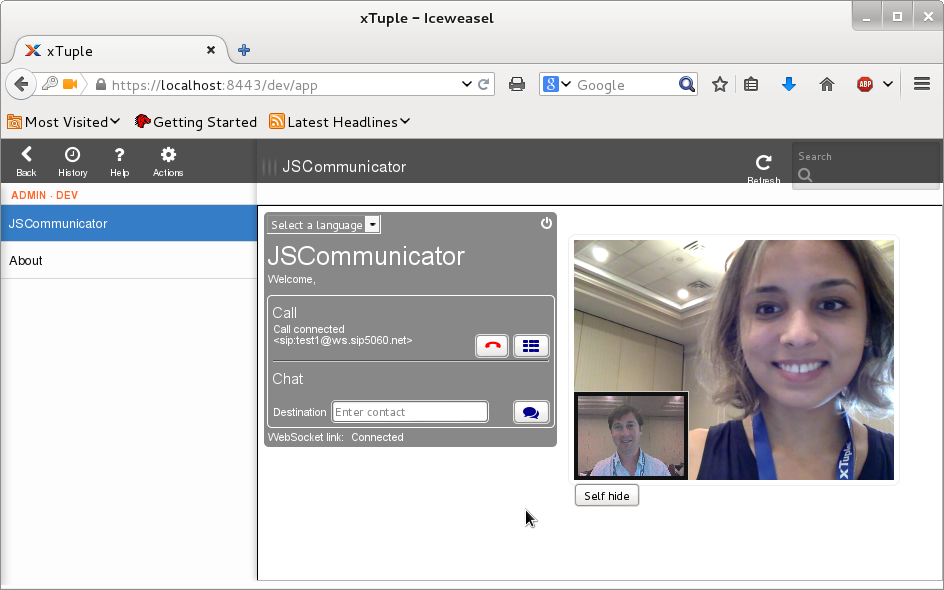
I recently updated the PostBooks packages in Debian and Ubuntu to version 4.7. This is the version that was released in Ubuntu 14.10 (Utopic Unicorn) and is part of the upcoming Debian 8 (jessie) release. Better prospects for Fedora and RHEL/CentOS/EPEL packages As well as getting the packages ready, I've been in contact with xTuple helping them generalize their build system to make packaging easier. This has eliminated the need to patch the makefiles during the build. As well as making it easier to support the Debian/Ubuntu packages, this should make it far easier for somebody to create a spec file for RPM packaging too. Debian wins a prize While visiting xTupleCon 2014 in Norfolk, I was delighted to receive the Community Member of the Year award which I happily accepted not just for my own efforts but for the Debian Project as a whole. Steve Hackbarth, Director of Product Development at xTuple, myself and the impressive Community Member of the Year trophy This is a great example of the productive relationships that exist between Debian, upstream developers and the wider free software community and it is great to be part of a team that can synthesize the work from so many other developers into ready-to-run solutions on a 100% free software platform. Receiving this award really made me think about all the effort that has gone into making it possible to apt-get install postbooks and all the people who have collectively done far more work than myself to make this possible: Here is a screenshot of the xTuple web / JSCommunicator integration, it was one of the highlights of xTupleCon: and gives a preview of the wide range of commercial opportunities that WebRTC is creating for software vendors to displace traditional telecommunications providers. xTupleCon also gave me a great opportunity to see new features (like the xTuple / Drupal web shop integration) and hear about the success of consultants and their clients deploying xTuple/PostBooks in various scenarios. The product is extremely strong in meeting the needs of manufacturing and distribution and has gained a lot of traction in these industries in the US. Many of these features are equally applicable in other markets with a strong manufacturing industry such as Germany or the UK. However, it is also flexible enough to simply disable many of the specialized features and use it as a general purpose accounting solution for consulting and services businesses. This makes it a good option for many IT freelancers and support providers looking for a way to keep their business accounts in a genuinely open source solution with a strong SQL backend and a native Linux desktop interface.

Julien Danjou: Distributed group management and locking in Python with tooz

With OpenStack embracing the Tooz library more and more over the past year, I think it's a good start to write a bit about it. A bit of history A little more than year ago, with my colleague Yassine Lamgarchal and others at eNovance, we investigated on how to solve a problem often encountered inside OpenStack: synchronization of multiple distributed workers. And while many people in our ecosystem continue to drive development by adding new bells and whistles, we made a point of solving new problems with a generic solution able to address the technical debt at the same time. Yassine wrote the first ideas of what should be the group membership service that was needed for OpenStack, identifying several projects that could make use of this. I've presented this concept during the OpenStack Summit in Hong-Kong during an Oslo session. It turned out that the idea was well-received, and the week following the summit we started the tooz project on StackForge. Goals Tooz is a Python library that provides a coordination API. Its primary goal is to handle groups and membership of these groups in distributed systems. Tooz also provides another useful feature which is distributed locking. This allows distributed nodes to acquire and release locks in order to synchronize themselves (for example to access a shared resource). The architecture If you are familiar with distributed systems, you might be thinking that there are a lot of solutions already available to solve these issues: ZooKeeper, the Raft consensus algorithm or even Redis for example. You'll be thrilled to learn that Tooz is not the result of the NIH syndrome, but is an abstraction layer on top of all these solutions. It uses drivers to provide the real functionalities behind, and does not try to do anything fancy. All the drivers do not have the same amount of functionality of robustness, but depending on your environment, any available driver might be suffice. Like most of OpenStack, we let the deployers/operators/developers chose whichever backend they want to use, informing them of the potential trade-offs they will make. So far, Tooz provides drivers based on: All drivers are distributed across processes. Some can be distributed across the network (ZooKeeper, memcached, redis ) and some are only available on the same host (IPC). Also note that the Tooz API is completely asynchronous, allowing it to be more efficient, and potentially included in an event loop. Features Group membership Tooz provides an API to manage group membership. The basic operations provided are: the creation of a group, the ability to join it, leave it and list its members. It's also possible to be notified as soon as a member joins or leaves a group. Leader election Each group can have a leader elected. Each member can decide if it wants to run for the election. If the leader disappears, another one is elected from the list of current candidates. It's possible to be notified of the election result and to retrieve the leader of a group at any moment. Distributed locking When trying to synchronize several workers in a distributed environment, you may need a way to lock access to some resources. That's what a distributed lock can help you with. Adoption in OpenStack Ceilometer is the first project in OpenStack to use Tooz. It has replaced part of the old alarm distribution system, where RPC was used to detect active alarm evaluator workers. The group membership feature of Tooz was leveraged by Ceilometer to coordinate between alarm evaluator workers. Another new feature part of the Juno release of Ceilometer is the distribution of polling tasks of the central agent among multiple workers. There's again a group membership issue to know which nodes are online and available to receive polling tasks, so Tooz is also being used here. The Oslo team has accepted the adoption of Tooz during this release cycle. That means that it will be maintained by more developers, and will be part of the OpenStack release process. This opens the door to push Tooz further in OpenStack. Our next candidate would be write a service group driver for Nova. The complete documentation for Tooz is available online and has examples for the various features described here, go read it if you're curious and adventurous!

20 November 2014

Steve McIntyre: UEFI Debian CDs for Jessie...

So, my work for Wheezy gave us working amd64 UEFI installer images. Yay! Except: there were a few bugs that remained, and also places where we could deal better with some of the more crappy UEFI implementations out there. But, things have improve since then and we should be better for Jessie in quite a few ways. First of all, Colin and the other Grub developers have continued working hard and quite a lot of the old bugs in this area look to be fixed. I'm hoping we're not going to see so many "UEFI boot gives me a blank black screen" type of problems now. For those poor unfortunates with Windows 7 on their machines, using BIOS boot despite having UEFI support in their hardware, I've fixed a long-standing bug (#763127) that could leave people with broken systems, unable to dual boot. We've fixed a silly potential permissions bug in how the EFI System Partition is mounted: (#770033). Next up, I'm hoping to add a workaround for some of the broken UEFI implementations, by adding support in our Grub packages (and in d-i) for forcing the installation of a copy of grub-efi in the removable media path. See #746662 for more of the details. It's horrid to be doing this, but it's just about the best thing we can do to support people with broken firmware. Finally, I've been getting lots of requests for adding i386 (32-bit x86) UEFI support in our official images. Back in the Wheezy development cycle, I had test images that worked on i386, but decided not to push that support into the release. There were worries about potentially critical bugs that could be tickled on some hardware, plus there were only very few known i386 UEFI platforms at the time; the risk of damage outweighed the small proportion of users, IMHO. However, I'm now revisiting that decision. The potentially broken machines are now 2 years older, and so less likely to be in use. Also, Intel have released some horrid platform concoction around the Bay Trail CPU: a 64-bit CPU (that really wants a 64-bit kernel), but running a 32-bit UEFI firmware with no BIOS Compatibility Mode. Recent kernels are able to cope with this mess, but at the moment there is no sensible way to install Debian on such a machine. I'm hoping to fix that next (#768461). It's going to be awkward again, needing changes in several places too. You can help! Same as 2 years ago, I'll need help testing some of these images. Particularly for the 32-bit UEFI support, I currently have no relevant hardware myself. That's not going to make it easy... :-/ I'll start pushing unofficial Jessie EFI test images shortly.

Neil McGovern: Barbie the Debian Developer

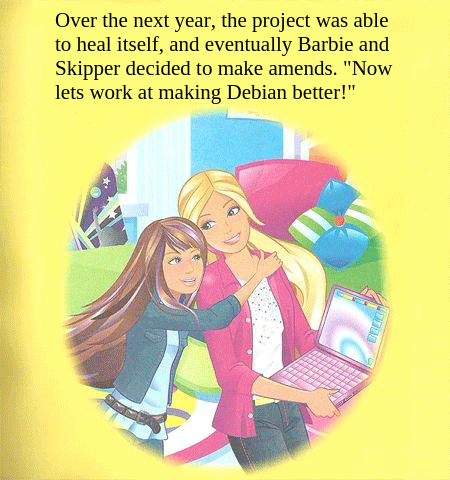
Some people may have seen recently that the Barbie series has a rather sexist book out about Barbie the Computer Engineer. Fortunately, there s a way to improve this by making your own version. Thus, I made a short version about Barbie the Debian Developer and init system packager. (For those who don t know me, this is satirical. Any resemblance to people is purely coincidental.) Edit: added text in alt tags. Also, hai reddit!
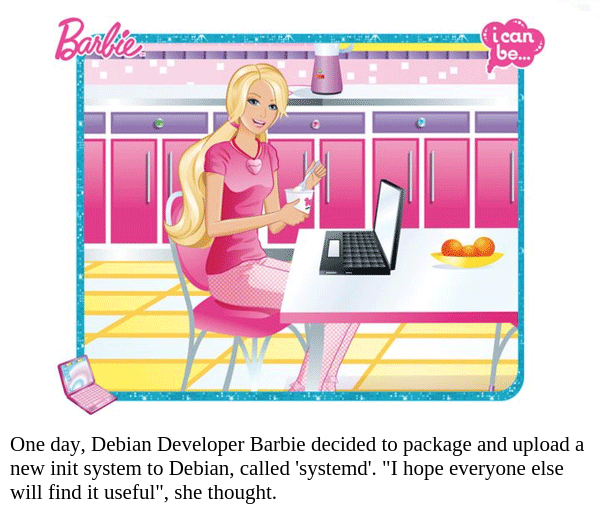
One day, Debian Developer Barbie decided to package and upload a new init system to Debian, called 'systemd'. I hope everyone else will find it useful, she thought.Oh no says Skipper! You'll never take my init system away from me! It's horrendous and Not The Unix Way! Oh dear said Barbie, What have I let myself in to?Skipper was most upset, and decided that this would not do. It's off to the technical committee with this. They'll surely see sense.Oh no! What's this? The internet decided that the Technical Committee needed to also know everyone's individual views! Bad Internet!There was much discussion and consideration. Opinions were reviewed, rows were had, and months passed. Eventually, a decision was agreed upon.Barbie was successful! The will of the Technical Committee was that systemd would be the default! But wait...Skipper still wasn't happy. We need to make sure this never affects me! I'm going to call for a General Resolution!And so, Ms Devotee was called in to look at the various options. She said that the arguments must stop, and we should all accept the result of the general resolution.The numbers turned and the vote was out. We should simply be most excellent to each other said Ms Devotee. I'm not going to tell you what you should or should not do.Over the next year, the project was able to heal itself and eventually Barbie and Skipper decided to make amends. Now let's work at making Debian better!

Daniel Pocock: Is Amnesty giving spy victims a false sense of security?

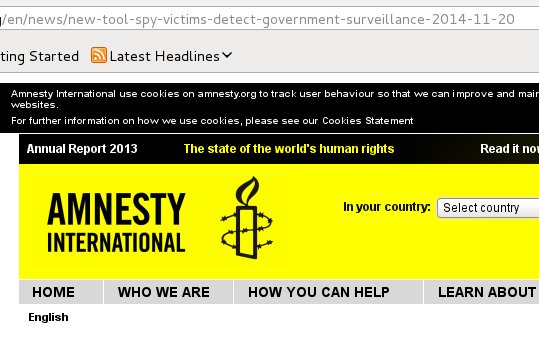
Amnesty International is getting a lot of attention with the launch of a new tool to detect government and corporate spying on your computer. I thought I would try it myself. I went to a computer running Microsoft Windows, an operating system that does not publish its source code for public scrutiny. I used the Chrome browser, users often express concern about Chrome sending data back to the vendor about the web sites the users look for. Without even installing the app, I would expect the Amnesty web site to recognise that I was accessing the site from a combination of proprietary software. Instead, I found a different type of warning. Beware of Amnesty? Instead, the only warning I received was from Amnesty's own cookies: Even before I install the app to find out if the government is monitoring me, Amnesty is keen to monitor my behaviour themselves. While cookies are used widely, their presence on a site like Amnesty's only further desensitizes Internet users to the downside risks of tracking technologies. By using cookies, Amnesty is effectivley saying a little bit of tracking is justified for the greater good. Doesn't that sound eerily like the justification we often hear from governments too? Is Amnesty part of the solution or part of the problem? Amnesty is a well known and widely respected name when human rights are mentioned. However, their advice that you can install an app onto a Windows computer or iPhone to detect spyware is like telling people that putting a seatbelt on a motorbike will eliminate the risk of death. It would be much more credible for Amnesty to tell people to start by avoiding cloud services altogether, browse the web with Tor and only use operating systems and software that come with fully published source code under a free license. Only when 100% of the software on your device is genuinely free and open source can independent experts exercise the freedom to study the code and detect and remove backdoors, spyware and security bugs. It reminds me of the advice Kim Kardashian gave after the Fappening, telling people they can continue trusting companies like Facebook and Apple with their private data just as long as they check the privacy settings (reality check: privacy settings in cloud services are about as effective as a band-aid on a broken leg). Write to Amnesty Amnesty became famous for their letter writing campaigns. Maybe now is the time for people to write to Amnesty themselves, thank them for their efforts and encourage them to take more comprehensive action. Feel free to cut and paste some of the following potential ideas into an email to Amnesty:


I understand you may not be able to respond to every email personally but I would like to ask you to make a statement about these matters on your public web site or blog. I understand it is Amnesty's core objective to end grave abuses of human rights. Electronic surveillence, due to its scale and pervasiveness, has become a grave abuse in itself and in a disturbing number of jurisdictions it is an enabler for other types of grave violations of human rights. I'm concerned that your new app Detekt gives people a false sense of security and that your campaign needs to be more comprehensive to truly help people and humanity in the long term. If Amnesty is serious about solving the problems of electronic surveillance by government, corporations and other bad actors, please consider some of the following:
  • Instead of displaying a cookie warning on Amnesty.org, display a warning to users who access the site from a computer running closed-source software and give them a link to download a free and open source web browser like Firefox.
  • Redirect all visitors to your web site to use the HTTPS encrypted version of the site.
  • Using free software such as the GNU/Linux operating system (using one of the Debian, Fedora or Ubuntu systems is one of the more common ways to achieve this) and LibreOffice for all Amnesty's own operations, making a public statement about your use of free software and mentioning this in the closing paragraph of all press releases relating to surveillance topics.
  • Encouraging Amnesty donors, members and supporters to choose similar software especially when engaging in any political activities.
  • Make a public statement that Amnesty will not use cloud services such as SalesForce or Facebook to store, manage or interact with data relating to members, donors or other supporters.
  • Encouraging the public to move away from centralized cloud services such as those provided by their smartphone or social networks and use de-centralized or federated services such as XMPP chat.
Given the immense threat posed by electronic surveillance, I'd also like to call on Amnesty to allocate at least 10% of annual revenue towards software projects releasing free and open source software that offers the public an alternative to the centralized cloud.

While publicity for electronic privacy is great, I hope Amnesty can go a step further and help people use trustworthy software from the ground up.

18 November 2014

Christian Perrier: Bug #770000

Martin Pitt reported Debian bug #770000 on Tuesday November 18th, against the release.debian.org pseudo-package. Bug #760000 was reported as of August 30th: so there have been 10,000 bugs reported in 3 months minus 12 days. The bug rate increased quite significantly during the last weeks. We can suspect this is related to the release and the freeze (that triggers many unblock requests) I find it interesting that this bug is directly related to the release, directly related to systemd and originated from one of the systemd packages maintainers, if I'm right. So, I'll take this opportunity to publicly thank all people who have brought the systemd packages to what they are now, whether or not they're still maintaining the package. We've all witnessed that Debian if facing a strong social issue nowadays and I'm very deeply sad about this. I hope we'll be able to go through this without losing too many brilliant contributors, as it happened recently. Please prove me right and do The Right Thing for me to be able to continue this silly "round bug number" contest and still believe that, some day, bug #1000000 will really happen and I'm still there to witness it. Ah, and by the way, systemd bloody works on my system. I can't even remember when I switched to it. It Just Worked.

Michal &#268;iha&#345;: Mercurial support in Weblate

Weblate has started as a translation system tightly bound to Git version control system. This was in no means design decision, but rather it was the version control I've used. But this has shown not to be sufficient and other systems were requested as well. And Mercurial is first of them to be supported. Weblate 2.0 already had separated VCS layer and adding another system to that is quite easy if you know the VCS you're adding. Unfortunately this wasn't the case for me with Mercurial as I've never used it for anything more serious than cloning a repository, committing fixes and pushing it back. Weblate needs a bit more than that, especially in regard to remote branches. But nevertheless I've figured out all operations and the implementation is ready in our Git. In case somebody is interested in adding support for another version control, patches are always welcome!

Filed under: English phpMyAdmin SUSE Weblate 0 comments Flattr this!

Dirk Eddelbuettel: RcppAnnoy 0.0.3

Hours after the initial blog post announcing the first release of the new package RcppAnnoy, Qiang Kou sent us a very nice pull request adding mmap support in Windows. So a new release with Windows support is on now CRAN, and Windows binaries should be available by this evening as usual. To recap, RcppAnnoy wraps the small, fast, and lightweight C++ template header library Annoy written by Erik Bernhardsson for use at Spotify. RcppAnnoy uses Rcpp Modules to offer the exact same functionality as the Python module wrapped around Annoy. Courtesy of CRANberries, there is also a diffstat report for this release. More detailed information is on the RcppAnnoy page page.

This post by Dirk Eddelbuettel originated on his Thinking inside the box blog. Please report excessive re-aggregation in third-party for-profit settings.

Next.

Previous.