Search Results: "mak"

2 March 2020

Petter Reinholdtsen: Nikita version 0.5 released - updated free software archive API server

Today, after many months of development, a new release of Nikita Noark 5 core project was finally announced on the project mailing list. The Nikita free software solution is an implementation of the Norwegian archive standard Noark 5 used by government offices in Norway. These were the changes in version 0.5 since version 0.4, see the email link above for links to a demo site: If free and open standardized archiving API sound interesting to you, please contact us on IRC (#nikita on irc.freenode.net) or email (nikita-noark mailing list). As usual, if you use Bitcoin and want to show your support of my activities, please send Bitcoin donations to my address 15oWEoG9dUPovwmUL9KWAnYRtNJEkP1u1b.

Antoine Beaupr : Moving dconf entries to git

I've been managing my UNIX $HOME repository with version control for almost two decades now (first under CVS, then with git). Once in a while, I find a little hack to make this work better. Today, it's dconf/gsettings, or more specifically, Workrave that I want to put in git. I noticed my laptop was extremely annoying compared with my office workstation and realized I never figured out how to write Workrave's configuration to git. The reason is that its configuration is stored in dconf, a binary database format, but, blissfully, I had forgotten about this and tried to figure out where the heck its config was. I was about to give up when I re-remembered this, when I figured I would just do a quick search ("dconf commit to git") and that brought me to Josh Triplett's Debconf 14 talk about this exact topic. The slides are... a little terse, but I could figure out the gist of it. The key is to change the DCONF_PROFILE environment to point to a new config file (say in your .bashrc):
export DCONF_PROFILE=$HOME/.config/dconf/profile
That file (~/.config/dconf/profile) should be created with the following content:
user-db:user
service-db:keyfile/user
  1. The first line is the default: store everything in this huge binary file.
  2. The second is the magic: it stores configuration in a precious text file, in .config/dconf/user.txt specifically.
Then the last step was to migrate config between the two. For that I need a third config file, a DCONF_PROFILE that has only the text database so settings are forcibly written there, say ~/.config/dconf/profile-edit:
service-db:keyfile/user
And then I can migrate my workrave configuration with:
gsettings list-recursively org.workrave   while read schema key val ; do DCONF_PROFILE=~/.config/dconf/profile-edit gsettings set "$schema" "$key" "$val" ; done
Of course, a bunch of those settings are garbage and do not differ from the default. Unfortuantely, there doesn't seem to be a way to tell gsettings to only list non-default settings, so I had to do things by hand from there, by comparing my generated config with:
DCONF_PROFILE=/dev/null gsettings list-recursively org.workrave
I finally ended up with the following user.txt, which is now my workrave config:
[org/workrave/timers/daily-limit]
snooze=1800
limit=25200
[org/workrave/timers/micro-pause]
auto-reset=10
snooze=150
limit=900
[org/workrave/timers/rest-break]
auto-reset=600
snooze=1800
limit=10800
[org/workrave/breaks/micro-pause]
max-preludes=0
That's a nice setup: "YOLO" settings end up in the binary database that I don't care about tracking in git, and a precious few snowflakes get tracked in a text file. Triplett also made a command to change settings in the text file, but I don't think I need to bother with that. It's more critical to copy settings between the two, in my experience, as I rarely have this moment: "oh I know exactly the key setting I want to change and i'll write it down". What actually happens is that I'm making a change in a GUI and later realize it should be synchronized over. (It looks like Triplett does have a tool to do those diffs and transitions, but unfortunately git://joshtriplett.org/git/home doesn't respond at this time so I can't find that source code.) (Update: that git repository can be downloaded with:
git clone https://joshtriplett.org/git/home
It looks like dconfc is designed to copy settings between the two databases. So my above loop would be more easily written as:
dconf dump /org/workrave/   DCONF_PROFILE=~/.config/dconf/profile-edit dconf load /org/workrave/
Certainly simplifies things. dconfd is also nice although it relies on the above dconfe script which makes it (IMHO) needlessly hard to deploy.) Now if only Firefox bookmarks were reasonable again...

Russell Coker: Amazon Prime and Netflix

I ve been trying both Amazon Prime and Netflix. I signed up for the month free of Amazon Prime to watch Good Omens and Picard . Good Omens is definitely worth the effort of setting up the month free of Amazon Prime and is worth the month s subscription if you have used your free month in the past and Picard is ok. Content Amazon Prime has a medium amount of other content, I m now paying for a month of Amazon Prime mainly because there s enough documentaries to take a month. For reference there are plenty of good ones about war and about space exploration. There are also some really rubbish documentaries, for example a 2 part documentary about the Magna Carta where the second part starts with Grover Norquist claiming that the Magna Carta is justification for not having any taxes (the first part seemed ok). Netflix has a lot of great content. A big problem with Netflix is that there aren t good ways of searching and organising the content you want to watch. It would be really nice if Netflix could use some machine learning for recommendations and recommend shows based on what I ve liked and also what I ve disliked. On both Netflix and Amazon when you view the details of a show it gives a short list of similar shows which is nice. With Amazon I have no complaints about that. But with Netflix the content library is so great that you get lost in a maze of links. On the Android tablet interface for Netflix it shows 12 similar shows in a grid and on the web interface it s a row of 20 shows with looped scrolling. Then as you click a different show you get another list of 12/20 shows which will usually have some overlap with the previous one. It would be nice if you could easily swipe left on shows you don t like to avoid having them repeatedly presented to you. On Netflix I ve really enjoyed the Altered Carbon series (which is significantly more violent than I anticipated), Black Mirror (the episode written by Trent Reznor and starring Miley Cyrus is particularly good), and Love Death and Robots . Overall I currently rate Love Death and Robots as in many ways the best series I ve ever watched because the episodes are all short and get straight to the point. One advantage of online video is that they don t need to pad episodes out or cut them short to fit a TV time slot, they can use as much time as necessary to tell the story. Watch List Having a single row of shows to watch is fine for the amount of content that Amazon has, but for the Netflix content you can easily get 100 shows on your watch list and it would be good to be able to search my watch list by genre (it s a drag to flick through dozens of icons of war documentaries when I m in the mood for an action movie as the icons are somewhat similar). As well as a list of shows you selected to watch Netflix has a list of shows that have been recently watched with no way to edit it which is separate from the list of shows selected to watch. So if you watch 5 minutes of a show and decide that it sucks then it stays on the list until you have partially watched 10 other shows recently. For my usage the recently watched list is the most important thing as I m watching some serial shows and wouldn t want to go through the 100 shows on my watch list to find them. If I ve decided that a movie sucked after watching a bit of it I don t want to be reminded of it by seeing the icon every time I use Netflix for the next month. Amazon has only a single watch next list for shows that you have watched recently and shows that you selected as worth watching. It allows editing the list which is nice, but then Amazon also often keeps shows on the list when you have finished watching them and removed them from the to watch setting. Amazon s watch list is also generally buggy, at one time it decided that a movie was no longer available in my region but didn t let me remove it from the list. Quality Apparently the Netflix web interface on Linux only allows 720p video while the Amazon web interface on all platforms is limited to 720p. In any case my Internet connection is probably only good enough for 1080p at most. I haven t noticed any quality differences between Netflix and Amazon Prime. Multiple Users Netflix allows you to create profiles for multiple users with separate watch lists which is very handy. They also don t have IP address restrictions so it s a common practice for people to share a Netflix account with relatives. If you try to use Netflix when the maximum number of sessions for your account is in use it will show a list of what the other people on your account are watching (so if you share with your parents be careful about that). Amazon doesn t allow creating multiple profiles, but the content isn t that great. The trend in video streaming is for proprietary content to force users to subscribe to a service. So sharing an Amazon Prime account with a few people so you want watch the proprietary content would make sense. Watching Patterns Sometimes when I m particularly distracted I can t focus on one show for any length of time. Both Amazon and Netflix (and probably all other online streaming services) allow me to skip between shows easily. That s always been a feature of YouTube, but with YouTube you get recommended increasingly viral content until you find yourself watching utter rubbish. At least with Amazon and Netflix there is a minimum quality level even if that is reality TV. Conclusion Amazon Prime has a smaller range of content and some really rubbish documentaries. I don t mind the documentaries about UFOs and other fringe stuff as it s obvious what it is and you can avoid it. A documentary that has me watching for an hour before it s revealed to be a promo for Grover Norquist is really bad, did the hour of it that I watched have good content or just rubbish too? Netflix has a huge range of content and the quality level is generally very high. If you are going to watch TV then subscribing to Netflix is probably a good idea. It s reasonably cheap, has a good (not great) interface, and has a lot of content including some great original content. For Amazon maybe subscribe for 1 month every second year to binge watch the Amazon proprietary content that interests you.

1 March 2020

Ulrike Uhlig: Conflict as a clash of strategies and a vector for change

Map of conflict I've been practising Non-Violent Communication (NVC) for several years. It helps me to better understand my feelings and needs. The concepts of NVC can also help to look at conflicts. I would like to introduce a way to look at conflict using the basic concepts of NVC:

  1. Humans have needs. (I would add that this applies to other sentient beings, too).
  2. It's okay to have needs.
  3. When needs are satisfied, we experience pleasant feelings (joy, love, happiness, etc.).
  4. When needs are unsatisfied, we experience unpleasant feelings (sadness, anger, grief, etc.)
  5. To satisfy our needs, we employ strategies. (Example. Need = well-being. Possible strategies = sauna, sleeping, walk in nature, etc.)
  6. When conflict occurs between two parties, it's not the needs that conflict, but the strategies that are employed to satisfy the needs.
An example. May has issues doing all the work they're supposed to do and seeks to talk to their manager about it. The manager repeatedly refuses to receive them, as the manager is very busy. May had the hope to be able to sort their issues out with the manager but now they feel frustrated, and helpless, on top of feeling stressed out. Week after week, May tries to get in touch with the manager, as they don't know how to solve their issue alone. But as their demands become more pressing, the manager starts to feel annoyed, tense, and insecure, and keeps ignoring May's requests. May's needs: communication, cooperation, being understood, being seen, autonomy.
Manager's needs: efficacy, independence, respect, autonomy. Both their needs are legit. Some of them even overlap. The conflict occurs at the level of their strategies: the manager makes the conscious decision to deny May's discussion requests, effectively denying them to voice their concerns and worries, which makes May feel helpless, frustrated, and angry. When May chooses to make their demands more explicit, the manager starts to feel more and more insecure. Working on our strategies There are always different strategies to satisfy our needs. Out of habit, we sometimes fail to see them, and keep using the ever same strategies. How could May deal with the situation differently? When we are aware of the need strategies dynamics, we can work on strategies without compromising our needs. When we are not, we are running in circles, effectively worsening the situation. The manager could also employ different strategies as they start noticing that they are feeling tense and insecure. Which ones could that be? There are also inappropriate strategies, and if not aware, the manager could well end up employing one of those: What would be appropriate strategies for the manager? Transforming organizations Working on strategies is a good first step. But generally the emotional work effectively lies on the shoulders of the individual with lower rank in the organization who lacks control and corresponding privileges to deal with the conflict. I believe that when conflict occurs in the workplace, it is important to draw further conclusions that would benefit the organization as a whole. In the above example, such conclusions could be: These are just some ideas for a fictitious conflict, but you get the idea.
Conflicts effectively are chances for the organization, or the involved parties, to grow in maturity.
More about working with conflict and conflict mapping tools in this great publication.

29 February 2020

Chris Lamb: Free software activities in February 2020

Here is my monthly update covering what I have been doing in the free software world during February 2020 (previous month): For the Tails privacy-oriented operating system, I uploaded the following packages to Debian:
Reproducible builds One of the original promises of open source software is that distributed peer review and transparency of process results in enhanced end-user security. However, whilst anyone may inspect the source code of free and open source software for malicious flaws, almost all software today is distributed as pre-compiled binaries. This allows nefarious third-parties to compromise systems by injecting malicious code into ostensibly secure software during the various compilation and distribution processes. The motivation behind the Reproducible Builds effort is to provide the ability to demonstrate these binaries originated from a particular trusted source release: if identical results are generated from a given source in all circumstances, reproducible builds provides the means for multiple third-parties to reach a consensus on whether a build was compromised via distributed checksum validation or some other scheme. The initiative is proud to be a member project of the Software Freedom Conservancy, a not-for-profit 501(c)(3) charity focused on ethical technology and user freedom. Conservancy acts as a corporate umbrella allowing projects to operate as non-profit initiatives without managing their own corporate structure. If you like the work of the Conservancy or the Reproducible Builds project, please consider becoming an official supporter. This month, I: In our tooling, I also made the following changes to diffoscope, our in-depth and content-aware diff utility that can locate and diagnose reproducibility issues, including uploading version 137 to Debian:
Debian I submitted a Request for Package (RFP) bug for hsd, a blockchain-based top-level domain DNS protocol implementation that underpins Handshake and worked on some initial packaging. (#952472)
Debian LTS This month I have worked 18 hours on Debian Long Term Support (LTS) and 12 hours on its sister Extended LTS project. You can find out more about the project via the following video:
Uploads Finally, I made a non-maintainer upload of adminer (4.7.6-1) on behalf of Alexandre Rossi.

23 November 2017

Sean Whitton: Using Propellor to provision your Debian development laptop

sbuild is a tool used by those maintaining packages in Debian, and derived distributions such as Ubuntu. When used correctly, it can catch a lot of categories of bugs before packages are uploaded. It does this by building the package in a clean environment, and then running the package through the Lintian, piuparts, adequate and autopkgtest tools. However, configuring sbuild so that it makes use of all of these tools is cumbersome. In response to this complexity, I wrote a module for the Propellor configuration management system to prepare a system such that a user can just go ahead and run the sbuild(1) command. This module is useful on one s development laptop if you need to reinstall your OS, you don t have to look up the instructions for setting up sbuild again. But it s also useful on throwaway build boxes. I can instruct propellor to provision a new virtual machine to build packages with sbuild, and all the different tools mentioned above will be connected together for me. I just uploaded Propellor version 5.1.0 to Debian unstable. The version overhauls the API and internals of the Sbuild module to take better advantage of Propellor s design. I won t get into those details in this post. What I d like to do is demonstrate how you can set up sbuild on your own machines, using Propellor. Getting started with Propellor apt-get install propellor, and then propellor --init. You ll be offered two setups, options A and B. I suggest starting with option B. If you never use Propellor for anything other than provisioning sbuild, you can stick with option B. If this tutorial makes you want to check out more features of Propellor, you might consider switching to option A and importing your old configuration. Open ~/.propellor/config.hs. You will see something like this:
-- The hosts propellor knows about.
hosts :: [Host]
hosts =
        [ mybox
        ]
-- An example host.
mybox :: Host
mybox = host "mybox.example.com" $ props
        & osDebian Unstable X86_64
        & Apt.stdSourcesList
        & Apt.unattendedUpgrades
        & Apt.installed ["etckeeper"]
        & Apt.installed ["ssh"]
        & User.hasSomePassword (User "root")
        & File.dirExists "/var/www"
        & Cron.runPropellor (Cron.Times "30 * * * *")
You ll want to customise this so that it reflects your computer. My laptop is called iris, so I might replace the above with this:
-- The hosts propellor knows about.
hosts :: [Host]
hosts =
        [ iris
        ]
-- My laptop.
iris :: Host
iris = host "iris.silentflame.com" $ props
        & osDebian Testing X86_64
The list of lines beginning with & are the properties of the host iris. Here, I ve removed all properties except the osDebian property, which informs propellor that iris runs Debian testing and has the amd64 architecture. The effect of this is that Propellor will not try to change anything about iris. In this tutorial, we are not going to let Propellor configure anything about iris other than setting up sbuild. (The osDebian property is a pure info property, which means that it tells Propellor information about the host to which other properties might refer, but it doesn t itself change anything about iris.) Telling Propellor to configure sbuild First, add to the import lines at the top of config.hs the lines:
import qualified Propellor.Property.Sbuild as Sbuild
import qualified Propellor.Property.Schroot as Schroot
to enable use of the Sbuild module. Here is the full config for iris, which I ll go through line-by-line:
-- The hosts propellor knows about.
hosts :: [Host]
hosts =
        [ iris
        ]
-- My laptop.
iris :: Host
iris = host "iris.silentflame.com" $ props
        & osDebian Testing X86_64
        & Apt.useLocalCacher
        & sidSchrootBuilt
        & Sbuild.usableBy (User "spwhitton")
        & Schroot.overlaysInTmpfs
        & Cron.runPropellor (Cron.Times "30 * * * *")
  where
        sidSchrootBuilt = Sbuild.built Sbuild.UseCcache $ props
                & osDebian Unstable X86_64
                & Sbuild.update  period  Daily
                & Sbuild.useHostProxy iris
Running Propellor to configure your laptop propellor iris.silentflame.com. In this configuration, you don t need to worry about whether the hostname iris.silentflame.com actually resolves to your laptop. However, it must be possible to ssh root@localhost. This should be enough that spwhitton can:
$ sbuild -A --run-lintian --run-autopkgtest --run-piuparts foo.dsc
Further configuration It is easy to add new schroots; for example, for building backports:
        ...
        & stretchSchrootBuilt
        ...
  where
        ...
        stretchSchrootBuilt = Sbuild.built Sbuild.UseCcache $ props
                & osDebian (Stable "stretch") X86_64
                & Sbuild.update  period  Daily
                & Sbuild.useHostProxy iris
You can also add additional properties to configure your chroot. Perhaps on your LAN you need sbuild to install packages via https, and you already have an apt cacher available. You can replace the apt-cacher-ng configuration like this:
  where
        sidSchrootBuilt = Sbuild.built Sbuild.UseCcache $ props
                & osDebian Unstable X86_64
                & Sbuild.update  period  Daily
                & Apt.mirror "https://foo.mirror/debian/"
                & Apt.installed ["apt-transport-https"]
Thanks Thanks to Propellor s author, Joey Hess, for help navigating Propellor s type system while performing the overhaul included in version 5.1.0. Also for a conversation at DebConf17 which enabled this work by clearing some misconceptions of mine.

21 November 2017

Louis-Philippe V ronneau: DebConf Videoteam sprint report - day 2

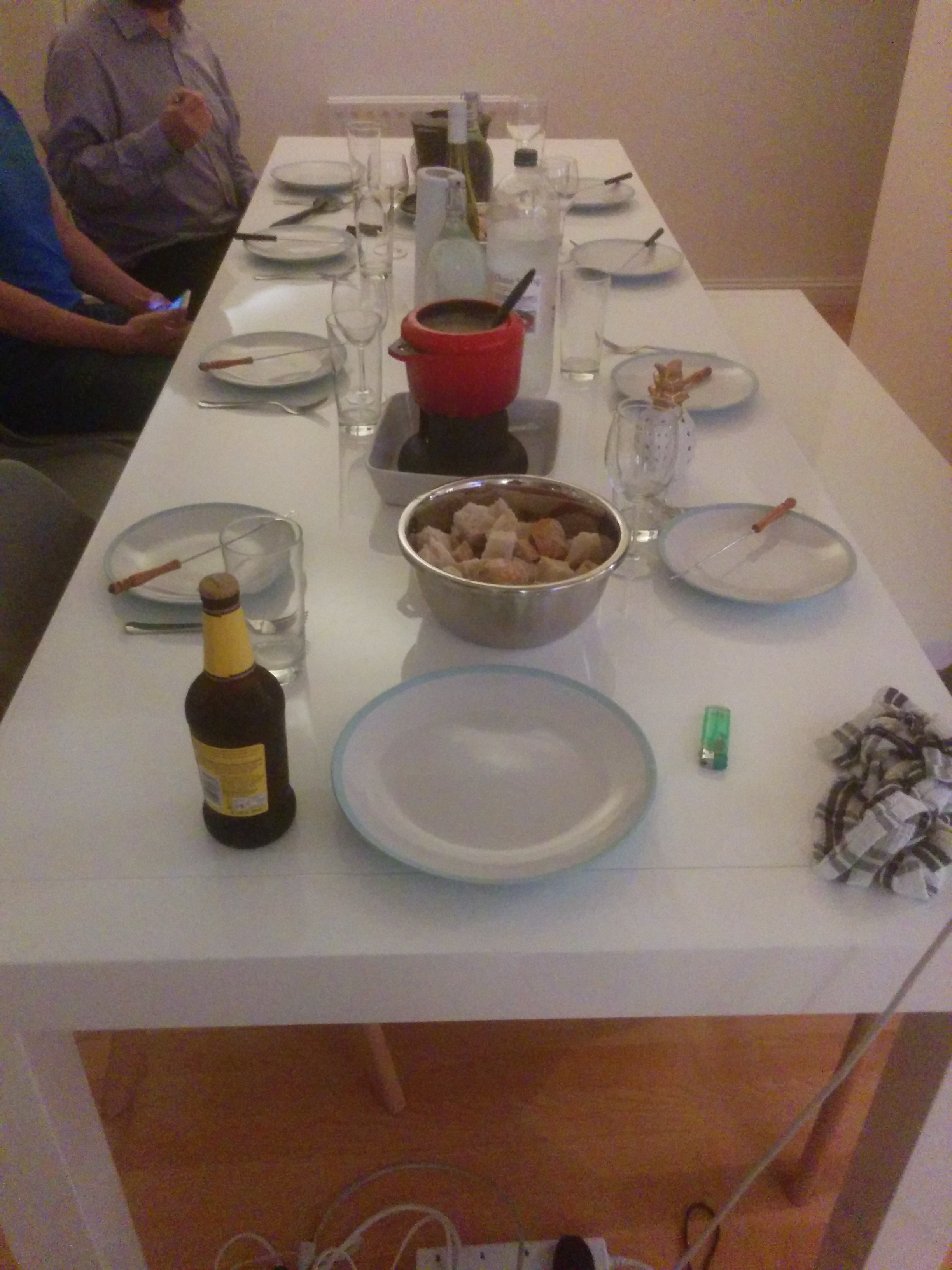
Another day, another videoteam report! It feels like we did a lot of work today, so let's jump right in: tumbleweed Stefano worked most of the day on the DebConf video archive metadata project. A bunch of videos already have been uploaded to YouTube. Here's some gold you might want to watch. By the end of our sprint, we should have generated metadata for most of our archive and uploaded a bunch of videos to YouTube. Don't worry though, YouTube is only a mirror and we'll keep our current archive as a video master. RattusRattus Andy joined us today! He hacked away with Stefano for most of the day, working on the metadata format for our videos and making schemes for our scraping tools. ivodd Ivo built and tested a good part of our video setup today, fixing bugs left and right in Ansible. We are prepared for the Cambridge Mini-DebConf! olasd Nicolas finished his scripts to automatically spool up and down our streaming mirrors via the DigitalOcean API today and ran our Ansible config against those machines to test our setup. pollo For my part, I completed a huge chunk of my sprint goals: we now have a website documenting our setup! It is currently hosted on Alioth pages, but olasd plans to make a request to DSA to have it hosted on the static.debian.org machine. The final URL will most likely be something like: https://video.debconf.org The documentation is still missing the streaming section (our streaming setup is not final yet, so not point in documenting that) and a section hosting guides for the volunteers. With some luck I might write those later this week. I've now moved on documentation our various Ansible roles. Oh, and we also ate some cheese fondue: Our fondue dinner

20 November 2017

Reproducible builds folks: Reproducible Builds: Weekly report #133

Here's what happened in the Reproducible Builds effort between Sunday November 5 and Saturday November 11 2017: Upcoming events On November 17th Chris Lamb will present at Open Compliance Summit, Yokohama, Japan on how reproducible builds ensures the long-term sustainability of technology infrastructure. We plan to hold an assembly at 34C3 - hope to see you there! LEDE CI tests Thanks to the work of lynxis, Mattia and h01ger, we're now testing all LEDE packages in our setup. This is our first result for the ar71xx target: "502 (100.0%) out of 502 built images and 4932 (94.8%) out of 5200 built packages were reproducible in our test setup." - see below for details how this was achieved. Bootstrapping and Diverse Double Compilation As a follow-up of a discussion on bootstrapping compilers we had on the Berlin summit, Bernhard and Ximin worked on a Proof of Concept for Diverse Double Compilation of tinycc (aka tcc). Ximin Luo did a successful diverse-double compilation of tinycc git HEAD using gcc-7.2.0, clang-4.0.1, icc-18.0.0 and pgcc-17.10-0 (pgcc needs to triple-compile it). More variations are planned for the future, with the eventual aim to reproduce the same binaries cross-distro, and extend it to test GCC itself. Packages reviewed and fixed, and bugs filed Patches filed upstream: Patches filed in Debian: Patches filed in OpenSUSE: Reviews of unreproducible packages 73 package reviews have been added, 88 have been updated and 40 have been removed in this week, adding to our knowledge about identified issues. 4 issue types have been updated: Weekly QA work During our reproducibility testing, FTBFS bugs have been detected and reported by: diffoscope development Mattia Rizzolo uploaded version 88~bpo9+1 to stretch-backports. reprotest development reproducible-website development theunreproduciblepackage development tests.reproducible-builds.org in detail Misc. This week's edition was written by Ximin Luo, Bernhard M. Wiedemann, Chris Lamb and Holger Levsen & reviewed by a bunch of Reproducible Builds folks on IRC & the mailing lists.

Dirk Eddelbuettel: RcppEigen 0.3.3.3.1

A maintenance release 0.3.3.3.1 of RcppEigen is now on CRAN (and will get to Debian soon). It brings Eigen 3.3.* to R. The impetus was a request from CRAN to change the call to Rcpp::Rcpp.plugin.maker() to only use :: as the function has in fact been exported and accessible for a pretty long time. So now the usage pattern catches up. Otherwise, Haiku-OS is now supported and a minor Travis tweak was made. The complete NEWS file entry follows.

Changes in RcppEigen version 0.3.3.3.1 (2017-11-19)
  • Compilation under Haiku-OS is now supported (Yu Gong in #45).
  • The Rcpp.plugin.maker helper function is called via :: as it is in fact exported (yet we had old code using :::).
  • A spurious argument was removed from an example call.
  • Travis CI now uses https to fetch the test runner script.

Courtesy of CRANberries, there is also a diffstat report for the most recent release.

This post by Dirk Eddelbuettel originated on his Thinking inside the box blog. Please report excessive re-aggregation in third-party for-profit settings.

Dirk Eddelbuettel: RcppClassic 0.9.9

A maintenance release RcppClassic 0.9.9 is now at CRAN. This package provides a maintained version of the otherwise deprecated first Rcpp API; no new projects should use it. Per a request from CRAN, we changed the call to Rcpp::Rcpp.plugin.maker() to only use :: as the function has in fact been exported and accessible for a pretty long time. So now the usage pattern catches up. Courtesy of CRANberries, there are changes relative to the previous release. Questions, comments etc should go to the rcpp-devel mailing list off the R-Forge page.

This post by Dirk Eddelbuettel originated on his Thinking inside the box blog. Please report excessive re-aggregation in third-party for-profit settings.

19 November 2017

Joey Hess: custom ARM disk image generation with propellor

Following up on propelling disk images, Propellor can now build custom ARM disk images for a variety of different ARM boards. The disk image build can run on a powerful laptop or server, so it's super fast and easy compared with manually installing Debian on an ARM board. Here's a simple propellor config for a Olimex LIME board, with ssh access and a root password:
lime :: Host
lime = host "lime.example.com" $ props
    & osDebian Unstable ARMHF
    & Machine.olimex_A10_OLinuXino_LIME
    & hasPartition (partition EXT4  mountedAt  "/"  setSize  MegaBytes 8192)
        & hasPassword (User "root")
        & Ssh.installed
    & Ssh.permitRootLogin (RootLogin True)
To make a disk image for that board, I only have to add this property to my laptop:
& imageBuiltFor lime
    (RawDiskImage "/srv/lime.img")
    (Debootstrapped mempty)
Propellor knows what kernel to install and how to make the image bootable for a bunch of ARM boards, including the Olimex LIME, the SheevaPlug, Banana Pi, and CubieTruck. To build the disk image targeting ARM, propellor uses qemu. So it's helpful that, after the first build, propellor incrementally updates disk images, quite quickly and efficiently. Once the board has the image installed, you can run propellor on it to further maintain it, and if there's a hardware problem, you can quickly replace it with an updated image.
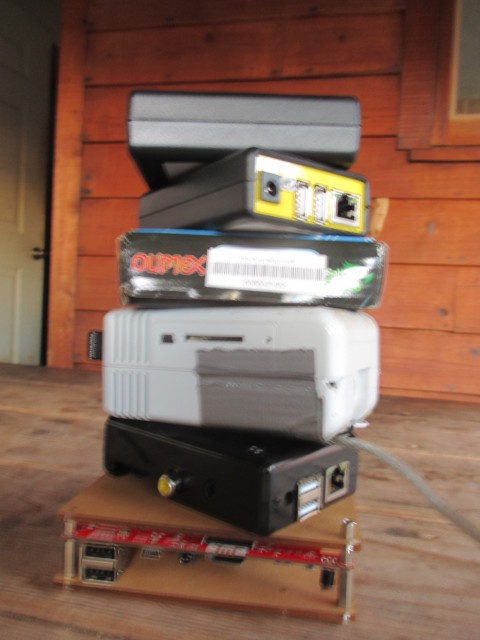
computer tower that I will be maintaining with propellor
It's fairly simple to teach propellor about other ARM boards, so it should be quite easy to keep propellor knowing about all ARM boards supported by Debian (and other distros). Here's how I taught it about the Olimex LIME:
olimex_A10_OLinuXino_LIME :: Property (HasInfo + DebianLike)
olimex_A10_OLinuXino_LIME = FlashKernel.installed "Olimex A10-OLinuXino-LIME"
     requires  sunixi "A10-OLinuXino-Lime"
     requires  armmp
My home server is a CubieTruck which serves as a wireless access point, solar panel data collector, and git-annex autobuilder. It's deployed from a disk image built by propellor, using this config. I've been involved with building disk image for ARM boards for a long time -- it was part of my job for five years -- and this is the first time I've been entirely happy with the process.

Louis-Philippe V ronneau: DebConf Videoteam sprint report - day 0

First day of the videoteam autumn sprint! Well, I say first day, but in reality it's more day 0. Even though most of us have arrived in Cambridge already, we are still missing a few people. Last year we decided to sprint in Paris because most of our video gear is stocked there. This year, we instead chose to sprint a few days before the Cambridge Mini-Debconf to help record the conference afterwards. Since some of us arrived very late and the ones who did arrive early are still mostly jet lagged (that includes me), I'll use this post to introduce the space we'll be working from this week and our general plan for the sprint. House Party After some deliberations, we decided to rent a house for a week in Cambridge: finding a work space to accommodate us and all our gear proved difficult and we decided mixing accommodation and work would be a good idea. I've only been here for a few hours, but I have to say I'm pretty impressed by the airbnb we got. Last time I checked (it seems every time I do, some new room magically appears), I counted 5 bedrooms, 6 beds, 5 toilets and 3 shower rooms. Heck, there's even a solarium and a training room with weights and a punching bag on the first floor. Having a whole house to ourselves also means we have access to a functional kitchen. I'd really like to cook at least a few meals during the week. There's also a cat! Picture of a black cat I took from Wikipedia. It was too dark outside to use mine It's not the house's cat per say, but it's been hanging out around the house for most of the day and makes cute faces trying to convince us to let it come inside. Nice try cat. Nice try. Here are some glamour professional photos of what the place looks like on a perfect summer day, just for the kick of it: The view from the garden The Kitchen One of the multiple bedrooms Of course, reality has trouble matching all the post-processing filters. Plan for the week Now on a more serious note; apart from enjoying the beautiful city of Cambridge, here's what the team plans to do this week: tumbleweed Stefano wants to continue refactoring our ansible setup. A lot of things have been added in the last year, but some of it are hacks we should remove and implement correctly. highvoltage Jonathan won't be able to come to Cambridge, but plans to work remotely, mainly on our desktop/xfce session implementation. Another pile of hacks waiting to be cleaned! ivodd Ivo has been working a lot of the pre-ansible part of our installation and plans to continue working on that. At the moment, creating an installation USB key is pretty complicated and he wants to make that simpler. olasd Nicolas completely reimplemented our streaming setup for DC17 and wants to continue working on that. More specifically, he wants to write scripts to automatically setup and teardown - via API calls - the distributed streaming network we now use. Finding a way to push TLS certificates to those mirrors, adding a live stream viewer on video.debconf.org and adding a viewer to our archive are also things he wants to look at. pollo For my part, I plan to catch up with all the commits in our ansible repository I missed since last year's sprint and work on documentation. It would be very nice if we could have a static website describing our work so that others (at mini-debconfs for examples) could replicate it easily. If I have time, I'll also try to document all the ansible roles we have written. Stay tuned for more daily reports!
18 November 2017

Matthieu Caneill: MiniDebconf in Toulouse

I attended the MiniDebconf in Toulouse, which was hosted in the larger Capitole du Libre, a free software event with talks, presentation of associations, and a keysigning party. I didn't expect the event to be that big, and I was very impressed by its organization. Cheers to all the volunteers, it has been an amazing week-end! Here's a sum-up of the talks I attended. Du logiciel libre la monnaie libre Speaker: lo s The first talk I attended was, translated to English, "from free software to free money". lo s compared the 4 freedoms of free software with money, and what properties money needs to exhibit in order to be considered free. He then introduced 1, a project of free (as in free speech!) money, started in the region around Toulouse. Contrary to some distributed ledgers such as Bitcoin, 1 isn't based on an hash-based proof-of-work, but rather around a web of trust of people certifying each other, hence limiting the energy consumption required by the network to function. YunoHost Speaker: Jimmy Monin I then attended a presentation of YunoHost. Being an happy user myself, it was very nice to discover the future expected features, and also meet two of the developers. YunoHost is a Debian-based project, aimed at providing all the tools necessary to self-host applications, including email, website, calendar, development tools, and dozens of other packages. Premiers pas dans l'univers de Debian Speaker: Nicolas Dandrimont For the first talk of the MiniDebConf, Nicolas Dandrimont introduced Debian, its philosophy, and how it works with regards to upstreams and downstreams. He gave many details on the teams, the infrastructure, and the internals of Debian. Trusting your computer and system Speaker: Jonas Smedegaard Jonas introduced some security concepts, and how they are abused and often meaningless (to quote his own words, "secure is bullshit"). He described a few projects which lean towards a more secure and open hardware, for both phones and laptops. Automatiser la gestion de configuration de Debian avec Ansible Speaker: J r my Lecour J r my, from Evolix, introduced Ansible, and how they use it to manage hundreds of Debian servers. Ansible is a very powerful tool, and a huge ecosystem, in many ways similar to Puppet or Chef, except it is agent-less, using only ssh connections to communicate with remote machines. Very nice to compare their use of Ansible with mine, since that's the software I use at work for deploying experiments. Making Debian for everybody Speaker: Samuel Thibault Samuel gave a talk about accessibility, and the general availability of the tools in today's operating systems, including Debian. The lesson to take home is that we often don't do enough in this domain, particularly when considering some issues people might have that we don't always think about. Accessibility on computers (and elsewhere) should be the default, and never require complex setups. Retour d'exp rience : mise jour de milliers de terminaux Debian Speaker: Cyril Brulebois Cyril described a problem he was hired for, an update of thousands of Debian servers from wheezy to jessie, which he discovered afterwards was worse than initially thought, since the machines were running the out-of-date squeeze. Since they were not always administered with the best sysadmin practices, they were all exhibiting different configurations and different packages lists, which raised many issues and gave him interesting challenges. They were solved using Ansible, which also had the effect of standardizing their system administration practices. Retour d'exp rience : utilisation de Debian chez Evolix Speaker: Gr gory Colpart Gr gory described Evolix, a company which manages servers for their clients, and how they were inspired by Debian, for both their internal tools and their practices. It is very interesting to see that some of the Debian values can be easily exported for a more open and collaborative business. Lightning talks To close the conference, two lightning talks were presented, describing the switch from Windows XP to Debian in an ecologic association near Toulouse; and how snapshot.debian.org can be used with bisections to find the source of some regressions. Conclusion A big thank you to all the organizers and the associations who contributed to make this event a success. Cheers!

Russ Allbery: Free software log (October 2017)

I've not been taking the time to write these promptly in part because I've not found the time to do much free software work. Thankfully, November will at least contain some work-sponsored work (on a package that isn't widely used yet, but maybe we can make it appealing enough). Anyway, that's for next month. For October, the only thing I have to report is refreshing the signing key for my personal Debian repository (generating a new key for the new release) and finally updating the distributions to move stretch to stable, jessie to oldstable, and create the new testing distribution (buster). If for some strange reason you're using my personal repositories (there probably isn't much reason just at the moment), be sure to upgrade eyrie-keyring, since I'm going to switch signing over to the new key shortly.

Petter Reinholdtsen: Legal to share more than 3000 movies listed on IMDB?

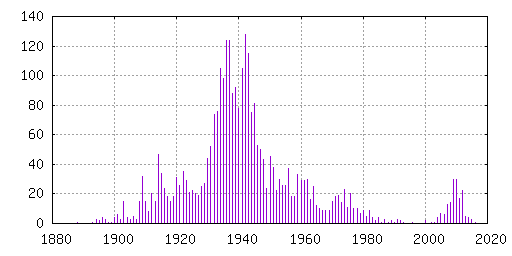
A month ago, I blogged about my work to automatically check the copyright status of IMDB entries, and try to count the number of movies listed in IMDB that is legal to distribute on the Internet. I have continued to look for good data sources, and identified a few more. The code used to extract information from various data sources is available in a git repository, currently available from github. So far I have identified 3186 unique IMDB title IDs. To gain better understanding of the structure of the data set, I created a histogram of the year associated with each movie (typically release year). It is interesting to notice where the peaks and dips in the graph are located. I wonder why they are placed there. I suspect World War II caused the dip around 1940, but what caused the peak around 2010?

I've so far identified ten sources for IMDB title IDs for movies in the public domain or with a free license. This is the statistics reported when running 'make stats' in the git repository:

  249 entries (    6 unique) with and   288 without IMDB title ID in free-movies-archive-org-butter.json
 2301 entries (  540 unique) with and     0 without IMDB title ID in free-movies-archive-org-wikidata.json
  830 entries (   29 unique) with and     0 without IMDB title ID in free-movies-icheckmovies-archive-mochard.json
 2109 entries (  377 unique) with and     0 without IMDB title ID in free-movies-imdb-pd.json
  291 entries (  122 unique) with and     0 without IMDB title ID in free-movies-letterboxd-pd.json
  144 entries (  135 unique) with and     0 without IMDB title ID in free-movies-manual.json
  350 entries (    1 unique) with and   801 without IMDB title ID in free-movies-publicdomainmovies.json
    4 entries (    0 unique) with and   124 without IMDB title ID in free-movies-publicdomainreview.json
  698 entries (  119 unique) with and   118 without IMDB title ID in free-movies-publicdomaintorrents.json
    8 entries (    8 unique) with and   196 without IMDB title ID in free-movies-vodo.json
 3186 unique IMDB title IDs in total
The entries without IMDB title ID are candidates to increase the data set, but might equally well be duplicates of entries already listed with IMDB title ID in one of the other sources, or represent movies that lack a IMDB title ID. I've seen examples of all these situations when peeking at the entries without IMDB title ID. Based on these data sources, the lower bound for movies listed in IMDB that are legal to distribute on the Internet is between 3186 and 4713. It would be great for improving the accuracy of this measurement, if the various sources added IMDB title ID to their metadata. I have tried to reach the people behind the various sources to ask if they are interested in doing this, without any replies so far. Perhaps you can help me get in touch with the people behind VODO, Public Domain Torrents, Public Domain Movies and Public Domain Review to try to convince them to add more metadata to their movie entries? Another way you could help is by adding pages to Wikipedia about movies that are legal to distribute on the Internet. If such page exist and include a link to both IMDB and The Internet Archive, the script used to generate free-movies-archive-org-wikidata.json should pick up the mapping as soon as wikidata is updates. As usual, if you use Bitcoin and want to show your support of my activities, please send Bitcoin donations to my address 15oWEoG9dUPovwmUL9KWAnYRtNJEkP1u1b.

Joey Hess: stupid long route

There's an old net story from the 80's, which I can't find right now, but is about two computers, 10 feet apart, having a ridiculously long network route between them, packets traveling into other states or countries and back, when they could have flowed over a short cable. Ever since I read that, I've been collecting my own ridiculously long routes. ssh bouncing from country to country, making letters I type travel all the way around the world until they echo back on my screen. Tasting the latency that's one of the only ways we can viscerally understand just how big a tangle of wires humanity has built. Yesterday, I surpassed all that, and I did it in a way that hearkens right back to the original story. I had two computers, 20 feet apart, I wanted one to talk to the other, and the route between the two ended up traveling not around the Earth, but almost the distance to the Moon. I was rebuilding my home's access point, and ran into a annoying bug that prevented it from listening to wifi. I knew it was still connected over ethernet to the satellite receiver. I connected my laptop to the satellite receiver over wifi. But, I didn't know the IP address to reach the access point. Then I remembered I had set it up so incoming ssh to the satellite receiver was directed to the access point. So, I sshed to a computer in New Jersey. And from there I sshed to my access point. And the latency was amazing. Because, every time I pressed a key: Not bad for a lazy solution to a problem that could have been solved by walking across the room, eh? Previously: roundtrip latency from a cabin with dialup in 2011

16 November 2017

Michal Čihař: New projects on Hosted Weblate

Hosted Weblate provides also free hosting for free software projects. The hosting requests queue has grown too long, so it's time to process it and include new project. This time, the newly hosted projects include: If you want to support this effort, please donate to Weblate, especially recurring donations are welcome to make this service alive. You can do that easily on Liberapay or Bountysource.

Filed under: Debian English SUSE Weblate

15 November 2017

Steinar H. Gunderson: Introducing Narabu, part 6: Performance

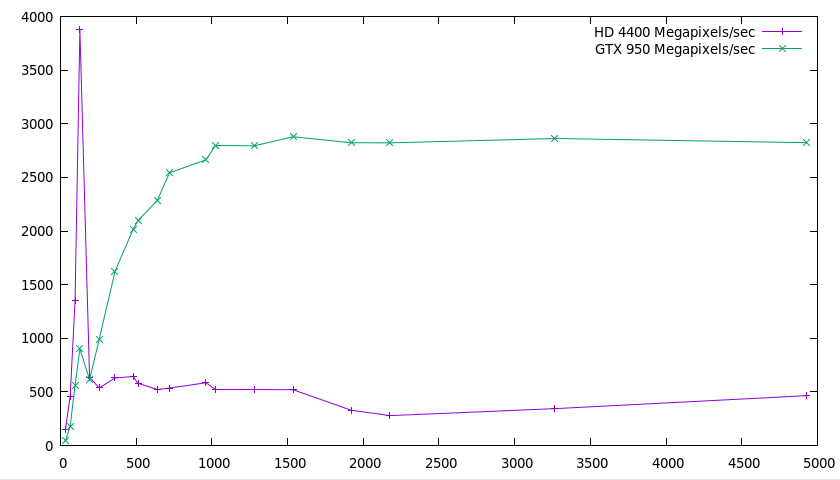
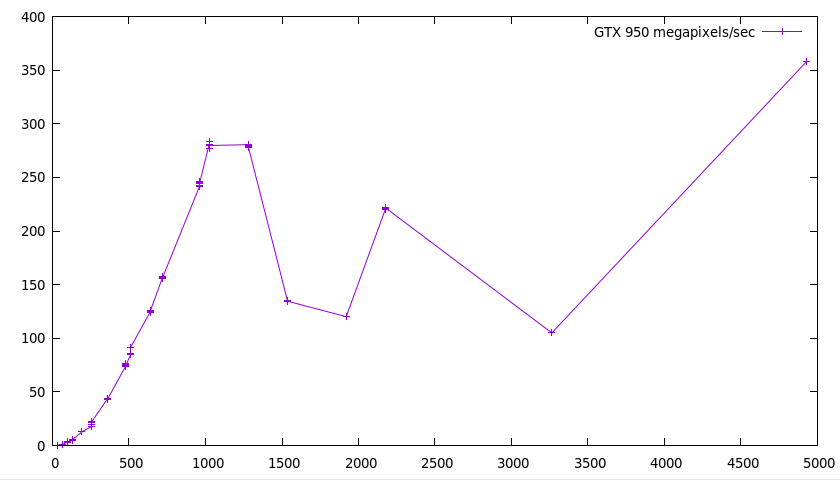
Narabu is a new intraframe video codec. You probably want to read part 1, part 2, part 3, part 4 and part 5 first. Like I wrote in part 5, there basically isn't a big splashy ending where everything is resolved here; you're basically getting some graphs with some open questions and some interesting observations. First of all, though, I'll need to make a correction: In the last part, I wrote that encoding takes 1.2 ms for 720p luma-only on my GTX 950, which isn't correct I remembered the wrong number. The right number is 2.3 ms, which I guess explains even more why I don't think it's acceptable at the current stage. (I'm also pretty sure it's possible to rearchitect the encoder so that it's much better, but I am moving on to other video-related things for the time being.) I encoded a picture straight off my DSLR (luma-only) at various resolutions, keeping the aspect. Then I decoded it a bunch of times on my GTX 950 (low-end last-generation NVIDIA) and on my HD 4400 (ultraportable Haswell laptop) and measured the times. They're normalized for megapixels per second decoded; remember that doubling width (x axis) means quadruple the pixels. Here it is: Narabu decoding performance graph I'm not going to comment much beyond two observations: Encoding only contains the GTX 950 because I didn't finish the work to get that single int64 divide off: Narabu encoding performance graph This is interesting. I have few explanations. Probably more benchmarking and profiling would be needed to make sense of any of it. In fact, it's so strange that I would suspect a bug, but it does indeed seem to create a valid bitstream that is decoded by the decoder. Do note, however, that seemingly even on the smallest resolutions, there's a 1.7 ms base cost (you can't see it on the picture, but you'd see it in an unnormalized graph). I don't have a very good explanation for this either (even though there are some costs that are dependent on the alphabet size instead of the number of pixels), but figuring it out would probably be a great start for getting the performance up. So that concludes the series, on a cliffhanger. :-) Even though it's not in a situation where you can just take it and put it into something useful, I hope it was an interesting introduction to the GPU! And in the meantime, I've released version 1.6.3 of Nageru, my live video mixer (also heavily GPU-based) with various small adjustments and bug fixes found before and during Tr ndisk. And Movit is getting compute shaders for that extra speed boost, although parts of it is bending my head. Exciting times in GPU land :-)
Kees Cook: security things in Linux v4.14

Previously: v4.13. Linux kernel v4.14 was released this last Sunday, and there s a bunch of security things I think are interesting: vmapped kernel stack on arm64
Similar to the same feature on x86, Mark Rutland and Ard Biesheuvel implemented CONFIG_VMAP_STACK for arm64, which moves the kernel stack to an isolated and guard-paged vmap area. With traditional stacks, there were two major risks when exhausting the stack: overwriting the thread_info structure (which contained the addr_limit field which is checked during copy_to/from_user()), and overwriting neighboring stacks (or other things allocated next to the stack). While arm64 previously moved its thread_info off the stack to deal with the former issue, this vmap change adds the last bit of protection by nature of the vmap guard pages. If the kernel tries to write past the end of the stack, it will hit the guard page and fault. (Testing for this is now possible via LKDTM s STACK_GUARD_PAGE_LEADING/TRAILING tests.) One aspect of the guard page protection that will need further attention (on all architectures) is that if the stack grew because of a giant Variable Length Array on the stack (effectively an implicit alloca() call), it might be possible to jump over the guard page entirely (as seen in the userspace Stack Clash attacks). Thankfully the use of VLAs is rare in the kernel. In the future, hopefully we ll see the addition of PaX/grsecurity s STACKLEAK plugin which, in addition to its primary purpose of clearing the kernel stack on return to userspace, makes sure stack expansion cannot skip over guard pages. This stack probing ability will likely also become directly available from the compiler as well. set_fs() balance checking
Related to the addr_limit field mentioned above, another class of bug is finding a way to force the kernel into accidentally leaving addr_limit open to kernel memory through an unbalanced call to set_fs(). In some areas of the kernel, in order to reuse userspace routines (usually VFS or compat related), code will do something like: set_fs(KERNEL_DS); ...some code here...; set_fs(USER_DS);. When the USER_DS call goes missing (usually due to a buggy error path or exception), subsequent system calls can suddenly start writing into kernel memory via copy_to_user (where the to user really means within the addr_limit range ). Thomas Garnier implemented USER_DS checking at syscall exit time for x86, arm, and arm64. This means that a broken set_fs() setting will not extend beyond the buggy syscall that fails to set it back to USER_DS. Additionally, as part of the discussion on the best way to deal with this feature, Christoph Hellwig and Al Viro (and others) have been making extensive changes to avoid the need for set_fs() being used at all, which should greatly reduce the number of places where it might be possible to introduce such a bug in the future. SLUB freelist hardening
A common class of heap attacks is overwriting the freelist pointers stored inline in the unallocated SLUB cache objects. PaX/grsecurity developed an inexpensive defense that XORs the freelist pointer with a global random value (and the storage address). Daniel Micay improved on this by using a per-cache random value, and I refactored the code a bit more. The resulting feature, enabled with CONFIG_SLAB_FREELIST_HARDENED, makes freelist pointer overwrites very hard to exploit unless an attacker has found a way to expose both the random value and the pointer location. This should render blind heap overflow bugs much more difficult to exploit. Additionally, Alexander Popov implemented a simple double-free defense, similar to the fasttop check in the GNU C library, which will catch sequential free()s of the same pointer. (And has already uncovered a bug.) Future work would be to provide similar metadata protections to the SLAB allocator (though SLAB doesn t store its freelist within the individual unused objects, so it has a different set of exposures compared to SLUB). setuid-exec stack limitation
Continuing the various additional defenses to protect against future problems related to userspace memory layout manipulation (as shown most recently in the Stack Clash attacks), I implemented an 8MiB stack limit for privileged (i.e. setuid) execs, inspired by a similar protection in grsecurity, after reworking the secureexec handling by LSMs. This complements the unconditional limit to the size of exec arguments that landed in v4.13. randstruct automatic struct selection
While the bulk of the port of the randstruct gcc plugin from grsecurity landed in v4.13, the last of the work needed to enable automatic struct selection landed in v4.14. This means that the coverage of randomized structures, via CONFIG_GCC_PLUGIN_RANDSTRUCT, now includes one of the major targets of exploits: function pointer structures. Without knowing the build-randomized location of a callback pointer an attacker needs to overwrite in a structure, exploits become much less reliable. structleak passed-by-reference variable initialization
Ard Biesheuvel enhanced the structleak gcc plugin to initialize all variables on the stack that are passed by reference when built with CONFIG_GCC_PLUGIN_STRUCTLEAK_BYREF_ALL. Normally the compiler will yell if a variable is used before being initialized, but it silences this warning if the variable s address is passed into a function call first, as it has no way to tell if the function did actually initialize the contents. So the plugin now zero-initializes such variables (if they hadn t already been initialized) before the function call that takes their address. Enabling this feature has a small performance impact, but solves many stack content exposure flaws. (In fact at least one such flaw reported during the v4.15 development cycle was mitigated by this plugin.) improved boot entropy
Laura Abbott and Daniel Micay improved early boot entropy available to the stack protector by both moving the stack protector setup later in the boot, and including the kernel command line in boot entropy collection (since with some devices it changes on each boot). eBPF JIT for 32-bit ARM
The ARM BPF JIT had been around a while, but it didn t support eBPF (and, as a result, did not provide constant value blinding, which meant it was exposed to being used by an attacker to build arbitrary machine code with BPF constant values). Shubham Bansal spent a bunch of time building a full eBPF JIT for 32-bit ARM which both speeds up eBPF and brings it up to date on JIT exploit defenses in the kernel. seccomp improvements
Tyler Hicks addressed a long-standing deficiency in how seccomp could log action results. In addition to creating a way to mark a specific seccomp filter as needing to be logged with SECCOMP_FILTER_FLAG_LOG, he added a new action result, SECCOMP_RET_LOG. With these changes in place, it should be much easier for developers to inspect the results of seccomp filters, and for process launchers to generate logs for their child processes operating under a seccomp filter. Additionally, I finally found a way to implement an often-requested feature for seccomp, which was to kill an entire process instead of just the offending thread. This was done by creating the SECCOMP_RET_ACTION_FULL mask (n e SECCOMP_RET_ACTION) and implementing SECCOMP_RET_KILL_PROCESS. That s it for now; please let me know if I missed anything. The v4.15 merge window is now open!

2017, Kees Cook. This work is licensed under a Creative Commons Attribution-ShareAlike 3.0 License.
Creative Commons License

Russ Allbery: Review: The Piper's Son

Review: The Piper's Son, by Melina Marchetta
Series: Francesca #2
Publisher: Candlewick Press
Copyright: 2010
Printing: 2011
ISBN: 0-7636-5458-2
Format: Kindle
Pages: 330
Tom Mackee's family has fallen apart. The impetus was the death of his uncle Joe in the London tube terrorist bombings, but that was only the start. He destroyed his chances with the only woman he really loved. His father's drinking got out of control, his mother left with his younger sister to live in a different city, and he refused to go with them and abandon his father. But then, six months later, his father abandoned him anyway. As this novel opens, Tom collapses while performing a music set, high on drugs and no sleep, and wakes up to discover his roommates have been fired from their jobs for stealing, and in turn have thrown him out of their apartment. He's at rock bottom. The one place he can turn for a place to stay is his aunt Georgie, the second (although less frequent) viewpoint character of this book. She was the one who took the trip to the UK to try to find out what happened and retrieve her brother's body, and the one who had to return to Australia with nothing. Her life isn't in much better shape than Tom's. She's kept her job, but she's pregnant by her ex-boyfriend but barely talking to him, since he now has a son by another woman he met during their separation. And she's not even remotely over her grief. The whole Finch/Mackee family is, in short, a disaster. But they have a few family relationships left that haven't broken, some underlying basic decency, and some patient and determined friends. I should warn up-front, despite having read this book without knowing this, that this is a sequel to Saving Francesca, set five years later and focusing on secondary characters from the original novel. I've subsequently read that book as well, though, and I don't think reading it first is necessary. This is one of the rare books where being a sequel made it a better stand-alone novel. I never felt a gap of missing story, just a rich and deep background of friendships and previous relationships that felt realistic. People are embedded in networks of relationships even when they feel the most alone, and I really enjoyed seeing that surface in this book. All those patterns from Tom's past didn't feel like information I was missing. They felt like glimpses of what you'd see if you looked into any other person's life. The plot summary above might make The Piper's Son sound like a depressing drama fest, but Marchetta made an excellent writing decision: the worst of this has already happened before the start of the book, and the rest is in the first chapter. This is not at all a book about horrible things happening to people. It's a book about healing. An authentic, prickly, angry healing that doesn't forget and doesn't turn into simple happily-ever-after stories, but does involve a lot of recognition that one has been an ass, and that it's possible to be less of an ass in the future, and maybe some things can be fixed. A plot summary might fool you into thinking that this is a book about a boy and his father, or about dealing with a drunk you still love. It's not. The bright current under this whole story is not father-son bonding. It's female friendships. Marchetta pulls off a beautiful double-story, writing a book that's about Tom, and Georgie, and the layered guilt and tragedy of the Finch/Mackee family, but whose emotional heart is their friends. Francesca, Justine, absent Siobhan. Georgie's friend Lucia. Ned, the cook, and his interactions with Tom's friends. And Tara Finke, also mostly absent, but perfectly written into the story in letters and phone calls. Marchetta never calls unnecessary attention to this, keeping the camera on Tom and Georgie, but the process of reading this book is a dawning realization of just how much work friendship is doing under the surface, how much back-channel conversation is happening off the page, and how much careful and thoughtful and determined work went into providing Tom a floor, a place to get his feet under him, and enough of a shove for him to pull himself together. Pulling that off requires a deft and subtle authorial touch, and I'm in awe at how well it worked. This is a beautifully written novel. Marchetta never belabors an emotional point, sticking with a clear and spare description of actions and thoughts, with just the right sentences scattered here and there to expose the character's emotions. Tom's family is awful at communication, which is much of the reason why they start the book in the situation they're in, but Marchetta somehow manages to write that in a way that didn't just frustrate me or make me want to start banging their heads together. She somehow conveys the extent to which they're trying, even when they're failing, and adds just the right descriptions so that the reader can follow the wordless messages they send each other even when they can't manage to talk directly. I usually find it very hard to connect with people who can only communicate by doing things rather than saying them. It's a high compliment to the author that I felt I understood Tom and his family as well as I did. One bit of warning: while this is not a story of a grand reunion with an alcoholic father where all is forgiven because family, thank heavens, there is an occasional wiggle in that direction. There is also a steady background assumption that one should always try to repair family relationships, and a few tangential notes about the Finches and Mackees that made me think there was a bit more abuse here than anyone involved wants to admit. I don't think the book is trying to make apologies for this, and instead is trying to walk the fine line of talking about realistically messed up families, but I also don't have a strong personal reaction to that type of story. If you have an aversion to "we should all get along because faaaaamily" stories, you may want to skip this book, or at least go in pre-warned. That aside, the biggest challenge I had in reading this book was not breaking into tears. The emotional arc is just about perfect. Tom and Georgie never stay stuck in the same emotional cycle for too long, Marchetta does a wonderful job showing irritating characters from a slightly different angle and having them become much less irritating, and the interactions between Tom, Tara, and Francesca are just perfect. I don't remember reading another book that so beautifully captures that sensation of knowing that you've been a total ass, knowing that you need to stop, but realizing just how much work you're going to have to do, and how hard that work will be, once you own up to how much you fucked up. That point where you keep being an ass for a few moments longer, because stopping is going to hurt so much, but end up stopping anyway because you can't stand yourself any more. And stopping and making amends is hard and hurts badly, and yet somehow isn't quite as bad as you thought it was going to be. This is really great stuff. One final complaint, though: what is it with mainstream fiction and the total lack of denouement? I don't read very much mainstream fiction, but this is the second really good mainstream book I've read (after The Death of Bees) that hits its climax and then unceremoniously dumps the reader on the ground and disappears. Come back here! I wasn't done with these people! I don't need a long happily-ever-after story, but give me at least a handful of pages to be happy with the characters after crying with them for hours! ARGH. But, that aside, the reader does get that climax, and it's note-perfect to the rest of the book. Everyone is still themselves, no one gets suddenly transformed, and yet everything is... better. It's the kind of book you can trust. Highly, highly recommended. Rating: 9 out of 10

Next.

Previous.