Search Results: "agi"

9 July 2013

Raphaël Hertzog: My Free Software Activities in June 2013

This is my monthly summary of my free software related activities. If you re among the people who made a donation to support my work (106.39 , thanks everybody!), then you can learn how I spent your money. Otherwise it s just an interesting status update on my various projects. Debian France I handled some subscriptions that we collected during Solutions Linux at the end of last month and I also worked on updating the accounts in preparation of our annual general assembly. As the current president, I wrote a moral assessment of the organization and I helped Sylvestre Ledru (the treasurer) to prepare an overview of our financial situation (which is rather good). The plan for this general assembly included the renewal of 6 of our 9 board members so I tried to motivate some persons to candidate and I m pretty happy to see that we managed to have 9 candidates for 6 seats, a real election for once. :-) And as usual, I updated Galette to version 0.7.4.2 and I filed a couple of tickets (#621, #622). Debian Package Tracking System We re getting close to one month of work on the Google Summer of Code Project that rewrites the Package Tracking System. On average I spent a good 1h30 per day on reviewing the code, giving my feedback, and preparing the user stories for the next iteration, plus a 2 hour meeting each Wednesday afternoon. This is more than I expected but at I m rather happy with the result so far. We have a live test instance updated each week (after the end of the iteration) at pts.debian.net. The web interface is empty because the bulk of the work has been spent on the email interface for now, but it s now feature complete and already has seen some improvements compared to the current implementation (fixing #340863 for example). You can interact with it by sending mails to control@pts.debian.net. The Debian Administrator s Handbook The fundraising for the liberation of the original book in French met its initial target very quickly and we added new targets with supplementary rewards (more ebook from Eyrolles, donation to Debian). All the supplementary targets were met, although the last one took until the last day! Thanks to all the supporters, we now have a French translation of the Debian Administrator s Handbook which is free and we have collected about 2700 EUR for Debian. Debian Packaging I got a couple of release critical bug reports that I had to fix: And trying to anticipate future issues, I filed an upstream ticket on feed2omb (#33) to see whether upstream had plans to support the new pump.io API that identi.ca is supposed to use soonish. Kali Linux I filed a couple of Debian bugs: #711866 to request a new upstream version of w3af in Debian, #711044 to report a missing dependency in LSB meta-informations of the vsftpd init script. I worked on packaging passing-the-hash. Basically this is a fork of several software just to override some NTLM authentication functions. In some cases, I managed to avoid the fork by transforming the patches in LD_PRELOAD libraries that override the specific symbol of the patched functions. Among the forked software, there was winexe which wasn t packaged yet. So I packaged it but we quickly ran into some segfaults (which was already reported to upstream since a few months). I investigated the problem and prepared a patch. It has been submitted to upstream and merged. Thanks See you next month for a new summary of my activities.

No comment Liked this article? Click here. My blog is Flattr-enabled.

7 July 2013

Sylvestre Ledru: LLVM toolchain packages

In parallel of my work on the LLVM Debian/Ubuntu nightly packages, I uploaded a couple months ago the same packages for the stable releases of the LLVM toolchain. By toolchain, this means LLVM + Clang + Clang extra tools + compiler-rt + polly + LLDB.
Previously, they were packaged as separate source packages. Making the maintenance harder and, especially, limiting the packaging of LLDB and polly. Currently, we have in the archive: For the 3.2 release, I am planning to focus on RC bug fixes.
The 3.3 and snapshot releases will get the feature improvements.
llvm-default will point to the 3.3 release once it builds on all architectures and it reached testing aka Jessie (probably during summer).

5 July 2013

Justus Winter: mount, umount and mtab

This week was all about getting mount into shape, addind umount and hacking up a prototype for the mtab issue. With all my patches to mount the boot log looks like this:
INIT: version 2.88 booting
Using makefile-style concurrent boot in runlevel S.
Activating swap...done.
Checking root file system...fsck from util-linux 2.20.1
hd2 : tray open or drive not ready
end_request: I/O error, dev 02:00, sector 0
ext2fs_check_if_mount: Can't check if filesystem is mounted due to missing mtab file while determining whether /dev/hd0s1 is mounted.
/dev/hd0s1: clean, 44101/181056 files, 283413/723200 blocks
done.
Cleaning up temporary files... /tmp.
/etc/rcS.d/S06mtab.sh: 48: /etc/rcS.d/S06mtab.sh: cannot open /proc/mounts: No such file
Activating lvm and md swap...(default pager): Already paging to partition hd0s5!
done.
Checking file systems...fsck from util-linux 2.20.1
hd2 : tray open or drive not ready
end_request: I/O error, dev 02:00, sector 0
done.
Mounting local filesystems...done.
Activating swapfile swap...(default pager): Already paging to partition hd0s5!
done.
df: Warning: cannot read table of mounted file systems: No such file or directory
Cleaning up temporary files....
Configuring network interfaces...inetutils-ifconfig: invalid arguments
ifup: failed to open pid file /run/network/ifup-/dev/eth0.pid: No such file or directory
Internet Systems Consortium DHCP Client 4.2.2
Copyright 2004-2011 Internet Systems Consortium.
All rights reserved.
For info, please visit https://www.isc.org/software/dhcp/
can't create /var/lib/dhcp/dhclient./dev/eth0.leases: No such file or directory
Listening on Socket//dev/eth0
Sending on   Socket//dev/eth0
DHCPDISCOVER on /dev/eth0 to 255.255.255.255 port 67 interval 7
DHCPREQUEST on /dev/eth0 to 255.255.255.255 port 67
DHCPOFFER from 10.0.2.2
DHCPACK from 10.0.2.2
can't create /var/lib/dhcp/dhclient./dev/eth0.leases: No such file or directory
bound to 10.0.2.15 -- renewal in 42107 seconds.
done.
Cleaning up temporary files....
Setting up X socket directories... /tmp/.X11-unix /tmp/.ICE-unix.
INIT: Entering runlevel: 2
Using makefile-style concurrent boot in runlevel 2.
Starting enhanced syslogd: rsyslogd.
Starting deferred execution scheduler: atd.
Starting periodic command scheduler: cron.
Starting system message bus: dbusFailed to set socket option"/var/run/dbus/system_bus_socket": Protocol not available.
Starting OpenBSD Secure Shell server: sshd.
GNU 0.3 (debian) (console)
login:
As you can see, mountall.sh works fine now (it's the line about mounting local filesystems). This is a list of issues I tackled this week: Note that even though I've implemented umount, it doesn't actually work yet. That is because umount needs a mtab file or /proc/mounts to do anything, because you can either invoke umount with the mount point or the device and umount needs an mtab style file to figure out whether the argument is referring to the former or the latter. So the next big issue is the mtab issue. There is some information about that in the Hurd wiki, it even is a gsoc project idea of its own: http://www.gnu.org/software/hurd/community/gsoc/project_ideas/mtab.html But I need this now, this cannot wait for another gsoc. The implementation outlined by that page consists roughly of: If this hypothetical mtab translator is bound to say /proc/mounts this would solve all our problems:
% settrans -ca /proc/mounts /hurd/mtab /
As this involves adding a RPC procedure and keeping a list of passive and active translators, this involves some design decisions. As discussed in #hurd I hacked up a prototype and post it for review: http://lists.gnu.org/archive/html/bug-hurd/2013-07/msg00022.html As soon as I get the necessary feedback on this issue, I will get the implementation up to speed. Until then, I will pick another item from my status list, most probably the ifupdown issue. Speaking of feedback, all of my patches I sent last week were merged at the appropriate locations. That was really quick, many thanks for that :) While working on the mount issues, I frequently looked at the implementation of Linux' and FreeBSD's mount to see how --types is handled there. I must admit that I was not to keen about the idea of writing c again, but I was positively surprised by the code I've seen from Hurd so far. As Hurd is the operating system of the GNU system, its code is free to use any GNU extension to libc and gcc including nice stuff like nested functions. If you look at the different mount implementations, you'll find the Hurd version to be the most modern and clean one imho:
Linux
http://sources.debian.net/src/util-linux/2.20.1-5.4/mount/mount.c
FreeBSD
http://sources.debian.net/src/freebsd-utils/9.0%2Bds1-11/sbin/mount/mount.c
Hurd
http://sources.debian.net/src/hurd/20130620-1/utils/mount.c
See you next week :)

4 July 2013

Daniel Pocock: My Linux server IPv6 deployment approach

I previously discussed the ease of deploying IPv6 for Linux servers. Whether it is Debian, Fedora or another distribution the IPv6 stack should "just work" these days. However, for maintaining a production network with minimum risk of interruption, there are a few extra things to be aware of during IPv6 deployment. Here I present a rough set of steps that can be followed, usually with minimal or no downtime, to deploy IPv6. The steps are in the order that they should be used in practice Plenty of other web sites already explain the theory of IPv6 networks or practical configuration detail (like how to set a static IPv6 address in Debian). This page ignores all of that detail and looks at the overall project strategy. Borrow the last decimal octet (or host bits) of IPv4 addresses As mentioned in my earlier blog:
  • Of the 128 bits in IPv6 addresses, most sites now use a fixed 64 bit netmask for all their subnets. This is the practice encouraged by RFC 4291.
  • Therefore, there are always more bits in the 64-bit "host" portion of the address than in the host portion of any 32-bit IPv4 address.
  • Consequently, it is possible to just borrow the host portion (typically the last octet for a class-C network) and use it as the host portion of an IPv6 address
IPv4 address Host portion of address IPv6 address
192.168.1.5/24 5 2001:1234:567::5
Gotcha: remember that the IPv4 addresses are usually written in decimal while IPv6 addresses, including the example above, are hex. This doesn't really matter in practice unless the addresses are being manipulated by code that is sensitive to the host bits. For all other intents and purposes, it just makes it easy to read the addresses and associate them with IPv4. A completely valid alternative is to use the full IPv4 address as the host portion of the IPv6 address. For example, if the IPv4 address = 192.168.1.5, the IPv6 address may be 2001:1234:567::192.168.1.5. This approach is slighly more verbose and is completely valid. Which approach you use is at your discretion. Create reverse mappings (PTR records) in DNS Just as IPv4 has the in-addr.arpa zone and telephone numbers have the e164.arpa zone (for ENUM), IPv6 addresses have a reverse mapping zone too: ip6.arpa The recommended way to proceed is to create reverse mappings for all hosts that have IPv4 reverse mappings. Some services may be using reverse lookups for authentication (e.g. MySQL will check this for any user who has a "Host" restriction defined). This is why it is recommended to create all the reverse mappings very early in the IPv6 program, before any hosts start making connections over IPv6. Create extra A records in DNS It's possible that some applications will be more stubborn about IPv6 adoption than others. For example, if you have a host called wolf.example.org and it hosts a mail server, web server, DNS server and XMPP server all using the name wolf then all those server processes will have to support IPv6 connectivity from the moment you add an AAAA record. A good practice is to create independent DNS A records (such as ns1.example.org and mail.example.org) for each application (not just CNAME records). Existing CNAME records can be converted to A records and converted back to CNAME records after the IPv6 deployment is 100% complete. Duplicate firewall entries Duplicate all IPv4 firewall entries to create an IPv6 firewall For many types of network, this is a trivial (although possibly tedious) task. There are some small gotchas:
  • There is no NAT. Any firewall entries for NAT need to be reviewed: for source NAT, it is necessary to use a mechanism like connection tracking to protect workstations that previously had asymmetrical access to the public Internet. For destination NAT, see the TPROXY feature in ip6tables
  • IPsec works slightly differently. Rules for AH and ESP packets can't simply be duplicated for IPv6, they need further tweaks or warnings will be generated.
  • IPv6 makes some ICMP packages mandatory. If IPv4 ICMP is completely blocked, you still need to enable the IPv6 ICMP (or at least the subset of ICMP packets that are mandatory).
For more comments about firewalling IPv6, please see my earlier blog on the subject Put the IPv6 addresses on the hosts Add the necessary records to the appropriate place, for example, the /etc/network/interfaces files on Debian/Ubuntu style systems. For hosts that have multiple addresses on a single interface, it is often desirable to ensure that outbound connections always appear to come from just one of the addresses. This can be achieved using the preferred_lft option when configuring the non-default addresses. For example, if configuring three addresses on eth0:
ip addr add dev eth0 preferred_lft 0 2001:1234:567::10/64
ip addr add dev eth0  2001:1234:567::11/64
ip addr add dev eth0 preferred_lft 0 2001:1234:567::12/64
In the example above, all outgoing IPv6 connections will appear to come from 2001:1234:567::11/64 Important: this is only a very shallow discussion of the issues around source addresses. If it doesn't provide a valid solution for you, there are many dedicated articles about this specific topic, madduck's blog looks at it for firewalls and tunnels but the concepts are valid for any type of multi-homed host Review listening processes with netstat Now that hosts have IPv6 addresses, it is worthwhile looking through the output of
netstat -nlp
to see which processes have bound to both IPv4 and IPv6 addresses and which processes remain stuck on IPv4 only. For processes that are only listening on IPv4 or only bound to a specific address (rather than 0.0.0.0), it is a good idea to investigate the way they are configured and find out if they will support IPv6. Review the monitoring infrastructure (Nagios, Ganglia, etc) Now is a good time to review the monitoring infrastructure. Make sure that tools like Nagios are testing the services using their dedicated DNS names and not the host names. For example, if the host wolf.example.org runs an LDAP server accessible as ldap1.example.org, make sure Nagios is configured to poll ldap1.example.org. Look at the check_v46 wrapper for Nagios and similar solutions to make sure that Nagios is testing both the IPv4 and IPv6 version of each service. Just as developers use unit testing as part of test-driven development workflows, administrators deploying IPv6 can use the monitoring framework to validate the progress of their IPv6 program. Check for ACLs Do any server processes use IP-based ACLs to control access? For example, an Apache web server may be using an IP ACL to restrict access to some pages. MySQL or Postgres databases may have IP ACLs defined for some users or databases. When hosts start using IPv6 to connect to services, their IPv6 source addresses won't pass the ACL and services may be inaccessible. Therefore, it is worthwhile checking for such ACLs early on. Prepare DNS servers first Preparing the DNS servers first is a good step. The DNS servers should be configured to accept queries over IPv6. Once the DNS servers are listening on IPv6 addresses, go ahead and do some of the following:
  • Insert IPv6 AAAA records for the name servers in their own zone files. As mentioned in the previous tip, the name server records should have their own independent A records already with names such as ns1.example.org. Consequently, no other application should notice when the AAAA record is created.
  • Create IPv6 glue records for any name servers that have IPv4 glue records
Configure secondary name servers to poll over IPv6 Configure the secondary nameservers to poll the primary nameserver using it's new IPv6 address. Update resolv.conf on all hosts Now that DNS servers are listening on IPv6, it is possible to put IPv6 nameserver addresses in /etc/resolv.conf on all the other hosts. Configure and test other low-level services Although services such as LDAP and MySQL may not be exposed to public Internet users, they are an essential foundation for many other applications to run. Make sure all these low level services are accessible over IPv6. Test them. After testing each of these services, it is OK to go ahead and create the AAAA records for the service. Configure and test other services Continue testing each service is accessible over it's IPv6 address and then add the necessary AAAA record. This includes all the high level services now, such as mail and web servers. Configure and test hostnames Finally, start adding AAAA records associated with hostnames to the DNS zone. Now it should be possible to ssh or ping6 the hostnames using IPv6. You may also want to add the IPv6 address of each host into it's own /etc/hosts file at this stage.

EvolvisForge blog: Fun with ssh pubkey auth

Okay, so imagine this: you just generated an SSH RSA key and threw its public part on system B into ~foo/.ssh/authorized_keys and its private part on system A into ~bar/.ssh/id_rsa but can t login. Why? Automated processes (Jenkins *cough*) often need you to ssh(1) manually once, to accept the remote host s server key. Do that. The id_rsa file on system A must be owned by the user bar and chmod 0600 or 0400 (similarily, the .ssh directory has strict permission checks, and everything in the path until there). Check those. And, the most surprising one of the day: if there s an id_rsa.pub it will be used for offering a key to the remote host (B) even if it does not match the secret key. Deleting A:~bar/.ssh/id_rsa.pub apparently makes OpenSSH generate the public part from the secret key each time (or just put the correct pubkey there), but if one s there, it seems to like to use them. (That was the only part of this post that was news to even me, of course ) And, as bottom line: hello to Planet Debian from mirabilos at work , too. I ll occasionally tag posts so they show up here, if I think they re of interest, since I m doing Debian work at the dayjob, too.

3 July 2013

Matthew Garrett: Explaining Intel Rapid Start Technology

Recent Intel-based systems often implement something called Intel Rapid Start Technology. Like many things with the word "Technology" in the name, there's a large part of this that's marketing. The relatively small amount of technical documentation available implies that it's tied to your motherboard chipset and CPU, but as far as I can tell it's entirely implemented in firmware and could work just as well on, say, a Cyrix on a circa 1996 SIS-based motherboard if someone wrote the BIOS code[1]. But since nobody has, we're stuck with the vendors who've met Intel's requirements and licensed the code.

The concept of IRST is pretty simple. There's a firmware mechanism for setting a sleep timeout. If you suspend your computer and this timeout expires, it'll resume. However, instead of handing control back to the OS, the firmware just copies the entire contents of RAM to a special partition and turns the computer off. Next time you hit the power button, the firmware dumps the partition contents back into RAM and resumes as if nothing had changed. This takes a few seconds longer than resume from S3 but is far faster than resume from hibernation since it starts the moment the system gets power.

At a more technical level, it's a little more complicated. The first thing to know about this feature is that it's entirely invisible unless your hard drive is set up correctly. There needs to be a partition that's at least the size of your system's physical RAM. For GPT systems, this needs to have a type GUID of D3BFE2DE-3DAF-11DF-BA-40-E3A556D89593. For MBR systems, you need a partition type of 0x84[2]. If the firmware doesn't find an appropriate partition then the OS will get no indication that the firmware supports it. Boo.

(The second thing is that it seems like it really does have to be on an SSD, and if you try to do this on spinning media your firmware will ignore it anyway)

If all the prerequisites are in place, an ACPI device with an HID of INT3392 will exist. It has four methods associated with it: GFFS, SFFS, GFTV and SFTV. GFFS returns an integer representing the events that will cause the system to wake up from S3 and suspend to SSD. The system will wake after the timeout expires if bit 0 is set, and will wake when the battery becomes critically low if bit 1 is set. The other bits appear to be unused at the moment[3]. SFFS sets the wakeup events, using the same bit values as GFFS. GFTV returns an integer containing the current wakeup timeout in minutes. SFTV sets it. Values above 1440 (ie, 24 hours) seem to be considered invalid - if I set them the value instead ends up as 10 and the timeout flag gets cleared from the wakeup events field.

I've submitted a patch that adds a sysfs interface for setting these values, and unless anyone objects it'll probably end up in 3.11. There's still the remaining question of how userspace should make use of these, and also how installers should behave when it comes to systems that support IRST. As previously mentioned, there's no obvious indication to the OS that the feature is supported unless the appropriate partition already exists. The easiest way to deal with this is for installers to default to retaining any partitions with the magic IDs, but I'm still looking into whether it's possible to get the firmware to cough up some more information so it can be created automatically even if the drive's entirely blank.

And now, having got this working on a test machine, I just need to split my Thinkpad's swap partition in half and make sure it works here as well. Woo.

[1] Note: I am not going to do this.
[2] Conveniently, the same as the partition type that APM systems used for suspend to disk back when dubstep hadn't been invented yet
[3] At least, if you attempt to set them they get ignored.

comment count unavailable comments

2 July 2013

Dominique Dumont: Seeking help to update OpenSSH configuration editor (Config::Model)

Hello OpenSsh 6.0 has been out for more than a year and the OpenSSH configuration editor still lacks the new parameters introduced by this release (like AllowAgentForwarding). Technically, the task is not difficult, but I lack time to address it: I m swamped by real life job, maintenance of Config::Model, Debian packaging activities So I m looking for volunteer(s) to help me on Config::Model. Updating OpenSSH model is a great way to start ! If you want to help, please: Be sure that you won t be forgotten in the change log ;-) Feel free to contact config-model-users at lists.sourceforge.net to get help, exchange ideas, or to discuss how to handle deprecation or upgrade of OpenSSH parameters All the best update: OpenSSH project name was corrected after Rafal s comment.
Tagged: Config::Model, OpenSsh, Perl

Ondřej Čertík: My impressions from the SciPy 2013 conference

I have attended the SciPy 2013 conference in Austin, Texas. Here are my impressions.

Number one is the fact that the IPython notebook was used by pretty much everyone. I use it a lot myself, but I didn't realize how ubiquitous it has become. It is quickly becoming the standard now. The IPython notebook is using Markdown and in fact it is better than Rest. The way to remember the "[]()" syntax for links is that in regular text you put links into () parentheses, so you do the same in Markdown, and append [] for the text of the link. The other way to remember is that [] feel more serious and thus are used for the text of the link. I stressed several times to +Fernando Perez and +Brian Granger how awesome it would be to have interactive widgets in the notebook. Fortunately that was pretty much preaching to the choir, as that's one of the first things they plan to implement good foundations for and I just can't wait to use that.

It is now clear, that the IPython notebook is the way to store computations that I want to share with other people, or to use it as a "lab notebook" for myself, so that I can remember what exactly I did to obtain the results (for example how exactly I obtained some figures from raw data). In other words --- instead of having sets of scripts and manual bash commands that have to be executed in particular order to do what I want, just use IPython notebook and put everything in there.

Number two is that how big the conference has become since the last time I attended (couple years ago), yet it still has the friendly feeling. Unfortunately, I had to miss a lot of talks, due to scheduling conflicts (there were three parallel sessions), so I look forward to seeing them on video.

+Aaron Meurer and I have done the SymPy tutorial (see the link for videos and other tutorial materials). It's been nice to finally meet +Matthew Rocklin (very active SymPy contributor) in person. He also had an interesting presentation
about symbolic matrices + Lapack code generation. +Jason Moore presented PyDy.
It's been a great pleasure for us to invite +David Li (still a high school student) to attend the conference and give a presentation about his work on sympygamma.com and live.sympy.org.

It was nice to meet the Julia guys, +Jeff Bezanson and +Stefan Karpinski. I contributed the Fortran benchmarks on the Julia's website some time ago, but I had the feeling that a lot of them are quite artificial and not very meaningful. I think Jeff and Stefan confirmed my feeling. Julia seems to have quite interesting type system and multiple dispatch, that SymPy should learn from.

I met the VTK guys +Matthew McCormick and +Pat Marion. One of the keynotes was given by +Will Schroeder from Kitware about publishing. I remember him stressing to manage dependencies well as well as to use BSD like license (as opposed to viral licenses like GPL or LGPL). That opensource has pretty much won (i.e. it is now clear that that is the way to go).

I had great discussions with +Francesc Alted, +Andy Terrel, +Brett Murphy, +Jonathan Rocher, +Eric Jones, +Travis Oliphant, +Mark Wiebe, +Ilan Schnell, +St fan van der Walt, +David Cournapeau, +Anthony Scopatz, +Paul Ivanov, +Michael Droettboom, +Wes McKinney, +Jake Vanderplas, +Kurt Smith, +Aron Ahmadia, +Kyle Mandli, +Benjamin Root and others.


It's also been nice to have a chat with +Jason Vertrees and other guys from Schr dinger.

One other thing that I realized last week at the conference is that pretty much everyone agreed on the fact that NumPy should act as the default way to represent memory (no matter if the array was created in Fortran or other code) and allow manipulations on it. Faster libraries like Blaze or ODIN should then hook themselves up into NumPy using multiple dispatch. Also SymPy would then hook itself up so that it can be used with array operations natively. Currently SymPy does work with NumPy (see our tests for some examples what works), but the solution is a bit fragile (it is not possible to override NumPy behavior, but because NumPy supports general objects, we simply give it SymPy objects and things mostly work).

Similar to this, I would like to create multiple dispatch in SymPy core itself, so that other (faster) libraries for symbolic manipulation can hook themselves up, so that their own (faster) multiplication, expansion or series expansion would get called instead of the SymPy default one implemented in pure Python.

Other blog posts from the conference:

1 July 2013

Michael Stapelberg: Survey answers part 2: the transition

This blog post is the second of a series of posts dealing with the results of the Debian systemd survey. I intend to give a presentation at DebConf 2013, too, so you could either read my posts, or watch the talk, or both :-). It seems that it is unclear how Debian s transition to systemd is intended to work. By transition , we mean going from the current state (sysvinit is the default and fully supported) to systemd is fully supported. Then by merely installing systemd by default and letting it provide /sbin/init, we can make it the default init system. If and when that happens is a different matter and it s not necessary for all packages to have systemd support. sysvinit compatibility systemd natively supports sysvinit scripts, meaning your existing package will work as-is but you cannot utilize all the features that systemd provides. The sysvinit support works very well, as you can try in a fresh Debian wheezy VM. In the output of systemctl list-units , every entry which has an LSB: prefix is actually a sysvinit script. The mechanism with which systemd decides whether to use an init script or a service file is by looking whether a service file with a corresponding name exists. That is, if e.g. apache2.service exists, systemd will prefer it over /etc/init.d/apache2. To make this crystal clear: it is not necessary to ship service files for all services in some kind of flag day. systemd supports a mixed installation where some services use init scripts and some services use service files. Adding systemd support to your package In a nutshell, it usually works like this:
  1. Install a service file to /lib/systemd/system/foo.service.
    Often, upstream already provides and installs a .service file.
    If not, you can place your file at debian/package.service
    Make sure that your service file name corresponds to the sysvinit script name
    (e.g. apache2.service for /etc/init.d/apache2)
  2. Ensure your service file(s) are enabled and started.
    We strongly recommend you to use our package dh-systemd.
    If you use dh(1), add --with=systemd in debian/rules and Build-Dep on dh-systemd
  3. Test your package, see the next section.
For details see wiki.debian.org/Systemd/Packaging. Testing systemd We carefully made sure that you can install the systemd Debian package on your machine alongside sysvinit without breaking anything. The systemd package does not conflict with any other packages, it will not replace /sbin/init and systemd will not be enabled right away. It is only after you specify the kernel parameter init=/bin/systemd in /etc/default/grub that you switch to systemd. In case you want to go back, simply boot without this kernel parameter. Conclusion In conclusion, the transition is straight-forward and the necessary infrastructure is in place. systemd is available in Debian and can be used today. Packages can add systemd support whenever their maintainer(s) feel like it. There is no need for a flag day. We can switch the default whenever we think we are ready.

Russ Allbery: Review: Dark Lies the Island

Review: Dark Lies the Island, by Kevin Barry
Publisher: Greywolf
Copyright: 2012
Printing: 2013
ISBN: 1-55597-651-4
Format: ARC
Pages: 185
This is a literary short story collection by a mainstream Irish writer, rather far from my normal fare. It was the second book in a shipment of Powell's Indiespensable, which is generally (when there is one) a proof or Advanced Reading Copy of something relatively obscure. I'm not really the target audience, not being much of a short story aficionado, but the whole point of doing this Indiespensable experiment is to stretch my reading range. First off, as I would generally expect by mainstream fiction, the quality of the writing is excellent. One thing I particularly like about Barry is that he's refreshingly and unhesitatingly profane. His characters curse like I expect people to curse, some of them at the drop of a hat, and for me it gives a feel of solid realism to his dialogue. He's also very good with eye dialect, giving the impression of accents without making the text hard to read. Some of these stories I liked a great deal, rather more than I had expected. But if there was a general undermining flaw for me, it was that I prefer stories that go somewhere, that have a plot or lead up to a definite point. Some of Barry's do, but a lot of them seem more vignettes or just scenes, sketches of characters, that drift off without resolution. I can admire those as writing exercises, but for me they don't fill the desire I have when I sit down with a story. I'm not sure how useful these reviews will be, given that I don't have a lot of mainstream fiction background to compare them with, but here are some reactions, for whatever they're worth. "Across the Rooftops": This is one of those sketches, but it's one of the best of them. It's a single moment on the rooftops, an attempt to capture the moment of possibility around the first romantic overture. It's sadly quite conventional in gender roles (nervous man initiating, woman as relationship gatekeeper), but apart from that it's very well-written. This kind of thing is normally not to my taste, but Barry does such a great job capturing the sense of uncertainty and the sharp focus on detail that I couldn't help but like it. (7) "Wifey Redux": This is by far my favorite story of this book. I think it's both hilarious and brilliant, right from the starting line.
This is the story of a happy marriage but before you throw up and turn the page let me say that it will end with my face pressed hard into the cold metal of the Volvo's bonnet, my hands cuffed behind my back, and my rights droned into my ear this will occur in the car park of a big-box retail unit on the Naas Road in Dublin.
It's the story of a marriage and how it changes over time, but also the story of being a father and his baffled, flailing reactions to his daughter's sexual explorations. But that's not what makes the story. What makes the story is what leads up to the arrest at the end, which had me laughing out-loud in delight. Barry is great at writing a sort of devilish humor; I wish more of the collection was like this. (9) "Fjord of Killary": This is another one of the ones I enjoyed. It's about an author who buys a hotel (with a bar) on the fjord of Killary thinking that the local culture and contact along with the wild beauty would inspire his poetry. At the start of the story, he's thoroughly sick of both the climate and the people, and the collision between his idyllic dreams and the reality, as well as his acerbic first-person complaints, is quite entertaining. A huge storm and resulting flood provides the conflict and impetus for change, and a few moments of humor in the understated local reactions. I thought the closing epiphany was a bit too obvious and expected, and the ending didn't quite work for me, but it has some good moments. (7) "A Cruelty": Here's where the collection started losing me. This is still well-written and closely observed, but in the case of this story, I wish it weren't, since I found it extremely uncomfortable. The viewpoint character is vulnerable to an encounter of unalloyed nastiness. I'm sure that's the point, but, similar to how I avoid horror, it's the sort of story I'd rather not read. (3) "Beer Trip to Llandudno": This was my second-favorite story of the collection. It's about a group of men who take periodic beer-tasting trips and rate beers. They're just normal men, from a variety of backgrounds and professions, and I thought Barry did a great job capturing the sort of camaraderie that comes from long association with a hobby. That includes, here, the awkward limits on what one talks about and the tendency to use the hobby as a shield from anything that drifts into less certain territory. I thought the story suffered somewhat from not having much of a plot or conclusion, but that's also necessary from the setup. This group of people isn't actually going to solve problems, but will be there for each other in their own way. (8) "Ernestine and Kit": Another very dark story, although that's not quite as obvious at the start. As with "A Cruelty," it's well-written but disturbing and lacks any sort of positive resolution. Here, I think Barry went a bit far into portraying people who are a large part of the popular imagination but who are exceptionally rare in reality. It's the kind of story that, at least for me, plays badly with my brain's threat analysis: too memorable for the level of actual risk, and feeling like it was playing a bit too much with popular boogeymen. (4) "The Mainland Campaign": This one was just too subtle for me. Some of the summaries for this book hint at a meaning for the story that I didn't pick up at all on my first reading. On re-reading, I suspect that analysis is right, but even re-reading the story with that interpretation in mind (this is the sort of story where I'm not sure the average American would pick it up on first reading, but others might), I still don't understand exactly what happened. I think some mainstream writing, and some short stories, tends to err on the side of subtle. (4) "Wistful England": Another one that's way over on the sketch of a moment side of stories. Unlike "Across the Rooftops," it failed to make any impression on me whatsoever; I had to skim it just now to remind myself of any details at all, and by the time I edited this review for posting, I'd forgotten it again. I think it was aiming at capturing a mood, but the mopey viewpoint character didn't mean anything to me. (3) "Doctor Sot": This is another odd one, and I'm not quite sure what I think of it. Either it's another character sketch without much of a plot, or the plot was too subtle. The protagonist is a rather unlikable drunk who doubles as a small town's incompetent doctor. The story involves his encounter with a local sort of hippie encampment, which is moderately interesting even though I couldn't stand the man. Then it leads to an encounter that clearly meant something, but which was entirely lost on me. (4) "The Girls and the Dogs": And from an absence of plot back to the deeply disturbing. This story is about a moderately unlikable drug dealer who gets refuge from an extremely unlikable crazy person in a weird relationship with a woman and her sister. (As is sadly typical, polyamory only makes an appearance when the author wants to paint a scenario that's utterly fucked up and psychotic.) There's a pseudo-fantasy element here in that the characters talk about spells, but I think the only spell involved is authorial fiat to create a deeply broken and sick game that plays into a host of negative stereotypes. Despite myself, I did get drawn into the suspense of the story (Barry's undoubtedly a good writer), but it left me feeling dirty on several levels. (4) "White Hitachi": Finally, another story that I liked, although not as good as the ones earlier in the collection. This one follows a con man and two-bit thief as he gets his brother out of lockup and tries to resolve, or at least stay ahead of, various problems in his life. Again, no real ending, but I thought Barry did a good job at taking a snapshot of a life from a perspective that I don't read much in literature (along with all the sexism and racism that comes along with it). It sort of drifts off rather than ends (although the last sentence is a great bit of characterization), but I found it oddly enjoyable. (6) "Dark Lies the Island": I'm not sure what to make of this. It's another character sketch, a moment of deep psychological significance for a character, floating somewhat alone but described in detail. But the character is a girl struggling with cutting, from a male author whose other stories did not fill me with confidence in his handling of female characters. Barry makes this psychologically believable, but I'm a little nervous about trusting his portrayal of that mindset. It's also, again, just a bit too subtle; I had a hard time getting an emotional feel for how the events of the story connect. (5) "Berlin Arkonaplatz My Lesbian Summer": The final story of the collection is fairly typical of the problem I had with most of it. It seems reasonably well-written, I had a hard time connecting with the protagonist or understanding his motivations. It looks at a slice of life with which I have no familiarity at all (and is interesting for that reason), but I don't quite trust the story enough to submerge in it. Barry seems to write a lot of protagonists who seem aimless, befuddled, or just largely out of control, and I like a bit more agency in the primary character. Silvija is an interesting character, even shown from another's perspective, but the story is almost purely observational: showing her without comment, without obvious motive, and mostly without plot. It's strangely compelling, but not quite compelling enough that I'd actually seek it out. Which, really, is the whole book in a nutshell. (6) Rating: 6 out of 10

Russ Allbery: Pod::Thread 1.01 and faq2html 1.32

Julien LIE pointed out a rendering problem with one of my pages, and some further investigation revealed that the changes that I made to faq2html when moving away from Subversion caused all sorts of problems. I started testing a new version of it, and then found a bunch of other problems with pod2thread. One I already knew about, but others I'd not seen before. Since I was working on this anyway, I decided to fix all the problems I knew about. Pod::Thread 1.01 now correctly encodes its output for UTF-8, which will fix some long-standing problems with ISO 8859-1 characters used to render non-breaking spaces. It also fixes some minor formatting issues and adds a workaround for the inability to format formatting codes in headings when generating an artificial table of contents. faq2html 1.32 now supports multiple subheadings at the top of a page provided that the start of the second subheading is still a centered line. I use this format in a bunch of my package README files, all of which had been misformatted due to not having this support. I did a large test generation of my web pages, and I don't think I added any new problems. (faq2html is inherently tricky, since it's converting plain text to HTML and has to do a bunch of markup guessing. I suppose one of these days I should just give up and switch over to writing README files in Markdown or something.) While I was at it, I also modernized Pod::Thread's module packaging and switched it to Module::Build, which is the direction I'm (slowly) going for all of my Perl module work. The generic parts of the test suite also got a refresh to the latest versions of my generic test suite code (which I'm currently maintaining in rra-c-util for lack of a better location). That had one interesting wrinkle. Pod::Thread was the one Perl distribution where I'd played with using a module filter program (something ExtUtils::MakeMaker supports) to set the module $VERSION automatically during the build. This had the advantage of letting me maintain the distribution version in one place (Makefile.PL) no matter how many Perl modules there are. However, Module::Build doesn't support that. So, this afternoon I wrote Module::Build::SetVersion, which overrides the processing of *.pm files to set the $VERSION string to whatever one sets dist_version to in Build.PL. This lets you just put placeholder strings in all of the modules, and the process of building them into blib will substitute in the current distribution version. Currently, this module is only in this package and subclasses Module::Build (it really should be a mixin of some kind, but I didn't work out a good way of doing that). I'm going to experiment with copying it into my various module packages, but I suppose at some point I should wrap it up in its own distribution, add a test suite, and release it properly. (If you would find this useful, drop me email and I'll prioritize releasing it properly on CPAN somewhat higher.) Note that you can do the same thing with the existing Module::Build::PM_Filter module, as well as a bunch of other things, but that requires you write and maintain a Perl script at the top level of the distribution that does the desired transformations and seemed unnecessarily complex for what I was trying to do. I really wanted something I could just drop in and forget about. You can get the latest releases of Pod::Thread and faq2html from my web tools distribution page.

30 June 2013

Francesca Ciceri: Imagining new worlds

If we can t write diversity into sci-fi, then what s the point? You don t create new worlds to give them all the same limits of the old ones.
Jane Espenson (from interview with Advocate)
Basically reblogged from here: I couldn't resist, because it's just oh-so-damn-right.
And this should always apply when we imagine new worlds, no matter if for writing them or for fighting for them.

Russ Allbery: Random haul

A random book haul, for no particular reason other than that it had been a while and several books came out that I have been eagerly awaiting (in one case for many years): Ann Aguirre Wanderlust (sff)
Ann Aguirre Killbox (sff)
Ann Aguirre Doubleblind (sff)
Ann Aguirre Aftermath (sff)
Ann Aguirre Endgame (sff)
Yoon Ha Lee A Conservation of Shadows (sff collection)
M.J. Locke Up Against It (sff)
China Mi ville Railsea (sff)
Chris Moriarty Ghost Spin (sff)
Paul Nahin An Imaginary Tale (non-fiction) Yes, Ghost Spin finally exists, and I have held it in my hands. Now if I can just remember what was happening in Spin State and Spin Control. I may just have to re-read them, which would be such a hardship.... The explanation of all the Aguirre purchases is that if you say sensible things amid the latest round of obnoxious sexism in the SFF community, and particularly when anonymous cowards claim your writing is obviously bad because of what you say, there are people like me who may well buy your entire series, new, as a show of support. Particularly if it was already on their radar as something to read. I already had the first book, but I bought all the rest sight unseen, based just on the strength of her commentary and some of the things other people have said about the books. This afternoon, I finished reading Grimspace, the first in the series, and now I'm delighted that I already have the others in hand. Excellent stuff; a bit trying on suspension of disbelief in a few spots, but the pacing was so good I didn't care. Review coming eventually when I catch up further. Yoon Ha Lee is my absolute favorite SF short fiction author writing currently, and that's saying something since I generally don't like short fiction. I've been eagerly awaiting her first collection ever since I heard it had gone to print. Also, in the context of picking up eight more SF novels or collections by women, I want to note just how irritating it is when people claim that women don't write science fiction. I read quite a lot of science fiction, and I haven't had any trouble finding female authors. I haven't even needed to try; the books I read run about half female authors with no special attention or effort on my part. If someone honestly hasn't heard of those writers, I have a bunch of suggestions in my collected book reviews, but too often it seems less a plea for help and more a rhetorical point about how science fiction is somehow more naturally male. Which is complete bullshit, and I have the library and reviews to prove it. Last year I read 13 unambiguous science fiction novels by women (not counting any fantasy). Some of them I liked, some of them I didn't, some of them were more believable than others, and some of them were harder (in the sense of being more scientifically plausible) than others just like the 11 science fiction novels, not counting fantasy, by men that I read in the same time frame. So far this year, I've reviewed one science fiction novel by a woman and two by men, and I have two more by women (and one by a man) waiting to be reviewed. I'm not doing anything special, just reading what's published, what's been recommended to me, and what wins awards. Anyone else can do exactly the same thing.

28 June 2013

Justus Winter: Getting into the mood - my second week

tl; dr version: shutdown works, Debian GNU/Hurd booting using sysvinit:
Loading GNU Mach ...
Loading the Hurd ...
GNU Mach 1.3.99-486
AT386 boot: physical memory map from 0x0 to 0x9f400
AT386 boot: physical memory map from 0x100000 to 0x1fffe000
AT386 boot: physical memory from 0x0 to 0x1fffe000
Enabling FXSR
pcibios_init : BIOS32 Service Directory structure at 0xfcff0
pcibios_init : BIOS32 Service Directory entry at 0xfc7ba
pcibios_init : PCI BIOS revision 2.10 entry at 0xfc78c
Probing PCI hardware.
ide: Intel 82371 PIIX3 (dual FIFO) DMA Bus Mastering IDE
    Controller on PCI bus 0 function 9
ide: BM-DMA feature is not enabled (BIOS), enabling
    ide0: BM-DMA at 0xc100-0xc107
    ide1: BM-DMA at 0xc108-0xc10f
hd0: got CHS=762/128/63 CTL=c8 from BIOS
hd0: QEMU HARDDISK, 3001MB w/256kB Cache, CHS=762/128/63, DMA
hd2: QEMU DVD-ROM, ATAPI CDROM drive
ide0 at 0x1f0-0x1f7,0x3f6 on irq 14
ide1 at 0x170-0x177,0x376 on irq 15
Floppy drive(s): fd0 is 1.44M
FDC 0 is a S82078B
probing scsi 5/22: Adapteco1542FInvalidiaddresseforishpnt.with 1542.
Invalid address for shpnt with 1542.
probing scsi 18/22:AWesternxDigitalAWD-7000nFailed9initialization of WD-7000 SCSI card!
probing eata on/1f0EATA0:Daddress 0x1f04in3use, skipping probe.
probing eata on 170EATA0: address 0x170 in use, skipping probe.
probing scsi 21/22: Iomega7parport ZIP drive ppa: Version 1.42
ppa: Probing port 03bc
ppa: Probing port 0378
ppa:         SPP port present
ppa:         PS/2 bidirectional port present
ppa: Probing port 0278
done
scsi : 0 hosts.
scsi : detected total.
Partition check (DOS partitions):
 hd0: hd0s1 hd0s2 < hd0s5 >
lpr0: at atbus0, port = 378, spl = 6, pic = 7.
2omultibootxmodulesd/execl$(exec-task=task-create)ne=$ kernel-command-line  --host-priv-port=$ host-port  --device-master-port=$ device-port  --exec-server-task=$ exec-task  -T typed $ root  $(task-create) $(task-resume)               task loaded: ext2fs --readonly --multiboot-command-line=root=device:hd0s1 console=com0 --host-priv-port=1 --device-master-port=2 --exec-server-task=3 -T typed device:hd0s1
task loaded: exec /hurd/exec
start ext2fs: Hurd server bootstrap: ext2fs[device:hd0s1] exec init proc auth
INIT: version 2.88 booting
Using makefile-style concurrent boot in runlevel S.
Activating swap...done.
Checking root file system...fsck from util-linux 2.20.1
hd2 : tray open or drive not ready
end_request: I/O error, dev 02:00, sector 0
ext2fs_check_if_mount: Can't check if filesystem is mounted due to missing mtab file while determining whether /dev/hd0s1 is mounted.
/dev/hd0s1: clean, 43930/181056 files, 281248/723200 blocks
done.
Cleaning up temporary files... /tmp.
/etc/rcS.d/S06mtab.sh: 48: /etc/rcS.d/S06mtab.sh: cannot open /proc/mounts: No such file
Activating lvm and md swap...(default pager): Already paging to partition hd0s5!
done.
Checking file systems...fsck from util-linux 2.20.1
hd2 : tray open or drive not ready
end_request: I/O error, dev 02:00, sector 0
done.
Mounting local filesystems...mount: invalid option -- 'O'
Try  mount --help' or  mount --usage' for more information.
failed.
Activating swapfile swap...(default pager): Already paging to partition hd0s5!
done.
df: Warning: cannot read table of mounted file systems: No such file or directory
Cleaning up temporary files....
Configuring network interfaces...inetutils-ifconfig: invalid arguments
ifup: failed to open pid file /run/network/ifup-/dev/eth0.pid: No such file or directory
Internet Systems Consortium DHCP Client 4.2.2
Copyright 2004-2011 Internet Systems Consortium.
All rights reserved.
For info, please visit https://www.isc.org/software/dhcp/
can't create /var/lib/dhcp/dhclient./dev/eth0.leases: No such file or directory
Listening on Socket//dev/eth0
Sending on   Socket//dev/eth0
DHCPDISCOVER on /dev/eth0 to 255.255.255.255 port 67 interval 6
DHCPREQUEST on /dev/eth0 to 255.255.255.255 port 67
DHCPOFFER from 10.0.2.2
DHCPACK from 10.0.2.2
can't create /var/lib/dhcp/dhclient./dev/eth0.leases: No such file or directory
bound to 10.0.2.15 -- renewal in 38544 seconds.
done.
Cleaning up temporary files....
Setting up X socket directories... /tmp/.X11-unix /tmp/.ICE-unix.
INIT: Entering runlevel: 2
Using makefile-style concurrent boot in runlevel 2.
Starting enhanced syslogd: rsyslogd.
Starting deferred execution scheduler: atd.
Starting periodic command scheduler: cron.
Starting system message bus: dbusFailed to set socket option"/var/run/dbus/system_bus_socket": Protocol not available.
Starting OpenBSD Secure Shell server: sshd.
GNU 0.3 (debian) (console)
login:
This is the result of: This yields a surprisingly functional Debian/Hurd system with sysvinit. There are still lot's of loose ends, I populated my status page with them. I spent quite some time in #hurd on freenode and Pino Toscano offered to send me some old notes of his about the sysvinit issue. This turned out to be most helpful as his notes were about plugging sysvinits init into the boot process. This was the next logical thing to do for me, so first thing Monday morning I just put his runsystem.sysv file with some very minor tweaks (my version) into my overlay and had a working system in front of my eyes. That certainly was a nice way to start a week of work :), so many thanks again Pino! For your convenience I've created an overlay with all necessary changes and recompiled binaries. Be careful though, you might want to backup /sbin/reboot first or you won't be able to reboot your system! Of course my tool does that for you, and I've managed to create a reasonably small (253 mb) image thanks to the zerofree tool, the process of compacting images is implemented in hurdtest as the compact subcommand. I also added sysvinit specific tests. So if you want to try hurdtest, download the image and unxz it, my tool expects the image to be in the current working directory and be named image.qcow2. Download and untar an overlay and execute:
% hurdtest -logfile log -sysvinit overlay path/to/second-week-overlay
If you specify -logfile you can execute tail -f path/to/log to see what the VM is printing to the console in real time. The sysvinit specific tests demonstrate that indeed sysvinit is managing the system and that e. g. init 0 or shutdown -r now works. There are at least three major problems that I will need to tackle for this project: I think the last issue is what I'm going to look at next week. There's information about this in the Hurd wiki and I've spoken with Richard Braun about it and he drilled me to think about the hurdish way to solve this. I think I've got a pretty good picture of how to implement this in my head and am eager to give it a go. This will involve adding a function to Hurds filesystem interface that allows one to query an active translator about his mount options and "source" and about all active and passive translators that are attached to one of its nodes. This is where the fun actually begins. This is changing an integral part of an operating system, but this is okay since it is just another program written in c, operating in userspace. But hey I know that, that's just c and if something goes wrong (and it always does) I fire up gdb and have a look. And mind you, I'm running all this as an unprivileged user, no need to jeopardize the entire system for that. Besides implementing /proc/mounts I will also add -O, --test-opts to mount, and -v, --verbose to swapo n,ff . PS: My blog is still not properly registered to planet.d.o. I asked planet@ about that, but got no response. Any help? I never imagined blogging being so stressful, I care about losing potential readers :/

Russ Allbery: Review: This Alien Shore

Review: This Alien Shore, by C.S. Friedman
Publisher: DAW
Copyright: 1998
Printing: July 1999
ISBN: 0-88677-799-2
Format: Mass market
Pages: 564
Jamisia is an orphan taken in by the Shido corporation, but she has a fairly comfortable and happy life in Shido Station. She lives in the care of her tutor, has friends, has something that feels like a relatively normal life. Then the station is attacked and destroyed by a rival corporation and she barely escapes in a one-person lifeboat, sent inexplicably by her tutor with a fake identity to rendezvous with a spaceship heading for the up-and-out. That begins a long and quite confusing flight away from everything she's known, and a discovery that her life is far more complicated than she thought. Meanwhile, far from the backwater of corporate tyranny that Earth has become, a new computer virus is wreaking havoc on Guild outpilots. The Guild navigate the ainniq: a sort of subspace that allows ships to slip between nodes without regard to distance. This is the only acceptable method of interstellar travel now that humans know that the more conventional Hausman Drive causes massive genetic mutations, and only Guerans have the secret of navigating it safely. But a virus of a sophistication no one has seen before appears to be targeting outpilot brains through their implants. This Alien Shore is told in two threads but multiple characters and viewpoints. Jamisia (yes, I stumbled over that name the entire book) spends nearly the whole book running while discovering that her head is a very complicated place for very bad reasons. Meanwhile, various other people (most notably the careful and meticulous Kio Masada) are analyzing and tracing the virus, which is of deep concern to the powers that be in the Guaran-controlled network of human colonies. The threads do come together eventually, helped by a young and much more impulsive hacker named Phoenix who is also on the trail of the virus, but it takes much longer than I expected. The book is a bit of cyberpunk, a bit of space opera, and is stuffed to the brim with world-building ideas. There's always something that feels slightly emotionally off about C.S. Friedman novels. Her characters are a bit too intense, a bit too full of primary colors and inherent natures. They don't do a lot of changing; they're just a little too much purely themselves to feel quite accurate. Sometimes it matters and sometimes it doesn't. This is one of the books where it mostly doesn't, partly because it's full of such an amazing variety of characters, and partly because Friedman does a great job adding situational complexity by playing them off of each other and showing them through each other's eyes. Pyschological realism, though, this isn't, nor would I look to Friedman for that. That's somewhat unfortunate given how central psychology is to this book. The focus that slowly emerges from this novel is the whole-hearted embrace of psychological difference as a force for creativity, power, and perspective. Acceptance, respect for, and integration of difference borders on a religious belief for Guerans, which makes this book one of the most wholeheartedly inclusive stories (at least for psychology) I've read. I loved that message enough to overlook the fact that those psychological differences are not treated with much subtlety. The most central of the differences (a very mild spoiler, but one that's essentially given away on the back cover and that is easy to guess early in the book) is multiple personalities. Sadly, I thought that was also the least successful. Friedman treats the topic respectfully and as a difficult asset, which I liked, but it's bog-standard fictional multiple personalities. The presentation owes much more to popular fiction than to the reality of disassociative identity, and the notes that Friedman hits (and the characteristics that the multiples embody) are predictable. However, her second major psychological idea is simply brilliant. The Guerans have developed a coding system for people to communicate their psychological profile to anyone who sees them, and all of the Gueran characters in the novel actively engage with that system and make extensive use of it. Friedman hints at a great deal of subtlety: a wealth of primary patterns (many of which are described in quite enjoyable animal metaphors as chapter epigraphs), secondary patterns that can be layered underneath, and a complex interaction of base patterns and patterns for daily mood. Here, I think Friedman's mild tendency towards archetypal characters helps, since it makes the psychological coding system clearer for the reader. I wish it had been more central to the story and explained further, although I can see the risk of turning the novel into an RPG sourcebook. (Although, now that I mention it, I would love to read an RPG sourcebook for this universe.) The other point for which I have to give Friedman huge credit is that at least half of the book is about a computer virus, the analysis of that virus, and the hacking culture of her future universe, and at no point during the story did I want to start throwing things. There are no completely unbelievable magic computer programs, the sense of movement of data and virtual presence through computer networks seemed vaguely plausible and less steeped in unrealistic VR metaphors, the sense of aesthetics of code is captured remarkably well for a story of this sort, and Friedman even brings some variety to her computer-savvy characters. There are a few mildly stereotyped young hackers (although even those have a tendency to have more depth than the stereotype), but Friedman also populates her electronic world with the other types you rarely see in these novels: thoughtful, brilliant, but meticulous researchers, competent technicians who don't engage as much on the aesthetic aspects, and even moderately-intelligent users who pay attention to the computers their lives are built around. I could actually believe in both these people and the software they use with only the suspension of disbelief required for any future SF. That's not to say there are no flaws, quibbles, or places where computers probably won't ever work that way. But that's part of what makes me so impressed. Friedman is still using computers and hacking in the direct service of a fairly typical SF plot to achieve specific dramatic ends and to create a mystery. She's not building the story around actual technology; she's staying fairly close to the sort of technology and plots that a lot of cyberpunk and hacking novels have. And yet she manages not to make the computing entirely stupid or unbelievable. It's existence proof that an SF author can pay attention to experts and research without compromising the story they want to tell. I want to take this book and smack Robert Sawyer upside the head with it. This is a great idea book with a heavily computer-driven plot strand that I quite enjoyed. It is, however, not without its flaws. The virus-hunting part of the plot is significantly more interesting than Jamisia's flight, particularly given that she keeps running, and running, and running, encountering various people who seem important and end up not being important at all. It takes more than half the book before anything particularly interesting happens to her; up until then, I was dragging myself through her segments so that I could get back to Masada and the other Guerans. She's also annoyingly dim about some things. I figured out what the deep secret in her brain was within the first four or five chapters (it's entirely obvious from the political structure of Friedman's universe), and I have no idea why it took everyone else so long to figure it out. There is also, as mentioned, the slightly off feeling of the characters that I find typical of Friedman, and a cut-throat power struggle at the heart of the book that just didn't have enough psychological believability to fully engage me. But the ideas are wonderful: technology-driven political structures, corporate-controlled states, ideological clashes, lots of believable cultural interactions, and a neat two-option interstellar travel system (even if the nature of the Hausman Drive damage bears no resemblence to any genetic science known to our reality). And that's on top of a wonderful visual language of psychology and discussions of computer security that I actually enjoyed reading. Friedman's the sort of author who won't be to everyone's tastes. You have to have some tolerance for her tendency to write grand clashes of power between highly flawed, aggressively emotional people. Sometimes you have to put up with rather a lot of setup. But I really liked this novel. I suspect I'm editing out a lot of the boring bits in my memory, but I fondly remember that edited version as a ton of fun. Rating: 8 out of 10

27 June 2013

Tollef Fog Heen: Getting rid of NSCA using Python and Chef

NSCA is a tool used to submit passive check results to nagios. Unfortunately, an incompatibility was recently introduced between wheezy clients and old servers. Since I don't want to upgrade my server, this caused some problems and I decided to just get rid of NSCA completely. The server side of NSCA is pretty trivial, it basically just adds a timestamp and a command name to the data sent by the client, then changes tabs into semicolons and stuffs all of that down Nagios' command pipe. The script I came up with was:
#! /usr/bin/python
# -* coding: utf-8 -*-
import time
import sys
# format is:
# [TIMESTAMP] COMMAND_NAME;argument1;argument2; ;argumentN
#
# For passive checks, we want PROCESS_SERVICE_CHECK_RESULT with the
# format:
#
# PROCESS_SERVICE_CHECK_RESULT;<host_name>;<service_description>;<return_code>;<plugin_output>
#
# return code is 0=OK, 1=WARNING, 2=CRITICAL, 3=UNKNOWN
#
# Read lines from stdin with the format:
# $HOSTNAME\t$SERVICE_NAME\t$RETURN_CODE\t$TEXT_OUTPUT
if len(sys.argv) != 2:
    print "Usage:  0  HOSTNAME".format(sys.argv[0])
    sys.exit(1)
HOSTNAME = sys.argv[1]
timestamp = int(time.time())
nagios_cmd = file("/var/lib/nagios3/rw/nagios.cmd", "w")
for line in sys.stdin:
    (_, service, return_code, text) = line.split("\t", 3)
    nagios_cmd.write(u"[ timestamp ] PROCESS_SERVICE_CHECK_RESULT; hostname ; service ; return_code ; text \n".format
                     (timestamp = timestamp,
                      hostname = HOSTNAME,
                      service = service,
                      return_code = return_code,
                      text = text))
The reason for the hostname in the line (even though it's overridden) is to be compatible with send_nsca's input format. Machines submit check results over SSH using its excellent ForceCommand capabilities, the Chef template for the authorized_keys file looks like:
<% for host in @nodes %>
command="/usr/local/lib/nagios/nagios-passive-check-result <%= host[:hostname] %>",no-port-forwarding,no-X11-forwarding,no-agent-forwarding,no-pty ssh-rsa <%= host[:keys][:ssh][:host_rsa_public] %> <%= host[:hostname] %>
<% end %>
The actual chef recipe looks like:
nodes = []
search(:node, "*:*") do  n 
  # Ignore not-yet-configured nodes                                                                       
  next unless n[:hostname]
  next unless n[:nagios]
  next if n[:nagios].has_key?(:ignore)
  nodes << n
end
nodes.sort!    a,b  a[:hostname] <=> b[:hostname]  
print nodes
template "/etc/ssh/userkeys/nagios" do
  source "authorized_keys.erb"
  mode 0400
  variables( 
              :nodes => nodes
             )
end
cookbook_file "/usr/local/lib/nagios/nagios-passive-check-result" do
  mode 0555
end
user "nagios" do
  action :manage
  shell "/bin/sh"
end
To submit a check, hosts do:
printf "$HOSTNAME\t$SERVICE_NAME\t$RET\t$TEXT\n"   ssh -i /etc/ssh/ssh_host_rsa_key -o BatchMode=yes -o StrictHostKeyChecking=no -T nagios@$NAGIOS_SERVER

26 June 2013

Russ Allbery: Review: River of Stars

Review: River of Stars, by Guy Gavriel Kay
Publisher: Roc
Copyright: April 2013
ISBN: 0-451-46497-4
Format: Hardcover
Pages: 639
In Under Heaven, Guy Gavriel Kay applied his style of slightly fantastic alternate history to Tang Dynasty China and wrote possibly the best book of his career. In River of Stars, he takes the unusual step of revisiting one of his historical worlds, something I don't think he's done explicitly apart from the Sarantime Mosaic duology. River of Stars is set in the same land of Kitai, Kay's alternate China, four centuries later. It's a stand-alone novel, not a sequel, but the effects of the events of the earlier book are deeply felt on the structure of society. Under Heaven was one of my favorite books of all time, so you can imagine how eagerly I've been awaiting this book ever since it was announced. It starts, once again, in the distant regions of Kitai, this time with a boy. Ren Daiyan is the second son of a minor clerk in a backwater town with a very atypical dream for someone of his social rank: to win back the lost provinces of Kitai from the Xiaolu and restore the glory of the empire as the center of the world. One sees little hope for this dream in a world where no one with any choice in the matter would let their sons join the discredited and suspected army. And, as River of Stars opens, it's become much less likely since the town's only teacher has closed his school and left. As with Under Heaven, the unfolding of Daiyan's life is full of surprises, all of which should be enjoyed in the flow of the story. Here, I think the cover flap even gives away too much information, despite only mentioning events at the start of the book, since the incident that it recounts has much more impact without being spoiled. I recommend avoiding any plot summary and just reading, and therefore will avoid giving any more details. River of Stars, in another echo of its predecessor novel, has a second, female protagonist. Lin Shan is the daughter of a scholar on the edges of imperial court life, a man who has quietly but persistently refused to educate her differently than he would have educated a son. This matters in the time of this novel. Kitai has turned more conservative, turned away from the roles of women in public life seen (in their limited ways) in Under Heaven, and has pressed women into new roles of formal modesty. Shan has been set up for a difficult life. But she's also brilliant, careful, and canny, making use of opportunties, and manages to make several extraordinary friends within the power structures of the court. It's impossible not to compare this novel to Under Heaven, but that's an unfair standard to which to hold any novel. So I will say up front that, at least for me, River of Stars does not capture quite the same magic. Shen Tai was a brilliant protagonist, and his unwanted journey into the circles of power was the perfect palette on which to mix personal integrity with sweeping politics. It used history as a backdrop for a novel that was always grounded in Shen Tai's modest ambitions and quiet integrity. Neither Daiyan nor Shen are that character, nor is River of Stars that book. This novel is far more political from the start, concerned directly with issues of governance, court intrigue, and military maneuvers. Even with Shen to ground the story, the personal is the political and the events of history have been moved to center stage. I've seen Kay approach a history both ways, and I prefer when he uses history as backdrop rather than focus. I find it easier to identify and celebrate with the protagonists when their journies are less caught up in grand events. When, as here, the personal becomes the political, it creates a darker tone. The stakes are higher, and there is little separable individual triumph to blunt the tragic moments. That said, Kay remains at the height of his form. Once again, this novel contains some of the best conversations I have ever read. I'm not sure what Kay is doing that other novelists aren't. It may be that he is discarding some realism in favor of presenting the purified essence of sharp and dangerous exchanges (more on that in a bit). But there are several conversations here that read like the distilled essence of a high-stakes, insightful exchange between fearsomely intelligent adversaries: steeped in strategy, carefully managed for effect, and full of thrilling rhetorical tightropes. There are also moments that literally sent shivers up my spine: moments when the story changes, and lives change, in ways that I was not expecting at all. The story is beautifully stage-managed, imbuing every moment with a feeling of a broader resonance. I do have to warn, as with all Kay but particularly recent writing, that this is done openly and explicitly via an omniscient and very obvious narrative voice. Kay writes in the style of high fantasy in which the narrator is nearly a character in the story, one who foreshadows events and shares observations directly with the reader. Some people dislike that style inherently, and if so, Kay may not be for you. I love it when it's done well, and I don't think anyone does it better than Kay. I feel like I'm in the hands of a master storyteller who is carefully crafting the story to preserve surprise and suspense and who knows exactly where he wants the story to go. That's fitting, since one of the major themes of this book is stories and legends, and how they are shaped by events but then come to shape events in turn. River of Stars is partly about the construction of stories in the way that Under Heaven was partly about poetry. Some of the characters try to control the setting and subject matter, some use stories as a way to focus their personal motivation, and some use them to define their lives. But stories also shape politics because they can define popular reaction and the limits of the possible. This theme is subtle through much of the book, but the more I thought about it the more I noticed it woven through the story. Unfortunately, and very unusually for one of Kay's novels, the journey was intense but the destination was mildly unsatisfying. I don't want to give away any detail of the plot, so this is necessarily vague, but while I intellectually appreciate the themes that I think Kay was exploring, I think River of Stars lacks the powerful catharsis that I normally get from his novels. This for me returns to the focus on the politics over the personal (which is in some ways another of the themes of the novel). The catharsis in a novel for me begins and ends with the characters, and these characters didn't have quite enough independence from the broader sweep of events. Another theme of the novel is the degree to which every character is operating within tight constraints. This also showed up in Under Heaven, but Under Heaven was full of characters who subverted and manipulated those constraints. In River of Stars, they are more often suffocating. Shen is my favorite character, and I think the strongest character in the novel, because she manages to work around the most constraints and has the most personal story. But the roles into which she's forced remain smothering and push her out of the center of the action. Her life is full of lovely details (I particularly liked her domestic situation, which shows a family model that I think was far more common in reality than it has been in fiction and one that I would like to see portrayed far more often), but she simply doesn't have realistic room, within the society portrayed here, to maneuver to the catharsis I was looking for. One other, minor note: as in Tigana, but more blatantly, unusual sexual desires make an appearance linked with the closest thing this story has to a villain. (In this case, femdom BDSM, although shown so glancingly that I suspect some readers will not pick up on what's being described.) It was neither unrealistic nor out of character, but there is a moment of nastiness that caught me by surprise and bothered me. I hope eventually to see alternative sexuality show up in a Kay novel without the negative linkages. It's not quite characterization by stereotype (I think Kay was going for a deeper point about the constrained roles available to women), but it's close enough to not work for me. I'm spending a lot of words on what didn't quite work for me, but that's because it's complex to explain, not because this is a bad story. Rather the opposite: it's an excellent novel that I didn't enjoy quite as much as its predecessor for reasons that are very individual to me. It's quite likely that those with different narrative preferences or different tolerances for certain emotional tones in novels will have a far different reaction. The quality of the writing is quite high, provided that you don't mind Kay's intrusive narrator, and several moments in this novel made me catch my breath in wonder. If you like Kay, read this; it's very much worth your time. If you're new to Kay, I would start with Under Heaven, which is near the top of my list of novels to recommend to anyone. Then read this, since seeing how the world develops and how the events of the previous novel change and shape subsequent politics is fascinating. It's not quite at the same level, but it's very much worth reading on its own terms. Rating: 9 out of 10

25 June 2013

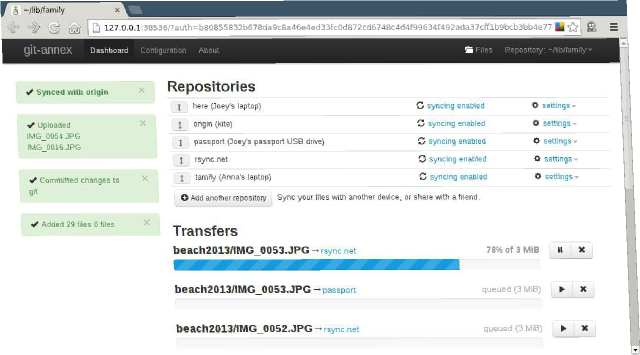
Joey Hess: git annex and my mom

[I'm encouraging git-annex users to post their success stories, and this one is my own.] I set up git-annex on my mom's and sisters' computers a couple of months ago. I noticed this was the first software I've written that I didn't have to really explain how to use. All I told them was, put files in this folder, and the rest of us will be able to see them. Don't put anything too big in there, or anything you don't want others to see. I paired the computers using XMPP, and set up an encrypted transfer repository using a free account rsync.net gave me for beta testing. I also added a repository on my server, which made things more robust. (XMPP has since improved, but it's still a good idea to have a git repository to suppliment XMPP.) I also have two removable drives that are used to back up our files. This was all set up using the webapp. And adding a computer takes just a couple of minutes that way. I set it up at my sister's in a spare moment during a visit, and it all just worked. Our shared git annex contains a couple of hundred files, and is a couple of gigabytes in size. And growing pretty fast as we find things we want to share. Mostly photos and videos so far but I won't be surprised to find poems and books pop up in there from the family's poets and authors. And it'll grow further as I add people who've so far been left out. Coming home from a week at the beach with my grand nephew and niece, was the first time I really used git-annex without thinking about it. Collapsed on a hotel bed, I plugged in my camera and loaded in the trip's photos. Only to see the hotel wifi cost extra. Urk, no! Later, in the lobby, I found an open wifi network, and watched it automatically sync up. screenshot By the time I was home, the video of cute kids playing weathermen and reporting on our near miss by a tropical storm had been enjoyed by the folks who didn't make that family gathering.

Daniel Pocock: Configuring strongSwan on Debian, RHEL and Fedora with the Android client

In my earlier blog post about VPNs, I looked at a range of VPN options. The strongSwan wiki documentation is generally quite good but it doesn't describe the exact procedure for an Android user anywhere. This blog aims to fill that gap. Here I am sharing some working examples of how to configure and use RSA certificate authentication between a Linux box and an Android phone using strongSwan. There are several commands to execute for each step, but they can be easily scripted. Here are the versions in play: Certificate creation: private certificate authority "example.org CA root" For production, I would highly recommend creating your own root CA on a smart card and managing it from a clean machine without any network connection. To start quickly for testing, just create a CA using the steps from the strongSwan wiki, in particular:
umask 0177
ipsec pki --gen > caKey.der
ipsec pki --self --in caKey.der \
   --dn "C=CH, O=Acme Ltd, CN=example.org CA root" \
   --ca > caCert.der
Certificate creation: VPN gateway machine vpn.example.org Now you need to create a key for the server. The key thing to observe here is the use of the "--san" argument: the Android client expects a subjectAltName in the certificate from the server. The VPN gateway has the hostname vpn.example.org:
ipsec pki --gen > vpnKey.der
ipsec pki --pub --in vpnKey.der   \
   ipsec pki --issue --cacert caCert.der --cakey caKey.der \
  --dn 'CN=vpn.example.org' \
  --san vpn.example.org > vpnCert.der 
cp vpnKey.der /etc/ipsec.d/private/
cp vpnCert.der /etc/ipsec.d/certs/
Certificate creation: mobile user For the Android client, it is necessary to create a private key and certificate and then embed them together with a copy of the root certificate in a PKCS#12 file. We will need OpenSSL or GnuTLS for some of these steps. The pkcs12 command will prompt for a password: make up a long, obscure password, you will only use it once when importing the certificate into the phone. Here is a script you can use for each client certificate you want to create:
#!/bin/bash -e
umask 0177
TARGET_HOST=$1
DOMAIN=example.org
IPSEC=/usr/sbin/ipsec
KEY_FILE="$ TARGET_HOST Key.der"
CRT_FILE="$ TARGET_HOST Cert.der"
if [ -f $ KEY_FILE  ];
then
  echo "$KEY_FILE exists"
  exit 1
fi
$ IPSEC  pki --gen > $ KEY_FILE  
$ IPSEC  pki --pub --in  $ KEY_FILE    \
  $ IPSEC  pki --issue \
  --cacert caCert.der --cakey caKey.der \
  --dn "CN=$ TARGET_HOST .$ DOMAIN " > $ CRT_FILE 
[ -f caCert.pem ]   \
   openssl x509 -in caCert.der -inform der -out caCert.pem -outform pem
openssl rsa \
   -in $ KEY_FILE  -out $ TARGET_HOST Key.pem -inform der
openssl x509 \
   -in $ CRT_FILE  -inform der \
   -out $ TARGET_HOST Cert.pem -outform pem
openssl pkcs12 \
   -export \
   -in $ TARGET_HOST Cert.pem \
   -inkey $ TARGET_HOST Key.pem \
   -certfile caCert.pem \
   -out $ TARGET_HOST .p12
# delete the key files, leaving only the key in the p12 file:
rm $ KEY_FILE  $ TARGET_HOST Key.pem
Assuming you call that script make-client-creds, you would run it once for each Android device:
$ ./make-client-creds phone1
$ ./make-client-creds phone2
...
Loading the PKCS#12 file into the phone Copy the cert bundle (the p12 file only) to the SD card in the phone. You can mount the phone over USB or using ADB, e.g.
$ adb push phone1.p12 /sdcard/
Now go to the Android settings, select Security and Install from SD card. Follow the prompts. Setting up the VPN gateway Add the following line to /etc/ipsec.secrets
: RSA vpnKey.der
and add a stanza like the following to /etc/ipsec.conf
conn private-droid
	left=vpn.example.org
	leftsubnet=insert gateway IP here/32
	leftcert=vpnCert.der
	leftid=@vpn.example.org
	leftfirewall=no
	lefthostaccess=no
	right=%any
	rightsourceip=192.168.10.0/24
	auto=add
Finally, restart ipsec and you should be ready.
# service ipsec restart
Install the app on the phone Finally, install the app on the phone. This bit should be quite easy. Once installed, press the option ADD VPN, put in the DNS name of the VPN gateway (must match the name in the certificate, e.g. vpn.example.org from the example above) and tell it to use IKEv2 Certificate as the authentication type. Press to select a certificate and highlight the certificate that you installed earlier. Checking for problems You should see a message on the phone telling you it is connected to the VPN. If it fails, it will let you see the log messages. If you see the error Constraint check failed it often means that the subjectAltName was not included in the VPN gateway's certificate (see the steps above) or the DNS name doesn't match the name in the certificate. On the server side, this command shows who is connected:
# ipsec status
Making it secure with iptables Once the packets are decrypted by strongSwan on the VPN gateway, the kernel will route them appropriately just like any other packet. Use standard Linux netfilter/iptables rules to ensure that routing is restricted appropriately so that the clients can access the services they need and nothing else. Support and discussion Please feel free to post comments below or discuss on the strongSwan Users mailing list

24 June 2013

Vincent Sanders: A picture is worth a thousand words

When Sir Tim made a band the first image on the web back in 1992, I do not imagine for a moment he understood the full scope of what was to follow. I also do not imagine Marc Andreessen understood the technical debt he was about to introduce and that fateful day in 1993 when he proposed the img tag allowing inline images.

Many will argue of course that the old adage of my title may not apply to the web, where if it were true, every page view would be like reading a novel! and many of those novels would involve cats or one pixel tall colour gradients.

Leaving aside the philosophical arguments for a moment it takes web browser author a great deal of effort to quickly and efficiently put those cat pictures in front of your eyeballs.
NavigatingImages are navigated by a user in a selection of ways, including:
Whatever the method, the resulting object is subject to the same caching operations as any content object within a browser. These caching and storage operations are not specific to images however images are one of the most resource intensive objects a browser must regularly deal with (though javascript and stylesheet sources are starting to rival it at times) because they are relatively large and numerous.
Pre render processing
When the image object fetch is completed the browser must process the image for rendering which is where this gets even more complicated. I shall use how this works in NetSurf as I know that browsers internals best, but operation is pretty similar in many browsers.

The content fetch will have performed basic content sniffing to determine the received objects mime type. This is necessary because a great number of servers are misconfigured and a disturbingly large number of images served as png are really jpegs etc. Indeed sometimes you even get files served which are not images!

Upon receipt of enough data to decode the image header, for the detected mime type, the images metadata is extracted. This metadata usually includes things like size and colour depth.

If the img tag in the original source document omitted the width or height of the image the entire document render may have to be reflowed at this point to allow the correct spacing. The reflow process is often unsightly and should be avoided. Additionally at this stage if the image is too large to handle or an unhandled format the object will be replaced with the "broken" image icon.

Often that will be everything that is done with the image, when I added "lazy" image conversion to NetSurf we performed extensive profiling and discovered well over 40% of images on visited pages are simply never viewed by the user but that small (100 pixel on a side) images were almost always displayed.

This odd distribution comes down to how images are used in modern web pages, they broadly fall into two categories of "decoration" and "content" for example all the background gradients and sidebar images etc. are generally small images used as decoration whereas the cat picture above is part of the "content". A user may not scroll down a page to see content but almost always gets to "view" the decoration.
Rendering
Created by Andrea R used under CC Attribution-NonCommercial-ShareAlike 2.0 licence
The exact browser heuristics used differ as to when the render operation is performed but they all have a similar job to perform. When i say render here this may be possibly as an "off screen" view if they are actually on another tab etc. Regardless the image data must be converted from the source data (a PNG, JPEG etc.) into a format suitable for the browsers display plotting routines.

The browser will create a render bitmap in whatever format the plotting routines require (for example the GTK plotters use a Cairo image surface) , use an image library to unpack the source image data (PNG) into the render bitmap (possibly performing transforms such as scaling and rotation) and then use that bitmap to update the pixels on screen.

The most common transform at render time is that of scaling, this can be problematic as not all image libraries have output scaling capabilities which results in having to decode the entire source image and then scaling from that bitmap.

This is especially egregious if the source image is large (perhaps a multi megabyte jpeg) but the width and height are set to produce a thumbnail. The effect is amplified if the user has set the image cache size limit to a small value like 8 Megabytes (yes some users do this apparently their machines have 32MB of RAM and they browse the web)

In addition the image may well require tiling (for background gradients) and quite complex transforms (including rotation) thanks to CSS 3. Add in that javascript can alter the css style and hence the transform and you can imagine quite how complex the renderers can become.
CachingThe keen reader might spot that repeated renderings of the source image (e.g. because window is scrolled or clipped) result in this computationally expensive operation also being repeated. We solve this by interposing a render image cache between the source data and the render bitmaps.

By keeping the data in the preferred format, image rendering performance can be greatly increased. It should be noted that this cache is completely distinct from the source object cache and relates only to the rendered images.

Originally NetSurf used to perform the render conversion for every image as it was received without exception, rather than at render time, resulting in a great deal of unnecessary processing and memory usage. This was originally done for simplicity and optimising for "decoration" images.

The rules for determining what gets cached and for how long are somewhat involved and the majority of the code within the current implementation NetSurf uses is metrics and statistic generation to produce better decisions.

There comes a time at which this cache is no longer sufficient and rendering performance becomes unacceptable. The NetSurf renderer errs on the side of reducing resource usage (clearing the cache) at the expense of increased render times. Other browsers make different compromises based on the expected resources of the user base.
FinallyHopefully that gives a reasonable overview to the operations a browser performs just to put that cat picture in front of your eyeballs.

And maybe next time your browser is guzzling RAM to plot thousands of images you might have a bit more appreciation to exactly what it is up to.

Next.

Previous.