Search Results: "ag"

8 June 2007

Ian Murdock: Where do I download OpenSolaris ?

Quick poll: What do you think of when you hear the name “OpenSolaris”? It’s an operating system? The community version of Solaris? Right? Not quite. Like Linux, OpenSolaris is a kernel. Except that it’s more than a kernel. Or, rather, more than a kernel but not quite a complete operating system. Are you confused yet? This comment from a recent Register article sums up the problem quite nicely:
If you go to the OpenSolaris web site, all bright eyed and eager to download a new operating system, you will walk away in bitter disappointment. Sure, it says the word “open” in two dozen languages on the web page, but when you go hunting for an installer disk to download, suddenly you are cast into a maze. Nevada builds? What the hell is Nevada? Oh, it’s what they’re calling the OpenSolaris code base. You’ll need to download these components and build them. Well, how do I install it? Oh, you can’t do that, you need to have a Solaris machine up already to build on. But you can get started if you go to Sun’s site and download their Solaris Express Enterprise Pro Champion Edition (after dutifully registering), and then enjoy that pleasant install experience. And when that’s done, you still have the work ahead of you of getting ON (what the hell is that? Oh, OS and Network. Sorry, I don’t work at Sun) built and updated. Did I miss anything? We haven’t gotten to packages to make the system usable yet.
Now, I’m willing to wager most of you reading this have probably heard about DTrace, ZFS, Zones, and the other great stuff Solaris has to offer, not to mention that Solaris is about as enterprise grade as they come, having been at the heart of the data center longer than many of the alternatives have even existed. And don’t forget about more mundane but critical things like backward compatibility, where Solaris has excelled for a very long time. But how many of you have actually experienced this great stuff first hand? How many hands go down if you’re under 30 and don’t remember the Sun workstation—i.e., you’re one of the many for whom Linux = Unix for as long as you’ve been in the computer business? How many of you would take Solaris for a spin if doing so was as easy as, say, downloading the latest version of Ubuntu and installing it? In other words, with all the buzz about making Solaris more familiar to Linux users, it turns out the widest part of the familiarity gap isn’t even technological. So, how do we bridge it? We need to make “OpenSolaris” something you can touch, something you can “Download Now!” and run on your laptop to try out the latest and greatest from the OpenSolaris community. We need to clearly articulate the link between Solaris and OpenSolaris in ways the industry understands—namely, that OpenSolaris is the rapidly moving version that delivers the latest innovations, and that Solaris is the enterprise-grade, supported-for-many-years, backward-compatibility- guaranteed version for the data center. Furthermore, the link needs to be more than just “OpenSolaris as upstream for Solaris”. Given how many more copies of Fedora and Ubuntu are running in the world than the enterprise Linuxes, there is significant opportunity here if we can get the model right. In short, to make OpenSolaris (and, by extension, Solaris) more familiar to Linux users, the first thing we need to do is make it a “distro” in the Linux sense of the word. After all, when people say they know “Linux”, that’s what they’re talking about—how many people really care about the Linux kernel underneath? What they care about is the GNU tools, the desktop, the development environment, and all the other things their favorite distro bundles—and the package system that holds it all together. There’s no reason in the world why (Open)Solaris can’t deliver those same things. Oh yeah, and DTrace, ZFS, Zones, enterprise grade security/scalability/performance/etc., backward compatibility, etc. too. Put this way, it’s easy to imagine what OpenSolaris needs to look like. That’s why the issues here are not primarily technological. This is the essence of the Project Indiana you’ve read so much about in the past several weeks. Our goal is to create a binary distribution of OpenSolaris that simultaneously delivers what people have come to expect from “Linux” alongside the great stuff that make Solaris unique. What comes next? We’re working that out in real time. If you’re interested in following along, participating, or just giving us your two cents, I encourage you to join the indiana-discuss mailing list we just created. We’re particularly interested in hearing from you if you consider yourself a “Linux user” and have been interested in taking Solaris for a spin but, for whatever reason, have considered the gap too wide. What would it take to get you running Solaris?
Evan Prodromou: 19 Prairial CCXV

It's been a topsy-turvy week, but I'm finally getting my head above water again here at our new home. A lot has happened, which I'll try to capture here, but I'm not sure I can get it all. On Tuesday, Maj, Amita June and I spent the morning in Central Park in New York City. It was a beautiful day -- the rains had cleared overnight, and it was warm and crisp everywhere. We went to the big playground near Columbus Circle, which had about 1000 kids from 2 to 14 running in every direction, and a huge water spray fountain which meant that most of those kids were soaking wet. We went and grabbed lunch at the Whole Foods Market on the circle itself, and ate it out on the grass. AJ and Maj went back to the hotel for a nap, and I got a haircut for the awards ceremony that night. Then I had coffee with Tim Wu, creator of the concept of net neutrality and a writer for Slate. We had a great talk about net neutrality, the future of Wikitravel (Tim wrote a critical piece in Slate in April), and new projects we're both working on. It was really pretty fun. Unfortunately, I took too long talking to Tim, and not enough time buying myself a pair of pants for the awards ceremony. So by the time we were done, I was in a huge hurry. I ran down to the Old Navy on W 34th, picked a pair of black khakis off the shelf, and jammed in a cab to get back to our hotel room in time. Maj was done up to the nines, so I jumped in the shower, shaved, threw on my sport jacket and slacks, cut off all the tags with nail clippers, and ran out the door. The event itself was pretty incredible, and I don't want to flood this blog post with all of my comments and recollections. So I'll add a more detailed report later today. tags:

Drive time Suffice it to say that we were out really, really late. We got up at 6AM the next morning to make our 8AM train back to Montreal, and it was clear to everyone (even Amita June) that if we tried to make this train it would be one of the worst days of our life. But there's only one train from NYC to Montreal per day, so we'd have to stay in town another night, and then have the same problem the next morning. So Maj canceled our Amtrak train tickets -- which were 100% refundable, even a couple of hours before the train leaves. Bravo, Amtrak! Then I got to work trying to rent us a car to drive home. It turns out that it's hard to get a rental car for a one-way trip from New York to Montreal. I tried Budget and Avis and National, and none of them would let me rent one-way into Canada. Annoyingly, none of their Web sites gave straight error messages on the subject -- I got "no cars available" or "unable to find your destination" (!) -- and I had to call the 1-800 numbers for each one in turn. I finally got a car from Hertz, on-line, and there was even a little note in my confirmation email to the effect of "ONE WAY TRAVEL CONFIRMED". I guess there's a reason that some companies get to be number one -- the more flexible you are, the more grateful your customers are going to be. I, for one, am planning to use Hertz in the future. I picked up the car at the W 55th Hertz office, and it took me 45 minutes to get back to our hotel at 7th and W 47th. The garage at Hertz goes onto W 54th, which is a "Thru Street" -- no turns allowed until you're halfway across town. And, it was bumper-to-bumper, of course. I finally gave up and made an illegal turn, and was promptly pulled over by a motorcycle cop. D'oh! Luckily, he let me off with a warning. Our trip out of New York was uneventful, but pleasant. It was a beautiful day, and the Catskills and Hudson Valley are a beautiful place to drive in the early summer. Deep, cool woods and bright green fields -- they're lush and fertile-looking. We stopped in Lake George for an early-afternoon dinner, and then had a pretty sunset drive through the Adirondacks up to the border. We got in late -- 10:30PM -- but it was overall a pretty good trip. And nice to have left at 2PM rather than 6AM. tags:

MANA Yesterday Mark, Allegra, No ma and Anoushka stopped back through Montreal as they wended their way home to Lausanne?. We had a nice lunch at Zyng and then took a walk down av Mont-Royal, where a pedestrian fair is going on this week. They got off yesterday evening, which makes the last of our RoCoCoCamp visitors to leave. tags:

Pecha Kucha Montreal I'm very interested to hear via Boris and James that we'll be having a Pecha Kucha night here in Montreal. It's going to be on 14 Jun 2007 at 20:20h (8:20PM) at the SAT. Pecha Kucha is an unconference for designers (not necessarily Web designers). I think it sounds like a really interesting event, and I hope to go. tags:

Biella Coleman: Michael Moore wants to hear your horror stories

Not so long ago, I blogged about my trials and tribulations with Blue Cross Blue Shield of NJ. I got a very interesting response that I will blog about later today or tomorrow, though I can’t say the outcome has been to my liking. While my problems with BCBS have not reached the status of truly horrific, I do think they are indicative of the how many insurance companies operate: with total lack of transparency and often, integrity (again more on this later). For those of you who have had horror stories, Michael Moore is now calling for collecting your horror stories as a consequence of the American health care system and health insurance companies. Do take the time to make a video if you have a story to tell.

Thijs Kinkhorst: Opentaal word list gets official approval

Good news: the OpenTaal Dutch word list (and spell checker) has gotten official approval from the TaalUnie, official authority on the Dutch language, which means that it's considered to be "just as correct" as the Green Booklet. The list is released under the LGPL licence. I've only contributed a bit to the project so far, but the next step will of course be to get it into Debian. The project originated to create a free update of the exising 1996 word list, according to the new spelling rules. Now that this is "finished", next projects are a grammar checker and thesaurus.

Amaya Rodrigo: Consumers Are Killing the Welfare State

Consumers Are Killing the Welfare State. Some excerpts, if you don t want to read the whole thing:

The average shopper at Karstadt, Metro and Lidl is a downright globalization fanatic. He compares price and service and always goes for what s cheapest. In doing so, he destroys massive numbers of jobs in Europe -- including, eventually, his own.

Nowadays, almost everything money can buy can be produced without the extra ingredient that we call the welfare state.

Indeed, 75 percent of the world s population has no unemployment benefit. And while this may put workers at a disadvantage, it certainly provides a boost to their product sales. It is the workers alone -- and not the products they produce -- who must bear the risk of illness, poverty and aging. In the West, exactly the opposite is true.

Many who considered the social market economy to be the final stage of history are now being forced to admit they made a colossal error. Capitalism has, thanks to a global labor and finance market, increased its range, while the social safety net has lost ground. The market has gained power, speed and apparently also inevitability. But the social triumph of yesteryear has faded. Indeed, capitalism is going back to its roots.

Russell Coker: Heartbeat service scripts

A service script for Heartbeat needs to support at least three operations, start, stop, and status. The operations will return 0 on success, 7 on failure (which in the case of the monitor script means that the service is not running) and any other value to indicate that something has gone wrong. In the second half of this post (not in the feed) I have included an example service script. It is a very brief script and does not support some of the optional parameters (monitor, validate-all, and meta-data). So this script is not of a quality that would be accepted for inclusion in a Heartbeat release but is adequate to demonstrate the concepts. The XML configuration for a service can have an arbitrary set of name-value pairs, and they are passed to the script as environment variables. For example the below script expects that the XML configuration item named ip will have the IP address used by the service, my script receives this as a variable named OCF_RESKEY_ip. My script doesn’t use the address, it merely allows it to be inherited by the IPaddr2 script (which is part of the Heartbeat distribution) and that script assigns the address to an Ethernet interface. The script is for testing Heartbeat, it mounts a filesystem and starts Apache (which is configured to serve web pages from the filesystem in question on the IP address supplied by the ip parameter). For test purposes the script looks for a file named /root/fail, if this file exists then the status check will always abort. An aborting status script means that Heartbeat can not be certain that the node in question has released all resources that it was using for the service. This means that Heartbeat will have to kill the node via the STONITH service. Such test scripts are the only way to test that STONITH works, and I believe that it’s a necessary part of pre-production testing of a Heartbeat cluster. Update: Made it display error messages in all cases and also reformatted it for better cut/paste.
(more…)

7 June 2007

Amaya Rodrigo: Walking Around

Update: Aprox. translation

Sucede que me canso de ser hombre.
Sucede que entro en las sastrer as y en los cines
marchito, impenetrable, como un cisne de fieltro
Navegando en un agua de origen y ceniza.

El olor de las peluquer as me hace llorar a gritos.
S lo quiero un descanso de piedras o de lana,
s lo quiero no ver establecimientos ni jardines,
ni mercader as, ni anteojos, ni ascensores.

Sucede que me canso de mis pies y mis u as
y mi pelo y mi sombra.
Sucede que me canso de ser hombre.

Sin embargo ser a delicioso
asustar a un notario con un lirio cortado
o dar muerte a una monja con un golpe de oreja.
Ser a bello
ir por las calles con un cuchillo verde
y dando gritos hasta morir de fr o

No quiero seguir siendo ra z en las tinieblas,
vacilante, extendido, tiritando de sue o,
hacia abajo, en las tapias mojadas de la tierra,
absorbiendo y pensando, comiendo cada d a.

No quiero para m tantas desgracias.
No quiero continuar de ra z y de tumba,
de subterr neo solo, de bodega con muertos
ateridos, muri ndome de pena.

Por eso el d a lunes arde como el petr leo
cuando me ve llegar con mi cara de c rcel,
y a lla en su transcurso como una rueda herida,
y da pasos de sangre caliente hacia la noche.

Y me empuja a ciertos rincones, a ciertas casas h medas,
a hospitales donde los huesos salen por la ventana,
a ciertas zapater as con olor a vinagre,
a calles espantosas como grietas.

Hay p jaros de color de azufre y horribles intestinos
colgando de las puertas de las casas que odio,
hay dentaduras olvidadas en una cafetera,
hay espejos
que debieran haber llorado de verg enza y espanto,
hay paraguas en todas partes, y venenos, y ombligos.
Yo paseo con calma, con ojos, con zapatos,
con furia, con olvido,
paso, cruzo oficinas y tiendas de ortopedia,
y patios donde hay ropas colgadas de un alambre:
calzoncillos, toallas y camisas que lloran
lentas l grimas sucias.


Pablo Neruda

Joerg Jaspert: Laptop suspend

Dear Lazyweb, some time ago I got a new notebook, a HP nw9440. It’s all nice and great and stuff and does what I want. Except two little things that I couldn’t fix yet, but maybe you have some suggestions? The first is only a little bit annoying. X does not like DPMS after a suspend/resume cycle. Running
xset dpms force off
will turn off the display, but the next acpi event received (according to acpi_listen) turns it on again. Restarting acpid fixes this, until next resume/suspend. For some reason the restart trick only works if done some time after the whole resume finished. Adding it to the scripts so its done automagically doesn’t fix this. The second thing, mostly time consuming, is the fact that this laptop does not like Suspend-to-RAM, so only Suspend-to-Disk working. It happily suspends to ram and goes to sleep and it also gets back on. Just that it doesnt turn the display back on, no matter what I try. I tried all combinations of options for s2ram I could find, nothing. Is there someone out there that has the same laptop and got it to suspend to ram and can tell me what screw he had to jump on? Update: Looks like the first problem is fixed in Xorg upstream.. Just that it didn’t got into etch anymore. Looking at xserver-xorg that probably means updating to sid right now, which I don’t want to do. So well, lets wait until a newer version is in lenny, maybe someone backports Xorg at some point? :)

Thijs Kinkhorst: Package Sponsorship

Miriam is worried that getting packages sponsored is a burden on DD's and that she's asking them a favour. I can understand where that comes from, but at least for me personally, that's definitely not the case. When I spend time to review and upload a package prepared by someone else, I don't do that just to help a friend, I do it because I've got a genuine desire to improve Debian. One way to do that is to work on my own packages, another is to help get the work done by others incorporated into Debian proper. I see that not as a burden or something they should be thankful for. Rather, I make it a habit to explicitly thank the sponsoree for their work after I've uploaded it. Just like I would thank someone that has provided a patch for my personal project. It's great that so many people are willing to contribute to Debian, and this needs to be encouraged wherever we can.

Daniel Stone: LCA 2008 CfP now open

The linux.conf.au 2008 Call for PapersPresentations is now open. We're accepting submissions from now until July 20th, 2007; you'll be notified in early September of the paper committee's decision.

Go check out the announcement, and start thinking of cool talk ideas. Once you've got to that stage, be sure to read mbp's How to get a conference abstract accepted, and Mary's Getting a talk into linux.conf.au (not just because she's a co-chair of the paper committee).

This year, we've introduced one optional step: a video submission. If you think that you're a great speaker, and if only we could see you, we'd say yes instantly, then grab a camera, and convince us. :)

Also, if you're interested in running a mini-conf before the main conference, we're also taking proposals for mini-confs.

See you in Melbourne!

Norbert Tretkowski: Murphy

Jun 7 13:35:14 magellan gdm[4893]: gdm_slave_xioerror_handler: Schwerwiegender X-Fehler - :0 wird neu gestartet Happened during a demonstration of GNOME 2.18 on my notebook...

Jonathan McDowell: Is it cos I is ginger?

I have to say "Yes" to the BBC. People say things about redheads they would think twice before saying about any other discriminated group.

Simon Huggins: The problem with being a morning person...

When you're tired in the morning you know things aren't really going to improve through the day. I haven't blogged for ages. I bought a dSLR and put some photos up, Xfce got some bugs cleared out with a spate of uploads (and some hard work by Corsac, ema and myself) after etch was released and I now have a raised vegetable patch with courgette plants, tomatoes, mange tout and chillis.

Miriam Ruiz: Sponsorship of Debian Packages

One of the worse things for a maintainer that happens not to be a DD (Heh!) is finding a sponsor for the packages. I remember some time ago I preferred to send the packages I had developed to upstream so that they could hang them in their own pages, instead of Debian repositories, because it was much more effort for me (and more emotionally stressing) to deal with finding a sponsor than to develop and maintain the package itself. I still have that feeling when I need to find an sponsor for any of my packages. The fact that I’m maintaining much more of them now doesn’t help, and I seem to be needing a sponsor almost every day lately. Even though I might have been spending lots of hours in getting a package ready for Debian, solved the problems with upstream, replaced non-free stuff inside, getting everything ready so that other people can benefit from my work, I still have that strange feeling that they’re doing me a favor by letting me put that package into the repositories. I wonder if the people developing other distributions have that feeling too or if it’s Debian-specific. Of course, having a lot of friends as DDs, knowing them in person, knowing that they trust you, helps a lot. At least you don’t have the feeling that you’re being scrutinized that you have when you’re a newbie to Debian Development. Still, when I need sponsorship for any of my packages, I still have the feeling that I’m appealing to friendship to achieve it, and that I’m pestering my friends. I’ve even been directly accused by some of pestering them about sponsoring my packages. It makes me feel bad. I don’t like spending lots of hours doing something for other people, and afterwards feeling an egoist for wanting to share it. That’s how the current sponsorship process makes me feel, and I guess I’m not the only one out there feeling this way. Do people doing stuff from Ubuntu feel this way too? “Finish your NM, Become a DD“, I’m often told when I complain about this. Yup, it’s true, I agree. Anyway I’m mentioning this not as a personal problem I myself have, but something that many non-DD maintainers feel, and that might be one of the reasons why some of them might decide in the end to jump into another distribution that doesn’t make them feel kinda bad people just for doing stuff. It might be surprising to here, but I don’t feel myself ready for becoming a DD yet. It might be kinda Impostor Syndrome, dunno, but I cannot keep myself from feeling it.

Daniel Burrows: Wallet arghness

This morning, when I got up, I couldn't find my wallet. I had it yesterday when I got on the bus (I pulled it out to pay my fare), and I went straight home from the bus, so I figured I might have left it on the bus. I called the lost & found office, and they said nothing with my name on it had been turned in to them.

When I got home I had a message on my answering machine from a guy named "Sidney":

"Hi, Daniel, my name is Sidney, and I, uh, found your wallet here, and just want to know ... is there a reward for it, or, uh ... you can reach me at (206)*BEEP*"

So, yay, I get to change my bank card number while hoping that the question above was intended more innocently than it sounded. And the new card won't arrive until after I leave town for a week, so this should be an interesting vacation (luckily I'm staying with family the whole time so money shouldn't be too much of a problem outside the airports). Meanwhile, I can see if I need to replace all the less important cards that I didn't get back, or if I can retrieve them from the guy who has the wallet. Obviously that last bit will require him calling me back and giving his entire phone number.

The one bright spot is that I just got an official Washington driver's license on Saturday, so my "real" license will hopefully arrive in the mail in the near future...that would be the most painful thing to be missing.

Adam Rosi-Kessel: Religion, Secularism, and Mystery

To follow up on my early post Christopher Hitchens v. God, Jonah at the Frontal Cortex has some insightful comments on religion and secularism. The money quote:
When people like Dawkins attack wimpy agnostics or moderate believers, they forget that many atheists aren’t uber-rationalists. They carry around tarot cards, not The Selfish Gene.
Jonah also makes a good point that science and religion may not have irreconcilable differences:
It’s important to note that science isn’t necessarily in conflict with our need to believe in some sort of mystery. Modern science, after all, has discovered some of the craziest ideas around, from the principles of quantum physics to the fact that our head holds a trillion cells trafficking in minor jolts of electricity. These ideas are both materialist and mysterious, since they hint at a universe that exceeds the current capacities of our imagination. What Hamlet said to Horatio is still true.
This sort of analysis seems to me far more nuanced and interesting than that advanced by what I’ll call the “vulgar atheists” — Dawkins, Hitchens, Dennett, et al.

DebConf team: Wireless setup for DebConf7 (Posted by Holger Levsen)

Only in the beginning of May it became clear that we need a new wireless sponsor this year, which quite quickly was found: www.freifunk.net, which is a german grassroot movement, connecting people and communities with mesh networks. As some of them are also upstream OpenWRT developers, we didn’t only get 19 accesspoints, but I also got quite some intensive training, which resulted in this wikipage with quite extensive documentation and a nice 3D map, how+where+why to place accesspoints. So we’ll use the Kamikaze version of OpenWRT, whereever possible. Despite it’s name, Kamikaze is the new stable release of OpenWRT, the successor of WhiteRussian. The accesspoints will be simply running in bridge mode (and using DHCP to get their IP and not running a DHCP server themselves) and provide unencrypted wireless (authentification via chillispot, you’ll have to login once via a webfrontend, then your MAC address will be recorded and you don’t need to login again) on the ESSID DebConf7. We’ll have 802.11b+g everywere and additionally 802.11a in some places. We calculated that for Teviot we’ll need approximatly 15 accesspoints and three extra for the hackcenter we’ll be using at night. As we got 19 from freifunk, we should have enough. But I like to have some more, to be on the safe side and to be able to replace the least powerful ones with better ones. If you can bring an accesspoint that runs OpenWRT, please send a short mail to debconf-infrastructure@lists.debconf.org. We prefer OpenWRT, so we can easily include them into our monitoring with munin and because it’s a PITA to deal with lots of different web interfaces for administration (and look up lots of different manuals on different webpages…). If you really want to bring an AP which doesn’t run OpenWRT, make sure the config described above is possible and please pre-configure it like that. You can check if your accesspoint can run OpenWRT, a modell with broadcom or atheros chips would be best, simply because I already have preconfigured images. Alternativly, the above mentioned wikipage has instructions how to build an image. (And I have a build environment on my laptop. But that’s easy to setup.) On a personal note, I intend not to be much involved in the wireless setup this year after unpacking the hardware, there is a nice admin team this year and I want to concentrate on the video team and our work there. And last but not least, but again: don’t just plug your AP into the network in Teviot. God might kill a kitten, and we might loose our uplink if you do :-)

6 June 2007

Michael Prokop: Python on the console

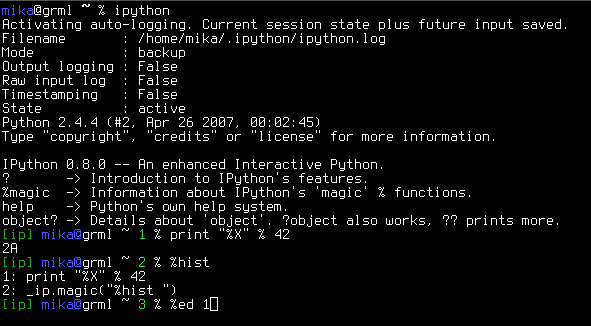
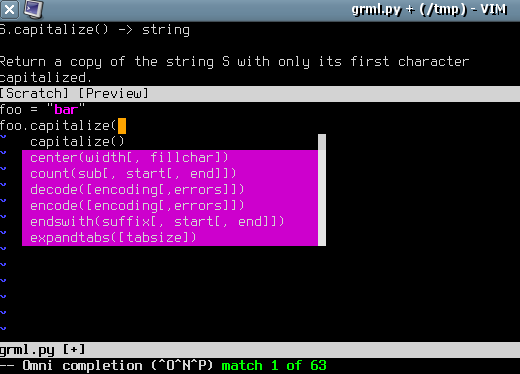
I wrote a small python webpage for the grml-wiki to provide some information regarding Python-development on grml. I just upgraded Vim on my main system to version 7.1 and omnicompletion with vim-python became better once more. So time for a short demo of ctrl-x-o: Python coding in Vim 7.1 - Screenshot I also very much like ‘%ed’ within ipython using the following snippet in my ~/.ipython/ipythonrc:
editor 1
editor /usr/bin/vim.python
Notice: Don’t wonder about the prompt style of the following ipython-screenshot, I customized it a little bit (see python-webpage in the grml-wiki again to get an idea). ipython demo - Screenshot So running the last line containing ‘%ed 1′ will execute /usr/bin/vim.python providing the code from the first command line of ipython and I can use all the magic of Vim for editing the code. When exiting the editor I have the code within ipython. Rocking. :) Oh, don’t forget to check out the Quick tips of ipython when exploring it. Now what’s missing in ipython is the edit-command-line feature of Zsh. That would allow me to edit already typed (but not yet executed) code with an external editor. Anyone out there with an according tip? ;-)

Paul van Tilburg: Master Project Finished

Yesterday, I have completed my master project with a presentation of my work and a defence of my thesis. I got awarded a 9 (out of 10) for my entire project. It is a result that I am very happy with and am very proud of. This result will allow me to get my Master of Science degree with honours on June 19, after the exam committee has checked everything. Note that the diploma will be handed out not on June 19, but on August 28, because I am on my holiday and at Debconf in Edinburgh the next two weeks. Thanks everyone for attending my presentation, joining the “celebration lunch” afterwards, and all the encouraging words and kudos. :-)

Ross Burton: Generating Random vCards

Again I found myself wanting a pile of realistic vCards to test with, and decided to write a decent and extendable solution for once (instead of the hilarity of this). A while ago I discovered Barnum, which can generate pseudo-realistic data by containing large data sets of names, street addresses, zip codes and credit card numbers. I extended it a little, adding support for creating an email address from a given name (it looks weird when the contact's name is John Smith but the email is john.doe@bar.com) and generating birth dates, then wrote a tiny script to write valid vCards. Et voilà:
$ ./gen_vcard.py 
BEGIN:VCARD
VERSION:3.0
UID:barnum-1107705517
FN:Caleb Barone
N:Barone;Caleb;;;
BDAY:1955-05-06
EMAIL;TYPE=WORK:cbarone@blanditvelit.eu
X-JABBER;TYPE=HOME:cbarone@eratdolore.eu
ADR;TYPE=HOME:;;8270 Kahlden Lane;Thompson;CT;06277;USA
END:VCARD
If this is useful to anyone else, you'll want Barnum, my patched gen_data.py, and gen_vcard.py. NP: More Than Music, Murphin

Next.

Previous.