Search Results: "tb"

6 November 2012

Stefano Zacchiroli: bits from the DPL for October 2012

Freshly baked, bits from the DPL for October 2012.
Dear Project Members,
another month, another periodic report of DPL-ish activities, this time for October 2012. Highlights Debian on public clouds I've spent quite some time to improve Debian presence on the so called "public clouds". Following up to an inquiry of a fellow developer, I've reached out to Microsoft to investigate the possibility of having Debian as an option on Windows Azure. Around the same time, I've been approached by Amazon to have Debian as an option on the AWS marketplace. In both cases, we will need to overcome challenges of various kinds, at the technical (e.g. image preparation), bureaucratic (e.g. terms of the agreements we'll need to accept to be present), and political (e.g. chain of trust, platform freedom) levels. Up to now, discussions have been going on mostly in private, simply because they started as 1-to-1 inquiries and continued from there, but there is no good reason they should remain so. Hence, thanks to the listmasters and in particular Alexander Wirt, we have setup the new debian-cloud mailing list. If you are interested in these topics please join the list. For both Azure and AWS there is good progress on the technical part already; summaries will soon be posted on the list so that we are all on the same page. Similarly, I'll post there status reports about the bureaucratic requirements. And of course there is no reason to focus on specific clouds, if you'd like to support others and are willing to put some work to that end, please join the list and let us know. DPL helpers meeting I've already bothered you at least in my last platform and DebConf13 talk with observations about how non-scalable the DPL job is. After having collected applications of DPL helpers for a while, I've finally sat down and tried to put those applications into good use. The idea is simple: to the extend of possible, we should shift from a one-man-band job to a more "board-like" job, with people sharing an agenda, a list of outstanding tasks, and public communication. We have started slowly, setting up the #debian-dpl IRC channel and running periodic bi-weekly meetings there. You can find the meeting minutes and full logs at the usual place. We are still ramping up, so we don't have yet "fancy" stuff like a mailing list or an issue tracker entry, but they're in the working. Some of the outcome are starting to show, too (e.g. as part of recent discussions on 3rd party orphaning, or on our inbound trademark policy, or even in the forthcoming DMCA policy to make mentors.d.n an official project service). It's an experiment and a big challenge. I'm, for one thing, not yet convinced there are enough people interested in sharing the load of DPL duties (that look boring, for many tech geeks) in the long run. But I'm also convinced that the sustainability of the Debian organization model depends on this, so it's worth trying. If you're interested in the challenge and willing to volunteer some of your time, please join us on #debian-dpl . I'll take care of keeping the project informed of further evolution, in particular about the communication channels we will pick for day to day activities and accountability. Events / public communication I've spent most of my remaining Debian time in October attending events on behalf of the Project, in particular: On the topic of public communication, I've also coordinated with the press team an answer to a press inquiry about Secure Boot (which has become part of this article), and happily vouched for the Ubuntu charity marathon, adding some Debian challenges to it. Delegations As largely overdue matters, I've finalized the delegations mentioned last month, namely: FTP masters, New Members Front Desk, and Policy editors. Assets and legal stuff Miscellanea Now let's all go back to RC Bug squashing to make Wheezy a reality. SPAM-my link of the month is http://udd.debian.org/bugs.cgi and its various "views" at the bottom of the page. Cheers.
PS the day-to-day activity log for October 2012 is available at the usual place master:/srv/leader/news/bits-from-the-DPL.txt.201210

Russ Allbery: Review: Cerebus

Review: Cerebus, by Dave Sim
Series: Cerebus #1
Publisher: Aardvark-Vanaheim
Copyright: August 1987
Printing: July 2003
ISBN: 0-919359-08-6
Format: Graphic novel
Pages: 546
Cerebus is something of a legend in comics. Begun in December of 1977 by Dave Sim, it was one of the first entirely independent, self-published comics in a field dominated by the large work-for-hire companies like Marvel and DC. It ran for 300 issues and nearly 27 years and became one of the most influential independent comic books of all time, in part due to Sim's outspoken views in favor of creator rights and his regular use of the editorial pages in Cerebus issues to air those views. This collection (the first "phonebook") collects issues 1 through 25, with one of the amazing wrap-around covers that makes all of the phonebooks so beautiful (possibly partly by later Cerebus collaborator Gerhard, although if so it's uncredited so far as I can tell). Cerebus reliably has some of the best black-and-white art you will ever see in comics. There is some debate over where to start with Cerebus, and a faction that, for good reasons, argues for starting with the second phonebook (High Society). While these first twenty-five issues do introduce the reader to a bunch of important characters (Elrod, Lord Julius, Jaka, Artemis Roach, and Suenteus Po, for example), all those characters are later reintroduced and nothing that happens here is hugely vital for the overall story. It's also quite rough, starting as Conan parody with almost no depth. The first half or so of this collection features lots of short stories with little or no broader significance, and the early ones are about little other than Cerebus's skills and fighting abilities. That said, when reading the series, I like to start at the beginning. It is nice to follow the characters from their moment of first introduction, and it's delightful to watch Sim's ability grow (surprisingly quickly) through the first few issues. Cerebus #1 is bad: crude, simplistic artwork, almost nothing in the way of a story, and lots of purple narration. But flipping forward even to Cerebus #6 (the first appearance of Jaka), one sees a remarkable difference. By Cerebus #7, Cerebus looks like himself, the plot is getting more complex, and Sim is clearly hitting his stride. And, by the end of this collection, the art has moved from crude past competent and into truly beautiful in places. It's one of the few black-and-white comics where I never miss color. The detailed line work is more enjoyable than I think any coloring could be. The strength of Cerebus as an ongoing character slowly emerges from behind the parody. What I like the most about Cerebus is that he's neither a predestined victor (apart from the early issues that follow the Conan model most closely) nor a pure loner who stands apart from the world. He gets embroiled in political affairs, but almost always for his own reasons (primarily wealth). He has his own moral code, but it's fluid and situational; it's the realistic muddle of impulse and vague principle that most of us fall back on in our everyday life, which is remarkably unlike the typical moral code in comics (or even fiction in general). And while he is in one sense better and more powerful than anyone else in the story, that doesn't mean Cerebus gets what he wants. Most stories here end up going rather poorly for him, forcing daring escapes or frustrating cutting of losses. Sim quickly finds a voice for Cerebus that's irascible, wise, practical, and a bit world-weary, as well as remarkably unflappable. He's one of the best protagonists in comics, and that's already clear by the end of this collection. Parody is the focus of these first issues, which is a mixed bag. The early issues are fairly weak sword-and-sorcery parody (particularly Red Sonja, primarily a vehicle for some tired sexist jokes) and worth reading only for the development in Sim's art style and the growth of Cerebus as a unique voice. Sim gets away from straight parody for the middle of the collection, but then makes an unfortunate return for the final few issues, featuring parodies of Man-Thing and X-Men that I thought were more forced than funny. You have to have some tolerance for this, and (similar to early Pratchett) a lot of it isn't as funny as the author seems to think it is. That said, three of Sim's most brilliant ongoing characters are parodies, just ones that are mixed and inserted into the "wrong" genres in ways that bring them alive. Elrod of Melvinbone, a parody of Moorcock's Elric of Melnibone who speaks exactly like Foghorn Leghorn, should not work and yet does. He's the source of the funniest moments in this collection. His persistant treatment of Cerebus as a kid in a bunny suit shouldn't be as funny as it is, but it reliably makes me laugh each time I re-read this collection. Lord Julius is a straight insertion of Groucho Marx who really comes into his own in the next collection, High Society, but some of the hilarious High Society moments are foreshadowed here. And Artemis Roach, who starts as a parody of Batman and will later parody a huge variety of comic book characters, provides several delightful moments with Cerebus as straight man. I'm not much of a fan of parody, but I still think Cerebus is genuinely funny. High Society is definitely better, but I think one would miss some great bits by skipping over the first collection. Much of what makes it work is the character of Cerebus, who is in turn a wonderful straight man for Sim's wilder characters and an endless source of sharp one-liners. It's easy to really care about and root for Cerebus, even when he's being manipulative and amoral, because he's so straightforward and forthright about it. The world Sim puts him into is full of chaos, ridiculousness, and unfairness, and Cerebus is the sort of character to put his head down, make a few sarcastic comments, and then get on with it. It's fun to watch. One final note: I've always thought the "phonebook" collections were one of Sim's best ideas. Unlike nearly all comic book collections, a Cerebus phonebook provides enough material to be satisfying and has always felt like a good value for the money. I wish more comic book publishers would learn from Sim's example and produce larger collections that aren't hardcover deluxe editions (although Sim has an admitted advantage from not having to reproduce color). Followed by High Society. Rating: 7 out of 10

5 November 2012

Alberto Garc a: Igalia at LinuxCon Europe

I came to Barcelona with a few other Igalians this week for LinuxCon, the Embedded
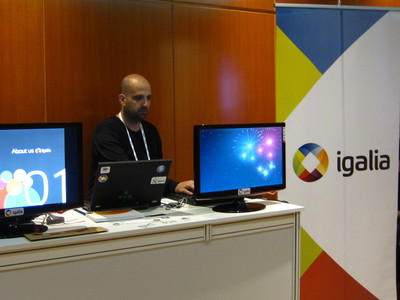
Linux Conference
and the KVM Forum. We are sponsoring the event and we have a couple of presentations this year, one about QEMU, device drivers and industrial hardware (which I gave today, slides here) and the other about the Grilo multimedia framework (by Juan Su rez). We ll be around the whole week so you can come and talk to us anytime. You can find us at our booth on the ground floor, where you ll also be able to see a few demos of our latest work and get some merchandising.
Igalia booth

4 November 2012

Gregor Herrmann: RC bugs 2012/44

not much to report this week, still a short summary:

Russ Allbery: Review: Set This House in Order

Review: Set This House in Order, by Matt Ruff
Publisher: Perennial
Copyright: 2003
Printing: 2004
ISBN: 0-06-095485-X
Format: Trade paperback
Pages: 479
A textbook case history would say that Andy Gage has disassociative identity disorder (referred to here as the more common although medically inaccurate "multiple personality disorder" for reasons of clarity and to match casual speech, according to the author). However, that's a completely inadequate description. A better description would be that Andy Gage's body is inhabited by a large set of different personalities, who take turns being in control. The original Andy Gage is dead, shattered by horrific childhood abuse. Aaron became the dominant personality and gave structure to the internal geography of the mind they all share, with the help of extensive counselling. But Aaron was exhausted by being the public face and maintaining control of the shared body. Hence, Andrew. Andrew Gage is the first-person narrator of half of this book. He is twenty-eight, the same age as the body, but he's only existed for two years. He considers Aaron his father, since Aaron called him out of the lake inside their internal metal geography. His purpose is to run the body and be the public face of the family. He is by turns capable and naive, shy on personal experience, but able to get the help of the others. The one heard from most frequently is Adam, a rude and mischevious teenager who also has an uncanny ability to read other people, and who frequently watches through the body's eyes from what the family calls the "pulpit" and gives Andrew advice. Andrew works for Julie Sivik, a woman he met the day he quit his job at a big-box store because he couldn't explain his behavior to his boss without discussing being a multiple. Julie is a wholly impractical, slightly unethical, well-meaning force of chaos who serves as the thread that draws the plot of the book together. She's running a startup on ingenuity and borrowed money that is attempting to create a comprehensive and customizable virtual reality world. She's the one who finds Penny and hires her, in part for her skills, and in part to push Penny and Andrew together. Penny Driver has the same condition as Andrew, but Penny is only vaguely aware of it. The world for her is full of blackouts, lost time, waking up in strange and sometimes horrific situations, and attempting to structure her life based on notes left for herself that she didn't write. When she meets Andrew, she's barely making it through life; thankfully, one of her personalities is remarkably good at computers, and that has been enough to make a living despite the chaos. But Julie is the unintentional catalyst for her losing that job, the best job she's ever had, leaving her with no real alternative but to take the job with Julie's company. There are a few things that are important to say up-front about this book. First, neither I nor the author are actually multiples (or, put another way, neither of us have DID), and writing about atypical mental states is fraught with peril. It's very easy to misrepresent other people's experiences, and multiple personalities in particular are frequent material for dramas of all sorts. There's something people find inherently fascinating about the idea, and it's easy for that fascination to run away with reality and distort the lived experience. I recommend reading Ruff's FAQ about the book, which spells out what his goals are and what approach he took. I did some quick searches and didn't uncover a lot of anger or dislike of the book among either people who have DID or psychiatrists, and it seems true to the descriptions of internal reality I've heard from people who are multiples. But despite being more respectful of real experience than most fictional treatments of DID, this is still a work of fiction written by someone without first-hand experience, and it's worth keeping that in mind. Second, DID is an intensely controversial diagnosis among psychiatrists. There are, generally speaking, two major controversies. One is over whether or not DID can actually be caused by traumatic experiences such as childhood abuse, or whether it is a creation of psychiatrists, a mental model that they've imposed on their patients or convinced their patients to believe. Set This House in Order comes down firmly on the first side of that controversy: that DID can be created by abuse and is not a creation of psychotherapy. (So, I should note, does every multiple that I've ever talked to or read.) Second, there is significant controversy over treatment, with some psychiatrists believing that integration of the personalities into one is the only true treatment, and others believing that multiples can remain stable and functional as multiple personalities. Set This House in Order leans strongly towards the view that multiples can be stable as multiples and that while integration may be appropriate for some, it's not for all. Both of these viewpoints are presented very convincingly by the narrative in the book, and both are consistent with the beliefs of a lot of multiples, but it's worth remembering that these are active and often quite heated controversies and a novel is not evidence. It's good to be aware of both of those points, and to read Put This House in Order as something of a what-if, where much more is clear about DID than is actually clear in our world. But once one has done that, one is in for an excellent book. I loved this book from start to finish. (Well, okay, I felt some surprise at the nature of the ending, but it grew on me after further consideration.) It's simply a brilliant novel, with a little bit of everything: very good characterization, messy love affairs, the satisfying tension of someone overcoming great odds to put themselves together with the help of friends, a startlingly original perspective of the world, some excellent surprises, and some absolutely wonderful characters. Andrew is a good choice of narrator: he brings an earnest calm to a story that could otherwise be quite chaotic and provides a great vantage point for the reader. And I found Penny (and particularly some of her other souls) impossible not to like. Set This House in Order is a tense book in places, and it's a book where people's lives break down before they can get better. It's also a book about rather horrific abuse, and while nearly all of the specifics happen off-stage, imagination fills in some nasty details. But Ruff manages to write it with a structure and with enough calm assurance that I felt just reassured enough without taking away the tension. That's a tricky balance; few books do it better. And the supporting characters are a delight. One might think, with all the complexity happening for both Andrew and Penny, that Ruff wouldn't have room in the narrative for other characters, but one would be wrong. There are very few saints and demons here, just a lot of complex people, with their own problems and their own perspectives, who are generally trying to do the best they can from day to day. There are some clear-cut villains in the past Ruff wisely makes no attempt to add shades of grey to abusers but even there one can see some clear signs of untreated severe mental illness and chaotic lives rather than mustache-twirling pre-meditated villainy. This is, in short, a book full of people, in all their messy complications, which is what makes it so delightful. I'm not going to say anything more about the plot, or even the various personalities, since discovering the direction of the book was so much of the fun. I will say that, despite the subject matter and some of the events, the book is surprisingly gentle. One of the things about it that I loved the most was the emotional tone Ruff gave to being a multiple: the sense of a squabbling but tight-knit family looking out for each other. I can't judge the reality of this impression, but it makes for a wonderful story. Highly recommended. The best book I've read so far this year. Rating: 10 out of 10

3 November 2012

Richard Hartmann: Release Critical Bug report for Week 42

Lucas Nussbaum pointed out that the weekly stats which Alexander Reichle-Schmehl used to provide are AWOL so I decided to take over. As I am patently lazy, I hacked together a little helper in perl which outputs the page I am just adding to by writing this. It's a tad hackish inasmuch I don't bother to transform the HTML into anything and simply embedd it in the Markdown, but it's working well enough for now. In the medium term, I am hoping to add some nice graphs as per azhag's suggestion, but they didn't get back to me, yet. A warning to anyone not subscribed to Planet Debian and reading this via a different aggregator: You will still see weekly stats from now on which may or may not be interesting to you. In case you object, please leave a comment or poke me directly. The UDD bugs interface currently knows about the following release critical bugs: How do we compare to the squeeze cycle ?
Week Squeeze Wheezy Diff
43 284 (213+71) 468 (332+136) +184 (+119 ; +65)
44 261 (201+60)
45 261 (205+56)
46 271 (200+71)
47 283 (209+74)
48 256 (177+79)
49 256 (180+76)
50 204 (148+56)
51 124 (124+54)
52 115 (78+37)
1 93 (60+33)
2 82 (46+36)
3 25 (15+10)
4 14 (8+6)
5 2 (0+2)
6 release!

2 November 2012

Vincent Bernat: Network virtualization with VXLAN

Virtual eXtensible Local Area Network (VXLAN) is a protocol to overlay a virtualized L2 network over an existing IP network with little setup. It is currently described in an Internet-Draft. It adds the following perks to VLANs while still providing isolation:
  1. It uses a 24-bit VXLAN Network Identifier (VNI) which should be enough to address any scale-based concerns of multitenancy.
  2. It wraps L2 frames into UDP datagrams. This allows one to rely on some interesting properties of IP networks like availability and scalability. A VXLAN segment can be extended far beyond the typical reach of today VLANs.
The VXLAN Tunnel End Point (VTEP) originates and terminates VXLAN tunnels. Thanks to a serie of patches from Stephen Hemminger, Linux can now act as a VTEP. Let s see how this works.

About IPv6 When possible, I try to use IPv6 for my labs. This is not the case here for several reasons:
  1. IP multicast is required and PIM-SM implementations for IPv6 are not widespread yet. However, they exist. This explains why I use XORP for this lab: it supports PIM-SM for both IPv4 and IPv6.
  2. VXLAN Internet-Draft specifically addresses only IPv4. This seems a bit odd for a protocol running on top of UDP and I hope this will be fixed soon. This is not a major stopper since some VXLAN implementations support IPv6.
  3. However, the current implementation for Linux does not support IPv6. IPv6 support will be added later.
Once IPv6 support is available, the lab should be easy to adapt.

Lab So, here is the lab used. R1, R2 and R3 will act as VTEPs. They do not make use of PIM-SM. Instead, they have a generic multicast route on eth0. E1, E2 and E3 are edge routers while C1, C2 and C3 are core routers. The proposed lab is not resilient but convenient to explain how things work. It is built on top of KVM hosts. Have a look at my previous article for more details on this. VXLAN lab The lab is hosted on GitHub. I have made the lab easier to try by including the kernel I have used for my tests. XORP comes preconfigured, you just have to configure the VXLAN part. For this, you need a recent version of ip.
$ sudo apt-get install screen vde2 kvm iproute xorp git
$ git clone git://git.kernel.org/pub/scm/linux/kernel/git/shemminger/iproute2.git
$ cd iproute2
$ ./configure && make
You get  ip' as  ip/ip' and  bridge' as  bridge/bridge'.
$ cd ..
$ git clone git://github.com/vincentbernat/network-lab.git
$ cd network-lab/lab-vxlan
$ ./setup

Unicast routing The first step is to setup unicast routing. OSPF is used for this purpose. The chosen routing daemon is XORP. With xorpsh, we can check if OSPF is working as expected:
root@c1# xorpsh
root@c1$ show ospf4 neighbor   
  Address         Interface             State      ID              Pri  Dead
192.168.11.11    eth0/eth0              Full      3.0.0.1          128    36
192.168.12.22    eth1/eth1              Full      3.0.0.2          128    33
192.168.101.133  eth2/eth2              Full      2.0.0.3          128    36
192.168.102.122  eth3/eth3              Full      2.0.0.2          128    38
root@c1$ show route table ipv4 unicast ospf   
192.168.1.0/24  [ospf(110)/2]
                > to 192.168.11.11 via eth0/eth0
192.168.2.0/24  [ospf(110)/2]
                > to 192.168.12.22 via eth1/eth1
192.168.3.0/24  [ospf(110)/3]
                > to 192.168.102.122 via eth3/eth3
192.168.13.0/24 [ospf(110)/2]
                > to 192.168.102.122 via eth3/eth3
192.168.21.0/24 [ospf(110)/2]
                > to 192.168.101.133 via eth2/eth2
192.168.22.0/24 [ospf(110)/2]
                > to 192.168.12.22 via eth1/eth1
192.168.23.0/24 [ospf(110)/2]
                > to 192.168.101.133 via eth2/eth2
192.168.103.0/24        [ospf(110)/2]
                > to 192.168.102.122 via eth3/eth3

Multicast routing Once unicast routing is up and running, we need to setup multicast routing. There are two protocols for this: IGMP and PIM-SM. The former one allows routers to forward multicast datagrams while the first one allows hosts to subscribe to a multicast group.

IGMP IGMP is used by hosts and adjacent routers to establish multicast group membership. In our case, it will be used by R2 to let E2 know it subscribed to 239.0.0.11 (a multicast group). Configuring XORP to support IGMP is simple. Let s test with iperf to have a multicast listener on R2:
root@r2# iperf -u -s -l 1000 -i 1 -B 239.0.0.11
------------------------------------------------------------
Server listening on UDP port 5001
Binding to local address 239.0.0.11
Joining multicast group  239.0.0.11
Receiving 1000 byte datagrams
UDP buffer size:  208 KByte (default)
------------------------------------------------------------
On E2, we can now check that R2 is properly registered for 239.0.0.11:
root@e2$ show igmp group
Interface    Group           Source          LastReported Timeout V State
eth0         239.0.0.11      0.0.0.0         192.168.2.2      248 2     E
XORP documentation contains a good overview of IGMP.

PIM-SM PIM-SM is far more complex. It does not have its own topology discovery protocol and relies on routing information from other protocols, OSPF in our case. I will describe here a simplified view on how PIM-SM works. XORP documentation contains more details about PIM-SM. The first step for all PIM-SM routers is to elect a rendez-vous point (RP). In our lab, only C1, C2 and C3 have been configured to be elected as a RP. Moreover, we give better priority to C3 to ensure it wins. RP election
root@e1$ show pim rps   
RP              Type      Pri Holdtime Timeout ActiveGroups GroupPrefix       
192.168.101.133 bootstrap 100      150     135            0 239.0.0.0/8
Let s suppose we start iperf on both R2 and R3. Using IGMP, they subscribe to multicast group 239.0.0.11 with E2 and E3 respectively. Then, E2 and E3 send a join message (also known as a (*,G) join) to the RP (C3) for that multicast group. Using the unicast path from E2 and E3 to the RP, the routers along the paths build the RP tree (RPT), rooted at C3. Each router in the tree knows how to send multicast packets to 239.0.0.11: it will send them to the leaves. RP tree
root@e3$ show pim join   
Group           Source          RP              Flags
239.0.0.11      0.0.0.0         192.168.101.133 WC   
    Upstream interface (RP):   eth2
    Upstream MRIB next hop (RP): 192.168.23.133
    Upstream RPF'(*,G):        192.168.23.133
    Upstream state:            Joined 
    Join timer:                5
    Local receiver include WC: O...
    Joins RP:                  ....
    Joins WC:                  ....
    Join state:                ....
    Prune state:               ....
    Prune pending state:       ....
    I am assert winner state:  ....
    I am assert loser state:   ....
    Assert winner WC:          ....
    Assert lost WC:            ....
    Assert tracking WC:        O.O.
    Could assert WC:           O...
    I am DR:                   O..O
    Immediate olist RP:        ....
    Immediate olist WC:        O...
    Inherited olist SG:        O...
    Inherited olist SG_RPT:    O...
    PIM include WC:            O...
Let s suppose that R1 wants to send multicast packets to 239.0.0.11. It sends them to R1 which does not have any information on how to contact all the members of the multicast group because it is not the RP. Therefore, it encapsulates the multicast packets into PIM Register packets and sends them to the RP. The RP decapsulates them and sends them natively. The multicast packets are routed from the RP to R2 and R3 using the reverse path formed by the join messages. Multicast routing via the RP
root@r1# iperf -c 239.0.0.11 -u -b 10k -t 30 -T 10
------------------------------------------------------------
Client connecting to 239.0.0.11, UDP port 5001
Sending 1470 byte datagrams
Setting multicast TTL to 10
UDP buffer size:  208 KByte (default)
------------------------------------------------------------
root@e1# tcpdump -pni eth0
10:58:23.424860 IP 192.168.1.1.35277 > 239.0.0.11.5001: UDP, length 1470
root@c3# tcpdump -pni eth0
10:58:23.552903 IP 192.168.11.11 > 192.168.101.133: PIMv2, Register, length 1480
root@e2# tcpdump -pni eth0
10:58:23.896171 IP 192.168.1.1.35277 > 239.0.0.11.5001: UDP, length 1470
root@e3# tcpdump -pni eth0
10:58:23.824647 IP 192.168.1.1.35277 > 239.0.0.11.5001: UDP, length 1470
As presented here, the routing is not optimal: packets from R1 to R2 could avoid the RP. Moreover, encapsulating multicast packets into unicast packets is not efficient either. At some point, the RP will decide to switch to native multicast1. Rooted at R1, the shortest-path tree (SPT) for the multicast group will be built using source-specific join messages (also known as a (S,G) join). Multicast routing without RP From here, each router in the tree knows how to handle multicast packets from R1 to the group without involving the RP. For example, E1 knows it must duplicate the packet and sends one through the interface to C3 and the other one through the interface to C1:
root@e1$ show pim join   
Group           Source          RP              Flags
239.0.0.11      192.168.1.1     192.168.101.133 SG SPT DirectlyConnectedS 
    Upstream interface (S):    eth0
    Upstream interface (RP):   eth1
    Upstream MRIB next hop (RP): 192.168.11.111
    Upstream MRIB next hop (S):  UNKNOWN
    Upstream RPF'(S,G):        UNKNOWN
    Upstream state:            Joined 
    Register state:            RegisterPrune RegisterCouldRegister 
    Join timer:                7
    KAT(S,G) running:          true
    Local receiver include WC: ....
    Local receiver include SG: ....
    Local receiver exclude SG: ....
    Joins RP:                  ....
    Joins WC:                  ....
    Joins SG:                  .OO.
    Join state:                .OO.
    Prune state:               ....
    Prune pending state:       ....
    I am assert winner state:  ....
    I am assert loser state:   ....
    Assert winner WC:          ....
    Assert winner SG:          ....
    Assert lost WC:            ....
    Assert lost SG:            ....
    Assert lost SG_RPT:        ....
    Assert tracking SG:        OOO.
    Could assert WC:           ....
    Could assert SG:           .OO.
    I am DR:                   O..O
    Immediate olist RP:        ....
    Immediate olist WC:        ....
    Immediate olist SG:        .OO.
    Inherited olist SG:        .OO.
    Inherited olist SG_RPT:    ....
    PIM include WC:            ....
    PIM include SG:            ....
    PIM exclude SG:            ....
root@e1$ show pim mfc  
Group           Source          RP             
239.0.0.11      192.168.1.1     192.168.101.133
    Incoming interface :      eth0
    Outgoing interfaces:      .OO.
root@e1$ exit
[Connection to XORP closed]
root@e1# ip mroute
(192.168.1.1, 239.0.0.11)        Iif: eth0       Oifs: eth1 eth2

Setting up VXLAN Once IP multicast is running, setting up VXLAN is quite easy. Here are the software requirements:
  • A recent kernel. Pick at least 3.7-rc3. You need to enable CONFIG_VXLAN option. You also currently need a patch on top of it to be able to specify a TTL greater than 1 for multicast packets.
  • A recent version of ip. Currently, you need the version from git.
On R1, R2 and R3, we create a vxlan42 interface with the following commands:
root@rX# ./ip link add vxlan42 type vxlan id 42 \
>                               group 239.0.0.42 \
>                               ttl 10 dev eth0
root@rX# ip link set up dev vxlan42
root@rX# ./ip -d link show vxlan42
10: vxlan42: <BROADCAST,MULTICAST,UP,LOWER_UP> mtu 1460 qdisc noqueue state UNKNOWN mode DEFAULT 
link/ether 3e:09:1c:e1:09:2e brd ff:ff:ff:ff:ff:ff
vxlan id 42 group 239.0.0.42 dev eth0 port 32768 61000 ttl 10 ageing 300
Let s assign an IP in 192.168.99.0/24 for each router and check they can ping each other:
root@r1# ip addr add 192.168.99.1/24 dev vxlan42
root@r2# ip addr add 192.168.99.2/24 dev vxlan42
root@r3# ip addr add 192.168.99.3/24 dev vxlan42
root@r1# ping 192.168.99.2                    
PING 192.168.99.2 (192.168.99.2) 56(84) bytes of data.
64 bytes from 192.168.99.2: icmp_req=1 ttl=64 time=3.90 ms
64 bytes from 192.168.99.2: icmp_req=2 ttl=64 time=1.38 ms
64 bytes from 192.168.99.2: icmp_req=3 ttl=64 time=1.82 ms
--- 192.168.99.2 ping statistics ---
3 packets transmitted, 3 received, 0% packet loss, time 2003ms
rtt min/avg/max/mdev = 1.389/2.375/3.907/1.098 ms
We can check the packets are encapsulated:
root@r1# tcpdump -pni eth0
tcpdump: verbose output suppressed, use -v or -vv for full protocol decode
listening on eth0, link-type EN10MB (Ethernet), capture size 65535 bytes
11:30:36.561185 IP 192.168.1.1.43349 > 192.168.2.2.8472: UDP, length 106
11:30:36.563179 IP 192.168.2.2.33894 > 192.168.1.1.8472: UDP, length 106
11:30:37.562677 IP 192.168.1.1.43349 > 192.168.2.2.8472: UDP, length 106
11:30:37.564316 IP 192.168.2.2.33894 > 192.168.1.1.8472: UDP, length 106
Moreover, if we send broadcast packets (with ping -b or ARP requests), they are encapsulated into multicast packets:
root@r1# tcpdump -pni eth0
11:31:27.464198 IP 192.168.1.1.41958 > 239.0.0.42.8472: UDP, length 106
11:31:28.463584 IP 192.168.1.1.41958 > 239.0.0.42.8472: UDP, length 106
Recent versions of iproute also comes with bridge, an utility allowing one to inspect the FDB of bridge-like interfaces:
root@r1# ../bridge/bridge fdb show vxlan42
3e:09:1c:e1:09:2e dev vxlan42 dst 192.168.2.2 self 
0e:98:40:c6:58:10 dev vxlan42 dst 192.168.3.3 self

Demo For a demo, have a look at the following video (it is also available as an Ogg Theora video).
<iframe frameborder="0" height="270" src="http://www.dailymotion.com/embed/video/xusell" width="480"></iframe>

  1. The decision is usually done when the bandwidth used by the follow reachs some threshold. With XORP, this can be controlled with switch-to-spt-threshold. However, I was unable to make this works as expected. XORP never sends the appropriate PIM packets to make the switch. Therefore, for this lab, it has been configured to switch to native multicast at the first received packet.

31 October 2012

Russell Coker: Links October 2012

The F Word has an informative post about men commenting on Feminist blogs [1]. Most of it applies to any situation where a member of a powerful group comments on an issue related to a minority group. Near the end they say: I ll also paraphrase and flesh out the most useful piece of advice I ever read, when I made the effort to research white privilege: don t expect the minority to trust you. Trust is earned, and you re just another commenter who they can t tell apart from any other commenter. You re entering someone else s space, where different rules apply. You get to have the rest of the world for people to assume you re a wonderful person. Here, you re just another one of them , and given the track record of them , it s up to you to listen, learn and prove that you re being thoughtful and honestly trying to examine your privilege. Sociological Images has an interesting article on people s perception of the sky colour it seems that the blue sky meme is modern [2]. Charles Stross wrote an interesting article about the possible uses for future low power computers [3]. He gets a bit over-excited about the possibilities for sensing making a tiny computer that can sense so many things isn t going to be easy (DSLRs are big for a reason). But having lots of powerful computers everywhere does provide lots of interesting and potentially bad opportunities. Martin Bekkelund has an interesting article about Amazon wiping DRM infected books that it had sold to a customer without giving a refund or an explanation [4]. If you want to buy ebooks it seems that the sensible thing to do would be to immediately crack them or download them from The Pirate Bay so Amazon can t steal them back. Rebecca Saxe gave an interesting talk about trying to develop methods for conflict resolution through neuroscience [5]. Barry Eisler has written an interesting article about the corruption of journalists [6]. It s really worth reading, some of the methods of corruption apply to even the more casual bloggers. Krebs on Security has an informative article about the Microsoft Tech Support phone scams [7]

29 October 2012

Nathan Handler: Hello Chronicle!

Over the years, I have had many different blogs. I mainly use them to post updates regarding my work in the FOSS community, with most of these relating to Ubuntu/Debian. My most recent blog was a Wordpress instance I ran on a VPS provided by a friend. This worked pretty well, but for various reasons, I no longer have access to that box. Earlier today, I started thinking about launching a new blog. The first problem I had to overcome was deciding where to host it. Many of the groups I am involved with provide members with a ~/public_html directory that can be used to host simple HTML+Javascript+CSS websites. However, most of these sites do not have the ability to use PHP, CGI, or access databases. I realized rather quickly that if I were to find a blogging platform that I could run from a ~/public_html directory on one of those machines, I would never have the problem of not having a host for my blog ever again. There is a near infinite number of free web hosts that can handle simple HTML sites. One key feature of any blog is the ability for readers to subscribe to it. Usually, the blogging platform handles automatically updating the feed when a new post is published. However, my simple HTML blog would not be able to do that. Since I knew I did not want to manually update the feeds, I started looking for a way to generate the feed locally on my personal machine and then push it to the remote site that is hosting my blog. About this time, I started compiling a list of features I would need to make this blogging platform usable. In no particular order, they included: After some searching, I found an application developed by Steve Kemp called Chronicle. Chronicle supports all of the features I described plus many more. It is also very quick and easy to setup. If you are running Debian, Chronicle is available from the repositories. Start by installing Chronicle. Note that these steps should all be done on your personal machine, not the machine that is going to host your blog.
sudo apt-get install chronicle
There are a few other packages that you can install to extend the functionality of Chronicle
sudo apt-get install memcached libcache-memcached-perl libhtml-calendarmonthsimple-perl libtext-vimcolor-perl libtext-markdown-perl
Next, create a few folders to hold our blog. We will store our raw blog posts in ~/blog/input and have the generated HTML versions go in ~/blog/output.
mkdir -p ~/blog/ input,output 
Now, we need to configure some preferences. We will base our preferences on the global configuration file shipped with the package.
cp /etc/chroniclerc ~/.chroniclerc
Open up the new ~/.chroniclerc file in your favorite editor. It is pretty well commented, but I will still explain the changes I made. input is the path to where your blog posts can be found. These are the raw blog posts, not the generated HTML versions of the posts. In our example, this should be set to ~/blog/input. pattern tells Chronicle which files in the input directory are blog posts. We will use a .txt extension to denote these files. Therefore, set pattern to *.txt. output is the directory where Chronicle should store the generated HTML versions of the blog posts. This should be ~/blog/output theme-dir is the directory that holds all of the themes. Chronicle ships with a couple of sample themes that you can use. Set this to /usr/share/chronicle/themes theme is the name of the theme you want to use. We will just use the default them, so set this to default entry-count specifies how many blog posts should be displayed on the HTML index page for the blog. I like to keep this fairly small, so I set mine to 10. rss-count is similar to entry-count, but it specifies the number of blog posts to include in the RSS feed. I also set this to 10 format specifies the format used in the raw blog posts. I write mine in markdown, but multimarkdown, textile, and html are also supported. Since most ~/public_html directories do not support CGI. We will disable comments by setting no-comments to 1 suffix gets appended to the filenames of all of the generated blog posts. Set this to .html url_prefix is the first part of the URL for the blog. If the index.html file for the blog is going to be available at http://example.com/blog/ , set this to *http://example.com/~user/blog/ blog_title is whatever you want your blog to be called. The title is displayed at the top of the site. Set it to something like Your Name's Blog post-build is a very useful setting. It allows us to have Chronicle perform some action after it finishes running. We will use this to copy our blog to the remote host's public_html directory. Set this field to something like scp -r output/* user@example.com:~/public_html/blog. You will probably want to setup SSH so that you do not need to enter a password each time. Finally, date-archive-path will allow you to get the nice year/month directories to sort your posts. Set this to 1. Your final ~/.chroniclerc should look something like this:
input = ~/blog
pattern = *.txt
output = ~/blog/output
theme-dir = /usr/share/chronicle/themes
theme = default
entry-count = 10
rss-count = 10
format = markdown
no-comments = 1
suffix = .html
url_prefix = http://example.com/~user/blog/
blog_title    = Your Name's Blog
post-build = scp -r output/* user2@example.com:~/public_html/blog
date-archive-path = 1
You are now ready to start writing your first blog post. Open up ~/blog/MyFirstBlogPost.txt in your favorite text editor. Modify it to look like this:
Title: My First Blog Post
Tags: MyTag
Date: October 29, 2012
This is my **first** blog post.
Notice the metadata stored at the top? This is required for every post. Chronicle uses it to figure out the post title, tags, and date. It has some logic to try and guess this information if missing, but it is probably safest if you specify it. The empty line between the metadata and the post content is also required. Remember, we configured Chronicle to treat these as Markdown files, so feel free to utilize any Markdown formatting you wish. Finally, run chronicle from a terminal. If all goes well, it should generate your blog and copy the files to the remote host. You can now go to http://example.com/~user/blog to view it. One final suggestion would be to store the entire blog in a git repository. This will allow you to utilize all of the features of a VCS, such as reverting any accidental changes or allowing multiple people to collaborate on a blog post at the same time.

28 October 2012

Steve Langasek: SecureBoot in Ubuntu 12.10

The 12.10 release is the first version of Ubuntu that supports Secure Boot out of the box. In what is largely an accident of release timing, from what I can tell (and please correct me if I'm wrong), this actually makes Ubuntu 12.10 the first general release of any OS to support Secure Boot. (Windows 8 of course is also now available; and I'm sure Matthew Garrett, who has been a welcome collaborator throughout this process, has everything in good order for the upcoming Fedora 18 release.) That's certainly something of a bittersweet achievement. I'm proud of the work we've done to ensure Ubuntu will continue to work out of the box on the consumer hardware of the future; in spite of the predictable accusations on the blogowebs that we've sold out, I sleep well at night knowing that this was the pragmatic decision to make, maximizing users' freedom to use their hardware. All the same, I worry about what the landscape is going to look like in a few years' time. The Ubuntu first-stage EFI bootloader is signed by Microsoft, but the key that is used for signing is one that's recommended by Microsoft, not one that's required by the Windows 8 certification requirements. Will all hardware include this key in practice? The Windows 8 requirements also say that every machine must allow the user to disable Secure Boot. Will manufacturers get this right, and will users be able to make use of it in the event the manufacture didn't include the Microsoft-recommended key? Only time will tell. But I do think the Linux community is going to have to remain engaged on this for some time to come, and possibly hold OEMs' feet to the fire for shipping hardware that will only work with Windows 8. But that's for the future. For now, we have a technical solution in 12.10 that solves the parts of the problem that we can solve. This first release gives us preliminary support for booting on Secure Boot, but there's more work to be done to provide a full solution that's sustainable over the long term. We'll be discussing some of that this week at UDS in Copenhagen. And as part of our committment to enabling new hardware on the current LTS release, we will be backporting this work for inclusion in 12.04.2. It remains to be decided how Debian will approach the Secure Boot question. At DebConf 12, many people seemed to consider it a foregone conclusion that Debian would never agree to include binaries in main signed by third-party keys. I don't think that should be a given; I think allowing third-party signatures in main for hardware compatibility is consistent with Debian's principles, and refusing to make Debian compatible with this hardware out of the box does nothing to advance user freedom. I hope to see frank discussion post-wheezy about keeping Debian relevant on consumer hardware of the future.

27 October 2012

Russ Allbery: Review: Devil Take the Hindmost

Review: Devil Take the Hindmost, by Edward Chancellor
Publisher: Plume
Copyright: 1999
Printing: June 2000
ISBN: 0-452-28180-6
Format: Trade paperback
Pages: 349
Subtitled A History of Financial Speculation, Devil Take the Hindmost is exactly that: a history, with chapters on notable speculative bubbles or surges going back to the 1630s. The first significant bubble described is, of course, the notorious tulip speculation in Holland, but Chancellor is more thorough than any previous history I've read. There are chapters on the early stock market schemes, the South Sea bubble, 1820s emerging markets, the railway mania of 1845, the Gilded Age, the late 1970s and early 1980s, and the Japanese real estate bubble of the 1980s, as well as the mandatory look at the stock market crash of 1929. Each is thorough and detailed; indeed, perhaps slightly too detailed, as the clear narrative picture can occasionally groan under the weight of names and capsule biographies. The first thing one should realize about this book is that, despite the apparent currency of the topic, it was written in 1999. That means it predates both the subprime real estate collapse and the dot.com boom, as well as some more minor but possibly relevant events such as the Enron electricity market manipulation. Japan is the most recent bubble that Chancellor can cover; one can only speculate as to what he would make of the 2008 financial crash. The other focus to be aware of is the omission of sovereign debt. Chancellor is exclusively focused on private markets, usually stock markets, and (apart from the chapter on Japan) Western markets, mostly in the US and the UK. Governments play a role in some of the early speculative bubbles (most notably the South Sea bubble), but Chancellor's topic is private speculative frenzies, not the risks and effects of government borrowing. Interrogation of the role of government is mostly limited to cursory discussions of the impact of regulation, mostly in the negative. More on that in a moment. This is a history as opposed to either a polemic or a prescription. Chancellor does not set out to explain how to curb financial speculation. Insofar as he expresses an opinion on it, he presents speculation as a force of unbridled freedom in natural tension with regulation and financial conservatism and sees a cyclical pattern of speculative frenzy, collapse, retrenchment, and then renewed speculation. Speculation, as presented here, is more akin to a force of nature than, as seen in most other books on the topic, a phenomenon of greed that should be limited or prevented. Indeed, Chancellor seems skeptical of the entire project of preventing or limiting speculation, and presents considerable reason for the reader to become skeptical as well. The history he presents is one of speculative manias adapting to and circumventing every control that governments and markets have attempted to place on them. When certain practices are outlawed (and some modern complex financial practices have surprisingly long histories), people just find loopholes or alternative approaches through which to accomplish the same thing. Or the speculative mania takes an unexpected new form. Nor do the manias seem to be decreasing in severity as more regulation, custom, and restrictions attempt to blunt them. Even without adding the financial collapse of 2008, the impacts of the speculative frenzies documented here seem, if anything, to be growing. This is, therefore, a relatively straightforward history, but it's an entertaining one, filling in details that I'd not previously been aware of. The complexity of financial schemes as early as the 1600s was particularly eye-opening. There's a tendency to believe that complex derivative schemes are an artifact of modern financial markets, but they've been a part of speculation for as long as Chancellor goes back. Computers may have added layers to the mathematics, but they haven't added as much to the legal strategems and levels of indirection as one might think. Chancellor emphasizes that throughout: speculation involves a lot of complexity, not necessarily to deceive but to construct situations in which it's in the interest (at least short term) of all involved parties to continue and escalate the speculation. While Chancellor doesn't provide much encouragement to the reader hoping to find ways to curb speculation, he does show some commonalities that provide a bit of a handle on how speculation starts. The one that lept out at me was leverage. Every speculative bubble documented in Devil Take the Hindmost involves borrowing money to reinvest. The mechanism keeps changing, from straightforward loans during the tulip craze to much more complex constructions in modern finance, primarily in response to regulation that attempted to reduce leverage but only banned one specific technique. But whatever method is used, at the bottom is always some scheme for purchasing an asset using debt, magnifying both positive and negative price swings. Some variation of buying stocks on margin is particularly common; Chancellor documents how it was reinvented despite the limits on straight margin purchases instituted after the Great Depression. There is no recommendation here for any regulatory or legal action, but it's obvious from the repetition of history that limiting leverage would be the place to focus attention. I enjoyed this history, but it can be dry, and at times is a bit overstuffed with names, unimportant details, and microbiographies. It's also unfortunate that Chancellor missed two of the most significant (and two very different) speculative bubbles through the timing of his work. It would have been interesting to see them through the lens of his history. What we have is still worth reading, but also somewhat frustrating in Chancellor's refusal to draw or at least underline general conclusions. Devil Take the Hindmost is long on history but short on analysis, and while I appreciate the historian's focus in a source of data, it left me somewhat unsatisfied. Rating: 6 out of 10

26 October 2012

Russ Allbery: Review: Fables: Legends in Exile

Review: Fables: Legends in Exile, by Bill Willingham, et al.
Series: Fables #1
Penciller: Lan Medina
Inker: Steve Leialoha
Inker: Craig Hamilton
Colorist: Sherilyn van Valkenburgh
Letterer: Todd Klein
Publisher: Vertigo
Copyright: 2002
ISBN: 1-56389-942-6
Format: Graphic novel
Pages: 127
The characters of human fairy tales are all real. Real, but hidden: they have been driven from their ancestral homelands by some force referred to here only as the Adversary, and have fled to the mundane world to escape his notice. Specifically, New York, where those characters who can pass as human blend into the streets of New York City, and those who can't (referred to only in passing in this story arc apart from one pig) stay at a farm upstate. That's the brilliant premise of Fables, an ongoing comic series from Vertigo that's up to 121 issues plus numerous spinoffs as of this writing. This is the first trade paperback, collecting issues 1 through 5 plus a prose story. Legends in Exile is, in underlying form, a murder mystery. It opens with Jack reporting a murder to Bigby Wolf, who is what passes for law enforcement among the Fables. Rose Red's apartment has been discovered covered in blood, and her body is missing. "No more happily ever after" is written on the wall in blood. Jack, despite being the one to report the crime, is Rose's lover and an obvious suspect. So is Snow White, the effective leader of the Fables (King Cole is a figurehead) and Rose's estranged sister. And, perhaps coincidentally, Prince Charming, Snow White's philandering and stunningly narcissistic ex-husband, has just turned up in town again. The basic plot plays out like a typical murder mystery, complete with a grand reveal in the last chapter and a reconstruction of events. It's diverting but nothing special in itself; it's primarily a hook on which to hang an introduction to the major characters and an exploration of Fables politics and history. And that part is excellent. Like most fractured fairy tales, the characters are more complex and nuanced than they are allowed to be in the canonical stories; unlike most fractured fairy tales, nearly all of that development is allowed to happen after the original stories. The original stories happened, largely as we all remember them, but then the characters kept living and changing. Wolf and his relationship with one of the three pigs is one of the highlights, but I think the odious Price Charming is the best bit of characterization. Willingham takes the idea of a charming seducer and layers in the rest of the womanizing associations that come to mind, while retaining a slick surface charm that is hard not to like at some level. I'm not the best at critiquing art. I read graphic novels for the story, with the art as a nice bonus if it's fairly good. But I can say that Medina's pencils tell the story well, with a few larger panels that were quite impressive. I particularly liked Snow White's office, early in the collection. Detail is reasonably good throughout, there aren't too many panels featuring only talking heads, and Medina does a wonderful job with the pig. (Significant credit probably also goes to Steve Leialoha and Craig Hamilton, the inkers. I'm not a good enough art critic to distinguish between the quality of the pencil work and what was added by subsequent inking.) The largest problem for me with Legends in Exile is my standard problem with graphic novels and the reason I don't buy many of them: the cover price is $10 for what is effectively a short story that builds an interesting world. If one really loves art in stories, graphic novels may be a good value. If, like me, one mostly cares about the story and would be almost as happy with straight prose, the value becomes questionable given the brief length of the material. That said, Legends in Exile does add a quite good prose short story by Willingham, "A Wolf in the Fold," which in several ways is better than the main story of the collection. It tells the story of the original exile and the covenant that settled all past grudges (mostly) from the perspective of the wolf. Willingham does a great job here both striking a more mythic tone than the main story but still tying it back to the sarcastic and practical tone of the rest of the collection. Although the main story itself is not particularly memorable, the background and concept make this one of the better graphic novels I've read. I can see why it's won so many awards, and I'll probably keep reading, despite the high graphic novel price tag. Followed by Fables: Animal Farm. Rating: 7 out of 10

25 October 2012

Pietro Abate: lesson learned making a cargo kilt

This entry is not really about computers, technology, or other work-related topics, but more about a hard-hack that I wanted to try for a while. How to make a kilt !!! After a bit of duck-ducking, I decided to follow this excellent tutorial. At first sight the entire process seems a bit long, but you will realize that after the first read, that everything boils down to 3 steps: measure, fold and pin, sew. For the measure part, I've the impression that the formula that is given in the instructable (waist/3*8+1) is a bit short for my comfort and taste. This is the size for the internal apron, the folded part that goes all around your left hip, back, and right hip, and the front apron. My suggestion would be to make the inner apron a bit longer then the front apron. This way the kilt will feel in my opinion more comfortable and it will envelop you body completely. For the fold and pin part, you just need a bit of patience and a ruler. Put the pins parallel to the folding as in the instructable and not perpendicular. This will help you later when sewing everything. The sewing ... If you know how to use a sewing machine, this is going to be a piece of cake. Otherwise, well, I spent more time troubleshooting the machine then sewing the kilt. I've broken few needles in the process and learned how to thread the machine with my eyes blindfolded. Not to mention that you have to learn how to disassemble this machines in a thousand parts to understand how the thread got stuck. It was fun. A lesson that I've learned is that a sewing machine works much better in the morning than late at night when you are tired and sleepy. Really ! Other then that, it was a fun experience. Maybe I'll make another one to commit this skill to mind. Maybe I'll run a kilt making workshop at the next debconf :) PA250002.JPG PA250003.JPG
AttachmentSize
PA250002.JPG134.19 KB
PA250003.JPG131.11 KB

Lucas Nussbaum: Release Critical Bugs report for week 43

During the Squeeze release cycle, Alexander Reichle-Schmehl used to blog every week about this. Let s try to continue the tradition. The UDD bugs interface currently knows about the following release critical bugs: Note: I m looking for someone to send this posts on a regular basis. All you need is a blog syndicated on Planet Debian (there s a secret UDD page that generates the HTML code for you ;) ). Contact me if you are interested. taken!

Russ Allbery: Review: Passion Play

Review: Passion Play, by Sean Stewart
Publisher: Ace
Copyright: 1992
Printing: December 1993
ISBN: 0-441-65241-7
Format: Mass market
Pages: 194
Diane is a shaper: an empath, a sort of telepath, who sees emotions and the actions of others in the form of patterns and stories that she is nearly compelled to follow. She uses that skill as an investigator, a semi-official adjunct to the police who can read crime scenes and motives and hunt down criminals with uncanny ability. That makes her almost socially acceptable, but a shaper is still not something it's safe to be, something best kept hidden. Diane's world is one of theocracy, of dominance by aggressive religion, and even shapers working with the police are not exactly okay. This is Sean Stewart's first novel. He's since gone on to write many other books, one of which I've read and quite enjoyed (Nobody's Son) and another (Galveston) that won several awards, although he's probably most famous for his work on the ilovebees ARG. Passion Play won a minor award itself: the Aurora for the best Canadian SF novel of the year. I found it surprising as a first novel, since it's sharp, focused, and very short. Usually first novels are stuffed to the gills with ideas and plot, as if material had built up for years and exploded in the first book. Passion Play doesn't have that problem; if anything, it errs on the side of telling too little. This is, at its heart, a mystery. A famous actor died in the middle of a play. It was possibly suicide, possibly an accident, and possibly murder; the events of the death are quite ambiguous. But the actor is very important in Redemptionist politics, which warrants an investigation, and then Diane's shaper instincts start finding a pattern and a story in the death. The rest of the cast and crew form the obvious set of suspects, and have the normal mystery novel variety of flaws, foibles, strong personalities, and possible motives. I'm not much of a mystery novel reader, and to be honest I had some trouble tracking all of the characters and remembering Diane's suspicions about each one. But the details of the mystery are less important to this book than Diane herself. Shapers are not exactly stable. The patterns they see are all-consuming, the experience of others' strong emotions acts like a sort of drug, and shapers can burn themselves out. They can fall into a spiral of seeking stronger and stronger emotions until they can't feel anything at all. That's the core conflict of the book: Diane is slowly losing herself. She has a tenuous existence at the outskirts of a society that has inculcated her with an inflexible set of religious beliefs and an uncompromising attitude towards law and justice, but it's not a stable existence, she knows it, and she doesn't know what to do about it. She knows that the pattern of this particular death is deep and powerful, but she can't stay away from it. This is an unusual, and sometimes disturbing, focus for a story. It's risky, unconventional, and doesn't quite work. I think some of the failure is because of first novel problems, but most of it is due to character problems. In the first novel problems category, Passion Play is a bit too choppy and a bit too disjointed. I think Stewart was trying hard to keep the story focused, fast-moving, and tight, but the introduction of the world background is not particularly smooth, and Diane's first-person account of her emotional state is a bit too labored. The plot wants to build in a smooth arc towards its climax, but the writing and scene-setting jerks and jumps instead of flowing. But the larger problem for me is that there aren't enough interesting characters in this book; specifically, there aren't enough to show all sides of Diane's character. Stewart tries, by introducing Jim early in the book to serve essentially as Diane's friend (and she's desperately in need of one), but he's too much of a non-entity. He serves some plot purposes, but he doesn't have a strong enough voice and character to hold his ground against Diane and balance her obsessive internal monologue. And, other than Jim, all the other characters in the book (with the possible exception of the murder victim) are playing bit roles. They're not bad characters, but they don't feel fully real to either Diane or to the reader. It's very easy to put them into boxes that they never break out of. This does support the feeling of narrative inevitability about some parts of the book, but I think it would have been stronger with more conflict, more open challenging of Diane's perspective. I would characterize Passion Play as interesting but flawed, and ultimately a minor work. I'm not sorry I read it, but neither would I have missed much if I'd gone through life without reading it. It has a few interesting ideas, and a bravely unconventional narrative resolution, but it felt choppy and off-balance. Unless you love Stewart's writing and want to read everything he wrote, or unless you (like me) has a quirk about reading all award winners, this is probably best skipped over in favor of Stewart's later work. Rating: 6 out of 10

24 October 2012

Jon Dowland: Debian Days #10 and #11

I've had a few weeks with very little time spent on Debian. I did set aside some time to try to find and fix an RC bug, to help the release. Steven C commented to let me know about the UDD Developer's Dashboard which is a great way to find RC bugs relevant to a team. I sat down to try and fix #648272 in 'Abuse' but sadly I didn't manage, instead finding another possible RC bug #689457 on the way. I was curious as to how long the version 1 web services API for musicbrainz will be kept around, in case there was a strong likelyhood it would be turned off during the lifetime of wheezy. If that were the case, then it might have been worth requesting freeze exceptions to patch the last few WS1 clients to use WS2 instead. However, the musicbrainz developers have no plans to turn off WS1 as long as there are people still using it. This is a bit of a chicken and egg situation for wheezy, but probably not strong enough grounds to persue it any further. So last night was my first "Debian Day" in a while, and by chance I've had a number of enquiries for software and packages which I haven't touched in a while. For the prboom package, we rebuild the upstream tarball to remove some material we don't have the right to distribute. The code that does the repackaging lives in a script called debian/fix_upstream.sh. Prboom upstream release very infrequently, so the script hasn't been run in a while. Fabian Greffrath noticed some bashisms which meant it would not work reliably with a non-bash /bin/sh. He also noticed that we couldn't build the binary lump data/prboom.wad using only free software since some changes that were made to freedoom. One possible fix was to expand the deutex package to recognise freedoom.wad, which I've now applied. Fabian has fixed the bashism issue, but I suspect a more robust solution long-term would be to always rebuild data/prboom.wad during package build, so that code gets exercised more often. The prboom changes are in the Git repository but I haven't release them yet. I need to decide whether it's worth requesting a freeze exception for the orig tarball build issue. It's not an FTBFS but it's similar: you could not rebuild a binary distributed in the source tarball using software only in Debian, at least not without some workarounds. We've had another request to package Prboom+. I've never been particularly interested in doing this myself, but it would probably be very little work, you could more-or-less take the prboom packaging as it stands. One thing I thought would be interesting to try would be to set up a git repository for the packaging and import the upstream Subversion repository in its entirety via git svn, rather than just import the released tarballs. Sadly their repository layout is not quite ideal for this. game-data-packager continues to grow. Following hot on the heels of Hexen 2 support, Markus Koschany has written preliminary support for LGeneral, a game which has been in Debian, at least in part, on and off. Hopefully we'll have that merged soon, and finish of Hexen 2 support whilst we're at it. On that note, here's a lazyweb question: what's the most convenient way to determine the length (at microsecond resolution) of a PCM WAV file from the command-line? Finally, we've been building Debian-based virtual machines at work, which meant dusting off some old preseed files and tweaking them to have unattended installs. This took a lot longer than I thought. It's certainly a lot more painful than kickstart and Redhat-based systems, and it's very unlikely that a preseed file that worked for one version of Debian would fully work for another. I'm not certain but I think even different releases of d-i targetting the same release "break" assumptions you might make, particularly about which questions you need to answer via the kernel command line, rather than in the preseed file. That's one thing we really need to sort. It's crazy having to specify keyboard layouts in the command line for VMs which won't ever have a keyboard. The disparity between what the user is asked, what value is written to the debconf database at that point in the install process, and what ends up in the debconf database at the end of the process is also a real pain: answering a question about keyboard layout sets half a dozen different debconf values in a cascade that is probably sensitive to other things like priority or whether d-i is in expert mode, too. So working backwards from the debconf database of an installed machine is an exercise in frustration, and figuring out which questions are asked prior to the preseed file being read for any given d-i or Debian release is a slow trial and error process. I'm going to get in touch with the d-i folks and see what kind of continuous integration systems they have in place. It would be great to have commit-level notification that you've broken preseed builds. If not for the d-i folks, then certainly at work.

22 October 2012

Craig Small: jqGridWidget in Turbogears

Turbogears 2 uses Toscawidgets 2 for a series of very clever widgets and base objects that you can use in your projects. One I have been playing with is the jqGridWidget which uses jquery to display a grid. The idea with jquery is creating a grid or other object and then using javascript to call back to the webserver to obtain the data which usually comes from a database using the very excellent SQLAlchemy framework. I found it a bit fiddly to get going and it is unforgiving, you get one thing wrong and you end up with an empty grid but when it works, it works very well.
from tw2.jqplugins.jqgrid import jqGridWidget
from tw2.jqplugins.jqgrid.base import word_wrap_css
 
class ItemsWidget(jqGridWidget):
    def prepare(self):
        self.resources.append(word_wrap_css)
        super(ItemsWidget, self).prepare()
    options =  
            'pager': 'item-list-pager2',
            'url': '/items/jqgrid',
            'datatype': 'json',
            'colNames': ['Date', 'Type', 'Area', 'Description'],
The code above is a snippet of the widget I use to make the graph. This is the visual side of the graph and shows just the graph with nothing in it. You need the datatype and url lines in the options which tell the code the url to get the data. I have an items controller and within it there is a jqgrid method. Note the number of columns I have, the data sent by the jqgrid method has to match this. Deep inside the items controller is a jqgrid method. The idea is to return some rows of data back to the grid in the exact way the grid expects it otherwise you get, yep more empty grids.
   @expose('json')
    def jqgrid(self, page=1, rows=30, sidx=1, soid='asc', _search='false',
            searchOper=u'', searchField=u'', searchString=u'', **kw):
 
        qry = DBSession.query(Item)
        qry = qry.filter()
        qry = qry.order_by()
        result_count = qry.count()
        rows = int(rows)
 
        offset = (int(page)-1) * rows
        qry = qry.offset(offset).limit(rows)
 
        records = [ 'id': rw.id,
           'cell': [ rw.created.strftime('%d %b %H:%M:%S'), rw.item_type.display_name), rw.display_name, rw.text()]  for rw in qry]
        total = int(math.ceil(result_count / float(rows)))
        return dict(page=int(page), total=total, records=result_count, rows=records)
The four items in the value for the cell in the dictionary must equal the number defined for the colNames. I found it was useful to have firebug looking at my gets and another widget based upon SQLAjqGridWidget which is a lot simpler to setup but much less flexible too.

20 October 2012

Vincent Bernat: Network lab with KVM

To experiment with network stuff, I was using UML-based network labs. Many alternatives exist, like GNS3, Netkit, Marionnet or Cloonix. All of them are great viable solutions but I still prefer to stick to my minimal home-made solution with UML virtual machines. Here is why: The use of UML had some drawbacks: However, UML features HostFS, a filesystem providing access to any part of the host filesystem. This is the killer feature which allows me to not use any virtual disk image and to get access to my home directory right from the guest. I discovered recently that KVM provided 9P, a similar filesystem on top of VirtIO, the paravirtualized IO framework.

Setting up the lab The setup of the lab is done with a single self-contained shell file. The layout is similar to what I have done with UML. I will only highlight here the most interesting steps.

Booting KVM with a minimal kernel My initial goal was to experiment with Nicolas Dichtel s IPv6 ECMP patch. Therefore, I needed to configure a custom kernel. I have started from make defconfig, removed everything that was not necessary, added what I needed for my lab (mostly network stuff) and added the appropriate options for VirtIO drivers:
CONFIG_NET_9P_VIRTIO=y
CONFIG_VIRTIO_BLK=y
CONFIG_VIRTIO_NET=y
CONFIG_VIRTIO_CONSOLE=y
CONFIG_HW_RANDOM_VIRTIO=y
CONFIG_VIRTIO=y
CONFIG_VIRTIO_RING=y
CONFIG_VIRTIO_PCI=y
CONFIG_VIRTIO_BALLOON=y
CONFIG_VIRTIO_MMIO=y
No modules. Grab the complete configuration if you want to have a look. From here, you can start your kernel with the following command ($LINUX is the appropriate bzImage):
kvm \
  -m 256m \
  -display none \
  -nodefconfig -no-user-config -nodefaults \
  \
  -chardev stdio,id=charserial0,signal=off \
  -device isa-serial,chardev=charserial0,id=serial0 \
  \
  -chardev socket,id=con0,path=$TMP/vm-$name-console.pipe,server,nowait \
  -mon chardev=con0,mode=readline,default \
  \
  -kernel $LINUX \
  -append "init=/bin/sh console=ttyS0"
Of course, since there is no disk to boot from, the kernel will panic when trying to mount the root filesystem. KVM is configured to not display video output (-display none). A serial port is defined and uses stdio as a backend1. The kernel is configured to use this serial port as a console (console=ttyS0). A VirtIO console could have been used instead but it seems this is not possible to make it work early in the boot process. The KVM monitor is setup to listen on an Unix socket. It is possible to connect to it with socat UNIX:$TMP/vm-$name-console.pipe -.

Initial ramdisk UPDATED: I was initially unable to mount the host filesystem as the root filesystem for the guest directly by the kernel. In a comment, Josh Triplett told me to use /dev/root as the mount tag to solve this problem. I keep using an initrd in this post but the lab on Github has been updated to not use one. Here is how to build a small initial ramdisk:
# Setup initrd
setup_initrd()  
    info "Build initrd"
    DESTDIR=$TMP/initrd
    mkdir -p $DESTDIR
    # Setup busybox
    copy_exec $($WHICH busybox) /bin/busybox
    for applet in $($ DESTDIR /bin/busybox --list); do
        ln -s busybox $ DESTDIR /bin/$ applet 
    done
    # Setup init
    cp $PROGNAME $ DESTDIR /init
    cd "$ DESTDIR " && find .   \
       cpio --quiet -R 0:0 -o -H newc   \
       gzip > $TMP/initrd.gz
 
The copy_exec function is stolen from the initramfs-tools package in Debian. It will ensure that the appropriate libraries are also copied. Another solution would have been to use a static busybox. The setup script is copied as /init in the initial ramdisk. It will detect it has been invoked as such. If it was omitted, a shell would be spawned instead. Remove the cp call if you want to experiment manually. The flag -initrd allows KVM to use this initial ramdisk.

Root filesystem Let s mount our root filesystem using 9P. This is quite easy. First KVM needs to be configured to export the host filesystem to the guest:
kvm \
  $ PREVIOUS_ARGS  \
  -fsdev local,security_model=passthrough,id=fsdev-root,path=$ ROOT ,readonly \
  -device virtio-9p-pci,id=fs-root,fsdev=fsdev-root,mount_tag=rootshare
$ ROOT can either be / or any directory containing a complete filesystem. Mounting it from the guest is quite easy:
mkdir -p /target/ro
mount -t 9p rootshare /target/ro -o trans=virtio,version=9p2000.u
You should find a complete root filesystem inside /target/ro. I have used version=9p2000.u instead of version=9p2000.L because the later does not allow a program to mount() a host mount point2. Now, you have a read-only root filesystem (because you don t want to mess with your existing root filesystem and moreover, you did not run this lab as root, did you?). Let s use an union filesystem. Debian comes with AUFS while Ubuntu and OpenWRT have migrated to overlayfs. I was previously using AUFS but got errors on some specific cases. It is still not clear which one will end up in the kernel. So, let s try overlayfs. I didn t find any patchset ready to be applied on top of my kernel tree. I was working with David Miller s net-next tree. Here is how I have applied the overlayfs patch on top of it:
$ git remote add torvalds git://git.kernel.org/pub/scm/linux/kernel/git/torvalds/linux-2.6.git
$ git fetch torvalds
$ git remote add overlayfs git://git.kernel.org/pub/scm/linux/kernel/git/mszeredi/vfs.git
$ git fetch overlayfs
$ git merge-base overlayfs.v15 v3.6
4cbe5a555fa58a79b6ecbb6c531b8bab0650778d
$ git checkout -b net-next+overlayfs
$ git cherry-pick 4cbe5a555fa58a79b6ecbb6c531b8bab0650778d..overlayfs.v15
Don t forget to enable CONFIG_OVERLAYFS_FS in .config. Here is how I configured the whole root filesystem:
info "Setup overlayfs"
mkdir /target
mkdir /target/ro
mkdir /target/rw
mkdir /target/overlay
# Version 9p2000.u allows to access /dev, /sys and mount new
# partitions over them. This is not the case for 9p2000.L.
mount -t 9p        rootshare /target/ro      -o trans=virtio,version=9p2000.u
mount -t tmpfs     tmpfs     /target/rw      -o rw
mount -t overlayfs overlayfs /target/overlay -o lowerdir=/target/ro,upperdir=/target/rw
mount -n -t proc  proc /target/overlay/proc
mount -n -t sysfs sys  /target/overlay/sys
info "Mount home directory on /root"
mount -t 9p homeshare /target/overlay/root -o trans=virtio,version=9p2000.L,access=0,rw
info "Mount lab directory on /lab"
mkdir /target/overlay/lab
mount -t 9p labshare /target/overlay/lab -o trans=virtio,version=9p2000.L,access=0,rw
info "Chroot"
export STATE=1
cp "$PROGNAME" /target/overlay
exec chroot /target/overlay "$PROGNAME"
You have to export your $ HOME and the lab directory from host:
kvm \
  $ PREVIOUS_ARGS  \
  -fsdev local,security_model=passthrough,id=fsdev-root,path=$ ROOT ,readonly \
  -device virtio-9p-pci,id=fs-root,fsdev=fsdev-root,mount_tag=rootshare \
  -fsdev local,security_model=none,id=fsdev-home,path=$ HOME  \
  -device virtio-9p-pci,id=fs-home,fsdev=fsdev-home,mount_tag=homeshare \
  -fsdev local,security_model=none,id=fsdev-lab,path=$(dirname "$PROGNAME") \
  -device virtio-9p-pci,id=fs-lab,fsdev=fsdev-lab,mount_tag=labshare

Network You know what is missing from our network lab? Network setup. For each LAN that I will need, I spawn a VDE switch:
# Setup a VDE switch
setup_switch()  
    info "Setup switch $1"
    screen -t "sw-$1" \
        start-stop-daemon --make-pidfile --pidfile "$TMP/switch-$1.pid" \
        --start --startas $($WHICH vde_switch) -- \
        --sock "$TMP/switch-$1.sock"
    screen -X select 0
 
To attach an interface to the newly created LAN, I use:
mac=$(echo $name-$net   sha1sum   \
            awk ' print "52:54:" substr($1,0,2) ":" substr($1, 2, 2) ":" substr($1, 4, 2) ":" substr($1, 6, 2) ')
kvm \
  $ PREVIOUS_ARGS  \
  -net nic,model=virtio,macaddr=$mac,vlan=$net \
  -net vde,sock=$TMP/switch-$net.sock,vlan=$net
The use of a VDE switch allows me to run the lab as a non-root user. It is possible to give Internet access to each VM, either by using -net user flag or using slirpvde on a special switch. I prefer the latest solution since it will allow the VM to speak to each others.

Debugging This lab was mostly done to debug both the kernel and Quagga. Each of them can be debugged remotely.

Kernel debugging While the kernel features KGDB, its own debugger, compatible with GDB, it is easier to use the remote GDB server built inside KVM.
kvm \
  $ PREVIOUS_ARGS  \
  -gdb unix:$TMP/vm-$name-gdb.pipe,server,nowait
To connect to the remote GDB server from the host, first locate the vmlinux file at the root of the source tree and run GDB on it. The kernel has to be compiled with CONFIG_DEBUG_INFO=y to get the appropriate debugging symbols. Then, use socat with the Unix socket to attach to the remote debugger:
$ gdb vmlinux
GNU gdb (GDB) 7.4.1-debian
Reading symbols from /home/bernat/src/linux/vmlinux...done.
(gdb) target remote   socat UNIX:$TMP/vm-$name-gdb.pipe -
Remote debugging using   socat UNIX:/tmp/tmp.W36qWnrCEj/vm-r1-gdb.pipe -
native_safe_halt () at /home/bernat/src/linux/arch/x86/include/asm/irqflags.h:50
50   
(gdb)
You can now set breakpoints and resume the execution of the kernel. It is easier to debug the kernel if optimizations are not enabled. However, it is not possible to disable them globally. You can however disable them for some files. For example, to debug net/ipv6/route.c, just add CFLAGS_route.o = -O0 to net/ipv6/Makefile, remove net/ipv6/route.o and type make.

Userland debugging To debug a program inside KVM, you can just use gdb as usual. Your $HOME directory is available and it should be therefore straightforward. However, if you want to perform some remote debugging, that s quite easy. Add a new serial port to KVM:
kvm \
  $ PREVIOUS_ARGS  \
  -chardev socket,id=charserial1,path=$TMP/vm-$name-serial.pipe,server,nowait \
  -device isa-serial,chardev=charserial1,id=serial1
Starts gdbserver in the guest:
$ libtool execute gdbserver /dev/ttyS1 zebra/zebra
Process /root/code/orange/quagga/build/zebra/.libs/lt-zebra created; pid = 800
Remote debugging using /dev/ttyS1
And from the host, you can attach to the remote process:
$ libtool execute gdb zebra/zebra
GNU gdb (GDB) 7.4.1-debian
Reading symbols from /home/bernat/code/orange/quagga/build/zebra/.libs/lt-zebra...done.
(gdb) target remote   socat UNIX:/tmp/tmp.W36qWnrCEj/vm-r1-serial.pipe
Remote debugging using   socat UNIX:/tmp/tmp.W36qWnrCEj/vm-r1-serial.pipe
Reading symbols from /lib64/ld-linux-x86-64.so.2...(no debugging symbols found)...done.
Loaded symbols for /lib64/ld-linux-x86-64.so.2
0x00007ffff7dddaf0 in ?? () from /lib64/ld-linux-x86-64.so.2
(gdb)

Demo For a demo, have a look at the following video (it is also available as an Ogg Theora video).
<iframe frameborder="0" height="270" src="http://www.dailymotion.com/embed/video/xuglsg" width="480"></iframe>

  1. stdio is configured such that signals are not enabled. KVM won t stop when receiving SIGINT. This is important for the usage we want to have.
  2. Therefore, it is not possible to mound a fresh /proc on top of the existing one. I have searched a bit but didn t find why. Any comments on this is welcome.

19 October 2012

Martin F. Krafft: Configuration management

Puppet I've really had it with Puppet. I used to be able to put up with all its downsides
  • Non-Unix approach to everything (own transport, self-made PKI, non-intuitive configuration language, a faint attempt at versioning (bitbucket), and much much more )
  • Ruby
  • Abysmal slowness
  • Lack of basic functionality (e.g. replace a line of text)
  • Host management and configuration programming intertwined, lack of a high-level approach to defining functionality
  • Horrific error messages
  • Catastrophic upgrade paths
  • Did I mention Ruby and its speed?
  • Lack of IPv6 support
  • [I could keep going ]
but now that my fourth attempt to upgrade my complex configuration from version 0.25.5 to version 2.7 failed due to a myriad of completely incomprehensible errors ("err: Could not run Puppet configuration client: interning empty string") and many hours were lost in trying to hunt these down using binary searches, I am giving up. Bye bye Puppet.

An alternative But I need an alternative. I want a system that is capable of handling a large number of hosts, but not so complex that one wouldn't put it to use for half a dozen machines. The configuration management system I want looks about as follows: It
  • makes use of existing infrastructure (e.g. SSH transport and public keys, Unix toolchain, Debian package management and debconf)
  • interacts with the package management system (Debian only in my case)
  • can provision files whose contents might depend on context, particular machine data and conditionals. There should be a unified templating approach for static and dynamic files, with the ability to override the source of data (e.g. a default template used unless a template exists for a class of machine, or a specific hostname)
  • can edit files on the target machine in a flexible and robust manner
  • can remove files
  • can run commands when files change
  • can reference data from other machines (e.g. obtain the certificate fingerprint of each hosts that define me as their SMTP smarthost)
  • can control running services (i.e. enable init.d scripts, check that a process is running
  • is written in a sensible language
  • is modular and easily extensible, ideally using a well-known language (e.g. Python!)
  • allows to specify infrastructure with tags ("all webservers", "all machines in Zurich", "machines that are in Munich and receive mail"), but with the ability to override every parameter for a specific host
  • should just do configuration management, and not try to take away jobs from monitoring software
  • logs changes per-machine and collects data about applied configurations in a central location
  • is configured using flat files that are human-readable so that the configuration may be stored in Git (e.g. YAML, not XML)
  • can be configured using scripts in a flexible way
Since for me, Ruby is a downside of Puppet, I won't look at Chef, but from this page, I gleaned a couple of links: Ansible, Quattor, Salt, and bcfg2 (which uses XML though). And of course, there remains the ephemeral cfengine.

cfengine I haven't used cfengine since 2002, but I am not convinced it's worth a new look because it seems to be an academic project with gigantic complexity and a whole vernacular to its own. There is no doubt that it is a powerful solution, and the most mature of all of them, but it's far away from the Unix-like simplicity that I've come to love in almost 20 years of Debian. Do correct me if I am wrong.

Ansible Ansible looks interesting. It seems rather bottom-up, first introducing a way to remotely execute commands on hosts, which you can then later extend/automate to manage the host configurations. It uses SSH for transport, and its reason-to-be made me want to look at it. My ventures into the Ansible domain are not over yet, but I've put them on hold. First of all, it's not yet packaged for Debian (Ubuntu-PPA packages work on Debian squeeze and wheezy). Second, I was put off a bit by its gratuitous use of the shell to run commands, as well as other design decisions. Check this out: there are modules for the remote execution of commands, namely "shell", "command", and "raw". The shell modules should be self-explanatory; the command module provides some idempotency, such as not running the command if a file exists (or not). To do this, it creates a Python script in /tmp on the target and then executes that like so:
$SHELL -c /tmp/ansible/ansible-1350291485.22-74945524909437/command

Correct me if I am wrong, but there is zero need for this shell indirection. My attempts at finding an answer on IRC were met by user "daniel_hozac" with a reason along the lines of "it's needed, believe me", and on the mailing list, I am told that only the shell can execute a script by parsing the interpreter line at the top of the module. Finally, the raw execution module also executes using the shell And there a few other design decisions that I can't quite explain, around the command-line switch --sudo see the aforementioned message In short: running a command like
ansible -v arnold.madduck.net -a "/usr/bin/apt-get update" --sudo

does not invoke apt-get with sudo, as one might like; it invokes the shell that runs the Python script that runs the command. Effectively therefore, you need to allow sudo shell execution, and for proper automation, this has to be possible without a password. And then you might just as well allow root logins again. The author seems to think that "core behaviour" is that sudo allows all execution and that limiting the commands to run is not a use-case that Ansible will support. Apparently, I was the first to ever suggest this. There are always ways around (e.g. skip --sudo and just use sudo as the command, simply ignore the useless shell invocation and trust that your machine can handle it, but when such design decisions remain incomprehensible and get defended by the project people, then I am hesitant to invest more time on principle.

Salt Finally, I've looked at Salt, which is what I've spent most time on so far. From the discussions I started on host targeting and data collection, it soon became apparent that Salt is very thin and flexible, and that the user community is accomodating. Unfortunately, Salt does not use SSH, but at least it reuses existing functionality (ZeroMQ). As opposed to the push/pull model, Salt "minions" interestingly maintain a persistent connection to the server (which is not yet very stable), and while non-root usage is still not unproblematic, at least there has already been work done in this direction. I think I will investigate Salt more as it does look like it can do what I want. The YAML-based syntax does seem a bit brittle, but it's the best I've found so far. NP: The Pineapple Thief: Someone Here is Missing

18 October 2012

Jonas Smedegaard: SOME DESCRIPTIVE TITLE

# Copyright (C) YEAR Free Software Foundation, Inc. # This file is distributed under the same license as the PACKAGE package. # FIRST AUTHOR <email>, YEAR. # #, fuzzy msgid "" msgstr "" "Project-Id-Version: PACKAGE VERSION\n" "POT-Creation-Date: 2012-10-12 12:27+0300\n" "PO-Revision-Date: YEAR-MO-DA HO:MI+ZONE\n" "Last-Translator: FULL NAME <email>\n" "Language-Team: LANGUAGE <ll>\n" "Language: \n" "MIME-Version: 1.0\n" "Content-Type: text/plain; charset=UTF-8\n" "Content-Transfer-Encoding: 8bit\n" #. type: Title # #, no-wrap msgid "Robot-driven phone theater" msgstr "" #. type: Plain text #, no-wrap msgid "\n" msgstr "" #. type: Plain text #, no-wrap msgid "\n" msgstr "" #. type: Plain text msgid "I collaborate with [Hello!earth][] on creating theater performances." msgstr "" #. type: Title ## #, no-wrap msgid "You've got a message!" msgstr "" #. type: Plain text msgid "" "Unlike traditional theater, however, the "stage" is everyday life. The " "familiar streets of your home town, the supermarket, or perhaps your own " "home. And the story is yours uniquely, like ancient storytelling at a " "campfire unfolding inside your head, imagined by you, only seeded by the " "storyteller." msgstr "" #. type: Plain text msgid " and the storyteller is robots, texting your cellphone." msgstr "" #. type: Title ## #, no-wrap msgid "Programming poems to be live-performed by machines" msgstr "" #. type: Plain text msgid "" "Vera and Jacob, the artists behind Hello!earth, compose "poems" that I " "program a system to "read" for the audience, triggered by a "dialogue" " "of words and actions of the audience." msgstr "" #. type: Plain text #, no-wrap msgid "[[!graph src="""\n" msgstr "" #. type: Plain text #, no-wrap msgid "" "rankdir=LR\n" "subgraph robot botphone poetrybot chatbot \n" "authors -> poetrybot -> botphone -> "phone net" -> audience;\n" "admin -> chatbot;\n" msgstr "" #. type: Plain text #, no-wrap msgid "#rank=same authors audience artists admin \n" msgstr "" #. type: Title ## #, no-wrap msgid "Who's behind the wheel?" msgstr "" #. type: Plain text msgid "When I say "robot-driven" I don't mean computers taking over." msgstr "" #. type: Plain text msgid "" "Like a car driven by the engine, these performances are driven by programs " "acting like agents with tiny missions. But like someone is (or should be!) " "steering the car to reach a sensible destination, the robot agents don't " "operate autonomously, but are steered throughout the performance." msgstr "" #. type: Plain text msgid "" "Our phone performances are guided by the plot and storyline(s) embedded " "into the robot system by HelloEarth and me. But the real beauty of it is " "that the one steering - the one really in control - are those traditionally " "called "audience", but here more accurately labelled "participants". " "Individually or collaboratively, depending on plot of each performance, the " "participants unfold the "play" in their minds, inspired by the weakest " "possible but accurately planted seeds of inspiration provided by our " "machinary." msgstr "" #. type: Plain text msgid "Theater performed by robots, controlled by the minds of the audience." msgstr "" #. type: Plain text #, no-wrap msgid "" "[hello!earth]: http://helloearth.cc/\n" " "hello!earth - platform for art projects crossing the edge of diverse performative practice"\n" msgstr ""

Next.

Previous.