Search Results: "sten"

15 February 2008

Stefano Zacchiroli: XQuery and XSLT 2.0 with Debian

XQuery 1.0 and XSLT 2.0: news and how to use them in Debian (long post about the second generation of the XSL family and how to use the related languages in Debian)
The 2nd generation of the XSL family At the beginning of 2007, W3C released a family of interrelated specification: XPath 2.0, XSLT 2.0, XQuery (1.0). The 3 specifications are based on the very same underlying data model which (finally!) supports typed values and exploits them to some extent, for example permitting some form of static type checking in XPath and XQuery. Types usually come from XML Schema, with both built-in and user-defined types supported. A brief overview of the 3 specifications and what they change in the state of the art follows. XPath 2.0 XPath 2.0 basically consists in XPath 1.0 + 3 new macro features. The first one is a revamp of those language features which are dealing with types, in order to better integrate them with the new typed data model. XPath now has operators to check whether a value belongs to a given type (so yes, type information are kept at run time), and to cast them from one type to another. The basic new type constructor is now the sequence, which replaces the old node-set solving many annoying issues, such as the impossibility of having a node ordering other than document order. The second feature is the improvement of standard library of functions which was ridiculously small in XPath 1.0; it is much better now. Additionally, 2nd generation languages (XSLT 2.0 and XQuery) now support the ability to define functions which will then be visible to inner (XPath) expressions, pushing yet forward the possibilities of plain old XPath. Functions can now also declare types in their signatures (for their arguments and return value) and untyped arguments will be automatically casted to them upon invocation. Hence, even if you are not using an implementation which assigns types to your XML trees, once you "enter" the typed world calling a typed function (almost all standard library functions are decently typed) you will be able to stay there avoiding annoying casts everywhere. Finally XPath 2.0 has turned into a powerful purely functional language and is now powered by constructs like conditionals, for-each loops, existential/universal quantifiers, and existentially-quantified comparison operators for sequences. Here is a complex expression to hwet your appetite (or scare you away ...), comments come as (: smiley faces :)
for $book in /bookshelf//books
return
  if ((every $author in $book/authors/author
       satisfies $author/nativeLang eq "it_IT")
      and $book/lang eq "it_IT")
  then $book
  else ()
(: think about the trouble of writing this in XSLT/XPath 1.0 ... :)

XSLT 2.0 XSLT 2.0 is what I would call a "bug fix release" of XSLT 1.0 + the routinary reworking of the language to deal with typed values, which is not sensibly different than what has been done for XPath 2.0. The fixed "bugs" are several, starting from the annoying issue of result tree fragments. They are basically tree snippets that in XSLT 1.0 you were able to generate for future use. Unfortunately they were not thaaat reusable, given that you were not even able to navigate them with XPath operators! Now the specification is much more clear and distinguishes final result trees from ordinary variables, which can now contain sequences of (navigable) tree nodes. Another important "bug" fixed is the new ability to output multiple documents with a single XSLT stylesheet: it marks the end of stupid extra post processing to be added in pipeline to a XSLT processor. Other minor "bugs" fixed are a limited amount of backtracking capabilities among imported templates, regular expression support directly in the language, and powerful grouping constructs on the lines of SQL's GROUP BY (but much more powerful). Here is a template snippet exploiting the latter feature:
<xsl:for-each-group select="*" group-starting-with="h1">
  <div>
    <xsl:apply-templates select="current-group()" />
  </div>
<xsl:for-each-group>

XQuery XQuery is the end of the chains imposed by XML-based syntaxes. Why the heck one has to use an XML syntax (as in the above snippet) only because she is manipulating XML tress is one of the mysteries of XML technologies which have always been floating around in my head. XQuery is the (supposedly) SQL equivalent for databases of XML documents, but is actually much more than that. I depict it in my head as the XML manipulation language with a syntax I can finally stand. Technically it is XPath 2.0 (say 80% of the whole language) + some extra ingredients (say 20%); so remember that every XPath 2.0 expression is also a XQuery expression. The main extra ingredient is the so called FLWOR expression (to be read: "flower expression", which in addition to the "smiley faces" used for comments gives a "back to 1968"-flavour to the language .... erm FLWOR/flower/flavour, no pun intended). A FLWOR expression is very similar to SQL's SELECT-FROM-WHERE: it lets you generate a tuple stream by iterating on sequences (F: for clauses), binding expression values to names (L: let clauses), filter out tuples which do not satisfy a required condition (W: where clause), order the survived tuples (O: order by clause), and finally return a sequence built using the residual tuple stream (R: return clause). The other interesting extra ingredient is the ability to build the XML snippets you want to manipulate. Within XQuery you do that using plain XML syntax (the only place where a sane-minded programmer actually wants to see it!) which also supports a classical interpolation mechanism to embed expressions which will be evaluated inside XML snippets, and also the other way around. A canonical XQuery example is:
for $t in doc("books.xml")//title,
    $e in doc("reviews.xml")//entry
where $t = $e/title
return <review>  $t, $e/remarks  </review>
(: braces denote the escaping context where XQuery expressions will
   be evaluated inside snippets; plain XML syntax is used for the
   other way around :)

But remember: XQuery for XML is much more than SQL for RDBMS, thanks to the implicit templating mechanism implemented by interpolation, and thanks to several language features fostering modularity (user-defined functions, library modules, XPath 2.0 standard library, ...) you can basically do with it any kind of XML manipulation you can imagine. I don't think I will ever write myself any other single line of XML output in DOM or XSLT ...
Cool, how can I use it in Debian? ... if only this stuff were decently supported in the open source world. Last time I checked, the author of most parts of the GNOME toolchain for dealing with XML (libxml2, libxslt, ...) was not intentioned to implement XSLT 2.0, not even mentioning XQuery. This comes as no surprise, the whole GNOME XML toolkit is written in C, and XSLT 2.0 / XQuery have reached a level of complexity and formal specification which usually entails a higher level approach. So on the GNOME side we are stuck. The other open source implementations of XSLT 2.0 / XQuery I'm aware of are Saxon and Galax. Saxon is an XSLT 2.0 and XQuery implementation written in Java, which is unfortunate per se. Additionally, it is also unfortunate that it is only partially open source. Indeed, Saxon is split into SaxonB (for "basic") which is open source under the Mozilla Public License and SaxonSA which is commercial. While SaxonSA is a fully conformant, XML Schema-aware processor, with support for static typing, SaxonB is a basic-conformant processor with no type-aware features and actually much less optimized than SaxonSA. This is annoying. (Much more annoying is the fact that SaxonSA's author is the only editor of the XSLT 2.0 specification and that instead of his mail address the specification includes an URL pointing to the website selling SaxonSA ...) Galax is an open source (IBM CPL / Lucent license) OCaml implementation of XQuery which is not fully conformant to the specification (though it gets quite close) which is type-aware and implements static typing. The only XQuery / XSLT 2.0 implementation available in Debian at the time of writing is SaxonB. The binary package is libsaxonb-java, kudos to Michael Koch and the Debian Java Maintainers for having packaged it (and to have stood some annoying pings of mine :-) bug #408842). To execute XQuery code you just have to aptitude install libsaxonb-java, prepare a query.xq file containing your query, and then execute something like:
CLASSPATH=/usr/share/java/saxonb.jar \
java net.sf.saxon.Query query.xq

note that the information in README.Debian are still referring to old Saxon versions, see bug #465894 which proposes a more up to date README.Debian. Similarly, to perform a XSLT 2.0 transformation you have to do something like:
CLASSPATH=/usr/share/java/saxonb.jar \
java net.sf.saxon.Transform -ext:off -s:input.xml -xsl:style.xsl -o:output.xml

Do not remove the -ext:off flag when processing untrusted stylesheets!, see bug #465885 for the reason. I've written some handier (1-liner) shell script helpers which remove the need of invoking java manually. They are attached to bug #465894 and I've proposed their addition to the saxonb package. Using them the above invocations become:
saxonb-xquery query.xq
saxonb-xslt -ext:off -s:input.xml -xsl:style.xsl -o:output.xml

Galax in Debian ... well, since long time I've been planning to package it (the ITP has been filed some months ago: bug #447984) and the authors sent me a newer version than what is available online to gather feedback before the long overdue final release. Unfortunately I've been lagging behind in finishing the packaging (which is tricky due to the need of binding libraries to several different languages: OCaml is native, but there is also Java for example). Hopefully this post will give me some renewed motivation for finishing the work ...
References
Acknowledgements Thanks to godog for his helpful comments.
Update: the helpers I've proposed have been accepted into the official package, I've also made available their manpages. Also the pending changes to README.Debian has been accepted. Kudos again to Michael Koch for his quick feedback on my patches!

14 February 2008

Steve Kemp: Listen to me when I'm telling you

So today I'm a little bit lazy and I've got the day off work. As my previous plan suggested I wanted to spend at least some of the day tackling semi-random bugs. Earlier I picked a victim: less. less rocks, and I use it daily. I even wrote an introduction to less once upon a time. So lets take a look at two bugs from the long-neglected pile. These two issues are basically the same: They seem like simple ones to fix, with the same root cause. Here's an example if you want to play along at home:
 cp /dev/null testing
 gzip testing
 zless testing.gz
What do you see? I see this:
"testing.gz" may be a binary file.  See it anyway? 
When I select "y" I see the raw binary of the compressed file. So, we can reproduce it. Now to see why it happens. /bin/zless comes from the gzip package and is a simple shell script:
#!/bin/sh
# snipped a lot of text
LESSOPEN=" gzip -cdfq -- %s"; export LESSOPEN
exec less "$@"
So what happens if we run that?
$ LESSOPEN=" gzip -cdfq -- ~/testing.gz" /usr/bin/less ~/testing.gz
"/home/skx/testing.gz" may be a binary file.  See it anyway? 
i.e. it fails in the same way. Interestingly this works just fine:
gzip -cdfq -- ~/testing.gz   less
So we've learnt something interesting and useful. We've learnt that when LESSOPEN is involved we get the bug. Which suggests we should "apt-get source less" and then "rgrep LESSOPEN ~/less-*/". Doing so reveals the following function in filename.c:
	public char *
open_altfile(filename, pf, pfd)
	char *filename;
	int *pf;
	void **pfd;
 
/* code to test whether $LESSOPEN is set, and attempt to run the 
   command if it is */
		/*
		 * Read one char to see if the pipe will produce any data.
		 * If it does, push the char back on the pipe.
		 */
		f = fileno(fd);
		SET_BINARY(f);
		if (read(f, &c, 1) != 1)
		 
			/*
			 * Pipe is empty.  This means there is no alt file.
			 */
			pclose(fd);
			return (NULL);
		 
		ch_ungetchar(c);
		*pfd = (void *) fd;
		*pf = f;
		return (save("-"));
That might not be digestible, but basically less runs the command specified in $LESSOPEN. If it may read a single character of output from that command it replaces the file it was going to read with the output of the command instead! (i.e. Here less failed to read a single character, because our gzipped file was zero-bytes long! So instead it reverted to showing the binary gzipped file.) So we have a solution: If we want this to work we merely remove the "read a single character test". I can't think of circumstance in which that would do the wrong thing, so I've submitted a patch to do that. Bug(s) fixed. Incidentally if you like these kind of "debuggin by example" posts, or hate them, do let me know. So I'll know whether to take notes next time or not..

13 February 2008

Vincent Fourmond: How to shut wine audio output

As I've mentioned before, I play to Morrowind (III) using Wine. Fine. Thanks to a nice guy on the AppDB Forum, I found out that what was causing Morrowind to segfault was simply that I had not set any audio device in my configuration... So I did with winecfg, and it worked, and I was quite delighted. So far, nothing fantastic. It so happens that I hate to play any game with the game's music/sounds/voices, as I prefer to be quietly listening to music of my taste (I have delicate ears). As in any other game, you can switch them off in Morrowind, which is what I immediately did. However, it happens that some sounds - so far, only the sound corresponding to a shield blocking an attack (a graceful and delicate sound as you imagine) - go through even with all sound volumes are turned down to 0. It is annoying to the point I had to stop using the computer for listening music and falling back to my old CD player. Painful ! Or at least so it was until today, when I finally took my courage and found out how to fool wine into believing it is playing sounds when in fact it is not. First step, create a null ALSA output device, by adding the following to your .asoundrc:
# Null audio output
pcm.null  
  type null               # Null PCM
 
Then, you need to have wine use it (and only this one). For this, a quick look at the Useful Registry Keys showed that I had to add the following to my .wine/user.ref configuration file:
[Software\\Wine\\Alsa Driver] 1202930020
"DevicePCM1"="null"
"AutoScanCards"="N"
"DeviceCount"="1"
Just make sure wine is using ALSA output, and that's all ! Morrowind plays, without sound and does not segfault ! I'll be able to listen to my music again... Note I'm unsure about the value 1202930020. The best is to add the key Software\Wine\Alsa Driver using regedit and then edit the configuration file -- or even do everything with regedit.

11 February 2008

Joachim Breitner: How to fork privately

A few days ago, I asked how to fork a debian package privately. I got some repsonses by comments, e-Mail and other blog posts, and I want to summarize the tools that were suggested. I have not really tried them, just looked at the webpages, the documentation or the sourcecode. I m only including Debian-specific solutions, as using Gentoo might be nice, but is out of scope here :-)I also deleted half the text before saving it, and I hate rewriting stuff, so it might be a bit terse.debtooEddy Petri or tells me about his three year old project debtoo, which wants to bring a Gentoo-like experience to Debian. While it probably provides what I need, it feels too big in that it has a more general aim than what I m looking for. It is not in Debian and not actively developed in the last two years.srcinstEddy also tells me about srcinst, which is a small haskell program written by jgoerzen in 2005. This is more a proof-of-concept that builds a package and all necessariy build-dependencies without using a binary package, but does not allow for patches to be applied. It is in Debian, actively maintained, but not developed, and barely documented (just an IRC log).apt-buildA similar tool and also in Debian is apt-build. This package is created to compile packages for optimization (as it asks half a dozend compiler-flag-questions with DebConf during the installation). It allows the user to apply a patch to the source, but it has to be passed as a command line option, and patches seem not to be tracked. Not much development in the last year, and not much documentation.debpatchNot to be confused with the program in the debdelta package is the debpatch tool by Victor Hsieh which Carsten Hey told me about. Also written in 2005, this comes closest to what I want. For every package you want to modify, you can configure it to apply patches to the source, to add patches to the debian/patches directory or to statically replace files in the generated binary and puts it in a local apt repository. No code yet to track new versions of the packages and no support for pbuilder though. This perl script is not yet in Debian, but is available as a Debian package and seems to have seen some development in the last years. Quick Googleing does not return any user reports; has any already tried this?customdebSomewhat in this direction goes the script that I wrote two weeks ago for a totally different project, customdeb, but it is aimed at binary debian files exclusively, and debpatch already supports replacing files in the binary package.Summary I found a few projects that go in a similar direction, and one that seems to fit my needs quite well. All of them are not widely used and in a very early state of development. I m actually surprised that this is not a itch more people had to scratch! I will have a closer look at debpatch when I find the time and maybe, if found useful, see if it can be included in Debian probably after a name change, since we already have a debpatch binary.

Joachim Breitner: Ways to fork privately

A few days ago, I asked how to fork a debian package privately. I got some repsonses by comments, e-Mail and other blog posts, and I want to summarize the tools that were suggested. I have not really tried them, just looked at the webpages, the documentation or the sourcecode. I m only including Debian-specific solutions, as using Gentoo might be nice, but is out of scope here :-)I also deleted half the text before saving it, and I hate rewriting stuff, so it might be a bit terse.debtooEddy Petri or tells me about his three year old project debtoo, which wants to bring a Gentoo-like experience to Debian. While it probably provides what I need, it feels too big in that it has a more general aim than what I m looking for. It is not in Debian and not actively developed in the last two years.srcinstEddy also tells me about srcinst, which is a small haskell program written by jgoerzen in 2005. This is more a proof-of-concept that builds a package and all necessariy build-dependencies without using a binary package, but does not allow for patches to be applied. It is in Debian, actively maintained, but not developed, and barely documented (just an IRC log).apt-buildA similar tool and also in Debian is apt-build. This package is created to compile packages for optimization (as it asks half a dozend compiler-flag-questions with DebConf during the installation). It allows the user to apply a patch to the source, but it has to be passed as a command line option, and patches seem not to be tracked. Not much development in the last year, and not much documentation.debpatchNot to be confused with the program in the debdelta package is the debpatch tool by Victor Hsieh which Carsten Hey told me about. Also written in 2005, this comes closest to what I want. For every package you want to modify, you can configure it to apply patches to the source, to add patches to the debian/patches directory or to statically replace files in the generated binary and puts it in a local apt repository. No code yet to track new versions of the packages and no support for pbuilder though. This perl script is not yet in Debian, but is available as a Debian package and seems to have seen some development in the last years. Quick Googleing does not return any user reports; has any already tried this?customdebSomewhat in this direction goes the script that I wrote two weeks ago for a totally different project, customdeb, but it is aimed at binary debian files exclusively, and debpatch already supports replacing files in the binary package.apt-srcAlso a related tool Carsten Hey told me about is apt-src. This tool wants to provide apt-like features for source packages. It allows you to install sources somewhere, upgrade the source and build binary packages from them. It does not really hide the sources from the user and seems to be created for people who want to work with the source somehow. If you have local changes to the sources, it can try to merge them with the new version, but these changes are not kept as a separate patch but only as implicit changes. If that were different, it would seem be a very nice tool. It s written by Joey Hess he abondonned it in 2004. Since then, not much development has happened.debnestYet another approach is taken by debnest, which Peter Makholm took over. Here, you create a full debian source package with a debian/ directory containing a control and rule file etc., but besides the debian/ directory, it contains just the packed sources (.dsc et al) from another package. In your debian/rules, you can specify your changes. I can see no support for tracking new versions of the inner package, but at least this project is maintained and in Debian.Summary I found a few projects that go in a similar direction, and one that seems to fit my needs quite well. All of them are not widely used and in a very early state of development, and it seems to be something people start to work on and quickly lose interest. I m actually surprised that this is not a itch more people had to scratch! I will have a closer look at debpatch when I find the time and maybe, if found useful, see if it can be included in Debian probably after a name change, since we already have a debpatch binary. Or maybe I should try to add support for what I need to apt-src, which seems to be the most advanced of all these programs, although it s unmaintained longer than the others exist.Update: Added apt-src.Update 2: Added debnest;

Biella Coleman: From coast to coast

One of my favorite radio stations, KEXP, based in Seattle is coming to NYC by parenting with a local station. Not much will change except that we will have the incredible John in the Morning for some of his time and he will, according to their website, scout out local talent:
Does this mean that John in the Morning is leaving Seattle?
No. Starting in June 2008, John will split time between Seattle and New York, broadcasting his show live from both locations throughout the year. While he s in New York, he ll be searching for new bands and discovering new music that The Morning Show listeners will be the first to hear.

10 February 2008

William Pitcock: What a busy night

mmap()/vmsplice() root exploit and fun with Xen: Today has been a very busy day. First of all, a new exploit was discovered today that uses vmsplice to gain root access. Of course, there’s an unpleasant side effect to that exploit (so don’t try it on your machines!), it messes up the memory map and applications start crashing until you reboot your machine. When combined with Xen, things get worse: the hypervisor crashes and obviously takes out all of your domUs which is unpleasant. As a result, I upgraded my Xen-using stuff to 3.2, but the bug is still there. There’s a nice “feature” though: When the hypervisor crashes, it reboots so you can’t even get a crash log. Fantastic, except not. Xen 3.2 seems nice so far, I backported it to etch for use on my dom0’s. I haven’t noticed any major problems yet so that’s good. It’d be nice to have linux-image-2.6.23-xen backported to etch, that’ll probably be my next project (at the same time, I plan to patch out the vmsplice syscall so it can’t be exploited by users on my machines). Hopefully the backports.org maintainer will do a backport soon. dsyslog in NEW: dsyslog has been released (I did this yesterday actually), and is now in NEW as of today. For those of you who don’t know what dsyslog is, it’s a syslogging daemon I am writing from scratch for my needs. It has a 100% modular design; the core only provides a generic message processing and routing framework. Thanks to naoliv and dmb for collaborating on the packaging. upse 0.6.0 released: Today I also released upse 0.6.0, which adds the ability to use a PSone ROM instead of emulation so that you can listen to mods that require a replayer which depends random aspects of the ROM itself. Right now, this feature only works with upse123, but I will add support to the audacious plugin in 0.7.0. Please note that upse does not include a PSone ROM image as it’s pretty much guaranteed to be non-free. You can use a gameshark, or some sort of JTAG method to dump the ROM’s contents. (The ‘crash2′ replayer is especially a problem with this one.) Additionally, the new release features reworked modeling of the PSone’s SPU analog filters. srctool: A lot of people commented on my ideas for replacing srcinst with something more modern and powerful (presently called srctool). I’ll be sure to take a look at them over the next few days and comment back. freenode adopts DroneBL as part of their anti-trolling defense: LoRez notified me on freenode today that they are using DroneBL to help keep trolls and proxy abusers off the network. I wish them luck with their use of this, and recommend an additional blacklist as a supplement, dnsbl.anoxs.net. While I disagree with the way they have implemented their DNSBL, they do indeed get results.

8 February 2008

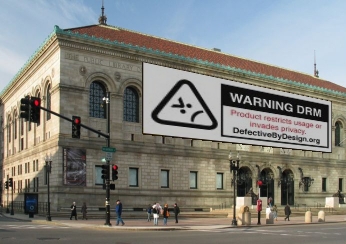
Benjamin Mako Hill: Protest DRM at the Boston Public Library

/copyrighteous/images/bpl_drm.jpg On Saturday February 9th, at 13:00, I'm going to be joining free software and anti-DRM activists to protest the use of DRM by the Boston Public Library on parts of its electronic collection. Those of us protesting are unhappy because the BPL has launched a new service powered by a company called OverDrive. The system gives BPL patrons access to books, music, and movies online -- but only if they use a Microsoft DRM system. There are lots of problems with the introduction of this system: it bars access to users of GNU/Linux and MacOS and creates a dependence on a single technology vendor for access. These are important issues, certainly. The worst problem, however, is much more fundamental. By adopting a DRM system for library content, the BPL is giving OverDrive, copyright holders, and Microsoft the ability to decide what, when, and how its patrons can and cannot read, listen, and watch these parts of the BPL collection. They are giving these companies veto power over the BPL's own ability to access this data -- both now and in the future. Cryptographically, BPL is quite literally handing over the keys to their collection. In the process, they are not only providing a disservice to their patrons. They are providing a disservice to themselves. The first-sale doctrine says that libraries can do essentially whatever they like with copies of books they purchase short of duplication, modification, or performance. Of course, copyright holders would prefer to charge a toll every time someone checks out a book. Public libraries were possible in spite of this desire because they were able to exploit power over the possession and control of their books in the interests of their patrons. With DRM, libraries will reduced to powerlessness. Of course, times have changed. As media and the ways we interact with it is increasingly digital, libraries have changed and will need to change more. But if public libraries are to succeed at their fundamental mission of spreading knowledge and serving communities, this change can't be at the expense of patrons' ability to control their own technology and libraries' ability to control their own collections. I've supported my academic library, MIT Libraries, as they took a risk and stood up to DRM when other institutions did not. And they won. BPL is the largest municipal library in the US and the third largest US library overall. It is the first library to be supported publicly, to be open to the public in the US, and to allow patrons to take home books to read and use them. BPL has an opportunity now to continue this history of leadership, of access, and of patron empowerment. If BPL stands up against DRM and in favor of its patrons' freedom and its own control of its technical destiny and collection, it may set an important precedent. If you're in or near Boston, please join me in Copley Square on Saturday to help make this happen. If you're not near Boston, please help put pressure on similar efforts in your own communities.

7 February 2008

Martin F. Krafft: Best stewart ever

I would like to suggest to my readers to ask airplane crews for explanations of their rules. If we can get a larger number of people to inquire about the reasons behind the do s and dont s on airplanes, maybe the airline companies will adopt the practice. In the context of a previous post on the lack of explanation of the motivations behind airline rules, I was utterly impressed when the steward on the Air New Zealand flight from Melbourne to Wellington asked me to turn off my music player so that I would hear when they asked us to evacuate the plane or similar. While I doubt that I would continue to listen to The Flower Kings in an exceptional event, his explanation actually got me to turn off the player, which I had previously never done (rebel me!). I know it s a bit ridiculous, but I was previously so set on the idea of small devices like a music player interfering with the airplane instruments that I failed to see this obvious bit of logic. The steward thus gets my best steward award. When you fly, ask the crew about the reasons for the rules they impose on you, the passengers! NP: The Flower Kings: Unfold the Future

Martin F. Krafft: Leaving LCA

I am 10 000 metres above sea level, on my way from Melbourne to Wellington. I am looking back at a very enjoyable week of conferencing, with LCA 2008 ending yesterday, followed by today s Open Day. The purpose of this final day is to invite the general public to learn about open-source. Individual projects present their work at booths and field questions by bypassers. Jacinta Richardson and the other organisers and helpers of the Open Day have done an amazing job. The place was buzzing and the selection of projects broad and interesting, even to me. Two talks and a series of lightning talks, as well as catered food for everyone rounded it off. I will try to have this event in mind as we organise a similar event in Buenos Aires after the forthcoming DebConf8 in Argentina. I had a splendid time at the conference and probably can t thank Donna Benjamin and her army of mignons enough for organising it. Compared to the other open-source conferences I previously attended, this one was the most professional. Good job, everyone!!! Here are the highlights: Apart from the busy programme, I particularly enjoyed the hallway track , which is usually the reason why I attend these events. I really ought to practice remembering names and faces a bit better. I am not paying enough tribute to this week with this report, but I shall conclude it regardless. Unless something very unexpected comes up, I will attend next year s LCA in Tasmania. NP: Porcupine Tree: Futile

Alastair McKinstry: Back from Holidays

Chocolate lion Cormac and Caoimhe at a patisserie with Chocolate lion in Concarneau, Brittany
So, I'm back from Holidays, to find we now have a new Government in Ireland. (An unexpected choice of government, of which more later.) We were camping in Fouesnant, in Brittany; Family & Friends might like to see the holiday snaps here). Camping in France went well. With three children aged 7, 4 and 2, there is only so much you can expect from a family holiday. Like it or not, you have to mind the toddler fairly consistently, and the older kids would like your full attention too. This is a holiday ''for'' the kids; plan also a break ''from'' the kids later (a long-weekend, with kids at grandparents, for example). This was our first time camping abroad, and its well recommended. While we went touring with a camper van with the two older children two years ago, this is different in that we were at the campsite for almost two weeks: the kids got to meet and play with others in a way they couldn't before. Also, there were good facilities at the site in Fouesnant, and the swimming pools in particular were appreciated (Caveat emptor though: there were no lifeguards or supervision. We went off-peak, and there were apparently two accidents in the time we were there: a broken kneecap and chin when people came down the slides too soon after others and collided). It was the first time the children (a) had pocket money to spend, and (b) were able to walk to a (campsite) shop to spend it. Lessons were learnt in the finiteness of pocket money, especially by Caoimhe :-(. The weather was fairly good: two wet days (though not overly so, compared to what we're used to in Galway); enough to give the 'authentic camping experience'. And for the children especially, just warm enough. Long drives South were not an option with young kids, and we wanted to see Carnac and Brittany in general. We went touring to two places: Mont St. Michel, on the way down, Carnac, and locally around Quimper and Concarneau. At seven, Cormac is beginning to be old enough to enjoy this, but Sadhbh at 2 is too young, and easily aggravated. Caoimhe can appreciate some of it, such as the well recommended Breton museum in Quimper, seeing the local costumes and clothing is just her style at the moment. We're looking forward to going back when the kids are older, or we can enjoy touring on our own. The camp site is dominated by English / Dutch / Irish. It is still term-time in Britain and Ireland, which meant the children on the site was full of 2-4 year-olds, with a shortage of playmates for Cormac. Next time, synchronise with English school times, etc. We went during Cormacs term-time because it was much cheaper (1000 Euro) than high-season. If Cormac was having difficulty in school things would have been different, as it is, we had no qualms in doing so. Things will probably be different next year with Caoimhe also in school at the same time, and we would go later. Suffice it to say I think synchonisation of school timetables is a bad idea, as it has led to these huge price differentials and parents taking their kids from school. As a friend with experience of the French school system points out, they've spent the last 40 years desynchronising their timetables ... So would we go again, or buy our own tents, etc? possibly. The brochure for next year arrived already, with large discounts for booking early ... Tags , , , , , ,

6 February 2008

Biella Coleman: Interview on Alzheimer s Disease

I am not quite up to listening to this myself, but this interview with author Terry Pratchet about hisearly on-set of alzheimer’s disease seems interesting and it is good to see people talk about it frankly.

4 February 2008

Gunnar Wolf: Switched!

Ok, the time has come. I have postponed this change too much - But finally, after three months of having hired my Dreamhost account (and stating so in this very blog), I finally made the switch from Jaws to Drupal.
Now I only hope I don't flood any planets with my RSS (I was careful to check the dates are consistent, but you never know), finish moving over my static content (I carried over about half of it already), play a bit with the theme, and... that's it! :D
Anyway, I promised my oh-so-not-generic-but-what-the-heck Jaws (0.7 at least) to Drupal (5.x) migration script. It worked like a charm - Ok, I only used it to move blog and photo albums/entries, but that's at least the most typical use AFAICT.
Now, I'll have to understand still some more terms and details in Drupal. For example, WTF? Why was jaws_to_drupal.pl renamed to jaws_to_drupal.pl.txt? (stated content-type, I guess) Why do my uploaded tar.gz files get renamed to tar_.gz even if I explicitly requested to allow .tar.gz suffix uploads? (same thing, I guess)

Pierre Habouzit: New git and CLI

Yes Junichi, this new release explicitely deprecates dashed form of git commands, as they will probably go away from the $PATH for many good reasons: So we gave our users a pretty good timeframe to adapt their scripts, hence the deprecation notice. Also note that best practices about scripting are now documented in the gitcli(5) man page I wrote.

Daniel Baumann: My misc developement news (Januar 2008)

In the past I was not blogging small things if they were not worth a full blog entry on their own (or if I did not have the time to make up a full entry of it :). Inspired by the example of Raphaël Hertzog <hertzog@debian.org> with "News for Debian developers" for <debian-devel-announce@lists.debian.org>, I am intending to do the same on a monthly basis about my own Debian related work. This first entry about January 2008 also covers a few things from the last month of 2007. General News Package News Team News

30 January 2008

Russell Coker: My LCA Talk

Last year at LCA Crispin Cowan suggested to me that I make a joint offer of a combined tutorial on SE Linux and AppArmor as a way of publicly comparing the two technologies. I ended up not accepting the challenge, among other things I had a long-term project going in production in early December that needed some ongoing support. Crispin’s plan B was to just give a lecture about AppArmor. Recently Crispin joined Microsoft [1] and John Johansen of Suse was going to give the talk in his place. The LCA people made a minor mistake by having the conference web site give the description of the tutorial option [2] (which I don’t believe was ever going to happen as I had not accepted the offer), but it’s easy to understand the webmaster copying the wrong description when the one person makes two offers (which I believe is not a common practice). So this morning I and about 150 other people were waiting in the main lecture theatre and no-one from Suse turned up. Being fairly audacious when the announcement was made that the event was officially cancelled I stood up and asked if anyone would like an impromptu talk about SE Linux instead. The audience received that idea quite well. My talk wasn’t as good as I had hoped, not having had a proper breakfast or any caffeinated drinks reduced my mental stack space. So I could talk well on one topic but when questions diverted me to a side topic I found it difficult to remember the previous point I was making. Fortunately when giving an impromptu talk with no notes or presentation materials the audience expectations for a consistent plan of the talk seem reasonably low. ;) I started by talking about my SE Linux Play Machines. Some of that material had been covered in previous talks at other conferences (such as at a previous SE Linux Symposium), but some things (such as my use of Xen) I had not previously covered, but none of it had been mentioned in a talk in Australia for a while. Having given an hour-long talk about SE linux yesterday to an audience with many of the same members I wanted to start by talking about something that they hadn’t heard before, and I was also wearing a Play Machine T-shirt (with the root password printed on it) [4]. After I finished talking about my Play Machines and started covering some of the same material as yesterday about a quarter of the audience left (which was fair enough). I then spoke about general SE Linux issues, largely in response to questions. I covered the differences between the policies (including the history of policy development), the JFFS2 XATTR development (and how SE Linux couldn’t be used on an iPaQ without it), issues of disk space usage for XATTRs for SE Linux labelling on various filesystems and how it drives the use of context mount options, poly-instantiated directories (including some discussion on how the actual storage location for such directories can be on a different filesystem and how this could be convenient when using encrypted filesystems), how Apache/PHP work in a SE Linux environment, and a lot more. I couldn’t resist mentioning to the audience the irony that I had declined a challenge for a joint presentation and then got a sole presenter spot (and a large audience) due to the Suse guy not showing up. For future situations I plan to load lecture notes from all my common talks on my iPaQ. Then next time I have such a speaking opportunity I can give a better prepared talk. Update: It turned out that the LCA people had been informed that the Suse talk was cancelled and had made a mistake, see this link for details.

29 January 2008

John Goerzen: Why Are We So Afraid of Socialized Medicine?

I've been thinking about this for awhile, so time to put down some thoughts.

First, what is socialized medicine? If we listen to the politicians that label health care as "socialized", it seems to be "anything that is paid for by taxes and delivered free or cheaply to citizens." Putting aside the question of whether that meets the academic definition of socialism for the moment, let's look at things in the United States that are already socialized:


That's right. We trust the government with our children all day long for 13 years. For free!

Yet this is a country in which hospitals dump the homeless in the gutter for being unable to pay their bills. Even insured Americans find claims turned down for arbitrary reasons. People are afraid to change jobs for fear of losing health insurance.

Why is it bad to have the government pay for health care?

Here in the United States, our health care system is far from best in the world. It's not even top 10. Or 20. Our system encourages minimizing health care, and doesn't encourage preventative care.

I'd suggest that, in a democracy, it's best to have the government pay for health care. That's because, in a democracy, we are in control of the bureaucrats. If we wish to exercise common sense and pound into their heads that paying for preventative care makes good long-term sense, then we can do so at the ballot box.

So why the scare tactics about government being involved in health care?

Perhaps our real problem is that we have let government get out of our control? Perhaps we are too frightened of change to vote. Perhaps we've given up on a responsive government. Perhaps we think that the insurance companies and drug companies will never let us have a good health care system.

Yes, the lobbyists have a lot of power. But we have the power to remove it, and it's high time we used it.

The audacity of Obama to have hope. To say that we can do better. When Hillary Clinton falls in line with the Republicans and accuses him of having "false hope", effectively saying that we can't do any better, then is she -- or any Republicans -- really a candidate of change? I think that all these accusations from conservatives and Hillary that Obama has "false hope" has finally convinced me that he's the one to vote for. If everyone else claims that his ideas are too good, that his dreams too big, then I like him.

Oh, and you could substitute "college education" for "socialized medicine" everywhere in this article and get equally valid arguments.

Michal &#268;iha&#345;: Gammu stable version 1.18.0

Good news everyone, first stable Gammu release in this year is out. Since 1.17.92 only few small fixes in SMS decoding and AT engine did happen, but there is quite big list of changes compared to 1.17.0: You can download from usual place: http://cihar.com/gammu/.

David Welton: Munich Android Mobile Meeting Report

I'm a bit tired after driving up to Munich for the Android developer meeting, hosted by Google, and being "on" all day, but it was worth it. I was a bit apprehensive that it might be too 'introductory' in the sense of the Google guys telling you in person things that you could have easily looked up on the web, without spending a bunch of time driving around Austria and Bavaria. Fortunately, that wasn't the case. There was some of that, but also plenty of unstructured time to chat with Dan Morrill and Jason Chen, the two Google "Developer Advocates", who are both very friendly, informative and informed, approachable and put a lot of energy into what they do, despite being a bit tired from flying over from the US. It was nice to get a chance to talk with them, and considering that the platform is still changing, useful as well, because they were definitely listening to what people had to say to them. My thanks to them for a job well done. Here are some "impressions" I took away - note that they're not what anyone said, just ideas I got about what they said: There's still really a sense of Android continuing to evolve, in a true spirit of openness. I liked that, as it means there is space for people to tell Google what they want, rather than simply being given a finished product and told that that's that... but then again, I would, being the open source guy that I am. I didn't get to show off Hecl quite as much as I would have liked to, but I did get to mention it a few times, so I guess I did ok.

28 January 2008

Martin F. Krafft: Consolidating packaging workflows across distros

I speculate that most of what we do for Debian squares with what others do for their respective distro. Thus, it should be possible to identify a conceptual workflow applicable to all distros, consolidate individual workflows on a per-package basis, and profit from each other. Jonathan let me have the after-afternoon-coffee slot of the Distro Summit for an impromptu discussion on the various workflows used by distros for packaging. The discussion round was very short-notice and despite the announcement sent to the conference mailing list, only ten people showed up: two people familiar with Fedora, and ( versus ) eight Debianites. Regardless, I think the discussion was success- and fruitful. We were able to identify a one-to-one mapping between the Fedora and Debian workflows, even though we use different techniques: Many Debian package maintainers use version control systems to maintain the ./debian directory, and if patch files are stored in ./debian/patches/, then Debian and Fedora both store patch files in a version control repository, which seems awful. Just as I am only one of many who are experimenting with VCS-based workflows for Debian packaging, the Fedora people are also considering the use of version control for packaging. Unlike Fedora, who seem to try to standardise on bzr, I try to cater for the plethora of version control systems in use in Debian, anticipating the impossibility of standardising/converging on a single tool across the entire project. It seems that our two projects are both at the start of a new phase in packaging, a paradigm shift . What better time could there be for us to listen to each other and come up with a workflow that works for both projects? My suggestion currently centres around a common repository for each package across all (participating) distros, and feature branches. Specifically, given an upstream source tree, modifications made during packaging for a given distro fall into four categories: Given a version control system with sufficient branching support, I imagine having different namespaces for branches: upstream-patches/*, distro/*, rpm/* or debian/*. Now, when building the Debian package, I d apply upstream-patches/*, distro/*, deb/* and debian/* in order, while my colleague from the Fedora project would apply upstream-patches/*, distro/*, rpm/* and fedora/*, before calling the build tools and uploading the package. There are surely problems to be overcome. Pascal Hakim mentioned patch dependencies, and I can t necessarily say with a clear conscience that my workflow isn t too complicated to be unleashed into the public yet. But if we find a conceptual workflow applicable to more than one distro, it should be possible to implement a higher-level tool to implement it. Also, the above is basically patch maintenance, not the entire workflow. Bug tracking system integration is going to play a role, as well as other aspects of daily distro packaging. I ll leave those for future time. For me, this is the start of a potentially fruitful cooperation and I hope that interested parties from other distros jump on. For now, I suggest my mailing list for discussion. You can also find some links on the Debian wiki.

Next.

Previous.