Search Results: "spa"

21 August 2016

David Moreno: Running find with two or more commands to -exec

I spent a couple of minutes today trying to understand how to make find (1) to execute two commands on the same target. Instead of this or any similar crappy variants:
$ find . -type d -iname "*0" -mtime +60 -exec scp -r -P 1337 " " "meh.server.com:/mnt/1/backup/storage" && rm -rf " " \;
Try something like this:
$ find . -type d -iname "*0" -mtime +60 -exec scp -r -P 1337 " " "meh.server.com:/mnt/1/backup/storage" \; -exec rm -rf " " \;
Which is:
$ find . -exec command   \; -exec other command   \;
And you re good to go.

20 August 2016

Daniel Stender: Collected notes from Python packaging

Here are some collected notes on some particular problems from packaging Python stuff for Debian, and more are coming up like this in the future. Some of the issues discussed here might be rather simple and even benign for the experienced packager, but maybe this is be helpful for people coming across the same issues for the first time, wondering what's going wrong. But some of the things discussed aren't easy. Here are the notes for this posting, there is no particular order. UnicodeDecoreError on open() in Python 3 running in non-UTF-8 environments I've came across this problem again recently packaging httpbin 0.5.0. The build breaks the following way e.g. trying to build with sbuild in a chroot, that's the first run of setup.py with the default Python 3 interpreter:
I: pybuild base:184: python3.5 setup.py clean 
Traceback (most recent call last):
  File "setup.py", line 5, in <module>
    os.path.join(os.path.dirname(__file__), 'README.rst')).read()
  File "/usr/lib/python3.5/encodings/ascii.py", line 26, in decode
    return codecs.ascii_decode(input, self.errors)[0]
UnicodeDecodeError: 'ascii' codec can't decode byte 0xe2 in position 2386: ordinal not in range(128)
E: pybuild pybuild:274: clean: plugin distutils failed with: exit code=1: python3.5 setup.py clean 
One comes across UnicodeDecodeError-s quite oftenly on different occasions, mostly related to Python 2 packaging (like here). Here it's the case that in setup.py the long_description is tried to be read from the opened UTF-8 encoded file README.rst:
long_description = open(
    os.path.join(os.path.dirname(__file__), 'README.rst')).read()
This is a problem for Python 3.5 (and other Python 3 versions) when setup.py is executed by an interpreter run in a non-UTF-8 environment1:
$ LANG=C.UTF-8 python3.5 setup.py clean
running clean
$ LANG=C python3.5 setup.py clean
Traceback (most recent call last):
  File "setup.py", line 5, in <module>
    os.path.join(os.path.dirname(__file__), 'README.rst')).read()
  File "/usr/lib/python3.5/encodings/ascii.py", line 26, in decode
    return codecs.ascii_decode(input, self.errors)[0]
UnicodeDecodeError: 'ascii' codec can't decode byte 0xe2 in position 2386: ordinal not in range(128)
$ LANG=C python2.7 setup.py clean
running clean
The reason for this error is, the default encoding for file object returned by open() e.g. in Python 3.5 is platform dependent, so that read() fails on that when there's a mismatch:
>>> readme = open('README.rst')
>>> readme
<_io.TextIOWrapper name='README.rst' mode='r' encoding='ANSI_X3.4-1968'>
Non-UTF-8 build environments because $LANG isn't particularly set at all or set to C are common or even default in Debian packaging, like in the continuous integration resp. test building for reproducible builds the primary environment features that (see here). That's also true for the base system of the sbuild environment:
$ schroot -d / -c unstable-amd64-sbuild -u root
(unstable-amd64-sbuild)root@varuna:/# locale
LANG=
LANGUAGE=
LC_CTYPE="POSIX"
LC_NUMERIC="POSIX"
LC_TIME="POSIX"
LC_COLLATE="POSIX"
LC_MONETARY="POSIX"
LC_MESSAGES="POSIX"
LC_PAPER="POSIX"
LC_NAME="POSIX"
LC_ADDRESS="POSIX"
LC_TELEPHONE="POSIX"
LC_MEASUREMENT="POSIX"
LC_IDENTIFICATION="POSIX"
LC_ALL=
A problem like this is solved mostly elegant by installing some workaround in debian/rules. A quick and easy fix is to add export LC_ALL=C.UTF-8 here, which supersedes the locale settings of the build environment. $LC_ALL is commonly used to change the existing locale settings, it overrides all other locale variables with the same value (see here). C.UTF-8 is an UTF-8 locale which is available by default in a base system, it could be used without installing the locales package (or worse, the huge locales-all package):
(unstable-amd64-sbuild)root@varuna:/# locale -a
C
C.UTF-8
POSIX
This problem ideally should be taken care of upstream. In Python 3, the default open() is io.open(), for which the specific encoding could be given, so that the UnicodeDecodeError disappears. Python 2 uses os.open() for open(), which doesn't support that, but has io.open(), too. A fix which works for both Python branches goes like this:
import io
long_description = io.open(
    os.path.join(os.path.dirname(__file__), 'README.rst'), encoding='utf-8').read()
non-deterministic order of requirements in egg-info/requires.txt This problem appeared in prospector/0.11.7-5 in the reproducible builds test builds, that was the first package of Prospector running on Python 32. It was revealed that there were differences in the sorting order of the [with_everything] dependencies resp. requirements in prospector-0.11.7.egg-info/requires.txt if the package was build on varying systems:
$ debbindiff b1/prospector_0.11.7-5_amd64.changes b2/prospector_0.11.7-5_amd64.changes 
 ... 
  prospector_0.11.7-5_all.deb
      file list
      @@ -1,3 +1,3 @@
       -rw-r--r--   0        0        0        4 2016-04-01 20:01:56.000000 debian-binary
      --rw-r--r--   0        0        0     4343 2016-04-01 20:01:56.000000 control.tar.gz
      +-rw-r--r--   0        0        0     4344 2016-04-01 20:01:56.000000 control.tar.gz
       -rw-r--r--   0        0        0    74512 2016-04-01 20:01:56.000000 data.tar.xz
      control.tar.gz
          control.tar
              ./md5sums
                  md5sums
                  Files in package differ
      data.tar.xz
          data.tar
              ./usr/share/prospector/prospector-0.11.7.egg-info/requires.txt
              @@ -1,12 +1,12 @@
               
               [with_everything]
              +pyroma>=1.6,<2.0
               frosted>=1.4.1
               vulture>=0.6
              -pyroma>=1.6,<2.0
Reproducible builds folks recognized this to be a toolchain problem and set up the issue randonmness_in_python_setuptools_requires.txt to cover this. Plus, a wishlist bug against python-setuptools was filed to fix this. The patch which was provided by Chris Lamb adds sorting of dependencies in requires.txt for Setuptools by adding sorted() (stdlib) to _write_requirements() in command/egg_info.py:
--- a/setuptools/command/egg_info.py
+++ b/setuptools/command/egg_info.py
@@ -406,7 +406,7 @@ def warn_depends_obsolete(cmd, basename, filename):
 def _write_requirements(stream, reqs):
     lines = yield_lines(reqs or ())
     append_cr = lambda line: line + '\n'
-    lines = map(append_cr, lines)
+    lines = map(append_cr, sorted(lines))
     stream.writelines(lines)
O.k. In the toolchain, nothing sorts these requirements alphanumerically to make differences disappear, but what is the reason for these differences in the Prospector packages, though? The problem is somewhat subtle. In setup.py, [with_everything] is a dictionary entry of _OPTIONAL (which is used for extras_require) that is created by a list comprehension out of the other values in that dictionary. The code goes like this:
_OPTIONAL =  
    'with_frosted': ('frosted>=1.4.1',),
    'with_vulture': ('vulture>=0.6',),
    'with_pyroma': ('pyroma>=1.6,<2.0',),
    'with_pep257': (),  # note: this is no longer optional, so this option will be removed in a future release
 
_OPTIONAL['with_everything'] = [req for req_list in _OPTIONAL.values() for req in req_list]
The result, the new _OPTIONAL dictionary including the key with_everything (which w/o further sorting is the source of the list of requirements requires.txt) e.g. looks like this (code snipped run through in my IPython):
In [3]: _OPTIONAL
Out[3]: 
 'with_everything': ['vulture>=0.6', 'pyroma>=1.6,<2.0', 'frosted>=1.4.1'],
 'with_vulture': ('vulture>=0.6',),
 'with_pyroma': ('pyroma>=1.6,<2.0',),
 'with_frosted': ('frosted>=1.4.1',),
 'with_pep257': () 
That list comprehension iterates over the other dictionary entries to gather the value of with_everything, and Python programmers know that of course dictionaries are not indexed and therefore the order of the key-value pairs isn't fixed, but is determined by certain conditions. That's the source for the non-determinism of this Debian package revision of Prospector. This problem has been fixed by a patch, which just presorts the list of requirements before it gets added to _OPTIONAL:
@@ -76,8 +76,8 @@
     'with_pyroma': ('pyroma>=1.6,<2.0',),
     'with_pep257': (),  # note: this is no longer optional, so this option will be removed in a future release
  
-_OPTIONAL['with_everything'] = [req for req_list in _OPTIONAL.values() for req in req_list]
-
+with_everything = [req for req_list in _OPTIONAL.values() for req in req_list]
+_OPTIONAL['with_everything'] = sorted(with_everything)
In comparison to the list method sort(), the function sorted() does not change iterables in-place, but returns a new object. Both could be used. As a side note, egg-info/requires.txt isn't even needed, but that's another issue.

  1. As an alternative to prefixing LC_ALL, env -i could be used to get an empty environment.
  2. 0.11.7-4 already but this package revision was in experimental due to the switch to Python 3 and therefore not tested by reproducible builds continuous integration.

Russell Coker: Basics of Backups

I ve recently had some discussions about backups with people who aren t computer experts, so I decided to blog about this for the benefit of everyone. Note that this post will deliberately avoid issues that require great knowledge of computers. I have written other posts that will benefit experts. Essential Requirements Everything that matters must be stored in at least 3 places. Every storage device will die eventually. Every backup will die eventually. If you have 2 backups then you are covered for the primary storage failing and the first backup failing. Note that I m not saying only have 2 backups (I have many more) but 2 is the bare minimum. Backups must be in multiple places. One way of losing data is if your house burns down, if that happens all backup devices stored there will be destroyed. You must have backups off-site. A good option is to have backup devices stored by trusted people (friends and relatives are often good options). It must not be possible for one event to wipe out all backups. Some people use cloud backups, there are many ways of doing this with Dropbox, Google Drive, etc. Some of these even have free options for small amounts of storage, for example Google Drive appears to have 15G of free storage which is more than enough for all your best photos and all your financial records. The downside to cloud backups is that a computer criminal who gets access to your PC can wipe it and the backups. Cloud backup can be a part of a sensible backup strategy but it can t be relied on (also see the paragraph about having at least 2 backups). Backup Devices USB flash sticks are cheap and easy to use. The quality of some of those devices isn t too good, but the low price and small size means that you can buy more of them. It would be quite easy to buy 10 USB sticks for multiple copies of data. Stores that sell office-supplies sell USB attached hard drives which are quite affordable now. It s easy to buy a couple of those for backup use. The cheapest option for backing up moderate amounts of data is to get a USB-SATA device. This connects to the PC by USB and has a cradle to accept a SATA hard drive. That allows you to buy cheap SATA disks for backups and even use older disks as backups. With choosing backup devices consider the environment that they will be stored in. If you want to store a backup in the glove box of your car (which could be good when travelling) then a SD card or USB flash device would be a good choice because they are resistant to physical damage. Note that if you have no other options for off-site storage then the glove box of your car will probably survive if your house burns down. Multiple Backups It s not uncommon for data corruption or mistakes to be discovered some time after it happens. Also in recent times there is a variety of malware that encrypts files and then demands a ransom payment for the decryption key. To address these problems you should have older backups stored. It s not uncommon in a corporate environment to have backups every day stored for a week, backups every week stored for a month, and monthly backups stored for some years. For a home use scenario it s more common to make backups every week or so and take backups to store off-site when it s convenient. Offsite Backups One common form of off-site backup is to store backup devices at work. If you work in an office then you will probably have some space in a desk drawer for personal items. If you don t work in an office but have a locker at work then that s good for storage too, if there is high humidity then SD cards will survive better than hard drives. Make sure that you encrypt all data you store in such places or make sure that it s not the secret data! Banks have a variety of ways of storing items. Bank safe deposit boxes can be used for anything that fits and can fit hard drives. If you have a mortgage your bank might give you free storage of papers as part of the service (Commonwealth Bank of Australia used to offer that). A few USB sticks or SD cards in an envelope could fit the papers criteria. An accounting firm may also store documents for free for you. If you put a backup on USB or SD storage in your waller then that can also be a good offsite backup. For most people losing data from disk is more common than losing their wallet. A modern mobile phone can also be used for backing up data while travelling. For a few years I ve been doing that. But note that you have to encrypt all data stored on a phone so an attacker who compromises your phone can t steal it. In a typical phone configuration the mass storage area is much less protected than application data. Also note that customs and border control agents for some countries can compel you to provide the keys for encrypted data. A friend suggested burying a backup device in a sealed plastic container filled with dessicant. That would survive your house burning down and in theory should work. I don t know of anyone who s tried it. Testing On occasion you should try to read the data from your backups and compare it to the original data. It sometimes happens that backups are discovered to be useless after years of operation. Secret Data Before starting a backup it s worth considering which of the data is secret and which isn t. Data that is secret needs to be treated differently and a mixture of secret and less secret data needs to be treated as if it s all secret. One category of secret data is financial data. If your accountant provides document storage then they can store that, generally your accountant will have all of your secret financial data anyway. Passwords need to be kept secret but they are also very small. So making a written or printed copy of the passwords is part of a good backup strategy. There are options for backing up paper that don t apply to data. One category of data that is not secret is photos. Photos of holidays, friends, etc are generally not that secret and they can also comprise a large portion of the data volume that needs to be backed up. Apparently some people have a backup strategy for such photos that involves downloading from Facebook to restore, that will help with some problems but it s not adequate overall. But any data that is on Facebook isn t that secret and can be stored off-site without encryption. Backup Corruption With the amounts of data that are used nowadays the probability of data corruption is increasing. If you use any compression program with the data that is backed up (even data that can t be compressed such as JPEGs) then errors will be detected when you extract the data. So if you have backup ZIP files on 2 hard drives and one of them gets corrupt you will easily be able to determine which one has the correct data. Failing Systems update 2016-08-22 When a system starts to fail it may limp along for years and work reasonably well, or it may totally fail soon. At the first sign of trouble you should immediately make a full backup to separate media. Use different media to your regular backups in case the data is corrupt so you don t overwrite good backups with bad ones. One traditional sign of problems has been hard drives that make unusual sounds. Modern drives are fairly quiet so this might not be loud enough to notice. Another sign is hard drives that take unusually large amounts of time to read data. If a drive has some problems it might read a sector hundreds or even thousands of times until it gets the data which dramatically reduces system performance. There are lots of other performance problems that can occur (system overheating, software misconfiguration, and others), most of which are correlated with potential data loss. A modern SSD storage device (as used in a lot of the recent laptops) doesn t tend to go slow when it nears the end of it s life. It is more likely to just randomly fail entirely and then work again after a reboot. There are many causes of systems randomly hanging or crashing (of which overheating is common), but they are all correlated with data loss so a good backup is a good idea. When in doubt make a backup. Any Suggestions? If you have any other ideas for backups by typical home users then please leave a comment. Don t comment on expert issues though, I have other posts for that.

19 August 2016

Dirk Eddelbuettel: RQuantLib 0.4.3: Lots of new Fixed Income functions

A release of RQuantLib is now on CRAN and in Debian. It contains a lot of new code contributed by Terry Leitch over a number of pull requests. See below for full details but the changes focus on Fixed Income and Fixed Income Derivatives, and cover swap, discount curves, swaptions and more. In the blog post for the previous release 0.4.2, we noted that a volunteer was needed for a new Windows library build of QuantLib for Windows to replace the outdated version 1.6 used there. Josh Ulrich stepped up, and built them. Josh and I tried for several month to get the win-builder to install these, but sadly other things took priority and we were unsuccessful. So this release will not have Windows binaries on CRAN as QuantLib 1.8 is not available there. Instead, you can use the ghrr drat and do
if (!require("drat")) install.packages("drat")
drat::addRepo("ghrr")
install.packages("RQuantLib")
to fetch prebuilt Windows binaries from the ghrr drat. Everybody else gets sources from CRAN. The full changes are detailed below.
Changes in RQuantLib version 0.4.3 (2016-08-19)
  • Changes in RQuantLib code:
    • Discount curve creation has been made more general by allowing additional arguments for day counter and fixed and floating frequency (contributed by Terry Leitch in #31, plus some work by Dirk in #32).
    • Swap leg parameters are now in combined variable and allow textual description (Terry Leitch in #34 and #35)
    • BermudanSwaption has been modfied to take option expiration and swap tenors in order to enable more general swaption structure pricing; a more general search for the swaptions was developed to accomodate this. Also, a DiscountCurve is allowed as an alternative to market quotes to reduce computation time for a portfolio on a given valuation date (Terry Leitch in #42 closing issue #41).
    • A new AffineSwaption model was added with similar interface to BermudanSwaption but allowing for valuation of a European exercise swaption utlizing the same affine methods available in BermudanSwaption. AffineSwaption will also value a Bermudan swaption, but does not take rate market quotes to build a term structure and a DiscountCurve object is required (Terry Leitch in #43).
    • Swap tenors can now be defined up to 100 years (Terry Leitch in #48 fising issue #46).
    • Additional (shorter term) swap tenors are now defined (Guillaume Horel in #49, #54, #55).
    • New SABR swaption pricer (Terry Leitch in #60 and #64, small follow-up by Dirk in #65).
    • Use of Travis CI has been updated and switch to maintained fork of deprecated mainline.
Courtesy of CRANberries, there is also a diffstat report for the this release. As always, more detailed information is on the RQuantLib page. Questions, comments etc should go to the rquantlib-devel mailing list off the R-Forge page. Issue tickets can be filed at the GitHub repo.

This post by Dirk Eddelbuettel originated on his Thinking inside the box blog. Please report excessive re-aggregation in third-party for-profit settings.

Olivier Gr goire: Conclusion Google Summer of Code 2016

SmartInfo project with Debian alt text 1. Me Before getting into the thick of my project, let me present myself:
I am Olivier Gr goire (Gasuleg), and I study IT engineering at cole de Technologie sup rieure in Montreal.
I am an technician in electronics, and I began object-oriented programming just last year.
I applied to GSoC because I loved the concept of the project that I would work on and I really wanted to be part of it. I also wanted to discover the word of the free software. 2. My Project During this GSoC, I worked on the Ring project. Ring is a free software for communication that allows its users to make audio or video calls, in pairs or groups, and to send messages, safely and freely, in confidence. Savoir-faire Linux and a community of contributors worldwide develop Ring. It is available on GNU/Linux, Windows, Mac OSX and Android. It can be associated with a conventional phone service or integrated with any connected object. Under this very easy to use software, there is a combination of technologies and innovations opening all kinds of perspectives to its users and developers. Ring is a free software whose code is open. Therefore, it is not the software that controls you. With Ring, you take control of your communication! Ring is an open source software under the GPL v3 license. Everyone can verify the codes and propose new ones to improve the software s performace. It is a guarantee of transparency and freedom for everyone!
Source: ring.cx The problem is about the typical user of Ring, the one who don t use the terminal to launch Ring. He has no information about what has happened in the system. My goal is to create a tool that display statistics of Ring. 3. Quick Explanation of What My Program Can Do The Code
Here are the links to the code I was working on all throughout the Google Summer of Code (You can see what I have done after the GSoC by clicking on the newest patchs):
Patch Status
Daemon On Review
Lib Ring Client (LRC) On Review
Gnome client On review
Remove unused code Merged
!!!!!CHANGE LINK TO PUT THE LATEST PATCHES BEFORE THE END OF GSOC!!!!! What Can Be Displayed?
This is the final list of information I can display and some ideas on what information we could display in the future:
Information Details Done?
Call ID The identification number of the call Yes
Resolution Local and remote Yes
Framerate Local and remote Yes
Codec Audio and video in local and remote Yes
Bandwidth Download and upload No
Performance use CPU, GPU, RAM No
Security level In SIP call No
Connection time No
Packets lost No

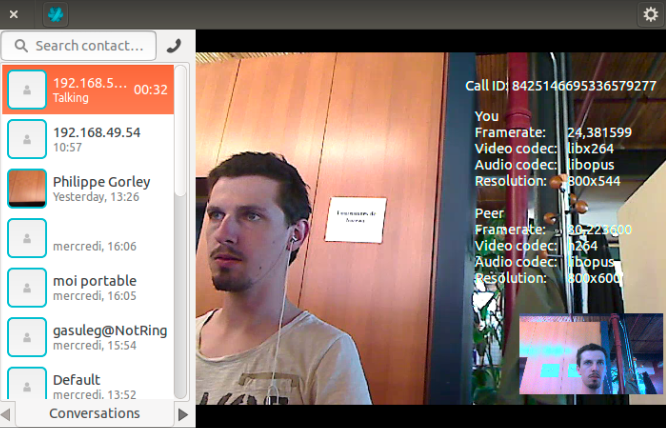
To launch it you need to right click on the call and click on Show advanced information .
alt text
To stop it, same thing: right click on the call and click on Hide advanced information .
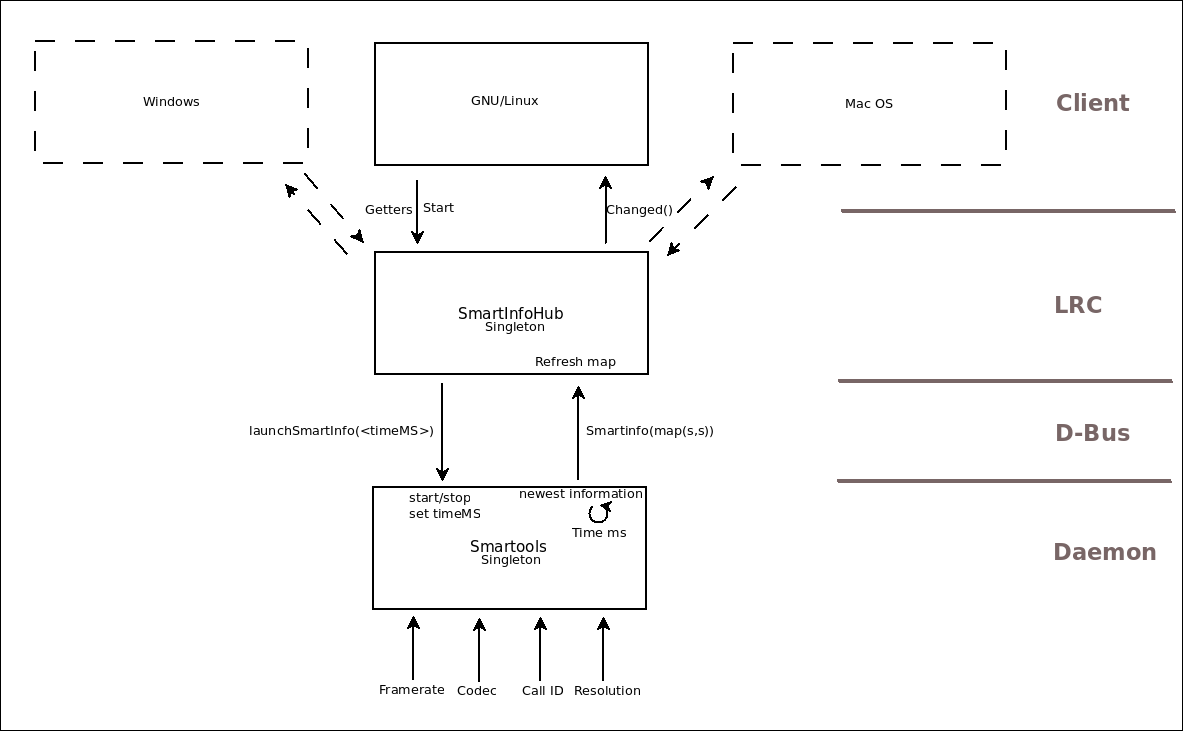
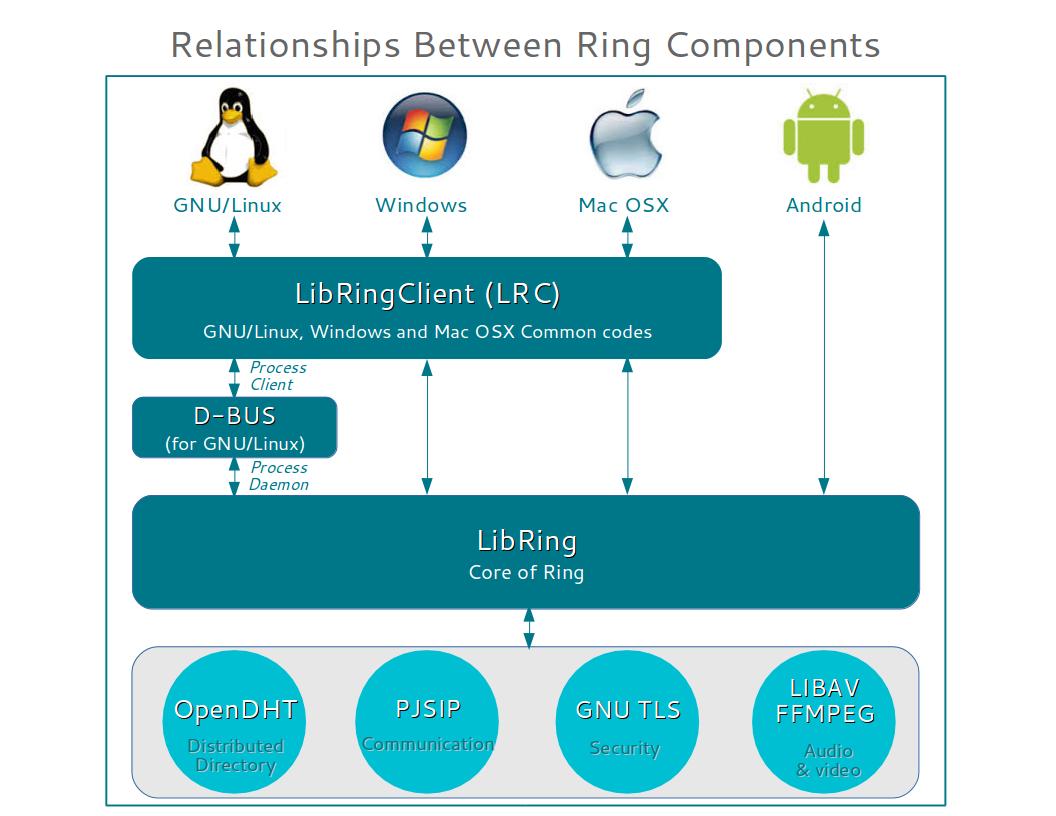
4. More Details About My Project My program needs to retrieve information from the daemon (LibRing) and then display it in gnome client. So, I needed to create a patch for the daemon, the D-Bus layer (in the daemon patch), LibRingClient and the GNU/Linux (Gnome) client.
This is what the architecture of the project looks like.
alt text
source: ring.cx And this is how I implemented my project.
alt text
5. Future of the Project 6. Thanks I would like to thank the following:
- The Google Summer of Code organisation, for this wonderful experience.
- Debian, for accepting my project proposal and letting me embark on this fantastic adventure.
- My mentor, Mr Guillaume Roguez, and all his team, for being there to help me.

Olivier Gr goire: Conclusion Google Summer of Code 2016

SmartInfo project with Debian alt text 1. Me Before getting into the thick of my project, let me present myself:
I am Olivier Gr goire (Gasuleg), and I study IT engineering at cole de Technologie sup rieure in Montreal.
I am a technician in electronics, and I began object-oriented programming just last year.
I applied to GSoC because I loved the concept of the project that I would work on and I really wanted to be part of it. I also wanted to discover the word of the free software. 2. My Project During this GSoC, I worked on the Ring project. Ring is a free software for communication that allows its users to make audio or video calls, in pairs or groups, and to send messages, safely and freely, in confidence. Savoir-faire Linux and a community of contributors worldwide develop Ring. It is available on GNU/Linux, Windows, Mac OSX and Android. It can be associated with a conventional phone service or integrated with any connected object. Under this very easy to use software, there is a combination of technologies and innovations opening all kinds of perspectives to its users and developers. Ring is a free software whose code is open. Therefore, it is not the software that controls you. With Ring, you take control of your communication! Ring is an open source software under the GPL v3 license. Everyone can verify the codes and propose new ones to improve the software s performace. It is a guarantee of transparency and freedom for everyone!
Source: ring.cx The problem is about the typical user of Ring, the one who don t use the terminal to launch Ring. He has no information about what has happened in the system. My goal is to create a tool that display statistics of Ring. 3. Quick Explanation of What My Program Can Do The Code
Here are the links to the code I was working on all throughout the Google Summer of Code (You can see what I have done after the GSoC by clicking on the newest patchs):
Patch Status
Daemon Merged
Lib Ring Client (LRC) On Review
Gnome client On Review
Remove unused code Merged

What Can Be Displayed?
This is the final list of information I can display and some ideas on what information we could display in the future:
Information Details Done?
Call ID The identification number of the call Yes
Resolution Local and remote Yes
Framerate Local and remote Yes
Codec Audio and video in local and remote Yes
Bandwidth Download and upload No
Performance use CPU, GPU, RAM No
Security level In SIP call No
Connection time No
Packets lost No

To launch it you need to right click on the call and click on Show advanced information .
alt text
To stop it, same thing: right click on the call and click on Hide advanced information .
4. More Details About My Project My program needs to retrieve information from the daemon (LibRing) and then display it in gnome client. So, I needed to create a patch for the daemon, the D-Bus layer (in the daemon patch), LibRingClient and the GNU/Linux (Gnome) client.
This is what the architecture of the project looks like.
alt text
source: ring.cx And this is how I implemented my project.
alt text
5. Future of the Project Weekly report link Thanks I would like to thank the following:
- The Google Summer of Code organisation, for this wonderful experience.
- Debian, for accepting my project proposal and letting me embark on this fantastic adventure.
- My mentor, Mr Guillaume Roguez, and all his team, for being there to help me.

Norbert Preining: Debian/TeX Live 2016.20160819-1

A new and unplanned release in quick succession. I have uploaded testing packages to experimental which incorporate tex4ht into the TeX Live packages, but somehow the tex4ht transitional updated slipped into sid, and made many packages uninstallable. Well, so after a bit more testing let s ship the beast to sid, meaning that tex4ht will finally updated from the last 2009 version to what is the current status in TeX Live. texlive2016-debian From the list of new packages I want to pick out the group of phf* packages that seem from a quick reading over the package documentations as very interesting. But most important is the incorporation of tex4ht into the TeX Live packages, so please report bugs and shortcomings to the BTS. Thanks. New packages aurl, bxjalipsum, cormorantgaramond, notespages, phffullpagefigure, phfnote, phfparen, phfqit, phfquotetext, phfsvnwatermark, phfthm, table-fct, tocdata. Updated packages acmart, acro, biblatex-abnt, biblatex-publist, bxdpx-beamer, bxjscls, bxnewfont, bxpdfver, dccpaper, etex-pkg, europasscv, exsheets, glossaries-extra, graphics-def, graphics-pln, guitarchordschemes, ijsra, kpathsea, latexpand, latex-veryshortguide, ledmac, libertinust1math, markdown, mcf2graph, menukeys, mfirstuc, mhchem, mweights, newpx, newtx, optidef, paralist, parnotes, pdflatexpicscale, pgfplots, philosophersimprint, pstricks-add, showexpl, tasks, tetex, tex4ht, texlive-docindex, udesoftec, xcolor-solarized.

Zlatan Todori : Defcon24

I went to Defcon24 as Purism representative. It was (as usual) held in Las Vegas, the city of sin. In the same module as with DebConf, here we go with good, bad and ugly. Good Badges are really cool. You can find good hackers here and there (but very small number compared to total number). Some talks are good and workshop + village idea looks good (although I didn't manage to attend any workshop as there was place for 1100 and there were 22000 attendees). The movie night idea is cool and Arcade space (where you can play old arcade games, relax and hack and also listen to some cool music) is really lovely. Also you have a camp/village for kids learning things such as electronics, soldering etc but you need to pay attention that they don't see too much of twisted folks that also gather on this con. And that's it. Oh, yea, Dark Tangent appears actually to be cool dude. Bad One does not simply hold a so-called hacker conference in Las Vegas. Having a conference inside hotel/casino where you mix with gamblers and casino workes (for good or for bad) is simply not in hacker spirit and certainly brings all kind of people to the same place. Also, there were simply not enough space for 22000 Defcon attendees, and you don't get proud of having on average ONLY 40min lines. You get proud if you don't have lines! Organization is not the strongest part of Defcon. Huge majority of attendees are not hackers. They are script kiddies, hacker wannabes, comic con people, few totally lost souls etc etc. That simply brings the quality of a conference down. Yes it is cool to have mix of many diverse people but not for the sake of just having people. Ugly They lack Code of Conduct (everyone knows I am not in favor of any writens rules how people should behave but after Defcon I clearly see need for it). Actually, tbh, they do have it but no one gives a damn about it. And you should report to Goons, more about them below. Sexism is huge here. I remember and hear about stories of sexual harassment in IT industry, but Debian somehow mitigated that before me entering its domains, so I never experienced it. The sheer number of sexist behavior on Defcon is tremendous. It appears to me that those people had lonely childhood and now they act as a spoiled 6 year old: they're spoiled, they need to yell to show their point, they have low and stupid sexist jokes and they simply think that is cool. Majority of Goons (their coordinators or whatever) are simply idiots. I don't know do they feel they have some superpowers, or are drunk or just stupid but yelling on people, throwing low jokes on people, more yelling, cursing all the time, more yelling - simply doesn't work for me. So now you can see the irony of CoC on Defcon. They even like to say, hey we are old farts, let us our con be as we want it to be. So no real diversity there. Either it is their way, and god forsaken if you try to change something for better and make them stop cursing or throwing sexist jokes ("squeeze, people. together, touch each other, trust me it will feel good"), or highway. Also it appears that to huge number of vocal people, word "fuck" has some fetish meaning. Either it needs to show how "fucking awesome this con or they are" or to "fucking tell few things about random fucking stuff". Thank you, but no thank you. So what did I do during con. I attended few talks, had some discussion with people, went to one party (great DJs, again people doing stupid things, like breaking invertory to name just one of them) and had so much time (read "I was bored") that I bought domain, brough up server on which I configured nginx and cp'ed this blog to blog.zlatan.tech (yes, recently I added letsencrypt because it is, let me be in Defcon mood, FUCKING AWESOME GRRR UGH) and now I even made .onion domain for it. What can boredom do to people, right? So the ultimate question is - would I go again to Defcon. I am strongly leaning to no, but in my nature is to give second chance and now I have more experience (and I also have thick skin so I guess I can play calm for one more round).

17 August 2016

Rapha&#235;l Hertzog: Freexian s report about Debian Long Term Support, July 2016

A Debian LTS logoLike each month, here comes a report about the work of paid contributors to Debian LTS. Individual reports In July, 136.6 work hours have been dispatched among 11 paid contributors. Their reports are available: Evolution of the situation The number of sponsored hours jumped to 159 hours per month thanks to GitHub joining as our second platinum sponsor (funding 3 days of work per month)! Our funding goal is getting closer but it s not there yet. The security tracker currently lists 22 packages with a known CVE and the dla-needed.txt file likewise. That s a sharp decline compared to last month. Thanks to our sponsors New sponsors are in bold.

2 comments Liked this article? Click here. My blog is Flattr-enabled.

Jamie McClelland: Nice Work Apertium

For the last few years I have been periodically testing out apertium and today I did again and was pleasantly surprised with the quality of the english-spanish and spanish-english translations (and also their nifty web site translator). So, I dusted off some of my geeky code to make it easier to use and continue testing. For starters...
    sudo apt-get install apertium-en-es xclip coreutils
Then, I added the following to my .muttrc file:
    macro pager <F2> "<enter-command>set pipe_decode<enter><pipe-entry> sed '1,/^$/d'   apertium es-en   less<enter><enter-command>unset pipe_decode<enter>" "translate from spanish"
If you press F2 while reading a message in spanish it will print out the English translation. If you use vim, you can create ~/.vim/plugins/apertium.vim with:
    function s:Translate()
        silent !clear
        execute "! apertium en-es " . bufname("%") . "   tee >(xclip)"
    endfunction
    command Translate :call <SID>Translate()
Then, you can type the command: :Translate And it will display the English to Spanish translation of the file you are editing and copy the translation into your clip board so you can paste it into your document.

14 August 2016

Chris Lamb: try.diffoscope.org CLI client

One criminally-unknown new UNIX tool is diffoscope, a diff "on steroids" that will not only recursively unpack archives but will transform binary formats into human-readable forms in order to compare them instead of simply showing the raw difference in hexadecimal. In an attempt to remedy its underuse, in December 2015 I created the try.diffoscope.org service so that I and hopefully others could use diffoscope without necessarily installing the multitude of third-party tools that using it can require. It also enables trivial sharing of the HTML reports in bugs or on IRC. To make this even easier, I've now introduced a command-line client to the web service:
 $ apt-get install trydiffoscope
 [..]
 Setting up trydiffoscope (57) ...
 $ trydiffoscope /etc/hosts.allow /etc/hosts.deny
 --- a/hosts.allow
 +++ b/hosts.deny
  @@ -1,10 +1,17 @@
  -# /etc/hosts.allow: list of hosts that are allowed to access the system.
  -#                   See the manual pages hosts_access(5) and hosts_options(5).
  +# /etc/hosts.deny: list of hosts that are _not_ allowed to access the system.
  +#                  See the manual pages hosts_access(5) and hosts_options(5).
You can also install it from PyPI with:
$ pip install trydiffoscope

Mirroring the original diffoscope command, you can save the output locally in an even more-readable HTML report format by appending "--html output.html". In addition, if you specify the --webbrowser (or -w) argument:
$ trydiffoscope -w /etc/hosts.allow /etc/hosts.deny
https://try.diffoscope.org/gaauupyapzkb
... this will automatically open your default browser to view the results.

David Moreno: Deploying a Dancer app on Heroku

There s a few different posts out there on how to run Perl apps, such as Mojolicious-based, on Heroku, but I d like to show how to deploy a Perl Dancer application on Heroku. The startup script of a Dancer application (bin/app.pl) can be used as a PSGI file. With that in mind, I was able to take the good work of Miyagawa s Heroku buildpack for general PSGI apps and hack it a little bit to use Dancer s, specifically. What I like about Miyagawa s approach is that uses the fantastic cpanm and makes it available within your application, instead of the monotonous cpan, to solve dependencies. Let s make a simple Dancer app to show how to make this happen:
/tmp $ dancer -a heroku
+ heroku
+ heroku/bin
+ heroku/bin/app.pl
+ heroku/config.yml
+ heroku/environments
+ heroku/environments/development.yml
+ heroku/environments/production.yml
+ heroku/views
+ heroku/views/index.tt
+ heroku/views/layouts
+ heroku/views/layouts/main.tt
+ heroku/MANIFEST.SKIP
+ heroku/lib
heroku/lib/
+ heroku/lib/heroku.pm
+ heroku/public
+ heroku/public/css
+ heroku/public/css/style.css
+ heroku/public/css/error.css
+ heroku/public/images
+ heroku/public/500.html
+ heroku/public/404.html
+ heroku/public/dispatch.fcgi
+ heroku/public/dispatch.cgi
+ heroku/public/javascripts
+ heroku/public/javascripts/jquery.js
+ heroku/t
+ heroku/t/002_index_route.t
+ heroku/t/001_base.t
+ heroku/Makefile.PL
Now, you already know that by firing perl bin/app.pl you can get your development server up and running. So I ll just proceed to show how to make this work on Heroku, you should already have your development environment configured for it:
/tmp $ cd heroku/
/tmp/heroku $ git init
Initialized empty Git repository in /private/tmp/heroku/.git/
/tmp/heroku :master $ git add .
/tmp/heroku :master $ git commit -a -m 'Dancer on Heroku'
[master (root-commit) 6c0c55a] Dancer on Heroku
22 files changed, 809 insertions(+), 0 deletions(-)
create mode 100644 MANIFEST
create mode 100644 MANIFEST.SKIP
create mode 100644 Makefile.PL
create mode 100755 bin/app.pl
create mode 100644 config.yml
create mode 100644 environments/development.yml
create mode 100644 environments/production.yml
create mode 100644 lib/heroku.pm
create mode 100644 public/404.html
create mode 100644 public/500.html
create mode 100644 public/css/error.css
create mode 100644 public/css/style.css
create mode 100755 public/dispatch.cgi
create mode 100755 public/dispatch.fcgi
create mode 100644 public/favicon.ico
create mode 100644 public/images/perldancer-bg.jpg
create mode 100644 public/images/perldancer.jpg
create mode 100644 public/javascripts/jquery.js
create mode 100644 t/001_base.t
create mode 100644 t/002_index_route.t
create mode 100644 views/index.tt
create mode 100644 views/layouts/main.tt
/tmp/heroku :master $
And now, run heroku create, please note the buildpack URL, http://github.com/damog/heroku-buildpack-perl.git:
/tmp/heroku :master $ heroku create --stack cedar --buildpack http://github.com/damog/heroku-buildpack-perl.git
Creating blazing-beach-7280... done, stack is cedar
http://blazing-beach-7280.herokuapp.com/   git@heroku.com:blazing-beach-7280.git
Git remote heroku added
/tmp/heroku :master $
And just push:
/tmp/heroku :master $ git push heroku master
Counting objects: 34, done.
Delta compression using up to 4 threads.
Compressing objects: 100% (30/30), done.
Writing objects: 100% (34/34), 40.60 KiB, done.
Total 34 (delta 3), reused 0 (delta 0)
-----> Heroku receiving push
-----> Fetching custom buildpack... done
-----> Perl/PSGI Dancer! app detected
-----> Bootstrapping cpanm
Successfully installed JSON-PP-2.27200
Successfully installed CPAN-Meta-YAML-0.008
Successfully installed Parse-CPAN-Meta-1.4404 (upgraded from 1.39)
Successfully installed version-0.99 (upgraded from 0.77)
Successfully installed Module-Metadata-1.000009
Successfully installed CPAN-Meta-Requirements-2.122
Successfully installed CPAN-Meta-2.120921
Successfully installed Perl-OSType-1.002
Successfully installed ExtUtils-CBuilder-0.280205 (upgraded from 0.2602)
Successfully installed ExtUtils-ParseXS-3.15 (upgraded from 2.2002)
Successfully installed Module-Build-0.4001 (upgraded from 0.340201)
Successfully installed App-cpanminus-1.5015
12 distributions installed
-----> Installing dependencies
Successfully installed ExtUtils-MakeMaker-6.62 (upgraded from 6.55_02)
Successfully installed YAML-0.84
Successfully installed Test-Simple-0.98 (upgraded from 0.92)
Successfully installed Try-Tiny-0.11
Successfully installed HTTP-Server-Simple-0.44
Successfully installed HTTP-Server-Simple-PSGI-0.14
Successfully installed URI-1.60
Successfully installed Test-Tester-0.108
Successfully installed Test-NoWarnings-1.04
Successfully installed Test-Deep-0.110
Successfully installed LWP-MediaTypes-6.02
Successfully installed Encode-Locale-1.03
Successfully installed HTTP-Date-6.02
Successfully installed HTML-Tagset-3.20
Successfully installed HTML-Parser-3.69
Successfully installed Compress-Raw-Bzip2-2.052 (upgraded from 2.020)
Successfully installed Compress-Raw-Zlib-2.054 (upgraded from 2.020)
Successfully installed IO-Compress-2.052 (upgraded from 2.020)
Successfully installed HTTP-Message-6.03
Successfully installed HTTP-Body-1.15
Successfully installed MIME-Types-1.35
Successfully installed HTTP-Negotiate-6.01
Successfully installed File-Listing-6.04
Successfully installed HTTP-Daemon-6.01
Successfully installed Net-HTTP-6.03
Successfully installed HTTP-Cookies-6.01
Successfully installed WWW-RobotRules-6.02
Successfully installed libwww-perl-6.04
Successfully installed Dancer-1.3097
29 distributions installed
-----> Installing Starman
Successfully installed Test-Requires-0.06
Successfully installed Hash-MultiValue-0.12
Successfully installed Devel-StackTrace-1.27
Successfully installed Test-SharedFork-0.20
Successfully installed Test-TCP-1.16
Successfully installed Class-Inspector-1.27
Successfully installed File-ShareDir-1.03
Successfully installed Filesys-Notify-Simple-0.08
Successfully installed Devel-StackTrace-AsHTML-0.11
Successfully installed Plack-0.9989
Successfully installed Net-Server-2.006
Successfully installed HTTP-Parser-XS-0.14
Successfully installed Data-Dump-1.21
Successfully installed Starman-0.3001
14 distributions installed
-----> Discovering process types
Procfile declares types -&amp;gt; (none)
Default types for Perl/PSGI Dancer! -&amp;gt; web
-----> Compiled slug size is 2.7MB
-----> Launching... done, v4
http://blazing-beach-7280.herokuapp.com deployed to Heroku
To git@heroku.com:blazing-beach-7280.git
* [new branch] master -&amp;gt; master
/tmp/heroku :master $
And you can confirm it works: Please note that the environment it runs on is deployment . The backend server it uses is the great Starman, also by the great Miyagawa. Now, if you add or change dependencies on Makefile.PL, next time you push, those will get updated. Very cool, right? :)

David Moreno: RVM + Rake tasks on Cron jobs

RVM hates my guts. And it doesn t matter, because I hate RVM back even more. Since I was technologically raised by aging wolfs, I have strong reasons to believe that you just shouldn t have mixed versions of software on your production systems, specially, if a lot of things are poorly tested, like most of Ruby libraries, aren t backward compatible. I was raised on a world where everything worked greatly because the good folks at projects like Debian or Perl have some of the greatest QA processes of all time, hands down. So, when someone introduces a thing like RVM which not only promotes having hundreds of different versions of the same software, both on development, testing and production environments, but also encourages poor quality looking back and looking forward, there isn t anything else but to lose faith in humanity. But enough for ranting. I had to deliver this side project that works with the Twitter API and the only requirement pretty much was that it had to be both run from the shell but also loaded as a class within a Ruby script. And so I did everything locally with my great local installation of Ruby 1.8.7. When it came the time to load on the testing/production server I found myself on a situation where pathetic RVM was installed. After spending hours trying to accommodate my changes to run properly with Ruby 1.9.2, I set up a cron job using crontab to run my shit every now and then. And the shit wasn t even running properly. Basically, my crontab line looked something like this:
*/30 * * * * cd /home/david/myproject && rake awesome_task
And that was failing, crontab was returning some crazy shit like Ruby and/or RubyGems cannot find the rake gem . Seriously? Then I thought, well, maybe my environment needs to be loaded and whatever, so I made a bash script with something like this:
#!/bin/bash
cd /home/david/myproject
/full/path/to/rvm/bin/rake -f Rakefile awesome_task
And that was still failing with the same error. So after trying to find out how cron jobs and crontab load Bash source files, I took a look at how Debian starts its shell upon login. And while that didn t tell me that much that I didn t know, I went to look at the system-wide /etc/profile and found a gem, a wonderful directory /etc/profile.d/ where a single shitty file was sitting, smiling back at me, like waiting for me to find it out and swear on all problems in life: rvm.sh. /etc/profile is not being loaded when I just run /bin/bash by my crappy script, only when I log in, I should ve known this. Doesn t RVM solve the issue of having system-wide installations so the user doesn t have to deal with, you know, anything outside of his own /home ? So I had to go ahead and do:
#!/bin/bash
source /etc/profile
cd /home/david/myproject
/full/path/to/rvm/bin/rake -f Rakefile awesome_task
And hours later I was able to continue with work. Maybe this will help some poor bastard like myself on similar situation on the future. Of course one can argue that I could ve installed my own RVM and its Ruby versions, but why, oh why, if it was, apparently, already there. Why would I have to fiddle with the Ruby installations if all I want is get my shit done and head to City Bakery where I can spend that money I just earned on chocolate cookies? My work is pretty simple to run with pretty much any ancient version of Ruby, nothing fancy (unless you call MongoMapper fancy). RVM is a great project that doesn t solve an issue, but just hides some really fucked up shit on the Ruby community.

13 August 2016

Dariusz Dwornikowski: Automatic PostgreSQL config with Ansible

If for some reasons you can t use dedicated DBaaS for your PostgreSQL (like AWS RDS) then you need to run your database server on a cloud instance. In these kind of setup, when you scale up or down your instance size, you need to adjust PostgreSQL parameters according to the changing RAM size. There are several parameters in PostgreSQL that highly depend on RAM size. An example is shared_buffers for which a rule of thumb says that is should be set to 0.25*RAM. In DBaaS, when you scale the DB instance up or down, parameters are adjusted for you by the cloud provider, e.g. AWS RDS uses parameter groups for that reason, where particular parameters are defined depending on the size of the RAM of the RDS instance. So what can you when you do not have RDS or any other DBaaS? You can always keep several configuration files on your instance, each for a different memory size, you can rewrite you config every time you change the size of the instance or you can use Ansible role for that. Our Ansible role will be very simple, we will have two tasks. One will change the PostgreSQL config, the second one will just restart the database server:
---
- name: Update PostgreSQL config
  template: src=postgresql.conf.j2 dest=/etc/postgresql/9.5/main/postgresql.conf
  register: pgconf
- name: Restart postgresql
  service: name=postgresql state=restarted
  when: pgconf.changed
Now we need the template, where are the calculations take place. RAM size will be taken from the Ansible s fact called ansible_memtotal_mb. Since it returns RAM size in MBs, we will stick to MBs. We will define the following parameters, you can adjust them to your needs: For max_connections we will define a default role variable of 100 but we will allow to specify it at a runtime. The relevant parts of the postgresql.conf.j2 are below:
 max_connections =   max_connections        
 shared_buffers =   (((ansible_memtotal_mb/1024.0) round int)*0.25) int*1024  MB
 work_mem =   ((((ansible_memtotal_mb/1024.0) round int)*0.25)/max_connections*1024) round int  MB
 maintenance_work_mem =   ((ansible_memtotal_mb/1024.0) round int)*64  MB
 effective_cache_size =   (((ansible_memtotal_mb/1024.0) round int)*0.75) int*1024  MB
You can now run the role every time you change the instance size, and the config will be changed accordingly to the RAM size. You can extend the role and maybe add other constraints and change max_connections to you specific needs. An example playbook could look like:
---
hosts: my_postgres
roles:
  - postgres-config 
vars:
  - max_connection: 300
And run it:
$ ansible-playbook playbook.yml
The complete role can be found in my github repo.

Russell Coker: SSD and M.2

The Need for Speed One of my clients has an important server running ZFS. They need to have a filesystem that detects corruption, while regular RAID is good for the case where a disk gives read errors it doesn t cover the case where a disk returns bad data and claims it to be good (which I ve witnessed in BTRFS and ZFS systems). BTRFS is good for the case of a single disk or a RAID-1 array but I believe that the RAID-5 code for BTRFS is not sufficiently tested for business use. ZFS doesn t perform very well due to the checksums on data and metadata requiring multiple writes for a single change which also causes more fragmentation. This isn t a criticism of ZFS, it s just an engineering trade-off for the data integrity features. ZFS supports read-caching on a SSD (the L2ARC) and write-back caching (ZIL). To get the best benefit of L2ARC and ZIL you need fast SSD storage. So now with my client investigating 10 gigabit Ethernet I have to investigate SSD. For some time SSDs have been in the same price range as hard drives, starting at prices well below $100. Now there are some SSDs on sale for as little as $50. One issue with SATA for server use is that SATA 3.0 (which was released in 2009 and is most commonly used nowadays) is limited to 600MB/s. That isn t nearly adequate if you want to serve files over 10 gigabit Ethernet. SATA 3.2 was released in 2013 and supports 1969MB/s but I doubt that there s much hardware supporting that. See the SATA Wikipedia page for more information. Another problem with SATA is getting the devices physically installed. My client has a new Dell server that has plenty of spare PCIe slots but no spare SATA connectors or SATA power connectors. I could have removed the DVD drive (as I did for some tests before deploying the server) but that s ugly and only gives 1 device while you need 2 devices in a RAID-1 configuration for ZIL. M.2 M.2 is a new standard for expansion cards, it supports SATA and PCIe interfaces (and USB but that isn t useful at this time). The wikipedia page for M.2 is interesting to read for background knowledge but isn t helpful if you are about to buy hardware. The first M.2 card I bought had a SATA interface, then I was unable to find a local company that could sell a SATA M.2 host adapter. So I bought a M.2 to SATA adapter which made it work like a regular 2.5 SATA device. That s working well in one of my home PCs but isn t what I wanted. Apparently systems that have a M.2 socket on the motherboard will usually take either SATA or NVMe devices. The most important thing I learned is to buy the SSD storage device and the host adapter from the same place then you are entitled to a refund if they don t work together. The alternative to the SATA (AHCI) interface on an M.2 device is known as NVMe (Non-Volatile Memory Express), see the Wikipedia page for NVMe for details. NVMe not only gives a higher throughput but it gives more command queues and more commands per queue which should give significant performance benefits for a device with multiple banks of NVRAM. This is what you want for server use. Eventually I got a M.2 NVMe device and a PCIe card for it. A quick test showed sustained transfer speeds of around 1500MB/s which should permit saturating a 10 gigabit Ethernet link in some situations. One annoyance is that the M.2 devices have a different naming convention to regular hard drives. I have devices /dev/nvme0n1 and /dev/nvme1n1, apparently that is to support multiple storage devices on one NVMe interface. Partitions have device names like /dev/nvme0n1p1 and /dev/nvme0n1p2. Power Use I recently upgraded my Thinkpad T420 from a 320G hard drive to a 500G SSD which made it faster but also surprisingly quieter you never realise how noisy hard drives are until they go away. My laptop seemed to feel cooler, but that might be my imagination. The i5-2520M CPU in my Thinkpad has a TDP of 35W but uses a lot less than that as I almost never have 4 cores in use. The z7k320 320G hard drive is listed as having 0.8W low power idle and 1.8W for read-write, maybe Linux wasn t putting it in the low power idle mode. The Samsung 500G 850 EVO SSD is listed as taking 0.4W when idle and up to 3.5W when active (which would not be sustained for long on a laptop). If my CPU is taking an average of 10W then replacing the hard drive with a SSD might have reduced the power use of the non-screen part by 10%, but I doubt that I could notice such a small difference. I ve read some articles about power use on the net which can be summarised as SSDs can draw more power than laptop hard drives but if you do the same amount of work then the SSD will be idle most of the time and not use much power . I wonder if the SSD being slightly thicker than the HDD it replaced has affected the airflow inside my Thinkpad. From reading some of the reviews it seems that there are M.2 storage devices drawing over 7W! That s going to create some cooling issues on desktop PCs but should be OK in a server. For laptop use they will hopefully release M.2 devices designed for low power consumption. The Future M.2 is an ideal format for laptops due to being much smaller and lighter than 2.5 SSDs. Spinning media doesn t belong in a modern laptop and using a SATA SSD is an ugly hack when compared to M.2 support on the motherboard. Intel has released the X99 chipset with M.2 support (see the Wikipedia page for Intel X99) so it should be commonly available on desktops in the near future. For most desktop systems an M.2 device would provide all the storage that is needed (or 2*M.2 in a RAID-1 configuration for a workstation). That would give all the benefits of reduced noise and increased performance that regular SSDs provide, but with better performance and fewer cables inside the PC. For a corporate desktop PC I think the ideal design would have only M.2 internal storage and no support for 3.5 disks or a DVD drive. That would allow a design that is much smaller than a current SFF PC.

David Moreno: Perl 5.12's each function

With Perl 5.12 released earlier this summer, the each function got a nice little addition that I d like to talk about: It now has the ability to work on arrays, not only key-value pair hashes, but not exactly as you d expect it (not like Ruby s each method). The traditional way to work with each, using a hash:
my %h = (
    a => 1,
    b => 2,
    c => 3,
);
while(my($key, $value) = each %h)  
    say "index: $key => value: $value";
 
And the output. Of course, hashes being unordered lists, you won t get the nice little order of an array.
index: c => value: 3
index: a => value: 1
index: b => value: 2
Now, when you use an array, each will return the next pair on the list consisting on the index of that element s position and the position itself. Since it returns the next pair, you can iterate through it on the same fashion as when using a hash:
my @arr = ('a'..'z');
while(my($index, $value) = each @arr)  
    say "index: $index => value: $value";
 
This is particularly useful to access direct named variables, both the index and the element, while looping through an array.
index: 0 => value: a
index: 1 => value: b
index: 2 => value: c
index: 3 => value: d
index: 4 => value: e
index: 5 => value: f
index: 6 => value: g
index: 7 => value: h
index: 8 => value: i
index: 9 => value: j
index: 10 => value: k
index: 11 => value: l
index: 12 => value: m
index: 13 => value: n
index: 14 => value: o
index: 15 => value: p
index: 16 => value: q
index: 17 => value: r
index: 18 => value: s
index: 19 => value: t
index: 20 => value: u
index: 21 => value: v
index: 22 => value: w
index: 23 => value: x
index: 24 => value: y
index: 25 => value: z

David Moreno: Disable Nginx logging

This is something that is specified clearly on the Nginx manual, but it s nice to have it as a quick reference. The access_log and error_log directives on Nginx are on separate modules (HTTP Log and Core modules respectively) and they don t behave the same way when all you want is to disable all logging on your server (in our case, we serve a gazillion static files and perform a lot of reverse proxying and we re not interested on tracking that). It s a common misconception that you can set error_log to off, because that s how you disable access_log (if you do that, the server will still log to the file $nginx_path/off). Instead, you have to set error_log to log to the always mighty black hole /dev/null using the highest level for logging (which triggers the fewest events), crit:
http  
  server  
    # ...
    access_log off;
    error_log /dev/null crit;
    # ...
   
  #...
 
If you re the possessor of the blingest of bling-bling, you can disable all logging (not only for a server block), by putting error_log on the root of the configuration and access_log within your http block and make sure you don t override that on any of the inner blocks. And you re good to go.

11 August 2016

Christoph Egger: Looking for a replacement Homeserver

Almost exactly six years ago I bought one of these Fuloong 6064 mini PCs. The machine has been working great ever since both collecting my mail and acting as an IMAP server as well as providing public services -- it's also keyserver.siccegge.de. However jessie is supposed to be the last Debian release supporting the hardware and the system's rather slow and lacks memory. This is especially noticeable with IMAP spam filter training and mail indexing. Therefore I'm looking for some nice replacement -- preferably non-x86 again (no technical reasons). My requirements are pretty simple: Now I'd consider one of these ARM boards and get it a nice case but they seem all to either fail in terms of SATA or not being faster at all (and one needs to go for outdated hardware to stand a chance of mainline kernel support). If anyone knows something nice and non-x86 I'll happily take suggestions.

10 August 2016

Tom Marble: webica

webica I've just pushed the first version of my new Clojure wrapper for Selenium called webica. The reason I need webica is that I want to do automated browser testing for ClojureScript based web applications. Certainly NodeJS, PhantomJS, Nashorn and the like are useful... but these can't quite emulate the full browser experience. We want to test our ClojureScript web apps in browsers -- ideally via our favorite automated continuous integration tools.

Selenium
My new approach with the webica library is to do full Java introspection in the spirit that amazonica does for the AWS API. In fact I wanted to take it a step further by actually generating Clojure source code via introspection that can be used by Codox to generate nice API docs (which you don't get with amazonica). That, alas, was a little trickier than expected due to pesky Quine-like problems :) . If you load the library on the REPL you can get a feeling for each namespace by calling the show-functions function. I realize this approach of aggressive introspection, playing fast and loose with types and application level dynamic dispatch are crazy antipatterns. In my defense I started out playing around to see "if I could do it". After seeing the result in the form of a shell script in Clojure -- imitating lmgtfy -- perhaps webica will actually be useful! I plan to talk about webica tonight at clojure.mn -- hope to see you there!

9 August 2016

Reproducible builds folks: Finishing the final variations for reprotest

Author: ceridwen I've been working on getting the last of the variations working. With no responses on the mailing list from anyone outside Debian and with limited time remaining, with Lunar I've decided to deemphasize it.
  1. Build path is done.
  2. Host and domain name use domainname and hostname. This site is old, but it indicates that domainname was available on most OSes and hostname was available everywhere as of 2004. Prebuilder uses a Linux-specific utility (unshare --uts) to run this variation in a chroot, but I'm not doing this for reprotest: if you want this variation, use qemu.
  3. User/group will not be portable, because they'll rely on useradd/groupadd and su. useradd and groupadd work on many but not all OSes, notably not including FreeBSD or MacOS X. su was universal in 2004.
  4. Time is not done but will probably be portable to some systems, because it will rely on date -s. Unfortunately, I haven't been able to find any information on how common date -s is across Unix-like OSes, as the -s option is not part of the POSIX standard.
  5. At the moment, I have no idea how to implement changes for /bin/sh and the login shell that will even work across different distributions of Linux, much less different OSes. There are a couple of key problems, starting with the need to find two different shells to use, because there's no way to find out what shells are installed. This blog post explains why /etc/shells doesn't work well for finding what shells are available: not everything in /etc/shells is necessarily a shell (Ubuntu has /usr/bin/screen) and not all available shells are in /etc/shells. Also, there's no good way to find out what shell is the system default because /bin/sh can be an arbitrary binary, not a symlink,and no good way to identify what it is if it is a binary. I can hard-code shell choices, but which shells? bash is obvious for Linux, but what's the best second choice?
On other topics:
  1. reprotest fails to build properly on jessie: Lunar said, and I agree, that fixing this is not a priority. I need someone with more knowledge of Debian Python packaging to help me. If I'm going to support old versions, I also need some kind of CI server, because I don't have the time or ability to maintain old versions of Debian and Python myself.
  2. libc-bin: ldconfig segfaults when run using "setarch uname26": I don't have a good solution for this, but I don't want to hard-code and maintain an architecture-specific disable. Would changing the argument to setarch work around the segfault? Is there a way to test for the presence of the bug that won't cause a segfault or similar crash?
  3. Please put adt-virt-* binaries back onto PATH: reprotest is not affected by this change because I forked the autopkgtest code rather than depending on it, so that reprotest can be installed through PyPi. At the moment, reprotest doesn't make its versions of the programs in virt/ available on $PATH. This is primarily because of the problems with distributing command-line scripts with setuptools. The approach I'm currently using, including the virt/ programs as non-code data with include reprotest/virt/* in MANIFEST.in, doesn't install them to make them available for other programs. Using one of the other approaches potentially could, but it's difficult to make the imports work with those approaches. (I haven't found a way to do it.) I think the best solution to this approach is to split autopkgtest into the Debian-specific components and the general-purpose virtualization components, but I don't have the time to do this myself or to negotiate with Martin Pitt, if he'd even be receptive. I'm also unsure at this point if it wouldn't be better for reprotest to switch from autopkgtest to using something like Ansible to run the virtualization, because Ansible has some solved some of the portability problems already and is not tied to Debian.
My goal is to finish the variations (finally), though as this has always proved more difficult than I expected in the past, I don't make any guarantees. Beyond that, I want to start working on finishing docstrings in the reprotest-specific (i.e., not inherited from autopkgtest) code, improving the documentation in general, and improving the tests.

Next.

Previous.