Erich Schubert: Are likes still worth anything?

In the 3.x days of KDE, there were some wonderful applications. One of them I still admire, is kscope. Recently, I stumbled upon this blog entry and thought of sharing my living with kscope.The move from KDE 3 to KDE 4 was a big one. During that move, the kscope author decided to port kscope to a Qt only application. That is what we have as the latest kscope, 1.9x version. But, on personal taste, it is not as good as the 1.6x series.With no viable replacement to my knowledge, making use of kscope 1.6x on Debian (and Ubuntu) was the choice. Thanks to the way it is all packaged by the KDE, it is easy.Kscope depends on 2 packages for its functionlity: kdelibs4c2a and kate. kdelibs4c2a is unsupported, but for the dire needs, you live with it. The library can be easily pulled from the snapshot website, or just get the package from the old distribution URLs. The same goes for kate and kscope (1.6x)Install the kdelibs4c2a package. 16:55:27 rrs@champaran:~$ apt-cache policy kdelibs4c2a
kdelibs4c2a:
Installed: 4:3.5.10.dfsg.1-5
Candidate: 4:3.5.10.dfsg.1-5
Version table:
*** 4:3.5.10.dfsg.1-5 0
100 /var/lib/dpkg/status
libkateinterfaces.so.0@ libkateutils.so.0@libkateinterfaces.so.0.0.0 libkateutils.so.0.0.0


Francesca Ciceri, photo by Andrew McMillan, CC-BY-SA 2.0
To my great surprise, no one treated me like an idiot for that error.Since then, I joined the WWW team and helped them apply the shiny new design provided by Kalle S derman. A lot of work was done during the week immediately before the release of the new website. Oh that was a week! We worked night and day to have the new design ready for February 6th, and it was fantastic when we finally published it, simultaneously with the release of Squeeze. At the same time, I started to contribute more actively to the Debian Publicity team, not only translating news but also writing them. It can sound scary for a non native English speaker to write something from scratch in English, but you have to keep in mind that your text will be reviewed by native speakers before being published. And we have some fantastic reviewers in the English localisation team: particularly Justin B Rye, who is tireless in his effort and more recently Moray Allan. I think I m particularly lucky to work with all these people: there s a special mood in both Publicity and WWW team, which makes you feel happy to do things and at the same time pushes you to do more just because it s fun to work with them sharing jokes, ideas, rants, patches and hugs. Rapha l: I believe that you have been trough the new member process very quickly. You re now a Non-Uploading Debian Developer. How was the experience and what does this mean to you? Francesca: Becoming a Debian Developer was not so obvious for me, because I didn t need to be a DD for the work I do in Debian. For instance, I don t maintain packages, so I had no reasons to want to become a DD in order to have uploading rights. For a while I didn t really feel the necessity of being a DD. Luckily, some people started to pester me about it, asking me to apply for the NM process. I remember Martin Zobel-Helas doing this for an entire week every single day, and Gerfried Fuchs doing it as well. Suddenly, I realized that people I worked with felt that I deserved the DD status and that I simply had thought I didn t. As a non coder and a woman, there probably was a bit of impostor syndrome involved. Having people encouraging me, gave me more confidence and the desire to finally become a DD. And so I did. The process for non uploading DD is identical to the one to become an uploading DD, with one exception: in the second part of the process (named Tasks and Skills) instead of questions about how to create and maintain packages, there are questions about the non packaging work you usually do in Debian. The general resolution which created the possibility to become a non uploading DD gave us a chance to recognize the great effort of Debian contributors who work in various area (translations, documentation, artworks, etc.) that were not always considered as important as packaging efforts. And this is great because if you are a regular contributor, if you love Debian and you are committed to the project, there are no reasons to not be an official member of it. With regards to this, I like the metaphor used by Meike Reichle in her recent talk about the Debian Women Project (video recording here):
a Debian Developer status is a lot like a citizenship in a country that you re living in. If you live in a country and you don t have citizenship, you can find a job, buy a house, have a family [...] but if this country at any point in time decides to go into a direction that you don t like, there s nothing you can do about it. You are not in the position to make any change or to make any effect on that country: you just live there, but there s no way that you can excercise influence on the people who run this country.Rapha l: You recently joined the Debian Press Team. What does it involve and how are you managing this new responsibility? Francesca: The Press Team is basically the armed wing of the Publicity Team: it handles announcements that need to be kept private until the release, moderate the debian-announce and debian-news mailing list and maintain contacts with press people from outside the project. The real job, so, is done within the Publicity Team. The most important part of our work is to write announcements and the newsletter: while the newsletter is published bi-weekly, the announcements need to be write in a shorter timeframe. Localization is really important in spreading Debian word, so we work closely with translators: both announcements and DPN are usually translated in four or five different languages. The publicity work could be stressful, as we have strict deadlines, we need to take quick decisions and often do last-minute changes. Personally, I like it: I work better under pressure. But I know that is sometimes difficult for contributors to accept that we can t debate endlessly on details, we have just to go on and do our best in a given timeframe.
The publicity work could be stressful, as we have strict deadlines, [ ]. Personally, I like it.Raphael: You re one of the main editor behind the Debian Project News. What s the role and scope of this newsletter? Francesca: Debian Project News is our beloved newsletter, direct successor of the Debian Weekly News founded by Joey Hess in 1999 and later kept alive by Martin Schulze. In 2007, Debian Weekly News was discontinued but in 2008 the project was revived by Alexander Reichle Schmehl. The idea behind DPN is to provide our users an overview of what is happening inside and outside the project. As the core team of editors is formed by three people, the main problem is to be able to collect enough news from various sources: in this sense we are always glad when someone points us to interesting blogposts, mails and articles. DPN is also a good chance for non coders to contribute to Debian: propose news, write paragraphs and review the draft before the publication are quite easy tasks but very useful. English native speakers can do a proofread (as no one of the main editors is a native speaker) while others can always translate DPN in their native language. People who want to help us can take a look at our wiki page.
DPN is also a good chance for non coders to contribute to Debian.Just yesterday I realized that since January we don t miss or delay an issue: so I d like to thank the fantastic team of editors, reviewers and translators who made it possible. The team is now working on another way of spreading Debian s message: a long-time project is finally becoming real. Stay tuned, surprise arriving! Raphael: You re trying to organize IRC training sessions but that doesn t seem to take off in Debian, while it s quite common in the Ubuntu community. How do you explain that? Francesca: I m not sure about it: both Debian users and contributors seemed to appreciate this initiative in the past. I was quite surprised by the amount of Debian members present during the various sessions and by the amount of interesting questions asked by the users. So the only reason I can think about is that I need to put more enthusiasm in convincing the teams to do it: they need more encouragement (or to be pestered more!). I, for myself, think that IRC training sessions are a great way to promote our work, to share our best practice, to talk about our project to a wider audience. And I ll sure try to organize more of them. Help, suggestions, ideas are really welcome! Raphael: If you could spend all your time on Debian, what would you work on? Francesca: There is a project I d like to give more love, but I always end up without the time to do it: the debian-community.org project. Back in 2007, Holger Levsen founded it with the aim of reducing the gap between Debian contributors and Debian users, giving all an opportunity to contribute, share ideas and more. The project was discontinued and I d really like to revive it: in these years various things have changed, but I think that the core idea of having a node to connect existing local communities is still good and doable. In Debian we don t have the wide and well articulated local infrastructure present in other distributions (Ubuntu, particularly, but also Fedora): even if I don t like too centralized structures, I think that a better connection between the project and local groups of users and on-line communities would be a step forward for the project. Being part of the Events Team, I m aware of how much we need to improve our communication with local groups. An example is the events organization: sometimes, Publicity and Events teams even don t know about regional Debian related events (like booth at conferences, workshops, talks, install parties, etc) and this is a shame because we could offer a lot of help in organizing and promoting local events. What we lack is better communication. And debian-community.org project could give us exactly this. Could be a cluster of local groups, a platform for events organization and even a useful resource for newbies who want to find a local group near them. I started some effort in this sense, sending a proposal about it, working on a census of Debian local groups. Any help is appreciated! I m really curious to see how many Debian communities (from all around the world and the web) are out there, and I d love to have members from these communities better connected with the Debian Project. Raphael: What s the biggest problem of Debian? Probably the bikeshedding feticism of almost all of us. It s the other side of the coin of Debian s commitment to technical excellence and our perfectionism, but sometimes it leads just to endless discussions about details, and it is a blocker for various initiatives. In Debian, you have to be really patient and in a way stubborn to push some changes. This is frustrating sometimes. On the other hand, I really appreciate how people take some times to think to each proposals, give some feedback and discuss about it: the process could be annoying, indeed, but the result is often an improvement of the initial proposal. Raphael: Is there someone in Debian that you admire for their contributions? Most of my teammates are simply brilliant and adorable and hard-working. But I have to admit that I particularly admire David Pr vot: beside being a webmaster he does a lot of things, from French translations to DPN editing. All his contributions have a great quality and he s able to push you always further in doing things and doing them better. He is a good example of how I d like to be as contributor: smart, tireless, friendly.
Subscribe to my newsletter to get my monthly summary of the Debian/Ubuntu news and to not miss further interviews. You can also follow along on Identi.ca, Google+, Twitter and Facebook.
3 comments Liked this article? Click here. My blog is Flattr-enabled.
In (roughly) 2008 I read "Blood Music" my first Greg Bear novel and
devoured it in a weekend, in only two or three reading sessions. That happens
very rarely, and when it does I often wonder whether it's the quality of the
writing or some combination of that and your personal moods and tastes at the
time that is responsible. My next Bear was "Darwin's Radio" in mid-2010 which,
whilst good, did not provoke the same feverish read. I might write short
reviews for both at some point in the future, but right now I can't remember
either well enough to do so.
In the last few weeks I read "Hull Zero Three" which was quite a different
beast. The novel first captured my attention due to the unusual way it was
promoted: via a video, which was created using a modified Quake 2 engine. It
wasn't a great video but the novelty made it interesting.
The story begins with a first-person narrator waking up from a sort-of hyper
sleep on a generation starship that has clearly had some serious problems. He
has to run to escape danger before he has an opportunity to figure out exactly
what has happened and what he is running from, or to.
Something has gone horribly wrong on the ship: it's nowhere near where it
should be going and nobody should be awake. The narrator's memory is fractured,
fabricated and unreliable; the ship is hostile, and whilst it's mechanical, it
cyclically changes and re-arranges it's hulls in an almost organic way. He is
joined by a rotating cast of similarly confused refugees of varying shapes and
sizes. Language and cultural barriers serve to further magnify the sense of
alienation that you experience on behalf of the story teller. The troupe are
persued through the corridors by a collection of lethally efficient killer
"things", contrasting with the background by being organic in nature but
mechanical in behaviour and appearance.
The scale of the ship is necessarily massive, and Bear does an impressive job
of capturing the awe you might feel when considering it. Three huge,
cigar-shaped hulls, joined by "spars" to an enormous chunk of ice captured from
the Oort cloud on exodus from the solar system. The ice serves as a mixture of
"fuel" for the biological ship systems and as part of a shield system for the
hulls from cosmic rays. However, in part due to the narrator's confusion, it
was hard to follow the very abstract descriptions of the environment in the
earlier stages of the story. I found myself re-reading passages to try and
understand the comparisons being offered and scales presented.
In common with the two earlier Bears I've read, 'body horror' features
prominently in this story. It feels like a "Dead Space" or "Resident Evil" in
space in a hard SF novel which seriously attempt to capture real speculative
science.
Like "Blood Music", I found myself compelled to read "Hull Zero Three" at every
available opportunity. I finished it off in a very enjoyable reading session
outdoors in the spring sunshine. It was an enjoyable read, well written but not
beyond criticism, with some interesting takes on well-worn themes. Very
reminiscent of the movie "Pandorum" (which was a surprisingly good movie).
printLn(mutable IO, String line)If we bind the the first parameter, what should be the type of the function, and especially important how do we get back the mutable parameter? Consider the partially applied form printLn1:
printLn1(String line)The mutability parameter would be lost and we could not do any further I/O (and the curried form would appear as a pure function, so a good compiler would not even emit a call to it) An answer might be to put the thing into the result when currying:
printLn2(String line) -> mutable IOBut how can we explain this? In the end result, do we maybe have to use a signature like:
printLn(String, mutable in IO io1, mutable out IO io2)We could then introduce syntax to call that as
printLn(string, mutable io)Where as the mutable io argument basically expands to io and io1 for the first call, and for later calls to io1, io2 , and so on. It can also be easily curried by allowing currying to take place on variables not declared as output parameters. We can then curry the function as:
printLn3(mutable in IO io1, mutable out IO io2)
printLn4(mutable out IO io2)
If so, we can rename mutable back to unique and make that easier by introducing the unary operator & for two locations, just like Mercury uses ! for it. We could then write calls looking like this:
printLn("Hello", &io);
printLn("Hello", io, io1);
How out parameters are explained is a different topic; we could probably say that an out parameter defines a new variable.
Another option is to forbid currying of mutable parameters entirely. This would have the advantage of maintaining the somewhat simple one parameter style.
The programming language Clean does not provide any special syntactic sugar for having mutable variables. In Clean, the function gets a unique object and returns a unique object (noted by *). For example, the main entry point in a Clean program (with state) looks like this:
Start:: *World -> *WorldIn short, the function Start gets a abstract world passed that is unique and at the end returns a new unique world. In Clean syntax, our example function would most likely have the signature:
printLn :: String *IO -> *IOYou know have to either maintain one additional variable for the new unique object, which gets a bit complicated with time. On the other hand, you can do function composition on this (if you have a function composition operator that preserves uniqueness when available, as should be possible in Clean):
printTwoLines :: *IO -> *IO
printTwoLines = (printLn "World") o (printLn "Hello")
Function composition on mutable things however, does not seem like it is needed often enough in a functional programming language with a C syntax.
People might also ask why monads are not used instead. Simon L Peyton Jones and Philip Wadler described monadic I/O in their paper Imperative Functional Programming (http://research.microsoft.com/en-us/um/people/simonpj/papers/imperative.ps.Z) in 1993, and it is used in Haskell (the paper was about the implementation in Haskell anyway), one of the world s most popular and successful functional programming languages.
While monadic I/O works for the Haskell crowd, and surely some other people, the use of Monads also limits the expressiveness of code, at least as far as I can tell. At least as soon as you want to combine multiple monads, you will have to start lifting stuff from one monad to another (liftIO and friends), or perform all operations in the IO monad, which prevents obvious optimizations (such as parallelizing the creation of two arrays) in short dependencies between actions are more strict than they have to be. For a functional language targeting imperative programmers, the lifting part seems a bit too complicated.
One of the big advantages of monads is that they are much easier to implement, as they do not require extensions to the type system and the Hindley-Milner type inference algorithm used by the cool functional programming languages. If you want uniqueness typing however, you need to modify the algorithm or infer the basic types first and then infer uniqueness in a second pass (as Clean seems to do it).
| Publisher: | Microsoft |
| Copyright: | 2004 |
| ISBN: | 0-7356-1993-X |
| Format: | Trade paperback |
| Pages: | 153 |
My public radio station is engaged in a most obnoxious spring pledge drive.
Good time to listen to podcasts. Here are the ones I'm currently liking.

Sarah's Mum had accrued too much annual leave and had to take some time off
work, so Sarah did some (very mild) arm twisting and convinced her to come
over for 3 weeks, and do a 5 day cruise to Mexico out of New Orleans.
Unfortunately, my annual leave situation wasn't quite so abundant, and I had
a lot going on at work, so regretfully I didn't join them on the cruise, and
instead went to New Orleans for a four day weekend when they returned.
From all reports, the cruise was very good. Zoe handled it well, although
she did say "home" a lot. One of the two stops in Mexico was to check out
some Mayan ruins, which looked awesome from the photos. The other stop
involved a dolphin encounter. I was incredibly envious of all that they got
to do, and would have loved to have gone with them, as I've never been on a
cruise ship either.
I can also report that no cats were lost during this bachelor stint.
I had a night flight on the Wednesday evening to get there, which was
scheduled to get in at around midnight, and I'd booked a motel room near the
airport for that night, and we'd booked a vacation rental home for Thursday
to Sunday nights. Unfortunately, my flight ended being delayed something
like 2.5 hours, so I didn't get into New Orleans until around 2am.
The house we rented did the trick
nicely. It was a small "shotgun" duplex in
what looked like a nice neighbourhood. It was advertised as being close to
the street car line, but they were doing some work on the tracks, so the
street car didn't seem to be running as far down the line as it usually did,
so it ended up being a bit more of a trek to get to it. It was also
extremely slow, and there was a marathon on the Sunday, which closed
everything down for a long time, making it a generally pretty unreliable
form the transport.
We ended up renting a car for Saturday and Sunday, which was something of a
saga in itself, as Enterprise
didn't have any cars at the location we'd booked one, so after a couple of
hours cooling our heels there (Zoe was incredibly well-behaved, all things
considered), they shuttled us over to another location and we ended up with
a minivan instead of a compact, which for the same price, allayed our
concerns about being able to transport all of our luggage to the airport on
Monday morning.
We had a very early morning flight on Monday morning to come back, which got
into SFO at around 9am, and I went directly to work from there.
Thursday
We all arrived at the house, separately. It ended up taking them 2 hours to
disembark the ship when it came back into port, with Customs taking an
eternity to process everyone. I think we went exploring the local area that
afternoon, and took a street car into the city to check out Bourbon Street,
having a Cajun dinner at Remoulade.
Friday
In the morning, we went to check out Lafayette Cemetery
Number 2. Sarah took Zoe back to the house for a nap, and Sarah's Mum
and I continued back to explore the French Quarter some more, walking down
the length of Royal Street (which was vastly different from Bourbon Street,
just one block over). We had lunch at the French Market. The cemetery was
interesting, as pretty much all of the graves were these huge above ground
tombs, that seemed to have multiple family members interred in them.
Apparently the cemetery filled up quite quickly courtesy of a Yellow Fever
outbreak.
After lunch, Sarah's Mum and I continued wandering around the French
Quarter. We went and took a look at the Mississippi River, and I had an
encounter with a grifter who was so good at his job I couldn't bring myself
to argue with him over the $20 he diddled me out of.
We tried to get to the Civil War
Museum, but it closed at 4pm. We looked at the Robert E. Lee Monument,
which seemed to be draped in drunks, and then I think we rendezvoused with
Sarah and Zoe back on Canal Street for dinner at The Court of Two Sisters (which
apparently we were under-dressed for, as Sarah and her Mum said we were
getting a lot of dirty looks from other patrons).
Saturday
On Saturday morning, we had the aforementioned car rental experience from
hell, and by the time we had the car it was lunchtime, so Zoe napped in the
car after lunch on the way out to Oak Alley
Plantation, where we were introduced to the delightful beverage known as
the mint julep, and
took a tour of the house and wandered the grounds.
Sunday
On Sunday, Sarah and her Mum did a swamp tour, and Zoe and I went to the
zoo. As I said earlier, there was a marathon that completely closed down
Saint Charles Avenue, which is where the street cars run, so after walking
down to where the street cars started operating (which ended up being most
of the way down South Carrollton Avenue), the driver informed me that the
street cars were queuing up at the corner of South Carrollton and Saint
Charles, and I should get off her street car and get on the one at the front
of the queue. I did this, but the driver of the front street car informed me
that she wouldn't be leaving for an hour and half. At this point, I started
considering a bus instead.
Zoe and I went to check out the Mississippi River, which was quite close to
where we were, and then I went back, and despite a street car having left
(without any passengers) the driver of the current street car couldn't tell
me when she'd be leaving, so I started walking down Saint Charles Avenue.
Unfortunately, Zoe's going through a phase where she wants to be carried
everywhere, so I was lugging her all over the place on my hip. Sarah didn't
take a stroller with her, and instantly regretted it. Lesson learned.
Eventually we managed to get onto a bus, which dropped us off at Audubon Park,
which had Audubon
Zoo at the other end of it. There was a playground near the Saint
Charles Avenue end of the park, so Zoe had a bit of a play on that, and then
we continued through the park to the zoo.
Mercifully, the zoo had dodgy strollers for rent, and there was no way in
the world I wasn't going to rent one of them, so that made getting around
with Zoe a lot easier on my back. We had a really good time at the zoo.
There was some sort of a music festival on in the parklands within the zoo
grounds, and that included a jumping castle, which Zoe expressed a desire to
have a go on. She had a fabulous time on it. I think she probably spent
about 15 minutes in there, without any tears. I was very impressed. I took a
brief video of some
of her antics.
It was getting close to Zoe's nap time, and she was getting tired, but
fortunately Sarah and her Mum were able to pick us up from the zoo after
their swamp tour and Zoe got to nap back at the house.
Monday
We had a very early start. Unfortunately, our flight (with United) was a
couple of days after United and Continental officially merged, and despite
having checked in online, we had to queue up with everyone else (for an
extended period of time) to drop off our checked luggage. Then there was a
45 minute line for security screening. We pulled the "toddler going to melt
down" card and jumped to the head of the line, but Sarah's Mum had to wait.
The flight ended up being delayed because people were stuck in the security
line.
Overall impressions of New Orleans
Fabulous architecture. There were so many gorgeous houses on Saint Charles
Avenue and the surrounding area. I'd have loved to do an architecture tour.
Crap (but cheap) public transport. $3 gets you a day pass. The street cars
are cute, but slow and unpredictable. The drivers were remarkably unhelpful.
The buses were okay.
Great food. Zoe seemed to have a liking for the spicy stuff. I gave her some
fresh alligator jerky, and after some initial coughing and spluttering at
the spiciness of it, she came back for more.
Post-Katrina recovery. We really only saw a very small part of the city, but
there were still some houses with boarded up windows, and some vacant blocks
where buildings had been demolished, but largely you'd not have been able to
tell that large parts of the city had been underwater, from casual
inspection.
I really enjoyed the trip, even though it was brief, I feel like I got a
good feel for the place. We were there just after Mardi Gras, and there were
still beads everywhere. Draped all over fences. Over power lines. Trees on
the parade route were absolutely covered in beads. I'd have loved to have
been there for Mardi Gras. My friend Brandon, who is an excellent street
photographer, took some great
photos that capture some of it.
Photos from Sarah's cruise and our time in New Orleans are here.
CLIENT SPECIFIC OPTIONS
-d, --dualtest
Do a bidirectional test simultaneously
Doeth the program:
host1:~% iperf -dc host2
WARNING: option -d is not valid for server mode
------------------------------------------------------------
Client connecting to host2, TCP port 5001
TCP window size: 16.0 KByte (default)
------------------------------------------------------------
[ 3] local host1 port 42220 connected with host2 port 5001
[ ID] Interval Transfer Bandwidth
[ 3] 0.0-10.0 sec 376 MBytes 315 Mbits/sec
host1:~% iperf -c host2 -d
------------------------------------------------------------
Server listening on TCP port 5001
TCP window size: 85.3 KByte (default)
------------------------------------------------------------
------------------------------------------------------------
Client connecting to host2, TCP port 5001
TCP window size: 63.1 KByte (default)
------------------------------------------------------------
[ 5] local host1 port 42221 connected with host2 port 5001
[ 4] local host1 port 5001 connected with host2 port 57550
[ ID] Interval Transfer Bandwidth
[ 5] 0.0-10.0 sec 98.7 MBytes 82.8 Mbits/sec
[ 4] 0.0-10.0 sec 978 MBytes 817 Mbits/sec
host1:~%
Ignoring the transfer rates, I invite you to spot the
premature,misguided optimization.
This is quite subtle and probably non-obvious during
implementation. The moral of the story is to collect all
data before starting to evaluate it, at least if full information
is needed for correct processing.
Before anyone points out the obvious, yes I
filed a bug.
Today we released Epiphany 3.4. It includes all the fixes, enhancements and new cool features that we build since September 2011. That is 6 months of cool stuff!
Xan already explained the bigger picture but I want to highlight some details in the spirit of Every Detail Matters.
Improved location bar, and the new history backend
The location bar suggestions now load extra-extra-fast, thanks to our new SQLite backend.
Besides being extra fast, SQLite allows us to make complex queries to offer better results in the completion. Goal for 3.6: to successfully handle searches like that page, with the dog, you know, that one with the funny one .
This also makes possible to have a cool Overview start page for 3.6. Much like Chrome or Opera do.
An awesome UI: cleaner toolbar, loading progress
That is all the chrome you are getting, kid!
Less distractions, more web! All the usual tools are still available in the gear menu:
Oh, and this other one is a pretty one. Check out the new load progress indicator:
You might have already noticed the combined stop/reload button. Some other niceties like the new link tooltips are all over the place. I will not ruin the surprise
.
Reliable download icons
This is my friend Juanjo:
He is always happy. One day he said: Diego, my PDF documents are shown as boxes while downloading. It makes me mad!
I want Juanjo to keep that happy hacker smile. So I decided to fix this. Downloads now have a better idea of the icon they should show:
Page icons, now a WebKitGTK+ feature
And, last but not least Less lines:
$ git diff --shortstat 3.2.0..3.4.0
328 files changed, 73211 insertions(+), 104528 deletions(-)
Unlike other browsers, Epiphany does not have dozens of engineers behind the project. This means that the more code we have to maintain, the less time we have to develop new features and to even maintain that code! Also, this makes Xan happy.
But luckily Igalia has hackers like Martin Robinson who are willing to show us how hacking should be done:
Epiphany 3.4.0, alias, Web. Is an awesome release. It will soon be in your distro of choice.
Thanks Allan for the screenshot help!
If you're in the habit of doing sudo debi at the end of a build, it's worth noting a complication with Multiarch.
dpkg: error processing ../libqof2_0.8.4-2_amd64.deb (--unpack):
trying to overwrite shared '/usr/share/doc/libqof2/changelog.Debian.gz', which is different from other instances of package libqof2:amd64
dpkg: error processing libqof2:amd64 (--install):
package libqof2:amd64 0.8.4-3 cannot be configured because libqof2:armel is at a different version (0.8.4-2)
dpkg: error processing libqof2:armel (--install):
package libqof2:armel 0.8.4-2 cannot be configured because libqof2:amd64 is at a different version (0.8.4-3)
sudo apt-get --reinstall install libqof2:amd64=0.8.4-2 libqof-dev:amd64=0.8.4-2 libqof2-backend-qsf:amd64=0.8.4-2 libqof2-backend-sqlite:amd64=0.8.4-2 libqof2-dbg:amd64=0.8.4-2 libqof2:armel=0.8.4-2
dpkg-cross but it is key to how Multiarch allows cross-building to use sensible dependency resolution.dpkg -l and either complain or automatically use the Multiarch support to look for the relevant .changes files. debi may even want to check the package (as it's working in the package top directory usually) for Multiarch support before accepting the architecture list option.

Photo by Wouter Verhelst
The Debian Account Managers (DAM) are responsible for maintaining the list of members of the Debian Project, also known as Debian Developers. DAMs are authoritative in deciding who is a member of the Debian Project and can take subsequent actions such as approving and expelling Project members.Now, aside from this quote, my OWN PERSONAL OPINION, without wearing anything even vaguely resembling a DAM hat: DAM is the one post that is entitled to decide who is a member or not. Usually that is in the way of joining (or not), which is simple enough. But every now and then this also means acting on a request to do something about whatever behaviour of a Debian Project member. I hate that (and i think one can easily replace I with WE there). But it s our job. We usually aren t quick about it. And we don t act on our own initiative when we do, we always have (numerous) other DDs complain/appeal/talk/whatever to us first. The expulsion procedure , luckily not invoked that often, does guarantee a slow process and lots of input from others. Are we the best for it? Probably not, we are just some people out of a thousand who happen to have a very similar hobby Debian. We aren t trained in dealing with the situations that can come up. But we are THE role inside Debian that is empowered to make such decisions, so naturally it ends up with us. Raphael: You did a lot of things for Debian over the years. What did bring you the most joy? Are there things that you re still bitter about? J rg: The most joy? Hrm, without being involved in Debian and SPI I would never have met my wife.
Subscribe to my newsletter to get my monthly summary of the Debian/Ubuntu news and to not miss further interviews. You can also follow along on Identi.ca, Google+, Twitter and Facebook.
One comment Liked this article? Click here. My blog is Flattr-enabled.
Recently after changing my blog to use jekyll and Github I came across the
hyde.el an emacs plugin which allows to maintain a jekyll powered blog from
emacs. You can find the post by author here
and source code here on Github.
At first site I was very happy about plugin and started using it but I could successfully
use it only once properly then whenever I launch the plugin I get error message
*zsh:cd blog path no such directory*(Note: I'm a zsh user not sure if this error is particular to zsh only. If you face same error on other shell please let me know) After error hyde mode never showed jekyll blog properly. Looking at the source code I saw all the statements which were commands were executed using shell-command elisp function similar to following
let (
(cmd (format "cd '%s' && git diff-files --quiet '%s' > /dev/null" repo file))
(= (shell-command cmd) 1))
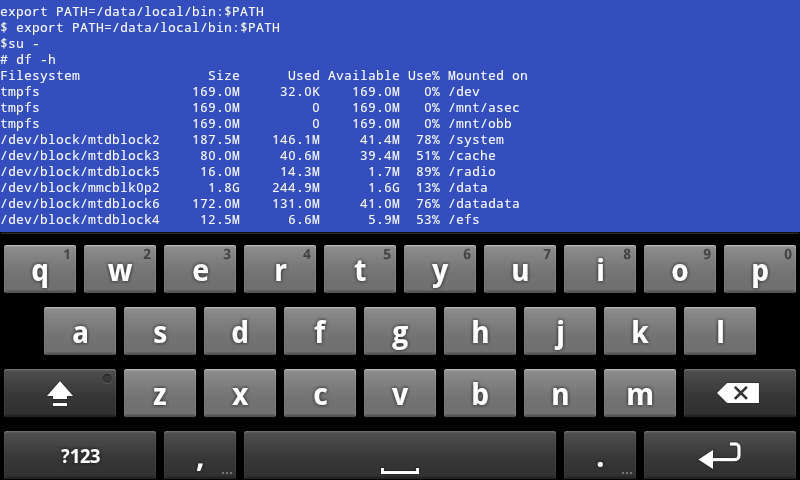
I started by explaining why having root access to your system is really important, including the issue of backing up an Android phone [2]. Cyanogenmod includes a terminal program which allows you to run su - . Running a shell as root isn t generally that useful, what you really want is to be able to run programs such as Titanium Backup which can only work properly if given root access. When you run an OS that allows root access you can run su - at a terminal prompt and you can also have an application use a GUI to request root access.
I recommend rooting and modding an Android phone immediately after buying it. However that takes some time which is somewhat equivalent to money and is a significant hidden cost to purchasing an Android phone.
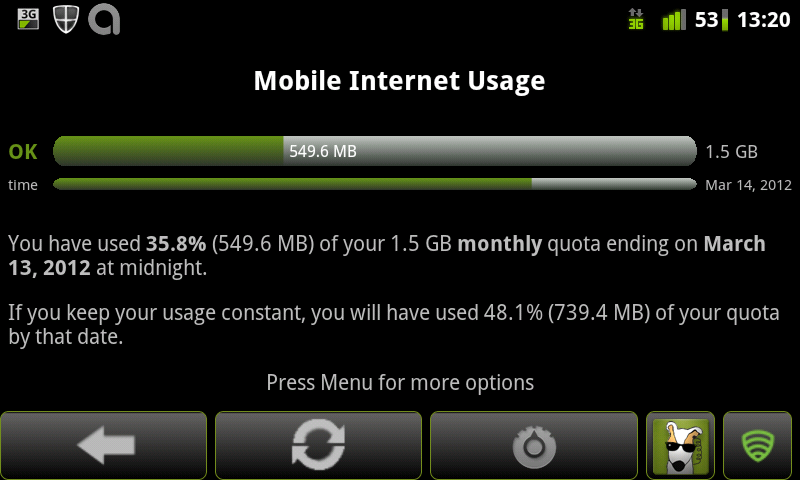
The business models of telephone companies seem to involve hidding users for unexpected fees and extra fees for excess bandwidth can be really expensive. 3G Watchdog is one app that can monitor bandwidth and disable data transfers if too much is used. Onavo is an alternative that allows tracking data use on a per-application basis, but it only runs on Android 2.3.x while 3G Watchdog works on Android 2.1.
EBay has an official app which is handy for searching for items. So far I ve only used it to get price estimates and have used a PC for buying.
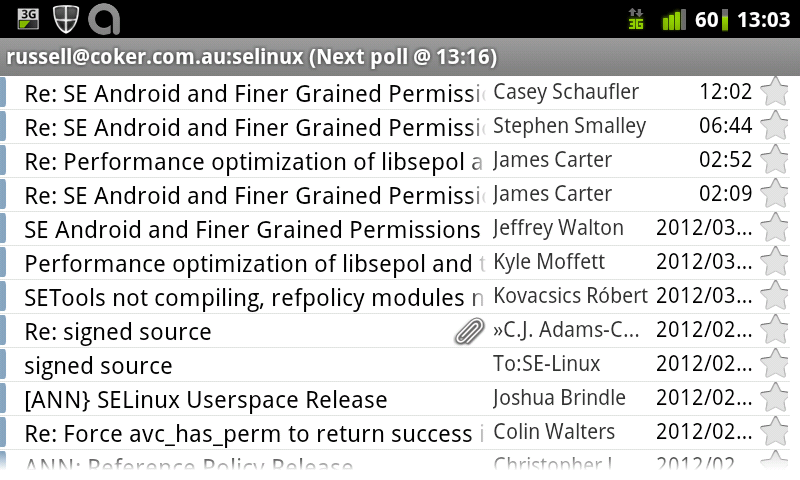
K9 seems to be the best MUA for Android. The MUA that ships with Android 2.1 isn t nearly as good and K9 is good enough that I didn t even bother testing the MUA from Cyanogenmod. The above picture shows a list of mail in my SE Linux folder.
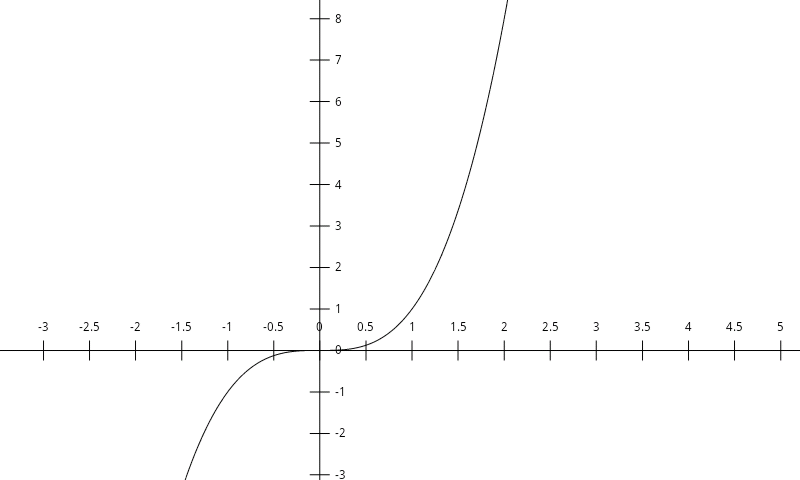
The Opticron Grapher is a good graphing calculator. I won t claim it s the best because I didn t seriously test such programs, but for the basic tests I ve done it has worked well.
The Google Maps client comes with every Android system, the above shows the location of the LUV meeting.
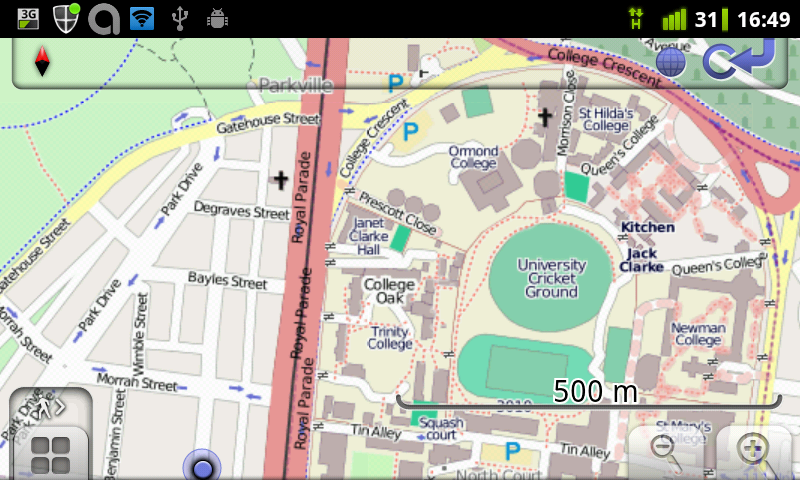
Osmand is an Android client for the Open Street Map project. Here is the web site for the Open Street Map project [3]. One significant advantage of OSM over the Google Maps is that OSM is free, the data is all contributed by users like Wikipedia. Another significant advantage is that you can download as much data as you need to your phone, for example the entire dataset for Australia is about 200M. Storing 200M of data on your phone is no big deal when you consider the availability of phones with more than 16G of storage and the ability to use a map when offline is a real benefit.
So far I ve used Osmand while waiting for a train at an underground station and I plan to use it to track my progress the next time I m on a cruise.
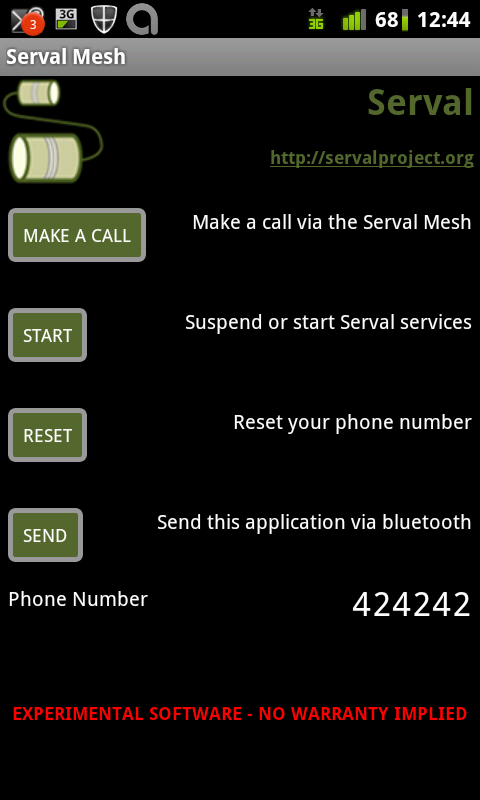
Serval is a mesh networking application for Android that supports VOIP phone calls and distributing messages and files. It s designed to be used in disaster areas, but there are lots of other potential uses of the technology. The Serval Project blog has an article about the presentation they gave at LCA 2012 [4].

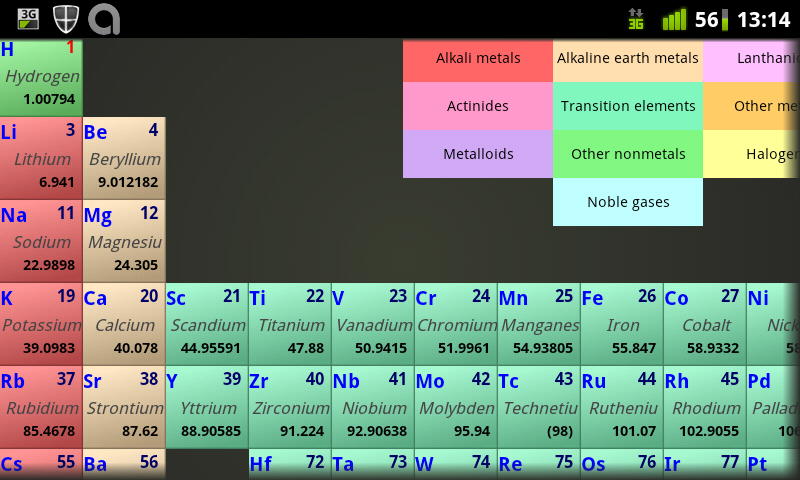
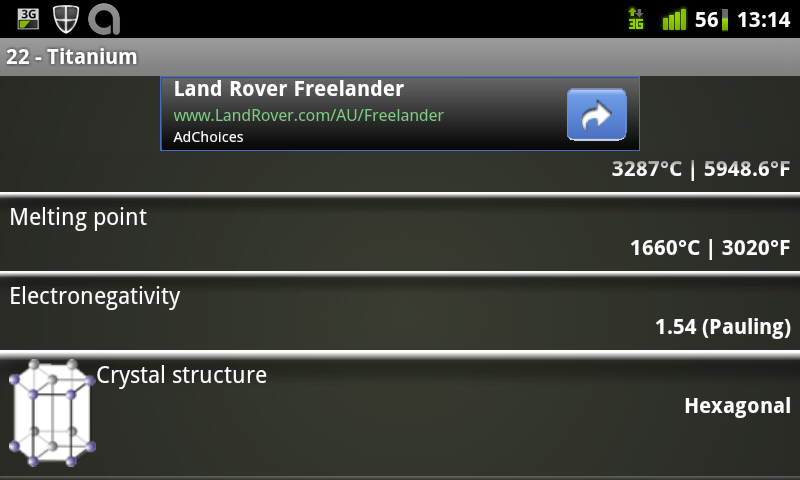
Periodic Droid is my favorite Periodic Table viewing program.
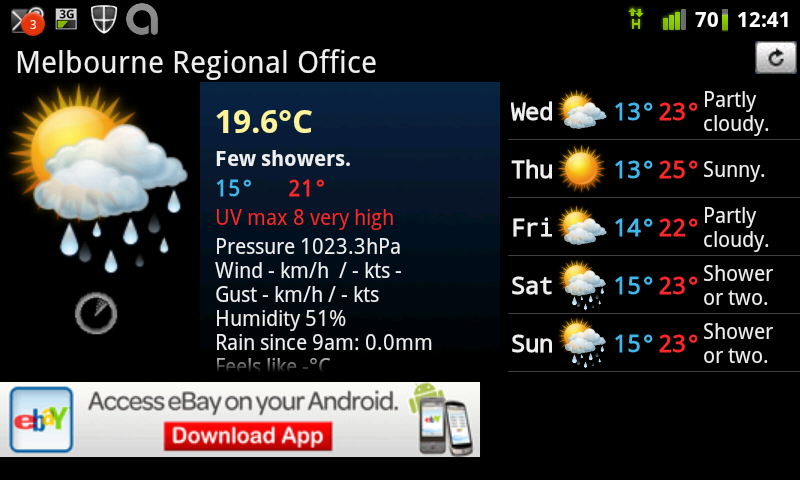
The Tomfusion AU Weather forecast app seemed to be better than the one from the BoM last time I checked. It s probably the best weather app for Australia.

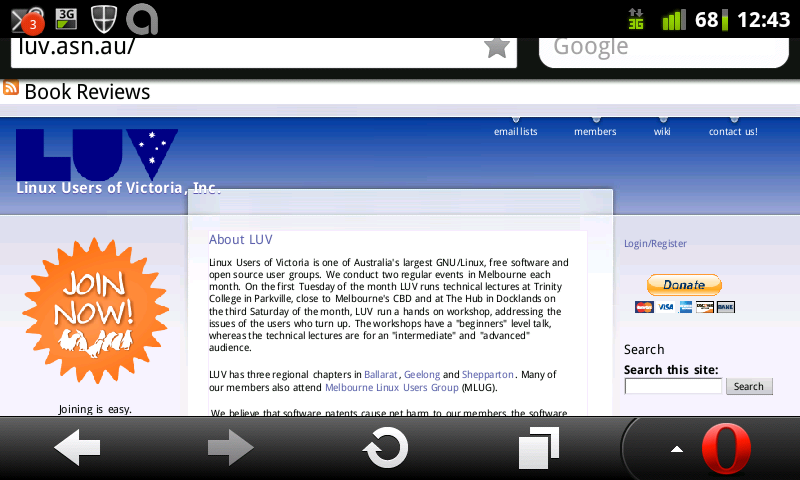
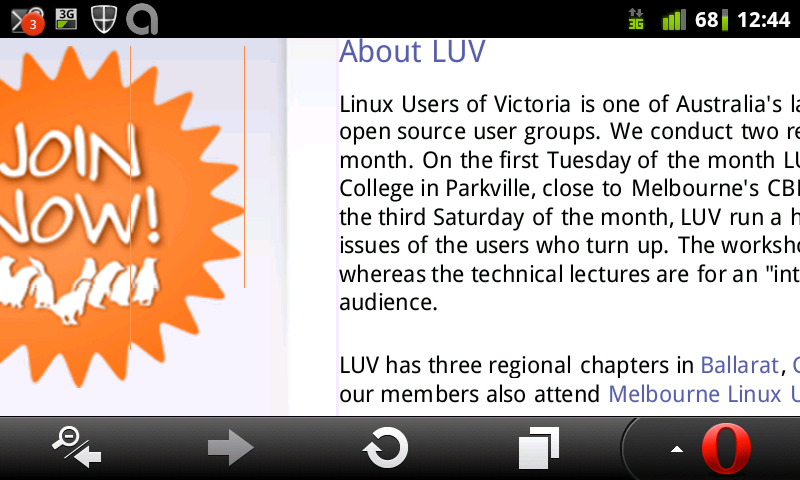
The Opera Mini browser is often faster than other browsers because it uses a compressing proxy run by Opera. It s not so good for privacy though
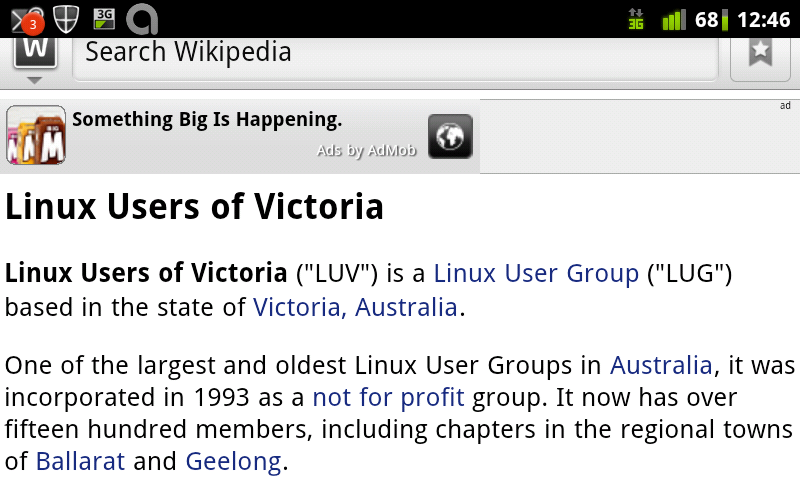
I have been using Wapedia for browsing Wikipedia. Since giving the talk I discovered the Official Wikipedia browser from the Wikimedia foundation [5] which is a better fit for my needs and I ve uninstalled Wapedia.
As an aside modern phones have 16G of storage or more and could easily have a copy of the entire English text of Wikipedia on internal storage. It would be good if someone like Jason King (who is known for work on stand-alone DVD images for Wikipedia) was to write an Android program to do this.
Handy Apps

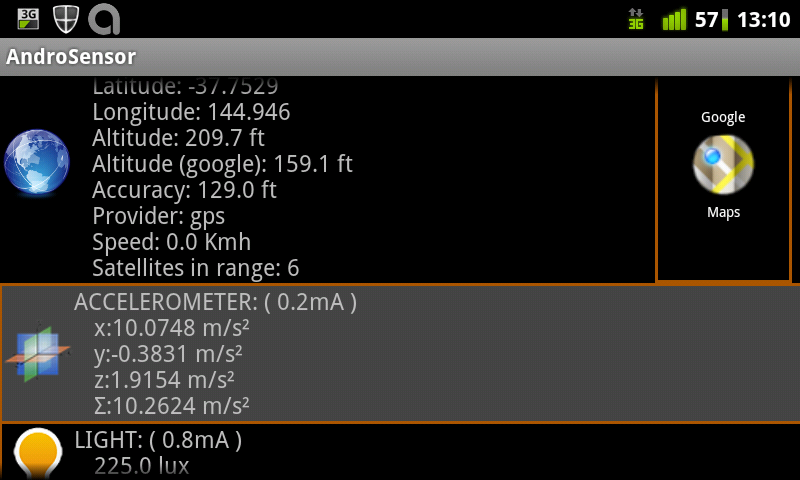
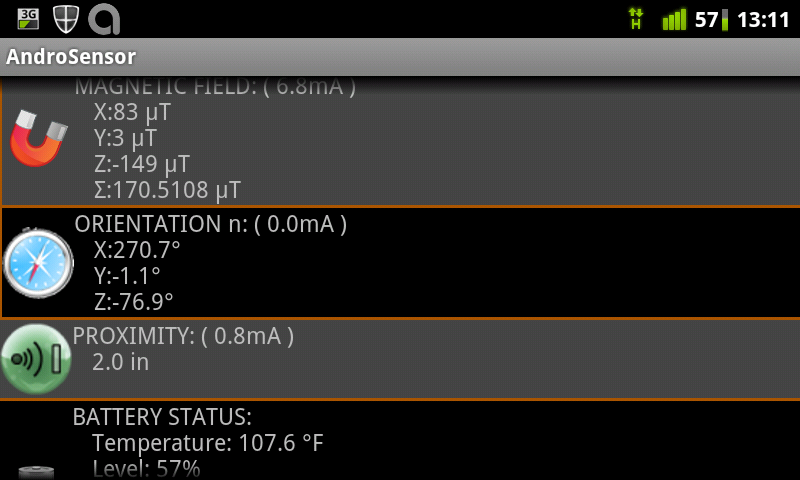
Androsensor is a program to display output from most (all?) of the sensors on your phone. The results aren t as accurate as one would hope, for example Earth s gravity is 9.81m/s^2 not the 10.26m/s^2 my phone registered. But they are a useful indication.


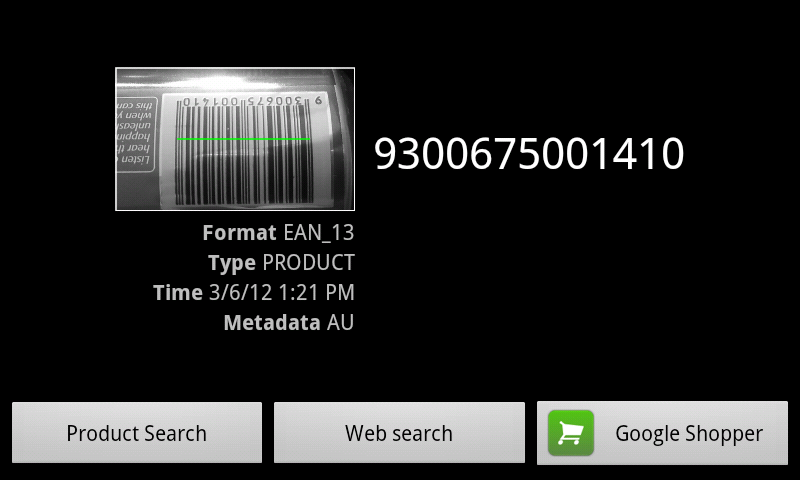
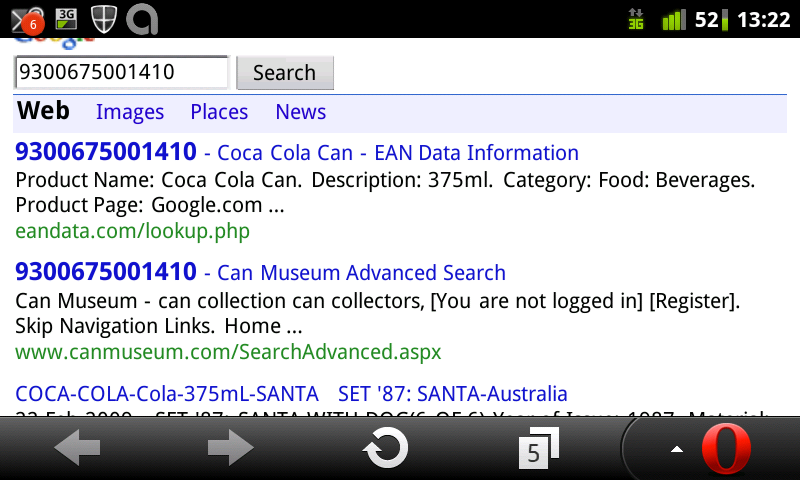
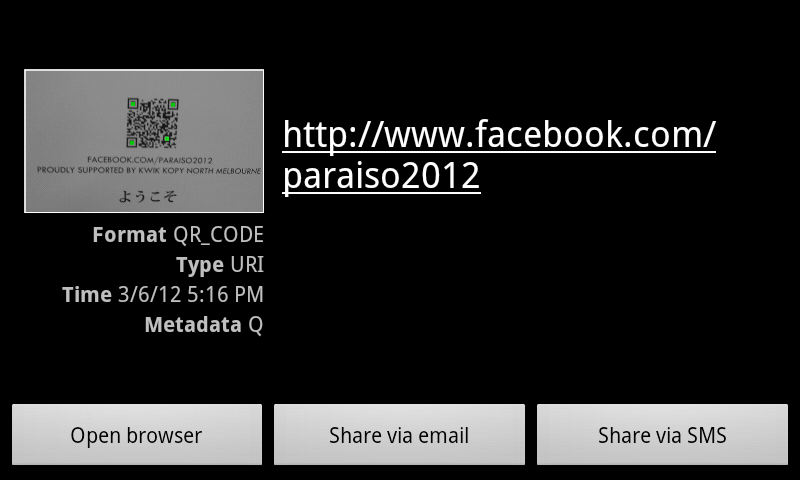
The Zxing Barcode scanner is one of many programs that will scan barcodes with the camera in an Android phone. It can launch a Google search on a product code or open a URL from a
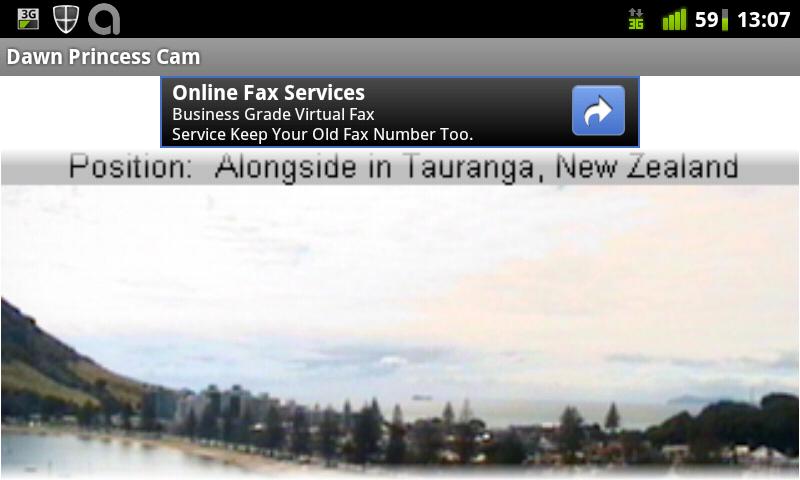
Cruise Cams allows you to download pictures from cruise ships. Some cruise ships have several cameras on different parts of the ship uploading pictures regularly so that people around the world can see what s happening.
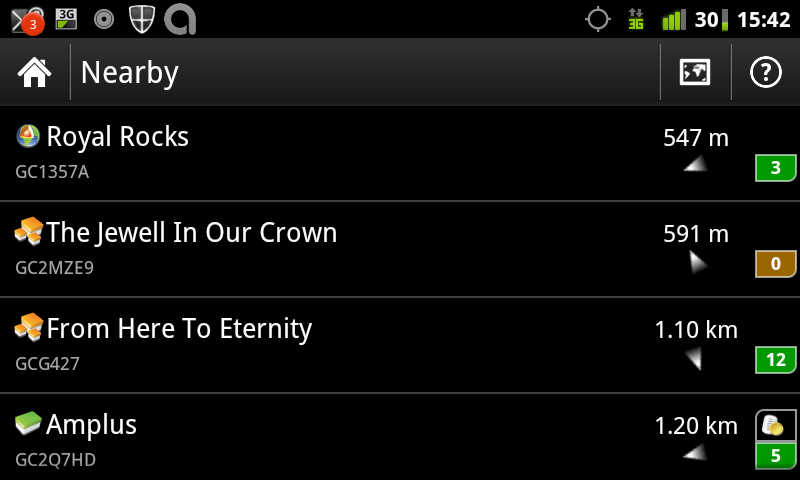
The c:geo opensource program allows you to get information on Geocaches and see a compass or map showing the location. This program has been getting an increasing number of features to do everything you might want to do related to Geocaching. The above picture shows some caches that are close to where I made the screen-shot, in a park a couple of Km from the meeting location.
The Google Sky map uses augmented reality techniques to display stars in the direction that your phone is pointing along with their names and the names of the constellations.


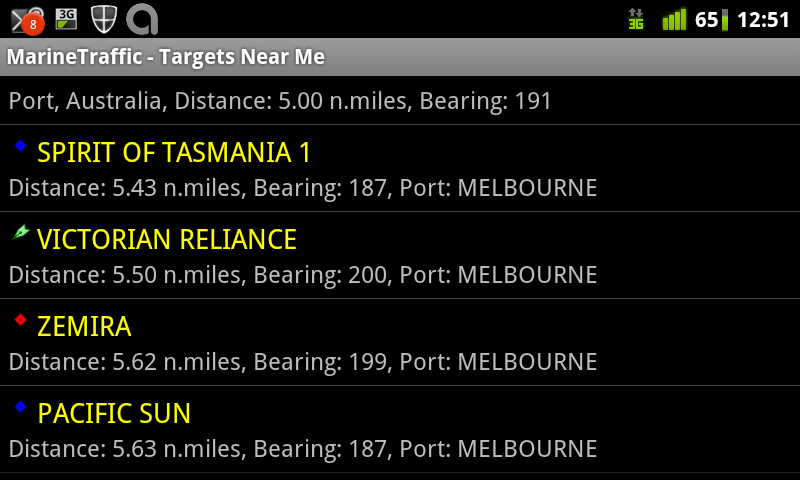
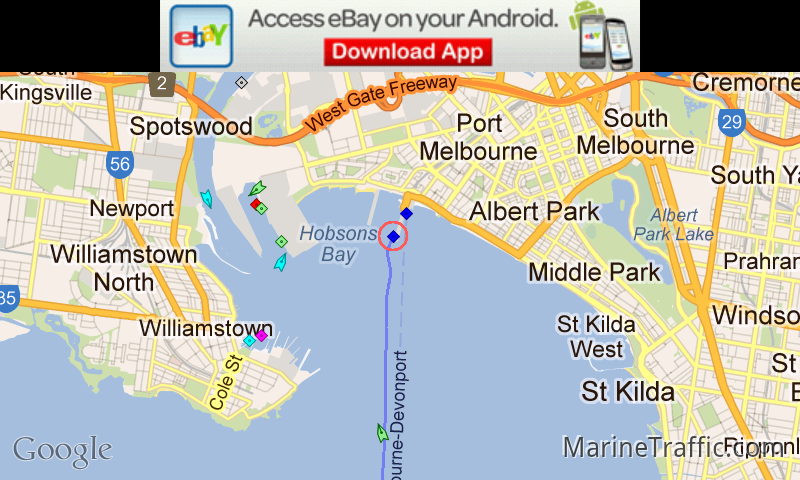
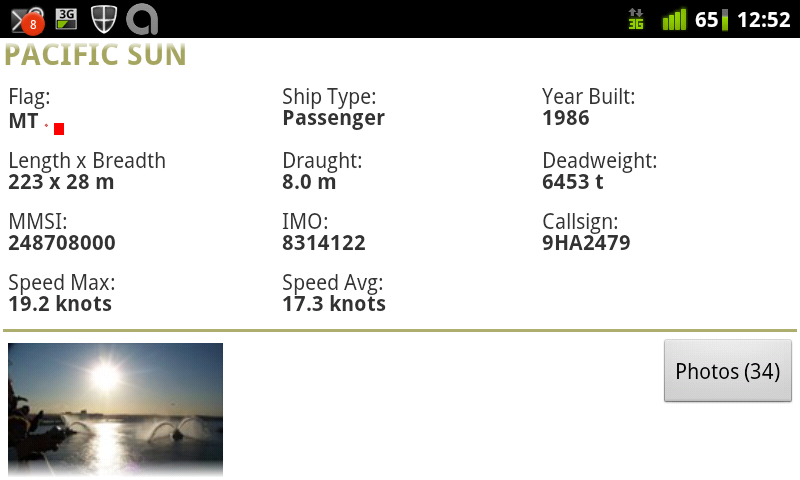
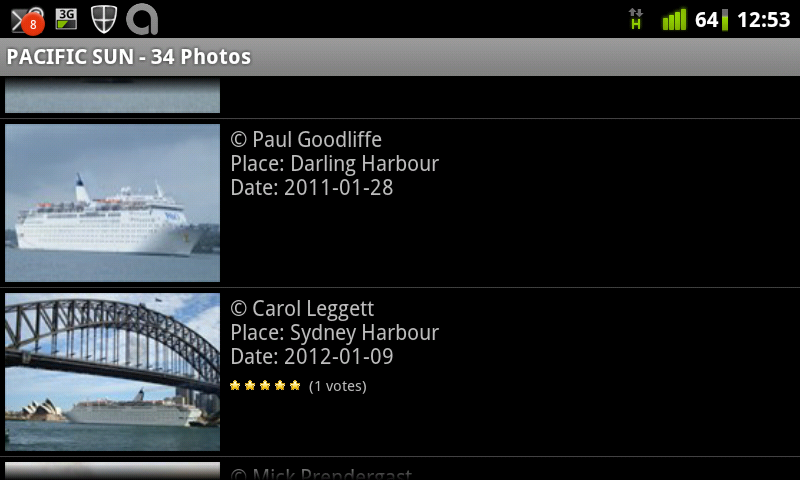
The Marine Traffic program shows the locations of ships as well as lots of information about them. The above pictures show me discovering that the Pacific Sun was nearby, viewing it s location on Google Maps, seeing the details, and then viewing fan pictures.
The developer s web site allows viewing all the same data without an Android phone [6]. Anyone can join the project by buying an Automatic Identification System (AIS) receiver and configuring a PC to take data from AIS and send it to the MarineTraffic.com servers. As an aside they seem to be missing coverage in western Victoria, so it would be good if someone near Apollo Bay or Warrnambool could install an AIS receiver and help out.
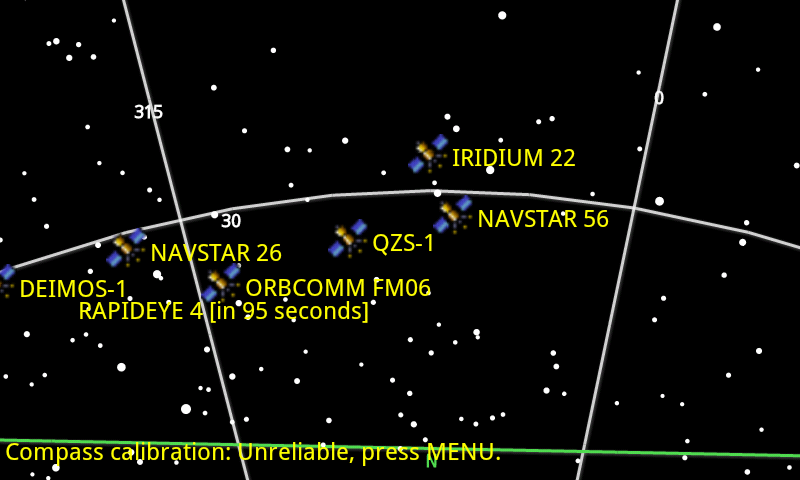
Satellite AR uses augmented reality to show the location of satellites and other things in spare. Unfortunately the screen capture process turned off the camera as I had a sign advertising fast food positioned in an amusing location in the background.

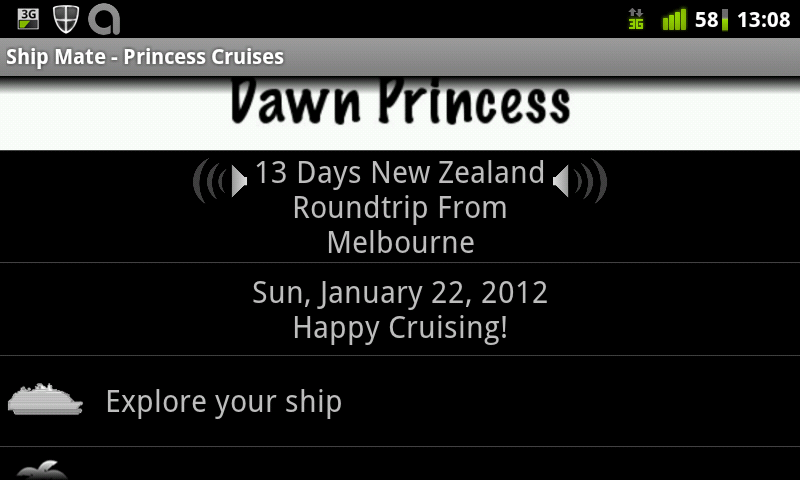
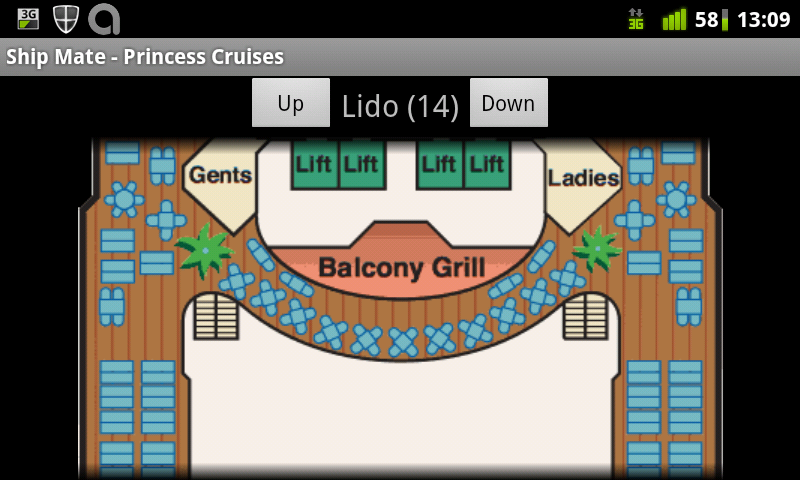
Shipmate publishes a set of programs giving information on cruise ships, they have one program for each cruise line. Above is the program for the Princess cruise line, the above pictures give information on the Dawn Princess. Unfortunately the program wasn t usable without net access when I tried to use it on a cruise ship.
Games
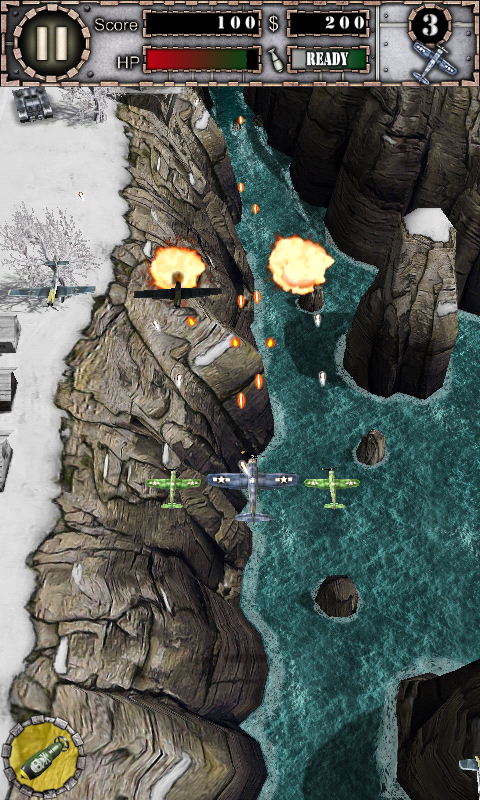
Air Attack HD is an entertaining game that demonstrates the capability of Android phones to run action games. Like many Android games it has a free version and paid versions if you want more.
Angry Birds is one of the most well known games for touch-screen devices. It has also spawned a huge line of merchandise.

Labyrinth Lite is one of the many Android games based on the old mechanical game where you tilt a toy to roll a ball-bearing through a maze. It s free and is better than most of the free games in that genre.
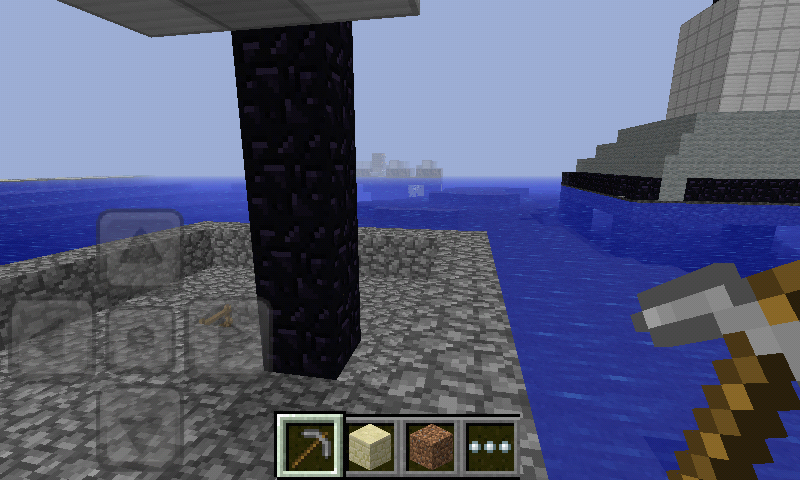
Minecraft Pocket Edition allows you to play Minecraft on your phone. The demo version doesn t allow saving the game, you have to buy the game for about $5 if you want to do that. It also lacked the full features of the game last time I checked, it didn t have monsters.

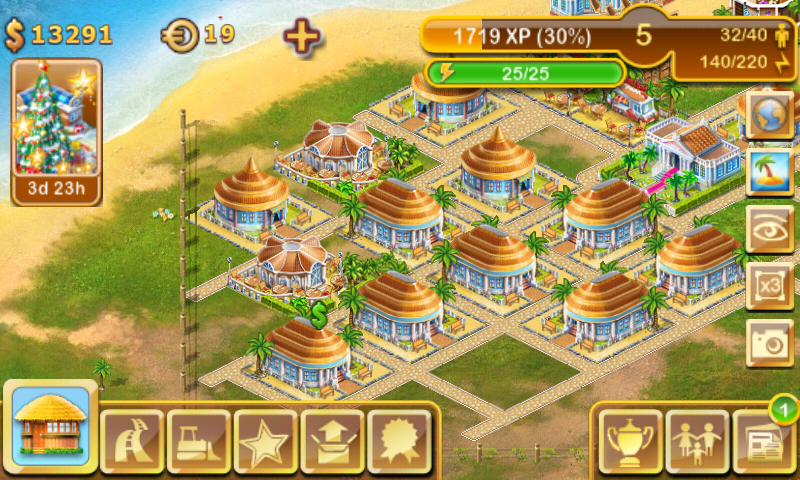
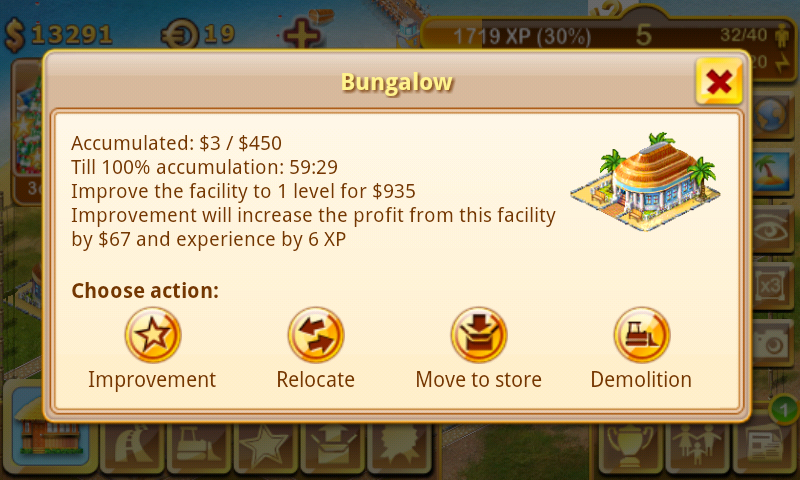
Paradise Island is one of many business simulation games for Android. It s more playable than most and has very detailed graphics, but the down-side is that it s a memory hog and will crash if you don t have enough RAM. It s one of the games that are free to download but encourage you to pay money to level up, for some players it s probably a very expensive game.
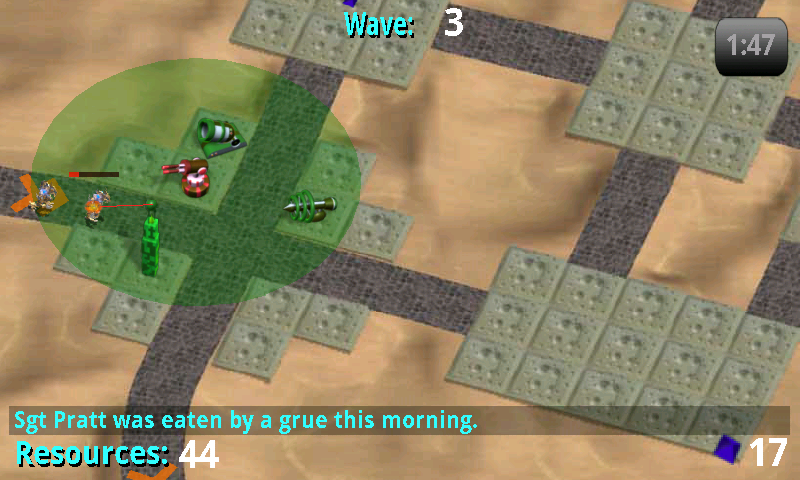
Tower Raiders 2 is one of the better tower defense games for Android.
This weekend, I launched an extremely ambitious effort to collect
evidence of extremely ambitious efforts. The result was a short
program that searched the web and revealed the:

As announced 3 weeks ago, the Debian project was present at Chemnitzer Linuxtage. Several talks and workshops where held by people related to the Debian project. At the booth we had talks and discussions with exhibitors and visitors, unfortunately I didn t had much time to visit more than small parts of two lectures.
Unfortunately (for the visitors) we didn t had any merchandising on board, while we received several requests. On Sunday Axel surprised us with some leftovers from fosdem of debian.ch merch.
At the booth we had a demo machine running Babelbox and xpenguins, which attracted visitors very well.
We received also more than one Just thank you by satisfied users. :)
Four different talks and one workshop were held by Debian people, but they were not specific to the Debian. The workshop was about OpenStreetMap, lectures was about commandline helpers, grep everything, quality analyzing and team management in opensource projects and Conkeror and other keyboard based webbrowsers.
Many thanks to Jan Dittberner, Andreas Tille, Christian Hoffmann, Florian Baumann, Christoph Egger, Axel Beckert, Adam Schmalhofer, Markus Schnalke, Sebastian Harl and Patrick Matth i for running the booth, answering a wide range of questions or just chatting with visitors . A special thank to TMT GmbH & Co. KG for providing the complete equipment and sponsoring it s transportation.
At the end we have to send a big thank to the organizing team of the Chemnitzer Linuxtage. It was fun and a pleasure to find new friends and meet old ones of the Free Software community.
A small sidenote was anybody aware that OpenSuSE Package search is using screenshots.debian.net?
Next.