Search Results: "nic"

10 November 2016

Matthew Garrett: Tor, TPMs and service integrity attestation

One of the most powerful (and most scary) features of TPM-based measured boot is the ability for remote systems to request that clients attest to their boot state, allowing the remote system to determine whether the client has booted in the correct state. This involves each component in the boot process writing a hash of the next component into the TPM and logging it. When attestation is requested, the remote site gives the client a nonce and asks for an attestation, the client OS passes the nonce to the TPM and asks it to provide a signed copy of the hashes and the nonce and sends them (and the log) to the remote site. The remoteW site then replays the log to ensure it matches the signed hash values, and can examine the log to determine whether the system is trustworthy (whatever trustworthy means in this context).

When this was first proposed people were (justifiably!) scared that remote services would start refusing to work for users who weren't running (for instance) an approved version of Windows with a verifiable DRM stack. Various practical matters made this impossible. The first was that, until fairly recently, there was no way to demonstrate that the key used to sign the hashes actually came from a TPM[1], so anyone could simply generate a set of valid hashes, sign them with a random key and provide that. The second is that even if you have a signature from a TPM, you have no way of proving that it's from the TPM that the client booted with (you can MITM the request and either pass it to a client that did boot the appropriate OS or to an external TPM that you've plugged into your system after boot and then programmed appropriately). The third is that, well, systems and configurations vary so much that outside very controlled circumstances it's impossible to know what a "legitimate" set of hashes even is.

As a result, so far remote attestation has tended to be restricted to internal deployments. Some enterprises use it as part of their VPN login process, and we've been working on it at CoreOS to enable Kubernetes clusters to verify that workers are in a trustworthy state before running jobs on them. While useful, this isn't terribly exciting for most people. Can we do better?

Remote attestation has generally been thought of in terms of remote systems requiring that clients attest. But there's nothing that requires things to be done in that direction. There's nothing stopping clients from being able to request that a server attest to its state, allowing clients to make informed decisions about whether they should provide confidential data. But the problems that apply to clients apply equally well to servers. Let's work through them in reverse order.We have no idea what expected "good" values areYes, and this is a problem. CoreOS ships with an expected set of good values, and we had general agreement at the Linux Plumbers Conference that other distributions would start looking at what it would take to do the same. But how do we know that those values are themselves trustworthy? In an ideal world this would involve reproducible builds, allowing anybody to grab the source code for the OS, build it locally and verify that they have the same hashes.

Ok. So we're able to verify that the booted OS was good. But how about the services? The rkt container runtime supports measuring each container into the TPM, which means we can verify which container images were started. If container images are also built in such a way that they're reproducible, users can grab the source code, rebuild the container locally and again verify that it has the same hashes. Users can then be sure that the remote site is running the code they're looking at.

Or can they? Not really - a general purpose OS has all kinds of ways to inject code into containers, so an admin could simply replace the binaries inside the container after it's been measured, or ptrace() the server, or modify rkt so it generates correct measurements regardless of the image or, well, there's lots they could do. So a general purpose OS is probably a bad idea here. Instead, let's imagine an immutable OS that does nothing other than bring up networking and then reads a config file that tells it which container images to download and run. This reduces the amount of code that needs to support reproducible builds, making it easier for a client to verify that the source corresponds to the code the remote system is actually running.

Is this sufficient? Eh sadly no. Even if we know the valid values for the entire OS and every container, we don't know the legitimate values for the system firmware. Any modified firmware could tamper with the rest of the trust chain, making it possible for you to get valid OS values even if the OS has been subverted. This isn't a solved problem yet, and really requires hardware vendor support. Let's handwave this for now, or assert that we'll have some sidechannel for distributing valid firmware values.Avoiding TPM MITMingThis one's more interesting. If I ask the server to attest to its state, it can simply pass that through to a TPM running on another system that's running a trusted stack and happily serve me content from a compromised stack. Suboptimal. We need some way to tie the TPM identity and the service identity to each other.

Thankfully, we have one. Tor supports running services in the .onion TLD. The key used to identify the service to the Tor network is also used to create the "hostname" of the system. I wrote a pretty hacky implementation that generates that key on the TPM, tying the service identity to the TPM. You can ask the TPM to prove that it generated a key, and that allows you to tie both the key used to run the Tor service and the key used to sign the attestation hashes to the same TPM. You now know that the attestation values came from the same system that's running the service, and that means you know the TPM hasn't been MITMed.How do you know it's a TPM at all?This is much easier. See [1].


There's still various problems around this, including the fact that we don't have this immutable minimal container OS, that we don't have the infrastructure to ensure that container builds are reproducible, that we don't have any known good firmware values and that we don't have a mechanism for allowing a user to perform any of this validation. But these are all solvable, and it seems like an interesting project.

"Interesting" isn't necessarily the right metric, though. "Useful" is. And I think this is very useful. If I'm about to upload documents to a SecureDrop instance, it seems pretty important that I be able to verify that it is a SecureDrop instance rather than something pretending to be one. This gives us a mechanism.

The next few years seem likely to raise interest in ensuring that people have secure mechanisms to communicate. I'm not emotionally invested in this one, but if people have better ideas about how to solve this problem then this seems like a good time to talk about them.

[1] More modern TPMs have a certificate that chains from the TPM's root key back to the TPM manufacturer, so as long as you trust the TPM manufacturer to have kept control of that you can prove that the signature came from a real TPM


comment count unavailable comments

9 November 2016

Russ Allbery: Some thoughts on the US elections

I apparently am not going to get anything done today until I write this. Some thoughts, in no particular order. I don't have any profound conclusions. I'm honestly pretty upset. And pretty scared. But we have to talk to each other. And we have to listen to each other. And we have to persaude each other. And we have to be willing to be persuaded. And please go tell someone this morning that you have their back.

Enrico Zini: On SPF

I woke up this morning with some Django server error mails in my inbox:
UnicodeDecodeError: 'ascii' codec can't decode byte 0xc5 in position 9: ordinal not in range(128)
 
 'REMOTE_USER': u' -guest@users.alioth.debian.org',
I did what one does in cases like these, I tried to fix the bug and mailed -guest@users.alioth.debian.org asking them to try again and let me know if it works. I get a bounce:
  <Actual user's email>
    (generated from  -guest@users.alioth.debian.org)
    SMTP error from remote mail server after MAIL FROM:<enrico@enricozini.org> SIZE=3948:
    host   [ ]: 550 Please see http://www.openspf.org/Why?id=enrico%40enricozini.org&ip=2001%3a41c8%3a1000%3a21%3a%3a21%3a21&receiver=bq :
    Reason: mechanism
I resent the mail to the actual user's address, and it went through. Job done, at least until they get back to me telling me that my fix didn't work. Lessons learnt:

Daniel Pocock: Understanding what lies behind Trump and Brexit

As the US elections finish, many people are scratching their heads wondering what it all means. For example, is Trump serious about the things he has been saying, or is he simply saying whatever was most likely to make a whole bunch of really stupid people crawl out from under their rocks to vote for him? Was he serious about winning at all, or was it just the ultimate reality TV experiment? Will he show up for work in 2017, or like Australia's billionaire Clive Palmer, will he set a new absence record for an elected official? Ironically, Palmer and Trump have both been dogged by questions over their business dealings, will Palmer's descent towards bankruptcy be replicated in the ongoing fraud trial against Trump University and similar scandals? While the answer to those questions may not be clear for some time, some interesting observations can be made at this point. The world has been going racist. In the UK, for example, authorities have started putting up anti-Muslim posters with an eery resemblance to Hitler's anti-Jew propaganda. It makes you wonder if the Brexit result was really the "will of the people", or were the people deliberately whipped up into a state of irrational fear by a bunch of thugs seeking political power? Who thought The Man in the High Castle was fiction? In January 2015, a pilot of The Man in the High Castle, telling the story of a dystopian alternative history where Hitler has conquered America, was the most-watched original series on Amazon Prime. It appears Trump supporters have already been operating US checkpoints abroad for some time, achieving widespread notoriety when they blocked a family of British Muslims from visiting Disneyland in 2015. Ambushing them at the last moment as they were about to board their flight, it is unthinkable how anybody could be so cruel. When you reflect on statements made by Trump and the so-called "security" practices around the world, this would appear to be only a taste of things to come though. Is it a coincidence that Brexit and Trump both happened in the same year that the copyright on Mein Kampf expired? Ironically, in the chapter on immigration Hitler specifically singles out the U.S.A. for his praise, is that the sort of rave review that Trump aspires to when he talks about making America great again? US voters have traditionally held concerns about the power of the establishment. The US Federal Reserve has been in the news almost every week since the financial crisis, but did you know that the very concept of central banking was thrown out the window four times in America's history? Is Trump the type of hardliner who will go down this path again, or will it be business as usual? In his book Rich Dad's Guide to Investing in Gold & Silver, Robert Kiyosaki and Michael Maloney encourage people to consider putting most of their wealth into gold and silver bullion. Whether you like the politics of Trump and Brexit or not, are we entering an era where it will be prudent for people to keep at least ten percent of net wealth in this asset class again? Online dealers like BullionVault in Europe already appear to be struggling under the pressure as people rush to claim the free grams of bullion credited to newly opened accounts. The Facebook effect In recent times, there has been significant attention on the question of how Facebook and Google can influence elections, some European authorities have even issued alerts comparing this threat to terrorism. Yet in the US election, it was simple email that stole the limelight (or conveniently diverted attention from other threats), first with Clinton's private email server and later with Wikileaks exposing the entire email history of Clinton's chief of staff. The Podesta emails, while being boring for outsiders, are potentially far more damaging as they undermine the morale of Clinton's grass roots supporters. These people are essential for knocking on doors and distributing leaflets in the final phase of an election campaign, but after reading about Clinton's close relationship with big business, many of them may well have chosen to stay home. Will future political candidates seek to improve their technical competance, or will they simply be replaced by candidates who are born hackers and fluent in the language of a digital world?

8 November 2016

Jonathan Carter: A few impressions of DebConf 16 in Cape Town

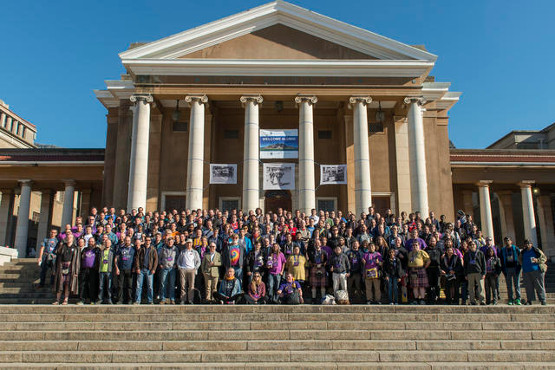
DebConf16 Group Photo

DebConf16 Group Photo by Jurie Senekal.

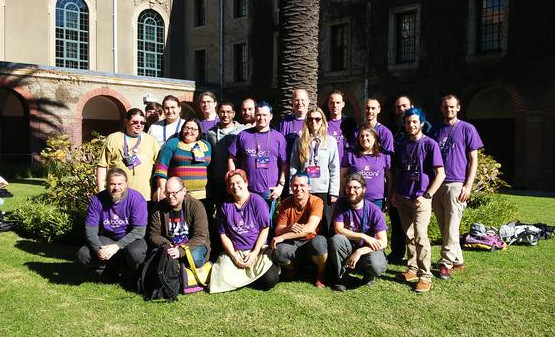
DebConf16 Firstly, thanks to everyone who came out and added their own uniqueness and expertise to the pool. The feedback received so far has been very positive and I feel that the few problems we did experience was dealt with very efficiently. Having a DebConf in your hometown is a great experience, consider a bid for hosting a DebConf in your city! DebConf16 Open Festival (5 August) The Open Festival (usually Debian Open Day) turned out pretty good. It was a collection of talks, a job fair, and some demos of what can be done with Debian. I particularly liked Hetzner s stand. I got to show off some 20 year old+ Super Mario skills and they had some fun brain teasers as well. It s really great to see a job stand that s so interactive and I think many companies can learn from them. The demo that probably drew the most attention was from my friend Georg who demoed some LulzBot Mini 3D Printers. They really seem to love Debian which is great! DebConf (6 August to 12 August) If I try to write up all my thoughts and feeling about DC16, I ll never get this post finished. Instead, here as some tweets from DebConf that other have written:


Day Trip We had 3 day trips: Brought to you by
orga

DebConf16 Orga Team.

See you in Montr al! DebConf17 dates: The DC17 sponsorship brochure contains a good deal of information, please share it with anyone who might be interested in sponsoring DebConf! Media

7 November 2016

Jaldhar Vyas: New Laptop / Problems with Windows part 896,324

I had mentioned previously that I had been forced to purchase a new laptop. I decided that I didn't want another Thinkpad. The Lenovo ones no longer have the high quality they had in the IBM days and while support is still pretty good by todays dismal standards it's not worth the premium price. (If I'm buying it with my own money that is.) I had heard good thing about Dells' Linux support so I looked into their offerings and ended up buying a Precision 7510. Mind you this model came with Windows 7 installed but I didn't mind. As I wanted to install Debian according to my own specs anyway, I was ok with just knowing that the hardware would be compatible. So I prepared a Jessie USB installation stick (This model doesn't have a CD/DVD drive.) and shrunk down the Windows installation (but not deleted it altogether for reasons to be explained below.) At this point it is traditional to give a long, tortured account of how Heaven and Earth had to be moved to get Linux installed. But that is a thing of the past. The combination of good hardware and the excellent work of the debian-installer team, made the setup a breeze with only a couple of minor bumps in the road. One is that the kernel on the Jessie cd was not quite up to snuff. Downloading 4.6.0 from backports did the trick. Post-install, to get the most out of my nifty new 4K display, I needed the latest, alas non-free, nvidia-drivers. And for stable wifi (I always install over ethernet for this reason) I had to install the firmware-iwlwifi package. Everything else even my printer either "just worked" or needed only minor fiddling around. Having used this machine for a while, the biggest problem I have is with the keyboard. It is nowhere near as tactile and comfortable to use as the old IBM Thinkpads. Even Lenovo Thinkpad keyboards are better. I'm a hunt-and-peck type myself but it is annoying. I think a real touch typist would hate it. The cursor and home, end, page up, page down etc. keys are in the wrong place and home and end are actually function keys. There is a pointer and a trackpad and two sets of mouse buttons which seems like a waste of space. In fact much space is wasted everywhere, space which could be used to improve the keyboard. Other than that I like it. The battery life is not the best but fairly good. It's a bit heavier than I was used to but I've gotten used to it. Although I didn't go with the SSD option, it is not that noisy; again you can get used to it. All in all, I think it is worth it for the price.
I installed Debian but I only really use it as a base to run VMWare Workstation. I occasionally have to support software across multiple platforms but I don't want the hassle or expense of multiple computers so I have Windows (the original installation upgraded to Windows 10) and Mac OS X running in VMs. Plus I have another VM running Kubuntu LTS for my day to day computing, another Debian install running sid for packaging, and Minix. Backups are as simple as making a snapshot of the VM. If something accidently gets screwed up, I can easily revert it back to a known good state. Ideally, I would like to replace VMWare with a free solution such as qemu or virtualbox etc. but as far as I know VMWare is far ahead in emulation capabilities (OpenGL support for example.) which is vital for efficiently using the proprietary OS's. Things were going swimmingly until a few days ago which brings me to part two of this post. I booted into the Windows 10 VM only to be greeted by a message from the Windows boot manager that "A component of the operating system has expired." I tried going back to a snapshot from September (when this definitely was working) but I still got the same thing. A bit of googling revealed this has happened to others and the advice seemed to be to reset the computers date and reinstall Windows 10. It took several tries but I finally got that done, completed the task I needed to do and shut it down. At the end of the day I shut the whole laptop down and thought no more of it. The next day I boot up and...where is grub? It seems that during the Windows reinstall, it had overwritten grub with the Windows boot loader. And while grub is nice enough to add an entry for Windows when detected, Windows does not extend the same courtesy to Linux. Ok time to bring out my trusty USB stick again and reinstall grub. Oops I've wiped it off to store other things. No matter, download another image and do it again. Reboot and...back in Windows. Fiddle around in the EFI settings until I can get it to boot from USB. Now i'm in the shell provided by debian-installer so I can mount and chroot my Linux partition and reinstall grub. Except no I can't because it is Luks encrypted. Ok apt-get install cryptsetup, open it with my passphrase and now I can mount the partion, chroot into and reinstall grub. Except no I can't because it is a logical volume group. Back to apt-get, install lvm2, vgscan (because of course I've forgotten the name of the group,) vgchange and now I can mount, chroot, etc. etc. Except no I can't.

# mount /dev/mapper/vg00-root /mnt
# chroot /mnt
# grub-install /dev/sda
error: cannot find a device for /boot/grub (is /dev mounted?).
sigh

# mount /dev/sda5 /boot
special device /dev/sda5 does not exist.
Well, /dev is mounted but it does indeed not contain a device called sda5.

# /etc/init.d/udev start
udev requires a mounted procfs.  not started.
Very well then.

# mount -t proc none /proc
# /etc/init.d/udev start
Nope. proc needs sysfs.

# mount -t sysfs none /sys
# /etc/init.d/udev start
Still no. You get a warning about how it is a bad idea to run udev from an interactive shell and there is still not /dev/sda5. Time to start googling again. It turns out what I should have done is open another shell from the installer environment and do...

# mount --bind /dev/ /mnt/dev
Now I can mount /boot/grub and reinstall grub and it should all work right? I should be so lucky. Ok back to square one. I now did what I should have done in the first place and searched the Debian wiki. Sure enough there is a page which deals exactly with my predicament. Finally I get everything installed correctly and triumphantly reboot into Linux. Of course now Windows doesn't work again...

Reproducible builds folks: Reproducible Builds: week 80 in Stretch cycle

What happened in the Reproducible Builds effort between Sunday October 30 and Saturday November 5 2016: Upcoming events Reproducible work in other projects Bugs filed Reviews of unreproducible packages 81 package reviews have been added, 14 have been updated and 43 have been removed in this week, adding to our knowledge about identified issues. 3 issue types have been updated: 1 issue type has been removed: 1 issue type has been updated: Weekly QA work During of reproducibility testing, some FTBFS bugs have been detected and reported by: diffoscope development buildinfo.debian.net development tests.reproducible-builds.org Reproducible Debian: Misc. Also with thanks to Profitbricks sponsoring the "hardware" resources, Holger created a 13 core machine with 24GB RAM and 100GB SSD based storage so that Ximin can do further tests and development on GCC and other software on a fast machine. This week's edition was written by Chris Lamb, Ximin Luo, Vagrant Cascadian, Holger Levsen and reviewed by a bunch of Reproducible Builds folks on IRC.

Petter Reinholdtsen: How to talk with your loved ones in private

A few days ago I ran a very biased and informal survey to get an idea about what options are being used to communicate with end to end encryption with friends and family. I explicitly asked people not to list options only used in a work setting. The background is the uneasy feeling I get when using Signal, a feeling shared by others as a blog post from Sander Venima about why he do not recommend Signal anymore (with feedback from the Signal author available from ycombinator). I wanted an overview of the options being used, and hope to include those options in a less biased survey later on. So far I have not taken the time to look into the individual proposed systems. They range from text sharing web pages, via file sharing and email to instant messaging, VOIP and video conferencing. For those considering which system to use, it is also useful to have a look at the EFF Secure messaging scorecard which is slightly out of date but still provide valuable information. So, on to the list. There were some used by many, some used by a few, some rarely used ones and a few mentioned but without anyone claiming to use them. Notice the grouping is in reality quite random given the biased self selected set of participants. First the ones used by many: Then the ones used by a few. Then the ones used by even fewer people And finally the ones mentioned by not marked as used by anyone. This might be a mistake, perhaps the person adding the entry forgot to flag it as used? Given the network effect it seem obvious to me that we as a society have been divided and conquered by those interested in keeping encrypted and secure communication away from the masses. The finishing remarks from Aral Balkan in his talk "Free is a lie" about the usability of free software really come into effect when you want to communicate in private with your friends and family. We can not expect them to allow the usability of communication tool to block their ability to talk to their loved ones. Note for example the option IRC w/OTR. Most IRC clients do not have OTR support, so in most cases OTR would not be an option, even if you wanted to. In my personal experience, about 1 in 20 I talk to have a IRC client with OTR. For private communication to really be available, most people to talk to must have the option in their currently used client. I can not simply ask my family to install an IRC client. I need to guide them through a technical multi-step process of adding extensions to the client to get them going. This is a non-starter for most. I would like to be able to do video phone calls, audio phone calls, exchange instant messages and share files with my loved ones, without being forced to share with people I do not know. I do not want to share the content of the conversations, and I do not want to share who I communicate with or the fact that I communicate with someone. Without all these factors in place, my private life is being more or less invaded.

6 November 2016

Shirish Agarwal: The long tail in a common s man journey to debconf16 1

I was going to put a technical post but saw the discussion of one of the meetings of the debconf meets and decided to share a novice s travel experience. Before I start here s the discussion log http://meetbot.debian.net/debconf-team/2016/debconf-team.2016-10-20-20.01.log.html and specifically this part which hit me (using fake names for discussion as haven t taken permission from the folks to cite them by name.)
20:36:52 abcd: $100 CAD is a lot for some, but you d only need it if you won t sleep in sponsored accom, which arguably is acceptable.
20:37:04 it would, efgh, fixed sponsorship sum for everybody and allocation of rooms completely decoupled. Hotel gets the money from everybody and the base fee from DebConf.
20:37:15 people who can t afford also have special needs and may be uncomfortable in sharing rooms. That s quite frequently in our community. Managing each case will be much more complicated.
20:37:31 hijk: we could set aside budget for such special needs, for sure.
20:37:43 I m talking about managing each case
20:37:46 hijk: yes, but we ll have the special cases no matter what.
20:37:48 yes, and the special cases need to be catered for regardless of how everybody else is housed
20:38:06 hijk: room allocation already includes this.
20:38:19 people having to expose their personal problems to have us permitting them staying in the hotel
20:38:23 that s just too weird
It just goes on. I dunno whether I m weird or not or the experience I would share is just normal, this I would leave for you to decide. As have shared before, some friends of mine from the free software community had cajoled me last year to apply for debconf bursary (debconf15), which surprisingly got approved, but as it was late and my pre-conceived myths/notions of visas taking a looooong time decided not to go further. Many things take a long time to happen in the Indian bureaucratic maze. For instance have been in a civil case for almost a decade now among other things so know and accept that things take their own sweet time otherwise known as Indian patience  Did the application and again, surprise, surprise this time too I was approved. Luckily, had done the application for bursary early so was a bit positive on the visa-front. There was a goof-up at the embassay but thanks to people at travel.stackexchange.com where I asked quite a few questions, I was a bit informed and travel was relatively hassle-free. Internally though, I was nervous as hell. I had been feeling like a conman or a fraud or being an imposter because I knew before-hand that the project is so huge and had done the mistake of putting up a talk and a workshop where the big guns would be, which again was accepted (not good). The only thing I was thinking of as a saving grace is that there might be some newbies who don t know about the project at all (on Open Day) and hopefully I could help with that but as you will see, even there I was fully inadequate. I live in Pune which is around 3.5 hours from Mumbai (BOM) from where international flights take off. While Pune has an Airport, due to defence considerations, there cannot be much improvement either for domestic or International carriers. There have been attempts to have an exclusive civilian Airport for a long time (almost a decade) and would still take a decade or more. Hence had decided to take an early morning train from Pune to Mumbai, change couple of locals and finally land up at the Mumbai International Airport. Hind-sight as they say is 50:50, while I do have friends in Mumbai, I also found about a homestay which is closer to the Airport and still relatively budget-friendly. Anyways, met few friends but as was paranoid about missing connections found myself in front of the Airport at 20:00 hrs. with about 7 hours + to go before my flight. While there is nothing to do around the airport rather than hanging around, just hung around outside the airport as knew that inside the airport will be chilling and once you go in, you cannot come out or at least it s an inconvenience to the security therein. The International Airport in on three levels, the basement is for vehicles, the first level to receive International and Domestic passengers and the upper-most level exclusively for people flying internationally. This again, came to know when I tried to enter into the ones meant for Domestic and International Passengers coming into the city. Came to the check-in counter at around 02:00 hrs, did the security thing and just had to wait as the flight was of 0400 hrs (from my limited search experience, the cheapest flights are at such times when nobody else (i.e.civilized people) wants to fly). Entered Doha around 5:15 Doha time and saw a much much bigger airport than either the Mumbai International Airport or/and the Delhi International Airport . While I have written some negative stuff about Doha, there were two positives that I am sure, I had forgotten to share a. There were no transit Visa Fees that I had to pay. Most countries and airports I researched have something called transit visa and that can really get expensive, so saved money on that. b. The free ride into the city and back with voluntary tipping the driver or/and guide (approx. 3-4 hours) While the second from what I could tell/know is a gimmick, this is something I wish other countries and airports emulate. There are hotels in the airport and I could have had hotel accommodation if I had booked a slightly more expensive ticket, roughly INR 5k/- each way which would have given me a bit more legroom as well as stay as my layover was more than 24 hours. But this information was known at last minute. Qatar Airways has just a toll-free number and trying more than a few times gave up. They don t have an office in the city. When I reached the check-in counter they said if I had upgraded to Y class I would have had the hotel thing. Changing tickets at the last moment was too expensive and anyways for hotel accommodation for layovers they required at least 24 hours notice. Had to make do with recliners and chairs which are not really comfortable. There were only a couple of waiting rooms on air-side which had a view of the aircraft and hence were a bit more pleasing than those which were on the land-side and were fully blocked without a view. I wish there was a map of the Airport from within the Airport as even with the single terminal it is really easy to get lost. Somehow the day and night went by and took my second flight and reached Cape Town, South Africa. Throughout the journey had been stressed as had to be awake at all times and make sure that nothing gets stolen. Having attendants at toilets were also good so that there is no possibility of any violence there. So it had been 2 days, no shower and no sleep. Later also came to know about Airport Sleeping Pods and shower stalls but these also seem to be less in number, at few airports and there always be a bit of premium attached to them as airports are a monopoly business. Anyways, reached the venue. Throughout the travel there was quite a bit of unnamed fear which I later came to know after seeing Dr. Ramanujan s The Man who knew Infinity . It was/is the fear or unknown, while in the movie it is articulated as fear of crossing seven seas, symbolically it is the fear or unknown. Now while I was dead tired, I still pushed myself as I didn t want to have the effects of jet lag interfere with the normal sleeping and waking patterns. I did freshen myself but didn t allow myself the luxury of the bath-tub as I knew that if I went in, I would not come out that day. Met all the people, learnt who s who, where things are happening etc. and slowly night came. Night came and I was so-looking forward to sleep but sleep was not to be. I later learnt it could be either of the two reasons, it could either have been travel-induced insomnia or/and what is known as the first night effect . It was only on the second day when I was in bath-tub for about 2/3 hours I could feel the tension leaving my body. I finally realized that I am in Cape Town, South Africa and could enjoy and be surprised at seeing birds within few feet of me . Now I don t know whether I m the only weird/paranoid one, I do know that it would not have been easier for me at least for the first night as I was turning and twisting throughout the night. I opened the lights, read for some time hoping for sleep to take over but that didn t work. Tried quite a few things but sleep didn t come. If I had been sleeping with other people I dunno how they would have reacted. I myself am a light sleeper (most of the time) and if I had sleep coming and somebody else acted or been the way I was, I wouldn t been able to sleep. However much you try, whatever is the natural reaction is, will be. There are still some bits to share but that would be in part 2.
Filed under: Miscellenous Tagged: #air-travel, #Debconf16, #paranoia, #sleep

Russell Coker: Is a Thinkpad Still Like a Rolls-Royce

For a long time the Thinkpad has been widely regarded as the Rolls-Royce of laptops . Since 2003 one could argue that Rolls-Royce is no longer the Rolls-Royce of cars [1]. The way that IBM sold the Think business unit to Lenovo and the way that Lenovo is producing both Thinkpads and cheaper Ideapads is somewhat similar to the way the Rolls-Royce trademark and car company were separately sold to companies that are known for making cheaper cars. Sam Varghese has written about his experience with Thinkpads and how he thinks it s no longer the Rolls-Royce of laptops [2]. Sam makes some reasonable points to support this claim (one of which only applies to touchpad users not people like me who prefer the Trackpoint), but I think that the real issue is whether it s desirable to have a laptop that could be compared to a Rolls-Royce nowadays. Support The Rolls-Royce car company is known for great reliability and support as well as features that other cars lack (mostly luxury features). The Thinkpad marque (both before and after it was sold to Lenovo) was also known for great support. You could take a Thinkpad to any service center anywhere in the world and if the serial number indicated that it was within the warranty period it would be repaired without any need for paperwork. The Thinkpad service centers never had any issue with repairing a Thinkpad that lacked a hard drive just as long as the problem could be demonstrated. It was also possible to purchase an extended support contract at any time which covered all repairs including motherboard replacement. I know that not everyone had as good an experience as I had with Thinkpad support, but I ve been using them since 1998 without problems which is more than I can say for most hardware. Do we really need great reliability from laptops nowadays? When I first got a laptop hardly anyone I knew owned one. Nowadays laptops are common. Having a copy of important documents on a USB stick is often a good substitute for a reliable laptop, when you are in an environment where most people own laptops it s usually not difficult to find someone who will let you use theirs for a while. I think that there is a place for a laptop with RAID-1 and ECC RAM, it s a little known fact that Thinkpads have a long history of supporting the replacement of a CD/DVD drive with a second hard drive (I don t know if this is still supported) but AFAIK they have never supported ECC RAM. My first Thinkpad cost $3,800. In modern money that would be something like $7,000 or more. For that price you really want something that s well supported to protect the valuable asset. Sam complains about his new Thinkpad costing more than $1000 and needing to be replaced after 2.5 years. Mobile phones start at about $600 for the more desirable models (IE anything that runs Pokemon Go) and the new Google Pixel phones range from $1079 to $1,419. Phones aren t really expected to be used for more than 2.5 years. Phones are usually impractical to service in any way so for most of the people who read my blog (who tend to buy the more expensive hardware) they are pretty much a disposable item costing $600+. I previously wrote about a failed Nexus 5 and the financial calculations for self-insuring an expensive phone [3]. I think there s no way that a company can provide extended support/warranty while making a profit and offering a deal that s good value to customers who can afford to self-insure. The same applies for the $499 Lenovo Ideapad 310 and other cheaper Lenovo products. Thinkpads (the higher end of the Lenovo laptop range) are slightly more expensive than the most expensive phones but they also offer more potential for the user to service them. Features My first Thinkpad was quite underpowered when compared to desktop PCs, it had 32M of RAM and could only be expanded to 96M at a time when desktop PCs could be expanded to 128M easily and 256M with some expense. It had a 800*600 display when my desktop display was 1280*1024 (37% of the pixels). Nowadays laptops usually start at about 8G of RAM (with a small minority that have 4G) and laptop displays start at about 1366*768 resolution (51% of the pixels in a FullHD display). That compares well to desktop systems and also is capable of running most things well. My current Thinkpad is a T420 with 8G of RAM and a 1600*900 display (69% of FullHD), it would be nice to have higher resolution but this works well and it was going cheap when I needed a new laptop. Modern Thinkpads don t have some of the significant features that older ones had. The legendary Butterfly Keyboard is long gone, killed by the wide displays that economies of scale and 16:9 movies have forced upon us. It s been a long time since Thinkpads had some of the highest resolution displays and since anyone really cared about it (you only need pixels to be small enough that you can t see them). For me one of the noteworthy features of the Thinkpads has been the great keyboard. Mechanical keys that feel like a desktop keyboard. It seems that most Thinkpads are getting the rubbery keyboard design made popular by Apple. I guess this is due to engineering factors in designing thin laptops and the fact that most users don t care. Matthew Garrett has blogged about the issue of Thinkpad storage configured as RAID mode without any option to disable it [4]. This is an annoyance (which incidentally has been worked around) and there are probably other annoyances like it. Designing hardware and an OS are both complex tasks. The interaction between Windows and the hardware is difficult to get right from both sides and the people who design the hardware often don t think much about Linux support. It has always been this way, the early Thinkpads had no Linux support for special IBM features (like fan control) and support for ISA-PnP was patchy. It is disappointing that Lenovo doesn t put a little extra effort into making sure that Linux works well on their hardware and this might be a reason for considering another brand. Service Life I bought my curent Thinkpad T420 in October 2013 [5] It s more than 3 years old and has no problems even though I bought it refurbished with a reduced warranty. This is probably the longest I ve had a Thinkpad working well, which seems to be a data point against the case that modern Thinkpads aren t as good. I bought a T61 in February 2010 [6], it started working again (after mysteriously not working for a month in late 2013) and apart from the battery lasting 5 minutes and a CPU cooling problem it still works well. If that Thinkpad had cost $3,800 then I would have got it repaired, but as it cost $796 (plus the cost of a RAM upgrade) and a better one was available for $300 it wasn t worth repairing. In the period 1998 to 2010 I bought a 385XD, a 600E, a T21, a T43, and a T61 [6]. During that time I upgraded laptops 4 times in 12 years (I don t have good records of when I bought each one). So my average Thinkpad has lasted 3 years. The first 2 were replaced to get better performance, the 3rd was replaced when an employer assigned me a Thinkpad (and sold it to be when I left), and 4 and 5 were replaced due to hardware problems that could not be fixed economically given the low cost of replacement. Conclusion Thinkpads possibly don t have the benefits over other brands that they used to have. But in terms of providing value for the users it seems that they are much better than they used to be. Until I wrote this post I didn t realise that I ve broken a personal record for owning a laptop. It just keeps working and I hadn t even bothered looking into the issue. For some devices I track how long I ve owned them while thinking can I justify replacing it yet , but the T420 just does everything I want. The battery still lasts 2+ hours which is a new record too, with every other Thinkpad I ve owned the battery life has dropped to well under an hour within a year of purchase. If I replaced this Thinkpad T420 now it will have cost me less than $100 per year (or $140 per year including the new SSD I installed this year), that s about 3 times better than any previous laptop! I wouldn t feel bad about replacing it as I ve definitely got great value for money from it. But I won t replace it as it s doing everything I want. I ve just realised that by every measure (price, reliability, and ability to run all software I want to run) I ve got the best Thinkpad I ve ever had. Maybe it s not like a Rolls-Royce, but I d much rather drive a 2016 Tesla than a 1980 Rolls-Royce anyway.

5 November 2016

Steinar H. Gunderson: Multithreaded OpenGL

Multithreading continues to be hard (although the alternatives are not really a lot better). While debugging a user issue in Nageru, I found and fixed a few races (mostly harmless in practice, though) in my own code, but also two issues that I filed patches for in Mesa. But that's not enough, it seems; there are still issues that are too subtle for me to figure out on-the-fly. But at least with those patches, I can use interlaced video sources in Nageru on Intel GPUs without segfaulting pretty much immediately. My laptop's GPU isn't fast enough to actually run the YADIF interlacer realtime in 1080p60, though, but it's nice at least not take the program down. (These things are super-sensitive to timing, of course, which is probably why I didn't see them when developing the feature a year or so ago.) As usual, NVIDIA's proprietary drivers seem to be near-flawless in this regard. I'm starting to think maybe it's about massive amounts of QA resources.
Russ Allbery: Review: The Just City

Review: The Just City, by Jo Walton
Series: Thessaly #1
Publisher: Tor
Copyright: 2014
Printing: January 2015
ISBN: 0-7653-3266-3
Format: Hardcover
Pages: 368
The premise for The Just City is easy to state: The time-traveling goddess Athene (Athena) decides to organize and aid an attempt to create the society described in Plato's Republic. She chooses Thera (modern Santorini) before the eruption, as a safe place where this experiment wouldn't alter history. The elders of the city are seeded by people throughout history who at some point prayed to Athene, wanting to live in the Republic. The children of the age of ten that Plato suggested starting with are purchased as slaves from various points in history and transported by Athene to the island. Apollo, shaken and confused by Daphne wanting to turn into a tree rather than sleep with him, finds out about this experiment as Athene tries to explain the concept of consent to him. He decides that becoming human for a while might help him learn about volition and equal significance, and that this is the perfect location. He's one of the three viewpoint characters. The others are two women: one (Maia) from Victorian times who prayed to Athene in a moment of longing for the tentative sexual equality of the Republic and was recruited as one of the elders, and another (Simmea) who is bought as a slave and becomes one of the children. I should admit up-front that I've never read Plato's Republic, or indeed much of Plato at all, just small bits for classes. The elders (and of course the gods) all have, and are attempting to stick quite closely to Plato's outline of the ideal city. The children haven't, though, so the book is quite readable for people like me who only remember a few vague aspects of Plato's vision from school. The reader learns the principles alongside Simmea. One of Walton's strengths is taking a science fiction concept, putting real people into it, and letting the quotidian mingle with the fantastic. Simmea is my favorite character here: her journey to the city is deeply traumatic, but the opportunity she gets there is incredible and unforeseen, and she comes to love the city while still understanding, and arguing about, its possible flaws. Maia is nearly as successful; Walton does a good job with committee debates and discussions, avoids coming down too heavily on the drama, and shows a believable picture of people with very different backgrounds and beliefs coming together to flesh out the outlines of something they all agree with, or at least want to try. I found Apollo less engaging as a character, partly because I never quite understood his motives or his weird failure to understand the principles of consent. Walton doesn't portray him as either hopelessly arrogant or hopelessly narcissistic, which would have been easy outs, but in avoiding those two obvious explanations for his failures of empathy, I felt like she left him with an odd and unexplained hole in his personality. He's a weirdly passive half-character for much of the book, although he does develop a bit more towards the end (which was probably the point). Half the fun of this book is working out what the Republic would be like in practice, and what breakdowns and compromises would happen as soon as you put real people in it. Athene obviously has to do a bit of cheating to make a utopia invented as an intellectual exercise work out in practice, plus a bit more for comfort (electricity and indoor plumbing, for instance). The most substantial cheat is robots to replace slaves and do quite a bit that slaves couldn't. Birth control (something Plato obviously never would have thought of) is another notable cheat; it's postulated to be an ancient method since lost, but even if that existed, there's no way it would be this reliable. But otherwise, the society mostly works, and Walton shows enough of the arguing and mechanics to make that believable, while still avoiding infodumps and boring descriptions. It's neatly done, although I'm still a bit dubious that the elders from later eras would have put up with the primitive conditions with this little complaint. The novel needs a plot, of course, and that's the other half of the fun. I can't talk about this in any detail without spoiling the book, since the plot only kicks in about halfway through once the setup and character introductions are complete. That makes it hard to explain why I found this a bit less successful, although parts of it are brilliant. What worked for me is the growth of Simmea and her friends as students and philosophers, the arguments and discussions (and their growing enthusiasm for argument and discussion), and the way Greek mythology is woven subtly and undramatically into the story. It really does feel like sitting in on ancient Greek philosophical arguments and experiments, and by that measure Walton has succeeded admirably in her goal. What didn't work for me was the driving conflict of the story, once it's introduced. I can't describe it without spoilers, but it's an old trope in science fiction and one with little scientific basis. It may seem weird to argue that point in a book with time-traveling Greek gods, a literal Lethe, and a Greek idea of souls, but those are mythological background material. The SF trope is something about which I have personal expertise and which simply doesn't work that way, and I had a harder time getting past that than alternate metaphysical properties. It threw me out of the book a bit. I see why Walton chose the conflict she did, but I felt like she could have gotten to the same place in the plot, admittedly with more difficulty, by using some of the more dubious aspects of Plato's long-term plan plus some other obstacles that were already built into the world. This more direct approach added a bit of SF-style analysis of the unknown that seemed weirdly at odds with the rest of the story (even if the delight of one of the characters is endearing). That complaint aside, I really enjoyed reading this book. Apollo didn't entirely work for me, but all of the other characters are excellent, and Walton keeps the story moving at a comfortable clip. Given the amount of description required, particularly for an audience that may not have read the Republic, a lesser writer could have easily slipped into the infodump trap. Walton never does. Fair warning, though: The Just City does end on a cliffhanger, and is in no way a standalone novel. You will probably want to have the sequel on hand. Followed by The Philosopher Kings. Rating: 7 out of 10

Elizabeth Ferdman: Applying to Debian for Outreachy 2016

This year, Outreachy featured internships from organizations such as Debian, Fedora, GNOME, the Linux Kernel, Mozilla, Python, and Wikimedia, just to name a few. Each organization features mentored projects and in order to apply, applicants must contact the mentor, introduce themselves on the appropriate channels and make a small contribution to the project. After that, applicants might be required to fulfill additional tasks to demonstrate their abilities. Successful applicants will make quality contributions, communicate effectively with mentors, ask questions, fulfill tasks, help out their peers via mailing lists, and/or blog about their experience. One of the projects I applied to was the Clean Room for PGP and X.509 (PKI) Key Management. The project aims to create a Live Disc that enables users to create and manage their PGP keys easily and securely, using a text-based UI. I ve been a Debian user for about a year, but before applying to the project I didn t know much about GnuPG or public key encryption. Since then, I ve made some contributions and attended my first keysigning event in San Francisco featuring a lecture by Neal Walfield (more on that below). For my initial contribution, Daniel Pocock, the mentor for this project, asked that I write a script that lists the USB flash devices connected to the system and specifies which device the system booted from. Here s the bash script that I wrote, and that was enough to submit an application for Debian. My next task was to write a dns hook script for the dehydrated project, a shell client for signing certificates with Let s Encrypt (for free!). The script completes a dns challenge sent by the ACME-server by provisioning a TXT record for a given domain in order to prove ownership of the domain. I chose to write it in python and used the dnspython API. I posted my solution on github and there are many more here. At the lecture, Neal talked about good practices for key creation and management. Here are a few of those points: See the slides for Neal s full presentation.

4 November 2016

Petter Reinholdtsen: My own self balancing Lego Segway

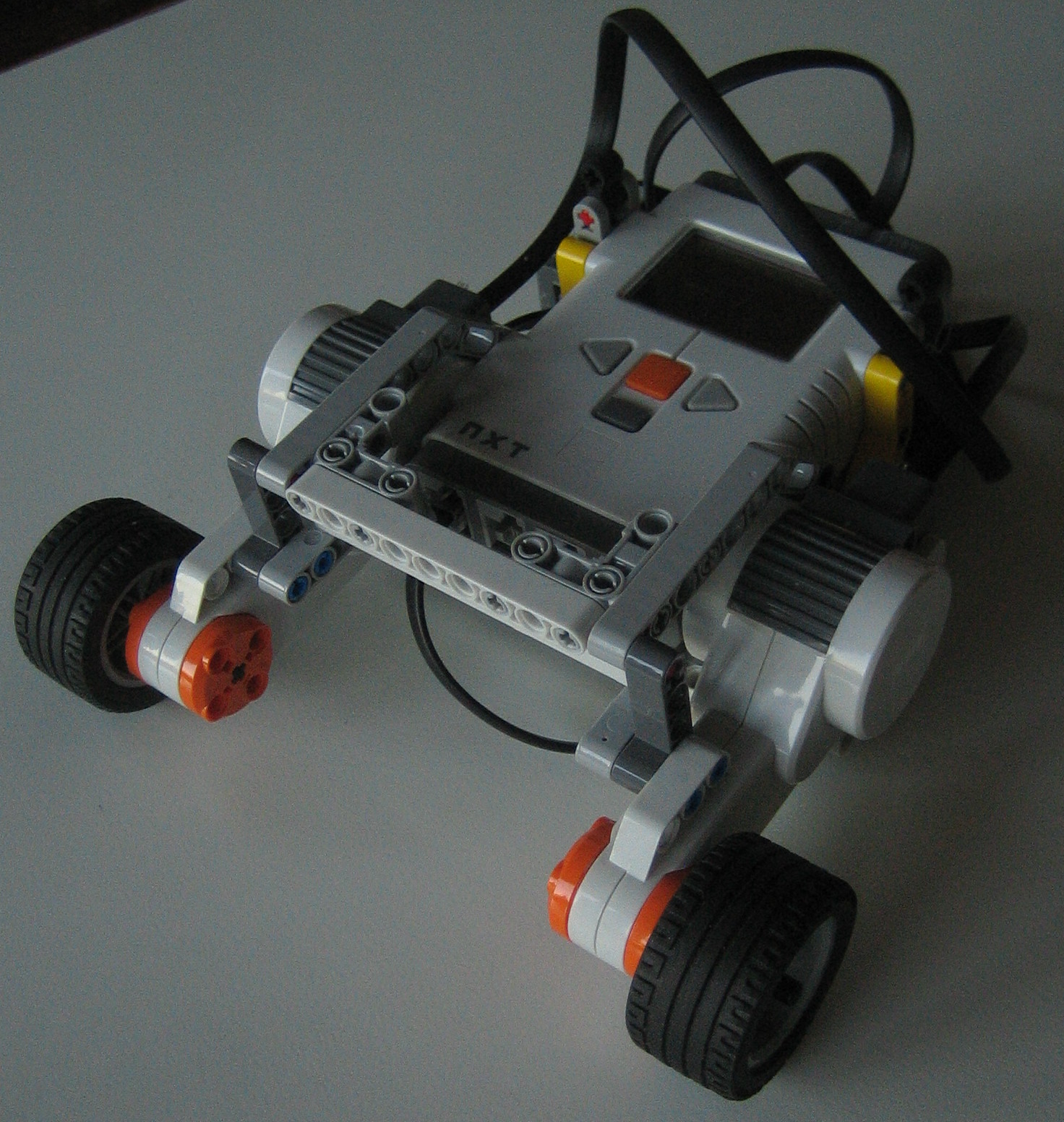
A while back I received a Gyro sensor for the NXT Mindstorms controller as a birthday present. It had been on my wishlist for a while, because I wanted to build a Segway like balancing lego robot. I had already built a simple balancing robot with the kids, using the light/color sensor included in the NXT kit as the balance sensor, but it was not working very well. It could balance for a while, but was very sensitive to the light condition in the room and the reflective properties of the surface and would fall over after a short while. I wanted something more robust, and had the gyro sensor from HiTechnic I believed would solve it on my wishlist for some years before it suddenly showed up as a gift from my loved ones. :) Unfortunately I have not had time to sit down and play with it since then. But that changed some days ago, when I was searching for lego segway information and came across a recipe from HiTechnic for building the HTWay, a segway like balancing robot. Build instructions and source code was included, so it was just a question of putting it all together. And thanks to the great work of many Debian developers, the compiler needed to build the source for the NXT is already included in Debian, so I was read to go in less than an hour. The resulting robot do not look very impressive in its simplicity:

Because I lack the infrared sensor used to control the robot in the design from HiTechnic, I had to comment out the last task (taskControl). I simply placed /* and */ around it get the program working without that sensor present. Now it balances just fine until the battery status run low:

Now we would like to teach it how to follow a line and take remote control instructions using the included Bluetooth receiver in the NXT. If you, like me, love LEGO and want to make sure we find the tools they need to work with LEGO in Debian and all our derivative distributions like Ubuntu, check out the LEGO designers project page and join the Debian LEGO team. Personally I own a RCX and NXT controller (no EV3), and would like to make sure the Debian tools needed to program the systems I own work as they should.

3 November 2016

Guido G nther: Debian Fun in October 2016

Debian LTS October marked the eighteenth month I contributed to Debian LTS under the Freexian umbrella. I spent 10 hours (out of allocated 9) Other Debian stuff Some other Free Software activities

Norbert Preining: Debian/TeX Live 2016.20161103-1

This month s update falls onto a national holiday in Japan. My recent start as a normal company employee in Japan doesn t leave me enough time during normal days to work on Debian, so things have to wait for holidays. There have been a few notable changes in the current packages, and above all I wanted to fix an RC bug and on the way fixed also several other (sometimes rather old) bugs.

texlive2016-debian From the list of new packages I want to pick apxproof: I have written something myself for one of my rather long papers (with proofs about 60pp), where at times I had to factor out the proofs into an appendix. I did this my own way, but I would have preferred to have a nice package! Another interesting change is the upstream merge of collection-mathextra (which translated to the Debian package texlive-math-extra) and collection-science (Debian: texlive-science) into a new collection collection-mathscience. Since introducing new packages and phasing out old ones is generally a pain in Debian, I decided to digress from the upstream naming convention and use texlive-science for the new collection-mathscience. In the end Mathematics is the most important science of all  Finally also a word about removals: Several ConTeXt packages have been removed due to the fact that they are outdated. These removals will find their way in an update of the Debian ConTeXt package in near future. The TeX Live packages lost voss-mathmode, which was retracted by the author due to various reasons. He is working on an updated version that will hopeful reappear in both TeX Live and Debian in near future. Well, that s it for now. Here now the full list with links. Enjoy. New packages apxproof, bangorexam, biblatex-gb7714-2015, biblatex-lni, biblatex-sbl, context-cmscbf, context-cmttbf, context-inifile, context-layout, delimset, latex2nemeth, latexbangla, latex-papersize, ling-macros, notex-bst, platex-tools, testidx, uppunctlm, wtref, xcolor-material. Removed packages voss-mathmode. Updated packages apa6, autoaligne, babel-german, biblatex-abnt, biblatex-anonymous, biblatex-apa, biblatex-manuscripts-philology, biblatex-nature, biblatex-realauthor, bibtex, bidi, boondox, bxcjkjatype, chickenize, churchslavonic, cjk-gs-integrate, context-filter, cooking-units, ctex, denisbdoc, dvips, europasscv, fixme, glossaries, gzt, handout, imakeidx, ipaex-type1, jsclasses, jslectureplanner, kpathsea, l3build, l3experimental, l3kernel, l3packages, latexindent, latexmk, listofitems, luatexja, marginnote, mcf2graph, minted, multirow, nameauth, newpx, newtx, noto, nucleardata, optidef, overlays, pdflatexpicscale, pst-eucl, reledmac, repere, scanpages, semantic-markup, tableaux, tcolorbox, tetex, texlive-scripts, ticket, todonotes, tracklang, tudscr, turabian-formatting, updmap-map, uspace, visualtikz, xassoccnt, xecjk, yathesis.

Jan Wagner: Container Orchestration Thoughts

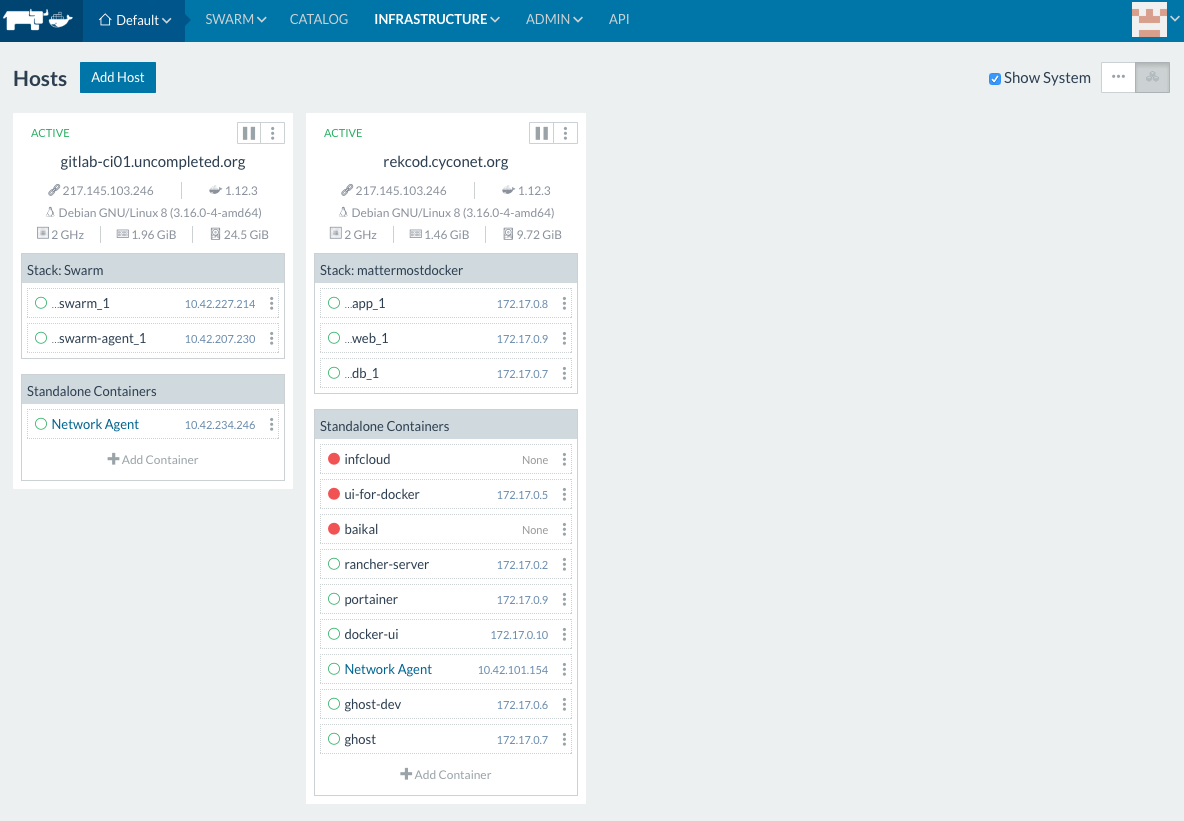
Container Orchestration ThoughtsSince some time everybody (read developer) want to run his new microservice stacks in containers. I can understand that building and testing an application is important for developers.
One of the benefits of containers is, that developer (in theory) can put their new version of applications into production on their own. This is the point where operations is affected and operations needs to evaluate, if that might evolve into better workflow. For yolo^WdevOps people there are some challenges that needs to be solved, or at least mitigated, when things needs to be done in large(r) scale.

Orchestration Engine Running Docker, which is actual the most preferred container solution, on a single host with docker command line client is something you can do, but there you leave the gap between dev and ops.

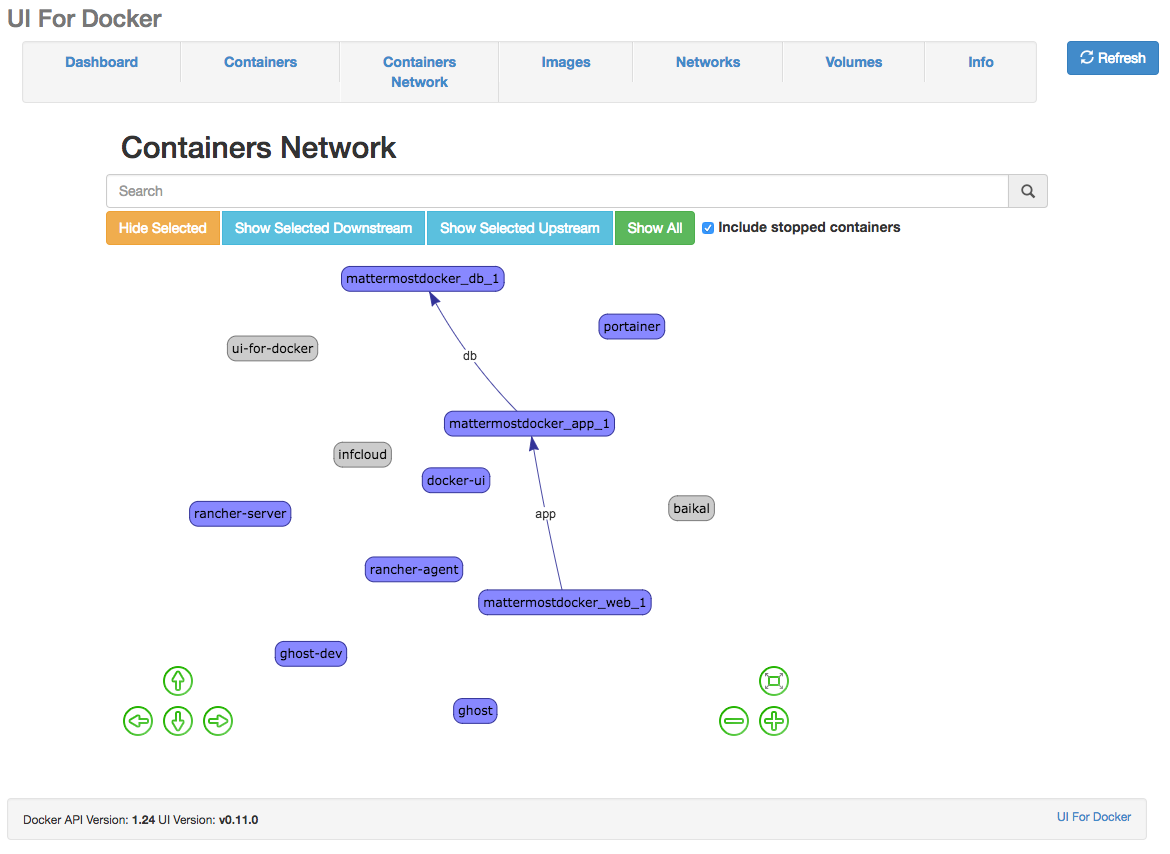
UI For Docker Since some time there is UI For Docker available for visualizing and managing containers on a single docker node. It's pretty awesome and the best feature so far is the Container Network view, which also shows the linked container. Container Orchestration Thoughts

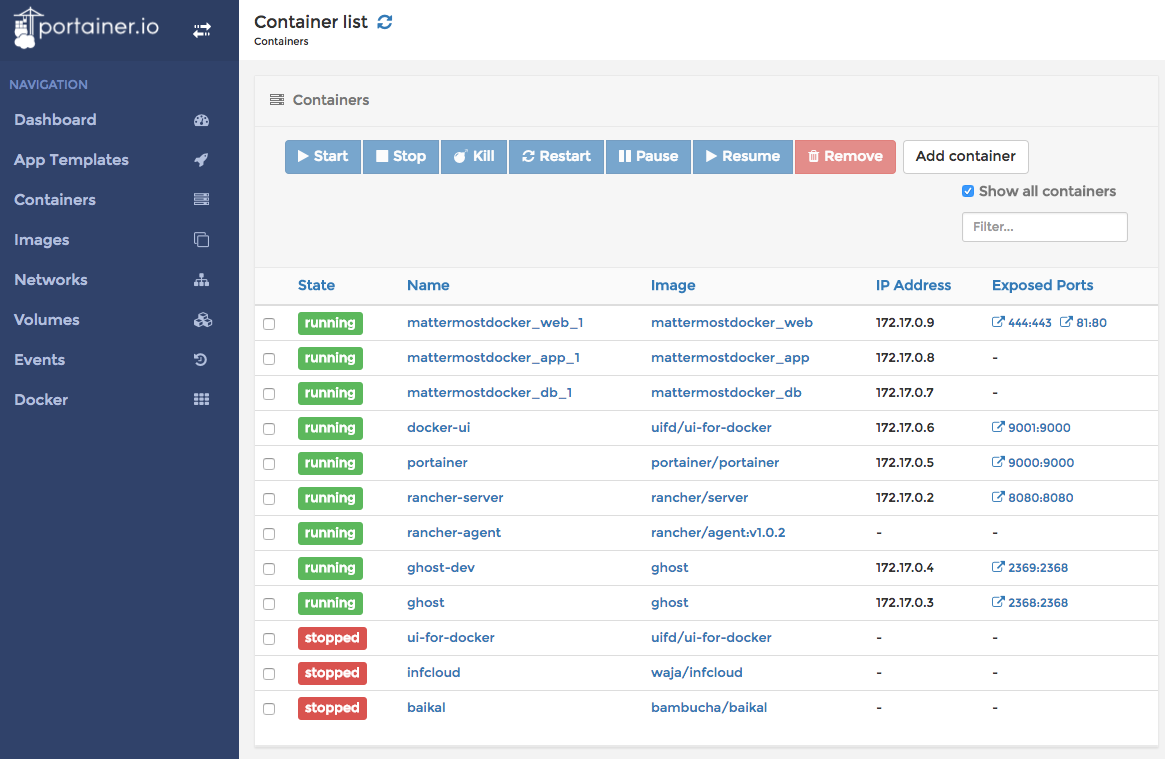
Portainer Portainer is pretty new and it can be deployed as easy as UI For Docker. But the (first) great advantage: it can handle Docker Swarm. Beside that it has many other great features. Container Orchestration Thoughts

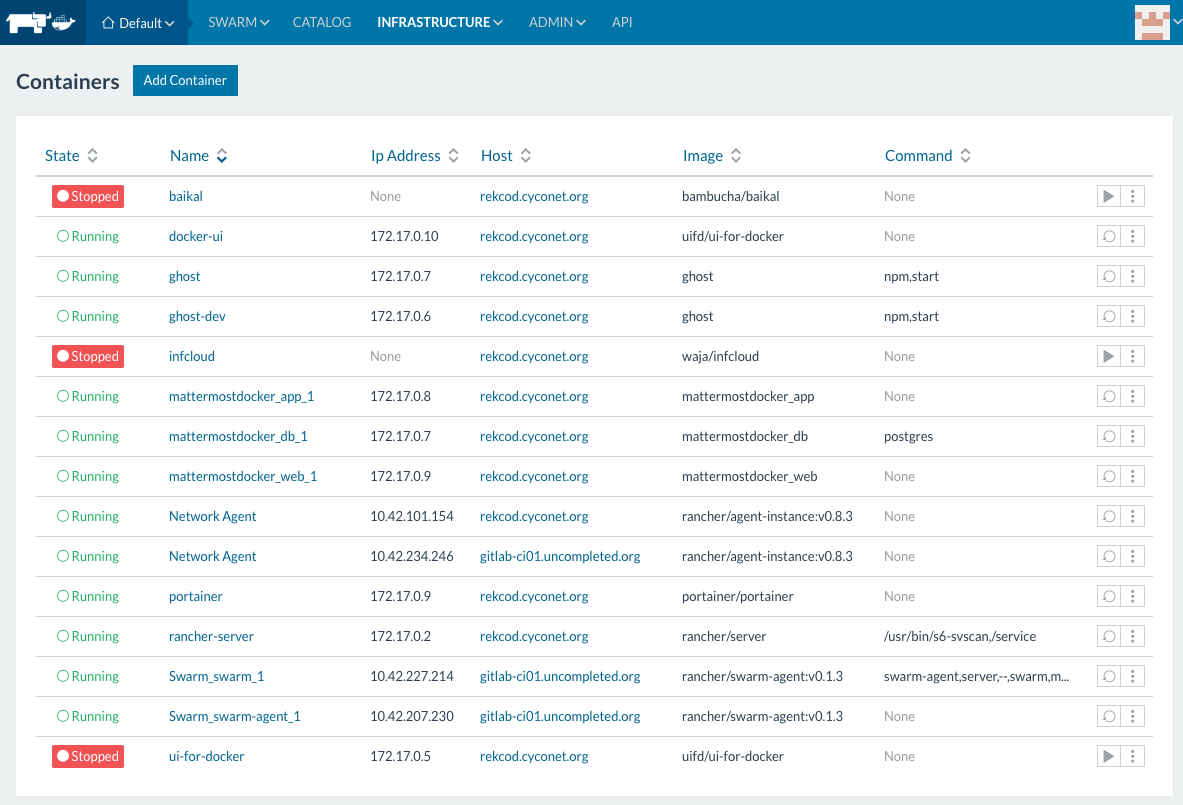
Rancher Rancher describes themselves as 'container management platform' that 'supports and manages all of your Kubernetes, Mesos, and Swarm clusters'. This is great because this are all of the relevant docker cluster orchestrations at the market actually. Container Orchestration Thoughts For the use cases, we are facing, Kubernetes and Mesos seems both like bloated beasts. Usman Ismail has written a really good comparison of Orchestration Engine options which goes into details. Container Orchestration Thoughts

Docker Swarm As there is actually no clear defacto standard/winner of the (container) orchestration wars, I would prevent to be in a vendor lock-in situation (yet). Docker swarm seems to be evolving and is getting more nice features other competitors doesn't provide.
Due the native integration into the docker framework and great community I believe Docker Swarm will be the Docker Orchestration of the choice on the long run. This should be supported by Rancher 1.2 which is not released yet.
From this point of view it looks very reasonable that Docker Swarm in combination with Rancher (1.2) might be a good strategy to maintain your container farms in the future. If you think to put Docker Swarm into production in the actual state, I recommend to read Docker swarm mode: What to know before going live on production by Panjamapong Sermsawatsri.

Persistent Storage While it is a best practice to use data volume container these days, providing persistent storage across multiple hosts for shared volumes seems to be tricky. In theory you can mount a shared-storage volume as a data volume and there are several volume plugins which supports shared storage. For example you can use the convoy plugin which gives you:
  • thin provisioned volumes
  • snapshots of volumes
  • backup of snapshots
  • restore volumes
As backend you can use:
  • Device Mapper
  • Virtual File System(VFS)/Network File System(NFS)
  • Amazon Elastic Block Store(EBS)
The good thing is, that convoy is integrated into Rancher. For more information I suggest to read Setting Up Shared Volumes with Convoy-NFS, which also mentions some limitations. If you want test Persistent Storage Service, Rancher provides some documentation. Actually I did not evaluate shared-storage volumes yet, but I don't see a solution I would love to use in production (at least on-premise) without strong downsides. But maybe things will go further and there might be a great solution for this caveats in the future.

Keeping base images up-to-date Since some time there are many projects that tries to detect security problems in your container images in several ways.
Beside general security considerations you need to deal somehow with issues in your base images that you build your applications on. Of course, even if you know you have a security issue in your application image, you need to fix it, which depends on the way how you based your application upon.

Ways to base your application image
  • You can build your application image entire from scratch, which leaves all the work to your development team and I wouldn't recommend it that way.
  • You also can create one (or more) intermediate image(s) that will be used by your development team.
  • The development team might ground their work on images in public available or private (for example the one bundled to your gitlab CI/CD solution) registries.

Whats the struggle with the base image? If you are using images being not (well) maintained by other people, you have to wait for them to fix your base image. Using external images might also lead into trust problems (can you trust those people in general?).
In an ideal world, your developers have always fresh base images with fixed security issues. This can probably be done by rebuilding every intermediate image periodically or when the base image changes.

Paradigm change Anyway, if you have a new application image available (with no known security issues), you need to deploy it to production. This is summarized by Jason McKay in his article Docker Security: How to Monitor and Patch Containers in the Cloud:
To implement a patch, update the base image and then rebuild the application image. This will require systems and development teams to work closely together.
So patching security issues in the container world changes workflow significant. In the old world operation teams mostly rolled security fixes for the base systems independent from development teams.
Now hitting containers the production area this might change things significant.

Bringing updated images to production Imagine your development team doesn't work steady on a project, cause the product owner consider it feature complete. The base image is provided (in some way) consistently without security issues. The application image is build on top of that automatically on every update of the base image.
How do you push in such a scenario the security fixes to production? From my point of view you have two choices:
  • Let the development team require to test the resulting application image and put it into production
  • Push the new application image without review by the development team into production
The first scenario might lead into a significant delay until the fixes hit production created by the probably infrequent work of the development team. The latter one brings your security fixes early to production by the notable higher risk to break your application. This risk can be reduced by implementing massive tests into CI/CD pipelines by the development team. Rolling updates provided by Docker Swarm might also reduce the risk of ending with a broken application. When you are implementing an update process of your (application) images to production, you should consider Watchtower that provides Automatic Updates for Docker Containers.

Conclusion Not being a product owner or the operations part of an application that is facing a widely adopted usage that would compensate the actual tradeoffs we are still facing I tend not to move large scale production projects into a container environment.
This means not that this might be a bad idea for others, but I'd like to sort out some of the caveats before. I'm still interested to put smaller projects into production, being not scared to reimplement or move them on a new stack.
For smaller projects with a small number of hosts Portainer looks not bad as well as Rancher with the Cattle orchestration engine if you just want to manage a couple of nodes. Things are going to be interesting if Rancher 1.2 supports Docker swarm cluster out of the box. Let's see what the future will bring us to the container world and how to make a great stack out of it.

Update I suggest to read Docker in Production: A History of Failure and the answer Docker in Production: A retort to understand the actual challenges when running Docker in larger scale production environments.

Bits from Debian: New Debian Developers and Maintainers (September and October 2016)

The following contributors got their Debian Developer accounts in the last two months: The following contributors were added as Debian Maintainers in the last two months: Congratulations!

2 November 2016

Junichi Uekawa: Surprisingly it is already November.

Surprisingly it is already November.

Next.

Previous.