Search Results: "ed"

12 April 2023

Jonathan Dowland: blog after death

I've been pondering what should happen to personal websites once the owner has passed, or otherwise "moved on". Some time ago I stumbled across a blog by Kev Quirk, who wrote
I d need to come up with contingency plans for...This website, and any other websites and own/manage
I thought it was a strange idea, to have a contingency plan for a personal site to survive its writer. Even a site such as my own, which (as sites go) would be trivial to host/mirror (since it's static), who would want to do that? Why would they do that? On the other hand, whether something I've written is useful or not is largely independent of whether I'm alive and well. And if anything I've written is useful independently from me (to pick a recent example, my notes on imaging optical media), should it persist somewhere? I've long thought of personal sites much like any website, which is to say, implicitly eternal, despite mountains of evidence that practically the reverse is true. I was influenced a long time ago by the article Cool URIs don't change. Thinking more about "digital legacy" led me to start believing that personal sites are ultimately not the right place for any kind of content that should have some persistence. (You might well have started with that assumption!) Yesterday via Planet Debian I read Aur lien Jarno's recent blog post where they have deprecated all of their personal site bar their blog. Quoting Aur lien:
Wikipedia is a much better platform for sharing knowledge than random websites.
This struck me as an interesting idea. Wikipedia is a reasonable place for a lot of material that might otherwise be hosted on personal sites, and as a "living website", content can be adapted, corrected, etc. over time. Wikipedia is clearly not the right place for much other material that might exist on personal sites (it's not the right place for my aforementioned article). I'm not sure where might be. Perhaps we, as a culture, need to move away from the notion of personal sites, and devise a more collective concept. Or perhaps it's no bad thing that, without intervention, this stuff disappears.

Andrej Shadura: Connecting lights to a Swytch e-bike kit

Last year I purchased an e-bike upgrade kit for my mother in law. We decided to install it on a bicycle she originally bought back in the 80s, which I fixed and refurbished a couple of years ago and used until September 2022 when I bought myself a Dutch Cortina U4. When I used this bicycle, I installed a lightweight Shutter Precision dynamo hub and compatible lights, XLC at the front, B chel at the back. Unfortunately, since Swytch is a front wheel with a built-in electric motor, these lights don t have a dynamo to connect to anymore, and Swytch doesn t have a dedicated connector for lights. I tried asking the manufacturer for more documentation or schematics, but they refused to do so. Luckily, a Canadian member of the Pedelecs forum managed to reverse-engineer the Swytch connector pinouts, which gave me an idea on how to proceed. Unfortunately, that meant that I had to replace both lights, and by trial and error I found specific models that worked. Before the Axa lights, I also tried B chel s Tivoli e-bike light, but it didn t work because the voltage was too low:
B chel Tivoli light that didn t workB chel Tivoli light that didn t work
Once I knew what to do, the rest was super easy So, here we go:
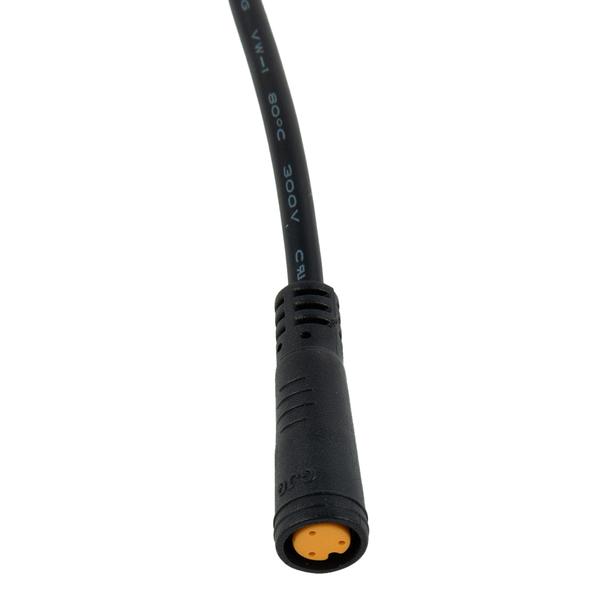
  1. Get a 3-pin (yellow) male connector with a cable, e.g. off AliExpress. Only two wires will be used, the white one is +4.2V (4-point-2, not 42!), the black one is earth. This will go into the throttle port. If you actually have a throttle, you need some sort of Y-splitter, but I don t, so this was not an issue for me. (However, I bought both sides (M and F), just to be sure.)
    Cable for the throttle portCable for the throttle port
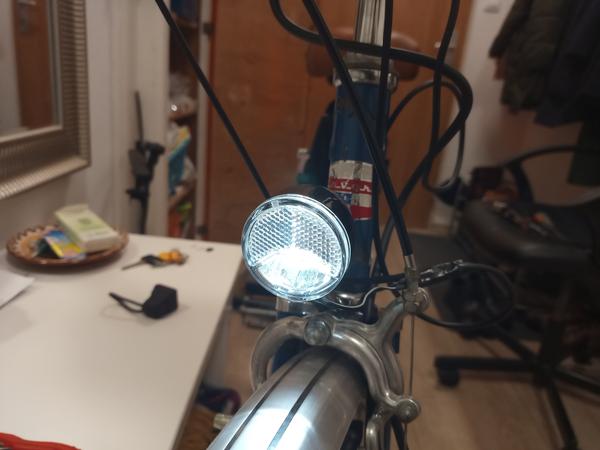
  2. Purchase an Axa 606 E6-48 front light. The 606 comes in two versions, for dynamos and e-bikes, use the one for e-bikes; despite being officially rated as 6 48V, these lights work quite well off 4.2V too.
    Axa 606 E6-48 lightAxa 606 E6-48 light
  3. Purchase an Axa Spark Steady rear light. This light works with both AC and DC (just like the 606, the official rating is 6 48V), and works off 4.2V without an issue.
    Axa Spark lightAxa Spark light
  4. Wire lights up. I used tiny wire terminals to join the wires, but I m sure there are better options too. Insulate them well, make sure the red wire from the throttle connector is insulated too. I used a bunch of shrink tubes and black insulation tape. Since the voltage is not wildly different from what the dynamo hub produced (although AC, not DC), I was able to reuse the cable I had already routed to the rear carrier.
  5. Lights go on automatically as soon as you touch the power button on the battery pack, and stay on until the battery pack is switched off completely. I was considering adding a handlebar switch, but since I lost the only one I had, I had to do without.
Front lightFront light
Rear lightRear light
The side effect of using the Axa Spark at the rear is that it has a capacitor inside and keeps going for a couple more minutes after the battery pack is off I haven t decided whether that s a benefit or a drawback

Jamie McClelland: Doing whatever Gmail says

As we slowly move our members to our new email infrastructure, an unexpected twist turned up: One member reported getting the Gmail warning:
Be careful with this message The sender hasn t authenticated this message so Gmail can t verify that it actually came from them.
They have their email delivered to May First, but have configured Gmail to pull in that email using the Check mail from other accounts feature. It worked fine on our old infrastructure, but started giving this message when we transitioned. A further twist: he only receives this message from email sent by other people in his organization - in other words email sent via May First gets flagged, email sent from other people does not. These Gmail messages typically warn users about email that has failed (or lacks) both SPF and DKIM. However, before diving into the technical details, my first thought was: why is Gmail giving a warning on a message that wasn t even delivered to them? It s always nice to get confirmation from others that this is totally wrong behavior. Unfortunately, when it s Gmail, it doesn t matter if they are wrong. We all have to deal with it. So next, I decided to investigate why this message failed both DKIM (digital signature) and SPF (ensuring the message was sent from an authorized server). Examining the headers immediately turned up the SPF failure:
Authentication-Results: mx.google.com;
       spf=fail (google.com: domain of xxx@xxx.org does not designate n.n.n.n as permitted sender) smtp.mailfrom=xxx@xxx.org
The IP address Google checked to ensure the message was sent by an authorized server is the IP address of our internal mail filter server in our new email infrastructure. That s the last hop before delivery to the user s mailbox, so that s the last hop Gmail sees. This is why Gmail is totally wrong to run this check: all email messages retreived via their mail fecthing service are going to fail the SPF test because Gmail has no way of knowing what the actual last hop is. So why is this problem only showing up after we transitioned to our new infrastructure? Because our old infrastructure had only one mail server for every user. The one mail server was the MX server and the relay server, so it was included in their SPF record. And why does this only affect mail sent via May First and not other domains? Because we add our DKIM signature to outgoing email, not to email delivered internally. Therefore, these messages both fail the SPF check and also don t have a DKIM signature. Other messages have a DKIM signature. Ugggg. So what do we do now? Clearly, something dumb and simple is in order: I added the IP addresses of our internal filter servers to our global SPF record. Someday, years from now, after Gmail is long gone (or has fixed this dumb behavior), when I m doing whatever retired people like me do, someone will notice that our internal filter server IPs are included in our SPF record. Hopefully they will fix the problem, but instead they ll probably think: no idea why these are here - something will probably break if I remove them.

Aurelien Jarno: Backup server upgraded to Bookworm

A few months ago, I switched my backup server to an ODROID-M1 SBC. It uses a RK3568 SoC with a quad-core Cortex-A55 and AES extensions (useful for disk encryption), and I added a 2 TB NVME SSD to the M2 slot. It also has a SATA connector, but the default enclosure does not have space for 2.5" drives. It's not the fastest SBC, but it runs stable and quite well as a backup server, and it's fanless, and low-power (less than 2 W idle). The support for the SoC has been added recently to the Linux kernel (it's used by various SBC), however the device tree for the ODROID-M1 was missing, so I contributed it based on the vendor one, and also submitted a few small fixes. All the changes ended in the Bookworm kernel, and with the Bookworm release approaching, I decided it was the good moment to upgrade it. It went quite well, and now I can enjoy running dist-upgrade like on other stable servers without having to care about the kernel. I am currently using Borg as a backup software, but the upgrade also gave access to a newer Restic version supporting compression (a must have for me), so I may give it a try.

Russ Allbery: Review: The Last Hero

Review: The Last Hero, by Terry Pratchett
Illustrator: Paul Kidby
Series: Discworld #27
Publisher: Harper
Copyright: 2001, 2002
ISBN: 0-06-050777-2
Format: Graphic novel
Pages: 176
The Last Hero is the 27th Discworld novel and part of the Rincewind subseries. This is something of a sequel to Interesting Times and relies heavily on the cast that was built up in previous books. It's not a good place to start with the series. At last, the rare Rincewind novel that I enjoyed. It helps that Rincewind is mostly along for the ride. Cohen the Barbarian and his band of elderly heroes have decided they're tired of enjoying their spoils and are going on a final adventure. They're going to return fire to the gods, in the form of a giant bomb. The wizards in Ankh-Morpork get wind of this and realize that an explosion at the Hub where the gods live could disrupt the magical field of the entire Disc, effectively destroying it. The only hope seems to be to reach Cori Celesti before Cohen and head him off, but Cohen is already almost there. Enter Lord Vetinari, who has Leonard of Quirm design a machine that will get them there in time by slingshotting under the Disc itself. First off, let me say how much I love the idea of returning fire to the gods with interest. I kind of wish Pratchett had done more with their motivations, but I was laughing about that through the whole book. Second, this is the first of the illustrated Discworld books that I've read in the intended illustrated form (I read the paperback version of Eric), and this book is gorgeous. I enjoyed Paul Kidby's art far more than I had expected to. His style what I will call, for lack of better terminology due to my woeful art education, "highly detailed caricature." That's not normally a style that clicks with me, but it works incredibly well for Discworld. The Last Hero is richly illustrated, with some amount of art, if only subtle background behind the text, on nearly every page. There are several two-page spreads, but oddly I thought those (including the parody of The Scream on the cover) were the worst art of the book. None of them did much for me. The best art is in the figure studies and subtle details: Leonard of Quirm's beautiful calligraphy, his numerous sketches, the labeled illustration of the controls of the flying machine, and the portraits of Cohen's band and the people they encounter. The edition I got is printed on lovely, thick glossy paper, and the subtle art texture behind the writing makes this book a delight to read. I'm not sure if, like Eric, this book comes in other editions, but if so, I highly recommend getting or finding the high-quality illustrated edition for the best reading experience. The plot, like a lot of the Rincewind books, doesn't amount to much, but I enjoyed the mission to intercept Cohen. Leonard of Quirm is a great character, and the slow revelation of his flying machine design (which I will not spoil) is a delightful combination of Leonardo da Vinci parody, Discworld craziness, and NASA homage. Also, the Librarian is involved, which always improves a Discworld book. (The Luggage, sadly, is not; I would have liked to have seen a richly-illustrated story about it, but it looks like I'll have to find the illustrated version of Eric for that.) There is one of Pratchett's philosophical subtexts here, about heroes and stories and what it means for your story to live on. To be honest, it didn't grab me; it's mostly subtext, and this particular set of characters weren't quite introspective enough to make the philosophy central to the story. Also, I was perhaps too sympathetic to Cohen's goals, and thus not very interested in anyone successfully stopping him. But I had a lot more fun with this one than I usually do with Rincewind books, helped considerably by the illustrations. If you've been skipping Rincewind books in your Discworld read-through and have access to the illustrated edition of The Last Hero, consider making an exception for this one. Followed by The Amazing Maurice and His Educated Rodents in publication order and, thematically, by Unseen Academicals. Rating: 7 out of 10

Freexian Collaborators: Debian Contributions: Debian Developer Survey Results, DebConf updates, and more! (by Utkarsh Gupta)

Contributing to Debian is part of Freexian s mission. This article covers the latest achievements of Freexian and their collaborators. All of this is made possible by organizations subscribing to our Long Term Support contracts and consulting services.

Results of the Debian Developer Survey, by Roberto C. S nchez In 2022, Freexian polled Debian Developers about the usage of money in Debian. More than 200 Debian Developers graciously participated, providing useful and constructive answers. Roberto and Utkarsh have worked on reviewing this feedback and summarizing it in a report recently published and announced to the project.

DebConf 23 Website, by Stefano Rivera In preparation for DebConf 23, Stefano did some work on the DebConf website s registration system. To support an expected large number of local registration requests, and a limited venue size, Stefano added a review system for registration requests. There was also some infrastructure work for the website framework. We use the same framework for miniconfs and DebConf, but without the full registration system. Since last DebConf, we have migrated from a pure-JS toolchain for the static assets, to django-compressor, to be friendlier to contributors and have a simpler dependency setup. This required some updates in the full-DebConf registration system that hadn t been noticed yet in miniDebConfs. Finally, with Utkarsh, we started to wind up the DebConf 22 travel bursary reimbursement process.

Debian Reimbursements Web App Progress, by Stefano Rivera In a project funded by Freexian s Project Funding initiative, Stefano made some more progress on the Debian Reimbursements Web App. The first rough implementation core request lifecycle is almost complete. Receipts can be collected and itemized, and the request can be submitted for a reimbursement request.

Debian Printing, by Thorsten Alteholz Due to the upcoming release, only bug fixing uploads are allowed in this part of the release cycle and Thorsten did uploads of three Debian Printing packages. The upload of hplip was rather straightforward and five bugs could be closed. cups-filters suddenly started to FTBFS and thus got an RC bug. It failed due to a compile error in a header file of some dependency. Luckily the maintainer of that dependency knew that his package now needed c++17, so the fix was to just remove an old compile flag that forced the compiler to use c++0x. This flag was once progressive but nowadays it is more of a hindrance than a help. The third package upload was for cups, which got some translation updates. Unfortunately this was the most tricky one as some translations did not appear in the binary packages. After debugging for some time, it turned out that the handling of links did not work properly. Now the version in Bookworm will be the cups version with the most translated man pages ever.

Miscellaneous contributions
  • Stefano Rivera updated a few Python modules in the Debian Python Team, to the latest upstream versions.
  • Stefano Rivera reviewed the current patch series applied to Python 3.12, as an Arch package maintainer had noticed that we dropped a patch by mistake, and reinstated it.
  • Anton Gladky prepared an upload of newer version (9.2.6) of vtk library and uploaded it into the experimental due to a freeze. VTK is the visualization kit - a library used mostly for scientific and engineering applications to visualize complex objects. Transition of dependent packages is planned on after-release phase.
  • Helmut Grohne, in the continual effort to improve Debian s cross-build support, provided 22 cross-build patches to packages in the archive.

11 April 2023

Aurelien Jarno: New website, or kind of...

For over 15 years, I've hardly made any updates to my website, and it remains low on my priority list. So I made a radical decision to replace it entirely with my blog. The content of the website has been reduced to just two additional pages. But nothing has been lost: nowadays, Wikipedia is a much better platform for sharing knowledge than random websites. And it happens that they already cover all that was on my website about subaquatic diving in French. They also offer a multitude of resources in electronics, including the topics that were on my website: LCD displays, I C bus, barcodes, parallel ports, serial ports, and DCF77 reception. Finally if you're in need of Debian QEMU images for various architectures, I recommend the Debian Quick Image Baker pre-baked images page instead.

Russ Allbery: Review: Circe

Review: Circe, by Madeline Miller
Publisher: Little, Brown and Company
Copyright: April 2018
Printing: 2020
ISBN: 0-316-55633-5
Format: Kindle
Pages: 421
Circe is the story of the goddess Circe, best known as a minor character in Homer's Odyssey. Circe was Miller's third book if you count the short novella Galatea. She wrote it after Song of Achilles, a reworking of part of the Iliad, but as with Homer, you do not need to read Song of Achilles first. You will occasionally see Circe marketed or reviewed as a retelling of the Odyssey, but it isn't in any meaningful sense. Odysseus doesn't make an appearance until nearly halfway through the book, and the material directly inspired by the Odyssey is only about a quarter of the book. There is nearly as much here from the Telegony, a lost ancient Greek epic poem that we know about only from summaries by later writers and which picks up after the end of the Odyssey. What this is, instead, is Circe's story, starting with her childhood in the halls of Helios, the Titan sun god and her father. She does not have a happy childhood; her voice is considered weak by the gods (Homer describes her as having "human speech"), and her mother and elder siblings are vicious and cruel. Her father is high in the councils of the Titans, who have been overthrown by Zeus and the other Olympians. She is in awe of him and sits at his feet to observe his rule, but he's a petty tyrant who cares very little about her. Her only true companion is her brother Ae tes. The key event of the early book comes when Prometheus is temporarily chained in Helios's halls after stealing fire from the gods and before Zeus passes judgment on him. A young Circe brings him something to drink and has a brief conversation with him. That's the spark for one of the main themes of this book: Circe slowly developing a conscience and empathy, neither of which are common among Miller's gods. But it's still a long road from there to her first meeting with Odysseus. One of the best things about this book is the way that Miller unravels the individual stories of Greek myth and weaves them into a chronological narrative of Circe's life. Greek mythology is mostly individual stories, often contradictory and with only a loose chronology, but Miller pulls together all the ones that touch on Circe's family and turns them into a coherent history. This is not easy to do, and she makes it feel effortless. We get a bit of Jason and Medea (Jason is as dumb as a sack of rocks, and Circe can tell there's already something not right with Medea), the beginnings of the story of Theseus and Ariadne, and Daedalus (one of my favorite characters in the book) with his son Icarus, in addition to the stories more directly associated with Circe (a respinning of Glaucus and Scylla from Ovid's Metamorphoses that makes Circe more central). By the time Odysseus arrives on Circe's island, this world feels rich and full of history, and Circe has had a long and traumatic history that has left her suspicious and hardened. If you know some Greek mythology already, seeing it deftly woven into this new shape is a delight, but Circe may be even better if this is your first introduction to some of these stories. There are pieces missing, since Circe only knows the parts she's present for or that someone can tell her about later, but what's here is vivid, easy to follow, and recast in a narrative structure that's more familiar to modern readers. Miller captures the larger-than-life feel of myth while giving the characters an interiority and comprehensible emotional heft that often gets summarized out of myth retellings or lost in translation from ancient plays and epics, and she does it without ever calling the reader's attention to the mechanics. The prose, similarly, is straightforward and clear, getting out of the way of the story but still providing a sense of place and description where it's needed. This book feels honed, edited and streamlined until it maintains an irresistible pace. There was only one place where I felt like the story dragged (the raising of Telegonus), and then mostly because it's full of anger and anxiety and frustration and loss of control, which is precisely what Miller was trying to achieve. The rest of the book pulls the reader relentlessly forward while still delivering moments of beauty or sharp observation.
My house was crowded with some four dozen men, and for the first time in my life, I found myself steeped in mortal flesh. Those frail bodies of theirs took relentless attention, food and drink, sleep and rest, the cleaning of limbs and fluxes. Such patience mortals must have, I thought, to drag themselves through it hour after hour.
I did not enjoy reading about Telegonus's childhood (it was too stressful; I don't like reading about characters fighting in that way), but apart from that, the last half of this book is simply beautiful. By the time Odysseus arrives, we're thoroughly in Circe's head and agree with all of the reasons why he might receive a chilly reception. Odysseus talks the readers around at the same time that he talks Circe around. It's one of the better examples of writing intelligent, observant, and thoughtful characters that I have read recently. I also liked that Odysseus has real flaws, and those flaws do not go away even when the reader warms to him. I'll avoid saying too much about the very end of the book to avoid spoilers (insofar as one can spoil Greek myth, but the last quarter of the book is where I think Miller adds the most to the story). I'll just say that both Telemachus and Penelope are exceptional characters while being nothing like Circe or Odysseus, and watching the characters tensely circle each other is a wholly engrossing reading experience. It's a much more satisfying ending than the Telegony traditionally gets (although I have mixed feelings about the final page). I've mostly talked about the Greek mythology part of Circe, since that's what grabbed me the most, but it's quite rightly called a feminist retelling and it lives up to that label with the same subtlety and skill that Miller brings to the prose and characterization. The abusive gender dynamics of Greek myth are woven into the narrative so elegantly you'd think they were always noted in the stories. It is wholly satisfying to see Circe come into her own power in a defiantly different way than that chosen by her mother and her sister. She spends the entire book building an inner strength and sense of herself that allows her to defend her own space and her own identity, and the payoff is pure delight. But even better are the quiet moments between her and Penelope.
"I am embarrassed to ask this of you, but I did not bring a black cloak with me when we left. Do you have one I might wear? I would mourn for him." I looked at her, as vivid in my doorway as the moon in the autumn sky. Her eyes held mine, gray and steady. It is a common saying that women are delicate creatures, flowers, eggs, anything that may be crushed in a moment s carelessness. If I had ever believed it, I no longer did. "No," I said. "But I have yarn, and a loom. Come."
This is as good as everyone says it is. Highly recommended for the next time you're in the mood for a myth retelling. Rating: 8 out of 10

10 April 2023

Simon Josefsson: Trisquel is 42% Reproducible!

The absolute number may not be impressive, but what I hope is at least a useful contribution is that there actually is a number on how much of Trisquel is reproducible. Hopefully this will inspire others to help improve the actual metric. tl;dr: go to reproduce-trisquel. When I set about to understand how Trisquel worked, I identified a number of things that would improve my confidence in it. The lowest hanging fruit for me was to manually audit the package archive, and I wrote a tool called debdistdiff to automate this for me. That led me to think about apt archive transparency more in general. I have made some further work in that area (hint: apt-verify) that deserve its own blog post eventually. Most of apt archive transparency is futile if we don t trust the intended packages that are in the archive. One way to measurable increase trust in the package are to provide reproducible builds of the packages, which should by now be an established best practice. Code review is still important, but since it will never provide positive guarantees we need other processes that can identify sub-optimal situations automatically. The way reproducible builds easily identify negative results is what I believe has driven much of its success: its results are tangible and measurable. The field of software engineering is in need of more such practices. The design of my setup to build Trisquel reproducible are as follows. I did not expect to be able to use the GitLab shared runners to do the building, however they turned out to work quite well and I postponed setting up my own runner. There is a manually curated lists/disabled-aramo.txt with some packages that all required too much disk space or took over two hours to build. Today I finally took the time to setup a GitLab runner using podman running Trisquel aramo, and I expect to complete builds of the remaining packages soon one of my Dell R630 server with 256GB RAM and dual 2680v4 CPUs should deliver sufficient performance. Current limitations and ideas on further work (most are filed as project issues) include: Happy Easter Hacking! Update 2023-04-17: The original project reproduce-trisquel that was announced here has been archived and replaced with two projects, one generic debdistreproduce and one with results for Trisquel: reproduce/trisquel .

Gunnar Wolf: Twenty years

Twenty years A seemingly big, very round number, at least for me. I can recall several very well-known songs mentioning this timespan: A quick Internet search yields many more And yes, in human terms 20 years is quite a big deal. And, of course, I have been long waiting for the right time to write this post. Because twenty years ago, I got the mail. Of course, the mail notifying me I had successfully finished my NM process and, as of April 2003, could consider myself to be a full-fledged Debian Project member. Maybe by sheer chance it was today also that we spent the evening at Max s house I never worked directly with Max, but we both worked at Universidad Pedag gica Nacional at the same time back then. But Of course, a single twentyversary is not enough! I don t have the exact date, but I guess I might be off by some two or three months due to other things I remember from back then. This year, I am forty years old as an Emacs and TeX user! Back in 1983, on Friday nights, I went with my father to IIMAS (where I m currently adscribed to as a PhD student, and where he was a researcher between 1971 and the mid-1990s) and used the computer one of the two big computers they had in the Institute. And what could a seven-year-old boy do? Of course use the programs this great Foonly F2 system had. Emacs and TeX (this is still before LaTeX). 40 years And I still use the same base tools for my daily work, day in, day out.

Russell Coker: BTRFS Rebuild Time

In February I replaced a Dell T320 server with a HP Z640 workstation for a home server/workstation [1]. The T320 has 8*3.5 drive bays which I had used to put 3*4TB disks in a BTRFS RAID-10 array for 6TB of usable capacity. The Z640 has only 2*3.5 bays and 4*2.5 bays, so one option I could have taken was to buy a 4TB 2.5 SSD and keep the same 3*4TB array as before. Instead I chose to use an 8TB disk I had spare in an array with one of the original 4TB disks and some extra on NVMe devices (the system has 2*1TB NVMe devices which are used as a 380G RAID-1 for the root filesystem and the rest for the storage array). It s nice how BTRFS allows putting any storage you have in a RAID-10 configuration. Unfortunately it seems that I chose the wrong 4TB disk to use for this as it failed three days ago. It gave thousands of read and write errors and Linux decided that the drive no longer existed. I tried rebooting the system to get it in the BTRFS array again but it failed again and failed so quickly that it wasn t even possible to use the data on it as part of a RAID rebuild. So I removed that disk and put in one of the other 4TB disks. As the array is comprised of an 8TB disk and 3 other devices that don t add up to 8TB the layout is the 8TB disk having one copy of everything and the other devices having parts of it. So the rebuild process comprised of copying data from the 8TB disk to the 4TB disk. For a RAID array run in the manner of Linux software RAID the rebuild of a RAID-1 involves a linear copy of data which is the optimal case for hard disks, copying 4TB of data in that manner would have an average speed of a bit over 100MB/s and take about 11 hours. With BTRFS the source disk has to be updated for each block that is recreated so the process was bottlenecked on writing to the 8TB disk. It took 2 days 23 hours to complete. The process involved reading 3,478,031MB and writing 4,405,545MB. The system was live for the process and some cron jobs etc were writing to the array, but in the 12 hours since the rebuild completed the array has had 7,038MB written. So presumably during the rebuild time about 42G of actual data were written to the array and the other 4.3TB written to the 8TB disk were from the process of copying 3.5TB from it to another device. Iostat reported that there were 645.36 TPS for the duration of the rebuild which seems like a decent number for a hard drive, during the process iostat reported that the drive had 99%+ of IO capacity used for the duration. While waiting for this to complete I wrote a blog post about storage trends [2]. One thing I didn t mention in that post is that if you are the type of person who checks the rebuild process fifty times a day then that should be counted as part of the cost of using slow storage. If instead of an 8TB disk plus some SSD storage I had used 2*4TB disks and 1*4TB SSD as I had considered doing then instead of having 3.8TB on one device I would have had about 2.5TB and the reconstruct would have probably taken 2/3 of the time. If I had moved the array to 3*4TB SSDs then it would have taken a small fraction of the time. One thing to note is that I made a mistake in this operation by removing the failed device instead of doing a btrfs replace operation which can be significantly faster. If I had correctly done this then I would have written a blog post about the rebuild taking 2 days or something, the issues of hard drives being slow and me compulsively checking the progress would still apply.

9 April 2023

Marco d'Itri: Installing Debian 12 on a Banana Pi M5

I recently bought a Banana Pi BPI-M5, which uses the Amlogic S905X3 SoC: these are my notes about installing Debian on it. While this SoC is supported by the upstream U-Boot it is not supported by the Debian U-Boot package, so debian-installer does not work. Do not be fooled by seeing the DTB file for this exact board being distributed with debian-installer: all DTB files are, and it does not mean that the board is supposed to work. As I documented in #1033504, the Debian kernels are currently missing some patches needed to support the SD card reader. I started by downloading an Armbian Banana Pi image and booted it from an SD card. From there I partitioned the eMMC, which always appears as /dev/mmcblk1:
parted /dev/mmcblk1
(parted) mklabel msdos
(parted) mkpart primary ext4 4194304B -1
(parted) align-check optimal 1
mkfs.ext4 /dev/mmcblk1p1
Make sure to leave enough space before the first partition, or else U-Boot will overwrite it: as it is common for many ARM SoCs, U-Boot lives somewhere in the gap between the MBR and the first partition. I looked at Armbian's /usr/lib/u-boot/platform_install.sh and installed U-Boot by manually copying it to the eMMC:
dd if=/usr/lib/linux-u-boot-edge-bananapim5_22.08.6_arm64/u-boot.bin of=/dev/mmcblk1 bs=1 count=442
dd if=/usr/lib/linux-u-boot-edge-bananapim5_22.08.6_arm64/u-boot.bin of=/dev/mmcblk1 bs=512 skip=1 seek=1
Beware: Armbian's U-Boot 2022.10 is buggy, so I had to use an older image. I did not want to install a new system, so I copied over my old Cubieboard install:
mount /dev/mmcblk1p1 /mnt/
rsync -xaHSAX --delete --numeric-ids root@old-server:/ /mnt/ --exclude='/tmp/*' --exclude='/var/tmp/*'
Since the Cubieboard has a 32 bit CPU and the Banana Pi requires an arm64 kernel I enabled the architecture and installed a new kernel:
dpkg --add-architecture arm64
apt update
apt install linux-image-arm64
apt purge linux-image-6.1.0-6-armmp linux-image-armmp
At some point I will cross-grade the entire system. Even if ttyS0 exists it is not the serial console, which appears as ttyAML0 instead. Nowadays systemd automatically start a getty if the serial console is enabled on the kernel command line, so I just had to disable the old manually-configured getty:
systemctl disable serial-getty@ttyS0.service
I wanted to have a fully working flash-kernel, so I used Armbian's boot.scr as a template to create /etc/flash-kernel/bootscript/bootscr.meson and then added a custom entry for the Banana Pi to /etc/flash-kernel/db:
Machine: Banana Pi BPI-M5
Kernel-Flavors: arm64
DTB-Id: amlogic/meson-sm1-bananapi-m5.dtb
U-Boot-Initrd-Address: 0x0
Boot-Initrd-Path: /boot/uInitrd
Boot-Initrd-Path-Version: yes
Boot-Script-Path: /boot/boot.scr
U-Boot-Script-Name: bootscr.meson
Required-Packages: u-boot-tools
All things considered I do not think that I would recommend to Debian users to buy Amlogic-based boards since there are many other better supported SoCs.

8 April 2023

Evgeni Golov: Running autopkgtest with Docker inside Docker

While I am not the biggest fan of Docker, I must admit it has quite some reach across various service providers and can often be seen as an API for running things in isolated environments. One such service provider is GitHub when it comes to their Actions service. I have no idea what isolation technology GitHub uses on the outside of Actions, but inside you just get an Ubuntu system and can run whatever you want via Docker as that comes pre-installed and pre-configured. This especially means you can run things inside vanilla Debian containers, that are free from any GitHub or Canonical modifications one might not want ;-) So, if you want to run, say, lintian from sid, you can define a job to do so:
  lintian:
    runs-on: ubuntu-latest
    container: debian:sid
    steps:
      - [ do something to get a package to run lintian on ]
      - run: apt-get update
      - run: apt-get install -y --no-install-recommends lintian
      - run: lintian --info --display-info *.changes
This will run on Ubuntu (latest right now means 22.04 for GitHub), but then use Docker to run the debian:sid container and execute all further steps inside it. Pretty short and straight forward, right? Now lintian does static analysis of the package, it doesn't need to install it. What if we want to run autopkgtest that performs tests on an actually installed package? autopkgtest comes with various "virt servers", which are providing isolation of the testbed, so that it does not interfere with the host system. The simplest available virt server, autopkgtest-virt-null doesn't actually provide any isolation, as it runs things directly on the host system. This might seem fine when executed inside an ephemeral container in an CI environment, but it also means that multiple tests have the potential to influence each other as there is no way to revert the testbed to a clean state. For that, there are other, "real", virt servers available: chroot, lxc, qemu, docker and many more. They all have one in common: to use them, one needs to somehow provide an "image" (a prepared chroot, a tarball of a chroot, a vm disk, a container, , you get it) to operate on and most either bring a tool to create such an "image" or rely on a "registry" (online repository) to provide them. Most users of autopkgtest on GitHub (that I could find with their terrible search) are using either the null or the lxd virt servers. Probably because these are dead simple to set up (null) or the most "native" (lxd) in the Ubuntu environment. As I wanted to execute multiple tests that for sure would interfere with each other, the null virt server was out of the discussion pretty quickly. The lxd one also felt odd, as that meant I'd need to set up lxd (can be done in a few commands, but still) and it would need to download stuff from Canonical, incurring costs (which I couldn't care less about) and taking time which I do care about!). Enter autopkgtest-virt-docker, which recently was added to autopkgtest! No need to set things up, as GitHub already did all the Docker setup for me, and almost no waiting time to download the containers, as GitHub does heavy caching of stuff coming from Docker Hub (or at least it feels like that). The only drawback? It was added in autopkgtest 5.23, which Ubuntu 22.04 doesn't have. "We need to go deeper" and run autopkgtest from a sid container! With this idea, our current job definition would look like this:
  autopkgtest:
    runs-on: ubuntu-latest
    container: debian:sid
    steps:
      - [ do something to get a package to run autopkgtest on ]
      - run: apt-get update
      - run: apt-get install -y --no-install-recommends autopkgtest autodep8 docker.io
      - run: autopkgtest *.changes --setup-commands="apt-get update" -- docker debian:sid
(--setup-commands="apt-get update" is needed as the container comes with an empty apt cache and wouldn't be able to find dependencies of the tested package) However, this will fail:
# autopkgtest *.changes --setup-commands="apt-get update" -- docker debian:sid
autopkgtest [10:20:54]: starting date and time: 2023-04-07 10:20:54+0000
autopkgtest [10:20:54]: version 5.28
autopkgtest [10:20:54]: host a82a11789c0d; command line:
  /usr/bin/autopkgtest bley_2.0.0-1_amd64.changes '--setup-commands=apt-get update' -- docker debian:sid
Unexpected error:
Traceback (most recent call last):
  File "/usr/share/autopkgtest/lib/VirtSubproc.py", line 829, in mainloop
    command()
  File "/usr/share/autopkgtest/lib/VirtSubproc.py", line 758, in command
    r = f(c, ce)
        ^^^^^^^^
  File "/usr/share/autopkgtest/lib/VirtSubproc.py", line 692, in cmd_copydown
    copyupdown(c, ce, False)
  File "/usr/share/autopkgtest/lib/VirtSubproc.py", line 580, in copyupdown
    copyupdown_internal(ce[0], c[1:], upp)
  File "/usr/share/autopkgtest/lib/VirtSubproc.py", line 607, in copyupdown_internal
    copydown_shareddir(sd[0], sd[1], dirsp, downtmp_host)
  File "/usr/share/autopkgtest/lib/VirtSubproc.py", line 562, in copydown_shareddir
    shutil.copy(host, host_tmp)
  File "/usr/lib/python3.11/shutil.py", line 419, in copy
    copyfile(src, dst, follow_symlinks=follow_symlinks)
  File "/usr/lib/python3.11/shutil.py", line 258, in copyfile
    with open(dst, 'wb') as fdst:
         ^^^^^^^^^^^^^^^
FileNotFoundError: [Errno 2] No such file or directory: '/tmp/autopkgtest-virt-docker.shared.kn7n9ioe/downtmp/wrapper.sh'
autopkgtest [10:21:07]: ERROR: testbed failure: unexpected eof from the testbed
Running the same thing locally of course works, so there has to be something special about the setup at GitHub. But what?! A bit of digging revealed that autopkgtest-virt-docker tries to use a shared directory (using Dockers --volume) to exchange things with the testbed (for the downtmp-host capability). As my autopkgtest is running inside a container itself, nothing it tells the Docker deamon to mount will be actually visible to it. In retrospect this makes total sense and autopkgtest-virt-docker has a switch to "fix" the issue: --remote as the Docker deamon is technically remote when viewed from the place autopkgtest runs at. I'd argue this is not a bug in autopkgtest(-virt-docker), as the situation is actually cared for. There is even some auto-detection of "remote" daemons in the code, but that doesn't "know" how to detect the case where the daemon socket is mounted (vs being set as an environment variable). I've opened an MR (assume remote docker when running inside docker) which should detect the case of running inside a Docker container which kind of implies the daemon is remote. Not sure the patch will be accepted (it is a band-aid after all), but in the meantime I am quite happy with using --remote and so could you ;-)

Russell Coker: Storage Trends 2023

It s been 2 years since my last blog post about storage trends [1]. Minimum Storage <=2TB In 2021 I stated that as MSY had 2TB disks for $72 and 2TB SSD for $245 it was barely worth considering a 2TB disk and anything less than 2TB wasn t worth considering. Now for 2TB storage from MSY NVMe starts at $129, SATA SSD starts at $143, and hard disks start at $75. I guess that NVMe is slightly cheaper due to some combination of economies of scale for manufacture/sales and having less postage costs. It really doesn t make sense to consider hard disks for storing 2TB or less. For storage for a small system (PC or laptop) the cheapest storage device is $19 for a 128G SATA SSD. But it wouldn t make sense to buy that when you can get a 256G SATA SSD for $22 or a 240G NVMe device for $23, saving $3 on storage wouldn t make any sense. For 512G of storage the prices are $32 for NVMe and $33 for SATA SSD. For 1TB of storage the prices start at $68 for SATA SSD and $74 for NVMe. Probably for the vast majority of home users 1TB of SATA SSD or NVMe is the minimum storage capacity to consider, the $50 price difference isn t much when considering the entire price of a PC or laptop and anything less than 1TB will run out quickly with modern use. Larger Storage 4TB+ The price for 4TB of storage from MSY is NVMe starting at $349, SATA SSD starting at $369, and hard disks starting at $115. If you need 4TB of RAID-1 storage then it might be worth saving $470 and getting hard drives for a home user. For business use it wouldn t make sense. Some laptops have two NVMe sockets so 8TB of storage (or 4TB of RAID-1) in a laptop would be interesting. For 8TB of storage the MSY prices are SATA SSD for $739 and hard drives starting at $179. Probably hard drives are the best choice for most situations where there is a need to store 8TB or more of data. But the prices are low enough to make 8TB SSD something that can be considered for home use, it doesn t seem that long ago that the 4TB hard drives I bought for my home server were almost that expensive. Big Storage MSY doesn t have 8TB NVMe, such devices are on eBay for $1700 for regular M.2 NVMe and just under $1000 for U.2 (server hot-swap devices). So if you need more than 8TB of NVMe storage then probably buying a server with U.2 built in is the correct solution. For home users who need more than 8TB of storage hard drives are a good solution. One issue is that the more affordable and larger drives use Shingled Magnetic Recording (SMR) which has some different performance characteristics for certain workloads. Apparently SMR performs badly for anything other than large file storage. Why MSY? I primarily used MSY prices for this post because they are a reliable local store that has a list of prices that is easy to read. For everything in this post I can get better prices by using eBay, the StaticIce.com.au price comparison site [2], and the computing section of the OzBargain site that gamifies finding good prices [3]. But a good shopping strategy nowadays is to compare prices in a store to determine what items are in your price range and then shop around for price on the item you want. Checking all the different bargain sites for all these items would take much more time than I want to spend writing a blog post! Conclusion Hard drives don t make sense for the vast majority of systems. Not for laptops, not for typical desktop PCs, and not for small business servers (say 8TB or less of RAID storage). Hard drives only make sense for dozens or hundreds of TB of storage and even then finding out how to deal with SMR issues is going to increase the pain of deployment. Maybe using a combination of SSD and hard drives to deal with the SMR issues is going to be a competitive advantage for NAS vendors in future. NVMe looks like it s on the way to being cheaper than SATA SSD. There is likely to be a good market for systems with NVMe as the only internal storage option. The long term trend of systems without DVD drives and with maybe 2.5 SATA devices but no 3.5 SATA devices seems to lead to the GPU being the major part that needs to fit into a PC case that determines the overall size. Maybe there will be a new trend of GPUs connected to riser cards so they can be parallel to the motherboard for compact PCs. For business desktop systems (IE low powered graphics hardware as it s not for gaming) I expect that the trend will be towards NUC type devices which are already based around the M.2 as a storage device size.

7 April 2023

Petter Reinholdtsen: rtlsdr-scanner, software defined radio frequency scanner for Linux - nice free software

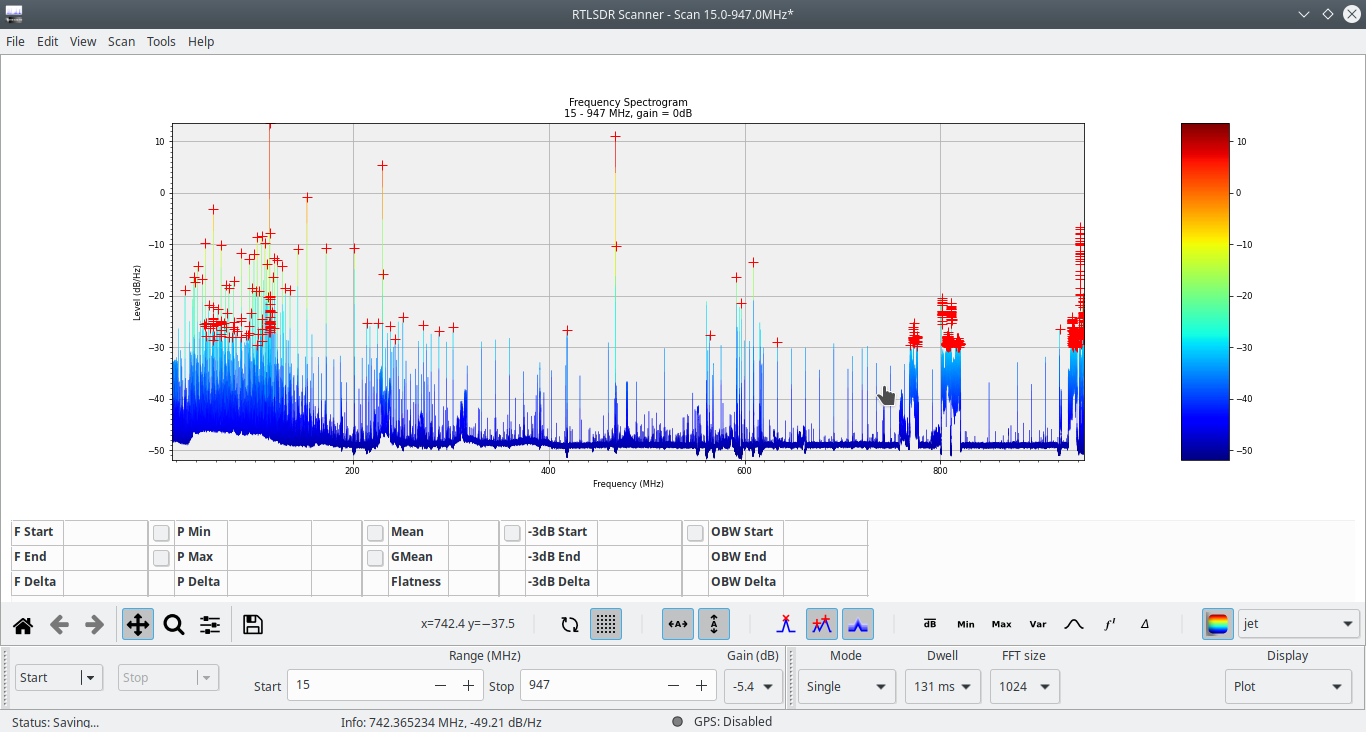
Today I finally found time to track down a useful radio frequency scanner for my software defined radio. Just for fun I tried to locate the radios used in the areas, and a good start would be to scan all the frequencies to see what is in use. I've tried to find a useful program earlier, but ran out of time before I managed to find a useful tool. This time I was more successful, and after a few false leads I found a description of rtlsdr-scanner over at the Kali site, and was able to track down the Kali package git repository to build a deb package for the scanner. Sadly the package is missing from the Debian project itself, at least in Debian Bullseye. Two runtime dependencies, python-visvis and python-rtlsdr had to be built and installed separately. Luckily 'gbp buildpackage' handled them just fine and no further packages had to be manually built. The end result worked out of the box after installation. My initial scans for FM channels worked just fine, so I knew the scanner was functioning. But when I tried to scan every frequency from 100 to 1000 MHz, the program stopped unexpectedly near the completion. After some debugging I discovered USB software radio I used rejected frequencies above 948 MHz, triggering a unreported exception breaking the scan. Changing the scan to end at 957 worked better. I similarly found the lower limit to be around 15, and ended up with the following full scan: Saving the scan did not work, but exporting it as a CSV file worked just fine. I ended up with around 477k CVS lines with dB level for the given frequency. The save failure seem to be a missing UTF-8 encoding issue in the python code. Will see if I can find time to send a patch upstream later to fix this exception:
Traceback (most recent call last):
  File "/usr/lib/python3/dist-packages/rtlsdr_scanner/main_window.py", line 485, in __on_save
    save_plot(fullName, self.scanInfo, self.spectrum, self.locations)
  File "/usr/lib/python3/dist-packages/rtlsdr_scanner/file.py", line 408, in save_plot
    handle.write(json.dumps(data, indent=4))
TypeError: a bytes-like object is required, not 'str'
As usual, if you use Bitcoin and want to show your support of my activities, please send Bitcoin donations to my address 15oWEoG9dUPovwmUL9KWAnYRtNJEkP1u1b.

Matthew Palmer: Database Encryption: If It's So Good, Why Isn't Everyone Doing It?

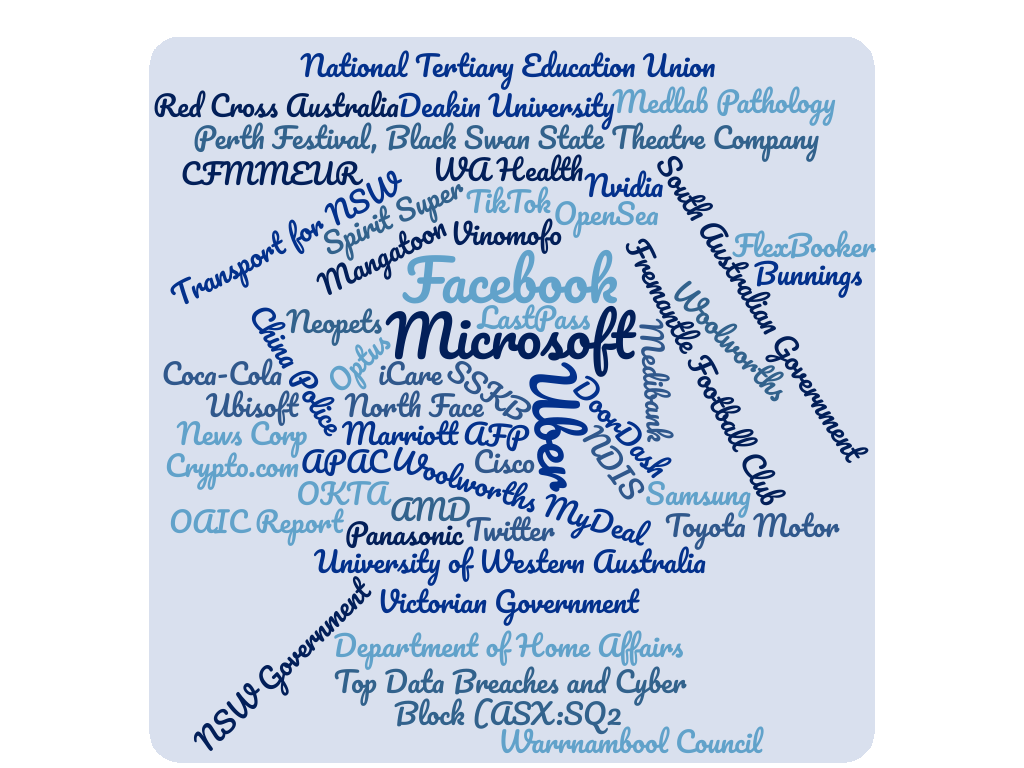
a wordcloud of organisations who have been reported to have had data breaches in 2022 Just some of the organisations that leaked data in 2022

It seems like just about every day there s another report of another company getting hacked and having its sensitive data (or, worse, the sensitive data of its customers) stolen. Sometimes, people s most intimate information gets dumped for the world to see. Other times it s just used for identity theft, extortion, and other crimes. In the least worst case, the attacker gets cold feet, but people suffer stress and inconvenience from having to replace identity documents. A great way to protect information from being leaked is to encrypt it. We encrypt data while it s being sent over the Internet (with TLS), and we encrypt it when it s at rest (with disk or volume encryption). Yet, everyone s data seems to still get stolen on a regular basis. Why? Because the data is kept online in an unencrypted form, sitting in the database while its being used. This means that attackers can just connect to the database, or trick the application into dumping the database, and all the data is just lying there, waiting to be misused.

It s Not the Devs Fault, Though You may be thinking that leaving an entire database full of sensitive data unencrypted seems like a terrible idea. And you re right: it is a terrible idea. But it s seemingly unavoidable. The problem is that in order to do what a database does best (query, sort, and aggregate data), it needs to be able to know what the data is. When you encrypt data, however, all the database sees is a locked box.
a locked box Not very useful for a database
The database can t tell what s in the locked box whether it s a number equal to 42, or a date that s less than 2023-01-01, or a string that contains the substring foo . Every value is just an opaque blob of stuff , and the database is rendered completely useless. Since modern applications usually rely pretty heavily on their database, it s essentially impossible to build an application if you ve turned your database into a glorified flat-file by encrypting everything in it. Thus, it s hardly surprising that developers have to leave the data laying around unencrypted, for anyone to come along and take.

Introducing Enquo I said before that having data unencrypted in a database is seemingly unavoidable. That s because there are some innovative cryptographic techniques that can make it possible to query encrypted data.
Andy Dwyer being amazed Indeed
The purpose of the Enquo project is to provide a common set of cryptographic primitives that implement ENcrypted QUery Operations (ie Enquo ), and integrate those operations into databases, ORMs, and anywhere else that could benefit. The end goal is to provide the ability to encrypt all the data stored in any database server, while still allowing the data to be queried and aggregated. So far, the project consists of these components:
  • the enquo-core library, that implements queryable encrypted integers, dates, and text in Rust and Ruby;
  • a PostgreSQL extension, pg_enquo, that allows PostgreSQL to query encrypted data; and
  • a Rails ActiveRecord extension, ActiveEnquo, that augments ActiveRecord to do the encryption/decryption required.
Support for other languages and ORMs is designed to be as straightforward as possible, and integration with other databases is mostly dependent on their own extensibility. The project s core tenets emphasise both uncompromising security, and a friendly developer experience. Naturally, all Enquo code is open source, released under the MIT licence.

Would You Like To Know More?
Desire to know more intensifies Everyone who uses a database...

If all this sounds relevant to your interests:
  1. If you use Ruby on Rails and PostgreSQL, you re halfway home already. Follow the ActiveEnquo getting started tutorial and see how much of your data Enquo can already protect. When you find data you want to encrypt but can t, tell me about it.
    • If you use Ruby and PostgreSQL with another ORM, such as Sequel, writing a plugin to support Enquo shouldn t be too difficult. The ActiveEnquo code should give you a good start. If you get stuck, get in touch.
  2. If you use PostgreSQL with another programming language, tell me what language you use and we ll work together to get bindings for that library created.
  3. If you use another database server, support is coming for your database of choice eventually, but at present there s no timeline on support. On the off chance that you happen to be a hard-core database hacking expert, and would like to work on getting Enquo support in your preferred database server, I d love to talk to you.

6 April 2023

Reproducible Builds: Reproducible Builds in March 2023

Welcome to the March 2023 report from the Reproducible Builds project. In these reports we outline the most important things that we have been up to over the past month. As a quick recap, the motivation behind the reproducible builds effort is to ensure no malicious flaws have been introduced during compilation and distributing processes. It does this by ensuring identical results are always generated from a given source, thus allowing multiple third-parties to come to a consensus on whether a build was compromised. If you are interested in contributing to the project, please do visit our Contribute page on our website.

News There was progress towards making the Go programming language reproducible this month, with the overall goal remaining making the Go binaries distributed from Google and by Arch Linux (and others) to be bit-for-bit identical. These changes could become part of the upcoming version 1.21 release of Go. An issue in the Go issue tracker (#57120) is being used to follow and record progress on this.
Arnout Engelen updated our website to add and update reproducibility-related links for NixOS to reproducible.nixos.org. [ ]. In addition, Chris Lamb made some cosmetic changes to our presentations and resources page. [ ][ ]
Intel published a guide on how to reproducibly build their Trust Domain Extensions (TDX) firmware. TDX here refers to an Intel technology that combines their existing virtual machine and memory encryption technology with a new kind of virtual machine guest called a Trust Domain. This runs the CPU in a mode that protects the confidentiality of its memory contents and its state from any other software.
A reproducibility-related bug from early 2020 in the GNU GCC compiler as been fixed. The issues was that if GCC was invoked via the as frontend, the -ffile-prefix-map was being ignored. We were tracking this in Debian via the build_path_captured_in_assembly_objects issue. It has now been fixed and will be reflected in GCC version 13.
Holger Levsen will present at foss-north 2023 in April of this year in Gothenburg, Sweden on the topic of Reproducible Builds, the first ten years.
Anthony Andreoli, Anis Lounis, Mourad Debbabi and Aiman Hanna of the Security Research Centre at Concordia University, Montreal published a paper this month entitled On the prevalence of software supply chain attacks: Empirical study and investigative framework:
Software Supply Chain Attacks (SSCAs) typically compromise hosts through trusted but infected software. The intent of this paper is twofold: First, we present an empirical study of the most prominent software supply chain attacks and their characteristics. Second, we propose an investigative framework for identifying, expressing, and evaluating characteristic behaviours of newfound attacks for mitigation and future defense purposes. We hypothesize that these behaviours are statistically malicious, existed in the past, and thus could have been thwarted in modernity through their cementation x-years ago. [ ]

On our mailing list this month:
  • Mattia Rizzolo is asking everyone in the community to save the date for the 2023 s Reproducible Builds summit which will take place between October 31st and November 2nd at Dock Europe in Hamburg, Germany. Separate announcement(s) to follow. [ ]
  • ahojlm posted an message announcing a new project which is the first project offering bootstrappable and verifiable builds without any binary seeds. That is to say, a way of providing a verifiable path towards trusted software development platform without relying on pre-provided binary code in order to prevent against various forms of compiler backdoors. The project s homepage is hosted on Tor (mirror).

The minutes and logs from our March 2023 IRC meeting have been published. In case you missed this one, our next IRC meeting will take place on Tuesday 25th April at 15:00 UTC on #reproducible-builds on the OFTC network.
and as a Valentines Day present, Holger Levsen wrote on his blog on 14th February to express his thanks to OSUOSL for their continuous support of reproducible-builds.org. [ ]

Debian Vagrant Cascadian developed an easier setup for testing debian packages which uses sbuild s unshare mode along and reprotest, our tool for building the same source code twice in different environments and then checking the binaries produced by each build for any differences. [ ]
Over 30 reviews of Debian packages were added, 14 were updated and 7 were removed this month, all adding to our knowledge about identified issues. A number of issues were updated, including the Holger Levsen updating build_path_captured_in_assembly_objects to note that it has been fixed for GCC 13 [ ] and Vagrant Cascadian added new issues to mark packages where the build path is being captured via the Rust toolchain [ ] as well as new categorisation for where virtual packages have nondeterministic versioned dependencies [ ].

Upstream patches The Reproducible Builds project detects, dissects and attempts to fix as many currently-unreproducible packages as possible. We endeavour to send all of our patches upstream where appropriate. This month, we wrote a large number of such patches, including: In addition, Vagrant Cascadian filed a bug with a patch to ensure GNU Modula-2 supports the SOURCE_DATE_EPOCH environment variable.

Testing framework The Reproducible Builds project operates a comprehensive testing framework (available at tests.reproducible-builds.org) in order to check packages and other artifacts for reproducibility. In March, the following changes were made by Holger Levsen:
  • Arch Linux-related changes:
    • Build Arch packages in /tmp/archlinux-ci/$SRCPACKAGE instead of /tmp/$SRCPACKAGE. [ ]
    • Start 2/3 of the builds on the o1 node, the rest on o2. [ ]
    • Add graphs for Arch Linux (and OpenWrt) builds. [ ]
    • Toggle Arch-related builders to debug why a specific node overloaded. [ ][ ][ ][ ]
  • Node health checks:
    • Detect SetuptoolsDeprecationWarning tracebacks in Python builds. [ ]
    • Detect failures do perform chdist calls. [ ][ ]
  • OSUOSL node migration.
    • Install megacli packages that are needed for hardware RAID. [ ][ ]
    • Add health check and maintenance jobs for new nodes. [ ]
    • Add mail config for new nodes. [ ][ ]
    • Handle a node running in the future correctly. [ ][ ]
    • Migrate some nodes to Debian bookworm. [ ]
    • Fix nodes health overview for osuosl3. [ ]
    • Make sure the /srv/workspace directory is owned by by the jenkins user. [ ]
    • Use .debian.net names everywhere, except when communicating with the outside world. [ ]
    • Grant fpierret access to a new node. [ ]
    • Update documentation. [ ]
    • Misc migration changes. [ ][ ][ ][ ][ ][ ][ ][ ]
  • Misc changes:
    • Enable fail2ban everywhere and monitor it with munin [ ].
    • Gracefully deal with non-existing Alpine schroots. [ ]
In addition, Roland Clobus is continuing his work on reproducible Debian ISO images:
  • Add/update openQA configuration [ ], and use the actual timestamp for openQA builds [ ].
  • Moved adding the user to the docker group from the janitor_setup_worker script to the (more general) update_jdn.sh script. [ ]
  • Use the (short-term) reproducible source when generating live-build images. [ ]

diffoscope development diffoscope is our in-depth and content-aware diff utility. Not only can it locate and diagnose reproducibility issues, it can provide human-readable diffs from many kinds of binary formats as well. This month, Mattia Rizzolo released versions 238, and Chris Lamb released versions 239 and 240. Chris Lamb also made the following changes:
  • Fix compatibility with PyPDF 3.x, and correctly restore test data. [ ]
  • Rework PDF annotation handling into a separate method. [ ]
In addition, Holger Levsen performed a long-overdue overhaul of the Lintian overrides in the Debian packaging [ ][ ][ ][ ], and Mattia Rizzolo updated the packaging to silence an include_package_data=True [ ], fixed the build under Debian bullseye [ ], fixed tool name in a list of tools permitted to be absent during package build tests [ ] and as well as documented sending out an email upon [ ]. In addition, Vagrant Cascadian updated the version of GNU Guix to 238 [ and 239 [ ]. Vagrant also updated reprotest to version 0.7.23. [ ]

Other development work Bernhard M. Wiedemann published another monthly report about reproducibility within openSUSE


If you are interested in contributing to the Reproducible Builds project, please visit our Contribute page on our website. However, you can get in touch with us via:

Dirk Eddelbuettel: RcppArmadillo 0.12.2.0.0 on CRAN: New Upstream Minor

armadillo image Armadillo is a powerful and expressive C++ template library for linear algebra and scientific computing. It aims towards a good balance between speed and ease of use, has a syntax deliberately close to Matlab, and is useful for algorithm development directly in C++, or quick conversion of research code into production environments. RcppArmadillo integrates this library with the R environment and language and is widely used by (currently) 1052 other packages on CRAN, downloaded 28.6 million times (per the partial logs from the cloud mirrors of CRAN), and the CSDA paper (preprint / vignette) by Conrad and myself has been cited 522 times according to Google Scholar. This release brings a new upstream release 12.2.0 made by Conrad a day or so ago. We prepared the usual release candidate, tested on the over 1000 reverse depends, found no issues and sent it to CRAN. Where it got tested again and was auto-processed smoothly by CRAN. The releases actually has a relatively small set of changes as a first follow-up release in the 12.2.* series.

Changes in RcppArmadillo version 0.12.2.0.0 (2023-04-04)
  • Upgraded to Armadillo release 12.2.0 (Cortisol Profusion Deluxe)
    • more efficient use of FFTW3 by fft() and ifft()
    • faster in-place element-wise multiplication of sparse matrices by dense matrices
    • added spsolve_factoriser class to allow reuse of sparse matrix factorisation for solving systems of linear equations

Courtesy of my CRANberries, there is a diffstat report relative to previous release. More detailed information is on the RcppArmadillo page. Questions, comments etc should go to the rcpp-devel mailing list off the R-Forge page. If you like this or other open-source work I do, you can sponsor me at GitHub.

This post by Dirk Eddelbuettel originated on his Thinking inside the box blog. Please report excessive re-aggregation in third-party for-profit settings.

Michael Ablassmeier: tracking changes between pypi package releases

I wondered if there is some tracking for differences between packages published on pypi, something that stores this information in a format similar to debdiff.. I failed to find something on the web, so created a little utility which watches the pypi changelog for new releaes and fetches the new and old version. It uses diffoscope to create reports on the published releases and automatically pushes them to a github repository: https://github.com/pypi-diff Is it useful? I dont know, it may be handy for code review or maybe running different security scanners on it, to identify accidentaly pushed keys or other sensitive data. Currently its pushing the changes for every released package every 10 minutes, lets see how far this can go just for fun :-)

5 April 2023

Valhalla's Things: Fitting Top and Camisole

Posted on April 5, 2023
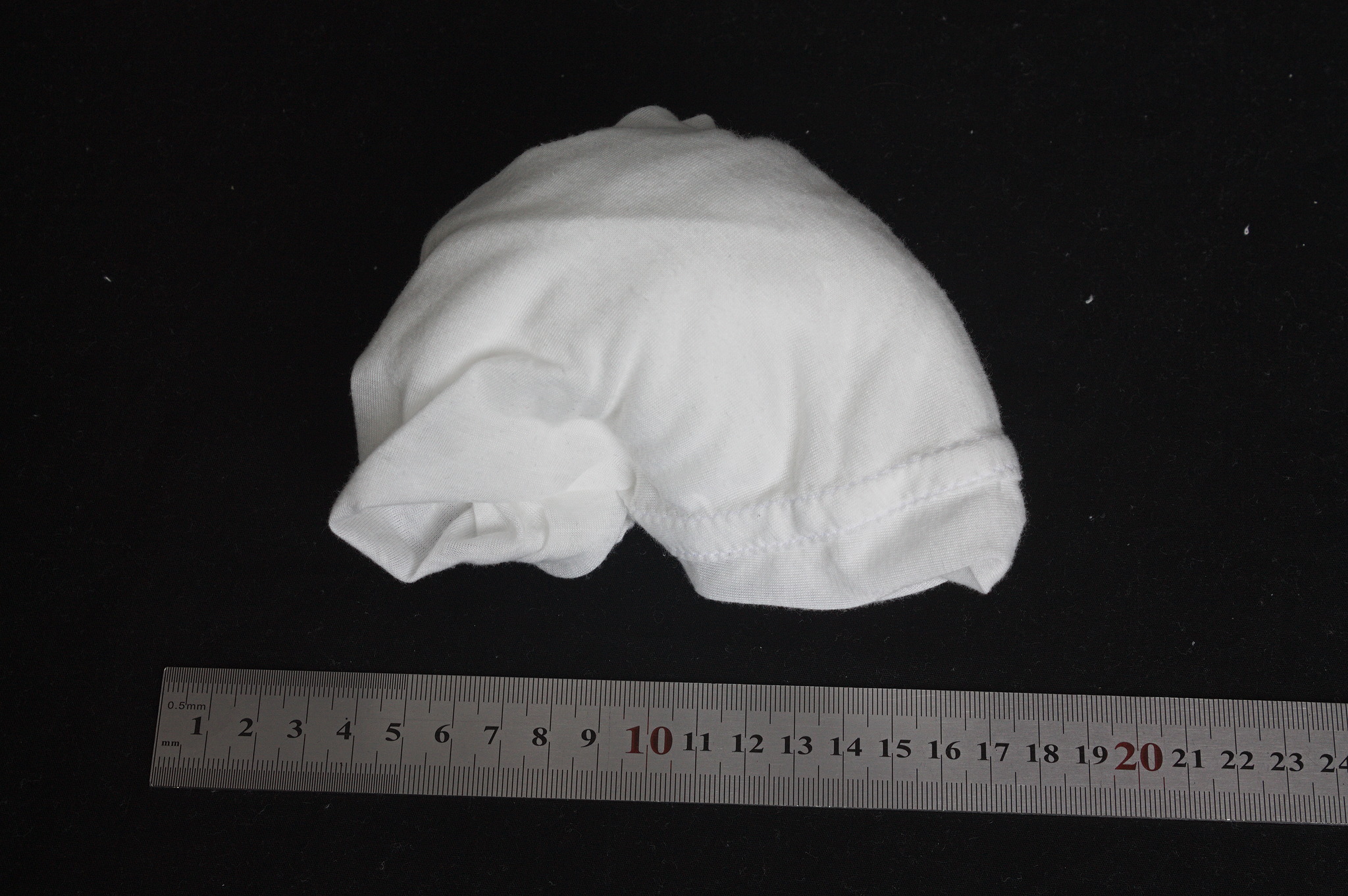
A woman wearing a simple, long sleeved, fitted white top; the fabric is somewhat transparent and the outline of a camisole can be seen. For this summer, I ve just made a nice sleeveless dress, but that doesn t mean that I m planning to go around with bare arms like, I don t know, a peasant or even somebody with no health issues, perish the thought! Instead, at the end of last season I ve bought a remnant of white ramie / viscose jersey that is a bit too transparent to be decent when worn on its own, but should still give some protection from the sun without being unconfortable in the heat, with the intent to make myself a new top. Because of the transparency I wasn t sure whether to actually use it for a top, or just to make camisoles, but with the decency preserved by the dress the choice was made: I had enough fabric for a top, a camisole and maybe something small. I already have a trusted pattern for the top and camisole, but they still had to be published, so I took care to write down instructions and take step-by-step pictures; maybe the white fabric isn t the best, but it s better than nothing, and I can still take better pictures the next time I ll do another make. They are of course on my pattern webiste: top and camisole. some fabric (the top pictured above) crunched up in a loose ball, less than 15 cm in diameter (there is a ruler for scale). Since the fabric was bought online as a remnant, I didn t exactly know what to expect, and was pleasantly surprised by how soft it is: it feels like touching a cloud. This however means that it felt like working with a cloud, and, well, let s just say I m happy that both patterns were quite simple and I didn t have to deal with fiddly bits. I was also not so pleasantly surprised by the fact that part of the fabric had a few small holes as if the end of the roll had been caught on something; I was able to cut everything around the holes, other than a small bit that I hadn t noticed and had to be mended. It s not a big deal, but I suspect it s a sign that this fabric may not be as sturdy as it could have been, and that there will be more mending in the future as I wear it. And then, when I had finished the set I was faced with another problem: taking pictures. For one thing, worn on their own they aren t exactly decent, and then there was the fact that after a week of late spring weather in March, as I was working on summer clothing the temperature dropped and there was even a hint of rain. image I solved this by wearing the new set on top of another set of fitting top and camisole, with matching leggings. Not exactly something I would wear on the regular streets, but good enough for a picture of underwear. A woman wearing a white camisole on top of black top and leggings. Still, the pictures were taken in quite a hurry, because I wasn t completely freezing, but still pretty cold. Anyway, I m off to find some other piece of summer wear to make, hoping that it will bring proper rain. :)


Next.

Previous.