Search Results: "dom"

19 September 2011

Keith Packard: MacBook-Air-2

Fixing the Sandbrige MacBook Air display initialization We left our hero with Debian installed on the MacBook Air, but with the display getting scrambled as soon as the i915 driver loaded. As was reported to Matthew, the problem is as simple as a lack of the right mode for the eDP panel in the machine. This mode is supposed to come from the panel EDID data, but for some reason the driver wasn t able to query the EDID data, and so it decided to try some random panel timings it dug out of the VBT tables, which are generally supposed to be used by LVDS panels. Apple helpfully stuck valid data there, but for some other panel one that is 1280x800 pixels instead of the 1366x768 pixel panel in the MacBook Air. I heard rumors that some machines would get a black screen when the i915 driver loaded. I was fortunate my machine simply displayed a 1366x768 subset of the programmed 1280x800 mode. A bit of garbage on the right side, and a few scanlines missing at the bottom. Quite workable, especially after I ran fbset -yres 768 to keep the console in the visible portion of the screen. DDC failure Looking through the kernel logs, the Intel driver tries to access the EDID data and times out, as if DDC is just completely broken. This is rather unexpected; the eDP spec says that the panel is required to support DDC and provide EDID. Now, we ve seen a lot of panels which don t quite live up to the rigorous eDP specifications, but it s a bit surprising from Apple, who generally do VESA stuff pretty well. We ve heard reports about panels reporting invalid EDID data, or EDID data which didn t actually match the panel (causing us to prefer the VBT data on LVDS machines). But I ve not heard of an eDP panel which didn t have anything hanging off of the DDC channel. But X works fine? During early debugging, I happened to start X up. Much to my surprise, X came up at the native 1366x768 mode. Digging through the kernel logs after that, I discovered that EDID was successfully fetched from the eDP panel while X started up. At this point, I knew it was all downhill the EDID data was present, it just wasn t getting picked up during the early part of the driver initialization when the console mode is initialized. eDP power management The CPU is given complete control over the power management of the eDP panel; sequencing through various power states and waiting appropriate amounts of time when things change. Given the goal of keeping power usage as low as possible, this makes a huge amount of sense. The eDP spec is quite clear though, without power, the panel will not respond to anything over the aux channel, and that includes EDID data. The eDP panel power hardware in the Sandybridge chip has a special mode for dealing with this requirement. If the panel is not displaying data, you can supply power for the aux channel stuff by setting a magic bit in the panel power registers. When initializing the frame buffer, the kernel driver turns off the panel completely so that it has all of the hardware in a known state (yeah, this is not optimal, but that s another bug). When X started, the panel was already running with the console mode. Given the difference between these two states EDID querying with the panel off failed, while EDID querying with the panel on worked, it seemed pretty clear that the panel power wasn t getting managed correctly. So, it seemed pretty clear that the magic power the panel bit wasn t getting turned on at the right times. Getting the power turned on. I stuck a check inside all of the aux channel communication functions to see where things were broken. This pointed out several places missing the panel power calls. This wasn t quite sufficient to get EDID data flowing. The remaining problem was that the code wasn t waiting long enough after turning the panel power on before starting the aux channel communication. A few msleep calls and huzzah! EDID at boot time and the console had the right mode. Making it faster However, it turns out that the driver does this a lot, and the msleeps required were fairly long the eDP panel wants a 500ms delay from turning the panel power off before you can turn it back on. I fix this by simply delaying the panel power off until things were idle for a long time. Now mode setting goes zipping through, and a few seconds later, the bit to force panel power on gets turned off. Getting these bits for yourself I ve pushed out the code to my (temporary) kernel repository git://people.freedesktop.org/~keithp/linux in the fix-edp-vdd-power branch. I d love to hear if you ve tried this on either a MacBook Air or any other eDP machine from Ironlake onwards.

18 September 2011

Paul Wise: Revisiting personal software freedom

Since it was Software Freedom Day again, I figured I should revisit my personal software freedom and see what has changed since my post two years ago. There hasn't been a vrms meme again this year so I don't have anyone else to compare with. A small survey on IRC indicates folks still need non-free nVidia drivers, embedded software, GNU documentation, Java and more. Since then I have switched my laptop from the Dell Inspiron 6400 to the Thinkpad X201 Tablet. Nothing really changed with my laptop, GNU documentation is still non-free and the new Intel WiFi chip on my new laptop still uses non-free embedded software. To remind myself of the non-free bits embedded in the hardware (CPU microcode, BIOS, EC etc), I have installed intel-microcode and microcode.ctl. Since then I didn't get any new phone, still the same OpenMoko FreeRunner. I'm now using QtMoko on a 4GB microSD card and Debian and SHR on other cards for testing. QtMoko is based on Debian and is the latest incarnation of Qtopia. It is probably free but I haven't done any audit of it. One interesting thing that changed with the FreeRunner in the past two years is that Harald Welte and friends started OsmocomBB, a project to create free software for the GSM modem built into the FreeRunner and many old feature-phones. I haven't tried it yet due to lack of time. While at the Chaos Communication Camp 2011 I learnt about the blackbox that SIM cards are (video), which hopefully OsmocomBB has a chance to protect against. AFAIK nothing else has changed to improve software freedom on the FreeRunner, the WiFi, GPS and other parts still contain non-free software with no chance of a replacement in sight. Since then I am still using the same wireless router and ADSL modem and I wasn't brave enough to try replacing their software. I still use gmail out of intertia, but I at least have started using offlineimap to prepare for the day when I will move away from it. I still use Google Maps, mainly for searching for public transport routes. With my recent travels in Europe I encountered many places where OpenStreetMap has much better coverage than Google. One nice thing about Google Maps adding public transport information is that public transport organisations have been publishing public data feeds for Google to consume. Apparently there is also a realtime variant. I also found one website using a JSON API for Google street view. The combination of these gives me hope for better support for spatial data in free software. The data (aerial and streets) will obviously remain a much longer term freeness issue though. For flash video on the web get-flash-videos appeared and made it even easier to ignore flash, especially since I got a few patches added to it. In addition Swfdec died but Gnash improved enough to replace it. Lightspark was also created but has so far been pretty buggy and unstable. Free RAR v3 format support appeared in the form of TheUnarchiver. The Voxware audio codec and DigiTrakker MDL files are still not supported by Rhythmbox. Unicode has been updated and so now Debian doesn't support every script fully. I still manage to avoid Skype. The nouveau drivers have matured enough to provide 3D support, multi-monitor support and general stability for the one nVidia card I used in the past two years. Overall, I'm reasonably happy with my level of software freedom. My main strategy for preventing regressions in my software freedom remains to just avoid doing things that require non-free software. The most problematic FLOSS issues for me are embedded software, spatial data support and Flash support. Please feel free to contact me with any comments or questions. Happy Software Freedom Day everyone!

17 September 2011

Petter Reinholdtsen: Ripping problematic DVDs using dvdbackup and genisoimage

For convenience, I want to store copies of all my DVDs on my file server. It allow me to save shelf space flat while still having my movie collection easily available. It also make it possible to let the kids see their favourite DVDs without wearing the physical copies down. I prefer to store the DVDs as ISOs to keep the DVD menu and subtitle options intact. It also ensure that the entire film is one file on the disk. As this is for personal use, the ripping is perfectly legal here in Norway. Normally I rip the DVDs using dd like this:
#!/bin/sh
# apt-get install lsdvd
title=$(lsdvd 2>/dev/null awk '/Disc Title: /  print $3 ')
dd if=/dev/dvd of=/storage/dvds/$title.iso bs=1M
But some DVDs give a input/output error when I read it, and I have been looking for a better alternative. I have no idea why this I/O error occur, but suspect my DVD drive, the Linux kernel driver or something fishy with the DVDs in question. Or perhaps all three. Anyway, I believe I found a solution today using dvdbackup and genisoimage. This script gave me a working ISO for a problematic movie by first extracting the DVD file system and then re-packing it back as an ISO.
#!/bin/sh
# apt-get install lsdvd dvdbackup genisoimage
set -e
tmpdir=/storage/dvds/
title=$(lsdvd 2>/dev/null awk '/Disc Title: /  print $3 ')
dvdbackup -i /dev/dvd -M -o $tmpdir -n$title
genisoimage -dvd-video -o $tmpdir/$title.iso $tmpdir/$title
rm -rf $tmpdir/$title
Anyone know of a better way available in Debian/Squeeze? Update 2011-09-18: I got a tip from Konstantin Khomoutov about the readom program from the wodim package. It is specially written to read optical media, and is called like this: readom dev=/dev/dvd f=image.iso. It got 6 GB along with the problematic Cars DVD before it failed, and failed right away with a Timmy Time DVD. Next, I got a tip from Bastian Blank about his program python-dvdvideo, which seem to be just what I am looking for. Tested it with my problematic Timmy Time DVD, and it succeeded creating a ISO image. The git source built and installed just fine in Squeeze, so I guess this will be my tool of choice in the future.

Benjamin Mako Hill: Software Freedom Day Boston 2011

This year, Software Freedom Day in Boston is being organized by Asheesh and Deb and OpenHatch which means a focus on increasing involvement in free software communities. If you are all interested in getting involved in the free software community in any way and at any level -- or interested in hearing about how that might happen someday -- this is a great event to attend. For my part, I'll be giving a short talk on getting involved in Debian. The event will be held on Saturday, September 17 at Cambridge College -- between Harvard and Central squares -- with an after party at Tommy Doyle's in Harvard.

16 September 2011

John Goerzen: Mexico Part 5: Food, Restaurants, and Dueling Karaoke Guys

The fifth in a series; see also parts 1, 2, 3, and 4. One piece of advice we got in Mexico went like this: the nicer a place looks, the worse the food and prices will be. Roadside taco stands will be great, and nice-looking restaurants not so much. That seemed to be accurate. We only tried one real nice-looking restaurant and it was very good (though pricy), but it may have been sort of an exception. But perhaps the most interesting bit about eating in Mexico wasn t the food. It s the adventure. We ate one day at Guadalajara s San Juan de Dios market. In that huge labyrinth somewhere was a set of restaurants. They d tend to have a small cooking area, usually just open, and a few tables. We chose one. And at this point, I have to take brief detour and explain something. There are a lot of people in Mexico that do things for tips, and quite often without being asked. Some other examples might be washing a car s windshield at a stoplight. So anyhow, we had ordered our food, and before long, a guy wanders down the aisle and plonks down a boombox. And turns it on. And then he pulled out a microphone, which we quite soon realized was connected to the boombox. (I guess making it more of a karaoke box.) Anyhow, he started singing a song decently and seemed to be enjoying it. About 45 seconds into it, a competing boombox man plonked down a competing boombox 25 feet away, turned it on, and yes, you guessed it pulled out a microphone and started singing a different song. Worse than the first person but louder. Eventually the boombox people left and our lunchtime conversation could resume. But pretty soon a drum guy showed up. He had a bunch of drums on a strap so he could just walk around and play them. He apparently decided that an excellent place to play them would be directly behind my head. I did not entirely agree with his decision, but hey, it beat the competing karaoke guys. Eventually the drum guy left, and somehow between the time I looked down to get out money to pay our bill and the time I had it counted out, a clown had shown up and made several balloon animals for our boys. I tipped him, we paid, and then headed on. You might think from this story that this would be an annoying series of events. And honestly, if it had happened in a big mall in the USA, it would probably have been both annoying and creepy. But really I enjoyed it. The fact that dueling karaoke happened, despite sounding really awful, was pretty funny and really seeing this whole parade of people was interesting too. It made American restaurants seem a little boring. You always know what s going to happen here (and if something surprising does happen, the place probably gets a bad review on Yelp.) Interesting things sometimes happen at mealtimes in Mexico and I like it that way. I had a torta ahogada (drowned sandwich) at that restaurant. And at this point, another brief aside. I m the kind of person that can go to an average American restaurant, see items on the menu helpfully indicated as spicy, order one, and genuinely wonder if other people would find them spicy, because I either don t notice spiciness at all, or maybe notice a tiny bit if I concentrate really hard. Others, meanwhile, might take a bite and lunge for the water. Having said that, I know people that lived in Thailand for awhile and I have nowhere near their tolerance for spiciness. So, having been in Mexico a whole 24 hours or so, I decided not to follow Jonathan s wise lead in ordering a torta with the spicy sauce on the side. I figured I hadn t had anything spicy yet, so maybe this was would be nice and mild for me. Via Jonathan s translation, I ordered it with the spicy sauce. I believe the phrase I heard him use was con chile . The waitress looked at me, gave me an amused the American is ordering it con chile? Hahaha . sort of smile, and went off. Pretty soon our food arrived. (The food always seems to arrive pretty soon in Mexico, by the way.) Oliver was having a bit of a culture shock that day, and mostly refusing to eat (once hunger got the best of him later, he really enjoyed Mexican food.) But the rest of us dug in, including me. I enjoyed my torta. It was spicy, but not too bad. I took some big bites (it was, after all, a thick sandwich) and was really enjoying it. For about a minute. Slowest-acting spiciness I ve had in awhile. Then it hit me. Spiciness, and lots of it. I took a big gulp of my horchata (a creamy sweet rice drink that I found at many restaurants). That helped. A little. I really liked the torta and ate it, but it wouldn t surprise me if the waitress noticed how extremely quickly a drank my horchata Another interesting experience was in Guanajuato. It was raining as we walked towards the Guanajuato market. Their market was large and similar in concept to the Guadalajara one, though a lot smaller. The restaurants were all in a row, in a side of the building that was open to the outside. Most were on the ground level but it looked like a restaurant or two were upstairs. As we approached, all of a sudden people were yelling at us. First it was a guy on the second story, then pretty soon people at the restaurants on the first floor did so as well. They were yelling rapidly in Spanish, waving their menus around in the air. I m imagining they were naming foods they sold or reasons to eat there, but I don t know enough Spanish to know. As we walked down the long row of restaurants, the ones we left behind would quiet down in disgust and other hopeful restaurant owners would take up the yelling and waving cause. I imagine if we did some time-lapse videography and walked up and down that row, we could produce an effect not unlike the sound of a dot-matrix printer going back and forth on the page. Anyhow, we selected one of the quieter restaurants pretty much random. The others then quieted down until another person chanced to walk past at which point it would get loud again. The lunch there was good but I think I mainly will remember it for the selection process! On our way into Guanajuato, we stopped at a wonderful roadside taco place. In typical fashion, they had a large vertical pork thing (I don t know the proper word for it) from which they would carve off meat on the spot anytime someone ordered something with pastor. We found a table. And we ordered a few tacos and such. They were usually a few pesos each (working out to less than a dollar), small round things on a soft tortilla, with meat, cilantro, and onion on top. And typically delicious. They had very little in common with an American taco . We d often order a few, and if we wanted more, just order more. They were made quickly enough for that. Tacos were very similar from one restaurant to the next. My favorite flavors were pastor (pork), chorizo (sausage), and bistec (beef steak). A restaurant in Guadalajara sadly I ve forgotten its name, since we kept calling it the potato place had what I might call a Mexican version of the loaded baked potato, with a meat, queso (cheese), a delicious sauce with a flavor unlike anything I d had before, and some garnish. But really my favorite thing from that restaurant was their amazing juices. I am not much of a juice drinker normally, but in Mexico I went for them whenever they were offered. What passes as fruit juice in the USA has about as much resemblance to a real Mexican fruit juice as Taco Bell has to a real Mexican taco stand. (Very little, in case that wasn t crystal clear.) That particular restaurant offered three types of juices, which were, if I m remembering right, aguas, frescas, and jugos. I has a jugo verde (green juice) on the first visit there. It was good, but the one I can still remember was called, I think, the fresa fresca (fresh strawberry juice). And it was incredible. I m not sure how to describe it, other than real. One observation before I end. It seemed a common thread at some Mexican roadside taco stands to not have soap in their restrooms. Instead there would be a plastic cup holding I kid you not powder-form Tide laundry detergent. It was amusing anyhow. My hands left those places extremely soft and smelling like laundry. One of the last restaurants we visited on our trip was in Ajijic, near the Chapala lake. It was actually right on the lake and served seafood. This was the only restaurant with prices as high as I d be used to in the United States. I ordered a stew served in a stone bowl. It came out sizzling, and since the very thick stone bowl retains heat well, it kept sizzling the entire time I was eating. It was excellent as usual. Coming up in part 6: some thoughts on returning to the United States, our decision to visit, communication, and tips for anyone else considering a first visit to Mexico.

14 September 2011

John Goerzen: Mexico Part 4: Street Scenes and Architecture

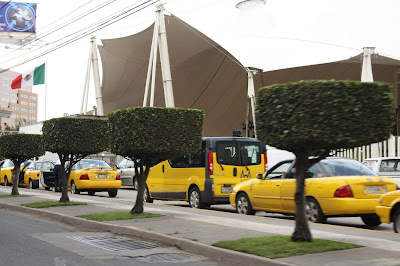
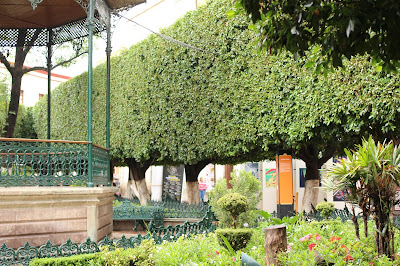
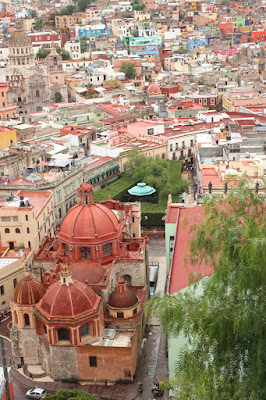
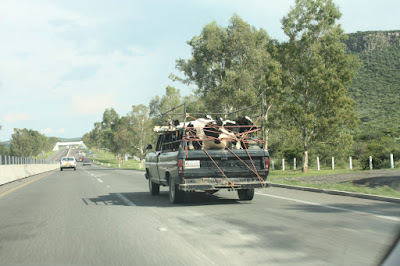
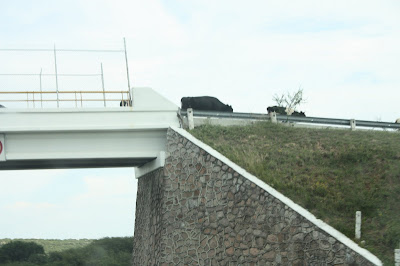
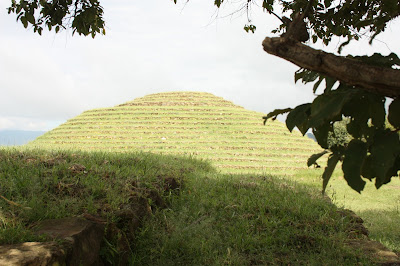
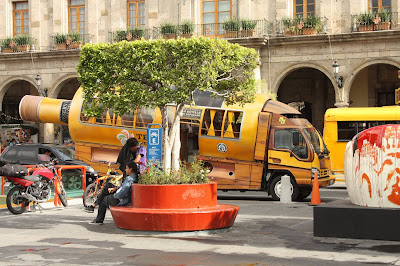
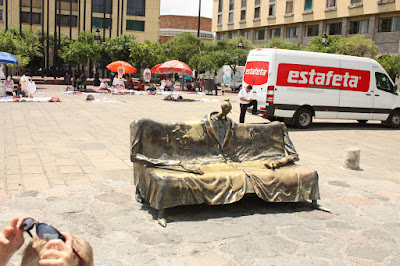
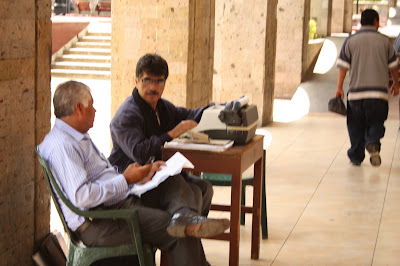
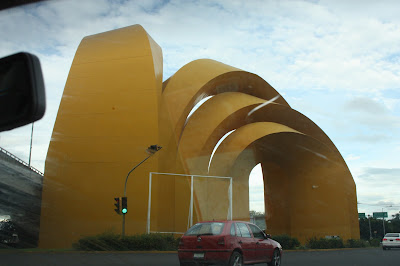
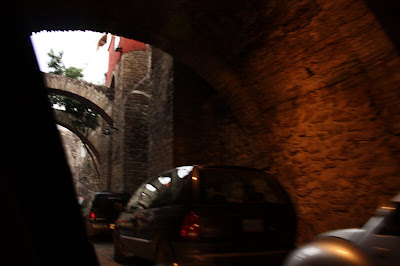
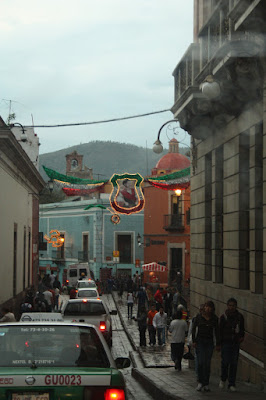
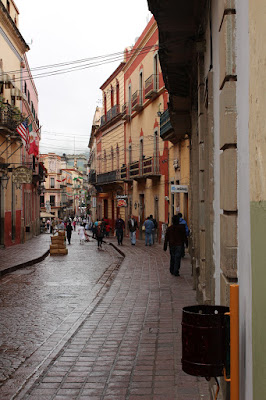
The fourth in a series; see also parts 1, 2, and 3. This post is going to be more a photolog than a narrative, and I apologize in advance for it being a bit disjointed. I ve already touched on these themes a bit in the other post, but now it s time to focus on them. Immediately after leaving the airport, it s quite clear that things are a little different. Trees are square. People ride around in the backs of pickups sometimes on top of piles of debris. Left turns are made in front of other lanes of traffic going the same way. But those are just the things obvious from the road. It s a lot of fun to enjoy the differences. First, the ubiquitous square trees. They look pretty, and are found all over. I also found carefully-manicured trees in cone shapes, more cylindrical shapes, etc. It seems that tree care is taken seriously in Mexico. It was also not uncommon to see the bottom few feet of a tree painted white. A park in Guanajuato had a whole bunch of trees carefully trimmed. And from up on the mountain, it still looked impressive (the green area behind the dome). Driving in Mexico was interesting for a lot of reasons. The highways there aren t quite as limited access as the freeways in the USA. It was quite common to see bicyclists, walkers, a mule, or some cattle ambling along the side of the road. Roadside taco stands don t require taking an exit. You just pull off the road because it s right there. Some sights were a bit surprising. Cattle in a pickup, with rope, for instance. Or cattle crossing the highway on the overpass. Street vendors were everywhere. Stop at a red light and someone might spring from the side of the road and suddenly start washing your windshield (expecting a tip); try to sell you flowers, juice, or bug zappers; or even throw business card-sized advertisements for adult websites into any open windows they can find. One night we saw an incredible fire juggler. I would have tipped him well but he was too far away to do so before the light turned green. Mexico s history stretches back into prehistoric times, and we saw the Teuchitlan ruins at Guachimontones one day. It was truly a remarkable feeling to be able to walk down the middle of the ancient ball court, or to climb up one pyramid and see the other from it. It s not exactly architecture, but Jacob and Oliver sure enjoyed visiting the hot springs at Bosque de la Primavera. Jacob still remembers that where the steam is, the water is 200 degrees, and we CAN T TOUCH IT THERE! Back in Guadalajara, here s a photo from the inside of the grand old cathedral. Compared to the cathedrals we saw in Europe, this was of a similar general size and design, and perhaps only slightly newer. But one big difference: worshipers outnumbered tourists at every Mexican cathedral I saw, whether in the center of Guadalajara or at a rainy intersection in Guanajuato or a plaza in Tlaquepaque. It made them feel more alive, and perhaps more sacred as well. One surprise was seeing people sitting on the steps of the cathedral in downtown Guadalajara selling trinkets such as beads. I think the only other place I had seen something like that was in New Orleans. All of Guadalajara s Centro was beautiful. Much of it survives from colonial days; I think a person could spend days exploring its museums and buildings. Way too many of my 900 photos were taken in Centro to post on the blog, but just for flavor, here s one of the less than historic scenes. Yes, that is a bus shaped like a tequila bottle. Fountains were beautiful and common across Mexico. A few of them were easily reachable by boys, and ours sure loved those. There was a lot of public art, including this interesting chair/skeleton/I m not sure what it is: And, just for good measure while walking around Centro, they tossed in an apparent Redundant Array of Inexpensive Typewriters. I don t know what they were doing, but there were about a dozen guys sitting out in the sun typing on their manual typewriters on their identical tables. And who can leave Guadalajara without seeing one of North America s most impressive traffic circles. I ve got to hand it to the Mexicans for making something that is normally really boring into an interesting work of art. Over in Guanajuato, a lot of driving takes place in the city s vast underground tunnel system. Here s a scene emerging from one of them. Guanajuato was already getting decorated for Mexican independence day festivities (Sept. 15-16) while we were there. Here s a typical Guanajuato street scene. Many of the streets were closed to traffic and perhaps not wide enough to handle vehicles anyway. Those streets had a wonderful peaceful and slow feel to them. I feel that I ve barely done the trip justice with this post. The feelings of walking down a beautiful Guanajuato street, or stepping into a Spanish cathedral, or even seeing a bunch of guys with typewriters, just can t be replicated. It s brimming with history and character, and shouldn t be missed.

9 September 2011

Wouter Verhelst: SSL and CAs

The CA model of SSL has always bothered me. The idea of a trusted third party feels eerily close to maffia security: you believe this person, whom you don't know, is who he claims he is on nothing more than the word of this other person, whom you also don't know. The DigiNotar story proves how problematic this model is, but you don't really need that to understand its problems. For the longest time, however, there simply was no better way to properly do these things. But now that we have DNSSEC, do we really still need CAs? Really? Can't we just store a fingerprint of a per-domain signing key in the forward (and, possibly, reverse) DNS zone of the host in question, have that signed by DNSSEC, and have the browser check the full DNS chain of the zones in question in addition to the signature on the certificate instead? I'm sure the CA business people would hate to see that happening, but really, paying someone so they say whatever you tell them to say? Try that in court, and they'd lock you up. Update: It's called the DANE protocol. No, that has nothing to do with Denmark: DANE stands for "DNS-based Authentication of Named Entities".

8 September 2011

Sylvain Beucler: Modern OpenGL lighting

The Modern OpenGL tutorials series continue - now with a first section on lighting, covering the different kind of lights (sun, hemi, spot, etc.) using a simple diffuse model and clear code.
http://en.wikibooks.org/wiki/OpenGL_Programming#The_lighting_arc
This one is derived from the excellent set of Blender GLSL tutorials by Martin Kraus. As usual, the documentation is CC-BY-SA/GFDL, and the code is in the public domain. We're also expecting another tutorial on scientific visualisation. [EDIT: lighNing->lighing - sorry for the typo :)]

Dirk Eddelbuettel: Faster (recursive) function calls: Another quick Rcpp case study

There was another question recently on StackOverflow that I had meant to discuss in a follow-up post here. User deltanovember asked about slow recursive functions and used the very classic Fibonacci number as an example. To recap, Fibonacci number are defined with two initial values F(0) = 0 and F(1) = 1; thereafter the Fibonacci number F(n) is defined as the sum of the two preceding numbers: F(n) = F(n-2) + F(n-1). This leads to very straightforward implementations using recursion:
## R implementation of recursive Fibonacci sequence
fibR <- function(n)  
    if (n == 0) return(0)
    if (n == 1) return(1)
    return (fibR(n - 1) + fibR(n - 2))
 
Unfortunately, this elegant implementation which remain close to the abtract formulation of the recurrence algorithm performs very poorly in R as there is noticeable overhead in function calls which becomes dominant in a recursion. This lead to the original question on StackOverflow, and the accepted answer uses a trick presented by Pat Burns in his lovely R Inferno: rewrite the solution using a computer science trick called memoization:
fibonacci <- local( 
    memo <- c(1, 1, rep(NA, 100))
    f <- function(x)  
        if(x == 0) return(0)
        if(x < 0) return(NA)
        if(x > length(memo))
        stop("'x' too big for implementation")
        if(!is.na(memo[x])) return(memo[x])
        ans <- f(x-2) + f(x-1)
        memo[x] <<- ans
        ans
     
 )
That is a fair answer, and even more was suggested with a link to a terrific analysis calling the Fibonacci recurrence the worst algorithm in the world. That is also fair, but all the basic research into better algorithms exploiting some structure of the problem to advance performance (and of course understanding) is overlooking one crucial part: algorithm analysis is essentially independent of the language. So whatever improvements we obtain by thinking really hard about a problem are then available for other implementations too. So with a tip of the hat to the old Larry Wall quote about Lazyness, Impatience and Hubris, I would like to suggest what I consider a much simpler route to much better performance: recode it in C++ using both Rcpp (for the R/C++ integration) and inline for the on-the-fly compilation, linking and loading of C++ code into R.
## inline to compile, load and link the C++ code
require(inline)
## we need a pure C/C++ function as the generated function
## will have a random identifier at the C++ level preventing
## us from direct recursive calls
incltxt <- '
  int fibonacci(const int x)  
     if (x == 0) return(0);
     if (x == 1) return(1);
     return (fibonacci(x - 1)) + fibonacci(x - 2);
   '
## now use the snippet above as well as one argument conversion
## in as well as out to provide Fibonacci numbers via C++
fibRcpp <- cxxfunction(signature(xs="int"),
                       plugin="Rcpp",
                       incl=incltxt,
                       body
                       ='
   int x = Rcpp::as<int>(xs);
   return Rcpp::wrap( fibonacci(x) );
')
This single R function call cxxfunction() takes the code embedded in the arguments to the body variable (for the core function) and the incltxt variable for the helper function we need to call. This helper function is needed for the recursion as cxxfunction() will use an randomized internal identifier for the function called from R preventing us from calling this (unknown) indentifier. But the rest of the algorithm is simple, and as beautiful as the initial recurrence. Three lines, three statements, and three cases for F(0), F(1) and the general case F(n) solved by recursive calls. This also illustrates how easy it is to get an integer from R to C++ and back: the as and wrap simply do the right thing converting to and from the SEXP types used internally by the C API of R. A performance comparison of the basic R version fibR, its byte-compiled variant fibRC and and the C++ version fibRcpp shown above is very compelling. We have added a file fibonacci.r to the large and still growing set of examples included with Rcpp, and we can just execute that script with Rscript or (as here) r from the littler package:
edd@max:~/svn/rcpp/pkg/Rcpp/inst/examples/Misc$ r fibonacci.r
Loading required package: inline
Loading required package: methods
Loading required package: compiler
        test replications elapsed relative user.self sys.self
3 fibRcpp(N)            1   0.092   1.0000      0.09     0.00
2   fibRC(N)            1  61.480 668.2609     61.47     0.00
1    fibR(N)            1  61.877 672.5761     61.83     0.02
edd@max:~/svn/rcpp/pkg/Rcpp/inst/examples/Misc$ 
So the recursion for the original argument of N=35 takes just over a minute at about 61.5 and 61.9 seconds, respectively, for the R version and its byte-compiled variant (as per the column titled elapsed). So byte-compilation essentially offers no help for the bottleneck of slow function calls. The C++ versions relying on Rcpp which created in a few lines of code and a single call to cxxfunction however takes just 92 milliseconds---or a relative gain of well over six-hundred times. That provides another nice demonstration of what Rcpp can do. Improved algorithms for well-understood problems are surely one way to accelerate solutions. But there are (many ?) times when we do not have the luxury of being able to think through to a new and improved approach. Or worse, such an approach may even introduce new errors or inaccurracies if we get it wrong on a first try. With Rcpp, we are able to the express the problem as written in its original statement: a simple recursion. The gain relative to a slow R implementation is noteworthy---and could of course be improved further if we really needed to by relying on better algorithms like memoization. But for day to day tasks, I gladly take speedups of (up to) a few hundred times thanks to Rcpp without having to do hard algorithmic work. Before closing, a quick reminder that I will be giving two classes on Rcpp in a few weeks. These will be in New York on September 24, and San Franciso on October 8, see this blog post as well as this page at Revolution Analytics (who are a co-organiser of the classes) for details and registration information.

Jose Luis Rivas Contreras: Moved from approx to apt-cacher-ng

I have been a long-time user of
approx
, I got used to it and knew how to configure it so all my machines + VMs used the same cache and saved me a lot of bandwidth. But that was when I got a stable connection at >100KiB/s in a daily-basis. Now I m with a mobile connection at <30KiB/s and sometimes is intermittent, so
approx
started giving me a lot of headaches. When
approx
tries to connect a host that can t be resolved its domain name, then gets 404. How does that reflects in the
/pool
? Well, you get a file
touch
d and 0 bytes size. When you try again,
approx
will find the same file with 0 bytes size and will gives you again a 404, even if you can now resolve the name address of that domain. And as I like to use what I know, then I made a workaround: Each time this happened I ran:
# find /var/cache/approx -size 0 xargs rm
So next time I requested a file to
approx
it tried to connect to the host. But I got tired. I installed
apt-cacher-ng
, tweaked a bit
/etc/apt-cacher-ng/acng.conf
so it uses port 9999 and the cache dir redirects to the same cache than
approx
and done.
apt-cacher-ng
returns 503 when it can t connect to the peer, even tries to several repositories with only a line in
/etc/apt/sources.list
in my clients. It makes me happy and keeps saving me a lot more of bandwidth than
approx
.

Stefano Zacchiroli: gnu hackers meeting 2011

report from GHM 2011 Debian and GNU have a lot in common: starting from the fact that strstr() applied to the respective project (full) names does not return NULL, up to the the common objective of building a UNIX-like operating system that grants fundamental software freedoms to its users. That is why I've been very pleased when the organizers of GNU Hackers Meeting 2011 (GHM) invited me to attend and speak about Debian and its relationships with GNU at the event. Slides of my talk are already available, while a video is being encoded (it will probably show up on both GHM homepage and IRILL website). Acknowledging the commonalities of goals on both Debian and GNU sides, we took the chance of this encounter to review how each project feel about relationships with the other (my original inquiries for the Debian community can be found on debian-project) and to talk it over during a discussion session scheduled to happen just after my talk. Yesterday, I've summarized all my notes from GHM 2011 in a report posted to debian-project. Quoting from there: After this experience, it is striking for me how much we have in common with GNU (ideally, culturally, socially, etc.) and at the same time how harsh can our "family battles" become at a times. Let's avoid that the remaining [few] differences get too much in the way [of collaboration], especially when that can be easily avoided. Enjoy!

Russell Coker: Moving from a Laptop to a Cloud Lifestyle

My Laptop History In 1998 I bought my first laptop, it was a Thinkpad 385XD, it had a PentiumMMX 233MHz CPU, 96M of RAM, and an 800*600 display. This was less RAM than I could have afforded in a desktop system and the 800*600 display didn t compare well to the 1280*1024 resolution 17 inch Trinitron monitor I had been using. Having only 1/3 the pixels is a significant loss and a 12.1 inch TFT display of that era compared very poorly with a good Trinitron monitor. In spite of this I found it a much better system to use because it was ALWAYS with me, I used it for many things that were probably better suited to a PDA (there probably aren t many people who have carried a 7.1 pound (3.2Kg) laptop to as many places as I did). But some of my best coding was done on public transport. But I didn t buy my first laptop for that purpose, I bought it because I was moving to another country and there just wasn t any other option for having a computer. In late 1999 I bought my second laptop, it was a Thinkpad 600E [1]. It had twice the CPU speed, twice the RAM, and a 1024*768 display that displayed color a lot better. Since then I had another three Thinkpads, a T21, a T43, and now a T61. One of the ways I measure a display is the number of 80*25 terminal windows that I can display at one time, my first Thinkpad could display four windows with a significant amount of overlap. My second could display four with little overlap, my third (with 1280*1024 resolution) could display four clearly and another two with overlap, and my current Thinkpad does 1680*1050 and can display four windows clearly and another five without excessive overlap. For most of the last 13 years my Thinkpads weren t that far behind what I could afford to get as a desktop system, until now. A Smart Phone as the Primary Computing Device For the past 6 months the Linux system I ve used most frequently is my Sony Ericsson Xperia X10 Android phone [2]. Most of my computer use is on my laptop, but the many short periods of time using my phone add up. This has forced some changes to the way I work. I now use IMAP instead of POP for receiving mail so I can use my phone and my laptop with the same mail spool. This is a significant benefit for my email productivity, instead of having 100 new mailing list messages waiting for me when I get home I can read them on my phone and then have maybe 1 message that can t be addressed without access to something better than a phone. My backlog of 10,000 unread mailing list messages lasted less than a month after getting an Android phone! A few years ago I got an EeePC 701 that I use for emergency net access when a server goes down. But even a 920g EeePC is more weight than I want to carry, as I need to have a mobile phone anyway there is effectively no extra mass or space used to have a phone capable of running a ssh client. My EeePC doesn t get much use nowadays. A Cheap 27 inch Monitor from Dell Dell Australia is currently selling a 27 inch monitor that does 2560*1440 (WQHD) for $899AU. Dell Australia offers a motor club discount which pretty much everyone in Australia can get as almost everyone is either a member of such a club or knows a member well enough to use their membership number for the discount. This discount reduces the price to $764.15. The availability of such a great cheap monitor has caused me to change my working habits. It doesn t make sense to have a reasonably powerful laptop used in one location for almost all the time when a desktop system with a much better monitor can be used. The Plan Now that my 27 inch monitor has arrived I have to figure out a way of making things work. I still need to work from a laptop on occasion but my main computer use is going to be a smart-phone and a desktop system. Email is already sorted out, I already have three IMAP client systems (netbook, laptop, and phone), adding a desktop system as a fourth isn t going to change anything. The next issue is software development. In the past I haven t used version control systems that much for my hobby work, I have just released a new version every time I had some significant changes. Obviously to support development on two or three systems I need to use a VCS rigorously. I m currently considering Subversion and Git. Subversion is really easy to use (for me), but it seems to be losing popularity. Git is really popular so if I use it for my own projects then I could allow anonymous access for anyone who s interested maybe that will encourage more people to contribute. One thing I haven t even investigated yet is how to manage my web browsing work-flow in a distributed manner. My pattern when using a laptop is to have many windows and tabs open at the same time for issues that I am researching and to only close them days or weeks later when I have finished with the issue. For example if I m buying some new computer gear I will typically open a web browser window with multiple tabs related to the equipment (hardware, software, prices, etc) and keep them all open until I have received it and got it working. Chromium, Mozilla, and presumably other modern web browsers have a facility to reopen windows after a crash. It would be ideal for me if there was some sort of similar facility that allowed me to open the windows that are open on another system and to push window open commands to another system. For example when doing web browsing on my phone I would like to be able to push the URLs of pages that can t be viewed on a phone to my desktop system and have them open waiting for me when I get home. It would be nice if web browsing could be conceptually similar to a remote desktop service in terms of what the user sees. Finally in my home directory there are lots of random files. Probably about half of them could be deleted if I was more organised (disk space is cheap and most of the files are small). For the rest it would be good if they could be accessed from other locations. I have read about people putting the majority of their home directory under version control, but I m not sure that would work well for me. It would be good if I could do something similar with editor sessions, if I had a file open in vi on my desktop before I left home it would be good if I could get a session on my laptop to open the same file (well the same named file checked out of the VCS). Configuring the Desktop System One of the disadvantages of a laptop is that RAID usually isn t viable. With a desktop system software RAID-1 is easy to configure but it results in two disks making heat and noise. For my new desktop system I m thinking of using a DRBD device for /home to store the data locally as well as almost instantly copying it to RAID-1 storage on the server. The main advantage of DRBD over NFS, NBD, and iSCSI is that I can keep working if the server becomes unavailable (EG use the desktop system to ask Google how to fix a server fault). Also with DRBD it s a configuration option to allow synchronous writes to return after the data is written locally which is handy if the server is congested. Another option that I m considering is a diskless system using NBD or iSCSI for all storage. This will prevent using swap (you can t swap to a network device to avoid deadlocks) but that won t necessarily be a problem given the decrease in RAM prices as I can just buy enough RAM to not need swap. The Future Eventually I want to be able to use a tablet for almost everything including software development. While a tablet display isn t going to be great for coding I m sure that I can make use of enough otherwise wasted time to justify the expense. I will probably need a tablet that acts like a regular Linux computer not an Android tablet.

7 September 2011

Soeren Sonnenburg: Shogun at Google Summer of Code 2011

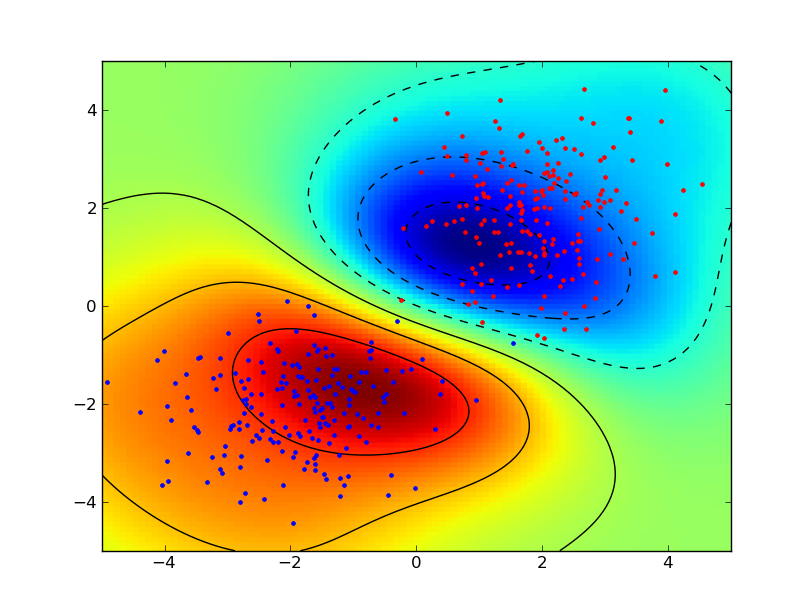
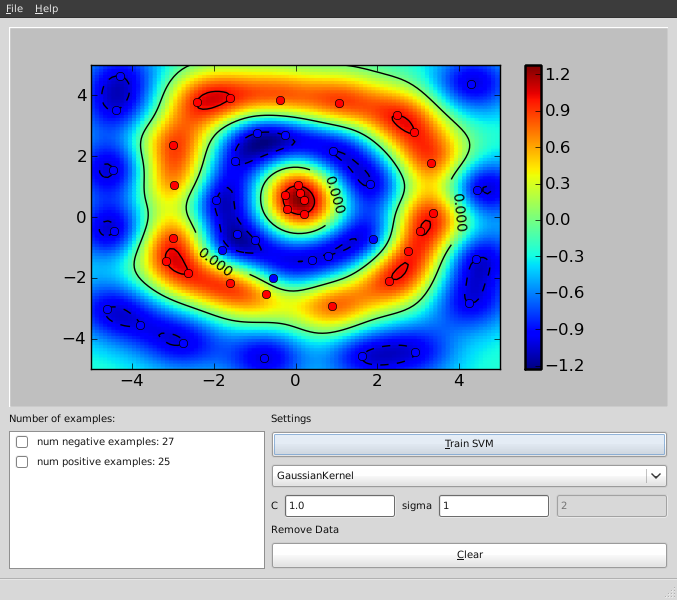
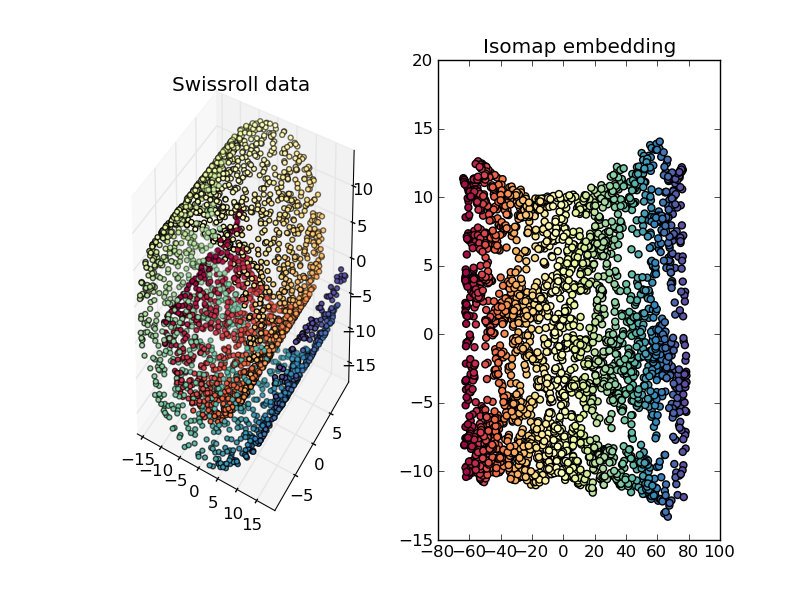
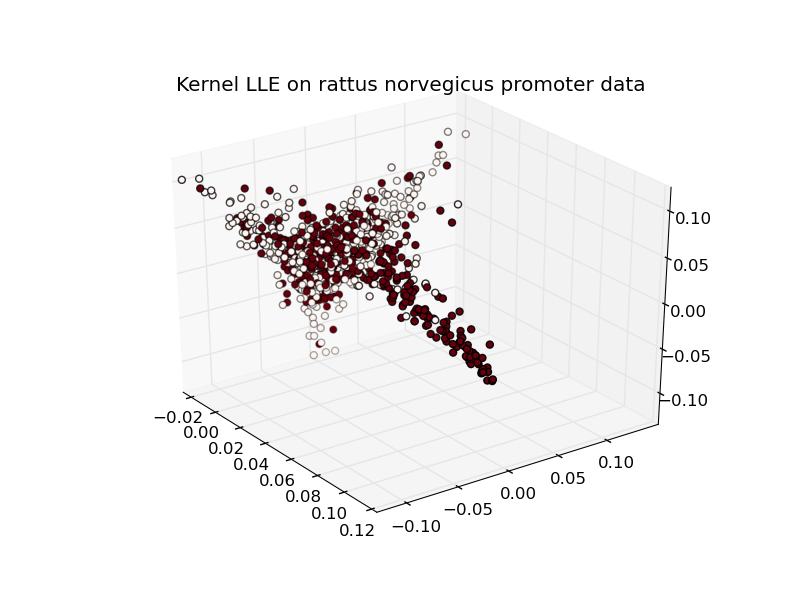
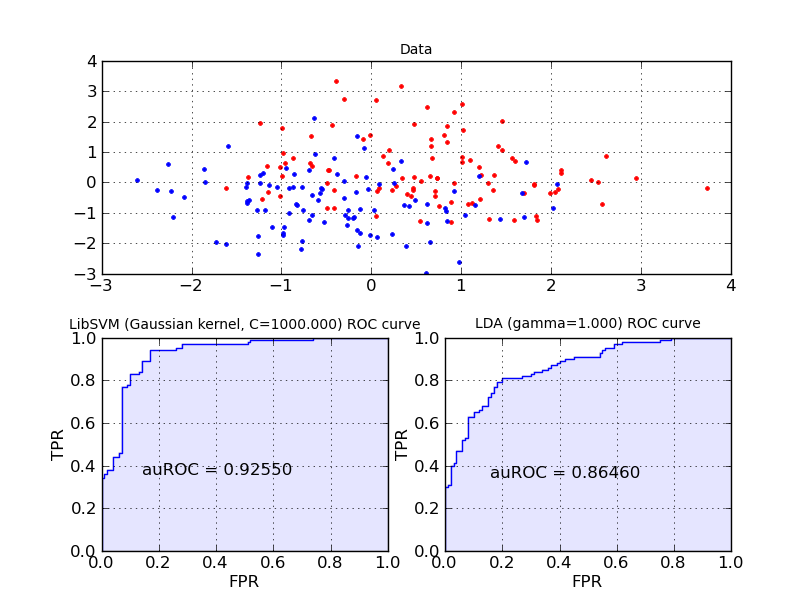
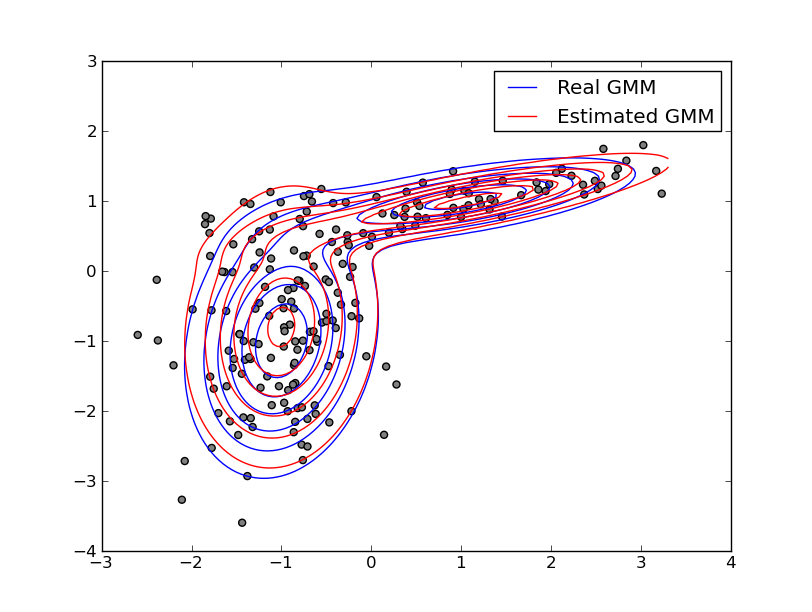
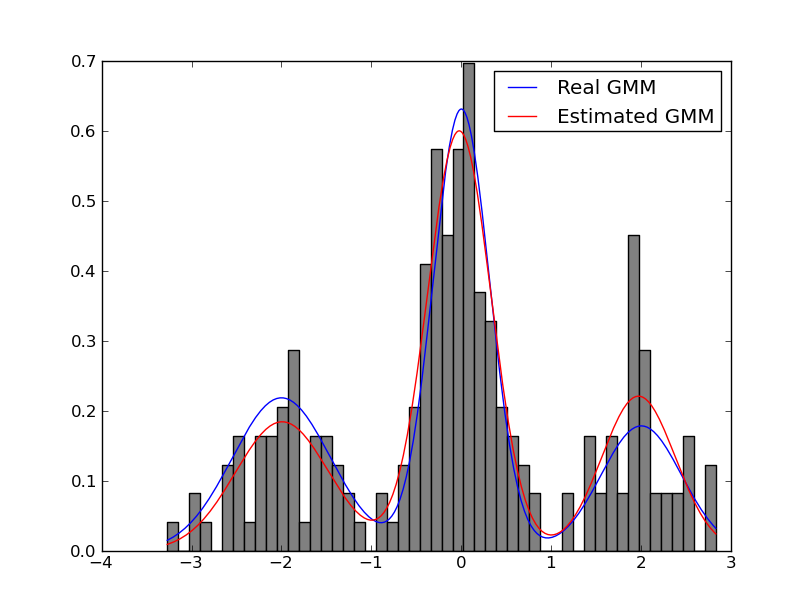
Google Summer of Code 2011 gave a big boost to the development of the shogun machine learning toolbox. In case you have never heard of shogun or machine learning: Machine Learning involves algorithms that do intelligent'' and even automatic data processing and is nowadays used everywhere to e.g. do face detection in your camera, compress the speech in you mobile phone, powers the recommendations in your favourite online shop, predicts solulabily of molecules in water, the location of genes in humans, to name just a few examples. Interested? Then you should give it a try. Some very simple examples stemming from a sub-branch of machine learning called supervised learning illustrate how objects represented by two-dimensional vectors can be classified in good or bad by learning a so called support vector machine. I would suggest to install the python_modular interface of shogun and to run the example interactive_svm_demo.py also included in the source tarball. Two images illustrating the training of a support vector machine follow (click to enlarge): svm svm interactive Now back to Google Summer of Code: Google sponsored 5 talented students who were working hard on various subjects. As a result we now have a new core developer and various new features implemented in shogun: Interfaces to new languages like java, c#, ruby, lua written by Baozeng; A model selection framework written by Heiko Strathman, many dimension reduction techniques written by Sergey Lisitsyn, Gaussian Mixture Model estimation written by Alesis Novik and a full-fledged online learning framework developed by Shashwat Lal Das. All of this work has already been integrated in the newly released shogun 1.0.0. In case you want to know more about the students projects continue reading below, but before going into more detail I would like to summarize my experience with GSoC 2011. My Experience with Google Summer of Code We were a first time organization, i.e. taking part for the first time in GSoC. Having received many many student applications we were very happy to hear that we at least got 5 very talented students accepted but still had to reject about 60 students (only 7% acceptance rate!). Doing this was an extremely tough decision for us. Each of us ended up in scoring students even then we had many ties. So in the end we raised the bar by requiring contributions even before the actual GSoC started. This way we already got many improvements like more complete i/o functions, nicely polished ROC and other evaluation routines, new machine learning algorithms like gaussian naive bayes and averaged perceptron and many bugfixes. The quality of the contributions and independence of the student aided us coming up with the selection of the final five. I personally played the role of the administrator and (co-)mentor and scheduled regular (usually) monthly irc meetings with mentors and students. For other org admins or mentors wanting into GSoC here come my lessons learned: Now please read on to learn about the newly implemented features: Dimension Reduction Techniques Sergey Lisitsyn (Mentor: Christian Widmer) Dimensionality reduction is the process of finding a low-dimensional representation of a high-dimensional one while maintaining the core essence of the data. For one of the most important practical issues of applied machine learning, it is widely used for preprocessing real data. With a strong focus on memory requirements and speed, Sergey implemented the following dimension reduction techniques: See below for the some nice illustrations of dimension reduction/embedding techniques (click to enlarge). isomap swissrollrno kllelocal tangent space alignment Cross-Validation Framework Heiko Strathmann (Mentor: Soeren Sonnenburg) Nearly every learning machine has parameters which have to be determined manually. Before Heiko started his project one had to manually implement cross-validation using (nested) for-loops. In his highly involved project Heiko extend shogun's core to register parameters and ultimately made cross-validation possible. He implemented different model selection schemes (train,validation,test split, n-fold cross-validation, stratified cross-validation, etc and did create some examples for illustration. Note that various performance measures are available to measure how good'' a model is. The figure below shows the area under the receiver operator characteristic curve as an example. foo Interfaces to the Java, C#, Lua and Ruby Programming Languages Baozeng (Mentor: Mikio Braun and Soeren Sonnenburg) Boazeng implemented swig-typemaps that enable transfer of objects native to the language one wants to interface to. In his project, he added support for Java, Ruby, C# and Lua. His knowlegde about swig helped us to drastically simplify shogun's typemaps for existing languages like octave and python resolving other corner-case type issues. The addition of these typemaps brings a high-performance and versatile machine learning toolbox to these languages. It should be noted that shogun objects trained in e.g. python can be serialized to disk and then loaded from any other language like say lua or java. We hope this helps users working in multiple-language environments. Note that the syntax is very similar across all languages used, compare for yourself - various examples for all languages ( python, octave, java, lua, ruby, and csharp) are available. Largescale Learning Framework and Integration of Vowpal Wabbit Shashwat Lal Das (Mentor: John Langford and Soeren Sonnenburg) Shashwat introduced support for 'streaming' features into shogun. That is instead of shogun's traditional way of requiring all data to be in memory, features can now be streamed from e.g. disk, enabling the use of massively big data sets. He implemented support for dense and sparse vector based input streams as well as strings and converted existing online learning methods to use this framework. He was particularly careful and even made it possible to emulate streaming from in-memory features. He finally integrated (parts of) vowpal wabbit, which is a very fast large scale online learning algorithm based on SGD. Expectation Maximization Algorithms for Gaussian Mixture Models Alesis Novik (Mentor: Vojtech Franc) The Expectation-Maximization algorithm is well known in the machine learning community. The goal of this project was the robust implementation of the Expectation-Maximization algorithm for Gaussian Mixture Models. Several computational tricks have been applied to address numerical and stability issues, like An illustrative example of estimating a one and two-dimensional Gaussian follows below. 1D GMM2D GMM Final Remarks All in all, this year s GSoC has given the SHOGUN project a great push forward and we hope that this will translate into an increased user base and numerous external contributions. Also, we hope that by providing bindings for many languages, we can provide a neutral ground for Machine Learning implementations and that way bring together communities centered around different programming languages. All that s left to say is that given the great experiences from this year, we d be more than happy to participate in GSoC2012.

6 September 2011

Lars Wirzenius: Entropy key: a review

I recently bought a Simtec Entropy Key. It's a hardware randomness generator encapsulated as a USB device, the size of a flash drive. It's good for any host or cluster that uses a lot of kernel-provided random numbers (/dev/random), or does things that cause the kernel to use a lot of random numbers. Opening a lot of network connections, or generating session keys for public key encryption. That kind of stuff. If the kernel has too little entropy available to generate good random numbers, things will stall until it gets some more. The ekey gives you real random bits, not just software-produced pseudo-random numbers. In other words, it's some kind of magic. I got the device in a DVD box, with a leaflet explaining how to install stuff, a CD with the software, an envelope with a secret key, and the actual device itself. I read the leaflet, which said to install the ekeyd daemon first. I ignored the CD, since a) my laptop has no optical drive and b) the software is in Debian stable (squeeze) anyway, so apt-getting it is easier and faster. I was utterly disappointed with the software. I didn't have to edit a single hard disk sector, or do a BIOS upgrade, or anything. Utterly, totally, boring. I had reserved an afternoon and evening for this, but I had to find something else to do instead. After plugging in the device in a spare USB port, I opened the envelope and ran a command to specify the secret key. The key and host processors use encryption to make sure nobody can eavesdrop on the randomness -- that would give them an edge in cracking SSL and GPG encryption, I guess. Here's an example of how it works. Before I plug in the device, the kernel has some, but not too much entropy available:
liw@havelock$ cat /proc/sys/kernel/random/entropy_avail 
1053
A few seconds after the ekey is inserted:
liw@havelock$ cat /proc/sys/kernel/random/entropy_avail 
3968
And here's the kicker: pretty much regardless of what I do, the entropy stays at about 4 kilounits (I don't know if it's bits or bytes, and I'm too lazy to check). In the end, the only thing I can really complain about is the typography and layout of the leaflet. The text is clear enough, but it's laid out too densely. It needs more whitespace. Some pictures of bunnies or kittens would be nice, too.

5 September 2011

Steve Kemp: Scriptable email clients

This is just a quick post to remind myself in the morning, as soon as I've made it I intend to turn my computer off and leave it off until I can re-organize my office. I've been using mutt for my email for the past few years. Nothing compares to the flexibility of procmail/sieve for organizing server-side mail, and then mutt is ideal for reading them. With the addition of the mutt-patched sidebar mode you can even go for a few days before realizing you're not in a graphical environment. But one thing I do long for is the ability to execute scripts at various times. Thus far I've not actually planned what I'd like to do, but as a starting point imagine being able to execute a hook when new mail arrives? Or when you send a message matching a pattern in some fashion? There are some things out there, such as the various hacks which are designed to abort sending a message if you mention "See attachment" in a message body but fail to add one before sendign the message. These hacks generally abuse the sendmail configuration such that they're extremely ad-hoc and hard to chain/nest. I've mellowed out over the years and I have no interest in attempting to write a mail-client (though at the same time how hard can it be? Just restrict yourself to using inotify on ~/Maildir and offload delivery to exim and you're almost done? I guess the hard part is the UI, though I do like the mutt + sidebar layout. Write the whole thing in some scripty language?) I'll re-examine notmuch and gnus over the next week or two, but I suspect both will continue to disappoint in various ways. Anyway, for the moment I'm just pondering. But threading is an obvious concern. Most current mutt hooks relate to the local folder, or the local message. If I were viewing a message in one directory and a new mail notification fired for a delivery to both ~/Maildir and ~/Maildir/.people.foo I'd need to either serialise them or thread them. Ponder ponder. In other news I've been doing more photography recently. Nothing cohesive except for my recent experiment with shooting a "street-girl" outdoors in falling light, but that was an interesting challenge and the results were sufficient to make me want to try shooting outdoors in an organized fashion again. (Some random images have been linked to from my wee twitter page.) ObFilm: "She doesn't get eaten by the eels at this time " - The Princess Bride

Andrew Pollock: [life] Four years later

I'm not very good with dates. For the last two years now, Joshua's anniversary has snuck up on me and caught me by surprise. I don't think that I'd really appreciated until this year that we lost him on the Labor Day long weekend. I'll have to remember that for next year so I don't forget. I don't know what my problem was this year. I just didn't realise that it was this early in September that we lost him. Last year I was just too exhausted from dealing with a new baby to realise when his anniversary was, and I felt terrible for missing it. This year, I just felt terrible for not realising when it was, but at least Sarah pointed it out before the fact. For added irony, the 4th of September this year is Father's Day in Australia. Yesterday, I was looking at photos of Joshua to remember him, and Gallery gave me a random photo of Zoe in the corner. That was something. I'm not sure what. I feel like Zoe being a wonderful child is some sort of consolation prize from the universe for taking Joshua, but I often wonder what Joshua would be like today if he were almost four.

4 September 2011

Sylvain Beucler: Modern OpenGL lightning

The Modern OpenGL tutorials series continue - now with a first section on lightning, covering the different kind of lights (sun, hemi, spot, etc.) using a simple diffuse model and clear code.
http://en.wikibooks.org/wiki/OpenGL_Programming#The_lightning_arc
This one is derived from the excellent set of Blender GLSL tutorials by Martin Kraus. As usual, the documentation is CC-BY-SA/GFDL, and the code is in the public domain. We're also expecting another tutorial on scientific visualisation.

3 September 2011

Benjamin Mako Hill: In Defense of Negativity

I often hear criticism of "negative campaigning" in the free software movement. For example, in reply to a blog post I once wrote about an FSF campaign, several people argued against, "negative campaigning of any sort, in any realm." Drawing an analogy to political smear campaigns, some members of the free software community have taken the position that negative campaigning in general is not useful and that negativity has no place in our advocacy. First, it is important to be clear on what we mean by a negative campaigns. I believe that there is a fundamental difference between speaking out against policies or actions and smear campaigns that employ untrue claims, ad hominem attacks, and that attempt to avoid a real conversation about issues. I will categorically condemn the latter form of smear campaigning in campaigns for software freedom or for anything else. That said, negativity directed at negativity has had a positive effect in many social movements. I have supported and participated in "negative" campaigns against proprietary software, software patents, DRM, centralized network services, and the firms behind these practices. I've done so because I believe that if one is taking an ethical position, it is justified, and often necessary, to not only speak about the benefits of freedom but against acts of dispossession and disenfranchisement. In some of the most effective social movements, unambiguously negative messages have been central. Should a campaign for abolishing child labor talk only about how valuable adult workers are to their employers or how happy kids are when they don't work? Should a campaign trying to abolish land mines talk only about the benefits of bomb-free fields and intact lower limbs? Should a free speech organization only speak out about the social welfare brought by a free press and never against acts of censorship? These may seem like outlandish comparisons but you can find people writing, only a couple centuries ago, about how slavery should be abolished by arguing in favor of the benefits of paid labor. Even if the economic arguments in favor of paid work are strong, these arguments seems irrelevant and offensive today. Whether slavery is more or less efficient is a moot point. Society has rejected it because it is wrong. We have made important strides toward eliminating injustices like child labor and slavery because activists waged decidedly negative campaigns against them and convinced others to join in opposition. In doing so, activists declared the status quo unconscionable and created an ethical responsibility to find alternatives and to redefine what was "realistic." While I will not suggest that the movement for software freedom is comparable in ethical weight to these other causes, I know that the free software mission is similar in kind. Of course, if one does not think that user control over technology is an ethical issue but is instead merely a matter of choice, one will probably oppose negative campaigns. It is also possible that a particular negative campaign is tactically unwise in that it is unlikely to reach a large audience, unlikely to change people's minds, or be difficult to carry out successfully. But such campaigns are a bad idea because they are ineffective, not because they are negative. Additionally, a movement that is purely negative and offers no reasonable alternative to the stated ill may also be unlikely to succeed. This is why, for example, I believe it is good that the FSF uses the large majority of its resources in the "positive" role of supporting free software. For those that do treat technological empowerment as an ethical ideal, it is both justified and essential to condemn the systematic disempowerment of others through non-free software just as we celebrate the benefits of software freedom. "Negative" campaigns against proprietary software, software patents, and DRM in music have already led our community to important -- if incomplete -- victories. The desire to right wrongs has been a critical part of our movement's success and of many others'. We would be wise not to give it up.

Tanguy Ortolo: Repacking ZIP-based containers

An open package showing two egg-like objects Several modern complex file formats are based on a ZIP container: this is at least the case of OpenDocument and EPUB. However, they are not simply a bunch of files joined into an archive, but they follow some rules in order to be easily recognized by tools such as file. As I had to unpack, modify and repack such a container, here is a recipe to do that.The zip command is flexible enough to allow you to work in place (I am not sure that it is really in place) to add, remove and replace files in the archive, however I find it more convenient to work on the unpacked tree and repack later. Unpack and work To unpack, just unzip, being aware that these containers do not have a root directory, so it is better to extract them to a dedicated directory. Modify as you wish; if you add, remove or replace files, remember that there is a file list to modify accordingly: META-INF/manifest.xml for OpenDocument, OEBPS/content.opf and possibly OEBPS/toc.ncx for EPUB. Repack To repack, you must create a ZIP archive without extra file attributes, and put the file mimetype uncompressed in first position. Its goal is to be visible as plain text at a fixed position, to serve as a magic file type indication. The remaining files can be stored compressed and in random order. For an EPUB, for instance, this gives the following commands:
% zip --no-extra --compression-method store ../book.epub mimetype
% zip --recurse-paths ../book.epub META-INF OEBPS
This could be automated by a dedicated script, but I felt no need to write one yet. By the way, these options can be abbreviated as -X0 and -r.

31 August 2011

David Welton: Pranks that are actually funny

I saw this link on Hacker News:
http://techcrunch.com/2011/08/30/speaking-of-dropbox-heres-my-no-1-phone-prank/

And couldn't help but thinking it was singularly unfunny. He changed the guy's password - ha ha! I'm sure most people can do better. Here's one off the top of my head: I was due to leave a company in a few days, prior to our move to Austria. One of my colleagues in the programming department was tasked, in that period, with doing a bunch of work with Drupal, which he found singularly unpleasant and a pain in the neck to work with, which was compounded by the boss asking often about the status of the project. My colleague tended to be an early riser and would get into the office to get some work done early, before it got noisy and people started hassling him about this, that or the other thing. So on my soon-to-be-abandoned workstation, I set up a cron job that would, during those hours, randomly play a sound file I recorded while he was out, with my impression of a ghostly voice saying "druuuuuuuppaaaaaaallll". He said it scared the pants off him the first couple of times it went off.

Next.

Previous.