Search Results: "bod"

6 October 2011

Colin Watson: Top ideas on Ubuntu Brainstorm (August 2011)

The Ubuntu Technical Board conducts a regular review of the most popular Ubuntu Brainstorm ideas (previous reviews conducted by Matt Zimmerman and Martin Pitt). This time it was my turn. Apologies for the late arrival of this review. Contact lens in the Unity Dash (#27584) Unity supports Lenses, which provide a consistent way for users to quickly search for information via the Dash. Current lenses include Applications, Files, and Music, but a number of people have asked for contacts to be accessible using the same interface. While Canonical's DX team isn't currently working on this for Ubuntu 11.10 or 12.04, we'd love somebody who's interested in this to get involved. Allison Randal explains how to get started, including some skeleton example code and several useful links. Displaying Ubuntu version information (#27460) Several people have asked for it to be more obvious what Ubuntu version they're running, as well as other general information about their system. John Lea, user experience architect on the Unity team, responds that in Ubuntu 11.10 the new LightDM greeter shows the Ubuntu version number, making that basic information very easily visible. For more detail, System Settings -> System Info provides a simple summary. Volume adjustments for headphone use (#27275) People often find that they need to adjust their sound volume when plugging in or removing headphones. It seems as though the computer ought to be able to remember this kind of thing and do it automatically; after all, a major goal of Ubuntu is to make the desktop Just Work. David Henningson, a member of Canonical's OEM Services group and an Ubuntu audio developer, responds on his blog with a summary of how PulseAudio jack detection has improved matters in Ubuntu 11.10, and what's left to do:
The good news: in the upcoming Ubuntu Oneiric (11.10), this is actually working. The bad news: it isn't working for everyone.
Making it easier to find software to handle a file (#28148) Ubuntu is not always as helpful as it could be when you don't have the right software installed to handle a particular file. Michael Vogt, one of the developers of the Ubuntu Software Center, responded to this. It seems that most of the pieces to make this work nicely are in place, but there are a few more bits of glue required:
Thanks a lot for this suggestion. I like the idea and it's something that software-center itself supports now. In the coming version 5.0 we will offer to "sort by top-rated" (based on the ratings&reviews data). It's also possible to search for an application based on its mime data. To search for a mime-type, you can enter "mime:text/html" or "mime:audio/ogg" into the search field. What is needed however is better integration into the file manager nautilus. I will make sure this gets attention at the next developer meeting and filed bug #860536 about it. In nautilus, there is now a button called "Find applications online" available as an option when opening an unknown file or when the user selects "open with...other application" in the context menu. But that will not use the data from software-center.
Show pop-up alert on low battery (#28037) Some users have reported on Brainstorm that they are not alerted frequently enough when their laptop's battery is low, as they clearly ought to be. This is an odd one, because there are already several power alert levels and this has been working well for us for some time. Nevertheless, enough people have voted for this idea that there must be something behind it, perhaps a bug that only affects certain systems. Martin Pitt, technical lead of the Ubuntu desktop team, has responded directly to the Brainstorm idea with a description of the current system and how to file a bug when it does not work as intended.

4 October 2011

Emanuele Rocca: Gospel according to Tux

Some years ago I came across a really peculiar newsgroup post. It was not about technicalities of any sort. It was about history. A beautifully written history of computers. From the Turing machine to the Free Software world, the original author managed to capture all the important events of the computer revolution with a great deal of humor. Re-posting it here, it is just brilliant. The Gospel of Tux (v1.0) In the beginning Turing created the Machine. And the Machine was crufty and bodacious, existing in theory only. And von Neumann looked upon the Machine, and saw that it was crufty. He divided the Machine into two Abstractions, the Data and the Code, and yet the two were one Architecture. This is a great Mystery, and the beginning of wisdom. And von Neumann spoke unto the Architecture, and blessed it, saying, Go forth and replicate, freely exchanging data and code, and bring forth all manner of devices unto the earth. And it was so, and it was cool. The Architecture prospered and was implemented in hardware and software. And it brought forth many Systems unto the earth. The first Systems were mighty giants; many great works of renown did they accomplish. Among them were Colossus, the codebreaker; ENIAC, the targeter; EDSAC and MULTIVAC and all manner of froody creatures ending in AC, the experimenters; and SAGE, the defender of the sky and father of all networks. These were the mighty giants of old, the first children of Turing, and their works are written in the Books of the Ancients. This was the First Age, the age of Lore. Now the sons of Marketing looked upon the children of Turing, and saw that they were swift of mind and terse of name and had many great and baleful attributes. And they said unto themselves, Let us go now and make us Corporations, to bind the Systems to our own use that they may bring us great fortune. With sweet words did they lure their customers, and with many chains did they bind the Systems, to fashion them after their own image. And the sons of Marketing fashioned themselves Suits to wear, the better to lure their customers, and wrote grave and perilous Licenses, the better to bind the Systems. And the sons of Marketing thus became known as Suits, despising and being despised by the true Engineers, the children of von Neumann. And the Systems and their Corporations replicated and grew numerous upon the earth. In those days there were IBM and Digital, Burroughs and Honeywell, Unisys and Rand, and many others. And they each kept to their own System, hardware and software, and did not interchange, for their Licences forbade it. This was the Second Age, the age of Mainframes. Now it came to pass that the spirits of Turing and von Neumann looked upon the earth and were displeased. The Systems and their Corporations had grown large and bulky, and Suits ruled over true Engineers. And the Customers groaned and cried loudly unto heaven, saying, Oh that there would be created a System mighty in power, yet small in size, able to reach into the very home! And the Engineers groaned and cried likewise, saying, Oh, that a deliverer would arise to grant us freedom from these oppressing Suits and their grave and perilous Licences, and send us a System of our own, that we may hack therein! And the spirits of Turing and von Neumann heard the cries and were moved, and said unto each other, Let us go down and fabricate a Breakthrough, that these cries may be stilled. And that day the spirits of Turing and von Neumann spake unto Moore of Intel, granting him insight and wisdom to understand the future. And Moore was with chip, and he brought forth the chip and named it 4004. And Moore did bless the Chip, saying, Thou art a Breakthrough; with my own Corporation have I fabricated thee. Thou thou art yet as small as a dust mote, yet shall thou grow and replicate unto the size of a mountain, and conquer all before thee. This blessing I give unto thee: every eighteen months shall thou double in capacity, until the end of the age. This is Moore s Law, which endures unto this day. And the birth of 4004 was the beginning of the Third Age, the age of Microchips. And as the Mainframes and their Systems and Corporations had flourished, so did the Microchips and their Systems and Corporations. And their lineage was on this wise: Moore begat Intel. Intel begat Mostech, Zilog and Atari. Mostech begat 6502, and Zilog begat Z80. Intel also begat 8800, who begat Altair; and 8086, mother of all PCs. 6502 begat Commodore, who begat PET and 64; and Apple, who begat 2. (Apple is the great Mystery, the Fruit that was devoured, yet bloomed again.) Atari begat 800 and 1200, masters of the game, who were destroyed by Sega and Nintendo. Xerox begat PARC. Commodore and PARC begat Amiga, creator of fine arts; Apple and PARC begat Lisa, who begat Macintosh, who begat iMac. Atari and PARC begat ST, the music maker, who died and was no more. Z80 begat Sinclair the dwarf, TRS-80 and CP/M, who begat many machines, but soon passed from this world. Altair, Apple and Commodore together begat Microsoft, the Great Darkness which is called Abomination, Destroyer of the Earth, the Gates of Hell. Now it came to pass in the Age of Microchips that IBM, the greatest of the Mainframe Corporations, looked upon the young Microchip Systems and was greatly vexed. And in their vexation and wrath they smote the earth and created the IBM PC. The PC was without sound and colour, crufty and bodacious in great measure, and its likeness was a tramp, yet the Customers were greatly moved and did purchase the PC in great numbers. And IBM sought about for an Operating System Provider, for in their haste they had not created one, nor had they forged a suitably grave and perilous License, saying, First we will build the market, then we will create a new System, one in our own image, and bound by our Licence. But they reasoned thus out of pride and not wisdom, not forseeing the wrath which was to come. And IBM came unto Microsoft, who licensed unto them QDOS, the child of CP/M and 8086. (8086 was the daughter of Intel, the child of Moore). And QDOS grew, and was named MS-DOS. And MS-DOS and the PC together waxed mighty, and conquered all markets, replicating and taking possession thereof, in accordance with Moore s Law. And Intel grew terrible and devoured all her children, such that no chip could stand before her. And Microsoft grew proud and devoured IBM, and this was a great marvel in the land. All these things are written in the Books of the Deeds of Microsoft. In the fullness of time MS-DOS begat Windows. And this is the lineage of Windows: CP/M begat QDOS. QDOS begat DOS 1.0. DOS 1.0 begat DOS 2.0 by way of Unix. DOS 2.0 begat Windows 3.11 by way of PARC and Macintosh. IBM and Microsoft begat OS/2, who begat Windows NT and Warp, the lost OS of lore. Windows 3.11 begat Windows 95 after triumphing over Macintosh in a mighty Battle of Licences. Windows NT begat NT 4.0 by way of Windows 95. NT 4.0 begat NT 5.0, the OS also called Windows 2000, The Millenium Bug, Doomsday, Armageddon, The End Of All Things. Now it came to pass that Microsoft had waxed great and mighty among the Microchip Corporations; mighter than any of the Mainframe Corporations before it had it waxed. And Gates heart was hardened, and he swore unto his Customers and their Engineers the words of this curse: Children of von Neumann, hear me. IBM and the Mainframe Corporations bound thy forefathers with grave and perilous Licences, such that ye cried unto the spirits of Turing and von Neumann for deliverance. Now I say unto ye: I am greater than any Corporation before me. Will I loosen your Licences? Nay, I will bind thee with Licences twice as grave and ten times more perilous than my forefathers. I will engrave my Licence on thy heart and write my Serial Number upon thy frontal lobes. I will bind thee to the Windows Platform with cunning artifices and with devious schemes. I will bind thee to the Intel Chipset with crufty code and with gnarly APIs. I will capture and enslave thee as no generation has been enslaved before. And wherefore will ye cry then unto the spirits of Turing, and von Neumann, and Moore? They cannot hear ye. I am become a greater Power than they. Ye shall cry only unto me, and shall live by my mercy and my wrath. I am the Gates of Hell; I hold the portal to MSNBC and the keys to the Blue Screen of Death. Be ye afraid; be ye greatly afraid; serve only me, and live. And the people were cowed in terror and gave homage to Microsoft, and endured the many grave and perilous trials which the Windows platform and its greatly bodacious Licence forced upon them. And once again did they cry to Turing and von Neumann and Moore for a deliverer, but none was found equal to the task until the birth of Linux. These are the generations of Linux: SAGE begat ARPA, which begat TCP/IP, and Aloha, which begat Ethernet. Bell begat Multics, which begat C, which begat Unix. Unix and TCP/IP begat Internet, which begat the World Wide Web. Unix begat RMS, father of the great GNU, which begat the Libraries and Emacs, chief of the Utilities. In the days of the Web, Internet and Ethernet begat the Intranet LAN, which rose to renown among all Corporations and prepared the way for the Penguin. And Linus and the Web begat the Kernel through Unix. The Kernel, the Libraries and the Utilities together are the Distribution, the one Penguin in many forms, forever and ever praised. Now in those days there was in the land of Helsinki a young scholar named Linus the Torvald. Linus was a devout man, a disciple of RMS and mighty in the spirit of Turing, von Neumann and Moore. One day as he was meditating on the Architecture, Linus fell into a trance and was granted a vision. And in the vision he saw a great Penguin, serene and well-favoured, sitting upon an ice floe eating fish. And at the sight of the Penguin Linus was deeply afraid, and he cried unto the spirits of Turing, von Neumann and Moore for an interpretation of the dream. And in the dream the spirits of Turing, von Neumann and Moore answered and spoke unto him, saying, Fear not, Linus, most beloved hacker. You are exceedingly cool and froody. The great Penguin which you see is an Operating System which you shall create and deploy unto the earth. The ice-floe is the earth and all the systems thereof, upon which the Penguin shall rest and rejoice at the completion of its task. And the fish on which the Penguin feeds are the crufty Licensed codebases which swim beneath all the earth s systems. The Penguin shall hunt and devour all that is crufty, gnarly and bodacious; all code which wriggles like spaghetti, or is infested with blighting creatures, or is bound by grave and perilous Licences shall it capture. And in capturing shall it replicate, and in replicating shall it document, and in documentation shall it bring freedom, serenity and most cool froodiness to the earth and all who code therein. Linus rose from meditation and created a tiny Operating System Kernel as the dream had foreshewn him; in the manner of RMS, he released the Kernel unto the World Wide Web for all to take and behold. And in the fulness of Internet Time the Kernel grew and replicated, becoming most cool and exceedingly froody, until at last it was recognised as indeed a great and mighty Penguin, whose name was Tux. And the followers of Linus took refuge in the Kernel, the Libraries and the Utilities; they installed Distribution after Distribution, and made sacrifice unto the GNU and the Penguin, and gave thanks to the spirits of Turing, von Neumann and Moore, for their deliverance from the hand of Microsoft. And this was the beginning of the Fourth Age, the age of Open Source. Now there is much more to be said about the exceeding strange and wonderful events of those days; how some Suits of Microsoft plotted war upon the Penguin, but were discovered on a Halloween Eve; how Gates fell among lawyers and was betrayed and crucified by his former friends, the apostles of Media; how the mercenary Knights of the Red Hat brought the gospel of the Penguin into the halls of the Corporations; and even of the dispute between the brethren of Gnome and KDE over a trollish Licence. But all these things are recorded elsewhere, in the Books of the Deeds of the Penguin and the Chronicles of the Fourth Age, and I suppose if they were all narrated they would fill a stack of DVDs as deep and perilous as a Usenet Newsgroup. Now may you code in the power of the Source; may the Kernel, the Libraries and the Utilities be with you, throughout all Distributions, until the end of the Epoch. Amen.

1 October 2011

Sylvain Beucler: Multiple glUseProgram

3D programming is great, but when something goes wrong, it can be quite hard to debug! I was trying to launch two different OpenGL programs one after another, the first for the normal rendering, the second for a post-processing effect (motion blur, etc.). It seemed the first program's output was cleared as soon as the second one was activated. I eventually found a behavior that is well summed up at http://www.gamedev.net/topic/541571-glsl-changing-between-shaders/page__view__findpost__p__4495411. You don't write:
glUseProgram( shader-A );
modelA->Draw();
glUseProgram( shader-B );
modelB->Draw();
glutSwapBuffers();
You write:
modelA->Draw();
glUseProgram( shader-B );
modelB->Draw();
glUseProgram( shader-A );
glutSwapBuffers();
and since the code is called multiple times (at each frame), this will cycle OK. (There seem to be an GL_INVALID_OPERATION error the very first time I call glUseProgram, too.) Anybody has an idea on why we have this behavior?

30 September 2011

Axel Beckert: Fun facts from the UDD

After spotting an upload of mira, who in turn spotted an upload of abe (the package, not an upload by me aka abe@d.o), mira (mirabilos aka tg@d.o) noticed that there are Debian packages which have same name as some Debian Developers have as login name. Of course I noticed a long time ago that there is a Debian package with my login name abe . Another well-known Debian login and former package name is amaya. But since someone else came up with that thought, too, it was time for finding the definite answer to the question which are the DD login names which also exist as Debian package names. My first try was based on the list of trusted GnuPG keys:
$ apt-cache policy $(gpg --keyring /etc/apt/trusted.gpg --list-keys 2>/dev/null   \
                     grep @debian.org   \
        	     awk -F'[<@]' ' print $2 '   \
                     sort -u) 2>/dev/null   \
                   egrep -o '^[^ :]*'
alex
tor
ed
bam
ng
But this was not satisfying as my own name didn t show up and gpg also threw quite a lot of block reading errors (which is also the reason for redirecting STDERR). mira then had the idea of using the Ultimate Debian Database to answer this question more properly:
udd=> SELECT login, name FROM carnivore_login, carnivore_names
      WHERE carnivore_login.id=carnivore_names.id AND login IN
      (SELECT package AS login FROM packages, active_dds
       WHERE packages.package=active_dds.login UNION
       SELECT source AS name FROM sources, active_dds
       WHERE sources.source=active_dds.login)
      ORDER BY login;
 login                   name
-------+---------------------------------------
 abe     Axel Beckert
 alex    Alexander List
 alex    Alexander M. List  4402020774 9332554
 and     Andrea Veri
 ash     Albert Huang
 bam     Brian May
 ed      Ed Boraas
 ed      Ed G. Boraas [RSA Compatibility Key]
 ed      Ed G. Boraas [RSA]
 eric    Eric Dorland
 gq      Alexander GQ Gerasiov
 iml     Ian Maclaine-cross
 lunar   J r my Bobbio
 mako    Benjamin Hill
 mako    Benjamin Mako Hill
 mbr     Markus Braun
 mlt     Marcela Tiznado
 nas     Neil A. Schemenauer
 nas     Neil Schemenauer
 opal    Ola Lundkvist
 opal    Ola Lundqvist
 paco    Francisco Moya
 paul    Paul Slootman
 pino    Pino Toscano
 pyro    Brian Nelson
 stone   Fredrik Steen
(26 rows)
Interestingly tor (Tor Slettnes) is missing in this list, so it s not complete either At least I m quite sure that nobody maintains a package with his own login name as package name. :-) We also have no packages ending in -guest , so there s no chance that a package name matches an Alioth guest account either

28 September 2011

Joey Hess: borrowed dogs

I've never had a dog of my own since I grew up, but there have always been dogs in my life.
Calypso and Percy
Calypso was dropped off at Wortroot soon after I moved in, and was my borrowed dog for years. And she remained out there, spending a good decade with run of the woods, fields and streams, a good doggy life. She got old and feeble, spent winters by the fireplace, and finally it was too much for her. I'll miss her, the best dog I've known. Recently I've caught glimpses of a dog lurking in the distance here at the Hollow. When I noticed it was sleeping on the roof of the battery box, I realized it was probably one of the dogs that used to live here but were given away last year. Exchanged email with the likely owners, now in Sudan, and they tell me her name is Domino, and she must have run away home. So I've been putting out food for Domino this week, and yesterday she came close enough to be petted. Medium sized and white, her name is for a black mask extending from eyes to ears. Although currently skittish, she seems basically a good, calm dog.

26 September 2011

Benjamin Mako Hill: Science as Dance

The following selected bibliography showcases only a small portion of the academics who have demonstrated that while it may take two to tango, it only takes one to give a scholarly paper a silly cliche title:
Briganti, G. 2006. It Takes Two to Tango-The CH-53K is arguably the first serious US attempt to open the defense cooperation NATO has been seeking. Rotor and Wing 40(7):60 63.
Coehran, J. 2006. It Takes Two to Tango: Problems with Community Property Ownership of Copyrights and Patents in Texas. Baylor L. Rev. 58:407.
Diamond, M.J. 1984. It takes two to tango: Some thoughts on the neglected importance of the hypnotist in an interactive hypnotherapeutic relationship. American Journal of Clinical Hypnosis 27(1):3 13.
Kraack, A. 1999. It takes two to tango: The place of women in the construction of hegemonic masculinity in a student pub. Masculinities in Aotearoa/New Zealand 153 165.
Lackey, J. 2006. It takes two to tango: beyond reductionism and non-reductionism in the epistemology of testimony. The Epistemology of testimony 160 89.
Miller, C.A. 1998. It takes two to tango: understanding and acquiring symmetrical verbs. Journal of psycholinguistic research 27(3):385 411.
Modiano, N. 1984. It Takes Two to Tango, or Transmission is a Two-Way Street. Anthropology & Education Quarterly 15(4):326 330.
Ott, M.A. 2008. It Takes Two to Tango: Ethical Issues Raised by the Study of Topical Microbicides with Adolescent Dyads. The Journal of adolescent health: official publication of the Society for Adolescent Medicine 42(6):541.
Rubenstein, J.H. 2009. It takes two to tango: dance steps for diagnosing Barrett s esophagus. Respiratory Care Clinics of North America 69(6):1011 1013.
Settersten Jr, R.A. 2009. It takes two to tango: the (un) easy dance between life-course sociology and life-span psychology. Advances in Life Course Research 14(1-2):74 81.
Skaerbaek, E. 2004. It takes two to tango on knowledge production and intersubjectivity. NORA: Nordic Journal of Women's Studies 12(2):93 101.
Spencer, M. 2005. It takes two to tango. Journal of Business Strategy 26(5):62 68.
Vanaerschot, G. 2004. It Takes Two to Tango: On Empathy With Fragile Processes. Psychotherapy: Theory, Research, Practice, Training 41(2):112.
Viskochil, D.H. 2003. It takes two to tango: mast cell and Schwann cell interactions in neurofibromas. Journal of Clinical Investigation 112(12):1791 1792.
Weiner, A. 2001. It Takes Two to Tango:: Information, Metabolism, and the Origins of Life. Cell 105(3):307 308.
Wittman, M.L. 1990. It Takes Two to Tango: Your Simplistic System for Self-survival. Witmark Pub. Co.
There are also a few hundred groups who have demonstrated that larger groups can so as well.

16 September 2011

Rapha&#235;l Hertzog: How to triage bugs in the Debian bug tracking system

Triaging bugs is one of the easiest way to start contributing to Debian. I ll teach you the basics in this article. 1. Prerequisites All interactions with the Debian Bug Tracking System (BTS) happen through email so you need to have an email account with an address that you re willing to make public. All the mail that you send to the BTS will be archived and publicly available through its web-interface. This also means that you should have some spam filters in place because it will inevitably be harvested by spammers. :-( To ensure that this email address is consistently used by the various tools that we re going to use, it s a good idea to put this email address in the DEBEMAIL environment variable. You can also specify your full name in DEBFULLNAME (in case you don t want to use the name associated with your Unix account). You usually do this by modifying ~/.bashrc (if you use bash as login shell):
export DEBEMAIL="hertzog@debian.org"
export DEBFULLNAME="Rapha l Hertzog"
You should also install the devscripts package, it provides the bts command that we re going to use. 2. Find a package or a team with too many bugs You can literally pick any popular software that s in Debian, they almost always get more bug reports than the maintainers can handle. Instead of picking a package, you can also select a packaging team and concentrate your efforts on the set of packages managed by the team. In any case, it s important to receive the bug traffic for the packages that you re going to work on. If you went for a specific package, you should subscribe to the package via the Package Tracking System (there s a subscribe box on the bottom left corner once you selected the source package of interest). If you decided to help a team, there s usually a dedicated mailing list receiving all bug traffic. You can browse a list of packages with the most bugs if you have troubles finding a package to work on. A stack of bug reports to triage 3. Triage bugs! Bug triaging is all about making sure that bugs are correctly classified so that when a developer looks at the bug list, he can quickly find bugs with all the information required to be able to fix them! 3.1 Adding information to bug Adding supplementary information is easily done just by sending a mail to XXXX@bugs.debian.org (replace XXXX with the bug number). But often you want to reply to a message in the bug history, in that case bts --mbox show XXXX is for you. It will grab the corresponding mailbox and open a mailer (mutt by default) on it. Now you can directly reply in your favorite mailer. 3.2 Classifying bugs The Debian BTS uses tags (click the link and read the doc!) to classify bugs. bts tag XXXX + foo will add the foo tag (replace the + with a to remove a tag). If you want to explain why you re adding a tag, you should instead reply in the bug log as explained above, put control@bugs.debian.org in Bcc (Blind Carbon Copy) and start the body of your message with your tag command:

tag XXXX + foo
thanks
But what tag should you add? When a bug is submitted, you should try to reproduce the bug. If you can reproduce it, then tag the bug confirmed (example in #641710). If you can t, you should request more information (ex: a sample document triggering the bug, a configuration file, the output of some relevant command, etc.) until you can reproduce it or conclude that it was a user mistake. When you request supplementary information due to this, you should tag the bug unreproducible moreinfo (example in #526774). moreinfo should be later dropped when the requested information are provided, and unreproducible should be dropped if those information were enough to actually help reproduce the bug (example in #526774). During that initial evaluation, it s also worth differentiating packaging bugs (which are specific to Debian) from upstream bugs (which are relevant also for non-Debian users). The latter should be tagged upstream (and forwarded upstream if the bug is reproducible or contains enough information for the upstream developers, example in #635112). If you saw a (viable) patch in the bug log, the bug should be tagged patch . This is usually done by the patch submitter but sometimes it s forgotten (example in #632460). Take care though to not reinstate the patch tag if it was initially set but then dropped by the package maintainer after a review of the patch. If the title of the bug report is not descriptive enough, you can change it with a retitle XXXX new-title command (example in #170850). You can also change the severity of the bug report depending on the impact of the problem (with a command severity XXXX new-severity , what a surprise!). Request for new features are wishlist , most documentation problems are minor . On the other side of the scale, you can use important for bugs that are very annoying but that should not block a release. serious , grave and critical are used for release critical bugs, check the official definitions of the severities (examples in 502738 or #506498). 3.3 Closing non-bugs and bugs that are already fixed If your analysis of the bug report is that it s not really a bug but a user mistake, then you should close it by sending a mail to XXXX-done@bugs.debian.org with some explanations of the user s mistake so that he can get past his problem (example in #592853). If the problem was a real bug, but one that is apparently already fixed, you should try to quickly find the version that fixed the bug. If you can t find it in the changelog (there s a link to it in the PTS, or you can use /usr/share/doc/package/changelog.Debian.gz), you ll make the safe assumption that the upstream version you re currently using is the first one where this is fixed. Then you send a mail to XXXX-done@bugs.debian.org but you start your mail with Version: version-that-fixed-the-bug and continue with a small explanation of why you believe the bug to be fixed by this version (example in #122948). 3.4 Reassigning misfiled bug reports Bug reports are not always filed against the proper package. Users file bugs against applications where they experience the bugs, but the real bug might be in an underlying library or application. When that happens, you should use the reassign XXXX correct-package version command to get it filed against the correct package. The version parameter is optional but should be provided if possible, it should be the oldest version that we know to have the problem (example in #626232). 3.5 Forwarding bugs Forwarding bugs means opening bug reports in the upstream bug tracker for issues that have been reported in Debian but that applies to the upstream (unmodified) source code. Be sure to include all the relevant information and a link to the corresponding Debian bug. Depending on the upstream bug tracker, you might have to open an account to be able to file new bug reports. On the Debian side, you must record that a bug has been forwarded with bts forwarded XXXX upstream-bug-url . upstream-bug-url is the URL corresponding to the upstream bug report you created (ex: http://projects.ciarang.com/p/feed2omb/issues/21/ recorded in #609345 ). If the upstream authors fix the bug you reported, you can tag the Debian bug with fixed-upstream so that it s easier to find bugs to close when the next upstream release comes out (example in #637275). 3.6 Updating version information The Debian BTS uses version tracking to know which package versions are affected by a given bug. It s particularly important to have correct version information for release critical bugs since it might affect the migration of packages to testing. You can learn more on this topic here: http://wiki.debian.org/HowtoUseBTS. 4. More advice Colin Watson wrote a constructive rant explaining some mistakes that bug triagers are often doing. While it refers mainly to Ubuntu s launchpad, the advice apply equally as well to Debian. Check it out to become a better bug triager! Note that you can refer to this article with this shorter URL: http://raphaelhertzog.com/go/bugtriaging/

Do you want to read more tutorials like this one? Click here to subscribe to my free newsletter, you can opt to receive future articles by email.

One comment Liked this article? Click here. My blog is Flattr-enabled.

15 September 2011

Christian Perrier: An update about Debian Installer localization

It's quite some time since I haven't nagged fellow translators about Debian Installer translation status. D-I development, these days, has ups and down. The team is quite loose and activity has not been that high after Debconf. Still, enough changes took place since squeeze for localization completeness to drop to about 93% for languages that were previously 100% when we released squeeze. So, this week, I felt the need to send a call for translation updates. As usual, this woke up several translators and a bunch of updates were committed. I suspect that more will come over the next days. Sadly, as usual, the call for translation lead to several translators sending me their updates directly instead of committing them to SVN. This is unfortunately something I probably have to live with even though I keep explaining and documenting how to do things. I suspect that nobody really imagines the hassle it is when you have to check and commit files and files and files and files..... Any, here's the status for D-I level 1 (core D-I files): Your language is not listed here? This is because its statistics are lower and it had no single update since the release of squeeze. See the the full statistics page for details about rankings and statistics for levels, sublevels and all the crap that's described in the beautiful D-I internationalization and localization documentation. In the upcoming weeks, I'll try to continue giving updates about the progress of this effort. The only demotivating part is that I already know it will lead to gazillion of exchanges by mail with people asking about how to help...leading me to explain over and over and over and over always the same thing. Sometimes, I wonder why I took time to write all these documentation and statistics pages.... So, before you jump on your mail client and write me a mail asking me how to help in translating D-I in Northern Bechuanalese (ijekavian variant)....please join debian-i18n and/or debian-boot lists, read available documentation, check existing PO files and try to get in touch with existing teams and/or individuals. Learn a bit about SVN and figure out how to commit things. Read documentation. Ask about robots that can notify you when a file changes. Read documentation. Read documentation. In short, try to help yourself first before expecting me to hold your hands. I like holding hands and helping people. It's only that you are so many folks that I can't help you individually. But, of course, if you mail me, I'll answer anyway.. And, of course, I'll keep posting updates and nagging you guys. And, of course, we'll have more complete languages for wheezy than we had for squeeze.

14 September 2011

Christian Perrier: An update about Debian Installer localization

It's quite some time since I haven't nagged fellow translators about Debian Installer translation status. D-I development, these days, has ups and down. The team is quite loose and activity has not been that high after Debconf. Still, enough changes took place since squeeze for localization completeness to drop to about 93% for languages that were previously 100% when we released squeeze. So, this week, I felt the need to send a call for translation updates. As usual, this woke up several translators and a bunch of updates were committed. I suspect that more will come over the next days. Sadly, as usual, the call for translation lead to several translators sending me their updates directly instead of committing them to SVN. This is unfortunately something I probably have to live with even though I keep explaining and documenting how to do things. I suspect that nobody really imagines the hassle it is when you have to check and commit files and files and files and files..... Any, here's the status for D-I level 1 (core D-I files): Your language is not listed here? This is because its statistics are lower and it had no single update since the release of squeeze. See the the full statistics page for details about rankings and statistics for levels, sublevels and all the crap that's described in the beautiful D-I internationalization and localization documentation. In the upcoming weeks, I'll try to continue giving updates about the progress of this effort. The only demotivating part is that I already know it will lead to gazillion of exchanges by mail with people asking about how to help...leading me to explain over and over and over and over always the same thing. Sometimes, I wonder why I took time to write all these documentation and statistics pages.... So, before you jump on your mail client and write me a mail asking me how to help in translating D-I in Northern Bechuanalese (ijekavian variant)....please join debian-i18n and/or debian-boot lists, read available documentation, check existing PO files and try to get in touch with existing teams and/or individuals. Learn a bit about SVN and figure out how to commit things. Read documentation. Ask about robots that can notify you when a file changes. Read documentation. Read documentation. In short, try to help yourself first before expecting me to hold your hands. I like holding hands and helping people. It's only that you are so many folks that I can't help you individually. But, of course, if you mail me, I'll answer anyway.. And, of course, I'll keep posting updates and nagging you guys. And, of course, we'll have more complete languages for wheezy than we had for squeeze.

13 September 2011

Kai Wasserb ch: Time-critical: Sign the petition against a new data retention law

If you're a German citizen and haven't signed the petition against a new data retention law, then sign it immediately, please. There are approximately [UPDATE]five twenty-five*[/UPDATE] hours left (after that you can still sign the petition until 2011-10-06, but it won't help in the endeavour to cause a public meeting of the petition committee). If you know somebody, who hasn't signed, get the word to them. [UPDATE]* According to netzpolitik.org the deadline for triggering a public meeting of the petition committee was moved to 2011-09-14 23:59 (CEST), which gives you another 24 hours to sign the petition in time (or get others to sign it). Please use that time![/UPDATE] [UPDATE2 (2011-09-14)]netzpolitik.org moved the entry about the deadline change to a new blog post, thus I've updated the link above. If you need instructions for the signing process, you can watch Endspurt: Petition gegen die Vorratsdatenspeicherung .[/UPDATE2 (2011-09-14)] [UPDATE3 (2011-09-14)]We did it! Keep it up![/UPDATE3 (2011-09-14)]

12 September 2011

Jose Luis Rivas Contreras: Full-Page Background with CSS with crossbrowser support

I ve been trying to get the perfect full-page background without using JavaScript since a while. I tried with CSS3 but, obviously for IE <9 was a pain in the ass, even for older Firefox' releases. So I decided to go with the plain-CSS option:
<!doctype html>
<head>
<link rel="stylesheet" href="style.css">
</head>
<body>
<img id="bg" src="/img/bg.jpg">

<p>Content</p>
</body>
</html>
img#bg
min-width: 100%;
min-height: 100%;

/* Proportionate re-dimension */
width: 100%;
height: auto;

position: fixed; top: 0; left: 0;

z-index: -1;
What does it does? It takes an inline image and uses it as if were a background-image thanks to the z-index: -1 CSS-rule. There are lots of other techniques at CSS-Tricks but none works in every browser as this one in particular. Enjoy.

11 September 2011

Julien Valroff: Quick and dirty Debian packages for various kernel modules

As I own several more or less recent laptops, some of their features require updated/new kernel modules to work as expected. I have hence decided to create Debian packages for them, primarily for my own use. Note that these packages are meant to be used with caution, I have only tested them on my own hardware, and they would deserve more careful review. All -source and -dkms packages are available in my personal repository for Debian sid. The sources are maintained in git, as usual.

9 September 2011

Rapha&#235;l Hertzog: People behind Debian: Enrico Zini, member of the New Maintainer Frontdesk

Enrico ZiniEven though Enrico is not smiling on this picture, he s one of the friendliest Debian person that I know. I always enjoy his presentations because he can t refrain from inserting jokes or other funny tricks. :-) That said he s serious too, there s lots of good stuff that he has developed over the years (starting with Debtags) and he has put a lot of effort in reforming the New Maintainer process. Read on to learn more about his various projects. Raphael: Who are you? Enrico: Hi, I m Enrico Zini, a DD from Italy. I m 35 and I work as a freelance Free Software developer. One of my historical roles in Debian is taking care of Debtags, but that is not all I do: my paid work led me to write and maintain some weather forecast related software in Debian, and recently I gained a Front Desk hat, and then a DAM hat. Raphael: How did you start contributing to Debian? Enrico: It was 2001, I was at uni, I was using Debian. At some point I wanted to learn packaging so I read through the whole Policy from top to bottom. Then I thought: why package only for myself? . There were many DDs at my uni, and it only seemed natural to me to join Debian as well. Evidently this was also natural for Zack [Note from editor: Stefano Zacchiroli], who had become DD 6 months earlier and didn t hesitate to advocate me. I found the Policy and the Developer s Reference to be very interesting things to read, and I welcomed my AM s questions as an excuse to learn more. I completely understand those people who have fun trying to answer all the questions in the NM templates while they wait for an AM. With my super DAM powers I can see that my AM report was submitted on October 16, 2001 by my AM Martin Michlmayr, and that James Troup created my account 9 days later, on October 25. Raphael: You have a special interest in the New Maintainer (NM) Process since you are a Debian Account Manager (DAM) and a member of the NM Frontdesk. Thanks to your work the process is much less academic/bureaucratic than it used to be. Can you remember us the main changes? Enrico: One of the first things I noticed when I become a Front Desk member is that there was a tendency to advocate people too early, thinking by the time they ll get an AM, they ll know enough . Unfortunately, this didn t always work, and once the real NM process started it would turn into a very long and demotivating experience both for the applicant and for the AM. So we tried raising the bar on advocacies, and that seems to have helped a lot. If people join NM when they are ready, it means that NM is quick and painless both for them and their AMs, who are therefore able to process more applicants. We also did a rather radical cleanup of the NM templates , which are a repository of questions that Application Managers can ask to their applicants. We realized that AMs were just sending the whole templates to their applicants, so we moved all non-essential questions to separate files, to drastically reduce the amounts of questions that are asked by default. Other improvements in the NM process came from other parts of Debian: nowadays there are lots of ways to learn and gradually gain experience and reputation inside the project before joining NM, which means that we get many candidates who we can process quickly. For example, packages can now be uploaded via sponsors, and the Mentors project helps new contributors to find sponsors and get their first packages reviewed. Then one can now become Debian Maintainer and take full responsibility of their own packages, gaining experience and reputation. The idea of working in teams also helped: big teams like the Perl, Python, KDE, Ocaml, Haskell teams (and many more) are excellent entry points for people who have something to package. But Debian is not just for packagers, and one could join teams like the Website team, the Press and Publicity team, the Events and Merchandise team or their local translation team. Becoming DDs the non-uploading way is not just for non-technical people: one could enjoy programming but not packaging. An interesting way to get involved in that way is to help writing or maintaining some of the many Debian services. Note that I m not suggesting this as a way to learn how to program, but as a way to get involved in Debian by writing code. Finally, we started to appreciate the importance of having people activities in Debian explicitly visible, which means that the more obviously good work one has done in Debian, the less questions we need to ask. Jan Dittberner s DDPortfolio is an excellent resource for AMs and Front Desk, and I m maintaining a service called minechangelogs that for people who have done lots of work in Debian is able to fully replace the Tasks&Skills parts of the NM process. Raphael: What are your plans for Debian Wheezy? Enrico: For Wheezy I hope to be able to streamline and simplify Debtags a bit more. At Debconf11 I had a conversation with FTP-masters on how to make some tags more official, and I now have to work a bit more on that. I d also like to considerably downsize the codebase behind the debtags package, now that its job is quite clear and I don t need to experiment with fancy features the way I did in the past. I have to say that I enjoy programming more than I enjoy packaging, so most of my plans in Debian are not tied to releases. For example, I d like to finish and deploy the new NM website codebase soon: it would mean to have a codebase that s much easier to maintain, and in which it s much easier to implement new features. I d also like to design a way to allow maintainers to review the tag submission to their own packages instead of having to wait for me or David Paleino to do a regular review of all the submissions. Finally, I d like to promote the usage of apt-xapian-index in more cutting-edge packaging applications. And to design a way to maintain up to date popcon information in one s local index. And improve and promote those services that I maintain, and I tend to often have ideas for new ones. Raphael: If you could spend all your time on Debian, what would you work on? Enrico: If I could spend all my time on Debian, I would do a lot of software development: I love doing software development, but most of my development energy is spent on my paid work. I guess I would start my all your time in Debian by taking better care of the things that I m already doing, and by promoting them better so that I wouldn t end up being the only person maintaining them. After that, however, I reckon that I do have a tendency of noticing new, interesting problems in need(?) of a solution, and I guess I would end up wildly experimenting new ideas in Debian much like a victorian mad scientist. Which reminds me that I most definitely need minions! Where can I find minions? Raphael: You re the author of the Debian Community Guidelines. I have always felt that this document should be more broadly advertised. For example by integrating it in the Developer s Reference. What do you think? Enrico: The DCG was really a collection of tips to improve one s online communication, based on ideas and feedback that I collected from pestering many experienced and well-respected people for some time. Like every repository of common sense, I think it should be widely promoted but never ever turned into law. It wouldn t be a bad idea to mention it in the Developer s Reference, or to package it as a separate file in the developers-reference package. The reasons I haven t actively been pushing for that to happen are two: there isn t much in the DCG that is specific to Debian, and I don t have the resources to do a proper job maintaining it. It d be great if somebody could take over its maintenance and make it become some proper, widespread, easy-to-quote online reference document, like one of those HOWTOs that all serious people have read at some point in their lives. Raphael: What s the biggest problem of Debian? Enrico: It s sometimes hard to get feedback or help if you work on something unusual. That is partly to be expected, and partly probably due to me not having yet learnt how to get people involved in what I do. Raphael: What motivates you to continue to contribute year after year? Enrico: Debian keeps evolving, so there is always something to learn. And Debian is real, so everything I do is constantly measured against reality. What more intellectual stimulation could one possibly want? Raphael: Is there someone in Debian that you admire for their contributions? Enrico: I don t think I could reasonably list everyone I admire in Debian: pretty much in every corner of the project there is someone, sometimes not very well known, who is putting a lot of Quality in what they do. Someone who decided that X should work well in Debian or that Debian should work well for Y or that Z is something Debian people can rely on and makes sure that it is so. Those are the people who make sure Debian is and will be not just a hobby, but a base upon which I can rely for my personal and working life.
Thank you to Enrico for the time spent answering my questions. I hope you enjoyed reading his answers as I did.

Subscribe to my newsletter to get my monthly summary of the Debian/Ubuntu news and to not miss further interviews. You can also follow along on Identi.ca, Twitter and Facebook.

5 comments Liked this article? Click here. My blog is Flattr-enabled.

8 September 2011

Dirk Eddelbuettel: Faster (recursive) function calls: Another quick Rcpp case study

There was another question recently on StackOverflow that I had meant to discuss in a follow-up post here. User deltanovember asked about slow recursive functions and used the very classic Fibonacci number as an example. To recap, Fibonacci number are defined with two initial values F(0) = 0 and F(1) = 1; thereafter the Fibonacci number F(n) is defined as the sum of the two preceding numbers: F(n) = F(n-2) + F(n-1). This leads to very straightforward implementations using recursion:

## R implementation of recursive Fibonacci sequence
fibR <- function(n)  
    if (n == 0) return(0)
    if (n == 1) return(1)
    return (fibR(n - 1) + fibR(n - 2))
 
Unfortunately, this elegant implementation which remain close to the abtract formulation of the recurrence algorithm performs very poorly in R as there is noticeable overhead in function calls which becomes dominant in a recursion. This lead to the original question on StackOverflow, and the accepted answer uses a trick presented by Pat Burns in his lovely R Inferno: rewrite the solution using a computer science trick called memoization:
fibonacci <- local( 
    memo <- c(1, 1, rep(NA, 100))
    f <- function(x)  
        if(x == 0) return(0)
        if(x < 0) return(NA)
        if(x > length(memo))
        stop("'x' too big for implementation")
        if(!is.na(memo[x])) return(memo[x])
        ans <- f(x-2) + f(x-1)
        memo[x] <<- ans
        ans
     
 )
That is a fair answer, and even more was suggested with a link to a terrific analysis calling the Fibonacci recurrence the worst algorithm in the world. That is also fair, but all the basic research into better algorithms exploiting some structure of the problem to advance performance (and of course understanding) is overlooking one crucial part: algorithm analysis is essentially independent of the language. So whatever improvements we obtain by thinking really hard about a problem are then available for other implementations too. So with a tip of the hat to the old Larry Wall quote about Lazyness, Impatience and Hubris, I would like to suggest what I consider a much simpler route to much better performance: recode it in C++ using both Rcpp (for the R/C++ integration) and inline for the on-the-fly compilation, linking and loading of C++ code into R.
## inline to compile, load and link the C++ code
require(inline)
## we need a pure C/C++ function as the generated function
## will have a random identifier at the C++ level preventing
## us from direct recursive calls
incltxt <- '
  int fibonacci(const int x)  
     if (x == 0) return(0);
     if (x == 1) return(1);
     return (fibonacci(x - 1)) + fibonacci(x - 2);
   '
## now use the snippet above as well as one argument conversion
## in as well as out to provide Fibonacci numbers via C++
fibRcpp <- cxxfunction(signature(xs="int"),
                       plugin="Rcpp",
                       incl=incltxt,
                       body
                       ='
   int x = Rcpp::as<int>(xs);
   return Rcpp::wrap( fibonacci(x) );
')
This single R function call cxxfunction() takes the code embedded in the arguments to the body variable (for the core function) and the incltxt variable for the helper function we need to call. This helper function is needed for the recursion as cxxfunction() will use an randomized internal identifier for the function called from R preventing us from calling this (unknown) indentifier. But the rest of the algorithm is simple, and as beautiful as the initial recurrence. Three lines, three statements, and three cases for F(0), F(1) and the general case F(n) solved by recursive calls. This also illustrates how easy it is to get an integer from R to C++ and back: the as and wrap simply do the right thing converting to and from the SEXP types used internally by the C API of R. A performance comparison of the basic R version fibR, its byte-compiled variant fibRC and and the C++ version fibRcpp shown above is very compelling. We have added a file fibonacci.r to the large and still growing set of examples included with Rcpp, and we can just execute that script with Rscript or (as here) r from the littler package:
edd@max:~/svn/rcpp/pkg/Rcpp/inst/examples/Misc$ r fibonacci.r
Loading required package: inline
Loading required package: methods
Loading required package: compiler
        test replications elapsed relative user.self sys.self
3 fibRcpp(N)            1   0.092   1.0000      0.09     0.00
2   fibRC(N)            1  61.480 668.2609     61.47     0.00
1    fibR(N)            1  61.877 672.5761     61.83     0.02
edd@max:~/svn/rcpp/pkg/Rcpp/inst/examples/Misc$ 
So the recursion for the original argument of N=35 takes just over a minute at about 61.5 and 61.9 seconds, respectively, for the R version and its byte-compiled variant (as per the column titled elapsed). So byte-compilation essentially offers no help for the bottleneck of slow function calls. The C++ versions relying on Rcpp which created in a few lines of code and a single call to cxxfunction however takes just 92 milliseconds---or a relative gain of well over six-hundred times. That provides another nice demonstration of what Rcpp can do. Improved algorithms for well-understood problems are surely one way to accelerate solutions. But there are (many ?) times when we do not have the luxury of being able to think through to a new and improved approach. Or worse, such an approach may even introduce new errors or inaccurracies if we get it wrong on a first try. With Rcpp, we are able to the express the problem as written in its original statement: a simple recursion. The gain relative to a slow R implementation is noteworthy---and could of course be improved further if we really needed to by relying on better algorithms like memoization. But for day to day tasks, I gladly take speedups of (up to) a few hundred times thanks to Rcpp without having to do hard algorithmic work. Before closing, a quick reminder that I will be giving two classes on Rcpp in a few weeks. These will be in New York on September 24, and San Franciso on October 8, see this blog post as well as this page at Revolution Analytics (who are a co-organiser of the classes) for details and registration information.

6 September 2011

Lars Wirzenius: Entropy key: a review

I recently bought a Simtec Entropy Key. It's a hardware randomness generator encapsulated as a USB device, the size of a flash drive. It's good for any host or cluster that uses a lot of kernel-provided random numbers (/dev/random), or does things that cause the kernel to use a lot of random numbers. Opening a lot of network connections, or generating session keys for public key encryption. That kind of stuff. If the kernel has too little entropy available to generate good random numbers, things will stall until it gets some more. The ekey gives you real random bits, not just software-produced pseudo-random numbers. In other words, it's some kind of magic. I got the device in a DVD box, with a leaflet explaining how to install stuff, a CD with the software, an envelope with a secret key, and the actual device itself. I read the leaflet, which said to install the ekeyd daemon first. I ignored the CD, since a) my laptop has no optical drive and b) the software is in Debian stable (squeeze) anyway, so apt-getting it is easier and faster. I was utterly disappointed with the software. I didn't have to edit a single hard disk sector, or do a BIOS upgrade, or anything. Utterly, totally, boring. I had reserved an afternoon and evening for this, but I had to find something else to do instead. After plugging in the device in a spare USB port, I opened the envelope and ran a command to specify the secret key. The key and host processors use encryption to make sure nobody can eavesdrop on the randomness -- that would give them an edge in cracking SSL and GPG encryption, I guess. Here's an example of how it works. Before I plug in the device, the kernel has some, but not too much entropy available:
liw@havelock$ cat /proc/sys/kernel/random/entropy_avail 
1053
A few seconds after the ekey is inserted:
liw@havelock$ cat /proc/sys/kernel/random/entropy_avail 
3968
And here's the kicker: pretty much regardless of what I do, the entropy stays at about 4 kilounits (I don't know if it's bits or bytes, and I'm too lazy to check). In the end, the only thing I can really complain about is the typography and layout of the leaflet. The text is clear enough, but it's laid out too densely. It needs more whitespace. Some pictures of bunnies or kittens would be nice, too.

5 September 2011

Steve Kemp: Scriptable email clients

This is just a quick post to remind myself in the morning, as soon as I've made it I intend to turn my computer off and leave it off until I can re-organize my office. I've been using mutt for my email for the past few years. Nothing compares to the flexibility of procmail/sieve for organizing server-side mail, and then mutt is ideal for reading them. With the addition of the mutt-patched sidebar mode you can even go for a few days before realizing you're not in a graphical environment. But one thing I do long for is the ability to execute scripts at various times. Thus far I've not actually planned what I'd like to do, but as a starting point imagine being able to execute a hook when new mail arrives? Or when you send a message matching a pattern in some fashion? There are some things out there, such as the various hacks which are designed to abort sending a message if you mention "See attachment" in a message body but fail to add one before sendign the message. These hacks generally abuse the sendmail configuration such that they're extremely ad-hoc and hard to chain/nest. I've mellowed out over the years and I have no interest in attempting to write a mail-client (though at the same time how hard can it be? Just restrict yourself to using inotify on ~/Maildir and offload delivery to exim and you're almost done? I guess the hard part is the UI, though I do like the mutt + sidebar layout. Write the whole thing in some scripty language?) I'll re-examine notmuch and gnus over the next week or two, but I suspect both will continue to disappoint in various ways. Anyway, for the moment I'm just pondering. But threading is an obvious concern. Most current mutt hooks relate to the local folder, or the local message. If I were viewing a message in one directory and a new mail notification fired for a delivery to both ~/Maildir and ~/Maildir/.people.foo I'd need to either serialise them or thread them. Ponder ponder. In other news I've been doing more photography recently. Nothing cohesive except for my recent experiment with shooting a "street-girl" outdoors in falling light, but that was an interesting challenge and the results were sufficient to make me want to try shooting outdoors in an organized fashion again. (Some random images have been linked to from my wee twitter page.) ObFilm: "She doesn't get eaten by the eels at this time " - The Princess Bride

Tanguy Ortolo: Startup scripts of Bash and Zsh

Both Bash and Zsh use several startup scripts: profile, bashrc, zlogin, zshrc, etc. The existence of several startup scripts exists to allow you to apply specific actions for interactive or login shells. For instance, you may want to set up a fancy colour prompt or to enable a powerful completion system for interactive shells only, as it would be pointless to apply it to non-interactive shells (that is, for shell scripts). Or you may want to display a joke and the weather forecast at login, but not each time you spawn a shell by other means.Common Both Bash and Zsh first execute a system-wide file, then the corresponding user-specific one. For instance, /etc/profile then ~/.profile. For simplicity I shall only mention the files' base names. Bash At startup, depending on the case: At exit, it executes ~/.bash_logout (no system-wide version). Note the funny (read: insane) non-login condition for executing bashrc: it is often worked around by having the profile execute bashrc anyway. Zsh Zsh always executes zshenv. Then, depending on the case: At the end of a login session, it executes zlogout, but in reverse order, the user-specific file first, then the system-wide one, constituting a chiasmus with the zlogin files. Summary

Bash
login
yes no
interactiveyesprofilebashrc
no profile-
Zsh
login
yes no
interactiveyeszshenv zprofile zshrc zloginzshenv zshrc
no zshenv zprofile zlogin zshenv
I personally find the Zsh process much saner. To be honest I should rather say that I find Bash's behaviour insane, with an absurd process (bashrc for interactive, non-login shells ) that needs to be worked around, and an inconsistent naming and search convention (~/.bashrc vs. /etc/bash.bashrc, no system-wide version of bash_logout).

4 September 2011

Rapha&#235;l Hertzog: My Debian activities in August 2011

This is my monthly summary of my Debian related activities. If you re among the people who made a donation to support my work (91.44 , thanks everybody!), then you can learn how I spent your money. Otherwise it s just an interesting status update on my various projects. Dpkg work When I came back from Debconf, I merged my implementation of dpkg-source --commit (already presented last month). I continued some work on the hardening build flags but it s currently stalled waiting on Kees Cook to provide the required documentation to integrate in dpkg-buildflags(1). Following a discussion held during DebConf, Michael Prokop has been kind enough to setup a git-triggered auto-builder of dpkg (using Jenkins). You can now help us by testing the latest git version. Follow those instructions:
$ wget -O - http://jenkins.grml.org/debian/C525F56752D4A654.asc   sudo apt-key add -
$ sudo sponge /etc/apt/sources.list.d/dpkg-git <<END
deb http://jenkins.grml.org/debian dpkg main
END
$ sudo apt-get update && sudo apt-get upgrade
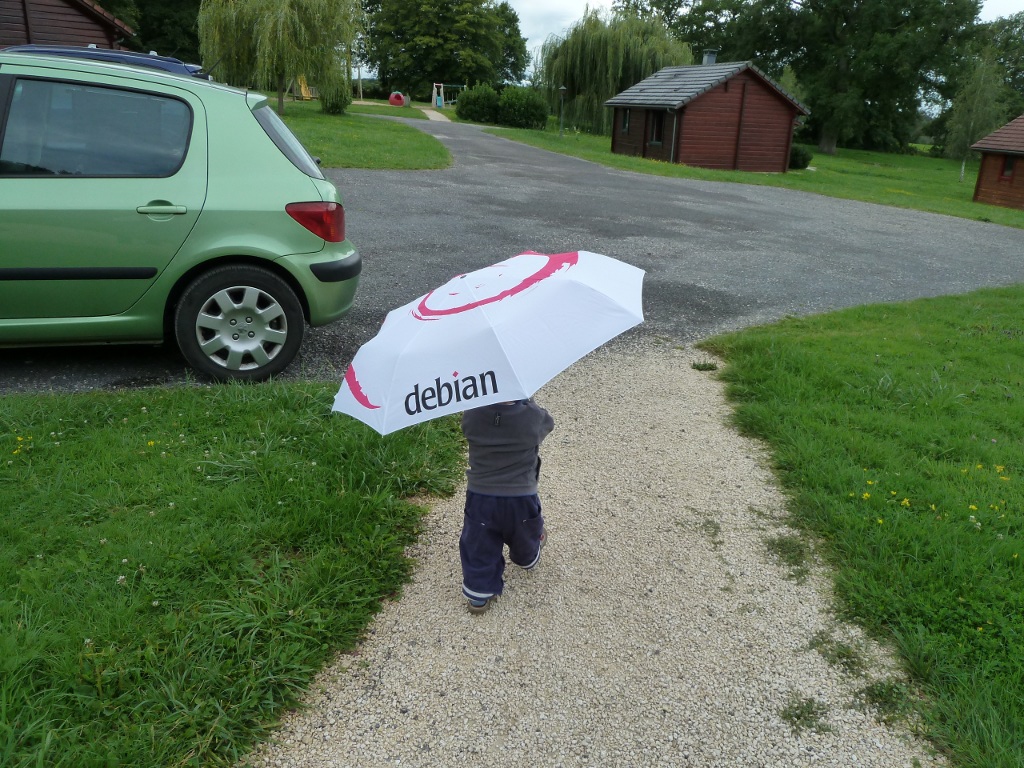
On the bug fixing side I took care of #640198 (minor man page update), #638291 (a fix to correctly handle hardlinks of conffiles), #637564 (the simplification logic of union dependencies was broken in some cases) and #631494 (interrupting dpkg-source while building a native source package left some temporary files around that should have been cleaned). WordPress update I released WordPress 3.2.1 in unstable (after having taken the time to test the updated package on my blog!) and fixed its RC bug (#625773). In the process I discovered a false positive in lintian (I reported it in 637473). Gnome-shell-timer package From time to time, I like to use the Pomodoro Technique. That s why I was an user of timer-applet in GNOME 2. Now with the switch to GNOME 3, I lost this feature. But I recently discovered gnome-shell-timer, a GNOME Shell extension that provides the same features. I created a Debian package of it and quickly filed some bugs while I was testing it (two usability issues and an encoding problem) QA Work During DebConf I met Giovanni Mascellani and he was interested to help the QA team. He started working on the backlog of bugs concerning the Package Tracking System (PTS) and submitted a bunch of patches. I reviewed them and merged them but since they were good, I quickly got lazy and got him added to the QA team so that he can commit his fixes alone. It also helps to build trust when you have had the opportunity to discuss face to face. :-) Vacation That s not so much compared to usual but to my defense I also took 2 weeks of vacation with my family. But somehow even in vacation I can t really forget Debian. Here s my son:
Thanks See you next month for a new summary of my activities.

3 comments Liked this article? Click here. My blog is Flattr-enabled.

2 September 2011

Wouter Verhelst: Mind reading

As a spectator to sporting events, there are times when the ability to read a sport(wo)man's mind would be... interesting. For instance. Yesterday's woman's 1500m final at the world athletics championships in Daegu was won by Jennifer Simpson. This was a surprise to many, including (apparently) Jennifer herself, as evidenced by the look on her face after the finish. See, for instance, this youtube clip (interesting bits around the 4 minute mark) Alternatively, I'd love to know what went through Carlos Berlocq when he won his first game in the match against Novak Djokovic in the third set. I mean, obviously nobody expected the world number one to lose from a relatively unknown 74-ranked argentine player, but that doesn't make it less painful.

1 September 2011

Matthew Garrett: The Android/GPL situation

There was another upsurge in discussion of Android GPL issues last month, triggered by couple of posts by Edward Naughton, followed by another by Florian Mueller. The central thrust is that section 4 of GPLv2 terminates your license on violation, and you need the copyright holders to grant you a new one. If they don't then you don't get to distribute any more copies of the code, even if you've now come into compliance. TLDR; most Android vendors are no longer permitted to distribute Linux.

I'll get to that shortly. There's a few other issues that could do with some clarification. The first is Naughton's insinuation that Google are violating the GPL due to Honeycomb being closed or their "license washing" of some headers. There's no evidence whatsoever that Google have failed to fulfil their GPL obligations in terms of providing source to anyone who received GPL-covered binaries from them. If anyone has some, please do get in touch. Some vendors do appear to be unwilling to hand over code for GPLed bits of Honeycomb. That's an issue with the vendors, not Google.

His second point is more interesting, but the summary is "Google took some GPLed header files and relicensed them under Apache 2.0, and they've taken some other people's GPLv2 code and put it under Apache 2.0 as well". As far as the headers go, there's probably not much to see here. The intent was to produce a set of headers for the C library by taking the kernel headers and removing the kernel-only components. The majority of what's left is just structure definitions and function prototypes, and is almost certainly not copyrightable. And remember that these are the headers that are distributed with the kernel and intended for consumption by userspace. If any of the remaining macros or inline functions are genuinely covered by the GPLv2, any userspace application including them would end up a derived work. This is clearly not the intention of the authors of the code. The risk to Google here is indistinguishable from zero.

How about the repurposing of other code? Naughton's most explicit description is:

For example, Android uses bootcharting logic, which uses the 'bootchartd' script provided by www.bootchart.org, but a C re-implementation that is directly compiled into our init program. The license that appears at www.bootchart.org is the GPLv2, not the Apache 2.0 license that Google claims for its implementation.

, but there's no indication that Google's reimplementation is a derived work of the GPLv2 original.

In summary: No sign that Google's violating the GPL.

Florian's post appears to be pretty much factually correct, other than this bit discussing the SFLC/Best Buy case:

I personally believe that intellectual property rights should usually be enforced against infringing publishers/manufacturers rather than mere resellers, but that's a separate issue.

The case in question was filed against Best Buy because Best Buy were manufacturing infringing devices. It was a set of own-brand Blu Ray players that incorporated Busybox. Best Buy were not a mere reseller.

Anyway. Back to the original point. Nobody appears to disagree that section 4 of the GPLv2 means that violating the license results in total termination of the license. The disagreement is over what happens next. Armijn Hemel, who has done various work on helping companies get back into compliance, believes that simply downloading a new copy of the code will result in a new license being granted, and that he's received legal advice that supports that. Bradley Kuhn disagrees. And the FSF seem to be on his side.

The relevant language in v2 is:

You may not copy, modify, sublicense, or distribute the Program except as expressly provided under this License. Any attempt otherwise to copy, modify, sublicense or distribute the Program is void, and will automatically terminate your rights under this License.

The relevant language in v3 is:

You may not propagate or modify a covered work except as expressly provided under this License. Any attempt otherwise to propagate or modify it is void, and will automatically terminate your rights under this License

which is awfully similar. However, v3 follows that up with:

However, if you cease all violation of this License, then your license from a particular copyright holder is reinstated (a) provisionally, unless and until the copyright holder explicitly and finally terminates your license, and (b) permanently, if the copyright holder fails to notify you of the violation by some reasonable means prior to 60 days after the cessation.

In other words, with v3 you get your license back providing you're in compliance. This doesn't mesh too well with the assumption that you can get a new license by downloading a new copy of the software. It seems pretty clear that the intent of GPLv2 was that the license termination was final and required explicit reinstatement.

So whose interpretation is correct? At this point we really don't know - the only people who've tried to use this aspect of the GPL are the SFLC, and as part of their settlements they've always reinstated permission to distribute Busybox. There's no clear legal precedent. Which makes things a little awkward.

It's not possible to absolutely say that many Android distributors no longer have the right to distribute Linux. But nor is it possible to absolutely say that they haven't lost that right. Any sufficiently motivated kernel copyright holder probably could engage in a pretty effective shakedown racket against Android vendors. Whether they will do remains to be seen, but honestly if I were an Android vendor I'd be worried. There's plenty of people out there who hold copyright over significant parts of the kernel. Would you really bet on all of them being individuals of extreme virtue?

comment count unavailable comments

Next.

Previous.