Search Results: "xam"

16 February 2014

Evgeni Golov: diffing configuration files made easy

Let s assume you are a sysadmin and have to debug a daemon giving bad performance on one machine, but not on the other. Of course, you did not setup either machine, have only basic knowledge of the said daemon and would really love to watch that awesome piece of cinematographic art with a bunch of friends and a couple of beers. So it s like every day, right? The problem with understanding running setups is that you often have to read configuration files. And when reading one is not enough, you have to compare two or more of them. Suddenly, a wild problem occurs: order and indentation do not matter (unless they do), comments are often just beautiful noise and why the hell did that guy smoke/drink/eat while explicitly setting ALL THE OPTIONS to their defaults before actually setting them as he wanted. If you are using diff(1), you probably love to read a lot of differences, which are none in reality. Want an example? [foo]
bar = bar
foo = foo and # settings for foo
[foo]
# foo is best
foo = foo
# bar is ok here, FIXME?
bar = bar and [foo]
foo = x
bar = x
[foo]
foo = foo
bar = bar are actually the same, at least for some parsers. XTaran suggested using something like wdiff or dwdiff, which often helps, but not in the above case. Others suggested vimdiff, which is nice, but not really helpful here either. As there is a problem, and I love to solve these, I started a small new project: cfgdiff. It tries to parse two given files and give a diff of the content after normalizing it (merging duplicate keys, sorting keys, ignoring comments and blank lines, you name it). Currently it can parse various INI files, JSON, YAML and XML. That s probably not enough to be the single diff tool for configuration files, but it is quite a nice start. And you can extend it, of course ;)

Mark Brown: Human factors

An issue which I always find depressing but sadly unsurprising in discussions of process with software is the frequent disregard for human elements; indeed often the goal people have in creating process is to try to control and eliminate human elements. Little thought is given to what is going to motivate people to do what s asked and if they are going to follow it at all, or in the spirit it was intended. One example I ve seen several times is the idea that some engineers work on irrelevant things and that this can be fixed by requiring every commit to be tied to the project plan or a bug so off project work is obvious. This isn t really attacking the problem so much as putting a roadblock in place to try to avert it; the real problem is normally people not communicating about what they re doing and what s important but those problems are really hard to address. Sadly what tends to happen is that people work around the roadblock and cause some collateral damage; for example devaluing the bug tracker by referencing irrelevant bugs or creating meaningless bugs solely to allow commits, while continuing to behave like they did originally. This is often worse than the original situation. This sort of issue is one of the things I appreciate most about working on Linux there s quite a bit of process but because of the way it has been evolved the incentives are usually right to make sure they are followed in the spirit in which they were intended. For example the patch submission process is essentially just best practices for making sure changes go to people who care in a form which makes it easy for them to work with it; there is a bunch of tooling around it which built on those practices (and in turn influenced the practices) but it all comes back to that basic thing of getting attention for changes and making them easy to work with. As a result people mostly do the right thing (or close enough) so everything runs smoothly. The trick is to remember to standardize and write things down when it s needed notice the good practice and spread its adoption. The key difference here seems to be if process is viewed as something to solve problems for people or if it is viewed as a way to solve problems with people. If the problem is with the people then the view starts off negative and it s perhaps unsurprising that there is little consideration of how they will react. Sometimes it s not so much that a problem is seen with people as that the people doing don t have any real interest in the process (write only timesheets often bear no relation to reality for example) but there is an assumption that they are going to just do what they re asked (but instead they for example don t fill in their time sheets or don t provide accurate information). The end result is the same, their needs don t get considered and their actions end up being counterproductive. Starting to avoid these problems is fairly straightforward take a step back and consider why the people expected to carry out the process are going to want to do so. How does it help them? How will they see it helping others? Generally what s in it for them? If these are difficult questions to answer then there may be a problem it is likely people will ignore the process or do it badly without a lot of active enforcement, but perhaps that s OK for the situation. Beware of using metrics to provide incentives, metrics are gameable and that game can cause problems without care. But do think about people; making software is all about people.

14 February 2014

Gergely Nagy: I love Free Software

I love Free Software! I love Free Software, and the people behind it. Even though I have been a free software user and developer for more than a decade now, there's still more to be amazed at, still more to contribute, and still more to learn. I love the Free Software community, because it never ceases to amaze me. It's not just about the technical side, but the social, human side of it, too!During the past year, I came to another milestone in my career: as of july first, I am a Free Software developer, and enjoying every moment of it. This is a feat that could not have been done without there being demand for what I do, without the free software community as a whole. For that, I owe you all a big thank you, you make it possible for me to make my dream come true. I can only hope that through my work, and through my example, I can contribute back enough.To this day, I take delight in contributing to free software, be it a Lisp on Python (or projects built in it), any of my own projects, syslog-ng, Google Summer of Code mentoring, Debian work - any and all of that are great fun. Even processing NEW is (I really should do that more often)! It's an endless source of not only entertainment and knowledge, but inspiration too.Whenever I read something as amazing as Russ Allbery's mail on the Debian technical committee impasse, I realize just how amazing people we have in our community, and how much we all can learn from them, and how much we owe them. This is yet another reason why I feel that contributing to Free Software is a passion many can share, because it teaches us good values too, atop of being technically excellent.I love Free Software, because without it, I would be lost. Thank you.

Paul Tagliamonte: Introducing: Acid!

I ve been hacking (on and off) on a small bit of code (written in Hy) called Acid. So, all of this is *really* fluid, and I m going to change it s API and code (it s currently just one massive hack), but I think the idea has kinda jelled enough for me to chat a bit about. Acid is a DSL for writing event-driven Hy. Currently it s just using global events (that ll change soon), and it s a monumental hack (not sure how much I can do there), but it works pretty well. It s built on top of tulip / asyncio, which is an amazing new Python 3.4 standard library package for working with async code. Although asyncio is designed around network-based usecases, I ve been trying to shoehorn in an event system on top of it. It s going well so far. A basic Acid script looks something like:
(trip
  (on :startup
    (every 1 second (emit :clock-pulse nil)))
  (on :clock-pulse (print "."))
  (emit :startup nil))
which will print a dot ( . ) every second forever. Something a bit more advanced (fetch the MBTA Red line T information once a minute forever)
(defn get-endpoint-url [line]
  (.format "http://developer.mbta.com/lib/rthr/ 0 .json"
    (get  :red-line  "red"
          :blue-line "blue"  line)))
(trip
  ;; OK. Let's do some work with MBTA feeds.
  (on :update-feed
      ;; let's just update feeds on a cron.
      (print (.json (.get requests (get-endpoint-url event))))
      (emit :feed-updated event))
  (every 1 minute
         (emit :update-feed :red-line)))
Clearly, both of these examples are just as clear as their straight functional counterparts, but I m keen to see what I can do with temporal recursion for long-running daemons. I think my first job will be porting snitch's codebase to Acid. Let me know if you have any ideas!

13 February 2014

Steve Kemp: Secure your rsync shares, please.

Recently I started doing a internet-wide scan for rsync servers, thinking it might be fun to write a toy search-engine/indexer. Even the basics such as searching against the names of exported shares would be interesting, I thought. Today I abandoned that after exploring some of the results, (created with zmap), because there's just too much private data out there, wide open IP redacted for obvious reason:
shelob ~ $ rsync  rsync://xx.xx.xx.xx/
ginevra        	Ginevra backup
krsna          	Alberto Laptop Backup
franziska      	Franz Laptop Backup
genoveffa      	Franz Laptop Backup 2
Some nice shares there. Lets see if they're as open as they appear to be:
shelob ~ $ rsync  rsync://xx.xx.xx.xx/ginevra/home/
drwxrwsr-x        4096 2013/10/30 13:42:29 .
drwxr-sr-x        4096 2009/02/03 10:32:27 abl
drwxr-s---       12288 2014/02/12 20:05:22 alberto
drwxr-xr-x        4096 2011/12/13 17:12:46 alessandra
drwxr-sr-x       20480 2014/02/12 22:55:01 backup
drwxr-xr-x        4096 2008/10/03 14:51:29 bertacci
..
Yup. Backups of /home, /etc/, and more. I found numerous examples of this, along with a significant number of hosts that exported "www" + "sql", as a pair, and a large number of hosts that just exported "squid/". I assume they must be some cpanel-like system, because I can't understand why thousands of people would export the same shares with the same comments otherwise. I still would like to run the indexer, but with so much easy content to steal, well I think the liability would kill me. I considered not posting this, but I suspect "bad people" already know..,

Erich Schubert: Google Summer of Code 2014 - not participating

Google Summer of Code 2014 is currently open for mentoring organizations to register. I've decided to not apply for GSoC with my data mining open source project ELKI anymore.

12 February 2014

Matthias Klumpp: AppStream/Listaller FOSDEM slides

FOSDEM is over, and it has been a great time! I talked to many people (thanks to full devrooms ;-) Graph Databases and Config management was crazy, JavaScript as well ) and there might be some cool new things to come soon, which we discussed there :-)
I also got some good and positive feedback on the projects I work on, and met many people from Debian, Kubuntu, KDE and GNOME (haven t seen some of them for almost 3 years) one of the best things of being at FOSDEM is, that you not only see people of your own kind for example, for me as Debian developer it was great to see Fedora people and discuss things with them, something which rarely happens at Debian conferences. Also, having GNOME and KDE closely together again (litterally, their stands were next to each other ) is something I missed since the last Desktop Summit in 2011. My talks were also good, except for the beamer-slides-technical-error at the beginning, which took quite some time (I blame KScreen ;-) ). In case you re interested in the slides, here they are: slides for FOSDEM 14 AppStream/Listaller talks. The slides can likely be understood without the talk, they are way too detailed (usually I only show images on slides, but that doesn t help people who can t see the talk ^^) I hope I can make it to FOSDEM 15 as well I ve been there only once, but it already is my favourite FOSS-conference (and I love Belgian waffles) ;-)

Dirk Eddelbuettel: RInside 0.2.11

A new release 0.2.11 of RInside is now on CRAN. RInside provides a set of convenience classes which facilitate embedding of R inside of C++ applications and programs, using the classes and functions provided by the Rcpp R and C++ integration package. This release, the first in fourteen months, fixes one important initialization issue created by the recent Rcpp 0.11.0 release, adds a few other changes related to that release and improves a number of small points such as new or improved examples. The NEWS extract below has more details.
Changes in RInside version 0.2.11 (2014-02-11)
  • Updated for Rcpp 0.11.0:
    • Updated initialization by assigning global environment via pointer only after R itself has been initialized with special thanks to Kevin Ushey for the fix
    • Updated DESCRIPTION with Imports: instead of Depends:
    • Added correspondiing importFrom(Rcpp, evalCpp) to NAMESPACE
    • Noted in all inst/examples/*/Makefile that Rcpp no longer requires a library argument, but left code for backwards compatibility in case 0.11.0 is not yet installed.
  • Added --vanilla --slave to default arguments for R initialization
  • Added a few more explicit #include statements in the qt example which Qt 5.1 now appears to require with thanks to Spencer Behling for the patch
  • Added new MPI example with worker functions and RInside instance, kindly contributed by Nicholas Pezolano and Martin Morgan
CRANberries also provides a short report with changes from the previous release. More information is on the RInside page. Questions, comments etc should go to the rcpp-devel mailing list off the Rcpp R-Forge page.

This post by Dirk Eddelbuettel originated on his Thinking inside the box blog. Please report excessive re-aggregation in third-party for-profit settings.

11 February 2014

Erich Schubert: Debian chooses systemd as default init

It has been all over the place. The Debian CTTE has chosen systemd over upstart as default init system by chairman call. This decision was overdue, as it was pretty clear that the tie will not change, and thus it will be up to chairman. There were no new positions presented, and nobody was being convinced of a different preference. The whole discussion had been escalating, and had started to harm Debian. Some people may not want to hear this, but another 10 ballots and options would not have changed this outcome. Repating essentially the same decision (systemd, upstart, or "other things nobody prefers") will do no good, but turn out the same result, a tie. Every vote counting I saw happen would turn out this tie. Half of the CTTE members prefer systemd, the other half upstart. The main problems, however, are these: So please, everybody get back to work now. If there ever is enough reason to overturn this decision, there are formal ways to do this, and there are people in the CTTE (half of the CTTE, actually) that will take care of this. Until then, live with the result of a 0.1 votes lead for systemd. Instead of pursuing a destructive hate campaign, why not improve your favorite init system instead. Oh, and don't forget about the need to spell out a policy for init system support requirements of packages.

Dirk Eddelbuettel: RcppSMC 0.1.2

Late last week, and just before leaving to participate in this crazy thing, I managed to get a new version of RcppSMC onto CRAN. RcppSMC combines the SMCTC template classes for Sequential Monte Carlo and Particle Filters (Johansen, 2009, JSS) with the Rcpp package for R/C++ Integration (Eddelbuettel and Francois, 2011, JSS) and thereby allows for easier and more direct access from R to the computational core of the Sequential Monte Carlo algorithm. This release regroups a few minor changes we accumulated over the last few months, but was triggered by the Rcpp 0.11.0 release last week. The NEWS entry is below:
Changes in RcppSMC version 0.1.2 (2014-02-06)
  • Updated for Rcpp 0.11.0 with explicit importFrom in NAMESPACE and corresponding versioned Imports: in DESCRIPTION; also removed linking instruction from src/Makevars as no it is longer needed with this new Rcpp version
  • Addded GitHub / Travis CI support
  • Use more portable dev.new() rather than x11() in pfLinearBS.R
  • Applied some corrections to pfNonlinBS.R example
  • Converted NEWS to NEWS.Rd
Courtesy of CRANberries, there is also a diffstat report relative to the previous release. As always, more detailed information is on the RcppSMC page,

This post by Dirk Eddelbuettel originated on his Thinking inside the box blog. Please report excessive re-aggregation in third-party for-profit settings.

10 February 2014

Russell Coker: Fingerprints and Authentication

Dustin Kirkland wrote an interesting post about fingerprint authentication [1]. He suggests using fingerprints for identifying users (NOT authentication) and gives an example of a married couple sharing a tablet and using fingerprints to determine who s apps are loaded. In response Tollef Fog Heen suggests using fingerprints for lightweight authentication, such as resuming a session after a toilet break [2]. I think that one of the best comments on the issue of authentication for different tasks is in XKCD comic 1200 [3]. It seems obvious that the division between administrator (who installs new device drivers etc) and user (who does everything from playing games to online banking with the same privileges) isn t working, and never could work well particularly when the user in question installs their own software. I think that one thing which is worth considering is the uses of a signature. A signature can be easily forged in many ways and they often aren t checked well. It seems that there are two broad cases of using a signature, one is to enter into legally binding serious contract such as a mortgage (where wanting to sign is the relevant issue) and the other is cases where the issue doesn t matter so much (EG signing off on a credit card purchase where the parties at risk can afford to lose money on occasion for efficient transactions). Signing is relatively easy but that s because it either doesn t matter much or because it s just a legal issue which isn t connected to authentication. The possibility of serious damage (sending life savings or incriminating pictures to criminals in another jurisdiction) being done instantly never applied to signatures. It seems to me that in many ways signatures are comparable to fingerprints and both of them aren t particularly good for authentication to a computer. In regard to Tollef s ideas about lightweight authentication I think that the first thing that would be required is direct user control over the authentication required to unlock a system. I have read about some Microsoft research into a computer monitoring the office environment to better facilitate the user s requests, an obvious extension to such research would be to have greater unlock requirements if there are more unknown people in the area or if the device is in a known unsafe location. But apart from that sort of future development it seems that having the user request a greater or lesser authentication check either at the time they lock their session or by policy would make sense. Generally users have a reasonable idea about the risk of another user trying to login with their terminal so user should be able to decide that a toilet break when at home only requires a fingerprint (enough to keep out other family members) while a toilet break at the office requires greater authentication. Mobile devices could use GPS location to determine unlock requirements, GPS can be forged, but if your attacker is willing and able to do that then you have a greater risk than most users. Some users turn off authentication on their phone because it s too inconvenient. If they had the option of using a fingerprint most of the time and a password for the times when a fingerprint can t be read then it would give an overall increase in security. Finally it should be possible to unlock only certain applications. Recent versions of Android support widgets on the lock screen so you can perform basic tasks such as checking the weather forecast without unlocking your phone. But it should be possible to have different authentication requirements for various applications. Using a fingerprint scan to allow playing games or reading email in the mailing list folder would be more than adequate security. But reading the important email and using SMS probably needs greater authentication. This takes us back to the XKCD cartoon.

9 February 2014

Erich Schubert: Minimizing usage of debian-multimedia packages

How to reduce your usage of debian-multimedia packages: As you might be aware, the "deb-multimedia" packages have seen their share of chaos. Originally, they were named "debian-multimedia", but it was then decided that they should better be called "deb-multimedia" as they are not an official part of Debian. The old domain was then grabbed by cybersquatters when it expired. While a number of packages remain indistributable for Debian due to legal issues - such as decrypting DVDs - and thus "DMO" remains useful to many desktop users, please note that for many of the packages, a reasonable version exists within Debian "main". So here is a way to prevent automatically upgrading to DMO versions of packages that also exist in Debian main: We will use a configuration option known as apt pinning. We will modify the priority of DMO package to below 100, which means they will not be automatically upgraded to; but they can be installed when e.g. no version of this package exists within Debian main. I.e. the packages can be easily installed, but it will prefer using the official versions. For this we need to create a file I named /etc/apt/preferences.d/unprefer-dmo with the contents:
Package: *
Pin: release o=Unofficial Multimedia Packages
Pin-Priority: 123
As long as the DMO archive doesn't rename itself, this pin will work; it will continue to work if you use a mirror of the archive, as it is not tied to the URL. It will not downgrade packages for you. If you want to downgrade, this will be a trickier process. You can use aptitude for this, and start with a filter (l key, as in "limit") of ?narrow(~i,~Vdmo). This will only show packages installed where the version number contains dmo. You can now patrol this list, enter the detail view of each package, and check the version list at the end for a non-dmo version. I cannot claim this will be an easy process. You'll probably have a lot of conflicts to clear up, due to different libavcodec* API versions. If I recall correctly, I opted to uninstall some dmo packages such as ffmpeg that I do not really need. In other cases, the naming is slightly different: Debian main has handbrake, while dmo has handbrake-gtk. A simple approach is to consider uninstalling all of these packages. Then reinstall as needed; since installing Debian packages is trivial, it does not hurt to deinstall something, does it? When reinstalling, Debian packages will be preferred over DMO packages. I prefer to use DFSG-free software wherever possible. And as long as I can watch my favorite series (Tatort, started in 1970 and airing episode 900 this month) and the occasional DVD movie, I have all I need. An even more powerful aptitude filter to review installed non-Debian software is ?narrow(~i,!~ODebian), or equivalently ?narrow(?installed,?not(?origin(Debian))). This will list all package versions, which cannot be installed from Debian sources. In particular, this includes versions that are no longer available (they may have been removed because of security issues!), software that has been installed manually from .deb files, or any other non-Debian source such as Google or DMO. (You should check the output of aptitude policy that no source claims to be o=Debian that isn't Debian though). This filter is a good health check for your system. Debian packages receive a good amount of attention with respect to packaging quality, maintainability, security and all of these aspects. Third party packages usually failed the Debian quality check in at least one respect. For example, Sage isn't in Debian yet; mostly because it has so many dependencies, that making a reliable and upgradeable installation is a pain. Similarly, there is no Hadoop in Debian yet. If you look at Hadoop packaging efforts such as Apache Bigtop, they do not live up to Debian quality yet. In particular, the packages have high redundancy, and re-include various .jar copies instead of sharing access to an independently packaged dependency. If a security issue arises with any of these jars, all the Hadoop packages will need to be rebuilt. As you can see, it is usually not because of Debian being too strict or too conservative about free software when software is not packaged. More often than not, it's because the software in question itself currently does not live up to Debian packaging quality requirements. And of course sometimes because there is too little community backing the software in question, that would improve the packaging. If you want your software to be included in Debian, try to make it packaging friendly. Don't force-include copies of other software, for example. Allow the use of system-installed libraries where possible, and provide upgrade paths and backwards compatibility. Make dependencies optional, so that your software can be pacakged even if a dependency is not yet available - and does not have to be removed if the dependency becomes a security risk. Maybe learn how to package yourself, too. This will make it easier for you to push new features and bug fixes to your userbase: instead of requiring your users to manually upgrade, make your software packaging friendly. Then your users will be auto-upgraded by their operating system to the latest version. Update: If you are using APT::Default-Release or other pins, these may override above pin. You may need to use apt-cache policy to find out if the pins are in effect, and rewrite your default-release pin into e.g.
Package: *
Pin: release a=testing,o=Debian
Pin-Priority: 912
for debugging, use a different priority for each pin, so you can see which one is in effect. Notice the o=Debian in this pin, which makes it apply only to Debian repositories.

8 February 2014

Mario Lang: boost::python and boost::variant

I have unsuccessfully tried to find a solution for the following problem on the internet several times. Now that I have come at least closer to a usable approach, I thought I'd document what I have found so that others trying to achieve a similar thing can use this as a starting point. Boost.Python offers a very nice and flexible way to interface C++ data types with Python. With just a few lines of code, and the proper linker flags, you get a Python importable shared object from your C++ compiler. This can be very productive. However, there is one aspect of C++ data types that I couldn't figure out how to interface with Python, which are C++ discriminated unions, or more specifically, heterogeneous containers. While Python has no problems with containers containing objects of different types, C++ does not make this very easy by default. Usually the problem is solved with a container of pointers to a base class, and various subclasses with virtual functions. However, this approach is not always practical, especially if the different types of objects in an heterogeneous container dont have many things in common. This is where discriminated unions come to the rescue. They basically behave like a normal union in C, but have an additional field which indicates the type of object currently stored in the union. Boost.Variant does exactly that, with a nice visitor interface added on top of it.
Heterogeneous containers in C++ If we put the boost::variant<> template inside a STL container like std::vector<>, the result is a heterogeneous container. For the purpose of illustration, lets implement such a container. The example below is deliberately simple. In reality, the various types allowed in your variant will probably have more fields then just one.
#include <boost/variant.hpp>
#include <vector>
struct a   int x;  ;
struct b   std::string y;  ;
typedef boost::variant<a, b> variant;
typedef std::vector<variant> vector;
To ease creation of these two types of objects, we are going to write a few factory functions. We are going to wrap them in Python later on.
variant make_variant()   return variant();  
vector make_vector()   return vector a(), b(), a() ;  
Boost.Python Now lets create a Python module which exports the above functionality to Python.
#include <boost/python/class.hpp>
#include <boost/python/def.hpp>
#include <boost/python/implicit.hpp>
#include <boost/python/init.hpp>
#include <boost/python/module.hpp>
#include <boost/python/object.hpp>
#include <boost/python/suite/indexing/vector_indexing_suite.hpp>
vector_indexing_suite apparently needs operator== defined on the value_type of the container. In our case, this is our boost::variant<a, b> type. Luckily, boost::variant<> already provides operator==. However, that operator== relies on operator== being defined for the underlying types. Since equality comparison is probably useful for other things as well, lets just create operator== for our two classes a and b.
bool operator==(a const &lhs, a const &rhs)   return lhs.x == rhs.x;  
bool operator==(b const &lhs, b const &rhs)   return lhs.y == rhs.y;  
Convert a boost::variant<> to PyObject * Boost.Python needs a way to convert our discriminated union to a Python object. This code relies on Python class definitions being present for all underlying variant types. We will define them later.
struct variant_to_object : boost::static_visitor<PyObject *>  
  static result_type convert(variant const &v)  
    return apply_visitor(variant_to_object(), v);
   
  template<typename T>
  result_type operator()(T const &t) const  
    return boost::python::incref(boost::python::object(t).ptr());
   
 ;
And finally, lets create our Python module.
BOOST_PYTHON_MODULE(bpv)  
  using namespace boost::python;
  class_<a>("a", init<a>()).def(init<>()).def_readwrite("x", &a::x);
  class_<b>("b", init<b>()).def(init<>()).def_readwrite("y", &b::y);
  to_python_converter<variant, variant_to_object>();
  implicitly_convertible<a, variant>();
  implicitly_convertible<b, variant>();
  def("make_variant", make_variant);
  class_<vector>("vector").def(vector_indexing_suite<vector, true>());
  def("make_vector", make_vector);
 
Compiling Lets create a shared object for Python.
$ g++ -std=c++11 -fPIC -shared $(python-config --includes) -o bpv.so file.cpp -lboost_python
Running We can load the module into Python and see what it does.
>>> import bpv
>>> variant=bpv.make_variant()
>>> variant
<bpv.a object at 0x7f06bb2130c0>
>>> variant.x
0
>>> variant.x=2
>>> variant.x
2
Nice. We can access the underlying type, and even modify it. Lets see how our heterogeneous container wrapping code behaves.
>>> vector=bpv.make_vector()
>>> vector
<bpv.vector object at 0x7f20693289d0>
>>> len(vector)
3
>>> list(vector)
[<bpv.a object at 0x7f20693190c0>, <bpv.b object at 0x7f20693193d0>, <bpv.a object at 0x7f2069319440>]
So far, so good. This will at least make it possible to convert heterogeneous containers from C++ to Python, which was my initial goal. Unfortunately, contained objects are not treated as references. Whenever retrieved, we get a copy. So in-place modification does not work.
>>> vector[0].x
0
>>> vector[0].x=2
>>> vector[0].x
0
However, we can override an existing element with a modified copy.
>>> e0=vector[0]
>>> type(e0)
<class 'bpv.a'>
>>> e0.x = 2
>>> vector[0] = e0
>>> vector[0].x
2
And we can also use the append and extend methods of Python containers.
>>> len(vector)
3
>>> vector.extend(vector)
>>> vector.append(bpv.a())
>>> len(vector)
7
>>> len(filter(lambda x: type(x)==bpv.b, vector))
2
>>> len(filter(lambda x: type(x)==bpv.a, vector))
5
>>> map(lambda x: x.x, filter(lambda x: type(x)==bpv.a, vector))
[2, 0, 2, 0, 0]
All that is missing for a perfect world is reference semantics for container elements. If anyone has a hint on how to achieve this, please let me know.

7 February 2014

Jo Shields: Dear Fake Debian Developers, shoo.

Another post about the Valve/Collabora free games thing. This time, the bad bit people trying to scam free games from us. Before I start, I want to make one thing clear there are people who have requested keys who don t meet the criteria, but are honest and legitimate in their requests. This blogspam is not about them at all. If you re in that category, you re not being complained about. So. Some numbers. At time of writing, I ve assigned keys to 279 Debian Developers or Debian Maintainers almost 25% of the total eligible pool of about 1200. I ve denied 22 requests. Of these 10 were polite requests from people who didn t meet the conditions stated (e.g. Ubuntu developers rather than Debian). These folks weren t at all a problem for us, and I explained politely that they didn t meet the terms we had agreed at the time with Valve. No problem at all with those folks. Next, we have the chancers, 7 of them, who pretended to be eligible when they clearly weren t. For example, two people sent me signed requests pointing to their entry on the Debian New Maintainers page when challenged over the key not being in the keyring. The NM page showed that they had registered as non-uploading Debian Contributors a couple of hours previously. A few just claimed I am a DD, here is my signature when they weren t DDs at all. Those requests were also binned.
Papers, Please screenshot - denied entry application

DENIED

And then we move onto the final category. These people tried identity theft, but did a terrible job of it. There were 5 people in this category:
From: Xxxxxxxx Xxxxxx <xxxxxxxx.xxxxxx@ieee.org>
Subject: free subscription to Debian Developer
8217 A205 5E57 043B 2883 054E 7F55 BB12 A40F 862E
This is not a signature, it s a fingerprint. Amusingly, it s not the fingerprint for the person who sent my mail, but that of Neil McGovern a co-worker at Collabora. Neil assured me he knew how to sign a mail properly, so I shitcanned that entry.
From: "Xxxxx, Xxxxxxxxx" <x.xxxxx@bbw-bremen.de>
Subject: Incoming!
Hey dude,
I want to have the redemption code you are offering for the Valve Games
mQGiBEVhrscRBAD4M5+qxhZUD67PIz0JeoJ0vB0hsLE6QPV144PLjLZOzHbl4H3N
...snip...
Lz8An1TEmmq7fltTpQ+Y1oWhnE8WhVeQAKCzh3MBoNd4AIGHcVDzv0N0k+bKZQ=3D=3D
=3Du/4R
Wat? Learn to GPG!
From: Xxxxxx-Xxxx Le Xxxxxxx Xxxx <xx.xxxxxxxxx@gmail.com>
Subject: pass steam
Hey me voila
Merci beaucoup
valve
2069 1DFC C2C9 8C47 9529 84EE 0001 8C22 381A 7594
Like the first one, a fingerprint. This one is for S bastien Villemot. Don t scammers know how to GPG sign?
From: "Xxxxxxxxx Xxxxxxx" <xxxxxxxx@web.de>
Subject: thanks /DD/Steam gifts us finally something back
0x6864730DF095E5E4
Yet again, a fingerprint. This one is for Marco Nenciarini. I found this request particularly offensive due to the subject line the haughty tone from an identity thief struck me as astonishingly impertinent. Still, when will scammers learn to GPG?
From: Sven Hoexter <svenhoexter@gmail.com>
Subject: Valve produced games
I'm would like to get the valve produced games
My keyring: 0xA6DC24D9DA2493D1 Sven Hoexter <hoexter> sig:6
Easily the best scam effort, since this is the only one which both a) registered an email address under the name of a DD, and b) used a fingerprint which actually corresponds to that human. Sadly for the scammer, I m a suspicious kind of person, so my instinct was to verify the claim via IRC.
31-01-2014 16:52:48 > directhex: Hoaxter, have you started using gmail without updating your GPG key? (note: significantly more likely is someone trying to steal your identity a little to steal valve keys from collabora)
31-01-2014 16:54:51 < Hoaxter!~sh@duckpond6.stormbind.net: directhex: I do not use any Google services and did not change my key
So yeah. Nice try, scammer. I m not listing, in all of this, the mails which Neil received from people who didn t actually read his mail to d-d-a. I m also not listing a story which I ve only heard second ha actually no, this one is too good not to share. Someone went onto db.debian.org, did a search for every DD in France, and emailed every Jabber JID (since they look like email addresses) asking them to forward unwanted keys. All in all, the number of evildoers is quite low, relative to the number of legitimate claims 12 baddies to 279 legitimate keys issued. But still, this is why the whole key issuing thing has been taking me so long and why I have the convoluted signature-based validation system in place. Enjoy your keys, all 279 of you (or more by the time some of you read this). The offer has no explicit expiry on it Valve will keep issuing keys as long as there is reason to, and Collabora will continue to administer their allocation as long as they remain our clients. It s a joint gift to the community thousands of dollars worth of games from Valve, and a significant amount of my time to administer them from Collabora.

6 February 2014

Neil Williams: iMX53 in the home lab

The iMX53 Quick Start Board has been a mainstay of the Debian armhf port and has been part of LAVA until recently. It s a natural choice for seeing how LAVA and Debian can work together more closely. So, in the first steps to getting my home lab running, I set about restoring two of these boards to LAVA support. I will be looking into each of the possible boot methods with these boards, but the way to start is with a LAVA master image on an SD card. With the pause in iMX53 development within LAVA, this raises a couple of issues: LAVA master image on iMX53 The LAVA master image is more recent and can fix these problems. See lava-image-creation preparing a master image
$ git clone git://git.linaro.org/lava/lava-master-image-scripts.git
$ cd lava-master-image-scripts

Use patch -p1 to apply this patch (apologies for the line wrapping in the blog):
diff --git a/lava-create-master b/lava-create-master
index 2e1d0e8..a1e6131 100755
--- a/lava-create-master
+++ b/lava-create-master
@@ -366,7 +366,7 @@ make_master()  
         verbose " * Building vanilla image with linaro-media-create..."
         if ! linaro-media-create \
             --dev $LMC_DEV \
-            --rootfs ext4 \
+            --rootfs ext3 \
             --image-file $CACHE_DIR/pristine-images/$dev-vanilla.img \
             --image-size 1G \
             --align-boot-part \
$ sudo ./lava-create-master imx53 Without the patch applied, I simply removed the SD card, mounted the third partition on my main machine and created a tarball of the contents:
$ sudo mount /dev/mmcblk0p3 /mnt/
$ pushd /mnt
$ sudo tar -czf /tmp/imx53-rootfs.tgz ./*
$ popd
$ sudo umount /mnt/
Reformat p3 to ext3 (or ext2 if you prefer)
$ sudo mkfs.ext3 /dev/mmcblk0p3
Put the rootfs back onto the replacement ext3 partition.
$ sudo mount /dev/mmcblk0p3 /mnt/
$ pushd /mnt
$ sudo tar -xzvf /tmp/imx53-rootfs.tgz
$ popd
$ sudo sync
$ sudo umount /mnt/
The bootscript is buggy, so run:
> run loaduimage
> run mmcboot
Then fix bootscript or you won t be able to reboot: Simplest way may be to set u-boot to ignore boot.scr
> setenv script
> saveenv
> reset
Device configuration in LAVA I found screen to be a bit awkward as a serial connection, (use Ctrl-A : quit) to quit. I tried autologin for the lucid image but that was not needed for the master image which uses the linaro overlay. The PDU commands are for my own setup. The daemon (the machine running the pdu daemon scripts), hostname (the hostname or IP of the PDU itself) and the port numbers will change between labs. Again, the blog has changed the line endings.
device_type = mx53loco
hostname = imx53-01
connection_command = telnet hobbes 4002
#login_prompt = lucid-desktop login:
#password_prompt = Password:
#username = lucid
#password = lucid
hard_reset_command = /usr/bin/pduclient --daemon localhost --hostname pdu --command reboot --port 05
power_off_cmd = /usr/bin/pduclient --daemon localhost --hostname pdu --command off --port 05
power_on_cmd = /usr/bin/pduclient --daemon localhost --hostname pdu --command on --port 05
testboot_offset = 3
Critical testboot_offset is currently undocumented. Without it, you will see:
 ** Partition 4 not valid on device 0 **
You can trace this back in a LAVA test log to:
  setenv bootcmd "fatload mmc 0:4 0x70000000 uImage; fatload mmc 0:4 0x72000000 uInitrd; fatload mmc 0:4 0x71ff0000 board.dtb; bootm 0x70000000 0x72000000 0x71ff0000"
The correct line needs to use mmc 0:5 in each case.
This is what testboot_offset modifies the default is 2.
  setenv bootcmd "fatload mmc 0:4 0x70000000 uImage; fatload mmc 0:5 0x72000000 uInitrd; fatload mmc 0:5 0x71ff0000 board.dtb; bootm 0x70000000 0x72000000 0x71ff0000"
Hacking session in LAVA A hacking session in LAVA is a way of getting an SSH login directly into a deployed test image, as root. It s a test image, so look around, trash stuff, build stuff, reboot the board When you are done, use stop-hacking and the test completes, leaving the master image unchanged, ready for the next rootfs to go onto the test image you were using. This will be improved in later blog entries but as a starter and so that you can play with the SATA drive with a recent installation, this is the JSON for a LAVA job which gives you an SSH session inside the LAVA test image on an iMX53. The test image comes from Linaro releases 12.01. I haven t set up a proxy yet, so to save time, I downloaded it once and used a local file:// URL in the testjob. Note the rootfstype parameter without this, LAVA will helpfully format the partition onto which the rootfs is installed to ext4, with predictable results. (This bug is currently being fixed in LAVA so that LAVA uses the same filesystem as the downloaded image. All part of making LAVA less presumptive.) The smoke-tests-basic testdef is gratuitous and can be removed but this particular run won t be quick it took over an hour to get into the hacking session, but future topics here will improve that so the extra few minutes for the smoke-tests is not a big win. Change the value for GATEWAY to something sane for your network, change the value for PUB_KEY to your SSH public key. Change the image location to something which works for your setup.
 
 "health_check": false,
 "job_name": "iMX53-hacking",
 "logging_level": "DEBUG",
 "device_type": "mx53loco",
 "timeout": 900,
 "actions": [
 
 "command": "deploy_linaro_image",
 "parameters": 
 "image": "file:///home/linaro/lava/mx53loco-ubuntu-desktop.img.gz",
 "rootfstype": "ext3"
 
 ,
 
 "command": "lava_test_shell",
 "parameters": 
 "testdef_repos": [
 
 "git-repo": "git://git.linaro.org/qa/test-definitions.git",
 "testdef": "ubuntu/smoke-tests-basic.yaml"
 ,
 
 "git-repo": "http://git.linaro.org/git/lava-team/hacking-session.git",
 "parameters": 
 "GATEWAY": "10.15.0.1",
 "PUB_KEY": "...."
 ,
 "testdef": "hacking-session-debian.yaml"
 
 ],
 "timeout": 18000
 
 ,
 
 "command": "submit_results_on_host",
 "parameters": 
 "server": "http://sylvester.codehelp/RPC2/",
 "stream": "/anonymous/codehelp/"
 
 
 ]
 
(Use http://jsonlint.com to reformat.) I was part of the way through running debootstrap on the SATA drive when ser2net timed out because I hadn t changed the values at that time. Configuring set2net for LAVA ser2net can run on any machine capable of providing the serial connections, including a dedicated device. Decide on a port range to use on the machine running ser2net. If the device has more than one network interface, ensure that ser2net only offers connections on the relevant interface by prefixing the port with the IP address or hostname. telnet is generally the easiest ser2net state to use with LAVA.
#  ::::
#     TCP port
#            Name   or  number of the TCP/IP port to accept con-
#            nections from for this device.  A port number may
#            be of the form [host,]port, such as 127.0.0.1,2000
#            or localhost,2000.  If this is specified, it will
#            only bind to the IP address specified. Otherwise
#            it will bind to all the ports on the machine.
# 10.15.0.1,4000:telnet:600:/dev/ttyUSB0:115200 8DATABITS NONE 1STOPBIT banner
Clear the timeout or long running jobs will fail.
10.15.0.1,4000:telnet:0:/dev/ttyUSB0:115200 8DATABITS NONE 1STOPBIT banner
10.15.0.1,4001:telnet:0:/dev/ttyUSB1:115200 8DATABITS NONE 1STOPBIT banner
I ve tried relatively carefully to preserve the instructions here from my notes. However, if you do try this yourself and there are problems, let me know and I ll update. I m also planning on putting all of the config files, patches, JSON examples and other code into a git repo fairly soon to make things easier.

3 February 2014

Kees Cook: compiler hardening in Ubuntu and Debian

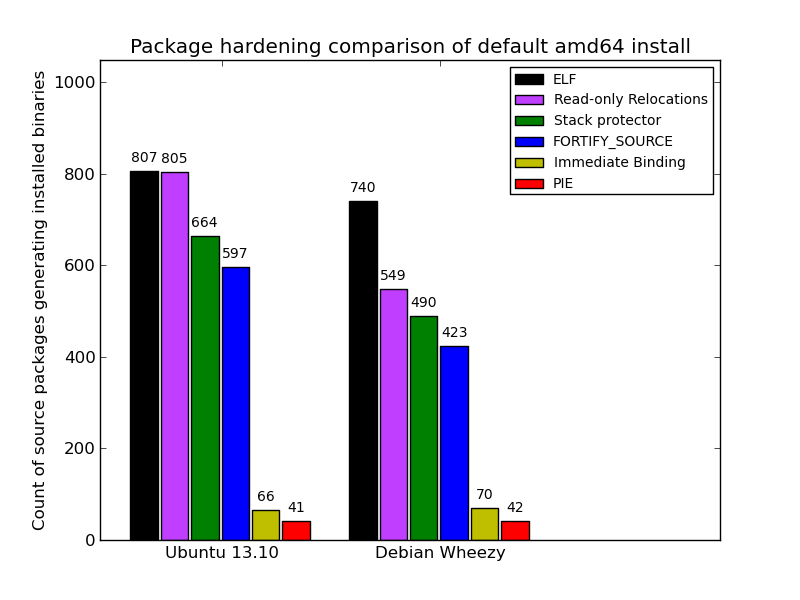
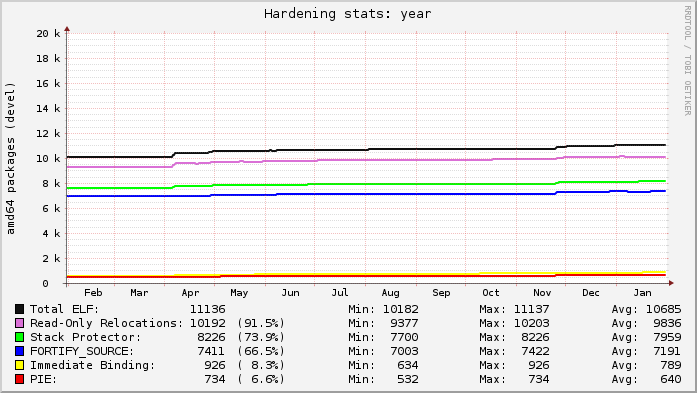
Back in 2006, the compiler in Ubuntu was patched to enable most build-time security-hardening features (relro, stack protector, fortify source). I wasn t able to convince Debian to do the same, so Debian went the route of other distributions, adding security hardening flags during package builds only. I remain disappointed in this approach, because it means that someone who builds software without using the packaging tools on a non-Ubuntu system won t get those hardening features. Think of a sysadmin trying the latest nginx, or a vendor like Valve building games for distribution. On Ubuntu, when you do that ./configure && make you ll get the features automatically. Debian, at the time, didn t have a good way forward even for package builds since it lacked a concept of global package build flags . Happily, a solution (via dh) was developed about 2 years ago, and Debian package maintainers have been working to adopt it ever since. So, while I don t think any distro can match Ubuntu s method of security hardening compiler defaults, it is valuable to see the results of global package build flags in Debian on the package archive. I ve had an on-going graph of the state of build hardening on both Ubuntu and Debian for a while, but only recently did I put together a comparison of a default install. Very few people have all the packages in the archive installed, so it s a bit silly to only look at the archive statistics. But let s start there, just to describe what s being measured. Here s today s snapshot of Ubuntu s development archive for the past year (you can see development opening after a release every 6 months with an influx of new packages):
Here s today s snapshot of Debian s unstable archive for the past year (at the start of May you can see the archive unfreezing after the Wheezy release; the gaps were my analysis tool failing):
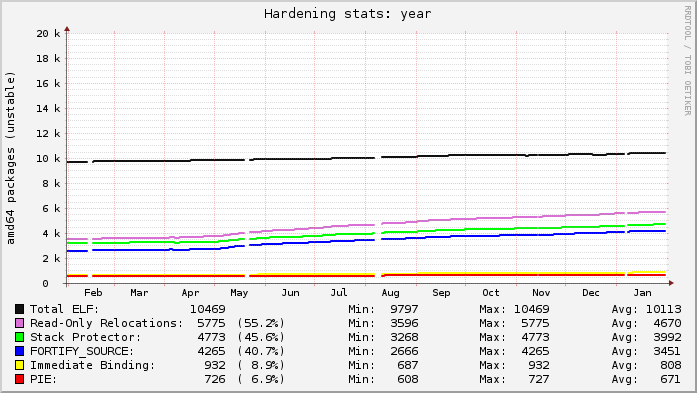
Ubuntu s lines are relatively flat because everything that can be built with hardening already is. Debian s graph is on a slow upward trend as more packages get migrated to dh to gain knowledge of the global flags. Each line in the graphs represents the count of source packages that contain binary packages that have at least 1 hit for a given category. ELF is just that: a source package that ultimately produces at least 1 binary package with at least 1 ELF binary in it (i.e. produces a compiled output). The Read-only Relocations ( relro ) hardening feature is almost always done for an ELF, excepting uncommon situations. As a result, the count of ELF and relro are close on Ubuntu. In fact, examining relro is a good indication of whether or not a source package got built with hardening of any kind. So, in Ubuntu, 91.5% of the archive is built with hardening, with Debian at 55.2%. The stack protector and fortify source features depend on characteristics of the source itself, and may not always be present in package s binaries even when hardening is enabled for the build (e.g. no functions got selected for stack protection, or no fortified glibc functions were used). Really these lines mostly indicate the count of packages that have a sufficiently high level of complexity that would trigger such protections. The PIE and immediate binding ( bind_now ) features are specifically enabled by a package maintainer. PIE can have a noticeable performance impact on CPU-register-starved architectures like i386 (ia32), so it is neither patched on in Ubuntu, nor part of the default flags in Debian. (And bind_now doesn t make much sense without PIE, so they usually go together.) It s worth noting, however, that it probably should be the default on amd64 (x86_64), which has plenty of available registers. Here is a comparison of default installed packages between the most recent stable releases of Ubuntu (13.10) and Debian (Wheezy). It s clear that what the average user gets with a default fresh install is better than what the archive-to-archive comparison shows. Debian s showing is better (74% built with hardening), though it is still clearly lagging behind Ubuntu (99%):

2014, Kees Cook. This work is licensed under a Creative Commons Attribution-ShareAlike 3.0 License.
Creative Commons License

29 January 2014

Daniel Pocock: Lumicall: giving you choice when you dial

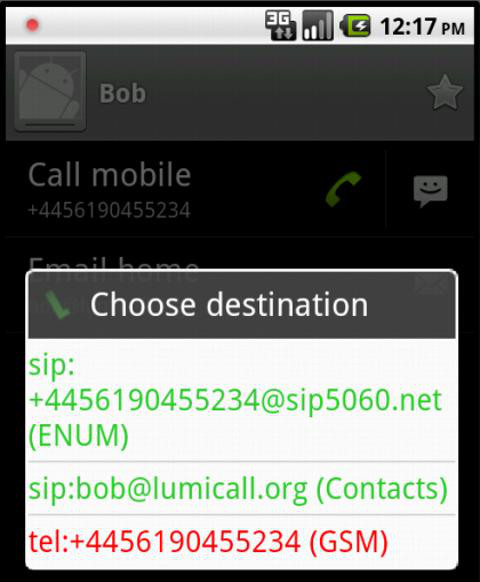
One of the distinguishing features of Lumicall, the free and open SIP/VoIP app for Android, is the unique dialing experience. In fact, even regular softphones for the desktop/laptop don't currently offer the same power when you want to make a call. In my previous blog, I looked at the ENUM technology that underpins part of this compelling new user experience. Here we can step back and look at the bigger picture. Choice is important, sneak preview of Sunday's talk at FOSDEM The fundamental reason for the dialing popup is to give the user choice. Choice is important. With that in mind, one of the key revelations that I will discuss during my talk about Lumicall this Sunday at FOSDEM is that I would like to give users the opportunity to use the Lumicall dialer with other VoIP apps, including Jitsi for Android and CSipSimple. To facilitate this, I hope to separate the dialing logic from the app and make it available as a standalone app or library module that can be used in any free communications software. Users expect convenience, Lumicall tries to deliver Have you noticed how many people will pick up their mobile phone to make a call even when they have a regular phone within reach? Have you found yourself calling your friends' mobile numbers even though you have their home and office numbers in your address book too? These mobile network calls are often at least ten times more expensive than landline calls and by definition they are infinitely more expensive than free calls made over the Internet. So why do people behave this way? The answer is simple: convenience. The caller does not want to make multiple efforts to dial, nor does he want to lose one or two minutes speaking to a secretary, colleague or spouse of the person he is trying to call. Dialing from the address book in his own mobile phone and calling the mobile number of the person he wants to speak with is the shortest path to success. It is efficient, it is compelling and it is what users expect. Free software products wanting to make an impact need to carefully align themselves with these user expectations and that is exactly what Lumicall tries to do. Choose your own adventure: dial the digits, use the address book or surf your call history Any of these everyday dialing practices triggers the Lumicall dialer. In this example, the user is trying to call Bob from the address book: While the user may have simply pressed the "call" button, Lumicall alerts them to several ways that they may proceed:
  • The first choice is a SIP address found in the ENUM directory, sip:+4456190455234@sip5060.net. Lumicall will take all the phone numbers associated with Bob in the address book and report any ENUM results associated with them. Here, just a single ENUM result is display.
  • The second choice is a SIP address constructed from Bob's email address. Lumicall found the email address in the address book entry and discovered that Bob's domain, lumicall.org, has a NAPTR record for SIP. Based on this discovery, Lumicall feels there is a good probability the email address is also a SIP address. If multiple email addresses are in the address book, they will all be checked for NAPTR.
  • (Not shown in the picture) if Lumicall has been configured to use a SIP-to-PSTN gateway account, it will display the option to call Bob's number through the gateway in blue
  • Finally, at the bottom of the list, Lumicall offers the option to call Bob's number in the normal manner, through the GSM network. This option is colour-coded in red to emphasize that it is usually the most expensive.
The tip of the iceberg This experience is a big improvement over the experience of the old rotary dial but it could also be taken even further. People don't always respond to their SIP address, especially if they live in a country where mobile data is not yet the norm. These are areas where Lumicall could be improved. For example, we could use SIP presence to make sure that Bob really is online before displaying the SIP option. This would reduce frustration and boost confidence in SIP. We could even go beyond that: Bob could use the SIP presence mechanism to advertise whether or not he is on a slow mobile data network or a fast network like 4G or wifi. You may choose to defer your call to Bob until he enters wifi coverage where the call quality is likely to be better and maybe video will be possible. This latter opportunity also has privacy implications: Bob may only choose to share that live insight into his network coverage with contacts he trusts. Try it at FOSDEM I will spend some time around the real-time lounge at FOSDEM and would be delighted to get feedback from users who are trying Lumicall, FreePhoneBox.net, JSCommunicator, DruCall or the new Debian SIP service.

Emanuele Rocca: Antifeatures and Antibugs

Software Engineering distinguishes between software features and software bugs. It is usually understood that features are positive, expected characteristics of a computer program. Features make users happy by allowing them to do something useful, interesting, or fun. Something good, anyways. Bugs are instead undesirable and annoying. You're sitting there at your computer writing a long email and the software crashes right before your email is sent. Bad stuff. Features are generally implemented by programmers on purpose, whereas bugs are purely unintentional. They are mistakes. You don't make a mistake on purpose. We might at this point be inclined to think that: i) what is good for users is done on purpose by software manufacturers; ii) what is bad for users was not meant to be. It happened by mistake. Here is a handy table to visualize this idea:
On purpose By mistake
Good Feature
Bad Bug
It seems to make a lot of sense. But you might have noticed that two cells of the table are empty. Right! In a great talk titled When Free Software isn't better, Benjamin Mako Hill mentions the concept of antifeatures, and how they relate to Free Software. Antifeatures are features that make the software do something users will hate. Something they will hate so much they would pay to have those features removed, if that's an option. Microsoft Windows 7 is used in the talk to provide some examples of software antifeatures: the Starter Edition does not allow users to change their background image. Also, it limits the amount of usable memory on the computer to 2GBs, regardless of how much memory the system actually has. Two antifeatures engineered to afflict users to the point that they will purchase a more expensive version of the software, if they have the means to do that. I have another nice example. The Spotify music streaming service plays advertisements between songs every now and then. To make sure users are annoyed as much as possible, Spotify automatically pauses an advertisement if it detects that the volume is being lowered. A poor Spotify user even tried to report the bug on The Spotify Community forum, only to find out that what she naively considered as a software error was "intentional behavior". A spectacular antifeature indeed. Whenever a piece of technology does something you most definitely do not want it to do, such as allowing the NSA to take complete control of your Apple iPhone, including turning on its microphone and camera against your will, that's an antifeature.
On purpose By mistake
Good Feature
Bad Antifeature Bug
Both bugs and antifeatures are bad for users. The difference between them is that antifeatures are engineered. Time and money are spent to make sure the goal is reached. A testing methodology is followed. "Are we really sure customers cannot change their wallpaper even if they try very very hard?" Engineering processes, of course, can fail. If the poor devils at Microsoft who implemented those harassments would have made a mistake that allows users to somehow change their wallpaper on Windows Starter... Well, I would call that a glorious antibug.
On purpose By mistake
Good Feature Antibug
Bad Antifeature Bug
There is no place for antifeatures in Free and Open Source Software. Free Software gives users control over what their software does. Imagine Mozilla adding a feature to Firefox that sets your speakers volume to 11 and starts playing a random song from the black metal artist Burzum every time you add a bookmark, unless you pay for Mozilla Firefox Premium Edition. The source code for Firefox is available under a free license. People who are not into Burzum's music would immediately remove this neat antifeature. I have spent many years of my life advocating Free and Open Source Software, perhaps using the wrong arguments. Mako's talk made me think about all this (thanks mate!). All these years I've been preaching about the technical superiority of Free Software, despite evidence of thousands of bugs and usability issues in the very programs I am using, and contributing to develop. Free Software is not better than Proprietary Software per se. Sometimes it is, sometimes it's not. But it gives you control, and freedom. When it annoys you, when it doesn't do what you expect and want, you can be sure it's not on purpose. And we can fix it together.

Petter Reinholdtsen: A fist full of non-anonymous Bitcoins

Bitcoin is a incredible use of peer to peer communication and encryption, allowing direct and immediate money transfer without any central control. It is sometimes claimed to be ideal for illegal activity, which I believe is quite a long way from the truth. At least I would not conduct illegal money transfers using a system where the details of every transaction are kept forever. This point is investigated in USENIX ;login: from December 2013, in the article "A Fistful of Bitcoins - Characterizing Payments Among Men with No Names" by Sarah Meiklejohn, Marjori Pomarole,Grant Jordan, Kirill Levchenko, Damon McCoy, Geoffrey M. Voelker, and Stefan Savage. They analyse the transaction log in the Bitcoin system, using it to find addresses belong to individuals and organisations and follow the flow of money from both Bitcoin theft and trades on Silk Road to where the money end up. This is how they wrap up their article:
"To demonstrate the usefulness of this type of analysis, we turned our attention to criminal activity. In the Bitcoin economy, criminal activity can appear in a number of forms, such as dealing drugs on Silk Road or simply stealing someone else s bitcoins. We followed the flow of bitcoins out of Silk Road (in particular, from one notorious address) and from a number of highly publicized thefts to see whether we could track the bitcoins to known services. Although some of the thieves attempted to use sophisticated mixing techniques (or possibly mix services) to obscure the flow of bitcoins, for the most part tracking the bitcoins was quite straightforward, and we ultimately saw large quantities of bitcoins flow to a variety of exchanges directly from the point of theft (or the withdrawal from Silk Road). As acknowledged above, following stolen bitcoins to the point at which they are deposited into an exchange does not in itself identify the thief; however, it does enable further de-anonymization in the case in which certain agencies can determine (through, for example, subpoena power) the real-world owner of the account into which the stolen bitcoins were deposited. Because such exchanges seem to serve as chokepoints into and out of the Bitcoin economy (i.e., there are few alternative ways to cash out), we conclude that using Bitcoin for money laundering or other illicit purposes does not (at least at present) seem to be particularly attractive."
These researches are not the first to analyse the Bitcoin transaction log. The 2011 paper "An Analysis of Anonymity in the Bitcoin System" by Fergal Reid and Martin Harrigan is summarized like this:
"Anonymity in Bitcoin, a peer-to-peer electronic currency system, is a complicated issue. Within the system, users are identified by public-keys only. An attacker wishing to de-anonymize its users will attempt to construct the one-to-many mapping between users and public-keys and associate information external to the system with the users. Bitcoin tries to prevent this attack by storing the mapping of a user to his or her public-keys on that user's node only and by allowing each user to generate as many public-keys as required. In this chapter we consider the topological structure of two networks derived from Bitcoin's public transaction history. We show that the two networks have a non-trivial topological structure, provide complementary views of the Bitcoin system and have implications for anonymity. We combine these structures with external information and techniques such as context discovery and flow analysis to investigate an alleged theft of Bitcoins, which, at the time of the theft, had a market value of approximately half a million U.S. dollars."
I hope these references can help kill the urban myth that Bitcoin is anonymous. It isn't really a good fit for illegal activites. Use cash if you need to stay anonymous, at least until regular DNA sampling of notes and coins become the norm. :) As usual, if you use Bitcoin and want to show your support of my activities, please send Bitcoin donations to my address 15oWEoG9dUPovwmUL9KWAnYRtNJEkP1u1b.

28 January 2014

Andrea Colangelo: The (brand new) Debian 3D-Printing Team is hiring!

The 3D-printing technology has gained quite a big momentum in recent times. Its use is spreading widely even among hobbyists and many sources report daily several (sometimes weird) examples of its usage. The thing I like most, as a Free Software activist, is that several 3D-printing-related free and open source software are already available and quite good, and some printers are even released as free hardware. Unfortunately, Debian is quite lagged behind with regard to the availability of such software in our archive, especially compared to other distributions who already ship much of it. Hopefully this situation will change drastically thanks to the brand new Debian 3D-Printing team, whose purpose is to make Debian a rocking platform to do some serious 3D-printing. The team is bootstrapping right now, and we are looking for volunteers who are willing to help us. Packagers are greatly welcomed, but also triagers, users and passionate people with some experience in the field are extremely valuable. People willing to join the team can take a look at our (in-progress) wiki page and apply on the team page on Alioth. As with any good packaging team, a mailing list is available to share ideas, feel free to subscribe it, and feel free to join #debian-3dprinting on OFTC if you want to hang out with other team members.

Next.

Previous.