Search Results: "tb"

19 November 2012

Steve Langasek: Pflaumkuchen

This was a good year for plums in the garden, both for the yellow plums and for the Italian prunes - enough so that it took some doing to figure out what to do with them all. Since I'm not in a hurry to set up a still and make slivovic, and you can only pawn so many plums off on friends and neighbors, I had on the order of 15 pounds of Italian prunes to dispense with. With our change of diet to eliminate extra carbs, Patty and I have both been experimenting with reduced-carb desserts in the kitchen. And I've always been fond of central European (e.g., German) desserts, which tend to be sweetened much more lightly than American equivalents. Indeed, my earliest impression of "coffee cake" comes from the home of an elderly couple who were friends of the family, who served a delicious plum cake in their home. She was from Bavaria, so I guess she probably wouldn't have called it Zwetchgendatschi like the Austrians do (if they even really call it that; I have my suspicions that this is a made-up name designed to poke fun at the foreigners). Maybe she would have called it Pflaumkuchen. The Internet calls it "Polish plum cake". Whatever you call it, it's tasty, and I aimed to recreate it at home. The plums are now nearly a month gone, but after multiple iterations the cake turned out well enough that I feel compelled to share it with the Internet. Since we have friends who are dairy-intolerant, this particular recipe is tailored to be low-carb and dairy-free. It doesn't lose anything in the taste for being made with a restricted set of ingredients. The original recipe did call for a streusel, and a non-dairy streusel is pretty pointless so this recipe simply omits it. Metric cooks, avert your eyes. ;)
  • 1 c almond flour
  • 1 tsp baking powder
  • tsp salt
  • c Steviva blend
  • 3 tbsp grapeseed oil
  • c milk
  • 1 large egg
  • 12 fresh plums, pitted and halved
  • tsp cloves
Lightly coat an 8"x8" pan with cooking spray. Heat oven to 350 degrees. In medium bowl, combine flour, baking powder, salt and Steviva. Add grapeseed oil, milk and egg. Beat at medium speed 4 minutes. Pour batter into prepared pan. Place plums on top, cut side up, pushing down slightly into batter. Sprinkle cloves over the plums. Bake about 50 minutes or until a toothpick tests clean. Let the cake cool in the pan so the plum juices will be reabsorbed to create a moist cake. Sprinkle with confectioners' sugar, if desired, and cut into 16 squares.

Russ Allbery: Review: Inversions

Review: Inversions, by Iain M. Banks
Publisher: Pocket
Copyright: 1998
Printing: May 2001
ISBN: 0-7434-1196-X
Format: Mass market
Pages: 376
Inversions poses a special challenge for book metadata for reviews that try to avoid spoilers. If you've looked at my index of reviews, I may have arguably already spoiled you. I'm going to discuss the book with that spoiler, as most reviews do, because I think it's a better book knowing that information up-front. But if you want to avoid any spoilers, stop reading here, and avoid looking at its placement in my review index. Inversions consists of the interleaved stories of two people: a strange female doctor to the king of Haspide, and the bodyguard of the Protector of Tassassen. The doctor's story is told in the form of letters written by the doctor's apprentice to his "Master," who has clearly told him to spy on the doctor. (The identity of this person is revealed during the story.) The bodyguard's story is told in the third person and presented as a reconstruction of events. The stories never meet, although the two countries have some indirect political exchanges. The doctor becomes entangled in court intrigue and several murders, and the bodyguard protects the Protector (a general in charge of what was effectively a military coup against the former regime) during a war with neighboring barons who had initially supported him. Both stories reach conclusions, but somewhat unsatisfactory ones. The two characters never meet in the book. All of this is set among countries at a medieval level of technology. The doctor faces scorn and derision, not to mention outright opposition, both because she's a woman (she's only permitted to claim the title of doctor due to the king's favor and her claimed citizenship in a far-away land with strange customs) and because she uses more effective and more modern techniques. Other physicians still bleed patients, but the doctor is clearly aware of the germ theory of disease, dismisses contageon via bad odors, and otherwise strikes the reader as someone with advanced medical knowledge trying to practice it in primitive conditions. The spoiler, which is never stated outright but which is relatively apparent from various hints and allusions dropped by the characters, as well as at least one event that would otherwise have to be supernatural, is that Inversions actually takes place in the Culture milieu. How this planet and these stories fit into that milieu remains unexplained throughout the story, but we do get some clues in supposedly made-up stories that the bodyguard tells the son of the Protector, stories that are recognizable to Culture readers as less fictional than they sound in a medieval context. Banks has a tendency to play with unusual narrative structure and to fall on the mainstream side of SF plot construction. Inversions is a very closely-observed pair of entwined stories told in a way that downplays most of the dramatic structure and rising action and that undermines feelings of conclusion or catharsis. Despite having, on later reflection, two clear plots with clear conclusions, it feels more like parallel slices of life and stubbornly refuses to advertise any conclusions or deeper meaning. Whether that works will probably have a lot to do with the reader's tolerance for trying to draw one's own conclusions. I found it frustrating and unsatisfying, but knowing going in that it's a Culture novel helped by adding some deeper structure to give the story a modicum of meaning. Insofar as there's a larger theme, it's the exploration of the conflict between the two Culture citizens that is presented, thinly disguised, in the bodyguard's stories. This connection is not obvious; even determining how to map the two characters into the stories is a touch challenging. But if one is aware of it and looking for it in advance, it provides a bit of broader structure and some basis for judging the actions of the doctor and the bodyguard against a larger plan. I needed that to wring enjoyment from the book; I never cared enough about the characters otherwise to fully engage with either story. With the puzzle, and the constant search for connections to Culture concepts, it's somewhat more interesting, but it's still maddeningly indirect. (And, from various other Internet reactions, I don't think I'm missing something obvious.) It's possible that I went into the book with some incorrect assumptions that undermined my enjoyment. Hopefully this review will help other readers. Knowing that this is a Culture book and enjoying the process of finding references makes it more fun (and most of the references aren't too hard to find). But don't expect lots of closure from the stories, and don't expend to find out "what's really going on." It's not that sort of book. If you enjoy the individual stories for themselves, you'll have the best chance of enjoying the book as a whole, with the Culture references providing a fun additional layer. If the basic stories don't appeal, the Culture material probably isn't enough to make the book engrossing. Rating: 6 out of 10

18 November 2012

Andrew Pollock: [tech] Better late than never

Last year (I think for my birthday) Sarah backed the Twine project on Kickstarter. Well, to say the project experienced some delays would be a bit of an understatement, but in yesterday's mail, it finally arrived. Twine box I'm planning on using it to replace the cat water bowl sensor that never got reinstated when we moved house.

Gregor Herrmann: RC bugs 2012/46

it's seems we're starting to run out of RC bugs with the implicit usertag easy-enough-for-gregoa

what I've done in the last days besides working on the bugs listed below is to tag quite a few bugs pending that were uploaded into a DELAYED queue. please try to remember to set this tag on delayed NMUs, nmudiff is quite convenient here.

Mike Hommey: Debian EFI mode boot on a Macbook Pro, without rEFIt

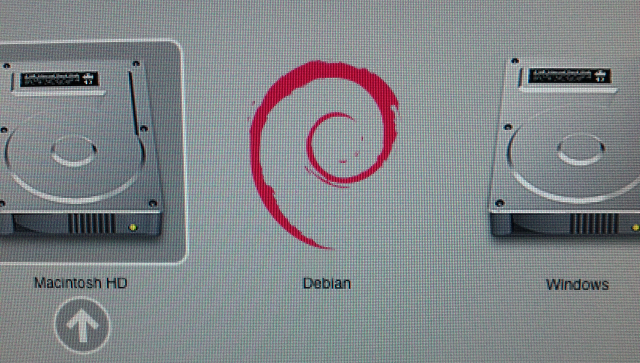
Diego s post got me to switch from grub-pc to grub-efi to boot Debian on my Macbook Pro. But I wanted to go further: getting rid of rEFIt. rEFIt is a pretty useful piece of software, but it s essentially dead. There is the rEFInd fork, which keeps it up-to-date, but it doesn t really help with FileVault. Moreover, the boot sequence for a Linux distro with rEFIt/rEFInd looks like: Apple EFI firmware rEFIt/rEFInd GRUB Linux kernel. Each intermediate step adding its own timeout, so rEFIt/rEFInd can be seen as not-so-useful intermediate step. Thankfully, Matthew Garrett did all the research to allow to directly boot GRUB from the Apple EFI firmware. Unfortunately, his blog post didn t have much actual detail on how to do it. So here it is, for a Debian system: Now, the Apple Boot Manager, shown when holding down the option key when booting the Macbook Pro, looks like this:
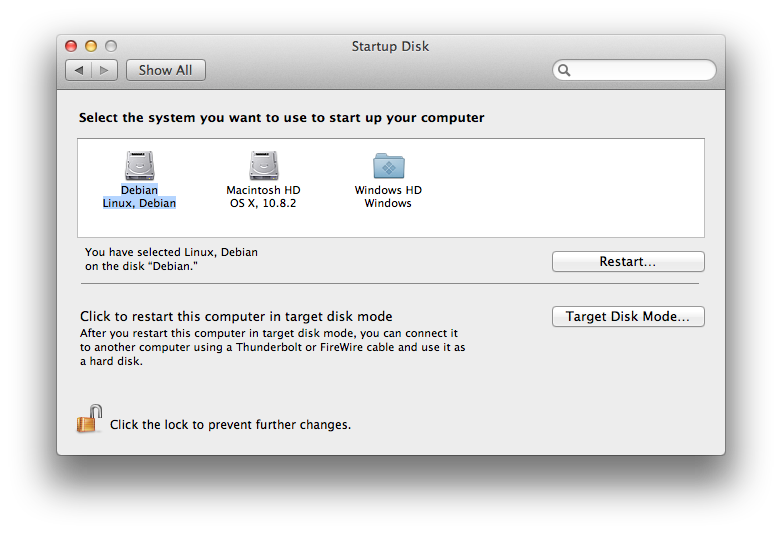
And the Startup disk preferences dialog under OSX, like this:

Russ Allbery: Review: A Hero's Tale

Review: A Hero's Tale, by Catherine M. Wilson
Series: Women Were Warriors #3
Publisher: Shield Maiden
Copyright: 2008
ISBN: 0-9815636-3-5
Format: Kindle
Pages: 301

This is an ebook, so metadata may be inaccurate or missing. See notes on ebooks for more information. A Hero's Tale is the third book in the When Women Were Warriors trilogy, which is best thought of as a single long novel. Reading it independently will miss most of the significance of the plot, since one wouldn't know many of the important characters. A Hero's Tale follows the pattern of the second book: even less quiet contemplation, and even more in the way of events and plot. Tamras completes her training, in a somewhat unexpected way (and in a rather interesting reworking of gender roles), but then both Maara's past and the problems of A Journey of the Heart catch up with them. There is, accordingly, quite a bit more action, or at least war councils and political maneuvering, than the previous books, and somewhat less time for thoughtful wisdom. That also means that A Hero's Tale shifts a bit more towards the traditional fantasy coming-of-age story, where the heroine is able to shift armies and win conflicts with an understated and self-deprecating skill that comes inevitably but indirectly out of all of her previous experiences. I think Wilson is still fairly original in how she presents those tropes, with an interesting focus on empathy and compassion that is all too rare in this sort of story, but this book does feel a lot more like a story that one has read before. If you're particularly allergic to that story shape, you may find this entry somewhat disappointing. One of the things I loved about it, though, was Wilson's avoidance of traditional villains. There is one, so it's not a complete avoidance, but nearly everyone in this story has their own viewpoint and perspective and is on the side of right in their own way. Wilson uses Tamras's empathy and willingness to listen and understand to let the reader see various different perspectives without moving away from the first-person perspective. It's very nicely done. I thought the handling of the emotional arc of the story was more mixed. Tamras is seriously tested in some moments that aimed for heartbreaking, but I thought they fell short of the emotional punch they were supposed to carry since the story shape had already made it obvious that everything would turn out okay in the end. The story is so gentle that Wilson hadn't established any willingness to end something badly, which robs a lot of the punch from emotional turmoil. I also had quite a bit of trouble with the principle of love above all else, particularly for someone in Tamras's position. Maybe that's because I'm still too entrenched in the attitude towards politics that this series argues against, but I had a hard time not seeing her as personally indulgent. Both of those factors blunted the emotional climax for me, leaving it moving but not as heartbreaking as I think Wilson was aiming for. (This is the point where a friend will tell me that I think too much about books while I'm reading them.) That said, Wilson continues to write one of the best mentoring relationships that I've seen in fiction. The dynamic between Tamras and Maara is just beautiful, and remains so through the end of the book. So many traditional issues with rivalry, growth, replacement of the mentor, and relative social position that are ignored or dealt with ham-handedly in other stories are handled adeptly and quietly. Maara is by far my favorite character of this series, largely because of how she handles that relationship. I could identify with her more easily than with Tamras at various points in the story, and I thought the understated ending was quietly beautiful. If you enjoyed the rest of the series, definitely read A Hero's Tale for the conclusion. If you've been hungry for more typical action, you'll get some of it here. I wish a few deep emotions other than love had been in play, but, despite that, When Women Were Warriors is still quietly and delightfully different than most things I've read, and worth the price. Rating: 8 out of 10

17 November 2012

Russell Coker: Geeky Jeans

It s likely that most people make things like comfort, style, and price the main criteria when purchasing clothes. But there are other things that can be more important such as the ability to fit a phone in the pocket. My last pair of jeans was from Rivers (one of the more affordable Australian clothing stores which also has online sales) [1]. They were the long leg version and have front pockets that are 28cm deep (measured from the bottom of the pocket to the lowest part of the lip) and 15cm wide (a 15cm ruler will barely fit sideways in the pocket). I ve just got some new jeans from Rivers which are the regular leg length, they have front pockets which are 21cm deep and slightly more than 16cm wide. The old pair could fit a Nexus 7 tablet in the front pocket. The new pair should more easily fit such a tablet in the pocket but it might be less comfortable to walk with the tablet in the pocket. I don t plan to try using my front pocket for a tablet (I d be more likely to use a backpack or my Scott e vest [2]), but a Galaxy Note 2 (which is about the largest device that most people would want in their pocket) would fit nicely. I find the Rivers jeans to be quite comfortable and I like the way they look. They also only cost $25 online or $30 in the store. When I bought my first pair before I even had a 4 phone they were good value and they will be even better value early next year when I get a bigger phone. Even though Rivers jeans may wear out faster than more expensive brands, for $30 it s easy to just buy a few pairs at a time. During an email discussion of geeky clothing the issue of women s clothes having fewer and smaller pockets was raised. Unfortunately I didn t think to measure the pockets in women s jeans when I was at the Rivers to discover whether they have big pockets too. I ll do that next time I m in the area.

16 November 2012

Richard Hartmann: Release Critical Bug report for Week 46

In case you care, there's a short discussion about when to publish this info and how it relates to DWN on the Debian publicity mailing list. The UDD bugs interface currently knows about the following release critical bugs: How do we compare to the squeeze cycle ? Yes, how indeed. There's not automatic way to generate this data, yet. Stay tuned for now.

15 November 2012

Axel Beckert: Tools to handle archives conveniently

TL;DR: There s a summary at the end of the article. Today I wanted to see why a dependency in a .deb-package from an external APT repository changed so that it became uninstallable. While dpkg-deb --info foobar.deb easily shows the control information, the changelog is in the filesystem part of the package. I could extract that one dpkg-deb, too, but I d have to extract either to some temporary directory or pipe it into tar which then can extract a single file from the archive and sent it to STDOUT:
dpkg-deb --fsys-tarfile foobar.deb   tar xOf - ./usr/share/doc/foobar/changelog.Debian.gz   zless
But that s tedious to type. The following command is clearly less to type and way easier to remember:
acat foobar.deb ./usr/share/doc/foobar/changelog.Debian.gz   zless
acat stands for archive cat is part of the atool suite of commands:
als
lists files in an archive.
$ als foobar.tgz
drwxr-xr-x abe/abe           0 2012-11-15 00:19 foobar/
-rw-r--r-- abe/abe          13 2012-11-15 00:20 foobar/bar
-rw-r--r-- abe/abe          13 2012-11-15 00:20 foobar/foo
acat
extracts files in an archive to standard out.
$ acat foobar.tgz foobar/foo foobar/bar
foobar/bar
bar contents
foobar/foo
foo contents
adiff
generates a diff between two archives using diff(1).
$ als quux.zip
Archive:  quux.zip
  Length      Date    Time    Name
---------  ---------- -----   ----
        0  2012-11-15 00:23   quux/
       16  2012-11-15 00:22   quux/foo
       13  2012-11-15 00:20   quux/bar
---------                     -------
       29                     3 files
$ adiff foobar.tgz quux.zip
diff -ru Unpack-3594/foobar/foo Unpack-7862/quux/foo
--- Unpack-3594/foobar/foo      2012-11-15 00:20:46.000000000 +0100
+++ Unpack-7862/quux/foo        2012-11-15 00:22:56.000000000 +0100
@@ -1 +1 @@
-foo contents
+foobar contents
arepack
repacks archives to a different format. It does this by first extracting all files of the old archive into a temporary directory, then packing all files extracted to that directory to the new archive. Use the --each (-e) option in combination with --format (-F) to repack multiple archives using a single invocation of atool. Note that arepack will not remove the old archive.
$ arepack foobar.tgz foobar.txz
foobar.tgz: extracted to  Unpack-7121/foobar'
foobar.txz: grew 36 bytes
apack
creates archives (or compresses files). If no file arguments are specified, filenames to add are read from standard in.
aunpack
extracts files from an archive. Often one wants to extract all files in an archive to a single subdirectory. However, some archives contain multiple files in their root directories. The aunpack program overcomes this problem by first extracting files to a unique (temporary) directory, and then moving its contents back if possible. This also prevents local files from being overwritten by mistake.
(atool subcommand descriptions from the atool man page which is licensed under GPLv3+. Examples by me.) I though miss the existence of an agrep subcommand. Guess why? atool supports a wealth of archive types: tar (gzip-, bzip-, bzip2-, compress-/Z-, lzip-, lzop-, xz-, and 7zip-compressed), zip, jar/war, rar, lha/lzh, 7zip, alzip/alz, ace, ar, arj, arc, rpm, deb, cab, gzip, bzip, bzip2, compress/Z, lzip, lzop, xz, rzip, lrzip and cpio. (Not all subcommands support all archive types.) Similar Utilities There are some utilities which cover parts of what atool does, too: Tools from the mtools package Yes, they come from the handle MS-DOS floppy disks tool package, don t ask me why. :-)
uz
gunzips and extracts a gzip d tar d archives
Advantage over aunpack: Less to type. :-)
Disadvantage compared to aunpack: Supports only one archive format.
lz
gunzips and shows a listing of a gzip d tar d archive
Advantage over als: One character less to type. :-)
Disadvantage compared to als: Supports only one archive format.
unp unp extracts one or more files given as arguments on the command line.
$ unp -s
Known archive formats and tools:
7z:           p7zip or p7zip-full
ace:          unace
ar,deb:       binutils
arj:          arj
bz2:          bzip2
cab:          cabextract
chm:          libchm-bin or archmage
cpio,afio:    cpio or afio
dat:          tnef
dms:          xdms
exe:          maybe orange or unzip or unrar or unarj or lha 
gz:           gzip
hqx:          macutils
lha,lzh:      lha
lz:           lzip
lzma:         xz-utils or lzma
lzo:          lzop
lzx:          unlzx
mbox:         formail and mpack
pmd:          ppmd
rar:          rar or unrar or unrar-free
rpm:          rpm2cpio and cpio
sea,sea.bin:  macutils
shar:         sharutils
tar:          tar
tar.bz2,tbz2: tar with bzip2
tar.lzip:     tar with lzip
tar.lzop,tzo: tar with lzop
tar.xz,txz:   tar with xz-utils
tar.z:        tar with compress
tgz,tar.gz:   tar with gzip
uu:           sharutils
xz:           xz-utils
zip,cbz,cbr,jar,war,ear,xpi,adf: unzip
zoo:          zoo
So it s very similar to aunpack, just a shorter command and it supports some more exotic archive formats which atool doesn t support. Also part of the unp package is ucat which does more or less the same as acat, just with unp as backend. dtrx From the man page of dtrx:
In addition to providing one command to extract many different archive types, dtrx also aids the user by extracting contents consistently. By default, everything will be written to a dedicated directory that s named after the archive. dtrx will also change the permissions to ensure that the owner can read and write all those files. Supported archive formats: tar, zip (including self-extracting .exe files), cpio, rpm, deb, gem, 7z, cab, rar, and InstallShield. It can also decompress files compressed with gzip, bzip2, lzma, or compress.
dtrx -l lists the contents of an archive, i.e. works like als or lz. dtrx has two features not present in the other tools mentioned so far: Unfortunately you can t mix those two features. But you can use the following tool for that purpose: deepfind deepfind is a command from the package strigi-utils and recursively lists files in archives, including archives in archives. I ve already written a detailed blog-posting about deepfind and its friend deepgrep. tardiff tardiff was written to check what changed in source code tarballs from one release to another. By default it just lists the differences in the file lists, not in the files contents and hence works different than adiff. Summary atool and friends are probably the first choice when it comes to DWIM archive handling, also because they have an easy to remember subcommand scheme. uz and lz and the shortest way to extract or list the contents of a .tar.gz file. But nothing more. And you have to install mtools even if you don t have a floppy drive. unp comes in handy for exotic archive formats atool doesn t support. And it s way easier to remember and type than aunpack. dtrx is neat if you want to extract archives in archives or if you want to extract metadata from some package files with just a few keystrokes. For listing all files in recursive archives, use deepfind.

14 November 2012

Sandro Tosi: Project Euler - Problem 4

Here's my solution to Project Euler problem 4:

# handy function to check if a number is palindrome
def is_palindrome(i):
    return str(i) == str(i)[::-1]
# what's the max?
max_p = 0
# multiply all numbers  i  between 100 and 998, with all between i+1 and 999
for i in xrange(100, 999):
    for j in xrange(i+1, 1000):
        p = i * j
        if is_palindrome(p) and p > max_p:
            max_p = p
print max_p

Comments are welcome.

Update: fixed as per Alex comment.

Martin F. Krafft: A small office, multi-function printer

Dear lazyweb, we need a new printer-scanner combination for our new office, ideally a laser printer and a high-resolution scanner (1200dpi). It must integrate nicely with CUPS and SANE, without requiring any proprietary, closed-licence drivers or plugins. It also has to come with an automatic document feeder in addition to the plain flatbed scanner. Additional, would-be-nice features in decreasing order of preference are I have investigated the Samsung CLX-6220FX, but the driver situation was such a nightmare (and the printer so loud), that we returned it right away. I should have read this article by Peter beforehand I have recently seen the HP Laserjet Pro 200 M276n, the successor of the HP Laserjet CM1415nf which looks promising, but according to LinuxPrinting.org, a proprietary plugin is required (WTF HP?). Does anyone have experience with these HP models and can recommend them for use with Debian stable? Does anyone have another recommendation? Please send me a message. Thanks!

13 November 2012

Steve McIntyre: Spoiling my vote

Ever since I passed the age of 18, I've used my legal right in the UK to vote in every poll I could: local council, British Parliament, European Parliament and even the messed-up referendum on the Alternative Vote that we had last year. In each of those cases, I made a point of considering my available options and I voted accordingly. I went along and marked my ballot paper in person where possible, or I filled in a postal vote for the last Westminster election in 2010 as I was on vacation in Florida when it was held. Unfortunately, it seems that my diligence in voting makes me unusual amongst the UK population these days. The long-term trend for voter turnout is downwards (as you can see). However, the latest election that's happening in the UK (well, England and Wales outside London) this week is for the newly-created posts of Police and Crime Commissioners. It's a textbook example of how not to organise an election, as pointed out eloquently by the Electoral Reform Society. This election has been incredibly badly managed and publicised by the Government, and lots of early polls are suggesting a tiny turnout of less than 20%. Despite the political crap about "democracy" being spouted by some Tory ministers, it's clear that very few people want this change in how the police are run, and it has simply been imposed from the top. Too few people care about the results of these elections for them to be valid - most people don't want the police politicised. After a lot of thought about the issue, I've decided how I'm going to vote this time. For the first time ever, I'm explicitly going to turn up and spoil my ballot paper as a protest - I do not want this crap. I urge other people in England and Wales to consider doing the same.

12 November 2012

Stefano Zacchiroli: Debian newcomer experience survey

In recent times we have worked quite a bit to improve the NM process, i.e. the process newcomers go through to become members of the Debian Project. As it happens, I've just read Nathan's recent post on his NM experience and I think it is a perfect example of the joining experience we are trying to offer to all newcomers. But examples, be them positive or negative, are only anecdotal. To evaluate a process one needs actual data and someone analyzing them, ideally with a scientific approach. This is why I'm happy to host below a guest blog post by Kevin Carillo, who is doing a pretty thorough scientific study about how newcomers join a wide range of Free Software projects, including KDE, OpenSUSE, GNOME, and Debian, of course! TL;DR: if you started contributing to Debian after January 2010, there's a survey for you; participating will help us improving the NM process even further. Kevin's guest blog post follows.
Newcomer experience in Debian and other FOSS communities - Survey My name is Kevin Carillo. I am a PhD student currently living in Wellington (New Zealand) and I am doing some research on Free/Open Source Software communities. If you have started contributing to the Debian project after January 2010 (within approximately the last 3 years), I would like to kindly request your help. I am interested in hearing from people who are either technical or non-technical contributors, and who have had either positive or negative newcomer experiences. The purpose of the research is to work out how newcomers to a FOSS community become valued sustainable contributors. The survey is online and will be available until Tuesday, 27 November, 2012. Inspiration from Debian New Member Debian is a successful community that keeps attracting new contributors and that relies on a very unique way to handle the integration of new contributors: the New Member process. The idea behind the NM process is that it is some sort of filtering procedure allowing to only retain the individuals who have the potential to become valued sustainable contributors in Debian. Within Debian, there is a lot of enthusiasm and pride around the NM process as it seems to be functioning pretty well but the question is: Is this really enough to ensure that Debian remains a healthy and growing community? How does it compare to the way newcomers are integrated in other large projects such as KDE, GNOME, or in other non-Linux related communities such as Mozilla? I have to admit that the Debian NM process has been among the main sources of inspiration that made me embark in this research project. I have kept being quite impressed when talking to people who had gone through the process as all of them came out of it with a real passion for the project and love for its community. When reflecting on the reasons why the NM process succeeds, I have a feeling it is some instance of ritualized socialization. In other words, barriers and initiation rituals that require some effort from newcomers, generate members with higher commitment and sense of identification towards the Debian community. What do newcomers really experience? The main assumption that motivated this project is that attracting new members has become crucial for a large majority of FOSS communities but this is not a sufficient condition to ensure the success and prosperity of a project. A proportion of a community's newcomers must contribute to the well-being and growth of the community. Keeping all that in mind, FOSS projects have thus to do a good job at "socializing" their newcomers and turning them into 'good' contributors. Doing a good job here means that FOSS projects shall ensure that they help generate citizenship-like behaviors from newcomers by designing appropriate newcomer programs and procedures. FOSS communities rely on a wide array of initiatives to facilitate the integration of newcomers but it seems like the other side of the coin is less understood: What do newcomers really experience? And how does this influence their contributions and actions within a project? How is this study going to help Debian? The data will help gain insights about the experience of newcomers within the Debian community. In addition, it will allow to understand how to design effective newcomer initiatives to ensure that Debian will remain a successful and healthy community. The dataset will be released under a share-alike ODbL license so that Debian contributors can extract as much value as possible from the data. Since this survey also involves other large FOSS projects such as Mozilla, KDE, Gnome, Ubuntu, Gentoo, OpenSUSE, and NetBSD, it will also be possible to compare practices across projects in order to identify what works from what does not work when facilitating the integration of newcomers. About the survey This survey is anonymous. The raw dataset of everything one fills in the survey will be released under the ODbL. Since all the questions but one are optional, one is free to control the amount of information they are giving away about themselves. I expect the survey to take around 20 minutes of your time. If you know members of the Debian community who you think would be interested in completing it, please do not hesitate to let them know about this research. I will post news about my progress with this research, and the results on my blog. Don't hesitate to contact me. --- Kevin Carillo

Sune Vuorela: Fake Akrobat browser plugin

So. for some reason, the danish tax authorities (Skat) has started requiring Adobe Acrobat for being able to see pdf files to work around a bug with handling of temporary files on Windows8 and shared computers and such. Luckily there is a couple of easy workarounds. Like modifying the Javascript to check things at runtime using some browser specific addons. Or just do it like I did and write a actual browserplugin. I cheated and used QtBrowserPlugin. Then my actual code was a couple of lines. Want to check it out? Look here: http://quickgit.kde.org/?p=scratch%2Fsune%2Ffakeacrobat.git. It just does enough to ensure the test succeeds. Work in: iceweasel and arora. For some reason, it doesn t work in konqueror/webkit nor in konqueror/khtml.

11 November 2012

Gregor Herrmann: RC bugs 2012/45

again, not one of my best RCBW weeks. still, here's the short report:

Jakub Wilk: All those translations, how did you ever manage it?

I've just released initial version of gettext-inspector, a tool for checking gettext PO/POT/MO files. While it's in an early stage of development, it's already able to detect wide rage of problems. For example, this is what it emits on my system:
$ gettext-inspector /usr/share/locale/*/LC_MESSAGES/*.mo   cut -d ' ' -f 1,3   sort   uniq -c   sort -rn
   1902 P: no-language-header-field
   1601 P: no-version-in-project-id-version
   1372 W: no-report-msgid-bugs-to-header-field
    273 P: invalid-content-transfer-encoding
    201 W: invalid-date
     78 W: syntax-error-in-plural-forms
     77 I: no-package-name-in-project-id-version
     63 W: boilerplate-in-report-msgid-bugs-to
     50 W: language-disparity
     47 I: unknown-header-field
     38 W: invalid-language
     25 W: boilerplate-in-project-id-version
     10 I: unknown-poedit-language
      8 W: no-date-header-field
      5 W: no-project-id-version-header-field
      5 W: c1-control-characters
      3 P: no-mime-version-header-field
      3 P: no-content-transfer-encoding-header-field
      2 W: non-portable-encoding
      1 W: invalid-report-msgid-bugs-to
      1 W: ancient-date
      1 I: unable-to-determine-language

9 November 2012

Richard Hartmann: Release Critical Bug report for Week 45

Erratum Last week's posting had the wrong week. Turns out the script always outputs week 42. As the weeks were so close to each other, I didn't realize this at first. I fixed this by hand for this posting and will have it fixed upstream by next week. Timing I have put a lot of thought into when to publish this. Friday so it's before the weekend? Sat/Sun so it's during the weekend? Monday so it's at the actual start of the week (sorry, people from the U.S.)? Feedback welcome, assuming anyone cares. The actual gist The UDD bugs interface currently knows about the following release critical bugs: How do we compare to the squeeze cycle ?
Week Squeeze Wheezy Diff
43 284 (213+71) 468 (332+136) +184 (+119 ; +65)
44 261 (201+60)
45 261 (205+56)
46 271 (200+71)
47 283 (209+74)
48 256 (177+79)
49 256 (180+76)
50 204 (148+56)
51 124 (124+54)
52 115 (78+37)
1 93 (60+33)
2 82 (46+36)
3 25 (15+10)
4 14 (8+6)
5 2 (0+2)
6 release!

Olivier Berger: Using a DreamPlug with Debian as an IPv4/IPv6 router for a home LAN behind a FreeBox

The goal of this article is to describe the setup I've made for my home LAN behind a FreeBox (French ISP Free.fr).

1 Principles
The FreeBox is configured :
  • in router mode (with a local IPv4 network on 192.168.0.x/24)
  • with IPv6 support activated (by convention, we'll use the 2a01:e35:1234:5678::/64 prefix below, to represent the IPv6 prefix provided by the FreeBox)
Behind the FreeBox, I have connected a DreamPlug computer (running Debian wheezy with a dual-boot setup as sold by NewIT) on its eth0 etherlink port. Behind the DreamPlug, I have connected a switch (to its eth1 ethernet port), on which the LAN's machines will be connected, on a dual IPv4/IPv6 network. The IPv4 will be on 192.168.4.0/24 (addresses for machines connected to the switch will be static) while the IPv6 will use the addresses auto-generated on the FreeBox's prefix. The DreamPlug will also provide a wifi network (in master mode, through its uap0 interface), only IPv4 on 192.168.3.0/24. On the DreamPlug, the outgoing IPv4 traffic will be masqueraded, while the IPv6 traffic will be bridged so that machines on the LAN can be reached from the Internet directly, passing through the eth0 eth1 bridge. The DreamPlug will also act as a filter/firewall to only allow selected traffic to reach the LAN machines (in particular for the IPv6, since the machines may be reached directly from the Internet otherwise).

1.1 Alternatives
There are a lot of howtos describing the setup of FreeBox + IPv6, but I couldn't find one that was exactly reflecting the kind of setup I have. Some dealt with a FreeBox setup in bridge mode (i.e. not the router mode), but in case the DreamPlug isn't so much reliable, or I've messed with the config, I'm tempted to keep the possibility to connect directly to the FreeBox. Others didn't use the same setup with a router distributing both wired and wifi networks. And note described exactly the setup for a DreamPlug running Debian wheezy and using ferm as a firewall. No, there's no NIH syndrom here ;)

2 DreamPlug router configuration

2.1 Interfaces configuration
The /etc/network/interfaces on the DreamPlug looks like the following (kudos to Dag Bertelsen's Setting up Dreamplug as a router with Shorewall firewall for the wifi configuration bits):
# Note: Order of the interfaces declarations matters

auto lo
iface lo inet loopback

auto uap0
iface uap0 inet static
post-up /usr/bin/uaputl sys_cfg_ssid dream-uAP-XXXX
# Modus WPA2
post-up /usr/bin/uaputl sys_cfg_protocol 32
# WLAN password
post-up /usr/bin/uaputl sys_cfg_wpa_passphrase "WHATEVER PASSWORD"
# Set the Cipher
post-up /usr/bin/uaputl sys_cfg_cipher 8 8
# automatic channel
post-up /usr/bin/uaputl sys_cfg_channel 0 1
post-up /usr/bin/uaputl bss_start
# we deliver addresses for the Wifi with DHCP
post-up /usr/sbin/service udhcpd start
address 192.168.3.1
netmask 255.255.255.0

# Only IP6 traffic passes through the router between the Freebox on eth0 and the LAN on eth1
auto br0
iface br0 inet manual
bridge_ports eth0 eth1
bridge_maxwait 0
pre-up ebtables -t broute -A BROUTING -p ! ipv6 -j DROP
down ebtables -t broute -F

# Connected to the FreeBox, with DHCP in IPv4, masquerading outgoing IPv4 traffic
auto eth0
iface eth0 inet dhcp
up iptables -t nat -A POSTROUTING -o eth0 -j MASQUERADE
down iptables -t nat -F
post-up sysctl -q -w net.ipv4.ip_forward=1
iface eth0 inet6 auto

# Connected to the LAN with a static IPv4 address
auto eth1
iface eth1 inet static
address 192.168.4.1
netmask 255.255.255.0

2.2 DHCP server configuration
The DHCP config for udhcpd is as such (in /etc/udhcpd.conf):
start 192.168.3.100
end 192.168.3.200
interface uap0
opt lease 86400
opt router 192.168.3.1
opt subnet 255.255.255.0
opt dns 192.168.3.1
opt domain localdomain
max_leases 101
lease_file /var/lib/udhcpd.leases
auto_time 5

2.3 Firewall configuration
The firewall I use is ferm. Here's the /etc/ferm/ferm.conf configuration (YMMV). Thanks to Ren Garcia's R gles de firewall pour un pont IPv6 for inspiration :
## Interfaces of the router

# Our LAN on a switch
@def $DEV_PRIVATE = eth1;

# The ISP router
@def $DEV_WORLD = eth0;

# Our Wifi LAN
@def $DEV_WIFI = uap0;


## IP networks of our LAN

# IPv4 (includes ethernet switch and wifi)
@def $NET_PRIVATE = 192.168.0.0/16;

# IPv6 (the prefix granted by the ISP)
@def $NET6_PRIVATE = 2a01:e35:1234:5678::/64;

# IPv6 Local link
@def $LINK6 = fe80::/10;

# Specific machines on the LAN
@def $MACHINE_MYDESKTOP = 2a01:0e35:1234:5678:1234:5678:9abc:def0;

# Special function to log dropped packets
@def &DROP() =
mod limit limit 1/second limit-burst 10 LOG log-prefix "$DOMAIN-$CHAIN: ";
DROP;


# IPv4 iptables rules
table filter
chain INPUT
policy DROP;

# connection tracking
mod state state INVALID DROP;
mod state state (ESTABLISHED RELATED) ACCEPT;

# allow local packet
interface lo ACCEPT;

# respond to ping
#proto icmp ACCEPT;
proto icmp icmp-type echo-request ACCEPT;

# allow IPsec
proto udp dport 500 ACCEPT;
proto (esp ah) ACCEPT;

# allow SSH connections from the private network and from some
# well-known internet hosts
#saddr ($NET_PRIVATE 123.45.67.89) proto tcp dport ssh ACCEPT;
saddr $NET_PRIVATE proto tcp dport ssh ACCEPT;

# we provide DNS and SMTP services for the internal net
interface $DEV_PRIVATE saddr $NET_PRIVATE
proto (udp tcp) dport domain ACCEPT;
proto tcp dport smtp ACCEPT;


interface $DEV_WIFI
# DHCP
proto udp dport 67:68 ACCEPT;
proto (udp tcp) dport domain ACCEPT;

proto udp dport netbios-dgm DROP;


# LOG all dropped packets
proto (udp tcp) &DROP();


# outgoing connections are not limited
chain OUTPUT policy ACCEPT;

chain FORWARD
policy DROP;

# connection tracking
mod state state INVALID DROP;
mod state state (ESTABLISHED RELATED) ACCEPT;

# connections from the internal net to the internet or to other
# internal nets are allowed
interface $DEV_PRIVATE ACCEPT;
interface $DEV_WIFI ACCEPT;

# LOG all dropped packets
proto (udp tcp) &DROP();


# IPv4 masquerade / NAT support

table nat
chain POSTROUTING
# masquerade private IP addresses
saddr $NET_PRIVATE outerface $DEV_WORLD MASQUERADE;


## IPv6:

domain ip6
table filter

chain INPUT
policy DROP;

# Internal traffic authorized
saddr $NET6_PRIVATE ACCEPT;
saddr $LINK6 ACCEPT;

# accept multicast
daddr ff00::/8 ACCEPT;

interface lo ACCEPT;

# For public traffic
# Only DNS resolution + NTP acceped for UDP
interface br0
proto udp

sport domain ACCEPT;

dport ntp ACCEPT;

&DROP();


# TCP on ports < 1024 forbidden except for SSH
proto tcp

dport ssh ACCEPT;

dport 0:1023 DROP;


# Accepted established traffic
mod state state INVALID DROP;
mod state state (ESTABLISHED RELATED) ACCEPT;

# incoming connections forbidden
proto tcp syn DROP;

# Accept ping
proto icmpv6 ACCEPT;


proto (udp tcp) &DROP();

chain FORWARD
policy DROP;

# All local traffic accepted
saddr $LINK6 ACCEPT;

# All ping accepted unless coming from internet
saddr ! $NET6_PRIVATE proto icmpv6 icmp-type echo-request DROP;
proto icmpv6 ACCEPT;

# Allow SSH to specific machines
proto tcp daddr $MACHINE_MYDESKTOP dport ssh ACCEPT;

# Accept established traffic
mod state state INVALID DROP;
mod state state (ESTABLISHED RELATED) ACCEPT;

# Accept outgoing traffic
saddr $NET6_PRIVATE ACCEPT;

# Accept local outgoing traffic
saddr ::1 ACCEPT;

proto (udp tcp) &DROP();


# ebtables
domain eb chain FORWARD
policy DROP;

# Only accept bridged traffic for IPv6
logical-in br0 logical-out br0
#ebtables -t broute -A BROUTING -p ! ipv6 -j DROP
proto IPv6 ACCEPT;


2.4 DNS config

The DreamPlug will run bind9 to cache the DNS for the wifi network (default config is OK out of the box).

3 Configuration for the LAN machines

3.1 Connection with Wifi
Machines connected with the WPA wifi network should get an IPv4 only address via DHCP on the 192.168.3.0/24 network. There's nothing to be configured specifically.

3.2 Ethernet connection on the switch
Machines connected via ethernet cables to the switch can run either with IPv4 config, in which case they should be configured statically for the 192.168.4.0/24 network, using the router on 192.168.4.1 as a gateway, or with IPv6 auto config. On wheezy, the /etc/network/interfaces will look like :
auto eth1
iface eth1 inet static
address 192.168.4.42
netmask 255.255.255.0
gateway 192.168.4.1
dns-nameservers 212.27.40.241 212.27.40.240

iface eth1 inet6 auto

4 To do list

The setup works fine, but there are a few things I'd like to improve :
  • running a regular Debian distro on the DreamPlug (the kernel used at the moment is patched for the wifi driver in master mode support), possibly using only Free Software.
  • using subnets for the IPv6 machines (but that seems not exactly obvious, requiring NDP proxying and stuff), so that the privacy is improved (the IPv6 auto generated global addresses depend on the MAC addresses hmmm probably not optimal).
  • adding more stuff to the DreamPlug router so that it becomes a full fledged FreedomBox.

5 References

Date: 2012-11-09 16:30:34 CET

8 November 2012

Tanguy Ortolo: Licence to kill -9

The title of the next James Bond movie! Or will that be the next OpenBSD release song? ;-)

Parody of a James Bond movie poster: licence to kill -9

7 November 2012

Russell Coker: Rape Apology and LCA 2011

After a lecture at LCA 2011 included some inappropriate slides there was a long discussion on several mailing lists about the issues related to this. In February 2011 I wrote a blog post debunking some of the bogus arguments in question [1]. Of course the matter didn t end there, at LCA 2012 I was drawn into a few debates IRL about the issues, as long as there are more than a few men who want such porny pictures used in LCA talks the issue can t be properly resolved. The most serious aspect of the discussion in question is that of rape apology, the bad ideas that were presented have a real impact on the way people behave, merely making public statements saying that something is OK is going to increase the incidence of it happening. The Geek Feminism Wiki has a good page summarising the issue [2]. The Finally Feminism 101 post about Rape Culture is also worth reading in this context [3]. Recently Valeria Aurora wrote a post for the Ada Initiaive blog about the rape apology issue and how the community needs to act to prevent such behavior [4]. This inspired Matthew Garrett to write about the issue and state the position that In the absence of an apology and explanation from Ted, I ll be interacting with him to the bare minimum that I m compelled to as a result of my job [5]. I agree with Matthew s article, everything he writes is logical and I believe that it is all for the benefit of the FOSS community as a whole. I think that most guys have quietly defriended guys who are rape-positive in the past (for example when I was 12 I refused to play D&D with boys who were raping NPCs). But blogging about it, explaining the problem, and giving the offender the possibility to reform is a good idea and it s something that should be done more often. Sam Varghese has written about the issue for ITWire [6]. He has taken the wrong approach to this, he specifically claims that Matthew Garrett has kicked off what could be a damaging episode . I think that Matthew s approach is necessary and the situation demands it. If Matthew had been on holidays and I had read the TAI post earlier then I would probably have written a blog post which Sam could have described in a similar manner. So I don t think that Matthew kicked anything off (I think that someone had to do it). I also don t think that this has to be damaging it depends on how everyone reacts. On her personal blog Valerie says When I first read Ts o s comments, I couldn t sleep for two nights. I wanted to throw up every time I thought about it. I was furious and frightened at the same time. Every time I think about this, even now, I literally have nightmares. I can t bear the thought of working with him even over email, much less attending the same conferences [7]. I don t think that any of us who are seriously involved in the FOSS community have a way of avoiding this issue, allowing Valerie and other women who have the same understanding of the situation to go through that without any support is not a neutral action. I think we need to consider whether someone who gives other delegates and speakers nightmares should be welcome to attend a conference. Valerie s post makes sense to me and I can understand why she doesn t want to associated with Ted, my understanding of the issue isn t important or even required, I merely note this because I m sure that there are lots of readers who will ignore anything that a woman might say. ITWire has a follow-up article with Ted s response, Ted fails to address all the issues and seems to think that the people who disagree with him merely don t appreciate his nuance [8]. The thing is that the issue of the incidence of rape was raised in discussion to consider the probability that rape survivors would have been in the audience for the Mark Pesce talk in question. None of Ted s claims indicate that rape could be rare enough that a crowd of 500+ random people could be expected not to have multiple rape survivors so his comments weren t even relevant to the discussion. Ted seems unwilling to try to understand the position of all the people who disagree with him.

Next.

Previous.