Search Results: "rra"

16 August 2006

Felipe Augusto van de Wiel: 15 Aug 2006

13 years...

[Debian]
Happy Birthday!!! I was waiting a little bit, in other parts of the world Debian is already celebrating, now people from Brazil (and also UTC-0300) can join the party! Last Saturday our Debian User Group celebrate the Debian Anniversary with a big barbecue, sports and good conversations during the entire afternoon! Next Saturday (19.August) different Debian User Groups in Brazil will coordinate the Debian Day in different cities at the same time. Have fun! 13 years of Debian and counting! :-)

In a quick note, I'm still moving ahead with my NM. I have to fix a few points on my packages (and I'm still waiting my sponsor -- Hi Otavio! -- to upload a couple of packages). And I have a few more to work on, I hope I find the time in the next days.


[Random Stuff]
At Monday (14.August) night (20h 00min UTC-0300) I visit (pt_BR) a very small city in the state I live in Brazil. They invited me to speak about Debian and Free Software for a group of students and also for locals. It was a nice talk and one of the things that got my attention is the number of women interested, of course, I told them to visit the Debian Women Project (which reminds me that I need to translate the site -- and lots of other files). Back to the work!

15 August 2006

Andrew Pollock: [tech] How to mount ATA over Ethernet volumes with a minimum of grossness

Yesterday I discovered some inadequacies in the stock Debian Etch initscripts when it came to filesystems on ATA over Ethernet block devices. Overnight I got a few emails, but it was a one Joshua J. Kugler who brought my attention to the _netdev mount option. The mount(8) manpage really is a treasure-trove of information that should be read often. So, in a nutshell, here's what I'm doing: Finally, I found I had to either load the aoe kernel module as a post-up operation for the Ethernet interface in /etc/network/interfaces or load it in /etc/modules and call /usr/sbin/aoe-discover as a post-up operation in /etc/network/interfaces, because just loading it from /etc/modules resulted in the driver being loaded a fair while before the network came up, and once the network had come up, it took the driver longer than the time for /etc/init.d/mountnfs.sh to be run to realise there were ATA over Ethernet devices on the LAN and arrange for the relevant entries to appear in /dev/etherd. I've currently opted for running aoe-discover from /etc/network/interfaces. So I'm now very happy. I can reboot my MythTV server and everything comes back without any intervention whatsoever. Sweet. It'd be nice if these fixes can make it into Etch, as all of the other components will be there for ATA over Ethernet support. The kernel is new enough to have the driver as standard, and vblade is in Etch. Just the support to mount it all properly isn't there. Oh, and nothing I've done (with the exception of the post-up stuff in /etc/network/interfaces) is ATAoE-specific. It'll work equally well for NBD for example, and presumably other SAN-like stuff. I certainly find this approach far less gross than what Coraid suggests, and it'd also be cool if Debian were the first distro to do it the right way. I wonder if Red Hat/Fedora are already? I suppose I could fire up Xen or VMware and find out if I get curious enough.

13 August 2006

Adam Rosi-Kessel: Return to Traverse City Film Festival

We spent last week at the Traverse City Film Festival in Michigan. This was the second year of the festival as well as our second year attending. Unlike last year, there was no “Freedom Festival” organized by Michael Moore-haters this year. Perhaps they are still recovering their debts from last year, when they lost money and had to stop their showing of “Michael Moore Hates America” after discovering it had inappropriate language for the family audience they were targeting. We saw nine films in just five days — four in one day was our max. (Rachele saw one more — The Beauty Academy of Kabul — that I missed, unfortunately, and we gave our tickets to Jesus Camp to Rachele’s parents.) Our selections were: The one that sticks most in my memory is La Moustache. The essence of the plot is revealed in the first minute of the movie: a man shaves off his mustache. His wife of fifteen years doesn’t notice. In fact, she doesn’t remember he ever had a mustache. While the film starts as vaguely comic, it quickly spirals into a psychic breakdown with a possibly unreliable narrator. It was quite nearly perfect. The beautifully restored virgin print of Monty Python’s Holy Grail was astonishing. The film was shown for free on a large outdoor screen by the lake, and the sound was crystal clear (now in stereo!) no matter where you sat. There are a bunch of scenes everyone always remembers in the Holy Grail. I realized after watching it again that the movie is composed entirely of these memorable scenes. (I had the same feeling watching the Wizard of Oz after a ten to fifteen year hiatus recently.) Finally, Stanley Kubrick’s first film, The Killing (1956) also merits the maximum rating, whatever that is (5.5 stars?). While it lacks the surreal/experimental feel of his later films, Kubrick was already beginning to play with narrative structure and sequencing. The film walks through the events leading to the climax several times, each time from a different character’s point of view. But really it’s just a great heist flick. Mani Haghigi, the Iranian director of Men at Work, had an interesting observation about the festival. Unlike most other film festivals, he, as a director, could just hang out and enjoy the films and the company and not worry about impressing executives and distributors. The festival’s motto is accurate — “Just Great Movies.”

Andrew Pollock: [tech] MythTV in under 24 hours

Last night, the final component of my MythTV setup arrived - the TV tuner card, a Hauppauge WinTV-PVR-350. I'd had the other bits and pieces for about a week, indeed I'd already had MythTV installed and "operational", but there's really only so much you can do without a TV signal in the mix as well. So I had a bit of a late night last night bashing on things and getting it all going. It was actually surprisingly trouble-free. For some reason, I naively thought that the more contemporary 2.6 kernels had all the support required for the PVR-350. Not true. You need to grab the ivtv driver and build it separately. If I was less impatient, I would have worked with module-assistant to get it packaged, but I just threw it on. I have to run 2.6.17 to get the sound working, so I needed the 0.7.0 version of the driver. This built and installed fine, and I could run mplayer against /dev/video0 and see (and hear) TV fine. With a bit of tweaking of MythTV, it was happily using the card. Getting the remote control to work was slightly more problematic. It turned out that I needed to get the latest greatest lirc from CVS in order to get everything to build correctly, and get a /dev/lirc that I could actually read from. After that, everything else just fell into place. The last thing I spent a bit of time battling with today was guide data and channel tuning. It seems for some reason that channels greater than or equal to 14 didn't have their frequency set correctly, so I had to manually edit each channel and put in the frequency in kilohertz that ivtv-tune --list-channels provided. The Zap2it chaps also provide two different sets of guide data for Mountain View, and depending on which one you pick, you get a totally screwed up idea of the actual channels available. I also discovered the hard way that changing from one set of channels to the other without cleaning out the channels first leads to a complete mish-mash of channel data that correlates even less with reality than choosing one or the other by itself. But within 24 hours of receiving the tuner card, I have everything up and running. The ATA over Ethernet disk array (that Myth tells me is good for over 600 hours of recording) seems to be holding up to the task alright. The current bandwidth utilisation for a few test recordings is interesting: Graph of bandwidth utilisation for disks attached to the MythTV server
via ATA over Ethernet So it seems that a TV show is a nice steady 5 mbits/sec, which everything seems to keep up with okay. The post-processing to flag commercials seems a bit more bandwidth-intensive. It seems to take about 40 minutes to flag the commercials for a 60 minute block of recording. It's early days yet, but I'm fairly happy with how everything's operating so far. I can certainly leave things as they are for a while without needing to fiddle with things any further. The one thing I do want to mention is the guide data. The fact that it's totally free, and designed to be used by the likes of MythTV is awesome. PVRs really live and die by the guide data, and it's so cool that Zap2it offer it complete gratis. Mad props to them. Oh, and while I'm dishing out praise, I really must also thank Christian Marillat for http://www.debian-multimedia.org/ and for packaging up MythTV for Debian. If I had to build all of this myself, I'm sure it wouldn't have been so trouble free.

11 August 2006

Aigars Mahinovs: Next day means next week?

The Dell saga goes into second stage. Despite me having a priority XPS next day on-site warranty it took three days, one click-trough of on-line wizard, two emails and three phone calls to get the collection of my broken laptop going. And now it will only be collected on Monday. Doh! I wonder how much it will actually take from the first problem report until I get my system back into a fully functional state. I was counting on being up and running by the end of the week, but apparently that is not happening.

10 August 2006

Martin F. Krafft: Through with XFS

I am through with XFS, once and for all. Well, at least for laptops. I still think it's a good filesystem when you can ensure that the power never goes, and your hardware is reliable, but it's just not adequate for laptops or even desktops. I ran into some serious problems a while ago, but managed to recover. Two nights ago, however, three XFS filesystems on my laptop decided to blow up and left my system thoroughly broken. I guess as the hibernate maintainer, I should really start doing my tests somewhere else than my main system... It all started out with a dist-upgrade and this output:
dpkg: error processing /var/cache/apt/archives/dpkg_1.13.22_i386.deb
(--unpack): unable to make backup link of
'./usr/share/man/man1/dpkg-deb.1.gz' before installing new version: Unknown
error 990
Looking at /usr/share/man/man1, I started to anticipate the apocalypse:
# ls -l /usr/share/man/man1
total 7956
?????????? ? ? ?    ? ? ? 7zr.1.gz
?????????? ? ? ?    ? ? ? 822-date.1.gz
?????????? ? ? ?    ? ? ? CA.pl.1ssl.gz
?????????? ? ? ?    ? ? ? Defoma::Common.1.gz
So I look at the log, and amidst kernel oops notices, there's this lovely cookie:
Filesystem "hda6": Corruption of in-memory data detected.  Shutting down
filesystem: hda6
Filesystem hda6 is /usr, so at that time I figured "it could have been worse", booted to single user, and remade the filesystem with the intention to simply reinstall all packages... when I found /var/lib/dpkg/info to be in similar condition. The rest of /var seemed fine, but I resolved then that there was no hope in reviving this system. Fortunately I brought an external drive that had just enough free space to hold my /home and some other stuff, but since USB is really slow when it comes to shifting large amounts of data, I decided to do something productive in the mean time and to answer some outstanding mails. It wasn't difficult to get SSH back up, so I started to work on a remote machine and used the time efficiently. Some time later, though, I got confused in the mist of screen sessions and was browsing my home directory on the laptop, thinking I was elsewhere (my home directories are mostly synchronised), when I noticed a directory in similar condition as the above. Oh shit. Imagine my pain and fear as I first thought my remote machine was also dying, imagine the sigh when I found out I was on the local filesystem, and imagine the shock when I realised that /home was also affected by the XFS breakage... A glance around /var confirmed that the XFS breakage was actually spreading and had now affected three filesystems on this machine. Fortunately, by that time, I had copied everything to the external drive, and decided to put my laptop and myself to sleep. I woke the next morning to the task of reinstalling the thing and decided to be optimistic about it. After all, a reinstall would mean I could finally try partman-crypto and encrypt my laptop's data to protect against leaking sensitive stuff in the case of loss or theft of my laptop. The installation was not as painless as I had hoped, but that was mainly because I ran into a known problem with the graphical installer and partman-crypto, which does not allow to set up volumes with random encryption keys (e.g. swap; see the forthcoming announcement for the beta3 release of the installer), and a bunch of smaller bugs. I had to restart the installation with the traditional frontend to get what I wanted, but other than that, I was very impressed with what our installer development team has accomplished! And a special round of gratitude to Frans Pop for not losing his patience while helping me on several occasions throughout the process. Now, 24 hours after the incident, I am back to normal with a fresh laptop and no data lost (except for one directory which I pulled from a mirrored remote machine; it had no local modifications (so why did XFS screw it up anyway?)). The fonts are all jaggy, so there's something I have to figure out. All things considered, I am sad to have lost 24 hours, but I can also relax more now, without fear of further XFS breakage or loss of private data. Update: Oh, and despite this, I did choose ext3 for all my laptop's filesystems. JFS was really cumbersome and slow last time I tried it, and I surely would not touch RazorFS after experiencing serious data loss on numerous occasions. Update: Two responses so far. Full ack for Julien (except for him laughing at me), Ingo's post warrants a reply though. First, ext3 is also journaled, and if you're about to say "yeah, but it's a hack on top of ext2, well... ext2 is damn mature, and journaling isn't really rocket science, so that "hack" isn't going to be too complicated. In fact, I like the idea of journaling being an option rather than a built-in feature. Second, of course you're supposed to keep backups. But since you keep backups, my top requirement of a filesystem is not "how to get the data back", but "how to ensure it does not break. If it breaks, I can reinstall and restore from backup, but that's a certain amount of time lost. If it doesn't break, well, that's like stealing a little something back from death then, isn't it? Third, I do follow the linux-xfs mailing list, but so what? I did not have write cache enabled, and I was running the 2.6.17.7 kernel at the time of the mishap. Lastly, you point to "excellent tools" to recover the filesystem. I am not sure how excellent xfs_repair really is when it reports "bad magic number 0x0 on dir inode 4696727" during the run, claims to have fixed it, I mount the filesystem, unmount it, run xfs_repair again and get the same message. No filesystem is perfect, and as we know from Biella's problems (among many others, ext3 is no exception. But we did get her data off! So then it's really an open field again, crap filesystem against crap filesystem. I guess at this point it helps to know that ext3 actually follows VFS semantics, while on XFS, a completed sync() syscall does not actually mean it has written the data to disk (see e.g. #317479). And then there are bugs like #239111... ext3 it is for now. If that let's me down, I'll try JFS. If that fails and noone has actually implemented a proper filesystem, I might have a go myself. Haha. Update: Alceste Scalas adds:
Ingo is right when he says that every filesystem has bugs --- but bugs apart, the design of Ext3 (i.e. its physical-block journaling) makes it a far more reliable choice for desktop and laptop PCs, expecially for people without an UPS. An Ext3 filesystem could only crash because of a bug or an hardware failure, while an XFS filesystem can be trashed even without bugs or hardware failures, due to the unavoidable consequences of a power loss on PC-class hardware.
He also alerted me to this mailing list post, which compares data=ordered journaling of ext3 (which almost noone does for performance reasons) with XFS and RazorFS. Update: You may also be interested in this post. Update: Otavio Salvador points me to this FAQ entry, which SGI must have added very lately. It explains how to deal with the directory corruption that was part of my problem. I guess I would have liked to know earlier, but I consider the outcome with dm-crypt + ext3 a win anyhow.

Andrew Pollock: [tech] Performance comparison between LVM and a straight disk

The beauty of having your hardware arrive in installments is you can do all sorts of fooling around with lots of storage that you wouldn't otherwise do because you'd be falling over yourself to get it all up and running yesterday. So as I impatiently wait for my TV tuner card to arrive, I've been doing some "benchmarking" to see how various different configurations perform. One of the things I wanted to find out was how much overhead did LVM give you. So I took one of the four disks in my non-redundant array of Bloody Huge Storage, and ran bonnie++ on it as a straight JFS volume on /dev/sda and as a logical volume in a volume group that used all of the logical extents provided by making /dev/sda into a physical volume. Again, I ran bonnie++ as:
bonnie++ -d /mnt -s 2G -n 1024 -u nobody:nogroup
So here's the results of running it on a JFS filesystem straight on /dev/sda:
                    -Per Chr- --Block-- -Rewrite- -Per Chr- --Block-- --Seeks--
Machine        Size K/sec %CP K/sec %CP K/sec %CP K/sec %CP K/sec %CP  /sec %CP
minotaur         2G 13712  95 18561  21  9152  11 13874  94 20446  18 142.2   1
                    ------Sequential Create------ --------Random Create--------
                    -Create-- --Read--- -Delete-- -Create-- --Read--- -Delete--
              files  /sec %CP  /sec %CP  /sec %CP  /sec %CP  /sec %CP  /sec %CP
               1024  5999  37  7125  19  1604  12   616  12   168   0    61   1
And here's the results of running it on a JFS filesystem on a logical volume that used all of the free logical extents provided by a volume group consisting of a physical volume made from /dev/sda
Version  1.03       ------Sequential Output------ --Sequential Input- --Random-
                    -Per Chr- --Block-- -Rewrite- -Per Chr- --Block-- --Seeks--
Machine        Size K/sec %CP K/sec %CP K/sec %CP K/sec %CP K/sec %CP  /sec %CP
minotaur         2G 13790  96 18566  21  9132  11 14202  96 20628  18 146.3   1
                    ------Sequential Create------ --------Random Create--------
                    -Create-- --Read--- -Delete-- -Create-- --Read--- -Delete--
              files  /sec %CP  /sec %CP  /sec %CP  /sec %CP  /sec %CP  /sec %CP
               1024  5989  37  7056  20  1605  12   611  12   167   0    61   1
Yup, that's right. It was actually slightly faster in a few cases. I can't explain that one. But it certainly goes to show that there is no noticeable performance impact of using LVM. Nice.

8 August 2006

Ross Burton: Cornish Bliss (part 2)

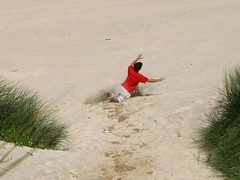
Now, where was I... Carbis Bay Carbis Bay Ah yes. After the horrendously grim weather had passed, the weather improved and we headed for the beach. On the way down we commented on how this was the classic British burning weather: bright sunshine, a strong breeze, and occassional clouds combine to burn skin without even feeling that hot. Of course knowing this meant nothing, we were too distracted with purchasing pasties and drink to think about putting a decent amount of sunblock on. Steve Relaxing Obviously the main thing to do at the beach, after we'd sat down, not applied sunblock, and scoffed a pasty, was to dig a hole. A huge hole. Spades were purchased and we took turns to help Pete dig The Hole. Digging Diggers Astute readers will notice the inevitable outcome of saying this is burning weather, not putting enough sunblock on, and digging a hole (an activity that results in the back being exposed to the sun). Ouch. After the hole had been dug we had to full it in again to avoid trapping small childen in it. Obviously this led to a series of hilarious scenes involving burying Pete up to his chest, modelling breasts and a penis, and so on. Finally the hole was flat again, at which point an impromptu long jump sand pit was arranged. I came first in the long jump, and although failing miserably at triple jump although I swear my technique was best (it's all in the wrists). Pete Next was to explore the costal path in the opposite direction towards Porthkidney beach. The beach is pretty huge by my standards, and due to the lack of facilities (no close car park, shops, toilets, and so on) it's almost deserted: there were a few other people there with dogs (the other local beaches are dog-free in summer) and that's about it. Googling to confirm the name of the beach reveals that there is a history of naturism and "inappropriate gay activity", but we didn't encounter any of that. ;) Progression Ross Footprints The costal path was great, far more rough than the walk to St Ives (often just a foot wide cutting in the ground), steep in places, and generally running very close to the cliff edge. The views were great, but I always think what a horror paths like these would be in winter, with the full force of the Atlantic winds pounding against the cliffs. As a finale it turns out that the costal path follows the cliff all the way along the back of the beach, which would easily be another twenty minutes of walking to reach sand. There is a shortcut down some stone stairs to the beach, but we arrived at high tide and the bottom of the stairs (well, rocks) were a foot deep in water. Wading up to the beach was a fitting end to the walk, and made the beach feel like our own little desert island! Cliff Steps Wading To Land Limpets! Ross I'll have to explain the expression on Vicky in the above photo. As a child when Vicky went to visit her father in Devon they used to go to the beach and spend the day annoying the wildlife: chasing crabs, kicking limpets off rocks and so on. When Vicky noticed that the rocks at the bottom of the cliff were covered in limpets, she shouted "limpets!" with a manic expression and preceeded to prod them frantically. After lots of sitting around and digging tunnels, we headed for the dunes for a spot of dune diving. This involves running at top spead down the dunes and throwing yourself into the sand at the bottom. Ah, the simple pleasures in life! Porthkidney Beach Dune Diving Dune Diving Dune Diving Dune Diving After my dive I ran back up the hill in the manner of a mad man, arms out-stretched to Vicky as I collapsed in front of her, gasping "It's". "What?", was the confused reply. This is terrible, I really need to get Vicky to watch the Best Of Monty Python DVD we have somewhere... It's! Possibly more to write, but Lost is on, so I'm off for now.

Gunnar Wolf: Biting your tongue

Sorry, this post will only mean anything to you if you can grok an es_* locale, preferrably an es_ES one. B3co points to a wonderful site, which I came accross sadly when I am about to start working. Still, lots of good laughs taken from mistakes in the Spanish press. The site? Morderse la Lengua (Biting your tongue), from Centro Virtual Cervantes. I found such beauties as the world's largest telescope, which can see object 100 meters away, a Boeing that goes back to Madrid through a crack, a Spanish airplane crashing in Turkey for the third time in a year. A Spanish party asks for the right to conduct abortions until the twelfth month, and -avoiding the problems that come with advanced age- a business looks for secretaries between 20 and 290 years old. And many, many, many more.

6 August 2006

Daniel Jacobowitz: Look Ma, I can blog too!

I've been meaning to set up a blog to keep track of random things that I run into and feel like sharing. One of those happened today, so I finally figured out how to install blosxom. I haven't gotten around to making a pretty CSS for it yet (not sure if I ever will, but I can pretend...) so for now it's somewhat utilitarian and default-looking. Blosxom is pretty bare-bones without plugins, and while Blosxom itself seems well documented the plugins are much less so. I spent about ten hours mucking around with the minimal set of plugins I needed to get something acceptable (timezone, autoblock, feedback, entriescache, interpolate_conditional, permalink, cooluri2, lastmodified, and a bunch of modified templates to use feedback and permalink). I tried and then discarded followsymlinks and metadate (for not playing well with other plugins I was using) and entries_index (lastmodified wanted something which set %others, so I used entriescache instead). I needed to hack lastmodified to work with entriescache, since it cleverly gets the timestamps from the cache, which are now publication dates. So here's a slightly modified lastmodified plugin which stats files directly. I spent a while getting RSS to behave, too. I used lastmodified to set lastBuildDate, modified the story template to use permalinks which were acceptable to feedback (it wants .rss on the end or it decides they aren't story pages), and eventually figured out that I needed to set <guid> to prevent liferea from thinking each modified post was new by comparing descriptions. All in all it was far more work than I meant to do last night when I decided this was a good idea. Hopefully I haven't messed it up too badly. We'll see whether I upset Planet. Leave me a note if it makes your feed reader unhappy, or something. I was actually going to use ikiwiki, but chickened out at the last moment; blosxom had fewer dependencies and I didn't want to mess around with getting ikiwiki to install on sarge. And it still seems to be evolving - so while it's wicked cool, I think I'll let it have a little more time to settle first. I spent most of this morning messing around with OpenWRT. I bought a LinkSys WRT54G quite a while ago (to replace a flaky D-Link DI-614+), and put OpenWRT on it. It took a little work to get it to do what I wanted, including fixing a quoting bug in the WPA startup script and tracking down an updated dnsmasq, but eventually I got it set up. Mostly the stock things: NAT, firewalling, wireless with WPA2, DHCP, internal DNS. Except that it can do one thing that none of the stock firmwares could: provide static DHCP addresses to specific boards, including custom options. This was absolutely essential for me to retire my old DHCP server, since I keep an embedded board lab in my office. I need the DHCP server to be able to tell boards where to get kernels and root filesystems. Anyway, it works well. Except that I've been having too many dropped connections lately and I have no way to track down whether it's the laptop (Dell Latitude D400, ipw2200 - mostly in Windows lately, I haven't retested it in Ubuntu in a bit) or the AP. I updated the Windows drivers and now it periodically tries to rekey, fails, reports "duplicated RSN" whatever that means, and periodically reports authentication failures. About the same as before except that now it has better diagnostic tools to tell me in undocumented messages what went wrong, instead of just telling me that something went wrong. So I next went looking for an updated driver for the other end. Which was a mistake. Note to others: if most of your packages are on a cromfs, running "ipkg update" is going to tear through your available MTD space really fast. And ipkg is not graceful at updates the way dpkg is; it failed to upgrade base-files due to file conflicts, leaving the updated dnsmasq unable to start. These are the same sorts of conflicts that you see in apt-get upgrade periodically: files moving from one package to another without sufficient package relationships (or in ipkg's case, maybe sufficient package manager support) to do it seamlessly. Then when I retried the update it succeeded, but it wiped out my firewall config and password file without asking. I don't really blame OpenWRT for this. "ipkg update" just isn't a good idea with their tools. But I miss apt. And I really miss 2.6 kernels; the binary-only Broadcom drivers that power the WRT54G only work on 2.4.30. And it's tight on flash/RAM anyway. So I went looking at options. Obviously, I can't get something that does exactly what I want for the kind of mass-market price the WRT54G sells at. But a suggestion from a coworker sent me looking at Mini-ITX systems, like the nice-looking Mini-Box M200. And at smaller things, like the WRAP WiFi and Soekris boards. I haven't done a hardware project of any sort since last summer, so I'm thinking about building myself an access point with benefits. I haven't decided what the benefits will be yet - if I get something like one of the Soekris boards, probably just bigger compact flash and back to dnsmasq for internal DHCP. But if I get a Mini-ITX system, I can throw a hard drive in it, arrange over-the-network backups, and use it as an incoming mail hub. This would let me decomission one of the always-on computers in my office. A mighty attractive proposition, although a bit less so now that the heat wave has broken.

5 August 2006

Zak B. Elep: Ok, I need to post now

Ah, well. I’m such an errant blogger, being focused in doing actual work. But here are some updates:

3 August 2006

DebianTimes: DebianTimes started

DebianTimes has started now. Hurray. DebianTimes (should) contain(s) the small items that we are happy to speak about, and users are happy to read about. For more information, please see http://times.debian.net/

2 August 2006

Roland Mas: Dead PDA

It seems what I've called my PDA for almost seven years (a Sharp PA-X500) is now dead. Well, it's not quite dead, but apparently the touch-sensitive screen is no longer sensitive to touching, and I'm not aware of any other input device for it. So I'm appealing to my fellow geeks, at least to those of you who know about this kind of things; hear my plea, and please provide some advice. People from Japan, I'm especially eager for your wisdom. First, is there any way I could recover the data that's in it? There's nothing deadly important, it's just to save me the bother of collecting all these phone numbers and addresses again. Some have sentimental value, even if I have totally lost touch with their owners. Before someone suggests deep hackery like removing the memory chip and plugging it into some hand-soldered adaptor then into their old Amstrad, I was more thinking about something infrared, since there's an infrared port. The problem is: can it be activated from outside? I can't switch the thing on the usual way (since the touchscreen is, well, not touchy), I can only get to what's best depicted by this picture of what happens when I remove and re-insert the battery. It's the standard touchscreen calibration tool, from what I understood, but maybe it says somewhere that it can be switched to infrared file-server or so. The manual (in Japanese) mentions Zaurus thingies numerously, but I don't know what they say about them (my Japanese skills are old, and they were never that great anyway). Any idea? Second part, in the very likely case I'm going to replace it: what should I buy? My specs are: stuff the PDA features, I initially bought that as a kanji dictionary, so the replacement needs to have a kanji dictionary too. One where you draw the kanji on the screen, and it recognises it. I'm clueless when it comes to classifying kanji, and if I have to tell the thing that what I'm looking for is something with 17 strokes and the key for "hand", then it loses much of its interest. A kanji→English dictionary would be nice, but not needed. I've managed to cope with kanji→Japanese then Japanese→English. The other, more normal, PDA thingies (addressbook, scheduler, world clock, alarm, etc.) would be nice, but are not compulsory. I don't care about games. I'm going to visit Japan in October, and yes I will spend a couple of hours of Akihabara, but I'd like ideas and opinions beforehand. If someone has an idea for getting the data out but it would require the manual, just say so, I'll bring it along. Why it chose to break down now will stay a mystery. Maximum embarrassment for me because I'll be dictionary-less for a few days in Japan? Or longing for some well-deserved rest since I'm soon going to have the opportunity to replace it? No idea. In any case, it sucks.

1 August 2006

Julien Danjou: The Etch song

Hi - Hi! We're your Debian Developers - Ah-huh -
And have we got news for you - You better listen!
Get ready, all you lonely geeks
and leave those packages at home. - Alright! - Graph is rising - motivation's getting low
According to all sources, the BTS's the place to go
Cause tonight for the first time
Just about half-past ten
For the first time in history
It's gonna start raining bugs. It's raining bugs! Hallelujah! - It's raining bugs! Amen!
I'm gonna go out to run and let my packages get
Absolutely bug free!
It's raining bugs! Hallelujah!
It's raining bugs! Every Specimen!
Critical, grave, important and serious
Normal, minor and gorgeous! God bless ours RM, they're brave men too
They took off to heaven and they did they what they had to do
They taught every developer to rearrange the archive
So that each and every package could find its perfect bug
It's raining bugs! Hallelujah! - It's raining bugs! Amen!
It's raining bugs! Hallelujah!
It's raining bugs! Ame-nnnn! I feel Etch coming / NMU about to begin
Hear the buildd / Don't you lose your head
Rip off the swirl and stay in red It's raining bugs! Hallelujah! - It's raining bugs! Amen!
It's raining bugs! Hallelujah! - It's raining bugs!

31 July 2006

Evan Prodromou: 13 Thermidor CCXIV

I recently blathered on about how much I love the A9 toolbar. So imagine my happy surprise when I found Alexadex.com, a fantasy stock market game in which the prices of domains are keyed to their Alexa "reach per million" numbers. For example, prodromou.name on Alexadex is priced at $4. I think this is pretty cool, but as I go twiddling around the site, I can't help wonder: don't we already have a fantasy stock market for domain names? (And, yes, that is a referral URL up there... I get $1000 pretend dollars for everyone who signs up for Alexadex with my referral number.) tags:

30 July 2006

Daniel Burrows: People suck, news at 11

Continuing the saga of the lost wallet, it turns out that my uneasy premonitions about "Sidney"'s phone message were entirely correct.

He called me up at work, gave me a long spiel about how I should be glad he came from such a "respectful" family, mentioned that "someone" had gone through the wallet and taken the cash, and then asked again if there was a reward. Rude, I thought, but hey, rewards for wallets aren't unheard-of and he is doing me a favor...so I said, sure, I'll give you $20. There was a long pause, and then he said "that's really insulting, you know?" Taken aback, I asked what he was thinking of, and he said that he was thinking of more like a few hundred dollars.

A FEW F**ING HUNDRED DOLLARS?

That isn't quite what I said, I just said "No" and "I don't know what makes you think that's a reasonable amount." At this point he started asking again about "don't you want your wallet back?" and making vague threats about what would happen if it got into the "wrong" hands. I made one mistake, raising my bid to $40 (I shoulda just cut him off there), but finally told him I had to get off and get to work. He wouldn't give me a number to contact him at but said he'd call me later.

So, at this point it was obvious that a pretty nasty character had my wallet, so I double-checked that all my important cards were cancelled and started ordering duplicates of the remaining ones. I called my apartment manager (since my provisional license had my home address on it) and warned them to keep an eye out for suspicious people hanging around my apartment, just in case.

I did try calling the police; however, they were just as useless as you'd expect (considering I didn't know how to get in touch with the wannabe extortionist). The only thing they could suggest was that I try making arrangements to collect the wallet, then arrange to have a police officer arrest the guy when he showed up. Given the fact that I have no actual evidence of the extortion, though, I figured the main result would be to leave someone that I already know is a bad character, and who has my personal information and address, a grudge to hold against me. Not a good long-term move.

What depresses me most about all this is that "Sidney" is far more representative of the average person than I am, or (I assume) most readers of my blog; and he may very well be better adapted to the world than I am. People suck, life sucks, and the world sucks; I should be grown-up enough at age 25 to not care by now, but I still do. :-(

29 July 2006

Dirk Eddelbuettel: Patch to build palm-db-tools_0.3.6 with recent g++ versions

A freshly downloaded version of palm-db-tools (using the most recent version 0.3.6 from June 2003) will not compile with g++ 4.0.3 and its pickier interpretation of C++. A simple patch which removes trailing semicolons after class definitions, and adds virtual destructors for a few classes, is below. The mailing list archives show one other patch for a different (yet probably relevant :) problem, and its from November 2003. By the way, would be nice if someone added the package to Debian. The Makefile's make clean target isn't quite right, and make install isn't exactly correct either. Plus, I seem to be building this by hand every few years, and it's so much easier to just apt-get. And no, my plate is already too full.
diff -ru palm-db-tools-0.3.6.orig/libpalm/Block.h palm-db-tools-0.3.6/libpalm/Block.h
--- palm-db-tools-0.3.6.orig/libpalm/Block.h	2003-06-19 18:37:47.000000000 -0500
+++ palm-db-tools-0.3.6/libpalm/Block.h	2006-07-29 15:04:19.000000000 -0500
@@ -176,7 +176,7 @@
 	size_type m_size;
      ;
 
- ;
+ 
 
 bool operator == (const PalmLib::Block& lhs, const PalmLib::Block& rhs);
 
diff -ru palm-db-tools-0.3.6.orig/libpalm/File.h palm-db-tools-0.3.6/libpalm/File.h
--- palm-db-tools-0.3.6.orig/libpalm/File.h	2003-06-19 18:37:47.000000000 -0500
+++ palm-db-tools-0.3.6/libpalm/File.h	2006-07-29 15:04:42.000000000 -0500
@@ -89,6 +89,6 @@
 	uid_map_t m_uid_map;
      ;
 
- ;
+ 
 
 #endif
diff -ru palm-db-tools-0.3.6.orig/libsupport/infofile.h palm-db-tools-0.3.6/libsupport/infofile.h
--- palm-db-tools-0.3.6.orig/libsupport/infofile.h	2003-06-19 18:37:47.000000000 -0500
+++ palm-db-tools-0.3.6/libsupport/infofile.h	2006-07-29 15:07:08.000000000 -0500
@@ -33,6 +33,7 @@
          
         public:
             virtual void parse(int linenum, std::vector< std::string> array) = 0;
+	  virtual ~Parser()  ;
          ;
         class ConfigParser: public Parser
          
@@ -40,6 +41,7 @@
                 ConfigParser(DataFile::CSVConfig& state)
                     : m_Config(state)
                      
+	        virtual ~ConfigParser()  ;
                 virtual void parse(int linenum, std::vector< std::string> array);
             private:
                 DataFile::CSVConfig& m_Config;
@@ -50,6 +52,7 @@
                 DatabaseParser(PalmLib::FlatFile::Database& db)
                     : m_DB(db)
                      
+	        virtual ~DatabaseParser()  ;
                 virtual void parse(int linenum, std::vector< std::string> array);
             private:
                 PalmLib::FlatFile::Database& m_DB;
@@ -60,6 +63,7 @@
                 TypeParser(std::string& p_Type)
                     : m_Type(p_Type)
                      
+	        virtual ~TypeParser()  ;
                 virtual void parse(int linenum, std::vector< std::string> array);
             private:
                 std::string& m_Type;

27 July 2006

Meike Reichle: What life's been like

It's been quite a while since my last post, so this will mainly be an update on what I've been up to the last weeks or even months. Overall the past time has mainly been pretty busy. It was the end of the semester, a time that always brings a lot of work, and in this case it was the end of my last semester, which adds a little extra pressure to the whole business, since I didn't only have to take care of the usual stuff, but also had to arrange for an appropriate topic for my upcoming thesis, which is always a kind of a "balancing act". Things are however looking good now and I am quite confident that I'll be able to spend the six months I have for my thesis on a subject that actually interests me, my tutors, complies with the official guidelines, has some purpose beyond getting me a Master of Arts AND EVEN has a realistic chance of actually working out! Yay academia! Apart from university work I've been kept additionally busy by my jobs, which unfortunately also both had a kind of peak during the last weeks. The problem about this is, that actually both of them were intended to be "only-jobs" since they both provided me with enough money and consumed just as much time as I could spare during the semester. But then I got accepted for both of them and absolutely couldn't decide which one to chose (one was at the university as a teaching assistant, the other at a pretty cool IT security consultant's) so I did both and have been juggling those two, my studies and actually getting to sleep/eat every now and then during the last weeks. This has been pretty exhausting, but on the bright side, I have a little spare money now to spend while the holidays. (Luckily both bosses are on a 3-4 week trip in August :)) One thing that suffered rather greatly from my very tight schedule this semester (apart from my horribly neglected sweetie of course) was my Debian/Free Software work that got almost entirely stalled ever since I returned from DC6. So I hope to be using the more quiet summer months to spend some time on this, maybe write a nice new talk and package some things I've had my eyes on for quite a while already. Oh, and I'll sleep. A LOT! PS: Last night, to celebrate the end of the semester, we went to see the Pirates of the Caribbean double feature. Hilarious!! Go see it!

Antti-Juhani Kaijanaho: Rumors of a WordPress security hole

See Dr Dave Blog Archive Critical Announcement affecting ALL Wordpress users. I don’t know if this is a hoax or for real, but since the price for believing this in the first case is merely a slight embarrassment, I’m taking this advice.

26 July 2006

Jeff Bailey: Vancouver friends

One of these days I'd like to understand why my life goes in waves. This round was contacts from Vancouver.

Katy and Ryan were here this weekend.
Frances just called to tell me about working at an Ottawa church this fall.
I sat down at my email and Mulan emailed me.
Ted, Tam, Heather and Rachel emailed to arrange visiting at the end of August.
Sandy (Angie's mom) is coming here on Saturday and will house-sit through Opus.
Jamu was in Montreal last week (even though I wasn't).
Heather (Angie's sister) was here the week before.

Weird. I don't mind at all, though. =) I miss all y'all!

Next.

Previous.