Antoine Beaupr : The Turris Omnia router: help for the IoT mess?
The Turris Omnia router is not the first FLOSS router out there, but
it could well be one of the first open hardware routers to be
available. As the crowdfunding campaign is coming to a close, it
is worth reflecting on the place of the project in the
ecosystem. Beyond that, I got my hardware recently, so I was able to
give it a try.
A short introduction to the Omnia project
A short introduction to the Omnia project
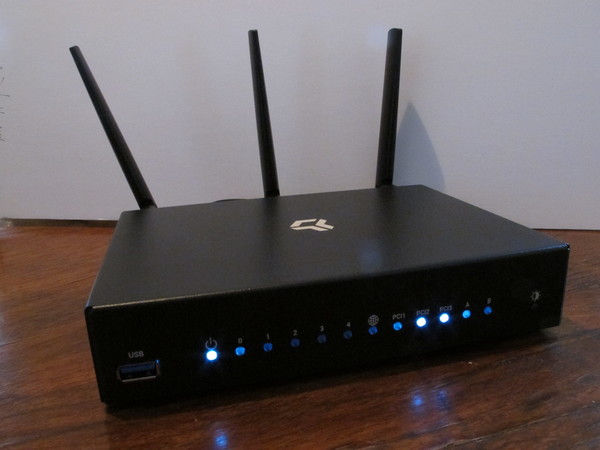 The Omnia router is a followup project on CZ.NIC's original
research project, the Turris. The goal of the project was to
identify hostile traffic on end-user networks and develop global
responses to those attacks across every monitored device. The Omnia is
an extension of the original project: more features were added and
data collection is now opt-in. Whereas the original Turris was simply
a home router, the new Omnia router includes:
- 1.6GHz ARM CPU
- 1-2GB RAM
- 8GB flash storage
- 6 Gbit Ethernet ports
- SFP fiber port
- 2 Mini-PCI express ports
- mSATA port
- 3 MIMO 802.11ac and 2 MIMO 802.11bgn radios and antennas
- SIM card support for backup connectivity
Some models sold had a larger case to accommodate extra hard drives,
turning the Omnia router into a NAS device that could actually serve
as a multi-purpose home server. Indeed, it is one of the objectives of
the project to make "more than just a router". The NAS model is not
currently on sale anymore, but there are plans to bring it back
along with LTE modem options and new accessories "to expand Omnia
towards home automation".
Omnia runs a fork of the OpenWRT distribution called TurrisOS that
has been customized to support automated live updates, a simpler web
interface, and other extra features. The fork also has patches to the
Linux kernel, which is based on Linux 4.4.13 (according to
uname -a). It is unclear why those patches are necessary since the
ARMv7 Armada 385 CPU has been
supported in Linux since at least 4.2-rc1, but it is common for
OpenWRT ports to ship patches to the kernel, either to backport
missing functionality or perform some optimization.
There has been some pressure from backers to petition Turris to
"speedup the process of upstreaming Omnia support to OpenWrt". It
could be that the team is too busy with delivering the devices already
ordered to complete that process at this point. The software is
available on the CZ-NIC GitHub repository and the actual Linux
patches can be found here and here. CZ.NIC also operates a
private GitLab instance where more software is available. There is
technically no reason why you wouldn't be able to run your own
distribution on the Omnia router: OpenWRT development snapshots should
be able to run on the Omnia hardware and some people have
installed Debian on Omnia. It may require some customization
(e.g. the kernel) to make sure the Omnia hardware is correctly
supported. Most people seem to prefer to run TurrisOS because of
the extra features.
The hardware itself is also free and open for the most part. There is
a binary blob needed for the 5GHz wireless card, which seems to be the
only proprietary component on the board. The schematics of the device
are available through the Omnia wiki, but oddly not in the GitHub
repository like the rest of the software.
Hands on
I received my own router last week, which is about six months late from
the original April 2016 delivery date; it allowed me to do some hands-on
testing of the device. The first thing I noticed was a known problem
with the antenna connectors: I had to open up the case to screw the
fittings tight, otherwise the antennas wouldn't screw in correctly.
Once that was done, I simply had to go through the usual process of
setting up the router, which consisted of connecting the Omnia to my
laptop with an Ethernet cable, connecting the Omnia to an uplink (I
hooked it into my existing network), and go through a web wizard. I was
pleasantly surprised with the interface: it was smooth and easy to use,
but at the same time imposed good security practices on the user.
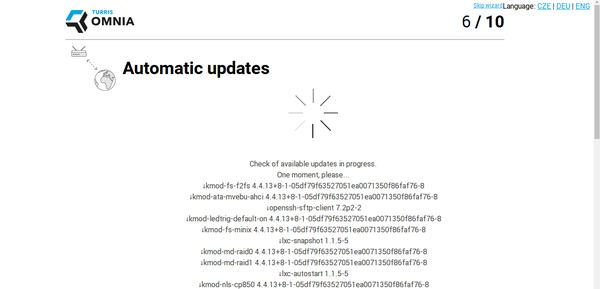 For example, the wizard, once connected to the network, goes through a
full system upgrade and will, by default, automatically upgrade itself
(including reboots) when new updates become available. Users have to
opt-in to the automatic updates, and can chose to automate only the
downloading and installation of the updates without having the device
reboot on its own. Reboots are also performed during user-specified time
frames (by default, Omnia applies kernel updates during the night). I
also liked the "skip" button that allowed me to completely bypass the
wizard and configure the device myself, through the regular OpenWRT
systems (like LuCI or SSH) if I needed to.
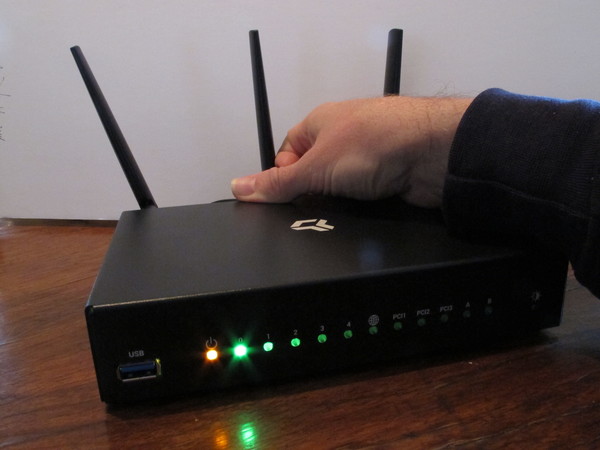 Notwithstanding the antenna connectors themselves, the hardware is
nice. I ordered the black metal case, and I must admit I love the
many LED lights in the front. It is especially useful to have color
changes in the reset procedure: no more guessing what state the
device is in or if I pressed the reset button long enough. The LEDs
can also be dimmed to reduce the glare that our electronic devices
produce.
All this comes at a price, however: at \$250 USD, it is a much higher
price tag than common home routers, which typically go for around
\$50. Furthermore, it may be difficult to actually get the device,
because no orders are being accepted on the Indiegogo site after
October 31. The Turris team doesn't actually want to deal with retail
sales and has now delegated retail sales to other stores, which
are currently limited to European deliveries.
A nice device to help fight off the IoT apocalypse
It seems there isn't a week that goes by these days without a
record-breaking distributed denial-of-service (DDoS) attack. Those
attacks are more and more caused by home routers, webcams, and "Internet
of Things" (IoT) devices. In that context, the Omnia sets a high bar for
how devices should be built but also how they should be operated. Omnia
routers are automatically upgraded on a nightly basis and, by default,
do not provide telnet or SSH ports to run arbitrary code. There is the
password-less wizard that starts up on install, but it forces the user
to chose a password in order to complete the configuration.
Both the hardware and software of the Omnia are free and open. The
automatic update's EULA explicitly states that the software
provided by CZ.NIC "will be released under a free software licence"
(and it has been, as mentioned earlier). This makes the machine much
easier to audit by someone looking for possible flaws, say for example
a customs official looking to approve the import in the eventual case
where IoT devices end up being regulated. But it also makes the device
itself more secure. One of the problems with these kinds of devices is
"bit rot": they have known vulnerabilities that are not fixed in a
timely manner, if at all. While it would be trivial for an attacker to
disable the Omnia's auto-update mechanisms, the point is not to
counterattack, but to prevent attacks on known vulnerabilities.
The CZ.NIC folks take it a step further and encourage users to
actively participate in a monitoring effort to document such
attacks. For example, the Omnia can run a honeypot to lure
attackers into divulging their presence. The Omnia also runs an
elaborate data collection program, where routers report malicious
activity to a central server that collects information about traffic
flows, blocked packets, bandwidth usage, and activity from a
predefined list of malicious addresses. The exact data collected is
specified in another EULA that is currently only available to users
logged in at the Turris web site. That data can then be turned into
tweaked firewall rules to protect the overall network, which the
Turris project calls a distributed adaptive firewall. Users need
to explicitly opt-in to the monitoring system by registering on a
portal using their email address.
Turris devices also feature the Majordomo software (not to be
confused with the venerable mailing list software) that can also
monitor devices in your home and identify hostile traffic, potentially
leading users to take responsibility over the actions of their own
devices. This, in turn, could lead users to trickle complaints back
up to the manufacturers that could change their behavior. It turns out
that some companies do care about their reputations and will
issue recalls if their devices have significant enough issues.
It remains to be seen how effective the latter approach will be,
however. In the meantime, the Omnia seems to be an excellent all-around
server and router for even the most demanding home or small-office
environments that is a great example for future competitors.
Note: this article first appeared in the
Linux Weekly News.

 For example, the wizard, once connected to the network, goes through a
full system upgrade and will, by default, automatically upgrade itself
(including reboots) when new updates become available. Users have to
opt-in to the automatic updates, and can chose to automate only the
downloading and installation of the updates without having the device
reboot on its own. Reboots are also performed during user-specified time
frames (by default, Omnia applies kernel updates during the night). I
also liked the "skip" button that allowed me to completely bypass the
wizard and configure the device myself, through the regular OpenWRT
systems (like LuCI or SSH) if I needed to.
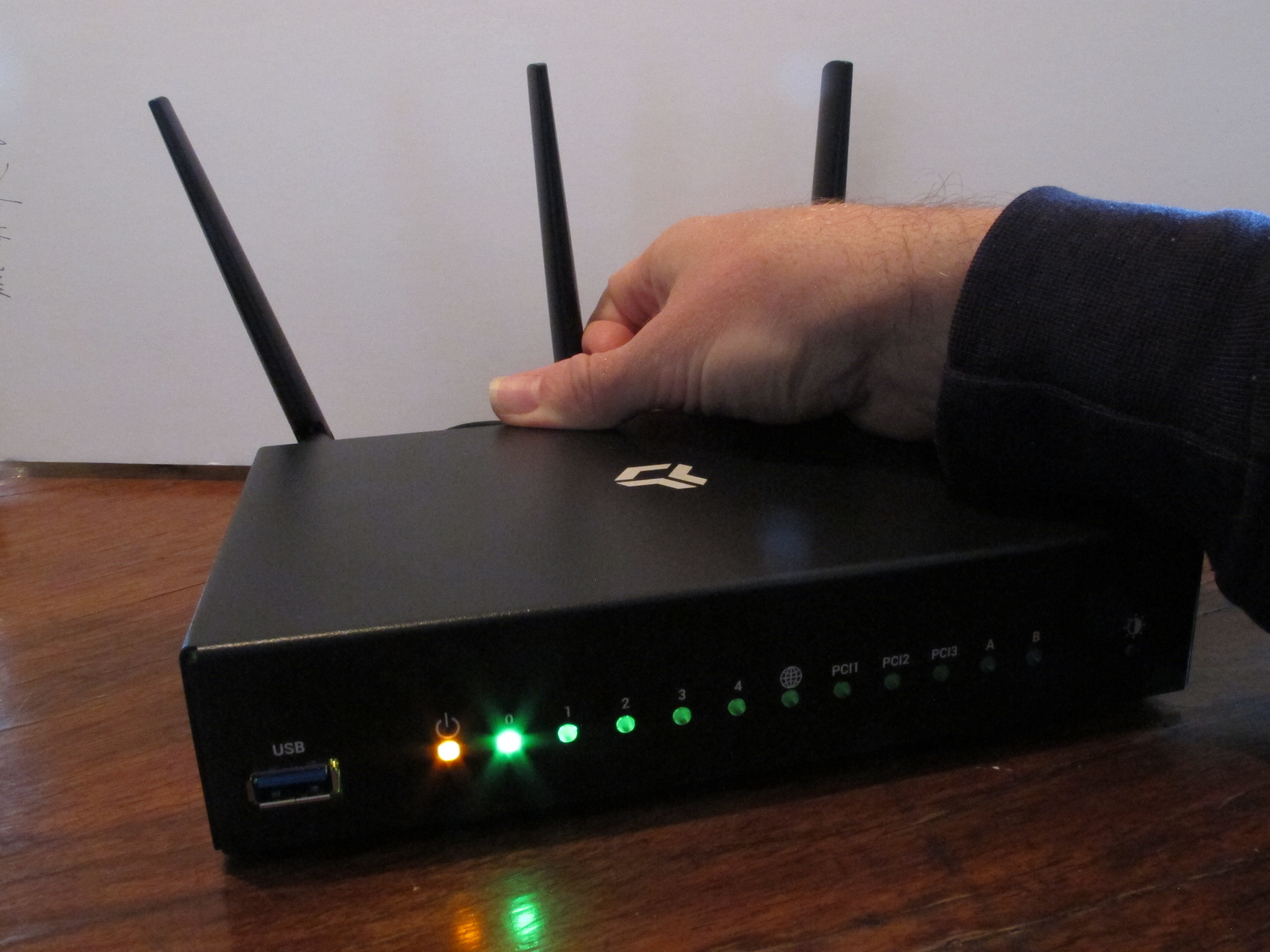 Notwithstanding the antenna connectors themselves, the hardware is
nice. I ordered the black metal case, and I must admit I love the
many LED lights in the front. It is especially useful to have color
changes in the reset procedure: no more guessing what state the
device is in or if I pressed the reset button long enough. The LEDs
can also be dimmed to reduce the glare that our electronic devices
produce.
All this comes at a price, however: at \$250 USD, it is a much higher
price tag than common home routers, which typically go for around
\$50. Furthermore, it may be difficult to actually get the device,
because no orders are being accepted on the Indiegogo site after
October 31. The Turris team doesn't actually want to deal with retail
sales and has now delegated retail sales to other stores, which
are currently limited to European deliveries.


 Like
 cnuke@ spotted something on the internet, and shared. Do

 Fran ois Hollande and S gol ne Royal. Royal's brother

 Last month, I was abroad with my trusty old

 I started buying vinyl records about 16 years ago, but recently I've become a
bit uncomfortable being identified as a "vinyl lover". The market is ascendant,
with vinyl album sales growing for 8 consecutive years, at least in the UK. So
why am I uncomfortable about it?
A quick word about audio fidelity/quality here. I don't subscribe to the school
of thought that audio on vinyl is inherently better than digital audio, far
from it. I'm aware of its limitations. For recordings that I love, I try to
seek out the best quality version available, which is almost always digital.
Some believe that vinyl is immune to the "loudness war" brickwall mastering
plaguing some modern releases, but for some of the worst offenders (Depeche
Mode's Playing The Angel; Red Hot Chili Pepper's Californication) I haven't
found the vinyl masterings to sound any different.
16 years ago
Let's go back to why I started buying vinyl. Back when I started, the world
was a very different place to what it is today. You could not buy most music
in a digital form: it was 3 more years before the iTunes Store was opened, and
it was Mac-only at first, and the music it sold was DRM-crippled for the first
5 or so years afterwards. The iPod had not been invented yet and there was no
real market for personal music players. Minidiscs were still around, but Net-MD
(the only sanctioned way to get digital music onto them from a computer) was
terrible.


 An indulgence