Search Results: "az"

11 December 2010

Dirk Eddelbuettel: Regina Carter / Esperanza Spalding

Went to the Chicago Symphony yesterday to see Regina Carter as well as Jazz wunderkind Esperanza Spalding perform one seat each with their respective bands. Regina Carter was presenting material from her current record 'Reverse Thread'. This was a real nice set of African-themed world music featuring Carter herself on violin, Yacouba Sissoko on kora, Will Holshouser on accordion, Chris Lightcap on bass and Alvester Garnett on drums. Some of pieces were really, really nicely done and I particularly enjoyed Holshouser on the accordion. After the break, Esperanza Spalding come on for her Chamber Music Society'. Lovely setup with Spalding on acoustic bass and vocals, Leo Genovese on piano/keyboards, Sara Caswell on violin, Lois Martin on viola, Jody Redhage on cello, the always impressice Terry Lyne Carrington on drums and Leala Cyr on backing vocals (and one co-lead in a really nice duet with Spalding). This was clearly more experimental and a chunk of the audience left during the act. But there is room for improvided chamber music, and it was a good modern music act. And Spalding is really quite impressive and I will gladly go and see her again.

Michael Banck: 11 Dec 2010

On Cancun's Success and Wikileaks The success of the international climate conference in Cancun appears to be a great (and desperately needed) leap forward in the struggle to preserve our climate. At least news sources in Germany marvel at the very much unexpected and bigger-than-hoped outcome of the final declaration. However, I keep wondering whether this could also be the first big success of Wikileak's power: what if Cablegate's timely leakage of the US and China's double-game at the Kopenhagen summit has scared their delegations so much they did not dare to repeat the backstabbing of the climate conference a second (or thrice?) time - in fear of their actions being defaced another time next year? If this was the case, one could either call this Diplomacy by Fear or Diplomacy by Transparency - I choose to pick the latter. And if it indeed turns out Wikileaks had been the prime source behind a success for our planet, nominating the organization for the Nobel Peace prize does not look so absurd to me as it did last week.

10 December 2010

Raphaël Hertzog: People behind Debian: David Kalnischkies, an APT developer

The two first interviews were dedicated to long-time Debian developers. This time I took the opposite approach, I interviewed David Kalnischkies who is not (yet) a Debian developer. But he s contributing to one of the most important software within Debian the APT package manager since 2009. You can already see him in many places in Debian sharing his APT knowledge when needed. English is not his native language and he s a bit shy, but he accepted the interview nevertheless. I would like to thank him for the efforts involved and I hope his story can inspire some people to take the leap and just start helping My questions are in bold, the rest is by David. Who are you? I am David Kalnischkies, 22 years old, living in the small town Erbach near Wiesbaden in Germany and I m studying computer science at the TU Darmstadt. Furthermore I am for more than half a decade now young group leader of my hometown. I never intended to get into this position, but it has similarities with my career in this internet-thingy here. I don t remember why, but in April 2009 I was at a stage that some simple bugs in APT annoyed me so much that I grabbed the source, and most importantly I don t know why I did it but I published my changes in Mai with #433007, a few more bugs and even a branch on launchpad. And this public branch got me into all this trouble in June: I got a mail from Mr. package managment Michael Vogt regarding this branch A few days later I joined an IRC session with him and closely after that my name appeared for the first time in a changelog entry. It s a strange but also addicting feeling to read your own name in an unfamiliar place. And even now after many IRC discussions, bugfixes and features, three Ubuntu Developer Summits and a Google Summer of Code in Debian, my name still appear in places I have never even thought about e.g. in an interview. What s your biggest achievement within Debian? I would like to answer MultiArch in APT as it was my Google Summer of Code project, but as it has (not much) use for the normal user at this point will hopefully change for wheezy I chose three smaller things in squeeze s APT that many people don t even know yet: If your impression is now that I only do APT stuff: that s completely right, but that s already more than enough for me for now as the toolchain behind the short name APT contains so many tools and use cases that you always have something different. You re an active member of the APT development team. Are there plans for APT in Debian Wheezy? What features can we expect? That s very hard to answer, as the team is too small to be able to really plan something. I mean, you can have fancy plans and everything and half a second later someone arrives on the mailing list with a small question which eats days of development time just for debugging But right now the TODO list contains (in no particular order): We will see what will get real for wheezy and what is postponed, but one thing is sure: more will be done for wheezy if you help! If you could spend all your time on Debian, what would you work on? I would spend it on APT s debbugs count zero would be cool to look at! We make progress in this regard, but with the current velocity we will reach it in ten years or so. Reading more mailing lists would be interesting, as I am kind of an information junky. Maintaining a package could be interesting to share the annoyance of a maintainer with handcrafted dependencies just to notice that APT doesn t get it in the way I intended it to be. Through, to make it feel real I need to train a few new APT contributors before so they can point my mistake out, but this unfortunately doesn t depend so much on time but on victims Maybe I could even be working on getting an official status. Beside that, I would love to be able to apt-get dist-upgrade the increasing mass of systems I and many others carry around in their pockets. In regards to my phone, this is already fixed, but there is much room for improvements. What s the biggest problem of Debian? You need to be lucky. You need to talk at the right time to the right person. That s not really a debian-only problem as such, but in a global project full of volunteers you can see it clearly as there are plenty of opportunities to be unlucky. For example, it s unlikely that an interview would be made with me now if Michael had not contacted me in June 2009. In a big project like Debian, you are basically completely lost without a mentor guiding you, so things like the debian-mentors list are good projects, but I am pretty certain they could benefit from some more helping hands. The other thing which I consider a problem is that and I read from time to time some people don t care for translations. That s bad. Yes, a developer is able to read English, otherwise s/he couldn t write code or participate on the mailinglists. Still, I personally prefer to use a translated application if I have the chance as it s simply easier for me to read in my mother tongue, not only because I am dyslexic, but because my mind still thinks in German and not in English. Yes, I could personally fix that by thinking in English only from now on, but its a quite big problem to convince my family which is not really familiar with tech-stuff to use something if they can t understand what is written on screen. It was hard enough to tell my mother how to write an SMS in a German interface. My phone with English words all over the place would be completely unusable for her despite the fact that my phone is powered by Debian and better for the task from a technical point of view. You are not yet an official Debian developer/maintainer, but you re already perceived in the community as one the most knowledgeable person about APT. It s a great start! What s your advice to other people who want to start contributing to Debian in general, and to APT in particular? It was never a goal in my life to start contributing . My goal was and still is to make my life easier by letting the computer work for me. At some point APT hindered the success of this goal, so it needed to be fixed. I didn t expect to open pandora s box. So, my advice is simple: Just start. Ignore the warning signs telling you that this is not easy. They are just telling you that you do something useful. Only artificial problems are easy. Further more, contribution to APT, dpkg or any other existing package is in no way harder than opening an ITP and working on your own, and it s cooler as you have a similar minded team around you to talk to. :) APT didn t accept release codenames as target release was one of the first things I fixed. If I had asked someone if that would be a good starting point the answer would have been a clear no , but I didn t search for a good starting point As a kid I can start playing football by just walking on the field and play or I can sit near the field, watching the others play, while analyzing which position would be the best for me to start ruling out one by one as the technical requirements seem too high Oh bicycle kick that sounds complicated I can t do that Julian Andreas Klode is working on a APT replacement, there s also Cupt by Eugene V. Lyubimkin. Both projects started because their authors are not satisfied with APT, they find APT s code difficult to hack partly due to the usage of C++. Do you share their concerns and what s your opinion on those projects? I don t think C++ is a concern in this regard, after all cupt is currently rewritten to C++0x and APT2 started in vala and is now C + glib last time I checked at least. I personally think that something is wrong if we need to advertise an application by saying in which language it is written The major problem for APT is probably that the code is old : APT does its job for more than 12 years now, under different maintainers with an always changing environment around it: so there are lines in APT which date from a time when nobody knew what a Breaks dependency is, that packages can have long descriptions which can be translated or even that package archives can be signed with a gpg key! And yet we take all those for granted today. APT has proven to adapt to these changes in the environment and became in this process very popular. So I don t think the point is near (if it will come at all) that APT can go into retirement as it is completely replaced by something else. The competitors one the other hand have their first 12 years still to go. And it will be interesting to see how they will evolve and what will be the state of the art in 2022 But you asked what I think about the competitors: I prefer the revolution from inside simply because I can see effects faster as more users will profit from it now. Cupt and co. obviously prefer the normal revolution. The goal is the same, creating the best package manager tool, but the chosen way to the goal is different. aptitude and cupt have an interactive resolver for example: that s something I dislike personally, for others that is the ultimate killer feature. cupt reading the same preference file as APT will have a different pinning result, which we should consider each time someone mentions the word drop-in replacement . APT2 isn t much more than the name which I completely dislike currently from a user point of view, so I can t really comment on that. All of them make me sad as each line invested in boilerplate code like configuration file parsing would be in my eyes better be spent in a bugfix or new feature instead, but I am not here to tell anyone what they should do in their free time But frankly, I don t see them really as competitors: I use the tools I use, if other do that too that s good, if not that s their problem. :) The thing that annoys me really are claims like plan is to remove APT by 2014 as this generates a vi vs. emacs like atmosphere we don t need. If some people really think emacs is a good editor who cares? I really hope we all can drink a beer in 2022 in Milliways, the restaurant at the end of the package universe, remembering the good old 2010 ;) Is there someone in Debian that you admire for his contributions? No, not one, many! Michael Vogt who has nearly the monopole of package manager maintainer by being upstream of APT, synaptics and software center to name only the biggest and still has the time to answer even the dumbest of my questions. :) Jason Gunthorpe for being one of the initial developers behind deity who I will probably never meet in person beside in old comments and commit logs. Christian Perrier for caring so much about translations. Obey Arthur Liu as a great admin for Debian s participation in Google s Summer of Code. Paul Wise for doing countless reviews on debian-mentors which are a good source of information not only for the maintainer of the package under review. I guess I need to stop here because you asked for just one. So let s end with some big words instead: I am just a little cog in the big debian wheel
Thank you to David Kalnischkies for the time spent answering my questions. I hope you enjoyed reading his answers as I did. Subscribe to my newsletter to get my monthly summary of the Debian/Ubuntu news and to not miss further interviews. You can also follow along on Identi.ca, Twitter and Facebook.

3 comments Liked this article? Click here. My blog is Flattr-enabled.

9 December 2010

James Morrison: Santa Weekend

I'll start with an apology that I didn't get any pictures this weekend. However, many, many other people did. This weekend started with a simple holiday supper for Sonia's work (ok, there was some Karaoke). Then it moved on to the crazy. Saturday was Santacon. I pre-partied with Sonia's crew (she even stopped in on her lunch break). Then had a delivery of 1/2 Cord of firewood that will be well used over the coming year. Then it was back to SantaCon still dressed as an Elf to meet up with Lina. Then back to Sonia's crew to bring Sonia her reindeer antlers that I'd forgotten to drop off at her place. (ok, there was some stops for karaoke, Lina was at the Mint, and Sonia was at Encore).

Sunday was as crazy as Saturday, but not as long. The Santa Skivvies run was a simple get dressed down to the bare essentials of red underwear and a santa hat, then run into the Castro from The Lookout, and back. Since any Santa event wouldn't be complete with only Santas, Sonia dressed and Santa and I was the red-nosed reindeer (complete with reins). (ok, there was no karaoke on sunday (the Mint was closed on the way home from The Lookout).

8 December 2010

Luke Faraone: Simple two-factor authentication

Do you want to allow "Rebooting of Cluster 19" as Jane Doe, Foo Corp? Yes/No

Mockup of mobile UI

I ve been thinking a lot recently about information security and passwords. It s widely agreed that two-factor authentication, which combines something-you-know (a password) with something you have (eg. a smart card or some one-time-password) is superior to using a password by itself. Most solutions I ve seen, short of client-side certificates, both require a trusted third party and provide little auditability. I m working on a project which attempts to address those problems. Basically, the idea is that you attempt to perform an action on a website, like logging in, moving some money between accounts, or restarting a cluster. Then, your mobile device1 (Android, iPhone, or some custom hardware) starts buzzing, displaying the text of the action. When you approve or deny the action, your device uses a locally stored private key to sign the text of the approval and send it back to the server. The server checks that you approved the same transaction number and text, then allows the action. The server can store the approval notice to allow auditors later to determine that somebody in possession of the private key signed the action request. So far, I ve written a small Django server application, and a Python CLI device and client. They re not yet ready for a public release; I need to write up installation instructions and test it a bit more, but I ll publish them soon on Launchpad. On the usability side of things, I plan to conduct some trials in January comparing it to things like Google Authenticator. This should be less susceptible to MITM attacks than one-time-passwords, since you can authenticate specific transactions, rather than entire sessions. On the other hand, I m no security researcher. Dear lazyweb, are there any problems with the above approach? Also, if I m going to release this (as I plan to once I get something working), I need a name. Ideas?
  1. iPhone used in the graphic to the right because a SVG was handy. Image adapted from work by Virgile Pypaert [CC-BY-SA-3.0], via Wikimedia Commons

Jan Hauke Rahm: Google maps irritated?

<fb:share-button href="http://blog.jhr-online.de/169" type="button"></fb:share-button>Countless times already have I used Google s amazing feature called maps. Admittedly, if you know me, you might wonder how I can be advertising Google. At least as often as I used google maps, I have told people about google s evilness. They re making their users transparent in ways most people can t even imagine transparent to other users (just like Facebook does) but, more importantly, transparent to themselves and their advertising customers. Technically skilled people reading my blog probably just nod and scoll down now :) Well, there still is something about Google that makes me use their developments: they are good. I don t know any other online service to create own maps, get directions etc. with as much detail and huge amount of data as google delivers. Thus, Google maps became my main source for locations and directions world wide. As such, I wanted to use it to get directions between places in Berlin, Germany. Apparently, Google s software had some kind of hick up or whatever, though. They got the directions right but somehow I doubt the map is anyhow related to what I requested. See for yourself Google maps irritatedYes, yes, no software is perfect but still :)

<iframe allowtransparency="true" frameborder="0" scrolling="no" src="http://www.facebook.com/plugins/like.php?href=http://blog.jhr-online.de/169&amp;layout=standard&amp;show_faces=true&amp;width=450&amp;action=like&amp;colorscheme=light" style="border:none; overflow:hidden; width:450px; height:65px"></iframe>

7 December 2010

John Goerzen: A Switchbox and a Very Happy 4-Year-Old

This all started this summer. My parents have some dimmer switches in their house, which Jacob loves. He also enjoyed turning their lights on an off rapidly to make them flash. Since we have CFLs almost exclusively, we have no dimmer switches, and we don t permit making the lights flash. (This hurts the lifespan of CFLs much more than traditional bulbs.) (I ll just put a few pictures from tonight within the story so you get an idea of what it turned out to be while you read.) IMG_5109.JPG So I had an idea: why not build him a box that has some switches that he can play with? And why not make it a project we can do together? So back in, I think, July, we went to the hardware store. We bought some AC power cord, some electrical boxes, and assorted supplies. I had some other supplies on hand already, so we didn t need to spend much. I asked Jacob today if he remembered that day, and he said, Oh yes! And I got popcorn to eat there! Which was, indeed, quite true. IMG_5111.JPG I had some surplus plywood, so I cut out two squares, one for a front and one for a back. Then, in 10-minute increments every so often over the last few months, Jacob would say, Dad, shall we go work on my switchbox? And by that, he meant that I should work on the switchbox while he pretends that my tape measures are train engines or raids the corner where disused toys are stored. After 10 minutes, he d be done. Which meant that after I gathered up my tools, remembered where I was, and got to work, I made only a few minutes progress each week. But that was fine. This week, I got it all wired up. It doesn t have its sides and back yet, but it was enough for Jacob to try it out. To add to the excitement just that much more, I spent a few dollars at the hardware store today and bought him four light bulbs: 25W red, green, and blue bulbs, and a 7.5W miniature white one. I let him choose two of them to use in the switchbox. IMG_5117.JPG So he started playing with it, and after just a few seconds, said, Dad, I am very very very very excited about my switchbox! And a little while later, he burst into applause, and announced, Dad, my switchbox is so so so so so fun! It is also so so so so so silly the lightbulb is green! I wired up a regular light switch that is a master on/off switch. Then the dimmer switch controls the light bulb socket but not the outlet. The dimmer switch also has a pushbutton on/off circuit, so there are plenty of opportunities for discovery. IMG_5113.JPG This is a play with it only with dad s supervision item for now, but after supper, he insisted in bringing Terah downstairs to show her how to use it too. He happily showed off the red and green lights, how to turn them on, and how to make the red light dimmer. I suggested he also show her what happens when he pushes on the dimmer switch, which he happily did, and also explained to her what it does. He was just amazingly excited. Every so often he d tell me how excited or happy he was, and some fun fact about it all. And, really, that s what I hoped would happen. I didn t accompany it with these words, but I hope that projects like this can serve to remind everyone that toys and gifts don t have to cost hundreds of dollars; they can be made with a few dollars supplies and some surplus materials laying around the house. But not only that, but the best parts of this project were the ones Jacob and I spent together from the time when just the two of us went shopping at the hardware store, through all those 10-minute times where he pretended my tape measures were locomotives and the tape was their track, right to today when he got to try it out. It took a long time, but when I asked him if it was worth the wait, he said Yes! and clapped while jumping up and down. And, I have to admit, as I got into the car with my $4 worth of light bulbs today, I was almost as excited as him, just to see what he would do. That s the best part: I got to experience Jacob s joy right along with him. It s a time when I really enjoy being a dad. IMG_5110.JPG

Matt Brown: Under the cover of the Kindle 3

For my birthday back in October, my wonderful wife gave me a Kindle 3 from Amazon. I d been considering other e-book readers for quite some time, but I had mostly ignored the Kindle due to the lack of EPUB support and a general dislike of Amazon s DRM enforcement. In the end, the superior hardware and ecosystem of the Kindle overpowered those concerns and overall I m very pleased with the purchase. The screen is amazing, literally just like reading off a piece of paper and the selection of books is OK. I ve been buying almost all my books from Amazon to date since it s so easy (the Whispernet is amazingly quick!) but it s not terribly difficult to get EPUBs from elsewhere onto the device after a quick run through Calibre to turn them into a MOBI file, so I keep telling myself I ve still got some flexibility. Almost as much fun as reading on the device has been learning about how it works. The Mobile Read forums have lots of step by step posts on how to do specific tasks like replacing the screensaver image, but they don t give much background detail on how the Kindle is actually operating which is what really interests me. Luckily among all the step by step posts I also found a usbnetwork package which also adds an SSH server to the Kindle, so after installing that and then SSHing in to my Kindle I ve been poking around. Under the cover the Kindle reveals a fairly standard Linux installation. While the hardware and IO devices are obviously unique, compared to something like an Android phone, the Kindle is refreshingly normal . Hardware Software The application/framework code is heavily obfuscated apparently using the Allatori Java Obfuscator. The jrename and jd-gui utilities have proven very handy in helping to untangle the puzzle, although they still only leave you with a pile of Java source code with mostly single letter alphabetic variable and class names! I ve been using IntelliJ s support for refactoring/renaming Java code to slowly work through it (thanks in large part to error/log messages and string constants found through the code which can t be obfuscated easily and help to explain what is going on), and I m slowly beginning to piece together how the book reading functionality works. I ll maybe write more on this in a future post. In one of my initial tweets about the Kindle I mentioned that it seemed to be regularly uploading syslog data to Amazon based on some sendlogs scripts I d noticed and a few syslog lines containing GPS co-ordinates that had been pasted on the Mobile Read forums. I can t find any trace of GPS co-ordinates in any syslog messages I ve seen on my device, but there is definitely information about the cell sites that my Kindle can see, the books that I m opening and where I m up to in them:

101206:235431 wand[2515]: I dtp:diag: t=4cfd77b7,MCC MNC=272 01,Channel=10762,Band=WCDMA I IMT 2000,Cell ID=1362209,LAC=3021,RAC=1
,Network Time=0000/00/00 00.00.00,Local Time Offset=Not provided,Selection Mode=Automatic,Test Mode=0,Bars=4,Roaming=1,RSSI=-88,Tx
Power=6,System Mode=WCDMA,Data Service Mode=HSDPA,Service Status=Service,Reg Status=Success,Call Status=Conversation,MM Attach St
ate=Attach accept,MM LU State=LU update,GMM Attach State=Attach accept,GMM State=Registered,GMM RAU State=Not available,PDP State=
Active,Network Mode=CS PS separate attach mode,PMM Mode=Connected,SIM Status=Valid; PIN okay; R3,MM Attach Error=No error,MM LU Er
ror=No error,GMM Attach Error=No error,GMM RAU Error=Not available,PDP Rej Reason=No error,Active/Monitored Sets=0;39;-11 1;180;-1
5,RSCP=-111,DRX=64,HSDPA Status=Active,HSDPA Indication=HSDPA HSUPA unsupp,Neighbor Cells=,Best 6 Cells=,Pathloss=,MFRM=,EGPRS Ind
ication=,HPLMN=,RPLMN=272;01 ,FPLMN=234;33 234;30 234;20 272;05 ,n=1:
101206:235758 cvm[3426]: I Reader:BOOK INFO:book asin=B003IWZZ3Y,file size=233168,file last mod date=2010-11-27 19.18.22 +0000,con
tent type=ebook,length=MobiPosition_ 465747,access=2010-12-06 09.44.32 +0000,last read position=MobiPosition_ 464387,isEncrypted=f
alse,isSample=false,isNew=false,isTTSMetdataPresent=false,isTTSMetadataAllowed=true,fileExtn=azw:
101206:233416 udhcpc[5639]: Offer from server xxx.xxx.2.254 received
101206:233416 udhcpc[5639]: Sending select for xxx.xxx.2.10...
Interestingly you can see from the last two lines, that Amazon has taken some care to preserve privacy by not including the full IP address given to the device by my local Wifi network, so in light of that I find it interesting that they decided not to obfuscate the Cell and Book IDs in those respective log messages too. Seems rather inconsistent. As to how and when these logs are sent to Amazon, the picture is a little bit murky. Every 15 minutes tinyrot runs out of cron and rotates /var/log/messages if it is greater than 256k in size. Rotated logs are stored into /var/local/log under filenames like messages_00000044_20101207000006.gz and alongside the log files are a set of state files named nexttosendfile, messages_oldest, messages_youngest. Something regularly sweeps through this directory to update the state and remove the old logs (after sending them up to Amazon I assume). I suspect that something is buried in the Java application code mentioned above. On the whole the Kindle is a fascinating piece of technology. It delivers a wonderful reading experience on top of a familiar Linux system and is going to provide me with many more hours of entertainment as I unpack all the tricks and techniques that have gone into this device. I would recommended it as a present for geeks everywhere.

6 December 2010

Erich Schubert: Google map results upgrade

Google map results ("local business results") are recently showing even more prominently than ever amongst the regular search results.
For a long time, the so called "seven pack" was another valued 'property' of SEO. At least if you had some local business: it doesn't work for non-locational things such as most web businesses that are all SEO-crazy.
When Google recognizes a search as being local, it would display a small map on the top along with seven results in summary form. With the latest changes to the main search results page (think of live search, instant previews, real time results etc.) this has now become even more so: the "local business results" now are at least as big as the regular results, and come with rich data such as images and ratings. This obviously makes them more attractive than ever.
I like it, because for my dancing club we do have such a prominent result. :-)

3 December 2010

Jos Parrella: Escenarios de uso de Likewise Open

Hace ya alg n tiempo escrib sobre el uso de libpam-ccreds y libnss-db para conseguir la implementaci n de un servicio de cach de credenciales. Sin embargo, hace casi un a o revisit el producto Likewise Open, en un proyecto grande de autenticaci n de Linux contra un Active Directory de Microsoft, o contra un dominio Windows desarrollado con Samba. En realidad Likewise Open elimina la incertidumbre de un setup artesanal de cach de credenciales, siempre y cuando el equipo se est loggeando contra un dominio Windows. Si usted tiene la necesidad de integrar una distribuci n de Linux moderna (una versi n reciente de Debian, Ubuntu, Fedora, por ejemplo) con un dominio Windows servidor por un Active Directory o por Samba, mi recomendaci n es que use Likewise Open. Likewise es libre, abierto y gratuito, y viene en los repositorios de muchas distribuciones, o se baja de la p gina Web de Likewise. Tiene dos versiones (paquetes), likewise-open-gui y likewise-open; el primero instala el segundo y ofrece una interfaz gr fica sencilla para unir el equipo al dominio. Solo se requiere el nombre del dominio, el nombre del equipo (se toma de hostname) y el usuario y la clave de un usuario que pueda agregar equipos al dominio. Como siempre, la resoluci n del dominio se hace consultando al DNS provisto en la configuraci n de red (u otorgado por el DHCP) por ciertos registros SRV, para obtener la IP de uno de los controladores de dominio, y luego ciertas conexiones a algunos puertos del controlador de dominio. Por lo tanto es importante que, si va a probar este escenario en una m quina virtual, la conexi n est en modo puente con la red en la que se encuentra el controlador de dominio. Una vez que el equipo se une al dominio, se crea la cuenta de m quina en el controlador de dominio, y al cerrar la sesi n, ya pueden ingresar a Linux los usuarios del dominio, usando la sintaxis DOMINIO.AD\usuario o DOMINIO\usuario (formas largas y cortas) y la contrase a del dominio. Las pol ticas de inicio de sesi n y contrase as ser n respetadas. Tambi n se puede usar domainjoin-cli para unirse por CLI. Obviamente, Likewise ya ofrece el servicio de cach de credenciales y de cach de usuarios y grupos (importa los grupos del dominio) y lo hace de forma transparente. Por ello, en muchos casos yo recomendar a que si tienes un OpenLDAP y quieres hacer cach con pam-ccreds y nss-db, haz un upgrade de OpenLDAP a un dominio usando Samba y usa Likewise. Ahorra muchos dolores de cabeza. En Likewise Open no hay soporte para GPOs. En ning n caso funcionar n las GPO que se hacen para Windows, pero en versiones pagadas de Likewise hay una funci n que a ade nuevas GPO para GNOME y otras aplicaciones. No he probado estas funcionalidades.

2 December 2010

Biella Coleman: If I could have, I would have

As I previously blogged about, I wrote an Annual Review of Anthropology on digital media last year. About a month ago, I found out that anyone can download it thanks to a link provided by the ARA, which we are allowed to put on one institutional web page. So go here (and go to the citation for the link) for those who are interested in a way too short review of some of the ethnographic literature on digital media. Writing the piece left me many psychological wounds and scars, one of which had to do with the fact that I probably overlooked some folks. I have been left out of review type essays and honestly, it sucks. I tried to be as comprehensive as possible: I chose not to massively whittle down the scope (which was an option) and was able to smuggle in more citations than originally allowed and yet I still cut out 200 citations. But in the end I overlooked some folks as I found out about them too late. If I could go back in time, this is who I would include (well there are others but I have chosen these for now). So Shaka McGlotten: not only does he have a cool name, he studies some cool stuff like DIY online porn, race, and zombies. He has published a bunch of articles and a book is forthcoming. Check out his work here. I missed this book Online a Lot of the Time: Ritual, Fetish, and Sign by Ken Hills which looks quite pertinent and a great read. Jonathan Marshall is an anthropologist in Sydney who has been working on digital stuff for a long while now and recently published Living Cybermind, which covers in detail modes of interacting and communicating in a detailed examination of a mailing list by the name of Cybermind. Although this book is not out yet, it will be soon and looks fascinating: Digital Jesus (great cover). From what I understand, and one of the reasons I want to dive into the book , is because it is so longitudinal, at least when measured in Internet years. Rob Howard has studied Christians online since the days of Usenet to the present and thus this ethnography promises to have some real meat to it. I am eagerly anticipating the forthcoming book by Beth Coleman . I had a chance to read a chapter recently and it looks fantastic. While in some respects grounded in virtual worlds, it is far more expansive than that topic, addressing a range of issues from desire, experience, emotion and race. Can t wait. I cite four dissertations in the ARA mostly because I read them, thought they were great, and material based on the dissertation is en route to being published in some form in the next future. The one dissertation I wish I had read is Jenny Cool s thesis on cyberorganic.

1 December 2010

Leo 'costela' Antunes: Screenshots on unrooted Android

A few weeks ago I noticed an image on my Froyo phone which appeared to be a screenshot. This came as a surprise, since I don t have any screenshot applications installed and am generally economic when it comes to the amount of fluff on my phone. I did a few searches and there doesn t seem to be any visible mention of this feature out there, only mentions of how to do it with the SDK or with specific apps. Since today I finally managed to discover how to actually do it again (holding the Back button and pressing Home), I took these screenshots using different launchers to be sure it wasn t some feature of ADW.Laucher. I still haven t beat my laziness to actually reset to factory settings and make sure it s not some other random app (which would be a bit unsettling, actually) and it could also be a Samsung specific feature, implemented as one of those pesky unremovable apps. Can anybody out there confirm this (not particularly useful) feature? Did I miss it being published somewhere? [UPDATE]: I found a couple of hidden apps that probably have something to do with this (through Settings Applications Manage applications All). The first one is an obvious suspect, but since it isn t named after Samsung (which admittedly doesn t mean much) I figured it might be activated by the second one, which in my overly-creative and not-really-investigative mind could be a sort of hotkey-daemon. [UPDATE 2: well, that's ignoring the obvious fact that SEC stands for "Samsung Electronics Corporation". D'oh!]
I don t think the feature is important or interesting enough for me to investigate much further, but still I thought I might leave some pointers if people want to get this on their ROMs.

Gintautas Miliauskas: Windows (II): User Interface

(This is a part of a series of posts on my recent experience with Windows. See Windows (I) for the first post.)

The Windows user interface is definitely acceptable. The charge that it is too colorful or toy-like is completely unfounded. Rather, perhaps geeks should spend less time looking at their gray Motif boxy controls. In terms of speed, the UI is generally more responsive than on Linux, though maybe less so than previous versions of Windows (that could be because my Intel video IGP is a slouch).

An interesting observation is that apps are almost as heterogeneous in terms of interface as in GNU/Linux, even though the standard controls are ubiquitous. Even apps by Microsoft can be separated into different "generations" of UI (e.g., folder windows, Control Panel, Microsoft Office). Also it is clear that generally more attention is paid to UI and usability by app developers, although perhaps not as much as in Apple products.

The greatest asset and the worst offender at the same time, by far, is the overall GUI orientation of the system. Needless to say, it aids discoverability, but reduces scripting capabilities. Problem is, even if you do not need to write scripts per se, command-line actions are useful because they can be repeated and chained very easily, using shell history. In Windows, I occasionally find myself doing much repetitive clicking that would likely be an "Alt-Tab Up Enter" (or sometimes just one key) sequence in Linux. Moreover, the lack of good standartized scripting is a huge pain during app deployments which tend be repetetive. I did not like Windows on servers before, and I do not like it now.

To be fair, my complaints about scripting capabilities may be partly moot because I have only used vanilla Windows batch files, and have not looked at all into Windows PowerShell, which is a new-generation scripting tool. The examples are fairly impressive. The language has a nice look and is clearly powerful, but also looks somewhat complicated which keeps me away until I find a good reason to learn it.

Initially I missed workspaces. The one app I found that was supposed to emulate workspaces would take several seconds to switch the workspace, so it was completely unusable. I learned to do without them rather quickly though. Actually I'm starting to think that using many workspaces is a sign that you are doing too many things at once and also they are an invitation to distraction (how many of you have a "blog reader" workspace right aside your "work" workspace, ready at your fingertips at a moment's notice?). Workspaces do have one killer feature: you can jump directly to a given workspace instead of cycling through windows. This is very useful when working with more than two apps, in which case without workspaces you are forced to think about the morphing Alt-Tab queue when switching windows.

Speaking about UI generations, I much prefer the ribbon toolbars of the new Office. The still-prevalent toolbars with zillions of old-style 32x32 (or 16x16) toolbar icons are really ugly. Typically only a few of the toolbar buttons are actually useful, and they make the user interface unnecessarily cramped and busy. The move to fewer and larger toolbar buttons is definitely on the right track.

The explorer context menus also tend to grow crazy long. Every app wants to get in there, and in the end you have a context menu that takes up half a screen vertically. Needless to say, most of those items are not used much. Sure, you can opt out during app installation, but at that time it is difficult to say how useful the context menu item will be, and there's no easy way (i.e. easier than just ignoring the cruft) to remove the entries afterwards.

In my coming posts I will cover package management and application development on Windows.

Gunnar Wolf: Back to... Normality?

For the past month, I got disconnected from basically all of my usual activities. Not only from Debian work (well, yes, I followed up on a couple of important bugs and releases, but I was in a very low power consumption mode of sorts), DebConf organization/following (some people have contacted me regarding the DebConf 12 venue decision, for which we should start working and have a presentation soon) Even the always-so-important Real Life got pushed aside. I barely participated in this year's EDUSOL (On-line Encounter of Education and Free Software). Even work suffered I asked my boss to hold any incoming requests for me (save, of course, for urgent stuff). I am now shyly coming up from the hole I dug myself in for this time. Why did I do such a thing? I do not have a formal education beyond high school. Due to several personal issues, I was accepted to the best university in my country, and to the first generation of the study program I would definitively love to have followed, but didn't attend. Of course, I had a fair bit of computing background, enough to be competitive and start working. After amazingly few years, I didn't only get a decent job, but I got a job precisely at the very university I wanted to study at (and where my father has worked for the past 40 years). And, even with some changes along the years, here I am with 10 years of laboral history in this university, with an academic position (although the smallest academic position, but still). It is one of my life's achievements, one of the things that makes me proudest of. Still, I don't want to stay at this level for the rest of my life. And an institution such as this one has rules Yes, flexible enough to allow me in, but rules whose importance I cannot deny. I aspire to become a professor/researcher at some point, and that is just not possible without filling in the prerequisites. Besides, I want to try my hand at teaching at a universitary level. So, what choices did I have besides devoting at least four years to full-time study? Well, there is a government entity that evaluates and regulates formal education given by smaller universities CENEVAL. For probably around ten years now, they have offered the ACREL (Acuerdo 286 Licenciatura) program to validate professional knowledge acquired through work experience And I'm writing this detail as several people have asked me for details on it. So, once you are accepted in the program (basic requisites: Having a high school certificate, over 30 year old, and with over 10 years of provable work experience), they can grant a Licenciatura degree (i.e. the equivalent to a four-year study program). So, in order to get it granted, I have to: Anyway... Enough of a blog posting. I hope this is useful for somebody. And I hope it explains why I have disappeared so much lately. If everything goes as planned, I expect to be receiving my "licenciatura" title around March, and afterwards... Well, we shall see! Now... Back to work. And back to life. And back to my huge backlog of other pending things :)

30 November 2010

Joey Hess: debugging musings

Debugging a computer program is such an interesting activity because it's not really a matter of fixing a program. It's a matter of fixing your own understanding to the point that the cause of the bug becomes obvious. So debugging means constantly challenging your assumptions, constantly looking for the overlooked insignificant thing that turns out to be crucial. I mostly debug by print statements. I don't like it much, but it works. I add some print statements around the problem area and see if what's going on matches what the model in my head thinks should be going on. If it doesn't, I try to fix the model, and if it does, I focus the print statements in tighter and tighter, deeper and deeper, until I finally reach the bug. It's nasty and ah-hoc, but it works really well, mostly. And I know I'm in good company doing it. But that method can fail; I myself can end up caught in a loop. Like today, tracking down an obscure bug in Branchable's auditing subsystem, when I found myself at what was apparantly the point of a bug: Function A was supposed to call function B, but B never seemed to be called. So surely A was buggy, and I instrumented it to bits with print statements and stuff, and started wondering if the libraries it relied on were somehow breaking it in non-obvious ways before it could call B, or maybe there was a bug in the runtime language that was breaking the call to B. Going deeper and deeper didn't help, because the thing I was overlooking was up at the top level -- one of the first print statements I inserted showed that all this code was running twice. Why? Didn't seem relevant to the bug so I ignored it. Of course what I was ignoring was a symptom of the real problem: The first run was by another subsystem, that happened to redefine function B temporarily.. Actually, one of the nice things about Haskell is that print statements are not very helpful in debugging pure code. Pure code tends to get loaded up in ghci and tested interactively, and the bug is then clear. Or a quickcheck test case gets written with an invariant that the pure code should satisfy. I spent a whole day a few weeks ago writing an inverse form of a buggy function in git-annex just so I could feed them both into quickcheck and automate debugging. (Most of that time was spent wrestling with unicode decomposition .. ugh.) Being used to getting down in the buggy code with print statements, that at the time felt rather like a waste of time unrelated to getting on with making my program work, but it was very much worth it since I got my program working 100% in even crazy edge cases, and got a test suite for free, too. Most of my debugging of Haskell code so far has not involved bugs in pure code. The most memorable bug was actually a bug in ghc's IO manager, which I'd have never tracked down without Josh's help. The problem with finding bugs in the runtime environment or compiler is that after you've found enough over the years, you're more likely to go down false paths distrusting runtime environments, like I did with the bug today. The beginner's assumption is that the runtime environment just works, but I by now may have over-challenged that assumption. :)

29 November 2010

Theodore Ts'o: Google has a problem retaining great engineers? Bullcrap.

Once again, there s been another story about how Google is having trouble retaining talent. Despite all Eric Schmidt s attempts to tell folks that Google s regretted attrition rate has not changed in seven years, this story just doesn t want to seem to die. (And those stories about Google paying $3.5 million and $7 million to keep an engineer from defecting to Facebook? As far as I know, total bull. I bet it s something made up by some Facebook recruiter who needed to explain how she let a live prospect get away. :-) At least for me, the complete opposite is true. There are very few companies where I can do the work that I want to do, and Google is one of them. A startup is totally the wrong place for me. Why? Because if you talk to any venture capitalist, a startup has one and only one reason to exist: to prove that it has a scalable, viable business model. Take diapers.com for example. As Business Week described, while they were proving that they had a business model that worked, they purchased their diapers at the local BJ s and shipped them via Fedex. Another startup, Chegg, proved its business model by using Amazon.com to drop ship text books to their first customers. (The venture capitalist Mark Maples talked about this in a brilliant talk at the Founders Showcase; the Chegg example starts around 20:50 minutes in, but I d recommend listening to the whole thing, since it s such a great talk.) You don t negotiate volume discounts with textbook publishers, or build huge warehouses to hold all of the diapers that you re going to buy until you prove that you have a business model that works. Similarly, you don t work on great technology at a startup. Startups, by and large, aren t about technology at least, not the Web 2.0 startups like Facebook, Foursquare, Twitter, Groupon, etc. They are about business model discovery. So if you are fundamentally a technologist at heart, whose heart sings when you re making a better file system, or fixing a kernel bug, you re not going to be happy at a startup. At least, not if the startup is run competently. If you have the heart of an entrepreneur, and you are willing to roll the dice (since 9 out of 10 startups go belly up; those are the ones that failed to find a viable business model), then sure, go for a startup. And understand that your job will be to make something that works well at a small scale, quick, dirty, and cheap. If that means using some proprietary software, then that s what you should do. Hopefully you ll get lucky and win the IPO lottery. But if your primary interest is to doing great engineering work, then you want go to company that has a proven business model. Google has enough scale that I can sleep well knowing that improvements I am making to Linux and the ext4 file system are saving enough money for the company that Google is making a profit on me. That is, the value Google is getting out of my work is worth many multiples of my total compensation. And that s a position that every engineer should strive for, since that s how you can be confident that you will remain gainfully employed. The fact that I can do what I love, and go to conferences, and all of my work is open source that s just total icing on the cake. :-) No related posts.

Keith Packard: Altos0.8

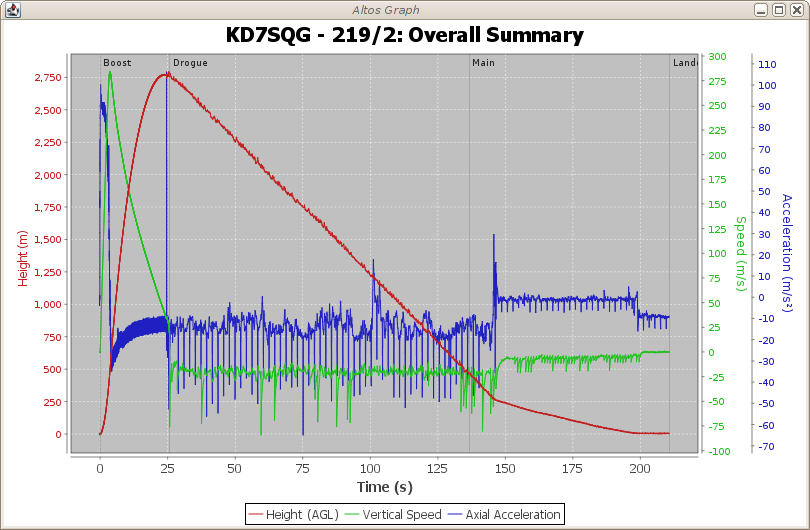
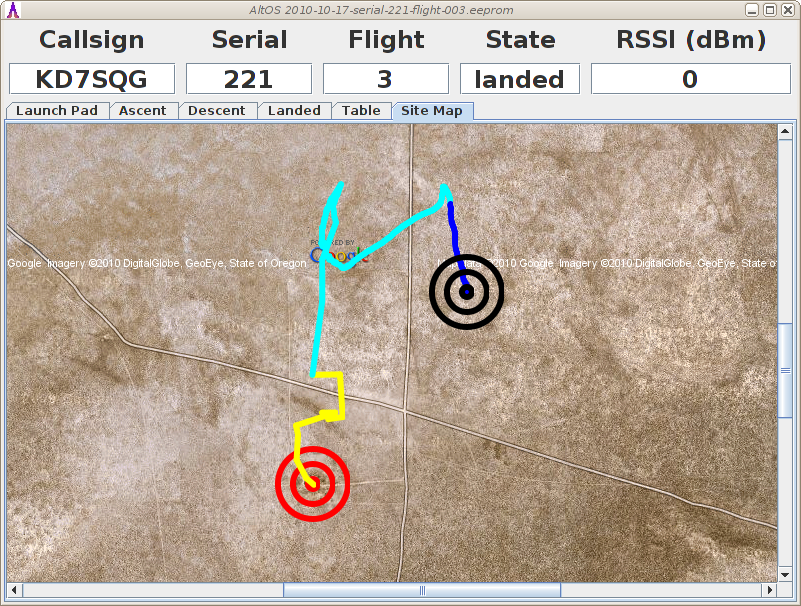
AltOS 0.8 New Software and Firmware for Altus Metrum Devices Bdale and I are pleased to announce the release of AltOS version 0.8. AltOS is the core of the software for all of the Altus Metrum products. It consists of cc1111-based microcontroller firmware and Java-based ground station software. AltosUI New Features in the AltusMetrum Ground Station AltOS version 0.8 contains significant upgrades to the ground station software, AltosUI: Continuing Features AltOS version 0.8 continues to provide the following features: AltOS Firmware Update AltOS version 0.8 contains a minor firmware update for TeleMetrum to resolve an issue with main deployment. A mis-feature in the igniter firing code would delay main deployment by 2 seconds in some cases. Thanks to our contributors! We had a lot of help with this release: Future Plans A number of features are implemented or in process in the sources available in our publicly visible repository that are not part of the current stable release. There are any number of additions that could be made to this list; feel free to send along ideas that you ve got. Of course, all of this software is licensed under the GNU General Public License, so you can get the source and hack on it in the comfort of your own home.

26 November 2010

Leo 'costela' Antunes: My kingdom for a VGA cable

So you have two geeks in a university room after a relatively late and (at least for one of them) unproductive learning session. It s just natural that they decide to kick back and watch some mind-numbingly stupid geek series, which in this case happened to be Stargate SG-1 (so absurdly shitty its actually very entertaining).
The first lazy geek instinct is to just watch it on the laptop that has the file, which with its 11 display and shitty speakers doesn t turn out to be a great idea. The next try involves the other laptop, but a 13 screen isn t that big of an improvement.
Since the room our intrepid heroes are in happens to have a pretty decent built-in projector and a couple of small but still a lot better than a laptop s Bose speakers, the obvious next step would be using it. The only problem is the lack of a VGA cable. Inspired by the brief sight of MacGyver on the 11 screen, one particularly enterprising geek comes up with the challenge of making a VGA cable out of the only material available at the time: one horribly yellow cat5 ethernet cable.
Being the helpful little extra-dimensional entity that it is, the internet happily provided all the needed information and after some slight problems trying to appropriately deprive the cat5 of its connectors (no scissors and no blades of any kind in sight) and some annoying and manual sticking-cable-to-socket action what did you mother tell you about sticking things in sockets? our reluctant hackers get it right: it's ALIIIIIVEEEE!!! The final solution looked like this: nothing like cable salad for dinner And if you re wondering where those white wires came from, one final touch of ber-hackerdom: notepads have never been more useful This might seem like overkill, but after a nice nice 4 hour movies and series marathon, we can safely say it was totally worth it (but no, we didn t stand 4 hours of Stargate; even geeks have their limits). Just in case the Instructables page gets hosed at some point, here s the invaluable connection diagram, originally scraped off of a since dead Geocities page.

David Welton: Kindle thoughts

I went ahead and got myself a Kindle for my birthday. Thanks to everyone for their comments in the last post. Here are my thoughts on it, in no particular order:
I like it a lot. I was worried that I would not actually enjoy reading with it, or that it would be significantly inferior to real books. However, I do enjoy reading with it, and I think they have achieved their aim of making it so that it 'just disappears' like a good book does. It's a very small and light device, even with the leather cover I got for it (always best with a small child in the house), so it's in no way heavy or uncomfortable. It's relatively more expensive and fragile than a copy of The Economist or a paperback, so I don't sling it around quite so casually, and do try and remember to keep it out of reach of said small child, which makes it a little less worry-free than an actual book. On the other hand, it's much cheaper than an ipad or samsung galaxy or something like that, so it's not the end of the world if something happens to it, although it would be unfortunate to be without reading material for the time it took to replace it!
The selection of material available for it is ok, but I'm just a bit disappointed - I thought offhand there were more books than there are. I regularly bump into things I might consider getting if they were available for it, but are not. On the other hand, there are quite a few books available for it for *free* because they're old and out of copyright. Stuff you might get for 99 cents at a used book store as a paperback, but it's pretty cool to be able to just zip it right to the device, for nothing at all. I am not convinced that the economics of it all has settled down yet. It's pretty absurd, for instance, that The Intelligent Investor costs nearly twice as much for the Kindle version as for the paperback! Especially since I can never resell it. I think a lot of the value I get from the device is derived from my situation: living abroad here in Italy, it's expensive and slow to get English language books, and now I can get them *instantly*, which is absolutely wonderful, and will significantly increase my reading. Also, should we ever move back to the US or elsewhere, it means a few less books to lug along or go through the sorrow of parting with. Were I in the US in a place with a decent used book store, and sure about staying in the same place for a while, I am not sure I would have bothered. I find it somehow a bit monotonous to read everything in the same form factor and with the same fonts. It takes something away from the character of a book, especially a well-done hardback. Of course, what counts is the content, but the presentation counts for something too, I think. I really do like the size and shape of the Kindle, and could see the 'smaller tablet' size catching on. Speaking of which, I'm curious to see how reading devices and tables will intersect. Clearly, a generic device that can also read books is going to be a lot more popular, but for now e-ink still has a few advantages: it's better for reading - I can stare at it much longer than I can at an LCD screen; also the battery life is much better, meaning I don't have to worry about/fiddle with charging it every day. Also, in some ways, it's nice not to have the siren-call of the web just a click away... I think though that at some point, generic devices will likely overtake dedicated readers. Who knows when, though.
Yes, it does have a browser, however, the screen refresh is so slow that I'd only really consider using it for reading web pages - wikipedia, say, rather than doing much with it. Still, I think it's nice to have and hope they continue the experiment.
Coming back to the comparison with 'real' books, I don't like the fact that I can no longer finish a book and then hand it to my wife if it's good. We could get her a Kindle too, but I'm still not sure they have the sharing thing worked out that well. 2 weeks - and then what? One way to do it might be that you can share it with anyone who you trust with one-click purchases. That'd limit it to family members or really trustworthy friends. Although... even there, I regularly loan books to friends, and would like to continue to be able to do so. Also, like I mentioned in the previous article, I'm leary of a future where my daughter doesn't have a multitude of books to peruse on our bookshelves. Bookshelves are a great way of making serendipitous discoveries that recommendation engines (those I've used at least) don't really account for. All in all, I'm very pleased with the Kindle, though, and look forward to seeing what the future holds.

25 November 2010

Michal &#268;iha&#345;: Upgrading OpenWrt

While doing some bigger downloads, my wifi network used to have big problems, seeing tx errors, frame errors on the router. The router is old ASUS WL-500g Deluxe which was running OpenWrt Kamikaze up to now. I was anyway thinking going for something with 802.11a or 802.11n support, so I started to look for replacement. While looking for it and checking what newer boxes are supported by OpenWrt, I noticed, that I can finally try using 2.6 kernel and I should get working wireless as well with free (what was not possible for very long time). I gave it a try and upgraded to Backfire 10.03.1-rc4. And looks there is no need to upgrade hardware right now. No more tx errors, the wireless is much more stable and faster. Thanks to anybody who helped to create free drivers for Broadcom 4306 wireless chip. PS: Upgrading OpenWrt while keeping configuration lead to horrible mess in my case, so I rather did clean install reconfiguring everything and rediscovering all errors I've made in the past.

Filed under: Linux 3 comments Flattr this!

Next.

Previous.