Search Results: "ag"

1 July 2007

Russell Coker: Committing Data to Disk

I’ve just watched the video of Stewart Smith’s LCA talk Eat My Data about writing applications to store data reliably and not lose it. The reason I watched it was not to learn about how to correctly write such programs, but so that I could recommend it to other people. Recently I have had problems with a system (that I won’t name) which used fwrite() to write data to disk and then used fflush() to commit it! Below is a section from the fflush(3) man page:
NOTES
Note that fflush() only flushes the user space buffers provided by the
C library. To ensure that the data is physically stored on disk the
kernel buffers must be flushed too, e.g. with sync(2) or fsync(2).
Does no-one read the man pages for library calls that they use? Then recently I discovered (after losing some data) that both dpkg and rpm do not call fsync() after writing package files to disk. The vast majority of Linux systems use either dpkg or rpm to manage their packages. All those systems are vulnerable to data loss if the power fails, a cluster STONITH event occurs, or any other unexpected reboot happens shortly after a package is installed. This means that you can use the distribution defined interface for installing a package, be told that the package was successfully installed, have a crash or power failure, and then find that only some parts of the package were installed. So far I have agreement from Jeff Johnson that RPM 5 will use fsync(), no agreement from Debian people that this would be a good idea, and I have not yet reported it as a bug in SUSE and Red Hat (I’d rather get it fixed upstream first). During his talk Stewart says sarcastically “everyone uses the same filesystem because it’s the one true way“. Unfortunately I’m getting this reaction from many people when reporting data consistency issues that arise on XFS. The fact that Ext3 by default will delay writes by up to 5 seconds for performance (which can be changed by a mount option) and that XFS will default to delaying up to 30 seconds means that some race conditions will be more likely to occur on XFS than in the default configuration of Ext3. This doesn’t mean that they won’t occur on Ext3, and certainly doesn’t mean that you can rely on such programs working on Ext3. Ext3 does however have the data=ordered mount option (which seems to be the default configuration on Debian and on Red Hat systems), this means that meta-data is committed to disk after the data blocks that it referrs to. This means that an operation of writing to a temporary file and then renaming it should give the desired result. Of course it’s bad luck for dpkg and rpm users who use Ext3 but decided to use data=writeback as they get better performance but significantly less reliability. Also we have to consider the range of filesystems that may be used. Debian supports Linux and HURD kernels as main projects and there are less supported sub-projects for the NetBSD, FreeBSD, and OpenBSD kernels as well as Solaris. Each of these kernels has different implementations of the filesystems that are in common and some have native filesystems that are not supported on Linux at all. It is not reasonable to assume that all of these filesystems have the same caching algorithms as Ext3 or that they are unlike XFS. The RPM tool is mainly known for being used on Red Hat distributions (Fedora and RHEL) and on SuSE - these distributions include support for Ext2/3, ReiserFS, and XFS as root filesystems. RPM is also used on BSD Unix and on other platforms that have different filesystems and different caching algorithms. One objection that was made to using fsync() was the fact that cheap and nasty hard drives have write-back caches that are volatile (their contents dissappear on power loss). As with such drives reliable operation will be impossible so why not just give up! Pity about the people with good hard drives that don’t do such foolishness, maybe they are expected to lose data as an expression of solidarity with people who buy the cheap and nasty hardware. Package installation would be expected to be slower if all files are sync’d. One method of mitigating this is to write a large number of files (EG up to a maximum of 900) and then call fsync() on each of them in a loop. After the last file has been written the first file may have been entirely committed to disk, and calling fsync() on one file may result in other files being synchronised too. Another issue is that the only time package installation speed really matters is during an initial OS install. It should not be difficult to provide an option to not call fsync() for use during the OS install (where any error would result in aborting the install anyway).

Mike Hommey: Google Keywords - May & June 2007

“12 years old harddisk” - I don’t own any that old.
“dead browsers” - I see them.
“dm-crypt luks header size partition block device” - 1032 blocks for 128bit keys and 2056 for 256bit ones.
“ebtables vmware server” - I’d like it too.
“fact on what horse represents” - We definitely have a recurring theme.
“hobbit debian install” - I didn’t know Debian was popular in the Shire.
“i agree with you blog” - I don’t
“perverts” - Where ?
“what kind of files are needed to installed properly a psp7 plugin” - damn, how did you end up here ?
“what version of debian 4 do we use” - hum… 4 ?

Bastian Venthur: Python, os.fork(), webbrowser and debbugs

Gustavo writes about python, it’s webbrowser module, os.fork and parsing bugreports from our BTS via html. This all sound very familiar, so here are some hints from me:

David Welton: 10 Years of Debian

I'm not sure of the exact date - if my memory serves me correctly, it was sometime during the summer of 1997 - I was given an account on Debian's server (located, at the time, in Beaverton, Oregon). I didn't go on to upload my first package until October of that year, as I had landed my first programming job at the same time, at CKS Partners. The "new maintainer process" in those days consisted of Klee Dienes calling me up and checking that I was a real person, had a pgp key, and wasn't completely clueless. It was a very different project in many ways than it is today - much smaller, much more informal, and of course much less well known in the world at large. Some elements were in place, though - my recollection is that the "flame friendly" atmosphere, while perhaps not quite as accentuated as it at times appears today, was firmly in place even back then. In '98, '99', and 2000, the Linux world was an exciting place to be. I still recall reading about the database companies deciding to release their products on Linux, reading The Cathedral and the Bazaar, and going to one of the first big commercial Linux conferences, in San Jose, in early 1999. Debian was well poised to take advantage of Linux's growth, too. Under Bruce Perens' leadership, several key elements of Debian had been put in place, like the social contract and free software guidelines. Fortuitously, Jason Gunthorpe was working on apt in that time period as well, which was another key element in Debian's success. One of the things I've always admired about Debian in the open source world is that it is in some ways a "stepping stone" project, meaning that it's a good way for people to start getting involved with free software, to get their toes wet "giving something back", without already being an expert hacker. It's easier to maintain a package of code, if you're willing to put in the time and attention to details, than to, say, write a new kernel module, or some other piece of critical C code. I've seen a number of people take this route - they get started with Debian, and as they go, learn more about the packages they work with, and perhaps even get involved with them "upstream", as they acquire skills and knowledge. By no means is everyone in Debian in that situation, though - there are some really first rate hackers, who tend to be the small core of people that really make Debian zing along. Indeed, being an autodidact in the world of computers, outside of one very forgettable term of C++ at Lane Community College, has given me an immense appreciation for the enormous opportunities open source affords in terms of learning - and especially hands-on learning. How many other fields let you work from anywhere in the world with an internet connection, with anyone else who is interested in the same subject, at whatever time you want, with tools that you can download entirely for free? It's really an intoxicating sensation realizing that you can do anything you want if you are willing to put the time in to learn how. The learning opportunities are one of the many things I'm grateful to Debian for. These days, I'm really not involved much with Debian anymore. I mostly run Ubuntu, which I think has perhaps improved on some of the social aspects of Debian (although Mark's zillions of dollars certainly play a large role, too). In terms of free software, I don't have as much time, and dedicate more of it to my own projects like Hecl. I still love the idea of open source software, but I'm also older and wiser (or more cynical?), and must face the reality that without scarcity, you have nothing to trade with others for things like food. Due to my lack of activity, perhaps I should resign, but ... I really don't want to, and who knows, maybe I'll have more time, and an "itch to scratch" at some point in the future. Who knows what the next ten years hold for Debian?

Biella Coleman: The Worst of the Web: Punditry 2.0

Tonight, instead of minding my dinner, which did burn, I was drawn into and extended a pretty fiery IRC conversation on debian-devel on a topic that does not like to die: the merits and demerits of Wikipedia. It is not worth summarizing the conversation here for it followed a pretty predictable arc. There were those who thought Wikipedia was novel and valuable, others who saw it as a pit of bad facts, and inaccuracies and a few others who saw it in ways negative and positive. I found the conversation somewhat ironic, because I usually find myself defending free software to outsiders much in the same way I was defending Wikipedia to free software developers. I tend to be in the camp of admirers, and for many reasons, although, of course, I also was arguing that it is too early to judge the value of Wikipedia as it is in its infancy. Like Debian, since Wikipedia is an institution that has changed *a lot* in its short history, it is hard to make any hard and fast conclusions about its worth, impact, etc, although more modest and qualified claims are certainly in order. The only reason I feel like I can argue anything about Wikipedia is because I am currently reading a dissertation on Wikipedia by Joseph Reagle. He not only has really insightful things to say about the collaborative culture driving the online encyclopedia, but also about the prolific commentary that has closely followed the heels of Wikipedia in the last few years. Just today, he wrote a blog entry entitled, Punditry and The Web 2.0 debate, which so hit the nail on the head on the problems–not with Wikipedia–but with the peanut gallery (commentary) on Wikipedia. As he notes, the problem is often not with the so called correct or incorrect judgments on Wikipedia (or other Web 2.0 phenomenon) but with the very debates themselves, because many of them are built on a shaky foundation of sand, but this punditry, as Joe rightly calls it, is nonetheless worthy of critical examination:
.. while I follow the discussion with interest, I actually don’t find it substantively engaging. Many of the arguments, particularly Gorman’s, tend to be characterized by unsubstantiated claims and the purposeful construal of nuanced issues as extremes — propping up strawmen for subsequent potshots. As I’ve already indicated, while it might bring pundits a sense of righteousness and attention, in the end “Time, not arguments, will utlimately tell.” (And, for this reason I appreciate Larry Sanger’s continuing efforts to implement his vision.)Why, then, do I find this discussion of interest? Punditry, communicative disorders, and history. First, I’m trying to come to an understanding of “punditry,” and I think Gorman’s recent bloggings is an exemplar. My sense is that sometimes people argue for arguments’ sake. That is, even if they genuinely believe the thing they are arguing for, attention, not persuasion, is the goal. (In a sense, perhaps it is a high-brow, and perhaps more genuinely held, form of trolling — another interesting phenomenon.)
While punditry has always existed, there is no doubt that the Internet has accentuated and facilitated this form of (often male) communication and it is great to see someone tackle this topic. Because let’s face it, there is a lot more “garbage” spewing from Web 2.0 or Wikipedia commentary compared to than the actual Wikipedia articles themselves.

Junichi Uekawa: qemu user emulation.

I was reading Qemu User emulation wiki page, and 306637, and noticed that I could invoke ld.so directly.The main problem I encountered when running qemu (shared library version) within chrootwas that the fact that the name of ld.so can be the same for different architectures (mips and amd64 being an exception).If I can directly specify the path to ld.so, then I can work around that.I can even use the --library-path command-line option to work around the problem of not having a shared library path (last time I used /usr/lib/tls/i686/cmov, but that's not something I can take advantage of on every arch)

30 June 2007

Theodore Ts'o: Hope for the future...

Daddy, What's Internet Explorer?

Holger Levsen: Happy Camper

ikiwiki rules my world! Today I switched debian-community.org and my personal todo list to ikiwiki, and I must say, I'm impressed and happy. Just being able to use svn+vim to edit and organize a wiki or more generally, information, really rocks. Joey, thanks a swarm of fish for ikiwiki!!

On a somewhat, very loosly related note, I've decided to give up on gnome and beryl, and go back to ion2 or maybe 3. Beryl and Gnome are nice and fancy, and it's good to show others that Debian can be beautiful, but a.) it's way slower than using ion as window manager. And b.) I'm now running 2.6.21 and have been using powertop... ;) Maybe I'll come back to a typical desktop UI with Lenny.. :)

And, now you might ask, how is this related? I formerly used Riot as Information Organisation Tool, which is written by the same author as ion. That said, I totally want to run a free fork of ion3 with a proper licence. I *heart* debian stable with custom repositories! :)

Gustavo R. Montesino: Python, os.fork() and GSoC

This one was a bit tricker to find, so I'm going to post it here: if you use os.fork() on Python, you will want to use os._exit() on the child process, or it will clean stuff it shouldn't and you will have segfaults with doubled memory free.

That said, python's webbrowser module is quite useful; check it if you ever has to open a browser from a Python script/program. The only downside I see on it is exactly that it doesn't takes care of the forking stuff for you. I'm using it on bug-triage to show a bug report on the user browser.

Talking about GSoC, during the last week the Debian BTS was updated, breaking, between other things, btsutils' 0.1 version. The current development version of btsutils, which uses BeautifulSoup to parse the HTML stuff more realiable, wasn't affected by the update.

That's all for now, time to code.

Biella Coleman: FUD

This FUD is not spreadable, but it does make… , and was previously noted in Mexico last year.

Norbert Tretkowski: Serendipity

I switched my blog from PyBlosxom to Serendipity, and enabled all these shiny new (at least for me and my blog) comment and trackback things. Importing my old blog entries was easy, Serendipity is able to import blog entries from an RSS feed, but unfortunately the categories of older entries have been lost. Thanks to Apaches mod_rewrite the old RSS/Atom feed URLs still work, but I modified my Planet Debian subscription so in the future you'll only see my Debian related blog entries there.

As a result I'm no longer interested in maintaining the Debian package of PyBlosxom, drop me a mail if you want to take over the package.

Jose Carlos Garcia Sogo: GPL v3 released

I was a bit surprised when I haven't found any comment in Planet Debian about GPL v3 release. I feel strange when our project is not even metioning an event like this. A great piece of the software we distribute is now licensed both under GPL v2 and GPL v3. I am pretty sure that most of Debian Developers don't know what is new in this new GPL (and LGPL) version, and how it can affect the software he is packaging or how it can affect upstream developers for whom we have been for some years now 'license consultors'. I think we have made a good work in this last point, making upstream understand why he has to license properly his work so it can be safely distributed. For those interested, Luis Villa has written some articles about this issue A nice reading if you want to understand the key points of GPL v3.

Dirk Eddelbuettel: Improving simple charts

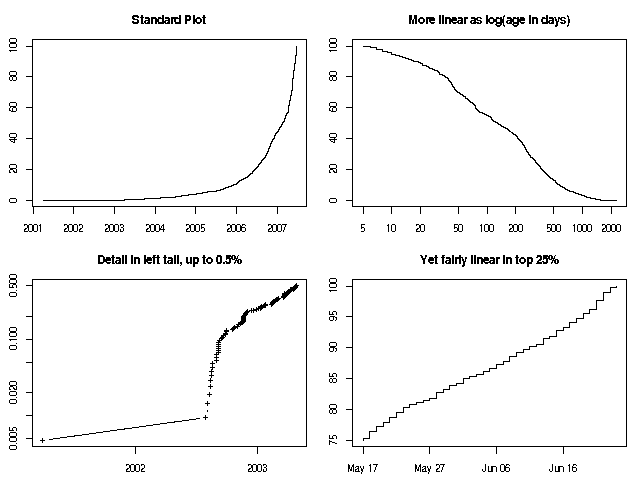
Earlier today and via Planet Debian, Lucas blogged about the 'age distribution' of Debian packages, defined as the time since the last (re-)compilation. He illustrated his findings with an, umm, rather ugly chart. Having climbed onto the soap box once before, I would like to point out how easy it can be to create simple, informative, and, at to least to me, prettier charts using R. Lucas included a URL to the data. The first nice thing to note that we can read the data directly from the URL -- no need to copy the file:
pkgAge <- read.table(file="http://people.debian.org/~lucas/arch-age/arch-age.log", col.names=c("pkg","yyyymmdd"))
read the data into a data.frame which we have given two column names.
pkgAge[,"date"] <- as.Date(as.character(pkgAge[,"yyyymmdd"]), "%Y%m%d")
pkgAge[,"age"] <- as.numeric(difftime(Sys.Date(), pkgAge[,"date"], units="day"))
pkgAge[,"prop"] <- (1:nrow(pkgAge)) / nrow(pkgAge) * 100
We then create three new columns. First is a date, by parsing the (integer) dates (after first casting them into characters) by supplying the format in standard C notation: "%Y%m%d" for year, date and month without any separators or formatters. Now, having the date as an actual date object inside a real data analysis language we can do things as e.g. computing date differences. The difftime function does just that, using the current date as other point. We ask for the return to be in days, and cast this down to a purely numeric vector (instead of datediff object). Lastly, we quickly compute the date proportion in percentages. We can then view the date. Before we plot,
png("packageAges.png", quality=100, width=640, height=480, pointsize=10)
oldpar <- par(mfrow=c(2,2), mar=c(2.5,2.5,3,1))
we direct the charts to a png file of given dimensions, and ask for all plots in one figure (using mfrow with two rows by two) with somewhat smaller figure margins using the mar argument to par. The first chart shows again proportion over date:
with(pkgAge, plot(date, prop, type='l', main="Standard Plot"))
(The with() function simply allows us to refer to the columns by their names without explicit subsetting. plot(pkgAge[,"date",], pkgAge[,"prop"]) is equivalent, but more cumbersome.) As it clear that the data has a fairly long tail in the older dates, we can also try to plot the plot over logarithmic time differences. This doesn't work for dates, but it works for our (positive-valued) age variable:
with(pkgAge, plot(age, prop, type='l', log="x", main="More linear as log(age in days)"))
The very far left tail below 0.5 percent is interesting as the one very old package is clearly an outlier within an outlier region. We use the subset function to take just one portion of the data, use logs, and explicit plotting symbols '+' in a points-and-lines plot:
with(subset(pkgAge, prop0.5), plot(date, prop, type='b', log="y", pch="+", main="Detail in left tail, up to 0.5%"))
Lastly, the upper quartile is fairly linear.
with(subset(pkgAge, prop>75), plot(date, prop, type='l', pch=".", main="Yet fairly linear in top 25%"))
At the end
oldpar <- par(mfrow=c(2,3))
dev.off()
we restore the graphics paramters and close the device (here the file). All this then yields the following chart: Debian Package Age-since-recompile Distributions Updated to correctly display the assignment operator <-

29 June 2007

Jose Carlos Garcia Sogo: Pownce uses Debian

Reading once again Enrique's blog I see an entry about Pownce, an enhaced Twitter-like web. As you can read in their own website they are using Debian as their distribution, and utils as Apache, MySQL, Python, ... A nice example on how powerful things can be made in an easy and cheap, but at the same time powerful, way.

Eddy Petri&#537;or: fglrx issues

I know, I shouldn't be using it in the first place, but I had no alternative until recently.

I think I have a really precise image of the development process of the fglrx drivers since I nave been successfuly using sleep with 8.33.6. That went down the drane with 8.36.5. After a month of pain (I don't understand why it took me sooooo long) I decided to go back to the version that worked (which was a package I prepared myself).

Matthew Garrett told me at DebConf that the avivo driver should work for my video card, but it needs pciaccess which is not available in Etch and at that time was not available even in experimental.


At some point I'll probably use avivo, but until then I still want my laptop to be able to sleep... I hope AMD opens those drivers soon.

MJ Ray: Sustainability, Search Engine Traffic and free software webmasters

Regular readers may remember that I'm a vocal critic of some search engines and the unreliability of their fast-changing algorithms. One day you're top ten and the next you're gone. If you're building your business on search engine referrals, you're building your castle on shifting sands. SEOBook: Website Sustainability: What Percent of Your Traffic Comes From Search Engines? has good advice:-
"one of the best moves you can make for the sustainability of that site is to lower the percentage of traffic that comes from search"
That's one reason why I'm glad to see the suggestion of etbe: Advertising Free Software Projects - nearly every free software project would be better off improving their web sites, adding cross-links and building more sustainable traffic, instead of wasting resources competing in the Google-ad Games. Unless you've got the thousands of pounds a year that successful AdWords marketers spend, your Google-ad success will probably be short-lived, as people with more money will outbid you for keywords that work. It's even less sustainable than search result traffic, because it's consuming your financial resources as well as your vounteer time. Meanwhile, most free software project webmasters I know are over-stretched, but many wannabe-contributors seem to want to nuke the entire site to rebuild it with their pet tool. Those offers are really about their ego more than helping the project, in my opinion. They want to Get Themslves Noticed, but I've seen far too many unfinished site rebuilds to like those offers. In fact, I don't think any good webmaster would offer a rebuild without the site owner asking for it - even in the rare cases where I really strongly want to restart a site, I explain why and ask permission first, not just wade in with an offer to nuke-and-rebuild. If the site owner says no, I move on: there's no shortage of work here, after all and very few free software projects pay their webmasters. So, if you want to help a free software project, ask their webmasters for suggestions and access to the site source code.

MJ Ray: Koha at Crimea 2007

On 13 June, Koha was presented to the Fourteenth International Conference: Crimea 2007: Libraries and Information Resources in the Modern World of Science, Culture, Education and Business by Sergey Dubik, V. Stefanik Lvov Scientific Library of the National Academy of Sciences of Ukraine, Lvov, Ukraine. The presentation PDF is online (tip from the author to koha list). It's in Cyrillic alphabet - which language is it in?

Enrico Zini: tg-linktoself

Linking to self in turbogears I want to put in my master.kid some icons that allow to change the current language for the session. First, all user-accessible methods need to handle a 'language' parameter:
@expose(template="myapp.templates.foobar")
def index(self, someparam, **kw):
    if 'language' in kw: turbogears.i18n.set_session_locale(kw['language'])
Then, we need a way to edit the current URL so that we can generate modified links to self that preserve the existing path_info and query parameters. In your main controller, add:
def linkself(**kw):
    params =  
    params.update(cherrypy.request.params)
    params.update(kw)
    url = cherrypy.request.browser_url.split('?', 1)[0]
    return url + '?' + '&'.join(['='.join(x) for x in params.iteritems()])
def add_custom_stdvars(vars):
    return vars.update( "linkself": linkself )
turbogears.view.variable_providers.append(add_custom_stdvars)
(see the turbogears stdvars documentation and the cherrypy request documentation (cherrypy 2 documentation at the bottom of the page)) And finally, in master.kid:
<div id="footer">
  <div id="langselector">
    <span class="language">
      <a href="$ tg.linkself(language='it_IT') ">
        <img src="$ tg.url('/static/images/it.png') "/>
      </a>
    </span>
    <span class="language">
      <a href="$ tg.linkself(language='C') ">
        <img src="$ tg.url('/static/images/en.png') "/>
      </a>
    </span>
  </div><!-- langselector -->
</div><!-- footer -->

Nico Golde: stfl-0.14

Just uploaded the new version of stfl a library which implements a curses-based widget set for text terminals.

The new version of the package introduces unicode awareness of stfl (introduced in stfl 0.9, Clifford released very often : ) and the often requested packages for the bindings stfl ships, namely ruby(1.8/1.9), python, perl and spl.

The package is now going through NEW, in the meantime you can get the packages (for i386) on:
http://nion.modprobe.de/stfl/

Oh and Michael Mende is my new Co-Maintainer, also thanks to him for his help!

Martin F. Krafft: DebConf7

I am sitting at Frankfurt airport in between flights home from Edinburgh (not anymore, but that's where this post was born). It's been an intense 2.5 weeks of DebConf7, which has been unlike other DebConfs for me in two respects: this was the first time I actually went to DebCamp, the week leading up to the conference, which is designated to teams and individuals with development goals to achieve during the week. And I was also actively involved in the organisation of the conference, which was unexpected, but a very good experience I am not going to miss next year. Well, it wasn't unexpected. When I booked my flights in January, I had decided to arrive a day early and leave a day late to be able to lend a hand. In between then and the conference, my life turned somewhat upside-down and I had forgotten everything about these noble goals of mine. So when I arrived at the conference venue on Saturday morning with thoughts of netconf circling my head, I was surprised to find everyone buzzing about (how na ve of me) and somewhat clueless as to how I should merge in: my wrists didn't really hold up to heavy lifting, and my knee certainly didn't enjoy stairs, of which there were plenty on the way up to the top floor, where DebCamp was taking place. After trying and being mostly ridiculed by the other organisers ("friends"... ha!), I set out to accomplish some other tasks more suited to my bodily condition, such as wiring the hack lab to accomodate 40 geeks for the first week. That took me most of the day, but at least the space was ready for Sunday morning and the official start of the camp. My goal for the week was netconf and I made good progress until I ran into a wall on Tuesday and had to back off and rethink my design. Reinhart Tartler and Enrico Zini dedicated their time to listen to my design and the problems and helped me clear the mess up and helped me reduce complexity and converge on a straight-forward, event-based design. As the newly appointed DebConf press officer and one of the organisation volunteers, I did not get any further for a few days, as I was manning the front desk or preparing and releasing my first press release (with the help of several others), which lead to a lovely story on The Register and doubled the number of attendees that preregistered for DebianDay (which marks the end of DebCamp and the start of DebConf). I blame the geeks in skirts, actually. Silly bunch, but not quite as silly as those attendants who could get a laugh out of the underwear question for two weeks in a row. Up to this point, I had managed to keep a perfect balance between netconf, orga-team, and sleep. So good, apparently, that when the orga-team t-shirts arrived, Uncle Steve made it quite clear that I should be getting one, even though I had spent considerable time on netconf, am sure some of the others must have worked twice the amount, and I was still quite well rested then. But they gave me a shirt and thus I became part of the orga-team. And even though it was rough at times, running around during the day, filling spare minutes with netconf brain-work, and enjoying nights that got longer with every day of the conference, I am glad and proud to be a member of this team now. It took me until after the official start of the conference to return to the netconf code, but with the new design, I got most of the framework to a point where it could obtain static and dynamic addresses from configuration files as well as DHCP servers in time for my presentation on Tuesday (the recording of which shall be linked from the netconf homepage as soon as it's available). Of course, nothing worked on screen in front of the audience, but noone really expected that anyway. and then I took it all apart for further simplification, so by the time night fell, the slides from the talk had already become outdated as I moved to yet another design, which is even simpler and which allowed me to sketch complex scenarios, such as DHCP after WPA. For two days, I made good progress, but the time available for hacking decreased noticeably, as I kept volunteering for more tasks that needed doing, and more and more people turned up. Somewhere in between, Keith Packard took hostage of (and fixed parts of) my broken X40 laptop, but that's the meat of another story. And on some other night, our leader Sam, in his official capacity as DPL, presented me with the instantiation of my innermost desires as consolation for my hosital stay: a pony. Just look at that smile! With 400 attendants, this year's DebConf continued the trend of immense growth of the event, and while it's great to witness this increase in popularity among attendees and sponsors, who make it possible each year to fly more people to the destination, I am also rather sceptical. The problem is less the additional load on the organising team the next 100 people are going to be easier to accomodate than the previous 100 were. It is more that the conference is losing focus. More people make you spend less time with the same folks, and as the number of non-contributors increases, the social element starts to outweigh the technical element. I am not condemning the social element, but to paraphrase the words of my favourite Debian developer, it's painful to come to DebConf or even IRC with a project and questions just to find that the people are generally more interested in being social, even to the point of preventing technical discussions. I realise that this is a sensitive subject as the issue of various cabals keeps coming up frequently and it does not seem right to start limiting the audience to this conference, but unless we consider the matter, DebConf might deteriorate similarly to other conferences, which have enjoyed enormous growth as well before it was too late. I think we must make sure that people understand that we are, after all, a technical project and must not lose touch with out roots. Of course, I may also be overreacting, after a week of intense coding and many other stress factors I continued working hard on netconf and helping with the organisation throughout Friday, briefly taking time off to prepare a presentation on my Ph.D. research, which was very well received, as well as a workshop on Debian packaging with modern (distributed) version control systems, which yielded around a dozen new subscribers to the vcs-pkg mailing list. But now, back to netconf. All things considered, I was making good progress, but not getting netconf into a releasable state just yet. I can parse /etc/network/interfaces files and get data from DHCP servers, even configure interfaces with those, but it's all still work in progress as I have not yet bothered to implement such basics as default gateways or DNS servers. But the framework is in place, and I am very happy with it as everything I keep adding falls into place beautifully. To mark the end of my netconf development sprint at DebConf7, I scheduled a code introduction session on Friday, where around 15 people turned out to get a walkthrough of the code and explanation of some of my design decisions. The session was recorded and will be available on video shortly. I think it turned out to be a very good idea; I found myself intrigued by someone else's code before until that someone took the time to explain what was going on. I sincerely hope that this introduction helps bootstrap a few people's experiences with the code and yields more contributors! Even though we ended almost every single evening of the two weeks in one of the surrounding pubs, the last few nights were definitely the most enjoyable. On Thursday, the local team had organised a Ceilidh with a band teaching us geeks how to dance the Scottish way, and the venue stayed open for two hours longer than before, causing most people to come out for beer or bouncing about. On Friday and Saturday, the folks of InfoSeed let us use their comfy couches (in the basement of the conference night venue) and we chilled to music and massages, while on Sunday, after a very tiresome day of cleaning up, the noticably lesser number of survivors hung out at the Forest Cafe for some so-so live music, few beers, and an early journey to bed, where a Dutch Muppet kept us entertained for at least another hour. The best about Monday, my day of return, must have been that the airline lost my backpack, which saved me from having to lug it around in Zurich, and made for a great moment on the phone with the baggage tracing service, who announced that my bags would be delivered in about 6 hours between 20:00 and 22:00 just as the door bell rang and the courier dropped off my bag. I'll be back in Argentina, unless something goes seriously wrong. And I'll be on the orga-team again. If you guys stop holding your meetings on Monday night. Thanks to everyone who made DebConf7 possible. I am proud to have been able to contribute, but the real work was done by a few others. You know who you are. NP: Solar Project: Five

Next.

Previous.