Search Results: "ag"

4 July 2007

MJ Ray: STklos 0.96 - a Scheme compiler/interpreter

The aim of this implementation is to be fast as well as light. The implementation is based on an ad-hoc Virtual Machine. STklos can also be compiled as a library, so one can easily embed it in an application. This release introduces a simple FFI (Foreign Function Interface), Better support for FreeBSD, Fixed a bug when using the -j option of make during bootstrap, Fixed several problems with ScmPkg packages installation.

MJ Ray: Fon goes wrong

Last month, I looked at running a Fon Access Point. I've not done anything more because of debconf and work, and I've since discovered how to access another firmware upload interface on my F5D7630uk4A (double-click the reset button). I see that some Fon users are moving their routers into lakes in protest at the 15-minute anonymous access offers from Fon. Fon know their sales figures better than I do, but it seems like bad business to introduce that 15 minute free access. 3-euro for 24-hours was already far cheaper than competitors like The Cloud. Message board posters already noticed the loss of sales as people exploit the anonymous access. There's over 300 in the protest lake today. I can't blame them - if your network gets abused for bad things like kiddie porn, the possible problems are terrible. I've seen innocent people punished for running insecure systems in the past. One of the most disappointing things is that the Fon workers seem to be near-silent on this. A few sympathetic posts to the boards, but no official statement yet, as far as I can see. So, I'll not be getting a Fon access point while this problem continues and it worries me for the future, but do you know of any alternatives?

MJ Ray: ASK 3D - New but not good enough

ASK 3D has launched. It looks pretty, but I don't see much improvement on the actual searching. If I search for something in the UK, it switches back to World without asking (I suspect some undisclosed cookie-fu). If I search for certain company names, it auto-corrects the spelling and returns a page of irrelevant results. The results pages seem to have too much space occupied by adverts. And the list goes on. I'm ready to switch search engines, but it won't be to this version of Ask 3D.

3 July 2007

John Goerzen: Sierra Wireless 595U / Sprint on Linux

Here's how you use a Sierra Wireless 595U USB modem to connect to wireless Internet service with Sprint:

Insert the modem into the USB slot. lsusb should show:

Bus 001 Device 005: ID 1199:0120 Sierra Wireless, Inc.

rmmod usbserial

Then:

modprobe usbserial vendor=0x1199 product=0x0120

You should see /dev/ttyUSB0, ttyUSB1, and ttyUSB2 appear. See also instructions for automating this with a similar card (modify vendor and product to above settings).

Now you will need to configure PPP for this. On Debian, run pppconfig. Your settings will be:

Phone number: #777
Username: 1234567890@sprintpcs.com (replace 1234567890 with your data card's "phone number", no dashes)
Password: your sprint password
Speed (BPS): 921600 (use lower numbers such as 115200 if you have trouble with this)
Port: /dev/ttyUSB0
Init string: ATZ

Here are some other helpful pages:

Verizon EVDO
Sprint and Linux
Cingular AT&T UMTS
Sierra's Linux page

Gustavo R. Montesino: Debbugs SOAP

Following the hints by Bastian Venthur, which answered my last post (thanks, Bastian), and some suspicious mails to debian-debbugs, I've finally gotten to know that the debbugs' SOAP get_bugs is finally fixed. Of course, this means that btsutils has just got its query function implemented in SOAP besides the html parsing stuff.

Also great news on the debbugs' SOAP camp is that get_status now works on more than one bug per call. Yay! Debbugs people rocks. I'm not realy in place to ask something more drom these great folks, but it would be great if those cool features they keep adding were announced somewhere.

Now, the downside: Querying through SOAP is still quite slower than parsing the html. According to Python's timeit, getting a list with the bugs on all packages maintained by me takes about 17 seconds, while the same operation through HTML parsing takes about 10 seconds. I believe this differences comes from accessing the server one time on the HTML parsing and two times (get_bugs and get_status) on the SOAP.

MJ Ray: Oracom ORC-200M Media Player with Linux 2.6.21.5 usb-storage driver

Now that my Samsung YP-U2 was destroyed, I'm left with the Oracom ORC-200M USB Audio Player that I was given a while ago. It seems that this doesn't work with recent 2.6 kernels. Tales of brokenness abound on livejournal, in ubuntu forums, and in Gentoo forums. Its USB ID (in lsusb or /proc/bus/usb/devices) is 0f19:0103 and there is a patch available for 0f19:0101, which is the similar ORC-100 and DION-MX player. Simply changing the ID and using that patch didn't work for me. I could see the device appear in /proc/scsi/usb-storage (which was new), but still nothing in /proc/scsi/scsi, so I updated the patch slightly. The new patch for linux-2.6.21.5 is:
--- linux/drivers/usb/storage/unusual_devs.h.orig       2007-07-03 18:44:59.000000000 +0100
+++ linux/drivers/usb/storage/unusual_devs.h    2007-07-03 19:01:47.000000000 +0100
@@ -1317,6 +1317,16 @@
                US_SC_DEVICE, US_PR_DEVICE, NULL,
                US_FL_IGNORE_RESIDUE   US_FL_GO_SLOW   US_FL_MAX_SECTORS_64),
+/* Patch by Leonid Petrov mail at lpetrov.net
+ * http://www.qbik.ch/usb/devices/showdev.php?id=1705
+ * Updated to 103 device by MJ Ray mjr at phonecoop.coop
+ */
+UNUSUAL_DEV(  0x0f19, 0x0103, 0x0100, 0x0100,
+               "Oracom Co., Ltd",
+               "ORC-200M",
+                US_SC_DEVICE, US_PR_DEVICE, NULL,
+                US_FL_IGNORE_RESIDUE   US_FL_FIX_INQUIRY),
+
 /* David Kuehling <dvdkhlng@gmx.de>:
  * for MP3-Player AVOX WSX-300ER (bought in Japan).  Reports lots of SCSI
  * errors when trying to write.
Hope that helps someone else. Leave a comment if you have any improvements, please. I don't really know what I'm doing with USB and I didn't find descriptions of the usb-storage flags (US_FL_ right?). I just experimented until it worked.

Julien Valroff: New router - livebox!

I decided to buy a Livebox on Saturday. The livebox is a modem-router used by my French ISP Orange. It allows me to profit from Orange VoIP service (and thus stop my standard phone line), as well as from the TV over ADSL (which I haven’t tried yet). My only issue is that I can’t disable to router mode of the Livebox (which is a Sagem F@st 3202 router) - I would have liked to keep my current configuration with a simple modem, in bridge mode. However, I have managed to re-configure shorewall on my internal router and redirect everything from the livebox to this router. This setup means double NAT, but it seems to work like a charm.

Norbert Tretkowski: Updated 3dm2 packages

My colleague Jonas updated his 3dm2 Debian packages for i386 and amd64 to the latest release 9.4.1.2 today. Unfortunately 3ware decided to use a Java based installer for the latest releases, so it was quite a PITA to update the packages.

Julien Danjou: Five days of coding: rebuildd

Last week I decided to begin a new project, whose name is now rebuildd. If the name is not explicit to you, let me explain: it's like buildd, but its first purpose is to rebuild packages. If you want to know more, you can take a look on the Web page I just set up.

MJ Ray: Comments on coverage of the Tour de France

I asked for any other free-to-air satellite coverage of the Tour de France and Bernie S commented:
"RAI 3 on Hotbird"
and there's an online schedule on the RAI 3 site. Neville Emerson wrote:
"Can't wait. Cycling is the best and coverage is getting better and better every year."
Yes, at long last. There's now a full itv coverage listing on the CTC site but I still don't understand why itv are so late at launching their tdf site! Speckled Hen asks:
"Anyone know if there's any live coverage online? Can't see anything on either Eurosport or ITV web sites. I know the Beeb usually do it with rugby internationals."
I heard of some recorded items from ASO (Amury Sport Organisation, the tour's managers) on YouTube, but nothing about live video feeds yet. I've had audio in the past from both Radio France and Eurosport but I've not even found those details for this year yet (I'm slow at reading French and the new Yahoo Eurosport site is terribly hard to navigate). Keep watching Cycling Fans and TdFBlog (who kindly linked this item in their coverage summary ) for news of video coverage. Unless anyone would like to leave me details of live online coverage in a comment on my site, please?

Simon Huggins: X considered harmful!

No, not that sort of X. Rather a look at the origins of considered harmful as a phrase. The Language Log is well worth a read if that interests you.

John Goerzen: Mail Readers Still Stink

Five years ago, I started work on OfflineIMAP. I couldn't find any mail reader that offered good IMAP support and a good feature set. Rather than write my own mail reader, I simply wrote OfflineIMAP and used it with mutt. OfflineIMAP does a bi-directional sync between an IMAP server and local mailboxes. This lets you work offline, and also speeds up reading since each new message doesn't have to be downloaded from the network on the spot.

I kept hoping that OfflineIMAP would become obsolete soon, as mail readers got better. Back in 2004, two years after writing OfflineIMAP, I looked at mail readers. In 2005, after some more frustrations with mail readers, I wrote a comparison. I wound up sticking with mutt and OfflineIMAP each time.

I've gone out looking at mail readers again. Here's what I've found.

KMail
Overall a nice reader, KMail has almost every feature and setting I want. It has "disconnected IMAP" folders, which download every new message in folders to the local disk as part of the routine mail checking. It then caches local changes and syncs them to the remote on the next mail check. This boosts interactive performance and permits offline operation -- very similar to OfflineIMAP. KMail has keyboard shortcuts for most things, and keyboard shortcuts can be added or changed for most other things as well.

KMail also integrates with the KDE calendar and addressbook, which I already use. That's nice, too.

I have two big gripes about it though.

Back in 2004, I noticed that KMail crashes a lot. By 2005, it was worse. Sadly, KMail still has a tendency to crash. I've seen an average of 1-2 crashes per day, due to SIGFPE, SIGSEGV, and I think also SIGILL. This doesn't make me happy at all. Especially to see that it's no better on that in three years. Just don't try emptying trash while your mailbox is being synced, for one thing....

Gripe #2 is that there is absolutely no way to select a different alternative in a multipart message without using the mouse. Simply no way using the keyboard. It's also cumbersome, though possible, to view attachments using the keyboard -- you have to press Enter to open the message in its own window, then tab to the attachment.

KMail also sometimes works a bit sluggishly -- for instance, when you delete a message, you first see strikethrough through it, then it disappears. It doesn't feel very "snappy".

Evolution
Evolution has a decent core. It is easy to get set up and has an extensive set of keyboard shortcuts. It does IMAP downloading and syncing like Kmail, and it does it by default. It doesn't offer all that much flexibility in configuration, but probably enough.

Here's my gripe. There is no way for it to show a total message count next to each folder in the folder list. It will show an unread message count, but not a total message count. You have to click on each folder individually to see a total message count. I can't figure out why this is missing from Evolution. It's one of the main benefits to switching from mutt, and so I didn't bother looking at Evolution any more past there.

Thunderbird / Icedove
By default, it isn't all that capable of a mail reader. There aren't that many configuration options, and the keyboard shortcuts -- while existing for most things -- are cumbersome.

The Nostalgy extension helps with the keyboard shortcuts significantly. You still can't change some of them (Ctrl-L for forward, anyone) -- at least not without an extremely cumbersome process involving editing text files.

Thunderbird can do automatic IMAP downloading and syncing like KMail and Evolution, but for some inexplicible reason, only for your INBOX. In fact, Thunderbird won't even check for mail in folders other than INBOX unless you set an undocumented configuration option. It seems to assume that nobody does server-side mail filtering.

If you want IMAP downloading for offline use or performance, you have to manually invoke a download operation. There is a Sync on Arrival extension, but it isn't compatible with Thunderbird 2.0. From reading comments online, there are a lot of people frustrated about that.

So Thunderbird strikes out as well.

mutt + OfflineIMAP
The good thing about this combination is performace. mutt is extremely fast, and OfflineIMAP works faster than anything else for IMAP downloading. mutt is also far more configurable than anything else.

There are some annoyances about mutt.

#1 on that list is the lack of a folder list. There is just no way to see a list of folders along with new or total message counts. You can press c, Enter to go to the next folder with unread mail, which is something, but not enough. There have been numerous abortive projects over the years to address this, but for whatever reason, mutt itself doesn't have this yet. Probably the most promising current project is this one.

#2 is HTML mail. I don't mind the lack of default support for HTML mail. That's to be expected. There are some things that do bug me involving viewing HTML mail. First off, sometimes people attach graphics to messages that also have an HTML component. Viewing these graphics doesn't represent a security risk, but mutt doesn't make them available to a browser for viewing -- you have to manually save them if you want to view them. Also, you normally don't want to load graphics from the Internet for HTML mail. The only way to accomplish that with mutt is to set your browser to lynx or something; just using Firefox to view a HTML component will load all of that.

#3 is handling of embedded URLs. xterms can pass mouse clicks, and it would be nice if mutt made URLs clickable like other mail readers do.

#4 is the IMAP support. No support for caching, fragile, etc. That's why I use OfflineIMAP. That works, but it's a hassle.

#5 is printing. Printouts from mutt just spew the text of the message at the printer. No page numbers, formatting, nothing. muttprint makes that situation a bit better, but the integration is flaky and weird.

Conclusions
I'm not sure what I'll do. None of these are really where I want them to be, though mutt and KMail are probably the closest.

Kai Hendry: Slug

NAS installing with Debian 4.0 Bought a NSLU2 from Ebuyer. Was about ~50GBP hence qualifying for free delivery with 5 working days. I don’t know why, but according to the packaging it was sent “next day” on the 4th day(!?). The device came direct from the usual suspects Computer2000, one of the oldest and biggest computer part distributors in the UK. Sidenote: I wonder if Ebuyer can claim to have stock, when it’s actually their distributors stock? tbm’s slug install page aided my Debian etch install. This slug has a 80G external USB hard drive attached with 10G ext3 for Debian and the rest for my legacy pr0n collection on fat32. I’ve already configured nfs and it seems to work well. 539M Debian install for that… bloat. I am worried I might have not have given it enough swap, so now I am thinking of how to ramp up the memory. I’ve reassuringly discovered my slug is already operating at full 266 speeds. It would be good if this device can handle btdownloadcurses. Other ideas is to setup a logging server on it. Also I’d like to familiarise myself better with the architecture. I think I’ve seen these Xscale’s in at least one mobile phone. :) Other hardware purchases I am thinking of: I wish this slug had a USB-style power supply. As for backups, I want to switch everything I have over to LVM2 eventually and use its snapshot features. Any tips or suggestions, let me know. I am not a fan of RAID solutions btw.

Paul van Tilburg: Ruby D-Bus 0.2.0

Arnaud and I finally managed to release Ruby D-Bus “Almost live from DebConf 7” 0.2.0. The release was planned for DebConf 7. However, I didn’t manage to get it ready in between all the talks, meetings, and other social stuff. Ruby D-Bus is an implementation of the D-Bus protocol in pure Ruby. After starting the development in February, it soon became apparent that several other projects were out there with about the same goal, such as Pure Ruby DBUS and R-Bus. Our approach is to have an API that is close to the old Ruby D-Bus bindings. While the other, similar projects seem to have a slightly different goal, we still invite them to come to some sort of merging so that no duplicate effort is put into three or four separate projects with almost the same result. The 0.2.0 release is our first real public release. We have a large subset of the features working and documented. The main focus of this release was to improve the API documentation and the tutorial. The 0.2.0 release is a release for exploratory purposes. We invite everyone interested to have a look at the API and inner works and provide us with feedback and/or patches. This means that the API can still change a bit over time based on feedback and tweaks performed by ourselves. So don’t built a big application on it just yet if you’re not willing to make some changes later on. For more information, see our project (Trac) page.

Miriam Ruiz: Two new small cute games in Debian

Yesterday, two small cute games, both coded in python and pygame, finally entered the repositories. Both were submitted to the PyWeek Python Game Programming Challenge. Bouncy the Hungry Rabbit is a game targeted to small children, in which you play a hungry rabbit in a garden with yummy veggies and a farmer who’s not keen on you eating them Whichwayisup is a kinda traditional 2D platform game with a slight rotational twist, which means that up and down, left and right are constantly changing as you go ahead in the game. One of the interesting things about this game is that it is, AFAIK, the first package in Debian licensed under the CC-by 3.0 (Creative Commons 3.0 Attribution license).

Miriam Ruiz: New Garbage Collector for Gnash

The Gnash GC (garbage collector) is enabled by default in CVS HEAD since yesterday’s night, and its performance nearly reaches the RC (reference count) speed, which is really good news :) I’ve made newer experimental packages for Debian (source here), in case someone is interested. As always, feedback is really welcome :) I hope the current versions of Gnash get out of the NEW queue soon.

Neil Williams: DebConf7 keysigning

I've generated a springgraph of the DebConf7 keysigning keyring after refreshing the keys today. Thumbnails are available now. Click the thumbnail to see the full image. I've tried to correlate the thumbnails so that the overall area is similar.

For some reason, the images don't show via my blog.

For comparison, the springgraph before DebConf:

http://gnupg.neil.williamsleesmill.me.uk/ksp-spring.png

(The main image is much larger - may be best to wget it and view it locally.)


http://gnupg.neil.williamsleesmill.me.uk/ksp-spring-thumb.png


The change after DebConf:

http://gnupg.neil.williamsleesmill.me.uk/afterksp.png


http://gnupg.neil.williamsleesmill.me.uk/afterksp-thumb.png

(a much smaller final image).

Peter Makholm: Debian Social Contract 10 years and the danish connection

  1. Our priorities are pancakes and beer We will be guidede by our need for pancakes and (preferable free) beer. We will place this interest first in our priorities. We wil support the needs of our users for knowledge of where to get many different kinds of pancakes and beers. We will not object to other kind of food and drinks, but pancakes and beer are our main common interesst and priorities. In furtherance of this need, we will provide guidance to beer and pancakes all over the world near and far away from Denmark.
For some reason the celebration of the Debian Social Contract was centered on Denmark. So I thought we might as well organize something in Denmark for real (some of us had talked about it some days ago). We have yet to decide if our main priority is beer or pancake so the plans aren’t quite final yet. lbaren has been mentioned. If you are interested in joining contact me. (Update: lbaren is closed for the month)

Dirk Eddelbuettel: More on 'nicer charts'

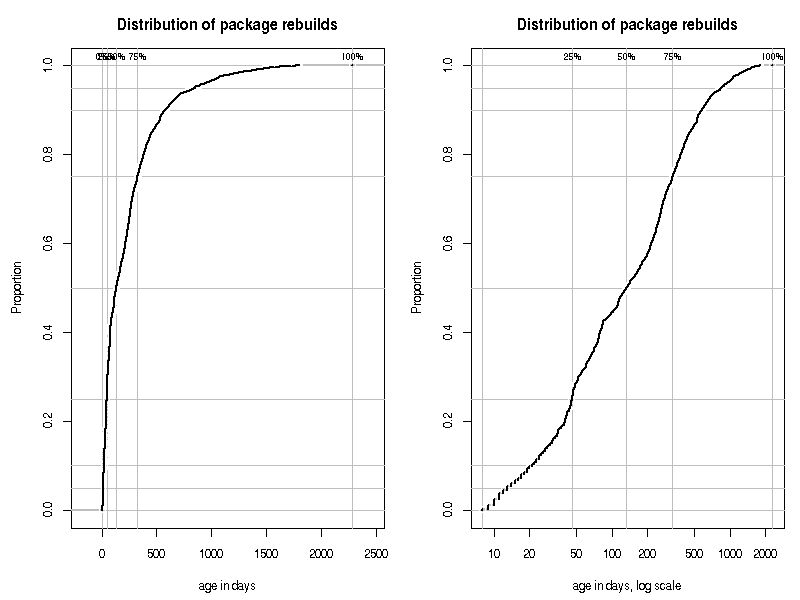
Via the Planet Debian aggregator and his blog, Sven followed up on my post regarding Lucas' plot of the package age distribution. As some of my points didn't seem to make it across, I will reiterate them more plainly: Sven also addresses the fact that what we really want is to see the quantiles of the data set. Quite right, and taking logs makes that easier. Consider the two charts below which plot the 'package age in days' as an empirical cumulative distribution function using built-in R functions ecdf and plot.stepfun (rather than redoing it ad-hoc as I had done), and also add explicitly quantiles. The two charts use the exact same instructions; however the second chart transforms the x-axis to a logarithmic scale. Debian Package Age-since-recompile Distributions charted two ways While it is close to impossible to find the 25 or 50 percentile on the first chart, it becomes a lot easier on the second chart because the x-axis is 'stretched' using the log transform. About one quarters of the distribution appears to be rebuild within 1.5 months old, and about half is younger than four months (as a quick call to summary(pkgAge) confirms). Reading these proprtions off the original chart, or the non-log chart, is much more difficult.

2 July 2007

Mike Hommey: svk vs. git for xulrunner maintenance

I’ve been using svk for xulrunner maintenance since the first test packages. And I’ve been thinking about switching to git for a while now. I did some testing in march, which led to my post about diffing. I went a bit further today by actually trying to convert my svk repository. And I got both interesting and surprising results. The repository is (only) about 250 revisions in svk, and includes 15 upstream releases (or CVS pulls). I had to reorganize the svk repository so that git-svnimport could do its work properly. [ Note: these tests have been done on a 5 years old laptop ] The first surprise is the time it took for the conversion : almost half an hour. Dumping (svnadmin dump) and reloading (svnadmin load) the svk repository takes a bit more than 3 minutes, in comparison… I guess git-svnimport is very ineffective. The second surprise is that the svk repository is actually almost twice as small as the git equivalent: 116MB for svk vs. 224MB for git. On the other hand, git is amazingly fast. One of the most common things I do on this repository is a diff between the upstream branch and the trunk. I create the .diff.gz file I give pbuilder this way. It’s much quicker than doing a real dpkg-source, especially considering pbuilder does one itself. After dropping caches (echo 3 > /proc/vm/sys/drop_caches), such a diff takes about 50 seconds with svk and… a little more 2 seconds with git. Without dropping caches, it gets down to 38 seconds with svk and… 0.05s with git. That is pretty damn fast ! Update: after a git repack -d, the git repository is down to 61MB.

Next.

Previous.