Search Results: "ag"

5 July 2007

Aigars Mahinovs: Photos, photos, photos

Finally I took my time and uploaded all my good Debconf7 photos to Flickr, 193 photos in total. Most interestingly I have created a much improved version of the group photo.
Debconf 7 Group Photo
Please do note that these photos are under Creative Commons Attribution licence, so please do give credit where it is due. And I also would love if you would send me an email telling where you have used my photos of the event. Links to other photos (and mugshots) can be found via the corresponding wiki page.

Evan Prodromou: 16 Messidor CCXV

We had a good Fourth of July yesterday. Last night, John Usher had a nice cinq sept at his house to celebrate his birthday and departure for dear old Blighty, as he calls it. (No, not a celebration of Independence Day -- I don't think there's an official one here in Montreal.) Maj, Amita June and I went over to our friend Patti's for nice sushi takeout from Tokyo Sushibar. Yay! I got dropped off at YULblog at the Quincaillerie for a late-evening drink. It was a good time -- I got to talk a lot to Chris Car and Hugh McGuire, whose time I tend to monopolize. tags:

Cameron Dale: Simulating DebTorrent

I've been spending some time on the #bittorrent channel on Freenode, to see if I could get any good information from other bittorrent client developers. After some poor initial contact, I did get some good suggestions, as well as some tidbits of information I wasn't aware of. One of the tidbits was that most of the bittorrent client developers frowned on the use of selective downloading for torrents, to the point where some refuse to implement it in their clients (apparently the latest mainline client doesn't even have it, though I haven't checked due to license issues). This concerned me, as the DebTorrent client I'm working on will rely heavily on selective downloading to only download packages to be installed by the user. It's not clear to me that it would be an issue though. I'm sure it will make it more difficult to find a rare package in a large swarm of peers, but that's to be expected, and is nicely solved by using an HTTP download from a backup mirror. This backup downloading could become extreme though, making the bittorrent-like download (peer-to-peer) mostly just an HTTP download (client-server). To see if it will be a problem, I conducted a simulation of different sized swarms to determine the amount of unnecessary HTTP downloading that will occur. First, some assumptions to make the simulation easier: With these assumptions, the simulation becomes quite simple. I used the popcon data to assign packages appropriately to the N peers. The peers download their assigned packages from the C previous peers, if possible, or otherwise by HTTP. I ran this multiple times, varying N and C, and calculating each time how much was downloaded through the debtorrent protocol, and how much through HTTP. debtorrent wasted.png This graph shows the percentage of the total download that used HTTP from a mirror. The optimal line shows the minimum possible (i.e. all peers are connected), which corresponds to only one copy (the first) of every package being downloaded using HTTP. This verifies my previous thinking, which is that fracturing the download population into multiple small swarms results in lots of inefficiencies, and lots of HTTP downloading. All efforts will need to be taken to keep the downloading populations together. (This is especially difficult for unstable, when a new swarm could be created twice a day due to archive updates.) Swarms of 1,000 peers or more seem to be sufficient to minimize the HTTP downloading. debtorrent unnecessary.png This graph shows the amount of unnecessary HTTP downloading that occurred, which is just the difference of each line from the optimal one in the previous plot. This shows the danger of selective downloading, as all of this unnecessary HTTP downloading occurs because the swarm is too big to find peers that have the desired package (they do exist). Fortunately, this unnecessary downloading seems to approach a maximum as the swarm size increases. For the large swarm sizes needed to make the downloading efficient, and assuming a reasonable number of connections of 100 (bittorrent defaults to maintaining at least 40, and large swarms usually means a large number of connections), we can expect to be using HTTP for about 4% of the download. This number is surprisingly low due to the popularity distribution of packages (only rare ones are hard to find, but they aren't downloaded very often). I think 4% is manageable in our situation, given that there is a backup method to find the rare packages, though it does show the need to have that backup method available. This is probably more of a problem for regular bittorrent clients, in which there is no backup method.

Russell Coker: Fragmenting Information about Jobs

A comment on my previous post about my Linux Jobs Blog suggested that I shouldn’t fragment the information. However I believe that fragmenting the information is ideal due to the ability of RSS syndication to drive the cost of coalescing the information to almost zero! Currently there is a Linux job web site run by Linux Australia. It doesn’t have many adverts and isn’t even linked from the main Linux Australia web site. I believe that we can do better for the people who want Linux jobs and the people who have such jobs to advertise. If you have a central site the jobs have to be moderated (which takes work and delays listing), the larger the area that the site covers the greater the work is to do this. The solution is to have a distributed system with different people running listings for various regions and a syndication service to aggregate them. To start this I have created a blog which will have categories for the states and territories of Australia. Someone who is only interested in one region can visit the category for that region. Then recruiting agencies and companies which regularly hire Linux people can start their own RSS feeds to be syndicated in a planet instance for each state and territory. This gives a faster and more efficient response (adverts will appear quickly, can be changed or removed at any time, and less effort for moderation. I expect that recruiting agencies will occasionally post off-topic entries - but when their feed gets removed from the Planet installation they will probably make a commitment to do the right thing in future. Planet installations can syndicate other Planet installations, so we can easily have a Linux jobs Planet for Australia (possibly run by Linux Australia) that syndicates the feeds from each state and territory. In the long term I think that the best way of running this is to have Linux Australia run the central Planet instance and a LUG in each region run the local site. I started running it myself because I didn’t get a positive response when suggesting it to the relevant people in Linux Australia and LUV. That didn’t deter me, so I decided to set it up myself. If the idea takes off and if Linux Australia and the LUGs want to take it over I’ll be happy to use HTTP redirects to send the traffic to them - and help them with the sys-admin work if asked. Also there is nothing specific to Australia in this idea. I am only interested in Australia because if I was to attempt to do it in a larger area (such as the EU) then I could spend all my time on it without gaining a critical mass in any region. If you are interested in running this in your region then you need to set up a blog (for adverts that are sent to you via email) and a Planet installation that feeds from your blog and any other Linux job advert blogs in your region. If your country doesn’t already have a central Planet for jobs then creating a separate Planet installation for your country would be a good idea too. I will be happy to run a Planet installation for world-wide Linux job adverts (at least until I can convince an organization such as Linux International to run it) if this idea takes off in other countries. Some people have asked what the benefit of a Planet is over a mailing list. You have to subscribe to a mailing list while with a Planet you can immediately visit it if you suddenly decide to find a new job. Subscribing to mailing lists for jobs from all countries would never work, but visiting a Planet for Linux jobs world-wide and then visiting a sub-planet for regional jobs would be quick and easy.

Gustavo R. Montesino: Debbugs, SOAP and Usertags

A small bit of info that can be hard to find: It's possible to call debbugs' SOAP get_usertag function passing only an user as argument, to get all usertags set for this user and all bugs with each of these tags, like this:

>>> import SOAPpy
>>> proxy = SOAPpy.SOAPProxy("http://bugs.debian.org/cgi-bin/soap.cgi", "Debbugs/SOAP/V1")
>>> proxy.get_usertags("bts-link-upstream@lists.alioth.debian.org")

MJ Ray: New (or new style) memberships and blog groups

I was accepted as ODP Editor: slef for the Weston-super-Mare Business and Economy listings a while ago, but I forgot to mention it here until now. I've just done a bit of basic tidying there so far and I'm finding my feet. ODP seems rather more structured and process-y than WWWVL ever was. I'm not sure whether that's good or not. I've also gained a LinkedIn Profile: MJ Ray after an invitation (and real email) from Richard Smedley of M6-IT, if that interests anyone. LinkedIn seems to work even without Javascript (ignoring the odd layout bug), but it really seems to get much slower in the English afternoons - America waking up? I've done a bit of CSS-tidying on my main site, my debian site, and OtherWayUp - I'm also looking to launch new groups on OtherWayUp. If you have a blog from or about Somerset or Cooperatives that you'd like to appear there, please leave me a comment or email.

Benjamin Mako Hill: DRM-FREE

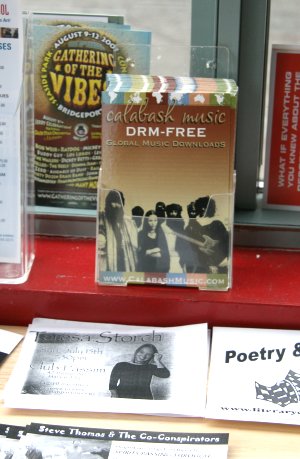
Just a couple years ago, music and technology companies would advertise their DRM schemes. While these technologies only served to prevent users of computers and consumer electronics devices from doing things, the media and technologies companies tried to spin it positively. Think of all the wonderful media that the music, film, and publishing industries will be willing to distribute to you at the click of a button, they said. All they asked for in return is the keys to your computer and the legal right to attack and sue you if you try to take control. As everyone who purchased iTunes music and made the mistake of buying a non-Apple DAP incapable of reading Apple DRMed music knows, DRM is a bad deal for consumers. Users are always better off with an unencumbered media file. In all the excitement over major label content, some consumers didn't see this immediately. With time though, the inconvenience of a computer that does the Apple and the RIAA wants over what you want hit home. This, combined with activist projects like the FSF's Defective By Design, have turned the tide. The DRM label that used to be a badge of honor is now a stigma that smart companies are going out of their way to avoid. This past weekend, I saw this flier from Calabash Music in the crepe store across the street: /copyrighteous/images/calabash_drm_table.jpg /copyrighteous/images/calabash_music_flyer.jpg The store served a general, non-technical audience. DRM-FREE, it turns out, is a good way to sell music. Not just to geeks but to any consumer who has been stymied unfairly by DRM or knows someone who has. That, it turns out, is a whole lot people. Consumers know what DRM is and they know don't like it. As consumers learn more about DRM, they want to avoid it. Seeing this, the companies that produce DRM are looking for ways to escape. The Apple/EMI deal seems to be an attempt to protect market share that the use of DRM is threatening. Others, like HBO's Bob Zitter, are disingenuously attempting to escape the stigma of DRM by simply rebranding the technology. Of course, DRM suffers from a much more fundemental problem than bad branding. The problem with DRM is that consumers don't like what it does and are only sometimes willing to suffer through it when not given the choice. Increasingly often, as with in the example of the flier I found, consumers have a choice. Things don't look good for DRM. For DRM opponents, the self-defeating nature of the technology is our greatest ally.

Stefano Zacchiroli: proactive bug reporting

Proactive Bug Reporting We can do better than Proactive Bug Discovery. Now we have "Proactive Bug Reporting", i.e. reporting bugs for stuff which isn't yet in the Debian archive: #431820. Thanks madduck, that made my day :-) LOL PS the Italian cabal has started chasing you this morning ...

Lucas Nussbaum: How do archive rebuilds and piuparts tests on Grid 5000 work?

With the development of rebuildd and the fact that several people are interested in re-using my scripts, I feel the need to explain how this stuff works. Grid’5000 First, Grid’5000 is a research platform used to study computer grids. It’s not really a grid (it doesn’t use all the classic grid middleware such as Globus). Grid’5000 is composed of 9 sites, each hosting from 1 to 3 clusters. Inside clusters, nodes are usually connected using gigabit ethernet, and sometimes another high speed network (Myrinet, Infiniband, etc). Clusters are connected using a dedicated 1OG ethernet network. Grid’5000 is in a big private network (you access it through special gateways), and one can access each node from any other node directly (no need for complex tunnelling). Using Grid’5000 nodes When you want to use some nodes on Grid’5000, you have to use a resource manager to say “I’d like to use 50 nodes for 10 hours”. Then your job starts. At that point, you can use a tool called KaDeploy to install your own system on all the nodes (think of it as “FAI for large clusters”). When KaDeploy finishes, the nodes are rebooted in your environment, and you can connect as root. At that point, you can basically break the nodes the way you want, since they will be restored at the end of your job. Running Debian QA tasks on Grid’5000 None of that was Debian-specific. I will now try to explain how QA tasks are run on Grid’5000. The scripts mentioned below are in the debcluster directory of the collab-qa SVN repository. When the nodes are ready, the first node is chosen to play a special role (it’s called the master node from now on). A script is run on the master node to prepare it. This consists in mounting a shared NFS directory, and run another script located on this shared NFS directory to install a few packages, configure some stuff, and start a script (masternode.rb) that will schedule the tasks on all the other nodes. masternode.rb is also responsible for preparing the other nodes. Which consists in mounting the same shared NFS directory, and executing a script (preparenode.rb) that installs a few packages and configures some stuff. After the nodes have been prepared, they are ready to execute tasks. To execute a task, masternode.rb connects to the node using ssh and executes a script in the shared directory. Those scripts are basically wrappers around lower-level tools. Examples are buildpackage.rb, and piuparts.rb. Now, some specific details: Comments and questions welcomed :)

MJ Ray: debian Pancake Society

Like Mike O'Connor's wife, people here are happier about the 10th anniversary of the Social Contract because of the pancakes more than its cultural significance. In his Everything goes into stew: Celebrating Freedom, there's a pancake recipe which may as well include stew. It's typical of the sort of bloat which users fear from a maintainer who doubled the length of his package name! Let's keep the Social Contract simple: one egg, 1/4l of milk, 200g flour, beat it all together, stand for 10 minutes, pour some into a hot oil-sprayed pan, fry while easing with a spatula and toss when firm enough. If you want to complicate things, run your pancake through the streets - don't add stuff to pancake batter.

Lars Wirzenius: Debian: HAPPY BIRTHDAY TO YOU ES CEE!

Ten years ago today Debian ratified its Social Contract. It is one of three foundational documents that have shaped the project and enabled its phenomenal growth. The SC is a formulation of what Debian is all about: in five short paragraphs it gives the project purpose, scope, and direction. Because of this, it keeps the project coherent: people join and leave, but the project continues in the same direction. Without the shared vision codified by the SC, the project would falter, waver, and splinter. The other two documents, the Constitution and the Policy Manual are of more practical influence in the day-to-day operation of the project. One lets us manage hundreds of people working together, the other lets us integrate tens of thousands of programs into a working system. The SC is more fundamentally import, though. Happy birthday, SC.

4 July 2007

Jon Dowland: Tabbed WMs

I moved back to using the ion window manager today (ion2 to be precise). Having tabs in my window manager, I no longer needed them in my web browser, which at the moment is epiphany. I couldn't find a way of disabling them or an extension to do it so I wrote my own. It's at /code/epiphany/, works for the epiphany in Etch but not in sid: it seems the GNOME people have disabled the "Detach Tab" functionality I was relying on. I think I can get it working in the later epiphany versions with a bit more work.

Enrico Zini: debtags-prod

Debtags prod pages Are you a Debian maintainer? Have a look at the Debtags prod page: it lists debtags statistics by maintainer, and you can sort it: Look at yourself in the list: are you doing well? You want to improve? Click on your name and you'll end up in your own "Go tagging!" page, where you can tag all your packages and get suggestions by our various happy AI engines. If you're not in the list it means that all your packages are somehow tagged. If you still want to review the tags of your packages, hit the "Debtags" link in your DDPO page. The prod pages are updated every 6 hours. The "Go tagging!" page is updated in realtime.

Mike Hommey: Contest for the most stupid user agent string

After Camino and Seamonkey, Epiphany is joining the let’s have a dumb UA club. Instead of actually fixing the problem at its root by forcing stupid people not to try to match Firefox, by totally removing Firefox in Firefox’s UA, which would definitely have had a good result, they go the opposite direction. If I see that crap coming in Debian in either epiphany, galeon or kazehakase, or any other browser based on libxul, I promise I’ll hack the thing that puts the user-agent together so that it suppresses all occurrences of Firefox from it. If only people at mozilla were as thoughtful as Robert Kaiser…

Mike O'Connor: Celebrating Freedom, part 2

Today is Independence Day in the United States. A day we are supposed to celebrate freedom by drinking bad beer and watching people make things explode. I figure, what a better way to celebrate freedom than by making a new release of the window manager which is giving me freedom from unreasonable upstream authors? I have just released tritium-0.2. The most interesting change in this release is that it now supports both tabbed desktops and desktops with floating windows. Its still alpha quality, but it is usable. I'm using it full time on my non-work machine. See my previous post about tritium.

Jeff Bailey: Leif's Dedication


img_8432.jpg
Originally uploaded by jbailey
Photo taken by Alice Robinette
We celebrated Leif's dedication a couple weekends ago on June 17th at the Unitarian Church of Montr al. I got permission from Diane Rollert, our minister, to post the text of it.

(LJ-cut used to keep it from being too long)


Dedication of Leif Alexander Bailey, June 17, 2007

To the Child:
Leif Alexander Bailey, you have come with stardust in your hair, with the rush of planets in your blood, your heart beating out the seasons of eternity, with a shining in your eyes like the sunlight.

Your parents have brought you here to be dedicated, to celebrate the joy they have and to count themselves blessed that you are a part of their family.

As you grow, may you come to love what it is that your parents and this community of Unitarian Universalists value. May you learn to count the number of your days, to weigh their meaning, to gather into your mind the wisdom of your ancestors, to know why we call one thing right and another wrong, and to treasure beauty, mercy and justice in the deepest places of your being.

To the Congregation:
A dedication in the Unitarian Universalist tradition is one of the few sacred rituals we share together as a community. It is a covenant, a promise of love and care, that the entire community bestows upon a child.
Although Leif and his parents are leaving us to pursue new lives in San Francisco, they have chosen to dedicate Leif here in this church that has meant so much to them. Their travels may take them far away, but in this act of dedication today, we will covenant to continue to hold a place of care and concern in our hearts for Leif as he grows. Do you, as this religious community called the Unitarian Church of Montreal, take upon yourselves the privilege and the responsibility of helping to nurture the character and spirit of this child even at a distance?

Congregational Response:
We who are members of this congregation rejoice with this family in the promise of this child. We pledge him now the love and care of this community.

To the Parents:
Angie and Jeff, parents of Leif, please repeat after me this pledge. Leif, we pledge to help you to realize the best that is in you. We will seek, to the best of our ability, to instruct you by our teaching and by our example. We promise to love you with an unselfish love.

To the Child:
Leif, I dedicate you to the service of goodness, beauty and truth. I touch you with this water, which is a symbol of purity, and with this rose which is a symbol of your unfolding life, on your brow, your eyes, your lips, your heart and your hands, that your thoughts, your vision, your speech, your love and your generosity may be dedicated to the care of the earth and its people. We dedicate you that the transcending power of all that is divine may be present in you all your life long.


Closing Prayer:
Spirit of Life and Transcending Source of Love that connects us all, bless this beautiful child Leif this day and all the days of his life. As we rejoice in the promise of Leif s life that stretches out before him, let us remember those no longer with us, especially Leif s grandmother Glennis Bailey who left this earth too soon to meet her grandson, but whose memory and spirit will continue on through him. May Leif continue to serve with strength as his life unfolds so that the richness and wonder of life may be abundantly his. May peace dwell in his heart,and understanding in his mind. May courage strengthen his will and may the love of truth forever guide him.

Bernd Zeimetz: gimp-plugin-registry updated

gimp-plugin-registry updated During the last days I've upgraded the gimp-plugin-registry package. Version 0.2-1 does not only fix a few smaller bugs, but also contains the following new plugins/scripts: Please note that not all plugins will work with gimp 2.3 from experimental, therefore my next plan is to create a branch for experimental, which will not only include the proper changes for 2.3, but also include plugins which need the new gimp version to build/work. For example: As usual, I'm searching for good plugins which should be added to the package - suggestions are welcome!

Mike O'Connor: Celebrating Freedom

My wife was very excited to hear that debian will be celebrating the 10th anniversary of the Social Contract with a virtual pancake party. She could care less about the social contract, she's just happy to have an excuse to have me make her pancakes again. In any case, I thought I'd share my favorite recipe for pancake batter:
Oatmeal Pancakes	
2 eggs
4 T. veg. oil
1 3/4 cup buttermilk
1 cup all-purpose flour
1 cup rolled oats
3 Tbl. brown sugar
1/2  tsp. cinnamon
2 tsp. baking powder
1/2 tsp. baking soda
1/2 tsp. salt
Beat eggs in medium-sized bowl.  Beat in vegetable oil until well mixed, then stir in buttermilk.  Add remaining ingredients and stir to blend. 

Russell Coker: CPU time use from Wordpress Javascript

Currently I have some significant problems with Javascript CPU use when editing my Wordpress blog. Some operations take about 10 seconds to complete which involves Konqueror using 100% CPU time. Does anyone have any ideas how to solve this problem? Is there a web browser that pre-compiles Javascript for faster execution? I am assuming that it’s Javascript at fault, because apart from that there’s nothing complex in the Wordpress web pages. This is an important issue for me as the Konqueror CPU use is the only thing that makes me want to use a faster computer. Apart from that my 3 year old Thinkpad should be able to last at least another couple of years. I recently had my keyboard replaced just before the warrantee ran out and would like to keep using it until I’ve worn out the new keyboard (I have worn out about 6 Thinkpad keyboards, thanks IBM/Lenovo for continually replacing them for me).

MJ Ray: PS/Tk 2007-06-27

PS/Tk is a portable interface between the Scheme programming language and the Tk Toolkit. This version adds support for a lot of Scheme implementations by re-importing code from the Snow version (see homepage).

Next.

Previous.