Search Results: "ag"

12 July 2007

Erich Schubert: Shaping your traffic for improved performance

Sometimes, putting up an arbitrary limit for your network connection can actually improve the performance.A typical setup will look like this: your computer is connected via 54-100 mBit to a router, which has a DSL line of let's say 2 mBit downstream and 192 kBit upstream (and then tons of other links).When you overload one of these connections, performance can go down a lot.The simples case how this can happen is when you upload data. 192 kBit are the weakest link here, and rather easy to fill up.What happens then is that your computer will start sending out data at his full link speed, until the buffers at the router are full and it starts dropping packets. TCP/IP will then adopt and - lacking 'ACK' packets - slow down sending data. It will likely still keep the send-buffer of the router full.Now if the router isn't very smart, it just keeps a first-in-first-out buffer. As long as you have just this single upload, you don't need to care. But if you have other connections, like a download, you do care.For your download to run at full speed, the sender needs to get those ACK packets from you. They're basically a "got your data, send more" kind of message. Really tiny packets, but essential for signaling.A simple trick you can use now is to limit your bandwith at the sending computer already. Since you're going to limit it just to the next link anyway it doesn't mean it will actually be getting much slower. But your network stack is smarter than the router's (probably). It can send out these ACK packets at a higher priority, so you end up with a better download-and-upload performance.If you know your network connection speed, just use it. Otherwise you can still measure it or guess it. I'm always going for 95% of the speed I see. You might want to limit it a bit more if you are sharing the connection with others.Now enough theory, here's what I use:
IFACE=wifi0
# setup ingress filtering
/sbin/tc qdisc add dev $IFACE handle ffff: ingress
# local network is unrestricted
/sbin/tc filter add dev $IFACE parent ffff: protocol ip \
  prio 10 u32 match ip src 192.168.2.0/24 \
  police conform-exceed ok/ok flowid :1
# incoming internet traffic is limited.
/sbin/tc filter add dev $IFACE parent ffff: protocol ip \
  prio 50 u32 match ip src 0.0.0.0/0 police \
  rate 1500kbit  burst 10k drop flowid :2
# outgoing traffic
/sbin/tc qdisc add dev $IFACE root handle 1: htb default 30
# local network is unrestricted
/sbin/tc class add dev $IFACE parent 1: classid 1:10 htb \
  rate 54mbit burst 15k
/sbin/tc qdisc add dev $IFACE parent 1:10 handle 10: sfq perturb 10
/sbin/tc filter add dev $IFACE parent 1:0 protocol ip \
  prio 10 u32 match ip dst 192.168.2.0/24 flowid 1:10
# internet traffic is limited.
/sbin/tc class add dev $IFACE parent 1: classid 1:20 htb \
  rate 160kbit ceil 196kbit burst 15k
/sbin/tc qdisc add dev $IFACE parent 1:20 handle 20: sfq perturb 10
/sbin/tc filter add dev $IFACE parent 1:0 protocol ip \
  prio 50 u32 match ip src 0.0.0.0/0 flowid 1:20
Long example, I know. The main reason is that I'm not limiting traffic to local computers. Furthermore, I'm also limiting my incoming traffic to use up at most 1.5 mbit of the 2 mbit connection, so my housemates will be able to use the internet as well (Debian mirrors send data fast - fast enough to kick them out of any online game they might be playing...).There is one important detail hidden in there: sfq. This stands for "stochastic fair queueing". It tells the network stack to basically send "one packet for each connection in turn". This way, the small packets needed for download or interactive SSH sessions will get out quickly even when doing a larger upload.It works great for me - I'm having a good download rate, using the 160 kBit upload limit completely (I don't want to completely fill up the 192k upload link either) and I'm actually writing this blog entry remotely via SSH. The lag when writing is okay, probably around 300ms. Without shaping, this wouldn't work this well.(And no: just using 'sfq' for your outgoing traffic is not enough, since the key scheduling is happening at the weakest link. So you have to limit your traffic shaping setup to be just below the actual weakest link.)
Benjamin Mako Hill: Footnotes

At the risk of seeming a self-aggrandizing, I wanted to point folks to a nice biographical profile that Linux.com is running about me upon my election my to the FSF board. I'm pretty honored, and excited, by the whole thing. The article talks a little bit about my road to free software and the FSF board in particular and about some of my ideas about the foundation and its work. There are three little footnotes I thought I would add to what I think is a great article:

11 July 2007

Mike Hommey: One great thing about free software developers

… is that more than one are likely to have the same crazy ideas. A while ago, when I was fooling around with VMware ESX and wrote diskimgfs (which I hope to be able to release some day), I found another implementation of the same root idea (without partition level access, though) in dm-userspace. A few months ago, Sam posted his code for a SSH/HTTPS port sharing program, idea of which had been on my mind since a few weeks earlier. And now that I’m playing around with git, I was thinking about having a FUSE filesystem to access a git repository. Guess what, it already exists. And it actually happens quite often. This is also one of the reasons there are so many implementations of the same things (another being the NIH syndrome).

Michael Prokop: VirtualBox + USB

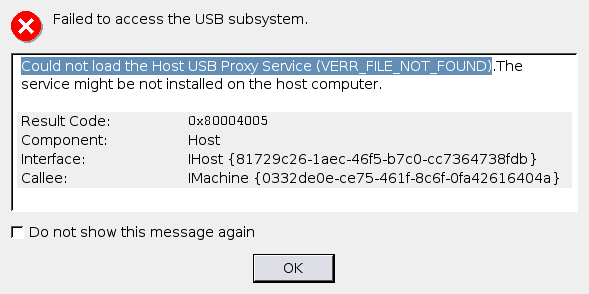
Running hot off the press 2.6.22-grml I took a look at the current version of VirtualBox. And I’m really amazed how responsive it is. Not only booting grml is rocking fast but also typing on the console is reaaaally fast - much more responsive than with VMware. (I took a look at VirtualBox several months ago already but the 64bit version did not work and I lost interest in it temporarly therefore.) Though I stumbled upon a small problem, that’s why I’m feeding google (several users don’t seem to manage the problem ;-)): Virtualbox - USB error message - screenshot of Could not load the Host USB Proxy Service (VERR_FILE_NOT_FOUND). The service might be not installed on the host computer. Result Code: 0x80004005 That’s telling you that USB might not work as expected. ;-) When straceing the process you’ll notice that VirtualBox tries to access /proc/bus/usb/devices. Nowadays /proc/bus/usb is deprecated by libusb + /dev/bus/usb but of course it’s no problem to use /proc/bus/usb anyway. So until upstream of VirtualBox moves to libusb the workaround is as simple as:
# VBOX=$(grep vboxusers /etc/group   sed 's/vboxusers:x:\(.*\):.*/\1/')
# mount -t usbfs -o devgid=$VBOX,devmode=664,nodev,noexec,nosuid none /proc/bus/usb

Romain Francoise: OKX

Via ateaseweb, OKX: A Tribute to OK Computer: an album of song-by-song covers of Radiohead's OK Computer. My Brightest Diamond (mentioned here a few weeks back) magnificently covers Lucky. Free download!

Stefano Zacchiroli: uploaders vs maintainers

More Uploaders, Less Maintainers: Infrastructure Issues When yet another discussion about "is collaborative maintenance good or not?" starts on debian- lists, the average lurker can easily identify two arguments / religions:
  1. it is good because duties are shared among co-maintainers
  2. it is bad because no one feels responsible for the co-maintained packages
Of the two religions, I stand for the first one. More generally I share the long term aim of decreasing as much as possible the "ownership" of Debian packages; collaborative maintenance is just a tool to achieve the goal. In the meantime, I believe the second religion is supported also by technical deficiencies in some pieces of our infrastructure. In particular some of our developer tools artificially enforce a distinction among Maintainers and Uploaders where it wouldn't be necessarily needed. In the last few days I thought about some of them: Think about such deficiencies, I'm pretty sure we can spot and fix easily a lot of them in our tools. Update: Lucas: I agree that the two arguments do not necessarily contradict, that's why I (initially) called them arguments. Then I moved to "religions", it was an oversimplification: there are of course pros and cons of collab maint. My main argument holds nevertheless: several perceived cons of collab maint are due to artificial distinctions maintainer/uploader in our tools, thanks for providing yet another example ... I want more! :)

Martin F. Krafft: Creating a git branch without ancestry

Robin Rosenberg introduced me to the simplest method of creating a new git branch without any ancestors:
$ echo ref: refs/heads/newbranch > .git/HEAD
$ git branch
  master
[...]
$ git commit -m 'creating newbranch'
$ git branch
  master
* newbranch
This comes in handy if you want to maintain two separate components without any common files in the same repository. I am using it currently while experimenting with a new method of storing my home directory in git, which is still far from anywhere. I shall report once I reach a point of success or failure. NP: Rush: Moving Pictures Update: Johannes Schindelin taught me how to do the same without touching files in .git/:
$ git symbolic-ref HEAD refs/heads/newbranch
[...]
and also addressed the issue which would have all files already committed to the "master" branch now appear in the git status output as staged. This is because the index contains the full copy of a revision of a file, as it would be if committed at any point. git status shows the differences between what has been committed, what would be committed, and what is available in the working tree. Since we pointed HEAD to nowhere ("newbranch" does not yet exist), the index and what has been committed (nothing in this case) diverge, the files are still staged, and thus are scheduled to be part of the impending commit. The way to fix this is to remove the index:
$ rm .git/index
This may seem weird, but it works, because git recreates the index whenever you switch branches:
piper:~> git init-db
Initialized empty Git repository in .git/
piper:~> echo 1 > a; git add a; git commit -m.
Created initial commit e774324: .
1 files changed, 1 insertions(+), 0 deletions(-)
create mode 100644 a
piper:~> git symbolic-ref HEAD refs/heads/newbranch
piper:~> rm .git/index
piper:~> git status
# On branch newbranch
#
# Initial commit
#
# Untracked files:
#   (use "git add <file>..." to include in what will be committed)
#
#       a
nothing added to commit but untracked files present (use "git add" to track)
piper:~> echo 2 > b; git add b; git commit -m.
Created initial commit 54ff342: .
1 files changed, 1 insertions(+), 0 deletions(-)
create mode 100644 b
piper:~> git branch
  master
* newbranch
piper:~> git checkout master
fatal: Untracked working tree file 'a' would be overwritten by merge.
piper:~> git checkout -f master
Switched to branch "master"
piper:~> git status
# On branch master
nothing to commit (working directory clean)
piper:~> ls
a
piper:~> git checkout newbranch
Switched to branch "newbranch"
piper:~> git status
# On branch newbranch
nothing to commit (working directory clean)
piper:~> ls
b
As you can see, the creation of the branch is a bit complex, but once you (forcefully) switched back to master, you can then freely switch between and commit to them.

Benjamin Mako Hill: Seeing Yellow

You may have heard some of the noise that EFF was making a year so ago about the tracking dots hidden in documents by color laser printers. A number of people contacted their printer manufacturers to ask how to turn the "feature" off. At least one person (who has, understandably I think, expressed interest in remaining anonymous) was subsequently visited by the United States Secret Service who asked him questions about why he wanted to turn off the tracking dots in his printer. I've put up a little website with some others in my research group at MIT that tries to organize individuals to call into their printer manufacturers and demand that the feature is turned off. If many people call, the government won't be able to visit us all. We've made a long list of technical support contacts to help with the process. Please call your printer manufacturer today and spread the word about the site so that more people call in. The site is called Seeing Yellow -- a reference to tiny yellow dots that make up the tracking code -- and its online at seeingyellow.com.

Russell Coker: Questions During Lectures

An issue that causes some discussion and debate is the number and type of questions that may be asked during a lecture. In a previous post giving advice for speakers I suggested that questions can be used as a mechanism for getting a talk back on track if a nervous speaker starts presenting the material too quickly (a common mistake). This mechanism can be used by the speaker if they realise that things aren’t going to plan or by audience members who are experienced speakers and who recognise a problem. Due to this a blanket ban on questions during a talk will only work with experienced speakers who have planned their talk well. There are different styles of presentation favoured by different speakers. Some are determined by the nature of the topic (an example that I have seen cited is topics that are very contentious which would lead to a debate if questions were permitted during the talk), but for computer science I think that questions during the talk can always work well. To a certain extent the fact that code either works or doesn’t limits the scope for debate. Probably the major factor that determines the utility of questions is the size of the audience. If you have an audience of less than 50 people then a conversational approach can work, if you have less than 200 people then a reasonable number of questions can be accepted. But as the audience size increases above 300 the utility of questions approaches zero. If the majority of people who might want to ask questions are unable to do so due to lack of time then the value of allowing any questions diminishes. For the largest audiences there probably isn’t any point in having question time. Another major factor determining which style works best is where the speaker has had experience speaking. Most of my speaking experience is with less formal meetings (such as local LUGs) and in countries with an informal attitude towards such things (Australia, the US, and The Netherlands). A speaker who has primarily spoken for universities such as Cambridge or Oxford (which seem to have a very formal style and questions strictly reserved for the end) or who has come from a country such as Japan(*) where it’s reported that the audience are obliged to show respect for the speaker by being quiet will probably expect questions only at the end and may flatly reject questions during the talk. A speaker who has a background speaking for less formal audiences will expect a certain number of questions during the course of the talk and may plan the timing of their talk with this in mind. When I plan a talk for a one hour slot I plan at most 30 minutes of scheduled talking (IE covering my notes) expecting that there will be 15 minutes of questions along the way and another 15 minutes of questions at the end. Often with such plans my talks run over-time. Of course this means that people who have mostly had experience speaking to smaller and less formal audiences will find it exceedingly difficult to give talks to larger audiences. This may be an incentive for having more formal arrangements for LUG talks to increase the skills of speakers. The next issue is what level of contentious questions is acceptable. I believe that if you have a disagreement with points that the speaker is making (and have some experience in the field in question) and the audience is not particularly large then one hostile question is acceptable - as a speaker it’s reasonable to refuse to take any further questions from an audience member who has asked one hostile question. Another category of question is the challenging question (not to be confused with a hostile question), for example describing in one sentence what your business requirements are and asking how the topic being discussed will apply to that business requirement. One of the most useful questions I have been asked during a SE Linux talk was concerning the issue of backups of file security contexts, it was presented in a challenging way and the answer that I gave was not nearly as good as I could give now (the code base has improved over the last few years in this regard) - but I think that everyone learned something so that validated the question. In smaller groups there may be some heckling when the speaker is a well known member of the group, I don’t think that this is a problem either as long as it only consumes a tiny fraction of the time (maybe 20-30 seconds at the start). For larger audiences or for speakers who don’t know the audience well heckling is generally a bad idea. (*) When speaking in Japan I had a lot of audience interaction. I’m not sure if this is an indication of the Japanese culture changing in this regard, the fact that translation problems forced some interaction, or the audience was showing respect for the Australian culture by asking questions.

Jeff Bailey: How many O's?


img_8498.jpg
Originally uploaded by jbailey
Well, I've hinted at it and told enough friends, I should get around to posting it: As of the end of this month, I'll be moving on from Canonical. By my calculations, I was something around employee #30, the first support tech, and I've had a great chance to build the support organisation up to where Linux Format magazine rated us as tied with RedHat ahead of Novell in this August's issue.

So what's up?

Well, those of you following along might remember a cute little bundle of joy entering my life. A couple of months in, I've realised that I can't stay on top of being with him and growing a 7x24 operation at this critical time in Canonical's growth. I'll be taking the month of August to be with Angie and Leif, and in September will start a new job with Google in the Open Source Program Office. I don't know the details of what I'll be doing there (The Google Omert , as one friend called it... *g*), but Google as a company is well aware of what happens with brand-new parents and the mad readjustment of priorities.

Angie and I are currently selling our place in Montr al in prep for moving to San Francisco at the end of August. I want to make sure I see people before we go, and if you're interested in buying the place, give us a call. =) Also, if you're in the Bay Area, a vegan, a parent, into Yoga/fitness, speaking French, etc., we'd love to meet you for tea sometime!

Ross Burton: Pimlico and Maemo Synergy Overdrive!

We've had Dates on Maemo for a long time now, but now and again people asked for Contacts. We never really bothered to build Contacts because it isn't ported to Maemo, so doesn't fit in to the environment. Well, yesterday I found myself with a clean Maemo 3.2 Scratchbox (quite unusual I assure you) so thought I'd build a package anyway. It's not integrated into Maemo, but it's in our repository now. Hopefully this will cause a fanbase of programmers to spontaneously appear who will help us develop the next generation of Contacts, which is modular and thus far easier to port to various platforms. Along with my recent Tasks on Maemo announcement, all of Pimlico is now available for Maemo. I'll have a N800 with the full suite on at GUADEC if anyone wants to see it. NP: This Too Shall Pass, Breakage

Eddy Petri&#537;or: More "RPM argh" or how to use %includes properly

It turns out that if you want to use includes in your .spec file and want the files to be included in the .src.rpm you have to declare those scripts as supplemental sources.

So instead of:
Name: foo
Version: x.y
Release: z
Summary: foo package
Group: Applications/System
Source: foo.tar.gz
Packager: Eddy Petrisor
BuildArch: noarch
BuildRoot: $RPM_BUILD_ROOT
....


You have to have:

Name: foo
Version: x.y
Release: z
Summary: foo package
Group: Applications/System
Source: foo.tar.gz
Source101: foo.pre.sh
Source102: foo.post.sh
Source103: foo.preun.sh
Source104: foo.postun.sh
Source105: foo.changelog
Packager: Eddy Petrisor
BuildArch: noarch
BuildRoot: $RPM_BUILD_ROOT
....

In case you want to have the scripts separated in different files and you use them all.

Note: the number in the "SourceXXX" is arbitrary but must be unique.

But mentioning the files as being Source... means you have to write:


%post
%include ../SOURCES/foo.post.sh

%preun
%include ../SOURCES/foo.preun.sh

%postun
%include ../SOURCES/foo.postun.sh


Instead of:


%post
%include foo.post.sh

%preun
%include foo.preun.sh

%postun
%include foo.postun.sh


Which should have been more reasonable...

RPM, please die... or grow some 21st century features... or some sense!!!


Update: Thanks to a few people, I was pointed out I am still not thinking in terms or RPM.
The proper way of writing the include without them looking odd is something like:

%post
%include % SOURCE102

Eddy Petri&#537;or: R U a programmer or a hax0r?

I have a few questions:
If you are programmer you will know what you should have answered...

Update: this post was tagged as "rant" and the rant was about a badly written and too rigid code; this was not about trying to tell the future and implementing now what you might need later

Mart&iacute;n Ferrari: Introducing Pancut n / GSoC status update

Hi, as everybody else, I'm blogging about the status of my GSoC project, which now has a name: Pancut n. Pancut n is a lintian-like tool to check ISO images generated by debian-cd and friends. It aims to support CDDs, and even Debian-Live CDs. In case you're wondering, the name is a stupid pun about avoiding (skin) burns and unusable debian CDs (Pancut n is a vintage lotion for burns in Argentina, and I think most joungsters won't even recognise the name). In any case, it sounds good :-). Since it has a name, also it has a alioth project page, SVN repository and mailing list. If you want to try it out, just checkout the repository and run:
$ ./pancutan <list of iso files> If you set the environment variable DEBUG to a number greater than zero, you get debugging info. Its dependencies are currently libyaml-perl (or libyaml-syck-perl for faster operation), fuseiso9660 and an user which fuse permissions. Of course, as I've been working in the architecture, there aren't many tests. But you can try the powerpc business card ISO for which pancutan currently detects that it's too big for a business card cd:
$ ./pancutan /media/IOMega/mirror/isos/debian-40r0-powerpc-businesscard.iso
E: image-too-big
 - The ISO file is too big for the target media
 + 73207808
About the architecture. The general idea is that a directory is scanned for modules, "requires" them, and extracts metadata embedded into them (I'm still thinking that this can be separated to delay compiling of modules when they're needed, but I haven't decided it yet). From that metadata, tasks and tags (errors and warnings) definitions are loaded. Also a lot of internal sanity checking is performed. There isn't any fixed order of execution, it's constructed based on the dependencies the tasks define. And it has been thought from the start with parallelisation in mind, although that functionality hasn't been written yet (I'll do it during this week). I have written a draft spec for the plug-ins in the wiki. I have to properly document that, but you can get an idea from it. At this point, I'd like to other, more experienced people take a look at it. So feedback is very welcomed, specially from the people that will use the tool!

MJ Ray: North Somerset Rubbish Targets

One of my examples to explain "the tragedy of targets" used to be councils meeting recycling collection targets by collecting the recyclable waste, then putting it in landfill because that was cheaper than actually recycling it. That's bad because it makes a lot of extra work for everyone, but only meets the collection target in fact, not in spirit. I stopped using that example because I thought it was too incredible and I didn't have a good reference to support it. So imagine my surprise to see a report in the Weston Mercury saying:
"If Veolia does not have enough manpower it will send out a green waste lorry, or a domestic refuse lorry which usually picks up black bag rubbish, to pick up both at the same time. [...] The staff will just take it for granted that green waste is in the green lorries and domestic waste is in the blue lorries."
This is bad on many levels, even worse than my old example where recycling-ready waste was knowingly tipped into landfill. There's green waste contamination and false collection statistics, for starters. The article continues to report that Cllr Carl Francis-Pester, North Somerset Council's executive member for environment, said:
"We are carrying out an immediate investigation into these allegations which we take very seriously indeed. This investigation will include urgent discussions with the contractor to ensure they are fulfilling the contract we have with them in the correct manner."
There doesn't seem to be any information about this investigation on North Somerset Council's web site. And if Veolia have spotted a loop-hole in the contract, then what? Even if they haven't, the council has to watch solely-profit-led contractors like hawks because if you give them a chance to cut costs (and therefore increase profits), they will try it. That is the hidden cost of outsourcing, not covered by the Best Value Indicators and other privatised council jargon. Incredibly, the councillor continues with:
"Thanks to the residents of North Somerset we have increased our recycling rate from 20.5 per cent to 30.8 per cent in the last 12 months."
If the allegations are true, then no, we haven't, because the statistics would be as full of toxic rubbish as the green waste lorries. Have private rubbish collectors been doing this elsewhere?

Miriam Ruiz: SnowballZ - a fun RTS strategy game featuring snowball fights with penguins

What about a reat time strategy game, kinda Command and Conquer, with penguins as the main characters, surrounded by the polar freeze, and throwing mercilessly snowballs against each other? That’s what SnowballZ is about: march through snow laden forests to conquer new frontiers and grow your small army. Ambush enemy lines with blasts of freezing snowballs. Of course, don’t forget to feed your troops with fresh fish, or warm them up in a nice igloo, if you expect them to grant you a good victory. And don’t neglect your home, invaders are just over the next snow drift! The packages are already in Debian SID, so there’s no excuse for not trying it, just get ready for the next snowfall!

Andreas Barth: Top testing migration blockers

During the recent weeks, we started to hunt and hint large batches of packages together to testing (and this blog is just to show a bit of what is part of the tasks of release team members). This started with a large jasper hint, continued with a very large poppler / texlive / jack / abiword-hint (which moved about 75% of the packages that were ready for testing migration in at the same time), then moved a more recent linux-2.6 version in, and now finally ghc6 / haskell. However, now we reached a point where a few more release teamisch hints don't help anymore: The next large blocker is gcj-4.1 / gccdefaults / ecj. This is now blocked by different bugs on different architecture: Update: Aurelien Jarno informed me that gcj-4.1 had to be bootstrapped on all architectures, but it hasn't happened yet on arm due to bugs in gcj.

Andrew Pollock: [opinion] Wal-Mart: The High Cost of Low Price

We finished watching Wal-Mart: The High Cost of Low Price last night, and, well, this user comment pretty much summed it up. It was a fairly poorly presented, heavily one-sided piece of "documentary" work. A lot of their claims we're really backed up with anything. I've no doubt that Wal-Mart is an evil mega-corporation, and we didn't really shop there much before, and we'll certainly never shop there again, but I would have preferred to have a seen a more balanced, better presented piece than what this had to offer. There were a lot of "Mom and Pop" businesses going "wah wah, Wal-Mart stole my lunch", and frankly, that's capitalism for you, sorry. I can appreciate that the "Mom and Pop" businesses may have provided better conditions for their employees, but that didn't seem to be the focus of those stories, just that various governments provided subsidies for Wal-Mart to come in, and all of the local small businesses had to shut up shop as a result. At no point was there any discussion about sales-tax benefits to the cities that provided incentives for Wal-Mart to move in. So yeah, the movie was an eye opener, even when taken with a large salt-shaker, but it could have been done a lot better. The user comments on IMDb are quite interesting in and of themselves.

Andrew Pollock: [tech] The trials and tribulations of trying to be compliant

Just because I'm a geek, I try to keep my blog standards-compliant. I've managed to keep the HTML compliant for some time now, and tonight I figured out how to embed Google Video the right way (rather than using the "HTML" that it provides) thanks to Flash Satay. So after I managed to maintain HTML compliance and have an embedded video, I thought I'd have another look at RSS feed compliance, because I've noticed that my feeble attempts at embedding video don't seem to make it into the various Planets that aggregate my blog. I cannot, for the life of me, figure out how to placate the Feed Validator with my blog's RSS feed. It seems to get bitter and twisted about embedded HTML, no matter how hard I try to escape the HTML. I've no idea if that's got anything to do with why my embedded videos won't show up on the Planets, but it's as far as I've been able to get with compliant RSS feeds...

Andrew Pollock: [life] Sarah made the news

Last night NBC11 was running a story and an email poll about the impending new legislation requiring that all cats and dogs over 6 months of age be spayed or neutered. Anyway, the legislation seems (surprisingly, in my opinion) divisive within the community. Since Sarah has done a lot of volunteer work at the Palo Alto Animal Services animal shelter in the past, as well as doing a bit of feral cat trap/neuter/release work, she's strongly in favour of the legislation as it'll help reduce the number of unwanted kittens and puppies that get dumped at shelters (or just dumped) every year. Unfortunately, plenty of pet owners seem to feel some need to not have their pet spayed or neutered, even if they have no intention of using the animal to breed, and these people have been kicking up a fair bit of fuss. So, as I was saying, NBC11 ran an email opinion poll, and Sarah wrote in a fairly informed piece about why she felt the way she did, and got an email back this morning for a reporter wanting to interview her, and that happened today. It's funny, Sarah was saying on the way home from work, that in hindsight one of her answers was pretty lame, and sure enough, the one sound bite they decided to use was that one... Oh well, she's had her 30 seconds of fame.

Next.

Previous.