Search Results: "ina"

21 November 2020

Michael Stapelberg: Winding down my Debian involvement

This post is hard to write, both in the emotional sense but also in the I would have written a shorter letter, but I didn t have the time sense. Hence, please assume the best of intentions when reading it it is not my intention to make anyone feel bad about their contributions, but rather to provide some insight into why my frustration level ultimately exceeded the threshold. Debian has been in my life for well over 10 years at this point. A few weeks ago, I have visited some old friends at the Z rich Debian meetup after a multi-year period of absence. On my bike ride home, it occurred to me that the topics of our discussions had remarkable overlap with my last visit. We had a discussion about the merits of systemd, which took a detour to respect in open source communities, returned to processes in Debian and eventually culminated in democracies and their theoretical/practical failings. Admittedly, that last one might be a Swiss thing. I say this not to knock on the Debian meetup, but because it prompted me to reflect on what feelings Debian is invoking lately and whether it s still a good fit for me. So I m finally making a decision that I should have made a long time ago: I am winding down my involvement in Debian to a minimum.

What does this mean? Over the coming weeks, I will:
  • transition packages to be team-maintained where it makes sense
  • remove myself from the Uploaders field on packages with other maintainers
  • orphan packages where I am the sole maintainer
I will try to keep up best-effort maintenance of the manpages.debian.org service and the codesearch.debian.net service, but any help would be much appreciated. For all intents and purposes, please treat me as permanently on vacation. I will try to be around for administrative issues (e.g. permission transfers) and questions addressed directly to me, permitted they are easy enough to answer.

Why? When I joined Debian, I was still studying, i.e. I had luxurious amounts of spare time. Now, over 5 years of full time work later, my day job taught me a lot, both about what works in large software engineering projects and how I personally like my computer systems. I am very conscious of how I spend the little spare time that I have these days. The following sections each deal with what I consider a major pain point, in no particular order. Some of them influence each other for example, if changes worked better, we could have a chance at transitioning packages to be more easily machine readable.

Change process in Debian The last few years, my current team at work conducted various smaller and larger refactorings across the entire code base (touching thousands of projects), so we have learnt a lot of valuable lessons about how to effectively do these changes. It irks me that Debian works almost the opposite way in every regard. I appreciate that every organization is different, but I think a lot of my points do actually apply to Debian. In Debian, packages are nudged in the right direction by a document called the Debian Policy, or its programmatic embodiment, lintian. While it is great to have a lint tool (for quick, local/offline feedback), it is even better to not require a lint tool at all. The team conducting the change (e.g. the C++ team introduces a new hardening flag for all packages) should be able to do their work transparent to me. Instead, currently, all packages become lint-unclean, all maintainers need to read up on what the new thing is, how it might break, whether/how it affects them, manually run some tests, and finally decide to opt in. This causes a lot of overhead and manually executed mechanical changes across packages. Notably, the cost of each change is distributed onto the package maintainers in the Debian model. At work, we have found that the opposite works better: if the team behind the change is put in power to do the change for as many users as possible, they can be significantly more efficient at it, which reduces the total cost and time a lot. Of course, exceptions (e.g. a large project abusing a language feature) should still be taken care of by the respective owners, but the important bit is that the default should be the other way around. Debian is lacking tooling for large changes: it is hard to programmatically deal with packages and repositories (see the section below). The closest to sending out a change for review is to open a bug report with an attached patch. I thought the workflow for accepting a change from a bug report was too complicated and started mergebot, but only Guido ever signaled interest in the project. Culturally, reviews and reactions are slow. There are no deadlines. I literally sometimes get emails notifying me that a patch I sent out a few years ago (!!) is now merged. This turns projects from a small number of weeks into many years, which is a huge demotivator for me. Interestingly enough, you can see artifacts of the slow online activity manifest itself in the offline culture as well: I don t want to be discussing systemd s merits 10 years after I first heard about it. Lastly, changes can easily be slowed down significantly by holdouts who refuse to collaborate. My canonical example for this is rsync, whose maintainer refused my patches to make the package use debhelper purely out of personal preference. Granting so much personal freedom to individual maintainers prevents us as a project from raising the abstraction level for building Debian packages, which in turn makes tooling harder. How would things look like in a better world?
  1. As a project, we should strive towards more unification. Uniformity still does not rule out experimentation, it just changes the trade-off from easier experimentation and harder automation to harder experimentation and easier automation.
  2. Our culture needs to shift from this package is my domain, how dare you touch it to a shared sense of ownership, where anyone in the project can easily contribute (reviewed) changes without necessarily even involving individual maintainers.
To learn more about how successful large changes can look like, I recommend my colleague Hyrum Wright s talk Large-Scale Changes at Google: Lessons Learned From 5 Yrs of Mass Migrations .

Fragmented workflow and infrastructure Debian generally seems to prefer decentralized approaches over centralized ones. For example, individual packages are maintained in separate repositories (as opposed to in one repository), each repository can use any SCM (git and svn are common ones) or no SCM at all, and each repository can be hosted on a different site. Of course, what you do in such a repository also varies subtly from team to team, and even within teams. In practice, non-standard hosting options are used rarely enough to not justify their cost, but frequently enough to be a huge pain when trying to automate changes to packages. Instead of using GitLab s API to create a merge request, you have to design an entirely different, more complex system, which deals with intermittently (or permanently!) unreachable repositories and abstracts away differences in patch delivery (bug reports, merge requests, pull requests, email, ). Wildly diverging workflows is not just a temporary problem either. I participated in long discussions about different git workflows during DebConf 13, and gather that there were similar discussions in the meantime. Personally, I cannot keep enough details of the different workflows in my head. Every time I touch a package that works differently than mine, it frustrates me immensely to re-learn aspects of my day-to-day. After noticing workflow fragmentation in the Go packaging team (which I started), I tried fixing this with the workflow changes proposal, but did not succeed in implementing it. The lack of effective automation and slow pace of changes in the surrounding tooling despite my willingness to contribute time and energy killed any motivation I had.

Old infrastructure: package uploads When you want to make a package available in Debian, you upload GPG-signed files via anonymous FTP. There are several batch jobs (the queue daemon, unchecked, dinstall, possibly others) which run on fixed schedules (e.g. dinstall runs at 01:52 UTC, 07:52 UTC, 13:52 UTC and 19:52 UTC). Depending on timing, I estimated that you might wait for over 7 hours (!!) before your package is actually installable. What s worse for me is that feedback to your upload is asynchronous. I like to do one thing, be done with it, move to the next thing. The current setup requires a many-minute wait and costly task switch for no good technical reason. You might think a few minutes aren t a big deal, but when all the time I can spend on Debian per day is measured in minutes, this makes a huge difference in perceived productivity and fun. The last communication I can find about speeding up this process is ganneff s post from 2008. How would things look like in a better world?
  1. Anonymous FTP would be replaced by a web service which ingests my package and returns an authoritative accept or reject decision in its response.
  2. For accepted packages, there would be a status page displaying the build status and when the package will be available via the mirror network.
  3. Packages should be available within a few minutes after the build completed.

Old infrastructure: bug tracker I dread interacting with the Debian bug tracker. debbugs is a piece of software (from 1994) which is only used by Debian and the GNU project these days. Debbugs processes emails, which is to say it is asynchronous and cumbersome to deal with. Despite running on the fastest machines we have available in Debian (or so I was told when the subject last came up), its web interface loads very slowly. Notably, the web interface at bugs.debian.org is read-only. Setting up a working email setup for reportbug(1) or manually dealing with attachments is a rather big hurdle. For reasons I don t understand, every interaction with debbugs results in many different email threads. Aside from the technical implementation, I also can never remember the different ways that Debian uses pseudo-packages for bugs and processes. I need them rarely enough to establish a mental model of how they are set up, or working memory of how they are used, but frequently enough to be annoyed by this. How would things look like in a better world?
  1. Debian would switch from a custom bug tracker to a (any) well-established one.
  2. Debian would offer automation around processes. It is great to have a paper-trail and artifacts of the process in the form of a bug report, but the primary interface should be more convenient (e.g. a web form).

Old infrastructure: mailing list archives It baffles me that in 2019, we still don t have a conveniently browsable threaded archive of mailing list discussions. Email and threading is more widely used in Debian than anywhere else, so this is somewhat ironic. Gmane used to paper over this issue, but Gmane s availability over the last few years has been spotty, to say the least (it is down as I write this). I tried to contribute a threaded list archive, but our listmasters didn t seem to care or want to support the project.

Debian is hard to machine-read While it is obviously possible to deal with Debian packages programmatically, the experience is far from pleasant. Everything seems slow and cumbersome. I have picked just 3 quick examples to illustrate my point. debiman needs help from piuparts in analyzing the alternatives mechanism of each package to display the manpages of e.g. psql(1). This is because maintainer scripts modify the alternatives database by calling shell scripts. Without actually installing a package, you cannot know which changes it does to the alternatives database. pk4 needs to maintain its own cache to look up package metadata based on the package name. Other tools parse the apt database from scratch on every invocation. A proper database format, or at least a binary interchange format, would go a long way. Debian Code Search wants to ingest new packages as quickly as possible. There used to be a fedmsg instance for Debian, but it no longer seems to exist. It is unclear where to get notifications from for new packages, and where best to fetch those packages.

Complicated build stack See my Debian package build tools post. It really bugs me that the sprawl of tools is not seen as a problem by others.

Developer experience pretty painful Most of the points discussed so far deal with the experience in developing Debian, but as I recently described in my post Debugging experience in Debian , the experience when developing using Debian leaves a lot to be desired, too.

I have more ideas At this point, the article is getting pretty long, and hopefully you got a rough idea of my motivation. While I described a number of specific shortcomings above, the final nail in the coffin is actually the lack of a positive outlook. I have more ideas that seem really compelling to me, but, based on how my previous projects have been going, I don t think I can make any of these ideas happen within the Debian project. I intend to publish a few more posts about specific ideas for improving operating systems here. Stay tuned. Lastly, I hope this post inspires someone, ideally a group of people, to improve the developer experience within Debian.

19 November 2020

Daniel Silverstone: Withdrawing Gitano from support

Unfortunately, in Debian in particular, libgit2 is undergoing a transition which is blocked by gall. Despite having had over a month to deal with this, I've not managed to summon the tuits to update Gall to the new libgit2 which means, nominally, I ought to withdraw it from testing and possibly even from unstable given that I'm not really prepared to look after Gitano and friends in Debian any longer. However, I'd love for Gitano to remain in Debian if it's useful to people. Gall isn't exactly a large piece of C code, and so probably won't be a huge job to do the port, I simply don't have the desire/energy to do it myself. If someone wanted to do the work and provide a patch / "pull request" to me, then I'd happily take on the change and upload a new package, or if someone wanted to NMU the gall package in Debian I'll take the change they make and import it into upstream. I just don't have the energy to reload all that context and do the change myself. If you want to do this, email me and let me know, so I can support you and take on the change when it's done. Otherwise I probably will go down the lines of requesting Gitano's removal from Debian in the next week or so.

17 November 2020

Raphaël Hertzog: Freexian s report about Debian Long Term Support, October 2020

A Debian LTS logo Like each month, here comes a report about the work of paid contributors to Debian LTS. Individual reports In October, 221.50 work hours have been dispatched among 13 paid contributors. Their reports are available: Evolution of the situation October was a regular LTS month with a LTS team meeting done via video chat thus there s no log to be shared. After more than five years of contributing to LTS (and ELTS), Mike Gabriel announced that he founded a new company called Frei(e) Software GmbH and thus would leave us to concentrate on this new endeavor. Best of luck with that, Mike! So, once again, this is a good moment to remind that we are constantly looking for new contributors. Please contact Holger if you are interested! The security tracker currently lists 42 packages with a known CVE and the dla-needed.txt file has 39 packages needing an update. Thanks to our sponsors Sponsors that joined recently are in bold.

No comment Liked this article? Click here. My blog is Flattr-enabled.

Louis-Philippe V ronneau: A better git diff

A few days ago I wrote a quick patch and missed a dumb mistake that made the program crash. When reviewing the merge request on Salsa, the problem became immediately apparent; Gitlab's diff is much better than what git diff shows by default in a terminal. Well, it turns out since version 2.9, git bundles a better pager, diff-highlight. la Gitlab, it will highlight what changed in the line. The output of git diff using diff-highlight Sadly, even though diff-highlight comes with the git package in Debian, it is not built by default (925288). You will need to:
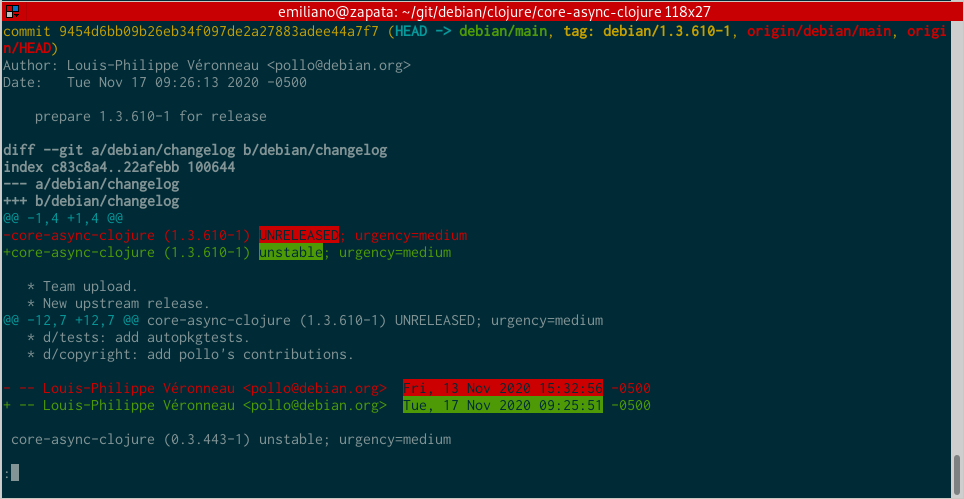
$ sudo make --directory /usr/share/doc/git/contrib/diff-highlight
You can then add this line to your .gitconfig file:
[core]
  pager = /usr/share/doc/git/contrib/diff-highlight/diff-highlight   less --tabs=4 -RFX
If you use tig, you'll also need to add this line in your tigrc:
set diff-highlight = /usr/share/doc/git/contrib/diff-highlight/diff-highlight

Dirk Eddelbuettel: RcppArmadillo 0.10.1.2.0

armadillo image Armadillo is a powerful and expressive C++ template library for linear algebra aiming towards a good balance between speed and ease of use with a syntax deliberately close to a Matlab. RcppArmadillo integrates this library with the R environment and language and is widely used by (currently) 779 other packages on CRAN. This release ties up a few loose ends from the recent 0.10.1.0.0.

Changes in RcppArmadillo version 0.10.1.2.0 (2020-11-15)
  • Upgraded to Armadillo release 10.1.2 (Orchid Ambush)
  • Remove three unused int constants (#313)
  • Include main armadillo header using quotes instead of brackets
  • Rewrite version number use in old-school mode because gcc 4.8.5
  • Skipping parts of sparse conversion on Windows as win-builder fails

Courtesy of my CRANberries, there is a diffstat report relative to previous release. More detailed information is on the RcppArmadillo page. Questions, comments etc should go to the rcpp-devel mailing list off the R-Forge page. If you like this or other open-source work I do, you can now sponsor me at GitHub. For the first year, GitHub will match your contributions.

This post by Dirk Eddelbuettel originated on his Thinking inside the box blog. Please report excessive re-aggregation in third-party for-profit settings.

Dirk Eddelbuettel: RcppAnnoy 0.0.17

annoy image A new release 0.0.17 of RcppAnnoy is now on CRAN. RcppAnnoy is the Rcpp-based R integration of the nifty Annoy library by Erik Bernhardsson. Annoy is a small and lightweight C++ template header library for very fast approximate nearest neighbours originally developed to drive the famous Spotify music discovery algorithm. This release brings a new upstream version 1.17, released a few weeks ago, which adds multithreaded index building. This changes the API by adding a new threading policy parameter requiring code using the main Annoy header to update. For this reason we waited a little for the dust to settle on the BioConductor 3.12 release before bringing the changes to BiocNeighbors via this commit and to uwot via this simple PR. Aaron and James updated their packages accordingly so by the time I uploaded RcppAnnoy it made for very smooth sailing as we all had done our homework with proper conditional builds, and the package had no other issue preventing automated processing at CRAN. Yay. I also added a (somewhat overdue one may argue) header file RcppAnnoy.h regrouping defines and includes which should help going forward. Detailed changes follow below.

Changes in version 0.0.17 (2020-11-15)
  • Upgrade to Annoy 1.17, but default to serial use.
  • Add new header file to regroup includes and defines.
  • Upgrade CI script to use R with bspm on focal.

Courtesy of my CRANberries, there is also a diffstat report for this release. If you like this or other open-source work I do, you can now sponsor me at GitHub. For the first year, GitHub will match your contributions.

This post by Dirk Eddelbuettel originated on his Thinking inside the box blog. Please report excessive re-aggregation in third-party for-profit settings.

12 November 2020

Dirk Eddelbuettel: tidyCpp 0.0.2: More documentation and features

A first update of the still fairly new package tidyCpp is now on CRAN. The packages offers a C++ layer on top of the C API for R which aims to make its use a little easier and more consistent. The vignette has been extended with a new examples, a new section and some general editing. A few new defines have been added mostly from the Rinternals.h header. We also replaced the Shield class with a simpler yet updated version class Protect. The name better represent the core functionality of offering a simpler alternative to the PROTECT and UNPROTECT macro pairing. We also added a short discussion to the vignette of a gotcha one has to be mindful of, and that we fell for ourselves in version 0.0.1. We also added a typedef so that code using Shield can still be used. The NEWS entry follows.

Changes in tidyCpp version 0.0.2 (2020-11-12)
  • Expanded definitions in internals.h to support new example.
  • The vignette has been extended with an example based on package uchardet.
  • Class Shield has been replaced by an new class Protect; a compatibility typdef has been added.
  • The examples and vignette have been clarified with respect to proper ownership of protected objects; a new vignette section was added.

Thanks to my CRANberries, there is also a diffstat report for this release. For questions, suggestions, or issues please use the issue tracker at the GitHub repo. If you like this or other open-source work I do, you can now sponsor me at GitHub. For the first year, GitHub will match your contributions.

This post by Dirk Eddelbuettel originated on his Thinking inside the box blog. Please report excessive re-aggregation in third-party for-profit settings.

11 November 2020

Vincent Fourmond: Solution for QSoas quiz #1: averaging spectra

This post describes the solution to the Quiz #1, based on the files found there. The point is to produce both the average and the standard deviation of a series of spectra. Below is how the final averaged spectra shoud look like:
I will present here two different solutions. Solution 1: using the definition of standard deviation There is a simple solution using the definition of the standard deviation: $$\sigma_y = \sqrt <y^2> - <y> ^2 $$ in which \(<y^2>\) is the average of \(y^2\) (and so on). So the simplest solution is to construct datasets with an additional column that would contain \(y^2\), average these columns, and replace the average with the above formula. For that, we need first a companion script that loads a single data file and adds a column with \(y^2\). Let's call this script load-one.cmds:
load $ 1 
apply-formula y2=y**2 /extra-columns=1
flag /flags=processed
When this script is run with the name of a spectrum file as argument, it loads it (replaces $ 1 by the first argument, the file name), adds a column y2 containing the square of the y column, and flag it with the processed flag. This is not absolutely necessary, but it makes it much easier to refer to all the spectra when they are processed. Then to process all the spectra, one just has to run the following commands:
run-for-each load-one.cmds Spectrum-1.dat Spectrum-2.dat Spectrum-3.dat
average flagged:processed
apply-formula y2=(y2-y**2)**0.5
dataset-options /yerrors=y2
The run-for-each command runs the load-one.cmds script for all the spectra (one could also have used Spectra-*.dat to not have to give all the file names). Then, the average averages the values of the columns over all the datasets. To be clear, it finds all the values that have the same X (or very close X values) and average them, column by column. The result of this command is therefore a dataset with the average of the original \(y\) data as y column and the average of the original \(y^2\) data as y2 column. So now, the only thing left to do is to use the above equation, which is done by the apply-formula code. The last command, dataset-options, is not absolutely necessary but it signals to QSoas that the standard error of the y column should be found in the y2 column. This is now available as script method-one.cmds in the git repository.

Solution 2: use QSoas's knowledge of standard deviation The other method is a little more involved but it demonstrates a good approach to problem solving with QSoas. The starting point is that, in apply-formula, the value $stats.y_stddev corresponds to the standard deviation of the whole y column... Loading the spectra yields just a series of x,y datasets. We can contract them into a single dataset with one x column and several y columns:
load Spectrum-*.dat /flags=spectra
contract flagged:spectra
After these commands, the current dataset contains data in the form of:
lambda1	a1_1	a1_2	a1_3
lambda2	a2_1	a2_2	a2_3
...
in which the ai_1 come from the first file, ai_2 the second and so on. We need to use transpose to transform that dataset into:
0	a1_1	a2_1	...
1	a1_2	a2_2	...
2	a1_3	a2_3	...
In this dataset, values of the absorbance for the same wavelength for each dataset is now stored in columns. The next step is just to use expand to obtain a series of datasets with the same x column and a single y column (each corresponding to a different wavelength in the original data). The game is now to replace these datasets with something that looks like:
0	a_average
1	a_stddev
For that, one takes advantage of the $stats.y_average and $stats.y_stddev values in apply-formula, together with the i special variable that represents the index of the point:
apply-formula "if i == 0; then y=$stats.y_average; end; if i == 1; then y=$stats.y_stddev; end"
strip-if i>1
Then, all that is left is to apply this to all the datasets created by expand, which can be just made using run-for-datasets, and then, we reverse the splitting by using contract and transpose ! In summary, this looks like this. We need two files. The first, process-one.cmds contains the following code:
apply-formula "if i == 0; then y=$stats.y_average; end; if i == 1; then y=$stats.y_stddev; end"
strip-if i>1
flag /flags=processed
The main file, method-two.cmds looks like this:
load Spectrum-*.dat /flags=spectra
contract flagged:spectra
transpose
expand /flags=tmp
run-for-datasets process-one.cmds flagged:tmp
contract flagged:processed
transpose
dataset-options /yerrors=y2
Note some of the code above can be greatly simplified using new features present in the upcoming 3.0 version, but that is the topic for another post. About QSoasQSoas is a powerful open source data analysis program that focuses on flexibility and powerful fitting capacities. It is released under the GNU General Public License. It is described in Fourmond, Anal. Chem., 2016, 88 (10), pp 5050 5052. Current version is 2.2. You can download its source code and compile it yourself or buy precompiled versions for MacOS and Windows there.

Reproducible Builds: Reproducible Builds in October 2020

Welcome to the October 2020 report from the Reproducible Builds project. In our monthly reports, we outline the major things that we have been up to over the past month. As a brief reminder, the motivation behind the Reproducible Builds effort is to ensure flaws have not been introduced in the binaries we install on our systems. If you are interested in contributing to the project, please visit our main website.

General On Saturday 10th October, Morten Linderud gave a talk at Arch Conf Online 2020 on The State of Reproducible Builds in Arch. The video should be available later this month, but as a teaser:
The previous year has seen great progress in Arch Linux to get reproducible builds in the hands of the users and developers. In this talk we will explore the current tooling that allows users to reproduce packages, the rebuilder software that has been written to check packages and the current issues in this space.
During the Reproducible Builds summit in Marrakesh in 2019, developers from the GNU Guix, NixOS and Debian distributions were able to produce a bit-for-bit identical GNU Mes binary despite using three different versions of GCC. Since this summit, additional work resulted in a bit-for-bit identical Mes binary using tcc, and last month a fuller update was posted to this effect by the individuals involved. This month, however, David Wheeler updated his extensive page on Fully Countering Trusting Trust through Diverse Double-Compiling, remarking that:
GNU Mes rebuild is definitely an application of [Diverse Double-Compiling]. [..] This is an awesome application of DDC, and I believe it s the first publicly acknowledged use of DDC on a binary
There was a small, followup discussion on our mailing list. In openSUSE, Bernhard M. Wiedemann published his monthly Reproducible Builds status update. This month, the Reproducible Builds project restarted our IRC meetings, managing to convene twice: the first time on October 12th (summary & logs), and later on the 26th (logs). As mentioned in previous reports, due to the unprecedented events throughout 2020, there will be no in-person summit event this year. On our mailing list this month El as Alejandro posted a request for help with a local configuration

Software development This month, we tried to fix a large number of currently-unreproducible packages, including: Bernhard M. Wiedemann also reported three issues against bison, ibus and postgresql12.

Tools diffoscope is our in-depth and content-aware diff utility. Not only could you locate and diagnose reproducibility issues, it provides human-readable diffs of all kinds too. This month, Chris Lamb uploaded version 161 to Debian (later backported by Mattia Rizzolo), as well as made the following changes:
  • Move test_ocaml to the assert_diff helper. [ ]
  • Update tests to support OCaml version 4.11.1. Thanks to Sebastian Ramacher for the report. (#972518)
  • Bump minimum version of the Black source code formatter to 20.8b1. (#972518)
In addition, Jean-Romain Garnier temporarily updated the dependency on radare2 to ensure our test pipelines continue to work [ ], and for the GNU Guix distribution Vagrant Cascadian diffoscope to version 161 [ ]. In related development, trydiffoscope is the web-based version of diffoscope. This month, Chris Lamb made the following changes:
  • Mark a --help-only test as being a superficial test. (#971506)
  • Add a real, albeit flaky, test that interacts with the try.diffoscope.org service. [ ]
  • Bump debhelper compatibility level to 13 [ ] and bump Standards-Version to 4.5.0 [ ].
Lastly, disorderfs version 0.5.10-2 was uploaded to Debian unstable by Holger Levsen, which enabled security hardening via DEB_BUILD_MAINT_OPTIONS [ ] and dropped debian/disorderfs.lintian-overrides [ ].

Website and documentation This month, a number of updates to the main Reproducible Builds website and related documentation were made by Chris Lamb:
  • Add a citation link to the academic article regarding dettrace [ ], and added yet another supply-chain security attack publication [ ].
  • Reformatted the Jekyll s Liquid templating language and CSS formatting to be consistent [ ] as well as expand a number of tab characters [ ].
  • Used relative_url to fix missing translation icon on various pages. [ ]
  • Published two announcement blog posts regarding the restarting of our IRC meetings. [ ][ ]
  • Added an explicit note regarding the lack of an in-person summit in 2020 to our events page. [ ]

Testing framework The Reproducible Builds project operates a Jenkins-based testing framework that powers tests.reproducible-builds.org. This month, Holger Levsen made the following changes:
  • Debian-related changes:
    • Refactor and improve the Debian dashboard. [ ][ ][ ]
    • Track bugs which are usertagged as filesystem , fixfilepath , etc.. [ ][ ][ ]
    • Make a number of changes to package index pages. [ ][ ][ ]
  • System health checks:
    • Relax disk space warning levels. [ ]
    • Specifically detect build failures reported by dpkg-buildpackage. [ ]
    • Fix a regular expression to detect outdated package sets. [ ]
    • Detect Lintian issues in diffoscope. [ ]
  • Misc:
    • Make a number of updates to reflect that our sponsor Profitbricks has renamed itself to IONOS. [ ][ ][ ][ ]
    • Run a F-Droid maintenance routine twice a month to utilise its cleanup features. [ ]
    • Fix the target name in OpenWrt builds to ath79 from ath97. [ ]
    • Add a missing Postfix configuration for a node. [ ]
    • Temporarily disable Arch Linux builds until a core node is back. [ ]
    • Make a number of changes to our thanks page. [ ][ ][ ]
Build node maintenance was performed by both Holger Levsen [ ][ ] and Vagrant Cascadian [ ][ ][ ], Vagrant Cascadian also updated the page listing the variations made when testing to reflect changes for in build paths [ ] and Hans-Christoph Steiner made a number of changes for F-Droid, the free software app repository for Android devices, including:
  • Do not fail reproducibility jobs when their cleanup tasks fail. [ ]
  • Skip libvirt-related sudo command if we are not actually running libvirt. [ ]
  • Use direct URLs in order to eliminate a useless HTTP redirect. [ ]

If you are interested in contributing to the Reproducible Builds project, please visit the Contribute page on our website. However, you can also get in touch with us via:

10 November 2020

Jonathan Dowland: Red Hat at the Turing Institute

In Summer 2019 Red Hat were invited to the Turing Institute to provide a workshop on issues around building and sustaining an Open Source community. I was part of a group of about 6 people to visit the Turing and deliver the workshop. It seemed to have been well received by the audience. The Turing Institute is based within the British Library. For many years I have enjoyed visiting the British Library if I was visiting or passing through London for some reason or other: it's such a lovely serene space in a busy, hectic part of London. On one occasion they had Jack Kerouac's manuscript for "On The Road" on display in one of the public gallery spaces: it's a continuous 120-foot long piece of paper that Kerouac assembled to prevent the interruption of changing sheets of paper in his typewriter from disturbing his flow whilst writing. The Institute itself is a really pleasant-looking working environment. I got a quick tour of it back in February 2019 when visiting a friend who worked there, but last year's visit was my first prolonged experience of working there. (I also snuck in this February, when passing through London, to visit my supervisor who is a Turing Fellow) I presented a section of a presentation entitled "How to build a successful Open Source community". My section attempted to focus on the "how". We've put out all the presentations under a Creative Commons license, and we've published them on the Red Hat Research website: https://research.redhat.com/blog/2020/08/12/open-source-at-the-turing/ The workshop participants were drawn from PhD students, research associates, research software engineers and Turing Institute fellows. We had some really great feedback from them which we've fed back into revisions of the workshop material including the presentations. I'm hoping to stay involve in further collaborations between the Turing and Red Hat. I'm pleased to say that we participated in a recent Tools, practices and systems seminar (although I was not involved).

9 November 2020

Joachim Breitner: Distributing Haskell programs in a multi-platform zip file

My maybe most impactful piece of code is tttool and the surrounding project, which allows you to create your own content for the Ravensburger Tiptoi platform. The program itself is a command line tool, and in this blog post I want to show how I go about building that program for Linux (both normal and static builds), Windows (cross-compiled from Linux), OSX (only on CI), all combined into and released as a single zip file. Maybe some of it is useful or inspiring to my readers, or can even serve as a template. This being a blob post, though, note that it may become obsolete or outdated.
Ingredients I am building on the these components: Without the nix build system and package manger I probably woudn t even attempt to pull of complex tasks that may, say, require a patched ghc. For many years I resisted learning about nix, but when I eventually had to, I didn t want to go back. This project provides an alternative Haskell build infrastructure for nix. While this is not crucial for tttool, it helps that they tend to have some cross-compilation-related patches more than the official nixpkgs. I also like that it more closely follows the cabal build work-flow, where cabal calculates a build plan based on your projects dependencies. It even has decent documentation (which is a new thing compared to two years ago). Niv is a neat little tool to keep track of your dependencies. You can quickly update them with, say niv update nixpkgs. But what s really great is to temporarily replace one of your dependencies with a local checkout, e.g. via NIV_OVERRIDE_haskellNix=$HOME/build/haskell/haskell.nix nix-instantiate -A osx-exe-bundle There is a Github action that will keep your niv-managed dependencies up-to-date. This service (proprietary, but free to public stuff up to 10GB) gives your project its own nix cache. This means that build artifacts can be cached between CI builds or even build steps, and your contributors. A cache like this is a must if you want to use nix in more interesting ways where you may end up using, say, a changed GHC compiler. Comes with GitHub actions integration.
  • CI via Github actions
Until recently, I was using Travis, but Github actions are just a tad easier to set up and, maybe more important here, the job times are high enough that you can rebuild GHC if you have to, and even if your build gets canceled or times out, cleanup CI steps still happen, so that any new nix build products will still reach your nix cache.

The repository setup All files discussed in the following are reflected at https://github.com/entropia/tip-toi-reveng/tree/7020cde7da103a5c33f1918f3bf59835cbc25b0c. We are starting with a fairly normal Haskell project, with a single .cabal file (but multi-package projects should work just fine). To make things more interesting, I also have a cabal.project which configures one dependency to be fetched via git from a specific fork. To start building the nix infrastructure, we can initialize niv and configure it to use the haskell.nix repo:
niv init
niv add input-output-hk/haskell.nix -n haskellNix
This creates nix/sources.json (which you can also edit by hand) and nix/sources.nix (which you can treat like a black box). Now we can start writing the all-important default.nix file, which defines almost everything of interest here. I will just go through it line by line, and explain what I am doing here.
  checkMaterialization ? false  :
This defines a flag that we can later set when using nix-build, by passing --arg checkMaterialization true, and which is off by default. I ll get to that flag later.
let
  sources = import nix/sources.nix;
  haskellNix = import sources.haskellNix  ;
This imports the sources as defined niv/sources.json, and loads the pinned revision of the haskell.nix repository.
  # windows crossbuilding with ghc-8.10 needs at least 20.09.
  # A peek at https://github.com/input-output-hk/haskell.nix/blob/master/ci.nix can help
  nixpkgsSrc = haskellNix.sources.nixpkgs-2009;
  nixpkgsArgs = haskellNix.nixpkgsArgs;
  pkgs = import nixpkgsSrc nixpkgsArgs;
Now we can define pkgs, which is our version of the nixpkgs package set, extended with the haskell.nix machinery. We rely on haskell.nix to pin of a suitable revision of the nixpkgs set (see how we are using their niv setup). Here we could our own configuration, overlays, etc to nixpkgsArgs. In fact, we do in
  pkgs-osx = import nixpkgsSrc (nixpkgsArgs //   system = "x86_64-darwin";  );
to get the nixpkgs package set of an OSX machine.
  # a nicer filterSource
  sourceByRegex =
    src: regexes: builtins.filterSource (path: type:
      let relPath = pkgs.lib.removePrefix (toString src + "/") (toString path); in
      let match = builtins.match (pkgs.lib.strings.concatStringsSep " " regexes); in
      ( type == "directory"  && match (relPath + "/") != null
        match relPath != null)) src;
Next I define a little helper that I have been copying between projects, and which allows me to define the input to a nix derivation (i.e. a nix build job) with a set of regexes. I ll use that soon.
  tttool-exe = pkgs: sha256:
    (pkgs.haskell-nix.cabalProject  
The cabalProject function takes a cabal project and turns it into a nix project, running cabal v2-configure under the hood to let cabal figure out a suitable build plan. Since we want to have multiple variants of the tttool, this is so far just a function of two arguments pkgs and sha256, which will be explained in a bit.
      src = sourceByRegex ./. [
          "cabal.project"
          "src/"
          "src/.*/"
          "src/.*.hs"
          ".*.cabal"
          "LICENSE"
        ];
The cabalProject function wants to know the source of the Haskell projects. There are different ways of specifying this; in this case I went for a simple whitelist approach. Note that cabal.project.freze (which exists in the directory) is not included.
      # Pinning the input to the constraint solver
      compiler-nix-name = "ghc8102";
The cabal solver doesn t find out which version of ghc to use, that is still my choice. I am using GHC-8.10.2 here. It may require a bit of experimentation to see which version works for your project, especially when cross-compiling to odd targets.
      index-state = "2020-11-08T00:00:00Z";
I want the build to be deterministic, and not let cabal suddenly pick different package versions just because something got uploaded. Therefore I specify which snapshot of the Hackage package index it should consider.
      plan-sha256 = sha256;
      inherit checkMaterialization;
Here we use the second parameter, but I ll defer the explanation for a bit.
      modules = [ 
        # smaller files
        packages.tttool.dontStrip = false;
       ] ++
These modules are essentially configuration data that is merged in a structural way. Here we say that we want the tttool binary to be stripped (saves a few megabyte).
      pkgs.lib.optional pkgs.hostPlatform.isMusl  
        packages.tttool.configureFlags = [ "--ghc-option=-static" ];
Also, when we are building on the musl platform, that s when we want to produce a static build, so let s pass -static to GHC. This seems to be enough in terms of flags to produce static binaries. It helps that my project is using mostly pure Haskell libraries; if you link against C libraries you might have to jump through additional hoops to get static linking going. The haskell.nix documentation has a section on static building with some flags to cargo-cult.
        # terminfo is disabled on musl by haskell.nix, but still the flag
        # is set in the package plan, so override this
        packages.haskeline.flags.terminfo = false;
       ;
This (again only used when the platform is musl) seems to be necessary to workaround what might be a big in haskell.nix.
     ).tttool.components.exes.tttool;
The cabalProject function returns a data structure with all Haskell packages of the project, and for each package the different components (libraries, tests, benchmarks and of course executables). We only care about the tttool executable, so let s project that out.
  osx-bundler = pkgs: tttool:
   pkgs.stdenv.mkDerivation  
      name = "tttool-bundle";
      buildInputs = [ pkgs.macdylibbundler ];
      builder = pkgs.writeScript "tttool-osx-bundler.sh" ''
        source $ pkgs.stdenv /setup
        mkdir -p $out/bin/osx
        cp $ tttool /bin/tttool $out/bin/osx
        chmod u+w $out/bin/osx/tttool
        dylibbundler \
          -b \
          -x $out/bin/osx/tttool \
          -d $out/bin/osx \
          -p '@executable_path' \
          -i /usr/lib/system \
          -i $ pkgs.darwin.Libsystem /lib
      '';
     ;
This function, only to be used on OSX, takes a fully build tttool, finds all the system libraries it is linking against, and copies them next to the executable, using the nice macdylibbundler. This way we can get a self-contained executable. A nix expert will notice that this probably should be written with pkgs.runCommandNoCC, but then dylibbundler fails because it lacks otool. This should work eventually, though.
in rec  
  linux-exe      = tttool-exe pkgs
     "0rnn4q0gx670nzb5zp7xpj7kmgqjmxcj2zjl9jqqz8czzlbgzmkh";
  windows-exe    = tttool-exe pkgs.pkgsCross.mingwW64
     "01js5rp6y29m7aif6bsb0qplkh2az0l15nkrrb6m3rz7jrrbcckh";
  static-exe     = tttool-exe pkgs.pkgsCross.musl64
     "0gbkyg8max4mhzzsm9yihsp8n73zw86m3pwvlw8170c75p3vbadv";
  osx-exe        = tttool-exe pkgs-osx
     "0rnn4q0gx670nzb5zp7xpj7kmgqjmxcj2zjl9jqqz8czzlbgzmkh";
Time to create the four versions of tttool. In each case we use the tttool-exe function from above, passing the package set (pkgs, ) and a SHA256 hash. The package set is either the normal one, or it is one of those configured for cross compilation, building either for Windows or for Linux using musl, or it is the OSX package set that we instantiated earlier. The SHA256 hash describes the result of the cabal plan calculation that happens as part of cabalProject. By noting down the expected result, nix can skip that calculation, or fetch it from the nix cache etc. How do we know what number to put there, and when to change it? That s when the --arg checkMaterialization true flag comes into play: When that is set, cabalProject will not blindly trust these hashes, but rather re-calculate them, and tell you when they need to be updated. We ll make sure that CI checks them.
  osx-exe-bundle = osx-bundler pkgs-osx osx-exe;
For OSX, I then run the output through osx-bundler defined above, to make it independent of any library paths in /nix/store. This is already good enough to build the tool for the various systems! The rest of the the file is related to packaging up the binaries, to tests, and various other things, but nothing too essentially. So if you got bored, you can more or less stop now.
  static-files = sourceByRegex ./. [
    "README.md"
    "Changelog.md"
    "oid-decoder.html"
    "example/.*"
    "Debug.yaml"
    "templates/"
    "templates/.*\.md"
    "templates/.*\.yaml"
    "Audio/"
    "Audio/digits/"
    "Audio/digits/.*\.ogg"
  ];
  contrib = ./contrib;
The final zip file that I want to serve to my users contains a bunch of files from throughout my repository; I collect them here.
  book =  ;
The project comes with documentation in the form of a Sphinx project, which we build here. I ll omit the details, because they are not relevant for this post (but of course you can peek if you are curious).
  os-switch = pkgs.writeScript "tttool-os-switch.sh" ''
    #!/usr/bin/env bash
    case "$OSTYPE" in
      linux*)   exec "$(dirname "''$ BASH_SOURCE[0] ")/linux/tttool" "$@" ;;
      darwin*)  exec "$(dirname "''$ BASH_SOURCE[0] ")/osx/tttool" "$@" ;;
      msys*)    exec "$(dirname "''$ BASH_SOURCE[0] ")/tttool.exe" "$@" ;;
      cygwin*)  exec "$(dirname "''$ BASH_SOURCE[0] ")/tttool.exe" "$@" ;;
      *)        echo "unsupported operating system $OSTYPE" ;;
    esac
  '';
The zipfile should provide a tttool command that works on all systems. To that end, I implement a simple platform switch using bash. I use pks.writeScript so that I can include that file directly in default.nix, but it would have been equally reasonable to just save it into nix/tttool-os-switch.sh and include it from there.
  release = pkgs.runCommandNoCC "tttool-release"  
    buildInputs = [ pkgs.perl ];
    ''
    # check version
    version=$($ static-exe /bin/tttool --help perl -ne 'print $1 if /tttool-(.*) -- The swiss army knife/')
    doc_version=$(perl -ne "print \$1 if /VERSION: '(.*)'/" $ book /book.html/_static/documentation_options.js)
    if [ "$version" != "$doc_version" ]
    then
      echo "Mismatch between tttool version \"$version\" and book version \"$doc_version\""
      exit 1
    fi
Now the derivation that builds the content of the release zip file. First I double check that the version number in the code and in the documentation matches. Note how $ static-exe refers to a path with the built static Linux build, and $ book the output of the book building process.
    mkdir -p $out/
    cp -vsr $ static-files /* $out
    mkdir $out/linux
    cp -vs $ static-exe /bin/tttool $out/linux
    cp -vs $ windows-exe /bin/* $out/
    mkdir $out/osx
    cp -vsr $ osx-exe-bundle /bin/osx/* $out/osx
    cp -vs $ os-switch  $out/tttool
    mkdir $out/contrib
    cp -vsr $ contrib /* $out/contrib/
    cp -vsr $ book /* $out
  '';
The rest of the release script just copies files from various build outputs that we have defined so far. Note that this is using both static-exe (built on Linux) and osx-exe-bundle (built on Mac)! This means you can only build the release if you either have setup a remote osx builder (a pretty nifty feature of nix, which I unfortunately can t use, since I don't have access to a Mac), or the build product must be available in a nix cache (which it is in my case, as I will explain later). The output of this derivation is a directory with all the files I want to put in the release.
  release-zip = pkgs.runCommandNoCC "tttool-release.zip"  
    buildInputs = with pkgs; [ perl zip ];
    ''
    version=$(bash $ release /tttool --help perl -ne 'print $1 if /tttool-(.*) -- The swiss army knife/')
    base="tttool-$version"
    echo "Zipping tttool version $version"
    mkdir -p $out/$base
    cd $out
    cp -r $ release /* $base/
    chmod u+w -R $base
    zip -r $base.zip $base
    rm -rf $base
  '';
And now these files are zipped up. Note that this automatically determines the right directory name and basename for the zipfile. This concludes the step necessary for a release.
  gme-downloads =  ;
  tests =  ;
These two definitions in default.nix are related to some simple testing, and again not relevant for this post.
  cabal-freeze = pkgs.stdenv.mkDerivation  
    name = "cabal-freeze";
    src = linux-exe.src;
    buildInputs = [ pkgs.cabal-install linux-exe.env ];
    buildPhase = ''
      mkdir .cabal
      touch .cabal/config
      rm cabal.project # so that cabal new-freeze does not try to use HPDF via git
      HOME=$PWD cabal new-freeze --offline --enable-tests   true
    '';
    installPhase = ''
      mkdir -p $out
      echo "-- Run nix-shell -A check-cabal-freeze to update this file" > $out/cabal.project.freeze
      cat cabal.project.freeze >> $out/cabal.project.freeze
    '';
   ;
Above I mentioned that I still would like to be able to just run cabal, and ideally it should take the same library versions that the nix-based build does. But pinning the version of ghc in cabal.project is not sufficient, I also need to pin the precise versions of the dependencies. This is best done with a cabal.project.freeze file. The above derivation runs cabal new-freeze in the environment set up by haskell.nix and grabs the resulting cabal.project.freeze. With this I can run nix-build -A cabal-freeze and fetch the file from result/cabal.project.freeze and add it to the repository.
  check-cabal-freeze = pkgs.runCommandNoCC "check-cabal-freeze"  
      nativeBuildInputs = [ pkgs.diffutils ];
      expected = cabal-freeze + /cabal.project.freeze;
      actual = ./cabal.project.freeze;
      cmd = "nix-shell -A check-cabal-freeze";
      shellHook = ''
        dest=$ toString ./cabal.project.freeze 
        rm -f $dest
        cp -v $expected $dest
        chmod u-w $dest
        exit 0
      '';
      ''
      diff -r -U 3 $actual $expected  
          echo "To update, please run"; echo "nix-shell -A check-cabal-freeze"; exit 1;  
      touch $out
    '';
But generated files in repositories are bad, so if that cannot be avoided, at least I want a CI job that checks if they are up to date. This job does that. What s more, it is set up so that if I run nix-shell -A check-cabal-freeze it will update the file in the repository automatically, which is much more convenient than manually copying. Lately, I have been using this pattern regularly when adding generated files to a repository: * Create one nix derivation that creates the files * Create a second derivation that compares the output of that derivation against the file in the repo * Create a derivation that, when run in nix-shell, updates that file. Sometimes that derivation is its own file (so that I can just run nix-shell nix/generate.nix), or it is merged into one of the other two. This concludes the tour of default.nix.

The CI setup The next interesting bit is the file .github/workflows/build.yml, which tells Github Actions what to do:
name: "Build and package"
on:
  pull_request:
  push:
Standard prelude: Run the jobs in this file upon all pushes to the repository, and also on all pull requests. Annoying downside: If you open a PR within your repository, everything gets built twice. Oh well.
jobs:
  build:
    strategy:
      fail-fast: false
      matrix:
        include:
        - target: linux-exe
          os: ubuntu-latest
        - target: windows-exe
          os: ubuntu-latest
        - target: static-exe
          os: ubuntu-latest
        - target: osx-exe-bundle
          os: macos-latest
    runs-on: $  matrix.os  
The build job is a matrix job, i.e. there are four variants, one for each of the different tttool builds, together with an indication of what kind of machine to run this on.
    - uses: actions/checkout@v2
    - uses: cachix/install-nix-action@v12
We begin by checking out the code and installing nix via the install-nix-action.
    - name: "Cachix: tttool"
      uses: cachix/cachix-action@v7
      with:
        name: tttool
        signingKey: '$  secrets.CACHIX_SIGNING_KEY  '
Then we configure our Cachix cache. This means that this job will use build products from the cache if possible, and it will also push new builds to the cache. This requires a secret key, which you get when setting up your Cachix cache. See the nix and Cachix tutorial for good instructions.
    - run: nix-build --arg checkMaterialization true -A $  matrix.target  
Now we can actually run the build. We set checkMaterialization to true so that CI will tell us if we need to update these hashes.
    # work around https://github.com/actions/upload-artifact/issues/92
    - run: cp -RvL result upload
    - uses: actions/upload-artifact@v2
      with:
        name: tttool ($  matrix.target  )
        path: upload/
For convenient access to build products, e.g. from pull requests, we store them as Github artifacts. They can then be downloaded from Github s CI status page.
  test:
    runs-on: ubuntu-latest
    needs: build
    steps:
    - uses: actions/checkout@v2
    - uses: cachix/install-nix-action@v12
    - name: "Cachix: tttool"
      uses: cachix/cachix-action@v7
      with:
        name: tttool
        signingKey: '$  secrets.CACHIX_SIGNING_KEY  '
    - run: nix-build -A tests
The next job repeats the setup, but now runs the tests. Because of needs: build it will not start before the builds job has completed. This also means that it should get the actual tttool executable to test from our nix cache.
  check-cabal-freeze:
    runs-on: ubuntu-latest
    steps:
    - uses: actions/checkout@v2
    - uses: cachix/install-nix-action@v12
    - name: "Cachix: tttool"
      uses: cachix/cachix-action@v7
      with:
        name: tttool
        signingKey: '$  secrets.CACHIX_SIGNING_KEY  '
    - run: nix-build -A check-cabal-freeze
The same, but now running the check-cabal-freeze test mentioned above. Quite annoying to repeat the setup instructions for each job
  package:
    runs-on: ubuntu-latest
    needs: build
    steps:
    - uses: actions/checkout@v2
    - uses: cachix/install-nix-action@v12
    - name: "Cachix: tttool"
      uses: cachix/cachix-action@v7
      with:
        name: tttool
        signingKey: '$  secrets.CACHIX_SIGNING_KEY  '
    - run: nix-build -A release-zip
    - run: unzip -d upload ./result/*.zip
    - uses: actions/upload-artifact@v2
      with:
        name: Release zip file
        path: upload
Finally, with the same setup, but slightly different artifact upload, we build the release zip file. Again, we wait for build to finish so that the built programs are in the nix cache. This is especially important since this runs on linux, so it cannot build the OSX binary and has to rely on the cache. Note that we don t need to checkMaterialization again. Annoyingly, the upload-artifact action insists on zipping the files you hand to it. A zip file that contains just a zipfile is kinda annoying, so I unpack the zipfile here before uploading the contents.

Conclusion With this setup, when I do a release of tttool, I just bump the version numbers, wait for CI to finish building, run nix-build -A release-zip and upload result/tttool-n.m.zip. A single file that works on all target platforms. I have not yet automated making the actual release, but with one release per year this is fine. Also, when trying out a new feature, I can easily create a branch or PR for that and grab the build products from Github s CI, or ask people to try them out (e.g. to see if they fixed their bugs). Note, though, that you have to sign into Github before being able to download these artifacts. One might think that this is a fairly hairy setup finding the right combinations of various repertories so that cross-compilation works as intended. But thanks to nix s value propositions, this does work! The setup presented here was a remake of a setup I did two years ago, with a much less mature haskell.nix. Back then, I committed a fair number of generated files to git, and juggled more complex files but once it worked, it kept working for two years. I was indeed insulated from upstream changes. I expect that this setup will also continue to work reliably, until I choose to upgrade it again. Hopefully, then things are even more simple, and require less work-around or manual intervention.

8 November 2020

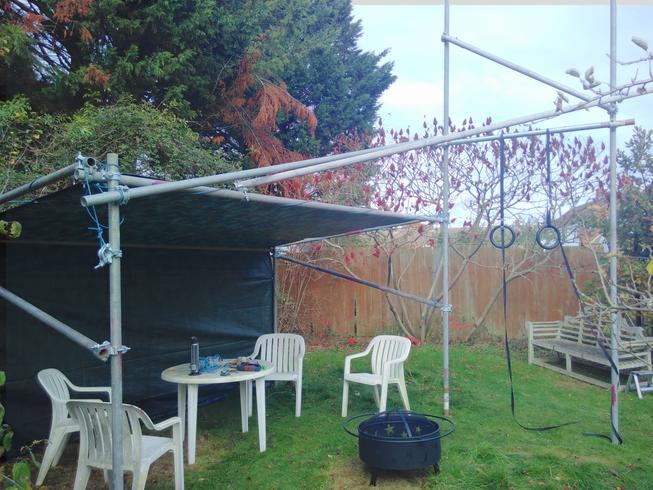
Ian Jackson: Gazebo out of scaffolding

Today we completed our gazebo, which we designed and built out of scaffolding: Picture of gazebo Scaffolding is fairly expensive but building things out of it is enormous fun! You can see a complete sequence of the build process, including pictures of the "engineering maquette", at https://www.chiark.greenend.org.uk/~ijackson/2020/scaffold/ Post-lockdown maybe I will build a climbing wall or something out of it...
edited 2020-11-08 20:44Z to fix img url following hosting reorg


comment count unavailable comments

Russell Coker: Links November 2020

KDE has a long term problem of excessive CPU time used by the screen locker [1]. Part of it is due to software GL emulation, and part of it is due to the screen locker doing things like flashing the cursor when nothing else is happening. One of my systems has an NVidia card and enabling GL would cause it to crash. So now I have kscreenlocker using 30% of a CPU core even when the screen is powered down. Informative NYT article about the latest security features for iPhones [2]. Android needs new features like this! Russ Allbery wrote an interesting review of the book Hand to Mouth by Linda Tirado [3], it s about poverty in the US and related things. Linda first became Internet famous for her essay Why I Make Terrible Decisions or Poverty Thoughts which is very insightful and well written, this is the latest iteration of that essay [4]. This YouTube video by Ruby Payne gives great insights to class based attitudes towards time and money [5]. News Week has an interesting article about chicken sashimi, apparently you can safely eat raw chicken if it s prepared well [6]. Vanity Fair has an informative article about how Qanon and Trumpism have infected the Catholic Church [7]. Some of Mel Gibson s mental illness is affecting a significant portion of the Catholic Church in the US and some parts in the rest of the world. Noema has an interesting article on toxic Internet culture, Japan s 2chan, 4chan, 8chan/8kun, and the conspiracy theories they spawned [8]. Benjamin Corey is an ex-Fundie who wrote an amusing analysis of the Biblical statements about the anti-Christ [9]. NYMag has an interesting article The Final Gasp of Donald Trump s Presidency [10]. Mother Jones has an informative article about the fact that Jim Watkins (the main person behind QAnon) has a history of hosting child porn on sites he runs [11], but we all knew QAnon was never about protecting kids. Eand has an insightful article America s Problem is That White People Want It to Be a Failed State [12].

5 November 2020

Mike Gabriel: Welcome, Fre(i)e Software GmbH

Last week I received the official notice: There is now a German company named "Fre(i)e Software GmbH" registered with the German Trade Register. Founding a New Company Over the past months I have put my energy into founding a new company. As a freelancing IT consultant I started facing the limitation of other companies having strict policies that forbid the cooperation with one person businesses (Personengesellschaften). Thus, the requirement for setting up a GmbH business came onto my agenda. I will move some of my business activities into this new company, starting next year. Policy Ideas The "Fre(i)e Software GmbH" will be a platform to facilitate the growth and spreading of Free Software on this planet. Here are some first ideas for company policies: This is all pretty fresh. I'll be happy about hearing your feedback, ideas and worries. If you are interested in joining the company, please let me know. If you are interested in supporting a company with such values, please also let me know. light+love
Mike Gabriel (aka sunweaver)

4 November 2020

Norbert Preining: Debian KDE/Plasma Status 2020-11-04

About a month worth of updates on KDE/Plasma in Debian has accumulated, so here we go. The highlights are: Plasma 5.19.5 based on Qt 5.15 is in Debian/experimental and hopefully soon in Debian/unstable, and my own builds at OBS have been updated to Plasma 5.20.2, Frameworks 5.75, Apps 20.08.2. Thanks to the dedicated work of the Qt maintainers, Qt 5.15 has finally entered Debian/unstable and we can finally target Plasma 5.20. OBS packages The OBS packages as usual follow the latest release, and currently ship KDE Frameworks 5.75, KDE Apps 20.08.2, and new, Plasma 5.20.2. The package sources are as usual (note the different path for the Plasma packages and the App packages, containing the release version!), for Debian/unstable:
deb https://download.opensuse.org/repositories/home:/npreining:/debian-kde:/frameworks/Debian_Unstable/ ./
deb https://download.opensuse.org/repositories/home:/npreining:/debian-kde:/plasma520/Debian_Unstable/ ./
deb https://download.opensuse.org/repositories/home:/npreining:/debian-kde:/apps2008/Debian_Unstable/ ./
deb https://download.opensuse.org/repositories/home:/npreining:/debian-kde:/other/Debian_Unstable/ ./
and the same with Testing instead of Unstable for Debian/testing. The update to Plasma 5.20 took a bit of time, not only because of the wait for Qt 5.15, but also because I couldn t get it running on my desktop, only in the VM. It turned out that the Plasmoid Event Calendar needed an update, and the old version crashed Plasma ( v68 and below crash in Arch after the Qt 5.15.1 update. ). After I realized that, it was only a question of updating to get Plasma 5.20 running. There are two points I have to mention (and I will fix sooner or later): As usual, let me know your experience! Debian main packages The packages in Debian/experimental are at the most current state, 5.19.5. We have waited with the upload to unstable until the Qt 5.15 transition is over, but hope to upload to unstable rather soon. After the upload is done, we will work on getting 5.20 into unstable. My aim is to get the most recent version of Plasma 5.20 into Debian Bullseye, so we need to do that before the freeze early next year. Let us hope for the best.

2 November 2020

Joerg Jaspert: Debian NEW Queue, Rust packaging

Debian NEW Queue So for some reason I got myself motivated again to deal with some packages in Debians NEW Queue. We had 420 source packages waiting for some kind of processing when I started, now we are down to something around 10. (Silly, people keep uploading stuff ) That s not entirely my own work, others from the team have been active too, but for those few days I went through a lot of stuff waiting. And must say it still feels mostly like it did when I somehow stopped doing much in NEW. Except - well, I feel that maintainers are much better in preparing their packages, especially that dreaded task of getting the copyright file written seems to be one that is handled much better. Now, thats not supported by any real numbers, just a feeling, but a good one, I think.

Rust Dealing with NEW meant I got in contact with one part that currently generates some friction between the FTP Team and one group of package maintainers - the Rust team. Note: this is, of course, entirely written from my point of view. Though with the intention of presenting it as objective as possible. Also, I know what rust is, and have tried a Hello world in it, but that s about my deep knowledge of it

The problem Libraries in rust are bundled/shipped/whatever in something called crates, and you manage what your stuff needs and provides with a tool called cargo. A library (one per crate) can provide multiple features, say a TLS lib can link against gnutls or openssl or some other random implementation. Such features may even be combinable in various different ways, so one can have a high number of possible feature combinations for one crate. There is a tool called debcargo which helps creating a Debian package out of a crate. And that tool generates so-called feature-packages, one per feature / combination thereof. Those feature packages are empty packages, only containing a symlink for their /usr/share/doc/ directory, so their size is smaller than the metadata they will produce. Inside the archive and the files generated by it, stuff that every user everywhere has to download and their apt has to process. Additionally, any change of those feature sets means one round through NEW, which is also not ideal. So, naturally, the FTP Team dislikes those empty feature packages. Really, a lot. There appears to be a different way. Not having the feature packages, but putting all the combinations into a Provides header. That sometimes works, but has two problems:
  • It can generate really long Provides: lines. I mean, REALLY REALLY REALLY long. Somewhat around 250kb is the current record. Thats long enough that a tool (not dak itself) broke on it. Sure, that tool needs to be fixed, but still, that s not nice. Currently preferred from us, though.
  • Some of the features may need different dependencies (say, gnutls vs openssl), should those conflict with each other, you can not combine them into one package.

Solutions Currently we do not have a good one. The rust maintainers and the ftp team are talking, exploring various ideas, we will see what will come out.

Devel archive / Component One of the possible solutions for the feature package problem would be something that another set of packages could also make good use of, I think. The introduction of a new archive or component, meant only for packages that are needed to build something, but where users are discouraged from ever using them. What? Well, take golang as an example. While we have a load of golang-something packages in Debian, and they are used for building applications written in go - none of those golang-something are meant to be installed by users. If you use the language and develop in it, the go get way is the one you are expected to use. So having an archive (or maybe component like main or contrib) that, by default, won t be activated for users, but only for things like buildds or archive rebuilds, will make one problem (hated metadata bloat) be evaluated wildly different. It may also allow a more relaxed processing of binary-NEW (easier additions of new feature packages).

But but but Yes, it is not the most perfect solution. Without taking much energy to think about, it requires
  • an adjustment in how main is handled. Right now we have the golden rule that main is self contained, that is, things in it may not need anything outside it for building or running. That would need to be adjusted for building. (Go as well as currently rust are always building static binaries, so no library dependencies there).
  • It would need handling for the release, that is, the release team would need to deal with that archive/component too. We haven t, yet, talked to them (still, slowly, discussing inside FTP Team). So, no idea how many rusty knives they want to sink into our nice bodies for that idea

Final Well, it is still very much open. Had an IRC meeting with the rust people, will have another end of November, it will slowly go forward. And maybe someone comes up with an entire new idea that we all love. Don t know, time will tell.

Vincent Bernat: My collection of vintage PC cards

Recently, I have been gathering some old hardware at my parents house, notably PC extension cards, as they don t take much room and can be converted to a nice display item. Unfortunately, I was not very concerned about keeping stuff around. Compared to all the hardware I have acquired over the years, only a few pieces remain.

Tseng Labs ET4000AX (1989) This SVGA graphics card was installed into a PC powered by a 386SX CPU running at 16 MHz. This was a good card at the time as it was pretty fast. It didn t feature 2D acceleration, unlike the later ET4000/W32. This version only features 512 KB of RAM. It can display 1024 768 images with 16 colors or 800 600 with 256 colors. It was also compatible with CGA, EGA, VGA, MDA, and Hercules modes. No contemporary games were using the SVGA modes but the higher resolutions were useful with Windows 3. This card was manufactured directly by Tseng Labs.
Carte Tseng Labs ET4000AX ISA au-dessus de la bo te "Plan te Aventure"
Tseng Labs ET4000 AX ISA card

AdLib clone (1992) My first sound card was an AdLib. My parents bought it in Canada during the summer holidays in 1992. It uses a Yamaha OPL2 chip to produce sound via FM synthesis. The first game I have tried is Indiana Jones and the Last Crusade. I think I gave this AdLib to a friend once I upgraded my PC with a Sound Blaster Pro 2. Recently, I needed one for a side project, but they are rare and expensive on eBay. Someone mentioned a cheap clone on Vogons, so I bought it. It was sold by Sun Moon Star in 1992 and shipped with a CD-ROM of Doom shareware.
AdLib clone on top of "Alone in the Dark" box
AdLib clone ISA card by Sun Moon Star
On this topic, take a look at OPL2LPT: an AdLib sound card for the parallel port and OPL2 Audio Board: an AdLib sound card for Arduino .

Sound Blaster Pro 2 (1992) Later, I switched the AdLib sound card with a Sound Blaster Pro 2. It features an OPL3 chip and was also able to output digital samples. At the time, this was a welcome addition, but not as important as the FM synthesis introduced earlier by the AdLib.
Sound Blaster Pro 2 on top of "Day of the Tentacle" box
Sound Blaster Pro 2 ISA card

Promise EIDE 2300 Plus (1995) I bought this card mostly for the serial port. I was using a 486DX2 running at 66 MHz with a Creatix LC 288 FC external modem. The serial port was driven by an 8250 UART with no buffer. Thanks to Terminate, I was able to connect to BBSes with DOS, but this was not possible with Windows 3 or OS/2. I needed one of these fancy new cards with a 16550 UART, featuring a 16-byte buffer. At the time, this was quite difficult to find in France. During a holiday trip, I convinced my parent to make a short detour from Los Angeles to San Diego to buy this Promise EIDE 2300 Plus controller card at a shop I located through an advertisement in a local magazine! The card also features an EIDE controller with multi-word DMA mode 2 support. In contrast with the older PIO modes, the CPU didn t have to copy data from disk to memory.
Promise EIDE 2300 Plus next to an OS/2 Warp CD
Promise EIDE 2300 Plus VLB card

3dfx Voodoo2 Magic 3D II (1998) The 3dfx Voodoo2 was one of the first add-in graphics cards implementing hardware acceleration of 3D graphics. I bought it from a friend along with his Pentium II box in 1999. It was a big evolutionary step in PC gaming, as games became more beautiful and fluid. A traditional video controller was still required for 2D. A pass-through VGA cable daisy-chained the video controller to the Voodoo, which was itself connected to the monitor.
3dfx Voodoo 2 Magic 3D II on top of "Jedi Knight: Dark Forces II" box
3dfx Voodoo2 Magic 3D II PCI card

3Com 3C905C-TX-M Tornado (1999) In the early 2000s, in college, the Internet connection on the campus was provided by a student association through a 100 Mbps Ethernet cable. If you wanted to reach the maximum speed, the 3Com 3C905C-TX-M PCI network adapter, nicknamed Tornado , was the card you needed. We would buy it second-hand by the dozen and sell them to other students for around 30 .
3COM 3C905C-TX-M on top of "Red Alert" box
3Com 3C905C-TX-M PCI card

Dirk Eddelbuettel: RcppSimdJson 0.1.2: New Upstream, New Utilities

A new RcppSimdJson release arrived on CRAN late yesterday bringing along the one recently updated simdjson release 0.6.0. RcppSimdJson wraps the fantastic and genuinely impressive simdjson library by Daniel Lemire and collaborators. Via very clever algorithmic engineering to obtain largely branch-free code, coupled with modern C++ and newer compiler instructions, it results in parsing gigabytes of JSON parsed per second which is quite mindboggling. The best-case performance is faster than CPU speed as use of parallel SIMD instructions and careful branch avoidance can lead to less than one cpu cycle per byte parsed; see the video of the talk by Daniel Lemire at QCon (also voted best talk). Other than the upstream update, Brendan added some new utilities to check for valid utf-8 or json format, and to minify json plus a small workaround for a clang-9 bug we encountered. We can confirm Daniel s statement on ridiculously fast utf-8 validattion. It is so cool to work with amazing tools. The NEWS entry follows.

Changes in version 0.1.3 (2020-11-01)
  • Added URLs to DESCRIPTION (Dirk closing #50).
  • Upgraded to simdjson 0.6.0 (Dirk in #52).
  • New policy option to always convert integers to int64_t (Brendan in #55 closing #54).
  • Added workaround for odd clang-9 bug (Brendan in #57).
  • New utility functions is_valid_utf8(), is_valid_json() and fminify() (Brendan in #58).

Courtesy of my CRANberries, there is also a diffstat report for this release. For questions, suggestions, or issues please use the issue tracker at the GitHub repo. If you like this or other open-source work I do, you can now sponsor me at GitHub. For the first year, GitHub will match your contributions.

This post by Dirk Eddelbuettel originated on his Thinking inside the box blog. Please report excessive re-aggregation in third-party for-profit settings.

Sandro Knau : Bugzilla integration for KDE Project API

The KDE Bugzilla handles a lot of projects and they often match with the repo name, but not always. For instance we have ancient products and components at Bugzilla, as projects have a lifecycle from playground into Release Service, or Frameworks, sometimes with a change of name. So you may end up searching Bugzilla quite awhile for the correct product and component to be able to confirm or create bug reports against an application. Let's have a look at KPeople, and see why the situation is complicated. You find two products in KDE Bugzilla: kpeople (the repository's name) and on the other hand Frameworks have the scheme of a "frameworks-" prefix: frameworks-kpeople. From the data displayed even I as a developer am unable to tell which is the correct product to add new bug reports. Both have bug reports this year that got fixed and the number of bug reports is too low to get a clear picture of which to choose. This is not only a problem of KDE; it is a general problem in different communities that it is hard for newcomers to find the correct place to search and add new bug reports. That's why Debian added the bug report information for every package. This should help users to search the upstream bug reports or create new ones (Bug-Submit and Bug-Database): https://wiki.debian.org/UpstreamMetadata#Fields While I was collecting this information for Frameworks and KDE PIM, I wondered why KDE does not have links between each project and Bugzilla. After some searching and discussions it became obvious, that KDE does not have this information that can be processed. Okay let's fix this. The obvious place to reach this information is the Project API available under https://projects.kde.org/api/. To reach this goal I began adding Bugzilla information to the data source of the Project API named Git Repo Metadata. Then a merge request later the Project API is able to generate the links to Bugzilla invent:sysadmin/projects-api!2. Where you should search for bugs in kontact? Go to https://projects.kde.org/api/v1/identifier/kontact: After implementing the needed bits I found out that Nicolas Alvarez had the same idea, to store Bugzilla information in Git Repo Metadata invent:sysadmin/repo-metadata@085d878ea. Fortunately I can say that since June the information are used by Project API. So now, back to my task to add upstream metadata to Debian packages. After I filled the needed information to Repo Metadata I created a script to update the links in Debian salsa:qt-kde-team/pkg-kde-dev-scripts/function_collection/functions_plasma.py:addMissingBugMetadatafields. This should hopefully help to always point to the correct Bugzilla links in future. A random list came to my mind of places that may benefit from the Bugzilla information in Git Metadata Repository: The truth is, that Nicolas is right that adding the Bugzilla links are a manual task. But on the other hand, let's add this information once at one place and than we can use it at several places. Please help adding this information; it is simple a yaml file. If you see the data missing example commit and create a merge request. Or you can also give me the data and I'll add it.

1 November 2020

Steve Kemp: Archiving Debian-Administration.org, for real

Back in 2017 I announced that the https://Debian-Administration.org website was being made read-only, and archived. At the time I wrote a quick update to save each requested page as a flat-file, hashed beneath /tmp, with the expectation that after a few months I'd have a complete HTML-only archive of the site which I could serve as a static-website, instead of keeping the database and pile of CGI scripts running. Unfortunately I never got round to archiving the pages in a git-repository, or some other store, and I usually only remembered this local tree of content was available a few minutes after I'd rebooted the server and lost the stuff - as the reboot would reap the contents of /tmp! Thinking about it today I figured I probably didn't even need to do that, instead I just need to redirect to the wayback machine. Working on the assumption that the site has been around for "a while" it should have all the pages mirrored by now I've made a "final update" to Apache:
 RewriteEngine on
 RewriteRule   ^/(.*)  "http://web.archive.org/web/https://debian-administration.org/$1"  [R,L]
Assuming nobody reports a problem in the next month I'll retire the server and make a simple docker container to handle the appropriate TLS certificate renewal, and hardwire the redirection(s) for the sites involved.

Next.

Previous.