Search Results: "ana"

3 July 2016

Jonathan McDowell: Confirming all use of an SSH agent

For a long time I ve wanted an ssh-agent setup that would ask me before every use, so I could slightly more comfortably forward authentication over SSH without worrying that my session might get hijacked somewhere at the remote end (I often find myself wanting to pull authenticated git repos on remote hosts). I m at DebConf this week, which is an ideal time to dig further into these things, so I did so today. As is often the case it turns out this is already possible, if you know how. I began with a setup that was using GNOME Keyring to manage my SSH keys. This isn t quite what I want (eventually I want to get to the point that I can sometimes forward a GPG agent to remote hosts for signing purposes as well), so I set about setting up gpg-agent. I used Chris excellent guide to GnuPG/SSH Agent setup as a starting point and ended up doing the following:
$ echo use-agent >> ~/.gnupg/options
$ echo enable-ssh-support >> ~/.gnupg/gpg-agent.conf
$ sudo sed -i.bak "s/^use-ssh-agent/# use-ssh-agent/" /etc/X11/Xsession.options
$ sudo rm /etc/xdg/autostart/gnome-keyring-ssh.desktop
The first 2 commands setup my local agent, and told it to do SSH agent foo. The next stopped X from firing up ssh-agent, and the final one prevents GNOME Keyring from being configured to be the SSH agent, without having to remove libpam-gnome-keyring as Chris did. After the above I logged out of and into X again, and could see ~/.gnupg/S.gpg-agent.ssh getting created and env grep SSH showing SSH_AUTH_SOCK pointing to it (if GNOME Keyring is still handling things it ends up pointing to something like /run/user/1000/keyring/ssh). [Update: Luca Capello emailed to point out this was a bad approach; there s thankfully no need to do the last 2 commands that require root. #767341 removed the need to edit Xsession.options and you can prevent GNOME Keyring starting on a per user basis with:
(cat /etc/xdg/autostart/gnome-keyring-ssh.desktop ;
 echo 'X-GNOME-Autostart-enabled=false') > \
 ~/.config/autostart/gnome-keyring-ssh.desktop
] After this it turned out all I need to do was ssh-add -c <ssh keyfile>. The -c says confirm use and results in the confirm flag being appended to the end of ~/.gnupg/sshcontrol (so if you ve already done the ssh-add you can go and add the confirm if that s the behaviour you d like). Simple when you know how, but I ve had conversations with several people in the past who wanted the same thing and hadn t figured out how, so hopefully this is helpful to others.

Petter Reinholdtsen: How to use the Signal app if you only have a land line (ie no mobile phone)

For a while now, I have wanted to test the Signal app, as it is said to provide end to end encrypted communication and several of my friends and family are already using it. As I by choice do not own a mobile phone, this proved to be harder than expected. And I wanted to have the source of the client and know that it was the code used on my machine. But yesterday I managed to get it working. I used the Github source, compared it to the source in the Signal Chrome app available from the Chrome web store, applied patches to use the production Signal servers, started the app and asked for the hidden "register without a smart phone" form. Here is the recipe how I did it. First, I fetched the Signal desktop source from Github, using
git clone https://github.com/WhisperSystems/Signal-Desktop.git
Next, I patched the source to use the production servers, to be able to talk to other Signal users:
cat <<EOF   patch -p0
diff -ur ./js/background.js userdata/Default/Extensions/bikioccmkafdpakkkcpdbppfkghcmihk/0.15.0_0/js/background.js
--- ./js/background.js  2016-06-29 13:43:15.630344628 +0200
+++ userdata/Default/Extensions/bikioccmkafdpakkkcpdbppfkghcmihk/0.15.0_0/js/background.js    2016-06-29 14:06:29.530300934 +0200
@@ -47,8 +47,8 @@
          );
      );
 
-    var SERVER_URL = 'https://textsecure-service-staging.whispersystems.org';
-    var ATTACHMENT_SERVER_URL = 'https://whispersystems-textsecure-attachments-staging.s3.amazonaws.com';
+    var SERVER_URL = 'https://textsecure-service-ca.whispersystems.org:4433';
+    var ATTACHMENT_SERVER_URL = 'https://whispersystems-textsecure-attachments.s3.amazonaws.com';
     var messageReceiver;
     window.getSocketStatus = function()  
         if (messageReceiver)  
diff -ur ./js/expire.js userdata/Default/Extensions/bikioccmkafdpakkkcpdbppfkghcmihk/0.15.0_0/js/expire.js
--- ./js/expire.js      2016-06-29 13:43:15.630344628 +0200
+++ userdata/Default/Extensions/bikioccmkafdpakkkcpdbppfkghcmihk/0.15.0_0/js/expire.js2016-06-29 14:06:29.530300934 +0200
@@ -1,6 +1,6 @@
 ;(function()  
     'use strict';
-    var BUILD_EXPIRATION = 0;
+    var BUILD_EXPIRATION = 1474492690000;
 
     window.extension = window.extension    ;
 
EOF
The first part is changing the servers, and the second is updating an expiration timestamp. This timestamp need to be updated regularly. It is set 90 days in the future by the build process (Gruntfile.js). The value is seconds since 1970 times 1000, as far as I can tell. Based on a tip and good help from the #nuug IRC channel, I wrote a script to launch Signal in Chromium.
#!/bin/sh
cd $(dirname $0)
mkdir -p userdata
exec chromium \
  --proxy-server="socks://localhost:9050" \
  --user-data-dir= pwd /userdata --load-and-launch-app= pwd 
The script start the app and configure Chromium to use the Tor SOCKS5 proxy to make sure those controlling the Signal servers (today Amazon and Whisper Systems) as well as those listening on the lines will have a harder time location my laptop based on the Signal connections if they use source IP address. When the script starts, one need to follow the instructions under "Standalone Registration" in the CONTRIBUTING.md file in the git repository. I right clicked on the Signal window to get up the Chromium debugging tool, visited the 'Console' tab and wrote 'extension.install("standalone")' on the console prompt to get the registration form. Then I entered by land line phone number and pressed 'Call'. 5 seconds later the phone rang and a robot voice repeated the verification code three times. After entering the number into the verification code field in the form, I could start using Signal from my laptop. As far as I can tell, The Signal app will leak who is talking to whom and thus who know who to those controlling the central server, but such leakage is hard to avoid with a centrally controlled server setup. It is something to keep in mind when using Signal - the content of your chats are harder to intercept, but the meta data exposing your contact network is available to people you do not know. So better than many options, but not great. And sadly the usage is connected to my land line, thus allowing those controlling the server to associate it to my home and person. I would prefer it if only those I knew could tell who I was on Signal. There are options avoiding such information leakage, but most of my friends are not using them, so I am stuck with Signal for now.

Paul Wise: DebConf16 Open Festival day 1

Today was day one of the DebConf16 Open Festival and I attended the open hardware panel, part of the talk about Code For South Africa, shirish's experiences and the DebConf new folks session. The open hardware panel was a wide ranging discussion between bdale, Andy and indiebio. bdate talked about the experiences he has had with his rocketry hardware. bdale said "Make concious decisions about what you are buying", referencing a case where he investigated, found a GPL violation and didn't buy. Various people care about openness of different layers of the hardware. Off-the-shelf products are very strongly integrated, which is great for makers but means that people who care about lower layers like CPU micro-architecture aren't able to participate. Andy said "We are just beginning to come out of the shareware stage [of open hardware]". bdale mentioned the companies who do hardware production as a service from design files. Later in the pub some folks mentioned j-core, an open re-implementation of SuperH processors. I missed most of the code4sa talk unfortunately, but it was about government services and open data. shirish covered his journey through life to Debian. His youth, how satellite TV and knowledge of the outside world came to India around the time of the Iraq war. His experience accessing the Internet for the first time, uncensored vs the usual censorship in India's media. His experiences of Windows 95 viruses and crashes. He learned of PCTwist Linux through a magazine cover. His initial install was not a success but eventually managed to break through and install a desktop, but experienced network and other issues. Eventually he encountered Ubuntu and began contributing bug reports. His experiences there led him to Debian. He began blogging about Debian. In the last few years he and others have been going around the country doing mini-DebConfs at institutes around India. The first question was predictably about having a DebConf in India and how shirish might like to get more involved. DebConf in India sounds like a possibility some day and shirish was thinking about getting involved in publicity, marketting and the Debian installer. The DebConf new folks session was a great intro to DebConf for folks new to the community. There were some quite excellent touches added to this year's version of the event by indiebio and Rhonda. I also got some things done. Usual spam reporting. Reviewed wiki RecentChanges. Talked to the chromium-bsu/MacPorts maintainer about AX_CHECK_GL brokenness. Filed Debian wishlist bug #829292 asking to update autoconf-archive. Redirected a Hurd porterbox request to the exodar admin and quickly found out I was wrong to do that, rectified. Then we found out the LDAP sync to exodar was broken. Replied to someone who intends to sell Debian pre-installs. Thanked BunsenLabs folks for joining the derivatives list. Applied reproducible builds patch for cats from Chris Lamb. Heard about awesome new terminal-mode screensaver. Moo! Prepared a blog post about check-all-the-things.

Russ Allbery: Review: Coming Home

Review: Coming Home, by Jack McDevitt
Series: Alex Benedict #7
Publisher: Ace
Copyright: November 2014
Printing: November 2015
ISBN: 0-425-26088-7
Format: Mass market
Pages: 356
Coming Home is a direct sequel to Firebird, the first time McDevitt has done that in this series. You therefore don't want to start here, although the nature of the sequel doesn't require that you remember Firebird in that much detail. The mystery of the disappearing starships was understood in Firebird but not resolved. The title advertises that as a major theme in this book, but it progresses very slowly. There's more media bickering and various factional attempts to draw Alex (and, to a lesser extent, Chase) into the controversies. McDevitt does a good job writing popular media, the strange position of public intellectual and talk-show favorite, and the way this filters into popular arguments. But with Alex trying to take a nuanced and unsure position and with a lot of talk but little action, it's not the most compelling reading. Coming Home holds to form in balancing a mystery and a second plot. Since the starship problem is understood, it can't be the central mystery of the book. That role is taken by the discovery of communication device from the very early days of space flight, which takes Alex and Chase to Earth for the first time in this series (at least that I can recall). This time, the search is for a legendary trove of historical artifacts that was moved from a space flight museum in Florida when the ocean rose to cover the state. From there, its location was lost in the middle of a general economic collapse called the Time of Troubles that destroyed most of Earth's governmental systems (and, apparently rather more importantly to McDevitt, the space program). Anyone who has gotten this far in the series will know the standard problem with McDevitt's futures: they're indistinguishable from the 1960s except that they have flying cars. There is a tiny break from that tradition here, since climate change has clearly happened to Earth, covering Florida with the ocean and shifting the major cities north. But the sense of deep history that McDevitt is trying for in this series doesn't work: I just don't believe as much time has gone by as the story claims. He does offer an explanation for why technology has been stagnant for apparently millennia, but it's just a contention that science ran out of more things to discover due to authorial fiat and is now just a matter of engineering and step-wise refinement. (I think the science behind the disappearing starships happening in this very same book undermines that contention considerably.) Even if one can put that aside, Earth is, well, boring. This is partly an intriguing stylistic choice by McDevitt: Earth is intended to be just one more world. It might have a longer history than many other human-occupied worlds, but history is so long everywhere that this only matters to a few people like Alex and Chase. The choice makes sense, but it doesn't make a good story. And there are other things that I flatly didn't believe, such as the supposed isolation of Earth from the communication network of Alex's home world of Rimway for... no apparent reason other than that different communication networks don't talk to each other except via, essentially, letters. Even if one is willing to ignore the mysterious failure of forward progress in technology, this makes no social or engineering sense given the capabilities already shown in the series. I found the main mystery at best mildly interesting. McDevitt does a good job showing the research and investigation process, with all its tedium and dead ends, but I wasn't as invested in the search as he wanted me to be. The endless space boosterism started getting on my nerves, as it so often does in science fiction of a certain type, and I had a much harder time swallowing McDevitt's Earth than his fictional Rimway. I will give him credit for a surprisingly affecting conclusion of the main mystery, but the missing starship subplot putters to an undistinguished end. I think this series is running out of steam. It's become increasingly formulaic, and the characters, like McDevitt's future technology, have stopped developing. I was hoping the reunion foreshadowed since Firebird would shake things up, but at least in this book it doesn't. Maybe it will in subsequent books, but I'm starting to question whether I really want to keep reading. Rating: 5 out of 10

Thadeu Lima de Souza Cascardo: Debian on old Linux versions

On recent posts, I mentioned that I have a Chromebook, and that I would like to run Debian on devices that ship with old Linux versions. The Samsung ARM Chromebook is such a device, it has Linux 3.4, and that's still what I am running on it most of the time. After an upgrade of Debian, systemd stopped working, and it took me some time before I could look into it. In order to boot, I had to temporarily use System V init. The bug involves the use of new interfaces, bugs in such interfaces, and how versioning would not be a solution to such cases. Cases like this are not common, so it's no excuse to doing the right thing when developing software, like considering portability, API and ABI maintenance and not bundle. But they expose some of the challenges when trying to support different OSes on top of old versions of Linux, or maybe even new versions. The new version of systemd included in Debian Jessie uses a feature of Linux of checking the mount ID of a file by inspecting the mnt_id line in the fdinfo files. fdinfo files are not that new, they have been present since 2007, Linux 2.6.22. The mnt_id line, however, is from Linux 3.15, from 2014. So, a fairly new feature. But systemd falls back to other methods if the feature is not present. However, during the last few weeks of development of Linux 3.4, a bug was introduced to fdinfo handling, which will cause its access to fail in a way that will cause systemd to halt. It simply will refuse to mount the most basic filesystems and not proceed. The bug was fixed not much longer than two weeks after that, but that window of time was enough to have it on a shipped product, one that was not using systemd, let alone one that required a feature not yet present on Linux. But now I wanted to run this new systemd on this old Linux version. Being too early in the boot process, systemd even ignored some of the debug options and I had to resort to other methods of debugging. As I am running a kernel I built by myself, it wasn't hard for me to have a fixed kernel up and running after I found out the problem. Unfortunately, not everyone will be able to do it by themselves. And the point of getting different OSes working on these many varied devices is scaling. If every device needs to be tested, we lose this scalability. The other problem I found was that this old Linux version didn't load firmware files by itself, and requested help from userspace, which used to be the job of udev. Well, udev now does not support loading firmware, and the kernel must do it by itself. I managed to backport that feature too. But now, it sounds like I should get upstream support for this device. Unfortunately, this means not working on the scalability problem, but going back to get upstream support for a lot of devices out there, which is very hard to scale without the necessary people to do the work. I am certainly going to do that, because it's the right thing to do. But not as many people will benefit from that. But I think it has been interesting to look into the possible problems we might find when trying to make Debian and other OSes working on old Linux versions. I know even older Debian versions won't boot fine on Linux 2.6.32, one of the LTS versions of Linux. I have one other device which runs on it, and I am also working on getting better upstream support for it. Let's see if I can get some news on that soon.

2 July 2016

Jonathan Carter: So, that was DebCamp16!

Picture: Adrian Frith

University of Cape Town, host location to DebConf 16. Picture: Adrian Frith

What an amazingly quick week that was Our bid to host DebConf in Cape Town was accepted nearly 15 months ago. And before that, the bid itself was a big collective effort from our team. So it s almost surreal that the first half of the two weeks of DebCamp/DebConf is now over. Things have been going really well. The few problems we ve had so far were too small to even mention. It s a few degrees colder than it usually is this time of the year and there s already snow on the mountains, so Cape Town is currently quite chilly.
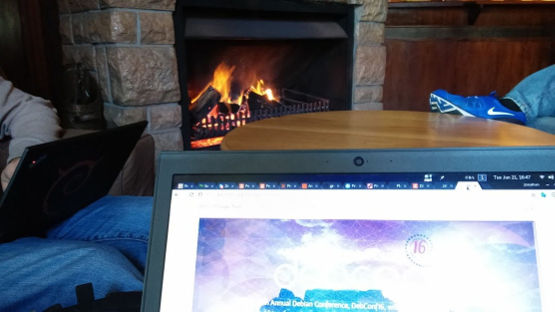
Hacking by the fire at the sports club

Gathering some heat by the fire at the sports club while catching up to the world the day before it all started.

All Kinds of Quality Time I really enjoyed working with the video team last year, but this year there was just 0 time for that. Working on the orga team means dealing with a constant torrent of small tasks, which is good in its own way because you get to deal with a wide variety of Debian people you might not usually get to interact with, but video team problems are more fun and interesting. Next year I hope to do a lot more video work again. If you re at DebConf over the next week, I can highly recommend that you get involved!
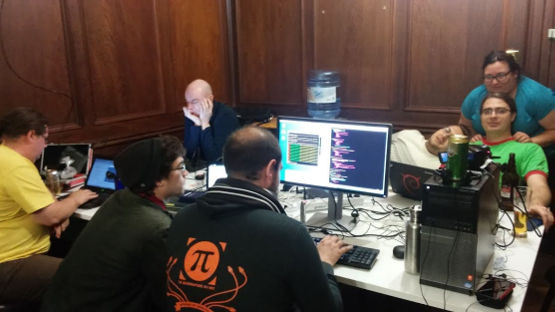
Video team hacking away at problems

Video team members hacking away at problems late at night during DebCamp

The first time I met Debian folk was early in 2004. I worked at the Shuttleworth Foundation as Open Source Technical Co-ordinator at the time, and Mark Shuttleworth had them over for one of the early Ubuntu sprints in Canonical s early days. I was so intimidated by them back then that I could hardly even manage to speak to them. I was already a big free software fan before working there, but little did I even dream to think that I would one day be involved in a project like Ubuntu or Debian. My manager back then encouraged me to go talk to them and get involved and become a Debian Developer and joked that I should become highvoltage@debian.org. I guess that was when the initial seeds got planted and since then I ve met many great people all over the world who have even became friends during UDS, DebConf, BTS and other hackfests where Debianites hang out. It gave me a really nice warm feeling to have all these amazing, talented and really friendly people from all over coming together in this little corner of the world to work together on projects that I think are really important.
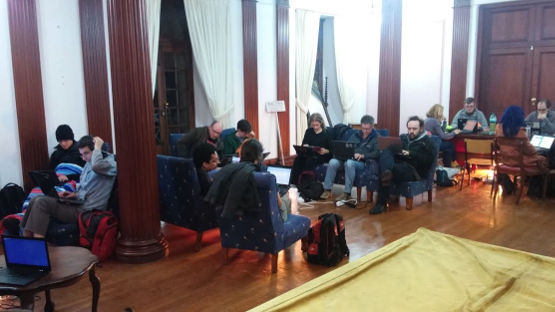
Finding a warm space to work in the Happy Feet hack lab

Finding a warm space to work in the Happy Feet hack lab

Oh the Chicken Back at DebConf12, someone (I don t remember the exact history) brought a rubber chicken to DebConf who was simply called Pollito ( chicken in Spanish). Since then the chicken has grown into somewhat of a mascot for DebConf. Back in 2012 I already imagined that if we would ever host a DebConf, I d make a little of picture book story about Pollito. Last year after DC15, when bringing Pollito over, I created a little story called Pollito s first trip to Africa . I was recovering from flu while putting that together and didn t spend much time on it, but it turned out to be somewhat of a hit. I was surprised to see it in the #debconf topic ever since I posted it :) We gave a tour of the campus on the first and second days and it was quite time consuming and there was no way we could do it every day for the rest of DebCamp, so on the 2nd day I smacked together a new rush job called Pollito s Guide to DC16 . The idea was that newcommers could use it as a visual guide and rely on others who have been there for a while if they get stuck. I wish I had the time to make it a lot nicer, but I think the general idea is good and next year we can have a much nicer one that might not be quite as Pollito focused.
Pollito's Guide to DC16

Pollito s Guide to DC16

Debian Maintainer After all these years, I finally sat down and applied to become a Debian Maintainer, and the application was successful (approved yesterday \o/). Now just for the wait until my key is uploaded to the keyring. I haven t yet had time to properly process this but I think once the DebConf dust settles and I had some time to recover, I will be ecstatic. Some actual DebCampy work Everywhere I go, I see people installing a bunch of GNOME extensions on their Debian GNOME desktops shortly after installation using http://extensions.gnome.org/ (I noticed this even at DebCamp!). A few months ago I thought that it s really about time someone package up some of the really popular ones. So I started to put together some basic packaging for AIMS Desktop around a month ago. During the last few days of DebCamp, things were going well enough with the organisational tasks that I had some time to do some actual packaging work and improve these so that they re ready for upload to the Debian archives. The little DebCamp time I had ended up being my very own little extension fest :) I worked on the following packages which are ready for upload: I worked on the following packages which still need minor work, might be able to get them in uploadable state by the end of DebConf: The actual packaging of GNOME extensions is actually pretty trivial. It s mostly source-only JavaScript with some CSS and translations and maybe some gsettings schemas and dialogs. Or at least, it would be pretty trivial, but many extensions are without licenses, contain embedded code (often JavaScript) from other projects, or have no usable form of upstream tarball, to name a few of the problems. So I ve been contacting the upstream authors of these packages where there have been problems, and for the most part they ve been friendly and pretty quick to address the problems. So that s it, for now. I couldn t possibly sum up the last week and everything that lead up to it in a single blog post. All I can really say is thank you for letting me be a part of this very special project!

Lior Kaplan: Implementing NATO s standards (STANAG)

I recently joined Linnovate, and while working on one of the open source projects the company produces, we needed to process video content according to NATO s standard agreement (STANAG) 4609: NATO Digital Motion Imagery Standard. Obviously we started with trying to find code already done, but we only found some implementation in Java, while our project is written in JavaScript. We decided to just implement the standard in the way most convenient to us, and later refactoring the project when more standards (STANAGs) will get implemented. So I m happy to introduce our new project: STANAG at https://github.com/linnovate/stanag , also available with NPM (see https://www.npmjs.com/package/stanag).
Filed under: Linnovate

Joey Hess: twenty years of free software -- part 6 moreutils

moreutils is a little love letter to the Unix Tools philosophy. It was interesting to try to find new tools as basic as cat and ls. With sponge and vidir and ifne and chronic and others, we managed to find several such tools. So, it was fun to work on moreutils, but it also ran into inherent problems with the Unix Tools philosophy. One is namespacing; there are only so many good short names for commands, and a command like parallel can easily collide with something else. And since Unix Tools have a bigger surface area than a pure function, my parallel is not going to be quite compatible with your parallel, even if they were developed with (erm) parallel intentions. Partly due to that problem, I have gotten pickier about adding new tools to moreutils as it's gotten older, and so there's a lot of suggested additions that I will probably never get to. And as my mention of pure functions suggests, I have kind of moved on from being a big fan of the Unix Tools philosophy. Unix tools are a decent approximation of pure functions for their time, but they are not really pure, and not typed at all, and not usefully namespaced, and this limits them. Next: twenty years of free software -- part 7 git-annex

Paul Tagliamonte: Hello, InfluxDB

Last week, I posted about python-sense, and API wrapper for the internal Sense API. I wrote this so that I could pull data about myself into my own databases, allowing me to use that information for myself. One way I'm doing this is by pulling my room data into an InfluxDB database, letting me run time series queries against my environmental data.
#!/usr/bin/env python
from influxdb import InfluxDBClient
import json
import datetime as dt
from sense.service import Sense
api = Sense()
data = api.room_sensors(quantity=20)
def items(data):
    for flavor, series in data.items():
        for datum in reversed(series):
            value = datum['value']
            if value == -1:
                continue
            timezone = dt.timezone(dt.timedelta(
                seconds=datum['offset_millis'] / 1000,
            ))
            when = dt.datetime.fromtimestamp(
                datum['datetime'] / 1000,
            ).replace(tzinfo=timezone)
            yield flavor, when, value
client = InfluxDBClient(
    'url.to.host.here',
    443,
    'username',
    'password',
    'sense',
    ssl=True,
)
def series(data):
    for flavor, when, value in items(data):
        yield  
            "measurement": " ".format(flavor),
            "tags":  
                "user": "paultag"
             ,
            "time": when.isoformat(),
            "fields":  
                "value": value,
             
         
client.write_points(list(series(data)))
I'm able to run this on a cron, automatically loading data from the Sense API into my Influx database. I can then use that with something like Grafana, to check out what my room looks like over time.

Russ Allbery: Review: Ashes of Honor

Review: Ashes of Honor, by Seanan McGuire
Series: October Daye #6
Publisher: DAW
Copyright: September 2012
ISBN: 1-101-59480-2
Format: Kindle
Pages: 368
This is the sixth book in the October Daye series, contains payoffs for some relationships that have been building over the whole series, and involves entangled politics set up by previous books. It's not the place to start with the series. Ashes of Honor starts, as so many of Toby's books do, with a friend asking her for help. But this request is entirely unexpected, and the help needed comes as a complete surprise: a previously unknown changeling, who has disappeared. A changeling whose powers are completely out of control, and who poses a threat to reality itself. As Toby's cases go, this involves a lot fewer horrible things happening to her and a lot more faerie politics and maneuvering than usual. I appreciated that; I'm not as fond of the books that go deep into despair or desperation. It does involve Toby getting almost killed multiple times, but, due to earlier events of the series, that isn't quite as bad as it used to be. More focus on investigation and political maneuvering and less Toby braving her way through horrors works for me. Even more notably, this book marks Toby finally figuring out that she has friends and allies who are there to help, not just be obligations she feels overwhelmed by or aid that she's not allowed to accept. This was one of her most frustrating characteristics; it's a relief to see her finally relax. This opens the way not only for deeper friendships and more complex plots but also a relationship that I've been awaiting for the entire series, and it's as much fun as I was hoping it would be. Toby started the series rather messed up and unwilling to let anyone close. It was for understandable reasons, but I like her better when she realizes why people respect her. Toby's connections with the royalty of the Bay Area also allow McGuire to tell a political story that moves farther afield from the Shadowed Hills. First in One Salt Sea and now in Ashes of Honor we see more of local politics, more of the lore of McGuire's universe, and another dangerous queen. Toby is particularly fun when she's dangerously outflanking people with considerably more power than she has. At this point, you could call it a specialty. I thought McGuire's take on San Jose and the sort of person who would be in charge of its fae was on point. We also get more of the Luidaeg, which is always a good sign for a Toby novel, and more of Tybalt, who is entangled in a major subplot of the story. Next to Luidaeg, Tybalt is my favorite of Toby's friends, so this book is full of the things that make me happy. McGuire adds some more pieces to her transplanted Celtic mythology and some tantalizing hints of what the fae have left behind. I'm hoping we see more of that in future books. (I suspect that may be what this whole series is building up to.) The story doesn't have quite as much oomph as One Salt Sea, but it's still one of the best books in the series so far. If you've enjoyed the series up to this point, keep reading. Followed by Chimes at Midnight. Rating: 8 out of 10

1 July 2016

Rapha&#235;l Hertzog: My Free Software Activities in June 2016

My monthly report covers a large part of what I have been doing in the free software world. I write it for my donators (thanks to them!) but also for the wider Debian community because it can give ideas to newcomers and it s one of the best ways to find volunteers to work with me on projects that matter to me. Debian packaging Django and Python. I uploaded Django 1.9.7 and filed an upstream ticket (#26755) for a failure seen in its DEP-8 tests. I packaged/sponsored python-django-modeltranslation and python-paypal. I opened a pull request on model-translation to fix failing tests in the Debian package build. I packaged a new python-django-jsonfield (1.0.0), filed a bug and discovered some regression in its PostgreSQL support. I helped on the upstream ticket and I have been granted commit rights. I used this opportunity to do some bug triage and push a few fixes. I also discussed the future of the module and ended up starting a discussion on Django s developer list about the possibility to add a JSONField to the core. CppUTest. I uploaded a new upstream version (3.8) with more than a year of work. I found out that make install does not install a required header so I opened a ticket with a patch. The package ended up not compiling on quite a few architectures so I opened a ticket and prepared a fix for some of those failures with the help of the upstream developers. I also added a DEP-8 tests after having uploaded a broken (untested) package systemd support in net-snmp and postfix. I worked on adding native systemd service units to net-snmp (#782243) and postfix (#715188). In both cases, the maintainers have not been very reactive so far so I uploaded my changes as delayed NMU. pkg-security team. The team that I started quietly a few months ago is now growing, both with new members and new packages. I created the required Teams/pkg-security wiki page. I sponsored xprobe, hydra, made an upload of medusa to merge Kali changes into Debian (and at the same time submitting the patch to upstream). fontconfig. After having read Jonathan McDowell s analysis of a bug that I experienced multiple times (and that many Kali users had too), I opened bug #828037 to get it fixed once for all. Unfortunately, nothing happened yet. DebConf 16 I spent some time to prepare the 2 talks and the BoF that I will give/manage in Cape Town next week: Distro Tracker I continued to mentor Vladimir Likic who managed to finish his first patch. He is now working on documentation for new contributors based on his recent experience. I enhanced the tox configuration to run tests with Django 1.8 LTS with fatal warnings (python -Werror) so as to ensure that I m not relying on any deprecated feature and so that I can be sure that the codebase will work on the next Django LTS release (1.11). Thanks to this, I did discover quite a few places where I have been using deprecated API and I fixed them all (the JSONField update to 1.0.0 I mentionned above was precisely to fix such a warning). I also fixed a few more issues with folded mail headers that you can t inject back in a new Message object and with messages lacking the subject field. All those have been caught through real (spam) email generating exceptions wich are then mailed to me. Kali related work I uploaded a new live-boot (5.20160608) to Debian to fix a bug where the boot process was blocking on some timeout. I forwarded a Kali bug against libatk-wrapper-java (#827741) which turned out to be an OpenJDK bug. I filed #827749 against reprepro to request a way to remove selected internal file references. This is required if you want to be able to make a file disappear and if that file is part of a snapshot that you want to keep despite this. But in truth, my real need is to be able to replace the .orig.tar.gz used by Kali by the orig.tar.gz used by Debian those conflicts break the mirroring/import script. Salt I have been using salt to deploy a new service, and I developed patches for a few issues in salt formulas. I also created a new letsencrypt-sh formula to manage TLS certificates with the letsencrypt.sh ACME client. Thanks See you next month for a new summary of my activities.

No comment Liked this article? Click here. My blog is Flattr-enabled.

30 June 2016

Chris Lamb: Free software activities in June 2016

Here is my monthly update covering a large part of what I have been doing in the free software world (previously):
Debian My work in the Reproducible Builds project was covered in our weekly reports. (#58, #59 & #60)
Debian LTS

This month I have been paid to work 18 hours on Debian Long Term Support (LTS). In that time I did the following:
  • "Frontdesk" duties, triaging CVEs, etc.
  • Extended the lts-cve-triage.py script to ignore packages that are not subject to Long Term Support.

  • Issued DLA 512-1 for mantis fixing an XSS vulnerability.
  • Issued DLA 513-1 for nspr correcting a buffer overflow in a sprintf utility.
  • Issued DLA 515-1 for libav patching a memory corruption issue.
  • Issued DLA 524-1 for squidguard fixing a reflected cross-site scripting vulnerability.
  • Issued DLA 525-1 for gimp correcting a use-after-free vulnerability in the channel and layer properties parsing process.

Uploads
  • redis (2:3.2.1-1) New upstream bugfix release, plus subsequent upload to the backports repository.
  • python-django (1.10~beta1-1) New upstream experimental release.
  • libfiu (0.94-5) Misc packaging updates.


RC bugs

I also filed 170 FTBFS bugs against a7xpg, acepack, android-platform-dalvik, android-platform-frameworks-base, android-platform-system-extras, android-platform-tools-base, apache-directory-api, aplpy, appstream-generator, arc-gui-clients, assertj-core, astroml, bamf, breathe, buildbot, cached-property, calf, celery-haystack, charmtimetracker, clapack, cmake, commons-javaflow, dataquay, dbi, django-celery, django-celery-transactions, django-classy-tags, django-compat, django-countries, django-floppyforms, django-hijack, django-localflavor, django-markupfield, django-model-utils, django-nose, django-pipeline, django-polymorphic, django-recurrence, django-sekizai, django-sitetree, django-stronghold, django-taggit, dune-functions, elementtidy, epic4-help, fcopulae, fextremes, fnonlinear, foreign, fort77, fregression, gap-alnuth, gcin, gdb-avr, ggcov, git-repair, glance, gnome-twitch, gnustep-gui, golang-github-audriusbutkevicius-go-nat-pmp, golang-github-gosimple-slug, gprbuild, grafana, grantlee5, graphite-api, guacamole-server, ido, jless, jodreports, jreen, kdeedu-data, kdewebdev, kwalify, libarray-refelem-perl, libdbusmenu, libdebian-package-html-perl, libdevice-modem-perl, libindicator, liblrdf, libmail-milter-perl, libopenraw, libvisca, linuxdcpp, lme4, marble, mgcv, mini-buildd, mu-cade, mvtnorm, nose, octave-epstk, onioncircuits, opencolorio, parsec47, phantomjs, php-guzzlehttp-ringphp, pjproject, pokerth, prayer, pyevolve, pyinfra, python-asdf, python-ceilometermiddleware, python-django-bootstrap-form, python-django-compressor, python-django-contact-form, python-django-debug-toolbar, python-django-extensions, python-django-feincms, python-django-formtools, python-django-jsonfield, python-django-mptt, python-django-openstack-auth, python-django-pyscss, python-django-registration, python-django-tagging, python-django-treebeard, python-geopandas, python-hdf5storage, python-hypothesis, python-jingo, python-libarchive-c, python-mhash, python-oauth2client, python-proliantutils, python-pytc, python-restless, python-tidylib, python-websockets, pyvows, qct, qgo, qmidinet, quodlibet, r-cran-gss, r-cran-runit, r-cran-sn, r-cran-stabledist, r-cran-xml, rgl, rglpk, rkt, rodbc, ruby-devise-two-factor, ruby-json-schema, ruby-puppet-syntax, ruby-rspec-puppet, ruby-state-machine, ruby-xmlparser, ryu, sbd, scanlogd, signond, slpvm, sogo, sphinx-argparse, squirrel3, sugar-jukebox-activity, sugar-log-activity, systemd, tiles, tkrplot, twill, ucommon, urca, v4l-utils, view3dscene, xqilla, youtube-dl & zope.interface.

FTP Team

As a Debian FTP assistant I ACCEPTed 186 packages: akonadi4, alljoyn-core-1509, alljoyn-core-1604, alljoyn-gateway-1504, alljoyn-services-1504, alljoyn-services-1509, alljoyn-thin-client-1504, alljoyn-thin-client-1509, alljoyn-thin-client-1604, apertium-arg, apertium-arg-cat, apertium-eo-fr, apertium-es-it, apertium-eu-en, apertium-hbs, apertium-hin, apertium-isl, apertium-kaz, apertium-spa, apertium-spa-arg, apertium-tat, apertium-urd, arc-theme, argus-clients, ariba, beast-mcmc, binwalk, bottleneck, colorfultabs, dh-runit, django-modeltranslation, dq, dublin-traceroute, duktape, edk2, emacs-pdf-tools, eris, erlang-p1-oauth2, erlang-p1-sqlite3, erlang-p1-xmlrpc, faba-icon-theme, firefox-branding-iceweasel, golang-1.6, golang-defaults, golang-github-aelsabbahy-gonetstat, golang-github-howeyc-gopass, golang-github-oleiade-reflections, golang-websocket, google-android-m2repository-installer, googler, goto-chg-el, gr-radar, growl-for-linux, guvcview, haskell-open-browser, ipe, labplot, libalt-alien-ffi-system-perl, libanyevent-fcgi-perl, libcds-savot-java, libclass-ehierarchy-perl, libconfig-properties-perl, libffi-checklib-perl, libffi-platypus-perl, libhtml-element-library-perl, liblwp-authen-oauth2-perl, libmediawiki-dumpfile-perl, libmessage-passing-zeromq-perl, libmoosex-types-portnumber-perl, libmpack, libnet-ip-xs-perl, libperl-osnames-perl, libpodofo, libprogress-any-perl, libqtpas, librdkafka, libreoffice, libretro-beetle-pce-fast, libretro-beetle-psx, libretro-beetle-vb, libretro-beetle-wswan, libretro-bsnes-mercury, libretro-mupen64plus, libservicelog, libtemplate-plugin-datetime-perl, libtext-metaphone-perl, libtins, libzmq-ffi-perl, licensecheck, link-grammar, linux, linux-signed, lua-busted, magics++, mkalias, moka-icon-theme, neutron-vpnaas, newlisp, node-absolute-path, node-ejs, node-errs, node-has-flag, node-lodash-compat, node-strip-ansi, numba, numix-icon-theme, nvidia-graphics-drivers, nvidia-graphics-drivers-legacy-304xx, nvidia-graphics-drivers-legacy-340xx, obs-studio, opencv, pacapt, pgbackrest, postgis, powermock, primer3, profile-sync-daemon, pyeapi, pypandoc, pyssim, python-cutadapt, python-cymruwhois, python-fisx, python-formencode, python-hkdf, python-model-mommy, python-nanomsg, python-offtrac, python-social-auth, python-twiggy, python-vagrant, python-watcherclient, python-xkcd, pywps, r-bioc-deseq2, r-bioc-dnacopy, r-bioc-ensembldb, r-bioc-geneplotter, r-cran-adegenet, r-cran-adephylo, r-cran-distory, r-cran-fields, r-cran-future, r-cran-globals, r-cran-htmlwidgets, r-cran-listenv, r-cran-mlbench, r-cran-mlmrev, r-cran-pheatmap, r-cran-pscbs, r-cran-r.cache, refind, relatorio, reprotest, ring, ros-ros-comm, ruby-acts-as-tree, ruby-chronic-duration, ruby-flot-rails, ruby-numerizer, ruby-u2f, selenium-firefoxdriver, simgrid, skiboot, smtpping, snap-confine, snapd, sniffles, sollya, spin, subuser, superlu, swauth, swift-plugin-s3, syncthing, systemd-bootchart, tdiary-theme, texttable, tidy-html5, toxiproxy, twinkle, vmtk, wait-for-it, watcher, wcslib & xapian-core.

Dirk Eddelbuettel: RMarkdown and Metropolis/Mtheme

Nick Tierney asked on Twitter about rmarkdown and metropolis about whether folks had used RMarkdown-driven LaTeX Beamer presentations. And the answer is a firm hell yeah. I have been using mtheme (and/or a local variant I called 'm2') as well as the newer (renamed) release mtheme for the last year or two for all my RMarkdown-based presentations as you can see from my presentations page. And earlier this year back I cleaned this up and wrote myself local Ubuntu packages which are here on Launchpad. I also have two GitHub repos for the underlying .deb package code: - the pkg-latex-metropolis package for the LaTeX part (which is also in TeXlive in an older version) - the pkg-fonts-fira for the underlying (free) font (and this sadly cannot build on launchpad as it needs a download step). To round things up, I now also created a public 'sample' repo on GitHub. It is complete for all but the custom per-presenteation header.tex that modifies colours, add local definitions etc as needed for each presentation. With that, Happy Canada Day (tomorrow, though) -- never felt better to be part of something Glorious and Free, and also free of Brexit, Drumpf and other nonsense.

29 June 2016

Wouter Verhelst: Debcamp NBD work

I had planned to do some work on NBD while here at debcamp. Here's a progress report:
Task Concept Code Tested
Change init script so it uses /etc/nbdtab rather than /etc/nbd-client for configuration
Change postinst so it converts existing /etc/nbd-client files to /etc/nbdtab
Change postinst so it generates /etc/nbdtab files from debconf
Create systemd unit for nbd based on /etc/nbdtab
Write STARTTLS support for client and/or server
The first four are needed to fix Debian bug #796633, of which "writing the systemd unit" was the one that seemed hardest. The good thing about debcamp, however, is that experts are aplenty (thanks Tollef), so that part's done now. What's left: If I manage to get all of the above to work and there's time left, I'll have a look at implementing STARTTLS support into nbd-client and nbd-server. A spec for that exists already, there's an alternative NBD implementation which has already implemented it, and preliminary patches exist for the reference implementation, so it's known to work; I just need to spend some time slapping the pieces together and making it work. Ah well. Good old debcamp.

28 June 2016

Reproducible builds folks: First steps towards getting containers working

Author: ceridwen The 0.1 alpha release of reprotest has been accepted into Debian unstable and is available for install at packages.debian.org or through apt. I've been working on redesigning reprotest so that it runs commands through autopkgtest's adt_testbed interface. For the most part, I needed to replace explicit calls to Python standard library functions for copying files and directories with calls to adt_testbed.Testbed.command() with copyup and copydown, and to use Testbed.execute() and Testbed.check_exec() to run commands instead of subprocess. To test reprotest on the actual containers requires having containers constructed for this purpose. autopkgtest has a test that builds a minimal chroot. I considered doing something like this approach or using BusyBox. However, I have a Python script that mocks a build process, which requires having Python available in the container, and while I looked into busybox-python and MicroPython to keep the footprint small, I decided that for now this would take too much work and decided to go straight to the autopkgtest recommendations for building containers, mk-sbuild and vmdebootstrap. (I also ended up discovering a bug in debootstrap.) This means that to get the tests run requires some manual setup at the moment. In the long run, I'd like to improve that, but it's not an immediate priority. While working on adding tests for the other containers supported by autopkgtest, I also converted to py.test so that I could use fixtures and parametrization to run the Cartesian product of each variation with each container. With tests written, I started trying to verify that my new code worked. One problem I encountered while trying to debug was that I wasn't getting full error output. In VirtSubproc.check_exec(), execute_timeout() acts something like a Popen() call:
(status, out, err) = execute_timeout(None, timeout, real_argv,
                                     stdout=stdout, stderr=subprocess.PIPE)
if status:
    bomb("%s%s failed (exit status %d)" %
         ((downp and "(down) " or ""), argv, status))
if err:
    bomb("%s unexpectedly produced stderr output  %s'" %
         (argv, err))
The problem with this is that if the call returns a non-zero exit code, which is typical for program failures, stderr doesn't get included in the error message. I changed the first if-block to:
if status:
    bomb("%s%s failed (exit status %d)\n%s" %
         ((downp and "(down) " or ""), argv, status, err))
Another example is that autopkgtest calls schroot with the --quiet flag, which in one case was making schroot fail without any output due to a misconfiguration. I'm still trying to find and eliminate more places where errors are silenced. autopkgtest was designed to be installed with Debian's packaging system, which handles arbitrary files and directory layouts. Unfortunately, setuptools is completely different in a way that doesn't work well with autopkgtest's design. (I'm sure this is partly because setuptools has to support all the different major OSes that run Python, including Windows.) As I discussed last week, autopkgtest has Python scripts in virt/ that are executed by subprocess calls in adt_testbed. Because these scripts import files from lib/, there needs to be an __init__.py in virt/ to make it into a package and a sys.path hack in each script to allow it to find modules in lib/. Unfortunately, setuptools will not install this structure. First, setuptools will not install any file without a .py extension into a package. Theoretically, this is fixable, the files in virt/ are Python scripts so I could rename them. (Theoretically, there's supposed to be some workaround involving MANIFEST.in or package_data in setup.py, but I have yet to find any documentation or explanation giving a method for installing non-Python files inside a Python package.) Second, however, setuptools does not preserve the executable bit when installing package files. The obvious workaround, changing the subprocess calls so that they invoke python virt/foo.py rather than virt/foo.py requires changing all the internal calls in the autopkgtest code, which I'm loathe to do for fear of breaking it. (It's not clear to me I can easily find all of the calls, for starters.) There are about three solutions to this I see at the moment, all of them difficult. The first involves using either the scripts keyword or console_scripts entry point in setup.py, as explained here. The scripts keyword is supposed to preserve the executable bit according to this StackExchange question, but I haven't verified this myself, and like everything to do with setuptools I don't trust anything anyone says about it without testing it myself. It also has the disadvantage of dumping them all into the common scripts directory. Using console_scripts involves rewriting all of them to have an executable function I can refer to in setup.py. I worry that this would be both fragile and break existing expectations in the rest of the autopkgtest code, but it might be the best solution. The third solution involves refactoring of all the autopkgtest code to import the code in the scripts rather than running it through subprocess calls. I'm reluctant to do this because I think it's almost certain to break things that will require significant work to fix. Getting setuptools to install the autopkgtest code correctly is one blocker for the next release. Another is that autopkgtest's handling of errors during the build process involves closing the adt_testbed.Testbed so it won't take further commands. Unfortunately, this handling runs before any cleanup code I write to run outside it, which means that at the moment errors during the build will result in things like disorderfs being left mounted. The last release blocker is that adt_testbed doesn't have any way to set a working directory when running commands. For instance, the virt/schroot script always calls schroot with --directory=/. I thought about trying to use absolute paths, but decided this was unintuitive and impractical. For the user, this would mean that instead of running something simple like make in the correct directory, they would have to run make --file=/absolute/path/to/Makefile or something similar, making all paths absolute. I worry that some build scripts wouldn't handle this correctly, either: for instance, running python setup.py from a different directory can have different effects because Python's path is initialized to contain the current directory. Changing this is going to require going deeper into the autopkgtest code than I'd hoped. I intend to try to resolve these three issues over the next week and then prepare the next release, though how much progress I make depends on how thorny they turn out to be.

27 June 2016

Paul Tagliamonte: Hello, Sense!

A while back, I saw a Kickstarter for one of the most well designed and pretty sleep trackers on the market. I fell in love with it, and it has stuck with me since. A few months ago, I finally got my hands on one and started to track my data. Naturally, I now want to store this new data with the rest of the data I have on myself in my own databases. I went in search of an API, but I found that the Sense API hasn't been published yet, and is being worked on by the team. Here's hoping it'll land soon! After some subdomain guessing, I hit on api.hello.is. So, naturally, I went to take a quick look at their Android app and network traffic, lo and behold, there was a pretty nicely designed API. This API is clearly an internal API, and as such, it's something that should not be considered stable. However, I'm OK with a fragile API, so I've published a quick and dirty API wrapper for the Sense API to my GitHub.. I've published it because I've found it useful, but I can't promise the world, (since I'm not a member of the Sense team at Hello!), so here are a few ground rules of this wrapper: This module is currently Python 3 only. If someone really needs Python 2 support, I'm open to minimally invasive patches to the codebase using six to support Python 2.7. Working with the API: First, let's go ahead and log in using python -m sense.
$ python -m sense
Sense OAuth Client ID: xxxxxxxx-xxxx-xxxx-xxxx-xxxxxxxxxxxx
Sense OAuth Client Secret: xxxxxxxx-xxxx-xxxx-xxxx-xxxxxxxxxxxx
Sense email: paultag@gmail.com
Sense password: 
Attempting to log into Sense's API
Success!
Attempting to query the Sense API
The humidity is **just right**.
The air quality is **just right**.
The light level is **just right**.
It's **pretty hot** in here.
The noise level is **just right**.
Success!
Now, let's see if we can pull up information on my Sense:
>>> from sense import Sense
>>> sense = Sense()
>>> sense.devices()
 'senses': [ 'id': 'xxxxxxxxxxxxxxxx', 'firmware_version': '11a1', 'last_updated': 1466991060000, 'state': 'NORMAL', 'wifi_info':  'rssi': 0, 'ssid': 'Pretty Fly for a WiFi (2.4 GhZ)', 'condition': 'GOOD', 'last_updated': 1462927722000 , 'color': 'BLACK' ], 'pills': [ 'id': 'xxxxxxxxxxxxxxxx', 'firmware_version': '2', 'last_updated': 1466990339000, 'battery_level': 87, 'color': 'BLUE', 'state': 'NORMAL' ] 
Neat! Pretty cool. Look, you can even see my WiFi AP! Let's try some more and pull some trends out.
>>> values = [x.get("value") for x in sense.room_sensors()["humidity"]][:10]
>>> min(values)
45.73904
>>> max(values)
45.985928
>>> 
I plan to keep maintaining it as long as it's needed, so I welcome co-maintainers, and I'd love to see what people build with it! So far, I'm using it to dump my room data into InfluxDB, pulling information on my room into Grafana. Hopefully more to come! Happy hacking!

26 June 2016

Clint Adams: A local script for local people

This isn't actually answering the question, but it's close. It's also horrible, so whoever adopts Enrico's script should also completely rewrite this or burn it along with the stack of pizza boxes and the grand piano. Input:
#!/bin/zsh
set -e
PATHS=$(tempfile)
NEWKEYS=$(tempfile)
NEWKEYRING=$(tempfile)
FARTHEST_TEN=$(tempfile)
trap "rm -f $ PATHS  $ NEWKEYS  $ NEWKEYRING  $ FARTHEST_TEN " EXIT
keyring=$ 1:-ksp-dc16.gpg 
myfpr=$ 2:-2100A32C46F895AF3A08783AF6D3495BB0AE9A02 
#keyserver=$ 3:-http://pool.sks-keyservers.net:11371/ 
# this doesn't handle hokey fetch failures
#(for fpr in $(hkt list --keyring $ keyring  --output-format JSON   jq '.[].publickey.fpr')
#do
#  hokey fetch --keyserver "$ keyserver " --validation-method MatchPrimaryKeyFingerprint "$ (Q)fpr "
#done) >$ NEWKEYS 
#
#gpg2 --no-default-keyring --keyring $ NEWKEYRING  --import $ NEWKEYS 
cp "$ keyring " "$ NEWKEYRING "
gpg2 --no-default-keyring --keyring $ NEWKEYRING  --refresh
hkt findpaths --keyring $ NEWKEYRING  '' '' '' > $ PATHS 
id=$(awk -F, "/$ myfpr )\$/  sub(/\(/,BLANKY,\$1);print \$1; " $ PATHS )
grep -e ",\[$ id ," -e ",$ id \]" $ PATHS    sort -n   tail -n 10 > $ FARTHEST_TEN 
targetids=($ (f)"$ $((sed 's/^.*\[//;s/,.*$//;' $ FARTHEST_TEN ; sed 's/\])$//;s/.*,//;' $ FARTHEST_TEN )   sort -n -u   grep -v "^$ id $") " )
targetfprs=($(for i in $ targetids ; do awk -F, "/\($ i ,[^[]/  sub(/\)/,BLANKY,\$2); print \$2 " $ PATHS ; done))
gpg2 --no-default-keyring --keyring $ NEWKEYRING  --list-keys $ targetfprs 
Output:
pub   rsa4096/0x664F1238AA8F138A 2015-07-14 [SC]
      Key fingerprint = 3575 0B8F B6EF 95FF 16B8  EBC0 664F 1238 AA8F 138A
uid                   [ unknown] Daniel Lange <dl.ml1@usrlocal.de>
sub   rsa4096/0x03BEE1C11DB1954B 2015-07-14 [E]
pub   rsa4096/0xDF23DA3396978EB3 2014-09-05 [SC]
      Key fingerprint = BBBC 58B4 5994 CF9C CC56  BCDA DF23 DA33 9697 8EB3
uid                   [  undef ] Michael Meskes <michael@fam-meskes.de>
uid                   [  undef ] Michael Meskes <meskes@postgresql.org>
uid                   [  undef ] Michael Meskes <michael.meskes@credativ.com>
uid                   [  undef ] Michael Meskes <meskes@debian.org>
sub   rsa4096/0x85C3AFFECF0BF9B5 2014-09-05 [E]
sub   rsa4096/0x35D857C0BBCB3B25 2014-11-04 [S]
pub   rsa4096/0x1E953E27D4311E58 2009-07-12 [SC]
      Key fingerprint = C2FE 4BD2 71C1 39B8 6C53  3E46 1E95 3E27 D431 1E58
uid                   [  undef ] Chris Lamb <chris@chris-lamb.co.uk>
uid                   [  undef ] Chris Lamb <lamby@gnu.org>
uid                   [  undef ] Chris Lamb <lamby@debian.org>
sub   rsa4096/0x72B3DBA98575B3F2 2009-07-12 [E]
pub   rsa4096/0xDF6D76C44D696F6B 2014-08-15 [SC] [expires: 2017-06-03]
      Key fingerprint = 1A6F 3E63 9A44 67E8 C347  6525 DF6D 76C4 4D69 6F6B
uid                   [ unknown] Sven Bartscher <sven.bartscher@weltraumschlangen.de>
uid                   [ unknown] Sven Bartscher <svenbartscher@yahoo.de>
uid                   [ unknown] Sven Bartscher <kritzefitz@debian.org>
sub   rsa4096/0x9E83B071ED764C3A 2014-08-15 [E]
sub   rsa4096/0xAEB25323217028C2 2016-06-14 [S]
pub   rsa4096/0x83E33BD7D4DD4CA1 2015-11-12 [SC] [expires: 2017-11-11]
      Key fingerprint = 0B5A 33B8 A26D 6010 9C50  9C6C 83E3 3BD7 D4DD 4CA1
uid                   [ unknown] Jerome Charaoui <jerome@riseup.net>
sub   rsa4096/0x6614611FBD6366E7 2015-11-12 [E]
sub   rsa4096/0xDB17405204ECB364 2015-11-12 [A] [expires: 2017-11-11]
pub   rsa4096/0xF823A2729883C97C 2014-08-26 [SC]
      Key fingerprint = 8ED6 C3F8 BAC9 DB7F C130  A870 F823 A272 9883 C97C
uid                   [ unknown] Lucas Kanashiro <kanashiro@debian.org>
uid                   [ unknown] Lucas Kanashiro <kanashiro.duarte@gmail.com>
sub   rsa4096/0xEE6E5D1A9C2F5EA6 2014-08-26 [E]
pub   rsa4096/0x2EC0FFB3B7301B1F 2014-08-29 [SC] [expires: 2017-04-06]
      Key fingerprint = 76A2 8E42 C981 1D91 E88F  BA5E 2EC0 FFB3 B730 1B1F
uid                   [ unknown] Niko Tyni <ntyni@debian.org>
uid                   [ unknown] Niko Tyni <ntyni@cc.helsinki.fi>
uid                   [ unknown] Niko Tyni <ntyni@iki.fi>
sub   rsa4096/0x129086C411868FD0 2014-08-29 [E] [expires: 2017-04-06]
pub   rsa4096/0xAA761F51CC10C92A 2016-06-20 [SC] [expires: 2018-06-20]
      Key fingerprint = C9DE 2EA8 93EE 4C86 BE73  973A AA76 1F51 CC10 C92A
uid                   [ unknown] Roger Shimizu <rogershimizu@gmail.com>
sub   rsa4096/0x2C2EE1D5DBE7B292 2016-06-20 [E] [expires: 2018-06-20]
sub   rsa4096/0x05C7FD79DD03C4BB 2016-06-20 [S] [expires: 2016-09-18]
Note that this completely neglects potential victims who are unconnected within the KSP set.

25 June 2016

Paul Wise: DebCamp16 day 2

Review wiki RecentChanges since my bookmark. Usual spam reporting. Mention microG on #debian-mobile. Answer pkg-config question on #debian-mentors. Suggest using UUIDs in response to a debian-arm query. Reported Debian bug #828103 against needrestart. A giant yellow SOS crane between the balcony hacklab and a truly misty city. Locate the 2014 Debian & stuff podcast on archive.org. Poke the SPARC porters in response to a suggestion on debian-www. Mention systemctl daemon-reload wrt buildd service changes. Automate updating some extension lists from check-all-the-things. Reported wishlist Debian bug #828128 against debsources. Engage lizard mode! Wish for better display technology. Nice vegetarian food with nice folks and interesting discussions with interesting locals. Polish and release check-all-the-things. Close bugs I forgot to close in the changelog. Add link to debian-boot on Debootstrap wiki page. Notice first mockup of a theme for Debian stretch. Answer a question about package naming on #debian-mentors. Discuss the future of cross compilation on Debian. Notice a talk about FOSSology & update a wiki page. Mention AsteroidOS and MaruOS on the mobile wiki page. Contemplate how close to the FSDG Debian might be and approaches to improving that.

24 June 2016

Norbert Preining: Rest in peace UK

I am mourning for the UK. I feel so much pain and pity for all my good friends over there. Stupidity has won again. Good bye UK, your long reign has found its end. The rest is silence. UK-deadend RIP. uk-leave-vs-education (Graphic from The Guardian EU referendum results in full)

23 June 2016

Paul Wise: DebCamp16 day 0

Today is officially the first day of DebCamp 2016. The night wasn't as cold as I had feared. Woke at 5am for some reason. Noted the network still blocks port 6697 and 7000, worked around in IRC client configuration using 9999. Reply to network discussion to point that out. Minor changes to the empathy Debian RTC wiki page. Answer support@mentors.d.n bug email about shared company OpenPGP keys and suggest moving to individual keys. Review wiki RecentChanges. Comment on NetworkManager upstream bug #705545 that MAC address privacy is a complicated feature with many use cases. Warn another person that reporting Alioth to SpamCop does nothing and link to the unsubscription URL. Talk to Brown about IP address conflict sparc64 porters found with the setup of notker (sparc64 build machine). Filed Debian wishlist bug #827944 against at asking for support for using an editor to write at jobs. Woke up properly, discussed spam over breakfast. Notice Point Linux in the Distrowatch feed and invite them to the derivatives census. Point out reproducible builds in a discussion about source-only uploads. Commented that I encountered evolution upstream crash bug #680471 again. Reported gnome-shell upstream crash bug #767969. Joined the tour around the campus, enjoyed the view from the outdoor hacklab at the top of the hill. Confirmed that "Monkey Gland" from the pub menu is not in fact derived from monkeys in any way. Noted that Pollito did not eat chicken from the buffet. Beat head against VPN/SIP/WebRTC for a while but oncoming jetlag put me out of business for some hours. Pointed out the future Packages.gz removal in favour of Packages.xz to the popcon developers.

Next.

Previous.