Search Results: "agi"

6 September 2013

Daniel Pocock: Latest NSA revelations no surprise, but...

The latest NSA revelations confirm the systematic manner in which the NSA exploits known and potentially unknown backdoors to work around cryptography. This is not surprising, I speculated briefly about the OpenBSD and Windows NSA key incidents when Snowden originally came into view. Even two days ago, a detailed piece in Wired Magazine predicted many of the things that are in today's headlines., although Schneier indicates in The Guardian he had seen some of the material before publication. What we really need to know If the NSA and CIA have had these capabilities, just how much did they really know before and during the financial crisis that kicked off in 2007? Could the crisis have been averted? It was already known that the Greek parliament was wired, was the NSA involved in similar shenanigans? This could well be part of the Snowden revelations that we are yet to see. In fact, it is this last issue that could be the most damaging for "US interests". If countries (or their citizens) receive such undeniable evidence of a CIA conspiracy exposed by Snowden in broad daylight and they refuse to pay debts then it could lead to major re-alignment of international politics, alliances and treaties. Syria would be just the tip of the iceberg.

NOKUBI Takatsugu: The Internet Timeline in Japan

JPNIC published The Internet Timeline (Japanese version is also there). My first contact with the Internet was about 20 years ago. I was a Universal student. The University had 64kbps bandwidth, it was really slow. Nowerday, I have 128kbps mobile network with 950 yen/month. It is usable for some use case, like text messaging.

Steve Kemp: Dynamically discovering settings for a cluster?

Pretend I run a cluster, for hosting a site. Pretend that I have three-six web-nodes, and each one needs to know which database host to contact. How do I control that? Right now I have a /etc/settings.conf file, more or less, deployed by Slaughter. That works. Another common pattern is to use a hostname - for example pmaster.example.org. However failover isn't considered here. If I wanted to update to point to a secondary database I'd need to either: In short I'm imagining there are several situations where you want to abstract away the configuration in a cluster-wide manner. (A real solution is obviously floating per-service IPs. Via HAProxy, Keepalived, ucarp, etc. People do that quite often for database specifically, but not for redis-servers, etc.) So I'm pondering what is essentially a multi-cast accessible key-value storage system. Have a deamon on the VLAN which will respond to multicast questions like "get db", or "get cache", with a hostname/IP/result. Suddenly your code would read: To me that seems like it should be genuinely useful. But I'm unsure if I'm trading one set of problems for another. I can't find any examples of existing tools/deamons in this area, which either means I'm being novel, innovate, and interesting. Or I'm over thinking...

3 September 2013

Jan Wagner: nagios-plugins: Call for testing

Some of you might have noticed there is a new nagios-plugins version in the row. To support upstream in evaluating bugs and bringing the code to a wider audience, I uploaded the latest development version into Debian unstable. Since this package version contrib/ is dropped by upstream. But we stopped shipping the latest plugins of contrib/ with Debian wheezy. We also removed perlmods/ from the upstream tarball, as this was never used by our package. The packaging changes are:
* New upstream git snapshot (b15adb7762)
  - Adjust debian/copyright
* Droped the following upstream integrated patches
  - 05_fix_gets_undefined_in_iso_c11.dpatch
  - 10_check_apt_perfdata.dpatch
  - 11_check_nt_npe.dpatch
  - 12_check_smtp_double_threshold.dpatch
* Fix removing empty /usr/include
* Add new check_dbi into nagios-plugins-standard
* Remove whois from Recommands, as check_bgpstate is removed
* Cleanup debian/rules from unused stuff
* Provide information about repackaging
  - Extend debian/README.source
  - Add debian/bin/repack.sh
* Updating standards version to 3.9.4 (no changes needed)
* Add libfreeradius-client-dev to build-deps and remove libradiusclient-ng-dev
  (Closes: #721621)
* Remove traces of contrib/ from debian/copyright
* Remove command.cfg from examples in nagios-plugins-common, it was removed
  upstream
The Debian Nagios Maintainer and Upstream Developer are asking you to try out this new package on non production systems. Not that we think there might be a high risk for damage, but you know .. :) The latest version of the plugins are running on several systems already, but it is nearly impossible to test all scenarios even automated. If you find bugs, please report all packaging bugs into the BTS. Upstream bugs you might consider to report in the upstream bugtracker. If you want to give it a try on Debian wheezy, you could install the packages from our wheezy-backports repository:
    # wget "http://ftp.cyconet.org/debian/sources.list.d/wheezy-backports-cyconet.list" \
        -O /etc/apt/sources.list.d/wheezy-backports-cyconet.list
    # aptitude update
    # aptitude -t wheezy-backports install nagios-plugins
For adding our archive key, you can just install the package "debian-cyconet-archive-keyring"

2 September 2013

Daniel Pocock: Australia's Labor Party exposed spying on their own members

Australia's Labor Party claims to represent the little guy, advocating the interests of a wide slice of the population over the interests of those who might supposedly exploit them. In this latest blog I'll look at just how the Victorian state branch of the party is emulating the more sinister elements of monitoring and control that you would typically expect from marketers, spammers and the NSA. It makes you wonder, if they do this to their own members, how can Australia's government ever hope to rein in spammers or other undesirable practices? Europe has tried cookie laws and the right to be forgotten, while the ALP has taken these developments almost as a guide to exploiting their own most valuable resource, their membership. The email version of invisible ink Straight out of an email attempting to recruit party members to the federal election campaign, we find that the ALP's logo itself has been turned into a sinister tracking mechanism. Looking underneath the logo, there is a hidden tracking number attached to every message:
http://gallery.mailchimp.com/3021e68df9a7200135725c633/images/Email_Header_ThisisLabor.jpg
There it is, that big long code 3021e68df9a7200135725c633. On it's own, you may think this number can't do much harm. Think again. After all, as the filename says, "ThisisLabor". Reaching the grass roots by long distance email When a party member sees any of the images in the email or clicks any of the links, their email software or web browser sends a HTTP request to the ALP's outsourced tracking server in the United States. Here is an example of what that request may contain:
TCP Headers:
  SOURCE IP ADDRESS: 198.51.100.56
HTTP headers:
  GET /3021e68df9a7200135725c633/images/Email_Header_ThisisLabor.jpg
  HTTP/1.1
  Host: gallery.mailchimp.com
  User-Agent: Mozilla/5.0 (X11; Linux x86_64; rv:17.0) Gecko/20130515 Firefox/17.0 Iceweasel/17.0.6
  Accept: text/html,application/xhtml+xml,application/xml;q=0.9,*/*;q=0.8
  Accept-Language: en-US,en;q=0.5
  Accept-Encoding: gzip, deflate
  X-Forwarded-For: 192.168.1.54
  Connection: keep-alive
These codes are all transmitted from the recipient of the email back to the ALP. Notice the tracking number is in the very first line of the HTTP request? These codes send many details to the tracking server. Just what is revealed?
  • What time the message was read
  • How many times the message was opened
  • Whether the message was read on multiple computers (perhaps it was forwarded)
  • The IP addresses reveal which network was used.
    • For people reading email at work or on wifi, the IP address reveals the name of the employer, it can be easily looked up in this public database. Here is an example querying one of the ALPs own IP addresses, 203.24.72.2
    • For people using an internet connection at home, the IP address reveals the service provider. There is more to it though: if one party member regularly visits another party member and uses their wifi, they will both appear to be using the same IP address and the party will be able to deduce that there is a connection between these two people.
  • The web browser name and version and the operating system name and version.
  • The language normally used on the computer
Crunching the numbers You may think that nobody would be interested in all that data or that it is even too much data for anybody to easily study. Think again. The ALP has outsourced processing of this data to an offshore firm that specializes in bulk email, MailChimp. After lecturing everybody about the dangers of outsourcing, the ALP has literally sold the farm (their own membership data) - to a foreign marketing company. Here are some of the claims MailChimp make on their web site:
"Dig even deeper with Subscriber Activity Reports, which give you a real time report for every subscriber s email activities: when they opened, what they clicked, and when they came back for more. You can even generate a list of people who didn t open, and send them a modified campaign."
That's right: if ALP members don't read their emails fast enough, they will send even more of them. Just who has access to this data? Well, the scope is quite broad. According to these rules, it is not only the dubious officials in the party's state office, but Labor Party regulations also list a whole lot of other officials who have access to some subset of the data: branch and FEA district committees, policy committees and maybe some trade union officials too. Once you start to contemplate this, it becomes apparent that the probability of somebody profiling members at an individual level is very real. On the other hand, those rules clearly do not permit the state branch to process the member's data offshore. Double whammy In fact, even MailChimp is further outsourcing the data. When receiving an image from the booby-trapped link in the email, we receive a response like this:
HTTP/1.1 200 OK
Content-Type: image/jpeg
Content-Length: 407474
Connection: keep-alive
Date: Wed, 10 Jul 2013 06:25:55 GMT
Last-Modified: Tue,  03 Sep 2013 04:05:37 GMT
ETag: "df9a7200135725c6331369a22"
Accept-Ranges: bytes
Server: AmazonS3
Age: 62097
Via: 1.0 e71fe855f29513f54a41e213fe653fb1.cloudfront.net (CloudFront)
X-Cache: Hit from cloudfront
X-Amz-Cf-Id: S2V2aW4gUnVkZCBpcyBhIGJhZCBib3kuCg==
which contains more tracking numbers and clearly indicates that the data is being processed in the massive AmazonS3 (a.k.a Amazon online bookstore) cloud platform. Thanks to cloud computing, there is considerable scope for cross-referencing records across other web sites. The IP address becomes a magic key, allowing a range of sinister forces to join the dots at the click of a button and profile the whole private and professional identity of any individual ALP member. Googling ALP members It doesn't stop there however, after following these links a victim will eventually end up on one of the ALP's own web pages. Looking through the HTML code underneath http://www.viclabor.com.au is very easy, in most web browsers, you can just press Control-U to see what is hidden away in the shadows. Buried in the code, I found this little gem:
  var _gaq = _gaq   [];
  _gaq.push(['_setAccount', 'UA-35325645-1']);
  _gaq.push(['_trackPageview']);
  (function()  
    var ga = document.createElement('script'); ga.type = 'text/javascript'; ga.async = true;
    ga.src = ('https:' == document.location.protocol ? 'https://ssl' : 'http://www') + '.google-analytics.com/ga.js';
    var s = document.getElementsByTagName('script')[0]; s.parentNode.insertBefore(ga, s);
   )();
This may be even scarier: it's a JavaScript code that channels all access to the ALP web site into an outsourced tracking system provided by Google. Google can now cross-reference ALP members against their Gmail accounts, their friends and the topics they search for to further profile the type of advertising they should be exposed to. Google, like any private company, has a loyalty to its shareholders and the laws of the country where it is domiciled. Will that coincide with the best interests of ALP members in Victoria? Australia's other parties: samples needed Do you have similar communications from Australia's other political parties? Please send them to me and I'll be happy to examine them for similar shortcomings.

1 September 2013

Raphaël Hertzog: My Free Software Activities in August 2013

This is my monthly summary of my free software related activities. If you re among the people who made a donation to support my work (47.50 , thanks everybody!), then you can learn how I spent your money. Otherwise it s just an interesting status update on my various projects. Package Tracking System There are only 2-3 weeks left in the summer of code project dedicated to rewrite the package tracking system. We have come a long way during August check it out yourself in pts.debian.net. The rewrite doesn t have all the features of the old PTS yet, but I opted to keep some of the easy and less interesting features for others to re-implement. Instead I asked Marko to work in the coming weeks on new features that will bring more value, like the possibility to have user accounts with the possibility to easily review and tweak all your subscriptions on the web, and like the possibility to subscribe to groups of packages (i.e. those managed by a team). Our main problem right now is that exim has a pretty poor default behavior of forking hundreds of processes if you get hundreds of mails (in a batch) to an address that delivers via a pipe (postfix is saner, it serializes the deliveries on pipes). The new PTS is much more modular and its memory footprint is bigger (about 3 times more for the process that delivers mails, 30Mb instead of 10Mb), and in such a situation we managed to run out of memory for now we worked around the situation with an exim setting that queues mails once the load gets too high but it s a poor workaround IMO. We could obviously implement our own queue and a daemon but I d like to avoid this. So who knows how to tell exim to behave? :-) On the positive side, Marko has gotten some feedback from people who like the new PTS and are using it daily already. And several persons have expressed their interest to work on the new codebase already. On my side, I created a package so that it s easy to deploy for derivatives. In this process, I revamped the way we manage the Django settings (for development and for production). The package is not finished yet, but it s mostly usable already. But I still want to do some cleanup/refactoring in the models before others start deploying it. We must also enable South to make it possible to upgrade easily afterwards. DebConf 13 in Vaumarcus From August 10th to 17th, I was attending DebConf 13. It matched the only week of vacation that my wife had this summer so we went there with the whole family (that is with a 3 years old son, and 6 months old one). Thus I could not immerse myself in Debconf and missed all the nice things that happen outside of the talk rooms. I picked 3-4 interesting talks per day and I spent the rest with my family. On the positive side, I was pleased that my wife could meet (or at least see) some other Debian people. She knows quite a few (of you) by name because I have been telling her Debian stories for years now Debian France Debian France sold quite some merchandise during Debconf but I didn t take care of that. It was supervised by Sylvestre Ledru but fortunately he got the help of multiple persons, both to bring everything there, to sell it, and to bring back the rest. The good news of the month is that the upstream author of galette published a new version with all the features that we ordered him a few months ago. We send now automatic reminders to members who must renew their subscription, we have automatic update of our accounting books (in a ledger file in a git repository) when we people donate or pay their subscription via the paypal form on our website. I was so pleased to finally have this that I took some hours to finalize the packaging of galette, so that it could be uploaded to Debian. It s now waiting in the NEW queue. I also spent multiple hours to write the python script that is executed by galette and that updates the accounting files. Misc Debian stuff Debian Packaging. I did two uploads of logidee-tools to fix bugs #718671 and #718836. I created a package for Dolibarr a PHP-based CRM and ERP software (it doesn t do accounting however), it s sitting in the NEW queue for almost a month already. I forwarded #719000 to the upstream Publican developers. I filed #720393 to request a new upstream version of libphp-mailer. git-multimail. After its deployment on Alioth last month, Niels Thykier reported me a case where it lead to bounces, I filed this as a new upstream ticket and in fact I fixed it myself a few days after. I got the fixed version installed on Alioth. dpkg. I investigated why the the automatic builds of dpkg were no longer happening and asked Michael Prokop if he could install a newer version of gettext in the build chroot. He told me that he would need a backport for that so I asked Santiago Vila if he was willing to provide it and he kindly accepted. A few days after, the package was in backports and I m now again running the latest dpkg out of git thanks to the nice service provided by Michael. Misc discussions. The thread about user planets drifted into a discussion of how to avoid promotional posts on such planets and in that context someone again brought up the Debian Machine Usage Policy as a way to shut down any kind of (self-)promotional content on planet if there s money involved. This always irritates me and this time I opted to ask James Troup about the origin of that clause in the DMUP. So who is willing to work with DSA to fix the DMUP so that people stop abusing it in contexts where it doesn t make sense? I also participated in some discussions concerning dgit. I like the ideas behind the tool, but I m saddened by the behavior of Ian Jackson. I helped him to fill his gap of knowledge about new sources formats but he keeps on bashing about the 3.0 (quilt) source format both in the manual page and in the output of the program. He believes that dgit is no longer an experiment but the truth is that it s still a poorly commented Perl script doing lots of hackish things. Kali Linux Between Debconf and all, I haven t done much for Kali except a couple of fixes. There s a nice story of how I tracked a bug in live-installer on the Kali blog. That fix has been committed to Debian. I also improved live-build to include xfsprogs/jfsutils on the ISO image when you include the debian-installer (so that you don t end up in problems when you pick JFS or XFS as file systems for your installation). Thanks See you next month for a new summary of my activities.

One comment Liked this article? Click here. My blog is Flattr-enabled.

Russ Allbery: Review: An Artificial Night

Review: An Artificial Night, by Seanan McGuire
Series: October Daye #3
Publisher: DAW
Copyright: September 2010
ISBN: 1-101-44276-X
Format: Kindle
Pages: 368
This is the third book of the October Daye series, following A Local Habitation. It could be read out of order, as each chapter of Toby's story so far is somewhat standalone, but I wouldn't recommend it. You'd miss the character development and the background behind several friendships. As with the previous book review, a caveat: I am reviewing this book four months after finishing it, rather than the normal couple of weeks, so apologies in advance for any thinness or inaccuracies. The first sign that something is about to go seriously wrong in Toby's life this time is a visitor. She says her name is May Daye, and apparently she's Toby's Fetch: a duplicate in nearly every respect except personality, manifested to guide someone to their death. Their imminent death. The second sign is that her best friend's children are kidnapped. The children who treat her like an aunt. And the cause of that kidnapping is far, far beyond the level of power that Toby could be expected to deal with. I have profound mixed feelings about this book. On one hand, McGuire further expands Toby's web of connections and shows us more of Toby's friends and their background, and that's becoming my favorite part of this series. She introduces May, who I think is a great character: at first apparently much different than Toby, but with a similarity beneath surface impressions that one notices more over time. And I thought the climax of the story, once we finally got there, was very moving and well-done. Also, I just love the way that McGuire uses children's rhymes and doggerel throughout this series as a magical element, and that's particularly well-handled here. Due to the nature of the antagonist, McGuire has a good excuse to bring that front and center, and the process of familiar rhymes expanding into deep magical rules was a fun intellectual experience. Best of all, the Luidaeg plays a significant role in the story again. The Luidaeg is, hands down, my favorite character in McGuire's constructed universe, and she becomes even more so over the course of this story. Her complex relationship with Toby is clearly blossoming into a friendship that's surprising both of them deeply, but a friendship that has to play by an odd set of rules (like so much else in Toby's life). I loved her here. Seeing someone that difficult and abrupt show unexpected emotional depths is one of the story elements I enjoy the most. The problem, though, is that quite a lot of An Artificial Night is very, very dark. And by that, I don't mean that there is a lot of tension, or that Toby is struggling against monsterous things, although both of those statements are also true. Rather, Toby is not only out of her league but ends up in some viciously nasty situations, and they persist for rather more of this book than I would have preferred. Putting one's protagonist through hell has a long tradition in urban fantasy, but I found the level of sheer helplessness that Toby struggled through to be a bit more than I wanted to read about. It was too reminiscent of events from Toby's background (as discussed in Rosemary and Rue) that I still don't like to think about. There is, of course, an eventual payoff, as dark as the interim events seem. One knows that, given the genre and given that this is an ongoing series, and even just given the nature of stories. But as much as I like the growing cast of this series, and adored the scenes with the Luidaeg, I found parts of this journey to be deeply disturbing, and not in an enjoyable dramatic tension sort of way. I don't mind protagonists being seriously hurt (although it's not my favorite plot), or even some amount of despair, but this went beyond that. I think McGuire was going for a story about sacrifice and self-definition, about trying even when one can't possibly win, and I can appreciate the narrative arc. But parts of the book were simply awful to read for me. I'm therefore not quite sure what to say in terms of a recommendation. I'm still reading the series, and will definitely read the next book. I think my reaction is somewhat idiosyncratic; the events here will probably not bother others as much as they bothered me. And I can't disagree with their dramatic effectiveness, or with the way that McGuire builds conflict out of the rules of fairy and is building Toby into a stronger and more capable person than she ever thought she could be. But there were still spots where I wished I were reading a different book. Hopefully the next book in the series will be that book I wanted to read. Followed by Late Eclipses. Rating: 6 out of 10

Russ Allbery: Review: Redshirts

Review: Redshirts, by John Scalzi
Publisher: Tor
Copyright: June 2012
ISBN: 1-4299-6360-3
Format: Kindle
Pages: 317
The next few reviews deserve a small apology in advance. Normally, I try to write reviews within a few weeks, or at most a month, after reading a book, while it's still fresh in my mind. This is particularly important since I read a lot and sometimes don't have a good memory for specific detail. But this summer has made it completely impossible to keep to any sort of regular writing schedule. As a result, this book, and the subjects of the next few reviews that follow, are books that I read four months ago and am reviewing from memory. Hopefully, I'll still get the details right. Ensign Andrew Dahl is one of the newest crew members of the Universal Union Capital Ship Intrepid. It's his first posting, just out of the Academy. He's one of five new ensigns, expecting a normal tour of duty (albeit with the pride of being on a capital ship of the fleet). But very shortly after arriving on the ship, Andrew and and the other new ensigns discover that something is very... strange. The casualty rate on the ship is surprisingly high (as foreshadowed in a prologue). The other crew members avoid the bridge crew, and particularly away missions, with startling effectiveness (and desperation). And things regularly happen on the ship that, for lack of a better description, simply make no sense. Redshirts starts off as a very obvious Star Trek parody. So obvious, in fact, that it's eyeroll-inducing. The prologue reads exactly like a section of a Star Trek episode written by a third-rate hack, leavened with some of the humor that readers of Scalzi's blog have come to expect. But it's obvious that Scalzi is doing this intentionally, and it doesn't take long before the subject of the book shifts. It's a Star Trek parody that functions much more like a Star Trek parody than any universe should, to the degree that it becomes obvious to the characters. And the characters, despite being straight from central casting, are clearly not expecting their universe to act that way and find this extremely strange. By far the best part of this book is the second quarter: the characters have been introduced, they're starting to figure out what's going on, and they have to do so while dodging away-team duty (or trying to survive it) and participating in the ridiculous plot contrivances that keep occurring. Scalzi mixes a feeling of serious consequences with wry humor and handles the mix deftly. I was both laughing and eagerly reading to see what comes next. The last half of the book, though, has problems. How many problems the reader perceives will, I think, depend on how hard one thinks about the situation Scalzi has set up, or how much one has thought about similar constructs in the past. But I'm afraid the setup does not survive serious scrutiny in ways that, for me at least, seriously damaged my ability to engage with the story. I'm going to avoid saying explicitly where Scalzi goes with this plot, since it is a spoiler (although it's commonly mentioned in discussions of this book on the Internet). But it happens to be an idea that some friends of mine and I pounded on for years in some of our role-playing scenarios, poking at the corners and implications, and subsequently gave up on because it doesn't work for storytelling. The idea is compelling, and on first glance seems like a great story seed. But it's too large. The problem with really big ideas with huge implications is that they can change the nature of a story so much that there's no longer any point of commonality for the reader and the entire nature of story falls apart. And I think that's what happens here. Scalzi handles the deeper implications of the concept by, essentially, ignoring them. He focuses on one narrow set of implications for one specific set of people, largely skips over any discussion of anything larger, and tries a pivot from wry humor (and a bit of slapstick) into serious emotional depth. For me, in part because I'm so familiar with the concept, none of this really worked. The implications of the discovery that drives this story are so much broader and so much more significant than the characters seem to admit that it threw me right out of the story. The ethical implications are absolutely paralyzing, to the point that I don't think you can write a coherent story about them, but ignoring them doesn't work either. It's the kind of discovery that requires action of some kind beyond the attempt by the characters to go back to what they consider a normal life, even if I have a hard time imagining what that action could be. To be fair, he does try to salvage this in the first epilogue, which is all about the implications of his idea and its effects. But it's still too small. That epilogue just barely touches on the implications on a single person, but if one thinks a bit longer, one starts coming up with more and more implications for all of society, for how we talk about story, for how we raise children, for nearly every form of creativity. Implications that involve nasty concepts like slavery and mind control and murder and the nature of consent in ways that are very difficult to avoid. I think Scalzi's attempts at serious emotional connection, including in the other two attached epilogues (which are perspective-shifting close focuses on some of the characters), also suffer from his world setup, but in a different way. The characters are simply too bland to sustain the level of emotional connection he's striving for. They're bland for a very specific reason that is entirely justified by the story that Scalzi is handling, and the implications of that for the primary protagonist were, I thought, one of the best-handled moments of the book. But they're still bland, which undermines the attempted pivot. All that being said, this is not a bad book. Parts of it, particularly the second quarter, are excellent. And even when I wasn't engaging with the characters, Scalzi's writing on a paragraph level is snappy and often quite funny. The first epilogue in particular is hilarious, even if I think it was too limited in the scope of implications that it considers and a bit too meta in where it goes with those implications. And the story is a fun romp, with drama and humor and tension and a fairly satisfying ending. Everyone's a bit too bland and earnest when Scalzi isn't being funny, but he's funny enough that I didn't mind that much. Despite the relatively low rating, I actually recommend this book. If you don't dive into the metaphysical implications, it's a lot of fun, and if you've thought a lot about this particular set of metaphysical implications, it's somewhat satisfying to argue with (and to internally point out all of the hard questions that Scalzi is skipping over). It's particularly fun if you've watched a lot of Star Trek, since Scalzi gets some of the absurdities note-perfect. But be aware that the character reactions to Scalzi's concept don't hold up to much scrutiny. Rating: 7 out of 10

31 August 2013

Christian Perrier: DebConf 13: hacking outcome

I *did* some hacking at DebConf, as usual. For once, I had no TODO list: after all, I never complete these, so why make one? Still, I participated to discussions around samba packaging, mostly animated by Ivo De Decker and I think we're making good progress towards samba 4.x packages. The road is long, quite complicated, but we now have a stronger team, with a very active Ivo, Jeroen Dekkers who officially joined, Steve Langasek who still cherishes one of his pet packages (and even branched in our git with the Ubuntu packages). Great work and thanks to Ivo for pushing this forward. I also worked quite actively on the migration of fonts packages to git (I now reached the point where I'm more comfortable with git than SVN, yes, everything can happen). These packages were modernized at the same time and checked for new upstream versions (I have to say that few of these fonts had new upstream versions, indeed). We unfortunately found no time to have a good font BoF in Vaumarcus, indeed...but I'm not sure we would have many things to say. The work is done and done well, in this team. Some progress was made, also, for restoring a working "monolithic" build of D-I. This build gathers together all udebs from unstable, which means it offers a D-I image that uses ALL udebs from nustable.....which is not the default of other images. This would be very helpful for translators who want to check their work as soon as possible. In the future, with a Jenkins task that would build each package at each commit and then build a monolithic image, we could have a way to provide a tes snapshot of D-I git repos.....which could help catching more bugs (or more of my stupid mistakes). So, in general, I consider this a quite successful DebConf when it comes at "real" production.

30 August 2013

Steve Kemp: A shaved head is a sign of a tidy mind?

This week I have mostly:
Knocked up a forum ("gathering")
It is a simple clone of hacker news, storing things in Redis.None of the aging though, entries are first->last and my tagging support is basic. I'm in two minds about releasing it. I'm in three minds about deploying it at the location I'd written it for - forums.lumail.org - since there's nothing worse than a forum with no posts, unless it is a forum that used to be popular and is now a wasteland, or circlejerk. (c.f. slashdot. ahem.)
Updated Slaugther
I found a hidden dependency when installing a new slaughter controlled host.A new release is imminent.
Setup a remote host for backups
Using BigV I configured a system with LUKS-encrypted disks to act as a "remote dropbox" via git-annex, and rsync.An encrypted volume is manually mounted post-boot. It stays mounted (oops that's bad) but provides security when the guest is offline, or has been retired.
Wrestled with Graphite
Because damn that software is hard to install.
Turned down two weddings
Because I will never shoot a wedding again. And if I did I'd not do it for free for "exposure".
Merged my (digital) music archive with that belonging to my partner
Which took more discussion than a) moving in together, or b) opening a shared bank account.
Secretly decided I do like my kindle
Even though I bought two books from a charity shop tonight I'm almost certainly going to file them away and look for the epub online instead.
He fought with the goblins! He battled the trolls! He riddled with Gollum! The magic ring he stole! This weekend I'll be mostly offline. Saturating my home broadband while I sync backups.

27 August 2013

John Goerzen: Engaged!

Today I have the delightful chance to write about a deep and wonderful joy. Yes, Laura and I are engaged! There are no words adequate for this kind of occasion, but there is a picture that gets close: I never imagined a person could find a friend so wonderful, a person that enjoys so much in common, someone that understands me and that I understand so well. And yet, here I am, engaged to that friend. Amazing only begins to describe the feeling. One of the first things Laura and I talked about was a hymn I was tinkering with, typesetting with GNU LilyPond. That hymn ends like this: Since Love is Lord of heav n and earth, how can I keep from singing? It is a wonderful thought, and very true. Even literally true; I often find myself singing, humming, or playing the penny whistle during my day. One of my good friends once told me, I am completely sure that your happiest days lie ahead of you. And he was right. I have already experienced them. This is a wonderful time, and every day brings plentiful reasons to be thankful. And as Laura and I prepare for a life together, I know that it is true not only that my friend was right, but that he is right my happiest days are yet to come, and our happiest days are yet to come, too. I have been blessed in many ways, and feel like the luckiest man alive. To be loved, and to love, a person so wonderful is truly a remarkable gift.

25 August 2013

Yves-Alexis Perez: Expiration extension on PGP subkeys

So, last year I've switched to an OpenPGP smartcard setup for my whole personal/Debian PGP usage. When doing so, I've also switched to subkeys, since it's pretty natural when using a smartcard. I initially set up an expiration of one year for the subkeys, and everything seems to be running just fine for now. The expiration date was set to october 27th, and I though it'd be a good idea to renew them quite in advance, considering there's my signing key in there, which is (for example) used to sign packages. If the Debian archive considers my signature subkey expired, that means I can't upload packages anymore, which is a bit of a problem (although I think I could still upload packages signed by the main key). dak (Debian Archive Kit, the software managing the Debian archive) uses keys from the keyring provided by Debian admins, which is usually updated every month or so from the keyring.debian.org public key server, so pushing the expiration date two months before the due date seemed like a good idea. I've just did that, and it was pretty easy, actually. For those who followed my setup last year, here's how I did it: First, I needed my main smartcard (the one storing the main key), since it's the only one able to do operations on the subkeys. So I plug it, and then:
corsac@scapa: gpg --edit-key 71ef0ba8
gpg (GnuPG) 1.4.14; Copyright (C) 2013 Free Software Foundation, Inc.
This is free software: you are free to change and redistribute it.
There is NO WARRANTY, to the extent permitted by law.
Secret key is available.
pub  4096R/71EF0BA8  created: 2009-05-06  expires: never       usage: SC  
                     trust: ultimate      validity: ultimate
sub  4096g/36E31BD8  created: 2009-05-06  expires: never       usage: E   
sub  2048R/CC0E273D  created: 2012-10-17  expires: 2013-10-27  usage: A   
sub  2048R/A675C0A5  created: 2012-10-27  expires: 2013-10-27  usage: S   
sub  2048R/D98D0D9F  created: 2012-10-27  expires: 2013-10-27  usage: E   
[ultimate] (1). Yves-Alexis Perez <corsac@corsac.net>
[ultimate] (2)  Yves-Alexis Perez (Debian) <corsac@debian.org>
gpg&> key 2
pub  4096R/71EF0BA8  created: 2009-05-06  expires: never       usage: SC  
                     trust: ultimate      validity: ultimate
sub  4096g/36E31BD8  created: 2009-05-06  expires: never       usage: E   
sub* 2048R/CC0E273D  created: 2012-10-17  expires: 2013-10-27  usage: A   
sub  2048R/A675C0A5  created: 2012-10-27  expires: 2013-10-27  usage: S   
sub  2048R/D98D0D9F  created: 2012-10-27  expires: 2013-10-27  usage: E   
[ultimate] (1). Yves-Alexis Perez <corsac@corsac.net>
[ultimate] (2)  Yves-Alexis Perez (Debian) <corsac@debian.org>
gpg> expire
Changing expiration time for a subkey.
Please specify how long the key should be valid.
         0 = key does not expire
      <n>  = key expires in n days
      <n>w = key expires in n weeks
      <n>m = key expires in n months
      <n>y = key expires in n years
Key is valid for? (0) 429d
Key expires at mar. 28 oct. 2014 12:43:35 CET
Is this correct? (y/N) y
At that point, a pinentry dialog should ask you the PIN, and the smartcard will sign the subkey. Repear for all the subkeys (in my case, 3 and 4). If you ask for PIN confirmation at every signature, the pinentry dialog should reappear each time. When you're done, check that everything is ok, and save:
gpg> save
corsac@scapa: gpg --list-keys 71ef0ba8
gpg: checking the trustdb
gpg: public key of ultimately trusted key AF2195C9 not found
gpg: 3 marginal(s) needed, 1 complete(s) needed, PGP trust model
gpg: depth: 0  valid:   4  signed:   5  trust: 0-, 0q, 0n, 0m, 0f, 4u
gpg: depth: 1  valid:   5  signed:  53  trust: 5-, 0q, 0n, 0m, 0f, 0u
gpg: next trustdb check due at 2013-12-28
pub   4096R/71EF0BA8 2009-05-06
uid                  Yves-Alexis Perez <corsac@corsac.net>
uid                  Yves-Alexis Perez (Debian) <corsac@debian.org>
sub   4096g/36E31BD8 2009-05-06 [expires: 2014-10-28]
sub   2048R/CC0E273D 2012-10-17 [expires: 2014-10-28]
sub   2048R/A675C0A5 2012-10-27 [expires: 2014-10-28]
sub   2048R/D98D0D9F 2012-10-27 [expires: 2014-10-28]
Now that we have the new subkeys definition locally, we need to push it to the keyservers so other people get it too. In my case, I also need to push it to Debian keyring keyserver so it gets picked at the next update:
corsac@scapa: gpg --send-keys 71ef0ba8
gpg: sending key 71EF0BA8 to hkp server subkeys.pgp.net
corsac@scapa: gpg --keyserver keyring.debian.org --send-keys 71ef0ba8
gpg: sending key 71EF0BA8 to hkp server keyring.debian.org
Main smartcard now back in safe place. As far as I can tell, there's no operation needed on the daily smartcard (which only holds the subkeys), but you will need to refresh your public key on any machine you use it on before it gets the updated expiration date.

Matthias Klumpp: Some Tanglu updates

Tanglu Logo (big)Long time since I published the last update about Tanglu. So here is a short summary about what we did meanwhile (even if you don t hear that much, there is lots of stuff going on!) Better QA in the archive We now use a modified version of Debian s Britney tool to migrate packages from the newly-created staging suite to our current development branch aequorea . This ensures that all packages are completely built on all architectures and don t break other packages. New uploads and syncs/merges now happen through the staging area and can be tested there as well as being blocked on demand, so our current aequorea development branch stays installable and usable for development. People who want the *very* latest stuff, can embed the staging-sources into their sources.list (but we don t encourage you to do that). Improved syncs from Debian The Synchrotron toolset we use to sync packages with Debian recently gained the ability to sync packages using regular expressions. This makes it possible to sync many packages quickly which match a pattern. Tons of infrastructure bugfixes The infrastructure has been tweaked a lot to remove quirks, and it now works quite smoothly. Also, all Debian tools now work flawless in the Tanglu environment. A few issues are remaining, but nothing really important is affected anymore (and some problems are merely cosmetic). Long term we plan to replace the Jenkins build-infrastructure with the software which is running Paul Tagliamontes debuild.me (only the buildd service, the archive will still be managed by dak). This requires lots of work, but will result in software not only usable by Tanglu, but also by Debian itself and everyone who wants a build-service capable of building a Debian-distro. KDE 4.10 and GNOME 3.8 Tanglu now offers KDE 4.10 by default, a sync of GNOME 3.8 is currently in progress. The packages will be updated depending on our resources and otherwise just be synced from Debian unstable/experimental (and made working for Tanglu). systemd 204 & libudev1 Tanglu now offers systemd 204 as default init system, and we transitioned the whole distribution to the latest version of udev. This even highlighted a few issues which could be fixed before the latest systemd reached Debian experimental. The udev transition went nicely, and hopefully Debian will fix bug#717418 too, soon, so both distributions run with the same udev version (which obviously makes things easier for Tanglu ^^) Artwork We now have a plymouth-bootscreen and wallpapers and stuff is in progress :-) Alpha-release & Live-CD ? This is what we are working on we have some issues in creating a working live-cd, since live-build does have some issues with our stack. We are currently resolving issues, but because of the lack of manpower, this is progressing slowly (all contributors also work on other FLOSS projects and of course also have their work :P ) As soon as we have working live-media, we can do a first alpha release and offer installation media. You! Tanglu is a large task. And we need every help we can get, right now especially technical help from people who can build packages (Debian Developers/Maintainers, Ubuntu developers, etc.) We especially need someone to take care of the live-cd. But also the website needs some help, and we need more artwork or improved artwork ;-) In general, if you have an idea how to make Tanglu better (of course, something which matches it s goals :P ) and want to realize it, just come back to us! You can reach us on the mailiglists (tanglu-project for stuff related to the project, tanglu-devel for development of the distro) or in #tanglu / #tanglu-devel (on Freenode).

24 August 2013

Marko Lalic: PTS Rewrite Project Status

The rewrite has already achieved some of the major goals which have been set in the beginning, as well as made some changes and improvements along the way. Some of the major points of the new system implemented so far will be presented here.

    Tasks framework
    The current PTS implementation regenerates the HTML pages for all packages a few times per day. A goal of the rewrite was to make smaller incremental updates possible so that the information displayed for each package can be much more dynamic.

    In order to allow incremental updates, it is necessary to consider the situation where updating some information should trigger an update of other information.

    This is where the tasks framework comes in. It allows developers to define a task with a list of "events" that it produces. An event can be triggered by any change to shared information or anything else the task would like to signal. Each event is identified by a simple unique string name. Events can also contain arbitrary (JSON-serializable) objects. Other than events that it produces, a task defines a list of dependencies events it depends on.

    When a single task should be executed, the tasks framework uses this information to build a dependency graph (a DAG) and executes the tasks in topological sort order, making sure each task runs only after all tasks which could raise an event it depends on have finished. It automatically makes the raised events available to the task so that it can access the extra data. Tasks for which no event was raised are skipped.

    Such execution of a task along with all its dependencies is called a Job. A Job's state is persisted to the database after each task completes its operation. This allows Jobs to be continued if there is an unexpected error causing it to terminate.

    So far, the tasks framework has already proven useful. For example, there are tasks which extract some package information to a denormalized model suited for directly displaying the data in the package page after a new package version is detected in a repository. Other examples are tasks which update standards-version warnings (after a new package version is detected) and the news generation task based on various detected changes to the packages (new source version, version removed from repository, version migrated to another repository).

    Vendor-specific customizationAnother goal of the rewrite was to make the PTS less Debian-specific. This is so that derivatives could easily deploy their own versions of the PTS. The idea is to have a number of core PTS services which alternative deployments can customize and augment.

    The simplest way vendors can customize PTS is by changing some of the local settings values. An example of this would be changing the PTS_VENDOR_NAME which leads to this name being displayed in any part of the system.

    This is fairly uninteresting since the information is always static. What is more interesting is when the vendor should provide different information based on some context, e.g. package name, received message, etc. This requirement led to the concept of the vendor app with a rules module.

    Various core parts of the PTS specify hook functions which different vendors can implement to provide customized behavior of the core component. Some examples are:
    • providing URLs to a developer information site (e.g. http://qa.debian.org/developer.php in Debian's case) based on a developer's email
    • providing a URL to a bug tracker for a particular package (based on the package type and bug category type)
    • providing additional rules to tag received package mails with keywords
    • providing additional headers to be injected in the forwarded package mails
    • providing a list of bugs which should be displayed in the bugs panel
    A settings value is set giving the full dotted path to the Python module containing the implementation of these hook functions.

    Vendor-specific featuresA step beyond customizing core features is for vendors to include their own specific functionality. The already described tasks framework allows for implementing custom data update/generation processes (optionally depending on core events). Furthermore, since a vendor-specific Django app is expected, it can contain any vendor-specific models which are managed just as the core models are (syncdb, migrations, etc. all work as expected). The last piece of the puzzle is displaying this information on the package page.

    Currently, all package information is provided in various boxes (general, bugs, links, etc.) which were named panels. The rewrite has made it possible to implement additional panels in a really elegant way.

    It is required to implement a class with some properties giving:
    • the panel's title
    • position in the page (left, center, right)
    • panel importance (higher importance panels are placed above lower importance ones in the same column)
    To generate the HTML for a package, two alternatives are allowed. The first is to provide a property which gives (explicitly marked safe) HTML output which is then included in the correct position verbatim. The second alternative, which is what should cover most needs and should be preferred, is to provide a property giving a template name and a property giving the additional context variables necessary to render this template. By using the power of Python properties, the context can be dynamically generated for each package by the panel. The PTS then makes sure to pass the correct panel's context when rendering its template and to include the rendered result in the final package page.

    Various convenience classes are implemented in the panel API, but those are better left to be read about in the panels API documentation.

    Changes from current PTSSome existing features of PTS were not simply rewritten to fit into a Django project, but also improved upon.

    One of the first such changes was reducing the number of confirmation mails sent by the email control bot to only one per received control mail (as per a wishlist PTS bug).

    Work started by Markus Wanner (see this bug) was expanded on and integrated with the new News model so that any inline GPG signatures found in the content of a news item are automatically extracted and the signers name displayed in the package page.

    The existing TODO and Probems panels have been merged into a single Action Needed panel. However, besides merging their representation in the package page, all the package issues are now represented as an ActionItem Django model which provides additional meta-data (item type, date created/updated, severity level) which could be used in the future to provide additional functionality (such as all packages with a certain issue type).

    The descriptions of the action items were also shortened from their current rendition, with the detailed description being moved to a dedicated item page. If Javascript is enabled in the user's browser, it can also be displayed in a popup.

    GUIThe graphical interface has seen some changes, however I hesitate to claim improvements. In my opinion, some of it is definitely better, more polished and more "modern" (for what it's worth).

    Still, this could benefit from more people getting involved in testing and providing feedback so that the design is polished to suit the largest number of users. For example, the padding between the panels is increased, which to me definitely looks better, however, it is possible that this introduces too much whitespace and reduces the information density below what some may expect.

    RecapOverall, I am quite pleased with where the project is currently. Most of the information provided by the current PTS has been reimplemented, with only a few smaller ones remaining. For now, since we are nearly entering the final month of GSoC, the development will switch focus from porting old features to the new PTS to adding in some new ones. Namely, user registration and account management is in the pipeline for the coming week. It entails features such as managing package subscriptions via the online interface (for multiple emails associated with the account) and sso.debian.org integration for Debian Developers.

    This post aimed to provide the most notable changes and improvements made so far to the PTS. In reality, there has been quite a lot of them and not everything is covered here. For more information, check out the PTS documentation which is updated weekly (corresponding to the weekly deployments) or the source code repository.

    The latest iteration of the PTS can always be found at http://pts.debian.net. The mail control interface bot responds to mails sent to control@pts.debian.net.

    Stay tuned for updates and be sure to check out pts.debian.net on at least a weekly basis to see new deployments in action!

    23 August 2013

    Justus Winter: No noweb anymore...

    ... which is probably a good thing. But here is the boot log you all have been waiting for:
    start ext2fs: Hurd server bootstrap: ext2fs[device:hd0s1] exec init proc auth
    INIT: version 2.88 booting
    Using makefile-style concurrent boot in runlevel S.
    Activating swap...done.
    Checking root file system...fsck from util-linux 2.20.1
    hd2 : tray open or drive not ready
    hd2 : tray open or drive not ready
    hd2 : tray open or drive not ready
    hd2 : tray open or drive not ready
    end_request: I/O error, dev 02:00, sector 0
    /dev/hd0s1: clean, 44693/181056 files, 291766/723200 blocks
    done.
    Activating lvm and md swap...(default pager): Already paging to partition hd0s5!
    done.
    Checking file systems...fsck from util-linux 2.20.1
    hd2 : tray open or drive not ready
    hd2 : tray open or drive not ready
    end_request: I/O error, dev 02:00, sector 0
    done.
    Cleaning up temporary files... /tmp.
    Mounting local filesystems...done.
    Activating swapfile swap...(default pager): Already paging to partition hd0s5!
    done.
    df: Warning: cannot read table of mounted file systems: No such file or directory
    Cleaning up temporary files....
    Configuring network interfaces...Internet Systems Consortium DHCP Client 4.2.2
    Copyright 2004-2011 Internet Systems Consortium.
    All rights reserved.
    For info, please visit https://www.isc.org/software/dhcp/
    Listening on Socket//dev/eth0
    Sending on   Socket//dev/eth0
    *** stack smashing detected ***: dhclient terminated
    Aborted
    Failed to bring up /dev/eth0.
    done.
    Cleaning up temporary files....
    Setting up X socket directories... /tmp/.X11-unix /tmp/.ICE-unix.
    INIT: Entering runlevel: 2
    Using makefile-style concurrent boot in runlevel 2.
    Starting enhanced syslogd: rsyslogd.
    Starting deferred execution scheduler: atd.
    Starting periodic command scheduler: cron.
    Starting system message bus: dbusFailed to set socket option"/var/run/dbus/system_bus_socket": Protocol not available.
    Starting OpenBSD Secure Shell server: sshd.
    unexpected ACK from keyboard
    GNU 0.3 (debian) (console)
    login: root
    [...]
    root@debian:~# ifup /dev/eth0
    Internet Systems Consortium DHCP Client 4.2.2
    Copyright 2004-2011 Internet Systems Consortium.
    All rights reserved.
    For info, please visit https://www.isc.org/software/dhcp/
    Listening on Socket//dev/eth0
    Sending on   Socket//dev/eth0
    *** stack smashing detected ***: dhclient terminated
    Aborted
    Failed to bring up /dev/eth0.
    root@debian:~# dhclient -v -pf /run/dhclient.-dev-eth0.pid -lf /var/lib/dhcp/dhclient.-dev-eth0.leases /dev/eth0
    Internet Systems Consortium DHCP Client 4.2.2
    Copyright 2004-2011 Internet Systems Consortium.
    All rights reserved.
    For info, please visit https://www.isc.org/software/dhcp/
    Listening on Socket//dev/eth0
    Sending on   Socket//dev/eth0
    *** stack smashing detected ***: dhclient terminated
    Aborted
    root@debian:~# dhclient -pf /run/dhclient.-dev-eth0.pid -lf /var/lib/dhcp/dhclient.-dev-eth0.leases /dev/eth0
    root@debian:~# ifup /dev/eth0
    Internet Systems Consortium DHCP Client 4.2.2
    Copyright 2004-2011 Internet Systems Consortium.
    All rights reserved.
    For info, please visit https://www.isc.org/software/dhcp/
    Listening on Socket//dev/eth0
    Sending on   Socket//dev/eth0
    DHCPREQUEST on /dev/eth0 to 255.255.255.255 port 67
    DHCPACK from 10.0.2.2
    bound to 10.0.2.15 -- renewal in 34108 seconds.
    ps: comm: Unknown format spec
    root@debian:~# halt
    Broadcast message from root@debian (console) (Fri Aug 23 19:42:19 2013):
    The system is going down for system halt NOW!
    INIT: Switching to runlevel: 0root@debian:~#
    INIT: Sending processes the TERM signal
    INIT: Sending processes the KILL signal
    Using makefile-style concurrent boot in runlevel 0.
    Stopping deferred execution scheduler: atd.
    task c10f53f8 deallocating an invalid port 2098928, most probably a bug.
    Asking all remaining processes to terminate...done.
    All processes ended within 1 seconds...done.
    Stopping enhanced syslogd: rsyslogd.
    Deconfiguring network interfaces...Internet Systems Consortium DHCP Client 4.2.2
    Copyright 2004-2011 Internet Systems Consortium.
    All rights reserved.
    For info, please visit https://www.isc.org/software/dhcp/
    Listening on Socket//dev/eth0
    Sending on   Socket//dev/eth0
    DHCPRELEASE on /dev/eth0 to 10.0.2.2 port 67
    /dev/eth0 (2):
      inet address  0.0.0.0
      netmask       255.255.255.0
      broadcast     10.0.2.255
      flags         BROADCAST ALLMULTI MULTICAST
      mtu           1500
    done.
    Deactivating swap...swapoff: /dev/hd0s5: 177152k swap space
    done.
    Unmounting weak filesystems...umount: /etc/mtab: Warning: duplicate entry for device /dev/hd0s1 (/servers/socket/26)
    umount: /etc/mtab: Warning: duplicate entry for device /dev/hd0s1 (/dev/cons)
    umount: could not find entry for: /dev/cons
    umount: could not find entry for: /servers/socket/26
    done.
    mount: cannot remount /: Device or resource busy
    Will now halt.
    store a new irq 11init: notifying pfinet of shutdown...init: notifying tmpfs swap of shutdown...init: notifying tmpfs swap of shutdown...init: notifying tmpfs swap of shutdown...init: notifying ext2fs device:hd0s1 of shutdown...init: halting Mach (flags 0x8)...
    In tight loop: hit ctl-alt-del to reboot
    
    With some tiny patches for ifupdown I've been able to resolve network related issues. All of them? Of course not, funny thing about developing for the Hurd is that once you fix one thing, then some other thing or code path is executed that has never been run on Hurd before, and therefore something else breaks. In this case I fixed ifupdown to generate valid names for the pid file and leases file and all of the sudden dhclient starts dying. Funny thing about that is, if one drops the -v flag from the dhclient invocation as I did it above, the crash isn't triggered and once the lease file has been successfully written, it is safe to add the -v flag again. Not yet sure what goes on there, then again, looking at the source of isc-dhcp-client it is not so surprising that it crashes :/ When I first looked at ifupdown it was written in noweb, a literate programming tool. It is an interesting idea, even more so since (classic) c can be very verbose and cryptic. But it decouples the control flow from the structure of the program, which makes patching it quite a challenge since it is not as obvious where the changes have to go in. This is how ifupdown looked some weeks ago:
    % wc --lines ifupdown.nw
    6123 ifupdown.nw
    % pdftk ifupdown.pdf dump_data   grep NumberOfPages
    NumberOfPages: 113
    
    The ifupdown.nw is the noweb source, from which seven .c, four .h, two .pl and one Makefile are generated. It also contains a redicioulus amount of documentation, to the point that the authors at several points did not now what to write and just drop some nonsensical lines into the file. The source also compiles to a 113 page pdf file, that contains all of the documentation and all of the code, not at all in the order that one would expect a program to be written, but in the order the authors chose to structure the documentation. Fortunately for me the maintainer decided to drop the noweb source and to add the generated files to the source control system. This made my job much easier :) So here are the patches I published this week: I must admit that I do not know exactly what I will do next week. Obviously fixing the dhclient crash would be nice, I'll look into that. But I'm surely find some useful thing to do.

    Gregor Herrmann: DebConf 2013

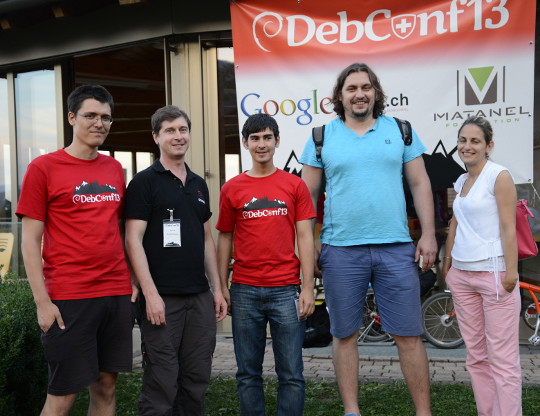
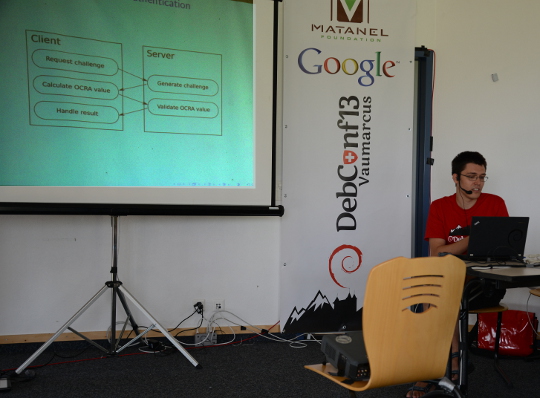
    [still no pictures here, feel free to go to gallery.debconf.org]. After my report about DebCamp, & after being home for 5 days now, here are some thoughts about DebConf13: First of all, I really enjoyed being there, & this was one of the best DebConfs for me so far. An important reason for this was the place: Le Camp was in my opinion the best DebConf venue ever (I've been to), with everything & everyone in one place, & still enough space (especially outdoors space!) for work & relaxing. Kudos to the local team for finding this spot, & for sticking to it despite some criticism. In general, I'd like to say thanks to the local team for the perfect organisation of all aspects you did a great job! What else did I enjoy? As usual, meeting old friends & making new ones was an important part. It was great to see people I've worked together with on-line in person for the first time, & also to get to know new people. Debian not only produces a great operating system, it also is an awesome community! Speaking of which: I attended quite a few seesions from the Community and Team tracks, & it's good to see that lots of energy & thoughts are going into improving how we deal with new or existing contributors. Like each year, we had the "use Perl;" BoF, the annual meeting of the Debian Perl Group, where we discussed various topics around our tasks, tools, & workflow. As each year, in a very friendly & collaborative atmosphere. Besides that, I attended talks about systemd & upstart; the first one disappointed me, since it felt more like a sales pitch than a technical talk & the presenter come across alot like "I know better than you what's good for you", the latter was better but tried to avoid upstart's main issue, the infamous Canonical Contributor License Agreement; of course the audience raised this topic in the Q&A part afterwards. Rock vs. hard place Other interesting topics were what Debian can learn from Ubuntu's QA processes for its own testing migration (mail from the Release Team pending, AFAIK); lots of git stuff, & especially the "birth" of dgit, a tool to treat the Debian archive as a git remote. If this gets traction, it could be a revolution in packaging! The lintian BoF encouraged me further to try to create some pkg-perl specific checks, & then there was jenkins, piuparts, autopkgtest, etc. On Friday we celebrated Debian's 20th birthday with a huge Krem nita/Cr meschnitte/mille-feuille. & with the Poetry Night at the campfire. Usually I'd close with "See you next year in Portland!"; but since it seems like the local team has decided to scratch DebCamp (which they only said after being asked in the Q&A after their presentation), I'm not sure how attractive this really is for me We'll see. Thanks again to everyone who made this DebConf possible!

    22 August 2013

    Mart&iacute;n Ferrari: Setting up my server: re-installing on an encripted LVM

    Very long post ahead (sorry for the wall of text), part of a series of posts on some sysadmin topics, see post 1 and post 2. I want to show you how I set up my tiny dedicated server to have encrypted partitions, and to reinstall it from scratch. All of this without ever accessing the actual server console.

    Introduction As much as my provider may have gold standards on how to do things (they don't, there are some very bad practises in the default installation, like putting their SSH key into root's authorized_keys file), I wouldn't trust an installation done by a third party. Also, I wanted to have all my data securely encrypted. I know this is not perfect, and there are possible attacks. But I think it is a good barrier to have to deter entities without big budgets from getting my data. I have done this twice on my servers, and today I was reviewing each step as he was doing the same thing (with some slight differences) on his brand new server, so I think this is all mostly correct. Please, tell me if you find a bug in this guide. This was done on my 12 /month Kimsufi dedicated server, sold by OVH (see my previous post on why I chose it), and some things are specific to them. But you can do the same thing with any dedicated server that has a rescue netboot image. The process is to boot into the rescue image (this is of course a weak link, as the image could have a keylogger, but we have to stop the paranoia at some point), manually partition the disk, set-up encryption, and LVM; and then install a Debian system with debootstrap. To be able to unlock the encrypted disks, you will have to ssh into the server after a reboot and enter the passphrase (this is done inside the initrd phase). Once unlocked, the normal boot process continues. If anything fails, you end up with an unreachable system: it might or might have not booted, the disk might or might not be unlocked, etc. You can always go back into the rescue netboot image, but that does not allow you to see the boot process. Some providers will give you real remote console access, OVH charges you silly money for that. They used to offer a "virtual KVM", which was a bit of a kludge, but it worked: another netboot image that started a QEMU connected to a VNC server, so by connecting to the VNC server, you would be able to interact with the emulated boot process, but with a fake BIOS and a virtual network. For some unspecified reason they've stopped offering this, but there is a workaround available. The bottom line is, if you have some kind of rescue netboot image, you can just download and run QEMU on it and do the same trick.

    The gritty details Start by netbooting into your rescue image. For OVH, you'd go to the control panel, in the Services/Netboot section and select "rescue pro". Then reboot your server. OVH will mail you a temporary password when it finishes rebooting. Connect to it, without saving the temporary SSH key:
    $ ssh -oUserKnownHostsFile=/dev/null -oStrictHostKeyChecking=no root@$ IP 
    
    For the rest of the text, I am assuming you have one hard drive called /dev/sda. We start by partitioning it:
    # fdisk /dev/sda
    
    Start a new partition table with o, and then create two primary partitions: a small one for /boot at the beginning (100 to 300 MB would do), and a second one with the remaining space. Set both as type 83 (Linux), and don't forget to activate the first one, as this servers refuse to boot from the hard drive without that. Create the file system for /boot, and the encrypted device:
    # mkfs.ext4 /dev/sda1
    # cryptsetup -s 512 -c aes-xts-plain64 luksFormat /dev/sda2
    
    The encryption parameters are the same as the ones used by the Debian Installer by default, so don't change them unless you really know what you are doing. You will need to type a passphrase for the encrypted device, be sure not to forget it! This passphrase can later be changed (or secondary passphrases added) with the cryptsetup tool. Look up the crypt device's UUID, and save it for later:
    # cryptsetup luksDump /dev/sda2   grep UUID:
    UUID:           xxxxxxxx-xxxx-xxxx-xxxx-xxxxxxxxxxxx
    
    Open the encrypted device (type the passphrase again), and set up the LVM volume group:
    # cryptsetup luksOpen /dev/sda2 sda2_crypt
    # pvcreate /dev/mapper/sda2_crypt
    # vgcreate vg0 /dev/mapper/sda2_crypt
    
    Create the logical volumes, this is of course a matter of personal taste and there are many possible variations. This is my current layout, note that I put most of the "big data" in /srv.
    # lvcreate -L 500m -n root vg0
    # lvcreate -L 1.5g -n usr vg0
    # lvcreate -L 3g -n var vg0
    # lvcreate -L 1g -n home vg0
    # lvcreate -L 10g -n srv vg0
    # lvcreate -L 500m -n swap vg0
    # lvcreate -L 100m -n tmp vg0
    
    Some possible variations:
    • You can decide to use a ramdisk for /tmp, so instead of creating a logical volume, you would add RAMTMP=yes to /etc/default/tmpfs.
    • You can merge / and /usr in one same partition, as neither of them change much.
    • You can avoid having swap if you prefer.
    • You can put /home in /srv, and bind mount it later.
    Now, create the file systems, swap space, and mount them in /target. Note that I like to use human-readable labels.
    # for i in home root srv tmp usr var; do 
      mkfs.ext4 -L $i /dev/mapper/vg-$i; done
    # mkswap -L swap /dev/mapper/vg0-swap
    # mkdir /target
    # mount /dev/mapper/vg0-root /target
    # mkdir /target/ boot,home,srv,tmp,usr,var 
    # mount /dev/sda1 /target/boot
    # for i in home srv tmp usr var; do
      mount /dev/mapper/vg-$i /target/$i; done
    # swapon /dev/mapper/vg-swap
    
    Don't forget to set the right permissions for /tmp.
    # chmod 1777 /target/tmp
    
    If you want to do the /home on /srv, you'll need to do this (and then copy to /etc/fstab):
    # mkdir /target/srv/home
    # mount -o bind /target/srv/home /target/home
    
    The disk is ready now. We will use debootstrap to install the base system. The OVH image carries it, otherwise consult the relevant section in the Install manual for details. It is important that at this point you check that you have a good GPG keyring for debootstrap to verify the installation source, by comparing it to a good one (for example, the one in your machine):
    # gpg /usr/share/keyrings/debian-archive-keyring.gpg
    pub  4096R/B98321F9 2010-08-07 Squeeze Stable Release Key <debian-release@lists.debian.org>
    pub  4096R/473041FA 2010-08-27 Debian Archive Automatic Signing Key (6.0/squeeze) <ftpmaster@debian.org>
    pub  4096R/65FFB764 2012-05-08 Wheezy Stable Release Key <debian-release@lists.debian.org>
    pub  4096R/46925553 2012-04-27 Debian Archive Automatic Signing Key (7.0/wheezy) <ftpmaster@debian.org>
    
    Now, for the actual installation. You can use any Debian mirror, OVH has their own in the local network. In OVH's case it is critical to specify the architecture, as the rescue image is i386. I didn't notice that and had to painfully switch architectures in place (which was absolutely not possible a couple of years ago).
    # debootstrap --arch amd64 wheezy /target http://debian.mirrors.ovh.net/debian
    
    After a few minutes downloading and installing stuff, you almost have a Debian system ready to go. Since this is not D-I, we still need to tighten a few screws manually. Let's mount some needed file systems, and enter the brand new system with chroot:
    # mount -o bind /dev /target/dev
    # mount -t proc proc /target/proc
    # mount -t sysfs sys /target/sys
    # XTERM=xterm-color LANG=C.UTF-8 chroot /target /bin/bash
    
    The most critical parts now are to correctly save the parameters for the encrypted device, and the partitions and logical volumes. You'll need the UUID saved before:
    # echo 'sda2_crypt UUID=xxxxxxxx-xxxx-xxxx-xxxx-xxxxxxxxxxxx none luks' \
      > /etc/crypttab
    
    Create the file systems table in /etc/fstab. Here I use labels to identify the devices:
    # file system   mount point type    options             dump    pass
    LABEL=root      /           ext4    errors=remount-ro   0       1
    LABEL=tmp       /tmp        ext4    rw,nosuid,nodev     0       2
    LABEL=var       /var        ext4    rw                  0       2
    LABEL=usr       /usr        ext4    rw,nodev            0       2
    LABEL=home      /home       ext4    rw,nosuid,nodev     0       2
    # Alternative home in /srv:
    #/srv/home      /home       auto    bind                0       0
    LABEL=srv       /srv        ext4    rw,nosuid,nodev     0       2
    LABEL=boot      /boot       ext4    rw,nosuid,nodev     0       2
    LABEL=swap      none        swap    sw                  0       0
    
    You can also just use the device mapper's names (/dev/mapper/<volume_group>-<logical_volume>), be sure not to use the /dev/<volume_group>/<logical_volume> naming, as there are some initrd-tools that choked on them.
    # file system           mount point type    options             dump    pass
    /dev/mapper/vg0-root    /           ext4    errors=remount-ro   0       1
    /dev/mapper/vg0-tmp     /tmp        ext4    rw,nosuid,nodev     0       2
    /dev/mapper/vg0-var     /var        ext4    rw                  0       2
    /dev/mapper/vg0-usr     /usr        ext4    rw,nodev            0       2
    /dev/mapper/vg0-home    /home       ext4    rw,nosuid,nodev     0       2
    # Alternative home in /srv:
    #/srv/home              /home       auto    bind                0   0
    /dev/mapper/vg0-srv     /srv        ext4    rw,nosuid,nodev     0   2
    /dev/sda1               /boot       ext4    rw,nosuid,nodev     0   2
    /dev/mapper/vg0-swap    none        swap    sw                  0   0
    
    Some tools depend on /etc/mtab, which now is just a symbolic link:
    # ln -sf /proc/mounts /etc/mtab
    
    Now configure the network. You most surely can use DHCP, but you might prefer static configuration, that's personal choice. For DHCP, it is very straightforward:
    # cat >> /etc/network/interfaces
    auto eth0
    iface eth0 inet dhcp
    
    For static configuration, first find the current valid addresses and routes as obtained by DHCP:
    # ip address
    # ip route
    
    And then store them:
    # cat >> /etc/network/interfaces
    auto eth0
    iface eth0 inet static
        address AAA.BBB.CCC.DDD/24
        gateway AAA.BBB.CCC.254
        pre-up /sbin/ip addr flush dev eth0   true
    
    Note that pre-up command I added; that is to remove the configuration that is to be done by the kernel during boot (more on that later), otherwise ifupdown will complain about existing addresses. If your provider does IPv6, add it too. For OVH, the IPv6 set-up is a bit weird, so you need to add the routes in post-up. Your default gateway is going to be your /64 prefix, with the last byte replaced by ff, and then followed by :ff:ff:ff:ff. As you can see, that gateway is not in your network segment, so you need to add an explicit route to it. They have some information, but it is completely unreadable. If your IPv6 address is 2001:41D0:1234:5678::1/64, you will add:
    iface eth0 inet6 static
        address 2001:41D0:1234:5678::1/64
        post-up /sbin/ip -6 route add 2001:41D0:1234:56ff:ff:ff:ff:ff dev eth0
        post-up /sbin/ip -6 route add default via 2001:41D0:1234:56ff:ff:ff:ff:ff
    
    You probably don't want the auto-configured IPv6 addresses, so disable them via sysctl:
    # cat >> /etc/sysctl.conf
    # Disable IPv6 autoconf 
    net.ipv6.conf.all.autoconf = 0
    net.ipv6.conf.default.autoconf = 0
    net.ipv6.conf.eth0.autoconf = 0
    net.ipv6.conf.all.accept_ra = 0
    net.ipv6.conf.default.accept_ra = 0
    net.ipv6.conf.eth0.accept_ra = 0
    
    To have a working DNS resolver, we can use the local server (OVH in this case):
    # cat > /etc/resolv.conf 
    search $DOMAIN
    nameserver 213.186.33.99
    
    The most important part of a new install: choose a host name (and make the system use it).
    # echo $HOSTNAME > /etc/hostname
    # hostname $HOSTNAME
    # echo "127.0.1.1 $HOSTNAME.$DOMAIN $HOSTNAME" >> /etc/hosts
    
    If we want to speficy the BIOS clock to use UTC:
    # echo -e '0.0 0 0.0\n0\nUTC' > /etc/adjtime
    
    Set up your time zone:
    # dpkg-reconfigure tzdata
    
    Configure APT with your preferred mirrors. I also prevent APT from installing recommends by default.
    # echo deb http://ftp2.fr.debian.org/debian wheezy main contrib non-free \
      >> /etc/apt/sources.list
    # echo deb http://ftp2.fr.debian.net/debian wheezy-updates main contrib non-free \
      >> /etc/apt/sources.list
    # echo deb http://security.debian.org/ wheezy/updates main contrib non-free \
      >> /etc/apt/sources.list
    # echo 'APT::Install-Recommends "False";' > /etc/apt/apt.conf.d/02recommends
    # apt-get update
    
    Before installing any package, let's make sure that the initial ram disk (initrd) that is going to be created will allow us to connect. There will be no chance of using the root password during boot. Your public key is usually found in $HOME/.ssh/id_rsa.pub.
    # mkdir -p /etc/initramfs-tools/root/.ssh/
    # echo $(YOUR_PUB_RSA_KEY) > /etc/initramfs-tools/root/.ssh/authorized_keys
    
    If you change this, or the host key stored at /etc/dropbear/dropbear_*_host_key, the /etc/crypttab, or any other critical piece of information for the booting process, you need to run update-initramfs -u. Now we can install the missing pieces:
    # apt-get install makedev cryptsetup lvm2 ssh dropbear busybox ssh \
      initramfs-tools locales linux-image-amd64 grub-pc kbd console-setup
    
    During the installation you will have to choose where to install grub, I recommend directly on /dev/sda. Also, the magic initrd will be created. We want to double check that it has all the important pieces for a successful boot:
    # zcat /boot/initrd.img-3.2.0-4-amd64   cpio -t conf/conf.d/cryptroot \
      etc/lvm/lvm.conf etc/dropbear/\* root/.ssh/authorized_keys sbin/dropbear
    etc/lvm/lvm.conf
    etc/dropbear/dropbear_dss_host_key
    etc/dropbear/dropbear_rsa_host_key
    sbin/dropbear
    root/.ssh/authorized_keys
    conf/conf.d/cryptroot
    
    All these files need to be there. Most critically, we need to check that the cryptroot file has the right information to access the root file system:
    # zcat /boot/initrd.img-*   cpio -i --to-stdout conf/conf.d/cryptroot
    target=sda2_crypt,source=UUID=xxxxxxxx-xxxx-xxxx-xxxx-xxxxxxxxxx,key=none,rootdev,lvm=vg0-root
    
    If all that was correct, now we need to tell the kernel to configure the network as soon as possible so we can connect to the initrd and unlock the disks. This is done by passing a command-line option though grub. This should match what was done in /etc/network/interfaces: either DHCP or static configuration. For DHCP, this line should be changed in /etc/default/grub:
    GRUB_CMDLINE_LINUX="ip=:::::eth0:dhcp"
    
    For static configuration:
    GRUB_CMDLINE_LINUX="ip=MY_IP_ADDR::MY_DEFAULT_GW:MY_NETMASK::eth0:none"
    
    It is also a good idea to disable the quiet boot and graphical boot splash, in case we need to use QEMU to fix some booting issue:
    GRUB_CMDLINE_LINUX_DEFAULT=""
    GRUB_TERMINAL=console
    
    And make the changes effective:
    # update-grub2
    
    Having fsck fix problems automatically can be a life-saver too:
    # echo FSCKFIX=yes >> /etc/default/rcS
    
    Get some very useful packages:
    # apt-get install vim less ntpdate sudo
    
    Create an user for yourself, possibly make it an administrator:
    # adduser tincho
    # adduser tincho sudo
    # adduser tincho adm
    
    This is mostly done, exit the chroot, and unmount everything.
    # exit  # the chroot.
    # umount /target/ dev,proc,sys,boot,home,srv,tmp,usr,var 
    # umount /target
    # swapoff -a
    # lvchange -an /dev/mapper/vg0-*
    # cryptsetup luksClose sda2_crypt
    
    Disable the netboot option from your administration panel, reboot, and hope it all goes well. If you followed every step carefully, a few minutes later you should be able to ping your server. Use this snippet to enter the password remotely:
    $ stty -echo; ssh -o UserKnownHostsFile=$HOME/.ssh/known_hosts.initramfs \
      -o BatchMode=yes root@"$HOST" 'cat > /lib/cryptsetup/passfifo'; \
      stty echo
    
    It is very important that you close the pipe (with control-D twice) without typing enter. For my servers, I have a script that reads the passphrase from a GPG-encrypted file and pipes it directly into the remote server. That way, I only type the GPG passphrase locally:
    $ cat unlock.sh 
    #!/bin/sh
    BASE="$(dirname "$0")"
    HOST="$1"
    gpg --decrypt "$BASE"/key-"$HOST".gpg   \
        ssh -o UserKnownHostsFile="$BASE"/known_hosts.initramfs -o BatchMode=yes \
            root@"$HOST" 'cat > /lib/cryptsetup/passfifo'
    
    It might be a good idea to create a long, impossible to guess passphrase that you can use in the GPG-encrypted file, and that you can also print and store in somewhere safe. See the luksAddKey function in the cryptsetup(8) man page. Once again, if everything went right, a few seconds later the openSSH server will replace the tiny dropbear and you will be able to access your server normally (and with the real SSH host key). Hope you find this article helpful! I would love to hear your feedback.

    17 August 2013

    Daniel Pocock: DebConf13: breakthroughs in OTP and WebRTC

    Saturday, 17 August was a day that saw groundbreaking new work revealed at DebConf13 and may have been a watershed moment in the emergence of WebRTC for the free software community.
    Fabian Gr nbichler, Daniel Pocock, Catalin Constantin Usurelu, Emil Ivov, Yana Stamcheva Advancing the use of One Time Passwords with free software Google Summer of Code (GSoC) student Fabian Gr nbichler has spent the summer enhancing oath-toolkit and dynalogin to support a more diverse range of One Time Password schemes. dynalogin's original 1.0 release supports vanilla HOTP and TOTP authentication schemes. Fabian's work has extended the framework to support the more generic and powerful OCRA approach. To find out about all the benefits this brings, I would strongly encourage you to review his slides and video presentation, with a demo where it is explained thoroughly. While there are existing hardware tokens that support HOTP and TOTP using this open algorithm (Gooze has been kind enough to donate some which were on display), the mutual challenge-response schemes are yet to be widely supported in hardware and this means that Fabian's work is now at the cutting edge of development in this area. WebRTC: premium voice/video chat in modern browsers, no plugin required Another member of Debian's GSoC program, Catalin Constantin Usurelu helped organise and run one of the must-see sessions of DebConf13 (video available). In a demonstration that had all the hallmarks of a magic show, Catalin and I took random members of the audience and invited them to wave a magic wand over their web browsers and effortlessly turn them into Skype-busting softphones. As the grand finale, we took Wookey's blog and showed him how to add a WebRTC "call-me" page in less than 20 seconds, less time than it takes to hand over all your private data to the registration process of those rather uncomfortable alternatives. Anybody else seeking to duplicate this effort is encourage to review options like Drucall for Drupal or just directly use JsSIP Jitsi and the Jitsi Video-bridge The grand-finale of the DebConf13 real-time communications track was our guest speaker, Emil Ivov, founder of the Jitsi softphone project. Jitsi itself has recently been accepted into Debian and is easier than ever before to install and use. Emil's talk (video and slides available) went into some detail about the cutting edge development activities of his team, particularly the new Jitsi Video bridge Subsequent to the talk, we had some out-of-bands discussion about ways to potentially integrate Jitsi Video bridge with the open source dvswitch system used to produce streams and recordings from free software events such as DebConf and FOSDEM. It is hoped that this will provide an additional option for remote participation at free software events of all sizes. Upcoming events Emil and I have been invited to participate in the WebRTC Conference Paris 2013 in December. This will be an excellent opportunity to have further discussion about progress with WebRTC and do more to raise the compelling case for premium quality free software to meet the demanding needs of modern business communications. There are a series of talks for both technical and business-oriented audiences.
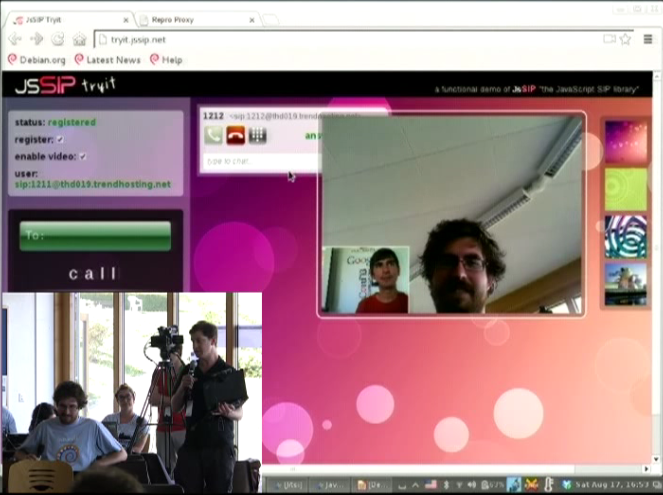
    16 August 2013

    Joey Hess: Debian at 20

    RichiH used flint and steel to light the bonfire. We carefully fed it up from those sparks to a blaze. Put on the biggest logs we could find to make it last. Now I'm sitting on the hill above it watching folks gathered around. A poem is being read, in Hindi, then translated for us to English. Others have shared songs and poems in a dozen languages, both classics and their own. Out below the darkness of the lake. This is Debian at 20. At the start of this DebConf, I gave a talk on "Debian Cosmology. In that (and a later "dh_busfactor" talk) I shared my hopes and my fears. I was conflicted about giving the this talk, worked on it for weeks, felt it might not work, or be depressing. I've had nothing but good comments about it. 20 years is ages in internet time and technical projects ossify over time. The last session I was in this afternoon was a presentation of a new tool, which I hope & feel has the potential to fundamentally change an important and suboptimal part of Debian. Then I walked outside to a rainbow over crystal clear Swiss alps on the horizon. How encouraging, and what a nice story that will be around some future campfire.

    Justus Winter: All the important bits are there - please test and review :)

    Finally, more bootlog-pr0n:
    start ext2fs: Hurd server bootstrap: ext2fs[device:hd0s1] exec init proc auth
    INIT: version 2.88 booting
    Using makefile-style concurrent boot in runlevel S.
    Activating swap...done.
    Checking root file system...fsck from util-linux 2.20.1
    hd2 : tray open or drive not ready
    hd2 : tray open or drive not ready
    hd2 : tray open or drive not ready
    hd2 : tray open or drive not ready
    end_request: I/O error, dev 02:00, sector 0
    /dev/hd0s1: clean, 44680/181056 files, 292234/723200 blocks
    done.
    Activating lvm and md swap...(default pager): Already paging to partition hd0s5!
    done.
    Checking file systems...fsck from util-linux 2.20.1
    hd2 : tray open or drive not ready
    hd2 : tray open or drive not ready
    end_request: I/O error, dev 02:00, sector 0
    done.
    Cleaning up temporary files... /tmp.
    Mounting local filesystems...done.
    Activating swapfile swap...(default pager): Already paging to partition hd0s5!
    done.
    df: Warning: cannot read table of mounted file systems: No such file or directory
    Cleaning up temporary files....
    Configuring network interfaces...inetutils-ifconfig: invalid arguments
    ifup: failed to open pid file /run/network/ifup-/dev/eth0.pid: No such file or directory
    Internet Systems Consortium DHCP Client 4.2.2
    Copyright 2004-2011 Internet Systems Consortium.
    All rights reserved.
    For info, please visit https://www.isc.org/software/dhcp/
    can't create /var/lib/dhcp/dhclient./dev/eth0.leases: No such file or directory
    Listening on Socket//dev/eth0
    Sending on   Socket//dev/eth0
    DHCPDISCOVER on /dev/eth0 to 255.255.255.255 port 67 interval 8
    DHCPREQUEST on /dev/eth0 to 255.255.255.255 port 67
    DHCPOFFER from 10.0.2.2
    DHCPACK from 10.0.2.2
    can't create /var/lib/dhcp/dhclient./dev/eth0.leases: No such file or directory
    bound to 10.0.2.15 -- renewal in 34744 seconds.
    done.
    Cleaning up temporary files....
    Setting up X socket directories... /tmp/.X11-unix /tmp/.ICE-unix.
    INIT: Entering runlevel: 2
    Using makefile-style concurrent boot in runlevel 2.
    Starting enhanced syslogd: rsyslogd.
    Starting deferred execution scheduler: atd.
    Starting periodic command scheduler: cron.
    Starting system message bus: dbusFailed to set socket option"/var/run/dbus/system_bus_socket": Protocol not available.
    Starting OpenBSD Secure Shell server: sshd.
    unexpected ACK from keyboard
    GNU 0.3 (debian) (console)
    login: root
    root@debian:~# shutdown -h now
    Broadcast message from root@debian (console) (Fri Aug 16 20:02:47 2013):
    The system is going down for system halt NOW!
    INIT: Switching to runlevel: 0root@debian:~#
    INIT: Sending processes the TERM signal
    INIT: Sending processes the KILL signal
    Using makefile-style concurrent boot in runlevel 0.
    Stopping deferred execution scheduler: atd.
    task c10f72a8 deallocating an invalid port 2098928, most probably a bug.
    Asking all remaining processes to terminate...done.
    All processes ended within 1 seconds...done.
    Stopping enhanced syslogd: rsyslogd.
    Deconfiguring network interfaces...ifdown: failed to open pid file /run/network/ifdown-/dev/eth0.pid: No such file or directory
    Internet Systems Consortium DHCP Client 4.2.2
    Copyright 2004-2011 Internet Systems Consortium.
    All rights reserved.
    For info, please visit https://www.isc.org/software/dhcp/
    can't create /var/lib/dhcp/dhclient./dev/eth0.leases: No such file or directory
    Listening on Socket//dev/eth0
    Sending on   Socket//dev/eth0
    /bin/sh: 1: ifconfig: not found
    done.
    Deactivating swap...swapoff: /dev/hd0s5: 177152k swap space
    done.
    Unmounting weak filesystems...umount: /etc/mtab: Warning: duplicate entry for device /dev/hd0s1 (/dev/cons)
    umount: could not find entry for: /dev/cons
    done.
    Unmounting local filesystems...done.
    mount: cannot remount /: Device or resource busy
    Will now halt.
    init: notifying pfinet of shutdown...init: notifying tmpfs swap of shutdown...init: notifying tmpfs swap of shutdown...init: notifying tmpfs swap of shutdown...init: notifying ext2fs device:hd0s1 of shutdown...init: halting Mach (flags 0x8)...
    In tight loop: hit ctl-alt-del to reboot
    
    (You might note that df complains about not being able to read the mtab file. That is because it has been built with _PATH_MOUNTED being /var/run/mtab. This will correct itself when the coreutils package is being rebuilt against a patched libc.) I spent my last two weeks with polishing my patch series, that meant a lot of package rebuilds and that means a lot of waiting (even more so on the Hurd, short version: fakeroot-hurd could be fast but is not yet working properly, fakeroot-tcp is slow) and thus some frustration ;) Also I had to pay special attention so that the upgraded packages could be installed without accidentally breaking anything in the process. Making sysvinit pid 1 is surprisingly tricky in this regard since it breaks the ABI and requires a libc fix that also worked with the current Hurd servers. Here are the patches: So I had some spare time on my hand while waiting for numerous package rebuilds and I took this as an opportunity to read papers about Mach and to familiarize myself with mig, the Mach Interface Generator. While I have used it in the past, I had not yet looked at its implementation. And I had to patch the exec server, and there was both code implementing a questionable feature (on-demand unzipping of binaries) and code that was not even compiled (courtesy of the preprocessor) and had probably bit-rot by now. So I figured I could spend my time doing some cleanups: I have rebuild all the necessary packages and uploaded them into an apt repository:
    deb http://teythoon.cryptobitch.de/gsoc/heap/debian unstable main
    
    Please use unstable for now. Also make sure that you have a recovery plan for your Debian/Hurd installation if anything goes wrong. For your convenience there's a seed tarball containing packages with the appropriate sources.list.d snippets and the repository key: https://teythoon.cryptobitch.de/gsoc/heap/debian/seed.tar If you want to switch to the new runsystem.sysv, do:
    # update-alternatives --config runsystem
    
    Whenever you switch runsystems, please use reboot-hurd to reboot the system. This is the most robust way. Known issues:
    • procfs hardcodes the default kernel pid to 2. This breaks /proc/uptime and any program relying on it, most notably top and friends. Until this is properly fixed, you can do:

      # settrans -apfg /proc /hurd/procfs -c -k 3
      
    • The mtab translator should probably try to filter out non-filesystem translators. df complains loudly about /dev/cons for example.

    Next week I will address the network related issues. By now they are the source of most of the error messages in the bootlog.

    Next.

    Previous.