Antoine Beaupr : October 2017 report: LTS, feed2exec beta, pandoc filters, git mediawiki
Debian Long Term Support (LTS)
This is my monthly Debian LTS report. This time I worked on the
famous KRACK attack, git-annex, golang and the continuous stream of
GraphicsMagick security issues.
WPA & KRACK update
I spent most of my time this month on the Linux WPA code, to
backport it to the old (~2012) wpa_supplicant release. I
first published a patchset based on the patches shipped after the
embargo for the oldstable/jessie release. After feedback from the
list, I also built packages for i386 and ARM.
I have also reviewed the WPA protocol to make sure I understood
the implications of the changes required to backport the patches. For
example, I removed the patches touching the WNM sleep mode code as
that was introduced only in the 2.0 release. Chunks of code regarding
state tracking were also not backported as they are part of the state
tracking code introduced later, in 3ff3323. Finally, I still have
concerns about the nonce setup in patch #5. In the last chunk, you'll
notice peer->tk is reset, to_set to negotiate a new TK. The other
approach I considered was to backport 1380fcbd9f ("TDLS: Do not
modify RNonce for an TPK M1 frame with same INonce") but I figured I
would play it safe and not introduce further variations.
I should note that I share Matthew Green's observations regarding
the opacity of the protocol. Normally, network protocols are freely
available and security researchers like me can easily review them. In
this case, I would have needed to read the
opaque 802.11i-2004 pdf which is behind a TOS wall at
the IEEE. I ended up reading up on the IEEE_802.11i-2004
Wikipedia article which gives a simpler view of the protocol. But it's
a real problem to see such critical protocols developed behind closed
doors like this.
At Guido's suggestion, I sent the final patch upstream
explaining the concerns I had with the patch. I have not, at the time
of writing, received any response from upstream about this,
unfortunately. I uploaded the fixed packages as DLA 1150-1 on
October 31st.
Git-annex
The next big chunk on my list was completing the work on git-annex
(CVE-2017-12976) that I started in August. It turns out
doing the backport was simpler than I expected, even with my rusty
experience with Haskell. Type-checking really helps in doing the right
thing, especially considering how Joey Hess implemented the fix: by
introducing a new type.
So I backported the patch from upstream and notified the security
team that the jessie and stretch updates would be similarly easy. I
shipped the backport to LTS as DLA-1144-1. I also shared the
updated packages for jessie (which required a similar backport) and
stretch (which didn't) and those Sebastien Delafond published those
as DSA 4010-1.
Graphicsmagick
Up next was yet another security vulnerability in the Graphicsmagick
stack. This involved the usual deep dive into intricate and sometimes
just unreasonable C code to try and fit a round tree in a square
sinkhole. I'm always unsure about those patches, but the test suite
passes, smoke tests show the vulnerability as fixed, and that's pretty
much as good as it gets.
The announcement (DLA 1154-1) turned out to be a little special
because I had previously noticed that the penultimate
announcement (DLA 1130-1) was never sent out. So I made a merged
announcement to cover both instead of re-sending the original 3 weeks
late, which may have been confusing for our users.
Triage & misc
We always do a bit of triage even when not on frontdesk duty, so I:
- sent another ping to the ca-certificates maintainer
- triaged Puppet's CVE-2016-5714 out of wheezy and other
suites, after a thorough analysis of the what has become
the intricate numbering scheme for Puppet suites
- triaged ImageMagick as not affecting in wheezy and jessie, but it
turned out the latter was a little too enthusiastic as the team
wanted to wait for upstream confirmation before skipping jessie
- did some research on tiff's CVE-2017-11613 (skipped by
RHEL) and CVE-2017-9935 (no fix upstream)
I also did smaller bits of work on:
- worked on a patch to add a
dch --lts flag in Debian bug #762715
which is currently pending review
- golang's CVE-2017-15041 which I
originally triaged out but then changed my mind as the
patch was small and the impact was large. This turned
into DLA-1148-1.
The latter reminded me of the concerns I have about the long-term
maintainability of the golang ecosystem: because everything is
statically linked, an update to a core library (say the SMTP library
as in CVE-2017-15042, thankfully not affecting LTS)
requires a full rebuild of all packages including the library in all
distributions. So what would be a simple update in a shared library
system could mean an explosion of work on statically linked
infrastructures. This is a lot of work which can definitely be
error-prone: as I've seen in other updates, some packages (for example
the Ruby interpreter) just bit-rot on their own and eventually fail to
build from source. We would also have to investigate all packages to
see which one include the library, something which we are not well
equipped for at this point.
Wheezy was the first release shipping golang packages but at least
it's shipping only one... Stretch has shipped with two golang
versions (1.7 and 1.8) which will make maintenance ever harder in the
long term.
We build our computers the way we build our cities--over time,
without a plan, on top of ruins.
- Ellen Ullman
Other free software work
This month again, I was busy doing some serious yak shaving
operations all over the internet, on top of publishing two of my
largest LWN articles to date
(2017-10-16-strategies-offline-pgp-key-storage and
2017-10-26-comparison-cryptographic-keycards).
feed2exec beta
Since I
announced
this new project last month I have released it as a beta and
it entered Debian. I have also wrote useful plugins like the
wayback plugin that saves pages on the Wayback machine for
eternal archival. The archive plugin can also similarly save pages
to the local filesystem. I also added bash completion, expanded unit
tests and documentation, fixed default file paths and a bunch of bugs,
and refactored the code. Finally, I also started using two external
Python libraries instead of rolling my own code: the pyxdg
and requests-file libraries, the latter which
I packaged in Debian (and fixed a bug in their test suite).
The program is working pretty well for me. The only thing I feel is
really missing now is a retry/fail mechanism. Right now, it's a little
brittle: any network hiccup will yield an error email, which are
readable to me but could be confusing to a new user. Strangely enough,
I am particularly having trouble with (local!) DNS resolution that I
need to look into, but that is probably unrelated with the software
itself. Thankfully, the user can disable those with --loglevel=ERROR
to silence WARNINGs.
Furthermore, some plugins still have some rough edges. For example,
The Transmission integration would probably work better as a
distinct plugin instead of a simple exec call, because when it adds
new torrents, the output is totally cryptic. That plugin could also
leverage more feed parameters to save different files in different
locations depending on the feed titles, something would be hard to do
safely with the exec plugin now.
I am keeping a steady flow of releases. I wish there was a way to see
how effective I am at reaching out with this project, but
unfortunately GitLab doesn't provide usage statistics... And I
have received only a few comments on IRC about the project, so maybe I
need to reach out more like it says in
the fine manual. Always feels strange to have to promote your
project like it's some new bubbly soap...
Next steps for the project is a final review of the API and release
production-ready 1.0.0. I am also thinking of making a small
screencast to show the basic capabilities of the software, maybe
with asciinema's upcoming audio support?
Pandoc filters
As I mentioned earlier, I dove again in Haskell programming when
working on the git-annex security update. But I also have a small
Haskell program of my own - a Pandoc filter that I use to convert
the HTML articles I publish on LWN.net into a Ikiwiki-compatible
markdown version. It turns out the script was still missing a bunch of
stuff: image sizes, proper table formatting, etc. I also worked hard
on automating more bits of the publishing workflow by extracting the
time from the article which allowed me to simply extract the full
article into an almost final copy just by specifying the article
ID. The only thing left is to add tags, and the article is complete.
In the process, I learned about new weird Haskell constructs. Take
this code, for example:
-- remove needless blockquote wrapper around some tables
--
-- haskell newbie tips:
--
-- @ is the "at-pattern", allows us to define both a name for the
-- construct and inspect the contents as once
--
--   is the "empty record pattern": it basically means "match the
-- arguments but ignore the args"
cleanBlock (BlockQuote t@[Table  ]) = t
Here the idea is to remove <blockquote> elements needlessly wrapping
a <table>. I can't specify the Table type on its own, because then
I couldn't address the table as a whole, only its parts. I could
reconstruct the whole table bits by bits, but it wasn't as clean.
The other pattern was how to, at last, address multiple string
elements, which was difficult because Pandoc treats spaces specially:
cleanBlock (Plain (Strong (Str "Notifications":Space:Str "for":Space:Str "all":Space:Str "responses":_):_)) = []
The last bit that drove me crazy was the date parsing:
-- the "GAByline" div has a date, use it to generate the ikiwiki dates
--
-- this is distinct from cleanBlock because we do not want to have to
-- deal with time there: it is only here we need it, and we need to
-- pass it in here because we do not want to mess with IO (time is I/O
-- in haskell) all across the function hierarchy
cleanDates :: ZonedTime -> Block -> [Block]
-- this mouthful is just the way the data comes in from
-- LWN/Pandoc. there could be a cleaner way to represent this,
-- possibly with a record, but this is complicated and obscure enough.
cleanDates time (Div (_, [cls], _)
                 [Para [Str month, Space, Str day, Space, Str year], Para _])
    cls == "GAByline" = ikiwikiRawInline (ikiwikiMetaField "date"
                                           (iso8601Format (parseTimeOrError True defaultTimeLocale "%Y-%B-%e,"
                                                           (year ++ "-" ++ month ++ "-" ++ day) :: ZonedTime)))
                        ++ ikiwikiRawInline (ikiwikiMetaField "updated"
                                             (iso8601Format time))
                        ++ [Para []]
-- other elements just pass through
cleanDates time x = [x]
Now that seems just dirty, but it was even worse before. One thing I
find difficult in adapting to coding in Haskell is that you need to
take the habit of writing smaller functions. The language is really
not well adapted to long discourse: it's more about getting small
things connected together. Other languages (e.g. Python) discourage
this because there's some overhead in calling functions (10
nanoseconds in my tests, but still), whereas functions are a
fundamental and important construction in Haskell that are much more
heavily optimized. So I constantly need to remind myself to split
things up early, otherwise I can't do anything in Haskell.
Other languages are more lenient, which does mean my code can be more
dirty, but I feel get things done faster then. The oddity of Haskell
makes frustrating to work with. It's like doing construction work but
you're not allowed to get the floor dirty. When I build stuff, I don't
mind things being dirty: I can cleanup afterwards. This is especially
critical when you don't actually know how to make things clean in
the first place, as Haskell
will simply not let you do that at all.
And obviously, I fought with Monads, or, more specifically, "I/O" or
IO in this case. Turns out that getting the current time is IO in
Haskell: indeed, it's not a "pure" function that will always return
the same thing. But this means that I would have had to change the
signature of all the functions that touched time to include IO. I
eventually moved the time initialization up into main so that I had
only one IO function and moved that timestamp downwards as simple
argument. That way I could keep the rest of the code clean, which
seems to be an acceptable pattern.
I would of course be happy to get feedback from my Haskell readers (if
any) to see how to improve that code. I am always eager to learn.
Git remote MediaWiki
Few people know that there is a MediaWiki remote for Git which
allow you to mirror a MediaWiki site as a Git repository. As a
disaster recovery mechanism, I have been keeping such a historical
backup of the Amateur radio wiki for a while now. This originally
started as a homegrown Python script to also convert the contents
in Markdown. My theory then was to see if we could switch from
Mediawiki to Ikiwiki, but it took so long to implement that I never
completed the work.
When someone had the weird idea of renaming a page to
some impossible long name on the wiki, my script broke. I tried
to look at fixing it and then remember I also had a mirror running
using the Git remote. It turns out it also broke on the same issue
and that got me looking in the remote again. I
got lost in a zillion issues, including fixing
that specific issue, but I especially looked at the possibility
of fetching all namespaces because I realized that the remote
fetches only a part of the wiki by default. And that drove me to
submit namespace support as a patch to
the git mailing list. Finally, the discussion came back
to how to actually maintain that contrib: in git core or outside?
Finally, it looks like I'll be doing some maintenance that project
outside of git, as I was granted access to the GitHub
organisation...
Galore Yak Shaving
Then there's the usual hodgepodge of fixes and random things I did
over the month.
- Beta testing for the new Signal desktop app which is,
unfortunately, an Electron app. This means the binary is huge, at
95MB, and the app takes a whopping 300MB of ram right after
startup. Compare this with my IRC client (irssi) which takes
15MB of ram or pidgin, which takes 80MB of ram. Then ponder the
costs of developer convenience versus impact on the environment and
users...
- Routine linkchecker maintenance: 3 PRs merged including
a bugfix of my own, one of which inspired me to add the pyxdg
dependency in feed2exec.
- When adding "badges" to the feed2exec documentation, I also
fixed an issue in badges.debian.net, where
Debian was referring to wheezy instead of the symbolic name
- Tested the Wireguard VPN with moderate success. It can only
cross NAT one way, so it was useless for my use case. I ended up
using end to end IPv6! still,
I updated the Turris OS Wireguard version so that I could use
this as a way to get end to end IPv4 connectivity to machines
behind my NAT.
- Tested a static image gallery generator replacement
called Sigal. I suggested a way to
add progress information for video processing and did a
general issue review. I also looked at how to package it in Debian,
in RFP #879239. I looked into Sigal after finally getting a
confirmation from the Photofloat maintainer (Jason
A. Donenfeld, who's also the Wireguard author)
that our patches will never get merged, after 3 years of radio
silence. In comparison, the response I got from the communications
with Sigal were much more positive. I have therefore requested
removal of photofloat from Debian
- More on ham radio stuff: I got a Signalink working, which
allowed me to receive and transmit APRS signals using a handheld
transmitter
- I worked more on SafeEyes to try and get it
to credit me idle time, which is still not working yet,
and suggested improvements to the preferences panel
- I found out about the Chrome Lighthouse web page auditor, which
doesn't seem to work at all in Chromium, but has a lot of
potential. there's a standalone version as well, which could be
packaged for Debian, but found that #775925 is for a
different lighthouse - a dead Bitcoin-based crowdfunding
platform
- I helped Koumbit.org configure load balancing for their
HTTPS services. For this, I needed to change my IP address, so I
test again the Bitmask client and found problems
with polkit and the password failure prompt. I also
suggested improvements the kerying package.
- After realizing there was no future in the It's all text!
(IAT) extension, I have switched to Ghosttext which works both
in Chromium and Firefox and uses a model similar to
the Edit in Emacs extension for Chrome, but it also supports
Firefox and other editors. I
have filed an issue about silent failures with uMatrix and
generally tried to help the IAT community find an exit
strategy. (Short story: it's impossible to port, and XUL will die a
horrible death.)
There is no [web extension] only XUL! - Inside joke
wpa_supplicant release. I
first published a patchset based on the patches shipped after the
embargo for the oldstable/jessie release. After feedback from the
list, I also built packages for i386 and ARM.
I have also reviewed the WPA protocol to make sure I understood
the implications of the changes required to backport the patches. For
example, I removed the patches touching the WNM sleep mode code as
that was introduced only in the 2.0 release. Chunks of code regarding
state tracking were also not backported as they are part of the state
tracking code introduced later, in 3ff3323. Finally, I still have
concerns about the nonce setup in patch #5. In the last chunk, you'll
notice peer->tk is reset, to_set to negotiate a new TK. The other
approach I considered was to backport 1380fcbd9f ("TDLS: Do not
modify RNonce for an TPK M1 frame with same INonce") but I figured I
would play it safe and not introduce further variations.
I should note that I share Matthew Green's observations regarding
the opacity of the protocol. Normally, network protocols are freely
available and security researchers like me can easily review them. In
this case, I would have needed to read the
opaque 802.11i-2004 pdf which is behind a TOS wall at
the IEEE. I ended up reading up on the IEEE_802.11i-2004
Wikipedia article which gives a simpler view of the protocol. But it's
a real problem to see such critical protocols developed behind closed
doors like this.
At Guido's suggestion, I sent the final patch upstream
explaining the concerns I had with the patch. I have not, at the time
of writing, received any response from upstream about this,
unfortunately. I uploaded the fixed packages as DLA 1150-1 on
October 31st.
Git-annex
The next big chunk on my list was completing the work on git-annex
(CVE-2017-12976) that I started in August. It turns out
doing the backport was simpler than I expected, even with my rusty
experience with Haskell. Type-checking really helps in doing the right
thing, especially considering how Joey Hess implemented the fix: by
introducing a new type.
So I backported the patch from upstream and notified the security
team that the jessie and stretch updates would be similarly easy. I
shipped the backport to LTS as DLA-1144-1. I also shared the
updated packages for jessie (which required a similar backport) and
stretch (which didn't) and those Sebastien Delafond published those
as DSA 4010-1.
Graphicsmagick
Up next was yet another security vulnerability in the Graphicsmagick
stack. This involved the usual deep dive into intricate and sometimes
just unreasonable C code to try and fit a round tree in a square
sinkhole. I'm always unsure about those patches, but the test suite
passes, smoke tests show the vulnerability as fixed, and that's pretty
much as good as it gets.
The announcement (DLA 1154-1) turned out to be a little special
because I had previously noticed that the penultimate
announcement (DLA 1130-1) was never sent out. So I made a merged
announcement to cover both instead of re-sending the original 3 weeks
late, which may have been confusing for our users.
Triage & misc
We always do a bit of triage even when not on frontdesk duty, so I:
- sent another ping to the ca-certificates maintainer
- triaged Puppet's CVE-2016-5714 out of wheezy and other
suites, after a thorough analysis of the what has become
the intricate numbering scheme for Puppet suites
- triaged ImageMagick as not affecting in wheezy and jessie, but it
turned out the latter was a little too enthusiastic as the team
wanted to wait for upstream confirmation before skipping jessie
- did some research on tiff's CVE-2017-11613 (skipped by
RHEL) and CVE-2017-9935 (no fix upstream)
I also did smaller bits of work on:
- worked on a patch to add a
dch --lts flag in Debian bug #762715
which is currently pending review
- golang's CVE-2017-15041 which I
originally triaged out but then changed my mind as the
patch was small and the impact was large. This turned
into DLA-1148-1.
The latter reminded me of the concerns I have about the long-term
maintainability of the golang ecosystem: because everything is
statically linked, an update to a core library (say the SMTP library
as in CVE-2017-15042, thankfully not affecting LTS)
requires a full rebuild of all packages including the library in all
distributions. So what would be a simple update in a shared library
system could mean an explosion of work on statically linked
infrastructures. This is a lot of work which can definitely be
error-prone: as I've seen in other updates, some packages (for example
the Ruby interpreter) just bit-rot on their own and eventually fail to
build from source. We would also have to investigate all packages to
see which one include the library, something which we are not well
equipped for at this point.
Wheezy was the first release shipping golang packages but at least
it's shipping only one... Stretch has shipped with two golang
versions (1.7 and 1.8) which will make maintenance ever harder in the
long term.
We build our computers the way we build our cities--over time,
without a plan, on top of ruins.
- Ellen Ullman
Other free software work
This month again, I was busy doing some serious yak shaving
operations all over the internet, on top of publishing two of my
largest LWN articles to date
(2017-10-16-strategies-offline-pgp-key-storage and
2017-10-26-comparison-cryptographic-keycards).
feed2exec beta
Since I
announced
this new project last month I have released it as a beta and
it entered Debian. I have also wrote useful plugins like the
wayback plugin that saves pages on the Wayback machine for
eternal archival. The archive plugin can also similarly save pages
to the local filesystem. I also added bash completion, expanded unit
tests and documentation, fixed default file paths and a bunch of bugs,
and refactored the code. Finally, I also started using two external
Python libraries instead of rolling my own code: the pyxdg
and requests-file libraries, the latter which
I packaged in Debian (and fixed a bug in their test suite).
The program is working pretty well for me. The only thing I feel is
really missing now is a retry/fail mechanism. Right now, it's a little
brittle: any network hiccup will yield an error email, which are
readable to me but could be confusing to a new user. Strangely enough,
I am particularly having trouble with (local!) DNS resolution that I
need to look into, but that is probably unrelated with the software
itself. Thankfully, the user can disable those with --loglevel=ERROR
to silence WARNINGs.
Furthermore, some plugins still have some rough edges. For example,
The Transmission integration would probably work better as a
distinct plugin instead of a simple exec call, because when it adds
new torrents, the output is totally cryptic. That plugin could also
leverage more feed parameters to save different files in different
locations depending on the feed titles, something would be hard to do
safely with the exec plugin now.
I am keeping a steady flow of releases. I wish there was a way to see
how effective I am at reaching out with this project, but
unfortunately GitLab doesn't provide usage statistics... And I
have received only a few comments on IRC about the project, so maybe I
need to reach out more like it says in
the fine manual. Always feels strange to have to promote your
project like it's some new bubbly soap...
Next steps for the project is a final review of the API and release
production-ready 1.0.0. I am also thinking of making a small
screencast to show the basic capabilities of the software, maybe
with asciinema's upcoming audio support?
Pandoc filters
As I mentioned earlier, I dove again in Haskell programming when
working on the git-annex security update. But I also have a small
Haskell program of my own - a Pandoc filter that I use to convert
the HTML articles I publish on LWN.net into a Ikiwiki-compatible
markdown version. It turns out the script was still missing a bunch of
stuff: image sizes, proper table formatting, etc. I also worked hard
on automating more bits of the publishing workflow by extracting the
time from the article which allowed me to simply extract the full
article into an almost final copy just by specifying the article
ID. The only thing left is to add tags, and the article is complete.
In the process, I learned about new weird Haskell constructs. Take
this code, for example:
-- remove needless blockquote wrapper around some tables
--
-- haskell newbie tips:
--
-- @ is the "at-pattern", allows us to define both a name for the
-- construct and inspect the contents as once
--
-- is the "empty record pattern": it basically means "match the
-- arguments but ignore the args"
cleanBlock (BlockQuote t@[Table ]) = t
Here the idea is to remove <blockquote> elements needlessly wrapping
a <table>. I can't specify the Table type on its own, because then
I couldn't address the table as a whole, only its parts. I could
reconstruct the whole table bits by bits, but it wasn't as clean.
The other pattern was how to, at last, address multiple string
elements, which was difficult because Pandoc treats spaces specially:
cleanBlock (Plain (Strong (Str "Notifications":Space:Str "for":Space:Str "all":Space:Str "responses":_):_)) = []
The last bit that drove me crazy was the date parsing:
-- the "GAByline" div has a date, use it to generate the ikiwiki dates
--
-- this is distinct from cleanBlock because we do not want to have to
-- deal with time there: it is only here we need it, and we need to
-- pass it in here because we do not want to mess with IO (time is I/O
-- in haskell) all across the function hierarchy
cleanDates :: ZonedTime -> Block -> [Block]
-- this mouthful is just the way the data comes in from
-- LWN/Pandoc. there could be a cleaner way to represent this,
-- possibly with a record, but this is complicated and obscure enough.
cleanDates time (Div (_, [cls], _)
[Para [Str month, Space, Str day, Space, Str year], Para _])
cls == "GAByline" = ikiwikiRawInline (ikiwikiMetaField "date"
(iso8601Format (parseTimeOrError True defaultTimeLocale "%Y-%B-%e,"
(year ++ "-" ++ month ++ "-" ++ day) :: ZonedTime)))
++ ikiwikiRawInline (ikiwikiMetaField "updated"
(iso8601Format time))
++ [Para []]
-- other elements just pass through
cleanDates time x = [x]
Now that seems just dirty, but it was even worse before. One thing I
find difficult in adapting to coding in Haskell is that you need to
take the habit of writing smaller functions. The language is really
not well adapted to long discourse: it's more about getting small
things connected together. Other languages (e.g. Python) discourage
this because there's some overhead in calling functions (10
nanoseconds in my tests, but still), whereas functions are a
fundamental and important construction in Haskell that are much more
heavily optimized. So I constantly need to remind myself to split
things up early, otherwise I can't do anything in Haskell.
Other languages are more lenient, which does mean my code can be more
dirty, but I feel get things done faster then. The oddity of Haskell
makes frustrating to work with. It's like doing construction work but
you're not allowed to get the floor dirty. When I build stuff, I don't
mind things being dirty: I can cleanup afterwards. This is especially
critical when you don't actually know how to make things clean in
the first place, as Haskell
will simply not let you do that at all.
And obviously, I fought with Monads, or, more specifically, "I/O" or
IO in this case. Turns out that getting the current time is IO in
Haskell: indeed, it's not a "pure" function that will always return
the same thing. But this means that I would have had to change the
signature of all the functions that touched time to include IO. I
eventually moved the time initialization up into main so that I had
only one IO function and moved that timestamp downwards as simple
argument. That way I could keep the rest of the code clean, which
seems to be an acceptable pattern.
I would of course be happy to get feedback from my Haskell readers (if
any) to see how to improve that code. I am always eager to learn.
Git remote MediaWiki
Few people know that there is a MediaWiki remote for Git which
allow you to mirror a MediaWiki site as a Git repository. As a
disaster recovery mechanism, I have been keeping such a historical
backup of the Amateur radio wiki for a while now. This originally
started as a homegrown Python script to also convert the contents
in Markdown. My theory then was to see if we could switch from
Mediawiki to Ikiwiki, but it took so long to implement that I never
completed the work.
When someone had the weird idea of renaming a page to
some impossible long name on the wiki, my script broke. I tried
to look at fixing it and then remember I also had a mirror running
using the Git remote. It turns out it also broke on the same issue
and that got me looking in the remote again. I
got lost in a zillion issues, including fixing
that specific issue, but I especially looked at the possibility
of fetching all namespaces because I realized that the remote
fetches only a part of the wiki by default. And that drove me to
submit namespace support as a patch to
the git mailing list. Finally, the discussion came back
to how to actually maintain that contrib: in git core or outside?
Finally, it looks like I'll be doing some maintenance that project
outside of git, as I was granted access to the GitHub
organisation...
Galore Yak Shaving
Then there's the usual hodgepodge of fixes and random things I did
over the month.
- Beta testing for the new Signal desktop app which is,
unfortunately, an Electron app. This means the binary is huge, at
95MB, and the app takes a whopping 300MB of ram right after
startup. Compare this with my IRC client (irssi) which takes
15MB of ram or pidgin, which takes 80MB of ram. Then ponder the
costs of developer convenience versus impact on the environment and
users...
- Routine linkchecker maintenance: 3 PRs merged including
a bugfix of my own, one of which inspired me to add the pyxdg
dependency in feed2exec.
- When adding "badges" to the feed2exec documentation, I also
fixed an issue in badges.debian.net, where
Debian was referring to wheezy instead of the symbolic name
- Tested the Wireguard VPN with moderate success. It can only
cross NAT one way, so it was useless for my use case. I ended up
using end to end IPv6! still,
I updated the Turris OS Wireguard version so that I could use
this as a way to get end to end IPv4 connectivity to machines
behind my NAT.
- Tested a static image gallery generator replacement
called Sigal. I suggested a way to
add progress information for video processing and did a
general issue review. I also looked at how to package it in Debian,
in RFP #879239. I looked into Sigal after finally getting a
confirmation from the Photofloat maintainer (Jason
A. Donenfeld, who's also the Wireguard author)
that our patches will never get merged, after 3 years of radio
silence. In comparison, the response I got from the communications
with Sigal were much more positive. I have therefore requested
removal of photofloat from Debian
- More on ham radio stuff: I got a Signalink working, which
allowed me to receive and transmit APRS signals using a handheld
transmitter
- I worked more on SafeEyes to try and get it
to credit me idle time, which is still not working yet,
and suggested improvements to the preferences panel
- I found out about the Chrome Lighthouse web page auditor, which
doesn't seem to work at all in Chromium, but has a lot of
potential. there's a standalone version as well, which could be
packaged for Debian, but found that #775925 is for a
different lighthouse - a dead Bitcoin-based crowdfunding
platform
- I helped Koumbit.org configure load balancing for their
HTTPS services. For this, I needed to change my IP address, so I
test again the Bitmask client and found problems
with polkit and the password failure prompt. I also
suggested improvements the kerying package.
- After realizing there was no future in the It's all text!
(IAT) extension, I have switched to Ghosttext which works both
in Chromium and Firefox and uses a model similar to
the Edit in Emacs extension for Chrome, but it also supports
Firefox and other editors. I
have filed an issue about silent failures with uMatrix and
generally tried to help the IAT community find an exit
strategy. (Short story: it's impossible to port, and XUL will die a
horrible death.)
There is no [web extension] only XUL! - Inside joke
dch --lts flag in Debian bug #762715
which is currently pending reviewfeed2exec beta
Since I
announced
this new project last month I have released it as a beta and
it entered Debian. I have also wrote useful plugins like the
wayback plugin that saves pages on the Wayback machine for
eternal archival. The archive plugin can also similarly save pages
to the local filesystem. I also added bash completion, expanded unit
tests and documentation, fixed default file paths and a bunch of bugs,
and refactored the code. Finally, I also started using two external
Python libraries instead of rolling my own code: the pyxdg
and requests-file libraries, the latter which
I packaged in Debian (and fixed a bug in their test suite).
The program is working pretty well for me. The only thing I feel is
really missing now is a retry/fail mechanism. Right now, it's a little
brittle: any network hiccup will yield an error email, which are
readable to me but could be confusing to a new user. Strangely enough,
I am particularly having trouble with (local!) DNS resolution that I
need to look into, but that is probably unrelated with the software
itself. Thankfully, the user can disable those with --loglevel=ERROR
to silence WARNINGs.
Furthermore, some plugins still have some rough edges. For example,
The Transmission integration would probably work better as a
distinct plugin instead of a simple exec call, because when it adds
new torrents, the output is totally cryptic. That plugin could also
leverage more feed parameters to save different files in different
locations depending on the feed titles, something would be hard to do
safely with the exec plugin now.
I am keeping a steady flow of releases. I wish there was a way to see
how effective I am at reaching out with this project, but
unfortunately GitLab doesn't provide usage statistics... And I
have received only a few comments on IRC about the project, so maybe I
need to reach out more like it says in
the fine manual. Always feels strange to have to promote your
project like it's some new bubbly soap...
Next steps for the project is a final review of the API and release
production-ready 1.0.0. I am also thinking of making a small
screencast to show the basic capabilities of the software, maybe
with asciinema's upcoming audio support?
Pandoc filters
As I mentioned earlier, I dove again in Haskell programming when
working on the git-annex security update. But I also have a small
Haskell program of my own - a Pandoc filter that I use to convert
the HTML articles I publish on LWN.net into a Ikiwiki-compatible
markdown version. It turns out the script was still missing a bunch of
stuff: image sizes, proper table formatting, etc. I also worked hard
on automating more bits of the publishing workflow by extracting the
time from the article which allowed me to simply extract the full
article into an almost final copy just by specifying the article
ID. The only thing left is to add tags, and the article is complete.
In the process, I learned about new weird Haskell constructs. Take
this code, for example:
-- remove needless blockquote wrapper around some tables
--
-- haskell newbie tips:
--
-- @ is the "at-pattern", allows us to define both a name for the
-- construct and inspect the contents as once
--
-- is the "empty record pattern": it basically means "match the
-- arguments but ignore the args"
cleanBlock (BlockQuote t@[Table ]) = t
Here the idea is to remove <blockquote> elements needlessly wrapping
a <table>. I can't specify the Table type on its own, because then
I couldn't address the table as a whole, only its parts. I could
reconstruct the whole table bits by bits, but it wasn't as clean.
The other pattern was how to, at last, address multiple string
elements, which was difficult because Pandoc treats spaces specially:
cleanBlock (Plain (Strong (Str "Notifications":Space:Str "for":Space:Str "all":Space:Str "responses":_):_)) = []
The last bit that drove me crazy was the date parsing:
-- the "GAByline" div has a date, use it to generate the ikiwiki dates
--
-- this is distinct from cleanBlock because we do not want to have to
-- deal with time there: it is only here we need it, and we need to
-- pass it in here because we do not want to mess with IO (time is I/O
-- in haskell) all across the function hierarchy
cleanDates :: ZonedTime -> Block -> [Block]
-- this mouthful is just the way the data comes in from
-- LWN/Pandoc. there could be a cleaner way to represent this,
-- possibly with a record, but this is complicated and obscure enough.
cleanDates time (Div (_, [cls], _)
[Para [Str month, Space, Str day, Space, Str year], Para _])
cls == "GAByline" = ikiwikiRawInline (ikiwikiMetaField "date"
(iso8601Format (parseTimeOrError True defaultTimeLocale "%Y-%B-%e,"
(year ++ "-" ++ month ++ "-" ++ day) :: ZonedTime)))
++ ikiwikiRawInline (ikiwikiMetaField "updated"
(iso8601Format time))
++ [Para []]
-- other elements just pass through
cleanDates time x = [x]
Now that seems just dirty, but it was even worse before. One thing I
find difficult in adapting to coding in Haskell is that you need to
take the habit of writing smaller functions. The language is really
not well adapted to long discourse: it's more about getting small
things connected together. Other languages (e.g. Python) discourage
this because there's some overhead in calling functions (10
nanoseconds in my tests, but still), whereas functions are a
fundamental and important construction in Haskell that are much more
heavily optimized. So I constantly need to remind myself to split
things up early, otherwise I can't do anything in Haskell.
Other languages are more lenient, which does mean my code can be more
dirty, but I feel get things done faster then. The oddity of Haskell
makes frustrating to work with. It's like doing construction work but
you're not allowed to get the floor dirty. When I build stuff, I don't
mind things being dirty: I can cleanup afterwards. This is especially
critical when you don't actually know how to make things clean in
the first place, as Haskell
will simply not let you do that at all.
And obviously, I fought with Monads, or, more specifically, "I/O" or
IO in this case. Turns out that getting the current time is IO in
Haskell: indeed, it's not a "pure" function that will always return
the same thing. But this means that I would have had to change the
signature of all the functions that touched time to include IO. I
eventually moved the time initialization up into main so that I had
only one IO function and moved that timestamp downwards as simple
argument. That way I could keep the rest of the code clean, which
seems to be an acceptable pattern.
I would of course be happy to get feedback from my Haskell readers (if
any) to see how to improve that code. I am always eager to learn.
Git remote MediaWiki
Few people know that there is a MediaWiki remote for Git which
allow you to mirror a MediaWiki site as a Git repository. As a
disaster recovery mechanism, I have been keeping such a historical
backup of the Amateur radio wiki for a while now. This originally
started as a homegrown Python script to also convert the contents
in Markdown. My theory then was to see if we could switch from
Mediawiki to Ikiwiki, but it took so long to implement that I never
completed the work.
When someone had the weird idea of renaming a page to
some impossible long name on the wiki, my script broke. I tried
to look at fixing it and then remember I also had a mirror running
using the Git remote. It turns out it also broke on the same issue
and that got me looking in the remote again. I
got lost in a zillion issues, including fixing
that specific issue, but I especially looked at the possibility
of fetching all namespaces because I realized that the remote
fetches only a part of the wiki by default. And that drove me to
submit namespace support as a patch to
the git mailing list. Finally, the discussion came back
to how to actually maintain that contrib: in git core or outside?
Finally, it looks like I'll be doing some maintenance that project
outside of git, as I was granted access to the GitHub
organisation...
Galore Yak Shaving
Then there's the usual hodgepodge of fixes and random things I did
over the month.
- Beta testing for the new Signal desktop app which is,
unfortunately, an Electron app. This means the binary is huge, at
95MB, and the app takes a whopping 300MB of ram right after
startup. Compare this with my IRC client (irssi) which takes
15MB of ram or pidgin, which takes 80MB of ram. Then ponder the
costs of developer convenience versus impact on the environment and
users...
- Routine linkchecker maintenance: 3 PRs merged including
a bugfix of my own, one of which inspired me to add the pyxdg
dependency in feed2exec.
- When adding "badges" to the feed2exec documentation, I also
fixed an issue in badges.debian.net, where
Debian was referring to wheezy instead of the symbolic name
- Tested the Wireguard VPN with moderate success. It can only
cross NAT one way, so it was useless for my use case. I ended up
using end to end IPv6! still,
I updated the Turris OS Wireguard version so that I could use
this as a way to get end to end IPv4 connectivity to machines
behind my NAT.
- Tested a static image gallery generator replacement
called Sigal. I suggested a way to
add progress information for video processing and did a
general issue review. I also looked at how to package it in Debian,
in RFP #879239. I looked into Sigal after finally getting a
confirmation from the Photofloat maintainer (Jason
A. Donenfeld, who's also the Wireguard author)
that our patches will never get merged, after 3 years of radio
silence. In comparison, the response I got from the communications
with Sigal were much more positive. I have therefore requested
removal of photofloat from Debian
- More on ham radio stuff: I got a Signalink working, which
allowed me to receive and transmit APRS signals using a handheld
transmitter
- I worked more on SafeEyes to try and get it
to credit me idle time, which is still not working yet,
and suggested improvements to the preferences panel
- I found out about the Chrome Lighthouse web page auditor, which
doesn't seem to work at all in Chromium, but has a lot of
potential. there's a standalone version as well, which could be
packaged for Debian, but found that #775925 is for a
different lighthouse - a dead Bitcoin-based crowdfunding
platform
- I helped Koumbit.org configure load balancing for their
HTTPS services. For this, I needed to change my IP address, so I
test again the Bitmask client and found problems
with polkit and the password failure prompt. I also
suggested improvements the kerying package.
- After realizing there was no future in the It's all text!
(IAT) extension, I have switched to Ghosttext which works both
in Chromium and Firefox and uses a model similar to
the Edit in Emacs extension for Chrome, but it also supports
Firefox and other editors. I
have filed an issue about silent failures with uMatrix and
generally tried to help the IAT community find an exit
strategy. (Short story: it's impossible to port, and XUL will die a
horrible death.)
There is no [web extension] only XUL! - Inside joke
-- remove needless blockquote wrapper around some tables
--
-- haskell newbie tips:
--
-- @ is the "at-pattern", allows us to define both a name for the
-- construct and inspect the contents as once
--
-- is the "empty record pattern": it basically means "match the
-- arguments but ignore the args"
cleanBlock (BlockQuote t@[Table ]) = t
<blockquote> elements needlessly wrapping
a <table>. I can't specify the Table type on its own, because then
I couldn't address the table as a whole, only its parts. I could
reconstruct the whole table bits by bits, but it wasn't as clean.
The other pattern was how to, at last, address multiple string
elements, which was difficult because Pandoc treats spaces specially:
cleanBlock (Plain (Strong (Str "Notifications":Space:Str "for":Space:Str "all":Space:Str "responses":_):_)) = []
-- the "GAByline" div has a date, use it to generate the ikiwiki dates
--
-- this is distinct from cleanBlock because we do not want to have to
-- deal with time there: it is only here we need it, and we need to
-- pass it in here because we do not want to mess with IO (time is I/O
-- in haskell) all across the function hierarchy
cleanDates :: ZonedTime -> Block -> [Block]
-- this mouthful is just the way the data comes in from
-- LWN/Pandoc. there could be a cleaner way to represent this,
-- possibly with a record, but this is complicated and obscure enough.
cleanDates time (Div (_, [cls], _)
[Para [Str month, Space, Str day, Space, Str year], Para _])
cls == "GAByline" = ikiwikiRawInline (ikiwikiMetaField "date"
(iso8601Format (parseTimeOrError True defaultTimeLocale "%Y-%B-%e,"
(year ++ "-" ++ month ++ "-" ++ day) :: ZonedTime)))
++ ikiwikiRawInline (ikiwikiMetaField "updated"
(iso8601Format time))
++ [Para []]
-- other elements just pass through
cleanDates time x = [x]
IO in this case. Turns out that getting the current time is IO in
Haskell: indeed, it's not a "pure" function that will always return
the same thing. But this means that I would have had to change the
signature of all the functions that touched time to include IO. I
eventually moved the time initialization up into main so that I had
only one IO function and moved that timestamp downwards as simple
argument. That way I could keep the rest of the code clean, which
seems to be an acceptable pattern.
I would of course be happy to get feedback from my Haskell readers (if
any) to see how to improve that code. I am always eager to learn.
Git remote MediaWiki
Few people know that there is a MediaWiki remote for Git which
allow you to mirror a MediaWiki site as a Git repository. As a
disaster recovery mechanism, I have been keeping such a historical
backup of the Amateur radio wiki for a while now. This originally
started as a homegrown Python script to also convert the contents
in Markdown. My theory then was to see if we could switch from
Mediawiki to Ikiwiki, but it took so long to implement that I never
completed the work.
When someone had the weird idea of renaming a page to
some impossible long name on the wiki, my script broke. I tried
to look at fixing it and then remember I also had a mirror running
using the Git remote. It turns out it also broke on the same issue
and that got me looking in the remote again. I
got lost in a zillion issues, including fixing
that specific issue, but I especially looked at the possibility
of fetching all namespaces because I realized that the remote
fetches only a part of the wiki by default. And that drove me to
submit namespace support as a patch to
the git mailing list. Finally, the discussion came back
to how to actually maintain that contrib: in git core or outside?
Finally, it looks like I'll be doing some maintenance that project
outside of git, as I was granted access to the GitHub
organisation...
Galore Yak Shaving
Then there's the usual hodgepodge of fixes and random things I did
over the month.
- Beta testing for the new Signal desktop app which is,
unfortunately, an Electron app. This means the binary is huge, at
95MB, and the app takes a whopping 300MB of ram right after
startup. Compare this with my IRC client (irssi) which takes
15MB of ram or pidgin, which takes 80MB of ram. Then ponder the
costs of developer convenience versus impact on the environment and
users...
- Routine linkchecker maintenance: 3 PRs merged including
a bugfix of my own, one of which inspired me to add the pyxdg
dependency in feed2exec.
- When adding "badges" to the feed2exec documentation, I also
fixed an issue in badges.debian.net, where
Debian was referring to wheezy instead of the symbolic name
- Tested the Wireguard VPN with moderate success. It can only
cross NAT one way, so it was useless for my use case. I ended up
using end to end IPv6! still,
I updated the Turris OS Wireguard version so that I could use
this as a way to get end to end IPv4 connectivity to machines
behind my NAT.
- Tested a static image gallery generator replacement
called Sigal. I suggested a way to
add progress information for video processing and did a
general issue review. I also looked at how to package it in Debian,
in RFP #879239. I looked into Sigal after finally getting a
confirmation from the Photofloat maintainer (Jason
A. Donenfeld, who's also the Wireguard author)
that our patches will never get merged, after 3 years of radio
silence. In comparison, the response I got from the communications
with Sigal were much more positive. I have therefore requested
removal of photofloat from Debian
- More on ham radio stuff: I got a Signalink working, which
allowed me to receive and transmit APRS signals using a handheld
transmitter
- I worked more on SafeEyes to try and get it
to credit me idle time, which is still not working yet,
and suggested improvements to the preferences panel
- I found out about the Chrome Lighthouse web page auditor, which
doesn't seem to work at all in Chromium, but has a lot of
potential. there's a standalone version as well, which could be
packaged for Debian, but found that #775925 is for a
different lighthouse - a dead Bitcoin-based crowdfunding
platform
- I helped Koumbit.org configure load balancing for their
HTTPS services. For this, I needed to change my IP address, so I
test again the Bitmask client and found problems
with polkit and the password failure prompt. I also
suggested improvements the kerying package.
- After realizing there was no future in the It's all text!
(IAT) extension, I have switched to Ghosttext which works both
in Chromium and Firefox and uses a model similar to
the Edit in Emacs extension for Chrome, but it also supports
Firefox and other editors. I
have filed an issue about silent failures with uMatrix and
generally tried to help the IAT community find an exit
strategy. (Short story: it's impossible to port, and XUL will die a
horrible death.)
There is no [web extension] only XUL! - Inside joke
- Beta testing for the new Signal desktop app which is, unfortunately, an Electron app. This means the binary is huge, at 95MB, and the app takes a whopping 300MB of ram right after startup. Compare this with my IRC client (irssi) which takes 15MB of ram or pidgin, which takes 80MB of ram. Then ponder the costs of developer convenience versus impact on the environment and users...
- Routine linkchecker maintenance: 3 PRs merged including a bugfix of my own, one of which inspired me to add the pyxdg dependency in feed2exec.
- When adding "badges" to the feed2exec documentation, I also fixed an issue in badges.debian.net, where Debian was referring to wheezy instead of the symbolic name
- Tested the Wireguard VPN with moderate success. It can only cross NAT one way, so it was useless for my use case. I ended up using end to end IPv6! still, I updated the Turris OS Wireguard version so that I could use this as a way to get end to end IPv4 connectivity to machines behind my NAT.
- Tested a static image gallery generator replacement called Sigal. I suggested a way to add progress information for video processing and did a general issue review. I also looked at how to package it in Debian, in RFP #879239. I looked into Sigal after finally getting a confirmation from the Photofloat maintainer (Jason A. Donenfeld, who's also the Wireguard author) that our patches will never get merged, after 3 years of radio silence. In comparison, the response I got from the communications with Sigal were much more positive. I have therefore requested removal of photofloat from Debian
- More on ham radio stuff: I got a Signalink working, which allowed me to receive and transmit APRS signals using a handheld transmitter
- I worked more on SafeEyes to try and get it to credit me idle time, which is still not working yet, and suggested improvements to the preferences panel
- I found out about the Chrome Lighthouse web page auditor, which doesn't seem to work at all in Chromium, but has a lot of potential. there's a standalone version as well, which could be packaged for Debian, but found that #775925 is for a different lighthouse - a dead Bitcoin-based crowdfunding platform
- I helped Koumbit.org configure load balancing for their HTTPS services. For this, I needed to change my IP address, so I test again the Bitmask client and found problems with polkit and the password failure prompt. I also suggested improvements the kerying package.
- After realizing there was no future in the It's all text! (IAT) extension, I have switched to Ghosttext which works both in Chromium and Firefox and uses a model similar to the Edit in Emacs extension for Chrome, but it also supports Firefox and other editors. I have filed an issue about silent failures with uMatrix and generally tried to help the IAT community find an exit strategy. (Short story: it's impossible to port, and XUL will die a horrible death.)
There is no [web extension] only XUL! - Inside joke
 Here is my monthly update covering what I have been doing in the free software world in October 2017 (
 Halloween is here, time to upload a new set of scary packages of TeX Live. About a month has passed, so there is the usual big stream up updates. There was actually an intermediate release to get out some urgent fixes, but I never reported the news here. So here are the accumulated changes and updates.
 My favorite this time is
 To understand why this is a problem, I restart from the already linked blog: Our packages have revision numbers based on the latest change revision of all the contained files. Since subversion has a linear history and central repository, this guarantees that in contrast to version numbers provided by authors the revision numbers are strictly increasing .
Well, it turned out that this assumption was wrong. Because it is easy to trick subversion to have wrong revision numbers for files. Consider the following flow:
 For many years now, I have been driving a diesel based VW Passat Estate. It
has served me very well and been as reliable as I might have hoped given how
awful I am with cars. Sadly Gunther was reaching the point where it was
going to cost more per year to maintain than the car was worth, and also I've
been being more and more irked by not having a car from the future.
I spent many months doing spreadsheets, trying to convince myself I could
somehow afford a Tesla of some variety. Sadly I never quite managed it. As
such I set my sights on the more viable BEVs such as the Nissan Leaf. For a
while, nothing I saw was something I wanted. I am quite unusual it seems, in
that I don't want a car which is a "Look at me, I'm driving an electric car"
fashion statement. I felt like I'd never get something which looked like a
normal car, but happened to be a BEV.
Then along came the Hyundai Ioniq. Hybrid, Plug-in Hybrid, and BEV all looking
basically the same, and not in-your-face-special. I began to covet.
Eventually I caved and arranged a test drive of an Ioniq plug-in hybrid because
the BEV was basically on 9 month lead. I enjoyed the drive and was instantly
very sad because I didn't want a plug-in hybrid, I wanted a BEV. Despondent,
I left the dealership and went home.
I went online and found a small number of second-hand Ioniq BEVs but as I
scrolled through the list, none seemed to be of the right trim level. Then,
just as I was ready to give up hope, I saw a new listing, no photo, of the
right thing. One snag, it was 200 miles away. No matter, I rang the place,
confirmed it was available, and agreed to sleep on the decision.
The following morning, I hadn't decided to not buy, so I called them up, put
down a deposit to hold the car until I could test drive it, and then began the
long and awkward process of working out how I would charge the car given I have
no off-street parking so I can't charge at home. (Yeah yeah, you'd think I'd
have checked that first, but no I'm just not that sensible). Over the week
I convinced myself I could do it, I ordered RFID cards for various schemes,
signed up with a number of services, and then, on Friday last week, I drove
down to a hotel near the dealership and had a fitful night's sleep.
I rocked up to the dealership exactly as they opened for business, shook the
hand of the very helpful salesman who had gone through the purchase process
with me over the phone during the week, and got to see the car. Instant want
coursed through me as I sat in it and decided "Yes, this somehow feels right".
I took the car for about a 45 minute test drive just to see how it felt
relative to the plug-in hybrid I'd driven the week before and it was like night
and day. The BEV felt so much better to drive. I was hooked. Back to the
dealership and we began the paperwork. Emptying Gunther of all of the bits
and bobs scattered throughout his nooks and crannies took a while and gave me a
chance to say goodbye to a car which, on reflection, had actually been a
pleasure to own, even when its expensive things went wrong, more than once.
But once I'd closed the Passat for the last time, and handed the keys over, it
was quite a bittersweet moment as the salesman drove off in what still felt
like my car, despite (by this point) it not being so.
Sitting in the Ioniq though, I headed off for the 200 mile journey back home.
With about 90% charge left after the test drive, I had two stops planned at
rapid chargers and I headed toward my first.
Unfortunately disaster struck, the rapid (50KW) charger refused to initialise,
and I ended up with my car on the slower (7KW) charger to get enough juice into
it to drive on to the next rapid charger enabled service station. When I got
the message that my maximum charge period (45m) had elapsed, I headed back to
the car to discover I couldn't persuade it to unlock from the car. Much hassle
later, and an AA man came and together we learned that it takes 2 to tango, one
to pull the emergency release in the boot, the other to then unplug the cable.
Armed with this knowledge, I headed on my way to a rapid charger I'd found on
the map which wasn't run by the same company. Vainly hoping that this would
work better, I plugged the car in, set the charger going, and headed into the
adjacent shop for a rest break. I went back to the car about 20 minutes later
to see the charger wasn't running. Horror of horrors. I imagined maybe some
nasty little oik had pressed 'stop' so I started the charger up again, and sat
in the car to read my book. After about 3 minutes, the charge stopped. Turns
out that charger was slightly iffy and couldn't cope with the charge current
and kept emergency-stopping as a result. The lovely lady I spoke to about it
directed me to a nearby (12 miles or so, easily done with the charge I had)
charger in the grounds of a gorgeous chateau hotel. That one worked perfectly
and I filled up. I drove on to my second planned stop and that charge went
perfectly too. In fact, every charge since has gone flawlessly. So perhaps my
baptism of failed charges has hardened me to the problems with owning a BEV.
I've spent the past few days trying different charge points around Manchester
enjoying my free charge capability, and trying different names for the car
before I finally settled on which is a reasonable Korean boy's name
(since the car is Korean I even got to set that as the bluetooth ID) and it's
roughly pronounced sock/gin which are two wonderful things in life.
I'm currently sat in a pub, eating a burger, enjoying myself while suckles
on the teat of "free" electricity to make up for the fact that I've developed a
non-trivial habit of leaving Audi drivers in the dust at traffic lights.
Further updates may happen as I play with Android Auto and other toys in an
attempt to eventually be able to ask the car to please "freeze my buttocks"
(a feature it has in the form of air-conditioned seats.)
 Reproducible Builds Summit 3 next week in Berlin
Next week from Tuesday, the 31st of October until Thursday, November 2nd, we'll have the
 Wishing all Debian people a prosperous and auspicious Gujarati new year (V.S. 2074 called Saumya.)
This year fireworks became legal for the first time in New Jersey. Not that it ever stopped us before but it is nice to see the government stop meddling for no reason. (
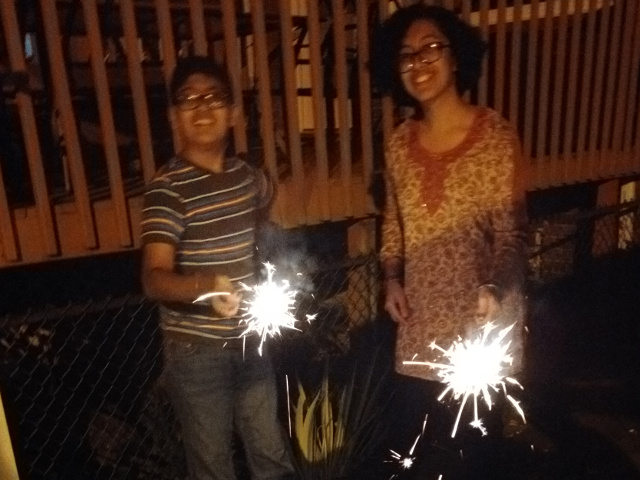 Although you can only see sparklers in the picture above, we got enough armament to make
 This post has it all. Flotillas of sailboats, peer-to-peer wikis, games,
and de-frogging. But, I need to start by talking about some tech you may not
have heard of yet...