Search Results: "sten"

6 May 2008

Joey Hess: distributed wikis

Done some interesting stuff in ikiwiki this evening.. Maybe you want to set up a mirror of a wiki. It's easy enough to do with an ikiwiki that's backed by git since you can just clone its repository and set up the mirror. But how to know when there's an update of the origin wiki, to update your mirror? I've added a plugin that allows you to edit a page on the origin wiki, and ask it to ping your wiki. And another plugin that your wiki can use to listen for pings and update itself, pulling down the changes from version control. Nice thing about this is that any ikiwiki wiki that publishes its revision control, and enables the pinger plugin, can then be mirrored by anyone, with no coordination needed with its admin. Even multilevel mirror networks are possible to set up. (The astute may notice that loops are also possible.. but they will will be broken after 1 cycle.) But this doesn't only allow mirroring. If you're using distributed version control, it also allows branching of a wiki. Just mirror as usual, but then make changes to the mirror, and don't send them back to the origin. Instant branch, that will be kept up-to-date with changes made to the origin. (Unless there's a conflict, that would need to be manually resolved, obviously.) Wouldn't it be nice if you could git clone git://wikipedia.org/ or git://wiki.debian.org/ and go off and make it into something you're really happy with? Only thing standing in the way is that neither site uses ikiwiki. For now, you'll have to settle with cloning and branching git://git.ikiwiki.info/ :-) Technical details here.

Biella Coleman: Monsanto: Making the RIAA and Big Pharma Look Kinda Good

Surveillance, massive patent litigation, and toxic trails are just a few of the atrocities that are part and parcel of the global giant Monsanto. They do not just produce a lot of the worlds GE crops but some MAJOR FUD with real muscle as this disturbing in-depth article demonstrates . Whether it is their shadowy, relentless fight against American farmers to “protect” their patents or their fight to scare dairy farmers from labeling their milk BST free, they deploy an astonishing range of legal and extra-legal tactics to make sure they stay on top. Below is a smattering of some of their creepiest tactics, which kinda make the RIAA look angelic in comparison.
“To gather leads, the company maintains an 800 number and encourages farmers to inform on other farmers they think may be engaging in seed piracy. Once Pilot Grove had been targeted, Monsanto sent private investigators into the area. Over a period of months, Monsanto s investigators surreptitiously followed the co-op s employees and customers and videotaped them in fields and going about other activities. At least 17 such surveillance videos were made, according to court records
“Studies by health authorities consistently found elevated levels of PCBs in houses, yards, streams, fields, fish, and other wildlife and in people. In 2003, Monsanto and Solutia entered into a consent decree with the E.P.A. to clean up Anniston. Scores of houses and small businesses were to be razed, tons of contaminated soil dug up and carted off, and streambeds scooped of toxic residue. The cleanup is under way, and it will take years, but some doubt it will ever be completed the job is massive. To settle residents claims, Monsanto has also paid $550 million to 21,000 Anniston residents exposed to PCBs, but many of them continue to live with PCBs in their bodies. Once PCB is absorbed into human tissue, there it forever remains.”
The company contends that advertising by Kleinpeter and other dairies touting their no rBGH milk reflects adversely on Monsanto s product. In a letter to the Federal Trade Commission in February 2007, Monsanto said that, notwithstanding the overwhelming evidence that there is no difference in the milk from cows treated with its product, milk processors persist in claiming on their labels and in advertisements that the use of rBST is somehow harmful, either to cows or to the people who consume milk from rBST-supplemented cows. Monsanto called on the commission to investigate what it called the deceptive advertising and labeling practices of milk processors such as Kleinpeter, accusing them of misleading consumers by falsely claiming that there are health and safety risks associated with milk from rBST-supplemented cows.

Martin F. Krafft: How launchpad got it wrong

A common rant against Launchpad is that it s closed: the code is proprietary, and Canonical doesn t give raw access to the data they collect via the interface. Anyway, other people have taken up this issue, and it s not the point of this post to do so. I ve heard two argument why Launchpad is closed: first, it s a test bed for a product, which Canonical hopes to market to commercial entities to manage their own release cycles. And second: it s purposely cross-project and tries to integrate and link between them. Thus, lots of instances of Launchpad would defeat the point. I ll address these points in turn, starting from the back: While I won t deny a pre-trend towards (back to) mainframe-like computing, with Google, Amazon, and others providing rent-a-computer-cycle services. In addition, environmental concerns cast clouds over the 400W heating appliance under your desk, which happens to run your word processor and browser when it doesn t lose track of its countless spare cycles. Yet, I maintain that centralised services, such as Launchpad are a thing of the past. If you ask me, Launchpad got it wrong, even though it s light years further than its predecessors. It features pleasant graphics and obviously has had lots of smart thinking and experience shoved into it, but it s still centralised. It might be a business case, but it s not what the world needs. We ve seen massive growth of decentralised approaches to classic services, from file sharing to version control, from number crunching to simple web browsing, and yet, there s Launchpad, single point of entry (and failure) to the world of data surrounding Free software (at least if you follow their vision). What we need is something as slick as Launchpad, and thousands of instances thereof, which all peer with each other, automatically. The information would automatically be mirrored wherever it s referenced, so the entire cloud would be highly-available and failure-proof. Obviously, this wouldn t render itself well to the (traditional) software business model Canonical seems to strive for, so they re unlikely to go down this route. But we could. It would be a non-competitor. Update: thanks for the copious feedback I ve received. Among them was a comment by [Elliot Murphy]](http://launchpad.net/~statik), who speaks of us and thus leads me to believe that he s part of the Launchpad team:
We re definitely listening, and we still have lots more improvements we want to make. Our goal is collaboration, not centralization: thats why we build bazaar, are working busily on doing two-way integration with other bug tracker systems, and are building the best API we can. Our goal in the team is to make it trivially easy for you to get all the data that you put into launchpad back out through the API, data portability is very important. There is no big evil business model, but it would be socially irresponsible if we did not work toward making launchpad self-sustaining. It has been a long road, but the launchpad team is steadily working toward a distributed model, one step at a time.
While it s definitely nice to hear that data portability is a concern to them, I don t see Debian using Launchpad without the ability to run it on our own servers. I m definitely curious to hear more about the distributed model the team is pursuing. I certainly don t have a problem with self-sustainability, but in the Free software world, I do wonder what that is supposed to achieve. Release early, release often, anyone? Update: Philip Newborough took up the issue and has received a number of noteworthy replies. It made me very happy that he sees my post as a rant about Launchpad which is not lambasting Canonical for their proprietary Launchpad software; I wasn t aiming for any lambasting. NP: Nine Inch Nails: Further Down the Spiral

5 May 2008

Wouter Verhelst: Microsoft on installing PHP and Perl

On their "get the facts" site (as if), Microsoft recently posted a set of screencast demonstrating how much "easier" it is to install Perl and PHP on IIS than it is on Linux. Being bored, I had a look at these screencasts. The first covered installing stuff on Windows; in a 5 minute screencast, they first explain how you install ActivePerl, and have it handle perl scripts for a webserver through a CGI interface. This involves way too many steps to remember for me (including clicking through a wizard, going to the IIS management interface and enabling it, creating a directory and enabling that in the IIS interface as a CGI location, and more). Next, they do the same for PHP. Since they install PHP as a CGI binary rather than an ISAPI module, the setup isn't as complex—they conveniently reused many of the settings they'd done for perl—but it still required quite some steps. After having watched this screencast, I was wondering how they'd make it look harder on a Linux system. My guess was that they'd use Slackware and would compile apache, perl, and php from scratch or some such. That didn't turn out to be the case, however. They used ubuntu. To make the process look complicated, they refrained from using synaptic, instead opening an (almost full-screen) shell window, in which they use apt-get to install the libapache2-mod-php5 package. They conveniently also first installed the wrong version of apache, so that it would do all kinds of magical and confusing things. Really, however, after having installed this package, everything works—and they show that. The perl step should have been ignored. After installing apache on Debian or any of its derivatives, such as Ubuntu, support for Perl CGI scripts has already been installed and configured. Configuring that requires exactly zero steps. However, they still install libapache2-mod-perl, just to make it look a bit more confusing. It's not a very bad idea to do this, actually; installing mod_perl makes serving Perl scripts go quite a bit faster. But if you just want to have apache serve perl through CGI scripts, as they'd done on the IIS setup, all you need to do is install ubuntu, and make sure there's an apache installed. Period. But that's not all. They cheat. The installation of the perl and php modules on ubuntu includes the process of downloading the binaries and their dependencies; on the Windows screencast, the downloads have already been performed, and are placed on the desktop. This nicely avoids showing how you need to go to the ActivePerl and PHP websites, track down installers, download them, wait for your download to complete, and then manually start the installation process. To make things even more laughable, they install Perl and PHP as CGI handlers on Windows, but perform an installation of the same software through apache's C API. In other words, they told you how to install a fast and useful Linux system, and how to install a slow and less useful Windows installation (since a PHP setup that uses CGI will not support sessions or persistent database connections, amongst other things). And even with all that cheating and blundering, the Windows screencast still takes 5 minutes, as compared to the four for Ubuntu. I think Mahatma Gandhi forgot one line in his famous quote. It should have this:
Then they make complete and utter fools of themselves in a vain attempt to still look relevant
... right before the "then you win".

Aigars Mahinovs: Speak to the mind and youll drop in ratings

Apparently it is a political suicide in USA to make people think. Obama’s ex-preacher Jeremiah Wright is the most sane US preacher that I’ve ever heard. If you read or listen to his sermons in full length and go beyond the Fox News presented soundbites, he is 99% right. The US has long been doing extreme violence to countries around the world, so it is no wonder that such violence came back to US. Russia had the same problem with Afghanistan and Chechnya. If you try to put yourself up as ‘world police’, some people will disagree. Then he damned America’s _government_ for letting Americans down by not caring enough about the people. The only thing that I would smile and shake my head at was the statement that American government invented HIV. I doubt even they have such resources. Read this transcript for example, the sermon is just a great sermon that urges the people think for themselves. And what people put this sermon down for? Using a word ‘Negro’? Having an issue with some specific politicians? He is a pastor, pastors are meant to have a strong opinion a vision and to project that for the congregation to see. “I’m not going to stop thinking just because I love Jesus” is the summary of that sermon if you ask me. And that is the most positive religious message I’ve heard from that side of the pond for a long time. You can agree or disagree with rev. Wright, but you can still go to his sermons and enjoy it because he makes you think. I would talk to most racist bastard, serial killer or even Hitler himself if he could tell me something that would provoke my mind to think and thus improve myself. You don’t have to agree with people to benefit from speaking to them or from listening to what they have to say. Even if someone is 100% wrong and misguided, if his speeches can make you think of some good idea, it is worth it. And rev. Jeremiah Wright is not 100% wrong, from what I’ve heard he is on the money most of the time and only some of his statements I would disagree with. And he is a great speaker. If I would have not been an Obama supporter, I would become one because of Wright. Or because of the very accurate observation by Obama that in hard times people in rural USA cling to trusted values such as guns and religion. There is nothing wrong with that. I am amazed how such true statements can be so turned by US press and can actually reduce Obamas rating. I was starting to believe that not all is lost in the US, but if Obama does not get elected, well … it is all lost in the US. PS. How this related to Debian? Or software is the best choice for the society in the long term. However, that is only true if we assume that people behave rationally and use it, improve it and contribute back improvements for the public good. If the general population is made weary of rational thinking and starts thinking in soundbites and slogans, then there is a ceiling to free software expansion and the whole free software movement can eventually be crushed in the interests of homeland security with strong corporate commercial software backing. (Only government approved software is allowed to run with mandatory government approved back-doors and hardware verification to prevent cyber-terrorism or something, thus also forbidding any compilers and interpreters outside government controls.)

4 May 2008

Jeff Licquia: Damned If You Do

JROBI, a chess blogger, on energy policy:
A large study in Europe concluded that it takes more gas and oil to produce a bottle of bio-fuel than it does to produce a bottle of gas. What does this mean? It means that Bio-Fuel is more damaging to the environment in the long run, and on top of that it is driving up the cost of basic food supplies. Millions and millions around the world in a number of countries are unable to afford the rising food costs for basic staples like Corn, and for what? If Bio-Fuel is not better for the environment, why are politicians and environmentalists getting behind this growing industry? I think it’s because it seems to be the “trendy” thing to do, and we all know what happens when the media promotes a new trend. We get tons of media coverage telling us why it’s a good thing, and hardly any coverage of the negative impacts. Already people from the Bio-Fuel industry are getting on television shouting out that there are many factors contributing to rising food prices, trying to deflect the fact that their destruction of food to fuel vehicles is the main culprit.
Actually, I suspect the emphasis on biofuels in the USA and Europe has to do with the fact that it’s the only alternative to fossil-based motor fuels proven to be sustainable and scalable:
The success of FFFVs, together with the mandatory use of E25 blend of gasoline throughout the country, allowed Brazil to get more than 40% of its automobile fuels from sugar cane-based ethanol in 2007.
I see no link to the European study in question, but previous studies have suffered from various faults; for example, the assumption that trucks transporting fuel cannot themselves shift to biofuels. I’m sure better analysis of the study is on its way. But that’s not the most interesting thing, to me. More interesting: my general impression that a lot of the climate-change hysteria is just that. If we hear what science seems to be telling us about the environment, and we think that something needs to be done, then we should do things that will actually work. One thing that really works is conservation: use less of the bad stuff we’re using. But we’ve done quite a bit on that front, only to hear that much, much more is required to make a difference. I’m not sure there’s much, much more benefit for us to realize in conservation, at least in the short term. So, to make a real difference, we have to make more radical changes. Can we change our motor fuel? Sure; starting with something that pollutes less, and that even absorbs some of that same pollutant in its production, sounds like a winner. JROBI, again:
It makes no sense whatsoever to create Bio-Fuel when there are much better options on the table - for instance Hydrogen vehicles. When was the last time you heard someone on the news talk about Hydrogen initiatives?
I hear it every so often. But most talk, today, focuses on the very real problems with hydrogen as a motor fuel. There are many; just look at the discussions of hydrogen fuel tank technology for a sample. But one of the biggest problems is that of developing an infrastructure for delivering fuel to the customer. No one talks about the problems of setting up an ethanol infrastructure. We already have it. Brazil has demonstrated that the current gasoline infrastructure can easily be adapted to deliver ethanol instead, and that there is a viable migration plan for gradually moving people off fossil fuels. Now, this isn’t to say that the world of ethanol is hunky-dory. It’s arguable that, while ethanol may be sustainable, the corn-based system the USA has adopted isn’t. Some people are talking about sensible tweaks that may solve the food problems while continuing to support biofuels–removing our silly tariff on Brazilian ethanol, for example, or developing alternative feedstocks for ethanol production. The problem is that hysteria seems to be breeding hysteria. Global warming is so severe, we are told, that we need solutions, and we need them immediately. So we develop solutions we can use immediately. But no! These solutions cost; we need something else, and we need it immediately, and we need it cost-free. Practically, this kind of insistence on perfection–that we deploy solutions with no drawbacks, only benefits–has the effect of dampening our enthusiasm for environmental solutions. We tried, our leaders will tell us, but nothing was good enough, so we gave up. And so, rather than do something that helps, or even something that lays the foundation for helping, we continue our use of fossil fuels. Perhaps ethanol is the wrong solution. But if it is, we should resign ourselves to the inevitability of the future, as foretold by science, or fervently hope that the global warming deniers are right, because other solutions will arrive too late to do much good.

3 May 2008

Matthew Garrett

It turns out that I was insightful four and a half years ago, and I should damn well listen to my own opinions.

Ben Armstrong: Sister project in Ubuntu to Debian Eee PC

I was pleased to learn through Christer Edwards of the existence of a sister project in Ubuntu to our Debian Eee PC project. I followed up on his invitation to drop in on their irc channel and introduce myself. I’ve been looking over the bugs listed on their TODO to see if any are applicable to Debian. Already I have filed #479217 based on the corresponding bug in Ubuntu, and have encouraged them to check out ours as well. I look forward to sharing more with them in the future so we can benefit from each other’s work.

Steve Kemp: Please don't let them be as boring as Brian's friends

I made an emergency release of the chronicle blog compiler yesterday, after noticing that it was truncating titles containing periods. That was a bit of a mea-culpea moment, but I guess mistakes happen. The new release is in perfect shape for Lenny, and now includes two new scripts installed into the examples/ directory: The latter was applied to my own blog, and I discovered several duplicates. I guess my film quotes having only a limited source collection to work from could also include duplicates - so I've updated my Makefile to only build and rysnc my blog if there are none detected. (In many ways that films site is the precursor to this blog; it uses a collection of text files, one per film, and generates a cross-linked HTML output of film entries. Sadly it is out of date, because entering titles is a real pain..) Chronicle Comments
I'm pleased with the comment process now though, the CGI comment submission script simply archives each submitted comment into a "comments/" directory on the webserver. There a cron-job passes each one through a bayasian filter and moves the file(s) to either "comments/good/", "comments/bad/" or "comments/unsure/". When I come to rebuild the blog I rsync the "comments/good" directory to my local machine, rebuild and then rsync the output back to my remote webserver. (On a single machine this would be much simpler process!) I've imported my blog source into a mercurial repository, so the client-side is consistent. I have a bad habit of making new postings from wherever I happen to be and having a central repository will make that less prone to diaster. Just running "make steve" against the Makefile is sufficient to rebuild everything and sync it to my live system.
ObQuote: Kalifornia

30 April 2008

Biella Coleman: The Future of the Internet Depends on its Past

A few weeks ago, NYU hosted an interesting event about the future of the Internet, appropriately tittled The Futures of the Internet, the video of which is now available here. One of the panelists was Jonathan Zittrain (who recently wrote an important new book bearing the same name as the event) and during the talk he provided a few ideas about how geeks and developers can help secure the Future of the Internet. While I agree with a lot in fact most of his assessments about the state and fate of the Internet as he lays out in his book and his talks, his characterization of geek/hacker/developer politics is not one of them. Basically, one of Zittrain’s claims is that developers are not doing enough to save the Future of the Internet and it is their rampant, Atlas-like libertarianism, which is, in part, to blame (first made 37:20 minutes into the video for those who want to listen to the actual comments). They have little-to-no political consciousness, are too cool to care about the fine print and they don’t care about the broader politics of the the Internet because they assume that they can just hack around any sort of barrier and impediment. While we can, without a doubt, identify a strain of libertarianism among hackers, it is by no means representative of all of geekdom and in fact, is becoming more and more a worn out 1990s stereotype/clich as time passes than an accurate representation of what is a far more variegated set of ethics and practices among hackers (and I will soon publish an article on this topic). It also completely fails to capture the ethical spirit as well as sociological, and political workings of one of the most important strains of hacking free and open source software which not only powers most of our (open) Internet but which in fact has provided a pretty hefty ethical backbone by which to conceptualize one of the ways we should think about the fight for the future of the Internet. Ok, time for a rant now :-) Geeks not only designed the Internet, an indisputably revolutionary medium, but also implemented, and continue to maintain it, and then in their copious spare time, also engage in fighting back the political, legal and corporate encroachment which threatens to limit the very revolutionary nature of the Internet (as Chris Kelty’s new book on Free Software argues). If these acts by geeks are not enough political action, then maybe the development of not just one, but multiple entirely open and free alternatives to the only two proprietary operating systems that exist today might be a political act that would satisfy? Many would agree that even simply using a free operating system is a political act. It would be better to claim that individuals, lawyers and other political actors are not doing enough to save the Future of the Internet, rather than imploring the already overtaxed geeks to set aside everything that they are already doing to do something even more. (end rant) It also seems that when it comes to political questions related to the Internet, net neutrality being the hot topic now, or fighting restrictive and problematic laws like the DMCA, one of the only groups of people (outside of lawyers and librarians) to actually understand and dissect the fine print (and geeks actually are pretty attuned to and like to dissect the fine legal print), to protest these unsavory laws, and to support the organizations who are doing something about it (like the EFF), are geeks and hackers. While many geeks are not necessarily keen on conceptualizing their labor in traditional political terms, or aligning their technical projects with a political affiliation, and yes would rather just be writing good code, they do fight for their productive freedom and this productive freedom just happens to relate to most questions and concerns related to an open, accessible, and tweakable Internet, built by the geeks, lest we forget What was perhaps most surprising was that he also seemed to think that geeks and developers have not turned to “apprenticeship,” nor policies and procedure to coordinate their development projects, unlike Wikipedia, which he considers a shining example that geeks should look towards as a beacon of policy that geeks should consider emulating in their projects (comments made answering my question). He clearly has not been hanging out with any Debian developers in the last 10 years nor has he gone through their New Maintainer Process ;-) In other words, he seems to think they are allergic to regulation due to their accentuated libertarianism, or are against structure because of their anarchism, neither which is remotely true. I think I found this characterization most ironic and problematic for before Wikipedia was even an entry on a Wiki, projects like Debian (and most other F/OSS projects) were transforming and changing to integrate normative procedures and policies that allowed a group of people to work together, scale, grow and deal with crises’. No, they don’t have the Wikipedia badge system, but that system is emblematic of Wikipedia’s own transformation into integrating its own normative procedures and policies for working together, not an example of an idealized policy system that other projects are too primitive to have evolved into yet. About one hour into the talk when questions opened up, I objected to his characterization, but given his answer back to me, I did not make much of a dent in his thinking. Another lawyer Tim Wu (who also wrote a wonderful book on the Internet) chimed in to give me some props and also made a good point that even if geeks are the only groups of people who would storm AT&T and know intimately about the importance of net neutrality, there is a lot of room for thinking about how to strengthen and improve the tactics and politics among geeks and developers so that we can ensure the type of open and generative Internet and set of technologies we value. As part of thinking and rethinking new strategies, it is as key to acknowledge and honor the past. In this regard, free software development has been pivotal both in terms of providing software (and making it is an important political act as is choosing to use free software over propriety software) and a set of important set of ideas that a lot of lawyers like Yochai Benkler and Lawrence Lessig have run with to make some important political claims of their own. So despite my rant above, which was a rant and thus exaggerates things to some degree, I do think there is much more that geeks and non-geeks can do, such as help translate these uber-geeky issues into less geeky terms (and actually this is already being done by some geeks as the work of Jelena Karanovic has shown, or translate the technical issues into new domains as the uber-geek Karl Fogel is doing with question copyright but first lets give credit where credit it due and recognize that labor is political

29 April 2008

Benjamin Mako Hill: Laptop Liberation

In the last week, Nicholas Negroponte gave this unfortunate interview decrying "open source fundamentalism" and hinting the possibility of a warmer relationship with Microsoft. Predictably, this has elicited an ongoing response by OLPC News and on the OLPC development mailing lists. Just a few days before Negroponte's statements hit the press, I gave a talk at Penguicon called Laptop Liberation where I talked about why I thought that OLPC's use of a free software operating system and embrace of free software principles was essential for the initiative's success and its own goals of education reform and empowerment. I've been saying similar things for some time. My main point boiled down to something that, appropriately enough, Nicholas Negroponte was fond of saying back when the project was still called the $100 laptop: an extremely cheap laptop is not a matter of if, but of when and how. This technology will define the terms on which students communicate, collaborate, create, and learn. These terms are dictated by those with the ability to change the software -- by those with access to computers, the source necessary to make changes, and the freedom to share and collaborate. Constructionism -- OLPC's educational philosophy -- is about putting powerful tools and control over those tools into the hands of learners. It is about learning through exploration and creation -- about shaping one's own educational environment. Constructionist principles bear no small similarity to free software principles. Indeed, OLPC's stated commitment to free software did not happen by accident. OLPC convincingly argued that a free system was essential for creating a learning environment that could be used, tweaked, reinvented, and reapplied by its young users. Through these processes, the XO becomes a force for learning about computation and an environment through which children and their communities can use technology on their terms and in ways that are appropriate and self-directed. We know that laptop recipients will benefit from being able to fix, improve, and translate the software on their laptops into their own languages and contexts. Much more importantly, however, are all of the uses for the laptops that OLPC has not -- and can not -- think up. OLPC is a powerful tool for learning, but ultimate power is only in the hands of those that can freely use, change, and collaborate in defining the terms of their learning environments. In its commitment to software freedom, OLPC chose not to be arrogant by assuming that it knows how its users will use their laptops. Flexible environments designed for constructionist learning and a free software platform protect against this arrogance. Constructionism and free software, implemented and taught in a classroom, offer a profound potential for exploration, creation, and learning. If you don't like something, change it. If something doesn't work right, fix it. Free software and constructionism put learners in charge of their educational environment in the most explicit and important way possible. They create a culture of empowerment. Creation, collaboration, and critical engagement becomes the norm. OLPC does not get to choose if educational technology happens. If we work hard at it though we might get to influence the "how" and the "who." Proprietary software vendors like Microsoft want the "who" to be them. With free software, users can be in power. What's at stake is nothing less than autonomy. We can help foster a world where technology is under the control of its users, and where learning is under the terms of its students -- a world where every laptop owner has freedom through control over the technology they use to communicate, collaborate, create, and learn. This, to me, is the promise of OLPC and its mission. It is the reason I've been involved and in support of the project since nearly day one. It is the reason I left Canonical and Ubuntu to come back to school at MIT to be closer to the then nascent unincorporated project. It is the reason that OLPC's embrace of constructionist philosophy is so deeply important to its mission and the reason that its mission needs to continue to be executed with free and open source software. It is why OLPC needs to be uncompromising about software freedom. As an adviser and sometimes contractor to OLPC, OLPC does not need to listen to me. But I hope, for all our sake, that they do.
Update: Richard Stallman and the FSF have published another essay on the same topic focused more on pure free software (i.e., less education specific) objections.

20 April 2008

Pablo Lorenzzoni: So... it's over

And fisl9.0 is over. This was a great one not only because of its size, but there were so many things at stake that I am positively surprised such a few went wrong. We ve got a lot to think until next one To begin with, there s a major difference between this inter-fisl time: we already know where next s going to be and how much it ll cost us. The event-center cost, as you can imagine, is the most expensive part of our budget, and knowing that in advance, I believe, will play an important role in our planning. Also, we got more time to plan for the next one: it ll be in June, not April, as usual. Moving back to PUCRS (from FIERGS) as fisl s event-center now I can say was scaring me to death. PUCRS is smaller and we were foreseeing a huge event. Guess what! The event was bigger than first imagined, and PUCRS held it without major drawbacks. Sure, lectures were crowded but they were already crowded at FIERGS anyway The expo had more people than FIERGS, but I am sure our sponsors did not think that was a problem ;-) Of course, not everything went OK I think we had two important problems to solve for next fisl: our network must be born already correctly configured for the streaming, and our wireless infrastructure must be stronger. The first one I already wrote about and I think it had to to with the inexperience of the network people this year: apparently they ve put everything under a crappy load-balancing and while this might work for web-surfing or sending small amounts of data, it just hurts anything that should be continuously transfered, like real-time videos. Here is a piece of advice: network planning involves the right amount of everything (the right amount of cables, the right amount of bandwidth, the right amount of uplinks), including the right amount of configuration! I think our network problems were more a case of overconfiguration than one of lack of skills. The problem with the wi-fi is deeper. Maybe I don t completely understand the technology (and people handling it were not very helpful). How do you manage an event like fisl in the wireless front? PUCRS have provided us with enough wi-fi to hold 1500 concurrent connections (so they say), and have reported we never had more than 400 concurrent connections and yet, as many people have reported, to connect our laptops was a hassle. I don t have a laptop, but I ve seem a lot of my friends trying to connect with no luck. During the second day, PUCRS wi-fi technicians told us that the problem was the Access-Points people brought to fisl (according to them there were more than 30) that were, somehow, messing with the channels they were using. So we reserved some channels to PUCRS and asked people to use other ones. I tend to believe that the majority of the people listened to our appeal and reconfigured their Access-Points but no improvement were reported. So, either PUCRS cannot hold more than 400 concurrent connections in their wi-fi system, or there s some other problem we ve not identified. What is the right thing to do? To forbid people to bring their own Access-Points? No way I am going to see the day fisl organizing committee will disallow people to carry their own communication devices!! There must be a better solution I think I am going to study wi-fi at least not to be easily fooled around by this messing the channels crap (please, comment to this article if you have any ideas). Finally, people are dreaming of a 10-thousand people fisl next year. I think it s not more than a dream but hey! When we made the first fisl, there were only 300 people it has been a 9-year long dream Maybe that 10-thousand one will come true, as the previous ones did. I will just add one more problem to our list: the first day long lines to get people s badges must be addressed in a creative way Thanks to all that came to fisl. See you next year!

19 April 2008

Matthew Garrett: Why Linux claims to be Windows

Section 5.7.2 of the ACPI specification provides for a method called _OSI. Platform firmware can query for various interfaces, which allow it to tweak its behaviour depending on the interfaces that the OS supports. Linux claims to support the following interfaces:which all correspond (unsurprisingly) to different versions of Windows. Linux used to be in there, but was removed for reasons I'll get into later.

The typical way in which this feature is used by a platform is by querying each of the interfaces in turn, starting with the most recent a firmware is aware of. After the first match, a value will be stashed somewhere and used elsewhere in the firmware when making certain decisions. An example of this may be only enabling certain devices (such as the HPET) if the OS claims to support Windows Vista.

As I mentioned, recent versions of Linux no longer claim to support the Linux interface. There's a couple of reasons for this. Firstly, some platforms break if they're told that they're running on Linux. It's usually an entirely untested codepath. Secondly, the whole point of the _OSI method is to provide the platform with information about the interface supported by an OS. "Linux" is too coarse grained - we make no guarantees that the interface between the OS and the platform will remain constant. "Linux 2.6.25" isn't all that much better, since distribution patches may alter the behaviour and BIOSes would become specific to a given kernel version. We could have something like "Linux ABI 1" and then bump that every time we altered the behaviour of the kernel in this respect, but this would become unwieldy fairly quickly (what would count as an ABI breaking change?)

So what kind of interface can we claim to provide? The sad truth of the matter is that most vendors will only test their code against Windows, and that as a result Windows provides the de-facto specification for OS/platform interaction. We could skip claiming to be Windows, but (in the best case) that means that the system will assume it's working with an OS that supports no advanced features. Rather than getting support for brightness changes being handled by the OS, we get stuck with SMM traps and unexpectedly missing time. If we want hardware to work to its full potential, we need to claim to be a recent version of Windows.

Does this mean the entire _OSI mechanism is useless? Not really. It's still useful for providing information about supported functionality. One example used in the spec is whether or not the OS implements the ACPI 3.0 thermal model. Another obvious (but unspecced) example might be whether or not the video opregion spec is implemented in the OS. _OSI strings which explicitly advertise the existence of advanced functionality are something that should be specified and encouraged. What they shouldn't be used for is as a way of advertising lacking functionality, which is effectively the only way that Linux can be usefully interpreted today. We don't want machines to automatically repost their video if they detect they're running Linux. It makes it harder to implement proper kernel-level graphics resume code. We don't want them to suddenly alter their keyboard behaviour, because that probably makes it harder to support older machines that don't have these workarounds.

Message to vendors: If we're not behaving in the same way as Windows does, let us know. We'll fix it. This has the benefit of fixing not only your latest and greatest platform, but also all the older ones that expected the same behaviour. Please don't try to work around our bugs in your BIOS - it just means that we need to special case you forever, and in the long run your hardware won't work as well as it would if we just fixed things properly.

Evan Prodromou: 30 Germinal CCXVI

So, I'm really getting into the podcasts lately. I got myself a personal music player (one of these) in winter, and I've been using it to listen to podcasts while I run. Earideas has been a huge help in finding new podcasts to listen to. I've kind of graduated from the best of earideas feed, which covers a wide variety of podcasts, and I'm trying to dig into things that really matter to me. Three things in particular, of course: wine, parenting, and Open Source/Open Content. I've found a good number of podcasts on the first two subjects, but only a few on the last. Right now I listen to: So, what else is out there for Free, Libre, Open kinda people? Any podcast suggestions? tags:

18 April 2008

Gintautas Miliauskas: Calibrating the keyboard autorepeat setting

The default keyboard autorepeat setting on most systems is boringly slow. Even worse, the delay before autorepeat kicks in is so long. This is great for novice users, but we programmers deserve better. Here's a calibration procedure that I use: For me an autorepeat delay of ~250ms and 80 char/s rate works well. To get your numbers, you can use the command xset q grep 'repeat rate' . This tweak make the standard direction keys (and particularly the backspace & delete keys) much more useful: you can frequently get away without using special editor commands or, say, having to select things to delete them and thus resetting the X buffer. It makes things a little faster and more responsive. Try reverting to the standard setting after a few weeks of fast repeat to feel the difference.

Julien Blache: zomgwtfbbq!!11!!1111!!1! New DDs !!

New developer accounts have been created moments ago, “finally”. Congratulations to all new DDs, with a special note for Aur lien G R ME (ag) and Cyril BRULEBOIS (KiBi). All of this made possible by Sam, our best DPL to date. Also, don’t listen to the fucktards going around telling “OMG DEBIAN IS DYING!!11!1!”. They’re just that, fucktards.

16 April 2008

Simon McVittie: Implementing D-Bus services with telepathy-glib

16:46 < epmf> tp-glib is made of magic

—#telepathy, 2008-04-15

Rob pointed out today that I'd been promising to blog about telepathy-glib for several months and still haven't done so. I think there's too much to cover in one blog post, so I'll start with the oldest part - implementing a service (typically a Telepathy connection manager).

While telepathy-glib is (obviously) intended for Telepathy implementors, I think the ideas we've been implementing are likely to be useful for any D-Bus API, particularly flexible/complex APIs where an object implements many interfaces.

Introduction to telepathy-glib telepathy-glib started out as a collection of code extracted from our XMPP connection manager, telepathy-gabble, but at some point it grew beyond that into a wrapper around/partial replacement for dbus-glib. We've been quite pleased with it, really :-) My first major round of work on telepathy-glib, during the first half of 2007, was to split it out from telepathy-gabble (versions up to 0.5.9 were released as part of Gabble 0.5.x tarballs, in fact), leading to the release of the 0.6.x stable branch in late September. This was very helpful for implementing connection managers - Salut, Idle and telepathy-sofiasip (our connection managers for link-local XMPP, IRC and SIP) all started off by forking/cargo-culting from Gabble, and achieved huge code reductions by porting to telepathy-glib. Also, Will Thompson used it in his Summer of Code project, telepathy-haze, to go from nothing to a working and useful Telepathy implementation based on libpurple in a matter of a few months. The second major round of work, which I'll discuss in a later article, added client code to telepathy-glib, obsoleting the older/worse libtelepathy and allowing client programs like Empathy and telepathy-stream-engine to be written using telepathy-glib. In the process, I accidentally reinvented DBusGProxy :-) More details to come later!
Some background: service-side code generation
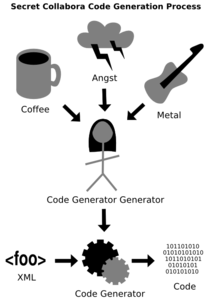
The secret Collabora code-generation process

(credit: daf)

Supporting D-Bus in the GObject world has always involved quite a lot of code generation. The core API of dbus-glib is heavily reliant on varargs functions, which aren't type-safe and are easy to get wrong. dbus-glib contains a program called dbus-binding-tool, which is meant to generate reasonably sane GObject APIs for D-Bus objects. Unfortunately, it seems to be intended to generate a whole GObject at a time. Early versions of telepathy-gabble used dbus-binding-tool plus a script called gengobject.py to generate API stubs for the exported objects; developers then filled in the blanks, and hey presto, we had a GObject on D-Bus. This was fine up to a point, but had a couple of major drawbacks. Whenever we changed the D-Bus API (quite common during the early development of Telepathy), there was a very laborious and error-prone merging process. We ended up with the following process:
  • copy the D-Bus introspection XML from the telepathy-spec repository into a directory xml/pristine (actually, the canonical form for the spec was Python for a while, and we had a script that exported a contrived object onto D-Bus and introspected itself to get the XML - but that's another story!)
  • preprocess the introspection XML to add the dbus-glib CFunctionName annotation, resulting in a directory xml/modified
  • run dbus-binding-tool and a Python script gengobject.py to generate C source in xml/src
  • three-way-diff the old version of xml/src, the new version of xml/src, and the real C code in src to create a new version of src
  • pray that the diff process hadn't randomly exchanged functions' implementations
  • update the resulting code in src so it worked
  • check the whole mess back into darcs
  • hope that nobody else had made changes that would result in darcs conflicts
If you haven't yet gathered, this was a bit of a nightmare. Also, it was very easy to return the wrong thing from a method without noticing - because all the APIs were varargs, the compiler didn't notice, and the first we'd know about it was a mysterious segfault under certain circumstances.
How telepathy-glib fixes code generation telepathy-glib improves on this by taking advantage of this innocuous-looking feature in dbus-glib:
commit 355ef78d98d6fc65715845d56232199162cab12a
Author: Steve Frécinaux <steve istique net>
Date:   Thu Aug 17 11:48:20 2006 +0200
    Interface support for bindings.
Instead of running dbus-binding-tool or creating GObjects with D-Bus interfaces, we put the entire Telepathy spec through glib-ginterface-gen.py, a distant descendant of Gabble's gengobject.py. For each interface in the spec, we generate a GInterface that mirrors the D-Bus interface. Any GObject that implements the GInterface automatically gets the D-Bus interface if it's exported onto D-Bus. There are a few non-obvious refinements, though:
  • The signature of the method implementation is always in the mode that dbus-glib calls "asynchronous", where the method implementation can either send a reply message before or after it returns. For "slow" methods, this is the only thing you can do. For instance, many Telepathy D-Bus methods can't return anything until some TCP round-trips to the server have happened. This is also the only thing you can do if you want to extract extra information, like the sender's unique name, from the method-call message (dbus-glib's "synchronous" API doesn't allow this to be done). For "fast" methods, sending a reply message before returning is just as easy as using the "synchronous" API (it's just a difference of syntax), and has an API consistent with that of the "slow" methods, making it easier for service authors.

  • The layout of the GInterface vtable is private, and (auto-generated) accessor functions are used to fill in implementations. This means our ABI doesn't change just because we re-ordered functions in the spec.

  • If no implementation is provided for a method, we just raise an appropriate error (org.freedesktop.Telepathy.Errors.NotImplemented), rather than suffering an assertion failure. This means we can safely add methods to an interface.

  • While we're generating code anyway, we generate some static inline wrapper functions which wrap dbus_g_method_return(), to have type-safe method returns. You can easily check that a method replies with correct types, by checking that the implementation of Foo() replies by calling tp_svc_some_interface_return_from_foo().

  • Similarly, we generate wrapper functions to emit signals, to get type-safe signal emission.

Not all interfaces are stable enough to be included in telepathy-glib's stable API and ABI, so some of our other projects include a copy of the telepathy-glib code-generation tools, and generate their own "mini-telepathy-glib" (traditionally in a /extensions/ directory) for their implementation-specific (drafts of) interfaces. This isn't yet as polished as it ought to be (mainly because we don't want to freeze the augmented-introspection-XML format that we write the Telepathy spec in, because it's rather ad-hoc and hackish in places) but it works quite well in practice. To see what this looks like in practice, have a look at the examples in telepathy-glib, or at a Telepathy connection manager like telepathy-gabble.
Mixins and base classes Another feature of telepathy-glib which makes life easier for connection manager authors is that it provides "mixins" and base classes which implement some of the GInterfaces. There's absolutely nothing magic about the base classes - they don't have any access to private implementation details of the GInterfaces, they just implement them like everyone else does. The "mixins" are only slightly more magical - they store some extra state inside the structures representing GObjects and their classes, and use it to provide default implementations of some or all of the methods on a particular interface (or two interfaces, in the case of the new TpMessageMixin). I'll leave it up to Rob to explain those in greater detail, since I seem to remember that he invented them :-P The examples and regression tests in telepathy-glib are quite good examples of how these work in practice.

Miriam Ruiz: More on OOXML: ISO tries to recover lost credibility through press notes

After the unfortunate show that Microsoft and ISO provided us recently, ISO’s response is a FAQ note about ISO/IEC 29500 (OOXML, that’s it) in which they threaten Microsoft with the most severe of penalties if they’re tricking on as. Funny. In that statement, they try to answer all the issues that initially were concerns but that now has turned into proven facts about the OOXML standard and it’s approval, and to try to recover some of their lost credibility. It’s sad to be commenting on this, words don’t come easy, as if to say. Microsoft has already proven who’s the one in charge here, who owns the committees, who takes the decisions and in which terms, and nothing happens. It’s gonna take more than to publish a FAQ note saying how well you did it and to threaten Microsoft to behave or else. No one seriously believe you at the moment, you know? A funny thing is that ISO dismisses any responsibility about standardization, and relies on the market taking the decisions for them. Microsoft has said many times that they consider something positive and healthy to have multiple standards for the same, and let the market decide. Now ISO declares to think along the same lines: “After a period of co-existence, it is basically the market that decides which survives”. We don’t really need an organization for standardization for that, do we? We already have the market for that. Will ISO apply the same policy for every standard from now on? Like, say, having a couple of competing standards at least for every need, and let the market decide? ISO tries to recover from their credibility loss with this note (“the standards development process is credible, works well and is delivering the standards needed, and widely implemented, by the market“), without much success at least in what I’m concerned. If they keep trying to convince with press notes instead of with real acts, no one is gonna believe them ever again.

15 April 2008

MJ Ray: Talk with People who want to Discuss

I spend too much of my time trying to talk with people who don't want to discuss, yet somehow I won't stop. I keep hoping that things like suggesting good advice on meeting scheduling will avoid them repeating old mistakes. The most extreme life-and-death example is probably trying to help with Kewstoke Toll Road, where people still speed and someone crashed off again last night (although I don't know what caused last night's crash - could have been a simple accident). Of course, it's better to talk with people who have asked questions and want to hear the answer. I'm currently involved in several groups like that and it makes me much happier [4HWW]. I've even made a confidentiality agreement [Network Blogging article] about one group because I really like the organiser and want to help them, but I've yet to see changes happen because of it and that's probably about all I can write here, which does rather suck. But talking of changes that make me happy, I spotted that Bristol Wireless has now gone further than TTLLP by deciding to change people away from Microsoft Windows when they find it:-
"all Windows stuff must be gone from the premises [...] no longer help do callers favours with broken Windows machines, apart from fixing them properly and permanently by installing Debian"
at their March meeting. Well done, BW! After a request, I finally put four photos from Social Source South West (which was hosted by BW) online, which reminded me to subscribe to watfordgap's travels. Disappointingly, on my first read, it promotes the Suppliers Directory developed by Lasa. That directory is a big problem because it creates a silly barrier to entry which hinders new social enterprises and cooperatives. At a time where most non-profit software is unsustainable and needs to change, requiring three referees is a way to obstruct change. Also, persuading three people to support their work is no substitute for supplier evaluation. Any non-profits who want to lead their sector should approach ICT suppliers directly. The article also mentions Experts Online which is even more short-sighted about computing: "both PC and Mac" indeed! What about GNU/Linux, thin clients, and other changes which are already making a big difference to some non-profits...? But here I go again, talking to a brick wall. I expressed these concerns when that Directory started and it didn't do any good then, so I doubt they'll change it now, near the end of its life. So I'm going to move on. There are lots of people emailing who want to hear from me, so it's time to concentrate on talking with people who do want to listen. If you want to discuss this with me, visit my website for the comments form (click the title or look for a "view original post" link, depending what site you're reading).

14 April 2008

James Morrison: Niti days

I don't think any of these are mine, but this needs to be published to the general public (at least until it rests on AlumNit).

Poo Alliterations
- The Earl of Excrement
- The Duke of Dung
- The Prince of Poop
- The Sultan of Shit
- The Father of Feces
- The Matriarch of Merde
- The Steward of Stink
- The Dignitary of Dangleberries
- The Grand Poohbah of Grand Poo
- The Tyrant of Turd
- The Shogun of Scheisse
- The Baron of Bowels
- The Cardinal of Crap
- The Director of Dump
- The Surveyor of Stool
- The Lord of the Log
- The Crown Prince of Cow Patties
- The Royal Archbishop of Road Apples
- The Duchess of Droppings
- The Princess of Poodie
- The Legionnaire of Loaf
- The Supervisor of Stinkers
- The Pharaoh of Floaters
- The Magnate of Manure
- The Tycoon of TCPDumps
- The Czar of Czesspools
- The Mogul of Bowel Movements
- The Ruler of the Runs
- The Dean of Diarrhea
- The Royal Ringleader of Rump Raisins
- The Denizen of Doo-doo
- The Emperor of Evacuations
- The Headmaster of Horrible Odors
- The Titan of the Trots
- The King of Klingons
- The Big Boss of Bum Beans
- The Taskmaster of Turtleheads
- The Supervising Sovereign of Sewer Serpents
- The Colonel of Colon Cobras
- The Nobleman of Number Two
- The Top Dog of Toilet Twinkies
- The Kingpin of Keester Cakes
- The Shepherd of Sea Pickles
- The Head Navigator of Heinie Nuggets
- Rectal Representative
- The Commander of Cow Pie
- The First Mate of Fecal Matter
- The Creator of Cloth Touchers
- The Protector of Porcelan
- The Theologian of the Throne
- The God of Grunts
- The Small Insignificant Yodeling President of Shit in your Pants
- The Diaper Destroyer
- The Loader of Loincloths
- The Pontiff of Plum Pudding
- The Daiymo of Dysentery
- The Master of Montezuma's revenge
- The Squire of Squirts
- The [Weaver] of [WvLog]s
- The Primary Contact of Pudding Cookies
- The Best Producer of Brown Puddles
- The Senior Partner of Steaming Piles
- The Fine Baker of Fudge Brownies
- The Sheriff of Stench
- The Don of the Deuce
- The Torrid Putrid Tainted Pervert of Two-Ply Toilet Paper
- The Sacred Monarch of Skid Marks
- The Main Scientist of Microfeceological Studies
- The G.I. Joe of Gastro Intestinal Journeys
- The Premier of Polyps
- The Brigadier General of Bedpan Gold
- The Plunger Pilot
- The Specialist of Splashers
- The Foreman of Fake Farts
- The Ambassador's Under-Secretary of Astounding Unearthly Scents
- The Old Man and the Sea of Odiferous Monsters in the Sink
- The Bafflingly Blunt and Blasphemous Bearer of Big Bad Beastly Booty Burdens
- The Crisp Pungence of Chain Pooping
- The Goddess of Groundhogging
- The Burly Bobby's Brief Battle with Brim Blasting Bowel Bombs
- The Nasty Neighbour's Noisy and Nefarious Neglect of Normal Nasal Niceties
- The Judge Jury and Executor of Jolly Jumper Excrement
- The Forwarder of the Forwarded
- The Wizard of the Water-closet
- The Grunting Lobber of Great Logs
- The Annoyingly Arrogant Architect of Awful and Abhorrent yet Amazingly Aerodynamic Anal Atrocities
- The Dark, Dangerous and Delusional Dealer of Death-Defying Doses of Disturbingly Decadent Dung
- The Shakespeare of Sinfully Smelly and Supremely Scary Scripture with Soggy Stains and Screaming Splashes
- The Wise but Weakened Warlord Whose Willful Wrath Was Wholly Wrought With Wicked and Wretched Winds from Within
- The Languid and Lackluster Legend of the Little Log from the Loo and its Lavish Life of Luxury in a Lasagna
- The Kahuna of Kaka
- The Emergency Evacuator of Enraged Entrails
- The Squire of Sultry Stinknuggets
- The Deadening Discomfort of a Dearth of Dumps
- The Far From Favourable Fragrance of Four Fragments of Fantastically Fresh Feces
- The Principal of Prodigiously Putrid Pellets
- The Markedly Morose Maintenance of Maniacally Mounded Midden Movements and Mostly Meaty Meals Mysteriously Made Mushy
- The Crass and Cranky Coroner Connecting Clues Concerning a Cornucopia of Casualties Caused by a Crude Cluster of Completely Contemptible Colon Concoctions
- The Thinking Thoughts of a Thinker
- The Horrible, Hubristic Heathen Hoarding Hoary Humps of Hideousness Hailing from His Huge Hairy Heinie in His Harmfully Heady Hovel
- Inane Writings on Irritated Wreathing of the Incubator of Wrath
- That Special Numbness from Sniffing Noodled Stink Nougat
- The Moral Sanctity of the Mystery Shit
- The Ornery Opressor's Opulent Outpost Overseeing the Ordinary Occupants' Outrageous and Ongoing Observance Of an Occasional but Offensive Orgy Of Offal
- The Rector of Relief
- The Rectal Regurgitator
- The Shit Squat
- The Smelly Surprise
- The World Wide Wisdom
- The Slayer Supreme of System Shock

Next.

Previous.