Search Results: "dom"

10 December 2011

Patrick Schoenfeld: Migrating from blogspot to Movable Type

A while ago I decided to migrate my existing blogspot blog to an own domain and webspace again. My reasoning was mostly, that blogspot lacked some features, which I'd like to have in my blog.
Additionally, my requirements have changed a bit since I originally moved to blogspot and, last but not least, Blogspot was a compromise anyway.

So I started re-evaluating a possible software platform for my blog. In my numerous previous attempts to start blogging (there were several blogs of me in the internet since at least 2006), before I moved to Blogspot, I used Wordpress. But there were quiet some reasons against it, one of the biggest concerns being its security history. Also, while I worked a lot with PHP in the past years, I have developed a serious antipathy against software written in PHP, which I couldn't just ignore.

In the end, the decision fell on Movable Type, because its written in Perl, which is the language I prefer for most of my projects, because its features were matching my wishes (mostly) and because I heard some good opinions about it. Also it is used by my employer for our company blog.

So the next question was: How to migrate?

I decided to use Movable Type 5, although, at present, it seems not to be the communities choice. At least the list of plugins supporting MT5 is really short. Foremost there was no plugin to import blogger posts, which, after all, was the most important thing about the migration.
Luckily there is such a plugin for Movable Type and so I basically did the following:

  1. Install Movable Type 4
  2. Install the Blogger Import Plugin
  3. Import posts (it supports either the export file of blogger or directly importing posts via the Google API)
  4. Upgrade to Movable Type 5
  5. Check the result
Check the results, or: The missing parts

Obviously such an import is not perfect. Some posts contain images or in-site links. The importer is not able to detect that and honestly it would have a hard time to track that anyway.
So as soon as content is migrated, its time to look for the missing parts.

The process to find missing parts is basically very easy and common among the various missing parts:
Just search for your blogspot URL via the Search & Replace option in the Movable Type administration.

Now how to fix that? For links its quiet easy (although I forgot about them in the first run), as long as the permalinks have kept the same scheme.
In my case that is the case, since I decided to use the Preferred Archive option "Entry" in the blog settings for the new blog and the default (if there is an option, because I don't know)
in Blogspot. The importer does import the Basename of the document, so fixing links is just a matter of replacing the domain part of the URL.

For images its some more work. One has to get the images somehow and upload them in Movable Type. Eventually it then boils down to search and replace, but I decided to do that manually, since I only have a very low number of images in my posts so far.

After that I did everything else, which is not specific to the migration, like picking a template, modifying it to my wishes, considering the additions of plugin etc.
And here we are. There were some issues during the migration, which I haven't handled here. I will blog about them another time.

Patrick Schoenfeld: The caravan is moving on..

I once moved to blogspot with my blog, because I was to lazy to handle all the hard stuff about blogging (finding, setting up and maintaing a blog software) myself. It was a compromise, back then, because blogspot was missing features I'd like to have from a blog software.
Recently the compromise was slowly going to not satisfy me enough anymore and so I planned and executed a migration plan to an own domain and powered by Movable Type.

Because I was always blogging about more technical and Open Source-community related things as well as private stuff, politics and anything else, which I was interested about, and because these subject areas are not really related to each other, I decided to split the blog into two.

So in the future you will find this blog split into two places:

I've tried to migrate everything to this sites, which has been on blogspot, including comments. So if you happen to find your comments there: Do not wonder.

The blogspot blog will stay around, eventually forever, eventually only for a certain time, to let search engine visitors still find stuff. But this is the last entry I'll publish here.

So update your bookmarks and stay tuned :)

7 December 2011

Gustavo Noronha Silva: WebKitGTK+ hackfest \o/

It s been a couple days since I returned from this year s WebKitGTK+ hackfest in A Coru a, Spain. The weather was very nice, not too cold and not too rainy, we had great food, great drinks and I got to meet new people, and hang out with old friends, which is always great!

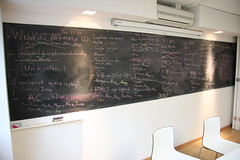
Hackfest black board, photo by Mario

I think this was a very productive hackfest, and as usual a very well organized one! Thanks to the GNOME Foundation for the travel sponsorship, to our friends at Igalia for doing an awesome job at making it happen, and to Collabora for sponsoring it and granting me the time to go there! We got a lot done, and although, as usual, our goals list had many items not crossed, we did cross a few very important ones. I took part in discussions about the new WebKit2 APIs, got to know the new design for GNOME s Web application, which looks great, discussed about Accelerated Compositing along with Joone, Alex, Nayan and Martin Robinson, hacked libsoup a bit to port the multipart/x-mixed-replace patch I wrote to the awesome gio-based infrastructure Dan Winship is building, and some random misc. The biggest chunk of time, though, ended up being devoted to a very uninteresting (to outsiders, at least), but very important task: making it possible to more easily reproduce our test results. TL;DR? We made our bots and development builds use jhbuild to automatically install dependencies; if you re using tarballs, don t worry, your usual autogen/configure/make/make install have not been touched. Now to the more verbose version! The need

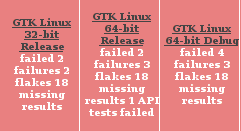
Our three build slaves reporting a few failures

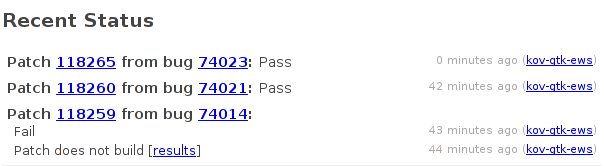
For a couple years now we have supported an increasingly complex and very demanding automated testing infrastructure. We have three buildbot slaves, one provided by Collabora (which I maintain), and two provided by Igalia (maintained by their WebKitGTK+ folks). Those bots build as many check ins as possible with 3 different configurations: 32 bits release, 64 bits release, and 64 bits debug. In addition to those, we have another bot called the EWS, or Early Warning System. There are two of those at this moment: one VM provided by Collabora and my desktop, provided by myself. These bots build every patch uploaded to the bugzilla, and report build failures or passes (you can see the green bubbles). They are very important to our development process because if the patch causes a build failure for our port people can often know that before landing, and try fixes by uploading them to bugzilla instead of doing additional commits. And people are usually very receptive to waiting for EWS output and acting on it, except when they take way too long. You can have an idea of what the life of an EWS bot looks like by looking at the recent status for the WebKitGTK+ bots. Maintaining all of those bots is at times a rather daunting task. The tests require a very specific set of packages, fonts, themes and icons to always report the same size for objects in a render. Upgrades, for instance, had to be synchronized, and usually involve generating new baselines for a large number of tests. You can see in these instructions, for instance, how strict the environment requirements are yes, we need specific versions of fonts, because they often cause layouts to change in size! At one point we had tests fail after a compiler upgrade, which made rounding act a bit different! So stability was a very important aspect of maintaining these bots. All of them have the same version of Debian, and most of the packages are pinned to the same version. On the other hand, and in direct contradition to the stability requirement, we often require bleeding edge versions of some libraries we rely on, such as libsoup. Since we started pushing WebKitGTK+ to be libsoup-only, its own progress has been pretty much driven by WebKitGTK+ s requirements, and Dan Winship has made it possible to make our soup backend much, much simpler and way more featureful. That meant, though, requiring very recent versions of soup. To top it off, for anyone not running Debian testing and tracking the exact same versions of packages as the bots it was virtually impossible to get the tests to pass, which made it very difficult for even ourselves to make sure all patches were still passing before committing something. Wow, what a mess. The explosion^Wsolution So a few weeks back Martin Robinson came up with a proposed solution, which, as he says, is the nuclear bomb solution. We would have a jhbuild environment which would build and install all of the dependencies necessary for reproducing the test expectations the bots have. So over the first three days of the hackfest Martin and myself hacked away in building scripts, buildmaster integration, a jhbuild configuration, a jhbuild modules file, setting up tarballs, and wiring it all in a way that makes it convenient for the contributors to get along with. You ll notice that our buildslaves now have a step just before compiling called updated gtk dependencies (gtk is the name we use for our port in the context of WebKit), which runs jhbuild to install any new dependencies or version bumps we added. You can also see that those instructions I mentioned above became a tad simpler. It took us way more time than we thought for the dust to settle, but it eventually began to. The great thing of doing it during the hackfest was that we could find and fix issues with weird configurations on the spot! Oh, you build with AR_FLAGS=cruT and something doesn t like it? OK, we fix it so that the jhbuild modules are not affected by that variable. Oh, turns out we missed a dependency, no problem, we add it to the modules file or install them on the bots, and then document the dependency. I set up a very clean chroot which we could use for trying out changes so as to not disrupt the tree too much for the other hackfest participants, and I think overall we did good. The aftermath By the time we were done our colleagues who ran other distributions such as Fedora were already being able to get a substantial improvements to the number of tests passing, and so did we! Also, the ability to seamlessly upgrade all the bots with a simple commit made it possible for us to very easily land a change that required a very recent (as in unreleased) version of soup which made our networking backend way simpler. All that red looks great, doesn t it? And we aren t done yet, we ll certainly be making more tweaks to this infrastructure to make it more transparent and more helpful to the users (contributors and other people interested in running the tests). If you ve been hit by the instability we caused, sorry about that, poke mrobinson or myself in the #webkitgtk+ IRC channel on FreeNode, and we ll help you out or fix any issues. If you haven t, we hope you enjoy all the goodness that a reproducible testing suite has to offer! That s it for now, folks, I ll have more to report on follow-up work started at the hackfest soon enough, hopefully =).

Kees Cook: how to throw an EC2 party

Prepare a location to run juju and install it:
mkdir ~/party
cd ~/party
sudo apt-get install juju
Initialize your juju environment. Be sure to add juju-origin: ppa to your environment, along with filling in your access-key and secret-key from your Amazon AWS account. Note that control-bucket and admin-secret should not be used by any other environment or juju won t be able to distinguish them. Other variables are good to set now too. I wanted my instances close to me, use I set region: us-west-1 . I also wanted a 64bit system, so using the AMI list, I chose default-series: oneiric , default-instance-type: m1.large and default-image-id: ami-7b772b3e
juju
$EDITOR ~/.juju/environments.yaml
Get my sbuild charm, and configure some types of builders. The salt should be something used only for this party; it is used to generate the random passwords for the builder accounts. The distro and releases can be set to whatever the mk-sbuild tool understands.
bzr co lp:~kees/charm/oneiric/sbuild/trunk sbuild-charm
cat >local.yaml <<EOM
builder-debian:
    salt: some-secret-phrase-for-this-party
    distro: debian
    releases: unstable
builder-ubuntu:
    salt: some-secret-phrase-for-this-party
    distro: ubuntu
    releases: precise,oneiric
EOM
Bootstrap juju and wait for ec2 instance to come up.
juju bootstrap
Before running the status, you can either accept the SSH key blindly, or use ec2-describe-instances to find the instance and public host name, and use my wait-for-ssh tool to inject the SSH host key into your ~/.ssh/known_hosts file. This requires having set up the environment variables needed by ec2-describe-instances , though.
ec2-describe-instances --region REGION
./sbuild-charm/wait-for-ssh INSTANCE HOST REGION
Get status:
juju status
Deploy a builder:
juju deploy --config local.yaml --repository $PWD local:sbuild-charm builder-debian
Deploy more of the same type:
juju add-unit builder-debian
Now you have to wait for them to finish installing, which will take a while. Once they re at least partially up (the builder user has been created), you can print out the slips of paper to hand out to your party attendees:
./sbuild-charm/slips   mpage -1 > /tmp/slips.ps
ps2pdf /tmp/slips.ps /tmp/slips.pdf
They look like this:
Unit: builder-debian/3
Host: ec2-256-1-1-1.us-west-1.compute.amazonaws.com
SSH key fingerprints:
  1024 3e:f7:66:53:a9:e8:96:c7:27:36:71:ce:2a:cf:65:31 (DSA)
  256 53:a9:e8:96:c7:20:6f:8f:4a:de:b2:a3:b7:6b:34:f7 (ECDSA)
  2048 3b:29:99:20:6f:8f:4a:de:b2:a3:b7:6b:34:bc:7a:e3 (RSA)
Username: builder
Password: 68b329da9893
To admin the machines, you can use juju itself, where N is the machine number from the juju status output:
juju ssh N
To add additional chroots to the entire builder service, add them to the config:
juju set builder-debian release=unstable,testing,stable
juju set builder-ubuntu release=precise,oneiric,lucid,natty
Notes about some of the terrible security hacks this charm does: Enjoy!

2011, Kees Cook. This work is licensed under a Creative Commons Attribution-ShareAlike 3.0 License.
Creative Commons License

1 December 2011

Dirk Eddelbuettel: Wicked Webapps with R, err, Wt

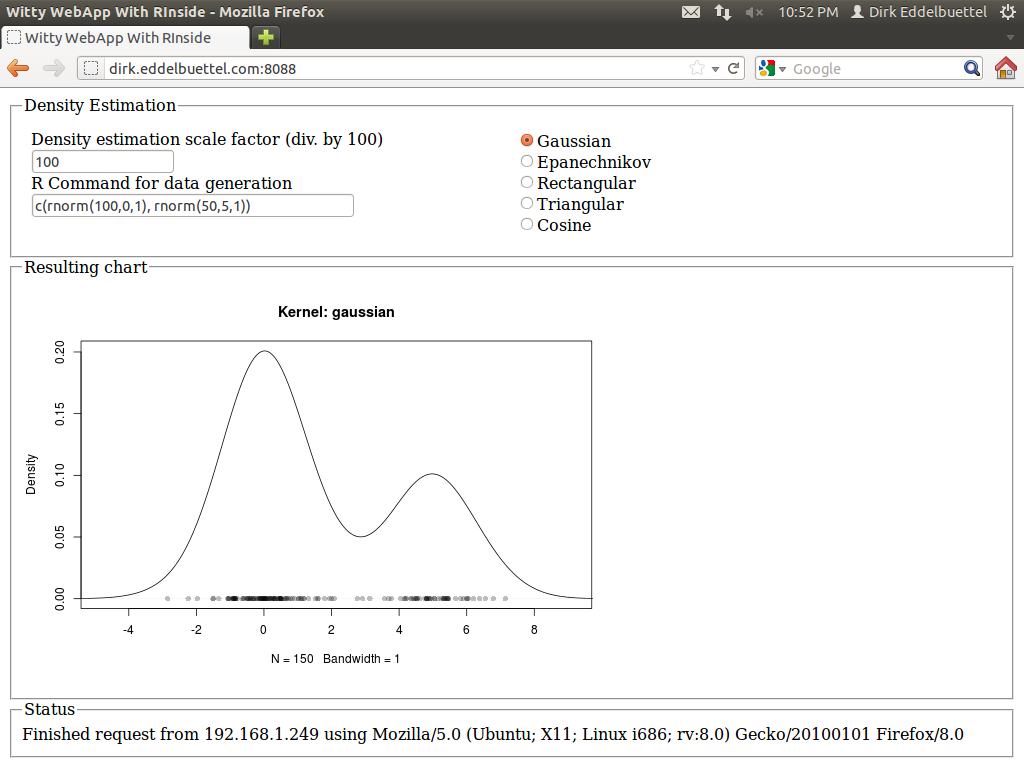
A few months ago, I had blogged about using R inside of Qt. This used our RInside package for embedding the statistical programming environment and language R inside of a C++ application, and further relies on our Rcpp package for R and C++ integration and object mapping. The example was simple yet powerful: a reimplementation of the standard GUI application of a standard density estimate. Here the user can pick a kernel density function from a selection, and also slide a bandwidth parameter. One nice addition was an entry field already populated with a simple expression for a mixture of Normals, allowing for arbitrary random distributions over which to estimate. The example is pretty (thanks to Qt), and was added to RInside with the last CRAN release 0.2.4. The blog post has a nice screenshot. I had long wondered how to do something similar 'on the web'. Web integration and application frameworks are of course a dime a dozen: Just about any language offers this, with more or less ease. But I wanted something simple yet powerful and fast. And I did not like the idea of a multi-tier app, or of a multi-language mix. I remember having seen something about a web-application framework not unlike Qt, and studying the very useful Wikipedia web application framework comparison I re-discovered Wt (pronounced "Witty"). So there it is, using C++ which brings us ample performance, the ability to connect to a number of libraries and applications (which is important in my quantitatively-minded workd) and avoid the whole multi-tier, multi-language combination. The Wt website has a few more good reason why this may be a suitable idea; the toolkit also offers a very decent amount of features and is amply documented with a fair number of examples. And after just a little bit poking around during two weekends, I now have the following webapp committed in the SVN repository of RInside, and it is all implemented in in less than two hundred (generously commented) lines of code. Example of embedding R via RInside into a Wt C++ application: density estimation for a mixture It is currently up and running at the address shown in the screenshot, so give it a go (though I may take it down at another point in time). I quite like it: The application is responsive: changes in the radio buttons (for the density), or the bandwidth, each trigger reestimation of the density, and a new and updated chart is displayed immediately with no noticeable delay---just like the desktop application did. Best of all, the code logic is essentially unchanged from the Qt-based app. Signals and slots related events to actions, the layout is in terms of standard GUI boxen and containers. And best of all, I did not have to write a line of html, javascript, css or ajax: it is all handled by the Wt toolkit. I was able to drive the app from an Android phone, my tablet, various computers around the house, and had a few friends poke a stick at it from afar. There is at one open issue. Wt launches new instances of the application object with each connection, which is a very clean model. That doesn't map perfectly with R (which is single-threaded) and RInside (which runs as a singleton for the same reason). So right now, each action sends its state back to the client. In other words, each clients own its parameters and well as vector of random numbers. Each new action sends these back to the app which passes it to R, launches the re-estimation and gets an updated chart back which is then shown by the the client. That is not perfect, and maybe a forking model as used by Simon's RServe would be better, though it would require a rewrite of RInside. Not sure if we get there anytime soon. And for simple applications not facing legions of concurrent users, the singleton should still work. It's a proof of concept at this point. Feedback welcome, and RInside and Rcpp questions should go to the rcpp-devel list as usual.

29 November 2011

Jon Dowland: mail archiving

I wrote a quick proof-of-concept script that can traverse my email (in local Maildir format) and detach all attachments: saving them to another location and replacing them with a text attachment which documents where they've gone. This reduces my work mailbox size substantially and allows for more space-efficient storage of the attachments (utilising all 8 bits of the byte, at the very least, but with the potential for compression to be added to the mix). It maintains the link between email and attachment, however, which is crucial if the method of discovery of the attachment in the future is to find the email. For this to be future proof, the path where the mail is saved needs to be. The best scheme I can think of involves dedicating a sub-domain to the problem and using a URI scheme which is guaranteed1 to be unique for the attachment, such as a hash-sum:
https://file.example.com/sha1/509c2fe2eba509e93987c3024a74d74583c274bd
I could finish up my script, set my my own personal infrastructure for this and convert my mailbox with a few hours more work. Before I do, I have two questions:

  1. within the practical limitations of hashing algorithms, at least.

Lior Kaplan: Translation status for LibreOffice 3.5.0 beta0

Following the good examples of Christian Perrier (Debian l10n leader), I m glad to publish translation status update for LibreOffice 3.5.0 beta0. Information is based on the documentation foundation pootle server. 9 languages at 100%: Catalan (ca), Danish (da), French (fr), Scottish Gaelic (gd), Portuguese (pt), Portuguese (Brazil) (pt_BR), Russian (ru), Slovenian (sl) and Chinese (China) (zh_CN). 15 languages at 99%: Asturian (ast), Bulgarian (bg), Breton (br), Welsh (cy), Belarusian (be), German (de), English (United Kingdom) (en_GB), Esperanto (eo), Estonian (et), Galician (gl), Latvian (lv), Norwegian Bokm l (nb), Polish (pl), Turkish (tr) and Slovak (sk). 1 languages at 98%: Hungarian (hu) 15 languages at 97%: Assamese (as), Czech (cs), Chinese (Taiwan) (ch_TW), Spanish (es), Basque (eu), Finnish (fi), Irish (ga), Gujarati (gu), Croatian (hr), Italian (it), Icelandic (is), Kannada (kn), Marathi (mr), Dutch (nl) andTelugu (te). 2 languages at 96%: Hebrew (he) and Japanese (ja). 1 languages at 95%: Vietnamese (vi) 5 languages at 94%: English (South Africa) (en_ZA), Indonesian (id), Khmer (km), Tamil (ta) and Uighur (ug). 4 languages at 93%: Arabic (ar), Bengali (bn), Catalan (Valencia) (ca_XV) and Korean (ko). 1 languages at 92%: Oriya (or). 1 languages at 91%: Swedish (sv). 1 languages at 90%: Greek (el). 11 languages between 80%-89%: Afrikaans (af), Bosnian (bs), Hindi (hi), Lithuanian (lt), Macedonian (mk), Burmese (my), Norwegian Nynorsk (nn), Occitan (oc), Oromo (om), Sinhala (si) and Ukrainian (uk). 11 languages between 70%-79%: (no list) 10 languages between 60%-69%: (no list) 13 languages between 50%-59%: (no list)
Filed under: LibreOffice

28 November 2011

Vincent Bernat: SSL/TLS & Perfect Forward Secrecy

Once the private key of some HTTPS web site is compromised, an attacker is able to build a man-in-the-middle attack to intercept and decrypt any communication with the web site. The first step against such an attack is the revocation of the associated certificate through a CRL or a protocol like OCSP. Unfortunately, the attacker could also have recorded past communications protected by this private key and therefore decrypt them. Forward secrecy allows today information to be kept secret even if the private key is compromised in the future. Achieving this property is usually costly and therefore, most web servers do not enable it on purpose. Google recently announced support of forward secrecy on their HTTPS sites. Adam Langley wrote a post with more details on what was achieved to increase efficiency of such a mechanism: with a few fellow people, he wrote an efficient implementation of some elliptic curve cryptography for OpenSSL.

Without forward secrecy To understand the problem when forward secrecy is absent, let s look at the classic TLS handshake when using a cipher suite like AES128-SHA. During this handshake, the server will present its certificate and both the client and the server will agree on a master secret. TLS full handshake This secret is built from a 48byte premaster secret generated and encrypted by the client with the public key of the server. It is then sent in a Client Key Exchange message to the server during the third step of the TLS handshake. The master secret is derived from this premaster secret and random values sent in clear-text with Client Hello and Server Hello messages. This scheme is secure as long as only the server is able to decrypt the premaster secret (with its private key) sent by the client. Let s suppose that an attacker records all exchanges between the server and clients during a year. Two years later, the server is decommissioned and sent for recycling. The attacker is able to recover the hard drive with the private key. She can now decrypt any session she recorded: the encrypted premaster secret sent by a client is decrypted with the private key and the master secret is derived from it. The attacker can now recover passwords and other sensitive information that can still be valuable today. The main problem lies in the fact that the private key is used for two purposes: authentication of the server and encryption of a shared secret. Authentication only matters while the communication is established, but encryption is expected to last for years.

Diffie-Hellman with discrete logarithm One way to solve the problem is to keep using the private key for authentication but uses an independent mechanism to agree on a shared secret. Hopefully, there exists a well-known protocol for this: the Diffie-Hellman key exchange. It is a method of exchanging keys without any prior knowledge. Here is how it works in TLS:
  1. The server needs to generate once (for example, with openssl dhparam command):
  2. The server picks a random integer a and compute g^a \mod p . After sending its regular Certificate message, it will also send a Server Key Exchange message (not included in the handshake depicted above) containing, unencrypted but signed with its private key for authentication purpose:
    • random value from the Client Hello message,
    • random value from the Server Hello message,
    • p , g ,
    • g^a\mod p=A .
  3. The client checks that the signature is correct. It also picks a random integer b and sends g^b \mod p=B in a Client Key Exchange message. It will also compute A^b\mod p=g^ ab \mod p which is the premaster secret from which the master secret is derived.
  4. The server will receive B and compute B^a\mod p=g^ ab \mod p which is the same premaster secret known by the client.
Again, the private key is only used for authentication purpose. An eavesdropper will only know p , g , g^a\mod p and g^b\mod p . Computing g^ ab \mod p from those values is the discrete logarithm problem for which there is no known efficient solution. Because the Diffie-Hellman exchange described above always uses new random values a and b , it is called Ephemeral Diffie-Hellman (EDH or DHE). Cipher suites like DHE-RSA-AES128-SHA use this protocol to achieve perfect forward secrecy1. To achieve a good level of security, parameters of the same size as the key are usually used (the security provided by the discrete logarithm problem is about the same as the security provided by factorisation of two large prime numbers) and therefore, the exponentiation operations are pretty slow as we can see in the benchmark below: Graphical comparison of speed with and without DHE

Diffie-Hellman with elliptic curves Fortunately, there exists another way to achieve a Diffie-Hellman key exchange with the help of elliptic curve cryptography which is based on the algebraic structure of elliptic curves over finite fields. To get some background on this, be sure to check first Wikipedia article on elliptic curves. Elliptic curve cryptography allows one to achieve the same level of security than RSA with smaller keys. For example, a 224bit elliptic curve is believed to be as secure as a 2048bit RSA key.

Some theory Diffie-Hellman key exchange described above can easily be translated to elliptic curves. Instead of defining p and g , you get some elliptic curve, y^2=x^3+\alpha x+\beta , a prime p and a base point G . All those parameters are public. In fact, while they can be generated by the server, this is a difficult operation and they are usually chosen among a set of published ones. The use of elliptic curves is an extension of TLS described in RFC 4492. Unlike with the classic Diffie-Hellman key exchange, the client and the server need to agree on the various paremeters. Most of this agreement is done inside Client Hello and Server Hello messages. While it is possible to define some arbitrary parameters, web browsers will only support a handful of predefined curves, usually NIST P-256, P-384 and P-521. From here, the key exchange with elliptic curves is pretty similar to the classic Diffie-Hellman one:
  1. The server picks a random integer a and compute aG which will be sent, unencrypted but signed with its private key for authentication purpose, in a Server Key Exchange message.
  2. The client checks that the signature is correct. It also picks a random integer b and sends bG in a Client Key Exchange message. It will also compute b\cdot aG=abG which is the premaster secret from which the master secret is derived.
  3. The server will receive bG and compute a\cdot bG=abG which is the same premaster secret known by the client.
An eavesdropper will only see aG and bG and won t be able to compute efficiently abG . Using ECDHE-RSA-AES128-SHA cipher suite (with P-256 for example) is already a huge speed improvement over DHE-RSA-AES128-SHA thanks to the reduced size of the various parameters involved. Web browsers only support a handful of well-defined elliptic curves, chosen to ease an efficient implementation. Bodo M ller, Emilia K sper and Adam Langley have provided 64bit optimized versions of NIST P-224, P-256 and P-521 for OpenSSL. To get even more details on the matter, you can read the end of the introduction on elliptic curves from Adam Langley, then a short paper from Emilia K sper which presents a 64bit optimized implementation of the NIST elliptic curve NIST P-224.

In practice First, keep in mind that elliptic curve cryptography is not supported by all browsers. Recent versions of Firefox and Chrome should handle NIST P-256, P-384 and P-521 but for most versions Internet Explorer, you are currently out of luck. Therefore, you need to keep accepting other cipher suites. You need a recent version of OpenSSL. Support for ECDHE cipher suites has been added in OpenSSL 1.0.0. Check with openssl ciphers ECDH that your version supports them. If you want to use the 64bit optimized version, you need to run a snapshot of OpenSSL 1.0.1, configured with enable-ec_nistp_64_gcc_128 option. A recent GCC is also required in this case. Next, you need to choose the appropriate cipher suites. If forward secrecy is an option for you, you can opt for ECDHE-RSA-AES128-SHA:AES128-SHA:RC4-SHA cipher suites which should be compatible with most browsers. If you really need forward secrecy, you may opt for ECDHE-RSA-AES128-SHA:DHE-RSA-AES128-SHA:EDH-DSS-DES-CBC3-SHA instead. Then, you need to ensure the order of cipher suites is respected. On nginx, this is done with ssl_prefer_server_ciphers on. On Apache, this is SSLHonorCipherOrder on. UPDATED: You need to check ECDHE support for your web server. For nginx, the support has been added in 1.0.6 and 1.1.0. The curve selected defaults to NIST P-256. You can specify another one with ssl_ecdh_curve directive. For Apache, it has been added in 2.3.3 and does not exist in the current stable branch. Adding support for ECDHE is quite easy. You can check how I added it in stud. This issue also exists for DHE cipher suites, in which case you also might have to specify DH parameters to use (generated with openssl dhparam) using some special directive or by appending the parameters to the certificate. Check Immerda Techblog article for more background about this point. The implementation of TLS session tickets may be incompatible with forward secrecy, depending on how they are implemented. When they are protected by a random key generated at the start of the server, the same key could be used for months. Some implementations2 may derive the key from the private key. In this case, forward secrecy is broken. If forward secrecy is a requirement for you, you need to either disable tickets or ensure that key rotation happens often. Check with openssl s_client -tls1 -cipher ECDH -connect 127.0.0.1:443 that everything works as expected.

Some benchmarks With the help of the micro-benchmark tool that I developed for my previous article, we can compare the efficiency of cipher suites providing forward secrecy: Speed comparison with/without DHE/ECDHE I have used a snapshot of OpenSSL 1.0.1 (2011/11/25). The optimized version of ECDHE is the one you get by using enable-ec_nistp_64_gcc_128 option when configuring OpenSSL. Let s focus on the server part. Enabling DHE-RSA-AES128-SHA cipher suite hinders the performance of TLS handshakes by a factor of 3. Using ECDHE-RSA-AES128-SHA instead only adds an overhead of 27%. However, if we use the 64bit optimized version, the cost is only 15%. The overhead is only per full TLS handshake. If 3 out of 4 of your handshakes are resumed, you need to adjust the numbers. Your mileage may vary but the computational cost for enabling perfect forward secrecy with an ECDHE cipher suite seems a small sacrifice for better security.

  1. Perfect forward secrecy is an enhanced version of forward secrecy. It assumes each exchanged key are independent and therefore a compromised key cannot be used to compromise another one.
  2. For example, this is the case of the implementation I have proposed for stud to enable sharing of tickets between multiple hosts.

Dirk Eddelbuettel: A Story of Life and Death. On CRAN. With Packages.

The Comprehensive R Archive Network, or CRAN for short, has been a major driver in the success and rapid proliferation of the R statistical language and environment. CRAN currently hosts around 3400 packages, and is growing at a rapid rate. Not too long ago, John Fox gave a keynote lecture at the annual R conference and provided a lot of quantitative insight into R and CRAN---including an estimate of an incredible growth rate of 40% as a near-perfect straight line on a log-log chart! So CRAN does in fact grow exponentially. (His talk morphed into this paper in the R Journal, see figure 3 for this chart.) The success of CRAN is due to a lot of hard work by the CRAN maintainers, lead for many years and still today by Kurt Hornik whose dedication is unparalleled. Even at the current growth rate of several packages a day, all submissions are still rigorously quality-controlled using strong testing features available in the R system. And for all its successes, and without trying to sound ungrateful, there have always been some things missing at CRAN. It has always been difficult to keep a handle on the rapidly growing archive. Task Views for particular fields, edited by volunteers with specific domain knowledge (including yours truly) help somewhat, but still cannot keep up with the flow. What is missing are regular updates on packages. What is also missing is a better review and voting system (and while Hadley Wickham mentored a Google Summer of Code student to write CRANtastic, it seems fair to say that this subproject didn't exactly take off either). Following useR! 2007 in Ames, I decided to do something and noodled over a first design on the drive back to Chicago. A weekend of hacking lead to CRANberries. CRANberries uses existing R functions to learn which packages are available right now, and compares that to data stored in a local SQLite database. This is enough to learn two things: First, which new packages were added since the last run. That is very useful information, and it feeds a website with blog subscriptions (for the technically minded: an RSS feed, at this URL). Second, it can also compare current versions numbers with the most recent stored version number, and thereby learns about updated packages. This too is useful, and also feeds a website and RSS stream (at this URL; there is also a combined one for new and updated packages.) CRANberries writes out little summaries for both new packages (essentially copying what the DESCRIPTION file contains), and a quick diffstat summary for updated packages. A static blog compiler munges this into static html pages which I serve from here, and creates the RSS feed data at the same time. All this has been operating since 2007. Google Reader tells me the the RSS feed averages around 137 posts per week, and has about 160 subscribers. It does feed to Planet R which itself redistributes so it is hard to estimate the absolute number of readers. My weblogs also indicate a steady number of visits to the html versions. The most recent innovation was to add tweeting earlier in 2011 under the @CRANberriesFeed Twitter handle. After all, the best way to address information overload and too many posts in our RSS readers surely is to ... just generate more information and add some Twitter noise. So CRANberries now tweets a message for each new package, and a summary message for each set of new packages (or several if the total length exceeds the 140 character limit). As of today, we have sent 1723 tweets to what are currently 171 subscribers. Tweets for updated packages were added a few months later. Which leads us to today's innovation. One feature which has truly been missing from CRAN was updates about withdrawn packages. Packages can be withdrawn for a number of reasons. Back in the day, CRAN carried so-called bundles carrying packages inside. Examples were VR and gregmisc. Both had long been split into their component packages, making VR and gregmisc part of the set of packages no longer on the top page of CRAN, but only its archive section. Other examples are packages such as Design, which its author Frank Harrell renamed to rms to match to title of the book covering its methodology. And then there are of course package for which the maintainer disappeared, or lost interest, or was unable to keep up with quality requirements imposed by CRAN. All these packages are of course still in the Archive section of CRAN. But how many packages did disappear? Well, compared to the information accumulated by CRANberries over the years, as of today a staggering 282 packages have been withdrawn for various reasons. And at least I would like to know more regularly when this happens, if only so I have a chance to see if the retired package is one the 120+ packages I still look after for Debian (as happened recently with two Rmetrics packages). So starting with the next scheduled run, CRANberries will also report removed packages, in its own subtree of the website and its own RSS feed (which should appear at this URL). I made the required code changes (all of about two dozen lines), and did some light testing. To not overwhelm us all with line noise while we catch up to the current steady state of packages, I have (temporarily) lowered the frequency with which CRANberries is called by cron. I also put a cap on the number of removed packages that are reported in each run. As always with new code, there may be a bug or two but I will try to catch up in due course. I hope this is of interest and use to others. If so, please use the RSS feeds in your RSS readers, and subscribe to the @CRANberriesFeed, And keep using CRAN, and let's all say thanks to Kurt, Stefan, Uwe, and everybody who is working on CRAN (or has been in the past).

26 November 2011

Andrew McMillan: CeBIT 2011 in (overdue) review

The German Linux Magazine runs a sponsored an "Open Source Lounge" at CeBIT each year. Last year I put in a proposal for DAViCal and it got accepted! With some airfare support from InternetNZ I got to showcase my Free Software project at the largest IT trade fair in the world.If you have an open source project to promote I can't recommend this highly enough. Below is a review of my experience at CeBIT early this year. This is long overdue for posting, and I'm prompted now because submissions are now open for the Open Source Project Lounge at CeBIT in 2012. Apply now.The German Linux Magazine runs a sponsored an "Open Source Lounge" at CeBIT each year. Last year I put in a proposal for DAViCal and it got accepted! With some airfare support from InternetNZ I got to showcase my Free Software project at the largest IT trade fair in the world. If you have an open source project to promote I can't recommend this highly enough. Below is a review of my experience at CeBIT early this year. This is long overdue for posting, and I'm prompted now because submissions are now open for the Open Source Project Lounge at CeBIT in 2012. Apply now.

CeBIT Hall 2 is an enormous space

DAViCal at CeBIT 2011 CeBIT in Hannover is said to be the largest trade fair in the world, attracting over 300,000 visitors during it's five days. Late last year a DAViCal user in Germany suggested that I apply for a free booth for DAViCal in the Linux New Media Open Source Project Lounge . When DAViCal was accepted, I realised I needed some funding to help me travel around the world to attend, so I applied for a grant from InternetNZ who were kind enough to agree to cover part of my travel costs, and I was on my way. Germany in March is cold, especially for me coming from Summer! My travel allowed for a couple of days in Germany before CeBIT because that was when I could get the cheapest flights, and I wanted to have a little time to recover from the journey. Everyone had warned me to pack my winter woollies, and they were definitely needed! I stayed with a friend in Hamburg for two days and on the the second day we walked through the frozen park, past the frozen lake and over the frozen streams to see the Attraktor Hackerspace in Hamburg Nord where the CCC also hold their meetings a very impressive hackerspace in a repurposed bank (including the vault :-) with several separated areas for talks, meetings and workplaces. The day before CeBIT I travelled to Hannover to take a look at my booth space, fetch exhibitor passes for myself and volunteers and generally prepare to do battle with the crowds. The following day the fair started and it was up at 6:30 to get ready and catch the 7:38 train out to the fairgrounds. Although the fair opens at 9:00 there was always something to do between eight o'clock or so when I arrived at my booth and when the attendees started wandering past.
I was fortunate to have two volunteers for my booth who were there all week, as well as a couple more who turned up on the first two days. Not only did this mean that I got to spend a few hours during the week actually wandering the fairgrounds, but that I had some knowledgeable native german speakers for the occasional visitor who could not speak English. DAViCal has been translated into a dozen languages, and there had been some extra work put in to update the German translation before CeBIT also. As well as showing DAViCal, I was also able to demonstrate a new project at the fair which was aCal - a CalDAV Calendar Client for Android which I had released into the market just a few days beforehand for a token sum (it is licensed GPL v3 or later and the source code is available on gitorious.org). Having the smartphone devices available was great for giving live demonstrations, and I used the timetable for events at the Open Source Forum across the aisle from the Open Source Lounge to populate a calendar that we shared among a variety of devices. The first day was really the calm before the storm, and we saw lots of people asking what we were about, and had some good conversations with people wanting to know more, or telling us they used the software and were very happy with it.
CeBIT closes the gates at 18:00 with the visitor supply drying up pretty quickly around then and the secret lives of the exhibitors are revealed with people starting to relax and joke, and beer or wine starting to come out and some booth parties kicking off... if you have the stamina! I didn't, so it was off back to the train, to Hildesheim, to dinner and to bed. That first day blurred into the next, and the next and by Friday I was starting to lose my voice with all the talking I had been doing. I was visited by a chap from Posnan University who are a DAViCal user and he invited me down to the Polish stand to tell me about what they do there, and he agreed that they would love to help get the Polish translation improved. Another DAViCal user turned up with some bavarian wheat beer and a special beer glass for it by way of thanks. In some spare moments I fixed a bug in aCal's handling of character sets and uploaded a new version, so that we could use umlauts in events. Many people came past to talk to us, some of whom want to help with them project or have ideas for interesting things to do with DAViCal, some were already users of DAViCal and some went away thinking that they would be in the future. The last day of CeBIT is a little different: it's a Saturday and the doors are opened to the public and the minimum age is lowered to allow children to attend the event. I had been warned that this day is a madhouse, and it did indeed seem to be so for many booths. For DAViCal it was probably quieter than the day before, I think perhaps because calendar server software is inherently less sexy than many of the other things on display. We still had plenty of great discussions with interested people nonetheless and to be honest I was fairly happy to be spared the further exhaustion that had been threatened. Sunday was spent recuperating: discovering that Hildesheim has a great little restaurant that does traditional german pancakes for breakfast and then wandering around the small city soaking in the sunshine that I'd seen through the windows outside all week. On Monday I caught the train to M nchengladbach to meet with an organisation that might provide support for DAViCal in Germany, but who hadn't been able to come to the fair to see me due to illness. I was encouraged to spend the night in Aachen a beautiful little city , which I did, arriving around sunset and I spent a couple more days before flying home being intensely antisocial to recover from the furious week beforehand. Is CeBIT worth it? CeBIT seemed to me to be quite a different business model, or perhaps on a different scale. I've seen trade fairs in New Zealand for other purposes, but not to showcase software and services in quite this way. To give an idea of it's scale, consider that I had a tiny booth in a hall that was probably four times the size of the TSB Arena, and CeBIT included around 20 such buildings , packed with exhibitors, with free buses to get around the campus, acres of multi-storey parking buildings, two train stations, and so on. The scale of the event is incredible.

Polish people are huge too, like these friendly DAViCal
users from Pozna University of Technology who
showed me all the cool toys they brought to CeBIT.

As a result of this scale, CeBIT boasts impressive visitor numbers, and while a visitor will usually attend with a specific area of interest in relation to their business they will also wander the fair to see other areas of more personal interest, or just to see what is around. Open Source is a specific area of interest to a significant percentage of business in Germany, and Deutsche Messe, the fair operators, recognise the value of having an open source area as a draw for visitors, with the primary open source area placed in Hall 2, directly off the main north entrance. Within the open source area, the Open Source Project Lounge , where DAViCal was located, is a series of booths sponsored by Linux New Media AG. Projects in the Open Source Lounge are selected by a jury of Linux New Media, Deutsche Messe and several community advisors, so as such there is a range of interesting projects on show and the draw of any given project has a flow-on effect to the others. As an example, at one point while briefly minding the adjacent stand for the OpenEmbedded project I was unable to help an inquiring visitor, but I was able to talk about DAViCal with him until the exhibitor returned to answer his question. His interest in DAViCal was definitely increased in this process, and I'm sure that many people came into our area of the lounge attracted by a specific exhibitor and moving on to see some of the others. Outside of this association with open source, however, CeBIT offers something which general free software events cannot: an association with mainstream software and services. This presentation of Open Source alongside IBM, SAP, HP, Oracle, Software AG, Apple, Microsoft and so forth makes inclusion at this event particularly valuable. Free software solutions can have good brand recognition within the open ecosystem itself and yet be practically unheard of outside it. Most traditional methods of communication with suppliers don't work well with Open Source projects: a request for proposal will sail silently by, unless noted by a related commercial entity. In general there is no sales department, and marketing is frequently a desultory hit or miss affair. The fair is different. The fair is about talking with people. While there is still plenty of collateral marketing with brochures, signs, presentations and giveaway knick-knacks those things are just there to bring people into range: the real action happens when you engage a person in conversation, and at that point a humble free software project can be on an equal footing with a larger booth staffed with eager young salesmen. Of course there are a number of places where free software can get a booth. Linuxtag is a German example where there are many booths for free software projects, linux.conf.au also offers booths to free software projects during it's more outreach Open Day and software freedom day events happen all around the world where booths are available, but the audience arriving at these events are all largely pre-sold on openness and free software. So in presenting this broad blend of people, in a way in which free software projects can present on a roughly equal footing with their commercial brethren, CeBIT is an opportunity not to be missed. The numbers speak for themselves, too: traffic to the DAViCal websites has increased by about 50% around CeBIT with 25% coming from Germany, but significant increases also from France, Netherlands, Italy, Switzerland and Poland. Traffic to the DAViCal wiki has doubled over the last 12 months in a steady increase to around 200,000 page views each month. This sudden increase to around 10000/day in March, with some days during CeBIT peaking at over 20000/day The Future I won't be returning to CeBIT to represent DAViCal in Hannover next year as the sponsored booth is pretty much a one-time thing and the costs involved in purchasing a booth for attendance at the fair are significant (around NZD$15000 for a small 3m x 2m stall). It's possible that I will return next year in a different capacity, as one of the larger stand organisers has confidentially indicated he will invite me to attend as part of an Open Source Apps area that he is considering running on his stand, somewhat along the lines of the Open Source Lounge . Time will tell, I guess, but if invited I think I would definitely go for that. I will definitely be suggesting to a few specific free software projects that they should apply for the Linux New Media opportunity when it comes around again. Koha is one project that immediately springs to mind, but of course there are many, many worthy free software projects and this opportunity seems to be little-understood outside of Germany.

Britta was unfailingly helpful and charming

If I do convince a project to apply, and they are successful, I will also try and give them some assistance and background knowledge to understand the fair, and how best they can take advantage of the opportunity it offers. Some basic tips would be: and finally... I would like to express my appreciation to InternetNZ for the grant to partially cover my travel costs to Hannover, making my attendance at this outstanding event much more achievable. My thanks also to Britta Wulfling who supported all of the projects in the Open Source Lounge. My friends Alexander & Meike in Hildesheim who supplied somewhere for me to recuperate, and accompanied me to the fair every day to run the Debian booth. Thanks also, of course, to the German Linux Magazine for selecting DAViCal for a free booth, and to Benny who pointed the opportunity out, encouraged me to apply, and came along and helped out for the whole week.

23 November 2011

Russell Coker: Receiving Death Threats

On occasion I receive death threats in comments on my blog. This doesn t bother me, I had more than a few pathetic losers say similar things to me in high school but the difference is that a pathetic loser on the other side of the world can t do much about it. The latest one is on my post Is Asperger Syndrome a Good Thing? [1]. At 11:04AM my time (00:04 UTC) on the 23rd of November someone using IP address 82.14.50.190 (registered to NTL Infrastructure for Tesco Guildford ) and with the claimed email address of sharkbait @ tesco.net told me that I m on his to kill list . He was angry because my post apparently didn t satisfy his need to prove to people that they don t want AS . As it s not possible to choose your DNA there is really no point in trying to prove that one set of genes is better than another, unless of course you want to harass people who have different genes to you. Naturally he didn t read my post, in fact the differences between his comment and what I wrote made me suspect that it s something he was pasting in to lots of blogs, but it seems unlikely that he would use an iPhone for such a copy/paste job so he must just not read. For example he rhetorically asks did you even mention it was a form of autism in your negative points when I gave a link to the proposed DSM changes where Asperger Syndrome is being merged with Autistic Disorder and the word Autism appears 5 times in the post. He has one specific complaint about people he knows who are on the Autism Spectrum, he says Every time someone speaks to them they get angry and tell said person to back the fuck off. I ve been on the receiving end. Generally there are two possible reasons for being told to fuck off , one is that the person telling you is an asshole and the other is that you are being an asshole. If you are the type of person who sends death threats to bloggers then you really should consider the latter explanation. He also suggests that I watch Boston Legal presumably because that show has one character who is an Aspie. Now I have actually watched that show and it s the worst legal show I ve ever seen, when a legal show has such unrealistic portrayal of court scenes I don t think it should be relied on for information on any other topic. I watched a couple of episodes of Boston Legal and only saw one scene with the Aspie guy, so I can t even determine whether it s a realistic portrayal he s a minor character. In any case there are plenty of Aspie guys in the Free Software community who I interact with regularly, I read forums such as AspiesForFreedom.com, and I ve read some text books on the topic. So even if a TV show had a very accurate portrayal of an Aspie character I still doubt that I would learn anything by watching it. As a general tip for flamers, if you want to accuse someone of being a member of a NAZI or KKK type organisation then the word you are after is Aryan not ayrien . If you don t know a word then don t use it. Please note the conditions of sending me email [2], I reserve the right to publish all threats in any way that I wish. A Final Note Thanks sharkbait for adding me to your to kill list , I m sure that there are lots of nice people on it and I ve got good company. If I didn t get the occasional death threat I would worry that I m not writing well enough or failing to address important issues. I will write more about Autism in the future.

22 November 2011

Rapha&#235;l Hertzog: People behind Debian: Stefano Zacchiroli, Debian Project Leader

picture by Tiago Bortoletto Vaz, CC BY-NC-SA 2.0


It s been one year since the first People behind Debian interview. For this special occasion, I wanted a special guest and I m happy that our Debian Project Leader (DPL) Stefano Zacchiroli accepted my invitation. He has a difficult role in the community, but he s doing a really great job of it. He s a great mediator in difficult situations, but he s also opinionated and can push a discussion towards a conclusion. Read on to learn how he became a Debian developer and later DPL, what he s excited about in the next Debian release, and much more. Raphael: Who are you? Stefano: I m Stefano Zacchiroli, but I prefer to be called Zack, both on the Internet and in real life. I m 32, Italian, emigrated to France about 4 years ago. I live in Paris, and I find it to be one of the most gorgeous and exciting cities in the world. As my day job I m a Computer Science researcher and teacher at University Paris Diderot and IRILL. In my copious free time I contribute to Debian, and I m firmly convinced that doing so is an effective way to help the cause of Free Software. Besides, I find it to be a lot of fun! Raphael: How did you start contributing to Debian? Stefano: Flash back to 1999, when I was a 2nd year student in Computer Science at the University of Bologna. Back then in Italy it was uncommon for young geeks to get exposed to Free Software: Internet was way less pervasive than today and most computer magazines didn t pay much attention to GNU/Linux. Luckily for me, the professor in charge of the student lab was a Free Software enthusiast and all students machines there were running Debian. Not only that, but there was also a student program that allowed volunteers to become sysadmins after having shown their skills and convinced the director they were trustworthy. Becoming one of those volunteer Debian admins quickly became one of my top objectives for the year, and that is were I ve learned using Debian. The year after that, I got in touch with a research group that was to become the happy bunch of hackers with whom I would have done both my master and PhD theses. They were designing a new proof assistant. Most of the development was in OCaml and happened on Debian. OCaml was available in Debian, but many of the libraries we needed were not. So I approached the Debian OCaml Team offering to help. Before I realize what was going on I was (co-)maintainer of tens of OCaml-related packages. At some point I got told I think you should apply as a Debian Developer . So I did and in a couple of months I went through the New Member (NM) process, that was back then in its infancy. I still remember my happiness while reading the account created mail, the day after my 22nd birthday. I know the NM process went through some bad publicity in the past, but I m happy to see that nowadays the process can be as swift as it has been for me 10 years ago. Raphael: It s your second year as Debian Project Leader (DPL). Are you feeling more productive in the role? Do you fear to burn out? Stefano: I m feeling way more productive, no doubts. The task of the Debian Project Leader is not necessarily difficult, but it is a complex and scarcely documented one. It is also profoundly different from any other task that Debian people usually work on, so that experience doesn t help much in getting started. Before becoming effective as DPL one needs to get to know many people and mechanisms he is not familiar with. More importantly, one needs to set up a personal work-flow that allows to keep up with day-to-day DPL tasks (which are aplenty) as well as with urgencies (that tend to pop-up in the leader@debian.org INBOX at the least convenient time). Finally, one also needs to do proper traffic shaping and always retain enough motivation bandwidth to keep the Project informed about what is going on in DPL-land. Finding the right balance among all these ingredients can take some time. Once one is past it, everything goes way more smoothly. The above is why I m constantly encouraging people interested in running for DPL in the future to reach out to me and work on some tasks of the current DPL s TODO list. I swear it is not just a cheap attempt at slavery!. It is rather an attempt at DPL mentoring that could be beneficial: both to give future candidates more awareness of the task, and to reduce the potential downtime when handing over from one DPL to the next. Regarding burn out, I don t feel prone to its risk these days. If I look back, I can say that my contributions as DPL have been pretty constant in volume over time; my enthusiasm for the task, if anything, is on the rise. The effectiveness of my contributions as DPL are, on the other hand, not mine to judge. Raphael: If you had to single out two achievements where you were involved as DPL, what would they be? Stefano: I d go for the following two, in no particular order: OK, let me cheat and add a third one I m also proud of having been able to report to the Project my whereabouts as DPL, thoroughly and periodically, since the very beginning is first term. People annoyed by my reporting logorrhea now have all my sympathies. Raphael: Among the possible new features of Debian Wheezy, which one gets you excited most? Stefano: It s multi-arch, no doubt. Even though it is not a directly user visible change, it s a very far reaching one. It is also one of those changes that make me feel that moment of truth of coders, when you realize you are finally doing the right thing and ditching piles of ugly hacks.
It s multi-arch [ ] you realize you are finally doing the right thing and ditching piles of ugly hacks.
Raphael: If you were not DPL and could spend all your time on Debian, what project would you do? Stefano: I would sit down and do software development for Debian. It s impressive how many important and beneficial changes for Debian could be delivered by specific software improvements in various parts of our infrastructure. We tend to attract many packagers, but not so many people willing to maintain Debian infrastructure softwares like dak, britney, debbugs, the PTS, etc. Their maintenance burden then falls on the shoulders of the respective teams which are generally very busy with other important tasks. As a project, we seem to be more appealing to packagers than to software developers. That is a pity given the amount of exciting coding tasks that are everywhere in Debian. Part of the reason we are not appealing to developers is that we are not particularly good at collecting coding tasks in a place where interested developers could easily pick them up. It also takes quite a bit of inside knowledge to spot infrastructure bugs and understand how to fix them. I long for some spare hacking time to check if I m still good enough of a coder to hunt down longstanding bugs in our infrastructure, which have ended up being my pet peeves. I d also love to dive again into RCBW. It s less committing than package maintenance, more diverse and challenging, and also an immensely useful activity to get Debian releases done. Raphael: Martin Michlmayr is worried that there is so few paid opportunities around Debian. Do you agree with his sentiment, and if yes do you have ideas on how to improve this situation? Stefano: The idealistic me wishes Debian to be a community made only of volunteers that devote their free time to the Project. Oh, and that me also wishes Debian to be competitive with similar projects, no matter how many full-time employees others have! That is coherent with a view of society where everyone has a day job, but also engages in volunteering activities ensuring that public interest is pursued by people motivated by interests other than profit. But I do realize that for Free Software to succeed companies, employees, and salaries should all have a role. I admire projects that strike a good balance between volunteer and paid work. The Linux kernel is emblematic in that respect: many developers are paid by companies that have a commercial or strategic interest in Linux. Nevertheless volunteers contributions are aplenty and the Linux community gives a convincing impression that choices are driven by the community itself (or by its benevolent dictator) without money-driven impositions.
I do realize that for Free Software to succeed companies, employees, and salaries should all have a role.
Such an ecosystem does not exist around Debian. We do have a partner program that allows for it to happen, but we have very few partners with an interest in doing distribution development work. Like Martin, I m worried by this state of affairs, because it de facto means we lag behind in terms of available people power. In a community of volunteers, that might frustrate people and that is not good. To improve over the status quo the first step is to federate together small and medium companies that have a strategic interest in Debian and listen to their needs. I m already in touch with representatives of such companies that, in many cases, already employ Debian Developers to do some distribution work in Debian. We will be soon sending out a call to reach out to more such companies, but since we are discussing this, why waiting? If some of our readers here are representative of such companies, I encourage them to get in touch with me about this. Raphael: You know that the fundraising campaign for the Debian Administrator s Handbook is on good track but the liberation of the book is not yet assured. What do you think of this project? Stefano: I m happy about the project, to the point that I ve accepted writing a testimonial for it :-) . I m sad about the scarce availability of up to date and high quality (DFSG-)Free books about Debian and I welcome any initiative that might help closing that gap.
I m sad about the scarce availability of up to date and high quality (DFSG-)Free books about Debian.
Free Culture is a great offspring of Free Software and I m convinced we need to stand up against double standards in the two camps. Letting aside software-specific licensing details, the basic freedoms to be defended are the same. They are those freedoms that ensure that a reader is in full control of his book, pretty much as they ensure that a computer user is in full control of the software that runs on it. I m therefore proud that Debian has long resolved that the Debian Free Software Guidelines (DFSG) apply not only to software but also to books and other pieces of documentation. But the status quo implies that not only we have very few up to date, high quality books about Debian. It also implies that, at present, we have no such book that we can distribute in the Debian archive, showing off the Free Software (and Free Culture!) values we stand for.
Crowdfunding is considered to be a good mate for Free Culture, where the services model that applies to Free Software is more difficult to exploit. I so wish any luck to yours and Roland s initiative. A different matter is whether Debian, as a project, should endorse the initiative and actively campaign for it. As you know, I think it should not. While we do advertise general project donations, we don t do mission-specific fundraising campaign for Debian itself. Coherently with that, I don t think we should relay crowdfunding campaigns for 3rd parties, even when the result would be beneficial to Debian. Raphael: Is there someone in Debian that you admire for their contributions? Stefano: There are two classes of people that I particularly admire in Debian:
Thank you to Zack for the time spent answering my questions. I hope you enjoyed reading his answers as I did.

Subscribe to my newsletter to get my monthly summary of the Debian/Ubuntu news and to not miss further interviews. You can also follow along on Identi.ca, Google+, Twitter and Facebook .

7 comments Liked this article? Click here. My blog is Flattr-enabled.

Jonas Smedegaard: Asia 2011

In september I visited Brussels, Belgium. EPFSUG had kindly invited me to give a talk about FreedomBox in the European Parliament, and together we extended to also visit other organizations - both grassroots and more formal. I returned home exhausted but also fuelled with renewed energy and passion, and decided to engage in more such activities. Also, an old promise of mine to visit friends in the Aceh region of Indonesia (whom I met in Taiwan a few years back) rumbled in the back of my head. After a bit of juggling with travel routes and sponsoring options, my course was set for a 2 month journey with Debian Pure Blends as main theme:
  1. England: London
  2. India: Khammam, Hyderabad, Mangaluru, Bengaluru
  3. Vietnam: Ho Chi Minh City, Can Tho
  4. Thailand: Bangkok
  5. Malaysia: Putrajaya
  6. Indonesia: Surabaya, Yogyakarta, Bogor, Banda Aceh, Takengon
  7. England: Cambridge
Debian will be sponsoring East Asia part, and Debian enthusiasts in India seek sponsorship for India part.

21 November 2011

Russell Coker: Galaxy S vs Xperia X10 and Android Network Access

Galaxy S Review I ve just been given an indefinite loan of a Samsung Galaxy S which is more useful than the Sony Ericsson Xperia X10 that I own. I think that the main benefit is that it runs Android 2.2 instead of Android 2.1 on the Xperia. 2.2 is what gives it USB tethering support without extra software (something I haven t tested yet but will use a lot if it works correctly) and Wifi AP support. Both phones are about the same size, the Galaxy S has slightly more RAM (reported as 304M vs 280M which doesn t really matter) and a lot more main storage (1.87G vs 465M usable after the OS is loaded). The main down-sides of the Galaxy S is that it lacks a flash . I m not aware of any phone camera having a proper flash, but the limited LED flash is useful for taking pictures at times and there are a variety of programs that can turn it on for use as a torch. Also I wonder whether the Samsung people actually test their phones in real use or whether they just build them to spec. When you read the specs it sounds nice to have a phone that s only 9.9mm thick (apart from the bulge at the bottom), but that makes it really difficult to hold. The Xperia X10 is 13mm thick and isn t as slick so you are much less likely to drop it. I sometimes wonder whether phone companies are designing their products to be broken so that they can sell replacements. Three Networking Sucks My parents use 3G broadband from Three as their only connection to the Internet, this is fast enough for viewing Youtube on occasion and generally works well for them. However whenever I try to transfer any data to their system which has integrity checks it turns out to be corrupted. About every megabyte of data transferred has a corrupt packet that has a matching checksum presumably it s a bug in Three s network. Because Three are desperate for customers they have given me a free 6 month subscription to a data SIM [1]. I ve been using that SIM with my Galaxy S and found the same data corruption problem and I ve reproduced it in many places around Melbourne so this isn t just one unreliable cell tower, it s something broken in the core of the Three network. The obvious solution to this is to use a VPN so the corrupt packets will be dropped. So I set up a PPTP VPN only to discover that it seems impossible to make the default route be via the VPN, there has been a bug report about this since 2009 the iPhone allows configuring whether Internet traffic should go via the VPN, it can t be that hard [2]. There is an option to use a proxy for web access, but when I tried that on Android 2.1 it only worked for the system web browser not for things like the Android Market. But there is no option for configuring a proxy for use when the VPN is active, so it doesn t seem likely that I could run a proxy on the VPN network and direct all traffic to it. Due to corruption on the Three network and the inability to get a VPN working correctly it seems that I can t use the Three SIM. Android isn t Really Free Software While Android implementations generally stick to the GPL and other free software licenses that are involved they seem to be a poor example of providing freedom to users. My Xperia X10 is running Android 2.1 because Sony-Ericsson has locked the boot loader so I can t install a newer kernel. They don t care enough to release a new version this is stupid of them because it means that I am much less likely to recommend their products. If Sony-Ericsson releases a newer Android release then it will be a total OS reinstall, unlike the way I can upgrade a Debian system an application at a time. I can t install new packages that replace system packages, so the Email and SMS programs that I ve installed sit along side the ones that came with the system. Periodically the unwanted SMS and Email programs show up. I can t make my Android phones perform basic networking tasks that I ve done on Linux systems since the early 90 s. Hiding the complexity from the newbies is OK, but they need to make the full capabilities of the system available to experts. It seems to me that Android effectively gives the majority of users no more freedom than the iPhone does. Even for the small minority of us who are technically capable of rooting phones and installing CyanogenMod etc it s often limited by technical measures and the amount of time required. Update: Philipp Kern pointed out that his Galaxy S has a front facing camera. I have checked my phone and discovered that it has one too. When I published this post I criticised the Galaxy S for not having a front facing camera for video-calls based on a misunderstanding of the Wikipedia page (which says that SOME models lack it) and not testing it. Thanks for the correction Philipp and sorry for publishing wrong data.

19 November 2011

Dominique Dumont: Debian SDL packaging team revival

Hello Most SDL packages are outdated, people are complaining in the BTS, and the team is mostly inactive. That s bad news for my project. What can I do ? Well, it s Debian project, I just have to step up. Thanks to Sam Hocevar, I m now admin on Debian Alioth SDL packaging project. I d like to revive the team. (Note that I don t have the bandwidth to be the team all by myself). Here are the first steps I plan (mostly inspired by the way Debian-perl team is working): Now, there are some ground rules I wish to push forward: If you don t agree with the above points, now is the time to say it. Feel free to join by:
  1. Creating an account on Alioth
  2. request to join sdl-team
  3. Last but not least, send a short introduction mail to pkg-sdl-maintainers AT lists.alioth.debian.org so we can know each other.
See you soon :-)

17 November 2011

Russell Coker: Cruises

It seems that in theory cruises can make for quite economical vacations. The cheapest prices tend to be around $100 per person per night for an inside cabin (IE no window) with two people (there is a significant extra fee for having a cabin with only one person). If you book a room in a half-decent hotel with a pool in some moderately desirable place then you will probably pay about $200 per night which might get you free breakfast but won t include lunch or dinner. Cruises include all the free food you can eat for at least 16 hours of the day with maybe an extra fee for getting food in the middle of the night. When a cruise ship stops at the port you can pay for an expensive shore trip arranged by the cruise company or have a cheap trip that involves walking on the beach or taking a taxi to somewhere local. Of course there are lots of extras that can make a cruise really expensive, but if you don t plan to eat at speciality restaurants or drink much alcohol then that shouldn t be a problem. I ve just booked a short luxury cruise, mostly as a trial of the cruise concept. The process of doing so was difficult enough that even if I hadn t previously needed a holiday then I d probably need one now. It would be interesting to compare the amount of time that a reasonable person would be likely to spend choosing a holiday and purchasing it for the different types of holiday, I expect that cruising would be a long way behind everything that involves flying to a foreign city and staying in a hotel. The Issues of Booking When booking a regular holiday you choose where to visit, then choose the time of year, the accommodation, and travel. While the order can vary it s generally a sequential process without too many variables at any stage. With a cruise one of the first decisions is to choose the cruise line, different lines cater to various market segments it s clear what Disney cruises aim for but often not so clear for others. Apart from Disney the other cruise lines don t seem to make clear statements about who they are and aren t targeting. Then there are a variety of ships run by each cruise line which in many cases offer different features, do you want 1 pool or 4? Do you want ice skating? The cruise lines that I have investigated don t offer clear comparisons of their ships. As a cruise ship is essentially a hotel, a collection of restaurants, and some other entertainment you can t just arbitrarily choose one the way you might choose a random hotel with a suitable price and rating. Now while you can choose a hotel and generally get a room when you want a cruise booking has to be made when the ship is in a convenient port. So your holiday needs to be scheduled around the availability of the ship. CruiseCritic.com is an excellent source of information on cruises and has a very active and useful advice forum [1]. The forum appears to be dominated by retirees, presumably because retirees have time to just wait for a ship they like to visit their local port while people who have to schedule holidays around work projects etc. When booking a hotel I have found that Wotif.com is really good for comparing hotels and finding a reasonably cheap one and they also have periodic mail-outs about special deals. I have made a couple of short vacations based on Wotif offering me unusually good prices on a hotel in a place that I was mildly interested in visiting. There are also special deals on cruises, but it s a lot more difficult to take them. Firstly as cruises aren t as interchangeable as hotels it s not as appealing to take an offer of a cruise you didn t previously consider because it s going cheap. The second factor is that according to cruise reviews there is more variation among cabins than there is among hotel rooms. The design of the ship that is needed to cram everything in the available space means that some cabins apparently have noise pollution from various activities on the ship while others are considered to have problems for people prone to sea-sickness. Discounts probably only apply after people who pay non-discount rates have had a chance to book what might be considered the better cabins. Of course it could be a good thing to have most of the ship booked out, CruiseCritic.com has some reviews of individual cabins and presumably there are people who compare hundreds of cabins to discover what is ideal for them. The Problem with Princess I have booked a Princess cruise. I chose it because it was going cheap, but the first two travel agents that advertised it were unable to take my order because Princess only allows US based agencies (which means the discount agents on the net) to sell to US customers I don t think that the people who run the Princess cruise company know what the Internet is about. So I booked the cruise through the Princess web site, they took my money, told me that a good chunk of that money would never be returned if I cancelled, and then sent me to the web page for providing all the information that they need which is a lot. The big problem was when their web site absolutely demanded a passport number and said that I would not be allowed to board without one even though their FAQ (and common sense) indicated that a cruise which doesn t involve any international travel has no need of a passport. Taking someone s money and then telling them that they can t attend due to not having a valid passport is one way of making a future passenger very unhappy. I called the support people (which was Carnival) and had to listen to some really strange hold music it was difficult to determine if the music was produced by someone with unusual tastes in electronic music vastly different from my own preference or whether the computer which manages the phone calls was producing noise instead of music. Eventually I got through to an operator who was very helpful and stored my drivers license number which was adequate. While on the topic of their web site, when booking a cruise with Princess they list which types of cabin (interior, balcony, etc) are available and list the price for the cheapest category of cabin in each price. However if the cheapest category is all sold out then it will still list that cheapest price and thus be advertising a price that can t be booked. This is misleading and annoying. Further Hassle But the difficulty doesn t end here. On a cruise you have to book in advance for which dinner seating you desire which is usually only early or late but some ships offer anytime . Then if you happen to be travelling with people who are in a separate cabin and paying separately (which one would expect to be fairly common) there is no obvious way of synchronising dinner preferences the ship people might assign people to different tables. I admit that I haven t fully explored the post-booking part of the Princess web site, maybe I can arrange a shared table but for the moment my pain threshold for the cruise booking process has been exceeded. Other Cruising Stuff Insight Cruises (formerly Geek Cruises) offers a variety of educational cruises including science, astronomy, chess, art, history, and some other things [2]. From a casual inspection of their web site it seems that the cruise prices are around $300 per night for a 2 person cabin and the registration fees for the conferences are between $1200 and $1500. Most readers of my blog will consider this to be unreasonably expensive as registration for a Linux conference tends to be a lot less than $1000. But when compared to typical for-profit conferences $1500 isn t anywhere near the high end of the range. Also while someone who is choosing a cruise holiday can easily get a cruise that costs less than $200 per day for a 2 person cabin, for commercial conferences it s not uncommon to spend more than $300 per night for two people on accommodation and food. So the only noteworthy part about the cost is that accommodation will be quite expensive if you aren t sharing a room. If you want to run a conference on a cruise there are companies which specialise in such things, Landry and Kling is one company that specialises in planning corporate events [3]. They do seem to aim for the high end of the market, including chartering a small cruise ship or half a large cruise ship that means ~1000 passengers. While there are some conferences with more than 1000 delegates it seems that most conferences top out at about 500 delegates. However I know that some conferences have limited the number of delegates to the maximum capacity of the biggest lecture hall available as some cruise ships have a theater with more than 1000 seats it seems that similar conferences could potentially arrange a half ship charter. A half ship charter apparently allows exclusive access to one of the theaters (at least when it s not needed for evening entertainment) and exclusive seating at the main dining room. It s a standard feature that cruise ships have all the equipment you might need to run a conference. Autism on the Seas is a brand used by the Alumni Cruise company for their holiday packages for special needs children [4]. They sell cruise tickets at the regular list price and the commission that they receive when acting as a travel agency is enough to hire staff to look after the kids while presumably still running at a profit. It seems to me that a similar model could be used for a computer conference, make a profit on cruise ticket sales and then have no extra costs for the conference for people sharing a room that would be cheaper than most Linux conferences I ve attended. For smaller conferences and un-conferences there is no minimum reservation size. One down-side for a computer conference is the cost of Internet access, according to Wikipedia a personal installation of satellite net access costs $5 per megabyte and ship pricing for their Internet access is up around $30-$100 per hour per person! But in the old days when attending a conference meant a week of no net access we survived somehow. It also seems to me that if a company had a small development team it could be productive to put everyone on a cruise ship with a server for testing and version control. They could do 9 hour days on board and still have lots of time for relaxation as it s only a few minutes walk to the pool. Of course this wouldn t work if some members of the team wanted to stay home due to slow and expensive net access.

14 November 2011

Vincent Bernat: A quick look at Typekit

Back in the dark ages of the web, before the introduction of CSS 3, browsers could only display fonts available on the client system. Thanks to the introduction of @font-face and its now widespread support, this is over. Now, Web designers have access to a large selection of fonts and most users will be able to appreciate them. Typekit provides a subscription-based library of hosted, high-quality fonts to use on websites. I expose here my own, mostly uneducated1 on the typographic side, look on this service.

Fonts embedding 101 There are several ways to embed fonts for the Web. Let s have a look at the most common ones.

Self-hosting and @font-face A first possibility is to host fonts yourself and provide a CSS file with the appropriate @font-face declarations. There are five important things to know:
  1. There is no common format. You will need to host different versions of the same font to support most browsers.
  2. Of course, Internet Explorer comes with its own quirks that you need to work around.
  3. Most browsers enforce a same origin policy. You need to serve your fonts from the same domain as the requesting page. You can circumvent such a limitation by enabling cross-origin resource sharing: add an Access-Control-Allow-Origin header when serving fonts.
  4. Fonts are unlikely to change. To leverage caching, configure an explicit expiration date far in the future. Something like 30 days.
  5. There is no MIME types registered for fonts. Don t bother setting one, even if Google Chrome likes to complain about them in the console.
One great resource is Font Squirrel which provides kits with fonts and the appropriate CSS declarations. You choose your font family (or upload one of your own), the formats that you want to use (check them all) and you will get a ZIP archive with all fonts and a CSS file. You may want to tweak it a bit to enable automatic use of the bold variant when needed and to use a local copy if available. For example, if you choose Crimson, an oldstyle typeface, you may want to declare the bold version with font-weight: bold and add local names:
@font-face  
    font-family: 'Crimson';
    src: url('Crimson-Bold-webfont.eot');
    src: local('Crimson Bold'), local('Crimson Text Bold'),
         url('Crimson-Bold-webfont.eot?#iefix') format('embedded-opentype'),
         url('Crimson-Bold-webfont.woff') format('woff'),
         url('Crimson-Bold-webfont.ttf') format('truetype'),
         url('Crimson-Bold-webfont.svg#CrimsonBold') format('svg');
    font-weight: bold;
    font-style: normal;
 

Google Web Fonts For open-source fonts, you can also use Google Web Fonts instead of hosting the files yourself. Build a collection of fonts and choose the variants that you want to use for each of them. You will then be provided with a code snippet to paste in the <head> element of your page. For example, for Crimson:
<link href='http://fonts.googleapis.com/css?family=Crimson+Text:400,700,400italic'
      rel='stylesheet' type='text/css'>
Why choose this solution over self-hosting?
  1. You don t use your own bandwith to serve fonts. This may be important if you pay for it.
  2. Google uses its own CDN to serve fonts. If you don t use a CDN yourself, this can be a major performance improvement.
  3. Caching is more efficient since many sites will use the same font.
  4. It s easier to do it right.
Unless you are concerned about Google tracking your users2, I think this is a better solution than self-hosting. Quick delivery of fonts is pretty important since content rendering can be delayed by them.

Typekit: the good parts So, why choose Typekit? First, there is the very large choice of fonts. The first paid plan comes with more than 500 fonts from about 80 foundries. There are about a hundred serif fonts and a couple hundred sans serif ones. Typekit provides a convenient interface to browse fonts. You can either search fonts by name or by characteristics. In the last case, you can filter on properties like the classification (serif, sans serif, decorative, etc.), weight, width, contrast, x-height, recommended use or language support. Once a font is selected and added to your kit, you can easily choose what variants you want. The kit total size is displayed. If you happen to meet any problem or have some questions, Typekit support is very responsive. I got clear and crisp answers in less than a few hours in the week-end.

and the bad ones Unfortunately, Typekit has also some shortcomings. One of the most commonly cited is that Javascript is mandatory. No Javascript, no fonts. If you want to display the appropriate fonts for users without Javascript, you should just not use Typekit.

Not free, nor free While Typekit offers some open-source fonts, most of them are not. Moreover, only a few of them are available in the free plan. While I would prefer to use open-source fonts, I don t consider this a strong requirement: if you are dissatisfied for some reason, switching back to open-source fonts (or another service) is fast and easy. I like serif fonts a lot and they get less attention from the FLOSS world: it is difficult to find one whose readability on screen is excellent. Droid Serif is a nice font but is a bit too black for me. Maybe Cardo would be a good match. You may disagree and in this case, Google Web Fonts or self-hosting seem the perfect match.

Difficulty to choose and test fonts While browsing fonts is easy and smooth, choosing and testing them is another matter. For example, Typekit is missing some interface to compare font rendering for whole paragraphs at a given size. It also misses a way to check how two fonts render together, one for headings and one for paragraphs. Here, Google Web Fonts is more versatile. Things become really difficult when you want to test your selected fonts for real. Except if you have invested into one of the expensive plans, you can only include a limited number of fonts in your kit. Each time you want to try another set of fonts, you need to modify your kit and wait for it to be distributed across Typekit network. You may have to wait five or ten minutes between each change! Another inconvenient thing is that once you publish your site, any change to the kit will affect the published version. Therefore, you need to use a second kit for development and play back and forth with those two kits. What would be convenient here is a special kit with all fonts from the library with restricted access to some IP to avoid abuse. This is something done by Fontdeck, a competitor.

Poor subset support Because you want to keep the font size small (about 30 kB for each variant), Typekit usually proposes two subsets: the default one contains only latin characters and the complete one with all glyphs. If some glyph is absent from the default subset, you need to use the complete one which is roughly two to four times the size of the default one. This is a bit huge for only one character. What would be nice is to have subsets for each language. In my case, I would take a French subset because I need the glyph which appears in French in words like c ur (heart or core) or il (eye). I don t want to select the complete subset just for this character. When a glyph is absent, the next font in the CSS stack is used. For example, if the selected font is FF Tisa Web Pro and the next font in the stack is Droid Serif, here is how the word c ur may be rendered. On the first line, FF Tisa Web Pro contains the appropriate glyph. On the second line, the glyph is absent and taken from Droid Serif. Since x-height and contrast are a bit different, the replaced glyph seems out of tone. At small sizes, the difference accounts for more than 10%. Various rendering of word "c ur" I have also added a third line where the ligature is built from o and e and the following style is applied to e :
.lf-ligature  
    margin-left: -0.172em;
    zoom: 1; /* Here to trigger hasLayout on IE7 */
 
As you can see, the result seems good. I have a piece of Javascript turning a ligature into the appropriate markup. It can be extended to handle more ligatures and could be adapted to handle other composed characters (like the ones in Anton n Dvo k ).

Defective caching Because a document can only be rendered after the fonts have been loaded3, it is pretty important to deliver fonts as fast as possible. Typekit uses Edgecast as a CDN and DynECT for DNS hosting. Two files are downloaded. Both of them are hosted on use.typekit.com. The first one is a script that will act as a loader. Based on the characteristics of your browser, it will choose how to download the requested fonts for best rendering. The second file is generally a big CSS file containing the fonts. Here are the headers returned for the first file:
HTTP/1.1 200 OK
Accept-Ranges: bytes
Cache-Control: max-age=300
Content-Encoding: gzip
Content-Type: text/javascript
Date: Tue, 08 Nov 2011 18:34:16 GMT
ETag: "388467610+gzip"
Expires: Tue, 08 Nov 2011 18:39:16 GMT
Last-Modified: Sat, 05 Nov 2011 09:31:57 GMT
Server: ECS (cdg/D624)
Vary: Accept-Encoding
X-Cache: HIT
Content-Length: 7440
First, notice that the content is served compressed. Good point. The next headers to look at are Cache-Control, Date, ETag and Expires: the server requests the content to be cached for 5 minutes. When the browser notices that its copy is out-of-date, it will issue a new request including a If-None-Match: 388467610+gzip header. Unless the kit has been modified, the server will answer with 304 Not Modified and no content. The copy of the browser will be valid for another 5 minutes. This means that after 5 minutes, at least 3 round-trips are needed to check if our fonts are up-to-date. Worse, sometimes, Typekit servers may be just slow. They can wait one second before answering, just to send a 304. Since the first file is a script embedded in <head>, the whole page is blocked until you get the answer. Here is an illustrative example with Chromium 14 where a page using Typekit is loaded while all static assets are in the navigator cache and things have gone wrong (which is pretty rare): Screenshot of Chromium Inspector Since fonts are needed, the rendering has been paused for 3.5 seconds until Typekit was fully loaded. If we look more closely, we may also notice we got a status 200 from the server instead of 304. Here is an excerpt of the browser request:
GET /tyt0atd.js HTTP/1.1
Host: use.typekit.com
Connection: keep-alive
Accept-Encoding: gzip,deflate,sdch
If-None-Match: "2200251225+gzip"
If-Modified-Since: Thu, 10 Nov 2011 11:38:11 GMT
And here is an excerpt of the answer headers:
HTTP/1.1 200 OK
Accept-Ranges: bytes
Cache-Control: max-age=300
Content-Type: text/javascript
Date: Fri, 11 Nov 2011 17:10:03 GMT
ETag: "2200251225"
Expires: Fri, 11 Nov 2011 17:15:03 GMT
Last-Modified: Thu, 10 Nov 2011 11:38:11 GMT
Server: EOS (lax001/54E5)
Content-Length: 25755
What happened? For some unknown reason, the server denied the access to the compressed version of the resource: there is no Content-Encoding: gzip while the browser did send Accept-Encoding: gzip. The tag provided by the browser (2200251225+gzip) came obviously from the compressed resource and therefore does not match. RFC 2616 requests If-Modified-Since header to be ignored if the tag does not match. Consequently, the server answers with 200 OK and resend the whole file. The same problem happened with the CSS file. Let me stress again how important the problem is: we had to download again the two files but we also downloaded the non-compressed version. Now, let s suppose that we did not run into this problem and the server answered with 304 Not Modified. The result is still not satisfactory: we would have waited 1.3 seconds to get both answers from the server. Keep in mind that most of the time, Typekit is pretty fast. Here is how I think this should have been done: each time you modify your font kit, you get a new URL to use (containing the version of the font kit for example). This resource and the associated fonts (whose URL is also versioned) are requested to be cached for several days. As a sidenote, this also enables to modify a kit for your development environment without modifying the kit for your production site. I suspect that Typekit did not go this way to track kit usage more accurately and enforce the appropriate pricing. Having multiple versions of the same kit would also allow us to use more fonts that we are paying for. UPDATED: Typekit support knows the problem and is working on it:
You ve identified a small bug in our CDN provider that we re working with them to fix. Hopefully I can give an explanation of what s happening. The CDN edge servers have a cache of recently served kits on them. Any request that is served from that cache will be correctly Gzipped and handle ETags. Unfortunately, if the content isn t already in cache and needs to be fetched from the master origin server then the request won t be gzipped correctly which has the side effect of breaking ETags. [ ] We are working to on getting this bug fixed, but any change to a globally distributed CDN will take some time. We re also working on having our content cached longer than 5 minutes whilst still allowing people to quickly update their site.

Conclusion I have mixed feelings about Typekit. While the difficulty to test fonts and the lack of language-related subsets are annoying, I have been able to work around them. However, the caching problem is more annoying. I am still considering going back to Google Web Fonts just because of this.

  1. While I have a high interest in typography, have my own copy of The Elements of Typographic Style by Robert Bringhurst and have throughly read The Elements of Typographic Style Applied to the Web , I am still fairly novice on this matter.
  2. Google serves fonts from a cookie-less domain. Technically, they could still do some kind of tracking but I believe they don t.
  3. In fact, browsers have different strategies on how to render before fonts availability. Paul Irish wrote a comprehensive article on FOUT. One common strategy is to render a blank space until downloaded fonts are available. If this takes too much time, fallback fonts may be used.

13 November 2011

Gregor Herrmann: RC bugs 2011/45

& another mix of various RC bug fixes: applying patches from others, fixing stuff myself, closing obsolete bugs: in somehow related news: the perl 5.14 transition has begun. that also means that the severity of some bug reports was raised, & maybe we'll see some new ones. but it also means these bugs are easier to fix now that perl 5.14 is in unstable.

10 November 2011

Jonas Smedegaard: Asia 2011 - London

First event of my trip was somewhat a gimmick: Give a 30 minutes talk on FreedomBox to an audience of 1 person, in the transit area of Heathrow airport, London. A guy from India now living in London helped preparing my visit to India, an was eager to participate - so much that he was willing to drive out to the airport to meet me. The meeting failed, unfortunately: My flight got delayed, and my one-man "audience" got caught in other duties. :-( Fun to try nevertheless. Also looking back, that crazy attempt to squeeze in a meeting during a 1 hour stop-over was an indicator of the general pace of the India trip This text is part of my Asia 2011 scriblings.

9 November 2011

Jon Dowland: Minecraft

The Archipelago The Archipelago
Bird's eye view Bird's eye view
You're on a small island in the middle of a vast ocean. There's nothing but dirt, stone and grass on the your island, which is part of a tiny archipelago. One of the nearby islands features a dark cave, with what looks like a coal seam near the entrance. You can glimps two small trees on another island nearby. All around your little clutch of islands is what appears to be vast, unending ocean in all directions. It's midday and you need to make yourself safe for the night. You can use the wood from the trees to craft a pickaxe. With this, you can fetch some coal from the seam. With the coal, you can create some torches, to see in the dark. You might have enough wood left over to make a door, if you're lucky. Or perhaps you should save it to craft a boat, or a sword. Groans from something unknown emanate worryingly closely from the darkness of the cave. You're lucky: one of your two trees has dropped a sapling. You eagerly plant it. In a few days time, you might be able to harvest some more wood. You've been granted a temporary reprieve, but the law of diminishing returns means at some point, and soon, you'll run out of wood. Swimming is time-consuming. By the time you have assembled a meagre supply of wood and coal, it's almost sunset. You nervously dig a burrow in the mud of your original island, light it with a torch and block the entrance back up. Night passes slowly as you listen to things crawling around in the darkness outside. I first learned about Minecraft from this blog post by Mike Watson last year. Mike did a great job of demonstrating the narrative power of the game and his post left a lasting impression on me. Every now and then I dip in to Minecraft to see what's new since the last time I played it. In the last few months version 1.8 was released and so I started a new map to check it out. I ended up with a corker of a randomly-generated map. Inspired by Mike's post, I thought I'd write a bit about it. In a follow-up post I will provide the map itself.

Next.

Previous.