Search Results: "az"

17 January 2011

Dirk Eddelbuettel: Keeping simple things simple

My friend Jeff deserves a sincere congratulation for finally unveiling his rebranded R consultancy Lemnica. One notable feature of the new website is a section called esoteric R which discusses less frequently-visited corners of the R world. It even boasts its own CRAN package esotericR with the example sources. esoteric R currently holds two articles. Jeff had sent me the one about introducing closures a while back, and I like it and may comment at another time. What caught me by surprise when Lemnica finally opened was the other article: R calling C. It is a fine article motivated by all the usual reasons that are e.g. mentioned in the Google Tech Talk which Romain and I gave last October about our work around Rcpp. But it is just not simple. Allow me to explain. When Jeff showed this C language file
#include <R.h>
#include <Rinternals.h>
SEXP esoteric_rev (SEXP x)  
  SEXP res;
  int i, r, P=0;
  PROTECT(res = allocVector(REALSXP, length(x))); P++;
  for(i=length(x), r=0; i>0; i--, r++)  
     REAL(res)[r] = REAL(x)[i-1];
   
  copyMostAttrib(x, res);
  UNPROTECT(P);
  return res;
 
and then needs several paragraphs to explain what is going on, what is needed to compile and then how to load it --- I simply could not resist. Almost immediately, I emailed back to him something as simple as this using both our Rcpp package as well as the wonderful inline package by Oleg which Romain and I more or less adopted:
library(inline)  ## for cxxfunction()
src <- 'Rcpp::NumericVector x = Rcpp::NumericVector(xs);
        std::reverse(x.begin(), x.end());
        return(x);'
fun <- cxxfunction(signature(xs="numeric"), body=src, plugin="Rcpp")
fun( seq(0, 1, 0.1) )
Here we load inline, and then define a three-line C++ program using facilities from our Rcpp package. All we need to revert a vector is to first access its R object in C++ by instantiating the R vector as a NumericVector. These C++ classes then provide iterators which are compatible with the Standard Template Library (STL). So we simply call the STL function reverse pointing the beginning and end of the vector, and are done! Rcpp then allows us the return the C++ vector which it turns into an R vector. Efficient in-place reversal, just like Jeff had motivated, in three lines. Best of all, we can execute this from within R itself:
R> library(inline)  ## for cxxfunction()
R> src <- 'Rcpp::NumericVector x = Rcpp::NumericVector(xs);
+         std::reverse(x.begin(), x.end());
+         return(x);'
R> fun <- cxxfunction(signature(xs="numeric"), body=src, plugin="Rcpp")
R> fun( seq(0, 1, 0.1) )
 [1] 1.0 0.9 0.8 0.7 0.6 0.5 0.4 0.3 0.2 0.1 0.0
R>
Lastly, Jeff shows a more complete example wherein a new vector is created, and any potential attributes are copied as well. Naturally, we can do that too. First, we used clone() to make a deep copy (ie forcing creation of a new object rather than a mere proxy) and use the same R API function he accessed---but it our case both prefixed with ::Rf_ for R remapping (to protect clashed with other functions with identical names) and a global namespace identifier (as it is a global C function from R).
R> library(inline)
R> src <- 'Rcpp::NumericVector x = Rcpp::clone<Rcpp::NumericVector>(xs);
+         std::reverse(x.begin(), x.end());
+         ::Rf_copyMostAttrib(xs, x);
+         return(x);'
R> fun <- cxxfunction(signature(xs="numeric"), body=src, plugin="Rcpp")
R> obj <- structure(seq(0, 1, 0.1), obligatory="hello, world!")
R> fun(obj)
 [1] 1.0 0.9 0.8 0.7 0.6 0.5 0.4 0.3 0.2 0.1 0.0
attr(,"obligatory")
[1] "hello, world!"
R> obj
 [1] 0.0 0.1 0.2 0.3 0.4 0.5 0.6 0.7 0.8 0.9 1.0
attr(,"obligatory")
[1] "hello, world!"
R>
Both the obj variable and the new copy contain the desired data attribute, the new copy is reversed, the original is untouched---and all in four lines of C++ called via one inline call. I have now been going on for over one hundred lines yet I never had to mention memory management, pointers, PROTECT or other components of the R API for C. Hopefully, this short writeup provided an idea of why Romain and I think Rcpp is the way to go for creating C/C++ functions for extending and enhancing R.

David Welton: The Kindle and Book Sharing

I'm very pleased with the Kindle; all of a sudden, I can quickly, easily, and fairly cheaply buy lots of English language books that otherwise I would have had to order (not cheap, not quick). Furthermore, they're not cluttering up my house, either! Not that I view books as clutter, but sooner or later we're going to have to move out of the apartment we're in, and the less I have to haul around, the better. However, the fact that it's not easy to share the books with my wife is starting to annoy me. I could always give her the Kindle itself to read something, but that would deprive me of not only that book, but all the others I have as well. Indeed, the difficulty of the problem lies in the difference between digital goods and physical goods. Real books are: Ebooks are: Setting aside the costs and benefits to society of DRM, intellectual property, and so on, let's take the point of view of Amazon, book publishers and authors, who all want to maximize their income, and of readers, who want as much freedom as possible, and also, for the sake of argument, believe that paying for books leads to more money for authors, which leads to more books. I think the trick is to try and make the ebook market as similar as possible to that for real books. For instance, if you had the freedom to resell an ebook quickly and easily, the price would likely start dropping quickly, as people started selling their "used" copies of books they didn't want to keep. This would be good for the consumer, but potentially quite bad for authors, as fewer new copies would be sold. Sure, we have used book stores, but the practical limitations involved, and the fact that real books show some wear and tear, mean that there's still an incentive to buy new books. On the other hand, an ebook ought to be a bit cheaper than a real book if it's something you'd consider reading and then selling, because you no longer have that option, so the lack of freedom should be priced in to the original price. The other problem they seem to be having is with the lending of books. If you lend a real book, you can only lend it to someone who you see with some frequency, so there's already a big geographical limitation. Also, while they're reading it, you obviously can't. You have to have some trust in them, that they'll give it back to you sooner or later, so you won't just loan it to anyone: if you wanted a transaction with more finality, you'd simply sell it. Currently, Kindle books can only be lent for two weeks, and you can't access it while the other person has it. I think the latter part of that is fair, but two weeks seems like an arbitrary number. Remember though, that they don't want you to be able to just give someone a book, with no strings attached and no return-by date, because then you could also sell it, undercutting their store prices, and so on, as above. So to make lending work, they have to have some "strings attached". I think "two weeks" is a fairly arbitrary string though. What would work better? Perhaps a way that permanently differentiates the original purchaser from anyone borrowing it. For instance, a "recall now" button? This button would, when the original purchaser pressed it, disable it on the borrower's device and reenable it on the buyer's device. This would prevent secondary markets, or at least limit them, because the 'borrowed' books would be inferior to the originals. And yet it might still work well for lending; I could lend books to people who trust me without problems. Interestingly, I became aware of this site the other day: http://www.kindlelendingclub.com/ so it looks like whatever Amazon does, there are going to be tradeoffs involved. And of course, there is the point of view that all of the costs involved by DRM are too high, but that's a fairly involved discussion in its own right. What do you think?

16 January 2011

John Goerzen: 24 hours with Jacob

Friday, I wrote about the train trip Jacob and I were planning to take. Here s the story about it. Friday night, Jacob was super excited. He was running around the house, talking about trains. I had him pack his own backpack with toys this time, which were you guessed it trains. Plus train track. His usual bedtime is around 7. He was still awake in his room at about 11, too excited to sleep. The train was an hour late into Newton, so got up, got ready, and then went into Jacob s room at 3:15AM. I put my arm around him and said his name softly. No response. I said, just a little louder, Jacob, it s time to wake up to go to the train station. There was about a 2-second pause and then he sat bolt upright rubbing his eyes. A couple seconds later, in a very tired but clear voice, OK dad, let s go! That is, I believe, a record for waking up speed for Jacob. We went downstairs, got coats, mittens, hats, etc. on, made sure we had the stuffed butterfly he always sleeps with, and went out the door. As usual, Jacob chattered happily during the entire 15-minute drive to the Amtrak station. One of these days I need to remember to record it because it s unique. He described things to me ranging from the difference between freight and passenger trains, to what the dining car is all about, to tractors and how to ride them safely. Newton has some winter lights , and a few places still had Christmas lights, which were of course big hits. We had to wait a few minutes at the Amtrak station, and Jacob hadn t shown any signs of slowing down yet. He wanted to look at every Amtrak poster, picture, logo, or sign in the building. This generally meant me holding him up high while he leaned over to touch it and make out a few words. Then, of course, he would pick out minute details about the trains, such as how many coach cars he thought they had, and we d visit about that for awhile. We got on at about 4:20. We found our seats, and Jacob showed no signs of calming down, despite having had only 4 hours of sleep (instead of his usual 11) so far. We checked out the buttons for lights. And, of course, he excitedly yelled out, Dad, the train is moving! He spent the next while mostly watching out his window, but also still exploring his space. Finally at about 5, I said, Jacob, I am really tired. I am going to sleep now. Will you sleep too? His response: Oh sure dad, I will sleep with my eyes open! As a result, no sleep was had for Jacob, and only a little for me. The dining car opens for breakfast at 6:30, which is normally a rather foreign time for breakfast on the train for us. But we were both awake so I figured might as well go. So Jacob and I went to the dining car. We sat with a woman going from New Mexico to Lawrence for her grandpa s funeral, though it was expected and she was having a good time on the train. Jacob turned completely shy, and refused to say a word, except maybe a few whispered into my ear. He got his favorite railroad French toast, and had me drizzle some syrup on it. I used the word drizzle for syrup the first time he had French toast on the train, and if I fail to use that word in the dining car, I will hear about it in no uncertain terms from Jacob. He loved his dining car breakfast, but we spent about an hour and a half there. He was really slow at eating because his face was pressed up against the window so much. But that was just fine; we had nowhere else to be, the person eating breakfast with us enjoyed visiting (and, apparently, scaring the dining car staff with tales of bears in the New Mexico mountains). This was what the train trip was all about, after all. We played in the lounge car for awhile. The almost floor-to-ceiling wrap-around windows provided a great view for him, and more opportunities to press his face against a window. We talked about freight trains that he saw, noticed the snow on some of them. Then we found the back of the train and he got to look out the back window. Back at our seat, he played with his toys for about 10 minutes, which was all he used them on the entire trip. There was just too much else to enjoy. When we used the restroom on the train, he d comment on how much he liked the Amtrak soap. It smells SO very very good! He wanted to wash his hands on the train. By late morning, he had decided: Dad, I LOVE this Amtrak soap. It smells like peaches! Shall your hands smell like peaches too? And, when we d get back up to our seats, he d put his hands in my face, saying, Dad, smell that! My hands smell like peaches! It was from the AMTRAK SOAP! At some point, he discovered the airline-style safety brochures in the seat back pockets. These were filled with diagrams of the train car, a few photos, and lots of icons with descriptions. I don t know how many times I read the thing to him, or really how many times he then recited it to me from memory. It was a lot. He spent hours with those brochures. Jacob had already told me that he wanted pizza for lunch, so I got him the kid-sized pizza. It wasn t all that big, and he could have devoured at least half of it when hungry. But he was getting really tired and ate only a few bites of pizza and a few chips. Pretty soon he was leaning up against me, the window, and eventually had his head on the table in some tomato sauce. But he didn t quite fall asleep by the time we went back to our seats, and of course was wide awake by that point. Jacob loves spotting the word Amtrak on things. It was very exciting when he noticed his orange juice at breakfast, and milk at lunch, were Amtrak juice and Amtrak milk due to the logo on the cups. At dinner he noticed we had Amtrak plates, and when I pointed out that his metal fork had the Amtrak logo on it, he got very excited and had to check every piece of silverware within reach. Dad, I have an Amtrak fork too! . And dad, YOU also have an Amtrak fork! We ALL have Amtrak forks! *cackling laughter* I finally insisted that Jacob lay down for some quiet time. I closed the curtains, and he finally did fall asleep less than an hour before our arrival into Galesburg. So by 2:15 he was up to 4.75 hours of sleep, I guess. We stopped in the train station briefly, then started our walk to the Discovery Depot Children s Museum, which was right nearby. Although I made no comment about it, Jacob said, Dad, there is a train museum RIGHT HERE! Yes, you re right Jacob. I can see a steam engine and some cars here. Let s go in! I don t think it s open today. It IS open shall we go check? It wasn t, and that was mighty sad though when he spotted another old caboose sitting outside the children s museum, the day suddenly seemed brighter. He complained of how cold he was, although my suggestion that he stop walking through the big piles of snowdrifts was met with a whiny, But dad, I WANT to do that! We went inside the museum (having to walk right buy the locked caboose thankfully the people at the desk promised to unlock it for us when we were ready) and Jacob started to explore. There was some wooden play trains big enough for children to climb in which he enjoyed, but in general he went from one thing to the next every minute or two as he does when he s really tired or overstimulated. Until, that is, he discovered the giant toy train table. It had a multi-level wooden track setup, and many toy trains with magnetic hitches. It was like what we have at home, only much bigger and fancier. He spent a LONG time with that. We then briefly explored the rest of the museum and went out into the caboose. It wasn t the hit it might have been, possibly because there are several at the Great Plains Transportation Museum that he gets to go in on a somewhat regular basis. After that, he was ready to go back into the museum, but I was feeling rather over-stimulated. On a day when the highs were still well below freezing, it seemed just about every family in Galesburg was crowded into the children s museum, making it loud and crowded which I don t enjoy at all. So I suggested maybe it was snack time instead. A moment s thought, then he started to pull me out of the caboose before I could get my gloves back on Yes dad, I think it IS snack time. Let s go. Let s go NOW! We walked over to Uncle Billy s Bakery (Google link or minimal website). Jacob spotted some sugar cookies shaped like mittens. Despite my reluctance to get him more sugar, he was so excited plus I had barely prevented a meltdown at lunch by promising him that he would get dessert later in the day so he picked two red mitten cookies. I got myself a wonderful peach muffin and a croissant and we sat down at one of the tables by the window. I taught Jacob how to hang his coat on his chair and he lit into those cookies. I spotted a guy at the next table over wearing a BNSF jacket, and asked him if he worked for the railroad. He had retired as an engineer a couple of years ago, and had worked various jobs before that. He grew up in Manhattan, KS and so was interested in our trip and very friendly. While we visited, Jacob devoured his cookies and increasing portions of my snack as well. He told us about a new shop The Stray Cat just two stores down that was having a grand opening event today. They make decorations and art out of basically discarded items, and had some really nifty things that I may have bought had I not been wanting for space in our backpack. Then I spotted Sweets Old-Fashioned Ice Cream, Candy, and Soda Shop across the road. I figured he d love it and I was already in for the sugar so might as well. He picked out some birthday cake flavor ice cream for himself. I got huckleberry ice cream, which he insisted on calling purpleberry and managed to get some tastes of as well. After that, we went to the train station. It was about an hour until our train would be there. I wasn t sure if we d find enough to do, but I shouldn t have worried. Earlier, we had made the happy discovery that the station s restroom featured the Amtrak soap, so there was that. Then there was the model Amtrak train in the ticket window, which Jacob kept wanting to look at while I d hold him. And also, the California Zephyr came in. We watched it arrive from the station window, saw people get off and on, and saw it leave maybe the first time Jacob has witnessed all that in person. And, of course, we looked at the pictures in that train station. The ticketmaster gave Jacob a paper conductor s hat with puzzles and mazes on the back side. And then it was time to get onto our train back home. We ate dinner Jacob again ate little and almost fell asleep and got back to our seats. I let Jacob stay awake until about 8, when he was starting to get a bit fragile. It took him awhile to fall asleep, but he finally did at about 8:30. Today he s still been all excited. He will randomly tell us about bits of the trip, that the man at supper called his grilled cheese sandwich piece little when it was really big, what we did at the ice cream store, etc. And I do think that he is now a train safety expert. All in all, I think that is probably the most excitement he s ever had in 24 hours and it was a lot of fun to be with him for it!

John Sullivan: Vegan dinner tonight

I made smoky grilled tofu (based on the recipe in Veganomicon) on a bed of collard greens and maple-glazed roasted beets and carrots. Bigger pictures are here.

Mike Hommey: Dear lazyweb

I would like to replace my current blog with a system that mostly generates static pages, with support for comments. I d like it to take files as input for blog posts (I d like to store them in git), instead of database tables, and to have a flexible markup language (flexible in that it d allow to customize the HTML output), and flexible templates. Ikiwiki might come close to that, though I haven t looked into details. Dear lazyweb, would you know other software that d fulfill my needs, or come close?

Russell Coker: Links January 2011

Halla Tomasdottir gave an interesting TED talk about her financial services company which uses feminine values and thus survived the Icelandic financial crash [1]. She also has a lot of other interesting ideas about how to run a corporation or a country.Hillary Clinton gave an interesting TED talk about national security and women s rights [2]. The US State Department is now making women s rights a priority due to the fact that places where women are mistreated tend to pose a security threat to the US. Unfortunately this talk can t be viewed without flash.Richard Dawkins reads some of his hate-mail while sitting by the fire [3], it s interesting to know that a loving God wants his minions to send hate-mail to scientists. There are a few cheap laughs here.Emily Pilloton gave an interesting TED talk about fixing some of the problems with the education system in rural USA by incorporating design [4]. Instead of having useless projects in shop class the students will complete real projects for their community which have to be designed, planned, and made. The students who end up going to university will learn some generally useful skills through this and the ones who don t go to university will probably have an immediate opportunity to apply the skills that they learn.Elizabeth Pisani gave an interesting TED talk about rational behavior and HIV [5]. She explains why certain behavior that carries great risk can be rational for the people who do it. One of her interesting points is the fact that the poor health system in the US makes it economically viable for the government to refrain from providing free needles to junkies as they don t pay to treat them when they get sick. She makes a good case for political change.Tony Porter gave an inspiring TED talk titled A Call to Men about the way the macho culture socialises men towards violence against women [6].Fraud Magazine has an interesting Interview with Dr. Robert D. Hare and Dr. Paul Babiak about psychopathic fraudsters [7]. Most of the interview is generally about psychopaths and the cases of psychopaths in business, there isn t much that is specific to financial fraud. It has a good summary of what some psychopaths are like.Barbara Fister wrote a Liberation Bibliography a call for knowledge to be free [8]. Currently universities pay researchers who then pay for corporations to accept copyright for their work and then resell it back to the universities. This is sucking money from the university system and denying access to knowledge to the people who can t pay.Charles Limb gave an interesting TED talk about using an MRI to study the brains of Jazz musicians doing Improv and Rappers doing Freestyle [9].Deborah Rhodes gave an interesting TED talk about her new method of screening for breast cancer for women with dense breast tissue [10].Cory Doctorow wrote an interesting article about Net Neutrality and it s importance in helping the less famous writers (the majority of writers) earn money [11]. He also makes some interesting points about Google and about the corporate welfare given to telephone companies.Beyond Zero Emissions has an interesting summary of the current situation regarding Carbon Capture and Sequestration (CCS), among other things the only system that s currently operational is leaking CO2 and killing plants and animals [12].The Brisbane council knew that the flood risks were greater than suggested by published information, they kept this news to themselves to assist property developers in selling low-lying land, and this led to increased problems now that the predicted floods have occurred [13]. Sounds like corruption, we could probably do with a Royal Commission into this.Psychology Today has an interesting article titled Wise Words From Fellow Introverts which is a collection of blog comments from introverts [14].

15 January 2011

Biella Coleman: Gazed deeply into the abyss

Someone by the name of lobster described my recent work in terms of its potential and damaging psychological effects (on me):
As for Ms. Coleman, I appreciate the work she s doing but I would not want to be locked in a room with her. She has gazed deeply into the abyss. Who knows what horrors have taken root in her mind, and lie sleeping, waiting to unleash unfathomable nightmares for the lulz?
(Yes I loled; captures beautifully a bit of the trauma that can ensue from working on the abyss)

Nikita Youshchenko: Fixing printing from iceweasel / firefox on Samsung CLP-315

I have a Samsung CLP-315 printer. It works will with CUPS and foo2qpdl driver. Just ignore all the anti-distro junk written at driver s homepage, run aptitude install foo2zjs, and enjoy working printer on consistent system. But since the beginning there was a strange problem printing worked from everywhere, but not from iceweasel. If tried to print from the browser, error page was printed instead. So had to print to a pdf file, open it in kpdf, and print from there. Working but annoying. At last decided to do something with this. A quick search shows that problem is known, is not new, and as such has little chance to be quickly resolved. But then I found this hint. I immediately checked paper size in iceweasel s print dialog and yes, it was Letter! But the setting was greyed out, so unchangeable I ve tried to play with about:config (searching for print there), then tried to remove all printer setup from prefs.js no result, still Letter without option to change. But a web search helped again. Someone pointed that iceweasel has a separate menu item for page setup, at File::Page setup! That is where paper size has to be configured, tab within print dialog does not work! Mozilla people are wonderful UI designers. Many thanks to them for months of non-working printing. I ve told myself zillion of times that I should perform active steps to get rid of bugs on computers I use search the web for solutions, report bugs, fix code myself if nothing helps. That s the very point of using free software, after all. But still laziness lack of free time random real-life issues make me not to do so too often. So also many thanks to myself for months of non-working printing. But now printing from browser works, and that s good news :) . Update: full thanks above should be directed to, in order: And real thanks to the person (link above) for the hint about page size in applications that are unable to print :)

Dirk Eddelbuettel: Allen Toussaint with Don Byron and Nicholas Payton

Lisa snagged us some sort of subscription to the CSO's jazz series and last night was a first concert resulting from this. In town were Allen Toussaint with a three piece rhythm section as well as Don Byron (also here) on clarinet and tenor saxophone, and Nicholas Payton (also here) on trumpet. Given Allen Toussaint's live-long association with New Orleans, there was a lot of music inspired by the town, including a modern rendition of an old Sidney Bechet tune as well as other material came from his most recent album The Bright Mississippi. And, given Allen Toussaint's fame in Rhythm and Blues circles, there was lot of R&B too. I found the program to be a little uneven and unbalanced that way---but it was still a great show, and he surely brought the house down. He is a charming old school performer, and maybe the audience warmed his heart right before the concert started with a quick Happy Birthday rendition as yesterday was in fact his this 73rd birthday! Don Byron and Nicholas Payton were, as expected, stellar in their own right. A nice night out.

Charles Plessy: Hello, planets!

This is my first post on Planet Debian. In the title, I used the plural for planets, as I will try to be bilingual, and send here each time a translation from my post on Plan te Debian. For this, I will use po4a and Virtaal or Poedit, mostly for training purpose since there is not much to translate anyway. Conversions will be via ikiwiki s po plugin. This blog is hosted on Branchable. I am a Debian developer since 2008, and specialize in bioinformatics through the Debian Med project. In the everyday life I'm a (molecular) biologist. My current packages are mostly research tools, but in view of the amazing progresses of DNA sequencing, we may see software aiming at the general public in the future. And given the stakes, I hope that some of them will be free and we'll manage to distribute them in Debian!

13 January 2011

Ingo Juergensmann: Changing/Renewing GPG key procedure?

I know I'm a little late with this, but I want to renew GPG key and change it from DSA to RSA. The length of my ElGamal key is 1024, which is not that good for todays standard. When searching on Planet Debian, I found some few HowTos, especially that by Ana Guerrero. Are there any other tips or caveats than those mentioned in her blog? Is an RSA key with a length of 4096 state of the art at the moment? Is it acceptable to send the new key sign (and maybe encrypted) to all those that already had signed my old key to get the new key signed? Comments are welcome, dear Lazy Web!

10 January 2011

Christoph G hre: Shredder (aka Thunderbird/Icedove) Nightly Builds

Last August I listened to Axel Beckert's (abe) talk at FrOSCon about Automated building .deb packages from VCS snapshots. Axel builds the web browser Conkeror this way and I daydreamed from a nightly built Icedove. Mozilla provides nightly snapshots of Thunderbird, but these are compressed tar files and I'm too lazy to do things (download, extract, remove, purge, ...) which a package manager does better and faster than me. Today, four months later, I want to announce my nightly build service for Icedove. It provides binary packages - shredder-nightly - for i386 and amd64 in a signed APT repository.

7 January 2011

Paul Wise: Another year, another log entry

It has been almost a full year since my last log entry. It has been a busy work year, I attended some nice conferences and did minimal FLOSS stuff. On the work side of things I was a third of an Australian VoIP startup that came and went. I setup Debian servers, installed OpenSIPS and associated software, wrote OpenSIPS scripts, wrote peripheral software and did customer support. We had a good thing going there for a while, some fans on the Whirlpool forums but in the end there wasn't enough money for the requisite marketing and local market circumstances were squeezing Australian VoIP providers anyway. On the conference side of things I went to LCA 2010, the Thai Mini-DebCamp 2010, DebConf10 and FOSSASIA 2010. Had a great time at all of them. At LCA 2010 in windy Wellington, New Zealand the distributions summit organised by Martin Krafft was one of the highlights. It was dominated by Debian/Ubuntu talks but there were some other interesting ones, especially the one on GoboLinux's integration of domain-specific package managers. Also excellent were the keynotes given by Gabriella Coleman (Best & worst of times), Mako Hill (Antifeatures) and others, which I felt gave LCA an improved and very welcome focus on software freedom. There were quite a few Debian folks at LCA, it was great to hang out with them during the week and afterwards. Monopedal sumo with mako and others was hilarious fun. At the Thailand Mini-DebCamp 2010 in Khon Kaen, I was glad to see Andrew Lee (Taiwan) and Christian Perrier (France) again and meet Yukiharu YABUKI (Japan) and Daiki Ueno (Japan). In addition to the five international folks, there were quite a few locals, including Thailand's currently sole Debian member, Theppitak Karoonboonyanan. The event was hosted at Khon Kaen University and opened with my talk about the Debian Social Contract and the Debian Free Software Guidelines. This was followed by a number of talks about Debian package building, a 3-day BSP where we touched 57 bugs, a great day of sightseeing and talks about i18n, derivative distros, keysigning, mirrors, contribution and a discussion about DebConf. During the week there was also the usual beersigning, combined with eating of unfamiliar and "interesting" Thai snacks. After the conference Andrew and I roamed some markets in Bangkok and got Thai massages. Beforehand I also visited a friend from my travels on the RV Heraclitus in Chiang Mai, once again experiencing the awesomeness of trains in Asia, unfortunately during the dry season this time. I took a lot of photos during my time in Thailand and ate a lot of great and spicy food. As a vegetarian I especially appreciated the organiser's efforts to accommodate this during the conference. At DebConf10 in New York City, by far the highlight was Eben Moglen's vision of the FreedomBox. Negotiating the hot rickety subways was fun, the party at the NYC Resistor space was most excellent, Coney Island was hot and the water a bit yuck, zack threw a ball, the food and campus was really nice. Really enjoyed the lintian BoF, ARM discussions, shy folks, GPLv3 question time, paulproteus' comments & insights, wiki BoF, puppet BoF, derivatives BoF, Sita, astronomy rooftop, cheese, virt BoF, Libravatar, DebConf11, Brave new Multimedia World, bagels for breakfast, CUT, OpenStreetMap & lightning talks. Having my power supply die was not fun at all. Afterwards I hung out with a couple of the exhausted organisers, ate awesome vegan food and fell asleep watching a movie about dreams. One weird thing about DebConf10 was that relatively few folks used the DebConf gallery to host their photos, months later only myself and Aigars Mahinovs posted any photos there. At FOSSASIA 2010 in H Ch Minh City (HCMC) was a mini-DebConf. I arrived at the HCMC airport and was greeted by Huyen (thanks!!), one of FOSSASIA's numerous volunteers, who bundled me into a taxi bound for the speakers accommodation and pre-event meetup at The Spotted Cow Bar. The next day the conference opened at the Raffles International College and after looking at the schedule I noticed that I was to give a talk about Debian that day. Since I didn't volunteer for such a talk and had nothing prepared, the schedule took me by surprise. So shortly after an awesome lunch of Vietnamese pancakes we gathered some Debian folks and a random Fedora dude and prepared a short intro to Debian. The rest of the day the highlights were the intro, video greetings and the fonts, YaCy and HTML5 talks. The next day the Debian MiniConf began with Arne Goetje and everyone trying to get Debian Live LXDE USB keys booted on as many machines in the classroom as possible (many didn't boot). Once people started showing up we kicked off with Thomas Goirand's introduction to the breadth of Debian. Others talked about Debian pure blends, Gnuk and building community and packages. The second last session was about showing the Vietnamese folks in the room how to do l10n and translation since Debian had only one Vietnamese translator (Clytie Siddall). After manually switching keyboard layouts (seems LXDE doesn't have a GUI for that) on the English LXDE installs, the two Cambodian folks were able to do some Khmer translation too. This was a great session and it resulted in two extra Vietnamese translators joining Debian. It went over time so I didn't end up doing my presentation about package reviewing. We rushed off to a university where the random Fedora ch^Wambassador was hosting a Fedora 14 release party in a huge packed classroom. There were a lot of excited faces, interesting and advanced questions and it was in general a success. Afterwards we had some food, joined up with some other speakers and ended up in a bar in the gross tourist zone. On the final day we hung around in the Debian room, went downstairs for the group photo and final goodbyes. Later we found a place with baked goods, coffee and juices and navigated the crazy traffic to a nice local restaurant. The next morning Arne & I went to the airport, others went on a Mekong Delta tour and Jonas hung out with the organisers. I took less photos than at other events but got a few interesting ones. I avoided doing a lot of FLOSS stuff over the last year, I hope to work on some things in the coming months; I'm also planning some interesting travel and acquiring some new technological goods, more on those in some later posts.

6 January 2011

Enrico Zini: Streaming JSON objects with python

Streaming JSON objects with python Dear Lazyweb, Suppose I'd like to create an HTTP service that gives you a looong list of JSON objects. For example, one JSON object for every package in Debian. One way I could do that is to just transfer a big, dozens of megabytes JSON array with one element per package. With the standard json module in python, this requires the client to buffer all the data in memory for decoding, as the JSON result would be something like this:
[
    info for package 1  ,
    info for package 2  ,
  ...dozens of megabytes...
    info for package 30000  ,
  ...
]
However, it would be reasonable to engineer things so that the client can process packages one at a time, as they are produced. This can dramatically reduce client memory usage, as well as remove a large latency between the start of the request and the start of processing. One trivial idea would be to just send JSON objects one after the other, and sort of call load multiple times. It doesn't work:
import json
from cStringIO import StringIO
a = StringIO()
json.dump( 1:3 , a)
json.dump( 2:4 , a)
a.reset()
print a.getvalue()
print json.load(a)
gives:
$ python z1.py 
 "1": 3 "2": 4 
Traceback (most recent call last):
  File "z1.py", line 8, in <module>
    print json.load(a)
  File "/usr/lib/python2.6/json/__init__.py", line 267, in load
    parse_constant=parse_constant, **kw)
  File "/usr/lib/python2.6/json/__init__.py", line 307, in loads
    return _default_decoder.decode(s)
  File "/usr/lib/python2.6/json/decoder.py", line 322, in decode
    raise ValueError(errmsg("Extra data", s, end, len(s)))
ValueError: Extra data: line 1 column 8 - line 1 column 16 (char 8 - 16)
And the json module documentation does not provide any way of telling the "stream" decoder to just stop parsing after the first valid object. An alternative can be to use chunked transfer encoding and transfer each JSON object in a separate HTTP chunk. It would add the overhead of a little HTTP header per JSON object, which could be significant when generating lots of small JSON objects, but it would be an implementation that strictly follows HTTP and JSON standards to the letter in a clean way. Except:
  1. How do you stream HTTP chunks in WSGI? The WSGI specification's only mention of chunks is that if you produce a result as a generator of "chunks", they are just sent one after the other (effectively, concatenated) in the response stream.
  2. How do you read and process one chunk at a time with urllib/urllib2? I searched on Google but I only found people in tears.
Another alternative is to wrap the JSON objects in some custom container protocol, but then we are not talking standards anymore. Is this all you can do with the standard python library? Can this only be done by adding a dependency on a C library with two obscure separately maintained bindings, or by writing my own JSON parser? Ideas? Please mail enrico@enricozini.org and I'll add them here. Updates Wouter van Heyst mentions that he heard of ijson, which indeed has my exact use case in the synopsis, but after some research looks like a third binding for yajl. Aigars Mahinovs suggests using YAML instead of JSON. Indeed YAML supports streaming very well (it's even already supported in DDE, but last time I tried to do anything serious with it, PyYaml was slooow. Of course, this being the Python ecosystem, There Are Lots Other Ways To Do It And You Shall Be Patronised For Not Chosing The Proper One, but Debian only has PyYaml. Another itch with YAML is that there is no YAML parser in the standard python library, which requires clients to add an extra dependency. Jyrki Pulliainen has so far mailed my favourite solution: disable formatting in the encoder and separate JSON objects with newlines:
we built a streaming JSON app as a part of our platform. However, we
didn't stream a single JSON object as that was a bit cumbersome. When
having syntax like:
[
  <json-obj1>,
  <json-obj2>,
  ....
  <json-objN>
]
The reader has some problems. Should it read the whole stream to find
the closing bracket ] even if the stream would me tens of megabytes?
Should it try to split on , and parse single objects? What if the
objects contain , so should there be some regexp magic?
We ended up streaming separate JSON objects separated by newlines
(\n). This way the reader can read until hitting \n or end of stream
and then split the result on newlines. The new stream looked like
this:
<json-obj1>\n
<json-obj2>\n
...
<json-objN>\n
This way we could efficiently stream hundreds of thousands of JSON
objects from server to client without reserving a load of memory. For
the WSGI part how to do this, the best would probably to do a
generator that would yield a single JSON object with the newline (we
didn't use WSGI back then). Reading can be done using any reader
capable of handling streams. We used pycurl for reading, but I can't
really recommend it as it is way too complicated for a simple task
like this :p
Hopefully this helps!
This means that if the client has no access to a JSON reader that supports a stream of concatenated toplevel objects, they can still trivially code it on top of any JSON library. This means that working clients can be written based just on Squeeze's python standard library. That's what I'm going to do; I'll probably implement it as a separate 'jsons' output format for DDE, because producing a JSON response with multiple toplevel obejcts somehow breaks the JSON standard. Thanks to all who provided this excellent information!

5 January 2011

Wouter Verhelst: Substituting gdb debug paths

Gdb is a debugger with many, many, many(1) options. Some of them are rather obscure, others... less so. While it's always had the ability to read source files and do useful stuff with them, recent versions of gdb have gained another interface (which you get by calling "gdb -tui") that makes it a bit easier to watch the source as you step through the code. Additionally (and I don't know how long that feature's been there), you can do some interesting things with source paths. Such as substituting a source path prefix by another prefix -- useful if you've moved sources around. This is accomplished by way of the 'set substitute-path' command:
(gdb) set substitute-path /home/buildd /home/wouter
Now whenever gdb is told by the debugging info to search for a file /home/buildd/foo/bar/baz.c, it will instead search for /home/wouter/foo/bar/baz.c. Very useful. One problem with the above approach, however, is that you need to know what the original path is the /home/buildd in our example. If you've built the binary yourself, you just need to remember where you built it, and you're all set. But what if you haven't built the binary yourself? I used to use strings for that, and look for any likely candidates, but that isn't very reliable and requires a bit of hunting through many many lines that just happen to look like strings to what really is a fairly naive program. Additionally, it doesn't work when the debugging symbols are in a separate file (as implemented by dh_strip), amongst others. But no worries! There's a simple solution. Rather than using strings, use readelf -w instead, and grep for DW_AT_comp_dir, which will give you the correct source directory to substitute. I'm happily single-stepping through a library now. If that isn't nice. 1 no really, many

Dirk Eddelbuettel: The kindness of strangers

A couple of days ago, an email arrived in which I am kindly asked to provide my PayPal coordinates. And before you dear reader start to laugh, it was actually perfectly genuine and came from a very happy user of the Finance::YahooQuote Perl module. DJ Padzensky wrote this well over a decade ago, and I first introduced and then maintained it as a package in Debian for what is now almost twelve years. I have also been acting as upstream maintainer for the last eight or so years providing the occassional patch to keep up with changes at the Yahoo! server side. After a short reflection, I decided to keep it simple. I undusted a wishlist I had once created over at Amazon, yet never publicised. And amazingly, within minutes of minutes of passing the URL on, I received a cheerful email stating that three books are their merry way. Appropriately enough, two were from Springer's useR! series and another one was a brand new GPU programming title. And they all arrived yesterday. I am still stunned. So with that, my time to say thanks! This was a genuinely nice gesture, and I really appreciate it. I have been doing open source work for over fifteen years now, and I would not still be doing it if I did not enjoy it myself. I continue to learn a lot in the process, and have had a chance to meet lot interesting folks. Yet it is also nice to get a little Thanks every now and them.

4 January 2011

Adrian von Bidder: Cyrus

Just say no. Filed under Debian since this is a Univention system which is based on Debian (still etch, though.) And what specifically annoyed me was today I knew from other experiences that one shouldn't use cyrus, but it can't be said often enough... And since I usually don't use it, it amazes me anew every time I have to babysit an installation. While I don't have a similarly big installation to compare it, I've found Dovecot to be very nice. Admittedly it doesn't have that many features.

3 January 2011

John Goerzen: Wikis, Amateur Radio, and Debian

As I have been getting involved with amateur radio this year, I ve been taking notes on what I m learning about certain things: tips from people on rigging up a bicycle antenna to achieve a 40-mile range, setting up packet radio in Linux, etc. I have long run a personal, private wiki where I put such things. But I really wanted a convenient place to put this stuff in public. There was no reason to keep it private. In fact, I wanted to share with others what I ve learned. And, as I wanted to let others add their tips if they wish, I set up a public MoinMoin instance on . So far, most of my attention has focused on the amateur radio section of it This has worked out pretty well for me. Sometimes I will cut and paste tips from emails into there, and then after trying them out, edit them into a more coherent summary based on my experiences. Now then, on to packet radio and Debian. Packet radio is a digital communications mode that runs on the amateur radio bands. It is a routable, networking protocol that typically runs at 300bps, 1200bps, and 9600bps. My packet radio page gives a better background on it, but essentially AX.25 the packet protocol is similar to a scaled-down TCP/IP. One interesting thing about packet is that, since it can use the HF bands, can have direct transcontinental wireless links. More common are links spanning 30-50 miles on VHF and UHF, as well as those going across a continent on HF. Linux is the only operating system I know of that has AX.25 integrated as a first-class protocol in the kernel. You can create AX.25 sockets and use them with the APIs you re familiar with already. Not only that, but the Linux AX.25 stack is probably the best there is, and it interfaces easily with TCP/IP there are global standards for encapsulating TCP/IP within AX.25 and AX.25 within UDP, and both are supported on Linux. Yes, I have telnetted to a machine to work on it over VHF. Of Linux distributions, Debian appears to have the best AX.25 stack built-in. The AX.25 support in Linux is great, but it s rather under-documented. So I set up a page for packet radio on Linux. I ve had a great deal of fun with this. It s amazing what you can do running a real networking protocol at 300bps over long-distance radio. I ve had real-time conversations with people, connected to their personal BBS and sent them mail, and even use AX.25 nodes (think of them as a kind of router or bridge; you can connect in to them and the connect back out on the same or different frequencies to extend your reach) to connect out to systems that I can t reach directly. MoinMoin has worked out well for this. It has an inviting theme and newbie-friendly interface (I want to encourage drive-by contributions).

Ian Wienand: easygeotag.info

I think I've just about finished my Thanksgiving project easygeotag.info. easygeotag.info I'm a little bit obsessive about geotagging my photos and while I know there are many photo management solutions out there that can do it in various ways, I generally find it quicker and easier to use exiv2 and simple shell scripts to embed the location info directly into my files. I've tried a number of things that have never worked out better than simply using Google Maps and panning around to find locations I even bought a GPS tracker which would supposedly automatically tag my photos; assuming of course it could ever get a GPS lock, it hadn't run out of batteries and corrupted its filesystem, you had all times in sync and could figure out the various timezone issues, daylight savings changes, etc etc. I always feel safer having all my metadata embedded in the actual files just incase Yahoo ever does a del.icio.us to Flickr (I use a little Python script with IPTC bindings for comments, which I then backup similarly obsessively locally and to Amazon S3). The site is fairly simple in concept it allows you to search for locations, easily extract the geotag info and provides the ability to save frequently used locations for easy reference. Mostly it was an exercise for me to implement something after reading the excellent Javascript patterns with YUI3, Google App Engine and OpenID all of which of which I managed to cram in. Although the audience may be limited (maybe just to me :) I hope someone else finds it useful for managaing their memories! If you think this might be useful and would like the output in some other format, just let me know.

Rapha&#235;l Hertzog: 16 Debian contributors that you can thank

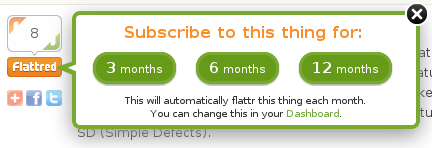
I put 5 EUR in Flattr each month and I like to spend those among other Debian contributors. That s why I keep a list of Debian people that I have seen on Flattr (for most of them I noticed through an article on Planet Debian). Directory of Debian contributors that you can thank I thought this list could be useful for others so I put it on a web page. Then I realized that limiting this to Flattr was not a good idea, and indeed several developers already propose multiple ways to be thanked. I went back through my list and looked up each developer s website to identify a Thank me page (it can be Donate , Support me , Amazon Wishlist , etc.). Obviously this means that Debian contributors who are not on Flattr do not appear on the initial list even if they have some Thank me page please help me fix this and send me the missing entries if you know of any. Click here to view the directory. The initial listing contains 16 developers and 8 of them have an additional (non-Flattr) Thank me link. Please note the warning I put on the page: the inclusion in the directory should not be taken as an endorsement of the amount or quality of the work done for Debian. You are supposed to make up your own judgment when deciding who you want to thank (but the links can help you learn more about what each contributor is doing). Flattr subscriptions explained Since this article replaces the traditional Flattr FOSS issue for this month, I wanted to introduce a new Flattr feature I recently discovered. With Flattr you have to click on some things every month or your monthly fee is given to a random charity. Now you can avoid this pitfall by subscribing to some things that you like. A subscription acts like an automatic click during a period of 3/6/12 months. If you want to subscribe to something, you just have to click a second time on the Flattr button and you will see this:
Screenshot with Flattr subscription choices Once you clicked on the desired duration, the subscription is recorded and the button will appear like this:

Screenshot with a subscribed flattr button Easy, isn t it? PS: I installed a WordPress plugin to make it super easy to share my articles on the most common social networks.

One comment Liked this article? Click here. My blog is Flattr-enabled.

Next.

Previous.