Announcement
After a very long work, over the course of 4 months, I have finished packaging the first RC1 of OpenStack. This comes on time, just 9 days before the official Havana release. Please do try this RC1 before the official 2013.2, code name Havana, is released, and hopefully uploaded to Debian. All of the packages are available from Debian Experimental, keeping Grizzly in Sid. However, there is also some private repositories that I maintain, holding Wheezy backports:
deb http://havana.pkgs.enovance.com/debian havana main
deb http://archive.gplhost.com/debian havana-backports main
The first repository holds the packages maintained within the Alioth group. These are built directly from my Jenkins machine, on each git push. The 2nd repository is holding backports from Sid to Wheezy for the packages that I don t actively maintain (though a lot of them are in the Python module team, in which I do a lot of packaging and updates as well).
A few numbers
A few numbers about this now. I had to work on 145 source packages: at least backport them to Wheezy, and push them in the GPLHost archive repository above. This generates 360 binary packages. Out of these, I maintain 77 source packages within the Alioth OpenStack group, generating 209 .deb files. That s a lot of stuff to deal with (and I feel sometimes a bit dizzy about it). While OpenStack is a big jigsaw puzzle to solve for the users, it is even more for someone who has to deal with all the (sometimes buried in the the code) Python dependencies. I hope others will come and join me in this packaging effort, since over the time, there s more and more work to be done, as the project grows. Note that most of the work is unfortunately done on packaging (and updating) the Python dependencies, working on the packages themselves is done last, at the end of the cycle.
Other things not packaged (yet)
Before the release (and the forthcoming Hongkong summit on the 5th of November), I hope to be able to finish packaging TripleO. TripleO is in fact OpenStack on OpenStack, which works with nova-baremetal. I have no idea how to test or install this, though it sounds like a lot of fun. There are 6 source packages that need to be done. Also, pending on the FTP masters NEW queue, is Trove: Database as a Service. I hope this one can get through soon. There is, also, Marconi, which is an incubated project for a new message queuing service, which probably will replace RabbitMQ (I m not sure yet what it does, and I will be happy to hear about it at the summit). Lastly, there s Ironic, which will at some point, replace nova-baremetal. That is, it does cloud computing over bare metal, without virtualization.
All of these new projects are still in an incubation stage, and are not part of the official release yet. Though, I have learned over the course of this past year, that with OpenStack, it s never early enough to start the packaging work.
Thanks to my sponsor!
Please note that all of this wouldn t be possible without eNovance sponsoring my packaging work. A big up to all of them for supporting and loving Debian! You guys rox. Also a special thanks to Mehdi / Sileth, for his work testing everything with the Tempest functional tests and the CI platform.
Just as last year, BalaBit applied to become a mentoring organisation for this year's Google Summer of Code, but like the year before, were not accepted. Instead, the openSUSE project was kind enough to give us two slots of their own, similarly to the year before - we are very thankful for this, and this year, both of the projects we took were closed successfully! So much so, that one of them was already merged into syslog-ng 3.5.0beta2, and the other one is being prepared for getting merged into the Incubator. I also helped out a little with Clojure & Leiningen packaging, although my contributions there were minimal at best.On the whole, I really liked this year's programme, our students accomplished a lot, and the whole summer was a great experience in itself, I learned a lot about mentoring, and about working with other people, people who are very new to the codebase they're working on. I would like to summarise what I learned and observed this year, in the hopes that others may find them useful too.This year, we set fairly ambitious goals for our students: they had to write a Redis and a MySQL destination, both of which presented interesting challenges to the students. None of them had prior experience with the syslog-ng source code, and their programming knowledge was mostly in C#, not plain old C which syslog-ng is written in. They also had to dabble a bit in the bowels of our overly complex configure.ac and a few Makefiles. Wasn't an easy task.In the beginning, we tasked the students to write proof of concept code, to get familiar with the libraries they will need to use - no syslog-ng involved at this point. This sounded like a good idea on paper, but without clear goals and milestones, a lot of time was spent on this task, and the students ran into a few dead-ends which could have been avoided, if we, the mentors, were more careful. This resulted in a reasonably poor first term, frustration and caused many a sleepless nights. We had to change our approach if we wanted to see the projects succeed.So we sat down with the students, and took one big leap: in person, we explained some of the internals of syslog-ng, did code reviews with them, and so on. But the best thing we did was what my colleague (and the main mentor), Viktor Tusa, came up with: we wrote a test script, that started syslog-ng, configured it, and ran tests against it. Students had to make their code pass the test by the next in-person meeting. This helped tremendously, and increased the speed they worked at by an order of magnitude at least. We kept developing the test script further, and so did the projects improve.ConclusionsThere are a couple of conclusions I arrived at as the programme concluded, things we (or other mentors, as I plan to participate as a student next year) will need to improve upon in the coming years.
We need milestones at the time of announcing the project, not later, but by the time we put a project online, we need clear milestones.
We need a way to help students track their own progress. We can't always be there for them, and that's OK. They need to be able to see how they're doing, though. Automated tests, whenever possible, are a great aid.
In person meetings, with code reviews and explaining idiosyncrasies of the existing code-base are a great help to students, and also help us better understand how others would like to use our APIs, which in turn makes it easier to write APIs that are actually good.
Lack of experience in the programming language is no big deal, experience can be gained during the programme, if the student is dedicated. We should not be afraid of involving smart, but less experienced students. As a consequence, requiring code samples may not be the best idea. That's a very high barrier to jump over. I would rather have a talk - in person, preferably - with the student, and see if they have the potential to bring the project to the finish line.
We need to start preparing for next year soon, if we want to participate on our own. Can't wait for the last minute, starting just a month before the application period for organisations open is already too late.
Involving the students in the project, letting them do useful work that gets merged during the programme is a huge accomplishment. Both our students expressed interest in not only participating next year too, but also continuing their work after GSoC. We need to keep this up in the coming years too!
Sirantha Jax is a jumper: a person with the rare genetic ability to jump
spaceships through the shortcut dimension of grimspace. It's a science
fiction idea with a long pedigree. It creates a separate in-group for the
characters to belong to, a society with its own rules, and sets up tension
with the rest of the institutions of the world. In Aguirre's version,
jumpers can provide the transition but direction in grimspace has to be
done by a pilot, and the jumper and the pilot develop a deep psychic bond.
Jax had been jumping with her husband piloting, but on their last trip
their ship crashed, killing everyone on board except her.
As Grimspace opens, Jax is in a treatment facility that's much more
like a prison. In theory, they're trying to figure out whether she's
still able to (and safe to allow to) jump. In practice, something quite a
bit more sinister is going on, a fact that the reader senses early but
only learns more about after Jax is helped to escape. Scarred, deeply
depressed, and nearly suicidal, she's pulled into the subversive plans of
a small ship of renegades who are trying to break open the Corp monopoly
on grimspace travel and their tight hold over every jumper. But she's not
sure whether she trusts them, or whether she cares enough about their
crusade to truly join in.
Grimspace follows well-trod SF paths of special cadres of pilots
and navigators, lawless corners of space with local warlords, and
rebellion against smothering centralization, but its first-person
protagonist and point of view have more in common with urban fantasy.
It's written in first-person and, at times, nearly stream of consciousness
from Jax's perspective, and Jax displays plenty of profanity, acidic
commentary, and emotional angst. If her special ability were
shapeshifting or magic instead of jumping spaceships, one could easily see
her as the typical burned-out urban fantasy detective. I liked that.
It's a fun point of view when it's written well, and it felt fresh when
applied to a science fiction background instead of the more typical
fantasy.
That said, Grimspace has a rather rough start. Jax isn't sure
what's going on at first and also isn't sure she cares, and I thought that
carried over to the reader's experience. The first section of the book is
rough and jagged, with staccato bursts of character introduction,
world-building that doesn't quite cohere, and an extended stop on a very
odd outback planet that felt to me like a repurposed stage from a western.
Part of the early problem is that Jax and the reader are being
intentionally kept in the dark about the real goal of this group, but part
of the problem is also that none of the characters start off as very
likable. That includes Jax, who is a complete mess and who is both scared
and despairing to the point of being almost nihilistic. The
world-building unfortunately does not carry the reader through that part
of the story, and at about eighty pages in I wasn't sure I was going to
like this book.
It does, however, get much better. For one, Jax calms down and starts
making emotional connections with the rest of the crew, and that lets her
demonstrate skills as a fearless problem solver. For another, while the
goal of the group of people she's fallen in with isn't exactly deep, it
does make sense and it does slowly become a cause the reader (and Jax) can
believe in. The frenetic pace of introduction and discovery also slows
down, the cast stabilizes, and the surroundings get a bit less weird (and
a bit more conventional for a science fiction novel). I didn't care for
the alien baby subplot I rarely do but the rest of the story slowly
pulled me in.
One thing Aguirre did extremely well was surprise me. There are several
points later in the book where Jax gets put in a fairly typical
high-stress position and does something very atypical in reaction to it,
twisting the story into a shape quite a bit unlike what I had been
expecting. That made Jax feel like a true free agent, establishing her
independence and her desire to control her own life, and that appealed to
me. Aguirre also palms one card exceptionally well, setting up an ending
that I thought was the best set of scenes in the whole book, and that had
me thoroughly engrossed. One can see the bones of the urban fantasy
heroine inside Jax's character, but they're fresh and interesting in an SF
world, and they work better than I would have expected.
There is a romance, in fitting with the urban fantasy inspiration, and it
didn't quite work for me, but Aguirre also builds in a reason why it might
not make sense and makes it spiky and fragile without being too cliched.
By the end of the book, I was, if not entirely persuaded, at least willing
to go along for the ride.
And that's the best summary of Grimspace, I think. Parts of it
don't make a great deal of sense, and parts of it are quite choppy. But I
liked Jax once she starts getting a handle on her trauma, the other
characters grew on me, and the plot surprised me in some interesting ways.
It's not the smoothest or most polished SF novel I've read, but it has a
lot of energy and an unusual genre mix. I think I'll stick along for the
ride.
Followed by Wanderlust.
Rating: 7 out of 10
This is a reply to Roman Cheplyaka s post Why PVP doesn't work , where he argues that Haskell packages should not per default put upper bounds on their build dependencies (as mandated by the Package Versioning Policy), at least not without good reason.
I disagree, and I d like to explain why. I assume that you are packaging your libraries and programs not only for your fellow developers, but also for users. Hackage has turned not only into a hub for developers sharing their libraries, but also for users to conveniently download stuff from. And when I say users, I include xmonad users (although they write a bit of Haskell for their configuration) and beginners (who we certainly don t expect to understand and make sense of error messages that occur if some obscure crypto-related dependency of their favourite web framework fails to build). And for their benefit we should try hard to make sure cabal install either succeeds (great) or fails early with an error message that the user can understand as I could not find a package configuration of which the maintainers believe with good confidence that it works. Please talk to them.
I speak with some experience, because as a maintainer of the >666 Haskell packages in Debian, I am, in a sense, a very heavy user. In the years after the PVP got commonly accepted, we could noticeably reduce the number of build failures that we encounter on our machines and the Debian build farms, simply because the meta data (which we transfer to the Debian package level) prevented such builds from being attempted. We now even have a build compatibility prediction system: We maintain a text file with all Haskell packages in Debian, together with a directory of patches (where we sometimes indeed override the packages Cabal file), and a script that runs cabal-install s dependency checker against this day. This way, when I want to upgrade a package, I can simply change the version in the file and know what packages will be broken. So I change their version until I either find a fixed-point (and only then actually upload packages to the user) or find a problem, which I then report to the maintainers or start cooking up my own patches.
This works really well, but it only does because most maintainers are following the PVP. That s why I argue: Please continue to do so.
(What we would probably need instead of less using the PVP is more tools in helping us with it. I could imagine a build bot that finds packages on Hackage with an upper bound on a package where a newer version exists, fetches those and automatically tries to build against the new version, and if it succeeds, sends a message to the maintainer: Your dependency on bar in foo also builds against version 0.42 of bar; please check for incompatibilities that are not expressed in the type system and upload a new version of foo allowing bar-0.42. Isn t that something the Stackage infrastructure can be used for?)
(What we could probably use as well (and is probably a stepping stone towards what I just said) is a way to tell cabal-install to ignore a certain build dependency version bound. This way we still prevent normal users from trying a dependency version that the maintainer did not test, but nevertheless make it as easy as possible for the advanced user to try nevertheless, and then hopefully report about it to the maintainer. Of course, other had that idea before, someone just has to make it happen.)
I wish I had known about that quote from Michael Graves before now. I would have perhaps had an answer to some recent visitors to makespace.
There are regular scheduled visits to makespace where people can come and view our facilities, and perhaps start the process of becoming a member if they decide they like what they see.
However, we sometimes get people who just turn up at the door. If a member feels charitable they may choose to give a short tour rather than just turn the person away. I happened to be in one Friday afternoon recently varnishing a folding chair when two such people rang the doorbell. There were few other members about and because watching varnish dry was dull I decided to be helpful and do a quick tour.
I explained that they really ought to return for a scheduled event for a proper tour, gave the obligatory minimal safety briefing, and showed them the workshops and tools. During the tour it was mentioned they were attending a certain local higher education establishment and were interested in makespace as an inexpensive studio.
Before they left I was asked what I was working on. I explained that I had been creating stools and chairs from plywood. At this point the conversation took a somewhat surreal turn, one of them asked, well more demanded, who my principle influence had been in designing with plywood.
When I said that I had mainly worked from a couple of Google image searches they were aghast and became quite belligerent. They both insisted I must have done proper research and my work was obviously influenced by Charles and Ray Eames and Arne Jacobsen and surely I intended to cite my influences in my design documents.
My admission that I had never even heard the names before and had no design documents seemed to lead to a distinctly condescending tone as they explained that all modern plywood design stemmed from a small number of early 20th century designers and any competent designers research would have revealed that.
At this point in proceedings I was becoming a bit put out that my good deed of showing off the workshop had not gone unpunished. I politely explained that I designed simply by generating a requirement in my head, maybe an internet search to see what others had done, measuring real things to get dimensions and then a great deal of trial and error.
I was then abruptly informed that my "design process was completely invalid and there were well established ways to design furniture correctly and therefore my entire design was invalid" and that I was wasting time and material. I thanked them for their opinion and showed them out, safe and well before anyone gets any ideas.
I put the whole incident out of my mind until I finished writing up the final folding chair post the other day. It struck me that perhaps I had been unknowingly influenced by these designers. It was certainly true I had generated ideas from the hundreds of images my searches had revealed.
I did some research and it turns out that from the 1930s to the 1950s there were a string of designers using plywood in novel ways from the butterfly stool by Sori Yanagi through formed curvy chairs by Alvar Aalto and eero saarinen.
While these designers produced some wonderfully iconic and contemporary furniture I think that after reviewing my initial notes that two more modern designers Christian Desile and Leo Salom probably influenced me more directly. Though I did not reference their designs beyond seeing the images along with hundreds of others, certainly nothing was directly copied.
And there in lies an often repeated observation: no one creates anything without being influenced by their environment. The entire creative process of several billion ape descendants (or Golgafrincham telephone sanitisers if you prefer) is based on the simple process of copying, combining and transforming what is around us.
In my case I am privileged enough to live in a time where my environment has grown to the size of the world thanks to the internet. My influences, and therefore what I create, is that much richer but at the same time it means that my influence on others is similarly diminished.
I have joined the maker community because I want to create. The act of creation teaches me new skills in a physical, practical way and additionally I get to exercise my mind using new techniques or sometimes things I had forgotten I already knew. I view this as an extension of my previous Open Source software work, adding a physical component to a previously purely mental pursuit.
But importantly I like that my creations might provide inspiration for someone else. To improve those chances in the wider world I force myself to follow a few basic rules:
Release
Possibly one of the hardest things for any project. I carefully avoided the word finish here because my experience leads me to the conclusion that I always want to improve my designs.
But it is important to get to a point in a project where you can say "that is good enough to share", this is more common in software but it really applies to any project.
Share
If your aim here is to improve your society with your contribution sharing your designs and information is important. I think there is nothing better than someone else taking one of your designs and using it and perhaps improving on it, remember that is what you probably did in one way or another better to make it less hard for that to happen.
Ensure your design files are appropriately licensed and they are readily accessible. I personally lean towards the more generally accessible open source licences like MIT but the decision is ultimately yours.
Licencing is important, especially in the current copyright happy society. I know it sounds dull and no one takes that seriously, right? Sorry, but yes they do and it is better for you to be clear from the start, especially if there is a software component to your project. Oh one personal plea, use an existing well known licence, the world simply does not need another one!
Write about it
The blog posts about the things I have made sometimes take almost as much time as the creation. The clear recording on my thoughts in written and photographic form often gives me more inspiration for improvements or other projects.
If someone else gets pleasure from the telling then that can only be good. If you do not do this then your voice cannot be heard and you wasted an opportunity to motivate others.
Feedback
If you do manage to get feedback on your creation, read it. You may disagree or not be interested for the current project but the feedback process is important. In software this often manifests as bug reports, in more physical projects this often becomes forum or blog comments.
Just remember that you need a thick skin for this, the most vocal members of any society are the minority with inflammatory opinion, the silent majority are by definition absent but there is still useful feedback out there.
Create again
By this I simply mean that once you are satisfied yourself on a project move on to the next. This may sound a little obvious but once you have some creative momentum it is much easier to keep going project to project than in you leave time between.
Also do not have too many projects ongoing, by all means have a couple so you do not get stuck waiting for materials or workshop time but more than three and four and you will never be able to release any of them.
Those students were perhaps somewhat misguided in how they stated their opinions, but they are correct that in the world in which we find ourselves we are all influenced. Though contrary to received wisdom those influences are more likely to be from the internet and our peers in the global maker society than historical artists.
This is my monthly summary of my free software related activities. If you re among the people who made a donation to support my work (86.18 , thanks everybody!), then you can learn how I spent your money. Otherwise it s just an interesting status update on my various projects.
Package Tracking System^U Distro Tracker
Marko Lalic implemented quite a few interesting features in the last weeks of the Google Summer of Code (support of teams most notably). Unfortunately he didn t deploy (yet) the latest changes on pts.debian.net.
Given the good work he made over the summer, I marked him as successful in his GSOC. Hopefully he will stick around and continue to contribute, he promised to try to handle some mass renaming that we agreed upon. Effectively, after much bike-shedding, I decided that the software would be called Distro Tracker .
Once those last-minute cleanups are done, I plan to request tracker.debian.org to Debian System Administrators. This means that it will be deployed in parallel to the current PTS at least until we re at feature parity in the new codebase.
The new codebase should be much more easy to get started with, so I should do some promotion and invite people to contribute to it possibly by writing some short how to get started documentation.
I started by creating a dedicated wiki page: http://wiki.debian.org/qa.debian.org/distro-tracker
Misc packaging
I got two REJECTs from ftpmasters this month (one for galette, one for dolibarr). I took care of fixing the various issues in galette and the package has been promptly accepted afterwards. For dolibarr, I mentored the upstream maintainer about the various problems and got him to fix it. It took a bit more time and the package is thus still in NEW.
I packaged wordpress 3.6, and then wordpress 3.6.1 (security update). python-django also had multiple security updates this month, I took care of one or two uploads but Luke Faraone dealt with most of them (including backports to Squeeze!).
I packaged Publican 3.6.1 and uploaded dh-linktree 0.4 to fix a FTBFS issue introduced with Perl 5.18.
Of anecdotal importance, but I also filed bug #721849 after seeing how much energy was spent to ensure debian/rules didn t contain an improper copyright statement.
Thanks
See you next month for a new summary of my activities.
XMir's been delayed from Ubuntu 13.10. The stated reason is that multi-monitor support isn't sufficiently reliable. That's true, but it's far from the only problem that XMir still has:
It's still broken on some single-monitor systems
Some machines have display corruption. There are writes to freed memory. To be fair, some of the behaviour that's been seen has been down to underlying bugs in the Xorg drivers that were never triggered under normal use but are hit by XMir. Others are down to implicit assumptions made in the drivers that XMir happens to violate. The problem is that there doesn't appear to have been enough room in the schedule to deal with these interactions, presumably because nobody accounted for the inevitable "This thing we thought would be easy turns out to be difficult" part of the project.
The input driver bug still isn't really fixed
I've mentioned this bug before. It's now marked "Fix released" which is kind of true but not really. Mir now tells XMir that the VT is changing before the VT is changed, but it doesn't wait for that to complete before switching the VTs. Until XMir is scheduled and runs, it's still receiving input events. In most circumstances that window is small, so there's no real risk of triggering it accidentally.
There's one corner case where it might still cause problems. Simply running isn't enough - XMir has to make progress through its event loop. That'll only happen if the X server is processing its wakeup events, and it's possible to effectively stall that by submitting a sufficiently awkward drawing request to the server. The X server will appear to freeze, and if the user then attempts to work out what's going on by switching to a VT and logging in, those input events will still be going to XMir. It's left as an exercise to the reader to construct ways to take advantage of this.
This can't happen in Xorg because the VT switch is blocked until the input devices have been released. Mir could have done the same, but doesn't because of a conscious design decision - in the Ubuntu Phone world, clients stop doing things when they're told to. Ubuntu Desktop is expected to behave the same way.
This is an unfortunate situation to be in. Ubuntu Desktop was told that they were switching to XMir, but Mir development seems to be driven primarily by the needs of Ubuntu Phone. XMir has to do things that no other Mir client will ever cope with, and unless Mir development takes that into account it's inevitably going to suffer breakage like this. Canonical management needs to resolve this if there's any hope of ever shipping XMir as the default desktop environment.
It's still missing features
XMir doesn't support colour profiles. XRandR properties aren't exposed, so there's no way to control TV output encoding or overscan. There's still no hardware cursor support. Switching to XMir now would reduce functionality without providing any user-visible gain.
It's clear that XMir has turned into a larger project than Canonical had originally anticipated, but that's hardly surprising. There's only one developer with previous X experience working on it full-time, and the announced schedule provided no opportunity to deal with unexpected problems. As if that weren't enough, there's obvious conflict between Ubuntu Desktop and Ubuntu Phone when it comes to developer time and required functionality. The one hardware vendor who's willing to take a public stand has demonstrated that they have no interest in supporting XMir, despite Canonical assuring people that they were already engaging in productive negotiations with GPU manufacturers.
Multiple monitor support may be the single most obvious feature where XMir is lacking, but it's not the only one. Technically and politically, this code is a long way from being ready for prime time. Without significant community contribution, Canonical need to focus on prioritising it appropriately rather than expecting a tiny number of developers to perform miracles. Or, alternatively, they could just drop XMir entirely and focus on Unity 8.
Today the Nagios Plugins Development Teamreleased the long awaited version 1.5 of the Nagios Plugins. It contains several bug-fixes as well as new features. The project moved to a new home at nagios-plugins.org, the SCM and issue tracker moved to github. If you want to contribute to the project, please have a look into the updated development documentation. Many thanks guys, you rock!
The package was uploaded already into Debianunstable and it should hit the Backports repository soon.
If you are impatiently, you could install the package from our repository.
After 1.5 month of work, I am proud to officialy release OUnit 2.0.0. This is a major rewrite of OUnit to include various feature that I think was missing from OUnit1. The very good news is that the port of the OASIS test suite has proven that this new version of OUnit can drastically improve the running time of a test suite.
OUnit is a unit test framework for OCaml. It allows one to easily create unit-tests for OCaml code. It is based on HUnit, a unit testing framework for Haskell. It is similar to JUnit, and other XUnit testing frameworks.
Download OUnit v2.0.0Documentation of v2.0.0Website
The basic features:
better configuration setup
environment variable
command line options
configuration files
improved output of the tests:
allow vim quickfix to jump in the log file where the error has happened
output HTML report
output JUnit report
systematic logging (verbose always on), but output log in a file
choose how to run your test:
run tests in parallel using processes (auto-detect number of CPU and run as many worker processes)
run tests concurrently using threads
use the old sequential runner
choose which test to run with a chooser that can do smart selection of tests:
simple: just run test in sequence
failfirst: run the tests that failed in the last run first and skip the success if they are still failing
some refactoring:
bracket: use a registration in the context but easier to use
remove all useless functions in the OUnit2 interface
non-fatal section: allow to fail inside non-fatal section without quitting immediately the whole test
allow to use OUnit1 test inside OUnit2 (smooth the transition)
timer that makes tests fail if they take too long, only when using the processes runner (I was not able to do it cleanly using threads and sequential)
allow to parametrize filenames so that you can use OUNIT_OUTPUT_FILE=ounit-$(suite_name),log and have $(suite_name) replace by the test suite name
create locks to avoid accessing the same resources within a single process or the whole application (typically to avoid doing a chdir while another thread is doing a chdir elsewhere)
create a in_testdata_dir function to locate test data, if any
Migration path
OUnit 2.0.0 still provides the OUnit module which is exactly the same as the last OUnit 1.X version. This way, you are not forced to migrate. However, this means that you will gain no advantage of the new release and even some slowdown due to increase complexity of the code. Though, I strongly recommend to upgrade to OUnit2.
Here is a checklist to do the migration:
replace all open OUnit by open OUnit2
the test function now takes test_ctxt argument, so replace all fun () -> ...) by fun test_ctxt -> ...
bracket are now inlined so bracket setUp f tearDown is now let x = bracket setUp tearDown test_ctxt in
make sure that you don't change global process state like chdir or Unix.putenv or that you don't rely on another test setting something for the next test
The OASIS test suite migration
In order to check that everything was working correctly, I have migrated the OASIS test suite to OUnit2. This is a big test suite (210 test cases) and it includes quite big sequences of tests (end to end tests from calling oasis setup to compiling and installing the results). This was really time consuming and I wish to see a significant speedup for the tests with OUnit2.
You can see the result in term of code of the full migration here.
Here are the results on my Intel Core i7 920/SSD:
oUnit1 over oUnit2: 60.39s (OUnit v2.0.0 using the OUnit v1 layer)
Migration to OUnit2 (166 tests):
processes (8 shards): 10.12s
processes (autodect, 4 shards): 12.99s
sequential: 58.77s
The migration was quite heavy because this test suite had a big design problem. It uses in-place modification of the test data. I think I pick this design because I thought this was a good idea to decrease the running time. As a matter of fact, this was a huge mistake, that keeps popping failed test cases because one of the previous tests was failing. I have refactored all this and now we start by copying the test data into a temporary directory, which ensure that everything is always starting from pristine test data.
During the redesign, I have decided to reduce the number of tests by merging some of them. This should have no big impact on the running time, although this is not as pure 1:1 comparison with OUnit v1. Although it is still testing exactly the same thing. This explain the loss of ~50 tests, which in fact has been merged in other tests.
The overall speedup is 4x compared to OUnit v1, when using processes. However there is a 12% increase compared to OUnit v1 for sequential and a 15% increase when using OUnit v1 compatibility layer. While this is not very good score, I hope this is small enough to compensate the huge win of being able to run tests in parallel with processes.
And now the magic !
At this point, if you read carefully the numbers, you would have noticed that there is a 4.5x decrease in speed when you compare sequential and 4 processes for OUnit2. Since we are only actively testing in 4 shards, it looks strange. I don't expect a super-linear speedup due to the use of processes. I have checked that every tests was indeed running and found no solutions to this mystery. Right now, I think this is due to the fact that we are running less tests in more processes which should lighten the load of the GC (which may not trigger at all). I am not sure about this explanation and will welcome any bug report which shows a problem in the implementation of either sequential or processes runner. Although, this is great.
Help still wanted
If you find any bugs with OUnit v2, this is the time to submit a bug.
OUnit BTS
If you want to try to fix bugs by yourself, please checkout the latest version of OUnit:
$> darcs get http://forge.ocamlcore.org/anonscm/darcs/ounit/ounit
It has taken just over two weeks for blogspam to reject 1 million SPAM comments.
I'm not sure how paranoid I should be about false-positives now, (I
accept false-negatives easily enough).
Using node.js is pretty good for making toy servers, and on that basis here's another toy server:
This is a small server which is designed to accept HTTP-POSTs containing a payload of a message, these are stored and later retrieved. Seems like a simple thing, right? Imagine how it is used:
root@server1:~# record-log Upgraded mysql
root@server2:~# record-log Tweaked /etc/sysctl.conf
root@server3:~# record-log Added user 'bob'
root@server3:~# record-log Added user 'steve'
Later:
root@server3:~# get-recent
1.2.3.4 2013-09-28T08:08:09.211Z
root:Added user 'bob'
1.2.3.4 2013-09-28T08:08:10.211Z
root:Added user 'steve'
In short it makes it easy to record "activity", and later retrieve it. A host can only fetch the entries it stored, but if you've got access to the remote server then you can get all logs.
I suspect a more standard solution is to use syslog-ng, and logger, or similar. But it is a cute hack and I suspect if you've the discipline to record actions then this is actually reasonably useful.
"Big Data" has been hyped a lot, and due to this now is burning down to
get some reality checking. It's been already overdue, but it is now happening.
I have seen a lot of people be very excited about NoSQL databases; and
these databases do have their use cases. However, you just cannot put
everything into NoSQL mode and expect it to just work. That is why we have
recently seen NewSQL databases, query languages for NoSQL databases etc. -
and in fact, they all move towards relational database management again.
Sound new database systems seem to be mostly made up of three aspects:
in-memory optimization instead of optimizing for on-disk operation (memory just
has become a lot cheaper the last 10 years), the execution of queries on the
servers that store the actual data (you may want to call this "stored
procedures" if you like SQL, or "map-reduce" if you like buzzwords), and
optimized memory layouts (many of the benefits of "colum store" databases
come from having a single, often primitive, datatype for the full column to
scan, instead of alternating datatypes in records.
However, here is one point you need to consider: is your data actually
this "big"? Big as in: Google scale.
I see people use big data and Hadoop a lot when they just
shouldn't. I see a lot of people run Hadoop in a VM on their
laptop. Ouch.
The big data technologies are not a one-size-fits-all solution. They are
the supersize-me solution, and supersize just does not fit every task.
When you look at the cases where Hadoop is really successful, it is mostly
in keeping the original raw data, and enabling people to re-scan the
full data again when e.g. their requirements changed. This is where Hadoop
is really good at: managing 100 TB of data, and allowing you to quickly filter
out the few GB that you really need for your current task.
For the actual analysis - or when you don't have 100 TB, and a large
cluster anyway - then just don't try to hadoopify everything.
Here is a raw number from a current experiment. I have a student work
on indexing image data; he is implementing some state of the art techniques.
For these, a large number of image features are extracted, and then clustering
is used to find "typical" features to improve image search.
The benchmarking image set is 56 GB (I have others with 2 TB
to use next). The subset the student is currently processing is 13 GB.
Extracting 2.3 million 128 dimensional feature vectors reduces this to about
1.4 GB. As you can see, the numbers drop quickly.
State of the art seems to be to load the data into Hadoop, and run
clustering (actually, this is more of a vector quantization than clustering)
into 1000 groups. Mahout is the obvious candidate to run this on Hadoop.
However, as I've put a lot of effort into the data mining software
ELKI, I considered also to try
processing it in ELKI.
By cutting the data into 10 MB blocks, Mahout/Hadoop can run the
clustering in 52x parallel mappers. k-Means is an iterative algorithm, so it
needs multiple processes. I have fixed the number of iterations to 10, which
should produce a good enough approximation for my use cases.
K-means is embarrassingly parallel, so one would expect the cluster to really shine
at this task. Well, here are some numbers:
Mahout k-Means took 51 minutes on average per iteration
(The raw numbers are 38:24, 62:29, 46:21, 56:20, 52:15, 45:11, 57:12, 44:58,
52:01, 50:26, so you can see there is a surpisingly high amount of variance
there).
ELKI k-Means on a single CPU core took 4 minutes 25 seconds
per iteration, and 45 minutes total, including parsing the input
data from an ascii file. Maybe I will try a parallel implementation next.
So what is happening? Why is ELKI beating Mahout by a factor of 10x?
It's (as always) a mixture of a number of things:
ELKI is quite well optimized. The Java Hotspot VM does a good job at
optimizing this code, and I have seen it to be on par with R's k-means, which
is written in C. I'm not sure if Mahout has received a similar amount of
optimization yet. (In fact, 15% of the Mahout runtime was garbage
collection runtime - indicating that it creates too many objects.)
ELKI can use the data in a uniform way, similar to a column store database.
It's literally crunching the raw double[] arrays. Mahout on the
other hand - as far as I can tell - is getting the data from a sequence file,
which then is deserialized into a complex object. In addition to the actual
data, it might be expecting sparse and dense vectors mixed etc.
Size: this data set fits well into memory. Once this no longer holds,
ELKI will no longer be an option. Then MapReduce/Hadoop/Mahout wins.
In particular, such an implementation will by design not keep the
whole data set in memory, but need to de-serialize it from disk again on
each iteration. This is overhead, but saves memory.
Design: MapReduce is designed for huge clusters, where you must expect
nodes to crash during your computation. Well, chances are that my computer
will survive 45 minutes, so I do not need this for this data size. However,
when you really have large data, and need multiple hours on 1000
nodes to process it, then this becomes important to survive losing
a node. The cost is that all interim results are written to the distributed
filesystem. This extra I/O comes, again, at a cost.
Let me emphasize this: I'm not saying, Hadoop/Mahout is bad. I'm
saying: this data set is not big enough to make Mahout beneficial.
Conclusions: As long as your data fits into your main memory and
takes just a few hours to compute, don't go for Hadoop.
It will likely be faster on a single node by avoiding the overhead
associated with (current) distributed implementations.
Sometimes, it may also be a solution to use the cluster only for preparing
the data, then get it to a powerful workstation, and analyze it there. We did
do this with the images: for extracting the image features, we used a
distributed implementation (not on Hadoop, but on a dozen PCs).
I'm not saying it will stay that way. I have plans for starting
"Project HELKI", aka "ELKI on Hadoop". Because I do sometimes hit the
barrier of what I can compute on my 8 core CPU in an "reasonable" amount
of time. And of course, Mahout will improve over time, and hopefully lose
some of its "Java boxing" weight.
But before trying to run everything on a cluster, always try to run it
on a single node first. You can still figure out how to scale up later, once
you really know what you need.
And last but not least, consider whether scaling up really makes sense.
K-means results don't really get better with a larger data set. They are
averages, and adding more data will likely only change the last few
digits. Now if you have an implementation that doesn't pay attention to
numerical issues, you might end up with more numerical error than you gained
from that extra data.
In fact, k-means can effectively be accelerated by processing a sample
first, and only refining this on the full data set then. And:
sampling is the most important "big data" approach. In particular when
using statistical methods, consider whether more data can really be expected to
improve your quality.
Better algorithms: K-means is a very crude heuristic. It optimizes the sum
of squared deviations, which may be not too meaningful for your problem. It is
not very noise tolerant, either. And there are thousands of variants. For
example bisecting k-means, which no longer is embarrassingly parallel (i.e.
it is not as easy to implement on MapReduce), but took just 7 minutes doing
20 iterations for each split. The algorithm can be summarized as starting with
k=2, then always splitting the largest cluster in two until you have the
desired k. For many use cases, this result will be just as good as the full
k-means result.
Don't get me wrong. There are true big data problems. Web scale search,
for example. Or product and friend recommendations at Facebook scale.
But chances are that you don't have this amount of data.
Google probably doesn't employ k-means at that scale either.
(actually, Google runs k-means on 5 mio keypoints for vector quantization;
which, judging my experience here, can still be done one a single host; in
particular with hierarchical approaches such as bisecting k-means)
Don't choose the wrong tool for the wrong problem!
A common theme that comes up in free software evangelism is the question of how to tap into the huge expenditure that small to medium-sized businesses make for off-the-shelf licensed software. It is well known that many small companies are paying over the odds compared to the site-license rates given to big business, so why is it that small businesses are not rushing to adopt free and open source solutions?
The answer is not likely to be found by fighting a battle on pricing (even though it is a battle that free software is inherently well prepared for). Rather, the most compelling strategy involves helping businesses find better ways to solve their own problems.
A problem that every business encounters in every industry is the maintenance of proper financial records. Up until now, packaged solutions like GnuCash and HomeBank, available in many Linux distributions, have only catered for the smallest businesses and household accounting. At the other end of the spectrum, solutions like Compiere/Adempiere and OpenERP require a level of effort to install and maintain that makes them unsuitable for small users and businesses that don't need their full range of features. OpenERP briefly appeared as a Debian package but subsequently dropped out due to difficulties supporting the package.
There is another choice, PostBooks. PostBooks has recently been packaged for Debian and this experience leads me to believe it will be supportable in Fedora and other distributions too. PostBooks, which started off as a commercial product, was re-licensed as an open source solution in 2007. In March 2013, PostBooks was project of the month on Sourceforge.
Of particular note,
PostBooks has a Qt-based GUI where users of equivalent commercial solutions are likely to feel comfortable very quickly
PostBooks does not depend on any dedicated server processes other than a PostgreSQL database
Using the quickstart database, it can be set up in less than half a day, making it suitable for many consultants and freelancers who may otherwise use a product having a setup wizard (such as QuickBooks).
However, with features like inventory, invoicing, a sophisticated data import GUI (known as CSVImp), a true SQL backend, multi-currency and multiple concurrent users, it scales beyond the use cases that Quickbooks and Sage Accounting are capable of servicing.
The company behind PostBooks, xTuple, is well established and offers related services such as training and an annual user conference (which takes place in just a few weeks). Many business users are likely to find this style of support very reassuring and familiar, even if they don't plan to immediately take advantage of these things.
Limitations
Two particular limitations caught my attention early when evaluating PostBooks:
There is no integrated support for tracking credit card expenditure, which is another very common requirement for many small businesses and professional/freelance consultants.
The developers have acknowledged these limitations and offered to complete these solutions with a crowd-funding campaign dubbed Feature Mob 2.
While everybody likes a free lunch, I personally feel that developers are perfectly entitled to request payment for their work. Having already taken a great leap of faith in open-sourcing a product that had previously been developed in-house, companies like xTuple need to look at new ways to generate revenue.
Having looked at some of the prices of equivalent solutions, I felt quite comfortable pledging a similar amount based on four things:
it is based on the Kickstarter model, they only keep the money if their funding target is reached and feature implementation goes ahead
they are releasing the work as open source
the desire to have the option of using a highly capable free software solution that will be around well into the future
the probability that this is one piece of software that is likely to create more commercial opportunities for free software developers
Next steps
People trying the packages and people who potentially want to package PostBooks for other distributions are very welcome to come and ask questions in the xTuple Debian maintainers packaging list or using the xTuple web forums. Please also feel free to report bugs through the Debian bug tracker.
On a regular basis, I find myself the odd-man-out when it comes to talking
about how to work with Python on Debian systems. I'm going to write this and
post it so that I might be able to point people at my thoughts without having
to write the same email in response to each thread that pops up.
Turns out I don't fit in with the Debian hardliners (which is to say, the
mindset that pip sucks and shouldn't exist), nor do I fit in with the Python
hardliners (which is to say apt and dpkg are out of date, and neither have
a place on a Development machine).
I think our discourse on this topic has become petty and stupid in general.
Let's all try to step back and drop a bit of the attitude.
pip doesn't suck, and neither does apt.
The truth is, both sides are wrong. As with any subject, the real
answer here is much more nuanced than either side presents it. I'm going to
try and present my opinion on this, in the way that both my Pythonista self
and my Debianite self see the issue. Hopefully I can keep this short, to
the point, and caked with logic.
The case for dpkg (the Debianite in me)
In defense of dpkg and apt, imagine having to install python-gnome2
on all your systems when you install. It'd be hell on earth.
Imagine having a user try to do this. It's insane to assume that
end-users will be using pip for this purpose.
pip is fun and all, but it's also installing 100% untrusted code to your
system (perhaps as root, if you're using pip with sudo for some reason),
and hasn't been reviewed for software freeness, which is something Debian
(and Debian users) take seriously. This isn't even to mention the hell that
pip wreaks on dpkg controlled files / packages.
Try to remember how much of your system running (yes, right now) is running
because of Python or Python modules. Try to imagine how much of a pain in
the ass it'd be if you couldn't boot into GNOME to use nm-applet to connect
to wifi to pip install something. I'm sure even the most extreme pip'er
understands the need for Operating System level package management.
Debian also has a bigger problem scope - we're not maintaining a library
in Debian for kicks, we're maintaining it so that end user applications may
use the library. When we update something like Django, we have to make sure
that we don't break anything using it (although, to be honest, the fact that we
package webapps is an entire rant for later) before we get to update it to the
newest release.
Hell, with a few coffees, I could automate the process of releasing a .deb
with a new upstream release, 100% unattended. I won't, however, since this is
an insane idea. Let's go over a brief list of things I do before uploading a
new package:
Review the entire codebase for simple mistakes.
Review the entire codebase for license issues.
Review the entire codebase for files without source, and track down
(and include source for) any sourceless files (such as pickle
files, etc).
Get to know the upstream, get to know open bugs, write something using
the lib, in case I need to debug later.
Install the package.
Test the package.
Work out any Debian package issues (this is easy).
Now, a brief list of things I do before I update a package:
Review the changes between the last uploaded version (in diff format, if
it's sane, otherwise get the VCS and review), ensure all the above are still
OK.
Review for Debian-local issues (such as how it will upgrade, using
piuparts, and adequate, etc).
Check to make sure it won't break any reverse dependencies.
Review for bugfixes that I might need to bring back to the stable release.
Figure out if I should (or even can) backport the package, if API is
stable.
Review for bugs (upstream or in Debian) that I need to mention in the
debian/changelog.
Clearly, this isn't a quick-and-dirty task. It's not a matter of getting a
package updated (technically), it's a much more detailed process than that.
This is also why Debian is so highly regarded for its technical virtuosity,
and why the
ISS decided to deploy Debian in space,
despite other commercial distros such as Red Hat, or Ubuntu, and
community distros, such as Fedora or Arch.
It's also not Debian's job to package the world in the archive. This is an
insane task, and it's not Debian's place to do it. We introduce libraries
as things need them, not because we wrote some new library that someone
may find slightly useful at some point in the future. maybe.
Upstream developers and language communities (not only Python here) tend to
lose sight of why we're doing this in the first place, which
is our users. This isn't some sort of technical pissing contest to see who can
distribute the software in the best way. Debian-folk always keep end users
as our highest priority.
I quote the
Debian Social Contract, when I say
that Our priorities are our users and free software. No one's trying to
get developers to use dpkg to create software. In fact, as you'll see
below, I actively discourage using system modules for development.
The case for pip (the Pythonista in me)
In defense of pip, the idea that Debian will keep the latest versions of
packages is insane. The idea that we can keep pace with upstream releases is
nuts, and the idea that every upstream release on pypi is ready to ship is
bananas. b-a-n-a-n-a-annas.
As a developer, I don't want to support every release, and I surely don't want
other people depending on some random snapshot.
Often times, I'll put stuff up on pypi as a preview, or to release often, and
solicit feedback without having to give out instructions on using a git
checkout (it's also easier to have them try a version from pypi so I can
cross-ref the git tag to reproduce issues when they file them)
pypi is easy, ubiquitous and works regardless of the platform, which means
less of my development time is spent packaging stuff up for platforms I don't
really care about (Arch, Fedora, OSX, Windows), even though I value
feedback from users on those systems. The effort it takes to release something
is limited to python setup.py sdist upload, and it's in a place (and in a
shape) that anyone can use it without having 10 sets of platform-local
instructions.
Even ignoring all the above, when I'm writing a new app or bit of code,
I want to be sure I'm targeting the latest version of the code I depend on,
so that future changes to API won't hit me as hard. By following
along with my dependencies' development, I can be sure that my code breaks
early, and breaks in development, not production. Upstreams also tend to not
like bug reports against old branches, so ensuring I have the latest code from
pypi means I can properly file bugs.
Lastly, I prefer virtualenv based setups for development, since I'm usually
working on many things at once. This often means version mismatches in
libraries, which brings in API changes (another whole rant here as well).
I don't want to keep installing and uninstalling packages to switch between
the two projects, and using a chroot(8) means a lot of overhead and that it's
disconnected from my development environment / filesystem, so I resort to
virtualenv to isolate my Development environment.
Final notes
I don't want to keep arguing about this. Just accept that the world's a big
place and that there exist use-cases that both apt and pip need to exist
and work in the way they're working now. At the very least, try and understand
there exist smart people on both sides, and no one is trying to screw anyone
over or keep their own little private club to themselves. Hopefully, going
forward, we can make sure that the integration between these two tools gets
better, not worse.
Help make this dream a reality. Contribute to a productive tone, not a
destructive one. In short:
Use pip without sudo always. Don't tell people to use sudo.
Use apt or dpkg when deploying system-wide.
Understand people are going to package, and they will be more concerned
about software using your library then keeping your library up to date.
Understand Debian Developers and package maintainers have to do a lot of
work when updating or sponsoring an upload.
Understand upstream developers can't be bothered to fix every issue
with every release (release early, release often) with some snapshot
you introduced into unstable.
Use pip and virtualenv in development setups, so we can upgrade your
app when we upgrade the lib.
I ve been running several Deb-o-Matic instances on several servers since ages. This service, meant to provide a way to automate the build of Debian source packages, has been the starting point for a lot of Italian developers to start packaging, and eventually become Debian or Ubuntu developers. I can t exactly tell how many packages Deb-o-Matic servers have built so far, but it has been the primary build and test environment for at least three Debian Developers since four years.
This service was hosted for free since the beginning, but the good things always come to an end. My provider decided they cannot keep our servers running (its core business is totally unrelated to hosting servers), and asked me to shut them down. I started with the two kfreebsd-* machines, and soon I will shut down i386 and amd64 as well. When all services will be down, I ll take care of removing the debian.net domains I created for them.
Deb-o-Matic development won t stop, but developers who used Deb-o-Matic daily will have to find a different solution to build and test their packages.
While I suspect that professional speakers have separate presentation
laptops that they use only to give talks, I don't do this often enough to
justify the hassle and cost of a separate machine. However, I do use a
separate user account to present from.
It allows me to focus on my presentation and not stress out about running
into configuration problems or exposing private information. But mostly, I
think it's about removing anything that could be distracting for the
audience.
The great thing of having a separate user for this is that you can do whatever
you want in your normal account and still know that the other account is ready
to go and configured for presenting on a big screen.
Basics
The user account I use when giving talks is called presenter and it has
the same password as my main user account, just to keep things
simple. However, it doesn't need to belong to any of the UNIX groups that my
main user account belongs to.
In terms of configuration, it looks like this:
power management and screen saver are turned off
all sound effects are turned off
window manager set to the default one (as opposed to a weird tiling one)
desktop notifications are turned off
Of course, this user account only has the software I need while
presenting. You won't find an instant messaging, IRC or Twitter client
running on there.
The desktop only has the icons I need for the presentation: slides and
backup videos (in case the network is down and/or prevents me from doing a
live demo).
Web browsers
While I usually have my presentations in PDF format (for maximum
compatibility, you never know when you'll have to borrow someone else's
laptop), I use web browsers (different ones to show that my demos work with
all of them) all the time for demos.
Each browser:
clears everything (cookies, history, cache, etc.) at the end of the session
has the site I want to demo as the homepage
only contains add-ons or extensions I need for the demos
has the minimal number of toolbars and doesn't have any bookmarks
has search suggestions turned off
never asks to remember passwords
Terminal and editors
Some of my demos may feature coding demos and running scripts, which is why
I have my terminal and editor set to:
a large font size
a color scheme with lots of contrast
It's all about making sure that the audience can see everything and follow
along easily.
Also, if you have the sl package installed system-wide, you'll
probably want to put the following in your ~/.bashrc:
alias sl="ls"
alias LS="ls"
Rehearsal
It's very important to rehearse the whole presentation using this
account to make sure that you have everything you need and that you are
comfortable with the configuration (for example, the large font size).
If you have access to a projector or a digital TV, try connecting your
laptop to it. This will ensure that you know how to change the resolution
of the external monitor and to turn mirroring ON and OFF ahead of time
(especially important if you never use the default window manager or desktop
environment). I keep a shortcut to the display settings in the sidebar.
Localization
Another thing I like to do is to set my operating system and browser
locales to the one where I am giving a talk, assuming that it is a western
language I can understand to some extent.
It probably doesn't make a big difference, but I think it's a nice touch and
a few people have commented on this in the past. My theory is that it might
be less distracting to the audience if they are shown the browser UI and
menus they see every day. I'd love to have other people's thoughts on this
point though.
Also, pay attention to the timezone since it could be another source of
distraction as audience members try to guess what timezone your computer is
set to.
Anything else?
If you also use a separate account for your presentations, I'd be curious to
know whether there are other things you've customised. If there's anything I
missed, please leave a comment!
Today I link you to a video narrated by the legendary Carl Sagan The Frontier is Everywhere.
Partial quotes:
We were hunters and foragers. The frontier was everywhere. We were bounded only by the earth, and the ocean, and the sky. The open road still softly calls. Our little terraqueous globe as the madhouse of those hundred thousand millions of worlds. We, who cannot even put our own planetary home in order, riven with rivalries and hatreds; are we to venture out into space?
By the time we are ready to settle even the nearest other planetary systems, we will have changed For all our failings, despite our limitations and fallibilities, we humans are capable of greatness How far will our nomadic species have wandered, by the end of the next century, and the next millennium?
Our remote descendants, safely arrayed on many worlds through the solar system, and beyond, will be unified, by their common heritage, by their regard for their home planet, and by the knowledge that, whatever other life may be, the only humans in all the universe, come from Earth.
They will gaze up and strain to find the blue dot in their skies. They will marvel at how vulnerable the repository of all our potential once was, how perilous our infancy, how humble our beginnings, how many rivers we had to cross, before we found our way.
The third wheezy based beta release of Debian Edu was wrapped up
today. This is the release announcement from Holger Levsen:
Hi,
it is my pleasure to announce the third beta release (beta 2 for
short) of Debian Edu /
Skolelinux based on Debian Wheezy!
Please test these images extensivly, if no new problems are found
we plan to do this final Debian Edu Wheezy release this coming
weekend. We are not aware of any major problems or blockers in beta2,
if you find something, please notify us immediately!
(More about the remaining steps for the Edu Wheezy release in
another mail to the edu list tonight or tomorrow...)
Noteworthy changes and software updates for Debian Edu 7.1+edu0~b2
compared to beta1:
The KDE proxy setup has been adjusted to use the provided wpad.dat. This
also gets Chromium to use this proxy.
Install kdepim-groupware with KDE desktops to make sure korganizer
understand ical/dav sources.
Increased default maximum size of /var/spool/squid and /skole/backup on the
main server.
A source DVD image containing all source packages is now available as well.
The SHA1SUM of this image is: 702d1718548f401c74bfa6df9f032cc3ee16597e
The Source DVD image has the filename
debian-edu-7.1+edu0~b2-source-DVD.iso and the SHA1SUM
089eed8b3f962db47aae1f6a9685e9bb2fa30ca5 and is available the same way
as the other isos.
How to report bugs
For information how to report bugs please see
http://wiki.debian.org/DebianEdu/HowTo/ReportBugs
About Debian Edu and Skolelinux
Debian Edu, also known as Skolelinux, is a Linux distribution based
on Debian providing an out-of-the box environment of a completely
configured school network. Immediately after installation a school
server running all services needed for a school network is set up just
waiting for users and machines being added via GOsa , a comfortable
Web-UI. A netbooting environment is prepared using PXE, so after
initial installation of the main server from CD or USB stick all other
machines can be installed via the network. The provided school server
provides LDAP database and Kerberos authentication service,
centralized home directories, DHCP server, web proxy and many other
services. The desktop contains more than 60 educational software
packages and more are available from the Debian archive, and schools
can choose between KDE, Gnome, LXDE and Xfce desktop environment.
This is the seventh test release based on Debian Wheezy. Basically
this is an updated and slightly improved version compared to the
Squeeze release.
Notes for upgrades from Alpha Prereleases
Alpha based installations should reinstall or downgrade the
versions of gosa and libpam-mklocaluser to the ones used in this beta
release. Both alpha and beta0 based installations should reinstall or
deal with gosa.conf manually; there are two options: (1) Keep
gosa.conf and edit this file as outlined on the mailing list. (2)
Accept the new version of gosa.conf and replace both contained admin
password placeholders with the password hashes found in the old one
(backup copy!). In both cases all users need to change their password
to make sure a password is set for CIFS access to their home
directory.
cheers,
Holger
DebConf 13 report (by Andreas Tille)
General impression
I'm beginning my DebConf report in an unofficial
"Scenic Hacklab" right at the edge of the lake in Yverdon. This
is the right place to memorise the last days. When I started from
this place cycling to Le Camp 12 days ago I was full of great
expectations and what should I say - the reality has even beaten
these.
Once it comes about comparing DebConfs even if it is an unfair
comparison due all the differences my secret long term favourite was
Helsinki very closely followed by Argentina and also very closely
followed by all the other great DebConfs I joined (and I joined all in
Europe). Would Le Camp be able to beat it? The short answer is: Yes,
it is now my favourite DebConf while I think I do not suffer from the
last-Debconf-was-the-best-DebConf-syndrome (and I realised there are
others
thinking the same).
As you might probably know I'm a bit addicted to swimming. While
Helsinki had admittedly the better conditions I was at least able to
fix the distance issue using my bicycle. (Hey, those Le Camp
photographers did a great job in hiding the fact that you can not
actually touch the lake right from the meadow of Le Camp.) Being able
to have my bicycle at DebConf scored some extra points. However, the
really great view of the lake, the inspiring "Scenic Hacklab" which
was my favourite place has bumped DebConf13 at first place in my
personal ranking.
So it comes quite natural to say: "Kudos to the great organisation
team!" They did a Swiss-like precise work and perfectly succeeded in
hiding any problems (I assume there were some as always) from the
attendees so everything went smooth, nice and shiny for the attendees.
The local team was even precise in setting up great weather conditions
for DebConf.
While saying thanks to the local team I would like to also explicitly
thank Luca Capello who has quite some share that this DebConf was
possible at all (while I have to decrease my DebConf score one point
because he was not really there - Luca to bad that you were not able to
come full time!) Also thanks to Gunnar and Gannef who helped remotely
(another score down because I were missing them this year as well).
Even if it was my favourite DebConf I was not able to work down my
todo list fully (which was not only uploading one package per day
which I at least statistically fullfilled). But that's probably a
general feature of todo lists anyway. One item was definitely done:
Doing my daily swimming BoF. I actually was able to do the other
parts of the triathlon which was skipped by Christian and have done in
summary about 150km cycling with 3500m elevation and estimated 7-8km
swimming (0m elevation ;-)). Considering the great view at sunrise
over the lake I was not hating my "Senile bed
escape" disease too much (I was every day waking up at sunset) -
it was simply a great experience. I will never forget seeing water
drips glimmering like gold inside the morning sun while seeing the
Alps panorama in the distant. I hope I was able to help all
interested swimmers with the DebConf Beach Map
which was just a by-product of my activities in DebCamp.
Speaking about OSM: I was astonished that the area was way less
covered than I expected. Thanks to several DebConf attendees the
situation became better and the map does not only show random trees in
the wild but also the tracks leading to these. (Remark: It was no
DebConf attendee who is responsible for plastering the map with single
trees.) While I had my mapping focus basically close to the edge of
the lake I was also able to even map my very
own street. :-)
I clearly remember one specific mapping tour when I was invited by the
DPL: He convinced me to join him on a bicycle tour and since I was
afraid to get fired I joined him instead to keep on hacking. Also
Sorina was brave enough to join us on the tour and she did quite well.
(Sorina, do you remember the agreement about your work on the installer?
;-)) Lucas described the tour as: going uphill on only asphalted roads.
Sorina and me were witnessing the mighty DPL powers when we left the
wood around Le Camp to reach the described road: The asphalt was just
put onto the road - no doubt that it was done on the immediate demand of
mighty DPL. :-)
DebCamp time was flying like nose dive and a lot of known (and unknown)
faces arrived at Le Camp. What I really liked a lot this year was that
several really young children has pulled down the average age of DebConf
attendees. I clearly remember all the discussion one year ago what to
do about children. As always the issue was solved in a typical Debian
way: Just do it and bring your children - they had obviously a great
time as well. I think the youngest child was 2 months and the oldest
"child" above 20. ;-) Actually Baptiste Perrier did great in making the
C&W party a success and had obviously a nice time. (I wished my son
would have been able to come as well but he needs to write his
bachelor s thesis in physics. :-()
It was nice to see the kids using all playing facilities and
communicating with geeks. Also I would like to point out that even the
very young attendees had their share at the success of DebConf: Just
think of the three "bell ringing assistants" who helped me ringing the
bells for lunch and dinner. I've got this cool job from Didier in the
beginning of DebCamp. I must say having some real bells ringing is by
far nicer than just the "lunch / dinner starts in 10 minutes" from IRC
bot. The only thing I did not understand was that people did not
considered ringing the bells at 8:00 for breakfast as a good idea.
Regarding the food in general I would also like to send kudos to the
kitchen: It was tasty, freshly prepared, regional food with a good
change rate. I really liked this. Extra points for having the chance
to sit outside when eating.
Talks
But lets have a look into the conference programme. I'd really
recommend watching the videos of the talks Bits
from the DPL (video)
and Debian
Cosmology (video).
I considered both talks as entertaining and interesting. I also
really hope that the effort Enrico Zini started in Debian
Contributors (video)
will be successful.
I had some talks and BoFs myself starting with Why
running a Blend (video)
and I admit that (as usual) the number of attendees was quite low even
if I think there is some proof (see below) that it is interesting for
way more people who should consider working more "blendish" in their
team. Do you know how to recruit one developer per year and relax the
man power problem in your team? Feel free to watch the video.
We have confirmation that ten DDs of our team have considered to join
Debian only because Debian Med exists. Admittedly biology and
medicine are really leaf topics inside the Debian universe. So if
even this topic that has a very tiny share of the Debian users is able
to attract this level of attention - how many more people could we win
for multimedia, games, GIS and others?
So if you feel you are quite overworked with your packaging and you
have no time this is most probably wrong. The amount of time is
basically a matter of priorities you set for your tasks. Try to put
some higher priority onto using the just existing Blends tools I
explained in my talk to attract more users and developers to your team
and by doing so spread the workload over more people. It works, the
prove was given in my
main talk. So before you start working on a specific
package you should wonder who else could have an even stronger
interest to get this work done and provide him with some additional
motivation and help to get the common goal done.
The interesting thing is that my BoF about How
to attract new developers for your team (video)
- which was a simple report about some by-product of the Blends work -
made it into the main talk room and got way more attention. For me
this is the proof that the Blends concept itself is probably badly
perceived as something like "a few outsiders are doing damn specific
stuff which is not really interesting for anybody else" instead of
what is really is: Smoothing the way from specific upstream
applications to the end user via Debian.
Once you see the video
of this BoF you can observe how my friend Asheesh Laroia became
more and more excited about the Blends concept and admitted what I
said above: We should have more Blends for different fields. Funnily
enough Asheesh asked me in his excitement to talk more about Blends.
This would have been a really good suggestion ten years ago. At
DebConf 3 in Oslo I had my very
first talk about Blends (at this time under the name "Debian
Internal Projects"). I continuously kept on talking about this
(MiniDebConf
Peking 2005, DebConf
5, Helsinki (video),
DebConf
7, Edinburgh (video),
DebConf
8, Mar del Plata (video),
DebConf
9, C ceres (video),
MiniDebConf
Berlin 2010 (video
in German),
MiniDebConf
Paris 2010 (not video recorded),
DebConf
11, Banja Luka (video)
... and these are only (Mini)DebConfs my talks page is full
of this topic)
and every new year I try different ways to communicate the idea to my
fellow Debianistas. I'm wondering how I could invent a title +
abstract avoiding the term Blends, put "Git", "release" and "systemd
versus upstart" in and being able to inform about Blends reasonably by
not becoming to off topic with the abstract.
I also registered the Debian
Science round table. I admit we were lacking some input from
remote via IRC which used to be quite helpful in the past. The
attendees agreed upon the handling of citations in debian/upstream
files which was invented by Debian Med team to create even stronger
bounds to our upstream developers by giving their work extra reward
and providing users with even better documentation (see my summary in
Wiki).
As usual I suggested to create some Debian Science offsprings like
"Debian Astronomy", "Debian Electronics", "Debian Mathematics",
"Debian Physics" etc. who could perfectly leave the Debian Science
umbrella to get a more fine grained structure and a more focused team
to enhance the contact to our users. Unfortunately there is nobody
who volunteers to take over the lead for such Blends. I have given a
short summary about this BoF on the Debian
Science mailing list.
In the Debian
Med meeting I have given some status report. No other long term
team members were attending DebConf and so I gave some kind of
introduction for newcomers and interested people. I touched also the
DebiChem topic which maintains some packages that are used by
biologists frequently and so we have a good connection to this team.
Finally I had registered three BoFs in Blends I'm actually not (or not
yet) active part of. My motivation was to turn the ideas I have
explained in my
main talk into specific application inside these teams and helping
them to implement the Blends framework.
In the first BoF about Debian GIS I have shown the usual team metrics
graphs to demonstrate, that the one packaging team Pkg-OSM is in danger
to become MIA. There are only three persons doing actual uploads. Two
of them were at DebConf but did not joined the BoF because they do not
consider their contribution to Pkg-OSM as a major part of their general
Debian work. I will contact the main contributor David Paleino about
his opinion to move the packages step by step into maintenance of Debian
GIS packaging team to try to overcome the split of two teams that are
sharing a good amount of interest. At least if I might become an
Uploader for one of the packages currently maintained by Pkg-OSM I will
move this to pkg-grass-devel (which is the name of the packaging team of
Debian GIS for historical reasons). The attendees of the BoF have
considered this plan as sensible.
Moreover I talked about my experiences with OSGeo Live - an Ubuntu
derivative that tries to provide a full tool chain to work on GIS and
OSM problems ... basically the same goal as Debian GIS has just
provided by the OSGeo project. I'm lurking on OSGeo mailing list when
I asked explicitly I've got the answer that they are working together
with Debian GIS and are using common repository (which is IMHO the
optimal way of cooperation). However, it seems that several
protagonists of OSGeo Live are underestimating the resources provided
by Debian. For instance there was a question about Java packaging
issues but people were not aware about the existence of the
debian-java mailing list. I was able to give an example how the
Debian Med team managed to strengthen its ties to BioLinux that
is also an Ubuntu derivative for biologists. At our first Debian
Med sprint in 2011 we invited developers from BioLinux and reached
a state where they are using the very same VCS on Alioth where we are
maintaining our packages. At DebConf I was able to upload two
packages where BioLinux developers did certain changes for enhancing
the user experience. My "work" was just bumping the version number in
changelog and so we did profit from the work of the BioLinux
developers as well as they are profiting from our work. I plan to
dive a bit more into Debian GIS and try to strengthen the connection
to OSGeo Live a bit.
The next BoF was the Debian Multimedia meeting. It was nice that the
current leader of Ubuntu Studio
Kaj Ailomaa joined the meeting. When I was explaining my ideas about
cooperation with derivatives I repeated my detailed explanation about
the relation with BioLinux. It seems every topic you could cover
inside Debian has its related derivative. So to me it seems to be
quite natural to work together with the developers of the derivative
to join forces. I actually consider a Blend a derivative done the
right way = inside Debian. The final work for the derivers that might
be left for them is doing some shiny customising of backgrounds or
something like this - but all the hard work could and should be done
in common with the relevant Debian team. My dream is to raise such
relevant teams inside Debian ... the Blends.
Finally the last BoF of this series was the Debian Games meeting. As
always I presented the team metrics graphs and the Debian Games team
members who attended the BoF were quite interested. So it seems to be
some unknown fact that team metrics are done
for several teams in side Debian and so I repeat the link to it for
those who are not yet aware of it. As a result of the BoF Debian
Games team members agreed to put some more effort into maintaining
their Blends tasks. Moreover Miriam Ruiz wants to put some effort
into reviving Debian Jr. Regarding Debian Jr. there was an
interesting talk
about DouDouLinux - in case you might want to watch the video I'd
recommend skipping the first 30min and rather watch the nice live
demo. There was also an ad hoc BoF about Debian Jr scheduled to bring
together all people interested into this cute project and Per Anderson
volunteered to take over the lead. I have given a
summary about this specific BoF at the Debian Jr list.
For some other talks that I'd regard as remarkable for some reasons:
I'd regard the talk "Debian-LAN"
by Andreas Mundt as some hidden pearl because it did not got a lot
of attention but after having seen the video I was quite impressed -
specifically because it is also relevant for the Blends topic.
Memories
I also liked "Paths
into Debian" by Moray Allan (and I was only able to enjoy the
latter talks thanks to the great work of the video team!) because it
also scratched the same topic I was concerned about in my
mentoring talk. Related to this was in my opinion also "Women
in Debian 2013" were we tried to find out reasons for the lack of
woman compared to other projects and how to overcome this issue.
Besides the talks I will probably never forget
two specific moments that make DebConf so special. One of these
moments is recorded on an image that clearly needs no words - just
see Geert hovering over the grass.
Another strong moment in my personal record was in the DebConf Newbies
BoF "First
time at DebConf" that unfortunately was not recorded but at least
for this statement it would have been very great if we would have some
reference better than personal memory. Aarsh Shah a GSoC student from
India suddenly raised up and said: "Four months ago I was not even
aware that Free Software exists. Now I'm here with so many people who
are totally equal. If I will tell my mother at home that I was
standing in the same queue where the Debian Project Leader was queuing
up for food she will never believe me." He was totally excited about
things we are regarding as normal. IMHO we should memorise moments
like this that might be part of the key to success in cultures, where
Debian is widely unknown and very rarely in use.
Amongst these not scheduled great moments the scheduled day trip was also
a great thing. I had a really hard time to decide what tour I might
join but ended up in the "long distance walking (or should I say
running) group". Inspired by the "running Bubulle" who was flashing
between the walking groups we went uphill with 5.4km/h which was a nice
exercise. Our destination the large cliff was an exciting landscape and
I guess we all enjoyed the dinner organised by the "Trout cabal". ;-)
So I had a hard time to leave Le Camp and tried hard to
make sure my memories will remain as long as possible. Keeping some
signs attached to my bicycle, conserving the "Scenic Hacklab" sign
for my private "scenic hacklab @ home" was one part. I also have cut
some branches of the Buxus sempervirens in Le Camp and have put them
in my garden at home (where I create some hedgerow from places where
I spent some great time). These will probably build a great part of
the hedgerow ...
Thanks for reading this longish report.
Looking forward to see you all in Germany 2015 (or earlier)
Andreas.
... at least until the cgroup interface is fixed. So, what can it do?
There is tasks and cgroup.procs. There are no thread IDs on
Hurd, so cgroupfs works only on a per-process basis, not
per-threads. Consequently tasks has the same semantic as
cgroup.procs. Seeing that PIDs and TIDs can be used (mostly)
interchangeably on Linux I think this is okay to do.
You can create and destroy cgroups, child processes are properly
tracked.
You can register an release_agent and it is executed whenever the
last process in a cgroup dies.
There is notify_on_release to enable or disable the use of
release_agent.
There is cgroup.clone_children, one can toggle this bit but it is
ignored.
So, what's missing?
There are no controllers. I haven't looked into this and resource
accounting is one of Hurds weakest points, but it is fathomable that
one could e.g. advise the scheduler inside the Mach kernel based
upon the state of the cgroups if the cgroupfs process is
sufficiently privileged (did I mention that any user can use
cgroupfs?).
The notification API aka cgroup.event_control. The Hurd lacks
eventfd(2), but even if that was implemented, this interface would
still be impossible to implement. Rant below.
A patch for gnumach to make this bulletproof. I made some
encouraging progress with that one this week, but there's nothing
presentable yet.
So, what's wrong with Linux cgroup API?
Well for one thing the whole API is underspecified. Yes, there is
Documentation/cgroups/cgroups.txt, but
that is not a specification, that's a howto at best. Second, the
notification API is not particularly nice:
To register a new notification handler you need to:
 - create a file descriptor for event notification using eventfd(2);
 - open a control file to be monitored (e.g. memory.usage_in_bytes);
 - write "<event_fd> <control_fd> <args>" to cgroup.event_control.
   Interpretation of args is defined by control file implementation;
Seriously? There is a POSIXly way to pass file-descriptors around, but
smashing the decimal representation of it into a string is not the way
to do that. Linux gets away with this hack because the kernel knows
the process who wrote(2) that string in the first place, parse the
string into an integer and look it up in the table of file descriptors
for that process.
Now the trouble for cgroupfs is, that it is not the kernel and even if
it were, it wouldn't solve the problem because on Hurd there are no
file descriptors (well there are, but that's only to appease all the
POSIX programs out there). Instead Hurd has ports, and you can send
messages to ports, and this is pretty much everything that you can do
on a Mach system. Reading a file works roughly like this:
You open a file and get a port X.
You send a message like "I'm like really interested in the first Y
bytes of that file" to X.
Whoever has the receiving end of X (probably the one who gave you X
in the first place) answers your request.
Ports look pretty much like file descriptors, they are (usually small)
integers, you can make them, destroy them, pass them around easily
(yes, ports are first class objects in the Mach messaging
system). Everything is implemented atop of this mechanism. It is
transport-agnostic, the other end could be on another machine and you
wouldn't even know. You can create proxies or filters (in fact, that
is exactly how the firewall eth-filter
is implemented). It's beautiful and extensible at it's heart, like
Lego bricks.
So if X were a port to e.g. memory.usage_in_bytes and the cgroups
interface would be less braindead^W^Wmore carefully designed so that
on Hurd it could be transported like ports usually are, then cgroupfs
could in fact use port X' to look up which file the caller is
interested in (this is possible because cgroupfs was the one handing
out the port in the first place) and generate notifications for that
file. This is not possible when X is "serialized for transport" using
sprintf because port names are specific for each process, so X !=
X'. The kernel would do the translation while sending the message, but
it obviously cannot do that if the number is carried in a character
array.
I'm not sure what I'm going to do next week. The gsoc timeline
suggests a soft-pencils-down, time to scrub code and write
documentation, not sure that this is applicable to me as I have pushed
most of my work upstream as early as possible. I guess I will nag
Samuel so that he merges the outstanding patches and continue working
on my gnumach patch.
Here s some documentation about a hack I ve been working on to allow publication of RDF views for Tastypie resources (in Django applications).
While working on implementing support for RDF meta-data for descriptions of Debian packages for the Debian Package Tracking System rewrite, I ve tried and idetify which libraries/frameworks would allow to create some RDF views for Django model objects with a minimal effort.
Ideally, this would save the hassle of writing code, and could just be a matter of mapping some Django model fields to proper ontology attributes.
I haven t found an existing tool to do so, but it seemed to me that Tastypie could offer a nice starting point. Tastypie (I focused on v. 0.9.15 which is currently in Debian testing) offers some REST content-negociation support, and other niceties.
This post is an attempt at documenting an initial implementation for my problem. I ve implemented it as some code in the example blog application described in the Tastypie documentation. Unfortunately, it s not yet a patch that could be applied to Tastypie, to add this as a standard feature.
The code is available in my git clone of Tastypie, based on 0.9.15, and lies in the commit(s) between the example_myapp and rdfviews branches. It needs an up to date RDFLib to work (Debian s is too old, btw).
It basically relies on the addition of a _rdf_mapping dict in the Django model objects, and an RdfModelResource as a base class for Tastypie ModelResources.
To provide an RDF view for a ModelResource, it also requires to declare a particular MetaClass, and adding a few bits to its Meta subclass.
The principle is that the dehydratation steps of the Tastypie system will replace fields values by their RDF objects counterparts, as either RDFLib Literals or URIRefs. Then the resuting Bundle will be converted to some RDFLib Graph. It is then just a matter of serialization of that Graph to turtle (I ve not added another format, but it should be pretty straightforward).
There s a bit of hackish drak magic in the code, in particular when introspecting the Tastypie / Django resource / model objects to be able to dynamically add some dehydrate_FOO methods to perform the conversion to Literals or URIRefs.
Custom dehydrateFoo methods can still be written to process the fields in particular ways.
I ve added some LDP style paging along the way, so I hope it will be quite usable by LDP compatible tools.
Here s the result :
First, listing all resources :
$ curl -H 'Accept: text/turtle' "http://localhost:8000/api/v1/entry/"

@prefix dcterms: <http://purl.org/dc/terms/> .

@prefix ldp: <http://www.w3.org/ns/ldp#> .

@prefix rdf: <http://www.w3.org/1999/02/22-rdf-syntax-ns#> .

@prefix rdfs: <http://www.w3.org/2000/01/rdf-schema#> .

@prefix sioc: <http://rdfs.org/sioc/ns#> .

@prefix xml: <http://www.w3.org/XML/1998/namespace> .

@prefix xsd: <http://www.w3.org/2001/XMLSchema#> .
</api/v1/entry/#list> dcterms:hasPart </api/v1/entry/1/#post>,
</api/v1/entry/2/#post>,
</api/v1/entry/3/#post> .
Then, details of one particular post :
$ curl -L -H 'Accept: text/turtle' "http://localhost:8000/api/v1/entry/1"

@prefix dcterms: <http://purl.org/dc/terms/> .

@prefix owl: <http://www.w3.org/2002/07/owl#> .

@prefix rdf: <http://www.w3.org/1999/02/22-rdf-syntax-ns#> .

@prefix rdfs: <http://www.w3.org/2000/01/rdf-schema#> .

@prefix sioc: <http://rdfs.org/sioc/ns#> .

@prefix xml: <http://www.w3.org/XML/1998/namespace> .

@prefix xsd: <http://www.w3.org/2001/XMLSchema#> .
</api/v1/entry/1/#post> a sioc:Post ;
dcterms:created "2011-05-21T22:46:38+00:00"^^xsd:dateTime ;
dcterms:title "Another Post" ;
sioc:content "MESSAGE: This will prbbly be my lst post. /MESSAGE" ;
sioc:has_creator </api/v1/user/1/> ;
owl:sameAs </posts/another-post#post> .
 Announcement
After a very long work, over the course of 4 months, I have finished packaging the first RC1 of OpenStack. This comes on time, just 9 days before the official Havana release. Please do try this RC1 before the official 2013.2, code name Havana, is released, and hopefully uploaded to Debian. All of the packages are available from Debian Experimental, keeping Grizzly in Sid. However, there is also some private repositories that I maintain, holding Wheezy backports:
deb http://havana.pkgs.enovance.com/debian havana main
deb http://archive.gplhost.com/debian havana-backports main
The first repository holds the packages maintained within the Alioth group. These are built directly from my Jenkins machine, on each git push. The 2nd repository is holding backports from Sid to Wheezy for the packages that I don t actively maintain (though a lot of them are in the Python module team, in which I do a lot of packaging and updates as well).
A few numbers
A few numbers about this now. I had to work on 145 source packages: at least backport them to Wheezy, and push them in the GPLHost archive repository above. This generates 360 binary packages. Out of these, I maintain 77 source packages within the Alioth OpenStack group, generating 209 .deb files. That s a lot of stuff to deal with (and I feel sometimes a bit dizzy about it). While OpenStack is a big jigsaw puzzle to solve for the users, it is even more for someone who has to deal with all the (sometimes buried in the the code) Python dependencies. I hope others will come and join me in this packaging effort, since over the time, there s more and more work to be done, as the project grows. Note that most of the work is unfortunately done on packaging (and updating) the Python dependencies, working on the packages themselves is done last, at the end of the cycle.
Other things not packaged (yet)
Before the release (and the forthcoming Hongkong summit on the 5th of November), I hope to be able to finish packaging TripleO. TripleO is in fact OpenStack on OpenStack, which works with nova-baremetal. I have no idea how to test or install this, though it sounds like a lot of fun. There are 6 source packages that need to be done. Also, pending on the FTP masters NEW queue, is Trove: Database as a Service. I hope this one can get through soon. There is, also, Marconi, which is an incubated project for a new message queuing service, which probably will replace RabbitMQ (I m not sure yet what it does, and I will be happy to hear about it at the summit). Lastly, there s Ironic, which will at some point, replace nova-baremetal. That is, it does cloud computing over bare metal, without virtualization.
All of these new projects are still in an incubation stage, and are not part of the official release yet. Though, I have learned over the course of this past year, that with OpenStack, it s never early enough to start the packaging work.
Thanks to my sponsor!
Please note that all of this wouldn t be possible without eNovance sponsoring my packaging work. A big up to all of them for supporting and loving Debian! You guys rox. Also a special thanks to Mehdi / Sileth, for his work testing everything with the Tempest functional tests and the CI platform.
 Just as last year,
 This is a reply to Roman Cheplyaka s post




 This is my monthly summary of my free software related activities. If you re among the people who
 XMir's been
 Today the
 After 1.5 month of work, I am proud to officialy release OUnit 2.0.0. This is a major rewrite of OUnit to include various feature that I think was missing from OUnit1. The very good news is that the port of the
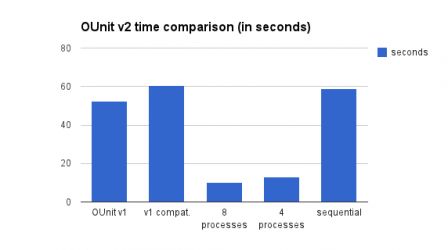 The migration was quite heavy because this test suite had a big design problem. It uses in-place modification of the test data. I think I pick this design because I thought this was a good idea to decrease the running time. As a matter of fact, this was a huge mistake, that keeps popping failed test cases because one of the previous tests was failing. I have refactored all this and now we start by copying the test data into a temporary directory, which ensure that everything is always starting from pristine test data.
During the redesign, I have decided to reduce the number of tests by merging some of them. This should have no big impact on the running time, although this is not as pure 1:1 comparison with OUnit v1. Although it is still testing exactly the same thing. This explain the loss of ~50 tests, which in fact has been merged in other tests.
The overall speedup is 4x compared to OUnit v1, when using processes. However there is a 12% increase compared to OUnit v1 for sequential and a 15% increase when using OUnit v1 compatibility layer. While this is not very good score, I hope this is small enough to compensate the huge win of being able to run tests in parallel with processes.
And now the magic !
At this point, if you read carefully the numbers, you would have noticed that there is a 4.5x decrease in speed when you compare sequential and 4 processes for OUnit2. Since we are only actively testing in 4 shards, it looks strange. I don't expect a super-linear speedup due to the use of processes. I have checked that every tests was indeed running and found no solutions to this mystery. Right now, I think this is due to the fact that we are running less tests in more processes which should lighten the load of the GC (which may not trigger at all). I am not sure about this explanation and will welcome any bug report which shows a problem in the implementation of either sequential or processes runner. Although, this is great.
Help still wanted
If you find any bugs with OUnit v2, this is the time to submit a bug.
 It has taken just over two weeks for


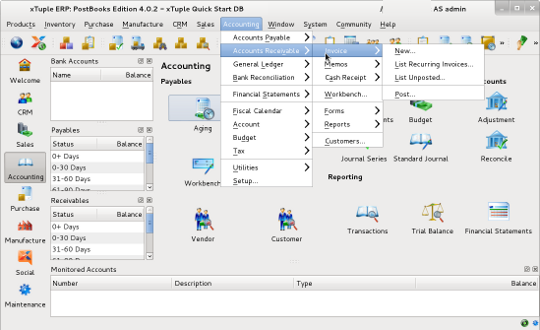 Of particular note,

 On a regular basis, I find myself the odd-man-out when it comes to talking
about how to work with Python on Debian systems. I'm going to write this and
post it so that I might be able to point people at my thoughts without having
to write the same email in response to each thread that pops up.
Turns out I don't fit in with the Debian hardliners (which is to say, the
mindset that
 I ve been running several

 While I suspect that professional speakers have separate presentation
laptops that they use only to give talks, I don't do this often enough to
justify the hassle and cost of a separate machine. However, I do use a
separate user account to present from.
It allows me to focus on my presentation and not stress out about running
into configuration problems or exposing private information. But mostly, I
think it's about removing anything that could be distracting for the
audience.
The great thing of having a separate user for this is that you can do whatever
you want in your normal account and still know that the other account is ready
to go and configured for presenting on a big screen.

 Here s some documentation about a hack I ve been working on to allow publication of RDF views for