Search Results: "pm"

20 February 2013

Daniel Pocock: Automatically mirroring SVN repositories to git and github

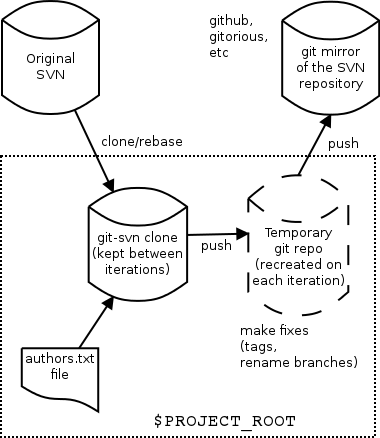
Updated 21 February 2013: the scripts below have now been adapted to run conveniently from cron and mirror multiple repositories. You can find full scripts and documentation on github There are a number of scripts around, including an earlier blog post of my own, for making a once-off conversion of an SVN repository to a Git repository. However, what if the project team is not yet ready for a full move to git? You may want to start benefiting from git (e.g. using the project as a submodule of another git project, or using Travis-CI.org for automated builds) while development officially continues to take place in SVN. If you don't need to make commits into git just now, you can set up a mirror and refresh it periodically from SVN. This process can be used with various SVN repositories, including Sourceforge and Google Code SVN repositories. Process overview
  • An authors.txt file is created manually before the first run.
  • A git-svn clone of the SVN repository is created. This clone needs to be retained between replication runs.
  • On each run, a temporary git repository is created. The svn-clone is rebased and pushed to the fresh git repository.
  • Fixes (e.g. branch renames and tagging) are made in the temporary git repository.
  • The final results are then pushed from the temporary repository to the real git mirror that is being maintained.
  • Finally, the temporary git repository is deleted, but the svn-clone is kept.
Here is a diagram of the workflow: Config file Here is a sample config file for the script, it mirrors the rather complicated reSIProcate repository with 10,000 commits:
PROJECT_ROOT=/home/daniel/svn-mirror/resiprocate
AUTHORS_FILE=$ PROJECT_ROOT /authors.txt
SVN_REPO=https://svn.resiprocate.org/rep/resiprocate
SVN_LAYOUT="--trunk=main --branches=branches --tags=tags"
GIT_REPO=git@github.com:resiprocate/resiprocate.git
Of particular note here:
  • The $PROJECT_ROOT is where the svn-clone and the temporary repositories will be created
  • $GIT_REPO is the final destination repository. For testing, it could just be a local directory initialised with git init --bare .
  • In this repository, our trunk is actually called main, hence we have the layout argument --trunk=main. Many projects would just use --trunk=trunk
The script The script itself is below. I'd suggest running it manually a few times first and observing how it behaves, disk space requirements, etc.
#!/bin/bash
set -e
if [ ! $# -eq 1 ];
then
  echo "Usage:"
  echo "$0 <config-file>"
  exit 1
fi
CONFIG_FILE="$1"
. "$ CONFIG_FILE "   exit 1
SVN_CLONE="$ PROJECT_ROOT /svn-clone"
GIT_BARE="$ PROJECT_ROOT /git-bare-tmp"
if [ ! -d "$ PROJECT_ROOT " ];
then
  mkdir -p "$ PROJECT_ROOT "
fi
cd "$ PROJECT_ROOT "
if [ ! -d "$ SVN_CLONE " ];
then
  git svn clone \
    "$ SVN_REPO " \
    -A "$ AUTHORS_FILE " \
    $ SVN_LAYOUT  \
    "$ SVN_CLONE "
  cd "$ SVN_CLONE "
else
  cd "$ SVN_CLONE "
  git remote rm bare   echo "failed to delete remote:bare, proceeding anyway"
  git svn rebase \
    --fetch-all \
    -A "$ AUTHORS_FILE "
fi
git remote add bare "$ GIT_BARE "
git config remote.bare.push 'refs/remotes/*:refs/heads/*'
if [ -d "$ GIT_BARE " ];
then
  rm -rf "$ GIT_BARE "
fi
mkdir -p "$ GIT_BARE "
cd "$ GIT_BARE "
git init --bare .
git symbolic-ref HEAD refs/heads/trunk
cd "$ SVN_CLONE "
git push bare
cd "$ GIT_BARE "
git branch -m trunk master
git for-each-ref --format='%(refname)' refs/heads/tags   \
   cut -d / -f 4   \
   while read ref;
   do
      git tag "$ref" "refs/heads/tags/$ref"
      git branch -D "tags/$ref"
   done
git remote add origin "$ GIT_REPO "
git config branch.master.remote origin
git config branch.master.merge refs/heads/master
git push --tags origin master
git push --all
rm -rf "$ GIT_BARE "
</config-file>
AttachmentSize
svn-mirror.png32.65 KB

Daniel Pocock: Automatically mirroring SVN repositories to git and github

Updated 21 February 2013: the scripts below have now been adapted to run conveniently from cron and mirror multiple repositories. You can find full scripts and documentation on github There are a number of scripts around, including an earlier blog post of my own, for making a once-off conversion of an SVN repository to a Git repository. However, what if the project team is not yet ready for a full move to git? You may want to start benefiting from git (e.g. using the project as a submodule of another git project, or using Travis-CI.org for automated builds) while development officially continues to take place in SVN. If you don't need to make commits into git just now, you can set up a mirror and refresh it periodically from SVN. This process can be used with various SVN repositories, including Sourceforge and Google Code SVN repositories. Process overview
  • An authors.txt file is created manually before the first run - see my other blog entry for convenient scripts to help generate authors.txt
  • A git-svn clone of the SVN repository is created. This clone needs to be retained between replication runs.
  • On each run, a temporary git repository is created. The svn-clone is rebased and pushed to the fresh git repository.
  • Fixes (e.g. branch renames and tagging) are made in the temporary git repository.
  • The final results are then pushed from the temporary repository to the real git mirror that is being maintained.
  • Finally, the temporary git repository is deleted, but the svn-clone is kept.
Here is a diagram of the workflow: Config file Here is a sample config file for the script, it mirrors the rather complicated reSIProcate repository with 10,000 commits:
PROJECT_ROOT=/home/daniel/svn-mirror/resiprocate
AUTHORS_FILE=$ PROJECT_ROOT /authors.txt
SVN_REPO=https://svn.resiprocate.org/rep/resiprocate
SVN_LAYOUT="--trunk=main --branches=branches --tags=tags"
GIT_REPO=git@github.com:resiprocate/resiprocate.git
Of particular note here:
  • The $PROJECT_ROOT is where the svn-clone and the temporary repositories will be created
  • $GIT_REPO is the final destination repository. For testing, it could just be a local directory initialised with git init --bare .
  • In this repository, our trunk is actually called main, hence we have the layout argument --trunk=main. Many projects would just use --trunk=trunk
The script The script itself is below. I'd suggest running it manually a few times first and observing how it behaves, disk space requirements, etc.
#!/bin/bash
set -e
if [ ! $# -eq 1 ];
then
  echo "Usage:"
  echo "$0 <config-file>"
  exit 1
fi
CONFIG_FILE="$1"
. "$ CONFIG_FILE "   exit 1
SVN_CLONE="$ PROJECT_ROOT /svn-clone"
GIT_BARE="$ PROJECT_ROOT /git-bare-tmp"
if [ ! -d "$ PROJECT_ROOT " ];
then
  mkdir -p "$ PROJECT_ROOT "
fi
cd "$ PROJECT_ROOT "
if [ ! -d "$ SVN_CLONE " ];
then
  git svn clone \
    "$ SVN_REPO " \
    -A "$ AUTHORS_FILE " \
    $ SVN_LAYOUT  \
    "$ SVN_CLONE "
  cd "$ SVN_CLONE "
else
  cd "$ SVN_CLONE "
  git remote rm bare   echo "failed to delete remote:bare, proceeding anyway"
  git svn rebase \
    --fetch-all \
    -A "$ AUTHORS_FILE "
fi
git remote add bare "$ GIT_BARE "
git config remote.bare.push 'refs/remotes/*:refs/heads/*'
if [ -d "$ GIT_BARE " ];
then
  rm -rf "$ GIT_BARE "
fi
mkdir -p "$ GIT_BARE "
cd "$ GIT_BARE "
git init --bare .
git symbolic-ref HEAD refs/heads/trunk
cd "$ SVN_CLONE "
git push bare
cd "$ GIT_BARE "
git branch -m trunk master
git for-each-ref --format='%(refname)' refs/heads/tags   \
   cut -d / -f 4   \
   while read ref;
   do
      git tag "$ref" "refs/heads/tags/$ref"
      git branch -D "tags/$ref"
   done
git remote add origin "$ GIT_REPO "
git config branch.master.remote origin
git config branch.master.merge refs/heads/master
git push --tags origin master
git push --all
rm -rf "$ GIT_BARE "
</config-file>
AttachmentSize
svn-mirror.png32.65 KB

17 February 2013

Gregor Herrmann: RC bugs 2013/07

here's the list of my contributions around release-critical bugs for the last week:

16 February 2013

Hideki Yamane: "Debian Hot Topics"


As I wrote before, I've started a series on "Software Design" magazine to introduce something inside Debian, news items, essay and so on. It's named "Debian Hot Topics" but it was decided after finished writing my article, so it comes to just an essay about distribution development, instead of "Hot Topics" ;-)

Anyway, it's a good chance for advertising (after all, no cost but get fee :)

Hideki Yamane: Developers Summit 2013 in Tokyo


"Developers Summit 2013" was held in (Meguro Gajoen), Tokyo. I've participated to this event to get information about development method and know-how.

Keyword is: Agile, Scrum, Continuous Delivery, Deploy 1000 times in an hour


Well, some talks were about Agile development (especially Scrum), the experience that how they tried to introduce "Agile" approach to their work to improve thier problems/troubles and what they've learned and got from it. I think it's very exciting if we Debian can deploy (=release) stable anytime we want! To achieve it, we should get Agility by learn their way of values and practice. I hope I'll go to DebConf13 then give a talk about it :)

Some community booth were there, I went and chatted with Vine Linux developer and community member for a while (Vine Linux is a Japanese local distribution since and we Debian get VLGothic font as default Japanese font from them :) They promoted "Handbook for developers" and it looks so good shape. Maybe you know, we also have Debian Develpers Reference(and I've completely translated it to Japanese), but their one is more catchy, of course I think we can borrow something from it to improve our DDR.

And I've got a book about CloudStack named "CloudStack " (Introduction to CloudStack, for beginners, users and professionals) at CloudStack (Japan CloudStack users group) booth, by winning a prize :)

Also bought some books at publishers booth because 10+Tax5% off was so attractive...

15 February 2013

Michal &#268;iha&#345;: phpMyAdmin at GSoC 2013

As you have probably already noticed, Google Summer of Code 2013 has been officially announced. As usual, we want to participate with phpMyAdmin. We really want good students to participate, so our selection process will be again slightly stricter than in last years. So if you want to participate as a student on phpMyAdmin, please check our applicant guide. The most important thing is that we expect you to show knowledge of the code before being accepted and fixing some bug for upcoming 4.0 release is great opportunity to start with that! Also student themselves usually don't bring new ideas, so it's pretty much on the organization to come with projects it would like to see. We are currently collecting these on our wiki. We will most likely add some new ones to the list as well, so feel free to get in touch if you have some brilliant idea. Also voting on feature requests might help us to choose what users see as most important improvements.

Filed under: English Phpmyadmin 0 comments Flattr this!

14 February 2013

Jon Dowland: Rpm, Yum, Puppet and GPG

I wrote that I would double-check how secure the module selection and downloading is in Puppet. Well, puppet module resolves, fetches and downloads unsigned tarballs from a HTTP source and unpacks them without any verification whatsoever. Related: I've been looking at rpm/yum GPG behaviour. rpm supports checking the signature of RPMs as a separate operation from installing them. You can't ask it to not install a package if the signature is absent or not correct. yum is better when dealing with repositories. It can be told to check the GPG signature on all RPMs both globally (the [main] section of yum.conf) and on a per-repository basis. GPG signature checking can be disabled on the command line with --nogpgcheck. It cannot be selectively enabled on the command line. However, yum install can install local RPMs and RPMs on web servers as well as from repositories. In both of these cases, it will not check the GPG signature at all, no matter what you've put in your yum.conf. Finally, even if all the above worked properly, the GPG keys published by Fedora have almost no public signatures (none at all for EPEL), so neither you nor I could establish a trust path to them. Luckily I can establish a trust path to the RH security key.

Michal &#268;iha&#345;: phpMyAdmin translations status

Next round of phpMyAdmin 4.0 translation status report is coming. So let's look at which translations are at 100% right now (some changes this week due to new strings to translate): There are also several languages which need just few strings to be complete: As you can see, there is still lot of languages missing, this might be your opportunity to contribute to phpMyAdmin. Also you are welcome to translate phpMyAdmin 4.0 using translation server. If your language is already fully translated and you want to help as well, you can translate our documentation as well.

Filed under: English Phpmyadmin 0 comments Flattr this!

13 February 2013

Hideki Yamane: introducing debian-mirror.sakura.ne.jp

Now we Debian JP (local Debian community in Japan) are pleased to announce new Debian full-mirror server named debian-mirror.sakura.ne.jp is running, kindly offered by Sakura Internet, Inc. which is one of most famous VPS/hosting provider in Japan.

So, their VPS/hosting user can use it without any setting now via magical GeoMirror as ftp.jp.debian.org (thanks to Yasuhiro Araki).

It is run at Ishikari DC, northen island Hokkaido.


I had a chance to visit there 3 month ago (you can see my entry in Google+ if you want), it was so interesting and exciting. They are trying to make power-saved data center as Google, Facebook or so, and it had succeed now since its PUE (Power Usage Effectiveness) is same level as Google one, wow :-)

I hope we will provide stable and comfortable Debian environment to their users and they would use Debian more and more, then we'll get their "wants" and "needs" to improve Debian itself.

Thanks to folks in Sakura Internet!

Jan Wagner: Searching painting: Strawberry and Man on Pumps with Sparkling wine

We are searching a motive for a painting or a painting itself for a quite while now. This should find it's place in our living room. Unfortunately we didn't found one, which matched our both prospect and/or wasn't compatible with the rest of our living room. Yesterday we stumbled upon a motive which was quite nice, but was too small and it was neighter possible to get it in a bigger size nor to find out who was the origin painter of the picture. Now we are searching for the name of the picture and/or the painter. Any hints appreciated at 'blog - at - waja - dot - info'. A photo with higher resolution can be found here Update: Okay ... an unknown people (many thanks) hinted me, that google image search is the tool that could be very usefull. Google revealed that the painter is Inna Panasenko. P.S. Is it noticeable that I'm in vacation mode? ;)

12 February 2013

Petter Reinholdtsen: "Electronic" paper invoices - using vCard in a QR code

Here in Norway, electronic invoices are spreading, and the solution promoted by the Norwegian government require that invoices are sent through one of the approved facilitators, and it is not possible to send electronic invoices without an agreement with one of these facilitators. This seem like a needless limitation to be able to transfer invoice information between buyers and sellers. My preferred solution would be to just transfer the invoice information directly between seller and buyer, for example using SMTP, or some HTTP based protocol like REST or SOAP. But this might also be overkill, as the "electronic" information can be transferred using paper invoices too, using a simple bar code. My bar code encoding of choice would be QR codes, as this encoding can be read by any smart phone out there. The content of the code could be anything, but I would go with the vCard format, as it too is supported by a lot of computer equipment these days. The vCard format support extentions, and the invoice specific information can be included using such extentions. For example an invoice from SLX Debian Labs (picked because we ask for donations to the Debian Edu project and thus have bank account information publicly available) for NOK 1000.00 could have these extra fields:
X-INVOICE-NUMBER:1
X-INVOICE-AMOUNT:NOK1000.00
X-INVOICE-KID:123412341234
X-INVOICE-MSG:Donation to Debian Edu
X-BANK-ACCOUNT-NUMBER:16040884339
X-BANK-IBAN-NUMBER:NO8516040884339
X-BANK-SWIFT-NUMBER:DNBANOKKXXX
The X-BANK-ACCOUNT-NUMBER field was proposed in a stackoverflow answer regarding how to put bank account information into a vCard. For payments in Norway, either X-INVOICE-KID (payment ID) or X-INVOICE-MSG could be used to pass on information to the seller when paying the invoice. The complete vCard could look like this:
BEGIN:VCARD
VERSION:2.1
ORG:SLX Debian Labs Foundation
ADR;WORK:;;Gunnar Schjelderups vei 29D;OSLO;;0485;Norway
URL;WORK:http://www.linuxiskolen.no/slxdebianlabs/
EMAIL;PREF;INTERNET:sdl-styret@rt.nuug.no
REV:20130212T095000Z
X-INVOICE-NUMBER:1
X-INVOICE-AMOUNT:NOK1000.00
X-INVOICE-MSG:Donation to Debian Edu
X-BANK-ACCOUNT-NUMBER:16040884339
X-BANK-IBAN-NUMBER:NO8516040884339
X-BANK-SWIFT-NUMBER:DNBANOKKXXX
END:VCARD
The resulting QR code created using qrencode would look like this, and should be readable (and thus checkable) by any smart phone, or for example the zbar bar code reader and feed right into the approval and accounting system. The extension fields will most likely not show up in any normal vCard reader, so those parts would have to go directly into a system handling invoices. I am a bit unsure how vCards without name parts are handled, but a simple test indicate that this work just fine. Update 2013-02-12 11:30: Added KID to the proposal based on feedback from Sturle Sunde.
10 February 2013

Petter Reinholdtsen: Sleep until morning - home automation for the kids

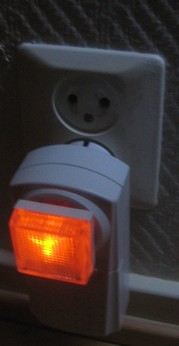
With kids in the house, one challenge is getting them to sleep during the night and wake up when it is morning. I mean, when I believe it is morning, and not two hours earlier. In our household we have decided that 07:00 is the turning point, but getting the kids to sleep until 07:00 is a small challenge every day. They have adapted quite well, and rarely wake up at 05:00 any more, but some times wake up at times like 05:50, 06:15, 06:30 or 06:45, and it is hard to put the awake one to bed again without disturbing and waking the rest. And I understand perfectly well that they fail to sleep until 07:00 some times, as there is no way for them to know if it is before or after the magic moment without coming and asking us parents. But yesterday I came up with a method to solve this problem. It involve home automation. A few years ago I bought a Tellstick and RF switches at the local Clas Ohlson shop, allowing me to control lights and other electrical gadgets using my Linux server. When I moved from the old flat to a small house, I put away all this equipment as most of the lighting in the house was not using wall sockets and thus not easy to connect to the gadgets I had. But recently I bought a Tellstick Net to be able to read sensor input as well as control power sockets. I want to control ovens in the basement to avoid the pipes to freeze, and monitor the humidity to detect flooding. The default setup for Tellstick Net is to be controlled by the vendor web service, which to me is a security problem, but it is also possible to build ones own firmware with local access instead of being controlled by a Swedish company, thanks to the release of the GPL licensed firmware source code. I plan to get that running before I let it control anything important. But while working on this, one idea to make it easier for the kids came to me yesterday. We can set up a night light controlled by the computer, and turn it automatically on at 07:00. The kids can then check the light in the morning to know if they are supposed to get up or not. They joined me in setting everything up, and I repeated the concept several times before bed times to make sure they remembered to check the light before getting up in the morning. We tested it this morning, and all the kids stayed in bed until after 07:00, and every one of them commented on the fact that the "morning light" was turned on and signalled that the morning had arrived. So this look like a success, and I am excited to see how this develops the next few days. :) I really hope this can allow us all to sleep a bit longer in the morning. A nice advantage of this setup is that we can remote control when to tell the kids to get up. We do not have to wait until 07:00, and can also delay it if we want to.

8 February 2013

Philipp Kern: Mozilla's direction

Am I the only one who's disappointed with the route Mozilla's taking and left wondering what the direction is? First they killed off the development of Thunderbird because, as we all know, people mainly use webmail these days. Then they presented us their view that the big Certificate Authorities are too big to fail, as CAs gravely violated our trust (c.f. Trustwave and their MitM authority). And "now" they're also blocking the introduction of new formats into their browser because they cannot be the one who innovates. Instead Microsoft and Apple obviously need to take the lead in introducing a format into their browsers because otherwise it wouldn't be useful. Even though it's safe to say that Chrome and Firefox make up for more than half of the desktop browser market share. It might be that Chrome's nibbling from Firefox's, still IE seems to be in decline and Safari is rather a further mention than something many people would care strongly about.

There were of course some valid reasons for not supporting WebP yet. But most of them got fixed in the meantime and all we hear is the referal to proprietary vendors who need to move first. If I'd want to depend on such vendors I'd go with proprietary operating systems. (Having to deal with hardware products of proprietary vendors at $dayjob is enough.) So what's up Mozilla? The solution is to ignore your users and tag bugs with patches wontfix?

The only real advantage of Firefox over Chromium these days is the vast amount of plugins and extensions (e.g. Pentadactyl, for which there is no real equivalent available). Another sad fact is that you need to pull Firefox from a 3rd party repository (even though packages are coming from the 2nd party) to get a current version onto your Debian system to work with the web. But then it's not Mozilla who's to blame here. Maybe we should've introduced one Iceweasel version that's allowed to have reverse-dependencies and one that cannot.

(This post might contain hyberboles, which should be considered as such.)

Olivier Berger: RDF development in PHP with a PostGreSQL triple store thanks to the LibRDF OO wrapper for redland/librdf

Redland/librdf offers powerful features like being able to persist an RDF model to a relational database (only PostGreSQL seems to work on my setup with 1.0.16, but I may have misconfigured it). You can then do SPARQL queries over the model, and lots of other nice things. Unfortunately, the default PHP bindings are not really object-oriented, so the code isn t looking so good. But thanks to a gentleman named David Shea, there is an object-oriented library named LibRDF (case is sensitive), that helps write nice looking PHP. I discovered it via the blog post of Felix Ostrowski, who took over the maintenance of the LibRDF library (still the docs live on the original author s site). In his post, Felix illustrates how you may use it to parse Richard Cyganiak s FOAF profile. But the examples he gives don t illustrate the full potential of persistence of the RDF graph into the DB. Here s my contribution in 2 examples that will hopefully help : first, one that load Richard s FOAF to the DB, and one, that later retrieve the saved model and perform the same query (both pushed to my github clone of the library). There may be some problems with the use of librdf, including its availability, as it is not full PHP of course and I ve heard of memory management problems, but, depening on your needs, this may be quite handy for writing Linked Data applications.

7 February 2013

Russell Coker: Links February 2013

Aaron on Software wrote an interesting series of blog posts about psychology and personal development collectively Titled Raw Nerve , here s a link to part 2 [1]. The best sections IMHO are 2, 3, and 7. The Atlantic has an insightful article by Thomas E. Ricks about the failures in leadership in the US military that made the problems in Afghanistan and Iraq a lot worse than they needed to be [2] Kent Larson gave an interesting TED talk about how to fit more people in cities [3]. He covers issues of power use, transport, space use, and sharing. I particularly liked the apartments that transform and the design for autonomous vehicles that make eye contact with pedestrians. Andrew McAfee gave an interesting TED talk titled Are Droids Taking Our Jobs [4]. I don t think he adequately supported his conclusion that computers and robots are making things better for everyone (he also presented evidence that things are getting worse for many people), but it was an interesting talk anyway. I Psychopath is an interesting documentary about Sam Vaknin who is the world s most famous narcissist [5]. The entire documentary is available from Youtube and it s really worth watching. The movie Toy Story has been recreated in live action by a couple of teenagers [6]. That s a huge amount of work. Rory Stewart gave an interesting TED talk about how to rebuild democracy [7]. I think that his arguments against using the consequences to argue for democracy and freedom (he suggests not using the torture doesn t work and women s equality doubles the workforce arguments) are weak, but he made interesting points all through his talk. Ernesto Sirolli gave an interesting TED talk about aid work and development work which had a theme of Want to help someone? Shut up and listen! [8]. That made me think of Mary Gardiner s much quoted line from the comments section of her Wikimania talk which was also shut up and listen . Waterloo Labs has some really good engineering Youtube videos [9]. The real life Mario Kart game has just gone viral but there are lots of other good things like the iPhone controlled car and eye controlled Mario Brothers. Robin Chase of Zipcar gave an interesting TED talk about various car sharing systems (Zipcar among others), congestion taxes, the environmental damage that s caused by cars, mesh networks, and other things [10]. She has a vision of a future where most cars are shared and act as nodes in a giant mesh network. Madeleine Albright gave an interesting TED talk about being a female diplomat [11]. She s an amazing speaker. Ron Englash gave an interesting TED talk about the traditional African use of fractals [12]. Among the many interesting anecdotes concerning his research in Africa he was initiated as a priest after explaining Georg Cantor s set theories. Racialicious has an insightful article about the low expectations that members of marginalised groups have of members of the privileged groups [13]. Rick Falkvinge has a radical proposal for reforming copyrights with a declared value system [14]. I don t think that this will ever get legislative support, but if it did I think it would work well for books and songs. I think that some thought should be given to how this would work for Blogs and other sources of periodical content. Obviously filing for every blog post would be an unreasonable burden. Maybe aggregating a year of posts into one copyright assignment block would work. Scott Fraser gave an interesting TED talk about the problem with eyewitness testimony [15]. He gave a real-world example of what had to be done to get an innocent man acquitted, it s quite amazing. Sarah Kendzior wrote an interesting article for al Jazeera about the common practice in American universities to pay Adjunct Professors wages that are below the poverty line [16]. That s just crazy, when students pay record tuition fees there s more than enough money to pay academics decent wages, where does all the money go to anyway?

6 February 2013

Biella Coleman: Edward Tufte was a phreak

It has been so very long since I have left a trace here. I guess moving to two new countries (Canada and Quebec), starting a new job, working on Anonymous, and finishing my first book was a bit much. I miss this space, not so much because what I write here is any good. But it a handy way for me to keep track of time and what I do and even think. My life feels like a blur at times and hopefully here I can see its rhythms and changes a little more clearly if I occasionally jot things down here. So I thought it would nice to start with something that I found surprising: famed information designer, Edward Tufte, a professor emeritus at Yale was a phone phreak (and there is a stellar new book on the topic by former phreak Phil Lapsley. He spoke about his technological exploration during a sad event, a memorial service in NYC which I attended for the hacker and activist Aaron Swartz. I had my wonderful RA transcribe the speech, so here it is [we may not have the right spelling for some of the individuals so please let us know of any mistakes]:
Edward Tufte s Speech From Aaron Swartz s Memorial
Speech starts 41:00 [video cuts out in beginning]
We would then meet over the years for a long talk every now and then, and my responsibility was to provide him with a reading list, a reading list for life and then about two years ago Quinn had Aaron come to Connecticut and he told me about the four and a half million downloads of scholarly articles and my first question is, Why isn t MIT celebrating this? .
[Video cuts out again]
Obviously helpful in my career there, he then became president of the Mellon foundation, he then retired from the Mellon foundation, but he was asked by the Mellon foundation to handle the problem of JSTOR and Aaron. So I wrote Bill Bullen(sp?) an email about it, I said first that Aaron was a treasure and then I told a personal story about how I had done some illegal hacking and been caught at it and what happened. In 1962, my housemate and I invented the first blue box, that s a device that allows for free, undetectable, unbillable long distance telephone calls. And we got this up and played around with it and the end of our research came when we concluded what was the longest long distance call ever made, which was from Palo Alto to New York time-of-day via Hawaii, well during our experimentation, AT&T, on the second day it turned out, had tapped our phone and uh but it wasn t until about 6 months later when I got a call from the gentleman, AJ Dodge, senior security person at AT&T and I said, I know what you re calling about. and so we met and he said You what you are doing is a crime that would , you know all that. But I knew it wasn t serious because he actually cared about the kind of engineering stuff and complained that the tone signals we were generating were not the standard because they record them and play them back in the network to see what numbers they we were that you were trying to reach, but they couldn t break though the noise of our signal. The upshot of it was that uh oh and he asked why we went off the air after about 3 months, because this was to make long distance telephone calls for free and I said this was because we regarded it as an engineering problem and we made the longest long distance call and so that was it. So the deal was, as I explained in my email to Bill Bullen, that we wouldn t try to sell this and we were told, I was told that crime significance would pay a great deal for this, we wouldn t do any more of it and that we would turn our equipment over to AT&T, and so they got a complete vacuum tube isolator kit for making long distance phone calls. But I was grateful for AJ Dodge and I must say, AT&T that they decided not to wreck my life. And so I told Bill Bullen that he had a great opportunity here, to not wreck somebody s life, course he thankfully did the right thing.
Aaron s unique quality was that he was marvelously and vigorously different. There is a scarcity of that. Perhaps we can be all a little more different too.
Thank you very much.

Michal &#268;iha&#345;: phpMyAdmin translations status

Next round of phpMyAdmin 4.0 translation status report is coming. So let's look at which translations are at 100% right now (no change this week): There are also several languages which need just few strings to be complete: As you can see, there is still lot of languages missing, this might be your opportunity to contribute to phpMyAdmin. Also you are welcome to translate phpMyAdmin 4.0 using translation server. If your language is already fully translated and you want to help as well, you can translate our documentation as well.

Filed under: English Phpmyadmin 0 comments Flattr this!

5 February 2013

Michal &#268;iha&#345;: FOSDEM 2013 summary (Sunday)

FOSDEM 2013 is over and it's time to look what interesting I have seen there on Sunday. Sunday was supposed to start for me with L20N, but it was postponed to 13:00 as the presenters weren't on time. I could have used one more hour of sleep, but at least I spent some time on coding. Detect merge conflicts in realtime was quite interesting talk, though I was pretty surprised that the conflict detecting does not at all care about underlying version control system, but does purely file based guesses. The Hardening MySQL talk pretty much described why security in MySQL sucks and what you should do to make it secure. Quite good introduction to the topic, but not much new information for me. Introduction of Firefox OS, was quite nice demo showing they have something working, though it had some problems with flaky network on FOSDEM. Looking forward to see phone being sold, though it will probably not be something I'd buy. To add some fun, I've stayed on systemd, Two Years Later presentation, which gave some summary of what is currently in systemd and where it wants to go. Still it did not move systemd from category of "I don't care as long as it works". Now followed delayed L20N talk - it showed new Mozilla's effort for localization. Which is quite powerful and has nice features, on the other side it put's quite more load to translators - now they would have to understand some basics of programming as well to be able to use the new features (or not so new ones as plurals). Their motivation is to remove localization effort from developers, but I'm not really convinced it will work nicely. After some meetings and lunch, I went to LibreOffice: cleaning and re-factoring a giant code-base, which showed some challenges LibreOffice has to take and how they dealt with that. I think it's pretty great job done and I'm looking forward to new releases. Being GNOME user, I could not skip Has the GNOME community gone crazy?. It of course tried to tell that they did not :-). Last, but not least my friend Dieter from phpMyAdmin had talk Present and future of phpMyAdmin. He listed some of the new features, demoed 3.5 and 4.0 version (of course the demo of 4.0 version broke due to some caching). Even when the talk had quite unpleasant timing, it has attracted some people and they even asked few questions. This years FOSDEM was again great and looking forward to be there next year.

Filed under: Debian English Phpmyadmin Suse Weblate 2 comments Flattr this!

Wouter Verhelst: Video at FOSDEM 2013

For the second year in a row, I've led the team that organized video at FOSDEM. This year, most things went pretty smoothly; more so than last year. We definitely learned from some of our mistakes, and although I can't say that everything went better than it did last year, after having done a first look at things I can certainly say that overall, the result is better now than it was last year. Our setup was very similar to what it was last year. However, there were some key differences: Unfortunately, that didn't mean all was well. The internal server would transcode the DV stream into WebM, which was then sent on to the Flumotion platform where it was going to be transcoded to Ogg Theora, before being streamed in both formats. Due to an issue which we could not track down (possibly something incorrect in my configuration), the transcoding into Ogg Theora did not work smoothly, and even had the unwanted effect of disrupting the WebM streaming. Since this made it difficult to debug without disrupting service, eventually we decided to give up on Ogg Theora and only provide WebM streams; I considered that to be a better solution than no streaming at all. In addition, apparently in the year since FOSDEM 2012, libav and gstreamer have changed significantly enough that the scripts that I used then had to be somewhat revisited in order to be able to transcode the existing recordings into WebM ready for video.fosdem.org. Oh well, I had to add in normalisation anyway; only it would've been nice if I didn't have to revisit it from scratch. Meh. At any rate, our streams seem to have been very popular. Some statistics:
Saturday

Sunday

Served traffic by country (over the whole weekend)
Served sessions by country (over the whole weekend)
As you can see from these graphs, watching the streams from Belgium seems to be happening fairly often; I suspect much of that is people at the conference watching a stream in a different room. Additionally, we peaked at 212 viewers, which is slightly more than the peak of 206 that we had last year. The final conclusion we can take home from these statistics is that the most popular talk on Saturday (at least according to people watching the streams) was the eudev one in the cross-distro room (with 68 viewers); on sunday, the talks in Janson were all fairly equally popular. The peak of 102 viewers was reached around 15:45. Overall, I'm quite happy with the result. Yesterday, Thomas Eug ne of NamurLUG (who used to do video for several years before I took over last year) helped me do the first review. What's left now is to do some transcoding and uploading; this will happen over the next few days and weeks.

Joey Hess: LCA2013 wrapup

After 27 hours of travel, I'm finally back from my first Linux.conf.au. This was a great conference! Some of my favorite highlights:
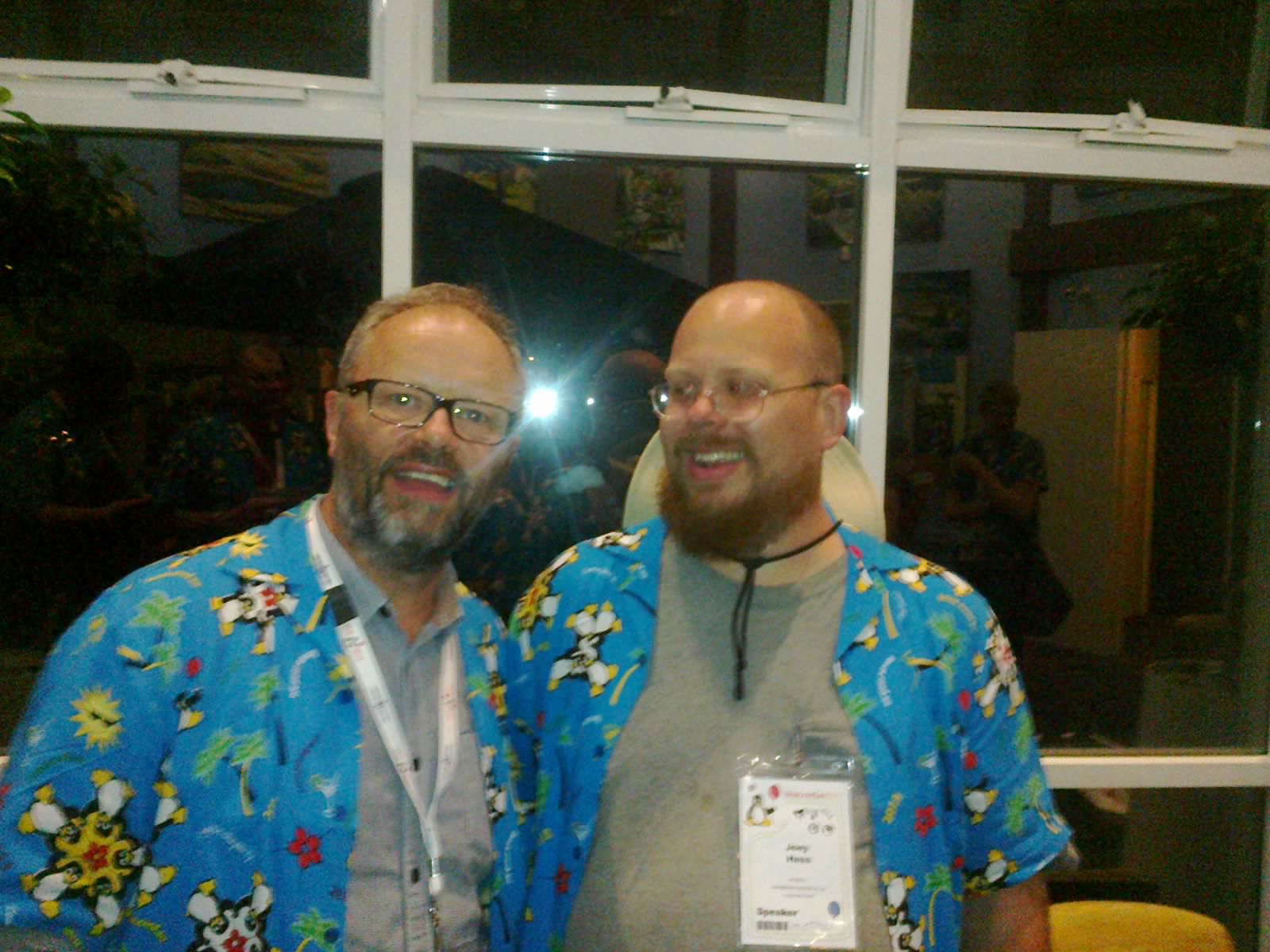
My git-annex talk went ok, despite technical problems with the video output, which the video team did a great job of working around. The first demo went well, and the Q&A was excellent. The demo of the git-annex assistant webapp was marred by, apparently, a bad build of the webapp -- which I ironically used rather than my usual development build because I assumed it'd be less likely to fail. At least I may have a way to reproduce that hang somewhat reliably now, so I can get on with debugging it. I will be redoing a demo of the webapp as a screencast.
Here are some of the best talks I attended. (I have quite a lot more queued up to watch still, and had to cut several due to space.) Click titles for videos, or browse all the videos.

Next.

Previous.