A long journey has come to nice finish. 9 month ago I switched to KDE/Plasma, and started to package newer versions of it than available in Debian. Since then I have packaged every single version of Plasma, the KDE frameworks, and KDE Apps and made them available for Debian/unstable and Debian/testing via the OBS build server.
Today, finally, I have uploaded Frameworks 5.77 and Plasma 5.20.4 to unstable, the end of a long story. Despite some initial disagreements with the Debian Qt/KDE Team, we found a modus vivendi, and since some months now I am member of the team and working together with the rest to get an uptodate KDE/Plasma system into Debian/bullseye. Thanks to everyone involved!
The last weeks we have also worked on updating many of the KDE/Apps packages to the latest release 20.12.0, which means that as of now, Debian/unstable contains the most recent versions of KDE Frameworks, KDE Plasma, and of most KDE Apps.
Thanks goes to all the team members, in particular to (in alphabetic order) Aur lien, Patrick, Pino, Sandro, and Scarlett for their work, and to all the testers and bug reporters.
The current status is also more or less what we plan to get into Debian/Bullseye. An update to Frameworks 5.78 and Plasma 5.20.5 is still possible, but not decided by now.
Concerning my OBS packages: they are mostly superseeded by now, and all but the KDE Apps package can be removed from the apt sources. The only remaining archive of interest is
deb https://download.opensuse.org/repositories/home:/npreining:/debian-kde:/apps2012/Debian_Unstable/ ./
and the same with Testing instead of Unstable for Debian/testing.
For those adventurous, there is also the digikam-beta repository
That s it. Have a nice Christmas, if you celebrate it, and a good start into a hopefully better 2021!
Enjoy.
I recently took part in an interview with Vladimir Bejdo, an intern at the Software Freedom Conservancy, in order to talk about the Reproducible Builds project, my own participation in software freedom, the importance of reproducibility in software development and to have a brief discussion on the issues facing free software as a whole:
VB: To start off with, it might be useful to first ask you this how would you relate the importance of reproducibility to a user who is non-technical?
CL: I sometimes use the analogy of the food supply chain to quickly relate our work to non-technical audiences. The multiple stages of how our food reaches our plates today (such as seeding, harvesting, picking, transportation, packaging, etc.) can loosely translate to how software actually ends up on our computers, particularly in the way that if any of the steps in the multi-stage food supply chain has an issue then it quickly becomes a serious problem.
For example, even if we could guarantee that only the most wholesome apples were picked in our orchards, if they became tainted on the way to the supermarket it will be a real problem for us at the end of the day. We may not even be able to even tell by simply inspecting our Pink Ladies or Honeycrisps, and washing them thoroughly under the tap may not be enough either.
In an ideal world, we would be able to personally inspect the provenance of our food at all of the stages of manufacturing and transportation. But at some point, we must place our trust in the process and in brands, as well as various regulatory bodies to ensure that potential problems in our food are minimized, possibly even paying a time/effort premium by growing our own or buying direct from local markets in order to minimize the number of steps, etc.
However, when we use free software we can do better: Reproducible builds are a set of software development practices, ideas and tools that create an independently-verifiable path all the way from the original source code to what actually runs on our machines. Reproducible builds can reveal the injection of back-doors introduced by the hacking of developers own computers, build servers and package repositories, and also expose where volunteers or companies have been coerced into making changes via blackmail, court order, and so on.
With reproducible builds, there is no longer any need to trust any particular source of authority. In the same way that, say, a Mr Smith might check that his calculator is giving him the right answer to 2+2=4 by asking enough of his friends to check theirs too, users and developers of a reproducible build can verify the software they are using by creating a collective consensus instead.
Hail is a gunrunner, an outlaw and criminal, someone who knows how to
survive violence and navigate by personal loyalty. That world knows her
as Cressen Stone. What her colleagues don't know is that she's also an
Imperial Princess. Hailimi Mercedes Jaya Bristol left that world twenty
years earlier in secret pursuit of her father's killer and had no
intention of returning. But her sisters are dead, her mother's health is
failing, and two Imperial Trackers have been sent to bring her back to her
rightful position as heir.
I'm going to warn up-front that the first half of this novel was rough to
the point of being unreadable. Wagers tries much too hard to establish
Hail as a reluctant heroine torn between her dislike of royal protocols
and her grief and anger at the death of her sisters. The result is
excessively melodramatic and, to be frank, badly written. There are a lot
of passages like this:
His words slammed into me, burning like the ten thousand volts of a
Solarian Conglomerate police Taser.
(no, there's no significance to the Solarian Conglomerate here), or, just
three paragraphs later:
The air rushed out of my lungs. Added grief for a niece I'd never
known. One more log on the pyre set to burn my freedom to ashes. The
hope I'd had of getting out of this mess was lost in that instant, and
I couldn't do anything but stare at Emmory in abject shock.
Given how much air rushes out of Hail's lungs and how often she's struck
down with guilt or grief, it's hard to believe she doesn't have brain
damage.
Worse, Hail spends a great deal of the first third of the book whining,
which given that the book is written in first person gets old very
quickly. Every emotion is overwritten and overstressed as Hail rails
against obvious narrative inescapability. It's blatantly telegraphed from
the first few pages that Hail is going to drop into the imperial palace
like a profane invasion force and shake everything up, but the reader has
to endure far too long of Hail being dramatically self-pitying about the
plot. I almost gave up on this book in irritation (and probably should
have).
And then it sort of grew on me, because the other thing Wagers is doing
(also not subtly) is a story trope for which I have a particular
weakness: The fish out of water who nonetheless turns out to be the person
everyone needs because she's systematically and deliberately kind and
thoughtful while not taking any shit. Hail left Pashati young and
inexperienced, with a strained relationship with her mother and a habit of
letting her temper interfere with her ability to negotiate palace
politics. She still has the temper, but age, experience, and confidence
mean that she's decisive and confident in a way she never was before. The
second half of this book is about Hail building her power base and winning
loyalty by being loyal and decent. It's still not great writing, but
there's something there I enjoyed reading.
Wagers's setting is intriguing, although it makes me a bit nervous. The
Indranan Empire was settled by colonists of primarily Indian background.
The court trappings, mythology, and gods referenced in Behind the
Throne are Hindu-derived, and I suspect (although didn't confirm) that
the funeral arrangements are as well. Formal wear (and casual wear) for
women is a sari. There's a direct reference to the goddess Lakshimi (not
Lakshmi, which Wikipedia seems to indicate is the correct spelling,
although transliteration is always an adventure).
I was happy to see this, since there are more than enough SF novels out
there that seem to assume only western countries go into space. But I'm
never sure whether the author did enough research or has enough personal
knowledge to pull off the references correctly, and I personally wouldn't
know the difference.
The Indranan Empire is also matriarchal, and here Wagers goes for an
inversion of sexism that puts men in roughly the position women were in
the 1970s. They can, in theory, do most jobs, but there are many things
they're expected not to do, there are some explicit gender lines in power
structures, and the role of men in society is a point of political
conflict. It's skillfully injected as social background, with a
believable pattern of societal prejudice that doesn't necessarily apply to
specific men in specific situations. I liked that Wagers did this without
giving the Empire itself any feminine-coded characteristics. All admirals
are women because the characters believe women are obviously better
military leaders, not because of some claptrap about nurturing or caring
or some other female-coded reason from our society.
That said, this gender role inversion didn't feel that significant to the
story. The obvious "sexism is bad, see what it would be like if men were
subject to it" message ran parallel to the main plot and never felt that
insightful to me. I'm therefore not sure it was successful or worth the
injection of sexism into the reading experience, although it certainly is
different from the normal fare of space empires.
I can't recommend Behind the Throne because a lot of it just isn't
very good. But I still kind of want to because I sincerely enjoyed the
last third of the book, despite some lingering melodrama. Watching Hail
succeed by being a decent, trustworthy, loyal, and intelligent person is
satisfying, once she finally stops whining. The destination is probably
not worth the journey, but now that I've finished the first book, I'm
tempted to grab the second.
Followed by After the Crown.
Rating: 6 out of 10
After writing my post about VDPAU in Debian [1] I received two great comments from anonymous people. One pointed out that I should be using VA-API (also known as VAAPI) on my Intel based Thinkpad and gave a reference to an Arch Linux Wiki page, as usual Arch Linux Wiki is awesome and I learnt a lot of great stuff there. I also found the Debian Wiki page on Hardware Video Acceleration [2] which has some good information (unfortunately I had already found all that out through more difficult methods first, I should read the Debian Wiki more often.
It seems that mplayer doesn t suppoer VAAPI. The other comment suggested that I try the mpv fork of Mplayer which does support VAAPI but that feature is disabled by default in Debian.
I did a number of tests on playing different videos on my laptop running Debian/Buster with Intel video and my workstation running Debian/Unstable with ATI video. The first thing I noticed is that mpv was unable to use VAAPI on my laptop and that VDPAU won t decode VP9 videos on my workstation and most 4K videos from YouTube seem to be VP9. So in most cases hardware decoding isn t going to help me.
The Wikipedia page about Unified Video Decoder [3] shows that only VCN (Video Core Next) supports VP9 decoding while my R7-260x video card [4] has version 4.2 of the Unified Video Decoder which doesn t support VP9, H.265, or JPEG. Basically I need a new high-end video card to get VP9 decoding and that s not something I m interested in buying now (I only recently bought this video card to do 4K at 60Hz).
The next thing I noticed is that for my combination of hardware and software at least mpv tends to take about 2/3 the CPU time to play videos that mplayer does on every video I tested. So it seems that using mpv will save me 1/3 of the power and heat from playing videos on my laptop and save me 1/3 of the CPU power on my workstation in the worst case while sometimes saving me significantly more than that.
Conclusion>
To summarise quite a bit of time experimenting with video playing and testing things: I shouldn t think too much about hardware decoding until VP9 hardware is available (years for me). But mpv provides some real benefits right now on the same hardware, I m not sure why.
The people who are pro-Government and in this case pro-Corporate do not have any success stories that they can share. Hence, most of the time the arguments are that the other are bad. For e.g. quite a few people argue that we don t need farmers, we can just order from restaurant. They have completely disassociated the idea that even then you need farmers as unless the farmers put the seed in, till the soil and wait for the rains or have irrigation you won t get ripe vegetables which then has to be taken out, and somehow sold to the wholesaler from where it comes to the restaurant and then to your plate. Sadly, even the farm-to-fork infographics are so depressingly sad, you want to look away. If you see the infographic you see it is just not non-veg but also vegetarian food grains which go under lot of questionable practices. Even, with such scenarios that is done by corporations our people want to go ahead. I will share stories from other countries which tell how they are doing more.
The Soldier-Farmer
Another sad part of these protests have been soldiers who have been returning their medals. The ones who oppose have the gall to say they should return the cash rewards they got. So just like farmers, seems soldiers also do not need money to survive. They are supposed to live only on air and water. This is after the present Govt. has reduced their pensions after retirement and that too without any discussion
GOI pensions to ex-servicemen
Now I nor anybody else would have minded if these conditions were shared going forward rather than doing it retrospectively. People who usually go to the army are not in it for money but for the adventure and glory they bring. But they do also have a family and have a family responsibility. In most other countries, the soldier and his families are well-looked after. If you know that even after you die, the Government would look after your family, you will do your best. Unfortunately, many veterans in India themselves are asked to help by many war widows as the widows don t get family pensions. The proposal naturally has left many miffed. In fact many of the veterans who used to advise people to join the armed forces now advise young people to pursue civilian life and careers. This is when Indian Army has been ironically having shortage of officers from well over a decade and stresses felt by Army personnel also known for a long time.
Even under this nationalistic Government, if it cannot take care of its soldiers, then forget about others.
India Defence Spending vis-a-vis other countries.
Now it is nobody s argument that India needs to improve its tooth-to-tail ratio but this is the wrong way to go about it. I would probably talk about that some other time as that totally needs its whole place.
Even OROP, which was the mandate of this Government hasn t had been done in full as there are quite a few cases in the Supreme Court. Almost all the cases have been heard and only decisions have to be given which the SC for whatever reason doesn t want to give. They just keep changing the date of the hearing. Nowadays, in many suits/cases, the SC asks for fresh hearings even though all the old records are there. This is a newish phenomena which is being observed in SC. Why is it being done? Your guess is as good as mine. One thing for sure has changed, the SC which used to be citizen-focussed or enabler of human rights and used to be held as a beacon for judicial activism has changed but these are other topics which need their own space.
Update 16/12/2020 The SC recommends setting up a committee to discuss farmer issues. And this is nothing new. This is called death by committee. When there is already so much literature on the subject, including the works done by Swaminathan Commission. There has been 6 reports which do look at farmer issues in a holistic manner. This is the Supreme Court giving an escape route to GOI. They also have abstained from having a whole session citing Covid. This is when the ruling Govt. is putting a massive 1000 crore on a new building on which the SC has put on hold. And even then the GOI went ahead and did a Bhoomi-Pujan (traditional ceremony when making a new construction from scratch.)
Naturally due to the double whammy of both the pension reforms and now the laws to make corporate farming more aggressive has left a deep impact on the soldier-farmer that the state does not think or feel for him.
Even the United States farm-aid eloquently describes how corporate farming has made independent farmers suffer. You read that, and it seems it is as the state of our farmers here in India. Even their average land-holding has dropped a bit. I have shared about the state of farmers in India, in twoblog posts previously. And it is not just farm owners who have had it bad, even farm workers in U.S. The issue may look to be about the pandemic but goes far deeper.
The Israeli Model
The Israelis have always used collective farming and do have a large share in farming there. The old model called Kibbutz is what made Israelis self-sufficient in food and water and actually are world-leaders where they export their services to other nations on the same thing.
France
Just like many other countries, France also seems to have favored farmer co-operatives. Almost 75% of all farmers are in co-operatives.
Italy
The country world-famous for its wines and cheese are made by its co-operatives. In fact co-ops are the buzzword it seems in Italy, more so in Northern Italy.
Asian economies
Even Asian economies, especially East Asian economies by and large have been turning to co-operatives.
Brazil
Now Brazil is almost 40% more than India. In fact, in most of the indices, Brazil beats India handsomely. So one would be forgiven to think that Brazil must have corporate farming. But nothing could be further from the truth. The only downer is that they have high crime in some areas. Otherwise, they are in many ways better than India. In fact, I was surprised a few years ago to learn about Mercsour. I would have to admit though I learned much about Brazil when Debian was holding a debconf about a year back. Otherwise, I had known about the country for number of years but apart from its carnival and samba, hadn t known much about it. I did come to know that most of Latin America also loves spices as much as Indians do. They show that love by using hot sauces. I do one day wanna try one of their sauces to see what makes it tick. I do know they like to barbecuevegetables as much as barbecuing non-veg food. This is going a bit OT but then that s the foodie in me Conclusion
I could have shared more countries which have chosen the co-operative way rather than corporate farming and that is simply because they know what is best for their people and what is best even politically. The new farm laws are neither grounded in farmer s welfare nor anything else. The Govt. has been trying to undermine the farmers for years together. In fact, Madhya Pradesh has openly said that they will not allow farmers from other states to sell in their state. Although, even before these laws there was nothing to restrict the farmer from selling his produce anywhere in the country. Angering the farmers is not good politics as was found sometime back but guessing some lessons need to be re-learned.
One comment though, on social media I have seen many people especially youngsters having no real understanding of what inflation is all about. For e.g. if you ask them how come we are having a sort of record inflation in a technical recession (there has been a contraction, actually) and you see them putting themselves into bigger and bigger ditches. This does explain in part why the BJP wins in elections. If you do more rhetoric, which BJP is good as, rather than educating people than you are bound to win. You don t need plans, you don t need a vision, just rhetoric will do. What more evidence is needed when the economy is and was in a worse shape even before the pandemic and BJP won. I would probably write about that as that again needs lot of background and understanding as well as related terms.
The Hetzner server that hosts my blog among other things has 2*256G SSDs for the root filesystem. The smartctl and smartd programs report both SSDs as in FAILING_NOW state for the Wear_Leveling_Count attribute. I don t have a lot of faith in SMART. I run it because it would be stupid not to consider data about possible drive problems, but don t feel obliged to immediately replace disks with SMART errors when not convenient (if I ordered a new server and got those results I would demand replacement before going live).
Doing any sort of SMART scan will cause service outage. Replacing devices means 2 outages, 1 for each device.
I noticed the SMART errors 2 weeks ago, so I guess that the SMART claims that both of the drives are likely to fail within 24 hours have been disproved. The system is running BTRFS so I know there aren t any unseen data corruption issues and it uses BTRFS RAID-1 so if one disk has an unreadable sector that won t cause data loss.
Currently Hetzner Server Bidding has ridiculous offerings for systems with SSD storage. Search for a server with 16G of RAM and SSD storage and the minimum prices are only 2E cheaper than a new server with 64G of RAM and 2*512G NVMe. In the past Server Bidding has had servers with specs not much smaller than the newest systems going for rates well below the costs of the newer systems. The current Hetzner server is under a contract from Server Bidding which is significantly cheaper than the current Server Bidding offerings, so financially it wouldn t be a good plan to replace the server now.
Monitoring
I have just released a new version of etbe-mon [1] which has a new monitor for SMART data (smartctl). It also has a change to the sslcert check to search all IPv6 and IPv4 addresses for each hostname, makes freespace check look for filesystem mountpoint, and makes the smtpswaks check use latest swaks command-line.
For the new smartctl check there is an option to treat Marginal alert status from smartctl as errors and there is an option to name attributes that will be treated as marginal even if smartctl thinks they are significant. So now I have my monitoring system checking the SMART data on the servers of mine which have real hard drives (not VMs) and aren t using RAID hardware that obscures such things. Also it s not alerting me about the Wear_Leveling_Count on that particular Hetzner server.
Like many other people, I first became aware of Anne Helen Petersen's
journalism when her Buzzfeed article
"How Millennials Became the Burnout Generation" went viral. Can't
Even is the much-awaited (at least by me) book-length expansion of that
thesis: The United States is, as a society, burning out, and that burnout
is falling on millennials the hardest. We're not recognizing the symptoms
because we think burnout looks like something dramatic and flashy. But
for most people burnout looks less like a nervous breakdown and more like
constant background anxiety and lack of energy.
Laura, who lives in Chicago and works as a special ed teacher, never
wants to see her friends, or date, or cook she's so tired, she just
wants to melt into the couch. "But then I can't focus on what I'm
watching, and end up unfocused again, and not completely relaxing,"
she explained. "Here I am telling you I don't even relax right! I
feel bad about feeling bad! But by the time I have leisure time, I
just want to be alone!"
Petersen explores this idea across childhood, education, work, family, and
parenting, but the core of her thesis is the precise opposite of the
pervasive myth that millennials are entitled and lazy (a persistent
generational critique that Petersen points out was also leveled at their
Baby Boomer parents in the 1960s and 1970s). Millennials aren't slackers;
they're workaholics from childhood, for whom everything has become a
hustle and a second (or third or fourth) job. The struggle with
"adulting" is a symptom of the burnout on the other side of exhaustion,
the mental failures that happen when you've forced yourself to keep going
on empty so many times that it's left lingering damage.
Petersen is a synthesizing writer who draws together the threads of other
books rather than going deep on a novel concept, so if you've been reading
about work, psychology, stress, and productivity, many of the ideas here
will be familiar. But she's been reading the same authors that I've been
reading (Tressie McMillan Cottom,
Emily Guendelsberger, Brigid Schulte, and even Cal Newport), and
this was the book that helped me pull those analyses together into a
coherent picture.
That picture starts with the shift of risk in the 1970s and 1980s from
previously stable corporations with long-lasting jobs and retirement
pensions onto individual employees. The corresponding rise in precarity
and therefore fear led to a concerted effort to re-establish a feeling of
control. Baby Boomers doubled down on personal responsibility and
personal capability, replacing unstructured childhood for their kids with
planned activities and academic achievement. That generation, in turn,
internalized the need for constant improvement, constant grading, and
constant achievement, accepting an implied bargain that if they worked
very hard, got good grades, got into good schools, and got a good degree,
it would pay off in a good life and financial security.
They were betrayed. The payoff never happened; many millennials graduated
into the Great Recession and the worst economy since World War II. In
response, millennials doubled down on the only path to success they were
taught. They took on more debt, got more education, moved back in with
their parents to cut expenses, and tried even harder.
Even after watching our parents get shut out, fall from, or simply
struggle anxiously to maintain the American Dream, we didn't reject
it. We tried to work harder, and better, more efficiently, with more
credentials, to achieve it.
Once one has this framework in mind, it's startling how pervasive the
"just try harder" message is and how deeply we've internalized it. It is
at the center of the time management literature: Getting Things Done focuses almost entirely on individual
efficiency. Later time management work has become more aware of the
importance of pruning the to-do list and doing fewer things, but addresses
that through techniques for individual prioritization.
Cal Newport is more aware than most that
constant busyness and multitasking interacts poorly with the human brain,
and has taken a few tentative steps towards treating the problem as
systemic rather than individual, but his focus is still primarily on
individual choices. Even when tackling a problem that is clearly
societal, such as the monetization of fear and outrage on social media,
the solutions are all individual: recognize that those platforms are bad
for you, make an individual determination that your attention is being
exploited, and quit social media through your personal force of will.
And this isn't just productivity systems. Most of public discussion of
environmentalism in the United States is about personal energy
consumption, your individual carbon footprint, household recycling, and
whether you personally should eat meat. Discussions of monopoly and
monopsony become debates over whether you personally should buy from
Amazon. Concerns about personal privacy turn into advocacy for using an
ad blocker or shaming people for using Google products. Articles about
the growth of right-wing extremism become exhortations to take
responsibility for the right-wing extremist in your life and argue them
out of their beliefs over the dinner table. Every major systemic issue
facing society becomes yet another personal obligation, another place we
are failing as individuals, something else that requires trying harder,
learning more, caring more, doing more.
This advice is well-meaning (mostly; sometimes it is an intentional and
cynical diversion), and can even be effective with specific problems. But
it's also a trap. If you're feeling miserable, you just haven't found the
right combination of time-block scheduling, kanban, and bullet journaling
yet. If you're upset at corporate greed and the destruction of the
environment, the change starts with you and your household. The solution
is in your personal hands; you just have try a little harder, work a
little harder, make better decisions, and spend money more ethically
(generally by buying more expensive products). And therefore, when we're
already burned out, every topic becomes another failure, increasing our
already excessive guilt and anxiety.
Believing that we're in control, even when we're not, does have
psychological value. That's part of what makes it such a beguiling trap.
While drafting this review, I listened to Ezra Klein's interview with
Robert Sapolsky on poverty and stress, and one of the points he made is
that, when mildly or moderately bad things happen, believing you have
control is empowering. It lets you recast the setback as a larger
disaster that you were able to prevent and avoid a sense of futility. But
when something major goes wrong, believing you have control is actively
harmful to your mental health. The tragedy is now also a personal
failure, leading to guilt and internal recrimination on top of the effects
of the tragedy itself. This is why often the most comforting thing we can
say to someone else after a personal disaster is "there's nothing you
could have done."
Believing we can improve our lives if we just try a little harder does
work, until it doesn't. And because it does work for smaller things, it's
hard to abandon; in the short term, believing we're at the mercy of forces
outside our control feels even worse. So we double down on
self-improvement, giving ourselves even more things to attempt to do and
thus burning out even more.
Petersen is having none of this, and her anger is both satisfying and
clarifying.
In writing that article, and this book, I haven't cured anyone's
burnout, including my own. But one thing did become incredibly clear.
This isn't a personal problem. It's a societal one and it will not
be cured by productivity apps, or a bullet journal, or face mask skin
treatments, or overnight fucking oats. We gravitate toward those
personal cures because they seem tenable, and promise that our lives
can be recentered, and regrounded, with just a bit more discipline, a
new app, a better email organization strategy, or a new approach to
meal planning. But these are all merely Band-Aids on an open wound.
They might temporarily stop the bleeding, but when they fall off, and
we fail at our new-found discipline, we just feel worse.
Structurally, Can't Even is half summaries of other books and
essays put into this overall structure and half short profiles and quotes
from millennials that illustrate her point. This is Petersen's typical
journalistic style if you're familiar with her other work. It gains a lot
from the voices of individuals, but it can also feel like argument from
anecdote. If there's a epistemic flaw in this book, it's that Petersen
defends her arguments more with examples than with scientific study. I've
read enough of the other books she cites, many of which do go into the
underlying studies and statistics, to know that her argument is
well-grounded, but I think Can't Even works better as a roadmap and
synthesis than as a primary source of convincing data.
The other flaw that I'll mention is that although Petersen tries very hard
to incorporate poorer and non-white millennials, I don't think the effort
was successful, and I'm not sure it was possible within the structure
of this book. She frequently makes a statement that's accurate and
insightful for millennials from white, middle-class families, acknowledges
that it doesn't entirely apply to, for example, racial minorities, and
then moves on without truly reconciling those two perspectives. I think
this is a deep structural problem: One's experience of American life
is very different depending on race and class, and the phenomenon that
Petersen is speaking to is to an extent specific to those social classes
who had a more comfortable and relaxing life and are losing it.
One way to see the story of the modern economy is that white people are
becoming as precarious as everyone else already was, and are reacting by
making the lives of non-white people yet more miserable. Petersen is
accurately pointing to significant changes in relationships with
employers, productivity, family, and the ideology of individualism, but
experiencing that as a change is more applicable to white people than
non-white people. That means there are, in a way, two books here: one
about the slow collapse of the white middle class into constant burnout,
and a different book about the much longer-standing burnout of being
non-white in the United States and our systemic failure to address the
causes of it. Petersen tries to gesture at the second book, but she's not
the person to write it and those two books cannot comfortably live between
the same covers. The gestures therefore feel awkward and forced, and
while the discomfort itself serves some purpose, it lacks the insight that
Petersen brings to the rest of the book.
Those critiques aside, I found Can't Even immensely clarifying.
It's the first book that explained to me in a way I understood what's so
demoralizing and harmful about Instagram and its allure of cosplaying as a
successful person. It helped me understand how productivity and
individual political choices fit into a system that emphasizes individual
action as an excuse to not address collective problems. And it also gave
me a strange form of hope, because if something can't go on forever, it
will, at some point, stop.
Millennials have been denigrated and mischaracterized, blamed for
struggling in situations that set us up to fail. But if we have the
endurance and aptitude and wherewithal to work ourselves this deeply
into the ground, we also have the strength to fight. We have little
savings and less stability. Our anger is barely contained. We're a
pile of ashes smoldering, a bad memory of our best selves.
Underestimate us at your peril: We have so little left to lose.
Nothing will change without individual people making different decisions
and taking different actions than they are today. But we have gone much
too far down the path of individual, atomized actions that may produce
feelings of personal virtue but that are a path to ineffectiveness and
burnout when faced with systemic problems. We need to make different
choices, yes, but choices towards solidarity and movement politics rather
than personal optimization.
There is a backlash coming. If we let it ground itself in personal
grievance, it could turn ugly and take a racist and nationalist direction.
But that's not, by in large, what millennials have done, and that makes me
optimistic. If we embrace the energy of that backlash and help shape it
to be more inclusive, just, and fair, we can rediscover the effectiveness
of collective solutions for collective problems.
Rating: 8 out of 10
Like each month, here comes a report about the work of paid contributors to Debian LTS.
Individual reports
In November, 239.25 work hours have been dispatched among 13 paid contributors. Their reports are available:
Evolution of the situation
In November we held the last
LTS team meeting for 2020 on IRC, with the next one coming up at the end of January.
We announced a new formalized initiative for
Funding Debian projects with money from Freexian s LTS service.
Finally, we would like to remark once again that we are constantly looking
for new contributors. Please contact Holger
if you are interested!
We re also glad to welcome two new sponsors, Moxa, a device manufacturer, and a French research lab (Institut des Sciences Cognitives Marc Jeannerod).
The security tracker currently lists 37 packages with a known CVE and the dla-needed.txt file has 40 packages needing an update.
Thanks to our sponsors
Sponsors that joined recently are in bold.
A new release 0.3.3.9.1 of RcppEigen arrived on CRAN today (and just went to Debian too) bringing support for Eigen 3.3.9 to R. Eigen is a C++ template library for linear algebra: matrices, vectors, numerical solvers, and related algorithms.
The release started with a gentle nudge from the Stan team to package Eigen 3.3.8. And once I got around to it and sat down, Eigen 3.3.9 had just been released the previous day. The freshly prepared release 0.3.3.9.0 was then announced on Twitter (and the rcpp-devel mailing list) along with a request for testing alongside the usual extended reverse dependency checking we do (just like CRAN asks us to). And it turns out that Eigen 3.3.9 required an update to StanHeaders, a CRAN package that is itself quite widely used. This took a couple of days and its round of testing, but Ben Goodrich shipped it to CRAN last night, so we were able to ship RcppEigen in turn today.
So this release once again bring few required changes to Eigen (see this directory for details). As we said for the previous three releases:
One additional and recent change was the accomodation of a recent CRAN Policy change to not allow gcc or clang to mess with diagnostic messages. A word of caution: this may make your compilation of packages using RcppEigen very noisy so consider adding -Wno-ignored-attributes to the compiler flags added in your ~/.R/Makevars.
I actually find this requirement rather annoying. Eigen is then only usable if you set, say,
as g++ options in ~/.R/Makevars. But CRAN makes the rules. Maybe if a few of us gently and politely nudge them they may relent one day. One can only hope.
The complete NEWS file entry follows.
Changes in RcppEigen version 0.3.3.9.1 (2020-12-17)
Today, the Debian website displays a new homepage.
Since the most recent web team sprint
in March 2019, we have been working on renewing the structure, content, layout
and scripts that build the site.
There has been work mainly in two areas: removing or updating obsolete content,
and creating a new homepage which is more attractive to newcomers,
and which also highlights the social aspect of the Debian project
in addition to the operating system we develop.
Although this took longer than we would have liked,
and we don't consider this new homepage final,
we think it's a good first step towards a much better web site.
The web team will continue to work on restructuring the Debian website.
We would like to appeal to the community for help, and are also considering
external assistance, since we're a small group, whose members are also involved
in other Debian teams. Some of the next steps we expect to walk are
improve the CSS, icons, and layout in general, and review of the content,
to have a better structure.
If you would like to help, contact us. You can reply to the version of this
article (with some more details)
published in our public mailing list
or chat with us in the #debian-www IRC channel (at irc.debian.org).
Despite having worked on a numberofARMplatforms I ve never actually had an ARM based development box at home. I have a Raspberry Pi B Classic (the original 256MB rev 0002 variant) a coworker gave me some years ago, but it s not what you d choose for a build machine and generally gets used as a self contained TFTP/console server for hooking up to devices under test. Mostly I ve been able to do kernel development with the cross compilers already built as part of Debian, and either use pre-built images or Debian directly when I need userland pieces. At a previous job I had a Marvell MACCHIATObin available to me, which works out as a nice platform - quad core A72 @ 2GHz with 16GB RAM, proper SATA and a PCIe slot. However they re still a bit pricey for a casual home machine. I really like the look of the HoneyComb LX2 - 16 A72 cores, up to 64GB RAM - but it s even more expensive.
So when I saw the existence of the 8GB Raspberry Pi 4 I was interested. Firstly, the Pi 4 is a proper 64 bit device (my existing Pi B is ARMv6 which means it needs to run Raspbian instead of native Debian armhf), capable of running an upstream kernel and unmodified Debian userspace. Secondly the Pi 4 has a USB 3 controller sitting on a PCIe bus rather than just the limited SoC USB 2 controller. It s not SATA, but it s still a fairly decent method of attaching some storage that s faster/more reliable than an SD card. Finally 8GB RAM is starting to get to a decent amount - for a headless build box 4GB is probably generally enough, but I wanted some headroom.
The Pi comes as a bare board, so I needed a case. Ideally I wanted something self contained that could take the Pi, provide a USB/SATA adaptor and take the drive too. I came across the pre-order for the DeskPi Pro, decided it was the sort of thing I was after, and ordered one towards the end of September. It finally arrived at the start of December, at which point I got round to ordering a Pi 4 from CPC.
Total cost ~ 120 for the case + Pi.
The Bad
First, let s get the bad parts out of the way.
I managed to break a USB port on the Desk Pi. It has a pair of forward facing ports, I plugged my wireless keyboard dongle into it and when trying to remove it the solid spacer bit in the socket broke off. I ve never had this happen to me before and I ve been using USB devices for 20 years, so I m putting the blame on a shoddy socket.
The first drive I tried was an old Crucial M500 mSATA device. I have an adaptor that makes it look like a normal 2.5 drive so I used that. Unfortunately it resulted in a boot loop; the Pi would boot its initial firmware, try to talk to the drive and then reboot before even loading Linux. The DeskPi Pro comes with an m2 adaptor and I had a spare m2 drive, so I tried that and it all worked fine. This might just be power issues, but it was an unfortunate experience especially after the USB port had broken off.
(Given I ended up using an M.2 drive another case option would have been the Argon ONE M.2, which is a bit more compact.)
The Annoying
The case is a little snug; I was worried I was going to damage things as I slid it in. Additionally the construction process is a little involved. There s a good set of instructions, but there are a lot of pieces and screws involved. This includes a couple of FFC cables to join things up. I think this is because they ve attempted to make a compact case rather than allowing a little extra room, and it does have the advantage that once assembled it feels robust without anything loose in it.
I hate the need for an external USB3 dongle to bridge from the Pi to the USB/SATA adaptor. All the cases I ve seen with an internal drive bay have to do this, because the USB3 isn t brought out internally by the Pi, but it just looks ugly to me. It s hidden at the back, but meh.
Fan control is via a USB/serial device, which is fine, but it attaches to the USB C power port which defaults to being a USB peripheral. Raspbian based kernels support device tree overlays which allows easy reconfiguration to host mode, but for a Debian based system I ended up rolling my own dtb file. I changed
#include "bcm283x-rpi-usb-peripheral.dtsi"
to
#include "bcm283x-rpi-usb-host.dtsi"
in arch/arm/boot/dts/bcm2711-rpi-4-b.dts and then I did:
and the resulting bcm2711-rpi-4-b.dtb file replaced the one in /boot/firmware. This isn t a necessary step if you don t want to use the cooling fan in the case, or the front USB ports, and it s not really anyone s fault, but it was an annoying extra step to have to figure out.
The DeskPi came with a microSD card that was supposed to have RaspiOS already on it. It didn t, it was blank. In my case that was fine, because I wanted to use Debian, but it was a minor niggle.
The Good
I used Gunnar s pre-built Pi Debian image and it Just Worked; I dd d it to the microSD as instructed and the Pi 4 came up with working wifi, video and USB enabling me to get it configured for my network. I did an apt upgrade and got updated to the Buster 10.7 release, as well as the latest 5.9 backport kernel, and everything came back without effort after a reboot. It s lovely to be able to run Debian on this device without having to futz around with self-compiled kernels.
The DeskPi makes a lot of effort to route things externally. The SD slot is brought out to the front, making it easy to fiddle with the card contents without having to open the case to replace it. All the important ports are brought out to the back either through orientation of the Pi, or extenders in the case. That means the built in Pi USB ports, the HDMI sockets (conveniently converted to full size internally), an audio jack and a USB-C power port. The aforementioned USB3 dongle for the bridge to the drive is the only external thing that s annoying.
Thermally things seem good too. I haven t done a full torture test yet, but with the fan off the system is sitting at about 40 C while fairly idle. Some loops in bash that push load up to above 2 get the temperature up to 46 C or so, and turning the fan on brings it down to 40 C again. It s audible, but quieter than my laptop and not annoying.
I liked the way the case came with everything I needed other than the Pi 4 and a suitable disk drive. There was an included PSU (a proper USB-C PD device, UK plug), the heatsink/fan is there, the USB/SATA converter is there and even an SD card is provided (though that s just because I had a pre-order).
Speaking of the SD, I only needed it for initial setup. Recent Pi 4 bootloaders are capable of booting directly from USB mass storage devices. So I upgraded using the RPi EEPROM Recovery image (which just needs extracted to the SD FAT partition, no need for anything complicated - boot with it and the screen goes all green and you know it s ok), then created a FAT partition at the start of the drive for the kernel / bootloader config and a regular EXT4 partition for root. Copies everything over, updated paths, took out the SD and it all just works happily.
Summary
My main complaint is the broken USB port, which feels like the result of a cheap connector. For a front facing port expected to see more use than the rear ports I think there s a reasonable expectation of robustness. However I m an early adopter and maybe future runs will be better.
Other than that I m pretty happy. The case is exactly the sort of thing I wanted; I was looking for something that would turn the Pi into a box that can sit on my desk on the network and that I don t have to worry about knocking wires out of or lots of cables hooking bits up. Everything being included made it very convenient to get up and running. I still haven t poked the Pi that hard, but first impressions are looking good for it being a trouble free ARM64 dev box in the corner, until I can justify a HoneyComb.
A new maintenance release, now at version 0.0.18, of RcppAnnoy is now on CRAN. RcppAnnoy is the Rcpp-based R integration of the nifty Annoy library by Erik Bernhardsson. Annoy is a small and lightweight C++ template header library for very fast approximate nearest neighbours originally developed to drive the famous Spotify music discovery algorithm.
This release is follow-up to release 0.0.17 which was made four weeks ago, and which brought the new upstream release 1.17 of Annoy. We now have an updated upstream with a PR by Aaron aiming for improved control of RNG seeding to ensure better reproducibility, along with extended tests and new helpers for RcppAnnoy and Annoy version numbers. The release was once again coordinated with Annoy and James whose BiocNeighbors and uwot packages both consume the Annoy header library shipped here.
Detailed changes follow below.
Changes in version 0.0.18 (2020-12-15)
Small tweaks to threading policy header defines (Dirk closing #65)
Vignette code is again compiled during testing (Aaron Lum and Dirk in #66 addressing #64)
Upstream code (with Aaron's PR) was synchronized once more (Dirk in #67)
A new helper function was added to report the Annoy version (Aaron in #68)
For my PhD work, I've been working on preparing an experimental branch of
StrIoT for merging down to the main branch. This has been a long-lived branch
(a year!) within which I've been exploring some ideas. Some of the code I want
to keep, and some I don't.
The history of the experimental branch is consequently messy. Looking it over
and considering what a reviewer needs to see, there's a lot of things that are
irrelevant and potentially distracting. And so, I've been going through an
iterative process of steadily whittling down the history to the stuff that
matters: some strings of commits are dropped, others squashed together, and
others re-ordered. The resulting branch is a historic fiction.
This is common practice. Joey Hess ruminated about it 5 years ago in "our
beautiful fake
histories",
pointing out that the real history is also useful, and perhaps worth
preserving.
After a recent conversation with my supervisor I realised the situation was
analagous to writing a research paper (or a thesis): the process of getting to
the conclusion which the thesis documents is messy, with false starts, wrong
directions, and plenty of roads-not-travelled. The eventual write-up focusses
on the path that lead to the conclusion, and a lot of the side-quest stuff
disappears.
The "true history" then, is captured elsewhere: in lab books, diaries and
the like, and these have their own value. So do my messy exploratory branches,
before they've been cleaned up for merging.
After almost two years of development, version 3.0 of QSoas is finally out ! It brings in a number of new features.
An expert mode for fitting
Undoubtedly the most important feature in the new version is a complete upgrade of the fit system, which now features an expert mode, turned on by using the /expert=true option with the fit commands. The expert mode features a command prompt that looks like the normal command prompt, in which it is possible:
to fix/unfix, set, reset and load ans save parameters;
export parameters or computed datasets;
launch the fit;
select fit engines and configure them;
list of all the fits that were run in the session with their starting and finishing parameters (see picture), and reuse them;
run scripts;
fit data completely non-interactively;
and, last but not least, perform parameter space exploration, which consists in running (automatically) a number of fits with different (random) starting parameters to maximize the chances of finding out the best parameters for the fit, avoiding local minima.
The latter feature is very important when running fits with many parameters. In that case, there are a number of local minima, and it is necessary to try a number of different starting parameters to really find the best parameters. The new parameter space exploration feature makes it much easier than before, with an interface that allows easily finding the best parameters tried so far and reuse them.
A new documentation system
Another very important update is the inclusion of a new, offline, documentation system. The documentation features browsing via table of contents, a command index and text search. It also features the possibility to copy commands from the help to the command prompt, or even run them directly. To top it all, it comes with a series of startup tips that might teach you a thing or two about QSoas (try hitting Show random to learn new tricks !).
Many other features
For the full list of changes, please see the changelog. Apart from the changes described above, these are my favorites:
running the command from the menu now gives a dialog box for selecting all the arguments and options, which is very useful to discover the possibilities of the various commands;
features that make the statistics and meta-data much easier to use with commands like apply-formula, like automatic code completion;
a new system for permanently storing meta-data using record-meta;
a new fit for fitting implicit equations, in which one cannot express \(y = f(x)\), but only \(f(x,y)=0\);
and, of course, a brand shiny new logo by Marta Meneghello !
To get the new version, you can just download the source code from the downloads page, where you can also purchase precompiled versions for Windows and MacOS. You can also clone the source from the GitHub repository.
About QSoasQSoas is a powerful open source data analysis program that focuses on flexibility and powerful fitting capacities. It is released under the GNU General Public License. It is described in Fourmond, Anal. Chem., 2016, 88 (10), pp 5050 5052. Current version is 3.0. You can download its source code there (or clone from the GitHub repository) and compile it yourself, or buy precompiled versions for MacOS and Windows there.
Last week I officially joined the Site Reliability Engineering team at the Wikimedia Foundation. I'll be working with the Service Operations team, which "...takes care of public and user-visible services."
I'm glad to be back at the WMF; I had originally started working there in 2013 but recently took a break to finish school. SRE will be my ninth distinct team at the WMF, and I'm looking forward to even more adventures.
As part of transitioning into my new role, I have unsubscribed myself from most MediaWiki bug mail and Gerrit notifications. Once I get more situated I'll put out a more detailed request for new maintainers for the components that need them. I'll continue taking care of maintenance as needed until then.
P.S.: I created a new userbox about Rust on mediawiki.org.
If you're familiar with linguistics as a field of scientific study (as
opposed to the tool-based fields of grammar or writing advice), you'll be
familiar with the dichotomy between written and spoken language. We may
spend more time thinking about written language since it is central to
most types of education and carries much of the intellectual and social
weight of society. Linguists, however, see spoken language as more
fundamental, since speech is wired into our brains and universal in human
societies. Written language is a recent and somewhat artificial
invention.
One also learns from linguistics that spoken language does not follow many
of the rules of written language that we painstakingly memorized in
school. In casual speech, people split infinitives, speak in partial and
run-on sentences, ignore nit-picking pronoun case rules, and rarely notice
or care about the difference between less and fewer. Spoken language does
have rules, but they're more subtle and nuanced than the grammar rules we
learn in school. (I think the real fun of linguistics is separating the
rules that native speakers follow effortlessly from the artificial rules
used as education markers.) This is, in part, because nearly all spoken
language is informal, whereas nearly all written language is formal.
Enter the Internet, and enter this book. For the first time in human
history we have both an explosion of informal writing and easy
availability of that writing to linguists for study.
Informal writing is not entirely new, of course. We've had personal
letters for nearly as long as we've had writing, not to mention private
notes, diaries, and other writing intended for tiny audiences. But
consider who wrote private letters and, on top of that historical filter,
whose private letters were preserved for linguistic research. Until
relatively recently, only the upper classes were literate and had access
to the infrastructure to write and send letters. Someone's letters or
private notes were unlikely to be preserved unless they were someone
famous and important, and thus often well-educated and more likely to take
a more formal tone in writing.
If you compare this to the Internet-driven blizzard of work and personal
email, SMS conversations, chatrooms, and social media posts, the
difference is obvious in both volume and level of informality. We're all
on the Internet, we all read and write with a frequency that would be
staggering to the average person from even fifty years ago, and while one
may take a bit of additional care with a tricky email to one's manager,
the SMS message to one's friend is as informal of a use of language as a
conversation over coffee.
Gretchen McCulloch is a professional linguist and Because Internet
is about exactly this phenomenon: the new conventions of informal writing,
how it has changed and evolved, and the new subtleties and shortcuts we've
invented to make written communication easier. That goes beyond words and
grammar to encompass punctuation, emoji and emoticons, memes and reaction
gifs, and even the subtleties of timing, whitespace, and the construction
of virtual places via our choices in how and where we write.
This topic is my catnip, so it's not surprising I love this book. I've
been heavily involved with online communities that communicate in writing
since 1993 (making me, in McCulloch's classification, an Old Internet
Person; each wave of introduction to the Internet has its own conventions
that can be in conflict with later waves). I've now spent more than half
my life carrying out most of my social activity and most of my closest
friendships primarily in writing, so I found a lot of satisfaction in a
linguistic study that takes that seriously rather than treating it as a
curiosity. But, even better, I was amazed at how much I didn't know, in
part because I am from a specific wave. I have a deep intuition for the
Usenet conventions, but not as good of an understanding of the ones from
AIM and LiveJournal one wave later (the Full Internet People). And I had
a lot to learn about the conventions of the Instagram and Snapchat cluster
(the Post Internet People, who have never known life without the
Internet).
One of the things that struck me while reading this book is how most of
the language innovations that McCulloch describes are addressing the old
complaint that written communication is inferior to face-to-face
conversation because it lacks emotional nuance. My knee-jerk reply is
that, no, written communication is full of emotional nuance and the
complainer is just bad at reading it, but that's somewhat unfair. A
better statement of the problem is that there is not a standardized
language for emotional nuance in written communication, in part because
it's so new in human history. Most humans are extremely good at reading
facial expressions and body language for emotional cues, and those
physical expressions are largely subconscious, reliable, and similar among
different people (particularly within a culture; one can get in trouble
with body language variations across cultures). This is not true of
writing. With friends I've talked to over chat for twenty-five years, I
can read volumes about their emotional state in a couple of short lines of
text. But with strangers, despite decades of Internet communications, I
will still misread cues and misinterpret simple intentions.
The other standard response to this complaint is that it is possible to
put extensive emotional nuance into formal writing. Just get better at
writing! This is true, but unhelpful. There's a reason why we give book
contracts to people who are very good at investing formal writing with
emotional nuance. It's difficult, time-consuming, and requires a great
deal of practice. That may be appropriate for formal, paid writing, but
it won't do for informal writing, which by definition needs to be as
effortless as possible.
It's therefore unsurprising that once millions of people were using the
Internet regularly for informal writing, they started adding new
mechanisms, shortcuts, and conventions for emotional nuance. The
standardization is growing, but conventions still vary widely between
waves of Internet users. One of the most fascinating parts of this book
for me was McCulloch's explanation of why periods (and, to a lesser
extent, capital letters) in short chat messages are perceived by younger
users as harsh or passive-aggressive. I still have the formal writing
mindset of treating proper capitalization and punctuation as a point of
pride, but McCulloch makes an excellent argument for letting go of my
biases and understanding how and why language is changing.
The realization I had while reading this is that many of the changes that
look like sloppiness or laziness to someone trained in formal writing have
the effect of giving language greater dynamic range. If one always uses
periods uniformly, the period becomes meaningless except as a sentence
boundary (which is redundant with newlines in most short informal chat
messages). If one normally doesn't use it, and then suddenly starts using
it, the period can carry semantic weight. It can convey a snippy tone of
voice, a note of annoyance, or other subtle shades of meaning.
I still use periods in most of my Slack messages because habits are hard
to break, but I'm remembering to leave them off some of the time and
paying more attention to what emotional weight they're carrying when
present. Because Internet is therefore the rare book that meets
the bar of changing my day-to-day behavior.
"lol" is another excellent example that McCulloch spends some time on. It
started life as LOL, an abbreviation for "laughing out loud," and that's
still how it's stuck in my head. But, as McCulloch explains, it no longer
means that to newer waves of Internet users. It now carries a far more
complicated and nuanced meaning that has very little to do with physical
laughter and that doesn't easily translate to a single word or sentence.
I went from being mildly irritated by and mildly superior towards the
ubiquitous "lol" to realizing that it's a fascinating new word that
carries primarily emotional nuance and that I don't understand well enough
to read or use properly (yet).
One more example of the type of analysis McCulloch brings to this book:
emoji. The tendency when talking about emoji is to treat them as rebuses
(pictures that stand in for a word, or at least a specific concept). They
are sometimes used that way, but McCulloch argues that they more often
function in the same role that gestures play in informal speech, including
the gestures that have no simple name and no independent meaning outside
of the context of the words being said at the same time. This seems
obvious in retrospect, but before reading Because Internet I had
never thought about what a gesture is, what function it plays in speech,
and how that could be translated into informal written communication.
If you're as interested in this area as I am, this is great stuff. I'd
seen several mentions of this book go past on Twitter and kept holding off
because I had lots of things to read and was worried it would only cover
the superficial things I already knew as a long-time Internet user who has
listened to a few lectures on linguistics. That was not the case at all.
I learned so much from this book and had a delightful time reading it. If
you're also interested in these topics, recommended.
Rating: 9 out of 10
Added multiple windows and a camera angle.
Maybe when I am talking and slides haven't started I want to show my face.
I probably have a terminal and presentation to show off.
So added a way to toggle between the sources.
here.
Not quite two months after the last release, we are happy to announce version 0.0.4 of RcppSpdlog. It contains release 1.8.2 of spdlog made today, along with version 7.1.3 of fmt.
RcppSpdlog bundles spdlog, a wonderful header-only C++ logging library with all the bells and whistles you would want that was written by Gabi Melman, and also includes fmt by Victor Zverovich.
The NEWS entry for this release follows.
It s the end of CentOS as we know it
Earlier this week, the CentOS project announced the shift to CentOS stream. In a nutshell, this means that they will discontinue being a close clone of RHEL along with security updates, and instead it will serve as a development branch of RHEL.
As you can probably imagine (or gleam from the comments in that post I referenced), a lot of people are unhappy about this.
One particular quote got my attention this morning while catching up on this week s edition of Linux Weekly News, under the distributions quotes section:
I have been doing this for 17 years and CentOS is basically my life s work. This was (for me personally) a heart wrenching decision. However, i see no other decision as a possibility. If there was, it would have been made.Johnny Hughes
I feel really sorry for this person and can empathize, I ve been in similar situations in my life before where I ve poured all my love and energy into something and then due to some corporate or organisational decisions (and usually poor ones), the project got discontinued and all that work that went into it vanishes into the ether. Also, 17 years is really long to be contributing to any one project so I can imagine that this must have been especially gutting.
Throw me a freakin bone here
I m also somewhat skeptical of how successful CentOS Stream will really be in any form of a community project. It seems that Red Hat is expecting that volunteers should contribute to their product development for free, and then when these contributors actually want to use that resulting product, they re expected to pay a corporate subscription fee to do so. This seems like a very lop-sided relationship to me, and I m not sure it will be sustainable in the long term. In Red Hat s announcement of CentOS Stream, they kind of throw the community a bone by saying In the first half of 2021, we plan to introduce low- or no-cost programs for a variety of use cases - it seems likely that this will just be for experimental purposes similar to the Windows Insider program and won t be of much use for production users at all.
Red Hat does point out that their Universal Base Image (UBI) is free to use and that users could just use that on any system in a container, but this doesn t add much comfort to the individuals and organisations who have contributed huge amounts of time and effort to CentOS over the years who rely on a stable, general-purpose Linux system that can be installed on bare metal.
Way forward for CentOS users
Where to from here? I suppose CentOS users could start coughing up for RHEL subscriptions. For many CentOS use cases that won t make much sense. They could move to another distribution, or fork/restart CentOS. The latter is already happening. One of the original founders of the CentOS project, Gregory Kurtzer, is now working on Rocky Linux, which aims to be a new free system built from the RHEL sources.
Some people from Red Hat and Canonical are often a bit surprised or skeptical when I point out to them that binary licenses are also important. This whole saga is yet another data point, but it proves that yet again. If Red Hat had from the beginning released RHEL with free sources and unobfuscated patches, then none of this would ve been necessary in the first place. And while I wish Rocky Linux all the success it aims to achieve, I do not think that working for free on a system that ultimately supports Red Hat s selfish eco-system is really productive or helpful.
The fact is, Debian is already a free enterprise-scale system already used by huge organisations like Google and many others, which has stable releases, LTS support and ELTS offerings from external organisations if someone really needs it. And while RHEL clones have come and gone through the years, Debian s mission and contract to its users is something that stays consistent and I believe Debian and its ideals will be around for as long as people need Unixy operating systems to run anywhere (i.e. a very long time).
While we sometimes fall short of some of our technical goals in Debian, and while we don t always agree on everything, we do tend to make great long-term progress, and usually in the right direction. We ve proved that our method of building a system together is sustainable, that we can do so reliably and timely and that we can collectively support it. From there on it can only get even better when we join forces and work together, because when either individuals or organisations contribute to Debian, they can use the end result for both private or commercial purposes without having to pay any fee or be encumbered by legal gotchas.
Don t get caught by greedy corporate motivations that will result in you losing years of your life s work for absolutely no good reason. Make your time and effort count and either contribute to Debian or give your employees time to do so on company time. Many already do and reap the rewards of this, and don t look back.
While Debian is a very container and virtualization friendly system, we ve managed to remain a good general-purpose operating system that manages to span use cases so vast that I d have to use a blog post longer than this one just to cover them.
And while learning a whole new set of package build chain, package manager and new organisational culture and so on can be uhm, really rocky at the start, I d say that it s a good investment with Debian and unlikely to be time that you ll ever felt was wasted. As Debian project leader, I m personally available to help answer any questions that someone might have if they are interested in coming over to Debian. Feel free to mail leader_AT_debian.org (replace _AT_ with @) or find me on the oftc IRC network with the nick highvoltage. I believe that together, we can make Debian the de facto free enterprise system, and that it would be to the benefit of all its corporate users, instead of tilting all the benefit to just one or two corporations who certainly don t have your best interests in mind.
Issues with Farm Laws
While I have written about the farm laws a bit sometime back. The issue is still in the nation s eye and that is due to the policies which have been done. I have been reading up on it quite a bit and also have been seeing what has been happening in here and now. The problems are with the three bills themselves which I have shared as below
Click to access farmers-produce-trade-and-commerce-promotion-and-facilation-bill.pdfClick to access farmers-empowerment-and-protection-bill.pdfClick to access essential-commodities-bill-2020.pdfBiggest issue with the laws
While there are many issues with the laws themselves but for me the biggest issue is that the fundamental right of the farmer to get justice via civil courts has been railroaded. From the laws itself. Standard disclaimer not a lawyer, please consult one for any issues per-se.
Farmers-produce-trade-and-commerce (promotion and facilitation-bill) 2020
Page 4 Chapter 3 Section 8 (1)8. (1) In case of any dispute arising out of a transaction between the farmer and a trader under section 4, the parties may seek a mutually acceptable solution through conciliation by filing an application to the Sub-Divisional Magistrate who shall refer such dispute to a Conciliation Board to be appointed by him for facilitating the binding settlement of the dispute.
(2) Every Board of Conciliation appointed by the Sub-Divisional Magistrate under sub-section (1), shall consist of a chairperson and such members not less than two and not more than four, as the Sub-Divisional Magistrate may deem fit.10
(5) If the parties to the transaction under sub-section (1) are unable to resolve the dispute within thirty days in the manner set out under this section, they may approach the Sub-Divisional Magistrate concerned who shall be the Sub-Divisional Authority for settlement of such dispute.
(8) Any party aggrieved by the order of the Sub-Divisional Authority may prefer an appeal before the Appellate Authority (Collector or Additional Collector nominated by the Collector) within thirty days of such order who shall dispose of the appeal within thirty days from the date of filing of such appeal.
10. (1) Any person aggrieved by an order under section 9 may, prefer an appeal within sixty days from the date of such order, to an officer not below the rank of Joint Secretary to the Government of India to be nominated by the Central Government for this purpose:
Page 6 of the bill. 13. No suit, prosecution or other legal proceedings shall lie against the Central Government or the State Government, or any officer of the Central Government or the State Government or any other person in respect of anything which is in good faith done or intended to be done under this Act or of any rules or orders made thereunder.
Page 7 of the bill, 15. No civil court shall have jurisdiction to entertain any suit or proceedings in respect of any matter, the cognizance of which can be taken and disposed of by any authority empowered by or under this Act or the rules made thereunder.
Now the same laws have been reiterated for the farmers (Empowerment and Protection) Agreement on Price Assurance and Farm Services Bill, 2020.
The problem is that too much power is being put into the hands of the executive. All the three, whether it is SDM (Sub-Divisional Magistrate) , the Appellate Authority or the Government Secretary directly are subservient to the whims and fancies of the Central Govt. They after all get their salaries from the Govt. itself. So there will be no independent oversight to any injustices done to the farmer.
The third bill i.e. the Essential Commodities Bill, 2020 does away with stock limits on traders and big players like Adani and Ambani. This means that both these players can take and keep produce at their end thereby forcing consumers like you and me who at the retail end would have to pay higher prices for fruits and vegetables while from the producer they will take at the lowest price possible.
While I have shared is just one of the points. That is the reason why even the Supreme Court bar association which almost never takes part in politics has been forced to take sides with the farmers. In many ways, one is forced to remember the Emergency
Update 11/12/20 Came across this article on the wire which tells how everybody s rights, not just the farmer s rights are being shod over. I think it depicts correctly the signs of time to come. While arguing on SM, also came to know about Article 300 (1), thanks to Sachin Kumar which shows multiple instances where Government was sued because somebody was working in official capacity and did mistakes, malafide or otherwise and it was the state who was made to pay.
FWIW, today farmers from Maharashtra, my state arrived at Delhi border where they were also kept at bay. I did come across an infographic which shows how the various states have fared. Most tellingly, is the state of Bihar. It was in 2006 (one of the most backward states) where APMC was taken off. While others have tried to paint a flattering picture of Bihar, they have failed to share that in the interim 15 odd years, there hasn t been any sort of infrastructure created for farmers which is the reason it is still the lowest earner. These are the last available figures we have about the farmer s income. From 2014 to 2020 there hasn t been any update.
Situation Assessment Survey of Agricultural Household 2013 Copyright GOI,
This concludes just one portion of the bill. I will take other parts of the bill. I may dwell on some other parts as and when I have the time. A cartoon which depicts the current issue
I stand with farmers Copyright Sanitary Panels Too much democracy Amitabh Kant
Yesterday, the Niti Aayog chief Amitabh Kant remarked that we are too much of a democracy at an event called for Atmanirbhar Bharat which is basically a coinage for import substitution. Whether this is desirable or not I have argued and if needed will re-argue the same later as well. What is and was interesting were the gentleman s context, the media reactions and our overall Democracy Index which has been going downhill for quite some years. Now the gentleman who is the Niti Aayog chief and who is supposed to have the ear of the Prime Minister had opined it in an event organized by Swarajya Magazine (a far-right magazine) known to be Islamophobic and all things undemocratic. It has been a target of defundthehate campaign and with good reason. But that s a different story altogether. His full statement was as below
Tough reforms are very difficult in the Indian context, as we are too much of a democracy but the government has shown courage and determination in pushing such reforms across sectors, including mining, coal, labour and agriculture. Niti Aayog chief. The upper quotation remarks and the statement has been from the article in Indian Express which I have linked to. I have archived it as a pdf just in case the link goes dead. Yesterday, after the statement became viraled, tweets of media houses which shared the tweet suddenly become unavailable. Seems too much democracy, became too little democracy all of a sudden. I think Mr. Amitabh Kant didn t visualize as the opposition as well as most people who are on Twitter to share their opinion on the same. Few examples
Too much Democracy copyright Satish Acharya
Too much democracy Illustration and Copyright Alok
Sterlite protest 13 dead, 100 injured Copyright Business Standard too much democracy
Erosion of Democracy V-dem institute Copyright The Hindu Web Team
The last one requires a bit more information. This comes from V-Dem Institute which is an independent research institute based out of Department of Political Science, University of Gothenburg, Sweden. I am gonna leave the methods they use for another day as the blog post itself has become rather big/large.
Apart from that is the Economists own Democracy Index -2019
Click to access democracy-index-2019.pdf
Now for many people, both the V-Dem report and the Economist Index are some sort of attack against India. Doesn t matter that in V-Dem 200+ countries have been taken a variety of indicators and data or the Economist which has data from 150+- countries. Somehow India is supposed to be bigger than all these countries, they do think that other countries data specifically our neighbor China or any other neighbor, those are all accurate. How the dissonance is, has to be gauged from statements of various people.
Update 11/12/20 Sadly, the newest V-Dem report marks India as getting into authoritarianism.
Gag on Press and Media owners
I had shared about the gag on the press especially with respect to western media or reports or anything. This news made its way to straitstimes which normally covers a wide-range of stories covering East Asia vis-a-vis India/South-East Asia. What has also been a big worry that most of the media has been in the hands of a few people. Caravan ran a story on the same in 2016, it has been four years, god only knows what the current situation might be. Any wonder that there is dearth of investigative journalism in India.
India media ownership 2016 Copyright Caravan
Incidentally, a reporter called Akarshan Uppal, who is a reporter on a channel called IBN24 had showecased just few days back how Adani has got land which was shot down for land change use in 2017 to 2020 around 100 acres. There seem to be very less details as to how the land was acquired, whose land it was etc. etc. The reporter was supposedly following a story on drugs on which he was attacked and is now lying in hospital.
Akarshan Uppal Reporter, IBN24 Copyright IBN24
While it would take a whole article/blog post to talk about either Adani or Ambani, in the recent case, the land that has been taken over by Adani is 100 acres and there are private rail lines. And all of this was secret till few days back. The place where these massive godowns/silos have been made are Panipat s Jondhan Kalan and Naultha villages in Haryana. This is Adani AgiLogistics. Almost 7 odd companies have registered and come up in the last couple of years. As can be seen, almost all have come up within the last 2-3 years. Seems to be a lot of coincidence, isn t it?
Personal Anecdote on Data Collection and child marriages in India.
Around 1995 -96 when Internet had started to become a thing in India, there had been quite a few non-profits which were working on various issues. One of those which I initially came in contact with and which I found to be a bit absurd was non-profit which was working in the field of women against Violence. Now it is and was not the concept or the idea which was absurd to me, it was what these women were doing. Instead of the traditional ways in which you counsel women and try and figure out issues, these women were collecting data points from newspapers and magazines. This was way way before data science became a thing in India. They had their own structure where a story about violence against women which would be above the fold would be 5 points, the one below 2.5 points, in inner pages, it would be less and less. Patriarchy at that time was so strong, even today is but at that time it was such, that it felt a waste of time. I did consult them but never said that but did privately feel the above. In hindsight, they were doing the right thing and yet even today crimes against women goes unreported and is suppressed by both State and Central Governments as well as NCRB (National Crime Records Bureau).
Interestingly, just few days back, the case against M.J. Akbar by Priya Ramani had taken a back seat and the defamation case by M.J. Akbar was taken forward. Even then, Priya Ramani s counsel s arguments were such that the court wound up in half an hour when they were expecting to do a whole day hearing. The next hearing would be happening today which I will look at in few hours from now. Why Priya Ramani was singled out rather than other tweets may probably be because she is an NRI and most NRI s usually do not want to be part of the bureaucratic Indian court system. This is also the reason that most companies from outside India especially those who are into startups prefer to change ownership, IPR etc. to their own or any country outside India which does make a loss to the exchequer. But this again is a story for another day.
At the end, while I did not want to end on a negative note, it seems in many ways status-quo remains. For e.g. 2 years back, a BJP candidate (part of the ruling dispensation) had made a controversy saying that if they win the police won t interfere in child marriages. This is and was in Rajasthan where they have been trying to eradicate it forever. Till date, neither the NHRC (National Human Rights Commission) nor NCW (National Commission for Women) has taken cognizance of the statement. This is our state of democracy.
 A long journey has come to nice finish. 9 month ago I switched to KDE/Plasma, and started to package newer versions of it than available in Debian. Since then I have packaged every single version of Plasma, the KDE frameworks, and KDE Apps and made them available for Debian/unstable and Debian/testing via the OBS build server.
Today, finally, I have uploaded Frameworks 5.77 and Plasma 5.20.4 to unstable, the end of a long story. Despite some initial disagreements with the Debian Qt/KDE Team, we found a modus vivendi, and since some months now I am member of the team and working together with the rest to get an uptodate KDE/Plasma system into Debian/bullseye. Thanks to everyone involved!
 The last weeks we have also worked on updating many of the KDE/Apps packages to the latest release 20.12.0, which means that as of now, Debian/unstable contains the most recent versions of KDE Frameworks, KDE Plasma, and of most KDE Apps.
Thanks goes to all the team members, in particular to (in alphabetic order) Aur lien, Patrick, Pino, Sandro, and Scarlett for their work, and to all the testers and bug reporters.
The current status is also more or less what we plan to get into Debian/Bullseye. An update to Frameworks 5.78 and Plasma 5.20.5 is still possible, but not decided by now.
Concerning my OBS packages: they are mostly superseeded by now, and all but the KDE Apps package can be removed from the apt sources. The only remaining archive of interest is
 I recently took part in an interview with Vladimir Bejdo, an intern at the
 The people who are pro-Government and in this case pro-Corporate do not have any success stories that they can share. Hence, most of the time the arguments are that the other are bad. For e.g. quite a few people argue that we don t need farmers, we can just order from restaurant. They have completely disassociated the idea that even then you need farmers as unless the farmers put the seed in, till the soil and wait for the rains or have irrigation you won t get ripe vegetables which then has to be taken out, and somehow sold to the wholesaler from where it comes to the restaurant and then to your plate. Sadly, even the farm-to-fork infographics are so depressingly
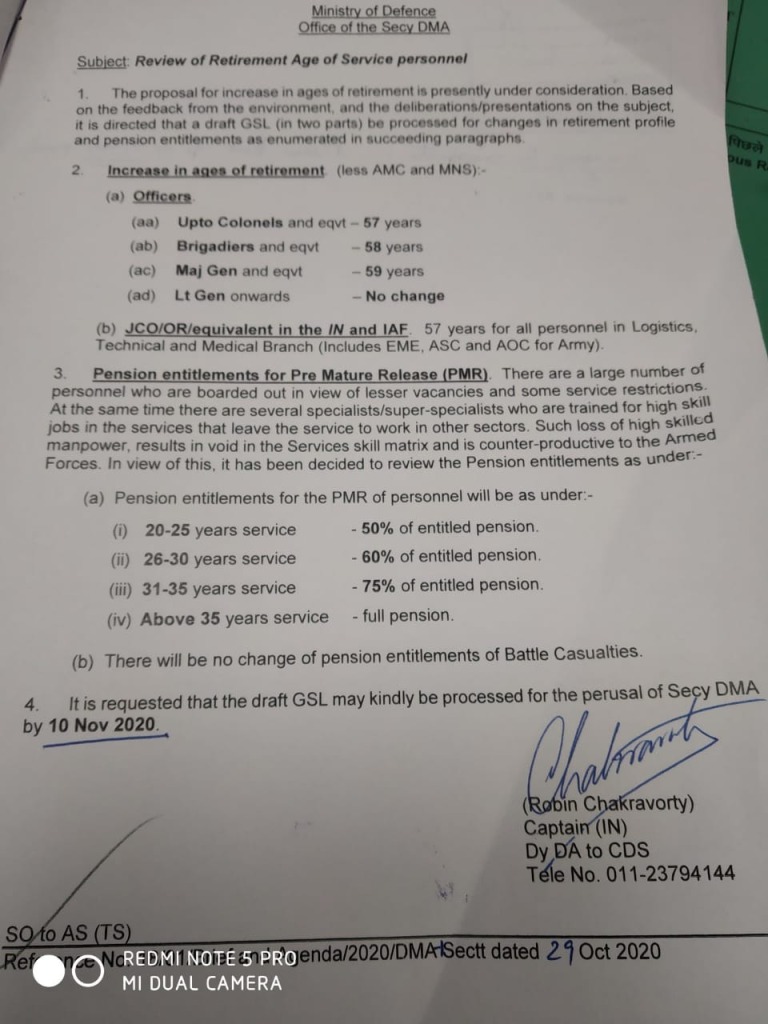
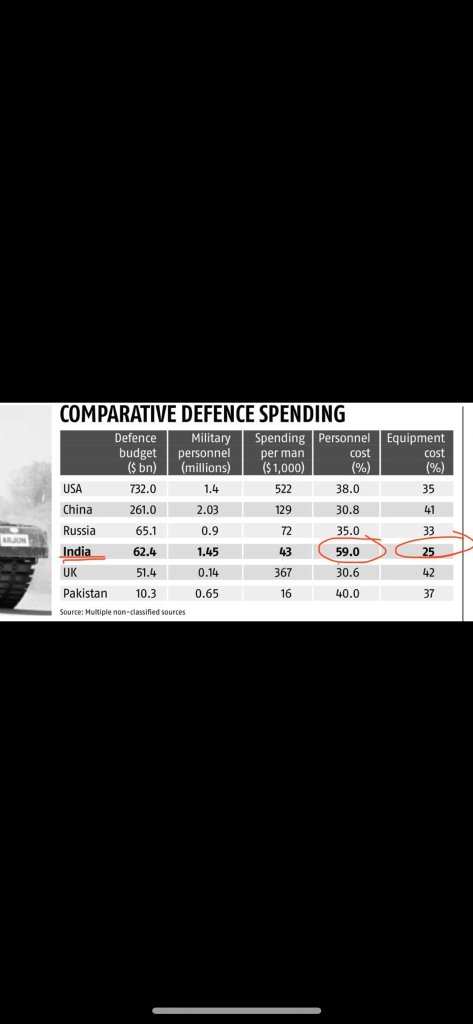


 Like
 A new release 0.3.3.9.1 of
 Today, the
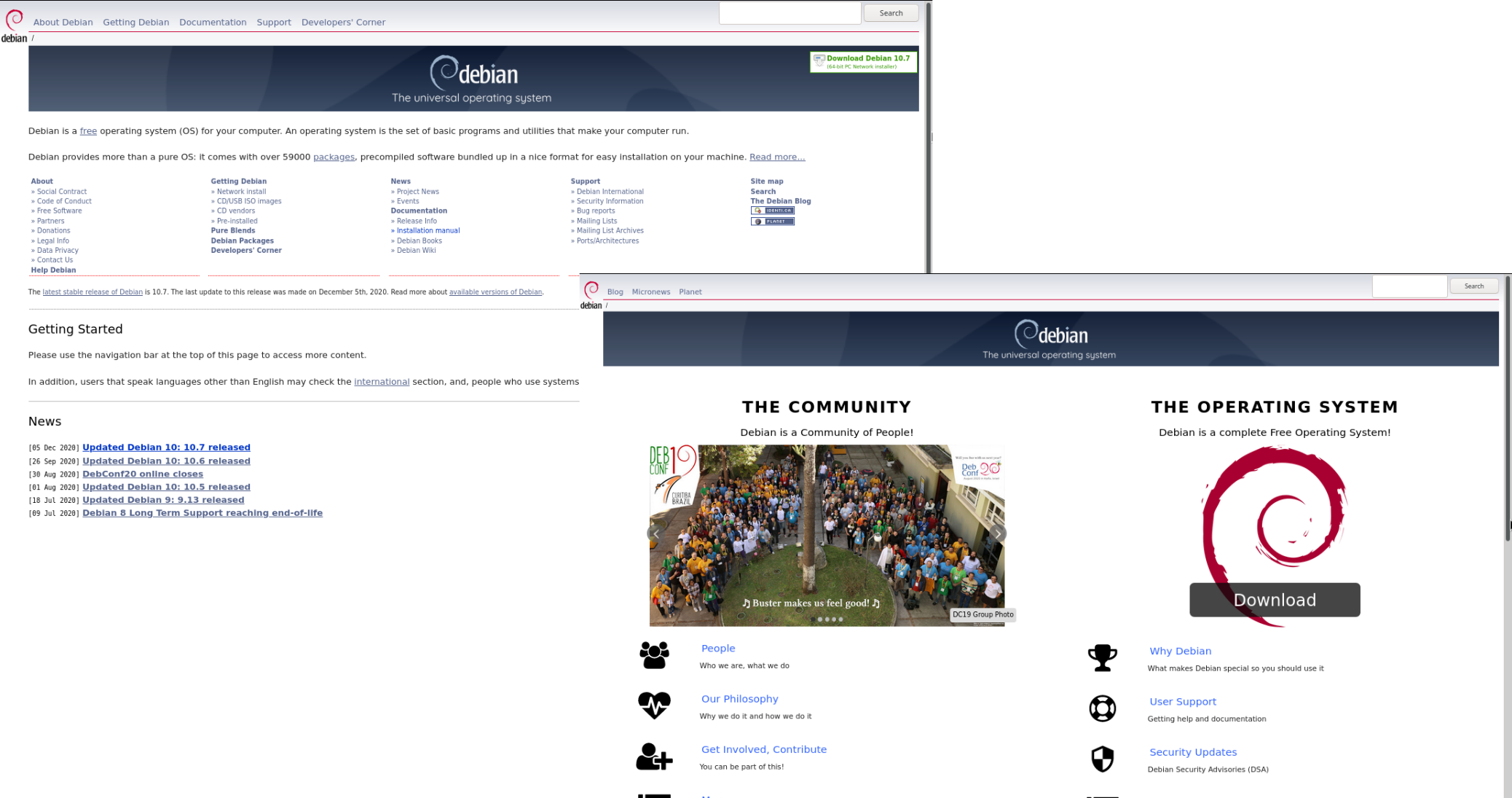

 Despite having worked on a
 I managed to break a USB port on the Desk Pi. It has a pair of forward facing ports, I plugged my wireless keyboard dongle into it and when trying to remove it the solid spacer bit in the socket broke off. I ve never had this happen to me before and I ve been using USB devices for 20 years, so I m putting the blame on a shoddy socket.
The first drive I tried was an old Crucial M500 mSATA device. I have an adaptor that makes it look like a normal 2.5 drive so I used that. Unfortunately it resulted in a boot loop; the Pi would boot its initial firmware, try to talk to the drive and then reboot before even loading Linux. The DeskPi Pro comes with an m2 adaptor and I had a spare m2 drive, so I tried that and it all worked fine. This might just be power issues, but it was an unfortunate experience especially after the USB port had broken off.
(Given I ended up using an M.2 drive another case option would have been the
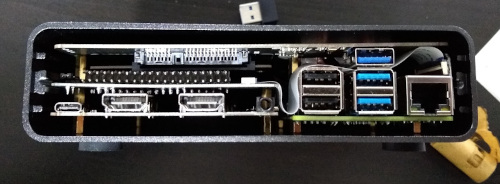 The case is a little snug; I was worried I was going to damage things as I slid it in. Additionally the construction process is a little involved. There s a good set of instructions, but there are a lot of pieces and screws involved. This includes a couple of
 I hate the need for an external USB3 dongle to bridge from the Pi to the USB/SATA adaptor. All the cases I ve seen with an internal drive bay have to do this, because the USB3 isn t brought out internally by the Pi, but it just looks ugly to me. It s hidden at the back, but meh.
Fan control is via a USB/serial device, which is fine, but it attaches to the USB C power port which defaults to being a USB peripheral. Raspbian based kernels support device tree overlays which allows easy reconfiguration to host mode, but for a Debian based system I ended up rolling my own dtb file. I changed
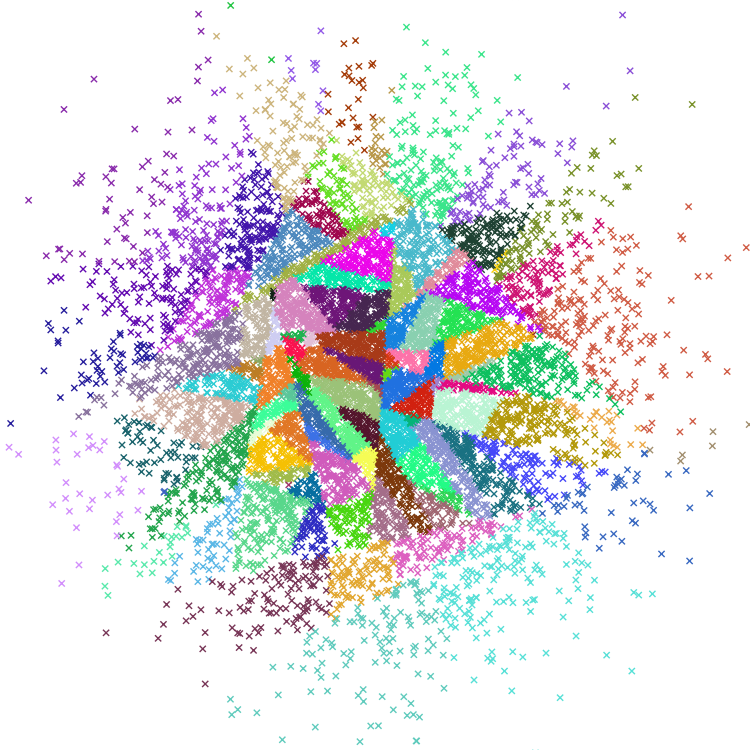 A new maintenance release, now at version 0.0.18, of
 For my

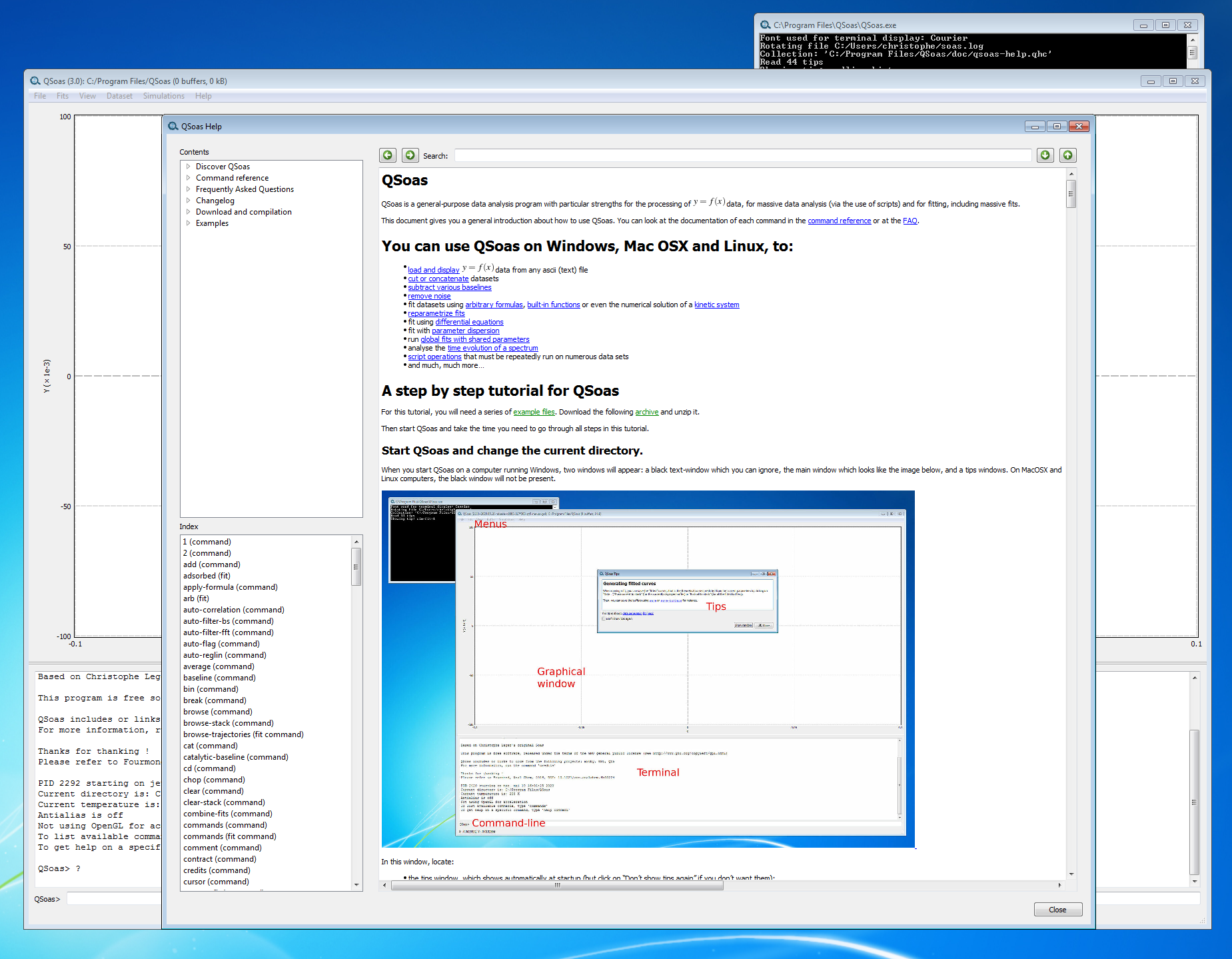

 Added multiple windows and a camera angle.
Maybe when I am talking and slides haven't started I want to show my face.
I probably have a terminal and presentation to show off.
So added a way to toggle between the sources.

 Update 11/12/20 Came across this article on the wire which tells how everybody s


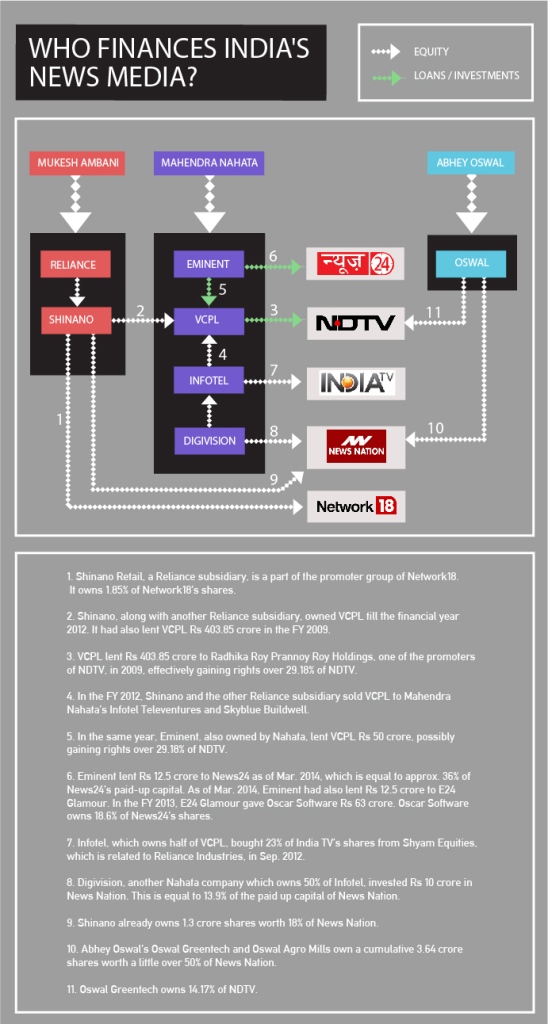
 Akarshan Uppal Reporter, IBN24 Copyright IBN24