Search Results: "bab"

18 January 2013

Russ Allbery: Review: Soulless

Review: Soulless, by Gail Carriger
Series: Parasol Protectorate #1
Publisher: Orbit
Copyright: October 2009
ISBN: 0-316-07165-X
Format: Kindle
Pages: 357
Alexia Tarabotti is a spinster in London society in the time of Queen Victoria. She is possessed of a hopelessly overwrought and society-focused mother, two half-sisters whose only thoughts are for fashion and gossip, a mixed Italian heritage, an unpopular body shape and complexion, and a secret. In a world in which vampire hives, werewolf packs, and the occasional ghost are out of hiding and openly participating in society, and where the Bureau of Unnatural Registry (headed by a particularly intimidating werewolf who is also an earl) keeps track of the undead, Alexia is something still rarer, and not entirely acceptable. She is preternatural, able to draw the supernatural out of the undead with a touch. She has no soul. In Carriger's Victorian urban fantasy, laced with a gentle helping of steampunk, vampires, werewolves, and ghosts all have similar conditions. All three are undead; even the change for werewolves happens after normal death. But the change doesn't happen to everyone killed by the corresponding type of undead. The requirements are quite exacting and include the quantity of soul in the person being changed. Only those with a surfeit of soul, too much to stay dead, can be successfully changed. Vampires and werewolves both are surrounded by hopeful humans, called drones and clavigers respectively, who hope to be transformed and gain immortality. But no one can tell in advance how much soul someone has. Alexia is the precise opposite of the undead. Rather than a surfeit of soul, she has none at all, a condition inherited from her father but unknown to the rest of her family. Her kind, the preternatural, make up the vampire and werewolf hunters of legend, called soul-suckers, curse-breakers, and exorcists by the supernatural set. She's viewed with great suspicion by most, but with fascination by some for her ability to revert them to humanity with physical contact. Not that this has been helpful in finding a husband, or, really, for much of anything else in her life. Soulless opens with Alexia being accousted by a rogue vampire in the library, where she went for refuge from a private ball. Not only does he not know who she is, despite every hive in the area telling all of their new vampires about her, but he doesn't seem to even know what a preternatural is, and she has to kill him with her parasol. That is the first unusual occurance in an escalating mystery involving new vampires appearing from nowhere, loner vampires and werewolves disappearing, and a truly prodigious use of chloroform. Not to mention quite a few encounters with Lord Maccon, Earl of Woolsey, the Alpha werewolf who runs the Bureau of Unnatural Registry. The start of Soulless feels a bit uneven and stilted until the story gets moving and the reader gets used to Carriger's voice. It's written in the style of a comedy of manners and takes delight in long words and a semi-formal style. For example:
The vampire recovered his equanimity quickly enough. He reared away from Alexia, knocking over a nearby tea trolley. Physical contact broken, his fangs reappeared. Clearly not the sharpest of prongs, he then darted forward from the neck like a serpent, diving in for another chomp. "I say!" said Alexia to the vampire. "We have not even been introduced!"
Sometimes this works. Sometimes it doesn't. The frequency with which it works seemed to me to increase as the book went along. The best thing this book has going for it is the character of Alexia Tarabotti. Rather than the typical kick-ass female protagonist of a modern urban fantasy novel, Alexia is not cynical, battle-hardened, or courageously sarcastic. Her attitude for most of the book is something closer to bemusement crossed with exasperation. She sees herself as an outsider, has largely given up on fitting into any sort of proper society, and has little use for the expectations of her family. But she's still embedded within her culture, still shocked (at least momentarily) by breaches in etiquette, and quite able to fit in, if a bit uncomfortably. Her delightfully logical tone and constant open-minded self-analysis is what made this book for me. The plot is fairly straightforward (and has a bit too much anti-science flavor for me). The romance angle, which is reasonably obvious from early on in the book, was entertaining mostly in Alexia's combination of thoughtful analysis (based in part on her father's extensive and not entirely acceptable library) and runaway physical reactions, although I thought the latter was slightly overdone. But all the elements of the story improve noticably towards the end of the book. I was unenthused by the halfway point, but by the time I finished Soulless, I decided I would probably read the sequel. This is more in the enjoyably fun reading pile than a book that I would go to great effort to acquire, and it has a somewhat rocky start, but I enjoyed it and would mildly recommend it. Followed by Changeless. Rating: 7 out of 10

17 January 2013

Russ Allbery: A few last thoughts on Aaron Swartz

Daniel Kahn Gillmor has a very good blog post. You should read it. It includes a thoughtful rebuttal to some of my earlier thoughts about activism. I think I'm developing a richer understanding of where I see boundaries here, but after my last post, I also realized that by focusing on the specific details of what should have been a minor alleged crime, I'm derailing. Swartz did so much else. I made a note to come back to the more theoretical discussion in six months; now isn't the time. Now is the time to celebrate open content and all of the things Swartz achieved. (But thank you very much to the multiple people who have pointed out flaws in my reasoning and attempted approach.) Hopefully, it's also an opportunity to keep the pressure on for a saner and less abusive judicial system that doesn't threaten people with ridiculous and disproportional punishment in order to terrify them into unwarranted plea bargains. The petition I mentioned has reached nearly 40,000 signatures and passed the threshold (at the time it was posted) for forcing a White House response. Probably more importantly, it also seems to be creating the feedback cycle that I was hoping to see: the popularity of the petition is causing this story to stay in the news cycle and continue to be written about, which in turn drives more signatures to the petition. I'm not particularly hopeful that the Obama administration cares about the vast and deep problems with our criminal justice system, but I'm somewhat more hopeful that they, like most politicians, hate news cycles that they don't control. The longer this goes on, the stronger the incentive to find some way to make it go away, which could lead to real disciplinary action. A key committee in the US House of Representatives is starting a formal investigation. One of my local representatives has proposed modifying the US federal law on computer fraud and abuse to remove violations of terms of service from the definition of the crime. (I don't have much hope that this will pass when proposed by the minority party in a fairly hostile House, but the mere act of proposing it keeps the news focus on.) Glenn Greenwald has a (typically long-winded) round-up of news in the Guardian. Note that both Greenwald and Declan McCullagh link directly to the petition in articles in mainstream news outlets. One thing that slacktivism can do is perpetuate a news cycle until it gets more uncomfortable for people in power. It's still nowhere near as effective as the types of activism that Swartz was so good at, but in this specific case I think one gets a reasonable return on one's five-minute investment of effort. I'm going to stop talking about this now, since other people are a lot better at this sort of post than I am. But one last link: the medical community has a related open content problem, and theirs is also killing people. Possibly people you know. If all of this has inspired you, as it has me, to care even more about open content, be watching the push for open access to clinical trial data. More background is in Ben Goldacre's TED talk.

Russell Coker: Cooling Phones

According to the bureau of meteorology today is 39C. But mad dogs and Ingressmen go out in the midday sun, so I took advantage of some spare time to capture a couple of portals. After that my phone battery was apparently at 46C and my phone refused to charge. It seems that in addition to the range of hardened phone cases we need some cooling cases for phones. A case that contained a substance with a melting point of 39C wouldn t melt from body heat but would set an upper limit on the phone temperature. A peltier device probably wouldn t work as it would take too much power (and the batteries supplying the power would produce more heat). I think that the phones with an aluminium back are the best design. Aluminium is light, reflective (unlike the black plastic which is so common), and conducts heat better than most things. A phone shell made of copper probably isn t viable due to copper being dense and soft. Another problem is the need for third party cases to protect against damage. If the phone companies designed phones to be solid, rubbery at the edges (to bounce not break) and so that the screen didn t touch the surface when the phone is face down then we could avoid phone cases which also act as thermal insulation. I am a bit disappointed in Samsung. I could understand Nokia making phones that don t survive the heat well, but I don t think that Korea is that much cooler than Australia. A phone that works well on the hottest day of summer in Seoul should do better than my Galaxy S3.

16 January 2013

Olivier Berger: Scheduling appointments with capture template from org-agenda view

I've been frustrated by my inability to schedule appointments directly from the org-agenda view, for quite some time, but I think I've found a way. If like me you're using org-mode to manage your appointments, you're probably using SCHEDULED TODO items that can be entered in your system using org-capture templates. A typical scenario is I'm asked by a colleague (face to face or on the phone) when I'm available to schedule a meeting or some other activity. I'm then firing an agenda view, and browse through the dates available... then agreeing on an empty slot, I'm capturing the meeting... but then I have to C-c C-s to add the SCHEDULED marker and set the correct date, although I was previously on that exact date in the org-agenda view :-/ The solution seems to be with the 'k c' command, i.e. the capture org-agenda-action in the agenda view. From the docs :
k runs the command org-agenda-action, which is an interactive compiled
c     Call  org-capture' with cursor date as the default date
Exactly what I need : it will prompt me for a capture template, which I just have to set to a template containing "SCHEDULED: %t". Excerpt from my .emacs :
(custom-set-variables
...
'(org-capture-templates (quote (("t" "Todo" entry (file+headline "~/org/newgtd.org" "TACHES") "* TODO %^ Brief description  %^g
 %?   
    Added: %U
%i
%a") ("n" "Notes" entry (file+datetree "~/org/journal.org") "* %^ topic  %T %^g
%i%?
%a") ("d" "Scheduled appointment" entry (file+headline "~/org/newgtd.org" "TACHES") "* TODO %^ Brief description  %^g
 %?   
    SCHEDULED: %t
%i
%a"))))
Tadaaa ! it works :-)

15 January 2013

Russ Allbery: More on Aaron Swartz

I got some feedback that the analogy I used in my last post was a bit confusing, and indeed I blew the phrasing of the analogy (also now corrected). So let me try this again, since I think there's a subtlety here that may be missed. I should note for the record that my understanding of what Swartz did that started the process is apparently somewhat based on the description from the prosecution, so it may not be the complete or accurate facts. Since there will now be no trial, we may never find out what the defense was, and whether those facts would be challenged. So it may be best to think of this as a hypothetical. We never established, or will establish, in court exactly what happened. Swartz was, generally speaking, charged with two things that I consider quite distinct, at least from an ethical perspective. Most of the focus is on the copyright part: downloading JSTOR articles with an intent (never acted upon) to distribute them to the world. There are a bunch of reasons why this may or may not be justified, which are tied into the origin of those articles (many of them were publicly funded) and the legitimacy of copyright licensing agreements. I think there is significant room to hold a variety of opinions on this, although I don't believe that "crime worth 35 years in prison" is even remotely close to justifiable under any interpretation. However, there is a second part of what he was charged with, and that's primarily what I was commenting on, not the copyright part. He allegedly hooked up a laptop in an unlocked MIT wiring closet without permission and then used MIT's network and JSTOR license to download information. This is, to me, a subtlely but entirely distinct act from the question of whether taking JSTOR's data was ethically or legally wrong. Whether or not one believes that JSTOR's copyrights are not legitimate, it's still not okay to use someone else's network and license or to trespass in their wiring closets without permission. (I work in central IT for a university, so this strikes closer to home.) And this is where the analogy came in, which I flubbed. I had originally said that this was akin to "traipsing into someone's barn or backyard shed without their permission and taking some of their tools because you want to use them." The word "taking" was wrong; it falsely implies that you weren't going to return the tools. I had been thinking "taking and then returning" when I wrote that, and the important second part didn't make it into the post. So let's try this again: Swartz's actions at MIT, as I understand them (and many things could change this, such as a revelation that he had MIT's prior permission), are akin to going onto someone's property and into their barn without permission, borrowing their hedge trimmer for a while because you want to use it, and returning the hedge trimmer without any damage when you're done (and without them noticing it was gone). I'm quite fond of this analogy, since I think it clearly establishes two things:
  1. Most people are going to be unhappy about this happening and will intuitively feel like it should probably be illegal. Not everyone; there are folks who don't believe in personal property, or at least wouldn't extend it to tools in a barn. But most people will feel that someone should ask first before they come borrow your tools. Even if they don't damage them, even if they return them before you notice they're gone, you might have wanted to use the tool at the same time or they might have damaged them without intending to, and they should just ask first. It's common politeness, and depending on the circumstances, someone who doesn't ask and is covert about borrowing tools might be worth calling the police over.
  2. There is absolutely no way in any reasonable moral system that doing this should result in 35 years in prison. Or even 10, or even 1. Yes, most people would consider this a crime, but most people would consider it a minor crime. It's the sort of thing where you might have to impose some consequences just to make sure the message of "knock it off" is delivered firmly, but someone doing this is rude and inconsiderate, not evil.
The JSTOR copyright stuff is more complex to analyze and is more politically divisive, but for me the key points are (a) Swartz never released the data, and (b) JSTOR declined to press charges. To me, that means the deeper copyright questions, which are quite interesting, were never actually reached in this particular case. The crime that did apparently happen was the trespass at MIT, for which I think the above analogy is the right way to think about it. The point I do want people to take away from this is that one should not overlook the trespass at MIT even if one wants to celebrate the undermining of the copyright regime and doesn't believe JSTOR's data should be considered their private property. Social activism and political disobedience are important and often valuable things, but performing your social activism using other people's stuff is just rude. I think it can be a forgivable rudeness; people can get caught up in the moment and not realize what they're doing. But it's still rude, and it's still not the way to go about civil disobedience. For both ethical and tactical reasons, involving bystanders in your act of social activism without their consent is a bad approach. ETA: The problem, of course, with discussing all of this is that while it's relevant and possibly even somewhat important in the broader sense of how our community acts going forward, it also doesn't capture the fact that this was only one incident in a remarkable life. One of the worst problems with the abusive prosecution of Swartz is that it blew this incident completely out of proportion. A moment of arguable judgement should not dominate one's life or cast a shadow over all of one's other accomplishments; the prosecution tried to make it do just that. That's part of what I'm arguing, but ironically that partly feeds into the lack of proportionality in the discussion. I've gotten kind of far afield here, so let me go back and say explicitly: Swartz was a remarkable person who did much to admire and respect, and the world is a worse place without him.

14 January 2013

Russell Coker: Promoting Enthusiasm

Rusty wrote an insightful post titled What Can I Do To Help? about reactions to new ideas [1]. He suggests that people make an effort to have a positive approach when someone talks about a new idea, it s quite common for people to point out reasons why the new idea might not work out which is discouraging for the person who had the idea. I think that is a really good point. I probably haven t done too well in that regard in the past and will try to do better in future. Code Written by Assholes Rusty previously wrote a post titled If you didn t run code written by assholes, your machine wouldn t boot which implies that we should just let assholes be assholes [2]. That doesn t go well with his What Can I Do To Help? post. Note that I m not accusing Rusty of hypocrisy here, giving advice to help people who want to get along well with others is not in contradiction with refraining from giving unsolicited advice and encouragement to difficult people who have expressed no interest in improving their behavior. A comment on the latter post by Doctor Whom says If I had seen this kind of talk when I was a teenager, I would have thought twice about picking up coding , presumably given the number of people who read Rusty s blog there are some teenagers who experienced some discouragement towards a career in computers (or a hobby in FOSS) from Rusty s post. I ve already written a response to the If you didn t run code written by assholes post, among other things I suggested that people who are minor assholes should be assisted to be less difficult and major assholes should be excluded [3]. In that post I was working on the assumption that for every significant task that needs to be completed (such as making a popular OS bootable) someone will do it, if the person working on it disappears then someone else will take over there is a community of programmers who will work on whatever needs to be done. The Importance of Individuals But in terms of new ideas it really comes down to individuals. Most projects which are significant and important now probably started out as one person or a small group who had an idea that seemed unlikely to succeed at the time. So while any big and successful project can have people replaced (which is among other things a requirement of long-term success) there are situations in which individuals with ideas matter. Another important factor is that even ideas which turn out to be impractical are still useful. Someone who has an impractical idea about a technical issue and investigates it fully will learn a lot and may end up working on the less radical ways of solving similar problems this is good for the individual and the community. Another Way of Promoting Enthusiasm In terms of promoting enthusiasm it seems that one thing that can be done by high profile people is to avoid writing posts like If you didn t run code written by assholes, your machine wouldn t boot . When people in positions of power and influence appear to have no interest in promoting good behavior it really discourages people who are vulnerable to the assholes which among other things means most members of minority groups. Obviously Rusty could t stamp out all asshole behavior, but if he announced a plan to try and make things better in that regard then it would help. It s difficult to be enthusiastic when faced with discrimination from a minority and disinterest from the majority. Of course with the way the Internet works I m sure someone will say what about the assholes who have great ideas, shouldn t we nurture their enthusiasm by letting them keep doing asshole things? . I think that for the major assholes this won t be a problem, for example anyone who s racist will be well aware that many people disagree strongly with them and thus won t be particularly discouraged when they meet more people who disagree. For the minor assholes (people who don t want to be assholes) it will be somewhat discouraging to be corrected, but that could be a learning experience for them that s worth more than support in implementing their latest technical idea. Update: Why Rusty is Important In response to a comment by private mail I ve added this section after publication. Firstly I think that the opinions of all members of the community matter as they all affect the social environment which determines what types of behavior are encouraged and discouraged. But Rusty is more important than most people. Firstly Rusty has a Wikipedia page [4], that alone is an objective criteria indicating his importance. But in terms of influencing people in the FOSS community the most important things are that he s a high profile Linux kernel programmer (which alone gives significant status and influence) and that he s the founder of the first Linux conference in Australia (which is now known as Linux.conf.au AKA LCA). When issues such as the anti-harassment policy for LCA are being discussed any opinion that Rusty offered would be taken very seriously. But so far he doesn t seem to be involved in any of the public discussions.

13 January 2013

Russ Allbery: Slacktivism that may actually help

Normally, I'm not that much of a fan of the slacktivist trend of signing pre-canned petitions, signing things that political organizations send in the mail, and so forth. It takes very little effort and therefore carries very little weight. A lot of those efforts are more exercises in helping the signers feel better about themselves. But there is the occasional exception. Most of you probably already know about the death of Aaron Swartz. For those who aren't familiar, see Larry Lessig's article. Swartz suffered from depression (and, seriously, fuck depression it's an awful, horrible disease), but there's little doubt that the ongoing federal prosecution using the full weight of the US district attorney's office to hound him for what amounts to political trespassing was part of what led to his suicide. As it happens, I personally believe that Swartz committed a crime, and probably should have paid some consequence for it (on the order of a fine or some community service). Hooking your devices up to someone else's network without their permission and messing around in their wiring closets (locked or not) is, for me, akin to traipsing into someone's barn or backyard shed without their permission and using some of their tools because you want to use them. And whether or not one likes the current copyright regime (and I don't like it at all), MIT is still in the awkward position of having to work with it. Abusing their license for your political goals is effectively recruiting them into your activism without their permission, and as I've mentioned before, I have a mild obsession with consent. It was a crime. However, it was a minor crime, and that's where this whole situation went completely off the rails. One aspect of a justice system is fairness: uniform application of the laws to everyone. However, another aspect of a justice system is proportionality: punishments that fit the crime. Without ever having been convicted, Swartz was already punished completely out of proportion to what he actually did, both financially and emotionally, by prosecution by the US attorney that went far, far beyond zealous into actively abusive. This despite the fact that the owner of the academic papers that he was downloading as an act of open access activism stated they did not want the case to proceed and asked the US government to drop the charges. I don't think what Swartz did was right, or legal. However, the correct reaction was "look, involuntarily recruiting MIT as an accomplice to your act of civil disobedience is not okay don't ever do that again." Not "you are evil and should be locked up in prison for 35 years." And I'm completely fed up with the disproportionality of our justice system and the practice of ridiculous over-charging of crimes in an attempt to terrify people into bad plea bargains. Which brings me to the slacktivism. This is exactly the sort of situation where popular opinion matters. US attorneys who have lost the faith and support of the population they serve won't keep their jobs. And no one in government particularly wants this case to be splashed across the front pages, or to have to answer questions about the appropriateness or proportionality of the prosecution while people are mourning a dead young man. If we make it clear enough to the Obama administration that people are watching, that this matters, and that we're angry about it, not only is it quite likely there will be consequences for this prosecutor, but it may serve as a deterrant for other prosecutors in the future. There is a petition on WhiteHouse.Gov to remove the district attorney for prosecutorial overreach, and for once taking five minutes to create an account and clicking on a petition may be both useful and appropriate. Taking disciplinary action here is, unlike with a lot of petitions, something that the Obama administration can actually do, directly, without involving the rest of the dysfunctional US government, and without making new law. If you are a US citizen, please consider going to this site and signing it to say that this matters to you and you believe this prosecution was excessive and inappropriate. Please note: you do not have to believe that Swartz died solely or even primarily because of this prosecution to do this. We'll never really know the complex factors behind his death. But this was a burden that he shouldn't have had to deal with. Please also note that you do not have to think he was justified in his behavior to sign this petition. This is not a question of whether what he did should be legal or was ethical. Rather, even assuming it was illegal, it's a question of appropriate punishment and proportionality of response. Whether or not you agree with his political cause, there simply was not enough damage done, to anyone, to warrant this kind of aggressive prosecution. And the direct victims agreed, which was the point at which the district attorney should have scaled way back on their actions or dropped the matter entirely. Not doing so was an abuse of office and position, and that should have consequences. ETA: Corrected "taking" to "using" in the analogy about tools. I was actually thinking "taking and then returning" when I wrote that, but only the first word made it into the post, and ended up creating a confusing parallel with theft that wasn't intended.

12 January 2013

Russ Allbery: Review: Asimov's, April/May 2011

Review: Asimov's Science Fiction, April/May 2011
Editor: Sheila Williams
Issue: Volume 35, No. 4 & 5
ISSN: 1065-2698
Pages: 192
Williams's editorial this issue is about the tendency of SF to take a rose-colored view of the world, which on the surface seems odd given the tendency of recent SF towards dystopia. But she makes a good point that the portrayal of the past is rose-colored, linking that into the current steampunk trend. She doesn't take the argument quite as far as I'd like, but I'm glad to see editorials raising points like this. I'm inclined to think that a lot of the rose-colored frame of the past is because few of us want to read about real historic conditions at any length, even for edification, because the stench and discomfort isn't fun to read about. Silverberg's column is another discussion of programmatic plot generators, which mostly makes the point that plot ideas are the easy part of writing. James Gunn contributes an extended biography of Isaac Asimov that probably won't be new to long-time genre readers but may fill in some details (although it politely sticks to mostly flattering material). Spinrad's book review column is one of his better ones; it looks at two novels by China Mi ville and two by Ian McDonald and explores differences in world-building. Spinrad predictably makes the case in favor of science fiction with rules and against the New Weird, but the discussion along the way was worth reading. "The Day the Wires Came Down" by Alexander Jablokov: Speaking of steampunk, here's an example. There is even an airship, although the primary technological focus is suspended street cars. Jablokov postulates a city-wide transportation network of suspended carriages called telpher cars, along with a city built around the telpher cables: stores on roofs, windows displaying merchandise to passing cars, and even a history of heated competition and dirty tricks between competing telpher networks. The story is set, as the title would indicate, on the last day of the network. It's being shut down for cost, with some hints that progress is destroying something precious. There is a plot here, revolving around some mysteries of the history of the telpher network and the roles of several people in that history. But the story is primarily a celebration of old technology. It's a rail fan's story recast with a steampunk technology, featuring the same mix of fascination with mechanics and a sense that the intricate details are falling out of common knowledge (and perhaps usefulness). As a story, it's a bit slow-moving, but I enjoyed the elegiac tone. (7) "An Empty House with Many Doors" by Michael Swanwick: This is a very short story, more of an emotional profile, involving a man's reaction to the death of his wife. Oh, and parallel universes. It's sort of the inverse of Niven's classic "All the Myriad Ways." Similar to Niven's story, I found the idea vaguely interesting but the conclusion and emotional reaction unbelievable and alien. (5) "The Homecoming" by Mike Resnick: Resnick tends to yank on the heart-strings rather sharply in his stories, so I knew roughly what to expect when a father comes home to find his son is visiting. A son who, rather against his father's wishes, has been significantly altered to be able to live with aliens. Throw in a mother with serious dementia, and you can probably predict what Resnick does with this. Still, most of the story is a two-sided conversation, and I thought he succeeded in doing justice to both sides, even though one of them was destined to lose. (6) "North Shore Friday" by Nick Mamatas: Illegal Greek immigrants, a family-run system for getting them married off before the INS catch them, government psi probes and eavesdropping on thoughts, joint projects between computer and religion departments, secret government experiments, and even ghosts... this story is a complex mess, with numerous thoughts stuck into small boxes and scattered through the surface story. It's one of those stories where figuring out what's going on, and even how to read the story in a sensible way, is much of the fun. If you find that fun, that is; if not, it will probably be frustrating. I wished there was a bit more plot, but there's something delightful about how much stuff Mamatas packs into it. (6) "Clockworks" by William Preston: This is a prequel to Preston's earlier "Helping Them Take the Old Man Down". Like that story, it's primarily a pulp adventure, but layered with another level of analysis and thoughtfulness that tries to embed the pulp adventure in our understanding of human behavior and the nature of the world, although this one stays a bit more pulp than its predecessor. As with Preston's other story, we don't get directly in the head of the Old Man (here, just called the man, but identifiable from clues in both stories as Doc Savage); instead, the protagonist is a former villain named Simon Lukic who the man hopes to have fixed by operating on his brain. The undercurrent that lies beneath a more typical pulp adventure is the question of whether Lukic is actually healed. I think there was a bit too much daring-do and human perfection, but it's a perfectly servicable pulp story with some depth. (6) "The Fnoor Hen" by Rudy Rucker: If you've read any of Rucker's work before, you probably know what to expect: a mind-boggling blizzard of mathematically-inspired technobabble that turns into vaguely coherent surrealism. (You can probably tell that I'm not much of a fan, although the clear good humor in these stories makes it hard to dislike them too much.) There's a mutated chicken and some sort of alternate mathematical space and then something that seems like magic... I'd be lying if I said that I followed this story. If you like Rucker, this seems like the sort of thing that you'd like. (4) "Smoke City" by Christopher Barzak: At the start of this story, I thought it was going to be an emotional parable about immigration. The progatonist lives two lives: one in our world, and one in the Smoke City of industry, a world of hard labor, pollution, and little reward, with families in both. But nearly all of the story is set within Smoke City, and the parable turns out to be a caustic indictment of industry and its exploitation of labor. I kind of wish Barzak hadn't used rape as a metaphor, but when the captains of industry show up, I can't argue with how deeply and accurately the story shoves in the knife. There isn't much subtlety here, but it's still one of the better stories in this issue. (7) "A Response from EST17" by Tom Purdom: I'm very happy to see Purdom's writing appearing regularly. His stories are always quiet and matter-of-fact, and at first seem to miss emotional zest, but they almost always grow on me. He lets the reader fill in their own emotional reactions to events, and there's always a lot going on. This story is a first-contact story, except that the "humans" here are not human at all. They're automated probes sent by two separate human civilizations, with different programming and different governance algorithms, and they quickly start competing negotiations. The aliens they've discovered similarly have factions, who start talking to the different probes in an elaborate dance of gathering information without giving too much away. The twist is that this pattern has replayed itself many times in the past, and information itself can be a weapon. I enjoyed this one from start to finish. (7) "The One That Got Away" by Esther M. Friesner: Friesner is best known, at least to me, for humorous fantasy, and this story is advertised as such from early on. The first-person protagonist is a prostitute in a seaside town. She's bemused to finally be invited over by a sailor who's been eyeing her all evening, but that sailor has something else in mind than normal business. For much of this story, the fantasy element is unclear; when it finally comes, it was an amusing twist. (7) "The Flow and Dream" by Jack Skillingstead: This is a mildly interesting variation on the old SF story of hibernating humans (on a generation ship or elsewhere) waking up to a transformed world. Here, it's not a ship, it's a planet, and the hiberation was to wait for terraforming rather than for transit. The twist comes from an excessively literal computer and the fun of putting together the pieces. Sadly, the story trails off at the end without much new to say. (5) "Becalmed" by Kristine Kathryn Rusch: "Becalmed" takes place immediately before "Becoming One with the Ghosts" and explains the incident that created the situation explored in that story. The first-person protagonist of "Becalmed" is a linguist, an expert in learning alien languages so that the Fleet can understand the civilizations that it runs across. But something went horribly wrong at their last stop, something that she's largely suppressed, and now she's confined to quarters and possibly in deep trouble. As is the ship; they're in foldspace, and they have been for days. "Becalmed" is structed like a mystery, centered around recovering the protagonist's memories. It's also a bit of a legal procedural; the ship is trying to determine what to do with her and to what degree she's responsible. But the heart of the story is a linguistic and cultural puzzle. This is another great SF story from Rusch, whose name on a cover will make me eager to start reading a new magazine. I love both angles on the universe she's built, but I think I like the Fleet even better than the divers. The Fleet captures some of the magic of the original Star Trek, but with much more mature characters, more believable situations, and a more sensible and nuanced version of the Prime Directive. Rusch writes substantial, interesting plots that hold my interest. I'd love to see more like this. (8) Rating: 7 out of 10

9 January 2013

Daniel Kahn Gillmor: universally accessible storage for the wary user

A friend wrote me a simple question today. My response turned out to be longer than i expected, but i hope it's useful (and maybe other people will have better suggestions) so i thought i'd share it here too: Angela Starita wrote:
I'd like to save my work in a location where I can access it from any computer. I'm wary of using the mechanisms provided by Google and Apple. Can you suggest another service?
Here's my reply: I think you're right to be wary of the big cloud providers, who have a tendency to inspect your data to profile you, to participate in arbitrary surveillance regimes, and to try to sell your eyeballs to advertisers. Caveat: You have to trust the client machine too But it's also worth remembering that the network service provider is not the only source of risk. If you really mean "accessing your data from any computer", that means the computer you're using to access the data can do whatever it wants with it. That is, you need to trust both the operator of these "cloud" services, *and* the administrator/operating system of the client computer you're using to access your data. For example, if you log into any "secure" account from a terminal in a web caf , that leaves you vulnerable to the admins of the web caf (and, in the rather-common case of sloppily-administered web terminals, vulnerable to the previous user(s) of the terminal as well). Option 0: Portable physical storage One way to have your data so that you can access it from "any computer" is to not rely on the network at all, but rather to carry a high-capacity MicroSD card (and USB adapter) around with you (you'll probably want to format the card with a widely-understood filesystem like FAT32 instead of NTFS or HFS+ or ext4, which are only understood by some of the major operating systems, but not all). Here is some example hardware: Almost every computer these days has either a microSD slot or a USB port, while some computers are not connected to the network. This also means that you don't have to rely on someone else to manage servers that keep your data available all the time. Note that going the microSD route doesn't remove the caveat about needing to trust the client workstation you're using, and it has another consideration: You'd be responsible for your own backup in the case of hardware failure. You're responsible for your own backup in the case of online storage too, of course -- but the better online companies are probably better equipped than most of us to deal with hardware failure. OTOH, they're also susceptible to some data loss scenarios that we aren't as individual humans (e.g. the company might go bankrupt, or get bought by a competitor who wants to terminate the service, or have a malicious employee who decides to take revenge). Backup of a MicroSD card isn't particularly hard, though: just get a USB stick that's the same size, and regularly duplicate the contents of the MicroSD card to the USB stick. One last consideration is storage size -- MicroSD cards are currently limited to 32GB or 64GB. If you have significantly more data than that, this approach might not be possible, or you might need to switch to a USB hard disk, which would limit your ability to use the data on computers that don't have a USB port (such as some smartphones). Option 1: Proprietary service providers If you don't think this portable physical storage option is the right choice for you, here are a couple proprietary service providers who offer some flavor of "cloud" storage while claiming to not look at the contents of your data: I'm not particularly happy with either of those, though, in part because the local client software they want you to run is proprietary, so there's no way to verify that they are actually unable to access the contents of your data. But i'd be a lot happier with either wuala or spideroak than i would be with google drive, dropbox, or iCloud. Option 2: What i really want I'm much more excited about the network-accessible, free-software, privacy-sensitive network-based storage tool known as git-annex assistant. The project is spearheaded by Joey Hess, who is one of the most skilled and thoughtful software developers i know of. "assistant" (and git-annex, from which it derives) has the advantage of being pretty agnostic about the backend service (many plugins for many different cloud providers) and allows you to encrypt your data locally before sending it to the remote provider. This also means you can put your encrypted data in more than one provider, so that if one of the providers fails for some reason, you can be relatively sure that you have another copy available. But "assistant" won't be ready for Windows or Android for several months (builds are available for Linux and Mac OS X now), so i don't know if it meets the criterion for "accessible from any computer". And, of course, even with the encryption capabilities, the old caveat about needing to trust the local client machine still applies.

8 January 2013

Russell Coker: The Death of the Netbook

The Age has an interesting article about how Apple supposedly killed the Netbook [1]. It s one of many articles with a similar spin on the news that the last two companies making Netbooks are going to cease production. The main point of these articles is that Apple decided that Netbooks were crap and killed the market for them by producing tablets and light laptops that squeeze them out of the market. Is the Macbook Air a Netbook? According to the Wikipedia page the Macbook Air [2] weighs 1080g for the 11 version and 1340g for the 13 version. According to Wikipedia the EeePC 701 (the first EeePC) weighs 922g and the last EeePC weighs 1460g [3]. The last EeePC produced is heavier than ANY Macbook Air while the first (and lightest) EeePC is only 158g lighter than the 11 Macbook Air. The 11 Macbook Air is 300*192*17mm (979cm^3) in size while the EeePC 701 is 225*165*35mm (1299cm^3) and the biggest EeePC was 266*191*38mm (1931cm^3). So the 11 Macbook Air is 13% wider than the widest EeePC but takes less volume than any EeePC. The 13 Macbook Air is 325*227*17mm (1254cm^3) which is still less volume than any EeePC. The Wikipedia page about Netbooks defines them as being small, lightweight, legacy-free (in terms of hardware not software) and cheap [4]. The Macbook Air clearly meets all the criteria apart from price. The Apple US web site offers the version of the 11 Macbook Air with 64G of storage for $999 with free shipping, for comparison the EeePC 701 was on sale in stores for $500 in 2008. The CPI adjusted price for the EeePC 701 would be at least $550 in today s money. The Macbook is a bit less than twice as expensive as the EeePC was, but that s more of an issue of Apple being expensive a few years ago companies like HP were also selling Netbooks that were more expensive than the EeePC. Unless having an awful keyboard is a criteria for being a Netbook I think that the Macbook Air meets the criteria. As an aside, a relative recently asked me for advice on a device that is like a Macbook Air but cheaper. Does anyone know of a good option? Is Netbook Production Ceasing? Officeworks currently sells an ASUS Notebook that has a 11.6 display and weighs 1.3kg for $398, it s got a metal body that looks a bit like a Macbook Air (which is the latest fashion and is good for heat dissipation). That s not advertised as a Netbook or a Eee product but it s cheap, lighter than the heaviest EeePC, and not much bigger than an EeePC. It seems that the general prices of laptops other than Apple products (which have always had higher prices) have been dropping a lot recently. There are lots of good options if you want a laptop that costs $500 or less. Even Thinkpads (one of the most expensive and best designed ranges of laptops) are well below $1000. Do the Articles about Netbooks Make Sense? The claims being made are that Apple skipped Netbooks because they couldn t make a good profit. This disregards the fact that the iPhone and iPad (which are very profitable) are in the high end of the price range that was occupied by Netbooks. While Apple does make a good deal of money from the iPhone App Market it would be possible to make a Netbook with a lower production price than an iPhone because making things smaller requires more engineering work and often more expensive parts. This also disregards the fact that there are a range devices which work as an iPad case with keyboard, an iPad with such a keyboard meets most criteria for being a Netbook, so Apple is one iPad keyboard device away from selling Netbooks. It s interesting to note that I haven t yet seen an article about the profits from Netbooks which didn t make an issue of the MS-Windows license fees. The first Netbooks only ran Linux but later on they switched to Windows, that had to make a big impact on profits. An article about Netbooks which just assumes that everyone has to pay a MS license fee is missing too much of the Netbook history to be useful. I wonder if anyone could make products that are as profitable as the iPhone and Macbook Air if they had to pay for MS license fees and design their hardware to work with MS software (as opposed to Apple who can change their software to allow a cheaper hardware design). The articles also claim that Netbooks give a bad user experience. When I bought my EeePC 701 it was the fastest system I owned for loading OpenOffice, SSD random read speeds were really good (writes sucked but that didn t matter so much). The keyboard on an EeePC 701 is not nearly as good as a full size laptop but it is also a lot better than using a tablet, I ve used both a 10 Android tablet and an EeePC as a ssh client and there is no comparison. When I m going somewhere that requires random sysadmin work (or other serious typing) and I can t carry much weight then I still take my EeePC 701 and I don t consider taking a tablet. The low resolution of the screen is a major issue, but it s about the same as a Macbook Air so that s not an advantage for Apple. I knew some people who used an EeePC 701 for the majority of their work, I couldn t do that but obviously some people have different requirements. I now use my phone for many tasks that I used to do on my EeePC (even light sysadmin work) so my EeePC sometimes goes unused for months. But it s still an important part of my collection of computers. It works well for what it does and I don t feel any need to buy a replacement. When it wears out I ll probably buy something similar to an 11 Macbook Air to replace it unless there s a good option of a tablet with a detachable keyboard. My plans for computer ownership for the near future are based on a reasonably large Android phone (currently a Samsung Galaxy S3 but maybe a Galaxy Note 2 or similar next year), a small laptop or large tablet with hardware keyboard (currently an EeePC 701), a large laptop (currently a Thinkpad T61), and a workstation (currently a NEC system with an Intel E4600 CPU and a Dell U2711 27 monitor). A reasonably small and light system with a hardware keyboard and solid state storage is an important part of my computer needs. If tablet computers with hardware keyboards replace traditional Netbooks that s not really killing Netbooks but introducing a new version of the same thing. But a good way of getting web hits on an article is to claim that a once popular product is dead.

7 January 2013

Russ Allbery: faq2html 1.31 and VCS migrations

faq2html is my version of that script that so many different people have written: a tool to convert text files into HTML for the web. This script is specifically tuned to the way that I format text files and has a lot of special logic to deal with my eccentricities, so I have no idea how well it would work for anyone else. This release adds a new -l option, which says to add a subheading to the HTML output giving the last modified date based on the file modification timestamp. Previously, these subheadings were only added in some situations and based on RCS/CVS-style Id keywords in the file. Since I'm converting my personal repositories to Git, that was going to stop working. You can get the current version of faq2html from my web tools distribution page. With this update, I was able to convert my FAQs repository from Subversion to Git, which means that I only have one personal repository left in Subversion (PGP::Sign, which I will probably convert to Git shortly). That leaves a few CVS repositories, and therein lies a problem. There are a few places where I'm still using CVS for a conventional package or for some random files, and those can move to Git without much trouble whenever I get around to it. But most of my remaining use of CVS is for storing individual scripts that, if I distribute them at all, I distribute individually. And, for that, CVS seems to have a lot of advantages that are hard to implement with Git: I'm not at all sure what I'm going to do about this. Some of my scripts currently maintained in CVS, such as all the AFS tools, should move into larger packages that are more conventionally distributed, with a separate README file and similar machinery, and I'm slowly in the process of doing that. But many of my scripts are small programs that don't fit into any larger whole and don't warrant that sort of treatment. Honestly, I'm moderately tempted to just keep using CVS for scripts, since everything newer goes to repository-wide instead of per-file version numbers (for exceptionally good reasons when working on a unified piece of software, rather than a conglomeration of individual scripts), and I'm unenthused about writing my own machinery using Git hooks and smart Git log and diff parsing. But the CVS command-line interface is awful and the CVS repository format is even worse. If there are any brilliant ideas that I'm missing, I'd be interested in hearing about them in email (or other blog posts on Planet Debian or somewhere else I read). If I come up with some solution or get any great advice, I'll post a follow-up.

6 January 2013

Steve Kemp: Debian-Administration.org almost migrated

The new version of the Debian Administration is almost ready now. I'm just waiting on some back-end changes to happen on the excellent BigV hosting product. I was hoping that the migration would be a fun "Christmas Project", but I had to wait for outside help once or twice and that pushed things back a little. Still it is hard to be anything other than grateful to folk who volunteer time, energy, and enthusiasm. Otherwise this week has largely consisted of sleeping, planting baby spider-plants, shuffling other plants around (Aloe Vera, Cacti, etc), and enjoying my new moving plant (video isn't my specific plant). I've spent too long reworking templer such that is now written in a modular fashion and supports plugins. The documentation is overhauled. The only feedback I received was that it should support inline perl - so I added that as a plugin this morning via a new formatter plugin:
Title: This is my page title
Format: perl
Name: Steve
----
This is my page.  It has inline perl:
   The sum of 1 + 5 is   1 + 5  
This page was written by   $name  
ObQuote: "She even attacked a mime. Just found out about it. Seems the mime had been reluctant to talk. " - Hexed

5 January 2013

Ian Wienand: Position Independent Code and x86-64 libraries

A comment pointed out that the original article from 2008 made a few simplifications that were a bit misleading, so I have taken some time to update this. Thanks for the feedback. If you've ever tried to link non-position independent code into a shared library on x86-64, you should have seen a fairly cryptic error about invalid relocations and missing symbols. Hopefully this will clear it up a little. Let's start with a small program to illustrate.
int global = 100;
int function(int i)  
    return i + global;
 
Firstly, inspect the disassembley of this function:
$gcc -c function.c
$objdump --disassemble function.o
0000000000000000 <function>:
   0:   55                      push   %rbp
   1:   48 89 e5                mov    %rsp,%rbp
   4:   89 7d fc                mov    %edi,-0x4(%rbp)
   7:   8b 05 00 00 00 00       mov    0x0(%rip),%eax        # d <function+0xd>
   d:   03 45 fc                add    -0x4(%rbp),%eax
  10:   c9                      leaveq
  11:   c3                      retq
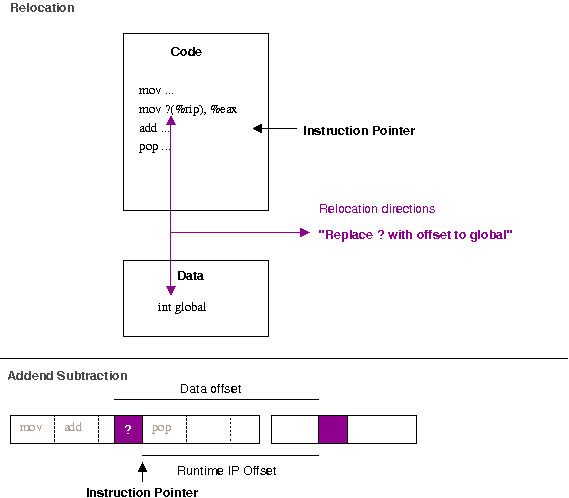
Lets just go through that for clarity: The IP relative move is really the trick here. We know from the code that it has to move the value of the global variable here. The zero value is simply a place holder - the compiler currently does not determine the required address (i.e. how far away from the instruction pointer the memory holding the global variable is). It leaves behind a relocation -- a note that says to the linker "you should determine the correct address of foo (global in our case), and then patch this bit of the code to point to that addresss". Relocations with addend The top portion of the image above gives some idea of how it works. We can examine relocations in binaries with the readelf tool.
$ readelf --relocs ./function.o
Relocation section '.rela.text' at offset 0x518 contains 1 entries:
  Offset          Info           Type           Sym. Value    Sym. Name + Addend
000000000009  000800000002 R_X86_64_PC32     0000000000000000 global + fffffffffffffffc
There are many different types of relocations for different situations; the exact rules for different relocation types are described in the ABI documentation for the architecture. The R_X86_64_PC32 relocation is defined as "the base of the section the symbol is within, plus the symbol value, plus the addend". The addend makes it look more tricky than it is; remember that when an instruction is executing the instruction pointer points to the next instruction to be executed. Therefore, to correctly find the data relative to the instruction pointer, we need to subtract the extra. This can be seen more clearly when layed out in a linear fashion (as in the bottom of the above diagram). If you try and build a shared object (dynamic library) with an object file with this type of relocation, you should get something like:
$ gcc -shared function.c
/usr/bin/ld: /tmp/ccQ2ttcT.o: relocation R_X86_64_32 against  a local symbol' can not be used when making a shared object; recompile with -fPIC
/tmp/ccQ2ttcT.o: could not read symbols: Bad value
collect2: ld returned 1 exit status
If you look back at the disassembly, we notice that the R_X86_64_32 relocation has left only 4-bytes (32-bits) of space left for the relocation entry (the zeros in 7: 8b 15 00 00 00 00). So why does this matter when you're creating a shared library? The first thing to remember is that in a shared library situation, we can not depend on the local value of global actually being the one we want. Consider the following example, where we override the value of global with a LD_PRELOAD library.
$ cat function.c
int global = 100;
int function(int i)  
    return i + global;
 
$ gcc -fPIC -shared -o libfunction.so function.c
$ cat preload.c
int global = 200;
$ gcc -shared preload.c -o libpreload.so
$ cat program.c
#include <stdio.h>
int function(int i);
int main(void)  
   printf("%d\n", function(10));
 
$ gcc -L. -lfunction program.c -o program
$ LD_LIBRARY_PATH=. ./program
110
$ LD_PRELOAD=libpreload.so LD_LIBRARY_PATH=. ./program
210
If the code in libfunction.so were to have a fixed offset into its own data section, it will not be able to be overridden at run-time by the value provided by libpreload.so. Additionally, there are only 4-bytes available to patch in for the address of global -- since a shared library could conceivably be loaded anywhere in the 64-bit (8-byte) address space we therefore need 8-bytes of space to cover ourselves for all possible addresses global might turn up at. The two basic possibilities for an object file are to be either linked into an executable or linked into a shared-library. In the executable case, the value of global will be in the exectuable's data section, which should definitely be reachable with a 32-bit offset of the current instruction-pointer. The instruction-pointer relative address can simply be patched in and the executable is finalised. But what about the shared-library case, where we know the value of global could essentially be anywhere within the 64-bit address space? It is possible to leave 8-bytes of space for the address of global, by telling gcc to use the large-code model. e.g.
$ gcc -c -mcmodel=large function.c
$ objdump --disassemble ./function.o
./function.o:     file format elf64-x86-64
Disassembly of section .text:
0000000000000000 <function>:
   0:  55                      push   %rbp
   1:  48 89 e5                mov    %rsp,%rbp
   4:  89 7d fc                mov    %edi,-0x4(%rbp)
   7:  48 b8 00 00 00 00 00    movabs $0x0,%rax
   e:  00 00 00
  11:  8b 10                   mov    (%rax),%edx
  13:  8b 45 fc                mov    -0x4(%rbp),%eax
  16:  01 d0                   add    %edx,%eax
  18:  5d                      pop    %rbp
  19:  c3                      retq
However, this creates a problem if you really want to share this code. By having to patch in an address of global directly, this means the run-time code above does not remain unchanged. Two separate processes therefore can't share this code -- they each need separate copies that are identical but for their own addresses of global patched into it. By enabling Position Independent Code (PIC, with the flag -fPIC) you can ensure the code remains share-able. PIC means that the output binary does not expect to be loaded at a particular base address, but is happy being put anywhere in memory (compare the output of readelf --segments on a binary such as /bin/ls to that of any shared library). This is obviously critical for implementing lazy-loading (i.e. only loaded when required) shared-libraries, where you may have many libraries loaded in essentially any order at any location. Of course, any problem in computer science can be solved with a layer of abstraction and that is essentially what is done when compiling with -fPIC. To examine this case, let's see what happens with PIC turned on.
$ gcc -fPIC -shared -c  function.c
$ objdump --disassemble ./function.o
./function.o:     file format elf64-x86-64
Disassembly of section .text:
0000000000000000 <function>:
   0:   55                      push   %rbp
   1:   48 89 e5                mov    %rsp,%rbp
   4:   89 7d fc                mov    %edi,-0x4(%rbp)
   7:   48 8b 05 00 00 00 00    mov    0x0(%rip),%rax        # e <function+0xe>
   e:   8b 00                   mov    (%rax),%eax
  10:   03 45 fc                add    -0x4(%rbp),%eax
  13:   c9                      leaveq
  14:   c3                      retq
It's almost the same! We setup the frame pointer with the first two instructions as before. We push the first argument into memory in the pre-allocated "red-zone" as before. Then, however, we do an IP relative load of an address into rax. Next we de-reference this into eax (e.g. eax = *rax in C) before adding the incoming argument to it and returning.
$ readelf --relocs ./function.o
Relocation section '.rela.text' at offset 0x550 contains 1 entries:
  Offset          Info           Type           Sym. Value    Sym. Name + Addend
00000000000a  000800000009 R_X86_64_GOTPCREL 0000000000000000 global + fffffffffffffffc
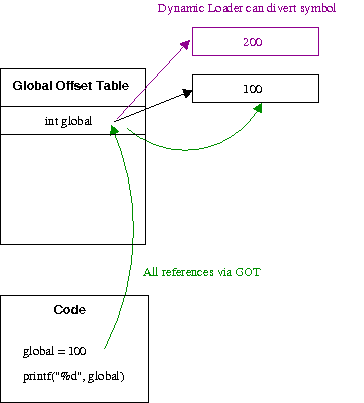
The magic here is again in the relocations. Notice this time we have a P_X86_64_GOTPCREL relocation. This says "replace the data at offset 0xa with the global offset table (GOT) entry of global. Global Offset Table operation with data variables As shown above, the GOT ensures the abstraction required so symbols can be diverted as expected. Each entry is essentially a pointer to the real data (hence the extra dereference in the code above). Since we can assume the GOT is at a fixed offset from the program code within plus or minus 2Gib, the code can use a 32-bit IP relative address to gain access to the table entries. So, taking a look a the final shared-library binary we see a final offset hard-coded
$ gcc -shared -fPIC -o libfunction.so function.c
$ objdump --disassemble ./libfunction.so
00000000000006b0 <function>:
 6b0:  55                      push   %rbp
 6b1:  48 89 e5                mov    %rsp,%rbp
 6b4:  89 7d fc                mov    %edi,-0x4(%rbp)
 6b7:  48 8b 05 8a 02 20 00    mov    0x20028a(%rip),%rax        # 200948 <_DYNAMIC+0x1d8>
 6be:  8b 10                   mov    (%rax),%edx
 6c0:  8b 45 fc                mov    -0x4(%rbp),%eax
 6c3:  01 d0                   add    %edx,%eax
 6c5:  5d                      pop    %rbp
 6c6:  c3                      retq
 6c7:  90                      nop
Every process who wants to share this code just needs to make sure they have their unique address of global at 0x20028a(%rip). Since each process has a separate address-space, this means they can all have different values for global but share the same code! Thus the default of the small-code model is sensible. It is exceedingly rare for an executable to need more than 4-byte offsets for a relative access to a variable in it's data region, so using a full 8-byte value would just be a waste of space. Although leaving 8-bytes would allow access to the variable anywhere in the 64-bit address space; when building a shared library, you really want to use -fPIC to ensure the library can actually be shared, which introduces a different relocation and access to data via the GOT. This should explain why gcc -shared function.c works on x86-32, but does not work on x86-64. Inspecting the code reveals why:
$ objdump --disassemble ./function.o
00000000 <function>:
   0:   55                      push   %ebp
   1:   89 e5                   mov    %esp,%ebp
   3:   a1 00 00 00 00          mov    0x0,%eax
   8:   03 45 08                add    0x8(%ebp),%eax
   b:   5d                      pop    %ebp
   c:   c3                      ret
$ readelf --relocs ./function.o
Relocation section '.rel.text' at offset 0x2ec contains 1 entries:
 Offset     Info    Type            Sym.Value  Sym. Name
00000004  00000701 R_386_32          00000000   global
We start out the same, with the first two instructions setting up the frame pointer. However, next we load a memory value into eax -- as we can see from the relocation information, the address of global. Next we add the incoming argument from the stack (0x8(%ebp)) to the value in this memory location; implicitly dereferencing it. But since we only have a 32-bit address-space, the 4-bytes allocated is enough to access any possible address. So while this can work, you're not creating position-independent code and hence not enabling code-sharing. The disadvantage of PIC code is that you require "bouncing" through the GOT, which requires more loads and reads to find an address than directly referencing it. However, if your program is at the point that this is becoming a performance issue you're probably not reading this blog! Hopefully, this helps clear up that possibly cryptic error message. Further searches around position-independent code, global-offset tables and code-sharing should also yield you more information if it remains unclear.

Russ Allbery: Automated Perl testing

I started several coding projects today, but none of them reached an announcable conclusion, so this seems like a good day to write up my current discoveries in automated Perl testing modules. This post isn't about test frameworks like Test::More and friends, or even about helper modules (although I do recommend Test::Warn if you want to test warning code in your modules). It's not about writing functionality tests. Rather, it's about various CPAN modules that can be used almost identically in just about every Perl module distribution (and in some other places, like Perl scripts inside a larger package written in another language). You can drop a small driver script into your t directory and (mostly) run make test with no further customization. If you want to see the driver scripts for all of the below that I'm currently using, see the t directory of the Term::ANSIColor distribution. They'll slowly make their way into my other modules, and probably, despite the name of the package, rra-c-util, since that's my equivalent of gnulib and I have tools to synchronize shared code from that package. The driver script generally tests whether the module is installed, skips the test if not, and otherwise dispatches to the "test everything" routine in the module. Test::MinimumVersion: This tests that you're not accidentally using a newer Perl feature than you were expecting. It's very handy if you want to support backward compatibility to a particular version of Perl. It knows about features as far back as 5.004_05. It won't be able to catch everything, but it will catch some of the most obvious things. Test::Perl::Critic: This is sort of the thousand-pound gorilla. Test::Perl::Critic runs all of your code through perlcritic and reports any errors. You will probably need to combine this with a perlcriticrc file in your distribution that you configure it to use, since otherwise the person running the tests may have customized perlcritic. If you let it run perltidy to check for formatting problems, you'll also want a perltidyrc. See the driver script mentioned above for how I set that up. I usually configure this test to only run for me (by checking an environment variable) since the results vary a lot depending on what version of perlcritic is installed, and it's likely new versions will cause the test to start failing. If you use this, expect to need to add ## no critic annotations to your code. Test::Pod: Checks for syntax errors in your POD documentation so that you won't have those embarassing POD ERRORS sections. Note that the latest version of podlators turns syntax errors into fatal errors, so soon you won't have to worry as much about this. But if you'd been using this module all along, you wouldn't have to worry about the fact that pod2man may start faliing due to syntax errors you never fixed! Test::Pod::Coverage: Only of interest to module distributions, not ramdom scripts, this checks that every sub provided by your module has POD documentation. It understands various subs that don't need to be documented (such as the ones you provide to implement a tied class) and lets you mark some subs as not requiring documentation. Test::Pod::Spelling: Checks your POD documentation for spelling mistakes with a spell checker. (Note that perlcritic, and hence Test::Perl::Critic, can also do this, but I use this module separately since I think the output is more readable.) You will almost certainly want to make this test maintainer-only, since spell checkers and spelling dictionaries vary a lot. But it prevents a lot of embarassment when you read your documentation on search.cpan.org and find that obvious spelling error you never saw before. Test::Strict: Checks all Perl code to ensure that it compiles, checks whether it has use strict, and optionally checks whether it has use warnings. This is great; I use this even with packages that just have a few Perl utility scripts in a package otherwise written in C, since I previously kept releasing packages with helper scripts with obvious syntax errors since I didn't run them much. Another place it's useful is if you have internal Debian packages that wrap up Perl utility scripts; just create a small test suite with this module and run it from override_dh_auto_check and you won't ever release a package with scripts that won't run. You can also do test suite coverage testing with this module (and Devel::Cover), but that you'll want to mark maintainer-only since it takes a while. Test::Synopsis: Checks the code in the SYNOPSIS section of any POD documentation to ensure that it compiles. No more syntax errors in your example code in the documentation! All of these modules are, of course, packaged for Debian (thanks largely to the wonderful Perl packaging team!), and otherwise available on CPAN. There are a variety of others, of course; these are just the main ones that I've found personally useful. One final whine, however: all this wonderful Perl testing infrastructure desperately needs a common module and a common interface for providing a list of files to check. Every one of these modules reinvents that wheel, and most of them do it a slightly different way than all the others. Most of them check in either blib or lib (or sometimes both). Most of them also add t. Most of them don't include Makefile.PL, but some of them do. Almost none of them look in examples. Some have a simple way to add more files or directories; some don't. Some can be run from the t directory and still find things, but most of them can't. And of course the syntax is different in every case! Most of the work in my driver scripts is finding the right way to add a few additional directories to the scope of the testing, and in one annoying case (Test::Synopsis), I actually had to use Perl::Critic::Utils (for lack of a better module) to build a list of files to check instead of using the build-in file list, since the build-in file list required all module code be in lib. A module to abstract out all of this and provide a common interface would be easy to write. Most of the work would involve talking to all the authors of all these different modules and asking them to use it. If someone in the Perl community felt like doing that, it would make life so much easier for everyone.

4 January 2013

David Welton: The Software Millionaire Next Door

I've been reading "The Millionaire Next Door" and have so far found it to be a pleasant book with a good message: don't waste your money on silly things and appearance (fancy suits, fancy cars, expensive boats, etc...), save what you do earn consistently and constantly, invest wisely, and so on. Wikipedia has a good summary:
http://en.wikipedia.org/wiki/The_Millionaire_Next_Door
One of the things I like about it is that it focuses on "ordinary" wealthy people, those with a million or more in the bank, but not the Warren Buffets or Bill Gates types that are extreme statistical outliers. There are plenty of people in the US who have done well by themselves by slowly but surely putting together enough money to be financially independent, without, however, being in the spotlight. As the book says, these are the kind of people who maybe own a local chain of businesses doing something fairly ordinary, but doing it well enough to succeed. They may very well not live in a fancy house, nor drive an expensive car, or otherwise outwardly draw much attention to themselves. The world of software does not revolve around "dressing for success" (you noticed?), but we do tend to focus on the "big winners". Gates, Jobs, Zuckerberg, Larry & Sergey, Larry Ellison, and so on are the stars of the show. Of course, the economics of software being what they are, instances of winner-take-all markets with one big fish and a lot of also-rans are not uncommon. However, that is not the only story, and I think it'd be interesting to know more about those in our industry who have accumulated significant wealth, yet are not the guys with more money than they could possibly ever spend on things that aren't, say, country-sized chunks of real-estate. I'm guessing they'd fall into these categories: It'd be very interesting to gather some actual data on this, although I'm not in a position to do so myself - I wouldn't even really know where to start. As I age, I think the third category has begun to seem appealing in many ways - I'm simply not cut out for the Big Company life, and I'm not interested in living in Silicon Valley and going "all in" on the latest startup - I already did that, and while it was fun and I don't regret it, it's not the kind of thing I'd want to do now that I'm married and have kids. Incidentally, this more relaxed, under the radar approach is exactly what is expoused in one of my favorite books of the past few years, Start Small, Stay Small. Edit : I finished reading the book and reviewed it here: http://davids-book-reviews.blogspot.com/

Julien Danjou: Integrating cl-irc and cl-async

Recently, I've started programming in Common Lisp. My idea here is to use cl-irc, an IRC library into an event loop. This can be really useful, for example to trigger action based on time, using timers. Creating a connection The first step is to create a basic cl-irc:connection object on our own. This can be achieved easily with this:
(require :cl-irc)

(defun connect (server)
(cl-irc:make-connection :connection-type 'cl-irc:connection
:client-stream t
:network-stream ?
:server-name server))

This will return a cl-irc:connection object, logging to stdout (:client-stream t) and having the server name server. Note that the server name could be any string. You probably noticed the ? I used as :network-stream value. This is not a real and working value: this should be a stream established to the IRC server you want to chat with. This is where we'll need to use cl-async:tcp-connect to establish a TCP connection. As you can read in this function's documentation, all we need to pass is the server address, two callbacks for read and general events, and the :stream option to get a stream rather than a socket. So you would do something like:
(require :cl-irc)
(require :cl-async)

(defun connection-socket-read (socket stream)
(format t "We should read the IRC message from ~a ~%" stream))

(defun connection-socket-event (ev)
(format t "Socket event: ~a~%" ev))

(defun connect (server &optional (port 6667))
(cl-irc:make-connection :connection-type 'cl-irc:connection
:client-stream t
:network-stream (as:tcp-connect server port
#'connection-socket-read
#'connection-socket-event
:stream t)
:server-name server))

(as:start-event-loop (lambda () (connect "irc.oftc.net")))

If you run this program, it will connect to the OFTC IRC server, and then notice you each time the server is sending you a message. Therefore our problem here is how we you treat the message read from the stream in connection-socket-read and handle them in the name of our connection object you used? We can't link both together at this point. We can't build a closure, because as the time we use as:tcp-connect we don't have the cl-irc:connection instance. Also we can't change easily the read-cb parameter of our network-stream established by as:tcp-connect, simply because cl-async doesn't use to do allow that. Building a closure So one solution here is to hack cl-irc:make-connection so we can build an cl-irc:connection instance without providing in advance the network-stream, allowing us to build a closure including the cl-irc:connection to read event for. This is what we're going to do in the connect function.
(require :cl-irc)
(require :cl-async)
(require :flexi-streams)

(defun connection-socket-read (connection)
(loop for message = (cl-irc::read-irc-message connection)
while message
do (cl-irc:irc-message-event connection message)))

(defun connection-socket-event (ev)
(format t "Socket event: ~a~%" ev))

(defun connect (server port nickname
&key
(username nil)
(realname nil)
(password nil))
;; Build an instance of cl-irc:connection, without any network/output stream
(let* ((connection (make-instance 'cl-irc:connection
:user username
:password password
:server-name server
:server-port port
:client-stream t))
;; Use as:tcp-connect to build our network stream, and build a
;; closure calling connection-socket-read' with our connection'
;; as arguments
(network-stream (as:tcp-connect server port
(lambda (socket stream)
(declare (ignore socket stream))
(connection-socket-read connection))
#'connection-socket-event
:stream t)))
;; Set the network stream on the connection
(setf (cl-irc:network-stream connection) network-stream)
;; Set the output stream on the connection
(setf (cl-irc:output-stream connection)
;; This is grabbed from cl-irc:make-connection
(flexi-streams:make-flexi-stream
network-stream
:element-type 'character
:external-format '(:utf8 :eol-style :crlf)))

;; Now handle the IRC protocol authentication pass
(unless (null password)
(cl-irc:pass connection password))
(cl-irc:nick connection nickname)
(cl-irc:user- connection (or username nickname) 0 (or realname nickname))
connection))

(as:start-event-loop (lambda () (connect "irc.oftc.net" 6667 "jd-blog")))

And here we are! If we run this, we're now using an event loop to run cl-irc. Each time the socket has something to read, the function connection-socket-read will be called on the non-blocking mode socket. If there's no message to be read, then the function will exit and the loop will continue to run. Using timers You can now modify the last line with this:
(defun say-hello (connection)
(cl-irc:privmsg connection "#jd-blog" "Hey I read your blog!")
(as:delay (lambda () (say-hello connection)) :time 60))

(as:start-event-loop (lambda ()
(let ((connection (connect "irc.oftc.net" 6667 "jd-blog")))
(cl-irc:join connection "#jd-blog")
(say-hello connection))))

This will connect to the IRC server, join a channel and then say the same sentence every minute. Challenge accomplished! And I'd like to thank Andrew Lyon, the author of cl-async, who has been incredibly helpful with my recent experimentations in this area.

3 January 2013

Tim Retout: New Year

Another year. 2012 was busy - I got moved house twice, changed jobs, and got married. In 2013, I should become a father, fingers crossed (due mid-April). Change is a familiar friend now. I just listened to Tom Armitage speaking about coding on Radio 4 - I /think/ the podcast mp3 link will work for people outside the UK, but the iPlayer probably won't. If you can get hold of it, it's worth the 20 minutes of your time. If I had to make a New Year's resolution, it would be to listen to more Radio 4 - there's such a lot of it, though. I'm going to try subscribing to some of their podcasts and listening to them on my commute - timeshifting some of the best bits. Might work.

Michal &#268;iha&#345;: Free software plans for 2013

Year 2013 has just started and it's time to think how to spend my free time during this year. Weblate Weblate was my toy project number one in last year and I expect it to stay for next year as well. I have several ideas for new features, but all that depends on free time. I will most likely spend my hackweek on that as well. phpMyAdmin I think my involvement will stay at about same level at phpMyAdmin - doing few random bugfixes, mostly security ones, taking care of infrastructure for translations and wiki and mentoring few GSoC students. Gammu and Wammu Gammu and Wammu has not seen much activity from me in past year and it will probably not change. I don't use the program anymore and this pretty much limits my interest in adding new features. In case somebody active will pop up on mailing list, I'd be happy to transfer the project ownership. Mobile apps I'd like to make some progress here, I was also thinking about making some of them working on Android as well, but this involves lot of learning and time is always an issue here. Anyway this might be good challenge for hackweek as well. Debian No changes expected here :-). Others I consider pretty much anything else from my software projects abandoned or finished.

Filed under: Debian English Gammu Phpmyadmin Suse Weblate 0 comments Flattr this!

2 January 2013

Russ Allbery: podlators 2.5.0

podlators is the package that contains Pod::Man and Pod::Text and the pod2man and pod2text driver scripts, which convert Perl's POD documentation format into text and *roff (for man pages) output. This release is a "clearing the decks" release that rolls up various smallish feature requests and bug fixes that have been pending for a while. I want to do the same reworking to podlators that I did to Term::ANSIColor, but it's going to take longer since it's quite a bit more code. (And Term::ANSIColor took me about two days.) I didn't want to block the various pending issues on that work, so this tries to clean up all the open bugs I was aware of other than sorting out the defaults for Unicode output. (That's a much larger problem and will probably be fixed in a major release.) The primary change is that pod2man and pod2text now die by default if the POD contains syntax errors. This will hopefully flush out numerous POD documents around the world that have been carrying POD ERRORS sections around forever. I considered just warning by default but not failing, since this will also cause CPAN builds to fail, and I may fall back to that if there are too many complaints. But usually fixing the POD syntax is straightforward, and normally parsing programs will fail on syntax errors. Note that the defaults for the modules, Pod::Man and Pod::Text, continue to be to add a POD ERRORS section, since aborting inside a module isn't very friendly to the caller. There is a new option for both the modules and the driver scripts to set the error handling behavior, which can be set to die, report to standard error but continue, add a POD ERRORS section, or ignore errors entirely. Also in this release is a new nourls option that suppresses the URLs in text and *roff output for L<> codes that have anchor text, which can declutter some POD texts, and fixes for X<> formatting codes containing whitespace and small-caps handling of paragraphs consisting entirely of all-caps text. You can get the latest release from the podlators distribution page.

1 January 2013

Russ Allbery: 2012 Book Reading in Review

For the year of 2012, I finished and reviewed 60 books, the same number as 2011. Given how stressful and chaotic much of the year was, I count this a major triumph. The hardest part was not the reading but the review writing; the end of the year required a significant push to finish writing reviews of all the books I'd read that year, and at one point I was reviewing things I'd read more than two months earlier. But I can enter 2013 entirely caught-up. This continues to feel like about the right pace, striking a balance between reading enough that I can pursue multiple reading goals at the same time, while leaving enough time for other projects and video games. I gave three novels a 10 out of 10 this year, but the stand-out even among that group was Elizabeth Wein's Code Name Verity. Not only was it my favorite book of the year, but it was one of the best books I've ever read. The other two 10-rated books are also highly recommended, of course: Matt Ruff's fascinating novel of multiple personalities, Set This House in Order; and C.J. Cherryh's SF classic, Cyteen. The latter was a re-read in advance of reading the sequel, Regenesis, which I also recommend if you've read and liked the last third of Cyteen. Other fiction highlights of the year were China Mi ville's Embassytown and Suzanne Collins's The Hunger Games triology, particularly the third book, Mockingjay. Embassytown continues the trend from Mi ville's The City & The City of tighter, faster-moving novels while moving into space opera and first contact territory. It keeps Mi ville in the top rank of current SFF writers, despite having some suspension of disbelief problems. Collins's world-building in The Hunger Games also has suspension of disbelief problems, but I understood why the series was so popular. I was caught by surprise by its look at violence and its after-effects and was particularly impressed by Mockingjay and Collins's chosen ending. I think this is a popular series that lives up to the hype. There were no 10 ratings in non-fiction this year, but several books nonetheless stood out. John Kenneth Galbraith's The Affluent Society is a thought-provoking book that questions the foundation of a consumer-oriented economy while perceptively pointing out how it distorts choices away from public goods. Susan Cain's Quiet is a passionate defense of introversion in an extroverted world. And, finally, Joshua Bloch's Effective Java and Damian Conway's Perl Best Practices are both insightful looks at the good and bad of their respective languages and taught me a great deal as a practicing programmer. One final highlight to mention: Eclipse Phase by Posthuman Studios is an excellent RPG sourcebook, at least from the perspective of interesting world-building. I haven't played it, but I thoroughly enjoyed reading it (and have acquired nearly all of the supplements). The full analysis includes some additional personal reading statistics, probably only of interest to me.

Next.

Previous.
