Search Results: "agi"

7 November 2013

Russ Allbery: Review: Muse of Fire

Review: Muse of Fire, by John Scalzi
Publisher: Subterranean
Copyright: 2012
Printing: 2013
ISBN: 1-59606-639-3
Format: Kindle
Pages: 28
This is another separately-published short work by Scalzi probably a novelette, although I didn't do a word count. Since it's separately published and has its own ISBN, it gets its own separate review page. At present, it's $1 on the Kindle (and probably elsewhere). I've read a variety of these now, and while the quality of Scalzi's short works varies (as with everyone), I've generally enjoyed them. This is the first one I've read that I really didn't like. The premise is promising enough. Ben Patton is a scientist or engineer of some sort (I don't recall if the story is specific) working on plasma physics for a corporation. He has a nervous tic involving playing with a lighter and an obsession with fire, which his co-workers tolerate (and his boss does not tolerate). The reason for that tic is something he keeps secret: he sees a beautiful woman named Hestia in any flames that he's looking at. For him, she's his muse, and his untouchable obsession. He's mangled one hand trying to touch her. But she appears in fire because she's trapped in hell. There are all sorts of great places Scalzi could have gone with this. Musae and inspiration by themselves are fodder for many stories. The woman's name is Hestia, which is immediately recognizable as the Greek goddess of the hearth and who is extremely important to Greek religious life (although she's definitely not a muse, but I'd even let that pass). That raises more story possibilities around the transition of religion and the effect on worshiped gods, including the way Christian missionaries called "pagan" gods and goddesses devils and indeed did claim they were from hell. There are interesting science and magic crossover possibilities between plasma physics and a muse of fire. And there is, of course, the whole rescue from hell angle, which has generated many a story going back to ancient Greek drama. As you might have guessed from this catalog and my disappointment, Scalzi didn't go any of those directions. He provides some good characterization of the passions and discomfort of Ben's life, shows us the practicalities of his relationship with Hestia, and sets up dramatic tension, all well and good. And then takes the most obvious, least interesting, and least satisfying twist possible. I was getting nervous as I got closer and closer to the end of the story and Scalzi had yet to develop any of the interesting possible directions, but even then I didn't expect the train wreck ending. Even a simplistic "happily ever after" ending would have been preferable. He did catch me by surprise, but only because I wouldn't have expected any author to take that easy of a way out of the story. I can't build up a proper rant while avoiding spoilers, but I will say that Scalzi even manages to walk straight into a rather nasty stereotype in the process. I'm not sure what happened here, but it didn't work, and it's far below the normal standards of Scalzi's work. Such a shame, too, since the setting had so much potential. Avoid. Rating: 4 out of 10

5 November 2013

Johannes Schauer: announcing bootstrap.debian.net

The following post is a verbatim copy of my message to the debian-devel list. While botch produces loads of valuable data to help maintainers modifying the right source packages with build profiles and thus make Debian bootstrappable, it has so far failed at producing this data in a format which is: While human readability is probably still lacking (it's hard to write in a manner understandable by everybody about a complicated topic you are very familiar with), the bootstrapping results are now generated automatically (on a daily basis) and published in a per-source-package-basis as well. Thus let me introduce to you: bootstrap.debian.net Paul Wise encouraged me to set this up and also donated the debian.net CNAME to my server. Thanks a lot! The data is generated daily from the midnight packages/sources records of snapshot.debian.org (I hope it's okay to grab the data from there on a daily basis). The resulting data can be viewed in HTML format (with some javascript for to allow table sorting and paging in case you use javascript) per architecture (here for amd64). In addition it also produces HTML pages per source package for all source packages which are involved in a dependency cycle in any architecture (for example src:avahi or src:python2.7). Currently there are 518 source packages involved in a dependency cycle. While this number seems high, remember that estimations by calculating a feedback arc set suggest that only 50-60 of these source packages have to be modified with build profiles to make the whole graph acyclic. For now it is funny to see that the main architectures do not bootstrap (since July, for different reasons) while less popular ones like ia64 and s390x bootstrap right now without problems (at least in theory). According to the logs (also accessible at above link, here for amd64) this is because gcc-4.6 currently fails compiling due to a build-conflict (this has been reported in bug#724865). Once this bug is fixed, all arches should be bootstrappable again. Let me remind you here that the whole analysis is done on the dependency relationships only (not a single source package is actually compiled at any point) and compilation might fail for many other reasons in practice. It has been the idea of Paul Wise to integrate this data into the pts so that maintainers of affected source packages can react to the heuristics suggested by botch. For this purpose, the website also publishes the raw JSON data from which the HTML pages are generated (here for amd64). The bugreport against the bts can be found in bug#728298. I'm sure that a couple of things regarding understandability of the results are not yet sufficiently explained or outright missing. If you see any such instance, please drop me a mail, suggesting what to change in the textual description or presentation of the results. I also created the following two wiki pages to give an overview of the utilized terminology: Feel also free to tell me if anything in these pages is unclear. Direct patches against the python code producing the HTML from the raw JSON data are also always welcome.

3 November 2013

Russ Allbery: Review: The Walls of Westernfort

Review: The Walls of Westernfort, by Jane Fletcher
Series: Celaeno #2
Publisher: Bold Strokes
Copyright: 2004
Printing: March 2005
ISBN: 1-60282-349-9
Format: Kindle
Pages: 320
While this is the first book of the Celaeno series that I've read, it turns out to be the second book in the series. This is somewhat difficult to determine from sources on-line since the first three books in the series were published in the same year, but it's fairly obvious from reading synopses after having finished one of the books. I don't think it does any great damage to the story to read it out of order (indeed, it preserves the suspense around some plot elements), but you may want to seek out The Temple at Landfall first. Natasha Ionadis is a member of the Guard. The military services are divided into three parts in her world: the Rangers, who defend cities against bandits and others in the countryside; the Militia, who maintain law and order in the cities; and the Guard, who are responsible for guarding the temples and protecting the rituals and teachings of the state religion. She is a devout worshiper of Celaeno and delighted to be part of the Guard. But, as this book opens, she gets a very unexpected mission for a young private: a suicide mission into the heart of a heretic group in the wilds, heretics who have successfully defied the official religion and are in danger of setting up a self-sustaining community. The Walls of Westernfort has the surface trappings of a fantasy and does include some magic, but it slowly develops into more of a character story with a medieval (or, more accurately, medieval-inspired) backdrop. At the start, it appears that this mission will be an opportunity for Natasha to find the mentors and companions that she's never had before, but then her encounter with the heretics turns her world upside down. They're not the monsters that she had imagined, although their beliefs are still outrageous to her. One heretic in particular affects her deeply and introduces a strong lesbian romance element to the plot that dominates the rest of the book. I enjoyed the slow emergence of one aspect of the setting (that I'm about to spoil, so skip to the next paragraph if you don't want to hear it, although it would already be spoiled by reading the predecessor book or most of the blurbs). This is a world devoid of men; all the characters are women. This isn't part of the plot; it's just the unremarked normal. Fletcher tosses in a hand-waving explanation about halfway through, but it's only discussed in passing and never mentioned again. I really enjoy this technique, and enjoyed watching how long it took in the book before I noticed. There are so many books out there where men are the unremarked normal that it's a refreshing change to read the opposite (and notice how little it really matters), although it does require throwing in implausible magic to solve the problem of procreation. (That's apparently more the topic of The Temple at Landfall.) Plot-wise, The Walls of Westernfort is not complicated. The shape of the plot after Natasha's first encounter with the heretics is not likely to surprise any reader. But it's a simple plot well-executed, with distinct and fleshed-out characters and steady helpings of people being thoughtful and reasonable. The basic story carries plenty of natural conflict; Fletcher doesn't need to add much additional tension and wisely chooses not to, keeping the focus tightly on Natasha and her conflict between duty and conscience. I liked both of the people involved in the romance and could believe they'd fall in love, and I also liked that the romance was significant but not decisive. It's part of what helps Natasha expand her view of the world, but one could see how she would have made the right decision in the end even if the romance had not been present. The story does force some significant secret-keeping, but it doesn't draw cheap tension from mundane failure to communicate. All of the communication gaps here are believable and honest, driven by the characters' backgrounds, and absolutely necessary. I'm hypersensitive to romance plots based on communication failure, and I wasn't even grumbling. The series this book reminds me the most of is another lesbian romance in a fantasy-style setting: Catherine M. Wilson's When Women Were Warriors. The Walls of Westernfort is not as deep or philosophical, it's a bit more black and white in its morality, and I don't think it's quite as good of a book, but for me it had a similar tone of good people trying to do the right thing and finding one's way through ethical mazes. It's a bit slow to get started, but by the time Natasha's critical decision point arrived, I was fully invested in the story and had a hard time putting it down. Recommended if you're in the mood for a relatively light faux-medieval fantasy romance. I'm not rushing out to grab the other books in the series, but they went on my want list and I'll probably get them at some point. Followed by Rangers at Roadsend in the publication order sense, but apparently it's a prequel. Rating: 7 out of 10

2 November 2013

Robert Collins: Learning is hard

I feel like I m taking a big personal risk writing this, even though I know the internet is large and probably no-one will read this :-) . So, dear reader, please be gentle. As we grow as people, as developers, as professionals some lessons are are hard to learn (e.g. you have to keep trying and trying to learn the task), and some are hard to experience (they might still be hard to learn, but just being there is hard itself ) I want to talk about a particular lesson I started learning in late 2008/early 2009 while I was at Canonical sadly one of those that was hard to experience. At the time I was one of the core developers on Bazaar, and I was feeling pretty happy about our progress, how bzr was developing, features, community etc. There was a bunch of pressure on to succeed in the marketplace, but that was ok, challenges bring out the stubborn in me :) . There was one glitch though we d been having a bunch of contentious code reviews, and my manager (Martin Pool) was chatting to me about them. I was as far as I could tell doing precisely the right thing from a peer review perspective: I was safeguarding the project, preventing changes that didn t fit properly, or that reduced key aspects- performance, usability from landing until they were fixed. However, the folk on the other side of the review were feeling frustrated, that nothing they could do would fix it, and generally very unhappy. Reviews and design discussions would grind to a halt, and they felt I was the cause. [They were right]. And here was the thing I simply couldn t understand the issue. I was doing my job; I wasn t angry at the people submitting code; I wasn t hostile; I wasn t attacking them (but I was being shall we say frank about the work being submitted). I remember saying to Martin one day look, I just don t get it can you show me what I said wrong? and he couldn t. Canonical has a 360 review system every 6 months / year (it changed over time) you review your peers, subordinate(s) and manager(s), and they review you. Imagine my surprise I was used to getting very positive reports with some constructive suggestions when I scored low on a bunch of the inter-personal metrics in the review. Martin explained that it was the reviews thing folk were genuinely unhappy, even as they commended me on my technical merits. Further to that, he said that I really needed to stop worrying about technical improvement and focus on this inter-personal stuff. Two really important things happened around this time. Firstly, Steve Alexander, who was one of my managers-once-removed at the time, reached out to me and suggested I read a book Getting out of the box and that we might have a chat about the issue after I had read it. I did so, and we chatted. That book gave me a language and viewpoint for thinking about the problem. It didn t solve it, but it meant that I got it , which I hadn t before. So then the second thing happened we had a company all hands and I got to chat with Claire Davis (head of HR at Canonical at the time) about what was going on. To this day the sheer embarrassment I felt when she told me that the broad perception of me amongst other teams managers was and I paraphrase a longer, more nuance conversation here technically fantastic but very scary to have on the team will disrupt and cause trouble . So, at this point about 6 months had passed, I knew what I wanted I wanted folk to want to work with me, to find my presence beneficial and positive on both technical and team aspects. I already knew then that what I seek is technical challenges: I crave novelty, new challenges, new problems. Once things become easy, it call all too easily slip into tedium. So at that time my reasoning was somewhat selfish: how was I to get challenges if no-one wanted to work with me except in extremis? I spent the next year working on myself as much as specific projects: learning more and more about how to play well with others. In June 2010 I got a performance review I could be proud of again I was in no way perfect, but I d made massive strides. This journey had also made huge improvements to my personal life a lot of stress between Lynne and I had gone away. Shortly after that I was invited to apply for a new role within Canonical as Technical Architect for Launchpad and Francis Lacoste told me that it was only due to my improved ability to play well with others that I was even considered. I literally could not have done the job 18 months before. I got the job, and I think I did pretty well in fact I was awarded an internal Spotlight on Success award for what we (it was a whole Launchpad team team effort) achieved while I was in that role. So, what did I change/learn? There s just a couple of key changes I needed to make in myself, but a) they aren t sticky: if I get overly tired, ye old terrible Robert can leak out, and b) there s actually a /lot/ of learnable skills in this area, much of which is derived lots of practice and critical self review is a good thing. The main thing I learnt was that I was Selfish. Yes capital S. For instance, in a discussion about adding working tree filter to bzr, I would focus on the impact/risk on me-and-things-I-directly-care-about: would it make my life harder, would it make bzr slower, was there anything that could go wrong. And I would spend only a little time thinking about what the proposer needed: they needed support and assistance making their idea reach the standards the bzr community had agreed on. The net effect of my behaviours was that I was a class A asshole when it came to getting proposals into a code base. The key things I had to change were:
  1. I need to think about the needs of the person I m speaking to *and not my own*. [Thats not to say you should ignore your needs, but you shouldn't dwell on them: if they are critical, your brain will prompt you].
  2. There s always a reason people do things: if it doesn t make sense, ask them! [The crucial conversations books have some useful modelling here on how and why people do things, and on how-and-why conversations and confrontations go bad and how to fix them.]
Ok so this is all interesting and so forth, but why the blog post? Firstly, I want to thank four folk who were particularly instrumental in helping me learn this lesson: Martin, Steve, Claire and of course my wife Lynne I owe you all an unmeasurable debt for your support and assistance. Secondly, I realised today that while I ve apologised one on one to particular folk who I knew I d made life hard for, I d never really made a widespread apology. So here it is: I spent many years as an ass, and while I didn t mean to be one, intent doesn t actually count here actions do. I m sorry for making your life hell in the past, and I hope I m doing better now. Lastly, if I m an ass to you now, I m sorry, I m probably regressing to old habits because I m too tired something I try to avoid, but it s not always possible. Please tell me, and I will go get some sleep then come and apologise to you, and try to do better in future. Less-assily-yrs,
Rob

31 October 2013

Daniel Pocock: init systems: what do users want?

The debate about Debian init system replacement continues and many developers have given their opinions. However, what do the users want? What type of features will make it easier for users to adopt and promote Debian and free software in general? Could this even help bring improvements to other distributions too? Some of the possibilities I've previously raised for discussion (and they are not specific to Debian by any means):
  • Better integration with tools for service monitoring (for example, so Nagios can automatically detect all the services on a system and the dependency relationship between them, avoiding any manual configuration of the monitoring system)
  • Better integration with tools for service management (for example, so Nagios can more easily restart a service without having to provide some action script developed by hand)
  • Better support for dependencies in clustering and distributed environments (e.g. Apache on host A should only start after MySQL is running on host B or host C)
  • Support for multiple instances of a service, each with separate configuration files on the same host
Some of the systems up for discussion go some of the way to addressing these types of requirements - none of them go all the way. What other requirements do people have? Should Debian wait a little longer and let the different solutions compete to offer more of these things before any decision is made? My own feeling is that Debian should not commit to something that will involve any loss in current features or support for ports and we should use this opportunity to find the best possible set of features for the future.

30 October 2013

Matthew Palmer: How to deal with the "package gcc: " problem in Puppet

In a comment to yesterday s post on why your Puppet module sucks, Warren asks what can be done about the problem of multiple modules needing to include the same package (gcc being the most common example I m yet to come across). As I stated previously, there is no sane, standardised way for multiple independent modules to cooperate to ensure that certain packages are installed for their cooperative use. If it wasn t already obvious, I consider this to be a significant failing in Puppet, and one which essentially renders any attempt at public, wide-scale reuse of Puppet modules impossible. Software packages are such a fundamental part of system management today that it is rare for a module not to want to interact with them in some way. Without strong leadership from Puppet Labs, or someone core to the project who s willing to be very noisy and obnoxious on the subject, the issue is fundamentally unsolveable, because it requires either deep (and non-backwards-compatible) changes to how Puppet works at a core level, or it needs cooperation from everyone who writes Puppet modules for public consumption (to use a single, coordinated approach to common packages). The approaches that I ve seen people advocate using, or that I ve considered myself, roughly fall into the following camps.

Put your package into a class in your module Absofrickinglutely useless, because the elementary package resources you end up creating will still conflict with other modules package resources. Anyone who suggests this can be permanently ignored, as they don t understand the problem being solved.

Use a globally common module of classes representing common packages This could work, if you could get everyone who writes modules to use it (see someone willing to be very noisy and obnoxious ). Practically speaking, anyone who suggests this doesn t understand human nature. I don t see this actually happening any time soon.

Use the defined() function everywhere By wrapping all your package resources in if !defined(Package["foo"]) blocks, you can at least stop your module from causing explosions. What it doesn t do is make sure that the various definitions of the package resource are congruent (imagine if one was package "gcc": ensure => absent ). In order to safely avoid explosion, everyone would have to follow this approach, which (in the worst case) reduces the problem to the globally common module of classes. However, it s the least-worst approach I can practically consider. At least your module won t be the cause of explosions, and realistically no module s going to ask for gcc to be removed (or, if they are, you ll quickly find them and kill them). I ve seen calls from Puppet core dev team members to deprecate and remove the defined() function entirely. Given the complete lack of alternatives, this is a disturbing illustration of just how out of touch they are from the unfortunate realities of practical Puppetry.

Use virtual resources This is yet another variant of the common class technique that would require everyone, everywhere, to dance to the same tune. It has all the same problems, and hence gets a big thumbs-down from me.

Use singleton_packages This module is a valiant attempt to work around the problem, but practically speaking is no better than using defined() because again, if a module that isn t using singleton_packages specifies package "gcc": ensure => absent , you re going to end up with assplosion. The mandatory dependency on hiera doesn t win me over, either (I m a hiera-skeptic, for reasons which I might go into some other time).

Use only modules from a single source This is the solution that I use myself, if that s any recommendation As a result of pretty much every publically-available Puppet module sucking for one reason or another, I do not, currently, have any externally-written Puppet modules in the trees that I use. Every module (158, at current count) has been written by someone in the sysadmin team at $DAYJOB, to our common standards. This means that I can coordinate use of package resources, using our module of common classes where appropriate, or refactor modules to separate concerns appropriately. If you re wondering why we don t have all of these 158 modules available publically, well, we have a few of them up, but yes, the vast majority of them aren t publically available. Some of them suck mightily, while many others are just too intertwined with other modules to be able to use on their own, and we don t want to release crap code there s far too much of that out there already.

29 October 2013

Soeren Sonnenburg: Shogun Toolbox Version 3.0 released!

Dear all, we are proud to announce the 3.0 release of the Shogun Machine-Learning Toolbox. This release features the incredible projects of our 8 hard-working Google Summer of Code students. In addition, you get other cool new features as well as lots of internal improvements, bugfixes, and documentation improvements. To speak in numbers, we got more than 2000 commits changing almost 400000 lines in more than 7000 files and increased the number of unit tests from 50 to 600. This is the largest release that Shogun ever had! Please visit http://shogun-toolbox.org/ to obtain Shogun. News Here is a brief description of what is new, starting with the GSoC projects, which deserve most fame: Screenshots Everyone likes screenshots. Well, we have got something better! All of the above projects (and more) are now documented in the form of IPython notebooks, combining machine learning fundamentals, code, and plots. Those are a great looking way that we chose to document our framework from now on. Have a look at them and feel free to submit your use case as a notebook! FGM.html GMM.html HashedDocDotFeatures.html LMNN.html SupportVectorMachines.html Tapkee.html bss_audio.html bss_image.html ecg_sep.html gaussian_processes.html logdet.html mmd_two_sample_testing.html The web-demo framework has been integrated into our website, go check them out. Other changes We finally moved to the Shogun build process to CMake. Through GSoC, added a general clone and equals methods to all Shogun objects, and added automagic unit-testing for serialisation and clone/equals for all classes. Other new features include multiclass LDA, and probability outputs for multiclass SVMs. For the full list, see the NEWS. Workshop Videos and slides In case you missed the first Shogun workshop that we organised in Berlin last July, all of the talks have been put online. Shogun in the Cloud As setting up the right environment for shogun and installing it was always one of the biggest problems for the users (hence the switching to CMake), we have created a sandbox where you can try out shogun on your own without installing shogun on your system! Basically it's a web-service which give you access to your own ipython notebook server with all the shogun notebooks. Of course you are more than welcome to create and share your own notebooks using this service! *NOTE*: This is a courtesy service created by Shogun Toolbox developers, hence if you like it please consider some form of donation to the project so that we can keep up this service running for you. Try shogun in the cloud. Thanks The release has been made possible by the hard work of all of our GSoC students, see list above. Thanks also to Thoralf Klein and Bj rn Esser for the load of great contributions. Last but not least, thanks to all the people who use Shogun and provide feedback. S ren Sonnenburg on behalf of the Shogun team (+ Viktor Gal, Sergey Lisitsyn, Heiko Strathmann and Fernando Iglesias)

Eddy Petrișor: The stupidest trend in laptop design is...

... numpads on laptop keyboards.

Just because a very, very, very restricted segment of the population is into accounting or other jobs needing frequent numeric input, almost all laptop manufacturers feel the stupid urge to place a numpad on laptops with screens over 14''.

Reasons why a numpad on a laptop is a bad idea:
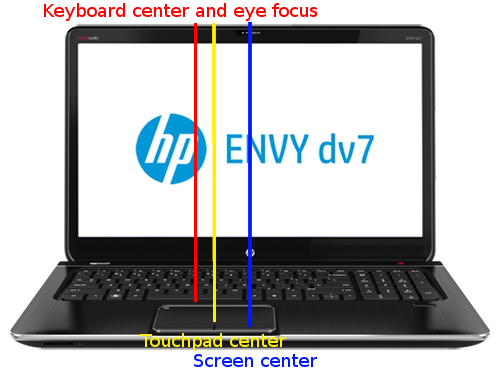
The numpad forces eye focus and users' hands to be way off center.
The touchpad looks as if it was thrown to the side by accident
Note how the designer tried to offset the misalignment forced
by the numpad by "positioning" the touchpad closer to center,
but not in line with the space bar (and the keyboard)

Without numpad the position is almost perfect!
The symmetry of the laptop improves on the design.
Notice how the touchpad is also centered.


What's worse is that most resellers do not have filters for this particular mis-feature, so you can't easily exclude laptops corrupted by this horrendous idea.

So, if you're a laptop designer, please stop putting numpads on laptops.

It will make for better looking laptops and you'll have the opportunity to be the one stating the obvious: numpads are generally useless! Even on desktop keyboards!

28 October 2013

Matthias Klumpp: Tanglu update & release plans

Long time with no article about Tanglu! This was mainly because we were busy with the project itself, improving various aspects of the distribution. So, here is a new summary on what has been done and what you can expect from the first release ;-) Tanglu QA We further improved the automatic archive QA. There is now qa.tanglu.org, which constantly monitors the number of uninstallable or unbuildable packages in the Tanglu suites. It also provides tanglu-platform-smallstatus information on the metapackage generator, which helps us in finding out which packages are available on the live-cds. Furthermore, information about the staging->devel migration process is provided, to answer the question why a package does not migrate (this still needs some improvements, but it is being worked on). We also use some code from Ubuntu to monitor package versions in Debian and upstream, which helps to see if others have released newer versions of software shipped with Tanglu. This already resulted in many improvements: The Tanglu Aequorea suite does not contain unbuildable packages (at least not due to build-dependency changed), and all live-cds are working well. We will soon migrate the archive to a new server, which frees some server capacities we can use for automated QA and things like automatic live-CD building. Live-CDs, Installer, Alpha-Releases We currently don t do Alpha-Releases of Tanglu, but we create Live-CD snapshots of Tanglu, which are available at releases.tanglu.org (or mirror1, mirror2). These snapshots still have issues and are just early previews. They also ship without and installer, we are still working on that part. Please note that CD more or less means DVD or USB-Stick right now (and this won t change the expected image size will be around 800MB). Release Planning I am happy to announce that we will do a release this year, most likely in December. But what can you expect from the release? KDE 4.11kde-konqui We will ship with KDE 4.11, which will be the only desktop we officially support so far. The reason is simply lack of manpower we could promise to support more, but that would just be not realistic for the small team. So we focus on KDE (Plasma Shells) right now, and try to make it awesome. Also, the team consists mostly of KDE people right now, which contributed to that decision ;-) . If you want to try Tanglu, right now the KDE live-images are the best to try it out. GNOME 3.8 gnome-logoWe will also provide images with GNOME. The problem with GNOME is, that the GNOME team does not have enough manpower to maintain the whole desktop or to upgrade it to the latest version (it is essentially just me looking at it from time to time). So GNOME will be available in a preview state. We invite everyone with GNOME knowledge to join the project and help improving Tanglu-GNOME GNOMErs, we want you! systemd >= 204 We ship with systemd by default, which works nicely so far, although more testing needs to be done. The logind service will be used to replace ConsoleKit, if we manage to get everything in place and working in time (if there are issues, we might switch back to CK for one release). There are some plans to use a higher systemd version, due to some improvements made there, but if this will be done is still unclear (Debian will most likely stick to 204 for some time, because with systemd > 205, running it as pid 1 will be mandatory to use logind (and Debian is just in the process to decide which init-system we will use there)). Systemd will run in SysVInit compatibility mode for most of the available services. This will improve in later Tanglu releases. Of course, systemd is usable, even if not every init-script has been converted to a service file. It just has an impact on startup times, so Tanglu will not be the distributions with the fastest startup times (yet ;-) ). Debian Package Mixdebian_logo1 Tanglu consists mostly of packages from Debian Testing (Jessie), but we take full advantage of the Debian archive, so you will also find package versions from Unstable or even Experimental (where it made sense). A very small portion of packages has also been merged with Ubuntu. Although stuff has been changed, the incompatibilities with Debian are almost zero, so if you are installing Tanglu, it will currently feel like an more up-to-date Debian Testing with some extras. Still, the differences are large enough that upgrading a Debian system to Tanglu might result in some issues. Installer Right now, the installer is a major field of work. Tanglu will most likely ship with the Debian-Installer, because it is the easiest thing to do right now. For later releases, it is planned to also offer the Ubiquity installer (the thing Ubuntu uses), or a new installer with a similar UI and concept. Other Cool Things266px-Wayland_Logo Tanglu will ship with a fully working Qt5 (which is currently being tested and updated) and the latest version of Wayland/Weston as a preview for developers to play around with. We also ship with Perl 5.18 and Haskell GHC 7.6, as well as with GCC 4.8 as default compiler (although the whole distribution does not yet compile with GCC 4.8). We might ship with Linux 3.12, but this also depends on other things. The Linux kernel build will be the same as in Debian. There might be more things to come :-) Please do always keep in mind that Tanglu is a new project, so the first release might still have some teething problems but we re working on it. The Aequorea release will be supported one to two more months after the next release is out. Tanglu Policy I started to draft a Tanglu policy, which defines stuff like the procedures to become a Tanglu project member and/or developer, some basic values of the distribution, decision making processes etc. This work is at a very early stage right now, and will need lots of feedback later. But as soon as it is done, joining the project will be easier and what Tanglu is will be well-defined. The policy will also include a Code-of-Conduct as an additional document from the start. We need help! ;-) First of all, thanks to everyone working on Tanglu! You are amazing! Also, many thanks to every Debian developer or contributor who helped a lot in setting the project up and contributed knowledge. And of course, thanks to everyone else who contributed by creating awesome artwork, helped with code, TangluTanglu Logo (big) archive mirrors, buildd-servers or by testing the distribution and providing feedback! (given the state the aequorea suite was in at the beginning, testing was a really frustrating activity but people still did it!) So, if you would like to help, just find us on #tanglu-devel on Freenode or join the tg-devel mailinglist. We also really need some people taking care of the Tanglu website and updating it with some recent information from time to time, so people can see what is going on. Before we have the Tanglu policy finished and the Tanglu members and developers directory in place (a software which allows us to track all registered developers and gives them an @tanglu.org mailalias), the start might be a bit confusing, but we do our best to make it easy for new people to join. The best way is asking people. Tanglu is still created by an incredibly small team, which has a large task to accomplish. Help is welcome :-)

26 October 2013

Niels Thykier: Breaking the RC bug curve

Early this month, the first batch of packages were automatically removed from testing due to RC bugs. Personally, I find that the results stand out pretty well on the RC bug graph[1]. There has been a very rapid decline in the number of RC bugs affecting testing a week or two ago, we had over 1000 RC bugs affecting testing and now it has dropped to something like 760. There has also been quite a few RC bug fixes in this time period. I spent a bit of time finding and aging some of the RC bug fixes in sid, so they would migrate to testing faster[2]. On the first batch, we saw something like 40 RC bugs disappear and we still have more RC bugs fixes in the sid->testing pipeline. While looking for packages I could age, I also noticed that we have quite a few RC bug fixes blocked by out of date binaries (which is usually either build issues or uncoordinated transitions). I have been filing a couple of RC bugs for these, but it does not scale do this kind of work manually. If you have uploaded a package recently, please take the 5 minutes to check that it actually built and it has no out of date binaries issues in its excuses. [1] http://bugs.debian.org/release-critical/ [2] The aging was equivalent to an urgency=medium, so reduced the requirement from 10 days to 5 days.

25 October 2013

Enrico Zini: A vision wanted

A vision wanted Today Richard Stallman mailed all Italian LUGs asking that tomorrow's LinuxDay be called "GNU/Linux Day" instead. I wonder how that is ever going to help a community so balkanised, that the only way Italian LUGs manage to do something together, is to say "let's not care what we all do, let's just do it on the same day and call it a national event". Of course a few LUGs still make a point of not doing anything on that day, because you know, Judean People's Front. Cawk. Today a friend asked me if I could help her support people in installing Citrix Whatsit to set up a video conference to network meetings that will take place in a month in different cities. Those meetings are something I look forwad to. It wasn't much of a problem to say "no, I can't do that"; it was a problem to be unable to come up with some viable, Free alternatives. I sometimes have to use Skype to talk with friends who also are Debian Developers, because I still haven't managed to make VoIP work unless I go through a commercial proxy. There was the happy news that our regional administration is switching from MS Word to OpenOffice. It soon became a flamewar, because some people loudly complained that they should have used LibreOffice instead. At DebConf, after spending an hour getting frustrated with the default formatting of bullet points in WhateverOffice Impress, I did my Debian Contributors talk using a text file in vim. And it was a success! Thanks Francois Marier for maintaining cowsay. I can't sync contact lists and appointments between my N900, which runs a Debian derivative, and my laptop, because I don't want to have a Google account, and nothing else would work out of the box. I don't even know how to keep a shared calendar with other DDs, without using a 3rd party cloud service that I don't want to trust with my life's personal schedule. I need to do a code review of every vim plugin I need to use, because you can only get them by cloning GitHub repositories over plain http, and they don't even provide signed tags. That code is run with my own privileges every time I start a text editor, which is, like, all the time. I'm frightened at the idea of how many people blissfully don't think about what that means. Vim users. Programmers. Cool chaps. Yet the most important thing in Debian today seems to be yet another crusade between upstart and systemd. But we haven't had a lengthy discussion on why, although the excellent OpenStreetMap exists and many of us contribute to it, it seems to still be more immediate to hit Google Maps to get a route computed. How can we change that? We haven't had a lengthy discussion on what can we offer to allow anyone to set up some social platform that won't get swamped with spam the first day and cracked open the second; that would allow people to share some photos with their friends only, and some with the rest of the world; that won't required a full-time paid person to maintain. That won't be obsolete and require a migration to a new platform in a year. That isn't Facebook or Google Plus. I stopped taking photos because it's too much work to show them to people. Other people use Instagram. Whatever the hipster trend is for photo sharing today, October 25, 2013, I'm pretty sure it's not a Free platform. But we can do something. We technology leaders. We are those who drive technological change! For example, today I invested two hours of hard effort trying to figure out why libbuffy's test suite fails on kfreebsd. All while wondering why I was doing that, since I know all buffy's users personally, and none of them uses kfreebsd. And I will take a day off work to study the library symbols file specification, so that next time I'll know right away if the new version of a C++ compiler decides that a template-generated symbol isn't worth adding to a library anymore. What is this effort really about? It sometimes feel like micromanaging to me. It's good to have excellent quality standards. But not without a vision. Not until "reliable network printing with all PDF viewers and print servers we ship" is among our release goals. Not until we commit to making sure that "sharing files between Debian users" will work out of the box, without the need of going through a 3rd party website, or email. I'm not interested in spending energy discussing init systems. I'm interested in spending energy sharing stories of what cool stuff we can do in Debian today, out of the box. And what cool stuff we'll be able to do tomorrow. Let's spend time on IRC, on mailing lists, and at the next Debian events, talking about why we are really into this. Talking about a vision! Note: Please don't spend time telling me how to fix the problems I mentioned above. I'm not interested in help fixing some problems for me today. I'm interested in asking help fixing problems for everybody, right in the next stable release. Remember, remember, the 5th of November, 2014.

Jan Wagner: PHP.net infected with Malware and Linux Malware Detect

As some of you might have noticed, the Site PHP.net was infected yesterday with Malware.
If you are running a shared hosting environment, you are also be faced with similar Malware problems. Beside XSS attacks and compromised server systems on OS-level, very widely used attack szenarios are stolen user credentials. A usefull mitigation strategy might be a web application firewall (WAF) like ModSecurity. Another way might be the Malware scanner Linux Malware Detect. The project describes itself:
**Description**
Linux Malware Detect (LMD) is a malware scanner for Linux released under the
GNU GPLv2 license, that is designed around the threats faced in shared hosted
environments. It uses threat data from network edge intrusion detection systems
to extract malware that is actively being used in attacks and generates
signatures for detection. In addition, threat data is also derived from user
submissions with the LMD checkout feature and from malware community resources.
The signatures that LMD uses are MD5 file hashes and HEX pattern matches, they
are also easily exported to any number of detection tools such as ClamAV.
**Features**
- MD5 file hash detection for quick threat identification
- HEX based pattern matching for identifying threat variants
- statistical analysis component for detection of obfuscated threats (e.g: base64)
- integrated detection of ClamAV to use as scanner engine for improved performance
- integrated signature update feature with -u update
- integrated version update feature with -d update-ver
- scan-recent option to scan only files that have been added/changed in X days
- scan-all option for full path based scanning
- checkout option to upload suspected malware to rfxn.com for review / hashing
- full reporting system to view current and previous scan results
- quarantine queue that stores threats in a safe fashion with no permissions
- quarantine batching option to quarantine the results of a current or past scans
- quarantine restore option to restore files to original path, owner and perms
- quarantine suspend account option to Cpanel suspend or shell revoke users
- cleaner rules to attempt removal of malware injected strings
- cleaner batching option to attempt cleaning of previous scan reports
- cleaner rules to remove base64 and gzinflate(base64 injected malware
- daily cron based scanning of all changes in last 24h in user homedirs
- daily cron script compatible with stock RH style systems, Cpanel & Ensim
- kernel based inotify real time file scanning of created/modified/moved files
- kernel inotify monitor that can take path data from STDIN or FILE
- kernel inotify monitor convenience feature to monitor system users
- kernel inotify monitor can be restricted to a configurable user html root
- kernel inotify monitor with dynamic sysctl limits for optimal performance
- kernel inotify alerting through daily and/or optional weekly reports
- e-mail alert reporting after every scan execution (manual & daily)
- path, extension and signature based ignore options
- background scanner option for unattended scan operations
- verbose logging & output of all actions
The recent development can be found at Github and in the last days I worked on packaging this into a Debian package 'maldetect'. If you want to give it a try on Debian, you could install the packages from our restricted repository:
    # wget "http://ftp.cyconet.org/debian/sources.list.d/restricted-cyconet.list" \
        -O /etc/apt/sources.list.d/restricted-cyconet.list
    # aptitude update
    # aptitude -t restricted install maldetect
For adding our archive key, you can just install the package "debian-cyconet-archive-keyring"

24 October 2013

Daniel Pocock: Final report on GSoC 2013 projects

Google Summer of Code finished recently. This is the first year that I have participated as a mentor for the Debian Project. Its a big responsibility to be part of the Debian team and to be one of the Debian team members representing Debian at the GSoC Mentor Summit. Birthdays all round This has been a particularly important year for the Debian Project, as the project celebrated our 20th birthday recently, on 16 August 2013, one of the final days of DebConf13 in Switzerland. GSoC celebrates its 10th year in 2014, with a generous 10% boost in the student stipend to mark the occasion. Google: don't be evil Google's "Don't be evil" approach to business has always been an interesting point for discussion. In my view, there are few cases of absolute good or absolute evil that we can universally classify and agree on. At a more pragmatic level, various people have commented that GSoC is a recruiting program for Google: some have even cited this as a reason not to participate. This is a more interesting point for discussion. The results of the program are not exclusive to the headhunters at Google. Anybody can browse through the Debian GSoC weekly student reports from each student to find out exactly what the students were up to and try to recruit them. Mentors and the projects they belong to have not been forced to sign any wide-ranging non-disclosure agreements or non-compete agreements with Google. In one recent example, the xWiki open source project even went as far as setting up a new office in Romania and employing some former GSoC students on a permanent basis.
Assorted images from Iasi, Romania, where xWiki set up an office employing former GSoC students How does Google benefit then? Well, there appear to be several possibilities:
  • Generating a huge amount of goodwill and recognition for the value that they place on the development of the next generation of software engineers
  • Stimulating the expansion of high quality free software projects, many of which they use directly or indirectly for their internal projects
  • Access to private evaluations prepared by the mentors. These evaluations don't take more than an hour for the mentors to complete but they do serve to give Google's headhunters a slight headstart over anybody else who is scouring the web for the names of graduates who completed GSoC
Overall, it appears to fit the definition of a "win-win" scenario: yes, Google gets stuff out of it, but the benefit is not exclusive to Google and projects like Debian are winners too. My initial approach I started by reviewing some of these materials: One particular concept that I took note of was the need to give students some opportunity to be innovative and original in their project proposals. In other words, it has been suggested that students should not be given a precise specification: rather, they should be given some very general concepts or goals and asked to suggest some funky, innovative new idea. The wisdom of this approach varies. If your free software project has some very specific gap that you need to fill, you may only be interested in taking a student who can fill that gap and you may not want to waste the time of other applicants. On the other hand, if you do precisely document this gap you want filled, you may get a bunch of very similar proposals from students and it may be more difficult to distinguish which of them is the most desirable candidate. Furthermore, if your expectations are too rigid, you may not benefit from a top-gun coming in and contributing some really exciting piece of work that you hadn't even thought of. In the end, I opted for providing more generic project briefs and looking at how students responded. The briefs that I published are available here. Coding tasks during the selection process There is no doubt about it, coding tasks are an important part of ensuring students are capable of development work before they are selected. They are also very important for us as mentors. It is not uncommon for some of us to be completely out of touch with the capabilities of other developers. The coding tasks completed by the students during the selection phase allow us to get a feel for their capabilities and set reasonable expectations for how much they can achieve during the course of the project. To simplify the management of coding tasks and engage the students in the Debian community at large, I decided to create tasks as wishlist items in the Debian bug tracking system, such as this dynalogin bug report. The prospective GSoC students were asked to put their name in the bug tracker to take ownership of the task they would complete. Student project proposals For the real-time communications project, I felt all the students slightly underestimated the complexity of this field and would have to be extremely lucky to complete everything they hoped to. After all, this is a field that the free software movement has been wrestling with for years without gaining the upper hand. For somebody with good knowledge of the projects in this space, it is possible to guide the students towards meaningful and achievable subprojects. Nonetheless, the proposals were useful for me in understanding which part of the topics were most attractive to the students. For the other project areas, the student proposals were slightly more specific. Fabian's appeared to be the most specific and well considered proposal for the one-time-password project, in fact, it appeared very much like a project that he could work through from start to finish. Debian teamwork Anybody looking at the GSoC web site will notice that there is a certain amount of overhead in joining the program, promotion, payment administration and optional participation in the GSoC Mentor Summit. As a large organisation, Debian established a dedicated SoC administration team who looked after the GSoC and Outreach Program for Women administrivia. As a developer and mentor, I found this arrangement was highly effective and allowed me to focus over 99% of my efforts on the front-line work, selecting students and supporting them through their projects. Project results One of the more controversial issues during the Debian 7 (wheezy) release cycle was the inclusion of the Mumble voice conferencing software. Although the software has some serious issues, it was eventually escalated to the technical committee and allowed to remain in Debian, partly due to lack of any alternative. One of the first results from Catalin's project was the creation of an alternative, the new reConServer project, based on the librecon conversation manager API from the reSIProcate SIP stack. reConServer is a significantly more generic solution than Mumble, as it allows any SIP peer to participate in an audio conference. It supports TURN for NAT traversal too. Catalin then went on to make the first working implementation of a scheme for passing context information from a web site to SIP WebRTC call as described in the IETF draft. All work has been integrated into release tarballs and packaging. Fabian worked through the latest standards for one-time passwords, extending the oath-toolkit and dynalogin projects to implement mutual two-factor authentication with just about any arbitrary crypto suite using one-time passwords. This work is yet to be merged into an official release of dynalogin as it requires co-ordination with the oath-toolkit release and package updates. However, there is a compelling demonstration in his video from DebConf13 and the source is available under Fabian's github account. In the post-Snowden world, the work from both of these student projects will be hugely valuable to people wanting to tighten up their computer security and communication security practices. The development process Deciding to mentor more than one project turned out to be a worthwhile decision. At first, this might seem like a big risk but it is manageable with support from co-mentors. The upside is that different students work at different speeds, they have different code styles, they even work at different times of the day or week and mentoring more than one student/project allows the mentor to gain a better appreciation of how the students differ than if mentoring only a single project. For Catalin's project, it became obvious at an early stage that he would benefit from having a dedicated server to run the VoIP applications on public IP addresses and low-latency networks while testing them. I spun up a virtual machine with IPv4 and IPv6 in my Xen Cloud Platform and this was extremely helpful for both of us. Throughout the project, I took a hands-off approach and often left the students to their own devices. I gave some suggestions to Catalin about the object-oriented design and this was enough for him to fill in the gaps and write all the code by himself. Fabian's project had fewer ambiguities and he was able to use existing code as a model more frequently than Catalin. It is possible that the students may have produced more code if I had thought through the designs myself and given them definite blue-prints. However, I feel that this would have made it harder for me to appreciate their own abilities and test the limits of their design skills. DebConf13 participation One of the highlights for the students was their participation in DebConf13. Both students presented a session at the conference showcasing some of their work. The DebConf video team produces high quality videos of all sessions at the conference and this in turn provides some great evidence of the students' capabilities and what GSoC adds to Debian and the wider free software universe. I would encourage other mentors to actively contemplate ways to involve their students in conferences during or shortly after the completion of their project work. Looking ahead Google has recently confirmed that Google Summer of Code will be repeated in 2014. It is the 10th anniversary of the program and to celebrate, students will get 10% extra pay. Thank you There are many people to thank for the success of these projects and the wider success of the Debian GSoC team:
  • The Debian GSoC and OPW organisation admin team
  • Google and the Google Open Source Programs Office
  • All the co-mentors who assisted on these projects with me: Simon Josefsson, Luke Faraone, Sylvain Berfini, Eloy Coto and Jes s P rez Rubio
  • The students themselves, C t lin Constantin U urelu and Fabian Gr nbichler
  • All the other very capable and motivated students who applied, submitted code samples but were not selected to participate: many of these students could have also completed a successful project and turning them away is one of the most difficult tasks for mentors in a volunteer organisation like Debian

Russ Allbery: Review: Applied Cryptography

Review: Applied Cryptography, by Bruce Schneier
Publisher: John Wiley & Sons
Copyright: 1996
ISBN: 0-471-11709-9
Format: Trade paperback
Pages: 621
This is the next entry in the series of Russ reading books that he bought years ago and never got around to reading. Thankfully, this time, the book has aged somewhat better. This review is for the second edition of Applied Cryptography, published in 1996. Given how important computer security has become, and how central cryptography is to computer security, one might think that the passage of 17 years would make a book effectively obsolete. This turns out not to be the case. Yes, Rijndael (the current AES standard and the most widely-used block cipher), Camellia (the up-and-comer in the block cipher world), and the SHA-2 hash postdate this book and aren't discussed. Yes, there have been some further developments in elliptic-curve public-key cryptography. And yes, much of the political information in this book, as well as the patent situation for public-key cryptosystems, is now mostly of historical interest. But a surprising amount of this book still applies directly. Partly that's because much of Applied Cryptography is focused on general principles, classes of algorithms, and cryptographic protocols, and those do not change quickly. A rather amazing number of techniques and protocols still in widespread use today originated in the 1970s. Block ciphers, stream ciphers, cipher modes, public-key systems, signature systems, hash functions, key exchange, secret splitting, key management, and other, similar topics have not changed substantially. And even in the area of specific algorithms, DES is still in use (unfortunately) and its analysis is valuable for understanding any block cipher. RC4, Triple DES, CAST, RSA, MD4, MD5, and SHA-1 are still part of the cryptography landscape, and Schneier was already warning against using MD5 in 1996. The source code included in this book has, thankfully, been made obsolete by widely-available, high-quality free implementations of all common ciphers, available for any modern operating system. But the math, the explanations, and much of the cryptanalysis is still quite relevant. While it contains a comprehensive introduction to cryptographic concepts, Applied Cryptography is structured more like a reference manual than a tutorial. The first two chapters provide some foundations. Then, a wide variety of protocols, from the common to the completely esoteric, are discussed across the subsequent four chapters. There are four chapters on the basics of ciphers, another chapter on the mathematics, and then the longest part of the book: twelve chapters that provide a tour of all major and several interesting minor protocols that existed in 1996. These are organized into block ciphers, stream ciphers (and pseudo-random number generators), hash functions, and public-key systems. An entire chapter is devoted to the history and analysis of DES, and I think that was my favorite chapter of the book. Not only is it worth understanding how DES works, but it also provides a comprehensive introduction to the complexities of block cipher design, the politics of interactions with the NSA, and a fascinating history of early computer cryptosystems. Finally, Applied Cryptography closes with chapters on real-world systems and on politics. The politics section is mostly a historical curiosity, as is much of the chapter on real-world systems. Schneier discusses some of the PKCS and X.509 protocols here but doesn't use SSL as one of his examples despite its specification predating this book (perhaps the most glaring omission of the book). But he does discuss Kerberos (which is of personal interest to me), and it was useful to see it analyzed in the broader context of this sort of book. Those who read Schneier's blog regularly, or who have read any of his other books, will know that he's concise, incisive, and very readable, even with difficult material. I think he does err on the side of compactness this is not a book that handholds the reader or explains something more than once but there's a lot of ground to cover, so I can't really blame him. Expect to have to read the more difficult parts several times, and (at least on a first read) expect to just skip past some of the most complex sections as probably not worth the effort. But I think Schneier does a great job structuring the book so that one comes away with a high-level impression and overview sufficient to make informed guesses about capabilities and relative difficulty even if one doesn't have the patience to work through the details. I suspect most readers will want to skim at least part of this book. Unless you're willing to do a lot of background reading to understand the math, or a lot of careful study to follow the detailed descriptions and flaws in often-obscure algorithms, the algorithm discussions start to blend together. I found myself skipping a lot of the math and focusing on the basic descriptions and the cryptanalysis, particularly for the obscure ciphers. Many of the algorithms are also highly opaque and of obscure benefit; I doubt I will ever care about blind signatures or oblivious transfer, and I struggled to wrap my mind around the details of bit commitment (although it's apparently important in zero knowledge proofs, which in turn are relevant to authentication). But this is not the sort of book where you have to read every word. It's very well-structured, provides clear resynchronization points for readers who have had enough of a particular topic, and marks the topics that are more obscure or of dubious general usefulness. The most useful parts of this book, in my opinion, are the basic conceptual introductions to each class of cryptographic algorithm or protocol, and those chapters are excellent. I've been working in applied computer security, at the application and deployment level, for years, and this is the first time that I've felt like I really understood the difference between a block cipher and a stream cipher, or the implications of block cipher mode selection. Applied Cryptography is also a fascinating exercise in adjusting one's intuition for where the complexity lies. It's a memorable experience to move from the chapters on block ciphers, full of S-boxes and complex mixing and magic numbers, into the far more straightforward mathematical analysis of stream ciphers. Or the mathematical simplicity of RSA (although quite a bit of complexity is lurking on the cryptanalysis side, much of which is only touched on here). Of more historical interest, but still quite impressive, is that Applied Cryptography doubles as a comprehensive literature review. Not only does it cover nearly every algorithm in use at the time, it discusses the cryptography literature on nearly every topic with brief summaries of results and lines of investigation. The references section is a stunning 66 pages of small print featuring 1,653 references, and those are mentioned and put in context throughout the book. I'm not personally interested in chasing those lines of research further, and of course 17 years means there are many new papers that are as important to read today, but it's obvious that this book would have been an amazing and invaluable map to the research territory when it was first published. There are now newer books on this topic that you should consider if you're purchasing a book today. Cryptography Engineering in particular is in my to-read pile, and I'm interested to see how much of this book it could replace, although I believe it's lighter on the mathematical analysis and details. But I think Applied Cryptography still has a place on the bookshelf of any computer security professional. Schneier is succinct, detailed, straightforward, and comprehensive, at least for 1996, and I know I'll be reaching for this book the next time I forget the details of CFB mode and then get hopelessly confused by the Wikipedia article on the topic. Rating: 8 out of 10

23 October 2013

Russell Coker: Thinkpad T420

I ve owned a Thinkpad T61 since February 2010 [1]. In most ways it s a great system and it still does most things that I require, even though it inspired my post about how modern laptops suck [2]. Problems with my T61 The biggest ongoing problem with my T61 was the heat production, I m not sure how much of it was due to the CPU producing heat and how much was due to the cooling system not removing it fast enough. But any serious computation for even a relatively small amount of time caused it to get close to thermal shutdown. But as I mostly use my laptop for reading email, a SSH client, and coding (for which the big compiles are done on servers) that didn t force me to replace it. The next problem was the battery life, it s expected that laptop batteries degrade over time so it wasn t a surprise that after 3 years my T61 battery only lasted for about 15 minutes. A final problem is the screen which didn t seem to be as bright as it used to be, it s annoying but doesn t compel me to buy a replacement. T61 Failure But in July my T61 stopped working, it appeared to be either the power supply or something internal related to power, it had been running but was suddenly powered down after being left alone so for some reason power wasn t getting from the wall to the laptop. I initially thought that it was the power supply at fault and investigated the price of a new PSU and a new battery as well. The Lenovo online store [3] charges $71.90 for a new PSU and $113 for a regular capacity battery or $156 for an extended capacity battery (50% more power). So based on the assumption that the PSU was faulty that meant a cost of $185 or $228 (maybe more if postage is included) to get the old Thinkpad going again. I could probably get the parts cheaper from somewhere else, but I m hesitant to buy batteries from sources that aren t reliable in case I get one that s been used. Buying at Auction I ended up buying a refurbished Thinkpad T420 (product ID 4236-J73) from Grays Online [4]. It was refurbished and cost me $306.35 including delivery. $306.35 for a new laptop including PSU was a much better deal than buying a new PSU and battery for $185 or more. It turned out that the PSU wasn t broken (a different PSU also didn t work with it) but then my Thinkpad T61 just started working again, presumably it has some intermittent fault related to power and needed to be replaced anyway (I use my laptop for work and can t have it fail randomly). One significant problem when buying a Thinkpad is that the model numbers aren t specific to the hardware specs. According to ThinkWiki the T420 model ranges from a 2.1GHz i3 to a 2.8GHz I7 CPU, from 160G to 500G hard drive, and has either a 1366*768 or a 1600*900 display [5]. Auction sites almost always specify the size of a hard drive and usually the exact CPU speed doesn t matter much for an auction purchase (2.1GHz is fast enough for most things). But the display resolution is a big deal, in this case Grays had multiple Thinkpads on offer with the same description and the same price so bidding on one with high resolution was quite important. Lenovo has a web site for discovering Thinkpad specs, this is the current link for it (it changes periodically) [6]. At that page you can specify the TYPE AKA PRODUCT ID that is printed on the back of a Thinkpad (and usually included in an auction listing) in the search field that s currently described as QUICK PATH and get all the specifications. Lenovo really do a great job of providing all the details for their products (including ones that were obsolete years ago). But it s unfortunate that their web site sucks, there should be a single URL for such things that s easy to find and they shouldn t use cookies to track which model you are looking at because it makes it really difficult to research two different models. Comparing T61 and T420 I upgraded my new Thinkpad to 8G of RAM because RAM is really cheap. I bought it with 4G of RAM which didn t seem to be quite enough as the hard drive is slow for paging (my desktop with 3G of RAM and a SSD performed well for similar tasks). Now it s running really well, my new Thinkpad is a lot cooler than the old one (not being broken is a good thing). My T420 has a screen resolution of 1600*900 which was a little disappointing initially when going from 1680*1050 (18% fewer pixels and 2% fewer than the T41p I used previously). But having a smaller screen means that the Thinkpad is a lot smaller and lighter. My T61 didn t fit in most backpacks and laptop bags and was unreasonably heavy, it s the type of laptop that looks good on a spec sheet but doesn t seem so good when you carry it around for a few hours. Not only is the T420 a lot smaller and lighter than the T61 but the power supply that shipped with it is a lot smaller and lighter too. I might have spent $72 a few years ago to buy a lighter PSU if I knew that was an option. Cost of Ownership Thinkpads are getting so cheap at auction that I m tempted to buy myself an X series as well. When a $300 item can last several years (my T41p was from some time before 2006, my T61 was from 2010, and my latest is from 2013) that brings the cost of ownership down to something like $0.25 per day. If I bought myself a Thinkpad X series (ultra light) as well at auction then I would be looking at maybe $0.50 per day for my laptop use which would give me the option of taking a light laptop to a conference and a bigger laptop for spending a day at a client site.

17 October 2013

Thomas Goirand: OpenStack Havana 2013.2 Debian packages available

OpenStack upstream was released today. Thanks to the release team and a big up to TTX for his work. By the time you read this, probably all of my uploads have reached your local Debian mirror. Please try Havana using either Sid from any Debian mirror, or using the Wheezy backports available here: deb http://havana.pkgs.enovance.com/debian havana main
deb http://archive.gplhost.com/debian havana-backports main Yes, you will need *both* repositories. This is unofficial, though these are the exact same packages as in Sid, just rebuilt for Wheezy. On the package side, here s what is new: - All packages who needs it can now be configured through debconf for the RabbitMQ settings. This is on top of what was already available for Grizzly, which is automated configuration for: keystone auth token, the database, the API endpoints and much more. (remember: this is fully optional, you can always use the non-interactive mode ) - All Quantum pluggin packages have been removed, and now everything is self-contained in the neutron-common package. The selection of which plugin to use is done directly using the core_plugin= directive in /etc/neutron/neutron.conf. This will also control the init.d script of neutron-server, so that it loads the corresponding ini file in /etc/neutron/plugins. The plugin selection is done through Debconf, so that users don t have to write the full path of the plugin class, which is (for most) very cryptic (am I the only one who thinks that writing neutron.plugins.openvswitch.ovs_neutron_plugin.OVSNeutronPluginV2 in a configuration file is user friendly?). - All of the package descriptions and Debconf templates have been reviewed by the Debian internationalization team, and most strings are translated in Czech, Danish, French, Italian, Japanese and Russian (sometimes even more) for almost all packages (thanks everyone!). I d like to publicly thanks eNovance for sponsoring my packaging work, and Mehdi Abaakouk for his work on our CI with the tempest tests. Happy Havana release testing,
Please report bugs through the Debian BTS.

14 October 2013

Bits from Debian: Ada Lovelace Day: meet some of the "women behind Debian"!

Today is Ada Lovelace Day:
"Ada Lovelace Day is about sharing stories of women - whether engineers, scientist, technologists or mathematicians - who have inspired you to become who you are today. The aim is to create new role models for girls and women in these male-dominated fields by raising the profile of other women in STEM". source
To celebrate, we asked to some of the "women behind Debian" to share their stories with us. Enjoy! Alt Ada Lovelace portrait Ana Guerrero Lopez (ana) Who are you? I'm a 30-something years old geek. I'm from Andalusia, Spain but live in France. What do you do in Debian? I work mostly on my packages, in sponsoring new people's packages and in this very blog you're reading now. I also maintain an unofficial Google+ page about Debian. At $PAID job, I work in an internal Debian distribution so from time to time, I get the opportunity to contribute back some of the stuff we do there. How and why did you start contributing to Debian? I started using Debian around 2003 switching from Mandrake. I was a happy Debian user when the Debian Women project started in the summer 2004. When I saw the project announced, I asked myself why I wasn't contributing to Debian and the rest is history... in a couple of weeks it'll be my 7 years DD-versary! If for some reason you want a longer reply to this question, read here. Beatrice Who are you? I am a PhD student with a degree in Biology. I am a computer fan since my first C64 and I am a self-taught computer geek wanna-be. And I am a bug fan - not software bugs, real bugs :) What do you do in Debian? I work on translations - doing the translation work itself, but also reviewing other translators' work and helping in coordinating the translation effort. How and why did you start contributing to Debian? I started using Linux because I liked the idea of an open source operative system based on collaboration and I began reviewing open source software translations. Since my first Linux system was Debian Potato and I sticked to Debian ever since, it only seemed natural to focus my translation work on Debian. Christine Caulfield Who are you? My name is Christine Caulfield. My day job is principal software engineer at Red Hat working on the cluster infrastructure components corosync & pacemaker. Outside computing I'm a musician and sound engineer. I play violin with lots of technology attached, and love avant garde music. What do you do in Debian? I'm not that active on Debian any more due to pressure of time, and maturity of the packages I work on. I currently maintain the, little-used, DECnet userspace packages and the, even less used I suspect, mopd bootloader. I used to maintain lvm2 for a while but dropped that a few years ago. How and why did you start contributing to Debian? My initial reasons for joining Debian were slightly selfish, to find a home for the DECnet project that I was heavily involved in at the time. I was a keep Debian user and people wanted a distribution where the software was easy to set up. DECnet is quite complicated for users to configure, being a totally independant networking stack to IP and so OS support is needed. Debian seemed like the logical place to make this happen. As mentioned above I got quite involved for a time and maintained other packages too. I picked up lvm2 because I was on the lvm2 dev team at work in Red Hat and as it was a new package at that time I seemed a logical choice. Elena Grandi (valhalla) Who are you? I'm a 30-something years old geek and Free Software enthusiast from Italy. What do you do in Debian? I'm currently maintaining a few packages (2 python modules and a python program) as a sponsored uploader; I'm also slowly looking around for other things to do (by preference technical, but not limited to packaging), with the aim to spend more time contributing to Debian. How and why did you start contributing to Debian? For a while I had being distro-hopping between "fun" distributions (the ones that break now and then) on the desktop while using Debian stable on the home server and in chroots. I was already doing marginal contributions to those distributions, where finding stuff that was missing was easy, but my perception as a stable user was that Debian was already working fine and probably didn't really need any help. Then I started to socialize on IRC with some DDs and DMs, and realized that my perception was superficial and that in reality there were dark holes in the depths of the archive where Evil festered and prospered and... ok, sorry, I got carried away :) Anyway, since I was actually using Debian more and more I decided to start contributing: I read documentation, I attended the useful IRC sessions on #debian-women and decided that it was probably best not to add new stuff, but look for things that I used and that needed help. Then nothing happened for a while, because finding stuff that doesn't work is hard (at least on my mostly textual systems). Then one day I was trying to write a python script that needed to verify gpg signed messages; it had to run on my Debian server, so I was trying to use python-pyme and its documentation was painful to use, while I remembered an earlier attempt using python-gnupg that was much more pythonic, but not available in Debian. In a fit of anger I decided to forgo all of my good intentions and actually add a new package: I checked the sources for problems, packaged, sent it to mentors@d-o, got reviews, fixed problems, resent and finally got sponsored and well, everything started. Francesca Ciceri (madamezou) Who are you? I'm Francesca, a 30-something Italian graduated in Social Sciences. What do you do in Debian? I'm a (non uploading) Debian Developer since 2011 and have been DPN editor, press officer, webmaster for www.debian.org and translator for the Italian l10n team. Recently, due to time constraints, I had to reduce my involvement and now only work on two things: writing/editing articles for bits.debian.org together with Ana Guerrero, and creating subtitles for the DebConf talks, in the DebConf Subs team. How and why did you start contributing to Debian? Basically thanks to the sudden abundance of free time - due to an health problem - and the desire to give something back to this wonderful operating system. After that, I found out that Debian is not only a great OS but also a very special community. Today, some of my dearest friends are people I met through Debian. :) Laura Arjona Who are you? I live in Madrid (Spain), and work as IT Assistant in the Technical University of Madrid (UPM). I'm married and I have a 4-years-old son. What do you do in Debian? In 2012 I started to clean spam and to translate Debian web pages into Spanish. I also follow the work of the web and publicity team, I hope I'll get more involved there too. And of course, I'm in Debian Women :) How and why did you start contributing to Debian? I'm using Debian at work since 2007 (servers), and in my desktops since 2010. I like very much that it is a community distro and I wanted to participate. I was already doing translations in other (small) free software projects, so I began here too. The Debian-Women list, the planet, and people in identi.ca helped me to learn a lot and feel part of the community even when I was not contributing yet. M nica Ram rez Arceda (monica) Who are you? My name is M nica Ram rez Arceda and I am an enthusiast of free software and sharing knowledge cultures: for me it's a kind of philosophy of life. I studied Maths a long time ago but ended up working as a developer for some years. Now I'm working as an IT teacher. What do you do in Debian? Debian is a huge project, so you can help in various scopes. Mainly, I work on packaging, fixing wnpp bug inconsistencies in BTS and helping in spam cleaning of the mailing lists. But I also enjoy doing some non-technical work from time to time: the project I am just now involved is organizing, with the rest of Debian Catalan community, a local team to propose Barcelona as the venue for a minidebconf where all the speakers will be women. How and why did you start contributing to Debian? In 2000 I discovered Free Software world and I fell deeply in love with its philosophy. Since then, I've been trying to do my best in different activities, like spreading the word, giving free courses, helping collectives and friends in technical stuff (from installing Debian to developing some helping apps for them)... but two years ago I was looking forward to join a free software project and I decided to try Debian, since it has been my first and only distro in my day-to-day life for about ten years. So, I wanted to give back Debian all what it had offered to me, but.... I thought I couldn't (hey, Debian is for real hackers, not for you little ant!), but I started to adopt some orphaned packages, do some QA uploads, fix some RC bugs, talk with some Debian Developers that helped me and encouraged me more than I expected, I traveled to my first Debconf... And one thing takes you to the other, and on March 2012 I became a DD. Now, I'm glad to see that everything that frightened me is not so scary :-)

13 October 2013

Matthew Palmer: RACK_ENV: It's not *for* you

(With apologies to Penny Arcade I m probably the last person on earth to realise this, but the RACK_ENV environment variable (and the -E option to rackup) isn t intended for consumption by anything other than Rack itself. If you want to indicate what sort of environment your application should run in, you re going to have to do it via some other means. Why is this? Because the interpretation that Rack applies to the value of RACK_ENV that you set makes no sense whatsoever outside of Rack. Valid options are development , deployment , and none . If you follow the usual Rails convention of naming your environments development , test , and production (and maybe staging if you re feeling adventurous), then in any environment other than development , you re not going to be telling Rack anything it understands. As I said, I may be the last person on earth to have worked this out, but I doubt it. There are plenty of bug reports and WTF? blog posts and Stack Overflow questions that appear to stem from people misunderstanding the purpose of RACK_ENV. Sadly, the Rack documentation is very quiet on the whole topic, and the only place that mentions how the environment is interpreted is in the comments for Rack::Server.new and that doesn t tie that environment to the -E option or RACK_ENV environment variable. At any rate, the take away is simple: unless you want Rack to pre-configure a bundle of middleware for you, RACK_ENV or rackup -E is not the configuration variable you re looking for. Use something else to tell your app how it s supposed to work.

8 October 2013

Daniel Kahn Gillmor: Unaccountable surveillance is wrong

As I mentioned earlier, the information in the documents released by Edward Snowden show a clear pattern of corporate and government abuse of the information networks that are now deeply intertwined with the lives of many people all over the world. Surveillance is a power dynamic where the party doing the spying has power over the party being surveilled. The surveillance state that results when one party has "Global Cryptologic Dominance" is a seriously bad outcome. The old saw goes "power corrupts, and absolute power corrupts absolutely". In this case, the stated goal of my government appears to be absolute power in this domain, with no constraint on the inevitable corruption. If you are a supporter of any sort of a just social contract (e.g. International Principles on the Application of Human Rights to Communications Surveillance), the situation should be deeply disturbing. One of the major sub-threads in this discussion is how the NSA and their allies have actively tampered with and weakened the cryptographic infrastructure that everyone relies on for authenticated and confidential communications on the 'net. This kind of malicious work puts everyone's communication at risk, not only those people who the NSA counts among their "targets" (and the NSA's "target" selection methods are themselves fraught with serious problems). The US government is supposed to take pride in the checks and balances that keep absolute power out of any one particular branch. One of the latest attempts to simulate "checks and balances" was the President's creation of a "Review Group" to oversee the current malefactors. The review group then asked for public comment. A group of technologists (including myself) submitted a comment demanding that the review group provide concrete technical details to independent technologists. Without knowing the specifics of how the various surveillance mechanisms operate, the public in general can't make informed assessments about what they should consider to be personally safe. And lack of detailed technical knowledge also makes it much harder to mount an effective political or legal opposition to the global surveillance state (e.g. consider the terrible Clapper v. Amnesty International decision, where plaintiffs were denied standing to sue the Director of National Intelligence because they could not demonstrate that they were being surveilled). It's also worth noting that the advocates for global surveillance do not themselves want to be surveilled, and that (for example) the NSA has tried to obscure as much of their operations as possible, by over-classifying documents, and making spurious claims of "national security". This is where the surveillance power dynamic is most baldly in play, and many parts of the US government intelligence and military apparatus has a long history of acting in bad faith to obscure its activities. The people who have been operating these surveillance systems should be ashamed of their work, and those who have been overseeing the operation of these systems should be ashamed of themselves. We need to better understand the scope of the damage done to our global infrastructure so we can repair it if we have any hope of avoiding a complete surveillance state in the future. Getting the technical details of these compromises in the hands of the public is one step on the path toward a healthier society. PostscriptLest I be accused of optimism, let me make clear that fixing the technical harms is necessary, but not sufficient; even if our technical infrastructure had not been deliberately damaged, or if we manage to repair it and stop people from damaging it again, far too many people still regularly accept ubiquitous private (corporate) surveillance. Private surveillance organizations (like Facebook and Google) are too often in a position where their business interests are at odds with their users' interests, and powerful adversaries can use a surveillance organization as a lever against weaker parties. But helping people to improve their own data sovereignty and to avoid subjecting their friends and allies to private surveillance is a discussion for a separate post, i think.Tags: cryptography, nsa

Next.

Previous.