After much wading through possible names, none of which really excited me, I have finally chosen "DAViCal" as the new name for my CalDAV server that was previously called RSCDS, or the "Really Simple CalDAV Store".
In the end, I chose DAViCal because it:
- seems easy to pronounce.
- combines the 'Cal' and 'DAV'.
- returns < 1000 results on google.
- doesn't make me cringe.
- didn't have a domain name registered.
That was about the hardest part of preparing for the 0.8.1 release, and now that I've done that I should manage to make the changes to the packaging, though I have no doubt that the old name will appear in all sorts of places for a while yet.
Choosing names is an important business, and I should know that from the length of time we spent agonising over names for our children, discarding all sorts of things because they had silly abbreviation collisions (like the "Royal Scottish Country Dance Society" :-) Even then, I think we got the kids names wrong, and the big one should be called "Thumper" with the little one called "Sly", but perhaps that's just a temporary annoyance and in time the names that we registered for them will fit them better.
I also recall
Grant once saying that you should never use the word "Simple" in the name of your project, and
he should know. DAViCal is no longer particularly simple, although I have attempted to hide the complexity from the user as far as that is possible, and will continue to do so.
Once I get out version 0.8.1 of DAViCal I will finally upload it to Debian, proper. This version has some important enhancements to its DAV spec compliance which are going to be needed by some future versions of Mozilla, and probably other things too, so it's important to push it out as soon as possible now.
The Australian has a new Environment writer named
Matthew Warren who has a history of doing PR work for the coal industry. This has the potential for insightful articles based on knowledge of what the industry is doing or for PR work for the coal industry masquerading as journalism. Unfortunately it seems like the latter is what we are getting.
Matthew’s latest effort is an article claiming a $6.5 billion cost to home-owners because of an “effective ban” on electric hot water systems that Labor might impose. Unfortunately he doesn’t clearly state what an effective ban is, but does note that apartments are exempt.
The specific claim that is used as the basis for the article is that solar hot-water systems cost $2,800 more than electric systems, and that after the solar hot-water rebate ($1,000) the additional cost would be $650,000,000 per annum, and that a period of 10 years would be required to replace all hot-water systems thus giving a cost of $6,500,000,000. So I presume that he expects that there would be 650,000,000/1,800 hot water systems installed per year which would be about 361,111.
According to the
Australian Bureau of Statistics there were 6,744,800 households in Australia in 2003. Matthew’s article states that about 40% of homes can have gas hot-water systems fitted that comply with the proposed new regulations, given that and the exemption for apartment buildings let’s assume for the sake of discussion that 50% of homes would require a solar hot-water system. Assuming that each household has a separate hot-water system that means that for these claims to hole we need an average expected lifetime for a hot water system of 6,744,800/2/361,111 = about 9.3 years. If the currently installed hot-water systems are expected to be replaced in 9.3 years then we can expect that hot water systems tend to survive for an average of about 18.6 years. I wonder if that number is correct (some google searching didn’t turn up an answer). One of the disadvantages of old-fashioned media is that they tend not to include calculations or cite sources adequately so we can’t easily verify or disprove their claims, I wonder if this is deliberate…
Matthew admits that using a solar hot water system can be expected to save households $300 per annum in electricity expenses, I presume that this is based on current energy prices and that the savings can therefore be expected to increase as energy prices increase (we have a lack of water which is increasing the cost of producing electricity from coal).
Let’s assume for the sake of discussion that the typical home-owner has a mortgage,
the Commonwealth Bank is currently advertising mortgages with a rate of just over 8%, the way things work is that there are various criteria for getting a discount rate which most borrowers can meet so the result will be slightly below 8%. If a solar hot water system costs $1,800 extra to install and the money comes from a mortgage then every year it will cost the home owner about 8% of $1,800 which is about $144 (a saving of $156 per annum). If the solar hot water system saves the home owner $300 per annum then at any interest rate below 300/1800 (16.66%) they will make money.
If there was no government subsidy and the entire $2,800 extra was paid by the home owner then at 8% interest it will cost $224 per annum (a saving of $76 per annum) and the interest rate would need to increase to 300/2800 = 10.7% to make it break even.
So for solar hot water to not save the home-owner money we need to have a significant increase in interest rates (which incidentally would bankrupt many home owners), AND to have electricity prices remain the same (which would require even more of our tax money to be spent on supporting the coal industry).
Finally Matthew complains that the solar hot-water rebate could cost the government $4 billion over the course of the scheme (the next 10 years). This sounds like a lot of money until you think about
the 9 billion dollars a year that the government spends on subsidies for the coal, oil, and gas industries! On the current course the government would spend 90 billion dollars of our tax money subsidising polluting industries that cause climate change, but Matthew opposes spending 4 billion subsidising technology that prevents pollution and reduces climate change.
Share This
Thanks to whoever ftp-master who did the review and approval, WebKit is now in unstable. It has not yet been built on all architectures, but several FTBFSes have already shown up :
- on arm, because
#if defined(arm) doesn’t seem to do much with our toolchain, and because gcc doesn’t pack a simple struct such as struct short x ; on arm, while it obviously does by default on all other architectures,
- on hppa, apparently because of a kernel bug,
- on s390, maybe fixable by using gcc 4.2.
I already fixed the arm issue in our git tree, but am waiting for the last buildds to keep up before uploading a new release, in case some other architecture would fail to build. I’d be very much thankful if some people with alpha, x86_64, ia64, mips, or powerpc machines could do some basic testing with
/usr/lib/WebKit/GdkLauncher and
/usr/lib/WebKit/QtLauncher and report any problem (BTS preferred).
Again, interested people are invited to
subscribe to the pkg-webkit-maintainers mailing list.
I just completed a very successful and long overdue dist-upgrade of
my unstable machine, using mainly
DebTorrent for downloading
the packages, so I thought I'd post some of my thoughts and
experiences.
The download consisted of 1294 packages to upgrade, totalling 1350
MB and taking 2h12m to download. Here are some of the good and bad
things I observed.
Good things
There was a single other peer with me in the same torrent, and I
managed to download 182 MB from him, which is about 13.5% of the
total download. This is the first time I have noticed this
downloading from peers occurring, as usually there are too few
peers, too many torrents and too many possible packages to download
for any sharing to occur. This will hopefully change in the future
when more people start using DebTorrent, and when
unique piece
numbers are introduced to make the torrents last longer.
However, it does show how the use of the backup HTTP downloader can
seamlessly integrate with downloading from peers to provide a good
user experience, even for early adopters.
The CPU time used was only 10m46s, which translates to an average
CPU usage of 8%, which is very reasonable.
The average download speed was 174 KB/s, which is 58% of my maximum
download speed. Though this may seem like a bad thing, my goal all
along has been to make sure that the download time would not be more
than twice as long as using HTTP. Of course, using DebTorrent may
never be as fast as a straight HTTP download from a well-provisioned
server, but that it not the point. The idea is to reduce the
bandwidth needs of hosting a debian archive. But in the future, when
there are many peers in a single torrent the download speed may be
even faster than using HTTP, especially for peers with very high
download rates that could not be matched by a single server.
Things that need improvement
The completion percentage reported by APT during the download was
fairly inaccurate. Here are some sample readings I noted, compared
with the actual completion percentage from the DebTorrent status
page:
| APT Reports |
Actual Completion |
| 10% |
40% |
| 20% |
70% |
| 30% |
85% |
| 40% |
90% |
| 50% |
93% |
| 60% |
96% |
| 70% |
97.5% |
| 80% |
98% |
| 90% |
99% |
The discrepancy occurs because larger packages are broken up into
pieces, so they can be partially downloaded without APT knowing
about it (since only fully downloaded packages are passed to APT).
Clearly this situation is far from ideal, and can lead to the user
feeling that the download is progressing very slowly, or not at all.
There are
some plans to add status updates to the
communication between APT and the DebTorrent client, but they
require changes to the APT code to support them, so it may take some
time to implement.
Another problem is the memory usage I saw during the download, which
was approximately 213 MB. This is obviously unnecessarily large,
though the metainfo that DebTorrent needs to be aware of is quite
large (stored in a text file it is about 3 MB). There does seem to
be a
memory allocation bug in Python 2.4 which causes
increased memory usage, so moving to python 2.5 might help. However,
my preliminary tests show this only saves you about 20% for
DebTorrent. I think I will have to delve deeper into which parts are
using all this memory, and unfortunately python doesn't seem to have
a good memory profiler to help with this. I will be looking at both
PySizer and
Guppy/Heapy to start, but if anyone knows of
a better solution, please
let me know.
I was recently talking to a client about the lack of guidelines for acceptable personal use of office resources in his company. He rejected the suggestion that he provide any real rules or guidelines (apart from some old rules that most employees were not aware of and of which there was no procedure to remind them to periodically read). He said that he only wanted to hire motivated people who wanted to work, and that people who need rules should work elsewhere.
The results of his approach seem reasonable, everyone who works for him works really hard. In return his attitudes towards employees are more relaxed than most employers, among other things he is very supportive of employees who desire career opportunities greater than his company can offer.
I have been wondering whether rules alone can make people lose interest in working, or whether it’s the type of person who doesn’t want to impose rules that inspires hard work.
My experience is that when working for people who have a rule-free environment I tend tend to work really hard, and that when working for companies that have lots of rules I find it difficult enough to get out of bed in the morning - let alone become motivated to do any work.
I am interested to see comments from other people, both workers and managers. Is my experience common in this regard?
Share This
It's been a long time without saying any word, my project completely drained
any free time!
So it's finished, as long as GSoC goes, but
Pancut n still is a work in
progress. What happened is that it turned out to be a
lot more
difficult that what I expected, so during the second part of the program
—when I would write all the tests— the schedule ran away. Anyway,
the tool is in a fully functional state: you can try it now and it
—$DEITY forbids— will not crash on you; but it will not be able to
spot many errors yet.
So, if you can, please install it and try it out! Bug reports are welcomed,
and code will be greatly appreciated. I've set up a
debian repository with
binaries (i386) and sources where you can grab it from, with all the
dependencies, or you can check out the SVN repository. Bear in mind that it
depends on a version of libcdio that's still not in the archive, so that can
also be found in my private repository.
As expected, my work with this tool doesn't end here; I will continue
hacking on it as soon as I end my vacations; which brings me to the other
subject of this post...
Tomorrow I'll be leaving Lisbon, heading north to Porto and then the
northern region of Spain: Galiza, Asturias, Euskadi and Catalunya; ending later
in Madrid. After Spain I'll visit a friend in Paris and money and time will
determine what I'll do after that. I am very excited, I love travelling and I
really need some rest.
PS: also I moved this blog to blosxom, which I expect to heavy hack on when I get back.
Tags: Planet Lugfi, Planet Debian, Programaci n, Debian, Viajes
We're just back home after spending two weeks enjoying the wonders (and
heat and forest fires...scirocco, mamma mia!) of Sicily.
We had no network at the hotel and Italian (or sicilian, or just Cefal 's) Internet Caf s just
suck (only a few computers running Windows while I forgot my special "Putty
key" and no way to connect my laptop).
So, 8000 mails to read (plus 6400 spams gently sorted by CRM114). I'll be
busy for the next few days and I cross my fingers for no disasters on my
packages.
...ah, apparently a KDE transition is in progress if I believe the output of
"aptitude dist-upgrade" on my laptop...:-)
For a project of mine, I had the dire need of getting the Unicode character (
U+26B0 COFFIN) in a PDF file created with pdflatex. I could find no latex package that provides this or a similar character, so I had to do it myself.There
are some HOWTOs on how to use a TrueType font in pdflatex, but all of them thought that you are trying to use the font for your regular text, not just for the one strange glyph. So based on these, here is what I did:
- Found a TrueType font containing the symbol. In my case, DejaVuSans.ttf, which is based on Bitstream Vera Sans.
- Created the encoding file burial.enc. Note that almost all characters are unmapped, and just the 1 maps to our character.
- Created the needed tfm file using the commands ttf2afm /usr/share/fonts/truetype/ttf-dejavu/DejaVuSans.ttf -o burial.afm -e burial.enc; afm2tfm burial.afm -c burial.enc
- Wrote a t1burial.fd file. Note the prepended T1 , which reflects the character encoding (whatever that is).
- Finally wrote a simple package (burial.sty) which provides the \burial command to show the glyph, by selecting the font and writing the character on position 1.
- Now I add \usepackage burial to the preamble of my TeX file and use the \burial command wherever I need it.
All in all you need to keep the files
burial.enc,
burial.sty,
burial.tfm and
t1burial.fd in the directory of your TeX file. I did not check how to install the files globally.If you think this is done horribly wrong, please feel free to tell me how it should be done instead.
The trip so farOklahoma is surprisingly empty. I'm not sure if that's because it's the Cherokee nation or for some other reason. One thing we noticed driving through Missouri was that there were a pile of Adult Superstores on the Interstate. Is there some sort of prohibition against them in OK?
We're just flipping through various news channels, and it looks like there's flooding through Illinois. We've passed through that area in just enough time it seems. We did hit rain that was hard enough that we pulled over twice yesterday.
Next stop: Somewhere in Texas, probably.
The Google Summer of Code coding period has ended earlier this week, so it seems to be a good time to stop and look what was done (and what wasn't). Let's start with an objective analysis, following the list of planned features:
Advanced query of bugs on the Debian BTS
In a 1-10 scale, I would give myself something like 6 or 7 here. bug-triage can query bugs by number, source package, package, maintainer and submitter. These parameters can be combined to make an query (reports must match all parameters) and more than one query may be added, subtracted and and'ed. A clearly missing feature is querying by usertag, support for it has been added on btsutils already and is just a question of adding a new input box on the query builder dialog (it should work if you enter the query manually in the bug-triage query line AFAICT).
Show all the information related to a bug report
bug-triage has a "goto" button which opens the bug in the user's preferred browser. Missing is the support to open the bug in a MUA, which I have promissed to Lo c.
Send additional information to a bug report
bug-triage has a "followup" button which opens the user's MUA with the right address. Maybe setting the subject would be nice...
Manipulate the tags of a bug report
I haven't had time to implement this at all. I've started it, the bugs have a context-sensitive menu which have each of the available tags as checkboxes on the right current status, but clicking on them does nothing currently.
Search for similar bugs in upstream developer BTS
This one would value something like 3 or 4 in a 1-10 scale. It searches upstream bugzillas by product and component, but doesn't do any cool trick like searching words in the bug subjects. The plus is that it does support KDE bugzilla, even though I haven't been brave enough to promisse it before SoC :P
Forward a bug report to the upstream developer BTS
There isn't really a good interface to report bugs programatically on GNOME bugzilla, which was disappointing. <rant>There is the bug-buddy xmlrpc(?) interface, but the developers say they will actively break anything using it, which I find very free-software-unlike.</rant>. The current bug-triage solution opens a browser with some of the fields filled. It would be nice to fill the full bug description, but its limited by the maximum size of an URL, so it fills only an introductory text (something like This bug was filled on Debian BTS #XXX) currently. Let's hope bugzilla 3 get on the GNOME world soon.
Conclusions
Unfortunately, this project hasn't evolved as much as I would like in the second half of the GSoC. As I said elsewhere, a lot of stuff has happened, some good, some bad, but on the end everything I hadn't been able to dedicate myself to anything I should. Even so, I think the project may be considered sucessful.
Maybe the more interesting product of this project, at least currently, is still on python-btsutils. As I said in the middle-term report, it'll be integrated in the debian_bundle soon, and might be powering important stuff like the devscripts in the future.
The bug-triage application has a lot to evolve yet, but is also an interesting tool IMHO. There are a lot of hurdles in the way to get different BTSes integrated, but the effort will for sure pay in the future. I plan to keep developing it (evon though keeping the GSoC pace is impossible) and am anxious to see the results ;)
Finally, as I said before, one of the main things on GSoC for me was the potential to learn cool stuff. The best choice I've made during all of this was to use Python. Even though it's still a new language for me, and i still have to search embarassingly simple things in the tutorial/reference, it was a lot more productive than if I was developing in C. Learning to use git was also a great. This goal was the more fulfilled one, I've really learnt a lot of things which will surely be useful in the future. BTOH, I still can't get used to glade :/
python-gammu 0.22 has been just released. New features:
- Complete support for managing calls.
- Compatibility with current gammu.
Thursday morning I arrived Chubu airport near Nagoya and at this time
started my first visit to Japan. It will take quite long time (3-6
months), so I should have enough time to do as much sightseeing as I
want. But there was not much time for sightseeing so far. Besides work
and having rest after 24 hours of travelling, we only went today to see
a bit of city. No real sightseeing, it was rather finding out some
things.
The most important was to find ATM accepting our credit cards. I didn't
expect it will be that difficult, but it turned out that most ATMs
accept only Japanese Visa and MasterCard cards and not ours.
Fortunately post office has ATMs accepting foreign cards, so we finally
have enough cache to survive next week ;-).
The next step was to buy something we can start to learn Japanese a bit.
It would be great to be able to read at least some signs and menu in
restaurant. We bought few books, but later in restaurant it turned out
to be almost useless. Fortunately the cook can a bit English, so we
managed to order something we wanted. But this is the largest problem
here - our poor Japanese knowledge as there was not time to prepare for
this back at home...
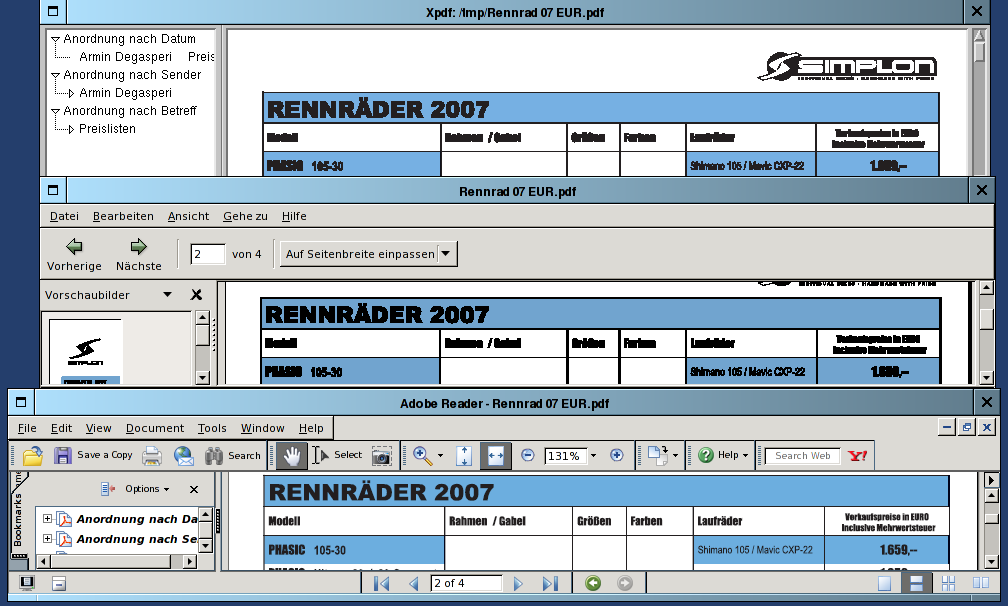
I have been wondering why xpdf rendered some pdf files really really bad.
(Check out this
example screenshot for
comparison of xpdf, evince and Adobe reader on etch.) The
error message Error: PDF version 1.6 -- xpdf supports version 1.5
(continuing anyway) should have given me a hint. But I just did not
think that going from 3.01 to 3.02 would make a big difference. However it
does; the sid versions of evince and xpdf render as well as Adobe reader.
[Updated 2007-08-25 19:05 CEST] I have uploaded a backport to
http://www.backports.org/ and less
than two hours later it has already gone through bpo's NEW processing and is
available for download. Thanks, ftp-master.
Around three months ago, I received my IBM/Lenovo X60s laptop (that has been fantastically well supported under Sid). As I was going to be doing a lot of travel in the future, I decided to go for the model with the built in 3G/GPRS radio... However, what I did not realise was that it was hardware locked to work only with Vodafone sim cards.
Considering I am moving to Norway in about a month; where Vodafone does not exist, it is obviously a drawback only being able to use a Vodafone SIM; so following the gude at thinkwiki.org; I proceeded to phone [UK] IBM/Lenovo technical support. This is where the problems began.
After waiting about 10 minutes, I got through to one support tech that didn't know they were shipping laptops with 3G modems built in, who then put me through to another, and yet another. Finally, I got through to a competent tech; who contacted Lenovo for the unlock code, and called back as promised the next day. However, this code did not work; returning an incorrect code error; and being the start of Debconf, I have had no time to call back the support people until now.
It makes me angry to think that all this hassle could have been spared by Vodafone not being utter cretins and locking hardware to their network! There was no mention of this network lock on the laptop retailer's page; and had I known of this, and how much hassle it would be, I would probably have bought a different model!
Dell just sent me a letter advertising their new Vostro line “especially for small business“. They say “we listened, then we listened some more” and explain that it’s based on feedback from people in small companies. The problem (which should be familiar to everyone who has ever done any consulting work) is that people don’t ask for what they need! Ask someone what they want in a computer system and the first thing that they will ask for is a fast CPU and a low price, the colour of the box will probably be higher on their priority list than the option of a backup.
Dell have proved this by advertising their small business machines by advertising cheap desktop machines for small business use.
Here is a list of the features that I consider essential in small business systems (based on my experience working for dozens of small companies):
Reliable operation. Using a relatively inexpensive machine as both a desktop machine and a server for the company network is very common in companies with less than 10 people. The Dell PowerEdge Tower systems are reasonably cheap (as little as $800AU - $100 more than a low-end Vostro in the base configuration, although the Vostro includes a bundled monitor). The PowerEdge machines have ECC RAM as a standard feature (avoids data loss due to memory errors) and can be delivered with hardware RAID support (SATA-2 or SAS) and a variety of backup options. A low-end tower PowerEdge server with 250G of hardware SATA RAID-1, a 160G removable disk for backup, and an extra gigabit-ethernet port costs $2015. Such a machine would do really well as a server for a small company while also being quite good as a desk-side workstation (the cooling fans would probably be louder than on most workstations but the money saved would be worth-while for most small businesses). If Dell was to promote PowerEdge tower machines (maybe under the label “Vostro Servers”) it would be good for customers and should be profitable for them.
The next thing that Dell should consider is a laptop with ECC RAM. Many small businesses start out as a sole trader with a laptop. Data loss on such a machine would be catastrophic. At the design stage ECC RAM would not be difficult to add - if there was a company that produced such RAM (I expect that Dell could purchase enough volume to drive the creation of new memory modules).
Another laptop issue is the reliability of mass storage. Laptops tend to get dropped and hard drives tend to break when dropped. Lenovo sells a “ThinkPad Serial ATA Hard Drive Bay Adapter” which allows two hard drives in a Thinkpad which could be used for RAID-1 (if you don’t want a built-in DVD drive). I chose to use regular backups instead of buying the extra hardware for RAID-1 but it would be good if other companies offered such options - especially when promoting their products to small businesses (who often don’t do regular backups). Even Lenovo could improve things in regard to their potential RAID-1 support in Thinkpads by promoting this feature (instead of just having the hardware listed as an optional extra with no mention of why you would want it) and offering a default install with RAID-1. Better still would be hot-swap RAID-1 in a laptop (which would be quite easy to do if the expansion bay was changed to use USB as it’s method of connection). Of course RAID-1 only covers you in the case where the drop is only enough to destroy one disk or if it causes partial damage to both disks but doesn’t destroy the same section of data on both disks.
The next big thing for laptops will be flash storage. One of the major advantages of flash is that it’s almost impossible to destroy it by dropping it. I would rather have my important data on a flash storage than a hard drive (it also saves electricity and therefore makes the battery last longer). The option of having flash as the primary storage device and a hard drive for files that are larger and less important would be useful to most small businesses. Of course hardly any small business owners will ask for this, they will probably ask for a machine that has a fast CPU.
Sometimes when developing a product you have to design something with the features that customers need and get the sales and marketting people to convince the customer of the benefits of the features. Even though the number of people who understand the technology and will jump at the opportunity to buy good things (such as me) is rather small, the number of people who can understand once it’s explained to them is quite significant. I’m sure that if Dell released a new line of computers with the slogan “reliable machines that don’t lose your data” instead of “good-looking new machines” then they would get some interest.
After writing this post but before publication time I happened to be speaking to the owner of a small business on the topic of choice of computers for a company such as his. He seemed convinced of the benefits of a better machine to replace his current desktop PC that is running as a server (it’s yet to be seen whether he considers the benefit to be worth the cost).
I wonder if Matt Domsch reads my blog…
Share This
This is the first post of a series on componentization, starting with a brief explanation of the problem(s) we are trying to solve. I expect some familiarity with programming in general, but no specific knowledge of any particular system; the terms "DLL" and "shared library" are used interchangeably.
When you are writing a DLL, you are essentially committing to support whatever interface you are exporting forever. So it better be good on the first try. DLL hell is what happens if it was not good, and you end up making an incompatible change.
The obvious way an interface can be "not good" is when you need to touch the header files that define it in order to implement some new functionality. You can get away with a few things, like the addition of new functions, if you can somehow make sure that users will always have a recent enough version of your DLL around, but in general any change to the interface is going to be incompatible.
The traditional Unix way of solving the issue has been renaming the library. When you link a program against a shared library on a system that uses the ELF format, the linker looks inside the library for the SONAME field, which tells it what name the library wants to be known under, and the program will then attempt to load this file at startup (which usually is a symlink to the latest compatible version). This "official" name of the library usually contains a number (sometimes more than one), and when there is an incompatible change, you simply change that number, and the new version of the library can be installed in parallel with the old. There are additional mechanisms, like symbol versioning support, that allow a single library to provide different "versions" of exported functions, and have the program specify the desired version for each symbol.
To run a system like this, one generally needs to keep track of programs' dependencies; this generally happens in the package manager with more (Debian) or less (Red Hat) support from package build scripts. If you built your system from scratch, you end up doing this work yourself. That's why you had highly paid system administrators in the old days, and very short shell scripts to replace them (with various degrees of success) in the current age.
In the Windows world, things have been a bit different, because except in large installations, you generally do not have a clueful, benevolent system administrator who will take care of these things; rather, you have users that expect your software to work without having an insight into the inner workings. In general, software developers have not been taking chances and simply shipped all the DLLs they needed along with the main program. When they installed these DLLs into the same directory as the program, things were fine, if they installed them into the WINDOWS directory, not so much, because when you had two conflicting versions of the same DLL, you had to decide which one to keep, and a program that would only work with the one that you threw away would simply fail in curious and interesting ways. This is the original definition of DLL hell — you cannot do it right.
To make matters worse, this is not the only way an interface could change. When you define a platform, you write up an "Application Binary Interface" (ABI) document that details conventions that should be followed; for example, the ARM processor does not have a dedicated stack pointer register, so the ABI document for Linux on ARM says that R13 is to be used as a stack pointer, functions may thus expect it to point to memory that is readable and writeable, and memory with an address lower than the stack pointer is considered "free". When the function is done, it is supposed to jump to the address in R14, which happens to be the register the ARM's "Branch with Link" instruction sets to the address of the instruction following it. If the function takes arguments, the ABI says where to find them, and if it returns a value, it also tells where to place that.
For everything not in the ABI document, the compiler author gets to choose. The ABI document usually attempts to be rather minimal, so it defines how C functions are to be called, and calls it a day. Anything not in the C standard is not guaranteed to work between different compilers (or even different versions of the same compiler). That includes C language extensions such as the "long double" data type, language features in C++ and Java such as namespaces, nested types and exceptions, and the data structures used by the C library's malloc() function. The latter makes life difficult even for pure C programmers, as it disallows releasing memory from a different module than the one it was allocated in, because the different modules may link to different C libraries.
In essence, this means you are not supposed to export anything from a DLL that is not a C function, and even then, there are additional requirements. You could in theory export data objects, but that is discouraged, as it exposes an implementation detail.
Now, we're in a bit of a dilemma here. There is lots of interesting code out there that is not necessarily written in C, we'd like to reuse it and we don't want stuff to break.
The Linux approach so far has been "we simply pretend the problem does not exist", and this has been working to a large extent, simply because everyone uses gcc, and when the ABI extensions the gcc people had made changed, recompiling everything that uses these extensions makes the problem go away.
This has several drawbacks. For one, it mandates that the tools used to rebuild everything and keep the installation consistent be written in C or handle the transition gracefully (for the curious who have a Debian system handy: look at libapt-pkg's SONAME), and it also requires that we have the full source code for everything not just available but buildable in an automated way. Within the context of a Linux distribution, both of these are true, so we have survived the last major ABI transitions without too many losses.
So we need an extension of the ABI document that specifies how modules written by different people and compiled with different compilers can interact. These are commonly called component models, and, to quote Andrew Tanenbaum, "[t]he good thing about standards is that there are so many to choose from".
Next: "componentization tutorial #2: CORBA and COM"
A frequent criticism of solar power is that the sun only shines brightly for part of the day, and that many of the times when there is significant electrical load (EG when people get home from work in winter) the sun light will be weak. One interesting solution to this problem is to store the solar power by splitting ammonia into nitrogen and hydrogen gases, storing them separately, and then reacting them to produce super-heated steam for power generation at any time that power is needed. The technology is based on three decades of research at
ANU and the Federal government has allocated $7,400,000 for building a power station near Whyalla in South Australia.
The down-side to this is that it needs water for the steam part of the electricity generation process which is a minor problem as we are having water shortages in most parts of Australia. But the up-side is that the process of combining nitrogen and hydrogen to produce heat should be something that can be turned on rapidly. So it seems that there is potential for having a wind power plant designed to satisfy all the power requirements on windy days and store hydrogen and nitrogen for times when there the combination of sunlight and wind is not adequate to satisfy the power requirements.
Previous plans for the maximum possible use of renewable energy in producing electricity have included gas fired power plants for times when wind and solar power can’t meet the demand. It seems that with technology such as this one it will be practical to have all electricity produced from renewable sources of energy.
Share This
There's this Brit named Steve. Steve loves strip clubs. Now, being
a Londoner, he has the requisite interest in talk of sex, boozing,
and sport, three topics that bore me numb, but I have only ever seen
Steve get truly excited about two things in life. The first is the
culture of strip clubs, best exemplified by a sex act Steve calls
(complete with pantomime) feeding the pony . The other has to do
with Ali G. Steve (remember Steve?) is tickled pink that people
wanted to sue Sacha Baron Cohen for racism but could not, for since
he is a Jew, he is incapable of bigotry. This made no sense to me,
but after witnessing the insanity of the UK legal system, I see no
reason to doubt it.
I am standing up to my nipples in salt water.
I saw someone who looked remarkably like Steve yelling
with a mildly impressive accent but poor grammar.
I knew it wasn't Steve because he wasn't being tailed by
an Eastender shouting blimey .
I am standing up to my neck in salt water.
J rg points out the reasoning for why normal peon developers
don't have access to NEW. This makes perfect sense once you
realize that each member of the ftp team is both a citizen
and resident of the United States of America.
The sea is rough. It is difficult to keep the laptop dry, and,
well, the Piers Anthony book in my other hand is going to smell
like ocean for weeks. That's precisely why I brought it, though;
it would take extreme effort to keep it from getting wet.
As it stands, or as I stand, there are three options available
to me. I can retreat to the beach, where I will be mostly safe
from the water. You could call this turning tail and running,
or you could call it mastering my environment. It's all in the
marketing. I'm going to succumb to this option anyway, and now
is not the time for it. So I could also keep doing what I'm
doing, keeping my head and laptop and book above water by
expending near-constant effort. It's a little easier than
in Puerto Rico at the place some random passerby kindly
informed me that i was going to die a horrible death just like
the 12 other people who had died in that spot that year.
In essence though, it's like the futility of continuing living
when you're surrounded by INTPs. Then there's the most appealing
option: to be as the reed in some Taoist metaphor. I can just let
go, and let the tides have their way with me, coolly caressing my
face, washing over me, drenching my book, short-circuiting my
keyboard, and filling my lungs with plant matter and some kind of
0.479M NaCl solution. My lungs see a problem with this
otherwise-logically-sound philosophy.
There's an old Middle Eastern proverb that goes something like
Be as the date palm, above the spites. When she is hit with
a rock, she strikes back with her sweetest fruits. Disthrust!
Dilute! Disthrust!
There may have been some corruption in the intermediate
language.
It is nice to see books on free software finally get their day under the sun and today, Samir Chopra and Scott Dexter have announced the release of
Decoding Liberation. Because it is a bit on the pricey side, try to get your library or work to order it and then when you get it, enjoy. I know I did and had the pleasure of reading early versions during an informal reading ground held in NYC 2 years ago and final versions more recently.
Among other great chapters, the one on the aesthetics of code, is, well beautiful. I can’t wait to re-read it.
If you are in the city, make sure to catch one of the book events that will be happening; your very own will help lead a discussion on October 3rd and I might write something up more formal about the book (and of course post here) then.