Search Results: "sf"

30 August 2012

Axel Beckert: deepgrep: grep nested archives with one command

Several months ago, I wrote about grep everything and listed grep-like tools which can grep through compressed files or specific data formats. The blog posting sparked several magazine articles and talks by Frank Hofmann and me. Frank recently noticed that we though missed one more or less mighty tool so far. We missed it, because it s mostly unknown, undocumented and hidden behind a package name which doesn t suggest a real recursive grep everything : deepgrep deepgrep is part of the Debian package strigi-utils, a package which contains utilities related to the KDE desktop search Strigi. deepgrep especially eases the searching through tar balls, even nested ones, but can also search through zip files and OpenOffice.org/LibreOffice documents (which are actually zip files). deepgrep seems to support at least the following archive and compression formats: A search in an archive which is deeply nested looks like this:
$ deepgrep bar foo.ar
foo.ar/foo.tar/foo.tar.gz/foo.zip/foo.tar.bz2/foo.txt.gz/foo.txt:foobar
foo.ar/foo.tar/foo.tar.gz/foo.zip/foo.tar.bz2/foo.txt.gz/foo.txt:bar
deepgrep though neither seems to support any LZMA based compression (lzma, xz, lzip, 7z), nor does it support lzop, rzip, compress (.Z suffix), cab, cpio, xar, or rar. Further current drawbacks of deepgrep: deepfind If you just need the file names of the files in nested archives, the package also contains the tool deepfind which does nothing else than to list all files and directories in a given set of archives or directories:
$ deepfind foo.ar
foo.ar
foo.ar/foo.tar
foo.ar/foo.tar/foo.tar.gz
foo.ar/foo.tar/foo.tar.gz/foo.zip
foo.ar/foo.tar/foo.tar.gz/foo.zip/foo.tar.bz2
foo.ar/foo.tar/foo.tar.gz/foo.zip/foo.tar.bz2/foo.txt.gz
foo.ar/foo.tar/foo.tar.gz/foo.zip/foo.tar.bz2/foo.txt.gz/foo.txt
As with deepgrep, deepfind does not implement any common options of it s normal sister tool find. Dependencies The package strigi-utils doesn t pull in the complete Strigi framework (i.e. no daemon), just a few libraries (libstreams, libstreamanalyzer, and libclucene). On Wheezy it also pulls in some audio/video decoding libraries which may make some server administrators less happy. Conclusion Both tools are quite limited to some basic use cases, but can be worth a fortune if you have to work with nested archives. Nevertheless the claim in the Debian package description of strigi-utils that they re enhanced versions of their well known counterparts is IMHO disproportionate. Most of the missing features and documentation can be explained by the primary purpose of these tools: Being backend for desktop searches. I guess, there wasn t much need for proper commandline usage yet. Until now. ;-) 42.zip And yes, I was curious enough to let deepfind have a look at 42.zip (the one from SecurityFocus, unzip seems not able to unpack 42.zip from unforgettable.dk due a missing version compatibility) and since it just traverses the archive sequentially, it has no problem with that, needing just about 5 MB of RAM and a lot of time:
[ ]
42.zip/lib f.zip/book f.zip/chapter f.zip/doc f.zip/page e.zip
42.zip/lib f.zip/book f.zip/chapter f.zip/doc f.zip/page e.zip/0.dll
42.zip/lib f.zip/book f.zip/chapter f.zip/doc f.zip/page f.zip
42.zip/lib f.zip/book f.zip/chapter f.zip/doc f.zip/page f.zip/0.dll
deepfind 42.zip  11644.12s user 303.89s system 97% cpu 3:24:02.46 total
I though won t try deepgrep on 42.zip. ;-)

27 August 2012

Robert Collins: Why platform specific package systems exist and won t go away

A while back mdz blogged about challenges facing Ubuntu and other Linux distributions. He raises the point that runtime libraries for Python / Ruby etc have a unique set of issues because they tend to have their own packaging systems. Merely a month later he attended Debconf 2010 where a presentation was given on the issues that Java packages have on Dpkg based systems. Since then the conversation seems to have dried up. I ve been reminded of it recently in discussions within Canonical looking at how we deploy web services. Matt suggested some ways forward, including: I think its time we revisit and expand on those points. Nothing much has changed in how Ubuntu or other distributions approach integration with other packaging systems but the world has kept evolving. Internet access is growing ever more ubiquitous, more platforms are building packaging systems clojure, scala, node.js, to name but three, and a substantial and ever growing number of products expect to operate in a hybrid fashion with an evolving web service plus a local client which is kept up to date via package updates. Twitter, Facebook and Google Plus are three such products. Android has demonstrated a large scale app store on top of Linux, with its own custom packaging format. In order to expand them, we need some background context on the use cases that these different packaging systems need to support. Platforms such as antivirus scanners, node.js, Python, Clojure and so forth care a great deal about getting their software out to their users. They care about making it extremely easy to get the latest and greatest versions of their libraries. I say this because the evidence is all around us: every successful development community / product has built a targeted package management system which layers on top of Windows, and Mac OSX, and *nux. The only rational explanation I can come up for this behaviour is that the lower level operating system package management tools don t deliver what they need. E.g. this isn t as shallow as wanting a packaging system written in their own language, which would be easy to write off as parochialism rather than a thoughtful solution to their problems. In general packaging systems provide a language for shipping source or binary form, from one or more repositories, to users machines. They may support replications, and they may support multiple operating systems. They generally end up as graph traversal engines, pulling in dependencies of various sorts you can see the DOAP specification for an attempt at generic modelling of this. One problem that turns up rapidly when dealing with Linux distribution package managers is that the versions upstream packages have, and the versions a package has in e.g. Debian, differ. They differ because at some stage, someone will need to do a new package for the distribution when no upstream change has been made. This might be to apply a local patch, or it might be to correct a defect caused by a broken build server. Whatever the cause, there is a many to one relationship between the package versions that end users see via dpkg / rpm etc, and those that upstream ship. It is a near certainty that once this happens to a library package, that comparing package versions across different distribution packages becomes hard. You cannot reliably infer whether a given package version is sufficient as a dependency or not, when comparing binary packages between Red Hat and Debian. Or Debian and Ubuntu. The result of this is that even when the software (e.g. rpm) is available on multiple distributions (say Ubuntu and RHEL), or even on multiple operating systems (say Ubuntu and Windows), that many packages will /have/ to be targeted specifically to build and execute properly. (Obviously, compilation has to proceed separately for different architectures, its more the depedency metadata that says and build with version X of dependency Y that has to be customised). The result of this is that there is to the best of my knowledge no distribution of binary packages that targets Debian/Ubuntu and RHEL and Suse and Windows and Mac OS X, although there are vibrant communities building distributions of and for each in isolation. Some of the ports systems come close, but they are still focused on delivering to a small number of platforms. There s nothing that gives 99% coverage of users. And that means that to reach all their users, they have to write or adopt a new system. For any platform X, there is a strong pressure to have the platform be maintainable by folk that primarily work with X itself, or with the language that X is written in. Consider Python there is strong pressure to use C, or Python, and nothing else, for any tools that is somewhat parochial, but also just good engineering reducing variables and making the system more likely to be well maintained. The closest system I know of Steam is just now porting to Ubuntu (and perhaps Linux in general), and has reached its massive popularity by focusing entirely on applications for Windows, with Mac OSX a recent addition. Systems like pypi which have multi platform eggs do target the wide range of platforms I listed above, but they do so both narrowly and haphazardly: whether a binary or source package is available for a given platform is up to the maintainer of the package, and the packages themselves are dealing with a very narrow subset of the platforms complexity: Python provides compilation logic, they don t create generic C libraries with stable ABI s for use by other programs, they don t have turing complete scripts for dealing with configuration file management and so forth. Anti virus updaters similarly narrow the problem they deal with, and add constraints on latency- updates of anti virus signatures are time sensitive when a new rapidly spreading threat is detected. A minor point, but it adds to the friction of considering a single packaging tool for all needs is the different use cases of low level package management tools like dpkg or rpm vs the use cases that e.g. pypi has. A primary use case for packages on pypi is for them to be used by people that are not machine administrators. They don t have root, and don t want it. Contrast that with dpkg or rpm where the primary use case (to date) is the installation of system wide libraries and tools. Things like man page installation don t make any sense for non-system-wide package systems, whereas they are a primary feature for e.g. dpkg. In short, the per-platform/language tools are (generally):
  1. Written in languages that are familiar to the consumers of the tools.
  2. Targeted at use on top of existing platforms, by non-privileged users, and where temporary breakage is fine.
  3. Intended to get the software packaged in them onto widely disparate operating systems.
  4. Very narrow they make huge assumptions about how things can fit together, which their specific language/toolchain permits, and don t generalise beyond that.
  5. Don t provide for security updates in any specific form: that is left up to folk that ship individual things within the manager.
operating system package managers:
  1. Are written in languages which are very easy to bootstrap onto an architecture, and to deploy onto bare metal (as part of installation).
  2. Designed for delivering system components, and to avoid be able to upgrade the toolchain itself safely.
  3. Originally built to install onto one operating system, ports to other operating systems are usually fragile and only adopted in niche.
  4. Are hugely broad they install data, scripts, binaries, and need to know about late binding, system caches etc for every binary and runtime format the operating system supports
  5. Make special provision to allow security updates to be installed in a low latency fashion, without requiring anything consuming the package that is updated to change [but usually force-uninstalling anything that is super-tightly coupled to a library version].
Anti virus package managers:
  1. Exist to update daemons that run with system wide escalated privileges, or even file system layer drivers.
  2. Update datasets in realtime.
  3. Without permitting updates that are produced by third parties.
Given that, lets look at the routes Matt suggested Decoupling applications from the core as a strategy makes an assumption that the core and applications are partitionable. If they are not, then applications and the core will share common elements that need to be updated together. Consider, for instance, a Python application. If you run with a system installed Python, and it is built without zlib for some reason, but the Python application requires zlib, you have a problem. A classic example of this problem is facing Ubuntu today, with all the system provided tools moving to Python 3, but vast swathes of Python applications still being unported to Python 3 at all. Currently, the Python packaging system virtualenv/buildout + distribute don t provide a way to install the Python runtime itself, but will happily install their own components for everything up the stack from the runtime. Ubuntu makes extensive use of Python for its own tools, so the system Python has a lot of packages installed which buildout etc cannot ignore this often leads to issues with e.g. buildout, when the bootstrap environment has (say) zope.interfaces, but its then not accessible from the built-out environment that disables the standard sys.path (to achieve more robust separation). If we want to pursue decoupling, whether we build a new package manager or use e.g. virtualenv (or gem or npm or ), we ll need to be aware of this issue and perhaps offer, for an extended time, a dedicated no-frills, no-distro-packages install, to avoid it, and to allow an extended supported period for application authors without committing to a massive, distro sponsored porting effort. While its tempting to say we should install pip/npm/lein/maven and other external package systems, this is actually risky: they often evolve sufficiently fast that Ubuntu will be delivering an old, incompatible version of the tool to users well before Ubuntu goes out of support, or even befor the next release of Ubuntu. Treating data as a service. All the cases I ve seen so far of applications grabbing datasets from the web have depended on web infrastructure for validating the dataset. E.g. SSL certificates, or SSL + content checksums. Basically, small self-rolled distribution systems. I m likely ignorant of details here, and I depend on you, dear reader, to edumacate me. There is potential value in having data repackaged, when our packaging system has behind-firewall support, and the adhoc system that (for instance) a virus scanner system has does not. In this case, I specifically mean the problem of updated a machine which has no internet access, not even via a proxy. The challenge I see it is again the cross platform issue: The vendor will be supporting Ubuntu + Debian + RHEL + Suse, and from their perspective its probably cheaper to roll their own solution than to directly support dpkg + rpm + whatever Apple offer + Windows the skills to roll an adhoc distribution tool are more common than the skills to integrate closely with dpkg or rpm What about creating a set of interfaces for talking to dpkg / rpm / the system packagers on Windows and Mac OSX ? Here I think there is some promise, but it needs as Matt said careful thought. PackageKit isn t sufficient, at least today. There are, I think, two specific cases to cater to:
  1. The anti-virus / fresh data set case.
  2. The egg/gem/npm/ specific case.
For the egg/gem/npm case, we would need to support a pretty large set of common functionality, on Windows/Mac OSX / *nux (because otherwise upstream won t adopt what we create: losing 90% of their users (windows) or 5% (mac) isn t going to be well accepted :) . We d need to support multiple installations (because of mutually incompatible dependencies between applications), and we d need to support multiple language bindings in some fashion some approachable fashion where the upstream will feel capable of fixing and tweaking what we offer. We re going to need to support offline updates, replication, local builds, local repositories, and various signing strategies to match the various tradeoffs made by the upstream tools. For the anti-virus / fresh data case, we d need to support a similar set of operating systems, though I strongly suspect that there would be more tolerance for limited support in that most things in that space either have very platform specific code, or they are just a large-scale form of the egg/gem/npm problem, which also wants easy updates. What next? We should validate this discussion with at least two or three upstreams. Find out whats missing I suspect a lot and whats wrong I hope not much :) . Then we ll be in a position to decide if there is a tractable, widespread solution *possible*. Separately, we should stop fighting with upstreams that have their own packaging systems. They are satisfying different use cases than our core distro packaging systems are designed to solve. We should stop mindlessly repackaging things from e.g. eggs to debs, unless we need that specific thing as part of the transitive runtime or buildtime dependencies for the distribution itself. In particular, if us folk that build system packaging tools adopt and use the upstream application packaging tools, we can learn in a deep way the (real) advantages they have, and become more able to reason about how to unify the various engineering efforts going into them and perhaps even eventually satisfy them using dpkg/rpm on our machines.

26 August 2012

Andrew Cater: Helios - Ken Starks - appeal for (time-critical) help

For anybody that doesn't know - Ken Starks is the man behind the Helios Project - recycling computers, putting Linux on them, donating them to youngsters and the needy in Austin Texas.

He has a cancer diagnosis but his disability pension is enough to defeat his state provided insurance. Now he himself needs the help of the community.

More details here: http://linuxlock.blogspot.co.uk/2012/08/something-ive-been-putting-off-all-day.html and his partner's post above.

and here: Thomas A. Knight, who is setting up donations.

http://thomasaknight.com/blog.php?id=71

UPDATE:

There is now also a donate button at the Blog of Helios (linuxlock.blogspot.com).

Enough has been raised so far to buy Ken an appropriate monitor - because of the effects of radiotherapy, he's been unable to tolerate using a monitor with backlighting.

One donor has also stepped in to buy a month's drug treatment.

The initial target -US $5000 - has been met but The cost of an operating theatre session is at least US $50,000. All donations continue to be gratefully received.

Should efforts for raising funds for Ken himself be unsuccessful, all surplus funds raised will be ploughed back into the Helios Project (now known as Reglue following a recent merger with another local computer charity).

The Helios Project has been associated with Software in the Public Interest [SPI - also the umbrella organisation supporting Debian] for some years.

UPDATE2 - From Thomas A. Knight's blog referenced above:

By Thomas A. Knight on Sun 19 Aug 2012 07:33:49 am $11,000 so far, and still going strong. The outpouring of support for this is amazing. My most humble thanks to all contributors.

Even though we are still far from our goal, this has been far more successful than I ever thought possible. Thank you.

UPDATE3 - From Ken Starks, Sunday 26 August 2012

The amount of money needed has been raised. Donations to Helios Project/Reglue are welcome, as ever - but Ken's immediate needs are satisfactorily met and he himself doesn't wish to profit further from the community's goodwill. As he says, he can't thank us enough
More news at http://linuxlock.blogspot.com is due on 27/08/2012

24 August 2012

Olivier Berger: Generating RDF description of Debian package sources with ADMS.SW

Edit : I ve now managed to roll out my contribution which is now in production on packages.qa.debian.org. See a later post I ve made on the subject, and beware that the generated RDF has changed a bit also. ADMS.SW proposes specifications for description of software present in software catalogues. I ve tried and apply it to the contents of the Debian Package Tracking System (PTS), using transformation of the information known by the PTS to RDF+XML. The result is not yet in production, but here s an example of what can be done, using the Turtle syntax (more readable) :
<style type="text/css"> .T1 color:#000000; font-size:14pt; font-weight:bold; .T2 color:#000000; font-size:12pt; .T3 color:#000000; font-size:8.5pt; .T4 color:#0000ff; font-size:8.5pt; .T5 color:#a020f0; font-size:8.5pt; .T6 color:#228b22; font-size:8.5pt; .T7 color:#b22222; font-size:8.5pt; .T8 color:#008b8b; font-size:8.5pt; .T9 color:#8b2252; font-size:8.5pt; .dp1 .dp2 </style> @base <http://packages.qa.debian.org/> .
@prefix rdf: <http://www.w3.org/1999/02/22 rdf syntax ns#> .
@prefix admssw: <http://purl.org/adms/sw/> .
@prefix doap: <http://usefulinc.com/ns/doap#> .
@prefix dcterms: <http://purl.org/dc/terms/> .
@prefix rdfs: <http://www.w3.org/2000/01/rdf schema#> .
@prefix foaf: <http://xmlns.com/foaf/0.1/> .
@prefix schema: <http://schema.org/> .
@prefix spdx: <http://www.spdx.org/rdf/terms#> .
@prefix : <http://www.w3.org/1999/xhtml> .
@prefix str: <http://exslt.org/strings> . #
# First the packaging project for apache2 in Debian
#
# <http://packages.qa.debian.org/apache2> resource :
<apache2>
a admssw:SoftwareProject ;
doap:name "apache2" ;
doap:description "Debian apache2 source packaging" ;
doap:homepage "http://packages.debian.org/src:apache2" ;
schema:contributor [
a foaf:OnlineAccount ;
foaf:accountName "Debian Apache Maintainers" ;
foaf:accountServiceHomepage <http://qa.debian.org/developer.php?login=debian apache@lists.debian.org>
], [
a foaf:OnlineAccount ;
foaf:accountName "Stefan Fritsch" ;
foaf:accountServiceHomepage <http://qa.debian.org/developer.php?login=sf@debian.org>
], [
a foaf:OnlineAccount ;
foaf:accountName "Steinar H. Gunderson" ;
foaf:accountServiceHomepage <http://qa.debian.org/developer.php?login=sesse@debian.org>
], [
a foaf:OnlineAccount ;
foaf:accountName "Arno T ll" ;
foaf:accountServiceHomepage <http://qa.debian.org/developer.php?login=arno@debian.org>
] ;
# pointer to the release in the different suites :
doap:release <apache2_2.2.16 6+squeeze7>, <apache2_2.2.22 11>, <apache2_2.4.2 2>. #
# Now the different debian package source releases
#
# <http://packages.qa.debian.org/apache2_2.2.16 6+squeeze7> resource
<apache2_2.2.16 6+squeeze7>
a admssw:SoftwareRelease ;
rdfs:label "apache2 2.2.16 6+squeeze7" ;
admssw:project <apache2> ;
dcterms:description "Debian apache2 source package version 2.2.16 6+squeeze7" ;
doap:revision "2.2.16 6+squeeze7" . # This one is the reference version for the PTS as in unstable, so
# contains more details than the others
<apache2_2.2.22 11>
a admssw:SoftwareRelease ;
rdfs:label "apache2 2.2.22 11" ;
admssw:project <apache2> ;
dcterms:description "Debian apache2 source package version 2.2.22 11" ;
doap:revision "2.2.22 11" ;
# this release contains two components
admssw:includedAsset <apache2/apache2_2.2.22 11_debian>, <apache2/apache2_2.2.22_orig>
;
# this release can be downloaded as one package (with dget)
admssw:package <apache2/apache2_2.2.22 11.dsc> ;
# it also has a related release somewhere else
dcterms:relation <https://launchpad.net/ubuntu/+source/apache2/2.2.22 6ubuntu2> .
<apache2_2.4.2 2>
a admssw:SoftwareRelease ;
rdfs:label "apache2 2.4.2 2" ;
dcterms:description "Debian apache2 source package version 2.4.2 2" ; admssw:project <apache2> ;
doap:revision "2.4.2 2" . # Then the .dsc file for the current unstable version
<apache2/apache2_2.2.22 11.dsc>
a admssw:SoftwarePackage ;
dcterms:description "Debian source package descriptor file for apache2 version 2.2.22 11";
schema:downloadUrl "http://cdn.debian.net/debian/pool/main/a/apache2/apache2_2.2.22 11.dsc";
schema:fileSize "2885" ;
spdx:checksum [
a spdx:Checksum ;
spdx:algorithm <apache2#checksumAlgorithm_md5sum> ;
spdx:checksumValue "d7d03719b9f6432beeecd3aa04f7b22c"
] . #
# Then the upstream project
#
<apache2/apache2_orig>
a admssw:SoftwareProject ;
doap:description "The apache2 upstream project" ;
# either its name or homepage can be matched against other ADMS.SW
# or DOAP descriptors
doap:name "apache2" ;
doap:homepage "http://httpd.apache.org/" . # And a upstream release 2.2.22
<apache2/apache2_2.2.22_orig>
a admssw:SoftwareRelease ;
rdfs:label "Upstream apache2 release 2.2.22" ;
dcterms:description "Upstream source release for apache2 version 2.2.22" ;
doap:revision "2.2.22" ;
admssw:project <apache2/apache2_orig> ;
# and a link to the upstream source tarball s description
admssw:package <apache2/apache2_2.2.22.orig.tar.gz> . # now the (potentially re archived) upstream source archive for that release
<apache2/apache2_2.2.22.orig.tar.gz>
a admssw:SoftwarePackage ;
dcterms:description "Upstream source archive for apache2 version 2.2.22 11 (potentially re archived by Debian)";
schema:downloadUrl "http://cdn.debian.net/debian/pool/main/a/apache2/apache2_2.2.22.orig.tar.gz";
# Those 2 bits should help match packagings of the same tarball if needed
schema:fileSize "7200529" ;
spdx:checksum [
a spdx:Checksum ;
spdx:algorithm <apache2#checksumAlgorithm_md5sum> ;
spdx:checksumValue "d77fa5af23df96a8af68ea8114fa6ce1"
] . #
# Now, document specific details of the second component : Debian
# packaging files archive
#
<apache2/apache2_2.2.22 11_debian>
a admssw:SoftwareRelease ;
rdfs:label "Package sources apache2_2.2.22 11" ;
dcterms:description "Debian packaging sources for apache2 version 2.2.22 11" ;
doap:revision "2.2.22 11" ;
admssw:package <apache2/apache2_2.2.22 11.debian.tar.gz> . <apache2/apache2_2.2.22 11.debian.tar.gz>
a admssw:SoftwarePackage ;
dcterms:description "Debian source package files archive for apache2 version 2.2.22 11" ;
schema:downloadUrl "http://cdn.debian.net/debian/pool/main/a/apache2/apache2_2.2.22 11.debian.tar.gz";
schema:fileSize "195980" ;
spdx:checksum [
a spdx:Checksum ;
spdx:algorithm <apache2#checksumAlgorithm_md5sum> ;
spdx:checksumValue "d3d4146ccad51129636b7dbff284a110"
] . #
# Now, we also weave links with the Ubuntu counterparts
#
<https://launchpad.net/ubuntu/+source/apache2>
a admssw:SoftwareProject ;
doap:description "\"apache2\" source package in Ubuntu" ;
# this one promises some trolls and flames
admssw:forkOf <apache2> ;
doap:homepage "https://launchpad.net/ubuntu/+source/apache2" ;
doap:release <https://launchpad.net/ubuntu/+source/apache2/2.2.22 6ubuntu2> . # and its release known by the PTS
<https://launchpad.net/ubuntu/+source/apache2/2.2.22 6ubuntu2>
a admssw:SoftwareRelease ;
rdfs:label "apache2 2.2.22 6ubuntu2" ;
dcterms:description "\"apache2\" 2.2.22 6ubuntu2 source package in Ubuntu" ;
doap:revision "2.2.22 6ubuntu2" ;
admssw:project <https://launchpad.net/ubuntu/+source/apache2> .

22 August 2012

Gunnar Wolf: An industry commits suicide and blames us

[ once again, I am translating somebody else's material In this case, my good Costa Rican friend Carolina Flores. Please excuse my stylistic mistakes My English is far from native as you well know. But this material is worth sharing, and worth investing some tens of minutes doing a quick translation. If you can read Spanish, go read Caro's original entry ] Have you been to a music record store lately? I did so last Saturday, as a mere excercise. I was not planning on buying anything but I wanted to monitor things and confirm my suspicions. What was I suspicious of? First, that I would only find old records. And so it was: The only recent record I found was ...little broken hearts by Norah Jones. the second, that I would only find music for over 50 year old people. so it was: Were I there to look for a present for my father, I would have walked out with 10 good records. Third, that in the store nothing worth commenting would happen. About that last point, I should point out it was around 10 AM and the store had just opened its doors. Lets concede the benefit of doubt. I don't think many of you will remember, but in Barrio La California (where there is now a beauty parlour, almost in front of AM.PM) there was Auco Disco. In Auco Disco there was a guy specialized in rock (Mauricio Alice) and another one specialized in jazz (I don't remember his name). In that record you could always find rare records, but if they were not there, at least you were sure to find somebody to say: "No, we don't have that, but that's an excellent record, it's the best that [insert group here] have ever recorded because just afterwards they switched their guitar player, they had gone a bit south but with that record they are flying. But no, we don't have it; I can recommend you this record by [insert another group] because it has a guitar solo in track six that is amazing". It would happen more or less like that, which means, one would arrive to Auco Disco at 10 AM and leave around 5 PM with three new records, after having listened to a spectacular music selection. What happened to those stores? Were they killed by The Pirate Bay? That's the simplistic answer from the recording industry! The answer is that those stores never got anything from the industry but an invoice. The industry specially in prescindible markets such as ours was limited to hiring artists, taking care of them recording a sellable product, producing the object called record, and that's it. The more commercial radio stations were paid to program those songs as it cannot be casual that "Mosa, mosa" is the summer hit in all of Latin America, can it? but, record stores? Nothing. Lets carry on with that idea: Radio stations are paid to program said music. This idea should not lead us to believe that recording companies are to blame for bad taste. I won't reveal my sources, but I know the success of the "Locura autom tica" song by La Secta was a real example. Nobody paid for it. That song got to the number one because of its own merits(?) (you don't know the effort it took to find that thing, I cannot recommend it to you). Same thing happens with other stations that don't program reggaet n, that try to save the species, and where they play what we do like. But the thing is, everything we like is not available in any record store in this country. Then, even if we wanted to buy a record or give it as a gift to somebody, it is plain impossible. And don't tell me it's the same to present as a gift a link or a CD full of downloaded MP3 as it is to give a record with cover and booklet, wrapped in gift paper. I might be old-school, but the fetish object record still exists, not only because of its cover, but because of its sound. A 3MB MP3 is akin to drinking coffee dripping from a bag that has been used eight times with the same coffee beans. That format is the worst that has ever happened to music, and if we had any bit dignity we would never purchase digital files in Amazon or iTunes safe for MP3 with an acceptable compression level. That, if we could buy them, because not only that is allowed to us. As the musical industry has no interest in resolving ITS problem (that is not our problem, it is those companies') it has not even been resolved how to charge for a MP3 download that includes import fees (well, if downloading from here a MP3 from a USA-based file server can be considered importing goods into Costa Rica!!!) so we don't have to get dizzy entering into the nineties to Titi Online to discover there is nothing by Muse, Andrew Bird, The Killers, Death Cab for Cutie, Paramore, Bj rk... (believe me, I looked them all up, even Norah jones and La Secta. They also were not there). This all leads me to the question, which I present with all due respect (NOT): What the fuck do they expect us to do??? It is outrageous; above all because in the best case they will sell us a watery coffee download that won't allow us to get all the details a vinyl or less compression would give us. In the worst case, post-MP3 groups will end up recording music with no harmonics or hidden sounds, because, what for? Nobody will hear it. They even admit it: "Some musicians and audio engineers say the MP3 format is changing the way studios mix their recordings. They say the MP3 format "flattens" dynamics differences in tone and volume in a song. As a result, a great deal of new music sounds very much alike, and there is nothing as focusing to create a dynamic listening experience. Why working so hard in creating complex sound if nobody can detect it?" (Rolling Stone, The Death of High fidelity, December 26 2007, taken from here). That's why I am not surprised by Adri n's post regarding the sales of old records. The price has nothing to do with it. The causes are related to the fetish object record and what it means or does not mean for people that have never purchased one. Adri n also asks if somebody here keeps buying records. I answered that I would if the stores sold anything I like. I do it even after the nausea I feel while reading "This phonogram is an intellectual work protected in favor of its producer COPYING IT IN WHOLE OR PARTIALLY IS FORBIDDEN " (like that, uppercased, yelling to whoever is only guilty of having bought a record and defending the producer, not the artist). But I am sure that almost nobody buys records because doing so is no longer a gratifying experience; because if buying a record is clicking to wait 15 days for it to reach the mailbox, we prefer clicking on the download link. But there is another reason for people not to buy records anymore. In one of my talks regarding the dictatorship of the all rights reserved, I asked the 30 twenty-something-year-old students if any of them had ever bought a record. One answered he had, because he is an author and performer (cantautor in Spanish) and understands the effort that producing a record entails. The rest of them had never done so. Is it possible that said young people have never listened to real music? Is it possible that, were it not for concerts, what they consider music is a set of washed-out MP3 that are about to fill up 1TB of their computer? Does people no longer buy records because they cannot differentiate one sound from the other? It is not very clear for me where do I want to get to. The recording industry is despicable. An industry that instead of innovating sets its energy on suing adolescents for downloading songs, trying to pass laws restricting our freedoms in Internet, putting up DRMs making us hostages to our devices* and forcing us to listen just the aroma of music, deserves my whole contempt. If we add ot this that said industry won't allow us to legally download their breadcrumbs because it has not understood that Internet does not need a van crossing borders, besides my contempt they deserve my pity and my heartfelt condolence. But the condolence is also for music, real music, that which is not compressed under the shoe using a terrible format. It is also for independent musicians that have not realized that begging for a bit of space to that industry they just add to themselves the "despicable" tag, given they deserve the fruits of their work to enter their bank account. However, there are good things that have come out of this absurdity. Be it for those that have joined projects such as Aut mata (even if it is in MP3) and for dreams come true such as Musopen (that have achieved that the music that's in theory Public Domain becomes so in practice as well). Good for the Electronic Frontier Foundation and the list of lawyers willing to defend people accused of ilegally downloading music in the USA. Good for the Creative Commons licenses that allow free sharing. All those are growing solutions, although none of them allows me to buy the Panamanian Carlos M ndez's record. Thankfully, a friend of mine who knows I will never give a dime to Apple, bought the files for me in iTunes. I thank him deeply, although I would have prefered to go to Auco Disco and have Mauricio tell me that the 2007 EP I have from Carlos is better than the record he did on 2009. * My devices don't have DRM because I use free software. I also use the ogg file format. Image by verbeeldingskr8


Clint Adams: Catching up

Finally, SFLphone 1.2.0 is almost a reasonable Twinkle substitute.

Thomas Goirand: MiniUPnP now fully in Debian

IT S FINALLY IN! With this last upload of the MiniUPnP daemon 1.7-3, I ve reached a first milestone: all of the MiniUPnP libraries, daemons and clients are finally in Debian, in a shape which I am not ashamed anymore. What is UPnP for? Back in the days (around Linux 2.0.3x), the only way to share a single Internet connection was to run a Linux box as your gateway. These days are far gone, and nearly every home connection is done through a mini home router, which also often provides a small switch and a WiFi access point. Every computer on the LAN gets its connectivity through the router thanks to NAT, and to be more accurate, masquerading. That works very well for outbound connections (browse the web, send a mail, etc.), but it is then a lot harder that something connects to a server located in the LAN. If you run a permanent server with a fixed LAN IP address, that s fine, you just configure your router to do some port forwarding, so that any inbound connection will be forwarded to the computer of your choice in the LAN. But if one application needs to listen on the public IP address just for a while (for example, IRC using DCC connection), so that something can connect to it, it becomes a way more tricky. That s when UPnP comes into play. UPnP stands for Universal Plug and Play. It s a protocol so that any application on the LAN can open ports on the public IP address of the gateway. Note that an UPnP router is also often referenced as UPnP IGD (Internet Gateway Device). Why using MiniUPnP, don t we have already linux-igd? Before my packaging work, the only UPnP server that was available in Debian was linux-igd, which has a dependency on libupnpX. That library is quite big for what it does (about 500KiB, on top of which you have to install the 200KiB daemon itself), while MiniUPnP is designed to be lightweight (only 158K, with dependencies on iptables, iproute, uuid-runtime and libc6 only). That seems ridiculous, but when you have only 8MiB of flash in your old router, saving few hundreds KiB is really important, and here, we re saving more than 500 KiB, with a full implementation of the UPnP protocol, and the Microsoft NATPmP implemented as well (yes, Microsoft decided that one protocol wasn t enough, and that they should implement their own (sic!)). Who is using MiniUPNP? Probably, you already have the libminiupnpc installed in your SID/wheezy desktop, because the transmission bittorent client which is installed with Gnome by default, depends on it, and minissdpd might be in your desktop too, if you installed the Recommends: packages as well. Which is why these are scoring quite high already in popcon. Previously, transmission was embedding its own version of the MiniUPnP client library, so it s nice to have it as a standalone shared library now. Also, because of its very light weight, and the fact that UPnP is often needed for gaming (both XBOX 360 and PSP need, and can use, the MiniUPnP daemon that runs on your IGD), many ISP who ship a router to their customer, install MiniUPnP in it. For example, at least, the 2nd and 3rd largest Internet access provider in France (Free Telecom and SFR) are shipping MiniUPnPd in their box (one of them using OpenWRT on their router). So probably as well, you are also using MiniUPnP daemon without knowing it. But isn t UPnP unsafe? To this question, I d answer that connecting to Internet is unsafe. It isn t less safe than connecting to Internet on a WiFi hotspot for example. So adding UPnP support on your gateway doesn t make it less safe, especially since MiniUPnP has some features to help with security (like an ACL with IP and port lists, or a secure mode were the router will only open ports to the client requesting it). Also, we are running a distribution where dependencies are easy to check, so it s easy for you to check if a client uses UPnP or not, and decide to trust it (or not). I personally have no issue trusting transmission, x-chat or warzone2010 (more exactly: I don t trust that incoming connectivity will make it less safe for these applications, there are so many other things that could go wrong). MiniUPnP consists of what? MiniUPnP is a set of 4 source packages to handle all of your UPnP needs: - The client library, libminiupnpc (and the corresponding -dev package), with its sidekick miniupnpc client program (you can use it to check the public IP of your gateway, or manually open ports). - The UPnP IGD daemon, miniupnpd, which just reached Debian Experimental. The latest version, 1.7-3, also includes debconf configuration so that you can choose the NIC and IP address to bind on. If you installed previous version, I strongly recommend upgrading to fix previous problems. - The libnatpmp client library (and the -dev package) for implementing the Microsoft protocol as a client (it also has a client package binary for your tests). - The minissdpd daemon to keep memory of all UPnP devices that announced themselves, and speed-up using the UPnP protocol (used by the MiniUPnP client library). A long process to have MiniUPnP in Debian All these 4 pieces of the puzzle were not as easy as it seems to be packaged in Debian. Especially, the IGD daemon, MiniUPnPd, used to depend on some header files that were not packaged in Debian. This was a decision of the iptables maintainers, which even after a long discussion, refused to add the necessary headers because it wasn t supposed to be a kernel API. While this might really be truth, the issue was that there was no public API available in the Linux kernel at all, and other distributions (Fedora, Gentoo, etc.) really did supply these needed files. As a consequence, during a very long time (years literally), shamefully, it was impossible to build the MiniUPnP daemon in Debian, while it was no problem on other distributions. Note that I do not want to start a troll discussion here, I m just stating facts, both parties have very strong and respectable arguments. Anyway, this needed API was finally embedded in MiniUPnPd itself thanks to a contributor to the project, and now it builds on both the Squeeze and the Wheezy (that is Linux 3.2) kernel without any issue. Call for testing Unfortunately, I don t have a Linux box as my Internet gateway. So I did the tests that I could: I installed MiniUPnPd on one computer on my LAN, and checked that I could open ports from another computer. So it seems to work, but I had no way to really test it live , with some real clients. So if you have an Debian SID box as your Internet gateway, feedback would be highly appreciated. What is remaining to do? A transition from libminiupnpc5 to libminiupnpc8 has to happen. Of course, this is too late for Wheezy, so this will happen right after the release. There s not so many reverse dependencies, so it should be ok, but I (yet) have zero experience with transitions. BTW, I had hard time to find out what this transition process was, and maybe some more effort for documenting it would help others (I m thinking about adding some text in the Debian wiki for that). Also, I have called for help on debian-devel, because I m currently the only one maintaining all these 4 source packages, and I m trying to have all my packages checked by others, and team maintained. So if you want to give a hand, or just declare yourself as a backup if I m busy, please raise your hand! Upstream is a friend of mine, and is very reactive to any requests (it very rarely took more than 48 hours to get a reply). Enjoy MiniUPnP and report bugs! Again, feedback would be appreciated. :)

11 August 2012

Julian Andres Klode: Implicit preferences in OR dependencies

Debian packages commonly use or dependencies of the form a b to mean that a or b should be installed, while preferring option a over b. In general, for resolving an or dependency, we will try all options from the left to the right, preferring the left-most option. We also prefer real packages over virtual ones. If one of the alternatives is already installed we use that.
def solve_or(or):
  best_real = None
  best_virtual = None
  for dep in or:
     for target in dep:
        if target.name == dep.name and best_real is None:
           best_real = target
        if target.name != dep.name and best_virtual is None:
           best_virtual = target        
        if target.is_installed():
          return target
  return best_real if best_real is not None else best_virtual
Now, this way of solving dependencies is slightly problematic. Let us consider a package that depends on: a b, b. APT will likely choose to install a to satisfy the first dependency and b to satisfy the second. I currently have draft code around for a future version of APT that will cause it to later on revert unneeded changes, which means that APT will then only install b . This result closely matches the CUDF solvers and cupt s solver. On the topic of solving algorithms, we also have the problem that optimizing solvers like the ones used with apt-cudf do not respect the order of dependencies, rather choosing to minimise the number of packages installed. This causes such a solver to often do stuff like selecting an sqlite database as backend for some service rather then a larger SQL server, as that installs fewer packages. To make such solvers aware of the implicit preferences, we can introduce a new type of dependency category: Weak conflicts, also known as Recommends-Not. If a package P defines a Recommends-Not dependency against a package Q, then this means that Q should not be installed if P is installed. Now, if we have a dependency like: Depends: a b c we can encode this as: Recommends-Not: c, c, b Causing the solver to prefer a, then b, and then c. This should be representable as a pseudo-boolean optimization problem, as is common for the dependency problem, although I have not looked at that yet it should work by taking the standard representation of conflicts, adding a relaxation variable and then minimising [or maximising] the number of relaxation variables.
Filed under: APT2, Debian, General

10 August 2012

Benjamin Mako Hill: A Model of Free Software Success

Last week I helped organize the Open and User Innovation Conference at Harvard Business School. One of many interesting papers presented there was an essay on Institutional Change and Information Production by Fabio Landini from the University of Siena. At the core of the paper is an economic model of the relationship between rights protection and technologies that affects the way that cognitive labor can be divided and aggregated. Although that may sound very abstract (and it is in the paper), it is basically a theory that tries to explain the growth of free software. The old story about free software and free culture (at least among economists and many other academics) is that the movements surged to prominence over the last decade because improvements in communication technology made new forms of mass-collaboration -- like GNU/Linux and Wikipedia -- possible. "Possible", for these types of models, usually means profit-maximizing for rational, profit-seeking, actors like capitalist firms. You can basically think of these attempts as trying to explain why open source claims that free licensing leads to "better quality, higher reliability, more flexibility, lower cost" are correct: new technology makes possible an open development process which leads to collaboration which leads to higher quality work which leads to profit. Landini suggests there are problems with this story. One problem is that it treats technology as being taken for granted and technological changes as effectively being dropped in from outside (i.e., exogenous). Landini points out that software businesses build an enormous amount of technology to help organize their work and to help themselves succeed in what they see as their ideal property rights regime. The key feature of Landini's alternate model is that it considers this possibility. What comes out the other end of the model is a prediction for a multiple equilibrium system -- a situation where there are several strategies that can be stable and profitable. This can help explain why, although free software has succeeded in some areas, its success has hardly been total and usually has not led to change within existing proprietary software firms. After all, there are still plenty of companies selling proprietary software. In Landini's model, free is just one of several winning options. But Landini's model raises what might be an even bigger question. If free software can be as efficient as proprietary software, how would anybody ever find out? If all the successful software companies out there are doing proprietary software, which greedy capitalist is going to take the risk of seeing if they could also be successful by throwing exclusive rights out the window? In the early days, new paths are always unclear, unsure, and unproven. Landini suggests that ethically motivated free software hackers provide what he calls a "cultural subsidy." Essentially, a few hackers are motivated enough by the ethical principles behind free software that they are willing to contribute to it even when it isn't clearly better than proprietary alternatives. And in fact, historically speaking, many free software hackers were willing to contribute to free software even when they thought it was likely less profitable than the proprietary alternative models. As Landini suggests, this group was able to build technological platforms and find new social and business arrangements where the free model actually is competitive. I think that the idea of an "cultural subsidy" is a nice way to think about the important role that ethical arguments play in movements like free software and free culture. "Open source" style efficiency arguments persuade a lot of people. Especially when they are true. But those arguments are only ever true because a group of ethically motivated people fought to find a way to make them true. Free software didn't start out as competitive with proprietary software. It became so only because a bunch of ethically motivated hackers were willing to "subsidize" the movement with their with their failed, and successful, attempts at free software and free culture projects and businesses. Of course, the folks attracted by "open source" style superiority arguments can find the ethical motivated folks shrill, off-putting, and annoying. The ethically motivated folks often think the "efficiency" group is shortsighted and mercenary. But as awkward as this marriage might be, it has some huge upsides. In Landini's model, the ethical folks can build their better world without convincing everyone else that they are right and by relying, at least in part, on the self-interest of others who don't share their principles. Just as the free software movement has done. I think that Landini's paper is a good description of the critically important role that the free software movement, and the FSF in particular, can play. The influence and importance of individuals motivated by principles can go far beyond the groups of people who take an ethical stand. They can make involvement possible for large groups of people who do not think that taking a stand on a particular ethical issue is even a good idea.

9 August 2012

Don Armstrong: Migrating from Subversion to git with git-annex

Recently, I've started converting many of my subversion repositories to git, some of which contain fairly large files (2-3G). However, git can be slow to deal with repositories with large files, and it also isn't able to selectively discard unneeded files when disk space is pressing. Thankfully, git-annex resolves most of these problems with git, but the process required to use git-annex on a converted subversion repository is slightly complicated. Basic conversion of svn to git The basic conversion of svn to git is done using git-svn:
 git svn clone file:///srv/svn/foo --no-metadata -A authors.txt -T trunk foo
where /srv/svn/foo is the subversion repository, authors.txt is a list of login = Full Name <email@example.com> pairs matching each of the subversion commit authors, and foo is the git repository to create. git-svn has a ton of useful options, but the basic invocation above is all I'm concerned with. Migrating large files from git into git-annex In order to migrate from git to a git+git-annex setup, we'll have to walk the entire commit history, and edit each commit to instead store large files in git-annex, replacing the large file with a symlink, and finally eliminate all of the references to the old large objects, and do garbage collection. Because we may have the same file move around, we're going to use the git-annex SHA1 backend instead of the default WORM backend which is based on filename and size, and init git-annex.
  cd foo; echo '* annex.backend=SHA1' > .git/info/attributes
  git annex init
Then, we're going to filter out the large files using git filter-branch. To do that, we'll first, we'll create a little helper script git_annex_add.sh, which will remove the file from the git repository, add to git annex, and fix up the symlinks:
 #!/bin/bash
 f="$1";
 git rm --cached "$ f ";
 git annex add "$ f ";
 annexdest="$(/bin/readlink -v $ f )";
 ln -sf "$ annexdest#../../ " "$ f ";
 echo -n "Added: "
 ls -l "$ f ";
Then we will run filter-branch, and annex all files larger than 5 megabytes. [Tweak the find command if you want to do something different.]
 git filter-branch  --tag-name-filter cat --tree-filter \
'find . -ipath \*.git\* -prune -o -path \*.temp\* -prune -o -size +5M -type f -print0 xargs -0 -r -n1 ~/git_annex_add.sh;
 git reset HEAD .git-rewrite; :' -- master
This operation will take a while. [It would be better to do this during the initial svn git conversion, but since that requires more knowledge of git-svn, svn, git, and git-annex internals than I have, and I only have to do this once for each repository, it's not worth my time.] Now we have successfully switched everything to using git-annex, and we need to clean out the old references to the files:
 rm .git/svn -rf;
 rm -rf .git/refs/original .git/refs/remote/trunk .git/refs/remote/git-svn;
 git reflog expire --expire=now --all
 git gc --prune=now
 git gc --prune=now --aggressive
(I'm not sure if the last two commands need to be separate; I'm cargo culting a bit there.) Storing all git-annex files in a remote repository Because git-annex allows you to easily throw away files which are no longer referred to by the tip of any branch using git annex unneeded (and because I'd like all of the files on my central remote repository), I'm going to shove all of the git annex files into the remote bare repository. Normally, you would use git annex copy --to=remote; to do this, but because that only copies needed files, not everything, we'll have to do it manually. First, create the remote repository:
 git init --bare /srv/git/foo.git
 cd /srv/git/foo.git; git annex init foo.example.com
Add the remote to the local repository, push to the remote, and sync the objects and sync the annex:
 git remote add origin ssh://foo.example.com/srv/git/foo.git
 git push origin master
 rsync -avP .git/annex/objects ssh://foo.example.com/srv/git/foo.git/annex/.;
 git annex sync
Finally, on the remote, run git annex fsck to clean up the links to the imported objects:
 cd /srv/git/foo.git; git annex fsck;
Unresolved issues I don't know if the above works properly for branches. I suspect that it does not. I also have not exhaustively tested this methodology to verify that all of the history is present in every case. But hopefully this post (or some modification of it) will be helpful to you. Credit Many of the methodologies described here I originally found in tyger's git-annex forum post, the git gc stuff came from random google searches about shrinking git repositories, and the rsync suggestion came from joeyh (author of git-annex) and the other helpful denizens of #vcs-home on irc.oftc.net.

8 August 2012

Russell Coker: Hard Drives for Backup

The general trend seems to be that cheap hard drives are increasing in capacity faster than much of the data that is commonly stored. Back in 1998 I had a 3G disk in my laptop and about 800M was used for my home directory. Now I have 6.2G used for my home directory (and another 2G in ~/src) out of the 100G capacity in my laptop. So my space usage for my home directory has increased by a factor of about 8 while my space available has increased by a factor of about 30. When I had 800M for my home directory I saved space by cropping pictures for my web site and deleting the originals (thus losing some data I would rather have today) but now I just keep everything and it s still doesn t take up much of my hard drive. Similar trends apply to most systems that I use and that I run for my clients. Due to the availability of storage people are gratuitously using a lot of disk space. A relative recently took 10G of pictures on a holiday, her phone has 12G of internal storage so there was nothing stopping her. She might decide that half the pictures aren t that great if she had to save space, but that space is essentially free (she couldn t buy a cheaper phone with less storage) so there s no reason to delete any pictures. When considering backup methods one important factor is the ability to store all of one type of data on one backup device. Having a single backup span multiple disks, tapes, etc has a dramatic impact on the ease of recovery and the potential for data loss. Currently 3TB SATA disks are really cheap and 4TB disks are available but rather expensive. Currently only one of my clients has more than 4TB of data used for one purpose (IE a single filesystem) so apart from that client a single SATA disk can backup anything that I run. Benefits of Hard Drive Backup When using a hard drive there is an option to make it a bootable disk in the same format as the live disk. I haven t done this, but if you want the option of a quick recovery from a hardware failure then having a bootable disk with all the data on it is a good option. For example a server with software RAID-1 could have a backup disk that is configured as a degraded RAID-1 array. The biggest benefit is the ability to read a disk anywhere. I ve read many reports of tape drives being discovered to be defective at the least convenient time. With a SATA disk you can install it in any PC or put it in a USB bay if you have USB 3.0 or the performance penalty of USB 2.0 is bearable a USB 2.0 bay is great if you want to recover a single file, but if you want terabytes in a hurry then it won t do. A backup on a hard drive will typically use a common filesystem. For backing up Linux servers I generally use Ext3, at some future time I will move to BTRFS as having checksums on all data is a good feature for a backup. Using a regular filesystem means that I can access the data anywhere without needing any special software, I can run programs like diff on the backup, and I can export the backup via NFS or Samba if necessary. You never know how you will need to access your backup so it s best to keep your options open. Hard drive backups are the best solution for files that are accidentally deleted. You can have the first line of backups on a local server (or through a filesystem like BTRFS or ZFS that supports snapshots) and files can be recovered quickly. Even a SATA disk in a USB bay is very fast for recovering a single file. LTO tapes have a maximum capacity of 1.5TB at the moment and tape size has been increasing more slowly than disk size. Also LTO tapes have an expected lifetime of only 200 reads/writes of the entire tape. It seems to me that tapes don t provide a great benefit unless you are backing up enough data to need a tape robot. Problems with a Hard Drive Backup Hard drives tend not to survive being dropped so posting a hard drive for remote storage probably isn t a good option. This can be solved by transferring data over the Internet if the data isn t particularly big or doesn t change too much (I have a 400G data set backed up via rsync to another country because most of the data doesn t change over the course of a year). Also if the data is particularly small then solid state storage (which costs about $1 per GB) is a viable option, I run more than a few servers which could be entirely backed up to a 200G SSD. $200 for a single backup of 200G of data is a bit expensive, but the potential for saving time and money on the restore means that it can be financially viable. Some people claim that tape storage will better survive a Carrington Event than hard drives. I m fairly dubious about the benefits of this, if a hard drive in a Faraday Cage (such as a regular safe that is earthed) is going to be destroyed then you will probably worry about security of the food supply instead of your data. Maybe I should just add a disclaimer this backup system won t survive a zombie apocalypse . ;) It s widely regarded that tape storage lasts longer than hard drives. I doubt that this provides a real benefit as some of my personal servers are running on 20G hard drives from back when 20G was big. The fact that drives tend to last for more than 10 years combined with the fact that newer bigger drives are always being released means that important backups can be moved to bigger drives. As a general rule you should assume that anything which isn t regularly tested doesn t work. So whatever your backup method you should test it regularly and have multiple copies of the data to deal with the case when one copy becomes corrupt. The process of testing a backup can involve moving it to newer media. I ve seen it claimed that a benefit of tape storage is that part of the data can be recovered from a damaged tape. One problem with this is that part of a database often isn t particularly useful. Another issue is that in my experience hard drives usually don t fail entirely unless you drop them, drives usually fail a few sectors at a time. How to Implement Hard Drive Backup The most common need for backups is when someone deletes the wrong file. It s usually a small restore and you want it to be an easy process. The best solution to this is to have a filesystem with snapshots such as BTRFS or ZFS. In theory it shouldn t be too difficult to have a cron job manage snapshots, but as I ve only just started putting BTRFS and ZFS on servers I haven t got around to changing my backups. Snapshots won t cover more serious problems such as hardware, software, or user errors that wipe all the disks in a server. For example the only time I lost a significant amount of data from a hosted server was when the data center staff wiped it, so obviously good off-site backups are needed. The easiest way to deal with problems that wipe a server is to have data copied to another system. For remote backups you can rsync to a local system and then use cp -rl or your favorite snapshot system to make a hard linked copy of the tree. A really neat feature is the ZFS ability to send a filesystem snapshot (or the diff between two snapshots) to a remote system [1]. Once you have regular backups on local storage you can then copy them to removable disks as often as you wish, I think I ll have to install ZFS on some of my servers for the sole purpose of getting the send feature! There are NAS devices that provide similar functionality to the ZFS send/receive (maybe implemented with ZFS), but I m not a fan of cheap NAS devices [2]. It seems that the best way to address the first two needs of backup (fast local restore and resilience in the face of site failure) is to use ZFS snapshots on the server and ZFS send/receive to copy the data to another site. The next issue is that the backup server probably won t be big enough for all the archives and you want to be able to recover from a failure on the backup server. This requires some removable storage. The simplest removable backup is to use a SATA drive bay with eSATA and USB connectors. You use a regular filesystem like Ext3 and just copy the files on. It s easy, cheap, and requires no special skill or software. Requiring no special skill is important, you never know who will be called on to recover from backups. When a server is backing up another server by rsync (whether it s in the same rack or another country) you want the backup server to be reliable. However there is no requirement for a single reliable server and sometimes having multiple backup servers will be cheaper. At current purchase prices you can buy two cheap tower systems with 4*3TB disks for less money than a single server that has redundant PSUs and other high end server features. Having two cheap servers die at once seems quite unlikely so getting two backup servers would be the better choice. For filesystems that are bigger than 4TB a disk based backup would require backup software that handles multi part archives. One would hope that any software that is designed for tape backup would work well for this (consider a hard drive as a tape with a very fast seek), but often things don t work as desired. If anyone knows of a good Linux backup program that supports multiple 4TB SATA disks in eSATA or USB bays then please let me know. Conclusion BTRFS or ZFS snapshots are the best way of recovering from simple mistakes. ZFS send/receive seems to be the best way of synchronising updates to filesystems to other systems or sites. ZFS should be used for all servers. Even if you don t currently need send/receive you never know what the future requirements may be. Apart from needing huge amounts of RAM (one of my servers had OOM failures when it had a mere 4G of RAM) there doesn t seem to be any down-side to ZFS. I m unsure of whether to use BTRFS for removable backup disks. The immediate up-sides are checksums on all data and meta-data and the possibility of using built-in RAID-1 so that a random bad sector is unlikely to lose data. There is also the possibility of using snapshots on a removable backup disk (if the disk contains separate files instead of an archive). The down-sides are lack of support on older systems and the fact that BTRFS is fairly new. Have I missed anything? Related posts:
  1. New Storage Developments Eweek has an article on a new 1TB Seagate drive....
  2. IDE hard drives I just lent two 80G IDE drives to a friend,...
  3. Hot-swap Storage I recently had to decommission an old Linux server and...

Johannes Schauer: Bootstrappable Debian - How to help

TLDR: multiarch, multiarch, multiarch, cross buildability, staged build dependencies, wiki page, corrections/hints/requests to debian-bootstrap at lists.mister-muffin.de This summer (and this year's GSoC) is nearing its end and to make it easier for people to make use of the information my tools produced so far, I created a page in the Debian wiki. It lists not only the open issues I see but also statistics that I gathered using the output of my GSoC project. I want to use this blog post to make people aware of that page as well as to get some feedback on it and anything related to it. The biggest blocker my tools face, is that many packages are still missing multiarch information. As long as at least the basic packages do not have their cross build dependencies satisfied via multiarch for an existing foreign architecture, automated tools can not properly analyze the dependency situation in the bootstrapping case, when many packages of the new foreign architecture do not even exist yet. If Debian is supposed to be bootstrappable, then the first stage is to make a set of basic packages cross compile for an existing foreign architecture. Once this is possible, a tool of mine can analyze the cyclic build dependency situation that might occur when cross compiling for an architecture that does not exist yet. Then, staged cross builds can be used to cross compile a minimal foreign system. Due to missing multiarch classification, it is not known yet how big the cyclic build dependency situation is for the base packages. It is not only the conversion of packages to multiarch that is needed but also the adding of the :any (and rare cases :native) qualifier to build dependencies on M-A: allowed packages. Prominent build dependencies that should (but are not yet) be M-A: allowed are python and gettext. Both are needed as a build dependency by many packages of the base system. Unfortunately wanna-build does not understand qualifiers like :any and :native yet. Until it does, no package can be marked :any or :native and cross compilation of many base packages can not succeed. Once the point is reached, where a base system can be cross compiled from nothing, native compilation can start. Since native compilation doesnt depend on multiarch, the dependency situation when trying to natively compiling all of Debian from nothing is understood much better. Unfortunately, the cyclic build dependency situation is also much worse in the native case and there exists a big 1000 node strongly connected component of binary and source packages that all interdepend on each other. This dependency mess can be solved using three approaches: The wiki page gives many hints on how to find packages that each method can be applied to. Stage building is a tool that might be useful for cross building (we dont know for sure yet) but is definitely needed for native compilation. It is needed for native compilation because after all possible dependencies are moved to Build-Depends-Indep, the only other alternative to stage building for breaking dependency cycles is to cross build source packages. Since building a package without one of its build dependencies "staged" is often much easier than making the package in question cross compile, it is a preferred alternative. Once more packages have been made multiarch, it might be possible to prove that there is no alternative to introducing a notion of staged builds. Some people (wookey, Patrick McDermott, Guillem Jover, myself) decided that the following format to mark staged build dependencies would be preferred over others:
Build-Depends: huge (>= 1.0) [i386 arm] <!embedded !bootstrap>, tiny
The <> format was proposed by Guillem Jover in bug#661538. Patches for dpkg and dose3 are done. More people need to discuss about this format for a final decision on how to indicate staged build dependencies. For more information on the topic, have a look at the corresponding wiki page. Feel free to direct any comments/critique/hints to debian-bootstrap at lists.mister-muffin.de or directly to me.

6 August 2012

Vincent Sanders: Education is when you read the fine print. Experience is what you get if you don't.

Given my title I guess I just got a load of "experience" from Gandi. Previously I have written about building the NetSurf Continuous Integration (CI) server and my misjudgement of the resources it would require to be useful.

I contacted Gandi and they confirmed my suspicion that my only options to extend the VPS were to spend a great deal more money. The total spend would have been in excess of 300 per year to get a minimally satisfactory configuration.

So I contacted Mythic Beasts and they offered the NetSurf project a selection of deals they could not refuse. Once we decided on the right deal for us the system was in place, ready to use, within a morning.

Thanks to the generous open source project discount the offering from Mythic is almost double what Gandi were offering for less than half the price. I was, as previously concluded, dumb to go with Gandi in the first place when Mythic were an option.

Once the system was transferred to the shiny new server I went back to Gandi and asked how much my mistake of buying a years service for a single month worth of VPS service was going to cost. The reply was somewhat disappointing I was simply referred to section 8.1.2 of the contract (tl;dr We have your money now, tough luck, your problem). It would appear my mistake was going to cost me the full 114 I had paid.

I was somewhat disheartened at this turn of events but then Daniel Silverstone offered to take on the VPS if I could transfer it to his Gandi handle so he could administer it. this seemed like a good solution, at least the resource would be used and not wasted. Gandi response to this was initially promising but this is the final reply:

I'm really sorry to inform you that my supervisor refused the share transfer request to the other account. He told me that we do not transfer products either in those cases. I deeply apologize since I thought it was possible. I thank you for your confidence in Gandi, and hope that this occurrence does not deter you from continuing with us.
Now I must stress that Gandi are completely within their contractual rights to do this and are not obligated to provide any assistance to help make my blunder less costly to me, but they have firmly shown they have no willingness to be flexible in any way which means I know where I will not be spending my money in future.

Oh and then Pete from Mythic mentioned that they have a full refund and flexible policy on their services and we can always switch to the monthly billing rate and get a refund on the outstanding balance or move it or...

Basically my recommendation for an open source project looking for hosting, VPS or any network services has to be to go talk to the nice people at Mythic and steer clear of Gandi. Maybe in future all providers will realise that they are in a competitive market and certainly a little customer service flexibility might have made this posting much more about my mistake and not the attitude of the suppliers involved.

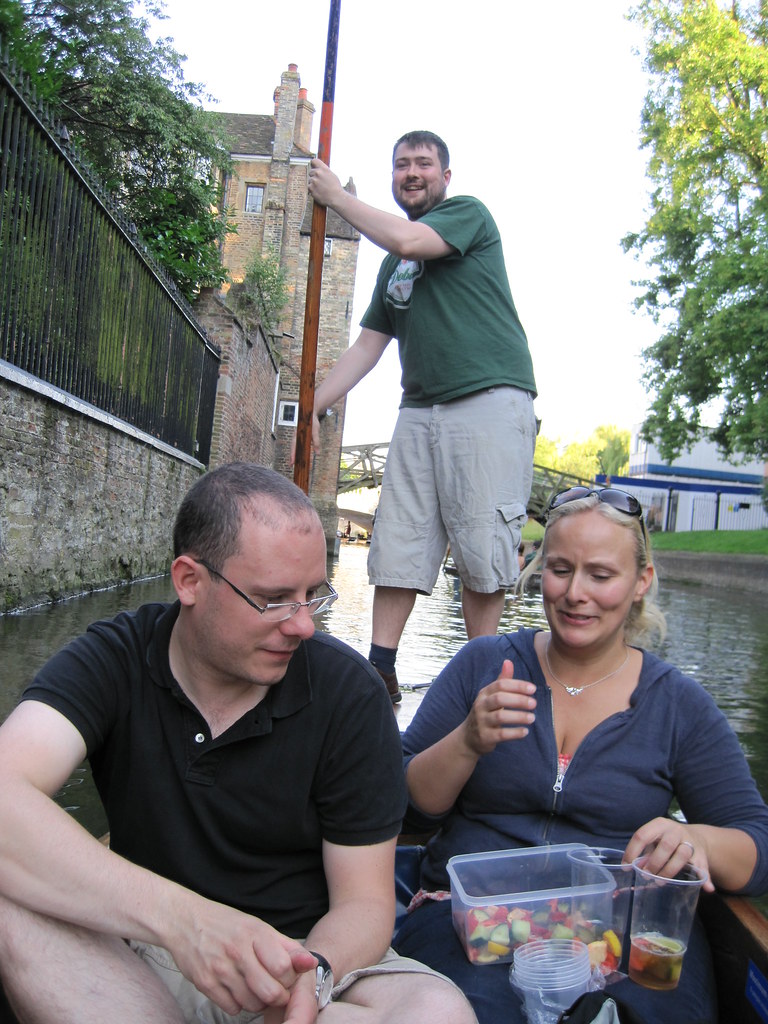
Vincent Sanders: Pimm's and Punting

The Sun came out in Cambridge the other week (yes I know, a rare occurrence) and because Robert is a generous soul he decided the office should go punting on the cam.

I had not previously been out on the river but Robert proved to be the consummate punter.

We even got fruit based drinks and some serenading, although perhaps that was not a benefit.


I took many photos of the event including the rather nice meal afterwards, some were even in focus and not blurry.

5 August 2012

Stefano Zacchiroli: bits from the DPL for July 2012

Monthly DPL bits, fresh from the oven.
Tip to feel good about the release #476: before reading this, grab and fix one of the RC bugs affecting Wheezy. Done? Now you're ready for a slightly less exciting report of DPL activities. Highlights Assets Logo & trademark Note that the actual logo relicensing should be done by SPI, via their board, upon request of mine (as Debian Project liaison). We won't make it for the next SPI board meeting, as it is on 4 days away. But we can aim for the subsequent meeting, on September 13th. If all goes well (big "if"), we will enjoy a DFSG-free logo after that date. Internal organization Recent flurry of re-organization in the tech-ctte --- which I somewhat triggered pushing for periodic meetings --- seems to be proceeding well. I'm very happy about it, as we all need to trust that tech-ctte decisions will be not only sound, but also prompt. If you're interested into this topic, some recent evidence of the ongoing reorganization and its result can be found in their DebConf12 BoF, minutes of the last meeting, a set of forthcoming GRs, and the recent great decision of posting decisions results to d-d-a (as it happened for node/nodejs). Kudos to tech-ctte members for the recent activism! I haven't worked on it myself directly, but I highlight Enrico's work on server side archival of NM conversations. It has the potential of enabling automatic detection of stuck NM processes. I'm a bit rusty as AM now, but I think missing that ability is one of the main remaining causes of frustration when joining Debian. So, if you are an AM, please opt-in and use this feature with your appicants. If you are not an AM why not? :-) Miscellanea Some misc legal stuff: and some misc "political" stuff: Happy RC bug squashing,
Cheers.
PS the boring day-to-day activity log for July 2012 is available at master:/srv/leader/news/bits-from-the-DPL.txt.201207

Steve Kemp: minidlna is now packaged

So in my previous entry I talked about streaming audio media to my new tablet. Despite it working for others I couldn't get MPDroid to stream to my tablet from my MPD server successfully. After looking around for alternatives I used MediaTomb to stream my content to the Android "2player" application. After a while I switched from MediaTomb to minidlna instead - that application being built from source. To save myself effort, and be useful, I've packaged that for Squeeze here : There's a configuration file in /etc/minidlna and a trivial init-script. Works for me. In more fun news yesterday I endured and epic 8 hour bus trip and travelled from Edinburgh to Loch Ness. Why go to Loch Ness? Well I fancied a swim, and wanted to capture shots of hairy cows. In addition to that I saw several interesting birds and a lot of Scottish Scenery. All in all a good day out. ObQuote: "It's not you. It's me... I'm completely fucked up."- Cruel Intentions

4 August 2012

Russell Coker: Love of Technology at First Sight

After seeing the Retina display I ve been thinking about the computer products that I ve immediately desired. Here is the list of the ones I can still remember:
  1. My first computer which was the TEC-1 [1], in 1982 or 1983.
  2. A computer with a full keyboard and a monitor (Microbee), in about 1984. A hex-only keypad is very limiting.
  3. Unix, initially SunOS 4.0 in 1991. Primarily the benefits of this were TCP/IP networking, fast email (no multi-day delay for Fidonet mail), IRC, and file transfer from anywhere in the world. Not inherent benefits to Unix, but at the time only Unix systems did TCP/IP at all well.
  4. OS/2 2.0 in 1992. At the time OS/2 had the best GUI of any system available (IMHO) and clearly the best multitasking of DOS and Windows programs.
  5. Linux in 1992. I started with the TAMU and MCC Interim distributions and then moved to SLS when it was released. The first kernel I compiled was about 0.52. At the time the main use of Linux for almost everyone was to learn about Unix and compile kernels. In 1993 I started running a public access Linux server.
  6. Trinitron monitors in 1996. I first saw an IBM Trinitron monitor when working on an IBM project and had to buy one for home use, at the time a 17 Trinitron monitor beat the hell out of any other display device that one could reasonably afford. A bigger screen allowed me to display more code at once which allowed easier debugging.
  7. Thinkpad laptops from 1998 until now. They just keep working well and seem to be better than other products every time I compare them. I also like the TrackPoint. 1998 was when a Thinkpad dropped to a mere $3,800 for a system that could run with 96M of RAM, enough compute power for the biggest compiles and it cost less than most cars!
  8. The KDE desktop environment in 1998. In 1998 I switched my primary workstation from a PC running OS/2 to a Thinkpad running Linux because of KDE. Prior to KDE nothing on Linux was user-friendly enough.
  9. The iPaQ hand-held PC. I got one in 2002 and ran the Familiar distribution of Linux on it. I had it running SE Linux and used it for writing an article for Linux Journal. Being able to get a computer out on public transport to do some work really saved some time. In some ways the iPaQ hardware and the Familiar OS beat modern Android systems.
  10. The EeePC 701 which I bought in 2008 [2]. In the last 4 years someone has probably released a system that s no larger or heavier and has the same amount of compute power (enough for web browsing, email, and ssh). But most Netbooks that I ve seen don t compete. The EeePC allowed me to take laptops to places where it previously wasn t convenient.
  11. Android, before using Android I never had a smart phone that I used for anything other than taking photos. The other smart phone OSs are either locked down or don t have the app support that Android has. I listed lots of problems with my first phone the Sony Ericsson Xperia X10, but I still really enjoyed using it a lot [3]. Since getting an Android phone I ve read a lot of email while on the go, this means I can respond faster when necessary and use time that might otherwise be wasted. The ssh client means that I don t need to carry a laptop with me when there s a risk that emergency sysadmin work may be required.
  12. Cheap rented servers, Amazon defined cloud computing with EC2, Linode offers great deals for small virtual servers, and Hetzner offers amazing deals on renting entire servers. Getting your own Internet connection or running your own physical server in someone s data-center is a lot of effort and expense. Being able to just rent servers is so much easier and allows so many new projects. I can t remember when I first started using such services, maybe 5 years ago.
  13. The Apple Retina Display [4] a few days ago.
For the period between 1998 and 2008 I can t think of anything that really excited me apart from the iPaQ. Computers became a lot smaller, faster, cheaper, etc. But it was never a big exciting change. The AMD64 architecture wasn t particularly exciting as most systems didn t need more than 4G of RAM and the ones that did could use PAE. What are the most exciting computer products you have seen? Related posts:
  1. Old PDA vs New Mobile Phone for PDA use Since about 2002 I have been using a iPaQ [1]...
  2. CyanogenMod and the Galaxy S Thanks to some advice from Philipp Kern I have now...
  3. Moving from a Laptop to a Cloud Lifestyle My Laptop History In 1998 I bought my first laptop,...

31 July 2012

Martin Pitt: My impressions from GUADEC

I have had the pleasure of attending GUADEC in full this year. TL;DR: A lot of great presentations + lots of hall conversations about QA stuff + the obligatory be er,ach = . Last year I just went to the hackfest, and I never made it to any previous one, so GUADEC 2012 was a kind of first-time experience for me. It was great to put some faces and personal impressions to a lot of the people I have worked with for many years, as well as catching up with others that I did meet before. I discussed various hardware/software testing stuff with Colin Walters, Matthias Clasen, Lennart Poettering, Bertrand Lorentz, and others, so I have a better idea how to proceed with automated testing in plumbing and GNOME now. It was also really nice to meet my fellow PyGObject co-maintainer Paolo Borelli, as well as seeing Simon Schampier and Ignacio Casal Quinteiro again. No need to replicate the whole schedule here (see for yourself on the interwebs), so I just want to point out some personal highlights in the presentations: There were a lot of other good ones, some of them technical and some amusing and enlightening, such as Frederico s review of the history of GNOME. On Monday I prepared and participated in a PyGObject hackfest, but I ll blog about this separately. I want to thank all presenters for the excellent program, as well as the tireless GUADEC organizer team for making everything so smooth and working flawlessly! Great Job, and see you again in Strasbourg or Brno!

Russell Coker: ZFS on Debian/Wheezy

As storage capacities increase the probability of data corruption increases as does the amount of time required for a fsck on a traditional filesystem. Also the capacity of disks is increasing a lot faster than the contiguous IO speed which means that the RAID rebuild time is increasing, for example my first hard disk was 70M and had a transfer rate of 500K/s which meant that the entire contents could be read in a mere 140 seconds! The last time I did a test on a more recent disk a 1TB SATA disk gave contiguous transfer rates ranging from 112MB/s to 52MB/s which meant that reading the entire contents took 3 hours and 10 minutes, and that problem is worse with newer bigger disks. The long rebuild times make greater redundancy more desirable. BTRFS vs ZFS Both BTRFS and ZFS checksum all data to cover the case where a disk returns corrupt data, they don t need a fsck program, and the combination of checksums and built-in RAID means that they should have less risk of data loss due to a second failure during rebuild. ZFS supports RAID-Z which is essentially a RAID-5 with checksums on all blocks to handle the case of corrupt data as well as RAID-Z2 which is a similar equivalent to RAID-6. RAID-Z is quite important if you don t want to have half your disk space taken up by redundancy or if you want to have your data survive the loss or more than one disk, so until BTRFS has an equivalent feature ZFS offers significant benefits. Also BTRFS is still rather new which is a concern for software that is critical to data integrity. I am about to install a system to be a file server and Xen server which probably isn t going to be upgraded a lot over the next few years. It will have 4 disks so ZFS with RAID-Z offers a significant benefit over BTRFS for capacity and RAID-Z2 offers a significant benefit for redundancy. As it won t be upgraded a lot I ll start with Debian/Wheezy even though it isn t released yet because the system will be in use without much change well after Squeeze security updates end. ZFS on Wheezy Getting ZFS to basically work isn t particularly hard, the ZFSonLinux.org site has the code and reasonable instructions for doing it [1]. The zfsonlinux code doesn t compile out of the box on Wheezy although it works well on Squeeze. I found it easier to get a the latest Ubuntu working with ZFS and then I rebuilt the Ubuntu packages for Debian/Wheezy and they worked. This wasn t particularly difficult but it s a pity that the zfsonlinux site didn t support recent kernels. Root on ZFS The complication with root on ZFS is that the ZFS FAQ recommends using whole disks for best performance so you can avoid alignment problems on 4K sector disks (which is an issue for any disk large enough that you want to use it with ZFS) [2]. This means you have to either use /boot on ZFS (which seems a little too experimental for me) or have a separate boot device. Currently I have one server running with 4*3TB disks in a RAID-Z array and a single smaller disk for the root filesystem. Having a fifth disk attached by duct-tape to a system that is only designed for four disks isn t ideal, but when you have an OS image that is backed up (and not so important) and a data store that s business critical (but not needed every day) then a failure on the root device can be fixed the next day without serious problems. But I want to fix this and avoid creating more systems like it. There is some good documentation on using Ubuntu with root on ZFS [3]. I considered using Ubuntu LTS for the server in question, but as I prefer Debian and I can recompile Ubuntu packages for Debian it seems that Debian is the best choice for me. I compiled those packages for Wheezy, did the install and DKMS build, and got ZFS basically working without much effort. The problem then became getting ZFS to work for the root filesystem. The Ubuntu packages didn t work with the Debian initramfs for some reason and modules failed to load. This wasn t necessarily a show-stopper as I can modify such things myself, but it s another painful thing to manage and another way that the system can potentially break on upgrade. The next issue is the unusual way that ZFS mounts filesystems. Instead of having block devices to mount and entries in /etc/fstab the ZFS system does things for you. So if you want a ZFS volume to be mounted as root you configure the mountpoint via the zfs set mountpoint command. This of course means that it doesn t get mounted if you boot with a different root filesystem and adds some needless pain to the process. When I encountered this I decided that root on ZFS isn t a good option. So for this new server I ll install it with an Ext4 filesystem on a RAID-1 device for root and /boot and use ZFS for everything else. Correct Alignment After setting up the system with a 4 disk RAID-1 (or mirror for the pedants who insist that true RAID-1 has only two disks) for root and boot I then created partitions for ZFS. According to fdisk output the partitions /dev/sda2, /dev/sdb2 etc had their first sector address as a multiple of 2048 which I presume addresses the alignment requirement for a disk that has 4K sectors. Installing ZFS deb http://www.coker.com.au wheezy zfs I created the above APT repository (only AMD64) for ZFS packages based on Darik Horn s Ubuntu packages (thanks for the good work Darik). Installing zfs-dkms, spl-dkms, and zfsutils gave a working ZFS system. I could probably have used Darik s binary packages but I think it s best to rebuild Ubuntu packages to use on Debian. The server in question hasn t gone live in production yet (it turns out that we don t have agreement on what the server will do). But so far it seems to be working OK. Related posts:
  1. Discovering OS Bugs and Using Snapshots I m running Debian/Unstable on an EeePC 701, I ve got an...
  2. Starting with BTRFS Based on my investigation of RAID reliability [1] I have...
  3. ZFS vs BTRFS on Cheap Dell Servers I previously wrote about my first experiences with BTRFS [1]....

30 July 2012

Russell Coker: Links July 2012

The New York Times has an interesting article about hacker hostels [1]. I had an idea for similar things after watching a Japanese movie about Tokiwa-s a shared apartment for Manga artists which among others inspired the creator of Astro Boy [2]. The TED blog has an interesting interview with William Noel about open access to art and historical data [3]. Most of his talk concerns an Archimedes codex which has been recovered and published on the Internet. He advocates publishing all manner of art and historical data under a Creative Commons license. The education system is often criticised for trying too hard to make children feel successful and not teaching them skills needed to be successful, it seems that the US military fails the same way in it s war games [4]. Webroot.com published an interesting article last year about the first BIOS rootkit in the wild [5]. I really wish that they would design motherboards with a switch to enable BIOS writing which would default to off . I recently did a poll at a LUG meeting and found that only half the audience had updated the BIOS on most systems they owned, if the most technical people generally don t need a dangerous feature then it should probably be disabled by default. Matthew Wright wrote an interesting article about the costs of upgrading the electricity grid in Australia vs the costs of upgrading air-conditioners [6]. It seems that it would be a lot cheaper for the government to buy everyone a new air-conditioner than to upgrade the grid. Owl City has a post of 10 Myths About Introverts [7]. That could probably be titled 10 Myths About Aspies and still be correct. Susan Cain gave the most popular talk of TED 2012 about The Power of Introverts , here is an interesting interview about the talk and Introversion [8]. Related posts:
  1. Links April 2012 Karen Tse gave an interesting TED talk about how to...
  2. Links July 2011 The Reid Report has an article about the marriage pledge...
  3. Links March 2012 Washington s Blog has an informative summary of recent articles about...

Next.

Previous.