Search Results: "ed"

25 May 2023

Jonathan Carter: Upgraded this host to Debian 12 (bookworm)

I upgraded the host running my blog to Debian 12 today. My website has existed in some form since 1997, it changed from pure html to a Python CGI script in the early 2000s, and when blogging became big around then, I migrated to WordPress around 2004. This WordPress instance ran on Ubuntu up until 2010, and then on Debian ever since. Upgrades are just too easy. I did end up hitting one small bug with today s upgrade though, I run the PHP fast process manager on the Apache MPM event server, and during upgrade, php8.2-fpm wasn t enabled somehow (contrary to what I would expect), at least a simple 'a2conf enable php8.2-fpm' saved my site again after a (very rare) few minutes of downtime.

Bits from Debian: New Debian Developers and Maintainers (March and April 2023)

The following contributors got their Debian Developer accounts in the last two months: The following contributors were added as Debian Maintainers in the last two months: Congratulations!

24 May 2023

Jonathan McDowell: RIP Brenda McDowell

My mother died earlier this month. She d been diagnosed with cancer back in February 2022 and had been through major surgery and a couple of rounds of chemotherapy, so it wasn t a complete surprise even if it was faster at the end than expected. That doesn t make it easy, but I m glad to be able to say that her immediate family were all with her at home at the end. I was touched by the number of people who turned up, both to the wake and the subsequent funeral ceremony. Mum had done a lot throughout her life and was settled in Newry, and it was nice to see how many folk wanted to pay their respects. It was also lovely to hear from some old school friends who had fond memories of her. There are many things I could say about her, but I don t feel that here is the place to do so. My father and brother did excellent jobs at eulogies at the funeral. However, while I blog less about life things than I did in the past, I did not want it to go unmarked here. She was my Mum, I loved her, and I am sad she is gone.

Scarlett Gately Moore: KDE Gear 23.04.1 Snaps Released! Snapcraft updates and more.

Kweather SnapKweather Snap
I have completed the 23.04.1 KDE Gear applications release for snaps! With this release comes several new KDE Snaps! Plus many long outdated / broken snaps are updated and or fixed! Check them all out here: https://snapcraft.io/search?q=KDE I have been busy triaging and squashing bugs in regards to snaps on https://bugs.kde.org Snapcraft: Updated the kde-neon extension for the newest content pack. Made a core22 qmake plugin with tests PR https://github.com/canonical/craft-parts/pull/463 Future work: Top on my TO-DO list is still PIM. There are many parts, making it more complex. I am working on it though. QT6/KF6 is making it s way to the top of the list as well. KDE Neon has made significant progress here, so I am in early stages of updating our build scripts to generate our qt6/kf6 content snap. Thanks for stopping by! https://gofund.me/2c7b1808 All proceeds go to improving my ability to work. Thanks for your consideration!

Jonathan Carter: Debian Reunion MiniDebConf 2022

It wouldn t be inaccurate to say that I ve had a lot on my plate in the last few years, and that I have a *huge* backlog of little tasks to finish. Just last week, I finally got to all my keysigning from DebConf22. This week, I m at MiniDebConf Germany in Hamburg. It s the second time I m here! And it s great already. Last year I drafted a blog entry, but never got around to publishing it. So, in order to mentally tick off yet another thing, here follows a somewhat imperfect (I had to delete a lot of short-hand because I didn t know what it means anymore), but at least published post about my activities from a year ago. This week (well, last year) I attended my first ever in-person MiniDebConf and MiniDebCamp in Hamburg, Germany. The last time I was in Germany was 7 years ago for DebConf15 (or at time of publishing, actually, last year for this same event). My focus for the week was to work on Debian live related stuff. In preparation for the week I tried to fix/close as many Calamares bugs as I could, so before the event I closed: Monday to Friday we worked together on various issues, and the weekend was for talks. On Monday morning, I had a nice discussion with Roland Clobus who has been working on making Debian live images reproducible. He s also been working on testing Debian Live on openqa.debian.net. We re planning on integrating his work so that Debian 12 live images will be reproducible. For automated testing on openqa, it will be ongoing work, one blocker has been that snapshots.debian.org limits connections after a while, so builds on there start failing fast.
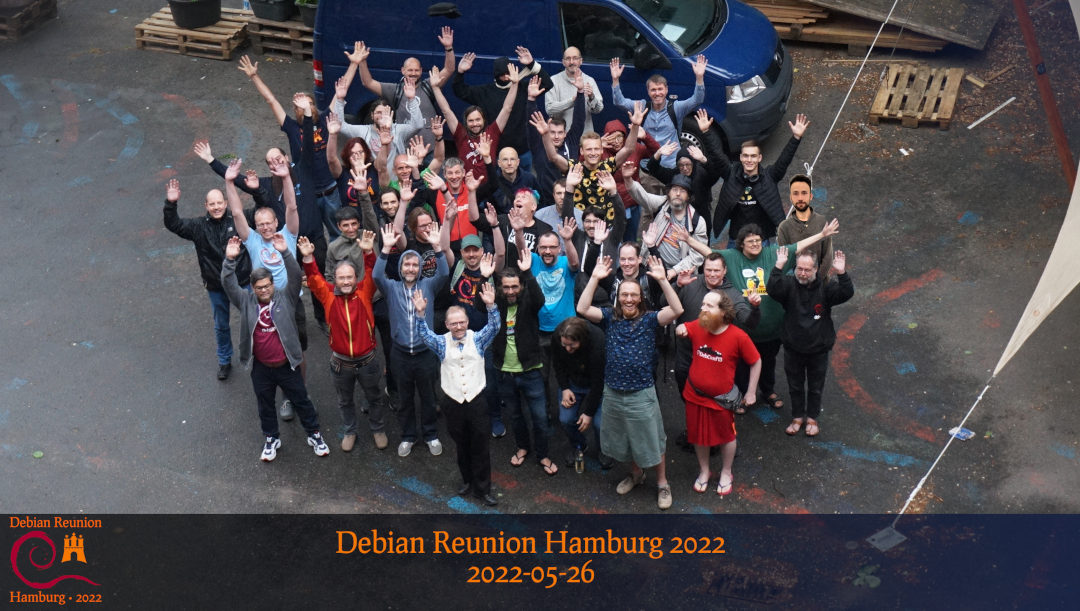
On Monday afternoon, I went ahead and uploaded the latest Calamares hotfix (Calamares 3.2.58.1-1) release that fixes a UI issue on the partitioning screen where it could get stuck. On 15:00 we had a stand-up meeting where we introduced ourselves and talked a bit about our plans. It was great to see how many people could benefit from each other being there. For example, someone wanting to learn packaging, another wanting to improve packaging documentation, another wanting help with packaging something written in Rust, another wanting to improve Rust packaging in general and lots of overlap when it comes to reproducible builds! I also helped a few people with some of their packaging issues. On Monday evening, someone in videoteam managed to convince me to put together a loopy loop for this MiniDebConf. There s really wasn t enough time to put together something elaborate, but I put something together based on the previous loopy with some experiments that I ve been working on for the upcoming DC22 loopy, and we can use this loop to do a call for content for the DC22 loop. On Tuesday morning had some chats with urbec and Ilu,Tuesday afternoon talked to MIA team about upcoming removals. Did some admin on debian.ch payments for hosting. On Tuesday evening worked on live image stuff (d-i downloader, download module for dmm). On Wednesday morning I slept a bit late, then had to deal with some DPL admin/legal things. Wednesday afternoon, more chats with people. On Thursday: Talked to a bunch more people about a lot of issues, got loopy in a reasonably shape, edited and published the Group photo!
On Friday: prepared my talk slides, learned about Brave (https://github.com/bbc/brave) It initially looked like a great compositor for DebConf video stuff (and possible replacement for OBS, but it turned out it wasn t really maintained upstream). In the evening we had the Cheese and Wine party, where lots of deliciousness was experienced. On Saturday, I learned from Felix s talk that Tensorflow is now in experimental! (and now in 2023 I checked again and that s still the case, although it hasn t made it s way in unstable yet, hopefully that improves over the trixie cycle) I know most of the people who attended quite well, but it was really nice to also see a bunch of new Debianites that I ve only seen online before and to properly put some faces to names. We also had a bunch of enthusiastic new contributors and we did some key signing.

23 May 2023

Craig Small: Devices with cgroup v2

Docker and other container systems by default restrict access to devices on the host. They used to do this with cgroups with the cgroup v1 system, however, the second version of cgroups removed this controller and the man page says:
Cgroup v2 device controller has no interface files and is implemented on top of cgroup BPF.
https://www.kernel.org/doc/Documentation/admin-guide/cgroup-v2.rst
That is just awesome, nothing to see here, go look at the BPF documents if you have cgroup v2. With cgroup v1 if you wanted to know what devices were permitted, you just would cat /sys/fs/cgroup/XX/devices.allow and you were done! The kernel documentation is not very helpful, sure its something in BPF and has something to do with the cgroup BPF specifically, but what does that mean? There doesn t seem to be an easy corresponding method to get the same information. So to see what restrictions a docker container has, we will have to:
  1. Find what cgroup the programs running in the container belong to
  2. Find what is the eBPF program ID that is attached to our container cgroup
  3. Dump the eBPF program to a text file
  4. Try to interpret the eBPF syntax
The last step is by far the most difficult.

Finding a container s cgroup All containers have a short ID and a long ID. When you run the docker ps command, you get the short id. To get the long id you can either use the --no-trunc flag or just guess from the short ID. I usually do the second.
$ docker ps 
CONTAINER ID   IMAGE            COMMAND       CREATED          STATUS          PORTS     NAMES
a3c53d8aaec2   debian:minicom   "/bin/bash"   19 minutes ago   Up 19 minutes             inspiring_shannon
So the short ID is a3c53d8aaec2 and the long ID is a big ugly hex string starting with that. I generally just paste the relevant part in the next step and hit tab. For this container the cgroup is /sys/fs/cgroup/system.slice/docker-a3c53d8aaec23c256124f03d208732484714219c8b5f90dc1c3b4ab00f0b7779.scope/ Notice that the last directory has docker- then the short ID. If you re not sure of the exact path. The /sys/fs/cgroup is the cgroup v2 mount point which can be found with mount -t cgroup2 and then rest is the actual cgroup name. If you know the process running in the container then the cgroup column in ps will show you.
$ ps -o pid,comm,cgroup 140064
    PID COMMAND         CGROUP
 140064 bash            0::/system.slice/docker-a3c53d8aaec23c256124f03d208732484714219c8b5f90dc1c3b4ab00f0b7779.scope
Either way, you will have your cgroup path.

eBPF programs and cgroups Next we will need to get the eBPF program ID that is attached to our recently found cgroup. To do this, we will need to use the bpftool. One thing that threw me for a long time is when the tool talks about a program or a PROG ID they are talking about the eBPF programs, not your processes! With that out of the way, let s find the prog id.
$ sudo bpftool cgroup list /sys/fs/cgroup/system.slice/docker-a3c53d8aaec23c256124f03d208732484714219c8b5f90dc1c3b4ab00f0b7779.scope/
ID       AttachType      AttachFlags     Name
90       cgroup_device   multi
Our cgroup is attached to eBPF prog with ID of 90 and the type of program is cgroup _device.

Dumping the eBPF program Next, we need to get the actual code that is run every time a process running in the cgroup tries to access a device. The program will take some parameters and will return either a 1 for yes you are allowed or a zero for permission denied. Don t use the file option as it dumps the program in binary format. The text version is hard enough to understand.
sudo bpftool prog dump xlated id 90 > myebpf.txt
Congratulations! You now have the eBPF program in a human-readable (?) format.

Interpreting the eBPF program The eBPF format as dumped is not exactly user friendly. It probably helps to first go and look at an example program to see what is going on. You ll see that the program splits type (lower 4 bytes) and access (higher 4 bytes) and then does comparisons on those values. The eBPF has something similar:
   0: (61) r2 = *(u32 *)(r1 +0)
   1: (54) w2 &= 65535
   2: (61) r3 = *(u32 *)(r1 +0)
   3: (74) w3 >>= 16
   4: (61) r4 = *(u32 *)(r1 +4)
   5: (61) r5 = *(u32 *)(r1 +8)
What we find is that once we get past the first few lines filtering the given value that the comparison lines have:
  • r2 is the device type, 1 is block, 2 is character.
  • r3 is the device access, it s used with r1 for comparisons after masking the relevant bits. mknod, read and write are 1,2 and 3 respectively.
  • r4 is the major number
  • r5 is the minor number
For a even pretty simple setup, you are going to have around 60 lines of eBPF code to look at. Luckily, you ll often find the lines for the command options you added will be near the end, which makes it easier. For example:
  63: (55) if r2 != 0x2 goto pc+4
  64: (55) if r4 != 0x64 goto pc+3
  65: (55) if r5 != 0x2a goto pc+2
  66: (b4) w0 = 1
  67: (95) exit
This is a container using the option --device-cgroup-rule='c 100:42 rwm'. It is checking if r2 (device type) is 2 (char) and r4 (major device number) is 0x64 or 100 and r5 (minor device number) is 0x2a or 42. If any of those are not true, move to the next section, otherwise return with 1 (permit). We have all access modes permitted so it doesn t check for it. The previous example has all permissions for our device with id 100:42, what about if we only want write access with the option --device-cgroup-rule='c 100:42 r'. The resulting eBPF is:
  63: (55) if r2 != 0x2 goto pc+7  
  64: (bc) w1 = w3
  65: (54) w1 &= 2
  66: (5d) if r1 != r3 goto pc+4
  67: (55) if r4 != 0x64 goto pc+3
  68: (55) if r5 != 0x2a goto pc+2
  69: (b4) w0 = 1
  70: (95) exit
The code is almost the same but we are checking that w3 only has the second bit set, which is for reading, effectively checking for X==X&2. It s a cautious approach meaning no access still passes but multiple bits set will fail.

The device option docker run allows you to specify files you want to grant access to your containers with the --device flag. This flag actually does two things. The first is to great the device file in the containers /dev directory, effectively doing a mknod command. The second thing is to adjust the eBPF program. If the device file we specified actually did have a major number of 100 and a minor of 42, the eBPF would look exactly like the above snippets.

What about privileged? So we have used the direct cgroup options here, what does the --privileged flag do? This lets the container have full access to all the devices (if the user running the process is allowed). Like the --device flag, it makes the device files as well, but what does the filtering look like? We still have a cgroup but the eBPF program is greatly simplified, here it is in full:
   0: (61) r2 = *(u32 *)(r1 +0)
   1: (54) w2 &= 65535
   2: (61) r3 = *(u32 *)(r1 +0)
   3: (74) w3 >>= 16
   4: (61) r4 = *(u32 *)(r1 +4)
   5: (61) r5 = *(u32 *)(r1 +8)
   6: (b4) w0 = 1
   7: (95) exit
There is the usual setup lines and then, return 1. Everyone is a winner for all devices and access types!

Jonathan Dowland: neovim plugins and distributions

I've been watching the neovim community for a while and what seems like a cambrian explosion of plugins emerging. A few weeks back I decided to spend most of a "day of learning" on investigating some of the plugins and technologies that I'd read about: Language Server Protocol, TreeSitter, neorg (a grandiose organiser plugin), etc. It didn't go so well. I spent most of my time fighting version incompatibilities or tracing through scant documentation or code to figure out what plugin was incompatible with which other. There's definitely a line where crossing it is spending too much time playing with your tools instead of creating. On the other hand, there's definitely value in honing your tools and learning about new technologies. Everyone's line is probably in a different place. I've come to the conclusion that I don't have the time or inclination (or both) to approach exploring the neovim universe in this way. There exist a number of plugin "distributions" (such as LunarVim): collections of pre- configured and integrated plugins that you can try to use out-of-the-box. Next time I think I'll pick one up and give that a try &emdash independently from my existing configuration &emdash and see which ideas from it I might like to adopt. shared vimrcs Some folks upload their vim or neovim configurations in their entirety for others to see. I noticed Jess Frazelle had published hers so I took a look. I suppose one could evaluate a bunch of plugins and configuration in isolation using a shared vimrc like this, in the same was as a distribution. bufferline Amongst the plugins she uses was bufferline, a plugin to re-work neovim's tab bar to behave like tab bars from more conventional editors1. I don't make use of neovim's tabs at all2, so I would lose nothing having the (presently hidden) tab bar reworked, so I thought I'd give it a go. I had to disable an existing plugin lightline, which I've had enabled for years but I wasn't sure I was getting much value from. Apparently it also messes with the tab bar! Disabling it, at least for now, at least means I'll find out if I miss it. I am already using vim-buffergator as a means of seeing and managing open buffers: a hotkey opens a sidebar with a list of open buffers, to switch between or close. Bufferline gives me a more immediate, always-present view of open buffers, which is faintly useful: but not much. Perhaps I'd like it more if I was coming from an editor that had made it more of an expected feature. The two things I noticed about it that aren't especially useful for me: when browsing around vimwiki pages, I quickly open a lot of buffers. The horizontal line fills up very quickly. Even when I don't, I habitually have quite a lot of buffers open, and the horizontal line is quickly overwhelmed. I have found myself closing open buffers with the mouse, which I didn't do before. vert Since I have brought up a neovim UI feature (tabs) I thought I'd briefly mention my new favourite neovim built-in command: vert. Quite a few plugins and commands open up a new window (e.g. git-fugitive, Man, etc.) and they typically do so in a horizontal split. I'm increasingly preferring vertical splits. Prefixing any3 such command with vert forces the split to be vertical instead.

  1. in this case the direct influence was apparently DOOM Emacs
  2. (neo)vim's notion of tabs is completely different to what you might expect from other UI models.
  3. at least, I haven't found one that doesn't work yet

Bits from Debian: proxmox Platinum Sponsor of DebConf23

proxmoxlogo We are pleased to announce that Proxmox has committed to sponsor DebConf23 as a Platinum Sponsor. Proxmox develops powerful, yet easy-to-use open-source server software. The product portfolio from Proxmox, including server virtualization, backup, and email security, helps companies of any size, sector, or industry to simplify their IT infrastructures. The Proxmox solutions are based on the great Debian platform, and we are happy that we can give back to the community by sponsoring DebConf23. With this commitment as Platinum Sponsor, Proxmox is contributing to make possible our annual conference, and directly supporting the progress of Debian and Free Software, helping to strengthen the community that continues to collaborate on Debian projects throughout the rest of the year. Thank you very much Proxmox, for your support of DebConf23! Become a sponsor too! DebConf23 will take place from September 10th to 17th, 2022 in Kochi, India, and will be preceded by DebCamp, from September 3rd to 9th. And DebConf23 is accepting sponsors! Interested companies and organizations may contact the DebConf team through sponsors@debconf.org, and visit the DebConf23 website at https://debconf23.debconf.org/sponsors/become-a-sponsor/.

Sergio Durigan Junior: Using WireGuard to host services at home

It s been a while since I had this idea to leverage the power of WireGuard to self-host stuff at home. Even though I pay for a proper server somewhere in the world, there are some services that I don t consider critical to put there, or that I consider too critical to host outside my home.

It s only NATural With today s ISP packages for end users, I find it very annoying the amount of trouble they create when you try to host anything at home. Dynamic IPs, NAT/CGNAT, port-blocking, traffic shapping are only a few examples of methods or limitations that prevent users from making local services reachable in a reliable way from outside.

WireGuard comes to help If you already pay for a VPS or a dedicated server somewhere, why not use its existing infrastructure (and public availability) in your favour? That s what I thought when I started this journey. My initial idea was to use a reverse proxy to redirect external requests to the service running at my home. But how could I make sure that these requests reach my dynamic-IP-behind-a-NAT-behind-another-NAT? Well, let s create a tunnel! WireGuard is the perfect tool for that because of many things: it s stateless, very performant, secure, and requires very little configuration.

Setting up on the server On the server side (i.e., VPS or dedicated server), you will create the first endpoint. Something like the following should do:
[Interface]
PrivateKey = PRIVATE_KEY_HERE
Address = 10.0.0.1/32
ListenPort = 51821
[Peer]
PublicKey = PUBLIC_KEY_HERE
AllowedIps = 10.0.0.2/32
PersistentKeepalive = 10
A few interesting points to note:
  • The Peer section contains information about the home service that will be configured below.
  • I m using PersistentKeepalive because I have a dynamic IP at my home. If you have a static IP, you could get rid of PersistentKeepalive and specify an Endpoint here (don t forget to set a ListenPort below, in the Interface section).
  • Now you have an IP where you can forward requests to. If we re talking about HTTP traffic, Apache and nginx are absolutely capable of doing it. If we re talking about other kind of traffic, you might want to look into other utilities, like HAProxy, Traefik and others.

Setting up at your home At your home, you will configure the peer:
[Interface]
PrivateKey = PRIVATE_KEY_HERE
Address = 10.0.0.2/32
[Peer]
PublicKey = PUBLIC_KEY_HERE
AllowedIps = 10.0.0.1/32
Endpoint = YOUR_SERVER:51821
PersistentKeepalive = 10

A few notes about security I would be remiss if I didn t say anything about security, especially because we re talking about hosting services at home. So, here are a few recommendations:
  • Make sure to put your services in a separate local network. Using VLANs is also a good option.
  • Don t run services on your personal (or work!) computer, even if they ll be running inside a VM.
  • Run a firewall on the WireGuard interface and make sure that you only allow traffic over the required ports.
Have fun!

Russ Allbery: Review: A Half-Built Garden

Review: A Half-Built Garden, by Ruthanna Emrys
Publisher: Tordotcom
Copyright: 2022
ISBN: 1-250-21097-6
Format: Kindle
Pages: 340
The climate apocalypse has happened. Humans woke up to the danger, but a little bit too late. Over one billion people died. But the world on the other side of that apocalypse is not entirely grim. The corporations responsible for so much of the damage have been pushed out of society and isolated on their independent "aislands," traded with only grudgingly for the few commodities the rest of the world has not yet learned how to manufacture without them. Traditional governments have largely collapsed, although they cling to increasingly irrelevant trappings of power. In their place arose the watershed networks: a new way of living with both nature and other humans, built around a mix of anarchic consensus and direct democracy, with conservation and stewardship of the natural environment at its core. Therefore, when the aliens arrive near Bear Island on the Potomac River, they're not detected by powerful telescopes and met by military jets. Instead, their waste sets off water sensors, and they're met by the two women on call for alert duty, carrying a nursing infant and backed by the real-time discussion and consensus technology of the watershed's dandelion network. (Emrys is far from the first person to name something a "dandelion network," so be aware that the usage in this book seems unrelated to the charities or blockchain network.) This is a first contact novel, but it's one that skips over the typical focus of the subgenre. The alien Ringers are completely fluent in English down to subtle nuance of emotion and connotation (supposedly due to observation of our radio and TV signals), have translation devices, and in some cases can make our speech sounds directly. Despite significantly different body shapes, they are immediately comprehensible; differences are limited mostly to family structure, reproduction, and social norms. This is Star Trek first contact, not the type more typical of written science fiction. That feels unrealistic, but it's also obviously an authorial choice to jump directly to the part of the story that Emrys wants to write. The Ringers have come to save humanity. In their experience, technological civilization is inherently incompatible with planets. Technology will destroy the planet, and the planet will in turn destroy the species unless they can escape. They have reached other worlds multiple times before, only to discover that they were too late and everyone is already dead. This is the first time they've arrived in time, and they're eager to help humanity off its dying planet to join them in the Dyson sphere of space habitats they are constructing. Planets, to them, are a nest and a launching pad, something to eventually abandon and break down for spare parts. The small, unexpected wrinkle is that Judy, Carol, and the rest of their watershed network are not interested in leaving Earth. They've finally figured out the most critical pieces of environmental balance. Earth is going to get hotter for a while, but the trend is slowing. What they're doing is working. Humanity would benefit greatly from Ringer technology and the expertise that comes from managing closed habitat ecosystems, but they don't need rescuing. This goes over about as well as a toddler saying that playing in the road is perfectly safe. This is a fantastic hook for a science fiction novel. It does exactly what a great science fiction premise should do: takes current concerns (environmentalism, space boosterism, the debatable primacy of humans as a species, the appropriate role of space colonization, the tension between hopefulness and doomcasting about climate change) and uses the freedom of science fiction to twist them around and come at them from an entirely different angle. The design of the aliens is excellent for this purpose. The Ringers are not one alien species; they are two, evolved on different planets in the same system. The plains dwellers developed space flight first and went to meet the tree dwellers, and while their relationship is not entirely without hierarchy (the plains dwellers clearly lead on most matters), it's extensively symbiotic. They now form mixed families of both species, and have a rich cultural history of stories about first contact, interspecies conflicts and cooperation, and all the perils and misunderstandings that they successfully navigated. It makes their approach to humanity more believable to know that they have done first contact before and are building on a model. Their concern for humanity is credibly sincere. The joining of two species was wildly successful for them and they truly want to add a third. The politics on the human side are satisfyingly complicated. The watershed network may have made first contact, but the US government (in the form of NASA) is close behind, attempting to lean on its widely ignored formal power. The corporations are farther away and therefore slower to arrive, but the alien visitors have a damaged ship and need space to construct a subspace beacon and Asterion is happy to offer a site on one of its New Zealand islands. The corporate representatives are salivating at the chance to escape Earth and its environmental regulation for uncontrolled space construction and a new market of trillions of Ringers. NASA's attitude is more measured, but their representative is easily persuaded that the true future of humanity is in space. The work the watershed networks are doing is difficult, uncertain, and involves a lot of sacrifice, particularly for corporate consumer lifestyles. With such an attractive alien offer on the table, why stay and work so hard for an uncertain future? Maybe the Ringers are right. And then the dandelion networks that the watersheds use as the core of their governance and decision-making system all crash. The setup was great; I was completely invested. The execution was more mixed. There are some things I really liked, some things that I thought were a bit too easy or predictable, and several places where I wish Emrys had dug deeper and provided more detail. I thought the last third of the book fizzled a little, although some of the secondary characters Emrys introduces are delightful and carry the momentum of the story when the politics feel a bit lacking. If you tried to form a mental image of ecofeminist political science fiction with 1970s utopian sensibilities, but updated for the concerns of the 2020s, you would probably come very close to the politics of the watershed networks. There are considerably more breastfeedings and diaper changes than the average SF novel. Two of the primary characters are transgender, but with very different experiences with transition. Pronoun pins are an ubiquitous article of clothing. One of the characters has a prosthetic limb. Another character who becomes important later in the story codes as autistic. None of this felt gratuitous; the characters do come across as obsessed with gender, but in a way that I found believable. The human diversity is well-integrated with the story, shapes the characters, creates practical challenges, and has subtle (and sometimes not so subtle) political ramifications. But, and I say this with love because while these are not quite my people they're closely adjacent to my people, the social politics of this book are a very specific type of white feminist collaborative utopianism. When religion makes an appearance, I was completely unsurprised to find that several of the characters are Jewish. Race never makes a significant appearance at all. It's the sort of book where the throw-away references to other important watershed networks includes African ones, and the characters would doubtless try to be sensitive to racial issues if they came up, but somehow they never do. (If you're wondering if there's polyamory in this book, yes, yes there is, and also I suspect you know exactly what culture I'm talking about.) This is not intended as a criticism, just more of a calibration. All science fiction publishing houses could focus only on this specific political perspective for a year and the results would still be dwarfed by the towering accumulated pile of thoughtless paeans to capitalism. Ecofeminism has a long history in the genre but still doesn't show up in that many books, and we're far from exhausting the space of possibilities for what a consensus-based politics could look like with extensive computer support. But this book has a highly specific point of view, enough so that there won't be many thought-provoking surprises if you're already familiar with this school of political thought. The politics are also very earnest in a way that I admit provoked a bit of eyerolling. Emrys pushes all of the political conflict into the contrasts between the human factions, but I would have liked more internal disagreement within the watershed networks over principles rather than tactics. The degree of ideological agreement within the watershed group felt a bit unrealistic. But, that said, at least politics truly matters and the characters wrestle directly with some tricky questions. I would have liked to see more specifics about the dandelion network and the exact mechanics of the consensus decision process, since that sort of thing is my jam, but we at least get more details than are typical in science fiction. I'll take this over cynical libertarianism any day. Gender plays a huge role in this story, enough so that you should avoid this book if you're not interested in exploring gender conceptions. One of the two alien races is matriarchal and places immense social value on motherhood, and it's culturally expected to bring your children with you for any important negotiation. The watersheds actively embrace this, or at worst find it comfortable to use for their advantage, despite a few hints that the matriarchy of the plains aliens may have a very serious long-term demographic problem. In an interesting twist, it's the mostly-evil corporations that truly challenge gender roles, albeit by turning it into an opportunity to sell more clothing. The Asterion corporate representatives are, as expected, mostly the villains of the plot: flashy, hierarchical, consumerist, greedy, and exploitative. But gender among the corporations is purely a matter of public performance, one of a set of roles that you can put on and off as you choose and signal with clothing. They mostly use neopronouns, change pronouns as frequently as their clothing, and treat any question of body plumbing as intensely private. By comparison, the very 2020 attitudes of the watersheds towards gender felt oddly conservative and essentialist, and the main characters get flustered and annoyed by the ever-fluid corporate gender presentation. I wish Emrys had done more with this. As you can tell, I have a lot of thoughts and a lot of quibbles. Another example: computer security plays an important role in the plot and was sufficiently well-described that I have serious questions about the system architecture and security model of the dandelion networks. But, as with decision-making and gender, the more important takeaway is that Emrys takes enough risks and describes enough interesting ideas that there's a lot of meat here to argue with. That, more than getting everything right, is what a good science fiction novel should do. A Half-Built Garden is written from a very specific political stance that may make it a bit predictable or off-putting, and I thought the tail end of the book had some plot and resolution problems, but arguing with it was one of the more intellectually satisfying science fiction reading experiences I've had recently. You have to be in the right mood, but recommended for when you are. Rating: 7 out of 10

22 May 2023

Adnan Hodzic: rpi-microk8s-bootstrap: Automate RPI device conversion into Kubernetes cluster nodes with Terraform

Considering I ve created my own private cloud in my home as part of: wp-k8s: WordPress on privately hosted Kubernetes cluster (Raspberry Pi 4 + Synology).... The post rpi-microk8s-bootstrap: Automate RPI device conversion into Kubernetes cluster nodes with Terraform appeared first on FoolControl: Phear the penguin.

Russ Allbery: Review: Tsalmoth

Review: Tsalmoth, by Steven Brust
Series: Vlad Taltos #16
Publisher: Tor
Copyright: 2023
ISBN: 1-4668-8970-5
Format: Kindle
Pages: 277
Tsalmoth is the sixteenth book in the Vlad Taltos series and (some fans of the series groan) yet another flashback novel to earlier in Vlad's life. It takes place between Yendi and the interludes in Dragon (or, perhaps more straightforwardly, between Yendi and Jhereg. Most of the books of this series stand alone to some extent, so you could read this book out of order and probably not be horribly confused, but I suspect it would also feel weirdly pointless outside of the context of the larger series. We're back to Vlad running a fairly small operation as a Jhereg, who are the Dragaeran version of organized crime. A Tsalmoth who owes Vlad eight hundred imperials has rudely gotten himself murdered, thoroughly enough that he can't be revived. That's a considerable amount of money, and Vlad would like it back, so he starts poking around. As you might expect if you've read any other book in this series, things then get a bit complicated. This time, they involve Jhereg politics, Tsalmoth house politics, and necromancy (which in this universe is more about dimensional travel than it is about resurrecting the dead). The main story is... fine. Kragar is around being unnoticeable as always, Vlad is being cocky and stubborn and bantering with everyone, and what appears to be a straightforward illegal business relationship turns out to involve Dragaeran magic and thus Vlad's highly-placed friends. As usual, they're intellectually curious about the magic and largely ambivalent to the rest of Vlad's endeavors. The most enjoyable part of the story is Vlad's insistence on getting his money back while everyone else in the story cannot believe he would be this persistent over eight hundred imperials and is certain he has some other motive. It's otherwise a fairly forgettable little adventure. The implications for the broader series, though, are significant, although essentially none of the payoff is here. Brust has been keeping a major secret about Vlad that's finally revealed here, one that has little impact on the plot of this book (although it causes Vlad a lot of angst) but which I suspect will become very important later in the series. That was intriguing but rather unsatisfying, since it stays only a future hook with an attached justification for why we're only finding out about it now. If one has read the rest of the series, it's also nice to see Vlad and Cawti working together, bantering with each other and playing off of each other's strengths. It's reminiscent of the best parts of Yendi. As with many of the books of this series, the chapter introductions tell a parallel story; this time, it's Vlad and Cawti's wedding. I think previous books already mentioned that Vlad is narrating this series into some sort of recording device, and a bit about why he's doing that, but this is made quite explicit here. We get as much of the surrounding frame as we've ever seen before. There are no obvious plot consequences from this it's still all hints and guesswork but I suspect this will also become important by the end of the series. If you've read this much of the series, you'll obviously want to read this one as well, but unfortunately don't get your hopes up for significant plot advancement. This is another station-keeping book, which is a bit of a disappointment. We haven't gotten major plot advancement since Hawk in 2014, and I'm getting impatient. Thankfully, Lyorn has a release date already (April 9, 2024), and assuming all goes according to the grand plan, there are only two books left after Lyorn (Chreotha and The Last Contract). I'm getting hopeful that we're going to get to see the entire series. Meanwhile, I am very tempted to do a complete re-read of the series to date, probably in series chronological order rather than in publication order (as much as that's possible given the fractured timelines of Dragon and Tiassa) so that I can see how the pieces fit together. The constant jumping back and forth and allusions to events that have already happened but that we haven't seen yet is hard to keep track of. I'm very glad the Lyorn Records exists. Followed by Lyorn. Rating: 7 out of 10

21 May 2023

Bits from Debian: Infomaniak First Platinum Sponsor of DebConf23

infomaniaklogo We are pleased to announce that Infomaniak has committed to sponsor DebConf23 as a Platinum Sponsor. Infomaniak is a key player in the European Cloud and the leading developer of Web technologies in Switzerland. It aims to be an independent European alternative to the web giants and is committed to an ethical and sustainable Web that respects privacy and creates local jobs. Infomaniak develops cloud solutions (IaaS, PaaS, VPS), productivity tools for online collaboration and video and radio streaming services. The company uses only renewable electricity, offsets 200% of its CO2 emissions and extends the life of its servers up to 15 years. The company cools its infrastructure with filtered air, without air conditioning, and is building a new data centre that will fully recycle the energy it consumes to heat up to 6,000 homes. With this commitment as Platinum Sponsor, Infomaniak is contributing to make possible our annual conference, and directly supporting the progress of Debian and Free Software, helping to strengthen the community that continues to collaborate on Debian projects throughout the rest of the year. Thank you very much Infomaniak, for your support of DebConf23! Become a sponsor too! DebConf23 will take place from September 10th to 17th, 2022 in Kochi, India, and will be preceded by DebCamp, from September 3rd to 9th. And DebConf23 is accepting sponsors! Interested companies and organizations may contact the DebConf team through sponsors@debconf.org, and visit the DebConf23 website at https://debconf23.debconf.org/sponsors/become-a-sponsor/.

Russ Allbery: Review: The Stone Canal

Review: The Stone Canal, by Ken MacLeod
Series: Fall Revolution #2
Publisher: Tor
Copyright: 1996
Printing: January 2001
ISBN: 0-8125-6864-8
Format: Mass market
Pages: 339
The Stone Canal is a sort of halfway sequel to The Star Fraction. They both take place in the same universe, but the characters are almost entirely disjoint. Half of The Stone Canal happens (mostly) well before the previous book and the other half happens well after it. This book does contain spoilers for the ending of The Star Fraction if one connects the events of the two books correctly (which was a bit harder than I thought it should be), so I would not read them out of order. At the start of The Stone Canal, Jon Wilde wakes up on New Mars beside the titular canal, in the middle of nowhere, accompanied only by a robot that says it made him. Wilde remembers dying on Earth; this new life is apparently some type of resurrection. It's a long walk to Ship City, the center of civilization of a place the robot tells him is New Mars. In Ship City, an android named Dee Model has escaped from her owner and is hiding in a bar. There, she meets an AI abolitionist named Tamara, who helps her flee out the back and down the canal on a boat when Wilde walks into the bar and immediately recognizes her. The abolitionists provide her protection and legal assistance to argue her case for freedom from her owner, a man named Reid. The third thread of the story, and about half the book, is Jon Wilde's life on Earth, starting in 1975 and leading up to the chaotic wars, political fracturing, and revolutions that formed the background and plot of The Star Fraction. Eventually that story turns into a full-fledged science fiction setting, but not until the last 60 pages of the book. I successfully read two books in a Ken MacLeod series! Sadly, I'm not sure I enjoyed the experience. I commented in my review of The Star Fraction that the appeal for me in MacLeod's writing was his reputation as a writer of political science fiction. Unfortunately that's been a bust. The characters are certainly political, in the sense that they profess to have strong political viewpoints and are usually members of some radical (often Trotskyite) organization. There are libertarian anarchist societies and lots of political conflict. But there is almost no meaningful political discussion in any of these books so far. The politics are all tactical or background, and often seem to be created by authorial fiat. For example, New Mars is a sort of libertarian anarchy that somehow doesn't have corporations or a strongman ruler, even though the history (when we finally learn it) would have naturally given rise to one or the other (and has, in numerous other SF novels with similar plots). There's a half-assed explanation for this towards the end of the book that I didn't find remotely believable. Another part of the book describes the formation of the libertarian microstate in The Star Fraction, but never answers a "why" or "how" question I had in the previous book in a satisfying way. Somehow people stop caring about control or predictability or stability or traditional hierarchy without any significant difficulties except external threats, in situations of chaos and disorder where historically humans turn to anyone promising firm structure. It's common to joke about MacLeod winning multiple libertarian Prometheus Awards for his fiction despite being a Scottish communist. I'm finding that much less surprising now that I've read more of his books. Whether or not he believes in it himself, he's got the cynical libertarian smugness and hand-waving down pat. What his characters do care deeply about is smoking, drinking, and having casual sex. (There's more political fire here around opposition to anti-smoking laws than there is about any of the society-changing political structures that somehow fall into place.) I have no objections to any of those activities from a moral standpoint, but reading about other people doing them is a snoozefest. The flashback scenes sketch out enough imagined history to satisfy some curiosity from the previous book, but they're mostly about the world's least interesting love triangle, involving two completely unlikable men and lots of tedious jealousy and posturing. The characters in The Stone Canal are, in general, a problem. One of those unlikable men is Wilde, the protagonist for most of the book. Not only did I never warm to him, I never figured out what motivates him or what he cares about. He's a supposedly highly political person who seems to engage in politics with all the enthusiasm of someone filling out tax forms, and is entirely uninterested in explaining to the reader any sort of coherent philosophical approach. The most interesting characters in this book are the women (Annette, Dee Model, Tamara, and, very late in the book, Meg), but other than Dee Model they rarely get much focus from the story. By far the best part of this book is the last 60 pages, where MacLeod finally explains the critical bridge events between Wilde's political history on earth and the New Mars society. I thought this was engrossing, fast-moving, and full of interesting ideas (at least for a 1990s book; many of them feel a bit stale now, 25 years later). It was also frustrating, because this was the book I wanted to have been reading for the previous 270 pages, instead of MacLeod playing coy with his invented history or showing us interminable scenes about Wilde's insecure jealousy over his wife. It's also the sort of book where at one point characters (apparently uniformly male as far as one could tell from the text of the book) get assigned sex slaves, and while MacLeod clearly doesn't approve of this, the plot is reminiscent of a Heinlein novel: the protagonist's sex slave becomes a very loyal permanent female companion who seems to have the same upside for the male character in question. This was unfortunately not the book I was hoping for. I did enjoy the last hundred pages, and it's somewhat satisfying to have the history come together after puzzling over what happened for 200 pages. But I found the characters tedious and annoying and the politics weirdly devoid of anything like sociology, philosophy, or political science. There is the core of a decent 1990s AI and singularity novel here, but the technology is now rather dated and a lot of other people have tackled the same idea with fewer irritating ticks. Not recommended, although I'll probably continue to The Cassini Division because the ending was a pretty great hook for another book. Followed by The Cassini Division. Rating: 5 out of 10

20 May 2023

Junichi Uekawa: Shared library loading.

Shared library loading. ld.so seems to load shared libraries serially, looking through the load paths, looking through DT_LOADED sections, and looking up library paths or what's in ld.so.cache. I thought I could scan DT_LOADED with just reading approx first 2kB of shared library, and get the full list of shared libraries first, and then readahead(2) the list of shared libraries available. The result was that I could load blender binary slightly faster. blender spends about 300ms waiting for disk loading shared libraries and I could shorten it to about 100ms. sopreload, is a proof of concept with rough edges but I think it's a nice improvement.

19 May 2023

Petter Reinholdtsen: wmbusmeters, parse data from your utility meter - nice free software

There is a European standard for reading utility meters like water, gas, electricity or heat distribution meters. The Meter-Bus standard (EN 13757-2, EN 13757-3 and EN 13757 4) provide a cross vendor way to talk to and collect meter data. I ran into this standard when I wanted to monitor some heat distribution meters, and managed to find free software that could do the job. The meters in question broadcast encrypted messages with meter information via radio, and the hardest part was to track down the encryption keys from the vendor. With this in place I could set up a MQTT gateway to submit the meter data for graphing. The free software systems in question, rtl-wmbus to read the messages from a software defined radio, and wmbusmeters to decrypt and decode the content of the messages, is working very well and allowe me to get frequent updates from my meters. I got in touch with upstream last year to see if there was any interest in publishing the packages via Debian. I was very happy to learn that Fredrik hrstr m volunteered to maintain the packages, and I have since assisted him in getting Debian package build rules in place as well as sponsoring the packages into the Debian archive. Sadly we completed it too late for them to become part of the next stable Debian release (Bookworm). The wmbusmeters package just cleared the NEW queue. It will need some work to fix a built problem, but I expect Fredrik will find a solution soon. If you got a infrastructure meter supporting the Meter Bus standard, I strongly recommend having a look at these nice packages. As usual, if you use Bitcoin and want to show your support of my activities, please send Bitcoin donations to my address 15oWEoG9dUPovwmUL9KWAnYRtNJEkP1u1b.

18 May 2023

Antoine Beaupr : A terrible Pixel Tablet

In a strange twist of history, Google finally woke and thought "I know what we need to do! We need to make a TABLET!". So some time soon in 2023, Google will release "The tablet that only Google could make", the Pixel Tablet. Having owned a Samsung Galaxy Tab S5e for a few years, I was very curious to see how this would pan out and especially whether it would be easier to flash than the Samsung. As an aside, I figured I would give that a shot, and within a few days managed to completely brick the device. Awesome. See gts4lvwifi for the painful details of that. In any case, Google made a tablet. I own a Pixel phone and I'm moderately happy with it. It's easy to flash with CalyxOS, maybe this is the promise land of tablets?

Compared with the Samsung But it turns out that the Pixel Tablet pales in comparison with the Samsung tablet, produced 4 years ago, in 2019:
  • it's thicker (8.1mm vs 5.5mm)
  • it's heavier (493g vs 400g)
  • it's not AMOLED (IPS LCD)
  • it doesn't have an SD card reader
  • its camera is worse (8MP vs 13MP, 1080p video instead of 4k)
  • it's more expensive (670EUR vs 410EUR)
What the Pixel tablet has going for it:
  • a slightly more powerful CPU
  • a stylus
  • more storage (128GB or 256GB vs 64GB or 128GB)
  • more RAM (8GB vs 4GB or 6GB)
  • Wifi 6
I guess I should probably wait for the actual device to come out to see reviews and how it stacks up, but so far it's kind of impressive how underwhelming this is. Also note that we're comparing against a very old Samsung tablet here, a fairer comparison might be against the Samsung Galaxy Tab S8. There the sizes are comparable, and the Samsung is more expensive than the Pixel, but then the Pixel has absolutely zero advantages and all the other disadvantages.

The Dock The "Dock" is also worth a little aside. See, the tablet comes with a dock that doubles as a speaker. You can't buy the tablet without the dock. You have to have a dock. I shit you not, actual quote: "Can I purchase a Pixel Tablet without the Charging Speaker Dock? No, you can only purchase the Pixel Tablet with the Charging Speaker Dock." In case you really, really like the dock, "You may purchase additional Charging Speaker Docks separately (coming soon)." And no, they can't all play together, only the dock the tablet is docked into will play audio. The dock is not a Bluetooth speaker, it can only play audio from that one tablet that Google made, this one time. It's also not a battery pack. It's just a charger with speakers in it. Promising e-waste. Again, I hope I'm wrong and that this is going to be a fine tablet. But so far, it looks like it doesn't even come close to whatever Samsung threw over the fence before the apocalypse (remember 2019? were we even born yet?). "The tablet that only Google could make." Amazing. Hopefully no one else gets any bright ideas like this.

17 May 2023

Jamie McClelland: Cranky old timers should know perl

I act like an old timer (I ve been around linux for 25 years and I m cranky about new tech that is not easily maintained and upgraded) yet somehow I don t know perl. How did that happen? I discovered this state when I decided to move from the heroically packaged yet seemingly upstream un-maintained opendmarc package to authentication_milter. It s written in perl. And, alas, not in debian. How hard could this be? The instructions for installing seemed pretty straight forward: cpanm Mail::Milter::Authentication. Wah. I m glad I tried this out on a test virtual machine. It took forever! It ran tests! It compiled things! And, it installed a bunch of perl modules already packaged in Debian. I don t think I want to add this command to my ansible playbook. Next I spent an inordinate amount of time trying to figure out how to list the dependencies of a given CPAN module. I was looking for something like cpanm --list-dependencies Mail::Milter::Authentication but eventually ended up writing a perl script that output perl code, inserting a use " before each dependency and a semicolon and line break after them. Then, I could execute that script on a clean debian installation and see which perl modules I needed. For each error, I checked for the module in Debian (and installed it) or kept a list of modules I would have to build (and commented out the line). Once I had a list of modules to build, I used the handy cpan2deb command. It took some creative ordering but eventually I got it right. Since I will surely forget how to do this when it s time to upgrade, I wrote a script. In total it took me several days to figure this all out, so I once again find myself very appreciative of all the debian packagers out there - particularly the perl ones!! And also if I did this all wrong and there is an easier way I would love to hear about it in the comments.

16 May 2023

Freexian Collaborators: Monthly report about Debian Long Term Support, April 2023 (by Roberto C. S nchez)

Like each month, have a look at the work funded by Freexian s Debian LTS offering.

Debian LTS contributors In April, 18 contributors have been paid to work on Debian LTS, their reports are available:
  • Abhijith PA did 6.0h (out of 0h assigned and 14.0h from previous period), thus carrying over 8.0h to the next month.
  • Adrian Bunk did 18.0h (out of 16.5h assigned and 24.0h from previous period), thus carrying over 22.5h to the next month.
  • Anton Gladky did 8.0h (out of 9.5h assigned and 5.5h from previous period), thus carrying over 7.0h to the next month.
  • Bastien Roucari s did 17.0h (out of 17.0h assigned and 3.0h from previous period), thus carrying over 3.0h to the next month.
  • Ben Hutchings did 16.0h (out of 12.0h assigned and 12.0h from previous period), thus carrying over 8.0h to the next month.
  • Chris Lamb did 18.0h (out of 18.0h assigned).
  • Dominik George did 0.0h (out of 0h assigned and 20.34h from previous period), thus carrying over 20.34h to the next month.
  • Emilio Pozuelo Monfort did 4.5h (out of 11.0h assigned and 9.5h from previous period), thus carrying over 16.0h to the next month.
  • Guilhem Moulin did 8.5h (out of 8.0h assigned and 12.0h from previous period), thus carrying over 11.5h to the next month.
  • Helmut Grohne did 5.0h (out of 2.5h assigned and 7.5h from previous period), thus carrying over 5.0h to the next month.
  • Lee Garrett did 0.0h (out of 31.5h assigned and 9.0h from previous period), thus carrying over 40.5h to the next month.
  • Markus Koschany did 40.0h (out of 40.0h assigned).
  • Ola Lundqvist did 12.5h (out of 0h assigned and 24.0h from previous period), thus carrying over 11.5h to the next month.
  • Roberto C. S nchez did 8.5h (out of 4.75h assigned and 15.25h from previous period), thus carrying over 11.5h to the next month.
  • Stefano Rivera did 1.0h (out of 0h assigned and 28.0h from previous period), thus carrying over 27.0h to the next month.
  • Sylvain Beucler did 35.0h (out of 40.5h assigned), thus carrying over 5.5h to the next month.
  • Thorsten Alteholz did 14.0h (out of 14.0h assigned).
  • Tobias Frost did 15.0h (out of 15.0h assigned and 1.0h from previous period), thus carrying over 1.0h to the next month.
  • Utkarsh Gupta did 3.5h (out of 11.0h assigned and 18.5h from previous period), thus carrying over 26.0h to the next month.

Evolution of the situation In April, we have released 35 DLAs. The LTS team would like to welcome our newest sponsor, Institut Camille Jordan, a French research lab. Thanks to the support of the many LTS sponsors, the entire Debian community benefits from direct security updates, as well as indirect improvements and collaboration with other members of the Debian community. As part of improving the efficiency of our work and the quality of the security updates we produce, the LTS has continued improving our workflow. Improvements include more consistent tagging of release versions in Git and broader use of continuous integration (CI) to ensure packages are tested thoroughly and consistently. Sponsors and users can rest assured that we work continuously to maintain and improve the already high quality of the work that we do.

Thanks to our sponsors Sponsors that joined recently are in bold.

15 May 2023

Sven Hoexter: GCP: Private Service Connect Forwarding Rules can not be Updated

PSA for those foolish enough to use Google Cloud and try to use private service connect: If you want to change the serviceAttachment your private service connect forwarding rule points at, you must delete the forwarding rule and create a new one. Updates are not supported. I've done that in the past via terraform, but lately encountered strange errors like this:
Error updating ForwardingRule: googleapi: Error 400: Invalid value for field 'target.target':
'<https://www.googleapis.com/compute/v1/projects/mydumbproject/regions/europe-west1/serviceAttachments/
k8s1-sa-xyz-abc>'. Unexpected resource collection 'serviceAttachments'., invalid
Worked around that with the help of terrraform_data and lifecycle:
resource "terraform_data" "replacement"  
    input = var.gcp_psc_data["target"]
 
resource "google_compute_forwarding_rule" "this"  
    count   = length(var.gcp_psc_data["target"]) > 0 ? 1 : 0
    name    = "$ var.gcp_psc_name -psc"
    region  = var.gcp_region
    project = var.gcp_project
    target                = var.gcp_psc_data["target"]
    load_balancing_scheme = "" # need to override EXTERNAL default when target is a service attachment
    network               = var.gcp_network
    ip_address            = google_compute_address.this.id
    lifecycle  
        replace_triggered_by = [
            terraform_data.replacement
        ]
     
 
See also terraform data for replace_triggered_by.

Next.

Previous.