Search Results: "ah"

16 January 2010

Biella Coleman: Being Bad-Ass w/o the Arrogance

bad-ass For the first time in a long while I took a vacation in New Zealand where I am for LCA. I decided to also take a break (mostly) from the Internet but I decided to it was worth to come back to write a brief response to Clay Shirky s rant about women, which I find pretty unsettling. So the basic upshot of his entry is that for women to get ahead in this world, they need to not only behave more like men but in specific, like all the effing blow-hard jerky self-promoting men like, well Clay Shirky (I guess, right? and he in fact might be proud, I a woman, made this accusation). What I appreciate about the post is the fact that he does not pigeon hole women as caring, maternal, and meek. I have always resented the idea that women can t be assertive and confident. However, confidence and self-esteem, which I agree are vital for getting noted, does not inherently entail jerky behavior.I think Shirky s perspective might be skewed because of his home field, which is filled with just the type of guys he is describing. I call them pundit-entrepreneurs (though to be sure some are pretty darn nice). If you take the field of anthropology, for example, it has traditionally and for a long time been known for grand slam female scholars from Ruth Benedict and Margaret Mead in the past to the ones of the present like Nancy Scheper Hughes and Jean Comaroff. During grad school, I was surrounded by strong, smart, witty, confident ladies and always felt I had role models to follow and emulate. They were not, however, low-life jerks clawing their way to the top of the academic mountain leaving a trail of destruction behind their path. Then when I started to go to the tech and media academic conferences, I was soon swimming in a sea of mostly white men and the vibe was different. I was ignored and talked over a handful of times, which had never happened to me before. There was a lot more self-promotion than I had seen in other fields, in part, it seemed because the media pays more attention to this field so folks are trying to get the media light focused on them. While I don t disagree that many fields from medicine to law promote and reward blow-hards and massive unrestrained arrogance, I would rather not create a false binary between meek/low self-esteem/female and total-jerky/arrogance/confidence. Why not instead promote and highlight behavior that rewards confidence sans the arrogance? Here are some thoughtful related posts.

Stefano Zacchiroli: Kuhn on Debian, Ubuntu, and the culture of freedom

The culture of freedom lies in the details Here is an interesting blog post by Bradley Kuhn about Ubuntu, Debian, and (warning: my interpretation ahead) the culture of freedom. While reading it, I had kinda moment of truth, because just yesterday I was musing with Mehdi and Lucas on the fact that Debian is basically the only remaining distribution among the mainstream ones (if that means something) that is free from the ground up, including its infrastructure. We "just" seek hardware via donations and then we run, thanks to the amazing work of DSA, our own free infrastructure on top of it. Let's cherish this value! Thanks to Roberto Di Cosmo for the pointer to Bradley's post. Update: there's a thread on the ubuntu-devel mailing list about Bradley's post.

14 January 2010

Jonny Lamb: Telepathy on Maemo

A few weeks ago, I got a cool Christmas present from work. It's pretty sweet, and I've been writing some apps for it. I'll try and blog about them here. A while ago, I wrote some a number of account plugins for Maemo 5, so that other Telepathy connection managers could be used and well-integrated into the N900's Contacts and Conversations User interface. This enables the following extra protocols: There are still a few problems which I'll try to iron out soon enough but they appear to be working pretty well. The best thing about it is clearly the integration with the rest of the phone, as demonstrated by Marco in the screenshot above. The PR1.1 update, which is due today, also opens the door for enabling other protocols dynamically by providing libpurple plugins. I will be adding Facebook Chat support soon, and someone else has made a package for Twitter. This is in extras-testing for you all to download and try out. You can find all the packages in the "Network" category of the Application manager. The Extra protocol plugins for Conversations and Contacts metapackage (telepathy-extras, in reality) pulls in all the cool account plugins and connection managers of the time. File bugs from the maemo.org package link.

13 January 2010

Matt Brubeck: Finding SI unit domain names with Node.js

I'm working on some ideas for finance or news software that deliberately updates infrequently, so it doesn't reward me for checking or reloading it constantly. I came up with the name "microhertz" to describe the idea. (1 microhertz once every eleven and a half days.) As usual when I think of a project name, I did some DNS searches. Unfortunately "microhertz.com" is not available (but "microhertz.org" is). Then I went off on a tangent and got curious about which other SI units are available as domain names. This was the perfect opportunity to try node.js so I could use its asynchronous DNS library to run dozens of lookups in parallel. I grabbed a list of units and prefixes from NIST and wrote the following script:
var dns = require("dns"), sys = require('sys');
var prefixes = ["yotta", "zetta", "exa", "peta", "tera", "giga", "mega",
  "kilo", "hecto", "deka", "deci", "centi", "milli", "micro", "nano",
  "pico", "femto", "atto", "zepto", "yocto"];
var units = ["meter", "gram", "second", "ampere", "kelvin", "mole",
  "candela", "radian", "steradian", "hertz", "newton", "pascal", "joule",
  "watt", "colomb", "volt", "farad", "ohm", "siemens", "weber", "henry",
  "lumen", "lux", "becquerel", "gray", "sievert", "katal"];
for (var i=0; i<prefixes.length; i++)  
  for (var j=0; j<units.length; j++)  
    checkAvailable(prefixes[i] + units[j] + ".com", sys.puts);
   
 
function checkAvailable(name, callback)  
  var resolution = dns.resolve4(name);
  resolution.addErrback(function(e)  
    if (e.errno == dns.NXDOMAIN) callback(name);
   )
 
Out of 540 possible .com names, I found 376 that are available (and 10 more that produced temporary DNS errors, which I haven't investigated). Here are a few interesting ones, with some commentary: To get the complete list, just copy the script above to a file, and run it like this: node listnames.js Along the way I discovered that the API documentation for Node's dns module was out-of-date. This is fixed in my GitHub fork, and I've sent a pull request to the author Ryan Dahl.

Theodore Ts'o: Proud to be a Googler

Although I obviously had nothing to do with Google s decision vis-a-vis China, having only started working there for a week, I was definitely glad to see it and it made me proud to be able to say that I work there. Kudos to Google s management team for having made (IMHO) the right decision. Hopefully Yahoo and Microsoft will consider carefully what the ethical implications of their collusion and collaboration with the Chinese government s attempt to control free speech and the human rights implications of the same. I have my own opinion regarding the IETF s decision to meet in Beijing, since as we ve seen with the Search Engine industry s attempt to accommodate the Chinese, engagement doesn t necessarily always lead to openness and goodness. All I can suggest is that those people who do decide to travel to that meeting be very careful about what sort of message they want to send with respect to China, as well as being very careful about protecting themselves against targetted information security attacks. No related posts.

12 January 2010

Julien Blache: forked-daapd: FreeBSD & kFreeBSD port completed

Mostly an update to my previous post on the subject, I ve just completed the FreeBSD port. It also builds and runs on GNU/kFreeBSD, by the way. The filescanner for forked-daapd on FreeBSD is now up to par with its Linux counterpart, as much as possible. Contrary to the latter, it will lose some metadata (play count, for instance) when files get moved around, because it s not possible to track moves and renames accurately. It also performs more rescans than the Linux/inotify implementation. Still, it works just as good. On a related note, the machine I tried to install FreeBSD 8.0 on and finally ended up installing GNU/kFreeBSD on just seemingly committed suicide. I m not sure what message it s trying to send me. It s previously been my main workstation for the best part of 10 years, so this is a bit sad. At least I found some bugs in the process and fixed some too: Not bad, is it?

David Welton: Rough Estimates of the Dollar Cost of Scaling Web Platforms - Part I

I have been pondering the idea behind this article for a while, and finally had a bit of time to implement it. The basic idea is this: certain platforms have higher costs in terms of memory per concurrent connection. Those translate into increased costs in dollar terms.
Nota Bene: Having run LangPop.com for some time, I'm used to people getting hot and bothered about this or that aspect of statistics that are rough in nature, so I'm going to try and address those issues from the start, with more detail below. Methodology All tests were run like so: my new laptop with two cores and four gigs of memory was used as a server, and my older laptop was used to run the ab (Apache Benchmark) program - they're connected via ethernet. I built up to successive levels of concurrency, running first 1 concurrent connection, 2, 10, and so on and so forth. The "server" computer is running Ubuntu 9.10, "karmic". Platforms The platforms I tested: As stated above, it's pretty obvious that using Rails or Django for something so simple is overkill: Better Tests for the Future I would like to run similar tests with a more realistic application, but I simply don't have the time or expertise to sit down and write a blog, say, for all of the above platforms. If I can find a few volunteers, I'd be happy to discuss some rough ideas about what those tests ought to look like. Some ideas: Results With that out of the way, I do think the results are meaningful, and reflect something of what I've seen on various platforms in the real world. First of all, here we look at the total "VSZ" (as ps puts it) or Virtual Size of the process(es) in memory. Much of this might be shared, between libraries, and "copy on write" where applicable. The results are impressive: Rails, followed by Django and PHP eats up a lot of memory for each new concurrent connection. Rails, which I know fairly well, most likely suffers from several problems: 1) it includes a lot of code. That's actually a good thing if you're building a reasonably sized app that makes use of all it has to offer. 2) Its garbage collector doesn't play well with "copy on write". Which is what "Enterprise Ruby" aims to fix. Django and PHP are also fairly large, capable platforms when compared to something small and light like mochiweb. That said, excuses aside, Erlang and Mochiweb are very impressive in how little additional memory they utilize when additional concurrent connections are thrown at them. I was also impressed with Jetty. I don't have a lot of experience with Java on the web (I work more with J2ME for mobile phones), so I expected something a bit more "bloated", which is the reputation Java has. As we'll see below, Jetty does take up a lot of initial memory, but subsequent concurrent connections appear to not take up much. Of course, this is also likely another 'apples and oranges' comparison and it would be good to utilize a complete Java framework, rather than just a tiny web app with one JSP file. So what's this mean in real world terms of dollars and cents? As your Rails application gets more popular, you're going to have to invest relatively more money to make it scale, in terms of memory. For this comparison, I utilized the bytes/dollar that I'm getting for my Linode, which works out to 18,889,040.85 ($79.95 for 1440 MB a month). As we can see, to have a similar amount of concurrent users is essentially free for Mochiweb, whereas with Rails, it has a significant cost. This information is particularly relevant when deciding how to monetize a site: with Erlang and Jetty it would appear that scaling up to lots of users is relatively cheap, so even a small amount of revenue per user per month is going to be a profit, whereas with Rails, scaling up to huge numbers of users is going to be more expensive, so revenue streams such as advertising may not be as viable. It's worth noting that 37 signals, the company that created Rails, is a vocal supporter of charging money for products. There's another interesting statistic that I wanted to include as well. The previous graph shows the average cost per additional concurrent user, but this one shows how much the platform costs (using when there is just one user, so it acts as a sort of baseline: As we can see, Jetty is particularly expensive from this point of view. The default settings (on Ubuntu) seem to indicate that, for instance, the basic $20 a month Linode package would not be sufficient to run Jetty, plus a database, plus other software. I think that the Apache Worker number is off a bit, and may reflect settings made to handle a large number of connections, or perhaps a different MPM would make sense. Source Code / Spreadsheet The spreadsheet I put together is here: http://spreadsheets.google.com/ccc?key=0An76R90VwaRodElEYjVYQXpFRmtreGV3MEtsaWYzbXc&hl=en And the source code (admittedly not terribly well organized) is here: http://github.com/davidw/marginalmemory/

Adrian von Bidder: IPv6 sucks.

I've had alias net-pf-10 off and alias ipv6 off in my configuration for ages, but with recent kernels, IPv6 is apparently compiled in, so my eth0 now has a (link local) IPv6 address. ... which means that I now had Java apps suddenly fail to connect to the database. Since stuff like sqlplus (Bah!) works, I didn't immediately think about a network problem and started testing various JVM versions and hunting missing libraries etc. Only, it turned out that running java with -Djava.net.preferIPv4Stack=true is the magic bullet. Is there a proper fix? I know IPv6 is (supposed to be) the nice and shiny future, but currently I just don't have any IPv6 connection so it just creates problems for me right now. (Ok, let's add here that I dislike Java anyway because its philosophy, or the philosophy of most software I have to deal with, is to define its own world instead of integrating nicely with the host platform. If you look at it from another direction you may think I should have titled this I suck )

John Goerzen: Sing to Me, Muse

(a review of Homer s Iliad)
Here, therefore, huge and mighty warrior though you be, here shall you die. - Homer (The Iliad)
And with that formidable quote, I begin my review of The Iliad. I shall not exhaust you with a rehashing of the plot; that you can find on Wikipedia. Nor shall I be spending page upon page of analyzing the beautiful imagery, the implications of our understanding of fate and destiny, or all the other things that compel English majors to write page after page on the topic. Nor even shall I try to decipher whether it is a piece of history or a piece of legend. Rather, I intend to talk about why I read it: it s a really good story.
Sing to me, O goddess Muse, the wrath of Achilles, son of Peleus, which brought countless ills upon the Acheans.
As I d be reading it, I d think to myself: Ah ha! Now here we finally have a section of the story that doesn t speak to modern life. Perhaps it was a section the fear of being enslaved or butchered by conquerors, or about pride leading both sides to fight a war they need not have, or a graphic description of a spear going clear through someone s head or neck. And then, I d have to sit and think. Are we really so far removed from that? Here we are, in a supposedly civilized world. We use remotely-operated drones to drop bombs on people, and think it naught but regrettable collateral damage when the brains and intestines of dozens of innocent victims are scattered about, killing them, all for the chance of killing one enemy. But we aren t the only ones to blame; we live in a world in which killing the innocent is often the goal. People fly airplanes into skyscrapers, drop atomic weapons to flatten entire cities, and kill noncombatants in terrible numbers. And for what? A little power, some prestige, some riches, some vengeance, some wounded pride? Slavery is not dead, either. We that can happily afford Internet access most likely abhor the thought. What, though, can we make of the fact that people are starving in this world in record numbers? That our actions may literally wipe some nations off the map? Are those people as free as we are? Do our actions repress them? I suspect you can t read the Iliad without being at least a bit introspective.
Fear, O Achilles, the wrath of heaven; think on your own father and have compassion upon me, who am the more pitiable
One of the great things about reading the Iliad is that I can learn about the culture of the ancient civilizations. Now, of course, one can read about this in history books and Wikipedia. But reading some dry sentence is different from reading a powerful story written by and for them. I know that the Iliad isn t exactly a work of history, but it sure shows what made people tick: their religion, their morals, their behavior, and what they valued. I feel that I finally have some sort of insight into their society, and I am glad of it.
The day that robs a child of his parents severs him from his own kind; his head is bowed, his cheeks are wet with tears, and he will go about destitute among the friends of his father, plucking one by the cloak and another by the shirt. Some one or other of these may so far pity him as to hold the cup for a moment towards him and let him moisten his lips, but he must not drink enough to wet the roof of his mouth; then one whose parents are alive will drive him from the table with blows and angry words.
There are gory battle scenes in the Iliad, but then there are also heart-wrenching tender moments: when Hector leaves his wife to go fight, for instance, and worries about the future of his child if he should die. That s not to say I found the entire story riveting. I would have liked it to be 1/3 shorter. The battle just dragged on and on. And yet, I will grant that there was some purpose served by that: it fatigued me as a reader, which perhaps gave me a small sense of the fatigue felt by the participants in the story.
Why, pray, must the Argives needs fight the Trojans? What made the son of Atreus gather the host and bring them?
A question that was never answered, for either side: why are we so foolish that we must go to war? One tragedy among many is that neither side got smart about it until way too late, if ever they did at all. I read The Illiad in the Butler translation, which overall I liked. Some of these quotes, however, use the Lattimore one. This completes the first item on my 2010 reading list. I leave you with this powerful hope for the future, written almost three thousand years ago. Despite my criticisms above, we have made a lot of progress, haven t we? What a beautiful ideal it is, and what a long ways we have yet to walk.
I wish that strife would vanish away from among gods and mortals, and gall, which makes a man grow angry for all his great mind, that gall of anger that swarms like smoke inside of a man s heart and becomes a thing sweeter to him by far than the dripping of honey.
Sing to me, O goddess, the anger of Achilles, that one day his story may speak less to our hearts, for then will we have outgrown it.

10 January 2010

Gunnar Wolf: Winter in the tropics

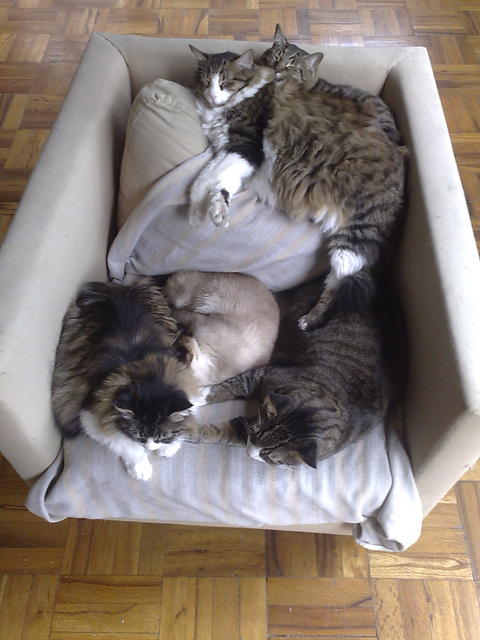
Five out of six experts agree: Five out of six cats cannot be mistaken
It. Is. Cold.
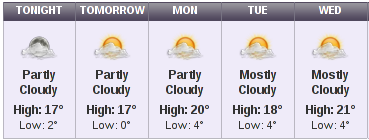
No, we are far from this very impressive picture of a fully-snowed UK seen from the sky that everybody and their dog must have seen by now. Still, in Mexico City we are experiencing the traditional one-or-two-weeks-a-year where it is genuinely cold. And, very strange being this Winter (the rainy season is Summer around here, January should be dry!) we have rain all day long. The Ajusco mountain is around 15Km south from my home, and it is the closest of the giants that surround our valley. Yesterday I managed to get some peeks at it behind the very thick layer of clouds we have. Ajusco looks really gorgeous all snowed, maybe down to the 3400m line (while the city's main area is at 2300m). This picture was not taken this year, we have snow in Ajusco almost every year (although very seldom as much as this time): (last photo is not current, we have not yet had a clear day to take a picture of our Ajusco yet this year) How does it feel? Well, I live in Coyoac n, in the flat area of the valley. Remember that houses here are not built to endure extreme temperatures (and this week is what we call extreme, of course ;-) ). According to Yahoo! Weather: And while the difference appears to be small, what about Magdalena Contreras, ~200m higher, where many people dear to me live (and have even a window pending to be installed)? People say this cold wave is the strongest in 120 years, since records are being taken. Every year people get excited, expecting that this time we will get snow. This has only happened once in at least a century, in 1966 AFAIR. I do not think this year to be atypical. Still, I have a reputation for being insensible to cold weather. Everybody wears heavy jackets while I still go to work with my usual long-sleeved shirt and that's it. But the last two days, I have been using jacket and scarf... But, of course, I don't look as gratious or cute as my cats :-


9 January 2010

Andrew Pollock: [life/americania] TransLink, the Bay Area's best kept public transportation secret?

We're not huge users of Caltrain, because frankly, it sucks. It's way slower than driving to San Francisco, and by the time you've paid for two return tickets, you might as well have driven and paid for parking. That said, we do use it from time to time. One of the things I noticed when we first moved over here was this intriguing box on a pole, to the side of the normal ticket vending machine. It looked all battered and faded, kind of like a deprecated form of ticketing that had been phased out years ago. Except it looked too high-tech to be phased out. Fast forward to four years later, and we're using Caltrain to get back from SFO after returning from Atlanta for Christmas, and there's this "Don't forget to tag off" TransLink poster inside the carriage. I'm now officially intrigued. I did some browsing of their website on the journey home. How could this be? Hong Kong's MTR has the Octopus Card. London's Tube has the Oyster Card, and the Bay Area has TransLink? Why the hell isn't this thing being pimped out more? It's awesome! I mentioned it to a co-worker the other day, who's been in the Bay Area for 7 years, and he'd never heard of it. So I signed up for it for myself and Sarah, and two cards promptly arrived. If you sign up with an autoload of $20 or more, there's no cost for cards at all. So from now on, whenever we need to ride Caltrain (or BART or Muni, which are the public transport networks we're ever likely to use) we can just wave these cards at something and never have to worry about a ticket ever again. It's awesome. Apparently VTA is coming on board with it later this year, so that'll round things out nicely. It sounds like it's been an epic implementation, starting back in 1999, and still rolling out ten years later. Better late than never. The added bonus will be for our visitors. When they come, we can just give them these cards, and they won't have to deal with BART's utterly confusing (for casual riders) fare system. One of my favourite things about Hong Kong was the MTR and the Octopus Card. Now we just need awesome mass transit for the Bay Area. Somehow, I think that's going to take even longer than TransLink.

Andrew Pollock: [life/americania] First encounter with the police

I was driving home from a late night at work recently, and I was almost home, when the car behind me lit up like a Christmas tree. My immediate reaction was, "Oh crap, I'm tired and I wasn't paying attention to my speed". So I pulled over. To my relief, it wasn't my speed that was the problem, my left-hand tail light was out. The officer was very nice about the whole thing, but he gave me a fix-it ticket. He told me I had until I think some time in February to fix the problem, then I had to get a police officer to sign off that it had been fixed. I thought that was the end of it, and continued on my way home. The other day, I got this official looking letter in the mail the Superior Court of California, County of Santa Clara. My initial thought was, "ha, the fools have issued me a jury summons like they did for Sarah. Can't they tell I'm an alien? Nanoo Nanoo." So I open the letter and start scanning it. It's a courtesy notice. The first actual sentences I run into start with "Failure to respond to this notice by the due date may result in your bail being increased...". Huh? Bail? What? It turns out that there's a bit more to the fix-it ticket story. Not only do I have to get a police officer to sign off that I've had the tail light fixed, to avoid going to court, I have to pay a $25 "dismissal fee" (also known as California is broke and needs every dollar it can get). Today was the first day that either of us have had any time to scratch ourselves, so we trekked off to Toyota. The guy yanked off the cover inside the boot, and was poking around to show us where to change the bulb, when lo and behold, it started working again. So it was just a loose connector. Dammit. So now I have to track down a police officer. Preferably under the cover of darkness, as we've tinted the front windows of the Prius, which is apparently cause for another fix-it ticket. Although I'm struggling to find the wording that specifically says that.

Andrew Pollock: [life] Renovations coming along

renovate
v 1: restore to a previous or better condition
  2: make brighter and prettier
remodel
v 1: do over, as of (part of) a house
  2: cast or model anew
I much prefer the term renovate to remodel. Remodelling to me feels more like tearing down internal walls and changing the actual layout of the place. But we're in America, so remodelling it is. We've had a bit of (mostly self-inflicted) scope creep. It started with just wanting to get some Ethernet cabling installed, then we decided to get recessed canned lighting (the whole lamp thing over here drives us nuts), and then we discovered that acoustic ("popcorn") ceilings are a haven for dust mites (we're both allergic) so it made sense to get the ceilings redone while they were putting the lights in. We're also getting the light switches replaced, and new childproof power outlets. We also got the electrical panel upgraded. Removing popcorn ceilings is somewhat hilarious. They put down plastic everywhere, then have at it with a garden hose, and then it just scrapes off. The ceilings they've completely finished already look a million bucks, so we're very happy with the decision to do that. The Ethernet cabling installation caused a lot of wall carnage, so we're going to get the walls repainted as well. Then we can get the carpets cleaned and stain proofed, and then we can start thinking about trying to move some non-essential stuff in. Hopefully it'll all be done by next weekend. The kitchen cabinets have a six week lead time, so the kitchen remodelling will have to be done while we're living there. Unfortunately some unexpectedly time demanding stuff has come up at work, right in the middle of this, so Sarah's had to do the bulk of the running around to sort out contractors for all of the work, and I've been stuck at work until all hours, 7 days a week. To cap it off, I've managed to come down with a cold, and feel quite crappy. NyQuil consumption is ensuing.

Andrew Pollock: [life] Twenty weeks later

Sarah hit the 20 week mark on Monday, and so we had the big anatomical ultrasound. We also found out that it looks like we're having a girl. We're now trying to come up with a name. There was also a worrying piece of news: they couldn't see the cavum septum pellucidum, while they were checking out her brain. Apparently the cavum septum pellucidum is a particular marker they look for when they're checking everything out. Now what the absence of the cavum septum pellucidum actually means isn't terribly clear. Apparently normally this is found along with other abnormalities, but the rest of her brain structures look fine. The nuchal translucency we had earlier in the pregnancy came back fine also. So we got bustled off to have a chat with the genetic counsellor (during which the 4.1 earthquake happened). We got booked in for an amniocentesis for later that afternoon, as well as a fetal MRI at 22 weeks, and trundled off home. To cap things off, when we were trying to park back at the hospital for the 2pm appointment, I managed to scrape the car up against one of the poles in the car park. (The lower level parking is notoriously tight). Note to self: always use the free valet parking service from now on. Sarah had some second thoughts about the amniocentesis, as it does carry with it some risk of miscarriage, and after chatting with with a couple of the obstetricians, we elected not to do it. The fetal MRI should definitively determine if the cavum septum pellucidum is absent, and then we can talk to a paediatric neurologist about what the ramifications of that might be. One of the reasons they wanted to do an amniocentesis now, rather than after the fetal MRI, is the amniocentesis itself takes a couple of weeks for the results to come back, and that would bring us up to the 24 week mark. Apparently if we wanted to terminate the pregnancy, once it was at 24 weeks, we'd have to go to LA to do it. Whilst I consider myself an atheist these days, I was raised a Catholic, and although I like to think of myself as pro-choice, I still have a lot of problems with abortion, so I don't think I'd be comfortable terminating unless it could be shown with reasonable certainty that our baby was going to be in a really bad way. Based on how the rest of the brain looked, and the nuchal translucency results, and the fact that the amniocentesis would only identify chromosomal and not genetic neurological disorders, I don't think we'll be aborting. From my limited research, it sounds like the cavum septum pellucidum disappears at about 3 months after birth anyway, so looking at it one way, you could say our baby's brain is developing faster. Other research has indicated a correlation with optic nerve development issues, so I don't know if that means she might be blind. We really need to chat with a paediatric neurologist. But hopefully the fetal MRI will find it, and this will turn out to be nothing. An anxious two weeks will now follow.

7 January 2010

Kumar Appaiah: Brief updates and some advice

So, while Richard is busy doing research and arranging or facilitating several Debian workshops, here I am, gulping down Idlis and Dosas by the dozen. It's been a fun visit, and I got to visit several places in my native state, but since my visit to Mumbai is rather short, I won't be able to say hello to several friends this time (Sorry Kartik). Maybe this would happen only when I am back in India on a permanent basis; let's see...Here are some general guidelines for travelers which I'd like to share:It's been a really fun trip, and I am sure I'll enjoy the rest of the trip, till I get back to my old routine and resume work.Finally, in keeping with the spirit of a blog I try to understand (albeit, in vain, I must accept), I duplicate the concept of a post from that blog, here is an up-to-date list of airports in which I have sat, but never left except by way of airplane:More updates later. Bye for now.

6 January 2010

John Goerzen: It s Time (or, how the ancient Greeks interfered with American sanitation)

Had you been on our yard tonight, you would have seen a strange sight. Me, dressed warmly (but not quite warmly enough), jumping on the icy and snowy hood of my pickup. Some maniacal fit? An obscure part of my 3-day-long taking out the trash routine? Not exactly. Before I tell you why I was doing such a strange thing and almost in the dark I feel compelled to take a detour through ancient Greek poetry. You heard right. I ve been reading ancient Greek poetry lately. Those Greeks were forever running around receiving signs and portents from the gods. If ever a bird flew by carrying a live snake, and you saw the snake bite the bird while looking over your left shoulder, you knew Zeus was telling you not to attack the enemy that day. Or something. And if you, fool that you are, attacked the enemy that day anyway, you should be not in the least surprised to find a spear through your shoulder in just a few pages time. If ever someone received a sign from Zeus in modern times, surely it was I, tonight. I say that because, as I was trying to close the hood on my pickup after charging its battery, the hood nearly snapped in two. The hood is supported by some spring-loaded brackets in the back, so to close it, you have to push down on the front. I did so, and was surprised that it was going down so easily. Then I realized, apparently in the nick of time, that only the front was going down. The back was staying put, aiming up in the air as ever. So I tried to straighten the hood back out. I then tried to get it down by pulling at it halfway back, but just couldn t get enough leverage to make it budge. So what next? Why, jump on it of course. I got it most of the way closed that way, then jumped/slid down, latched it in front, then crawled back up there to push down the sort of rusty mountaintop that had formed halfway down the hood where it was buckling. OK, sorted. So to recap By this point, I ve had the battery charging for 24 hours, inflated the tire, removed the bungee cord around the brake pedal, removed the battery charger, coerced the hood shut. Time to start it. I hop in, pump the accelerator a few times, and turned the key to start. I heard the sickening aaaaaaaaRRRRRRRRRRRRuuuuumphhh . of a weak battery. So it wasn t charged enough to crank fast enough to have any hope of starting in winter. So I go get the car, pull it up close, being careful to leave myself enough room to maneuver between it and the electric fence. I get out the jumper cables. Then it occurs to me: I have to open the hood again. DOH! I open it just a bit, and hook up the jumper cables. It turns over a bit faster. For just a bit. I get a small sputtering of life from it, but it fades faster than an enemy of Hector at the battle for Troy. So I have Terah come out and put her foot on the accelerator of the car while I try to start the pickup. This too proves futile. So I disconnect the jumper cables, close the pickup s hood with significantly less care than a 31-year-old rusty and nearly-broken hood deserves, roll the window back up, and go for plan B: 4 trips to the road with stuff in my car trunk, and leave the giant cardboard boxes that are covered with snow in the pickup bed for next month. Obviously I have displeased the gods. Forgotten to offer up a sacrifice to Penzoil, feared goddess of internal combustion, perhaps? Or perhaps it was just a sign that I need a new pickup? I m so convinced of the latter that I didn t even bother to replace the bungee cord. Postscript Terah walked in, and said, Ah, I thought I heard you writing a blog post. Yep. It s about pickups and the Greek gods. <very slight pause> Oh, of course it is.

3 January 2010

Stefano Zacchiroli: RC bugs of the week - week 17

RCBW - #17 Given that my "most blogged" Debian activity since last summer has been RCBW, what else could be my first post of 2010 if not a RCBW update? With further ado, here are this week squashes by yours truly: No particular remarks, but a long overdue tip of the week: the turmzimmer BTS interface is a great tool for bug squashing. Still, it has a issue with comments which can slow down some activities, but which you can help getting better! First of all you should know that comments are per-package and not per-bug (which might not be obvious, especially since often packages listed on the page have just one bug per-package). That means that you should generally mention the bug you are referring to when you post comments, unless the comments are really package-specific. Additionally, old comments are persistent, so you might get baffled by old comments that "invalidate" current issues. So, if you notice a comment that predates the actual bug numbers, please remove the comment by editing it and stating "no comment" in the form. Ah, happy new year (in case you care about sharp, calendar-based time partitions).

2 January 2010

Kartik Mistry: The year


* I mean that last damn 2009 was not so good but yeah, that is life! Promising readers to give more posts like 140 chars in coming year! ;)

Next.

Previous.