Search Results: "ag"

29 August 2007

David Welton: "Playing fetch" with DocBook

A while ago I wrote about the idea of "playing fetch" - meaning chasing after programming "sticks" that are basically makework. I am starting to get the feeling that the documentation system that I chose for Hecl is one such stick. I've been trying to document that lcdui commands that Wolfgang created last year. They're really cool, and give you access to pretty much everything you can do from Java, but cranking out these docs is sure time-consuming. Here's an example:
<refentry id="lcdui_date">
  <refnamediv>
<refname>lcdui.date</refname>
<refpurpose>Date/Time widget for lcdui forms</refpurpose>
  </refnamediv>
  <refsynopsisdiv>
<cmdsynopsis>
  <command>lcdui.date</command>
  <arg choice="opt">
    -date
    <replaceable>date/time in seconds</replaceable>
  </arg>
  <arg choice="opt">
    -label
    <replaceable>label</replaceable>
  </arg>
Once you finally slog through and create the documentation, it's very flexible, because you have not created just formatting instructions, but actually described each piece of the text. But... look at how often things get repeated. Aside from the repetitive XML tags, lcdui.date is more or less there three times. Ugh. Emacs + psgml mode helps some, but I still get the feeling I got suckered into doing something that should only be attempted by Big Corporations or at least large, well established projects that can afford to send people off to spend lots of time producing this kind of documentation.

Jeff Bailey: Ready to ride again!

We're in Albuquerque, NM now and have been for a couple of days. We made such excellent time across Oklahoma and Texas that we were able to stop and take a break for three nights.

Texas: Holy *crap* is Amarillo a dirty place. We spent three times what we've spend on any hotel this trip in order to get a place that we were sure was insect-free. And what we wound up with was a place over top of a bar. Luckily it wasn't all country, so we didn't mind too much. It was also (surprisingly) the best breakfast I'd had on the trip. They did hash-browns on a griddle, and had lots of ketchup (do I have to spell it catsup now?), tabasco, and pepper to go on it. Weirdly, they also had pre-mixed peanut butter and honey. Otherwise, the truck stop we stopped at had cockroaches on the floor, the bottled-water bottles were dirty on the outside, and the place smelled like an airport tarmac.

We left early and headed out to Albuquerque. Aside from the fact that whoever laid out the roads was certainly drunk at the time (We drove around in circles three times trying to get to a hotel we could see, but not find a way to legally drive to before giving up and going to a different hotel) this place is really pretty. I came here for my last meeting as a Regional Organising Consultant for Young Adult and Campus Ministry and got a chance to see a bit of the place and really wanted to show it to Angie. Instead we decided we'd had enough of driving and traveling. This hotel has laundry facilities and the town has a Whole Foods Market, so we stocked up on microwaveable foods, washed our clothes, watched TV and I finally finished Harry Potter during a nice long bath.

The next day (Yesterday), we headed out to the Puebo Cultural Centre to see the art pieces and learn a little about their successful resistance against the spanish resulting in actual land grants to the 19 local groups. We also got to see how different groups have influenced them over the years, with ancestry tracing something like 12,000 years back. From there we managed to find the old town and got to see the type of architecture that I wanted to show Angie. The little pink houses don't *just* exist in DisneyLand. ;) We went to a restaurant that looked really familiar - I think we ate there when I was here last. We had some wonderful New Mexico food and I introduced Angie to what the local sopapillas are like. Here's they're large puffy things, whereas the sopapillas in Texas and back home look like soft tortilla chips.

I've started uploading some pictures to Flickr, but it turns out that I hadn't done so since before Juniper's wedding and have over 400 pictures to send. Between hotel wireless being slow and f-spot being a fragile piece of crap I managed to upload something over 100 pictures of Leif to the family-only archives before giving up. I'll probably post the Opus pictures up on Facebook rather than flickr so that it's easier for other Opusers to find them

The next target is Flagstaff, AZ for Thursday night. We're meeting Karina and her husband for a day of wandering around the Grand Canyon, so we'll see if there's some interesting things between here and there. I suspect there will be. =)

*hugs*, all! Less than a week until I start my new job! I'm excited!

Chris Lamb: Citylink libnotify client

What does a geek do when waiting for shiny to arrive? Writes a libnotify client around Citylink’s parcel tracker, of course: Source available, patches welcome.

Sune Vuorela: Debian acronym?

According to a KDE packager in some Germany based distro:

Delivering Eventually, By Interminable Annihilation of Novelty

John Goerzen: Desktop Linux: Gnome

I had been intending to write an entire series of posts about our corporate switch to Linux on the Desktop. To date, I wrote only one introducing the project and our reasons for switching from Windows. That was back in April.

Today I'd like to start talking about it all some more.

We have standardized on Gnome for our desktops. Given the Windows background of our user base, it was pretty much a given that we would have to use either Gnome or KDE. Something like fvwm or a non-integrated environment just wouldn't be a good option.

We evaluated both Gnome and KDE. The very "clean" appearance of Gnome was a nice thing for us. KDE seemed to be to "chatty", talked about entering in audiocd:/ when it shouldn't have needed to, and generally violated the KISS and principle of least surprise too often. That said, I continue to run KDE for my personal desktop because Gnome just doesn't have the flexibility that KDE does. It is too bad that Gnome has gone on this remove functionality kick, and KDE hasn't gotten the KISS religion yet.

Anyway, Gnome worked well for the most part. We have set some defaults in gconf for things like panel icons. We also set a few mandatory defaults. I fixed a couple of bugs in the vfs system related to nfs4 support, which manifested themselves as icons for files newly saved to the desktop never showing up.

We wanted to present a customized menu to people based on what their job function is. That is, we are using a single system image, so all apps will be installed on all machines. But we didn't want people to have to see a ton of software that they don't use. That was easily enough accomplished for custom apps by creating desktop files with mode 0640 and setting the group to the set of people that should see the program on their menu. We removed a few stock programs (such as the terminal) from the menu as well, using dpkg-statoverride. That was also quite easily done. However, I will say that the entire Gnome XDG menu thing is woefully under-documented.

We use Firefox for the standard web browser. It is integrated well enough with Gnome and we have no problems there, aside from sites that are IE-only. We solve that with a Windows terminal server, which I'll discuss later.

Our network printing was already based on Cups. The individual machines are set up as Cups clients only, which works fine. We did find, however, that gnome-cups-manager automatically installs a tray monitor for cups. This monitor puts little printer icons on the tray when printers are in use. Unfortunately, it figures out which printers are in use by polling the server, and it is turned on by default out of the box, with no good way to disable it short of dpkg-statoverriding it to 0000. You can imagine that hundreds of users times dozens of printers times numerous polls per minute created quite the load on the server. This was a really braindead design and the people that wrote it should have known better. It is also quite useless to have icons coming on for all the printers on the network, which on some networks could be thousands, and not even on the same continent as the user.

Printing is generally a bit iffy in Gnome. They seem to be transitioning between about 3 different printing toolkits, all of which have different print dialog boxes with different supported features and different ways of selecting printers. One chief annoyance is that the print box in evince (the document/PDF viewer) does not let people access printer-specific features such as hole punching and stapling. So we installed gtklp and xpdf for people. The people that print heavy PDFs are huge fans of gtklp these days; it's a nicer solution than we had in Windows. Nobody really likes evince. We also have had some trouble with evince generating PostScript output that some printers can't grok. It sounds like all this should be much better in newer versions of Gnome, which if true, would be welcome news.

The Gnome screenshot tool makes it easy to save off a screenshot to a file, or to drag it into an email, but it is difficult to print it (you have to save it first). That was a common complaint around here, so I wrote a little wrapper around xwd and gtklp for printing screenshots. People really like that because gtklp gives them lots of options about orientation and size of the image if they want it, or a simple "Print" button to click if they don't care. We set a gconf default to bind this to Ctrl-PrintScr and it works well. KDE's screenshot tool is much more capable, and if we were using KDE, we wouldn't have had any problem with screenshots.

The bottom line on Gnome is that we, and are users, are happy with it after we've made these customizations. But we have had to do more customization that we should have. I still think that Gnome has been better for our users than KDE, but I do wonder how long we'll be able to survive with our "no KDE libraries" policy, as people want ksnapshot, kolour, etc.

Gunnar Wolf: At YAPC::EU 2007!

So here I am, sitting at a talk at YAPC::EU 2007, in the beautiful Vienna. It is too early to start thinking about a status report for what I've done and talked about, but I can say in advance that I'm very positively impressed - I expected my talk on the integration between CPAN and Debian that the Debian pkg-perl group is carrying out (presentation, full article) to be marginally interesting to a couple of people. Turns out, as YAPC drew closer, I heard from several people interested in attending it. Ok, maybe it is just for courtesy? Lets not get excited about no big deal...
Well, yesterday was the first day of CPAN - Man, after getting used to Debconf, three days of an interesting conference is just way too short! YAPC guys, for the next time... More time, please? :-
I knew I would be meeting pkg-perl members Zamoxles and Jeremiah - Very nice to finally meet you guys! And a very welcome surprise (although we have been barely even able to talk) was to find another fellow DD, Daniel Ruoso, one of the agitators that started the pkg-perl group. He is not active (in the group) anymore, but he is still one of The Patriarchs ;-)
Ok, on with the talk: Contrary to what I expected, the talk room was quite full. I am used to longer talk slots (20 minutes is just about enough to spell my name, damnit! I presented 24 slides, and jumped only two of them - But made it just in time for the very strict Austrian staff to prepare but not wave the __END__ signal ;-) Would they show a die 'argh'; afterwards?), so I had to keep the limit from the very beginning.
Of course, there was no time for questions as part of the session. However, I've since then been approached by several people and discussed several aspects of our work and ideas for the future. I'll post more about this after YAPC is over...
My warmest kudos to the very orangy, mohawk-wearing orga team. Not only they came up with a great conference and are invariably good-mooded and nice (hey, I should learn from them!), they even have the presence of mind to be very nice, to go out with us to have a good time yesterday night!
Anyway, it shows the conference's topic is Social Perl. Nice social geeks are no longer a novelty to me, but still: The Perl community is warm, welcoming and in general, very nice. I'm quite happy to have made it here!

Russell Coker: A Strange Attempt to Trick Google

I just noticed that my post about LED Headlights in an Audi Sports Car was linked from audi.host4blogs.com. Strangely they took some of the words from my post, added some other apparently random words to make it look like a response, and then linked to my post. Having summaries of my blog posts appear on splogs is nothing new. I don’t have any objection to it normally as summaries will in a small way promote my blog as long as they are intelligible. The host4blogs.com site has a couple of other car blogs that link to each other with content of the same quality. I guess I can’t file a DMCA take-down request as the text is not a summary of mine. I hope that Google will start taking action against the sploggers soon.

Peter Makholm: Best Current Practice for mail forwarding?

While SPF seems to be among the currently used technologies for spam protection, SRS looks rather dead. But forwarding mail breaks SPF without workarounds. So what is the best current practice? The forwarding part of SRS is rather simple, but I havn’t found any clear way to implement the actual handling of bounces. It wouldn’t be hard to hack some usage of Mail::SRS onto postfix but there doesn’t seem to be an off the shelves solution?

Miriam Ruiz: Internationalized hex-a-hop

The first serious i18n effort for the Games Team is now bearing fruit. The newer version of the game hex-a-hop is now entering Debian. All the merit goes to Jens Seidel, who has developed the patches for making it work with SDLPango and to support all the spectrum of Unicode characters, instead of the limited ASCII set included in the game, as well as to all the people of Debian i18n who have done the translations (Helge Kreutzmann, Damyan Ivanov, Enrique Mat as S nchez, Bas Wijnen, Piotr Engelking, Yuri Kozlov and Clytie Siddall). The game has already been translated to Bulgarian, German, Spanish, Dutch, Polish, Russian and Vietnamese. Thanks Jens, both for taking care of the changes in the code needed to achieve this, and also for coordinating all the t10n and i18n process, as I don’t really have much experience in those areas.

Joachim Breitner: Internet Trading Game Idea

Reviving parts of my old MuMer idea, I thought of this trading game yesterday. Before I start hacking: What do you think? Who would want to be beta-tester? Any other things to consider?The idea is to freely trade goods (think wood, stone, gold as currency etc.) online, on your trading partners website. The whole point will be that you will more or less stumble across other people to trade, e.g. on their blog, on some wiki page or their myspace or StudiVZ page. There you will see that he wants to trade MuMer goods, maybe with a list of things he d sell and buy, and for what price. From there (and only from there) it is only one click to the MuMer page where you can actually trade, maybe leaving a message as well.On the MuMer page itself, there would be no list of users or so. To find someone to trade you ll actually have to look somewhere else and trade again you have to go to the other persons blog again. (I imagine this can be reasonable enforced by checking the referrer.) So taking part in the game, you also draw some people to your web site.For the reward I could imaging that once you have a certain amount of specific resources, you can buy special items or even buy the skill to manufacture more special and hopefully attractive items.This is the rough sketch. What do you think?

MJ Ray: Announcement

"BOWN. Walter Sydney (Wally). Passed away on Monday, August 20th, 2007, aged 74 years. He will be greatly missed by all of his family and friends. The funeral service will be held on Thursday, August 30th, 12.30pm, Weston-super-Mare Crematorium. Family flowers only, donations if desired for Weston Hospicecare, c/o The Elms Funeral Directors, 50 Baker Street, Weston-super-Mare. Telephone 01934 616006."
(From the Weston & Somerset Mercury, 23rd August 2007 issue) So I'm not blogging much just now. I think usual service should resume Friday 31 August.

28 August 2007

DebConf team: DebConf Resources (Posted by Joerg Jaspert)

I just setup a DNS entry for panama.mini.debconf.org, on request of David Moreno Garza. He also got a mailing-list for that upcoming mini Debian Conference. Which reminded me to blog about debconf.org resources again, so that more people know/remember that there is something they can use whenever they organize a Debian meeting. If you happen to organize a meeting of Debian Developers / interested Debian people you can chose to use any debconf.org resource you need for it. This currently means:
DNSa name within .debconf.org. Either pointing to your host, if you have one, or see below for hosting.
Current style seems to be $something.mini.debconf.org, but we also have some miniconfX.debconf.org entries, so are pretty open. And in case it doesn’t fit into .debconf.org - there is always .debconf.net without restrictions (as its not really used currently).
Mailing-ListWant a mailing-list?
HostingDon’t have an own server for it? .debconf.org possibly has space for you.
You would manage the content via a svn repository.
CMSConference Management System - AKA pentabarf. Available in future, more info on that point when we finally switched to a version that let’s us easily give access to other people without giving out all personal data. :)
GalleryUse our gallery. Actually - don’t bother asking, just use it, as long as you use it for Debian related event pictures.
Want more? We have a page listing most of our resources, maybe you find something you need. Want something? Mail admins@debconf.org and describe what you want, most possibly we will make it happen. Or try to get one of us admins on IRC, you are looking for one of the nicks Ganneff, mhy, sgran, gwolf or h01ger. No, we do not bite … usually. :)

Russell Coker: The Silly BMW 745h

BMW has released a new prototype hydrogen powered car. The bmwworld.com web page about it claims the cruising range is 190 miles. Added to the 400-mile range of the normal fuel tank, the 745h can go 600 miles between fill-ups. The first issue is that 10 miles are not accounted for (maybe it finishes the 190 miles of hydrogen power at the top of a hill). But more seriously the hydrogen needed to drive for 190 miles would take as much space as petrol needed to drive for 646 miles (hydrogen needs 3.4* the volume to store an equivalent amount of energy). I wonder if that BMW has any space left in the boot/trunk? Now we have some green bloggers praising BMW. An internal combustion engine that burns hydrogen will not give no emissions other than water vapour, it will produce some nitrogen oxides. The processes to produce hydrogen for fuel all consume unreasonable amounts of energy (more than is required to charge a plug-in hybrid). BMW demonstrates their level of interest by giving the cars to some celebrities. This gets some PR but no analysis of the performance. They also introduce the prototype based on one of the most expensive models (the 745) which you almost never see on the roads. If they produced a 318 or 520 that ran on hydrogen it would demonstrate some level of interest in getting this working for the mass market. If BMW wanted to make their cars more environmentally friendly they would start by adopting some of the technology from the Prius. Rumour has it that part of Toyota’s plan to make money from Prius development is in licensing the technology that they patent. A couple of years ago I test drove a BMW 316 and a Prius. The Prius was very quiet and gave a smooth ride (you might call these luxury features), and also gave decent performance (it’s widely regarded that luxury cars should perform well - pity the BMW 316 is a slug). In Australia the concept of “badge engineering” of cars is well established. When government subsidies favoured large manufacturing runs the Ford Laser and Mazda 323 were essentially the same car. Maybe BMW could adopt this concept and sell a re-badged Prius i-tech with a few extra luxury features as a BMW 4 series (it’s a much better car than the 3 series BMW).

Eric Warmenhoven: Eclipse.

I stayed up late last night to watch the lunar eclipse, and took pictures. In related news, I need a lens that has a much longer zoom. The pictures I posted aren’t scaled (just cropped). I wish I’d thought of this a couple weeks ago so I could have finally ordered the Canon 100-400mm f/4.5-5.6L that I’ve been looking at for months now. I’ll probably get it soon though, so that I’ll have it for the Salinas Air Show at the end of September.

Kai Hendry: MBP versus X40

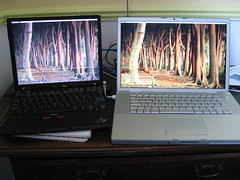
Thinkpad X40 vs MBP I’ve spent a bit of the bank holiday weekend by probably violating the warranty of a new 15” Macbook Pro (MBP) from work. I also was at the Debian bbq 2007 in Cambridge and met some friendly faces. :) More MBP & X40 porn So now I can boot into MacOSX and run Ubuntu or boot straight into Ubuntu from rEFIt. There are a couple of problems. There are some things I quite like about the MBP compared to the X40: Currently I remain not totally convinced about the Apple MBP. I’ll keep my Debian X40 my personal machine and the MBP for work. Now I can compile Webkit on Apple OSX (Debian can too) and see what’s happening in Ubuntu.

Joerg Jaspert: UMTS (3G) in Linux - very simple, better than in Windows!

I got my UMTS (3G) card on monday and started to play with it. And from what I could read about the windows software that comes with the card - I am glad to have Linux. After all the only thing I had to figure out was the fact that everything just works and I just have to point my dialup app at the right interface… In Windows you have to install tons of megabytes of bullshit, possibly with ten reboots. Ha. For future reference, mainly for me but possibly others too - lets write down what I have: I got a Vodafone Option card, Model GE0201. It’s one for the new-style ExpressCard Slots, so it ships with an adapter to the older CardBus standard. Inserting the card into its slot (already in the adapter) the following dmesg output appears:
[15930.197929] pccard: CardBus card inserted into slot 0
[15930.198371] PCI: Enabling device 0000:06:00.0 (0000 -> 0002)
[15930.198385] ACPI: PCI Interrupt 0000:06:00.0[A] -> GSI 18 (level,low) -> IRQ 18
[15930.198416] PCI: Setting latency timer of device 0000:06:00.0 to 64
[15930.198424] ohci_hcd 0000:06:00.0: OHCI Host Controller
[15930.198480] ohci_hcd 0000:06:00.0: new USB bus registered, assigned bus number 6
[15930.198507] ohci_hcd 0000:06:00.0: irq 18, io mem 0x8c000000
[15930.764279] usb usb6: configuration #1 chosen from 1 choice
[15930.764308] hub 6-0:1.0: USB hub found
[15930.764320] hub 6-0:1.0: 2 ports detected
[15931.276444] PCI: Enabling device 0000:06:00.2 (0000 -> 0002)
[15931.276460] ACPI: PCI Interrupt 0000:06:00.2[A] -> GSI 18 (level,low) -> IRQ 18
[15931.276827] PCI: Setting latency timer of device 0000:06:00.2 to 64
[15931.276836] ehci_hcd 0000:06:00.2: EHCI Host Controller
[15931.277145] ehci_hcd 0000:06:00.2: new USB bus registered, assigned bus number 7
[15931.299893] ehci_hcd 0000:06:00.2: irq 18, io mem 0x8c001000
[15931.299916] ehci_hcd 0000:06:00.2: USB 2.0 started, EHCI 1.00, driver 10 Dec 2004
[15931.300351] usb usb7: configuration #1 chosen from 1 choice
[15931.300523] hub 7-0:1.0: USB hub found
[15931.300535] hub 7-0:1.0: 2 ports detected
[15934.837567] usb 6-1: new full speed USB device using ohci_hcd and address 2
[15935.033681] usb 6-1: configuration #1 chosen from 1 choice
[15935.036577] option 6-1:1.0: GSM modem (1-port) converter detected
[15935.036751] usb 6-1: GSM modem (1-port) converter now attached to ttyUSB0
[15935.039703] option 6-1:1.1: GSM modem (1-port) converter detected
[15935.039813] usb 6-1: GSM modem (1-port) converter now attached to ttyUSB1
[15935.043067] option 6-1:1.2: GSM modem (1-port) converter detected
[15935.043482] usb 6-1: GSM modem (1-port) converter now attached to ttyUSB2
Inserting the adapter alone already gives the output up to timecode 15931.300535, so it doesn’t seem to be a simple adapter only. I wonder what I get when I use it with random ExpressCard devices. (Not that I have any other than the option card atm). Looks like the card registers 3 GSM modem ports. Only 2 are usable, so don’t try to use ttyUSB1, doesn’t work anyway. In case the system doesn’t like the ports one may need to reload the usbserial module telling it the vendor and product id it should work for, but I did not need to do it. Now, getting online. The actual act is very simple, just let me write down some more detailed text as background info: There are 2 usable “modem” interfaces one can use. I chosed to use ttyUSB0 for internet connections, leaving ttyUSB2 to other apps. Like - getting status information or sending/receiving short messages. The first step one has to do is unlocking the card with your pin. The command for this is AT+CPIN=xxxx, replacing xxxx with the actual pin. (Type it into a minicom if you want). The card will “login” into the mobile system and change its flashing lights from “both lights flash” to “only umts light flashes”. Its also useful to tell your card which net to use for future connections. So type AT+CGDCONT=1,”IP”,”web.vodafone.de” and you did select the Vodafone net. There are a few other AT commands where you can tell the card the preferred way of operation, ie. should it prefer UMTS(3G) or GPRS connections or should it only support one of those:
at_opsys=0,2Only GPRS
at_opsys=1,2Only UMTS(3g)
at_opsys=2,2Prefer GPRS over UMTS(3G)
at_opsys=3,2Prefer UMTS(3G) over GPRS
I did use the 3,2 setting, but there may be situations where you want other settings. Type AT+CSQ to see your current signal strength. After having done all those preparations we want to get connected. Simple. Dial *99***1# and the card will connect. You only need to talk a bit of PPP and you have net. Of course noone wants to do all this by hand, so lets use wvdial for it. Its simple. Take the following config:
[Dialer Defaults]
Init1 = ATZ
Init2 = ATQ0 V1 E1 S0=0 &C1 &D2 +FCLASS=0
Modem Type = Analog Modem
Baud = 460800
New PPPD = yes
Modem = /dev/ttyUSB0
ISDN = 0
[Dialer pin]
Init3 = AT+CPIN=xxxx
[Dialer umts]
Dial Command = ATD
Carrier Check = no
Phone = *99***1#
Password = doesntmatter
Username = noonecares
Stupid Mode = 1
Init4 = AT+CGDCONT=1,"IP","web.vodafone.de"
Dial Attempts = 2
With it you type wvdial pin, wait a second and type wvdial umts and you have a working internet connection. Hit Ctrl-C to disconnect. Yes, thats all thats needed. Plugin card, type wvdial pin && sleep 1 && wvdial umts and have fun. Now, what to do with the second “modem” on the card. You could use it to get status info about your connection, like signal strenght. You could also point wammu/gammu at it and send or receive SMS. Ok, well. Wammu has a little bug currently and doesn’t really like the option card. I mailed its maintainer already and got a patch back, which fixes half of the problem, so full support should be there soon. (Guessing with the time he needed for the initial patch it should be there within days at max… :) ). Trying a KDE app (*shudder* :) ) named kmobiletools one can read SMS without any patch. One can even send SMS. But kmobiletools can’t delete SMS stored on the card.). Finally - testing the stuff in a real life situation: My trip to work, which is about 1.5hours in a german train (ICE). I am impressed, it’s way better than I feared. I was online for the whole trip, about 90% of the time with UMTS (3G), 8-9% GPRS and for 2% the card didn’t had any signal. Which was to be expected, having a multi-kilometre tunnel soon after trip starts. The card never lost its PPP connection and all applications did run fine. The card does have *huge* buffers for data, the 2% nothing did give me a ping time maximum of 150.000 ms but not a single lost package. Thats also what one experiences when the card switches from UMTS to GPRS - ping time goes up for some time until GPRS takes over, then it continues without any trouble and every pending stuff is send. (Except that GPRS ping times are slightly larger, of course). Soooo, summary for me is: It’s worth the money, as I can use it for about 3 hours every day I go to work. Sometimes thats 4 hours, depending on the time I leave work (bad train times). Having a price of about 40EUR per month for a real flat it sounds acceptable for me. PS: The only thing one should never try is to run pccardctl eject. While the kernel tells you it eject a card - you will end up with a zombie process, forever. And also unable to get the card working again, you have to reboot. So - just stop the apps accessing the card and then just unplug it. Sounds bad, but is the working way…

Alexis Sukrieh: Perl Console 0.3 released

A new version of PerlConsole is available. As you can see in the changelog, lots of goodness with this release comes to you (~/.perlconsolerc rules, thanks to S. Zachariah Sprackett for his patch). After reading the source code of Devel::REPL and learning from it (this is really a great library, congrats to mst) I decided not to orphan Perl Console. Yes, that was a possibility as Devel::REPL provides anything you need to build a console (and comes with “re.pl” which actually is a console itself). I decided not to give it up for one reason: Devel::REPL is great, and better written than Perl Console (it supports plugins and profiles and is Moose-based) but, it’s slow. When you launch it, you have to wait a couple of seconds before the console prompts you. This is because of Moose I suppose. I know that’s not blocker as a console is a development tool, but I feel like some of PerlConsole’s users would like to have the choice between a full featured, extensible and Moose-base console that’s slow, and a light one that is basic in design and implementation. I backported one of the most interesting plugin of Devel::REPL to PerlConsole, being the console’s lexical environement. Devel::REPL did a great thing there, using Lexical::Persistence to simulate a namespace in the console. Feel free to give your feedback about this, I wonder if there’s still an audience for PerlConsole when Devel::REPL is in the town. I think so, maybe I’m wrong, then tell me.

Biella Coleman: Conversing about Open Access

Karl Fogel’s recent comment asking why Samir Chopra and Scott Dexter did not publish Decoding Liberation with some sort of open licenses, especially since they are such unabashed advocates of open licensing, spurred a flurry of further comments from the authors on my blog as well as some more thought out blog posts and commentary. I don’t have too much to add except perhaps to state the obvious: the economics of book publishing and software are quite distinct creatures. When it comes to software, one can pull in revenue from support and services, while this is pretty much impossible for most books. Software also has a much shorter shelf life, which is why making it open access, fast, is key. Books however have a longer shelf life, which is why I am personally not opposed to some sort of limited copyright for books (around 5 years, give or take a couple) so that publishers can recoup their costs (and in academic publishing, no one is making a bundle of money, that is sure) but then it should be made free to the world, never to die that awful death of “out of print” (in so far as it can be thrown on the web, legally). Journal publishing is another matter and I firmly believe that articles should spread far and wide and quick because of their shorter shelf life, which tends to be shorter mostly because there are just so many articles… As Alex Golub has informed us, my own professional association has really failed not only in providing more open access journals, they are not even allowing the members of the organization any say in the matter. But thankfully other disciplines and academics are taking open access and the possibilities afforded by new media a little more seriously and here is an edited volume by CT Watch Quarterly The Coming Revolution in Scholarly Communications & Cyberinfrastructure that provides an important node in what is an important conversation.

Zak B. Elep: Weekend Hacks: growl-notify and weeter for WeeChat

This weekend, a rather long one due to the observance of the National Heroes’ day, got me started into doing some little hacks for WeeChat, an IRC client that I have been using in place of Colloquy on the Macbook which I use at work. I have been using WeeChat originally because I’ve been using TOR to connect to the ‘Net, but later on I found out about WeeChat’s extensibility via script plugins that can be written in either Ruby, Lua, or Perl. And, being the Perl monger that I am, and having lots of idle time (hey, this was a weekend ;) I looked for some way to better integrate my WeeChat to my Mac setup. The first thing I came up with was a way to get the app to send event notifications via the Growl framework (which I got from Adium,) since the WeeChat I have here is a console-only app (there is an ongoing GTK/wxWidgets UI port, but not available yet in MacPorts, where I got WeeChat.) A quick look at the Growl developer documentation, however, got me looking into Mac::Growl, which provides a very simple Perl interface to Growl. And thus, I came up with growl-notify, which now keeps me up to date on what’s going on in IRC while I’m doing something else. The other thing that I got to work on with was a simple way to do Twitter status updates while on IRC. Of course, I do have the excellent Twitterific for Mac installed, but again I was raring for some quick hack to do at the weekend, so I decided to do this one too. In IRC, one can pretty much indicate his/her status by using the /me command (which is really a shortcut for doing a CTCP ACTION message, but I digress.) This particular command seemed to be a fairly natural command to tie a Twitter updater with, so it only took a while for me to look up Net::Twitter, write a modifier for the /me command, and come up with weeter. Now, the week’s back, and I look forward to my work and its pending tasks (currently something involving PostgreSQL, GlusterFS, and lots of Amazon EC2 nodes ;) with a renewed zest for tackling problems. And when weekend comes again, its yet another time to recharge, and perhaps hack some more on better integrating the apps that I use in my workflow (and thus helping my productivity.)

Michal &#268;iha&#345;: Photo album candidate - lazygal

I received number of reactions on my photoalbum post. Several were saying "I'm using some great Perl tool which is not actively maintained anymore.". Well I know such tools. I also used BINS some time ago, but it did break something (I don't recall what exactly right now, it's quite far far away in past) and I was unable to fix it. That was reason I switched to Matew. The other replies were much better. One of them recommended trying lazygal (well it was recommended by it's author). I gave it a try and it seemed to fit my basic needs quite well and extending it's EXIF support was a piece of cake. I will continue to tune it to my needs, but I'm pretty close right now. The hardest thing for me will be to come up with some good looking themes, but I will most likely steal my ones for Matew :-).

Next.

Previous.