Search Results: "xam"

5 May 2014

Robert Collins: Distributed bugtracking quick thoughts

Just saw http://sny.no/2014/04/dbts and I feel compelled to note that distributed bug trackers are not new the earliest I personally encountered was Aaron Bentley s Bugs everywhere coming up on it s 10th birthday. BE meets many of the criteria in the dbts post I read earlier today, but it hasn t taken over the world and I think this is in large part due to the propogation nature of bugs being very different to code different solutions are needed. XXXX: With distributed code versioning we often see people going to some effort to avoid conflicts semantic conflicts are common, and representation conflicts extremely common.The idions Take for example https://bugs.launchpad.net/ubuntu/+source/ntp/+bug/805661. Here we can look at the nature of the content:
  1. Concurrent cannot-conflict content e.g. the discussion about the bug. In general everyone should have this in their local bug database as soon as possible, and anyone can write to it.
  2. Observations of fact e.g. the code change that should fix the bug has landed in Ubuntu or Commit C should fix the bug .
  3. Reports of symptoms e.g. Foo does not work for me in Ubuntu with package versions X, Y and Z .
  4. Collaboratively edited metadata tags, title, description, and arguably even the fields like package, open/closed, importance.

Note that only one of these things the commit to fix the bug happens in the same code tree as the code; and that the commit fixing it may be delayed by many things before the fix is available to users. Also note that conceptually conflicts can happen in any of those fields except 1). Anyhow my humble suggestion for tackling the conflicts angle is to treat all changes to a bug as events in a timeline e.g. adding a tag foo is an event to add foo , rather than an event setting the tags list to bar,foo then multiple editors adding foo do not conflict (or need special handling). Collaboratively edited fields would be likely be unsatisfying with this approach though last-writer-wins isn t a great story. OTOH the number of people that edit the collaborative fields on any given bug tend to be quite low so one could defer that to manual fixups. Further, as a developer wanting local access to my bug database, syncing all of these things is appealing but if I m dealing with a million-bug bug database, I may actually need the ability to filter what I sync or do not sync with some care. Even if I want everything, query performance on such a database is crucial for usability (something git demonstrated convincingly in the VCS space). Lastly, I don t think distributed bug tracking is needed it doesn t solve a deeply burning use case offline access would be a 90% solution for most people. What does need rethinking is the hugely manual process most bug systems use today. Making tools like whoopsie-daisy widely available is much more interesting (and that may require distributed underpinnings to work well and securely). Automatic collation of distinct reports and surfacing the most commonly experienced faults to developers offers a path to evidence based assessment of quality something I think we badly need.

4 May 2014

Mehdi Dogguy: Clickable DepWaits and Edos results in pgstatus

A long time ago, St phane Glondu implemented an alternative to the Buildd status pages. It was implemented in OCaml and had some unique features. I think that my favorite one was the ability to click on package names appearing in DepWaits.

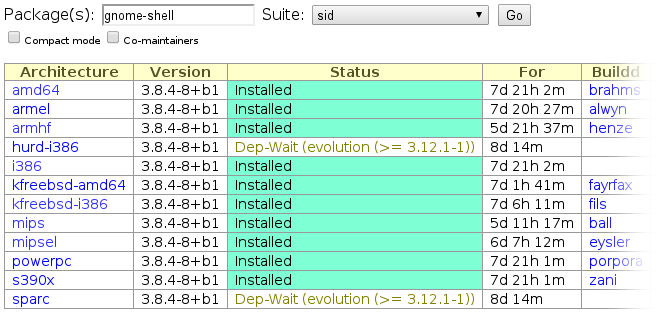
What you see on the image below is a simple example where the package gnome-shell Dep-Waits on a single package. This prevents buildd daemons to start the job as long as the specific version of the specified package or some new package are available. So, each package name in that field became now clickable and points to its buildd status page.


Similarly to Dep-Waits, results of edos-debcheck, which is used to spot installability issues of build dependencies, are now clickable too.

If you are a porter or if you are tracking down a build issue, I am sure you'll appreciate these two new features. Enjoy! As usual, if you notice some bugs or have some feature requests, please let me know.

Francois Marier: What's in a debian/ directory?

If you're looking to get started at packaging free software for Debian, you should start with the excellent New Maintainers' Guide or the Introduction to Debian Packaging on the Debian wiki. Once you know the basics, or if you prefer to learn by example, you may be interested in the full walkthrough which follows. We will look at the contents of three simple packages.

node-libravatar This package is a node.js library for the Libravatar service. Version 2.0.0-3 of that package contains the following files in its debian/ directory:
  • changelog
  • compat
  • control
  • copyright
  • docs
  • node-libravatar.install
  • rules
  • source/format
  • watch

debian/control
Source: node-libravatar
Priority: extra
Maintainer: Francois Marier <francois@debian.org>
Build-Depends: debhelper (>= 9)
Standards-Version: 3.9.4
Section: web
Homepage: https://github.com/fmarier/node-libravatar
Vcs-Git: git://git.debian.org/collab-maint/node-libravatar.git
Vcs-Browser: http://git.debian.org/?p=collab-maint/node-libravatar.git;a=summary
Package: node-libravatar
Architecture: all
Depends: $ shlibs:Depends , $ misc:Depends , nodejs
Description: libravatar library for NodeJS
 This library allows web application authors to make use of the free Libravatar
 service (https://www.libravatar.org). This service hosts avatar images for
 users and allows other sites to look them up using email addresses.
 .
 node-libravatar includes full support for federated avatar servers.
This is probably the most important file since it contains the bulk of the metadata about this package. Maintainer is a required field listing the maintainer of that package, which can be a person or a team. It only contains a single value though, any co-maintainers will be listed under the optional Uploaders field. Build-Depends lists the packages which are needed to build the package (e.g. a compiler), as opposed to those which are needed to install the binary package (e.g. a library it uses). Standards-Version refers to the version of the Debian Policy that this package complies with. The Homepage field refers to the upstream homepage, whereas the Vcs-* fields point to the repository where the packaging is stored. If you take a look at the node-libravatar packaging repository you will see that it contains three branches:
  • upstream is the source as it was in the tarball downloaded from upstream.
  • master is the upstream branch along with all of the Debian customizations.
  • pristine-tar is unrelated to the other two branches and is used by the pristine-tar tool to reconstitute the original upstream tarball as needed.
After these fields comes a new section which starts with a Package field. This is the definition of a binary package, not to be confused with the Source field at the top of this file, which refers to the name of the source package. In this particular example, they are both the same and there is only one of each, however this is not always the case, as we'll see later. Inside that binary package definition, lives the Architecture field which is normally one of these two:
  • all for a binary package that will work on all architectures but only needs to be built once
  • any for a binary package that will work everywhere but that will need to be built separately for each architecture
Finally, the last field worth pointing out is the Depends field which lists all of the runtime dependencies that the binary package has. This is what will be pulled in by apt-get when you apt-get install node-libravatar. The two variables will be substituted later by debhelper.

debian/changelog
node-libravatar (2.0.0-3) unstable; urgency=low
  * debian/watch: poll github directly
  * Bump Standards-Version up to 3.9.4
 -- Francois Marier <francois@debian.org>  Mon, 20 May 2013 12:07:49 +1200
node-libravatar (2.0.0-2) unstable; urgency=low
  * More precise license tag and upstream contact in debian/copyright
 -- Francois Marier <francois@debian.org>  Tue, 29 May 2012 22:51:03 +1200
node-libravatar (2.0.0-1) unstable; urgency=low
  * New upstream release
    - new non-backward-compatible API
 -- Francois Marier <francois@debian.org>  Mon, 07 May 2012 14:54:19 +1200
node-libravatar (1.1.1-1) unstable; urgency=low
  * Initial release (Closes: #661771)
 -- Francois Marier <francois@debian.org>  Fri, 02 Mar 2012 15:29:57 +1300
This may seem at first like a mundane file, but it is very important since it is the canonical source of the package version (2.0.0-3 in this case). This is the only place where you need to bump the package version when uploading a new package to the Debian archive. The first line also includes the distribution where the package will be uploaded. It is usually one of these values:
  • unstable for the vast majority of uploads
  • stable for uploads that have been approved by the release maintainers and fix serious bugs in the stable version of Debian
  • stable-security for security fixes to the stable version of Debian that cannot wait until the next stable point release and have been approved by the security team
Packages uploaded to unstable will migrate automatically to testing provided that a few conditions are met (e.g. no release-critical bugs were introduced). The length of time before that migration is influenced by the urgency field (low, medium or high) in the changelog entry. Another thing worth noting is that the first upload normally needs to close an ITP (Intent to Package) bug.

debian/rules
#!/usr/bin/make -f
# -*- makefile -*-
%:
    dh $@ 
override_dh_auto_test:
As can be gathered from the first two lines of this file, this is a Makefile. This is what controls how the package is built. There's not much to see and that's because most of its content is automatically added by debhelper. So let's look at it in action by building the package:
$ git buildpackage -us -uc
and then looking at parts of the build log (../node-libravatar_2.0.0-3_amd64.build):
 fakeroot debian/rules clean
dh clean 
   dh_testdir
   dh_auto_clean
   dh_clean
One of the first things we see is the debian/rules file being run with the clean target. To find out what that does, have a look at the dh_auto_clean which states that it will attempt to delete build residues and run something like make clean using the upstream Makefile.
 debian/rules build
dh build 
   dh_testdir
   dh_auto_configure
   dh_auto_build
Next we see the build target being invoked and looking at dh_auto_configure we see that this will essentially run ./configure and its equivalents. The dh_auto_build helper script then takes care of running make (or equivalent) on the upstream code. This should be familiar to anybody who has ever built a piece of free software from scratch and has encountered the usual method for building from source:
./configure
make
make install
Finally, we get to actually build the .deb:
 fakeroot debian/rules binary
dh binary 
   dh_testroot
   dh_prep
   dh_installdirs
   dh_auto_install
   dh_install
...
   dh_md5sums
   dh_builddeb
dpkg-deb: building package  node-libravatar' in  ../node-libravatar_2.0.0-3_all.deb'.
Here we see a number of helpers, including dh_auto_install which takes care of running make install. Going back to the debian/rules, we notice that there is manually defined target at the bottom of the file:
override_dh_auto_test:
which essentially disables dh_auto_test by replacing it with an empty set of commands. The reason for this becomes clear when we take a look at the test target of the upstream Makefile and the dependencies it has: tap, a node.js library that is not yet available in Debian. In other words, we can't run the test suite on the build machines so we need to disable it here.

debian/compat
9
This file simply specifies the version of debhelper that is required by the various helpers used in debian/rules. Version 9 is the latest at the moment.

debian/copyright
Format: http://www.debian.org/doc/packaging-manuals/copyright-format/1.0/
Upstream-Name: node-libravatar
Upstream-Contact: Francois Marier <francois@libravatar.org>
Source: https://github.com/fmarier/node-libravatar
Files: *
Copyright: 2011 Francois Marier <francois@libravatar.org>
License: Expat
Files: debian/*
Copyright: 2012 Francois Marier <francois@debian.org>
License: Expat
License: Expat
 Permission is hereby granted, free of charge, to any person obtaining a copy of this
 software and associated documentation files (the "Software"), to deal in the Software
 without restriction, including without limitation the rights to use, copy, modify,
 merge, publish, distribute, sublicense, and/or sell copies of the Software, and to
 permit persons to whom the Software is furnished to do so, subject to the following
 conditions:
 .
 The above copyright notice and this permission notice shall be included in all copies
 or substantial portions of the Software.
 .
 THE SOFTWARE IS PROVIDED "AS IS", WITHOUT WARRANTY OF ANY KIND, EXPRESS OR IMPLIED,
 INCLUDING BUT NOT LIMITED TO THE WARRANTIES OF MERCHANTABILITY, FITNESS FOR A
 PARTICULAR PURPOSE AND NONINFRINGEMENT. IN NO EVENT SHALL THE AUTHORS OR COPYRIGHT
 HOLDERS BE LIABLE FOR ANY CLAIM, DAMAGES OR OTHER LIABILITY, WHETHER IN AN ACTION OF
 CONTRACT, TORT OR OTHERWISE, ARISING FROM, OUT OF OR IN CONNECTION WITH THE SOFTWARE
 OR THE USE OR OTHER DEALINGS IN THE SOFTWARE.
This machine-readable file lists all of the different licenses encountered in this package. It requires that the maintainer audits the upstream code for any copyright statements that might be present in addition to the license of the package as a whole.

debian/docs
README.md
This file contains a list of upstream files that will be copied into the /usr/share/doc/node-libravatar/ directory by dh_installdocs.

debian/node-libravatar.install
lib/*    usr/lib/nodejs/
The install file is used by dh_install to supplement the work done by dh_auto_install which, as we have seen earlier, essentially just runs make install on the upstream Makefile. Looking at that upstream Makefile, it becomes clear that the files will need to be installed manually by the Debian package since that Makefile doesn't have an install target.

debian/watch
version=3
https://github.com/fmarier/node-libravatar/tags /fmarier/node-libravatar/archive/node-libravatar-([0-9.]+)\.tar\.gz
This is the file that allows Debian tools like the Package Tracking System to automatically detect that a new upstream version is available. What it does is simply visit the upstream page which contains all of the release tarballs and look for links which have an href matching the above regular expression. Running uscan --report --verbose will show us all of the tarballs that can be automatically discovered using this watch file:
-- Scanning for watchfiles in .
-- Found watchfile in ./debian
-- In debian/watch, processing watchfile line:
   https://github.com/fmarier/node-libravatar/tags /fmarier/node-libravatar/archive/node-libravatar-([0-9.]+)\.tar\.gz
-- Found the following matching hrefs:
     /fmarier/node-libravatar/archive/node-libravatar-2.0.0.tar.gz
     /fmarier/node-libravatar/archive/node-libravatar-1.1.1.tar.gz
     /fmarier/node-libravatar/archive/node-libravatar-1.1.0.tar.gz
     /fmarier/node-libravatar/archive/node-libravatar-1.0.1.tar.gz
     /fmarier/node-libravatar/archive/node-libravatar-1.0.0.tar.gz
Newest version on remote site is 2.0.0, local version is 2.0.0
 => Package is up to date
-- Scan finished

pylibravatar This second package is the equivalent Python library for the Libravatar service. Version 1.6-2 of that package contains similar files in its debian/ directory, but let's look at two in particular:
  • control
  • upstream/signing-key.asc

debian/control
Source: pylibravatar
Section: python
Priority: optional
Maintainer: Francois Marier <francois@debian.org>
Build-Depends: debhelper (>= 9), python-all, python3-all
Standards-Version: 3.9.5
Homepage: https://launchpad.net/pyLibravatar
...
Package: python-libravatar
Architecture: all
Depends: $ misc:Depends , $ python:Depends , python-dns, python
Description: Libravatar module for Python 2
 Module to make use of the federated Libravatar.org avatar hosting service
 from within Python applications.
...
Package: python3-libravatar
Architecture: all
Depends: $ misc:Depends , $ python3:Depends , python3-dns, python3
Description: Libravatar module for Python 3
 Module to make use of the federated Libravatar.org avatar hosting service
 from within Python applications.
...
Here is an example of a source package (pylibravatar) which builds two separate binary packages: python-libravatar and python3-libravatar. This highlights the fact that a given upstream source can be split into several binary packages in the archive when it makes sense. In this case, there is no point in Python 2 applications pulling in the Python 3 files, so the two separate packages make sense. Another common example is the use of a -doc package to separate the documentation from the rest of a package so that it doesn't need to be installed on production servers for example.

debian/upstream/signing-key.asc
-----BEGIN PGP PUBLIC KEY BLOCK-----
Version: GnuPG v1
mQINBEpQYz4BEAC7REQD1za69RUnkt6nRCFhSJmmoeJc+yEiWTKc9GOIMAwJDme1
+CMYgVn4Xzf1VQYwD/lE+mfWgyeMomLQjDM1mxx/LOM2a1WWPOk9+PvQwKfRJy92
...
UxDtZm/4yUmU6KvHvOGiDCMuIiB+MqhqJJ5wf80wXhzu8nmC+fyGt6nvu0ggMle8
sAMgXt/aQUTZE5zNCQ==
=RkTO
-----END PGP PUBLIC KEY BLOCK-----
This is simply the OpenPGP key that the upstream developer uses to sign release tarballs. Since PGP signatures are available on the upstream download page, it's possible to instruct uscan to check signatures before downloading tarballs. The way to do that is to use the pgpsigurlmange option in debian/watch:
version=3
opts=pgpsigurlmangle=s/$/.asc/ https://pypi.python.org/pypi/pyLibravatar https://pypi.python.org/packages/source/p/pyLibravatar/pyLibravatar-(.*)\.tar\.gz
which is simply a regular expression replacement string which takes the tarball URL and converts it to the URL of the matching PGP signature.

fcheck The last package we will look at is a file integrity checker. It essentially goes through all of the files in /usr/bin/ and /usr/lib/ and stores a hash of them in its database. When one of these files changes, you get an email. In particular, we will look at the following files in the debian/ directory of version 2.7.59-18:
  • dirs
  • fcheck.cron.d
  • fcheck.postrm
  • fcheck.postinst
  • patches/
  • README.Debian
  • rules
  • source/format

debian/patches This directory contains ten patches as well as a file called series which lists the patches that should be applied to the upstream source and in which order. Should you need to temporarily disable a patch, simply remove it from this file and it will no longer be applied at build time. Let's have a look at patches/04_cfg_sha256.patch:
Description: Switch to sha256 hash algorithm
Forwarded: not needed
Author: Francois Marier <francois@debian.org>
Last-Update: 2009-03-15
--- a/fcheck.cfg
+++ b/fcheck.cfg
@@ -149,8 +149,7 @@ TimeZone        = EST5EDT
 #$Signature      = /usr/bin/sum
 #$Signature      = /usr/bin/cksum
 #$Signature      = /usr/bin/md5sum
-$Signature      = /bin/cksum
-
+$Signature      = /usr/bin/sha256sum
 # Include an optional configuration file.
This is a very simple patch which changes the default configuration of fcheck to promote the use of a stronger hash function. At the top of the file is a bunch of metadata in the DEP-3 format. Why does this package contain so many customizations to the upstream code when Debian's policy is to push fixes upstream and work towards reduce the delta between upstream and Debian's code? The answer can be found in debian/control:
Homepage: http://web.archive.org/web/20050415074059/www.geocities.com/fcheck2000/
This package no longer has an upstream maintainer and its original source is gone. In other words, the Debian package is where all of the new bug fixes get done.

debian/source/format
3.0 (quilt)
This file contains what is called the source package format. What it basically says is that the patches found in debian/patches/ will be applied to the upstream source using the quilt tool at build time.

debian/fcheck.postrm
#!/bin/sh
# postrm script for fcheck
#
# see: dh_installdeb(1)
set -e
# summary of how this script can be called:
#        * <postrm>  remove'
#        * <postrm>  purge'
#        * <old-postrm>  upgrade' <new-version>
#        * <new-postrm>  failed-upgrade' <old-version>
#        * <new-postrm>  abort-install'
#        * <new-postrm>  abort-install' <old-version>
#        * <new-postrm>  abort-upgrade' <old-version>
#        * <disappearer's-postrm>  disappear' <overwriter>
#          <overwriter-version>
# for details, see http://www.debian.org/doc/debian-policy/ or
# the debian-policy package
case "$1" in
    remove upgrade failed-upgrade abort-install abort-upgrade disappear)
    ;;
    purge)
      if [ -e /var/lib/fcheck/fcheck.dbf ]; then
        echo "Purging old database file ..."
        rm -f /var/lib/fcheck/fcheck.dbf
      fi
      rm -rf /var/lib/fcheck
      rm -rf /var/log/fcheck
      rm -rf /etc/fcheck
    ;;
    *)
        echo "postrm called with unknown argument \ $1'" >&2
        exit 1
    ;;
esac
# dh_installdeb will replace this with shell code automatically
# generated by other debhelper scripts.
#DEBHELPER#
exit 0
This script is one of the many possible maintainer scripts that a package can provide if needed. This particular one, as the name suggests, will be run after the package is removed (apt-get remove fcheck) or purged (apt-get remove --purge fcheck). Looking at the case statement above, it doesn't do anything extra in the remove case, but it deletes a few files and directories when called with the purge argument.

debian/README.Debian This optional README file contains Debian-specific instructions that might be useful to users. It supplements the upstream README which is often more generic and cannot assume a particular system configuration.

debian/rules
#!/usr/bin/make -f
# -*- makefile -*-
# Sample debian/rules that uses debhelper.
# This file was originally written by Joey Hess and Craig Small.
# As a special exception, when this file is copied by dh-make into a
# dh-make output file, you may use that output file without restriction.
# This special exception was added by Craig Small in version 0.37 of dh-make.
# Uncomment this to turn on verbose mode.
#export DH_VERBOSE=1
build-arch:
build-indep:
build: build-stamp
build-stamp:
    dh_testdir
    pod2man --section=8 $(CURDIR)/debian/fcheck.pod > $(CURDIR)/fcheck.8
    touch build-stamp
clean:
    dh_testdir
    dh_testroot
    rm -f build-stamp 
    rm -f $(CURDIR)/fcheck.8
    dh_clean
install: build
    dh_testdir
    dh_testroot
    dh_prep
    dh_installdirs
    cp $(CURDIR)/fcheck $(CURDIR)/debian/fcheck/usr/sbin/fcheck
    cp $(CURDIR)/fcheck.cfg $(CURDIR)/debian/fcheck/etc/fcheck/fcheck.cfg
# Build architecture-independent files here.
binary-arch: build install
# Build architecture-independent files here.
binary-indep: build install
    dh_testdir
    dh_testroot
    dh_installdocs
    dh_installcron
    dh_installman fcheck.8
    dh_installchangelogs
    dh_installexamples
    dh_installlogcheck
    dh_link
    dh_strip
    dh_compress
    dh_fixperms
    dh_installdeb
    dh_shlibdeps
    dh_gencontrol
    dh_md5sums
    dh_builddeb
binary: binary-indep binary-arch
.PHONY: build clean binary-indep binary-arch binary install
This is an example of a old-style debian/rules file which you still encounter in packages which haven't yet upgraded to the latest version of debhelper 9, as can be shown by the contents of debian/compat:
8
It does essentially the same thing that what we've seen in the build log, but in a more verbose way.

debian/dirs
usr/sbin
etc/fcheck
This file contains a list of directories that dh_installdirs will create in the build directory. The reason why these directories need to be created is that files are copied into these directories in the install target of the debian/rules file. Note that this is different from directories which are created at the time of installation of the package. In that case, the directory (e.g. /var/log/fcheck/) must be created in the postinst script and removed in the postrm script.

debian/fcheck.cron.d
#
# Regular cron job for the fcheck package
#
30 */2  * * *   root    test -x /usr/sbin/fcheck && if ! nice ionice -c3 /usr/sbin/fcheck -asxrf /etc/fcheck/fcheck.cfg >/var/run/fcheck.out 2>&1; then mailx -s "ALERT: [fcheck]  hostname --fqdn " root </var/run/fcheck.out ; /usr/sbin/fcheck -cadsxlf /etc/fcheck/fcheck.cfg ; fi ; rm -f /var/run/fcheck.out
This file is the cronjob which drives the checks performed by this package. It will be copied to /etc/cron.d/fcheck by dh_installcron.

3 May 2014

Matthias Klumpp: Translated AppStream metadata for KDE!

kde-appstreamIt took some time, but now it s finally done: KDE has translations for AppStream upstream metadata! AppStream is a Freedesktop project to extend metadata about the software projects which is available in distributions, especially regarding applications. Distributions compile a metadata file from data collected from packages, .desktop files and possibly other information sources, and create an AppStream XML file from it, which is then directly or via a Xapian cache read by software-center-like applications such as GNOME-Software or KDEs Apper. Since the metadata available from current sources is not standardized and rather poor, upstream projects can ship small XML files, AppStream upstream metadata or AppData in short. These files contain additional information about a project, such as a long description and links to screenshots. They also provide hints about public interfaces a software provides, for example binaries and libraries, making it possible for distributors to give users exactly the right package name in case they are missing a software component. So, in order to represent graphical KDE applications like they deserve it in the new software centers making use of AppStream, we need to ship AppData files, with long descriptions, screenshots and a few URLs. But how can you create these metadata files? In case you want your graphical KDE app to ship an AppData file, there is now a help page on the Techbase Wiki which provides all information needed to get started! For non-visual stuff or software which just wants to publish it s provided interfaces with AppStream metadata, there is a dedicated page for that as well. Shipping metadata for non-GUI apps will help programmers to satisfy depedencies in order to compile new software, enhance bash-completion for missing binaries and provides some other neat stuff (take a look at this blogpost to get a taste of it). And if you want to read a FAQ about the metadata stuff and get the bigger picture, just go to the Techbase Wiki page about AppStream metadata as well. The pages are not 100% final, so if you have questions, please write me a mail and I ll update the pages, or simply correct/refine it by yourself (it s a wiki afterall). And now to the best thing: As soon as you ship an AppStream upstream metadata file (*.appdata.xml* for apps or *.metainfo.xml* for other stuff), the KDE l10n-script (Scripty!) will automatically start translating it, just like we already do with .desktop files. No further actions are necessary. I already have a large amount of metadata files here, partially auto-generated, which show that we have about 160+ applications in KDE which could get an AppData file, not counting any frameworks or other non-GUI stuff yet. Since that is a bit much to submit via Reviewboard (which I originally planned to do), I hope I can commit the changes directly to the respective repositories, where the maintainers can take a look at it and adjust it to their liking. If that idea does not receive approval, I will just publish a set of data at some place for the KDE app maintainers to take as a reference (the auto-generated stuff needs some fixup to be commit-ready (which I d do in case I can just commit changes)). Either way, it is safe now to write and ship AppData files in KDE projects! In order to get your stuff translated, it is necessary that you follow the AppStream 0.6 metadata specification, and not one of ther older revisions. You can easily detect 0.6 metadata by the <component> root node, instead of <application>, or by it having a metadata_license tag. We don t support the older versions simply because it s not necessary, as there were only two KDE projects shipping AppData before, which are now using 0.6 data as well. Since 0.6, the metadata XML format is guaranteed to be stable, and the only reason which could make me change it in an incompatible way is to prevent something as bad as the end of the world from happening (== won t happen ;-) ). You can find the full specification (upstream and distro data) here. All parsers are able to handle 0.6 data now, and the existing tools are almost all migrated already (might take a few months to hit the distributions though). So, happy metadata-writing! :-) Thanks to all people who helped with making this happen, and especially Burkhard L ck and Albert Astals Cid for their patch-review and help with integrating the necessary changes into the KDE l10n-script.

Andrea Veri: Adding reCAPTCHA support to Mailman

The GNOME and many other infrastructures have been recently attacked by an huge amount of subscription-based spam against their Mailman istances. What the attackers were doing was simply launching a GET call against a specific REST API URL passing all the parameters it needed for a subscription request (and confirmation) to be sent out. Understanding it becomes very easy when you look at the following example taken from our apache.log:
May 3 04:14:38 restaurant apache: 81.17.17.90, 127.0.0.1 - - [03/May/2014:04:14:38 +0000] "GET /mailman/subscribe/banshee-list?email=example@me.com&amp;fullname=&amp;pw=123456789&amp;pw-conf=123456789&amp;language=en&amp;digest=0&amp;email-button=Subscribe HTTP/1.1" 403 313 "http://spam/index2.html" "Mozilla/5.0 (Windows NT 6.1; WOW64) AppleWebKit/537.36 (KHTML, like Gecko) Chrome/34.0.1847.131 Safari/537.36"
As you can the see attackers were sending all the relevant details needed for the subscription to go forward (and specifically the full name, the email, the digest option and the password for the target list). At first we tried to either stop the spam by banning the subnets where the requests were coming from, then when it was obvious that more subnets were being used and manual intervention was needed we tried banning their User-Agents. Again no luck, the spammers were smart enough to change it every now and then making it to match an existing browser User-Agent. (with a good percentage to have a lot of false-positives) Now you might be wondering why such an attack caused a lot of issues and pain, well, the attackers made use of addresses found around the web for their malicius subscription requests. That means we received a lot of emails from people that have never heard about the GNOME mailing lists but received around 10k subscription requests that were seemingly being sent by themselves. It was obvious we needed to look at a backup solution and luckily someone on our support channel suggested the freedesktop.org sysadmins recently added CAPTCHAs support to Mailman. I m now sharing the patch and providing a few more details on how to properly set it up on either DEB or RPM based distributions. Credits for the patch should be given to Debian Developer Tollef Fog Heen, who has been so kind to share it with us. Before patching your installation make sure to install the python-recaptcha package (tested on Debian with Mailman 2.1.15) on DEB based distributions and python-recaptcha-client on RPM based distributions. (I personally tested it against Mailman release 2.1.15, RHEL 6) The Patch
diff --git a/Mailman/Cgi/listinfo.py b/Mailman/Cgi/listinfo.py
index 4a54517..d6417ca 100644
--- a/Mailman/Cgi/listinfo.py
+++ b/Mailman/Cgi/listinfo.py
@@ -22,6 +22,7 @@
 
 import os
 import cgi
+import sys
 
 from Mailman import mm_cfg
 from Mailman import Utils
@@ -30,6 +31,8 @@ from Mailman import Errors
 from Mailman import i18n
 from Mailman.htmlformat import *
 from Mailman.Logging.Syslog import syslog
+sys.path.append("/usr/share/pyshared")
+from recaptcha.client import captcha
 
 # Set up i18n
 _ = i18n._
@@ -200,6 +203,9 @@ def list_listinfo(mlist, lang):
     replacements[''] = mlist.FormatFormStart('listinfo')
     replacements[''] = mlist.FormatBox('fullname', size=30)
 
+    # Captcha
+    replacements[''] = captcha.displayhtml(mm_cfg.RECAPTCHA_PUBLIC_KEY, use_ssl=False)
+
     # Do the expansion.
     doc.AddItem(mlist.ParseTags('listinfo.html', replacements, lang))
     print doc.Format()
diff --git a/Mailman/Cgi/subscribe.py b/Mailman/Cgi/subscribe.py
index 7b0b0e4..c1c7b8c 100644
--- a/Mailman/Cgi/subscribe.py
+++ b/Mailman/Cgi/subscribe.py
@@ -21,6 +21,8 @@ import sys
 import os
 import cgi
 import signal
+sys.path.append("/usr/share/pyshared")
+from recaptcha.client import captcha
 
 from Mailman import mm_cfg
 from Mailman import Utils
@@ -132,6 +130,17 @@ def process_form(mlist, doc, cgidata, lang):
     remote = os.environ.get('REMOTE_HOST',
                             os.environ.get('REMOTE_ADDR',
                                            'unidentified origin'))
+
+    # recaptcha
+    captcha_response = captcha.submit(
+        cgidata.getvalue('recaptcha_challenge_field', ""),
+        cgidata.getvalue('recaptcha_response_field', ""),
+        mm_cfg.RECPTCHA_PRIVATE_KEY,
+        remote,
+        )
+    if not captcha_response.is_valid:
+        results.append(_('Invalid captcha'))
+
     # Was an attempt made to subscribe the list to itself?
     if email == mlist.GetListEmail():
         syslog('mischief', 'Attempt to self subscribe %s: %s', email, remote)
Additional setup Then on the /var/lib/mailman/templates/en/listinfo.html template (right below <mm-digest-question-end>) add:
      <tr>
        <td>Please fill out the following captcha</td>
        <td><mm-recaptcha-javascript></TD>
      </tr>
Make also sure to generate a public and private key at https://www.google.com/recaptcha and add the following paramaters on your mm_cfg.py file: Loading reCAPTCHAs images from a trusted HTTPS source can be done by changing the following line:
replacements[''] = captcha.displayhtml(mm_cfg.RECAPTCHA_PUBLIC_KEY, use_ssl=False)
to
replacements[''] = captcha.displayhtml(mm_cfg.RECAPTCHA_PUBLIC_KEY, use_ssl=True)
EPEL 6 related details A few additional details should be provided in case you are setting this up against a RHEL 6 host: (or any other machine using the EPEL 6 package python-recaptcha-client-1.0.5-3.1.el6) Importing the recaptcha.client module will fail for some strange reason, importing it correctly can be done this way:
ln -s /usr/lib/python2.6/site-packages/recaptcha/client /usr/lib/mailman/pythonlib/recaptcha
and then fix the imports also making sure sys.path.append( /usr/share/pyshared ) is not there:
from recaptcha import captcha
That s not all, the package still won t work as expected given the API_SSL_SERVER, API_SERVER and VERIFY_SERVER variables on captcha.py are outdated (filed as bug #1093855), substitute them with the following ones:
API_SSL_SERVER="https://www.google.com/recaptcha/api"
API_SERVER="http://www.google.com/recaptcha/api"
VERIFY_SERVER="www.google.com"
And then on line 76:
url = "https://%s/recaptcha/api/verify" % VERIFY_SERVER,
That should be all! Enjoy!

Russell Coker: Source Escrow for Proprietary Software

British taxpayers are paying for extra support for Windows XP due to a lack of planning by the UK government [1]. While the cost of this is trivial compared to other government stupidity (such as starting wars of aggression) this sort of thing should be stopped. The best way to solve such problems is for governments to only use free software. If the UK government used Red Hat Enterprise Linux then when Red Hat dropped support for old versions they would have the option of providing their own support for old versions, hiring any other company to support old versions, or paying Red Hat for supporting it. In that case the Red Hat offer would probably be quite reasonable as competition drives the prices down. It doesn t seem likely that the UK government will start using only free software in the near future. It s not impossible to do so, there are organisations dedicated to this task such as Free-gov.org which aims to develop e-government software that is under GPL licenses [2]. The Wikipedia page List of Linux Adopters [3] has a large section on government use, while not all entries are positive (some have reverted) it shows that it s possible to use Linux for all areas of government. But governments often move slowly and in the case of wealthy countries such as the UK it can be easier to just tax the citizens a little more than to go to the effort of saving money. But when governments use proprietary software they shouldn t be restricted in support. It seems that the only way to ensure that the government can do what it needs is to have a source escrow system. Then if the company that owned the software ceased supporting it anyone who wanted to offer support would be able to do so. This would probably require that software which is out of support be released to the public domain so that anyone who wanted to tender for such support work could first inspect the code to determine if they were capable of doing the work. People who believe the myths about secret source software claim that allowing the source code to be released would damage the company that owns it. This has been proved incorrect by the occasions when source code for software such as MS-Windows has been released on the Internet with no apparent harm. Also Microsoft have a long history of licensing their source code to universities, governments, and other companies for various purposes (including porting Windows to other CPUs). It s most likely that some part of the UK government already has the full source code to Windows XP, and it s also quite likely that computer criminals have obtained copies of the source by now for the purpose of exploiting security flaws. Also they stop supporting software when they can t make money from providing the usual support, so by definition the value to a company of the copyright is approaching zero by the time they decide to cease support. Given the lack of success experienced by companies that specialise in security (for example the attack on RSA to steal the SecurID data [4]) it doesn t seem plausible that Microsoft has had much success in keeping the source to Windows XP (or any other widely used product) secret over the course of 12 years. In summary source code to major proprietary software products is probably available to criminals long before support expires and is of little value to the copyright owners. But access to it can provide value to governments and other users of the software. The only possible down-side to the software vendor is if the new version doesn t provide any benefits to the user. This could be a problem for Microsoft who seem to have the users hate every second version of Windows enough to pay extra for the old version. The solution is to just develop quality software that satisfies the needs of the users. Providing a legal incentive for this would be a good idea.

Matthew Palmer: How *not* to do a redirect

This is the entireity of a (purportedly) HTML page I just got:
<script language="javascript">
  window.location = "http://example.com/obscured/to/protect/the/guilty"
</script>
To compound the pain, this didn t come from a site run by people who wouldn t be expected to know any better it s associated with a rather popular web-oriented test framework. So it should contain at least one person who might pipe up and say, WTF, don t do that! . I m up to about 7 things that are wrong with this. Anyone want to weigh in with their own enumeration of why this is shockingly bad?

1 May 2014

Daniel Pocock: reSIProcate v1.9 WebRTC available for Fedora 20 testing

Today I just released reSIProcate v1.9 packages into the Fedora 20 testing updates repository. This means Fedora 20 users can now try WebRTC more easily. The same version is already available in Debian wheezy-backports and Ubuntu trusty. Get started today Install the resiprocate-repro proxy server package using yum. Set up a DNS entry, here is what we will use in the example:
Domain sip-ws1.example.org
WebSocket URL
Use this in JSCommunicator or JsSIP
ws://sip-ws1.example.org
IP address of server 198.51.100.50
so the DNS entry will be
sip-ws1.example.org.     IN    A    198.51.100.50
Notice that in the ws:// URL, we do not specify a port. This means port 80 is used by default. You can also use a non-standard port if you prefer or if you dont' have root permissions. Now edit the file /etc/repro/repro.config, adding a transport definition for WebSockets (WS) and change a few other parameters from their defaults:
# Bind to 198.51.100.50 on port 80
Transport1Interface = 198.51.100.50:80
# Use WS (can also use WSS for TLS, see repro.config for full details)
Transport1Type = WS
# if using WSS, must also change the transport param here
Transport1RecordRouteUri = sip:sip-ws1.example.org;transport=WS
EnableFlowTokens = true
DisableOutbound = false
# Disable all authentication - just for testing
DisableAuth = false
# allow http admin access on all interfaces,
# default is 127.0.0.1
# HttpBindAddress = 0.0.0.0
Now set up a password for the web admin tool using htdigest:
# htdigest /etc/repro/users.txt repro admin
After all that, restart the repro process
# service repro restart
Go to the web interface on port 5080 (only listening on localhost by default), go to the "ADD DOMAIN" page and add sip-ws1.example.org Now restart repro again so it recognises the new domain.
# service repro restart
Finally, you can test it using JSCommunicator or tryit.jssip.net Next steps
  • Set up a TURN server for NAT traversal
  • Use WebSockets over TLS (WSS) instead of regular WS mode
  • Set up authentication (see the various options, including client certificate support, in repro.confg)
  • Connect to regular SIP infrastructure such as Asterisk
Questions? Please come and ask on the repro-users mailing list

30 April 2014

Russell Coker: Links April 2014

Yves Rossy is the Jetman, he flys with a wing and four jet engines strapped to his body, he gave an interesting TED talk about flying along with some exciting videos [1]. Larry Brilliant gave an informative and inspiring TED talk about stopping pandemics [2]. I thought that Smallpox was the last disease to be eradicated but I was wrong. Michael Shermer gave an interesting TED talk about pattern recognition and self deception [3]. It s a pity that the kissing prank shown at the end only pranked women, they should be less sexist and prank men too. Raffaello D Andrea gave an interesting TED presentation about Athletic quadcopters [4]. It s very impressive and has the potential for several new human/machine sports. Lisa D wrote an insightful article about Prejudice Spillover discussing the way that people who aren t in minority groups only seem to care about injustice when a member of the majority is targetted by mistake [5]. Ron Garret wrote an insightful post about the Divine Right of Billionaires which debunks some stupid arguments by a billionaire [6]. Ron says that it s often instructive to examine incorrect arguments, especially when those arguments are advanced by smart people and demonstrates it in this post. Lisa D wrote an interesting post about her problems with financial aid bureaucracy [7]. She intended the post to be a personal one about her situation, but I think it illustrates problems with the various aid programs. If aid was available to her with less bureaucracy then she would be doing paid work, completing her studies, and heading towards post-graduate studies. Mark Shuttleworth wrote an insightful article about ACPI, security, and device tree [8]. It s the first time I ve seen a good argument for device tree. TED presented an interesting video-conference interview with Edward Snowden [9]. It s unusually long by TED standards but definitely worth watching. Tom Meagher (who s wife was raped and murdered two years ago) wrote an insightful article about rape culture [10]. Key Lay (the Victorian Chief Commissioner of Police) wrote a good article encouraging men to act to stop violence against women [11]. It s particularly noteworthy when a senior police officer speaks out about this given the difficulties women have had in reporting such crimes to police. Emily Baker wrote an insightful article about the lack of support for soldiers who survive war [12]. A lot of attention and money is spent remembering the soldiers who died in the field but little on those who live suffer afterwards, more soldiers die from suicide than enemy fire. Daniel Pocock wrote an informative article about the failings of SMS authentication for online banking [13]. While he has good points I think he s a little extreme. Stopping the least competent attackers is still a significant benefit as most potential attackers aren t that competent. Jess Zimmerman wrote an interesting article for Time about the Not All Men argument that is a current trend in derailing discussions about the treatment of women [14]. The Belle Jar has an insightful article Why Won t You Educate Me About Feminism about some ways that men pretend to care about the treatment of women [15]. Jon Evans wrote an article for Tech Crunch about the Honywell Bubble Count measure of diversity in people you follow on social media [16]. Currently on Twitter I follow 57 accounts of which 15 are companies and organisations, so I follow 42 people. I follow 13 women 31%, for a visible minority group other than my own it s 2/42 or 5%, for people who live in other countries I think it s 8/42 (although it s difficult to determine where some people live) which is 19%. So my Honywell number is 55. The Top Stocks forum has an interesting post by a Coal Seam Gas (CSG) worker [17]. It seems that CSG is even worse than I thought. Ashe Dryden wrote an informative post for Model View Culture about the backlash that members of minority groups (primarily women) receive when they speak out [18].

Mirco Bauer: Smuxi 0.11 "Distractions" Release

And here we go again! We're proud to announce the new version of Smuxi, release 0.11 "Distractions". During the development, 11 bug reports and 2 feature requests in 112 commits were worked on. Notable highlights in this release are:

User Interface Enhancements
  • The chat list can be shrunken. This is especially handy with XMPP/Jabber and long group chat identifiers.
  • The highlight counter is now a separate column. This enhances the vertical alignment with other highlights and guarantees to be visible even if the chat name was truncated.

Multi Identity Support Smuxi cares for user feedback. Multi identity support was the most voted feature and thus it has been implemented! Now you can please your schizo^Wdesire to use different nicks, users and real names depending on the server. Simply edit the server in preferences and change the details.

Message Patterns Everybody knows text can be boring because it is all just text. Nothing can sidetrack you except reading that bare text. Text often has recurring patterns from which something useful and interactive can be created. For example, someone writes:
Hey meebey, do you know RFC2812?
RFCs are a recurring pattern with a distinct number behind it and are real references to something in the internet (collection of protocol specifications). So I would usually fire up a browser tab, copy/paste or type RFC2812 into my favorite search engine and click the first hit. Then I'd reply to the question afterwards. But with Smuxi's message patters, it turns RFC2812 into a link on which you can simply click to launch the relevant document. Wow this is very cool, but isn't this already happening with http URLs and email addresses? Exactly! Why shouldn't more information be used to create useful things from it? Smuxi message patterns allow you to define text patterns that are transformed into clickable links. This can be used for RFCs, CVEs, bug report numbers (#XXX), git commit hashes and much more. Make good use of your creativity! By default Smuxi comes with built-in message patterns for:
  • URLs
  • heuristic URLs (not starting with http:// etc)
  • email addresses
  • RFCs
  • CVEs
  • Debian Security Advisories (DSA)
  • Many popular bug trackers (GNU, GCC, kernel, Launchpad, freedesktop, GNOME, KDE, Xfce, Debian, Redhat, Novell, Xamarin, openSUSE, Mozilla, Samba, SourceForge, CPAN, boost, Claws and Smuxi)
If you know more general patterns useful for others, please submit them. For a full list of built-in message patterns or how to add your own patterns, head over to the message pattern documentation.

Hooks Enhancements
  • A bug was fixed that prevented hooks from issuing more than one command
  • New hook points:
    • engine/session/on-group-chat-person-added
    • engine/session/on-group-chat-person-removed
    • engine/session/on-group-chat-person-updated
  • New hook variables:
    • CMD
    • CMD_PARAMETER
    • CMD_CHARACTER
    • PROTOCOL_MANAGER_PRESENCE_STATUS: Unknown, Offline, Online, Away

Twitter Enhancements As of 14 Jan 2014, Twitter disallows unencrypted HTTP requests which broke Smuxi's Twitter support. Smuxi is now making exclusively encrypted requests (HTTPS) and thus works with Twitter again.

JabbR (Beta) Enhancements
  • Messages now raise Smuxi hooks
  • The Validate certificate setting is now correctly honored.

Updated Translations Smuxi should now be in your language, including:
  • Initial complete Dutch (Jeroen Baten)

Behind the Scenes
  • New Smuxi git repository @ GNOME
  • Cleaner XMPP code (Oliver Schneider)
  • Smuxi's STFL text frontend is doing a graceful shutdown on quit (Calvin B))
  • New sexy website! We hope you like it :)

Contributors Contributors to this release are the following people:
  • Mirco Bauer (98 commits)
  • Oliver Schneider (6 commits)
  • Calvin B (6 commits)
  • Andr s G. Aragoneses (1 commit)
  • Jeroen Baten (translations)
Thank you very much for your contributions to Smuxi! Want it? Go here and grab it right now!

Posted Mon Apr 14 13:23:29 2014

29 April 2014

Russell Coker: Autism and the Treatment of Women Again

Background I ve previously written about the claim that people use Autism as an excuse for bad behavior [1]. In summary it doesn t and such claims instead lead to people not being assessed for Autism. I ve also previously written about empathy and Autism in the context of discussions about conference sexual harassment [2]. The main point is that anyone who s going to blame empathy disorders for the widespread mistreatment of women in society and divert the subject from the actions of average men to men in minority groups isn t demonstrating empathy. Discussions of the actions of average men are so often derailed to cover Autism that the Geek Feminism Wiki has a page about the issue of blaming Autism [3]. The Latest Issue Last year Shanley Kane wrote an informative article for Medium titled What Can Men Do about the treatment of women in the IT industry [4]. It s a good article, I recommend reading it. As an aside @shanley s twitter feed is worth reading [5]. In response to Shanley s article Jeff Atwood wrote an article of the same title this year which covered lots of other things [6]. He writes about Autism but doesn t seem to realise that officially Asperger Syndrome is now Autism according to DSM-V (they decided that separate diagnosis of Autism, Asperger Syndrome, and PDD-NOS were too difficult and merged them). Asperger Syndrome is now a term that refers to historic issues (IE research that was published before DSM-V) and slang use. Gender and the Autism Spectrum Jeff claims that autism skews heavily towards males at a 4:1 ratio and cites the Epidemiology of Autism Wikipedia page as a reference. Firstly that page isn t a great reference, I fixed one major error (which was obviously wrong to anyone who knows anything about Autism and also contradicted the cited reference) in the first section while writing this post. The Wikipedia page cites a PDF about the Epidemiology of Autism that claims the 4.3:1 ratio of boys to girls [7]. However that PDF is a summary of other articles and the one which originated the 4.3:1 claim is behind a paywall. One thing that is worth noting in the PDF is that the section containing the 4.3:1 claim also references claims about correlations between race and Autism and studies contradicting such claims it notes the possibility of ascertainment bias . I think that anyone who reads that section should immediately consider the possibility of ascertainment bias in regard to the gender ratio. Most people who are diagnosed with Autism are diagnosed as children. An Autism diagnosis of a child is quite subjective, an important part is an IQ test (where the psychologist interprets the intent of the child in the many cases where answers aren t clear) to compare social skills with IQ. So whether a child is diagnosed is determined by the psychologist s impression of the child s IQ vs the impression of their social skills. Whether a child is even taken for assessment depends on whether they act in a way that s considered to be obviously different. Any child who is suspected of being on the Autism Spectrum will be compared other children who have been diagnosed (IE mostly boys) and this will probably increase the probability that a boy will be assessed. So an Aspie girl might not be assessed because she acts like other Aspie girls not like the Aspie boys her parents and teachers have seen. The way kids act is not solely determined by neuro-type. Our society expects and encourages boys to be louder than girls and take longer and more frequent turns to speak, this is so widespread that I don t think it s possible for parents to avoid it if their kids are exposed to the outside world. Because of this boys who would be diagnosed with Asperger Syndrome by DSM-IV tend to act in ways that are obviously different from other kids. While the combination of Autism and the the social expectations on girls tends to result in girls who are quiet, shy, and apologetic. The fact that girls are less obviously different and that their differences cause fewer difficulties for parents and teachers makes them less likely to be assessed. Note that the differences in behavior of boys and girls who have been diagnosed is noted by the professionals (and was discussed at a conference on AsperGirls that my wife attended) while the idea that this affects assessment rates is my theory. Jeff also cites the book The Essential Difference: Male And Female Brains And The Truth About Autism by Professor Simon Baron-Cohen (who s (in)famous for his Extreme Male Brain theory). The first thing to note about the Extreme Male Brain theory are that it depends almost entirely on the 4.3:1 ratio of males to females on the Autism Spectrum (which is dubious as I noted above). The only other evidence in support of it is subjective studies of children which suffer from the same cultural issues this is why double blind tests should be used whenever possible. The book Delusions of Gender by Cordelia Fine [8] debunks Simon Baron-Cohen s work among other things. The look inside feature of the Amazon page for Delusions of Gender allows you to read about Simon Baron-Cohen s work [9]. Now even if the Extreme Male Brain theory had any merit it would be a really bad idea to cite it (or a book based on it) if you want to make things better for women in the IT industry. Cordelia s book debunks the science and also shows how such claims about supposed essential difference are taken as exclusionary. The Problem with Jeff Atwood Jeff suggests in his post that men should listen to women. Then he and his followers have a huge flame-war with many women over twitter during which which he tweeted Trying to diversify my follows by following any female voices that engaged me in a civil, constructive way recently . If you only listen to women who agree with you then that doesn t really count as listening to women. When you have a stated policy of only listening to women who agree then it seems to be more about limiting what women may feel free to say around you. The Geek Feminism wiki page about the Tone Argument [10] says the following: One way in which the tone argument frequently manifests itself is as a call for civility. A way to gauge whether a request for civility is sincere or not is to ask whether the person asking for civility has more power along whatever axes are contextually relevant (see Intersectionality) than the person being called incivil , less power, or equal power. Often, people who have the privilege of being listened to and taken seriously level accusations of incivility as a silencing tactic, and label as incivil any speech or behavior that questions their privilege. For example, some men label any feminist thought or speech as hostile or impolite; there is no way for anybody to question male power or privilege without being called rude or aggressive. Likewise, some white people label any critical discussion of race, particularly when initiated by people of color, as incivil. Writing about one topic is also a really good idea. A blog post titled What Can Men Do should be about things that men can do. Not about Autism, speculation about supposed inherent differences between men and women which are based on bad research, gender diversity in various occupations, etc. Following up a post on What Can Men Do with discussion (in blog comments and twitter) about what women should do before they are allowed to join the conversation is ridiculous. Jeff s blog post says that men should listen to women, excluding women based on the tone argument is gross hypocrisy. Swearing Jeff makes a big deal of the fact that Shanley uses some profane language in her tweets. This combines a couple of different ways of silencing women. It s quite common for women to be held to a high standard of ladylike behavior, while men get a free pass on doing the same thing. One example of this is the Geek Feminism article about the results of Sarah Sharp s request for civility in the Linux kernel community [11]. That s not an isolated incident, to the best of my recollection in 20+ years my local Linux Users Group has had only one debate about profanity on mailing lists in that case a woman (who is no longer active in the group) was criticised for using lesser profanity than men used both before and after with no comment (as an experiment I used some gratuitous profanity a couple of weeks later and no-one commented). There is also a common difference in interpretation of expressions of emotion, when a woman seems angry then she invariably has men tell her to change her approach (even when there are obvious reasons for her anger) while when a man is angry the possibility that other people shouldn t make him angry will usually be considered. The issues related to the treatment of women have had a large affect on Shanley s life and her friend s lives. It s quite understandable that she is angry about this. Her use of profanity in tweets seems appropriate to the situation. Other Links Newsweek s Gentlemen in Technology article has a section about Jeff [12], it s interesting to note his history of deleting tweets and editing his post. I presume he will change his post in response to mine and not make any note of the differences. Jacob Kaplan-Moss wrote a good rebuttal to Jeff s post [13]. It s a good article and has some other relevant links that are worth reading.

28 April 2014

Daniel Pocock: SMS logins: an illusion of security

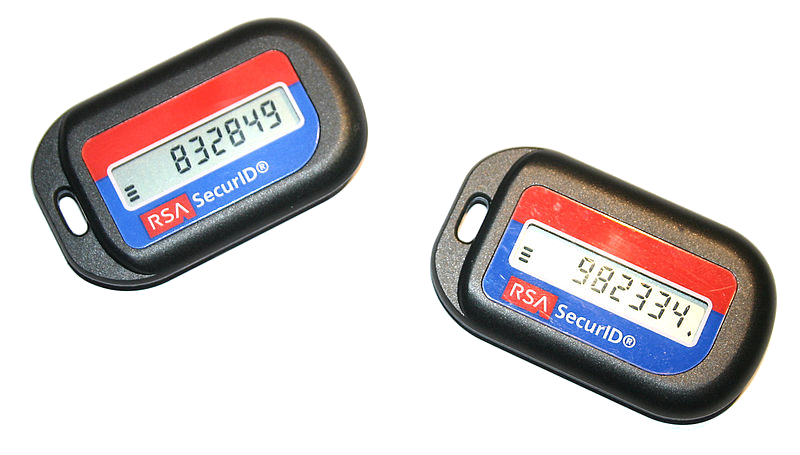
The IT security world is still reeling from the impact of the OpenSSL Heartbleed bug. Thanks to the bug, many experts have been reviewing other technologies to try and find similar risks. While Heartbleed was hidden away in the depths of the OpenSSL code base, another major security risk has been hiding in plain sight: SMS authentication for web site logins. Remarkably, a number of firms have started giving customers the ability to receive single-use passwords over SMS for logging into their secure web sites. Some have even insisted that customers can no longer log in without it, denying customers the right to make an important choice about their own security preferences. Unfortunately, SMS is no substitute to the one-time-passwords generated using proper authentication tokens or the use of other strong authentication schemes such as cryptographic smart cards. Even telephone companies themselves advise that SMS should not be used to secure financial transactions. Ocean's 11 in real life: exploiting the weakest link in the chain To deliver single-use SMS passwords, the SMS must travel through various networks from the firm's headquarters, to a wholesale SMS gateway, international SMS network and finally down the line of the local phone company. In comparison, properly certified token devices generate a code inside the device in the palm of your hand. The code only travels from the screen to your eyes. In a litany of frauds coming in all shapes and sizes, telephone networks have been exploited over and over again because they are almost always the weakest link in the chain. Using the mobile SMS network for authentication is not building on solid ground - some experts even feel it is downright stupidity. One of the most serious examples was the theft of $150,000,000 from a pension fund deposited with JP Morgan: it was described as a real-life case of Ocean's 11. The authentication was meant to be a phone call rather than an SMS: a phone company employee who was in on the scam duly ensured the call never reached the correct place. The insecurity of traditional telephone networks has been on display for all the world to see in the ongoing trial of News Corporation executives for phone hacking. If journalists from a tabloid newspaper can allegedly hack a dozen phones before their first cigarette of the day, is it really wise to use an insecure technology like SMS as the cornerstone of a security system for authorizing transactions? A fraud recently played out on many credit card holders in the UK exploited a low-tech feature of the phone system to trick people to believe they were safe by "calling back" to their bank. A plethora of new attack vectors The staggering reality of the situation is that attackers don't even have to directly hack their victim's phones to access SMS messages. As the Android API documentation demonstrates, SMS reception is notified to all apps in real-time. Apps can process the messages even when the phone is sleeping and the message is not read by the user. Just consider all the apps on a phone that have requested permission to read incoming messages. There was an uproar recently when a new version of the Facebook app started demanding permissions to read incoming SMS. The app can't be installed if the user doesn't agree to these new permissions. WhatsApp, another popular app that has SMS access rights, was recently exposed in a major security scandal which revealed they use a phone's IMEI number as the password. When people install an app like Tinder (which does not yet request SMS access) is the security of their bank account likely to be at the front of their mind? Even if Facebook intends no harm, they have opened the floodgates by further de-sensitizing users to the risks of giving apps un-necessary access to their data. These companies are looking for every piece of data that could give them an edge in their customer profiling and marketing programs. Having real-time access to your SMS is a powerful way for them to understand your activities and feelings at every moment in the day. To facilitate these data analysis techniques, replicating and archiving your messages into their cloud databases (whether you can see them there or not) is par for the course. The cloud, of course, has become a virtual smorgasboard for cyber-criminals, including both hackers and occasionally insiders wanting to peek at private data or harvest it en-masse. Social networking and communication sites are built on a philosophy of sharing data to create interaction and excitement. Unfortunately, this is orthogonal to the needs of security. In this context, the telephone network itself may no longer be the weakest link in the chain. The diligent attacker only needs to look for the cloud operator with an unplugged security hole and use their system as a stepping stone to read any SMS they want, when they want. Would you notice a stray SMS? Maybe you feel that you would notice a stray SMS carrying a login code for your bank account. Would you always be able to react faster than the criminal however? Thanks to social networks, or location data inadvertently leaked by other apps the attacker can easily work out whether you are on holiday, at the gym, at a party or sleeping or in some other situation where you are not likely to check messages immediately. If you receive a flood of SMS spam messages (deliberately sent by an attacker) in the middle of the night and you put your phone into silent mode and ignore it, you may well miss one message that was a login to your bank account. SMS technology was never designed for secure activities. The inconvenience of SMS While security is a headline issue these days, it is also worth reflecting on the inconvenience of SMS in some situations. Travel is at the top of the list: SMS doesn't work universally when abroad. These are usually the times when the only way to access the bank is through the web site. After dealing with the irritations of the hotel or airport wifi registration, do you really need more stress from your bank's systems too? For some networks, SMS can be delayed by hours or days, sometimes never arriving at all. Many people swap their SIM cards when travelling to avoid the excessive roaming charges and there is extra inconvenience in swapping SIM cards back again just to log in to a bank account. Worst of all, if you are tethering with a SIM card from the country you are visiting, then it is impossible for you to receive the SMS message from the bank on your regular SIM card while simultaneously maintaining the SSL connection to their web site over your new SIM card. Other problems like a flat battery, water damage or PIN permanently blocked by children playing with the phone can also leave you without access to your bank account for varying lengths of time. Is there any up-side to SMS authentication? The only potential benefit to SMS authentication is that it weeds out some of the most amateur attempts to compromise your bank account, but this is a false sense of security and it opens up new attack vectors through the cloud as we have just demonstrated. For all other purposes, it smells like a new form of security theater. A more likely reason why it has become popular amongst some firms is that many lenders want to ensure they have mobile phone numbers to contact customers when loan or credit card payments are missed. Making the mobile phone number mandatory for login ensures they almost always have the correct phone number for almost 100% of customers. It is not clear that this benefit justifies the failure to provide proper security and the inconvenience when travelling though. Opting out Next time you log in to a web site, if the firm does try to enrol you in an SMS authentication scheme, it may be a good idea to click the "No thanks" option. If you have already been registered into an SMS authentication scheme, fill out the online complaint form and inform the firm that you will only accept a proper authentication token or cryptographic smart card. These solutions are tried and tested and they are the correct tool for the job.

27 April 2014

Vincent Bernat: Local corporate APT repositories

Distributing software efficiently accross your platform can be difficult. Every distribution comes with a package manager which is usually suited for this task. APT can be relied upon on when using Debian or a derivative. Unfortunately, the official repositories may not contain everything you need. When you require unpackaged software or more recent versions, it is possible to setup your own local repository. Most of what is presented here was setup for Dailymotion and was greatly inspired by the work done by Rapha l Pinson at Orange.

Setting up your repositories There are three kinds of repositories you may want to setup:
  1. A distribution mirror. Such a mirror will save bandwidth, provide faster downloads and permanent access, even when someone searches Google on Google.
  2. A local repository for your own packages with the ability to have a staging zone to test packages on some servers before putting them in production.
  3. Mirrors for unofficial repositories, like Ubuntu PPA. To avoid unexpected changes, such a repository will also get a staging and a production zone.
Before going further, it is quite important to understand what a repository is. Let s illustrate with the following line from my /etc/apt/sources.list:
deb http://ftp.debian.org/debian/ unstable main contrib non-free
In this example, http://ftp.debian.org/debian/ is the repository and unstable is the distribution. A distribution is subdivided into components. We have three components: main, contrib and non-free. To setup repositories, we will use reprepro. This is not the only solution but it has a good balance between versatility and simplicity. reprepro can only handle one repository. So, the first choice is about how you will split your packages in repositories, distributions and components. Here is what matters:
  • A repository cannot contain two identical packages (same name, same version, same architecture).
  • Inside a component, you can only have one version of a package.
  • Usually, a distribution is a subset of the versions while a component is a subset of the packages. For example, in Debian, with the distribution unstable, you choose to get the most recent versions while with the component main, you choose to get DFSG-free software only.
If you go for several repositories, you will have to handle several reprepro instances and won t be able to easily copy packages from one place to another. At Dailymotion, we put everything in the same repository but it would also be perfectly valid to have three repositories:
  • one to mirror the distribution,
  • one for your local packages, and
  • one to mirror unofficial repositories.
Here is our target setup: Local APT repository

Initial setup First, create a system user to work with the repositories:
$ adduser --system --disabled-password --disabled-login \
>         --home /srv/packages \
>         --group reprepro
All operations should be done with this user only. If you want to setup several repositories, create a directory for each of them. Each repository has those subdirectories:
  • conf/ contains the configuration files,
  • gpg/ contains the GPG stuff to sign the repository1,
  • logs/ contains the logs,
  • www/ contains the repository that should be exported by the web server.
Here is the content of conf/options:
outdir +b/www
logdir +b/logs
gnupghome +b/gpg
Then, you need to create the GPG key to sign the repository:
$ GNUPGHOME=gpg gpg --gen-key
Please select what kind of key you want:
   (1) RSA and RSA (default)
   (2) DSA and Elgamal
   (3) DSA (sign only)
   (4) RSA (sign only)
Your selection? 1
RSA keys may be between 1024 and 4096 bits long.
What keysize do you want? (2048) 4096
Requested keysize is 4096 bits
Please specify how long the key should be valid.
         0 = key does not expire
      <n>  = key expires in n days
      <n>w = key expires in n weeks
      <n>m = key expires in n months
      <n>y = key expires in n years
Key is valid for? (0) 10y
Key expires at mer. 08 nov. 2023 22:30:58 CET
Is this correct? (y/N) y
Real name: Dailymotion Archive Automatic Signing Key
Email address: the-it-operations@dailymotion.com
Comment: 
[...]
By setting an empty password, you allow reprepro to run unattended. You will have to distribute the public key of your new repository to let APT check the archive signature. An easy way is to ship it in some package.

Local mirror of an official distribution Let s start by mirroring a distribution. We want a local mirror of Ubuntu Precise. For this, we need to do two things:
  1. Setup a new distribution in conf/distributions.
  2. Configure the update sources in conf/updates.
Let s add this block to conf/distributions:
# Ubuntu Precise
Origin: Ubuntu
Label: Ubuntu
Suite: precise
Version: 12.04
Codename: precise
Architectures: i386 amd64
Components: main restricted universe multiverse
UDebComponents: main restricted universe multiverse
Description: Ubuntu Precise 12.04 (with updates and security)
Contents: .gz .bz2
UDebIndices: Packages Release . .gz
Tracking: minimal
Update: - ubuntu-precise ubuntu-precise-updates ubuntu-precise-security
SignWith: yes
This defines the precise distribution in our repository. It contains four components: main, restricted, universe and multiverse (like the regular distribution in official repositories). The Update line starts with a dash. This means reprepro will mark everything as deleted before updating with the provided sources. Old packages will not be kept when they are removed from Ubuntu. In conf/updates, we define the sources:
# Ubuntu Precise
Name: ubuntu-precise
Method: http://fr.archive.ubuntu.com/ubuntu
Fallback: http://de.archive.ubuntu.com/ubuntu
Suite: precise
Components: main main multiverse restricted universe
UDebComponents: main restricted universe multiverse
Architectures: amd64 i386
VerifyRelease: 437D05B5
GetInRelease: no
# Ubuntu Precise Updates
Name: ubuntu-precise-updates
Method: http://fr.archive.ubuntu.com/ubuntu
Fallback: http://de.archive.ubuntu.com/ubuntu
Suite: precise-updates
Components: main restricted universe multiverse
UDebComponents: main restricted universe multiverse
Architectures: amd64 i386
VerifyRelease: 437D05B5
GetInRelease: no
# Ubuntu Precise Security
Name: ubuntu-precise-security
Method: http://fr.archive.ubuntu.com/ubuntu
Fallback: http://de.archive.ubuntu.com/ubuntu
Suite: precise-security
Components: main restricted universe multiverse
UDebComponents: main restricted universe multiverse
Architectures: amd64 i386
VerifyRelease: 437D05B5
GetInRelease: no
The VerifyRelease lines are GPG key fingerprint to use to check the remote repository. The key needs to be imported in the local keyring:
$ gpg --keyring /usr/share/keyrings/ubuntu-archive-keyring.gpg \
>     --export 437D05B5   GNUPGHOME=gpg gpg --import
Another important point is that we merge three distributions (precise, precise-updates and precise-security) into a single distribution (precise) in our local repository. This may cause some difficulties with tools expecting the three distributions to be available (like the Debian Installer2). Next, you can run reprepro and ask it to update your local mirror:
$ reprepro update
This will take some time on the first run. You can execute this command every night. reprepro is not the fastest mirror solution but it is easy to setup, flexible and reliable.

Repository for local packages Let s configure the repository to accept local packages. For each official distribution (like precise), we will configure two distributions:
  • precise-staging contains packages that have not been fully tested and not ready to go to production.
  • precise-prod contains production packages copied from precise-staging.
In our workflow, packages are introduced in precise-staging where they can be tested and will be copied to precise-prod when we want them to be available for production. You can adopt a more complex workflow if you need. The reprepro part is quite easy. We add the following blocks into conf/distributions:
# Dailymotion Precise packages (staging)
Origin: Dailymotion #  
Label: dm-staging   #  
Suite: precise-staging
Codename: precise-staging
Architectures: i386 amd64 source
Components: main role/dns role/database role/web #  
Description: Dailymotion Precise staging repository
Contents: .gz .bz2
Tracking: keep
SignWith: yes
NotAutomatic: yes #  
Log: packages.dm-precise-staging.log
 --type=dsc email-changes
# Dailymotion Precise packages (prod)
Origin: Dailymotion #  
Label: dm-prod      #  
Suite: precise-prod
Codename: precise-prod
Architectures: i386 amd64 source
Components: main role/dns role/database role/web #  
Description: Dailymotion Precise prod repository
Contents: .gz .bz2
Tracking: keep
SignWith: yes
Log: packages.dm-precise-prod.log
First notice we use several components (in ):
  • main will contain packages that are not specific to a subset of the platform. If you put a package in main, it should work correctly on any host.
  • role/* are components dedicated to a subset of the platform. For example, in role/dns, we ship a custom version of BIND.
The staging distribution has the NotAutomatic flag (in ) which disallows the package manager to install those packages except if the user explicitely requests it. Just below, when a new dsc file is uploaded, the hook email-changes will be executed. It should be in the conf/ directory. The Origin and Label lines (in ) are quite important to be able to define an explicit policy of which packages should be installed. Let s say we use the following /etc/apt/sources.list file:
# Ubuntu packages
deb http://packages.dm.gg/dailymotion precise main restricted universe multiverse
# Dailymotion packages
deb http://packages.dm.gg/dailymotion precise-prod    main role/dns
deb http://packages.dm.gg/dailymotion precise-staging main role/dns
All servers have the precise-staging distribution. We must ensure we won t install those packages by mistake. The NotAutomatic flag is one possible safe-guard. We also use a tailored /etc/apt/preferences:
Explanation: Dailymotion packages of a specific component should be more preferred
Package: *
Pin: release o=Dailymotion, l=dm-prod, c=role/*
Pin-Priority: 950
Explanation: Dailymotion packages should be preferred
Package: *
Pin: release o=Dailymotion, l=dm-prod
Pin-Priority: 900
Explanation: staging should never be preferred
Package: *
Pin: release o=Dailymotion, l=dm-staging
Pin-Priority: -100
By default, packages will have a priority of 500. By setting a priority of -100 to the staging distribution, we ensure the packages cannot be installed at all. This is stronger than NotAutomatic which sets the priority to 1. When a package exists in Ubuntu and in our local repository, we ensure that, if this is a production package, we will use ours by using a priority of 900 (or 950 if we match a specific role component). Have a look at the How APT Interprets Priorities section of apt_preferences(5) manual page for additional information. Keep in mind that version matters only when the priority is the same. To check if everything works as you expect, use apt-cache policy:
$ apt-cache policy php5-memcache
  Installed: 3.0.8-1~precise2~dm1
  Candidate: 3.0.8-1~precise2~dm1
  Version table:
 *** 3.0.8-1~precise2~dm1 0
        950 http://packages.dm.gg/dailymotion/ precise-prod/role/web amd64 Packages
        100 /var/lib/dpkg/status
     3.0.8-1~precise1~dm4 0
        900 http://packages.dm.gg/dailymotion/ precise-prod/main amd64 Packages
       -100 http://packages.dm.gg/dailymotion/ precise-staging/main amd64 Packages
     3.0.6-1 0
        500 http://packages.dm.gg/dailymotion/ precise/universe amd64 Packages
If we want to install a package from the staging distribution, we can use apt-get with the -t precise-staging option to raise the priority of this distribution to 990. Once you have tested your package, you can copy it from the staging distribution to the production distribution:
$ reprepro -C main copysrc precise-prod precise-staging wackadoodle

Local mirror of third-party repositories Sometimes, you want a software published on some third-party repository without to repackage it yourself. A common example is the repositories edited by hardware vendors. Like for an Ubuntu mirror, there are two steps: defining the distribution and defining the source. We chose to put such mirrors into the same distributions as our local packages but with a dedicated component for each mirror. This way, those third-party packages will share the same workflow as our local packages: they will appear in the staging distribution, we validate them and copy them to the production distribution. The first step is to add the components and an appropriate Update line to conf/distributions:
Origin: Dailymotion
Label: dm-staging
Suite: precise-staging
Components: main role/dns role/database role/web vendor/hp
Update: hp
# [...]
Origin: Dailymotion
Label: dm-prod
Suite: precise-prod
Components: main role/dns role/database role/web vendor/hp
# [...]
We added the vendor/hp component to both the staging and the production distributions. However, only the staging distribution gets an Update line (remember, packages will be copied manually into the production distribution). We declare the source in conf/updates:
# HP repository
Name: hp
Method: http://downloads.linux.hp.com/SDR/downloads/ManagementComponentPack/
Suite: precise/current
Components: non-free>vendor/hp
Architectures: i386 amd64
VerifyRelease: 2689B887
GetInRelease: no
Don t forget to add the GPG key to your local keyring. Notice an interesting feature of reprepro: we copy the remote non-free component to our local vendor/hp component. Then, you can synchronize the mirror with reprepro update. Once the packages have been tested, you will have to copy them in the production distribution.

Building Debian packages Our reprepro setup seems complete, but how do we put packages into the staging distribution? You have several options to build Debian packages for your local repository. It really depends on how much time you want to invest in this activity:
  1. Build packages from source by adding a debian/ directory. This is the classic way of building Debian packages. You can start from scratch or use an existing package as a base. In the latest case, the package can be from the official archive but for a more recent distribution or a backport or from an unofficial repository.
  2. Use a tool that will create a binary package from a directory, like fpm. Such a tool will try to guess a lot of things to minimize your work. It can even download everything for you.
There is no universal solution. If you don t have the time budget for building packages from source, have a look at fpm. I would advise you to use the first approach when possible because you will get those perks for free:
  • You keep the sources in your repository. Whenever you need to rebuild something to fix an emergency bug, you won t have to hunt the sources which may be unavailable when you need them the most. Of course, this only works if you build packages that don t download stuff directly from the Internet.
  • You also keep the recipe3 to build the package in your repository. If someone enables some option and rebuild the package, you won t accidently drop this option on the next build. Those changes can be documented in debian/changelog. Moreover, you can use a version control software for the whole debian/ directory.
  • You can propose your package for inclusion into Debian. This will help many people once the package hits the archive.

Builders We chose pbuilder as a builder4. Its setup is quite straightforward. Here is our /etc/pbuilderrc:
DISTRIBUTION=$DIST
NAME="$DIST-$ARCH"
MIRRORSITE=http://packages.dm.gg/dailymotion
COMPONENTS=("main" "restricted" "universe" "multiverse")
OTHERMIRROR="deb http://packages.dm.gg/dailymotion $ DIST -staging main"
HOOKDIR=/etc/pbuilder/hooks.d
BASE=/var/cache/pbuilder/dailymotion
BASETGZ=$BASE/$NAME/base.tgz
BUILDRESULT=$BASE/$NAME/results/
APTCACHE=$BASE/$NAME/aptcache/
DEBBUILDOPTS="-sa"
KEYRING="/usr/share/keyrings/dailymotion-archive.keyring.gpg"
DEBOOTSTRAPOPTS=("--arch" "$ARCH" "--variant=buildd" "$ DEBOOTSTRAPOPTS[@] " "--keyring=$KEYRING")
APTKEYRINGS=("$KEYRING")
EXTRAPACKAGES=("dailymotion-archive-keyring")
pbuilder is expected to be invoked with DIST, ARCH and optionally ROLE environment variables. Building the initial bases can be done like this:
for ARCH in i386 amd64; do
  for DIST in precise; do
    export ARCH
    export DIST
    pbuilder --create
  done
done
We don t create a base for each role. Instead, we use a D hook to add the appropriate source:
#!/bin/bash
[ -z "$ROLE" ]    
  cat >> /etc/apt/sources.list <<EOF
deb http://packages.dm.gg/dailymotion $ DIST -staging role/$ ROLE 
EOF
 
apt-get update
We ensure packages from our staging distribution are preferred over other packages by adding an /etc/apt/preferences file in a E hook:
#!/bin/bash
cat > /etc/apt/preferences <<EOF
Explanation: Dailymotion packages are of higher priority
Package: *
Pin: release o=Dailymotion
Pin-Priority: 900
EOF
We also use a C hook to get a shell in case there is an error. This is convenient to debug a problem:
#!/bin/bash
apt-get install -y --force-yes vim less
cd /tmp/buildd/*/debian/..
/bin/bash < /dev/tty > /dev/tty 2> /dev/tty
A manual build can be run with:
$ ARCH=amd64 DIST=precise ROLE=web pbuilder \
>         --build somepackage.dsc

Version numbering To avoid to apply complex rules to chose a version number for a package, we chose to treat everything as a backport, even in-house software. We use the following scheme: X-Y~preciseZ+dmW.
  • X is the upstream version5.
  • Y is the Debian version. If there is no Debian version, use 0.
  • Z is the Ubuntu backport version. Again, if such a version doesn t exist, use 0.
  • W is our version of the package. We increment it when we make a change to the packaging. This is the only number we are allowed to control. All the others are set by an upstream entity, unless it doesn t exist and in this case, you use 0.
Let s suppose you need to backport wackadoodle. It is available in a more recent version of Ubuntu as 1.4-3. Your first backport will be 1.4-3~precise0+dm1. After a change to the packaging, the version will be 1.4-3~precise0+dm2. A new upstream version 1.5 is available and you need it. You will use 1.5-0~precise0+dm1. Later, this new upstream version will be available in some version of Ubuntu as 1.5-3ubuntu1. You will rebase your changes on this version and get 1.5-3ubuntu1~precise0+dm1. When using Debian instead of Ubuntu, a compatible convention could be : X-Y~bpo70+Z~dm+W.

Uploading To upload a package, a common setup is the following workflow:
  1. Upload the source package to an incoming directory.
  2. reprepro will notice the source package, check its correctness (signature, distribution) and put it in the archive.
  3. The builder will notice a new package needs to be built and build it.
  4. Once the package is built, the builder will upload the result to the incoming directory.
  5. reprepro will notice again the new binary package and integrate it in the archive.
This workflow has the disadvantage to have many moving pieces and to leave the user in the dark while the compilation is in progress. As an alternative, a simple script can be used to execute each step synchronously. The user can follow on their terminal that everything works as expected. Once we have the .changes file, the build script just issues the appropriate command to include the result in the archive:
$ reprepro -C main include precise-staging \
>      wackadoodle_1.4-3~precise0+dm4_amd64.changes
Happy hacking!

  1. The gpg/ directory could be shared by several repositories.
  2. We teached Debian Installer to work with our setup with an appropriate preseed file.
  3. fpm-cookery is a convenient tool to write recipes for fpm, similar to Homebrew or a BSD port tree. It could be used to achieve the same goal.
  4. sbuild is an alternative to pbuilder and is the official builder for both Debian and Ubuntu. Historically, pbuilder was more focused on developers needs.
  5. For a Git snapshot, we use something like 1.4-git20130905+1-ae42dc1 which is a snapshot made after version 1.4 (use 0.0 if no version has ever been released) at the given date. The following 1 is to be able to package different snapshots at the same date while the hash is here in case you need to retrieve the exact snapshot.

25 April 2014

Matthias Klumpp: AppStream 0.6.1 released a quick look at what you can do with the cli tool

Today I released AppStream and libappstream 0.6.1, which feature mostly bugfixes, so nothing incredibly exciting to see there (but this also means no API/ABI breaks). The release clarifies some paragraphs in the spec which people found confusing, and fixes a few issues (like one example in the docs not being valid AppStream metadata). As only spec extension, we introduce a priority property in distro metadata to allow metadata from one repository to override data shipped by another one. This is used (although with a similar syntax) in Fedora already to have placeholder data for non-free stuff, which gets overridden by the real metadata if a new application was added. In general, the property tag was added to make the answer to the question which data is preferred much less magic. The libappstream library got some new API to query component data in different ways, and I also brought back support for Vala (so if you missed the Vapi file: It s back now, although you have to manually enable this feature). The CLI tool also got some extensions to query AppStream data. Here is a brief introduction: First of all, we need to make sure the database is up-to-date, which should be the case already (it is rebuilt automatically):
$ sudo appstream-index --refresh
The database will only be rebuilt when necessary, if you want to force a rebuild anyway, use the force parameter. Now imagine we want to search for an app containing the word media (in description, keywords, summary, ):
$ appstream-index -s media
which will return:
Identifier: gnome-media-player.desktop [desktop-app]
Name: GNOME Media Player
Summary: A simple media player for GNOME
Package: gnome-media-player
----
Identifier: mediaplayer-app.desktop [desktop-app]
Name: Media Player
Summary: Media Player
Package: mediaplayer-app
----
Identifier: kde4__plasma-mediacenter.desktop [desktop-app]
Name: Plasma Media Center
Summary: A mediacenter user interface written with the Plasma framework
Package: plasma-mediacenter
----
etc.
If we already know the name if a .desktop-file or the ID of a component, we can have the tool print out information about the application, including which package it was installed from:
$ appstream-index --get lyx.desktop
If we want to see more details, including e.g. a screenshot URL and a longer description, we can pass details to the tool:
Identifier: lyx.desktop [desktop-app]
Name: LyX
Summary: An advanced document processor with the power of LaTeX.
Package: lyx-common
Homepage: http://www.lyx.org/
Icon: lyx.png
Description: LyX is a document processor that encourages an approach to writing
 based on the structure of your documents (WYSIWYM) and not simply
 their appearance (WYSIWYG).
 
 LyX combines the power and flexibility of TeX/LaTeX[...]
Sample Screenshot URL: http://alt.fedoraproject.org/pub/alt/screenshots/f21/source/lyx-ea535ddf18b5c7328c5e88d2cd2cbd8c.png
License: GPLv2+
(I truncated the results slightly ;-) ) Okay, so far so good. But now it gets really exciting (and this is a feature added with 0.6.1): We can now query a component by the items it provides. For example, I want to know which software provides the library libfoo.2:
appstream-index --what-provides -t lib -v libfoo.so.2
This also works with binaries, or Python modules:
appstream-index --what-provides -t bin -v apper
This stuff works distribution-agnostic, and as long as software ships upstream metadata with a valid <provides/> field, or the distributor adds it while generating AppStream distro metadata.
This means that software can as soon as we have sufficient metadata of this kind declare it s dependencies upstream in form of a simple text file, referencing the needed components to build and run it on any Linux distribution. Users can simply install missing stuff by passing that file to their package manager, which can look up the components->packaging mapping and versions and do the right thing in installing the dependencies. So basically, this allows things pip -r does for Python, but for any application (not only Python stuff), and based on the distributors package database. With the provides-items, we can also scan software to detect it s dependencies automatically (and have it in a distro-agnostic form directly). We can also easily search for missing mimetype-handlers, missing kernel-modules, missing firmware etc. to install it on-demand, making the system much smarter in handling it s dependencies. And users don t need to do search orgies to find the right component for a given task. Also on my todo list for the future, based on this feature: A small tool telling upstream authors which distribution has their application in which version, using just one command (and AppStream data from multiple distros). Also planned: A cross-distro information page showing which distros ship which library versions, Python modules and application versions (and also the support status of the distro), so developers know which library versions (or GCC versions etc.) they should at least support to make their application easily available on most distributions. As always, you can get the releases on Freedesktop, as well es the AppStream specification.

22 April 2014

Steve Kemp: I've not commented on security for a while

Unless you've been living under a rock, or in a tent (which would make me slightly jealous) you'll have heard about the recent heartbleed attack many times by now. The upshot of that attack is that lots of noise was made about hardening things, and there is now a new fork of openssl being developed. Many people have commented about "hardening Debian" in particular, as well as random musing on hardening software. One or two brave souls have even made noises about auditing code. Once upon a time I tried to setup a project to audit Debian software. You can still see the Debian Security Audit Project webpages if you look hard enough for them. What did I learn? There are tons of easy security bugs, but finding the hard ones is hard. (If you get bored some time just pick your favourite Editor, which will be emacs, and look how /tmp is abused during the build-process or in random libraries such as tramp [ tramp-uudecode].) These days I still poke at source code, and I still report bugs, but my enthusiasm has waned considerably. I tend to only commit to auditing a package if it is a new one I install in production, which limits my efforts considerably, but makes me feel like I'm not taking steps into the dark. It looks like I reported only three security isseus this year, and before that you have to go down to 2011 to find something I bothered to document. What would I do if I had copious free time? I wouldn't audit code. Instead I'd write test-cases for code. Many many large projects have rudimentary test-cases at best, and zero coverage at worse. I appreciate writing test-cases is hard, because lots of times it is hard to test things "for real". For example I once wrote a filesystem, using FUSE, there are some built-in unit-tests (I was pretty pleased with that, you could lauch the filesystem with a --test argument and it would invoke the unit-tests on itself. No separate steps, or source code required. If it was installed you could use it and you could test it in-situ). Beyond that I also put together a simple filesystem-stress script, which read/wrote/found random files, computes MD5 hashes of contents, etc. I've since seen similar random-filesystem-stresstest projects, and if they existed then I'd have used them. Testing filesystems is hard. I've written kernel modules that have only a single implicit test case: It compiles. (OK that's harsh, I'd usually ensure the kernel didn't die when they were inserted, and that a new node in /dev appeared ;) I've written a mail client, and beyond some trivial test-cases to prove my MIME-handling wasn't horrifically bad there are zero tests. How do you simulate all the mail that people will get, and the funky things they'll do with it? But that said I'd suggest if you're keen, if you're eager, if you want internet-points, writing test-cases/test-harnesses would be more useful than randomly auditing source code. Still what would I know, I don't even have a beard..

Daniel Pocock: Automatically creating repackaged upstream tarballs for Debian

One of the less exciting points in the day of a Debian Developer is the moment they realize they have to create a repackaged upstream source tarball. This is often a process that they have to repeat on each new upstream release too. Wouldn't it be useful to:
  • Scan all the existing repackaged upstream source tarballs and diff them against the real tarballs to catalog the things that have to be removed and spot patterns?
  • Operate a system that automatically produces repackaged upstream source tarballs for all tags in the upstream source repository or all new tarballs in the upstream download directory? Then the DD can take any of them and package them when he wants to with less manual effort.
  • Apply any insights from this process to detect non-free content in the rest of the Debian archive and when somebody is early in the process of evaluating a new upstream project?
Google Summer of Code is back One of the Google Summer of Code projects this year involves recursively building Java projects from their source. Some parts of the project, such as repackaged upstream tarballs, can be generalized for things other than Java. Web projects including minified JavaScript are a common example. Andrew Schurman, based near Vancouver, is the student selected for this project. Over the next couple of weeks, I'll be starting to discuss the ideas in more depth with him. I keep on stumbling on situations where repackaged upstream tarballs are necessary and so I'm hoping that this is one area the community will be keen to collaborate on.

Erich Schubert: Kernel-density based outlier detection and the need for customization

Outlier detection (also: anomaly detection, change detection) is an unsupervised data mining task that tries to identify the unexpected.
Most outlier detection methods are based on some notion of density: in an appropriate data representation, "normal" data is expected to cluster, and outliers are expected to be further away from the normal data.
This intuition can be quantified in different ways. Common heuristics include kNN outlier detection and the Local Outlier Factor (which uses a density quotient). One of the directions in my dissertation was to understand (also from a statistical point of view) how the output and the formal structure of these methods can be best understood.
I will present two smaller results of this analysis at the SIAM Data Mining 2014 conference: instead of the very heuristic density estimation found in above methods, we design a method (using the same generalized pattern) that uses a best-practise from statistics: Kernel Density Estimation. We aren't the first to attempt this (c.f. LDF), but we actuall retain the properties of the kernel, whereas the authors of LDF tried to mimic the LOF method too closely, and this way damaged the kernel.
The other result presented in this work is the need to customize. When working with real data, using "library algorithms" will more often than not fail. The reason is that real data isn't as nicely behaved - it's dirty, it seldom is normal distributed. And the problem that we're trying to solve is often much narrower. For best results, we need to integrate our preexisting knowledge of the data into the algorithm. Sometimes we can do so by preprocessing and feature transformation. But sometimes, we can also customize the algorithm easily.
Outlier detection algorithms aren't black magic, or carefully adjusted. They follow a rather simple logic, and this means that we can easily take only parts of these methods, and adjust them as necessary for our problem at hand!
The article persented at SDM will demonstrate such a use case: analyzing 1.2 million traffic accidents in the UK (from data.gov.uk) we are not interested in "classic" density based outliers - this would be a rare traffic accident on a small road somewhere in Scotland. Instead, we're interested in unusual concentrations of traffic accidents, i.e. blackspots.
The generalized pattern can be easily customized for this task. While this data does not allow automatic evaluation, many outliers could be easily verified using Google Earth and search: often, historic imagery on Google Earth showed that the road layout was changed, or that there are many news reports about the dangerous road. The data can also be nicely visualized, and I'd like to share these examples with you. First, here is a screenshot from Google Earth for one of the hotspots (Cherry Lane Roundabout, North of Heathrow airport, which used to be a double cut-through roundabout - one of the cut-throughs was removed since):
Screenshot of Cherry Lane Roundabout hotspot
Google Earth is best for exploring this result, because you can hide and show the density overlay to see the crossroad below; and you can go back in time to access historic imagery. Unfortunately, KML does not allow easy interactions (at least it didn't last time I checked).
I have also put the KML file on Google Drive. It will automatically display it on Google Maps (nice feature of Drive, kudos to Google!), but it should also allow you to download it. I've also explored the data on an Android tablet (but I don't think you can hide elements there, or access historic imagery as in the desktop application).
With a classic outlier detection method, this analysis would not have been possible. However, it was easy to customize the method; and the results are actually more meaningful: instead of relying on some heuristic to choose kernel bandwidth, I opted for choosing the bandwidth by physical arguments: 50 meters is a reasonable bandwidth for a crossroad / roundabout, and for comparison a radius of 2 kilometers is used to model the typical accident density in this region (there should other crossroads within 2 km in Europe).
Since I advocate reproducible science, the source code of the basic method will be in the next ELKI release. For the customization case studies, I plan to share them as a how-to or tutorial type of document in the ELKI wiki; probably also detailing data preprocessing and visualization aspects. The code for the customizations is not really suited for direct inclusion in the ELKI framework, but can serve as an example for advanced usage.
Reference:
E. Schubert, A. Zimek, H.-P. Kriegel
Generalized Outlier Detection with Flexible Kernel Density Estimates
In Proceedings of the 14th SIAM International Conference on Data Mining (SDM), Philadelphia, PA, 2014.
So TLDR of the story: A) try to use more established statistics (such as KDE), and B) don't expect an off-the-shelf solution to do magic, but customize the method for your problem.
P.S. if you happen to know nice post-doc positions in academia:
I'm actively looking for a position to continue my research. I'm working on scaling these methods to larger data and to make them work with various real data that I can find. Open-source, modular and efficient implementations are very important to me, and one of the directions I'd like to investigate is porting these methods to a distributed setting, for example using Spark. In order to get closer to "real" data, I've started to make these approaches work e.g. on textual data, mixed type data, multimedia etc. And of course, I like teaching; which is why I would prefer a position in academia.

Mart&iacute;n Ferrari: DNSSEC, DANE, SSHFP, etc

While researching some security-related stuff for a post I am currently writing, I found some interesting bits here and there that I though I should share, as they were new to me, and probably for many others.


DNSSEC The first thing is DNSSEC. I knew about it, of course, but never bothered to dig much into it. While reading about many interesting applications of DNS for key distribution, and thinking of ways to use them, it is clear that DNSSEC is a precondition for any of that to work. In case you don't know about it, it is an extension for the DNS service to make it safer, for example, to avoid the bad guys having you think that google.com points to sniffer.nsa.gov. Apart from these ber-cool applications I was thinking about, avoiding DNS-based attacks becomes more and more relevant these days. And I think Debian and the rest of the Free Software world should work on making this available to all end-users as easily as possible. While adoption still looks pretty low, there are some good news. First, Google claims its public DNS supports DNSSEC. Of course, you need to trust Google servers, and the path between your machine and them. But if your resolver supports DNSSEC, you can use their servers and validate the answers. On the other side, I am not too sure about their implementation, as half of the time, it would return a valid answer to a query for an invalid record: dig +dnssec sigfail.verteiltesysteme.net @8.8.8.8). Also, they have not published DNSSEC records for google.com, which seems crazy. Some packages included in Debian already take advantage of DNSSEC, if available (more on that later), but more importantly, there are a couple of DNSSEC-enabled recursive servers, including bind, unbound, and the more commonly-used dnsmasq (there is a wiki page summarising Debian's status). Sadly, the default configuration for dnsmasq does not enable DNSSEC, and most people will not use it, even if it installed, because DHCP-provided servers are usually preferred. It seems to me that it would be wise to have a package that would install dnsmasq with DNSSEC enabled, and make it the only valid resolver for the system. If you want to check if your resolver is correctly validating DNSSEC, you can use this test web page. Another good news is that many top-level domains already support DNSSEC, and in my case, Gandi.net has support in place to set it up. So I am going to look into enabling it for my own domain.

SSHFP One useful and simple advantage of using DNSSEC, is that you can store information there, and then trust it to be correct. One new DNS RR (resource record) that is useful in this context is the SSHFP RR, which allows the sysadmin of a host to publish the host SSH key fingerprint in the DNS zone. The ssh client, when enabling the VerifyHostKeyDNS option, will use that information to trust unknown hosts. One downside to this, is that either if you set the option to ask, or if your resolver does not support DNSSEC, you get the same message, which does not warn you about the extra risk. To help you create your DNS records, you can just run this command:
$ ssh-keygen -r brie.tincho.org
brie.tincho.org IN SSHFP 1 1 6ac93c63379828b5b75847bc37d8ab2b48983343
brie.tincho.org IN SSHFP 2 1 cf0d11515367e3aa7eeb37056688f11b53c8ef23

DANE, S/MIME and GPG Recently, while at FOSDEM, I attended talks that mentioned DANE. This proposed IETF standard introduces a mechanism to use DNS as a secure key distribution system, which could completely override the CA oligopoly, a very attractive proposition for many people. In short, it is very similar to the SSHFP mechanism, but it is not restricted to SSH host keys: it can be used to distribute public key information for any TLS-enabled service. So, instead (or in addition to) of having a CA sign your certificate, and relying on the chain of trust by means of having a local copy of all root CA certificates, you use the chain of trust embedded in DNSSEC to make sure that the DNS RRs you publish are valid. Then, the client application can trust the fingerprint published for the relevant service to verify that it is talking to the right server. This is a very exciting development, and I hope it gets widespread adoption. It is already supported in Postfix, there seem to be some work going on in Mozilla, as well as in Prosody which is a great start. Another exciting development of this, is the generalisation of DANE for other entities, like email addresses. There are two draft RFCs being worked on right now to deploy S/MIME and OpenPGP key material using DNSSEC. This could also change completely the way we manage the Web of Trust.

21 April 2014

Russ Allbery: Review: Hyperbole and a Half

Review: Hyperbole and a Half, by Allie Brosh
Publisher: Touchstone
Copyright: November 2013
ISBN: 1-4767-6459-X
Format: Graphic novel
Pages: 373
It's fundamentally pointless to write this review. Some number of you have already heard of Hyperbole and a Half. Most of that group already own this book and are only reading this review so that you can remember how much fun you had reading it. But, even better, you could just stop reading this review and go read the book again. Some of you who have heard of Hyperbole and a Half didn't know that Allie Brosh had published a book. If that's you, you're probably not reading this review any more, since you're now at your favorite book seller buying a copy of the book, rendering the review somewhat pointless. For those of you who have not heard of Hyperbole and a Half, there's no need to read a review, because it's a blog. So, rather than reading this review, you can just follow that link and read it for yourself. If you find yourself laughing uncontrollably (and occasionally crying) and going "where can I get more of this?", well, there's a book. Which you could have also found out from the blog itself. Like I said, not much point. If you read the blog and don't particularly care for it, well, I greatly respect your position. The diversity of taste in the human race is what leads to our wonderful variety of culture, philosophy, and art, and I appreciate your substantial contribution to that diversity. However, you should now make a mental note to never trust my humor recommendations, and you shouldn't let this review change your mind. But, since I'm here, I may as well write a review anyway. Hyperbole and a Half is, as mentioned, a blog by Allie Brosh. Most of the posts are quite long and substantial and in the form of cartoons mixed with text, usually (but not always) telling some sort of story. The cartoon style is what is often called "MS Paint," meaning that it looks like something drawn in Microsoft Paint with its most basic tools. (Other examples of this style are the Oatmeal and Homestuck, although Brosh stays consistently with a rawer art style than either of those.) It looks extremely simple, like child drawings (and early childhood inspires much of Brosh's material), but once one gets used to it, one realizes that Brosh gets amazing expressiveness and character out of the art style. As an aside, yes, I am wholeheartedly recommending a book that is full of material about young children. Brosh is that good. The subtitle of this book is "unfortunate situations, flawed coping mechanisms, mayhem, and other things that happened," and it's mostly based on (exaggerated) incidents that occurred in Brosh's life. Most of them are hilarious. Some of them are both hilarious and stunning psychological insights. She has an amazing knack for storytelling and for exaggerating just the right moments of the story, or summing up emotions in a wonderful turn of phrase or a picture. She's also amazingly good at telling embarrassing stories about herself in a way that makes you empathize rather than just cringe, and then come away feeling like you understand both her and yourself better. If you've wandered around the Internet much, you have probably run across the phrase "clean ALL the things!" and the corresponding picture. That's from Hyperbole and a Half (specifically, "This is Why I'll Never Be an Adult") and is included in this book (improved; see below). It's even better in context. But, beyond storytelling, the other thing Brosh is amazingly good at is capturing internal mental states and emotions in a way that the reader understands and those who have experienced the emotion immediately go "yes, THAT." The apex of this is her two-part post on depression, which is hands-down the best description of depression that I've ever read. That judgment has been echoed by multiple friends of mine with depression. And yes, both of those posts are included in the book as well, although you can also read them on the web. As you've probably noticed, this book is partly a collection of material that's freely available on the web. Unlike some web comics collections, it's not entirely a reprint collection; there are entirely new stories here (which for me was enough by itself to buy the book). Brosh's post on the book says that it's about 50% new material. But the ones that aren't original have been edited and improved, sometimes substantially. For example, I did a quick comparison of the book version with the web version of "This is Why I'll Never be an Adult" and found Brosh redrew all of the cartoons for the story. The book is also gorgeous, if you care about such things like I do: high quality paper, thick pages, vibrant colors, and a comfortable heft to the hardcover version. It's the sort of book that feels like it will survive for decades, which is good since I intend to re-read it for decades. Brosh has a lot of material on-line, so obviously only a small fraction made it into the book and there's more to discover on the blog. I can particularly recommend "The Alot is Better Than You at Everything" and "Boyfriend Doesn't Have Ebola. Probably.". The latter, which is mostly about creating a better pain scale, is my favorite from the blog that didn't make it into the book. And there are two more examples of the sort of thing that you'll getting here. So ends the probably pointless review. I absolutely adore Hyperbole and a Half. It is my favorite web comic, even surpassing XKCD, which is saying something. Even if there were no material, I would have bought this book in hardcover to support Brosh and to have a high-quality printing of the blog posts. The reworkings and improvements of the republished material and the brand new additions are just bonuses. But there's no need to take my word for it; the best possible advertisement for Brosh's work is on-line, from which you can easily determine if you'll enjoy this book as much as I did. Even the back cover and the inside flaps are awesome. Rating: 10 out of 10

Russell Coker: Sociological Images 2014

White Trash The above poster was on a bridge pylon in Flinders St in 2012. It s interesting to see what the Fringe Festival people consider to be associated with white trash . They claim homophobia is a white trash thing however lower class people have little political power and the fact that we still don t have marriage equality in Australia is clear evidence that homophobia is prevalent among powerful people. Toys vs Fairies Fairies look pretty while boys toys do things I took the above photo at Costco in 2012. I think it s worth noting the way that the Disney Fairies (all female and marketed to a female audience) are standing around looking pretty while the Toy Story characters (mostly male and marketed to a male audience) are running out to do things. Having those items side by side on the shelf was a clear example of a trend in toys towards girls being encouraged to be passive while boys are doing things. The Toy Story pack has one female character, so it could be interpreted as being aimed at both boys and girls. But even that interpretation doesn t remove the clear gender difference. It seems ironic to me that the descriptions on the boxes are Read, Play, and Listen for the Toy Story pack and Read, Play, and Colour on the Fairies pack. Colouring is more active than listening so the pictures don t match the contents. Make Up vs Tools Girls chocolate is make-up and boys chocolate is tools I took the above photo in an Aldi store in early 2013, today I was in Aldi and noticed that the same chocolate is still on sale. A clear and pointless gender difference. Rumor has it that some of the gender difference in kids clothing is so that a child can t wear the clothes of an older sibling of different gender, but chocolate only gets eaten once so there is no reason for this. Oath The above poster was inside the male toilet at Melbourne University in 2013. It would probably be good to have something like that on display all the time instead of just for one event. Locks Locks with inscriptions on a bridge on the Yarra River in Melbourne I took the above picture early this year, it shows hundreds of padlocks attached to a bridge across the Yarra River in Melbourne. Each padlock has a message written or inscribed in it, mostly declarations of love. I first noticed this last year, I m not sure how long it s been up. There was nothing formal about this (no signs about it), people just see it and decide that they want to add to it. I guess that the council cuts some of them off periodically as the number of locks doesn t seem to be increasing much in recent times. It would be interesting to do some research into how many locks are needed to start one of these. It would also be interesting to discover whether the nature of the inscriptions determines the speed at which it takes off, would a bunch of padlocks with messages like I Love Linux inspire others as well as messages declaring love for random people? All that is required is some old locks and an engraving tool. I wonder what the social norm might be regarding messing with those locks. If I was to use those padlocks to practice the sport of lock-picking (which I learned when in Amsterdam) I wonder whether random bystanders would try to discourage me. It seems likely that picking the locks and taking them away would get a negative reaction but I wonder whether picking them one at a time and replacing them (or maybe moving them to another wire) would get a reaction. Blackface for Schoolkids teachers choice blackface and yellowface masks A craft shop at the Highpoint shopping center in Melbourne is selling Teacher s Choice brand Multicultural Face Masks . Multicultural is a well regarded term in education, teaching children about other cultures is a good concept but can be implemented really badly. When I was in high school the subject Social Studies seemed to have an approach of look how weird people are in other places instead of teaching the kids anything useful. Sociological Images has an informative article on the Australian Hey Hey it s Saturday blackface incident in 2009 [1]. The idea of these masks seems to involve students dressing up as caricatures of other races. The mask which looks like someone s idea of a Geisha is an even bigger WTF, mixing what the package calls culture (really race) with sex work. When I visited Tokyo I got the impression that French maids fill a similar niche to Geisha for younger Japanese men and the maid cafe thing is really popular there. I think it s interesting to consider the way that a French maid costume is regarded differently to a Geisha costume. I expect that Teacher s Choice doesn t sell French maid costumes. Delicious Cow picture of a bovine named Delicious Usually meat is advertised in a way that minimises the connection to living animals. Often adverts just show cuts of meat and don t make any mention of animals and when animals are shown they are in the distance. The above picture was on the wall at a Grill d burger restaurant in Point Cook. It shows a bovine (looks like a bull even though I believe that cows are the ones that are usually eaten) with a name-tag identifying it as Delicious . The name tag personalises the animal which is an uncommon thing to do when parts of an animal are going to be eaten. Of the animals that are commonly eaten it seems that the general trend is to only show fish as complete live animals, presumably because people can identify with mammals such as cattle in a way that they can t identify with fish. Fish are also the only complete animals that are shown dead, adverts for fish that are sold as parts (EG salmon and tuna) often show complete dead fish. But I ve never seen a meat advert that shows a complete dead cow or sheep.

Next.

Previous.