Rust is a hugely popular compiled programming language and accelerating it was an important goal for Firebuild for some time.
Firebuild s v0.8.0 release finally added Rust support in addition to numerous other improvements including support for Doxygen, Intel s Fortran compiler and restored javac and javadoc acceleration.
Firebuild s Rust + Cargo support
Firebuild treats programs as black boxes intercepting C standard library calls and system calls. It shortcuts the program invocations that predictably generate the same outputs because the program itself is known to be deterministic and all inputs are known in advance. Rust s compiler, rustc is deterministic in itself and simple rustc invocations were already accelerated, but parallel builds driven by Cargo needed a few enhancements in Firebuild.
Cargo s jobserver
Cargo uses the Rust variant of the GNU Make s jobserver to control the parallelism in a build. The jobserver creates a file descriptor from which descendant processes can read tokens and are allowed to run one extra thread or parallel process per token received. After the extra threads or processes are finished the tokens must be returned by writing to the other file descriptor the jobserver created. The jobserver s file descriptors are shared with the descendant processes via environment variables:
Since getting tokens from the jobserver involves reading them as nondeterministic bytes from an inherited file descriptor this is clearly an operation that would depend on input not known in advance. Firebuild needs to make an exception and ignore jobserver usage related reads and writes since they are not meant to change the build results. However, there are programs not caring at all about jobservers and their file descriptors. They happily close the inherited file descriptors and open new ones with the same id, to use them for entirely different purposes. One such program is the widely used ./configure script, thus the case is far from being theoretical.
To stay on the safe side firebuild ignores jobserver fd usage only in programs which are known to use the jobserver properly. The list of the programs is now configurable in /etc/firebuild.conf and since rustc is on the list by default parallel Rust builds are accelerated out of the box!
Writable dependency dir
The other issue that prevented highly accelerated Rust builds was rustc s -L dependency=<dir> parameter. This directory is populated in a not fully deterministic order in parallel builds. Firebuild on the other hand hashes directory listings of open()-ed directories treating them as inputs assuming that the directory content will influence the intercepted programs outputs. As rustc programs started in parallel scanned the dependency directory in different states depending on what other Rust compilations finished already Firebuild had to store the full directory content as an input for each rustc cache entry resulting low hit rate when rustc was started again with otherwise identical inputs.
The solution here is ignoring rustc scanning the dependency directory, because the dependencies actually used are still treated as input and are checked when shortcutting rustc. With that implemented in firebuild, too, librsvg s build that uses Rust and Cargo can be accelerated by more than 90%, even on a system having 12 cores/24 threads!:
Firebuild accelerating librsvg s Rust + Cargo build from 38s to 2.8s on a Ryzen 5900X (12C/24T) system
On the way to accelerate anything
Firebuild s latest release incorporated more than 100 changes just from the last two months. They unlocked acceleration of Rust builds with Cargo, fixed Firebuild to work with the latest Java update that slightly changed its behavior, started accelerating Intel s Fortran compiler in addition to accelerating gfortran that was already supported and included many smaller changes improving the acceleration of other compilers and tools. If your favorite toolchain is not mentioned, there is still a good chance that it is already supported. Give Firebuild a try and tell us about your experience!
Update 1: Comparison to sccache came up in the reddit topic about Firebuild s Rust acceleration , thus by popular demand this is how sccache performs on the same project:
Firebuild 0.8.0 vs. sccache 0.4.2 accelerating librsvg s Rust + Cargo build
All builds took place on the same Ryzen 5900X system with 12 cores / 24 threads in LXC containers limited to using 1-12 virtual CPUs. A warm-up build took place before the vanilla (without any instrumentation) build to download and compile the dependency crates to measure only the project s build time. A git clean command cleared all the build artifacts from the project directory before each build and ./autogen.sh was run to measure only clean rebuilds (without autotools). See test configuration in the Firebuild performance test repository for more details and easy reproduction.
Firebuild had lower overhead than sccache (2.83% vs. 6.10% on 1 CPU and 7.71% vs. 22.05% on 12 CPUs) and made the accelerated build finish much faster (2.26% vs. 19.41% of vanilla build s time on 1 CPU and 7.5% vs. 27.4% of vanilla build s time on 12 CPUs).
The voting period for the Debian Project Leader election has ended, with all of the votes tallied we announce the winner is: Jonathan Carter, who has been elected for the forth time.
Congratulations! The new term for the project leader started on 2023-04-21.
279 of 997 Developers voted using the Condorcet method.
More information about the results of the voting are available on the Debian Project Leader Elections 2023 page.
Many thanks all of our Developers for voting.
In a previous blog post I described the use of virtual
postings to track accidental personal/family expenses. I've always been
uncomfortable with that, and in hledger 1yr I outlined a potential scheme
for finally addressing the virtual posting problem.
separate journals
My outline built on top of continuing to maintain both personal and family
financial data in the same place, but I've decided that this can't work,
because the different "directions" (or signs) of accidental transactions
originating from either the family or personal side can't be addressed with any
kind of alternate view on the same data.
To illustrate with an example.
A negative balance in family:liabilities:jon means "family owes jon". A
coffee bought by mistake on the family credit card will have a negative
posting on the credit card, and thus a positive one on the liabilities
account. ("jon owes family"). That's fine.
But what about when I buy family stuff on a personal card? The other side of
of the transaction is also going to have a positive sign, so it can't be
posted to family:liabilities:jon: it would have to go to somewhere else,
like jon:liabilities:family. Now I have two accounts which track versions
of the same thing, and they cannot be combined with a simple transaction
since they're looking at the same value from opposite directions (and signs).
Back when I first described the problem I was using
a single journal file for all my transactions. After moving to lots of separate
journal files (in hledger 1yr), it's become clearer to me that I don't
need to maintain the Family and Personal data together, at all: they can be
entirely separate journals.
getting data between journals
When I moved to a new set of ledger files for 2023, I needed to carry forward
the balances from 2022 in the form of "opening balance" transactions. This was
achieved by a report on the 2022 data, exported as CSV, and imported into the
2023 data (all following the scheme outlined by fully-fledged hledger.))
Separate Personal and Family journals need some information from each other, and I
can achieve that in the same way as for opening balances: with an export of
the relevant transactions as CSV, then imported on the other side. HLedger's
CSV import system is flexible enough that we can effectively invert the sign
of liabilities, addressing the problem above.
Worked example
We start with an accidental coffee purchased on the family card (and so this
belongs to the Family ledger)
I've encoded the expense category that the Personal ledger will be interested
in (the last bit, expenses:coffee) as a sub-account of the liabilities
category that the Family ledger is interested in1 (the first bit,
liabilities:jon). When viewed on the Family side, the expense category is not
interesting, and we can hide it with HLedger's alias feature2:
This is then converted into a journal file by hledger import. The rules file
for the import is very simple: the fields date, description, account1
and amount are taken as-is; account2 is hard-coded to liabilities:family.
The resulting transaction looks like
Before this journal is included by the main one, we have to adjust the expense
account, to remove the liabilities:jon: prefix. The import rules can't do
this3 , so we use another journal file as a go-between with another alias
rule:
alias /^liabilities.jon:/ =
This results, finally, in the following transaction in the Personal ledger:
avoiding double-counting
There's one set of transactions that we don't want to export across this divide,
and that's because they're already there: any time I transfer money from myself
to the family accounts (or vice versa) to address the accrued debt, the transaction
is visible from both my family and personal statements. To avoid exporting these
and double-counting them, I make sure those transactions don't post to an account
matching the pattern used in the hledger reg report. That's what the trailing
colon is for: It ensures I only export transactions which are to a sub-account
of liabilities:jon, and not to the root account liabilities:jon itself:
which is where I put the repayment transactions. I could instead use a more
explicit sub-account like liabilities:jon:repayments or similar, since the
trailing colon is quite subtle, but this works for me.
Wrap up
I've been really on the fence as to whether the complexity of this scheme is
worth it to avoid the virtual postings. The previous scheme was much simpler.
I have definitely made some mistakes with it, which didn't get caught by the
double-entry rules that virtual postings ignore, but they're for small sums
of money anyway.
On the other hand, a lot of the "machinery" of this already existed for getting
opening balances between calendar years, and the gory details are written down
and hidden inside the Makefile. I also expect that I will continue to see
advantages in having Family and Personal entirely separate, as they can each
develop and adapt to their own needs without having to consider the other side
of things every time.
It's a running experiment, and time will tell if it's a good idea.
This scheme was originally suggested to me by Pranesh on Twitter
(described in dues), but I discounted it at the time
because of the exact arrangement they suggested, not realising
the broader idea might work.
I've hand-waved one problem with using hledger aliases here. If
we use them as described, to hide the Personal expense details, we need
them to not be applied when performing the CSV-generating report.
Therefore, in practise I have them in a front-most family/2023.journal
file, which imports the data from another family/2023-back.journal,
and the CSV export is performed on the backing journal with the data
and not the alias.
HLedger import rules can't manipulate the fields from the CSV a great
deal, but one change I proposed and started hacking on would allow for
this: to expose Regexp match-groups as interpolatable tokens:
https://github.com/simonmichael/hledger/issues/2009.
While visiting a convention during Easter, it occurred to me that
it would be great if I could have a digital Dictaphone with
transcribing capabilities, providing me with texts to cut-n-paste into
stuff I need to write. The background is that long drives often bring
up the urge to write on texts I am working on, which of course is out
of the question while driving. With the release of
OpenAI Whisper, this
seem to be within reach with Free Software, so I decided to give it a
go. OpenAI Whisper is a Linux based neural network system to read in
audio files and provide text representation of the speech in that
audio recording. It handle multiple languages and according to its
creators even can translate into a different language than the spoken
one. I have not tested the latter feature. It can either use the CPU
or a GPU with CUDA support. As far as I can tell, CUDA in practice
limit that feature to NVidia graphics cards. I have few of those, as
they do not work great with free software drivers, and have not tested
the GPU option. While looking into the matter, I did discover some
work to provide CUDA support on non-NVidia GPUs, and some work with
the library used by Whisper to port it to other GPUs, but have not
spent much time looking into GPU support yet. I've so far used an old
X220 laptop as my test machine, and only transcribed using its
CPU.
As it from a privacy standpoint is unthinkable to use computers
under control of someone else (aka a "cloud" service) to transcribe
ones thoughts and personal notes, I want to run the transcribing
system locally on my own computers. The only sensible approach to me
is to make the effort I put into this available for any Linux user and
to upload the needed packages into Debian. Looking at Debian Bookworm, I
discovered that only three packages were missing,
tiktoken,
triton, and
openai-whisper. For a while
I also believed
ffmpeg-python was
needed, but as its
upstream
seem to have vanished I found it safer
to rewrite
whisper to stop depending on in than to introduce ffmpeg-python
into Debian. I decided to place these packages under the umbrella of
the Debian Deep
Learning Team, which seem like the best team to look after such
packages. Discussing the topic within the group also made me aware
that the triton package was already a future dependency of newer
versions of the torch package being planned, and would be needed after
Bookworm is released.
All required code packages have been now waiting in
the Debian NEW
queue since Wednesday, heading for Debian Experimental until
Bookworm is released. An unsolved issue is how to handle the neural
network models used by Whisper. The default behaviour of Whisper is
to require Internet connectivity and download the model requested to
~/.cache/whisper/ on first invocation. This obviously would
fail the
deserted island test of free software as the Debian packages would
be unusable for someone stranded with only the Debian archive and solar
powered computer on a deserted island.
Because of this, I would love to include the models in the Debian
mirror system. This is problematic, as the models are very large
files, which would put a heavy strain on the Debian mirror
infrastructure around the globe. The strain would be even higher if
the models change often, which luckily as far as I can tell they do
not. The small model, which according to its creator is most useful
for English and in my experience is not doing a great job there
either, is 462 MiB (deb is 414 MiB). The medium model, which to me
seem to handle English speech fairly well is 1.5 GiB (deb is 1.3 GiB)
and the large model is 2.9 GiB (deb is 2.6 GiB). I would assume
everyone with enough resources would prefer to use the large model for
highest quality. I believe the models themselves would have to go
into the non-free part of the Debian archive, as they are not really
including any useful source code for updating the models. The
"source", aka the model training set, according to the creators
consist of "680,000 hours of multilingual and multitask supervised
data collected from the web", which to me reads material with both
unknown copyright terms, unavailable to the general public. In other
words, the source is not available according to the Debian Free
Software Guidelines and the model should be considered non-free.
I asked the Debian FTP masters for advice regarding uploading a
model package on their IRC channel, and based on the feedback there it
is still unclear to me if such package would be accepted into the
archive. In any case I wrote build rules for a
OpenAI
Whisper model package and
modified the
Whisper code base to prefer shared files under /usr/ and
/var/ over user specific files in ~/.cache/whisper/
to be able to use these model packages, to prepare for such
possibility. One solution might be to include only one of the models
(small or medium, I guess) in the Debian archive, and ask people to
download the others from the Internet. Not quite sure what to do
here, and advice is most welcome (use the debian-ai mailing list).
To make it easier to test the new packages while I wait for them to
clear the NEW queue, I created an APT source targeting bookworm. I
selected Bookworm instead of Bullseye, even though I know the latter
would reach more users, is that some of the required dependencies are
missing from Bullseye and I during this phase of testing did not want
to backport a lot of packages just to get up and running.
Here is a recipe to run as user root if you want to test OpenAI
Whisper using Debian packages on your Debian Bookworm installation,
first adding the APT repository GPG key to the list of trusted keys,
then setting up the APT repository and finally installing the packages
and one of the models:
curl https://geekbay.nuug.no/~pere/openai-whisper/D78F5C4796F353D211B119E28200D9B589641240.asc \
  -o /etc/apt/trusted.gpg.d/pere-whisper.asc
mkdir -p /etc/apt/sources.list.d
cat > /etc/apt/sources.list.d/pere-whisper.list <<EOF
deb https://geekbay.nuug.no/~pere/openai-whisper/ bookworm main
deb-src https://geekbay.nuug.no/~pere/openai-whisper/ bookworm main
EOF
apt update
apt install openai-whisper
The package work for me, but have not yet been tested on any other
computer than my own. With it, I have been able to (badly) transcribe
a 2 minute 40 second Norwegian audio clip to test using the small
model. This took 11 minutes and around 2.2 GiB of RAM. Transcribing
the same file with the medium model gave a accurate text in 77 minutes
using around 5.2 GiB of RAM. My test machine had too little memory to
test the large model, which I believe require 11 GiB of RAM. In
short, this now work for me using Debian packages, and I hope it will
for you and everyone else once the packages enter Debian.
Now I can start on the audio recording part of this project.
As usual, if you use Bitcoin and want to show your support of my
activities, please send Bitcoin donations to my address
15oWEoG9dUPovwmUL9KWAnYRtNJEkP1u1b.
It seems I'm having a theme recently on this blog, of making emacs-related posts. Here's another.
I write a bunch of stuff in markdown, such as my emacs init-file, blog-posts and other documents. I try to be quite consistent about vertical spacing, for example a post might look like this:
# header1
Some top-level stuff.
## header2
Some more details.
## header2
Some more things on a related topic.
# header2
Here I'm trying to breakup sections, so there is a "big gap" between H1 and smaller gaps between the lesser-level headings.
After going over my init file recently, making some changes, I noticed that the spacing was not at all consistent. So I figured "How hard could it be to recognize headers and insert/remove newlines before them?"
A trivial regexp search for "^#" identifies headers, and that counting the "#" characters lets you determine their depth. From their removing any previous newlines is the work of a moment, and inserting the appropriate number to ensure consistency is simple.
I spent 15 minutes writing the initial implementation, which was markdown-specific, then another 30 minutes adding support for org-mode files - because my work-diary is written using the org-diary package (along with other helpers, such as the org-tag-cloud.
Anyway the end result is that now when I save a markdown/org file the headers are updated automatically:
The fifth release of the still new-ish qlcal package
arrivied at CRAN just now.
qlcal
delivers the calendaring parts of QuantLib. It is provided (for the R
package) as a set of included files, so the package is self-contained
and does not depend on an external QuantLib library (which can be
demanding to build). qlcal covers
over sixty country / market calendars and can compute holiday lists, its
complement (i.e. business day lists) and much more.
This release brings updates to five calendars from the QuantLib 1.30
release from this week.
Changes in version 0.0.5
(2023-04-19)
Calendars routines for Australia, Denmark, New Zealand, Turkey
and the US have been updated from QuantLib 1.30.
Support for 'Australia/ASX' has been added.
Added demo showing all US holidays in current year
We also added a quick little demo using xts to
column-bind calendars produced from each of the different US
sub-calendars. This is a slightly updated version of the sketch we
tooted a few days ago. The output now is
(and we just discovered a tiny h -> hols
bug in the demo so see the git repo sorry!).
The release was finalized uploaded yesterday morning. But because we
have to set CXX_STD=CXX14 as satisfy requirements of some
of the Boost headers, we get ourselves a NOTE and with that a manual
inspection and a delay of 1 1/2 days. Not really all that meaningful
in the grand scheme of things but still suboptimal relative to the fully
automated passage this release should have gotten. Oh well.
Courtesy of my CRANberries, there
is a diffstat report for this
release. See the project page
and package documentation for more details, and more examples.
If you like this or other open-source work I do, you can now sponsor me at
GitHub.
As suggested in my initial announcement of apt-sigstore my plan was to look into stronger uses of Sigstore than rekor, and I m now happy to announce that the apt-cosign plugin has been added to apt-sigstore and the operational project debdistcanary is publishing cosign-statements about the InRelease file published by the following distributions: Trisquel GNU/Linux, PureOS, Gnuinos, Ubuntu, Debian and Devuan.
Summarizing the commands that you need to run as root to experience the great new world:
Then run your usual apt-get update and look in the syslog to debug things.
This is the kind of work that gets done while waiting for the build machines to attempt to reproducibly build PureOS. Unfortunately, the results is that a meager 16% of the 765 added/modifed packages are reproducible by me. There is some infrastructure work to be done to improve things: we should use sbuild for example. The build infrastructure should produce signed statements for each package it builds: One statement saying that it attempted to reproducible build a particular binary package (thus generated some build logs and diffoscope-output for auditing), and one statements saying that it actually was able to reproduce a package. Verifying such claims during apt-get install or possibly dpkg -i is a logical next step.
There is some code cleanups and release work to be done now. Which distribution will be the first apt-based distribution that includes native support for Sigstore? Let s see.
Sigstore is not the only relevant transparency log around, and I ve been trying to learn a bit about Sigsum to be able to support it as well. The more improved confidence about system security, the merrier!
I got a second external monitor. Overkill? Probably, but I like having a
dedicated space to instant messaging (now left monitor) and also a dedicated
space for a web browser (right monitor).
But, when I moved signal-desktop to the left monitor, clicks stopped working. I
moved it back to my laptop screen, clicks started working. Other apps (like
gajim) worked fine. A real mystery.
I spent a lot of time on the wrong thing. I turned this monitor into portrait
mode. Maybe signal doesn t like portrait mode? Nope.
Maybe signal doesn t think it has enough horizontal space? Nope.
Maybe signal suddently doesn t like being on an external monitor? Nope.
Maybe signal will output something useful if I start it via the terminal? Nope
(but that was a real distraction).
Then, I discovered that mattermost desktop behaves the same way. A clue! So,
now I know it s an electron app limitation, not a signal limitation.
Finally I hit on the problem: Via my sway desktop, I set my laptop screen to
the x,y coordinates: 0,0 (since it s in the middle). I set the left monitor to
negative coordinates so it would appear on the left. Well, electron does not
like that, not sure why.
Now, my left monitor occupies 0,0 and the rest are adjusted to that center.
I originally used negative coordinates so when I unplugged my monitors, my
laptop would still be 0,0 and display all desktops properly. Fortunately, sway
magically figures that all out even when the center shifts by unplugging the
monitors. Hooray for sway.
Changed in version 1.22.0: This argument was previously called "interpolation" ...
They renamed a keyword argument. So if you had working code that did
np.percentile( ...., interpolation=xxx, ....)
then running it in the most recent numpy would throw lots of
Deprecation warnings at you, and presumably eventually it will stop
working completely. This isn't great. The obvious answer is to change
the code to
np.percentile( ...., method=xxx, ....)
But then if you run it on a machine with an older numpy install, then
it won't work at all! There isn't a trivial method for users of numpy
to conform to this change without breaking stuff. In other words, the
numpy devs gave their users pointless homework. I just did this
homework with this commit to mrcal. It creates a percentile_compat()
function that figures out which flavor of argument we should use, and
uses it. Here it is:
defpercentile_compat(*args, **kwargs):
r'''Wrapper for np.percentile() to handle their API changeIn numpy 1.24 the "interpolation" kwarg was renamed to "method". I need to passthe right thing to work with both old and new numpy. This function tries thenewer method, and if that fails, uses the old one. The test is only done thefirst time.It is assumed that this is called with the old 'interpolation' key. '''ifnot'interpolation'in kwargs or \
percentile_compat.which == 'interpolation':
return np.percentile(*args, **kwargs)
kwargs_no_interpolation = dict(kwargs)
del kwargs_no_interpolation['interpolation']
if percentile_compat.which == 'method':
return np.percentile(*args, **kwargs_no_interpolation,
method = kwargs['interpolation'])
# Need to detecttry:
result = np.percentile(*args, **kwargs_no_interpolation,
method = kwargs['interpolation'])
percentile_compat.which = 'method'return result
except:
percentile_compat.which = 'interpolation'return np.percentile(*args, **kwargs)
percentile_compat.which = None
Please take it and use it. I give up all copyright.
Process
Rust is a trademark owned by the Foundation.
The Rust Foundation still seems to be finding its feet. Evidently, one of the items on its backlog was to update the trademark policy. Apparently they have been working on this for some time, in an informal working group.
In August, there was a survey. (I saw it in This Week In Rust, the community-curated newsletter where most important stuff appears, and responded.) I don t think the results of this survey have been published anywhere.
Last week (12th April) the Foundation published an official Inside Rust blog post linking to a draft. They included a link to a feedback survey, closing on the 17th of April i.e., it was open for 5 days.
This is far too short a period for formal feedback on such a draft. Especially given that this process has apparently already been generating significant controversy within parts of the Rust community.
Substance
Overall, this policy is poor. It is far too restrictive.
It is likely to lead to (further) controversy and argument, including conflicts with Rust s downstreams. It does not serve the needs of the Rust community.
In particular, the Rust community does not need the trademark to:
Maintain the quality of software called Rust.
Prevent people distributing badly-modified versions of its software, even called Rust , provided that users know what they are getting.
The community does need the trademark to:
Prevent people impersonating the Rust Project (for example by registering competing domain names).
Prevent people economically exploiting the value of the brand by holding shabby or vacuous conferences etc. (so requiring approval for e.g. conferences makes sense).
It might be useful to use the trademark to strengthen licensing or CoC compliance. For example, good faith redistributions of a modified Rust, as Rust , would be Free Software, even though the copyright licence permits proprietary derivatives; so use of the Rust trademark should probably require use of a Free licence.
There should be a series of blanket permissions to use the word Rust in for example:
Free Software distributions derived from official Rust software, provided it s recognisably similar. (I.e., you must change its name if you make other big changes too.)
Free Software libraries written in Rust, or interfacing to Rust, in non-Rust-specific software repositories (including source hosting systems like gitlab, distro package managers e.g. Debian apt, and package managers for other languages e.g. npm).
Currently there aren t. For example the current Debian practice of calling Rust libraries rust-<name-of-crate> is probably in violation.
There are a number of more detailed problems with the wording.
Values
The policy has all the hallmarks of excessive influence from traditional trademark lawyers and not enough influence from the Free Software community.
I would like to remind the Free Software activists on the inside of this process that the lawyers are there to serve you and the community.
The values embodied in trademark law often conflict with the values of the Free Software community. The Rust Project should adopt a trademark policy which follows the community s values - even if that might weaken our ability to sue evildoers.
Next steps
The Foundation should take a step back and pause the process.
Then, the Foundation should restart the process from a much earlier stage, with much wider publicity. Each stage should be widely advertised to the whole community, with opportunities for feedback.
This should include publishing the results of the August 2022 survey. The Foundation should publish a sketch of the legal advice they have received, publicly say what the plausible options are and what their consequences might be (for the community, for downstreams, and for the Foundation s enforcement ability).
(Some of this will no doubt repeat the work that has been done in the informal trademark working group. That work wasn t widely enough advertised.)
Echoes of a dispute from 2006
Mozilla made a very similar mistake with Firefox in 2006.
The official policy stated that no-one was allowed to distribute Firefox with any patches, unless those patches had been pre-approved by Mozilla.
Debian is committed to Software Freedom. This must includes the freedom to modify the software as one sees fit, even if the original authors don t agree.
Now, overly-restrictive trademark policies are hardly new. Debian often takes the practical view that usually the upstream with such a policy doesn t really mean it.
But Mozilla decided they did mean it. They contacted Debian asking for Debian to get their patches approved.
Since that wasn t acceptable to Debian, they stopped using the word Firefox . For a decade, Debian s Firefox browser was called Iceweasel .
We don t want something similar happening to Rust .
At ArgoCon today, Thomas Fricke gave a nice talk on Cloud Native
Deployments in Air Gapped
Environments
describing container vulnerability scanning in the German energy
sector and since he didn t mention data diodes, and since some of
my colleagues at Oakdoor/PA Consulting make data
diodes for a living, I thought this might be interesting to write
about!
It s one thing to have an air-gapped system, but eventually in order
to be useful you re going to have to move data into it, and this is
going to need something better than just plugging a USB stick into
your critical system. Just ask Iran how well this
goes.
Eight years after Stuxnet, the UK National Cyber Security Centre
published the NCSC Safely Importing Data
Pattern -
but I found this a bit cryptic on first reading, because it s not
clear what type of systems the pattern applies to, and deliberately uses
technology-neutral language. Also, this was published around the same
time GDPR was being implemented, mentions sensitive or personal
data , and claims to be aimed at small to medium organisations - but
I don t know how many small businesses implement a
MILS
security architecture. So without picking up on the mention of data
diode , you can be left scratching your head about how to actually
implement the pattern.
One answer using Oakdoor components:
PySISL, a Python library which you use to transform the data into a very simple format called SISL
an Oakdoor Import Diode, which can verify the syntax of SISL in hardware, and prevent any data moving back the other way
then some more PySISL code to validate the semantics of SISL on the high side and reconstruct the original format
The Oakdoor diodes themselves are quite interesting - they re
electrical rather than optical like most data diodes. The other thing
I d always wondered is how on earth you could even establish a TCP
handshake across one - the answer is, you can t, so you use a
UDP-based protocol like TFTP for file transfer.
In this way, you build the transform/verify and protocol break that
the NCSC pattern requires.
Congratulations, you can now import your documents to your otherwise
air-gapped system without also importing malicious code, and without
risking data exfiltration.
Note carefully that the Safely Importing Data pattern makes no
guarantees about the integrity of your documents - they could be
severely modified going through this process. For the same reason, I
anticipate challenges applying this pattern to software binaries.
PHILIPS PHL 221S8L
Those who have been reading this blog for a long time would perhaps know that I had bought a Viewsonic 19 almost 12 years ago. The Monitor was functioning well till last week. I had thought to change it to a 24 monitor almost 3-4 years ago when 24 LCD Monitors were going for around 4k/- or thereabouts. But the monitor kept on functioning and I didn t have space (nor do) to have a dual-monitor setup. It just didn t make sense. Apart from higher electricity charges it would have also have made more demands on my old system which somehow is still functioning even after all those years.
Then last week, it started to dim and after couple of days completely conked out. I had wanted to buy a new monitor in front of mum so she could watch movies or whatever but this was not to be. Sp I had to buy an LCD Monitor as Government raised taxes enormously after pandemic. Same/similar monitor that used to cost INR 4k/- today costed me almost INR 7k/- almost double the price. Hooking it to Debian I got the following
$ sudo hwinfo --monitor grep Model Model: "PHILIPS PHL 221S8L"
FWIW hwinfo is the latest version ~$ sudo hwinfo --version21.82
I did see couple of movies before starting to write this blog post. Not an exceptional monitor but better than before. I had option from three brands, Dell (most expensive), Philips (middle) and & LG (lowest in prices). Interestingly, Viewsonic disappeared from the market about 5 years back and made a comeback just couple of years ago. Even Philips which had exited the PC Monitor almost a decade back re-entered the market. Apart from the branding, it doesn t make much of a difference as almost all the products including the above monitors are produced in China. I did remember her a lot while buying the monitor as I m sure she would have enjoyed it far more than me but that was not to be
1984
During last week when I didn t have the monitor I re-read 1984. To be completely honest, I had read the above book when I was in the 20 s and I had no context. The protagonist seemed like a whiner and for the life of me I couldn t understand why he didn t try to escape. Re-reading after almost 2 decades and a bit more I shat a number of times because now the context is pretty near and pretty real. I can see why the Republicans in the U.S. banned it. I also realized why the protagnist didn t attempt to run away because wherever he would run away it would be the same thing. It probably is one of the most depressing books I have ever read. To willfully accept what is false after all that torture.
What was also interesting to me is to find that George Orwell was also a soldier just like Tolkien was. Both took part and wrote such different stories. While Mr. Tolkien writes and shares the pendulum between hope and despair, Mr. Orwell is decidedly dark. Not grey but dark. I am not sure if I would like to read Animal Farm anytime soon.
The Reaper Man Terry Pratchett
It is by sheer coincidence or perhaps I needed something to fill me up when I got The Reaper Man from Terry Pratchett. It was practically like a breath of fresh air. And I love Mr. Pratchett for the inclusivity he brings in. We think about skin color, and what not and here Mr. Pratchett writes about an undead gentleman who s extremely polite as he was a wizard. I won t talk more as I don t really want to spoil the surprise but rest assured everybody is gonna love it. I also read Long Utopia but this is for those who believe and think of multiverses long before it became a buzzword that it is today.
The Firm John Grisham
Now I don t know what I should write about this book as there aren t many John Grisham books where a rookie wins against more than one party opposite him. I wouldn t go much into depth but simply say it was worth a read. I am currently reading Gray Mountain. It very much shows how the coal Industry is corrupt and what all it does. It also brings to mind the amount of mining that is done in which Iron is the mostly sought after and done. Now if we are mining 94% Iron then wouldn t it make sense to ask to have a circular economy around Iron but we don t even hear a word about it. Even with all the imagined projections of lithium mining, it would hardly be 10% .
I could go on but will finish for now, till later.
Previously, I explained why ventilation monitoring is important, and the opportunity I see to help accelerate deployment of high quality ventilation monitoring for small businesses and organisations.
In this post, I m going to discuss my plans to tackle that opportunity:
My journey to ventilation monitoring
I started looking into ventilation monitoring in detail last year when I wanted to ensure that the classrooms of our local primary school were well ventilated during the Omicron outbreak. That research revealed that the existing products on offer were challenging to deploy in a school environment from a cost perspective while also not providing perfect functionality.
I built and deployed a set of monitors to our local school, along with a corresponding set of software and web services that provide management of the monitors and visibility into the collected data and trends. The benefit of the monitoring is evident - CO2 concentration drops immediately after a notification occurs, indicating the intended action of increasing ventilation is taking place. Initially this occurred more frequently, but over time low concentrations of CO2, indicating good ventilation levels, are regularly achieved across the school day thanks to simple changes in routine being established, such as leaving windows cracked open.
As the benefits of the project to the school became clear, my ambition and vision for ventilation monitoring grew from wanting to see my children learn in a safe and effective environment to desiring safe and effective learning, working, living and social spaces for everyone.
co2mon.nz: Ventilation monitoring as a service prototype
co2mon.nz is the service that I have launched to explore this opportunity. Based on the same hardware and software that I used for the school deployment I am selling both a physical CO2 monitor and an ongoing subscription service for the management and monitoring. Together, the monitor and software provide an effective and affordable path to understanding indoor air quality and ventilation status that anyone can use.
CO2 monitor
The CO2 monitor hardware and firmware are based on Oliver Seiler s design using a Sensirion SCD40 module for CO2 measurement and providing immediate in-room feedback via an on-monitor screen as well as a red/orange/green traffic light . In addition to the immediate feedback provided by the monitor itself, a WiFi connection can be configured allowing every measurement to be reported back to the supporting monitoring and management service.
At the current prototype stage, I am building all the hardware, 3D printing the plastic cases and assembling the circuit board from purchased components through a production line in my home workshop. The monitor is powered via a standard USB cable and wall adaptor for simplicity.
The first batch of monitors I built have been operating smoothly for nearly a year now. Further refinement and development of the design is required but already I am impressed with the potential this combination of easily accessible components provides to enable widespread adoption and deployment of ventilation monitoring.
Monitoring and management service
The web service provides a historical record of CO2 levels from each monitor through a set of graphs and other dashboards and allows for this data to be shared or published. This is useful both for providing visibility into ventilation status to those not directly present in the space (e.g. across an entire school) and to allow insights into trends and patterns in ventilation to be observed and acted upon.
When I began the project I approached the software side as an opportunity to explore the real-world equivalents of many of the internal tools and components that I was used to using within Google. That s been a fun process, even though it means I ve invested far more time on the software than the current number of customers or business state can really justify.
Communication with the monitors occurs via MQTT into a custom Go service responsible for maintaining the fleet and exposing the measurement data to Prometheus which acts as the storage layer. A second service (based on the Buffalo web framework) is responsible for serving the web interface containing the dashboards and configuration options. Alongside these core components another small Golang service manages a private X509 certificate authority to provide monitor identity and encryption of the measurement data and an automated pipeline of scripts and triggers takes care of firmware provisioning, sensor calibration and burn-in/failure testing when building batches of monitors.
While simple, the design is easy to manage and could scale to support many, many more monitors without significant effort. I m hosting the infrastructure on AWS, which I ve found pleasant and easy to use, and while not a typical choice, I m very pleased with the performance and flexibility that Prometheus offers as a data storage layer.
Areas of development
The prototype has been effective in proving the feasibility of offering ventilation monitoring as a service, but to evolve the prototype into an actual business is going to require further effort in the following areas:
Finding product market fit
I m confident that what co2mon.nz is offering could provide a useful and needed service for many small business owners and numerous others, but the question of whether it s sufficiently compelling that a sizeable group of customers see enough value that they re willing to regularly pay for it and therefore sustain a business providing the service is not yet proven.
While initial feedback on the idea has been positive, much of it has been from family and friends and I ve spent more time building the software (which has been fun and educational) than I have talking to actual potential customers and understanding their needs and wants.
This is a classic trap that technical founders fall into, and I m guilty despite my best intentions it s comfortable and easy for me to work on the parts where I have existing experience and neglect putting time into the customer-facing sales, marketing and research which are more uncomfortable, new and challenging!
Scaling monitor production
Scaling from the current prototype batches I have built to even modest levels (e.g. hundreds) of sales will require outsourcing. There are several potential New Zealand and overseas providers I can work with which look very promising, but will require iteration of the hardware design (e.g. to remove through-hole components which add complexity and expense to the PCB assembly process). The lead times I ve been quoted for working with these outsourced providers are in the order of 1-2 months per batch, and on top of this there are a number of other risks in terms of component availability and regulatory compliance that may add additional delays or time to resolve, particularly as my experience leans towards the software rather than the hardware.
It seems counter-intuitive to worry about how to scale to meet demand that doesn t yet provably exist, but given the potentially long lead times involved in establishing outsourced production I think it s worth taking some risk in starting this journey early.
Next steps
My aim now is to intentionally change my focus from the software to learning about the market and finding the right product to offer via two channels:
Via online marketing, to reach a wide range of potential customers and allow rapid iteration and testing of a variety of product/service combinations, including referral options for existing customers.
In-person with small businesses in my local area to seek out direct feedback and thoughts on the general issue of ventilation monitoring and the specific service I m offering.
One concrete possibility I m keen to test via both channels is a simple monthly price for the combined service, rather than purchasing a monitor and separate software subscription. This has the potential to be both simpler to market and explain to customers, while also opening the possibility of short-term rental or evaluation to customers who are not willing to make a long-term investment or commitment.
In parallel to the customer-focused discovery work, but as an explicit lower priority, I ll order an initial small batch of outsourced monitors to begin gaining experience with that process accepting the risk that the time and cost may turn out to be wasted if the product is wrong or not a good match for customers needs.
Here's an article from a French anarchist describing how his (encrypted) laptop was seized after he was arrested, and material from the encrypted partition has since been entered as evidence against him. His encryption password was supposedly greater than 20 characters and included a mixture of cases, numbers, and punctuation, so in the absence of any sort of opsec failures this implies that even relatively complex passwords can now be brute forced, and we should be transitioning to even more secure passphrases.
Or does it? Let's go into what LUKS is doing in the first place. The actual data is typically encrypted with AES, an extremely popular and well-tested encryption algorithm. AES has no known major weaknesses and is not considered to be practically brute-forceable - at least, assuming you have a random key. Unfortunately it's not really practical to ask a user to type in 128 bits of binary every time they want to unlock their drive, so another approach has to be taken.
This is handled using something called a "key derivation function", or KDF. A KDF is a function that takes some input (in this case the user's password) and generates a key. As an extremely simple example, think of MD5 - it takes an input and generates a 128-bit output, so we could simply MD5 the user's password and use the output as an AES key. While this could technically be considered a KDF, it would be an extremely bad one! MD5s can be calculated extremely quickly, so someone attempting to brute-force a disk encryption key could simply generate the MD5 of every plausible password (probably on a lot of machines in parallel, likely using GPUs) and test each of them to see whether it decrypts the drive.
(things are actually slightly more complicated than this - your password is used to generate a key that is then used to encrypt and decrypt the actual encryption key. This is necessary in order to allow you to change your password without having to re-encrypt the entire drive - instead you simply re-encrypt the encryption key with the new password-derived key. This also allows you to have multiple passwords or unlock mechanisms per drive)
Good KDFs reduce this risk by being what's technically referred to as "expensive". Rather than performing one simple calculation to turn a password into a key, they perform a lot of calculations. The number of calculations performed is generally configurable, in order to let you trade off between the amount of security (the number of calculations you'll force an attacker to perform when attempting to generate a key from a potential password) and performance (the amount of time you're willing to wait for your laptop to generate the key after you type in your password so it can actually boot). But, obviously, this tradeoff changes over time - defaults that made sense 10 years ago are not necessarily good defaults now. If you set up your encrypted partition some time ago, the number of calculations required may no longer be considered up to scratch.
And, well, some of these assumptions are kind of bad in the first place! Just making things computationally expensive doesn't help a lot if your adversary has the ability to test a large number of passwords in parallel. GPUs are extremely good at performing the sort of calculations that KDFs generally use, so an attacker can "just" get a whole pile of GPUs and throw them at the problem. KDFs that are computationally expensive don't do a great deal to protect against this. However, there's another axis of expense that can be considered - memory. If the KDF algorithm requires a significant amount of RAM, the degree to which it can be performed in parallel on a GPU is massively reduced. A Geforce 4090 may have 16,384 execution units, but if each password attempt requires 1GB of RAM and the card only has 24GB on board, the attacker is restricted to running 24 attempts in parallel.
So, in these days of attackers with access to a pile of GPUs, a purely computationally expensive KDF is just not a good choice. And, unfortunately, the subject of this story was almost certainly using one of those. Ubuntu 18.04 used the LUKS1 header format, and the only KDF supported in this format is PBKDF2. This is not a memory expensive KDF, and so is vulnerable to GPU-based attacks. But even so, systems using the LUKS2 header format used to default to argon2i, again not a memory expensive KDFwhich is memory strong, but not designed to be resistant to GPU attack (thanks to the comments pointing out my misunderstanding here). New versions default to argon2id, which is. You want to be using argon2id.
What makes this worse is that distributions generally don't update this in any way. If you installed your system and it gave you pbkdf2 as your KDF, you're probably still using pbkdf2 even if you've upgraded to a system that would use argon2id on a fresh install. Thankfully, this can all be fixed-up in place. But note that if anything goes wrong here you could lose access to all your encrypted data, so before doing anything make sure it's all backed up (and figure out how to keep said backup secure so you don't just have your data seized that way).
First, make sure you're running as up-to-date a version of your distribution as possible. Having tools that support the LUKS2 format doesn't mean that your distribution has all of that integrated, and old distribution versions may allow you to update your LUKS setup without actually supporting booting from it. Also, if you're using an encrypted /boot, stop now - very recent versions of grub2 support LUKS2, but they don't support argon2id, and this will render your system unbootable.
Next, figure out which device under /dev corresponds to your encrypted partition. Run
lsblk
and look for entries that have a type of "crypt". The device above that in the tree is the actual encrypted device. Record that name, and run
(Edit to add: Once everything is working, delete this backup! It contains the old weak key, and someone with it can potentially use that to brute force your disk encryption key using the old KDF even if you've updated the on-disk KDF.)
Next, run
sudo cryptsetup luksDump /dev/whatever
and look for the Version: line. If it's version 1, you need to update the header to LUKS2. Run
and follow the prompts. Make sure your system still boots, and if not go back and restore the backup of your header. Assuming everything is ok at this point, run
sudo cryptsetup luksDump /dev/whatever
again and look for the PBKDF: line in each keyslot (pay attention only to the keyslots, ignore any references to pbkdf2 that come after the Digests: line). If the PBKDF is either "pbkdf2" or "argon2i" you should convert to argon2id. Run the following:
and follow the prompts. If you have multiple passwords associated with your drive you'll have multiple keyslots, and you'll need to repeat this for each password.
Distributions! You should really be handling this sort of thing on upgrade. People who installed their systems with your encryption defaults several years ago are now much less secure than people who perform a fresh install today. Please please please do something about this.
I wrote the Ruby bindings for the Enquo Project, my attempt to bring queryable encryption to all databases, using the Rutie library.
Recently, I ve rewritten the bindings to use Magnus instead, and I thought I d put down my thoughts about the whole situation.
The Story So Far
The Enquo Project core cryptography is all written in Rust, as seems to be the vogue these days.
Rust is fast, safe, and easily interoperable with most of the rest of the modern software development ecosystem, making it a good choice as a language to implement the cryptographic primitives that Enquo needs, like Order-Revealing Encryption.
Of course, since not everyone writes their applications in Rust, we need to provide the functionality of the Enquo client in the languages that people do use, such as Ruby, Python, and so on.
Since re-writing all that cryptographic code in a myriad of languages would be tedious and error-prone, we instead provide bindings to the core Rust code.
These are just thin shims of code that translate the data types and function calls between Rust and the target language.
Wrong sort of shim, but canned language bindings would be handy
As I m most familiar with Ruby and its development ecosystem (particularly Ruby on Rails), it was natural that I d make Ruby bindings for Enquo as my first target.
Rummaging around, it seemed that Rutie was a good library to use, so off I went.
What are Rutie and Magnus, Anyway?
Both libraries share the same goal: provide the ability to write some Rust code, run that through a compiler, and produce something that can be loaded by the Ruby interpreter and used just like any other Ruby class.
They re both fairly high level interfaces, trying to abstract away much of the gory details, and do a lot of the common heavy lifting that can make writing bindings fiddly and annoying.
Things like mapping data types (like strings and integers) between Rust data types and the closest equivalents in Ruby.
This mapping never goes perfectly smoothly.
For example, Ruby integers don t have a fixed range of values they can represent you can store a huge number like 2256 more-or-less as easily as you can the number 12.
But Rust, being a lower-level language, only has a set of integer types that have fixed boundaries, like the u32 type, which can only store integers between zero and about four billion (232 - 1, to be precise).
There s also lots of little things that need to be just right, also, like translating the different memory management approaches of the languages, and dealing with a myriad of fiddly little issues like passing arguments and return values in and out of method calls, helpers for defining classes and methods (and pointing to the correct Rust functions), and so on.
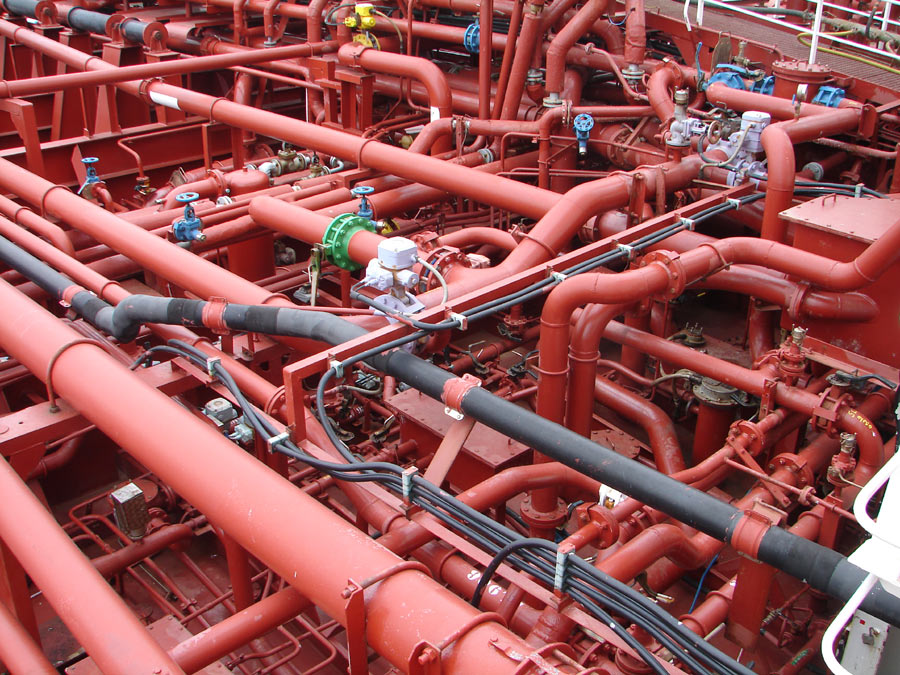
This is what I imagine it looks like inside these libraries
(Herv Cozanet / Wikimedia Commons, CC-BY-SA)
All in all, these libraries are fairly significant pieces of work, and I m mighty glad that someone else has taken on the job of building (and maintaining!) them.
So Why the Change?
Good question.
It s important to say at the outset that there s nothing particularly wrong with Rutie.
I found using Rutie to be very straightforward, and the Ruby bindings came together very quickly and easily.
If someone chose to use Rutie for their project, I m sure they d have a good experience.
What made me take the time to rewrite using Magnus was a set of a few tiny things, which together gave me enough of a shove to do the work.
Firstly, I d had a hiccup with Rutie s support of newer versions of Ruby, particularly 3.2 (PR).
Also, I d hit a couple of segfault issues, which were ultimately caused by Ruby garbage-collecting data out from underneath me.
These were ultimately my fault, of course, but Rutie wasn t helping me out in avoiding the problems in the first place.
Finally, while Rutie helped translate data types, there was still a bit of boilerplate and ugliness that needed to be included.
This wasn t a showstopper, but I m appreciating the extra smoothness that Magnus provides here.
As an example, here s what s required in Rutie to get native Rust data types from Ruby method parameters (and the self reference to the current object):
fn enquo_field_decrypt_text(ciphertext_obj: RString, context_obj: RString) -> RString
    let ciphertext = ciphertext_obj.to_str_unchecked();
    let context = context_obj.to_vec_u8_unchecked();
    let field = rbself.get_data(&*FIELD_WRAPPER);
    // etc etc etc
The equivalent in Magnus is just the function signature:
You can also see there that Magnus signals an exception via the Result return value, while Rutie s approach to raising an exception involves poking the Ruby VM directly, which always struck me as a bit ugly.
There are several other minor things in Magnus (like its cleaner approach to wrapping structs so they can be stored in Ruby objects) that I m appreciating, too.
Never discount the power of ergonomics for making a happy developer.
The End Result
I spent a bit over half of last weekend doing the rewrite maybe ten hours of so.
Since Magnus did more type checking and data validation, and its approach to error handling was smoother, I took the opportunity to rewrite a bunch of Ruby wrapper code I d written (which just existed to check things like ranges of values and string encodings) into Rust, as well.
To make sure that the conversion was accurate, I added a heap more unit tests to the bindings.
I also took the opportunity to restructure the codebase to split the code for the different Ruby classes into separate files, which I hadn t done initially as the code had originally accreted, rather than being purposefully written.
All up, though, my rewrite ended up removing over 60 lines (excluding the extra specs I added):
Considering that I was translating from a higher level language into a lower level one, the removal of so much code is quite remarkable.
Magnus was able to automagically replace rather a lot of raise ArgumentError if something.isnt_right code in those .rb files.
So, in conclusion, if you, too, are building Ruby extensions in Rust, while Rutie is a solid choice (and you probably should stick with it if you re already using it), I highly recommend giving Magnus a look for your next extension.
Building on my work to rebuild Trisquel GNU/Linux 11.0 aramo, it felt simple to generalize the tooling to any two apt-repository pairs and I ve created debdistreproduce as a template-project for doing this through the infrastructure of GitLab CI/CD and meanwhile even set up my own gitlab-runner on spare hardware. I ve brought over reproduce/trisquel to using debdistreproduce as well, and archived the old reproduce-trisquel project.
After fixing some quirks, building Devuan GNU+Linux 4.0 Chimaera was fairly quick since they do not modify that many packages, and I m now able to reproduce 46% of the packages that Devuan Chimaera add/modify on amd64. I have more work in progress here (hint: reproduce/pureos), but PureOS is considerably larger than both Trisquel and Devuan together. I m not sure how interested Devuan or PureOS are in reproducible builds though.
Reflecting on this work made me realize that while the natural thing to do here was to differentiate two different apt-based distributions, I have realized the same way I did for debdistdiff that it would also be interesting to compare, say, Debian bookworm from Debian unstable, especially now that they should be fairly close together. My tooling should support that too. However, to really provide any benefit from the more complete existing reproducible testing of Debian, some further benefit from doing that would be useful and I can t articulate one right now.
One ultimate goal with my effort is to improve trust in apt-repositories, and combining transparency-style protection a la apt-sigstore with third-party validated reproducible builds may indeed be one such use-case that would benefit the wider community of apt-repositories. Imagine having your system not install any package unless it can verify it against a third-party reproducible build organization that commits their results in a tamper-proof transparency ledger. But I m now on repeat here, so will stop.
CPUs can't do anything without being told what to do, which leaves the obvious problem of how do you tell a CPU to do something in the first place. On many CPUs this is handled in the form of a reset vector - an address the CPU is hardcoded to start reading instructions from when power is applied. The address the reset vector points to will typically be some form of ROM or flash that can be read by the CPU even if no other hardware has been configured yet. This allows the system vendor to ship code that will be executed immediately after poweron, configuring the rest of the hardware and eventually getting the system into a state where it can run user-supplied code.
The specific nature of the reset vector on x86 systems has varied over time, but it's effectively always been 16 bytes below the top of the address space - so, 0xffff0 on the 20-bit 8086, 0xfffff0 on the 24-bit 80286, and 0xfffffff0 on the 32-bit 80386. Convention on x86 systems is to have RAM starting at address 0, so the top of address space could be used to house the reset vector with as low a probability of conflicting with RAM as possible.
The most notable thing about x86 here, though, is that when it starts running code from the reset vector, it's still in real mode. x86 real mode is a holdover from a much earlier era of computing. Rather than addresses being absolute (ie, if you refer to a 32-bit address, you store the entire address in a 32-bit or larger register), they are 16-bit offsets that are added to the value stored in a "segment register". Different segment registers existed for code, data, and stack, so a 16-bit address could refer to different actual addresses depending on how it was being interpreted - jumping to a 16 bit address would result in that address being added to the code segment register, while reading from a 16 bit address would result in that address being added to the data segment register, and so on. This is all in order to retain compatibility with older chips, to the extent that even 64-bit x86 starts in real mode with segments and everything (and, also, still starts executing at 0xfffffff0 rather than 0xfffffffffffffff0 - 64-bit mode doesn't support real mode, so there's no way to express a 64-bit physical address using the segment registers, so we still start just below 4GB even though we have massively more address space available).
Anyway. Everyone knows all this. For modern UEFI systems, the firmware that's launched from the reset vector then reprograms the CPU into a sensible mode (ie, one without all this segmentation bullshit), does things like configure the memory controller so you can actually access RAM (a process which involves using CPU cache as RAM, because programming a memory controller is sufficiently hard that you need to store more state than you can fit in registers alone, which means you need RAM, but you don't have RAM until the memory controller is working, but thankfully the CPU comes with several megabytes of RAM on its own in the form of cache, so phew). It's kind of ugly, but that's a consequence of a bunch of well-understood legacy decisions.
Except. This is not how modern Intel x86 boots. It's far stranger than that. Oh, yes, this is what it looks like is happening, but there's a bunch of stuff going on behind the scenes. Let's talk about boot security. The idea of any form of verified boot (such as UEFI Secure Boot) is that a signature on the next component of the boot chain is validated before that component is executed. But what verifies the first component in the boot chain? You can't simply ask the BIOS to verify itself - if an attacker can replace the BIOS, they can replace it with one that simply lies about having done so. Intel's solution to this is called Boot Guard.
But before we get to Boot Guard, we need to ensure the CPU is running in as bug-free a state as possible. So, when the CPU starts up, it examines the system flash and looks for a header that points at CPU microcode updates. Intel CPUs ship with built-in microcode, but it's frequently old and buggy and it's up to the system firmware to include a copy that's new enough that it's actually expected to work reliably. The microcode image is pulled out of flash, a signature is verified, and the new microcode starts running. This is true in both the Boot Guard and the non-Boot Guard scenarios. But for Boot Guard, before jumping to the reset vector, the microcode on the CPU reads an Authenticated Code Module (ACM) out of flash and verifies its signature against a hardcoded Intel key. If that checks out, it starts executing the ACM. Now, bear in mind that the CPU can't just verify the ACM and then execute it directly from flash - if it did, the flash could detect this, hand over a legitimate ACM for the verification, and then feed the CPU different instructions when it reads them again to execute them (a Time of Check vs Time of Use, or TOCTOU, vulnerability). So the ACM has to be copied onto the CPU before it's verified and executed, which means we need RAM, which means the CPU already needs to know how to configure its cache to be used as RAM.
Anyway. We now have an ACM loaded and verified, and it can safely be executed. The ACM does various things, but the most important from the Boot Guard perspective is that it reads a set of write-once fuses in the motherboard chipset that represent the SHA256 of a public key. It then reads the initial block of the firmware (the Initial Boot Block, or IBB) into RAM (or, well, cache, as previously described) and parses it. There's a block that contains a public key - it hashes that key and verifies that it matches the SHA256 from the fuses. It then uses that key to validate a signature on the IBB. If it all checks out, it executes the IBB and everything starts looking like the nice simple model we had before.
Except, well, doesn't this seem like an awfully complicated bunch of code to implement in real mode? And yes, doing all of this modern crypto with only 16-bit registers does sound like a pain. So, it doesn't. All of this is happening in a perfectly sensible 32 bit mode, and the CPU actually switches back to the awful segmented configuration afterwards so it's still compatible with an 80386 from 1986. The "good" news is that at least firmware can detect that the CPU has already configured the cache as RAM and can skip doing that itself.
I'm skipping over some steps here - the ACM actually does other stuff around measuring the firmware into the TPM and doing various bits of TXT setup for people who want DRTM in their lives, but the short version is that the CPU bootstraps itself into a state where it works like a modern CPU and then deliberately turns a bunch of the sensible functionality off again before it starts executing firmware. I'm also missing out the fact that this entire process only kicks off after the Management Engine says it can, which means we're waiting for an entirely independent x86 to boot an entire OS before our CPU even starts pretending to execute the system firmware.
Of course, as mentioned before, on modern systems the firmware will then reprogram the CPU into something actually sensible so OS developers no longer need to care about this[1][2], which means we've bounced between multiple states for no reason other than the possibility that someone wants to run legacy BIOS and then boot DOS on a CPU with like 5 orders of magnitude more transistors than the 8086.
tl;dr why can't my x86 wake up with the gin protected mode already inside it
[1] Ha uh except that on ACPI resume we're going to skip most of the firmware setup code so we still need to handle the CPU being in fucking 16-bit mode because suspend/resume is basically an extremely long reboot cycle
[2] Oh yeah also you probably have multiple cores on your CPU and well bad news about the state most of the cores are in when the OS boots because the firmware never started them up so they're going to come up in 16-bit real mode even if your boot CPU is already in 64-bit protected mode, unless you were using TXT in which case you have a different sort of nightmare that if we're going to try to map it onto real world nightmare concepts is one that involves a lot of teeth. Or, well, that used to be the case, but ACPI 6.4 (released in 2021) provides a mechanism for the OS to ask the firmware to wake the CPU up for it so this is invisible to the OS, but you're still relying on the firmware to actually do the heavy lifting here
Another short note to myself, and whomever cares/searches later for
nft or nftables, tcp mss clamping.
Somewhat surprising, many/most of the instructions found by Google are
still related to iptables. I guess people stopped writing blog posts
by the time nftables became widely used?
The only official documentation I can find is in the official
wiki,
but it doesn t list/explain exactly how does this work/in which
conditions. I think this results in posts like this
one
that suggest additionally limiting the packets it acts on using a size
limiter, in order to prevent changing small packets.
Looking at the code that actually implements this, in net/netfilter/xt_TCPMSS.c (and not in the lower case-named file, which is about matching, TIL), in the function tcpmss_mangle_packet, first there is this comment:
/* Never increase MSS, even when setting it, as
 * doing so results in problems for hosts that rely
 * on MSS being set correctly.
 */
So at least the intent is that this always does the right thing (only
decrease).
Second, the code does correctly look at both directions of the packet
when using auto-clamping (set rt mtu rather than set 1452), in the
if
branch
for XT_TCPMSS_CLAMP_PMTU. This means, it s safer to use
auto-clamping, rather than manually set the value.
And finally, there is handling of some corner cases as well (syn
packet with data, syn packet without the MSS option - unlikely for
modern stacks - in which case it defaults to minimal values).
All in all, it seems to me that it should always be correct to simply
do what the wiki recommends, setting this for all packets traversing
the host:
nft add rule ip filter forward tcp flags syn tcp option maxseg size set rt mtu
Of course, if you d rather not do it always, but only for external
interfaces, make sure you set it in both directions:
nft add rule ip filter forward iifname ppp0 tcp flags syn tcp option maxseg size set rt mtu
nft add rule ip filter forward oifname ppp0 tcp flags syn tcp option maxseg size set rt mtu
And that should be it. Well, use iifgroup/oifgroup for better rules .
Do you want your apt-get update to only ever use files whose hash checksum have been recorded in the globally immutable tamper-resistance ledger rekor provided by the Sigstore project? Well I thought you d never ask, but now you can, thanks to my new projects apt-verify and apt-sigstore. I have not done proper stable releases yet, so this is work in progress. To try it out, adapt to the modern era of running random stuff from the Internet as root, and run the following commands. Use a container or virtual machine if you have trust issues.
If the stars are aligned (and the puppet projects of debdistget and debdistcanary have ran their GitLab CI/CD pipeline recently enough) you will see a successful output from apt-get update and your syslog will contain debug logs showing the entries from the rekor log for the release index files that you downloaded. See sample outputs in the README.
If you get tired of it, disabling is easy:
chmod -x /etc/apt/verify.d/apt-rekor
Our project currently supports Trisquel GNU/Linux 10 (nabia) & 11 (aramo), PureOS 10 (byzantium), Gnuinos chimaera, Ubuntu 20.04 (focal) & 22.04 (jammy), Debian 10 (buster) & 11 (bullseye), and Devuan GNU+Linux 4.0 (chimaera). Others can be supported to, please open an issue about it, although my focus is on FSDG-compliant distributions and their upstreams.
This is a continuation of my previous work on apt-canary. I have realized that it was better to separate out the generic part of apt-canary into my new project apt-verify that offers a plugin-based method, and then rewrote apt-canary to be one such plugin. Then apt-sigstore s apt-rekor was my second plugin for apt-verify.
Due to the design of things, and some current limitations, Ubuntu is the least stable since they push out new signed InRelease files frequently (mostly due to their use of Phased-Update-Percentage) and debdistget and debdistcanary CI/CD runs have a hard time keeping up. If you have insight on how to improve this, please comment me in the issue tracking the race condition.
There are limitations of what additional safety a rekor-based solution actually provides, but I expect that to improve as I get a cosign-based approach up and running. Currently apt-rekor mostly make targeted attacks less deniable. With a cosign-based approach, we could design things such that your machine only downloads updates when they have been publicly archived in an immutable fashion, or submitted for validation by a third-party such as my reproducible build setup for Trisquel GNU/Linux aramo.
What do you think? Happy Hacking!


 Firebuild accelerating librsvg s Rust + Cargo build from 38s to 2.8s on a Ryzen 5900X (12C/24T) system
 Firebuild 0.8.0 vs. sccache 0.4.2 accelerating librsvg s Rust + Cargo build
 The voting period for the Debian Project Leader election has ended, with all of the votes tallied we announce the winner is: Jonathan Carter, who has been elected for the forth time.
Congratulations! The new term for the project leader started on 2023-04-21.
279 of 997 Developers voted using the
 In
 It seems I'm having a theme recently on this blog, of making emacs-related posts. Here's another.
I write a bunch of stuff in markdown, such as
 The fifth release of the still new-ish


 Previously, I explained

 I wrote the
 Wrong sort of shim, but canned language bindings would be handy
 This is what I imagine it looks like inside these libraries
