Search Results: "nic"

20 January 2017

Joachim Breitner: Global almost-constants for Haskell

More than five years ago I blogged about the configuration problem and a proposed solution for Haskell, which turned into some Template Haskell hacks in the seal-module package. With the new GHC proposal process in plase, I am suddenly much more inclined to write up my weird wishes for the Haskell language in proposal form, to make them more coherent, get feedback, and maybe (maybe) actually get them implemented. But even if the proposal is rejected it is still a nice forum to discuss these ideas. So I turned my Template Haskell hack into a proposed new syntactic feature. The idea is shamelessly stolen from Isabelle, including some of the keywords, and would allow you to write
context fixes progName in
  foo :: Maybe Int -> Either String Int
  foo Nothing  = Left $ progName ++ ": no number given"
  foo (Just i) = bar i
  bar :: Int -> Either String Int
  bar 0 = Left $ progName ++ ": zero no good"
  bar n = Right $ n + 1
instead of
foo :: String -> Maybe Int -> Either String Int
foo progName Nothing  = Left $ progName ++ ": no number given"
foo progName (Just i) = bar progName  i
bar :: String -> Int -> Either String Int
bar progName 0 = Left $ progName ++ ": zero no good"
bar progName n = Right $ n + 1
when you want to have an almost constant parameter. I am happy to get feedback at the GitHub pull request.

18 January 2017

Reproducible builds folks: Reproducible Builds: week 90 in Stretch cycle

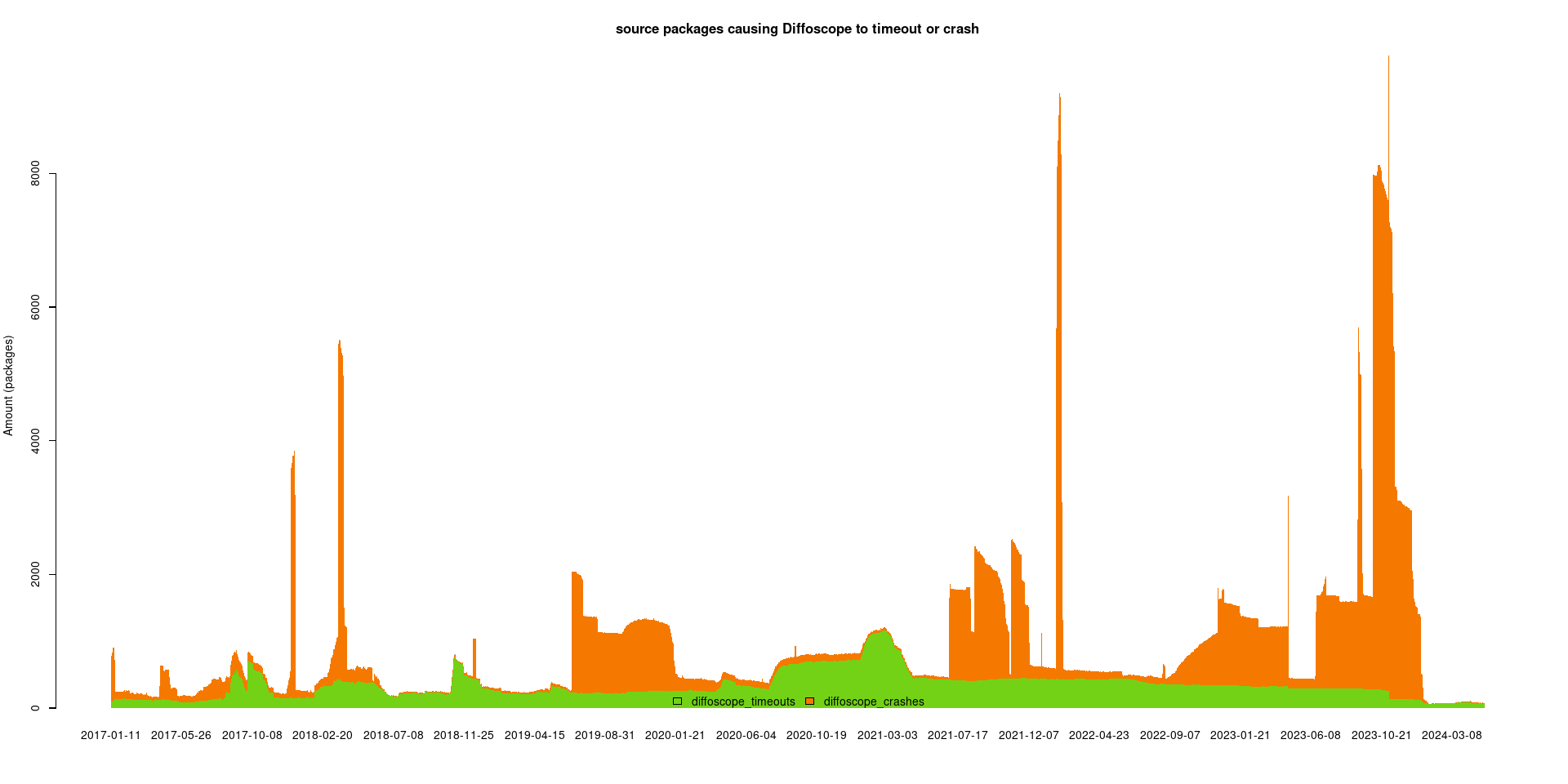
What happened in the Reproducible Builds effort between Sunday January 8 and Saturday January 14 2017: Upcoming Events Reproducible work in other projects Reproducible Builds have been mentioned in the FSF high-priority project list. The F-Droid Verification Server has been launched. It rebuilds apps from source that were built by f-droid.org and checks that the results match. Bernhard M. Wiedemann did some more work on reproducibility for openSUSE. Bootstrappable.org (unfortunately no HTTPS yet) was launched after the initial work was started at our recent summit in Berlin. This is another topic related to reproducible builds and both will be needed in order to perform "Diverse Double Compilation" in practice in the future. Toolchain development and fixes Ximin Luo researched data formats for SOURCE_PREFIX_MAP and explored different options for encoding a map data structure in a single environment variable. He also continued to talk with the rustc team on the topic. Daniel Shahaf filed #851225 ('udd: patches: index by DEP-3 "Forwarded" status') to make it easier to track our patches. Chris Lamb forwarded #849972 upstream to yard, a Ruby documentation generator. Upstream has fixed the issue as of release 0.9.6. Alexander Couzens (lynxis) has made mksquashfs reproducible and is looking for testers. It compiles on BSD systems such as FreeBSD, OpenBSD and NetBSD. Bugs filed Chris Lamb: Lucas Nussbaum: Nicola Corna: Reviews of unreproducible packages 13 package reviews have been added and 13 have been removed in this week, adding to our knowledge about identified issues. 1 issue type has been added: Weekly QA work During our reproducibility testing, the following FTBFS bugs have been detected and reported by: diffoscope development Bugs in diffoscope in the last year Many bugs were opened in diffoscope during the past few weeks, which probably is a good sign as it shows that diffoscope is much more widely used than a year ago. We have been working hard to squash many of them in time for Debian stable, though we will see how that goes in the end reproducible-website development tests.reproducible-builds.org Misc. This week's edition was written by Ximin Luo, Chris Lamb and Holger Levsen and reviewed by a bunch of Reproducible Builds folks on IRC & the mailing lists.

Jonathan Dowland: RetroPie, NES Classic and Bluetooth peripherals

I wanted to write a more in-depth post about RetroPie the Retro Gaming Appliance OS for Raspberry Pis, either technically or more positively, but unfortunately I don't have much positive to write. What I hoped for was a nice appliance that I could use to play old games from the comfort of my sofa. Unfortunately, nine times out of ten, I had a malfunctioning Linux machine and the time I'd set aside for jumping on goombas was being spent trying to figure out why bluetooth wasn't working. I have enough opportunities for that already, both at work and at home. I feel a little bad complaining about an open source, volunteer project: in its defence I can say that it is iterating fast and the two versions I tried in a relatively short time span were rapidly different. So hopefully a lot of my woes will eventually be fixed. I've also read a lot of other people get on with it just fine. Instead, I decided the Nintendo Classic NES Mini was the plug-and-play appliance for me. Alas, it became the "must have" Christmas toy for 2016 and impossible to obtain for the recommended retail price. I did succeed in finding one in stock at Toys R Us online at one point, only to have the checkout process break and my order not go through. Checking Stock Informer afterwards, that particular window of opportunity was only 5 minutes wide. So no NES classic for me! My adventures in RetroPie weren't entirely fruitless, thankfully: I discovered two really nice pieces of hardware.
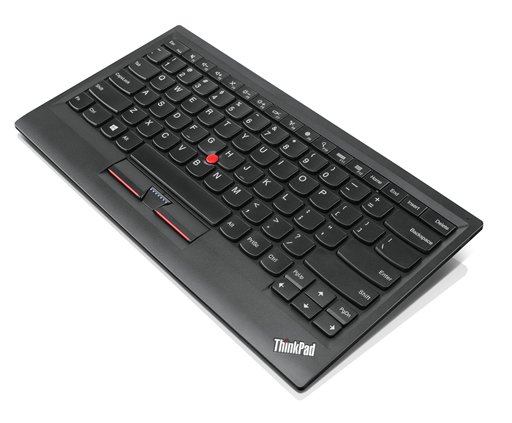
ThinkPad Keyboard ThinkPad Keyboard
The first is Lenovo's ThinkPad Compact Bluetooth Keyboard with TrackPoint, a very compact but pleasant to use Bluetooth keyboard including a trackpoint. I miss the trackpoint from my days as a Thinkpad laptop user. Having a keyboard and mouse combo in such a small package is excellent. My only two complaints would be the price (I was lucky to get one cheaper on eBay) and the fact it's bluetooth only: there's a micro-USB port for charging, but it would be nice if it could be used as a USB keyboard too. There's a separate, cheaper USB model.
8bitdo SFC30 8bitdo SFC30
The second neat device is a clone of the SNES gamepad by HK company 8bitdo called the SFC30. This looks and feels very much like the classic Nintendo SNES controller, albeit slightly thicker from front to back. It can be used in a whole range of different modes, including attached USB; Bluetooth pretending to be a keyboard; Bluetooth pretending to be a controller; and a bunch of other special modes designed to work with iOS or Android devices in various configurations. The manufacturer seem to be actively working on firmware updates to further enhance the controller. The firmware is presently closed source, but it would not be impossible to write an open source firmware for it (some people have figured out the basis for the official firmware). I like the SFC30 enough that I spent some time trying to get it working for various versions of Doom. There are just enough buttons to control a 2.5D game like Doom, whereas something like Quake or a more modern shooter would not work so well. I added support for several 8bitdo controllers directly into Chocolate Doom (available from 2.3.0 onwards) and into SDL2, a popular library for game development, which I think is used by Steam, so Steam games may all gain SFC30 support in the future too.

Norbert Preining: Debian/TeX Live January 2017

As the freeze of the next release is closing in, I have updated a bunch of packages around TeX: All of the TeX Live packages (binaries and arch independent ones) and tex-common. I might see whether I get some updates of ConTeXt out, too.
texlive2016-debian The changes in the binaries are mostly cosmetic: one removal of a non-free (unclear-free) file, and several upstream patches got cherrypicked (dvips, tltexjp contact email, upmendex, dvipdfmx). I played around with including LuaTeX v1.0, but that breaks horribly with the current packages in TeX Live, so I refrained from it. The infrastructure package tex-common got a bugfix for updates from previous releases, and for the other packages there is the usual bunch of updates and new packages. Enjoy! New packages arimo, arphic-ttf, babel-japanese, conv-xkv, css-colors, dtxdescribe, fgruler, footmisx, halloweenmath, keyfloat, luahyphenrules, math-into-latex-4, mendex-doc, missaali, mpostinl, padauk, platexcheat, pstring, pst-shell, ptex-fontmaps, scsnowman, stanli, tinos, undergradmath, yaletter. Updated packages acmart, animate, apxproof, arabluatex, arsclassica, babel-french, babel-russian, baskervillef, beamer, beebe, biber, biber.x86_64-linux, biblatex, biblatex-apa, biblatex-chem, biblatex-dw, biblatex-gb7714-2015, biblatex-ieee, biblatex-philosophy, biblatex-sbl, bidi, calxxxx-yyyy, chemgreek, churchslavonic, cochineal, comicneue, cquthesis, csquotes, ctanify, ctex, cweb, dataref, denisbdoc, diagbox, dozenal, dtk, dvipdfmx, dvipng, elocalloc, epstopdf, erewhon, etoolbox, exam-n, fbb, fei, fithesis, forest, glossaries, glossaries-extra, glossaries-french, gost, gzt, historische-zeitschrift, inconsolata, japanese-otf, japanese-otf-uptex, jsclasses, latex-bin, latex-make, latexmk, lt3graph, luatexja, markdown, mathspec, mcf2graph, media9, mendex-doc, metafont, mhchem, mweights, nameauth, noto, nwejm, old-arrows, omegaware, onlyamsmath, optidef, pdfpages, pdftools, perception, phonrule, platex-tools, polynom, preview, prooftrees, pst-geo, pstricks, pst-solides3d, ptex, ptex2pdf, ptex-fonts, qcircuit, quran, raleway, reledmac, resphilosophica, sanskrit, scalerel, scanpages, showexpl, siunitx, skdoc, skmath, skrapport, smartdiagram, sourcesanspro, sparklines, tabstackengine, tetex, tex, tex4ht, texlive-scripts, tikzsymbols, tocdata, uantwerpendocs, updmap-map, uplatex, uptex, uptex-fonts, withargs, wtref, xcharter, xcntperchap, xecjk, xellipsis, xepersian, xint, xlop, yathesis.

16 January 2017

Raphaël Hertzog: Freexian s report about Debian Long Term Support, December 2016

A Debian LTS logoLike each month, here comes a report about the work of paid contributors to Debian LTS. Individual reports In December, about 175 work hours have been dispatched among 14 paid contributors. Their reports are available: Evolution of the situation The number of sponsored hours did not increase but a new silver sponsor is in the process of joining. We are only missing another silver sponsor (or two to four bronze sponsors) to reach our objective of funding the equivalent of a full time position. The security tracker currently lists 31 packages with a known CVE and the dla-needed.txt file 27. The situation improved a little bit compared to last month. Thanks to our sponsors New sponsors are in bold.

No comment Liked this article? Click here. My blog is Flattr-enabled.

Maria Glukhova: APK, images and other stuff.

2 more weeks of my awesome Outreachy journey have passed, so it is time to make an update on my progress. I continued my work on improving diffoscope by fixing bugs and completing wishlist items. These include:

Improving APK support I worked on #850501 and #850502 to improve the way diffoscope handles APK files. Thanks to Emanuel Bronshtein for providing clear description on how to reproduce these bugs and ideas on how to fix them. And special thanks to Chris Lamb for insisting on providing tests for these changes! That part actually proved to be little more tricky, and I managed to mess up with these tests (extra thanks to Chris for cleaning up the mess I created). Hope that also means I learned something from my mistakes. Also, I was pleased to see F-droid Verification Server as a sign of F-droid progress on reproducible builds effort - I hope these changes to diffoscope will help them!

Adding support for image metadata That came from #849395 - a request was made to compare image metadata along with image content. Diffoscope has support for three types of images: JPEG, MS Windows Icon (*.ico) and PNG. Among these, PNG already had good image metadata support thanks to sng tool, so I worked on .jpeg and .ico files support. I initially tried to use exiftool for extracting metadata, but then I discovered it does not handle .ico files, so I decided to use a bigger force - ImageMagick s identify - for this task. I was glad to see it had that handy -format option I could use to select only the necessary fields (I found their -verbose, well, too verbose for the task) and presenting them in the defined form, negating the need of filtering its output. What was particulary interesting and important for me in terms of learning: while working on this feature, I discovered that, at the moment, diffoscope could not handle .ico files at all - img2txt tool, that was used for retrieving image content, did not support that type of images. But instead of recognizing this as a bug and resolving it, I started to think of possible workaround, allowing for retrieving image metadata even after retrieving image content failed. Definetely not very good thinking. Thanks Mattia Rizzolo for actually recognizing this as a bug and filing it, and Chris Lamb for fixing it!

Other work

Order-like differences, part 2 In the previous post, I mentioned Lunar s suggestion to use hashing for finding order-like difference in wide variety of input data. I implemented that idea, but after discussion with my mentor, we decided it is probably not worth it - this change would alter quite a lot of things in core modules of diffoscope, and the gain would be not really significant. Still, implementing that was an important experience for me, as I had to hack on deepest and, arguably, most difficult modules of diffoscope and gained some insight on how they work.

Comparing with several tools (work in progress) Although my initial motivation for this idea was flawed (the workaround I mentioned earlier for .ico files), it still might be useful to have a mechanism that would allow to run several commands for finding difference, and then give the output of those that succeed, failing if and only if they all have failed. One possible case when it might happen is when we use commands coming from different tools, and one of them is not installed. It would be nice if we still used the other and not the uninformative binary diff (that is a default fallback option for when something goes wrong with more clever comparison). I am still in process of polishing this change, though, and still in doubt if it is needed at all.

Side note - Outreachy and my university progress In my Outreachy application, I promised that if I am selected into this round, I will do everything I can to unload the required time period from my university time commitements. I did that by moving most of my courses to the first half of the academic year. Now, the main thing that is left for me to do is my Master s thesis. I consulted my scientific advisors from both universities that I am formally attending (SFEDU and LUT - I am in double degree program), and as a result, they agreed to change my Master s thesis topic to match my Outreachy work. Now, that should have sounded like an excellent news - merging these activities together actually mean I can allocate much more time to my work on reproducible builds, even beyond the actual internship time period. That was intended to remove a burden from my shoulders. Still, I feel a bit uneasy. The drawback of this decision lies in fact I have no idea on how to write scientific report based on pure practical work. I know other students from my universities have done such things before, but choosing my own topic means my scientific advisors can t help me much - this is just out of their area of expertise. Well, wish me luck - I m up to the challenge!

15 January 2017

Sam Hartman: Musical Visualization of Network Traffic

I've been working on a fun holiday project in my spare time lately. It all started innocently enough. The office construction was nearing its end, and it was time for my workspace to be set up. Our deployment wizard and I were discussing. Normally we stick two high-end monitors on a desk. I'm blind; that seemed silly. He wanted to do something similarly nice for me, so he replaced one of the monitors with excellent speakers. They are a joy to listen to, but I felt like I should actually do something with them. So, I wanted to play around with some sort of audio project.
I decided to take a crack at an audio representation of network traffic. The solaris version of ping used to have an audio option, which would produce sound for successful pings. In the past I've used audio queues to monitor events like service health and build status.
It seemed like you could produce audio to give an overall feel for what was happening on the network. I was imagining a quick listen would be able to answer questions like:

  1. How busy is the network

  2. How many sources are active

  3. Is the traffic a lot of streams or just a few?

  4. Are there any interesting events such as packet loss or congestion collapse going on?

  5. What's the mix of services involved


I divided the project into three segments, which I will write about in future entries:

I'm fairly happy with what I have. It doesn't represent all the items above. As an example, it doesn't directly track packet loss or retransmissions, nor does it directly distinguish one service from another. Still, just because of the traffic flow, rsync sounds different from http. It models enough of what I'm looking for that I find it to be a useful tool. And I learned a lot about music and Linux audio. I also got to practice designing discrete-time control functions in ways that brought back the halls of MIT.

Mehdi Dogguy: Debian from 10,000 feet

Many of you are big fans of S.W.O.T analysis, I am sure of that! :-) Technical competence is our strongest suit, but we have reached a size and sphere of influence which requires an increase in organisation.

We all love our project and want to make sure Debian still shines in the next decades (and centuries!). One way to secure that goal is to identify elements/events/things which could put that goal at risk. To this end, we've organized a short S.W.O.T analysis session at DebConf16. Minutes of the meeting can be found here. I believe it is an interesting read and is useful for Debian old-timers as well as newcomers. It helps to convey a better understanding of the project's status. For each item, we've tried to identify an action.

Here are a few things we've worked on:
During next DebConf, we can review the progress that has been made on each item and discuss new ones. In addition to this session acting as a health check, I see it as a way for the DPL to discuss, openly and publicly, about the important changes that should be implemented in the project and imagine together a better future.

In the meantime, everyone should feel free to pick one item from the list and work on it. :-)

14 January 2017

Mike Gabriel: UIF bug: Caused by flawed IPv6 DNS resolving in Perl's NetAddr::IP

TL;DR; If you use NetAddr::IP->new6() for resolving DNS names to IPv6 addresses, the addresses returned by NetAddr::IP are not what you might expect. See below for details. Issue #2 in UIF Over the last couple of days, I tried to figure out the cause of a weird issue observed in UIF (Universal Internet Firewall [1], a nice Perl tool for setting up ip(6)tables based Firewalls). Already a long time ago, I stumbled over a weird DNS resolving issue of DNS names to IPv6 addresses in UIF that I reported as issue #2 [2] against upstream UIF back then. I happen to be co-author of UIF. So, I felt very ashamed all the time for not fixing the issue any sooner. As many of us DDs try to get our packages into shape before the next Debian release these days, I find myself doing the same. I started investigating the underlying cause of issue #2 in UIF a couple of days ago. Issue #119858 on CPAN Today, I figured out that the Perl code in UIF is not causing the observed phenomenon. The same behaviour is reproducible with a minimal and pure NetAddr::IP based Perl script (reported as Debian bug #851388 [2]. Thanks to Gregor Herrmann for forwarding Debian bug upstream (#119858 [3]). Here is the example script that shows the flawed behaviour:
#!/usr/bin/perl
use NetAddr::IP;
my $hostname = "google-public-dns-a.google.com";
my $ip6 = NetAddr::IP->new6($hostname);
my $ip4 = NetAddr::IP->new($hostname);
print "$ip6 <- WTF???\n";
print "$ip4\n";
exit(0);
... gives...
[mike@minobo ~]$ ./netaddr-ip_resolv-ipv6.pl
0:0:0:0:0:0:808:808/128 <- WTF???
8.8.8.8/32
In words... So what happens in NetAddr::IP is that with the new6() "constructor" you initialize a new IPv6 address. If the address is a DNS name, NetAddr::IP internally resolves it into an IPv4 address and converts this IPv4 address into some IPv6'ish format. This bogus IPv6 address is not the one matching the given DNS name. Impacted Software in Debian Various Debian packages use NetAddr::IP and may be affected by this flaw, here is an incomplete list (use apt-rdepends -r libnetaddr-ip-perl for the complete list): Any of the above packages could be affected if NetAddr::IP->new6(<dnsname>) is being used. I haven't checked any of the code bases, but possibly the corresponding maintainers may want to do that. References light+love
Mike

Jamie McClelland: What's Up with WhatsApp?

Despite my jaded feelings about corporate Internet services in general, I was suprised to learn that WhatsApp's end-to-end encryption was a lie. In short, it is possible to send an encrypted message to a user that is intercepted and effectively de-crypted without the sender's knowledge. However, I was even more surprised to read Open Whisper Systems critique of the original story, claiming that it is not a backdoor because the WhatsApp sender's client is always notified when a message is de-crypted. The Open Whisper Systems post acknowledges that the WhatsApp sender can choose to disable these notifications, but claims that is not such a big deal because the WhatsApp server has no way to know which clients have this feature enabled and which do not, so intercepting a message is risky because it could result in the sender realizing it. However, there is a fairly important piece of information missing, namely: as far as I can tell, the setting to notify users about key changes is disabled by default. So, using the default installation, your end-to-end encrypted message could be intercepted and decrypted without you or the party you are communicating with knowing it. How is this not a back door? And yes, if the interceptor can't tell whether or not the sender has these notifications turned on, the interceptor runs the risk of someone knowing they have intercepted the message. Great. That's better than nothing. Except that there is strong evidence that many powerful governments on this planet routinely risk exposure in their pursuit of compromising our ability to communicate securely. And... not to mention non-governmental (or governmental) adversaries for whom exposure is not a big deal. Furthermore a critical reason for end-to-end encrption is so that your provider does not have the technical capacity to intercept your communications. That's simply not true of WhatsApp. It is true of Signal and OMEMO, which requires the active participation of the sender to compromise the communication. Why in the world would you distribute a client that not only has the ability to surpress such warnings, but has it enabled by default? Some may argue that users regularly dismiss notifications like "fingerprint has changed" and that this problem is the achilles heal of secure communications. I agree. But... there is still a monumental difference between a user absent-mindedly dismissing an important security warning and never seeing the warning in the first place. This flaw in WhatsApp is a critical reminder that secure communications doesn't just depend on a good protocol or technology, but on trust in the people who design and maintain our systems.

13 January 2017

Elena 'valhalla' Grandi: Modern XMPP Server

Modern XMPP Server

I've published a new HOWTO on my website 'http://www.trueelena.org/computers/howto/modern_xmpp_server.html':

http://www.enricozini.org/blog/2017/debian/modern-and-secure-instant-messaging/ already wrote about the Why (and the What, Who and When), so I'll just quote his conclusion and move on to the How.

I now have an XMPP setup which has all the features of the recent fancy chat systems, and on top of that it runs, client and server, on Free Software, which can be audited, it is federated and I can self-host my own server in my own VPS if I want to, with packages supported in Debian.


How

I've decided to install https://prosody.im/, mostly because it was recommended by the RTC QuickStart Guide http://rtcquickstart.org/; I've heard that similar results can be reached with https://www.ejabberd.im/ and other servers.

I'm also targeting https://www.debian.org/ stable (+ backports); as I write this is jessie; if there are significant differences I will update this article when I will upgrade my server to stretch. Right now, this means that I'm using prosody 0.9 (and that's probably also the version that will be available in stretch).

Installation and prerequisites

You will need to enable the https://backports.debian.org/ repository and then install the packages prosody and prosody-modules.

You also need to setup some TLS certificates (I used Let's Encrypt https://letsencrypt.org/); and make them readable by the prosody user; you can see Chapter 12 of the RTC QuickStart Guide http://rtcquickstart.org/guide/multi/xmpp-server-prosody.html for more details.

On your firewall, you'll need to open the following TCP ports:


The latter two are needed to enable some services provided via http(s), including rich media transfers.

With just a handful of users, I didn't bother to configure LDAP or anything else, but just created users manually via:

prosodyctl adduser alice@example.org

In-band registration is disabled by default (and I've left it that way, to prevent my server from being used to send spim https://en.wikipedia.org/wiki/Messaging_spam).

prosody configuration

You can then start configuring prosody by editing /etc/prosody/prosody.cfg.lua and changing a few values from the distribution defaults.

First of all, enforce the use of encryption and certificate checking both for client2server and server2server communications with:


c2s_require_encryption = true
s2s_secure_auth = true


and then, sadly, add to the whitelist any server that you want to talk to and doesn't support the above:


s2s_insecure_domains = "gmail.com"


virtualhosts

For each virtualhost you want to configure, create a file /etc/prosody/conf.avail/chat.example.org.cfg.lua with contents like the following:


VirtualHost "chat.example.org"
enabled = true
ssl =
key = "/etc/ssl/private/example.org-key.pem";
certificate = "/etc/ssl/public/example.org.pem";


For the domains where you also want to enable MUCs, add the follwing lines:


Component "conference.chat.example.org" "muc"
restrict_room_creation = "local"


the "local" configures prosody so that only local users are allowed to create new rooms (but then everybody can join them, if the room administrator allows it): this may help reduce unwanted usages of your server by random people.

You can also add the following line to enable rich media transfers via http uploads (XEP-0363):


Component "upload.chat.trueelena.org" "http_upload"

The defaults are pretty sane, but see https://modules.prosody.im/mod_http_upload.html for details on what knobs you can configure for this module

Don't forget to enable the virtualhost by linking the file inside /etc/prosody/conf.d/.

additional modules

Most of the other interesting XEPs are enabled by loading additional modules inside /etc/prosody/prosody.cfg.lua (under modules_enabled); to enable mod_something just add a line like:


"something";

Most of these come from the prosody-modules package (and thus from https://modules.prosody.im/ ) and some may require changing when prosody 0.10 will be available; when this is the case it is mentioned below.


@Gruppo Linux Como @LIFO

11 January 2017

Reproducible builds folks: Reproducible Builds: week 89 in Stretch cycle

What happened in the Reproducible Builds effort between Sunday January 1 and Saturday January 7 2017: GSoC and Outreachy updates Toolchain development Packages reviewed and fixed, and bugs filed Chris Lamb: Dhole: Reviews of unreproducible packages 13 package reviews have been added, 4 have been updated and 6 have been removed in this week, adding to our knowledge about identified issues. 2 issue types have been added/updated: Upstreaming of reproducibility fixes Merged: Opened: Weekly QA work During our reproducibility testing, the following FTBFS bugs have been detected and reported by: diffoscope development diffoscope 67 was uploaded to unstable by Chris Lamb. It included contributions from :
[ Chris Lamb ]
* Optimisations:
  - Avoid multiple iterations over archive by unpacking once for an ~8X
    runtime optimisation.
  - Avoid unnecessary splitting and interpolating for a ~20X optimisation
    when writing --text output.
  - Avoid expensive diff regex parsing until we need it, speeding up diff
    parsing by 2X.
  - Alias expensive Config() in diff parsing lookup for a 10% optimisation.
* Progress bar:
  - Show filenames, ELF sections, etc. in progress bar.
  - Emit JSON on the the status file descriptor output instead of a custom
    format.
* Logging:
  - Use more-Pythonic logging functions and output based on __name__, etc.
  - Use Debian-style "I:", "D:" log level format modifier.
  - Only print milliseconds in output, not microseconds.
  - Print version in debug output so that saved debug outputs can standalone
    as bug reports.
* Profiling:
  - Also report the total number of method calls, not just the total time.
  - Report on the total wall clock taken to execute diffoscope, including
    cleanup.
* Tidying:
  - Rename "NonExisting" -> "Missing".
  - Entirely rework diffoscope.comparators module, splitting as many separate
    concerns into a different utility package, tidying imports, etc.
  - Split diffoscope.difference into diffoscope.diff, etc.
  - Update file references in debian/copyright post module reorganisation.
  - Many other cleanups, etc.
* Misc:
  - Clarify comment regarding why we call python3(1) directly. Thanks to J r my
    Bobbio <lunar@debian.org>.
  - Raise a clearer error if trying to use --html-dir on a file.
  - Fix --output-empty when files are identical and no outputs specified.
[ Reiner Herrmann ]
* Extend .apk recognition regex to also match zip archives (Closes: #849638)
[ Mattia Rizzolo ]
* Follow the rename of the Debian package "python-jsbeautifier" to
  "jsbeautifier".
[ siamezzze ]
* Fixed no newline being classified as order-like difference.
reprotest development reprotest 0.5 was uploaded to unstable by Chris Lamb. It included contributions from:
[ Ximin Luo ]
* Stop advertising variations that we're not actually varying.
  That is: domain_host, shell, user_group.
* Fix auto-presets in the case of a file in the current directory.
* Allow disabling build-path variations. (Closes: #833284)
* Add a faketime variation, with NO_FAKE_STAT=1 to avoid messing with
  various buildsystems. This is on by default; if it causes your builds
  to mess up please do file a bug report.
* Add a --store-dir option to save artifacts.
Other contributions (not yet uploaded): reproducible-builds.org website development tests.reproducible-builds.org Misc. This week's edition was written by Chris Lamb, Holger Levsen and Vagrant Cascadian, reviewed by a bunch of Reproducible Builds folks on IRC & the mailing lists.

Enrico Zini: Modern and secure instant messaging

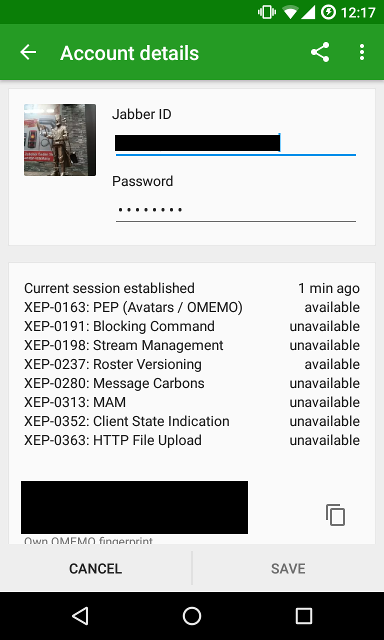
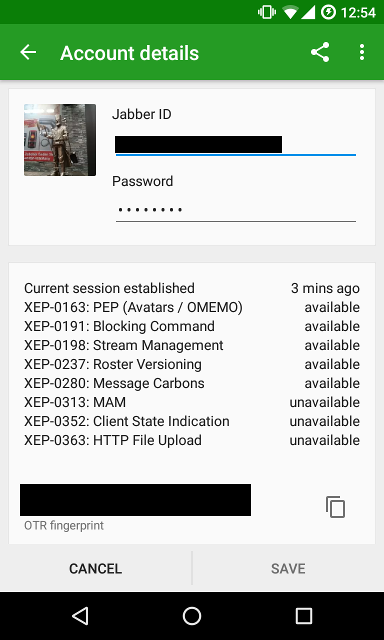
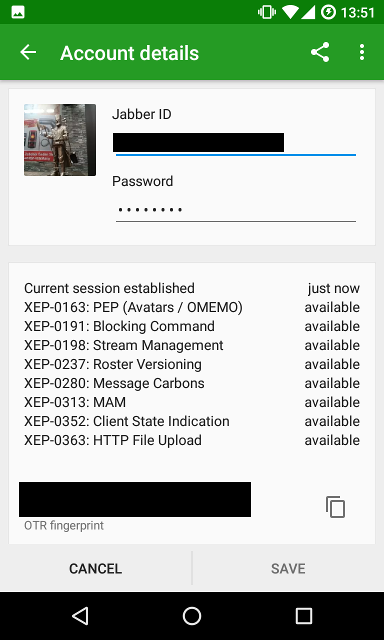
Conversations is a really nice, actively developed, up to date XMPP client for Android that has the nice feature of telling you what XEPs are supported by the server one is using: Initial server features Some days ago, me and Valhalla played the game of trying to see what happens when one turns them all on: I would send her screenshots from my Conversations, and she would poke at her Prosody to try and turn things on: After some work Valhalla eventually managed to get all features activated, purely using packages from Jessie+Backports: All features activated The result was a chat system in which I could see the same conversation history on my phone and on my laptop (with gajim)(https://gajim.org/), and have it synced even after a device has been offline, We could send each other rich media like photos, and could do OMEMO encryption (same as Signal) in group chats. I now have an XMPP setup which has all the features of the recent fancy chat systems, and on top of that it runs, client and server, on Free Software, which can be audited, it is federated and I can self-host my own server in my own VPS if I want to, with packages supported in Debian. Valhalla has documented the whole procedure. If you make a client for a protocol with lots of extension, do like Conversations and implement a status page with the features you'd like to have on the server, and little green indicators showing which are available: it is quite a good motivator for getting them all supported.

Dirk Eddelbuettel: nanotime 0.1.0: Now on Windows

Last month, we released nanotime, a package to work with nanosecond timestamps. See the initial release announcement for some background material and a few first examples. nanotime relies on the RcppCCTZ package for high(er) resolution time parsing and formatting: R itself stops a little short of a microsecond. And it uses the bit64 package for the actual arithmetic: time at this granularity is commonly represented at (integer) increments (at nanosecond resolution) relative to an offset, for which the standard epoch of Januar 1, 1970 is used. int64 types are a perfect match here, and bit64 gives us an integer64. Naysayers will point out some technical limitations with R's S3 classes, but it works pretty much as needed here. The one thing we did not have was Windows support. RcppCCTZ and the CCTZ library it uses need real C++11 support, and the g++-4.9 compiler used on Windows falls a little short lacking inter alia a suitable std::get_time() implementation. Enter Dan Dillon who ported this from LLVM's libc++ which lead to Sunday's RcppCCTZ 0.2.0 release. And now we have all our ducks in a row: everything works on Windows too. The next paragraph summarizes the changes for both this release as well as the initial one last month:

Changes in version 0.1.0 (2017-01-10)
  • Added Windows support thanks to expanded RcppCCTZ (closes #6)
  • Added "mocked up" demo with nanosecond delay networking analysis
  • Added 'fmt' and 'tz' options to output functions, expanded format.nanotime (closing #2 and #3)
  • Added data.frame support
  • Expanded tests

Changes in version 0.0.1 (2016-12-15)
  • Initial CRAN upload.
  • Package is functional and provides examples.

We also have a diff to the previous version thanks to CRANberries. More details and examples are at the nanotime page; code, issue tickets etc at the GitHub repository.

This post by Dirk Eddelbuettel originated on his Thinking inside the box blog. Please report excessive re-aggregation in third-party for-profit settings.

9 January 2017

Sean Whitton: jan17vcspkg

There have been a two long threads on the debian-devel mailing list about the representation of the changes to upstream source code made by Debian maintainers. Here are a few notes for my own reference. I spent a lot of time defending the workflow I described in dgit-maint-merge(7) (which was inspired by this blog post). However, I came to be convinced that there is a case for a manually curated series of patches for certain classes of package. It will depend on how upstream uses git (rebasing or merging) and on whether the Debian delta from upstream is significant and/or long-standing. I still think that we should be using dgit-maint-merge(7) for leaf or near-leaf packages, because it saves so much volunteer time that can be better spent on other things. When upstream does use a merging workflow, one advantage of the dgit-maint-merge(7) workflow is that Debian s packaging is just another branch of development. Now consider packages where we do want a manually curated patch series. It is very hard to represent such a series in git. The only natural way to do it is to continually rebase the patch series against an upstream branch, but public branches that get rebased are not a good idea. The solution that many people have adopted is to represent their patch series as a folder full of .diff files, and then use gbp pq to convert this into a rebasing branch. This branch is not shared. It is edited, rebased, and then converted back to the folder of .diff files, the changes to which are then committed to git. One of the advantages of dgit is that there now exists an official, non-rebasing git history of uploads to the archive. It would be nice if we could represent curated patch series as branches in the dgit repos, rather than as folders full of .diff files. But as I just described, this is very hard. However, Ian Jackson has the beginnings of a workflow that just might fit the bill.

Petter Reinholdtsen: Where did that package go? geolocated IP traceroute

Did you ever wonder where the web trafic really flow to reach the web servers, and who own the network equipment it is flowing through? It is possible to get a glimpse of this from using traceroute, but it is hard to find all the details. Many years ago, I wrote a system to map the Norwegian Internet (trying to figure out if our plans for a network game service would get low enough latency, and who we needed to talk to about setting up game servers close to the users. Back then I used traceroute output from many locations (I asked my friends to run a script and send me their traceroute output) to create the graph and the map. The output from traceroute typically look like this:
traceroute to www.stortinget.no (85.88.67.10), 30 hops max, 60 byte packets
 1  uio-gw10.uio.no (129.240.202.1)  0.447 ms  0.486 ms  0.621 ms
 2  uio-gw8.uio.no (129.240.24.229)  0.467 ms  0.578 ms  0.675 ms
 3  oslo-gw1.uninett.no (128.39.65.17)  0.385 ms  0.373 ms  0.358 ms
 4  te3-1-2.br1.fn3.as2116.net (193.156.90.3)  1.174 ms  1.172 ms  1.153 ms
 5  he16-1-1.cr1.san110.as2116.net (195.0.244.234)  2.627 ms he16-1-1.cr2.oslosda310.as2116.net (195.0.244.48)  3.172 ms he16-1-1.cr1.san110.as2116.net (195.0.244.234)  2.857 ms
 6  ae1.ar8.oslosda310.as2116.net (195.0.242.39)  0.662 ms  0.637 ms ae0.ar8.oslosda310.as2116.net (195.0.242.23)  0.622 ms
 7  89.191.10.146 (89.191.10.146)  0.931 ms  0.917 ms  0.955 ms
 8  * * *
 9  * * *
[...]
This show the DNS names and IP addresses of (at least some of the) network equipment involved in getting the data traffic from me to the www.stortinget.no server, and how long it took in milliseconds for a package to reach the equipment and return to me. Three packages are sent, and some times the packages do not follow the same path. This is shown for hop 5, where three different IP addresses replied to the traceroute request. There are many ways to measure trace routes. Other good traceroute implementations I use are traceroute (using ICMP packages) mtr (can do both ICMP, UDP and TCP) and scapy (python library with ICMP, UDP, TCP traceroute and a lot of other capabilities). All of them are easily available in Debian. This time around, I wanted to know the geographic location of different route points, to visualize how visiting a web page spread information about the visit to a lot of servers around the globe. The background is that a web site today often will ask the browser to get from many servers the parts (for example HTML, JSON, fonts, JavaScript, CSS, video) required to display the content. This will leak information about the visit to those controlling these servers and anyone able to peek at the data traffic passing by (like your ISP, the ISPs backbone provider, FRA, GCHQ, NSA and others). Lets pick an example, the Norwegian parliament web site www.stortinget.no. It is read daily by all members of parliament and their staff, as well as political journalists, activits and many other citizens of Norway. A visit to the www.stortinget.no web site will ask your browser to contact 8 other servers: ajax.googleapis.com, insights.hotjar.com, script.hotjar.com, static.hotjar.com, stats.g.doubleclick.net, www.google-analytics.com, www.googletagmanager.com and www.netigate.se. I extracted this by asking PhantomJS to visit the Stortinget web page and tell me all the URLs PhantomJS downloaded to render the page (in HAR format using their netsniff example. I am very grateful to Gorm for showing me how to do this). My goal is to visualize network traces to all IP addresses behind these DNS names, do show where visitors personal information is spread when visiting the page.
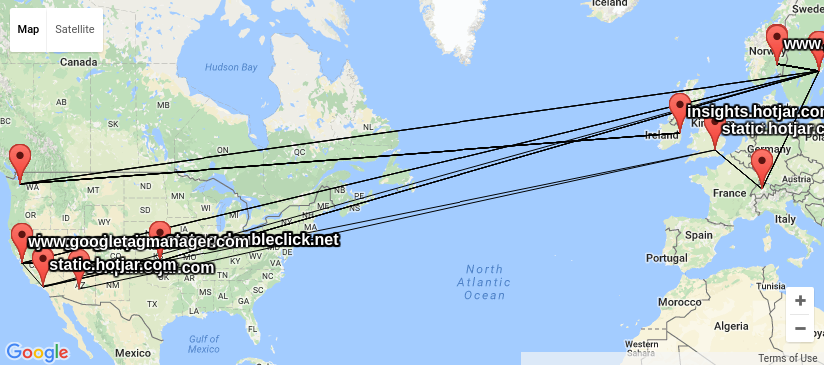
map of combined traces for URLs used by www.stortinget.no using GeoIP When I had a look around for options, I could not find any good free software tools to do this, and decided I needed my own traceroute wrapper outputting KML based on locations looked up using GeoIP. KML is easy to work with and easy to generate, and understood by several of the GIS tools I have available. I got good help from by NUUG colleague Anders Einar with this, and the result can be seen in my kmltraceroute git repository. Unfortunately, the quality of the free GeoIP databases I could find (and the for-pay databases my friends had access to) is not up to the task. The IP addresses of central Internet infrastructure would typically be placed near the controlling companies main office, and not where the router is really located, as you can see from the KML file I created using the GeoLite City dataset from MaxMind.
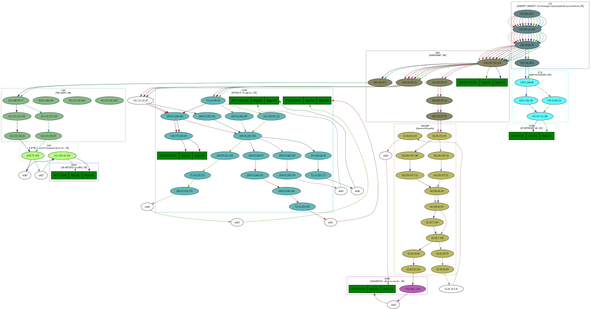
scapy traceroute graph for URLs used by www.stortinget.no I also had a look at the visual traceroute graph created by the scrapy project, showing IP network ownership (aka AS owner) for the IP address in question. The graph display a lot of useful information about the traceroute in SVG format, and give a good indication on who control the network equipment involved, but it do not include geolocation. This graph make it possible to see the information is made available at least for UNINETT, Catchcom, Stortinget, Nordunet, Google, Amazon, Telia, Level 3 Communications and NetDNA.
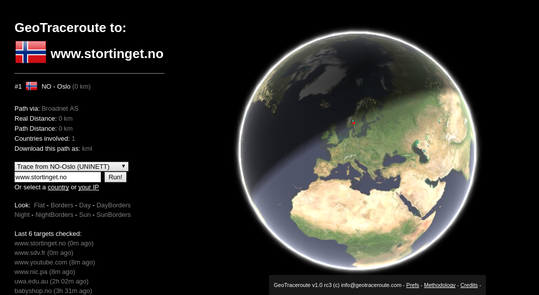
example geotraceroute view for www.stortinget.no In the process, I came across the web service GeoTraceroute by Salim Gasmi. Its methology of combining guesses based on DNS names, various location databases and finally use latecy times to rule out candidate locations seemed to do a very good job of guessing correct geolocation. But it could only do one trace at the time, did not have a sensor in Norway and did not make the geolocations easily available for postprocessing. So I contacted the developer and asked if he would be willing to share the code (he refused until he had time to clean it up), but he was interested in providing the geolocations in a machine readable format, and willing to set up a sensor in Norway. So since yesterday, it is possible to run traces from Norway in this service thanks to a sensor node set up by the NUUG assosiation, and get the trace in KML format for further processing.
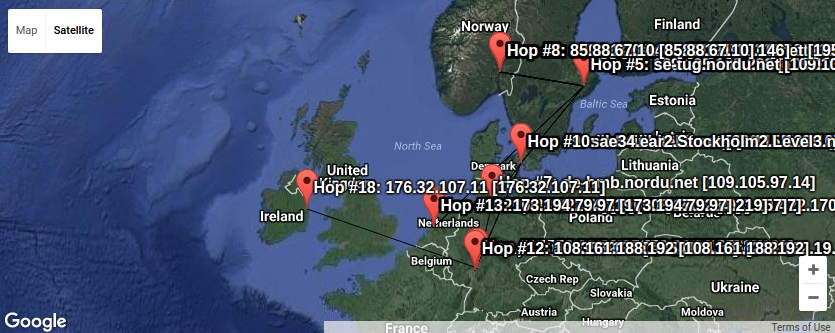
map of combined traces for URLs used by www.stortinget.no using geotraceroute Here we can see a lot of trafic passes Sweden on its way to Denmark, Germany, Holland and Ireland. Plenty of places where the Snowden confirmations verified the traffic is read by various actors without your best interest as their top priority. Combining KML files is trivial using a text editor, so I could loop over all the hosts behind the urls imported by www.stortinget.no and ask for the KML file from GeoTraceroute, and create a combined KML file with all the traces (unfortunately only one of the IP addresses behind the DNS name is traced this time. To get them all, one would have to request traces using IP number instead of DNS names from GeoTraceroute). That might be the next step in this project. Armed with these tools, I find it a lot easier to figure out where the IP traffic moves and who control the boxes involved in moving it. And every time the link crosses for example the Swedish border, we can be sure Swedish Signal Intelligence (FRA) is listening, as GCHQ do in Britain and NSA in USA and cables around the globe. (Hm, what should we tell them? :) Keep that in mind if you ever send anything unencrypted over the Internet. PS: KML files are drawn using the KML viewer from Ivan Rublev, as it was less cluttered than the local Linux application Marble. There are heaps of other options too. As usual, if you use Bitcoin and want to show your support of my activities, please send Bitcoin donations to my address 15oWEoG9dUPovwmUL9KWAnYRtNJEkP1u1b.

Guido G nther: Debian Fun in December 2016

Debian LTS November marked the 20th month I contributed to Debian LTS under the Freexian umbrella. I had 8 hours allocated which I used by: Other Debian stuff Some other Free Software activites

8 January 2017

Bits from Debian: New Debian Developers and Maintainers (November and December 2016)

The following contributors got their Debian Developer accounts in the last two months: The following contributors were added as Debian Maintainers in the last two months: Congratulations!

Keith Packard: embedded-arm-libc

Finding a Libc for tiny embedded ARM systems You'd think this problem would have been solved a long time ago. All I wanted was a C library to use in small embedded systems -- those with a few kB of flash and even fewer kB of RAM. Small system requirements A small embedded system has a different balance of needs: Available small C libraries I've looked at: Current AltOS C library We've been using pdclib for a couple of years. It was easy to get running, but it really doesn't match what we need. In particular, it uses a lot of stack space in the stdio implementation as there's an additional layer of abstraction that isn't necessary. In addition, pdclib doesn't include a math library, so I've had to 'borrow' code from other places where necessary. I've wanted to switch for a while, but there didn't seem to be a great alternative. What's wrong with newlib? The "obvious" embedded C library is newlib. Designed for embedded systems with a nice way to avoid needing a 'real' kernel underneath, newlib has a lot going for it. Most of the functions have a good balance between speed and size, and many of them even offer two implementations depending on what trade-off you need. Plus, the build system 'just works' on multi-lib targets like the family of cortex-m parts. The big problem with newlib is the stdio code. It absolutely requires dynamic memory allocation and the amount of code necessary for 'printf' is larger than the flash space on many of our devices. I was able to get a cortex-m3 application compiled in 41kB of code, and that used a smattering of string/memory functions and printf. How about avr libc? The Atmel world has it pretty good -- avr-libc is small and highly optimized for atmel's 8-bit avr processors. I've used this library with success in a number of projects, although nothing we've ever sold through Altus Metrum. In particular, the stdio implementation is quite nice -- a 'FILE' is effectively a struct containing pointers to putc/getc functions. The library does no buffering at all. And it's tiny -- the printf code lacks a lot of the fancy new stuff, which saves a pile of space. However, much of the places where performance is critical are written in assembly language, making it pretty darn hard to port to another processor. Mixing code together for fun and profit! Today, I decided to try an experiment to see what would happen if I used the avr-libc stdio bits within the newlib environment. There were only three functions written in assembly language, two of them were just stubs while the third was a simple ultoa function with a weird interface. With those coded up in C, I managed to get them wedged into newlib. Figuring out the newlib build system was the only real challenge; it's pretty awful having generated files in the repository and a mix of autoconf 2.64 and 2.68 version dependencies. The result is pretty usable though; my STM 32L discovery board demo application is only 14kB of flash while the original newlib stdio bits needed 42kB and that was still missing all of the 'syscalls', like read, write and sbrk. Here's gitweb pointing at the top of the tiny-stdio tree: gitweb And, of course you can check out the whole thing

git clone git://keithp.com/git/newlib
'master' remains a plain upstream tree, although I do have a fix on that branch. The new code is all on the tiny-stdio branch. I'll post a note on the newlib mailing list once I've managed to subscribe and see if there is interest in making this option available in the upstream newlib releases. If so, I'll see what might make sense for the Debian libnewlib-arm-none-eabi packages.

7 January 2017

Lars Wirzenius: Hacker Noir, chapter 1: Negotiation

I participated in Nanowrimo in November, but I failed to actually finish the required 50,000 words during the month. Oh well. I plan on finishing the book eventually, anyway. Furthermore, as an open source exhibitionist I thought I'd publish a chapter each month. This will put a bit of pressure on me to keep writing, and hopefully I'll get some nice feedback too. The working title is "Hacker Noir". I've put the first chapter up on http://noir.liw.fi/.

Next.

Previous.