Search Results: "mak"

3 June 2020

Ben Hutchings: Introducing debplate, a template system for Debian packages

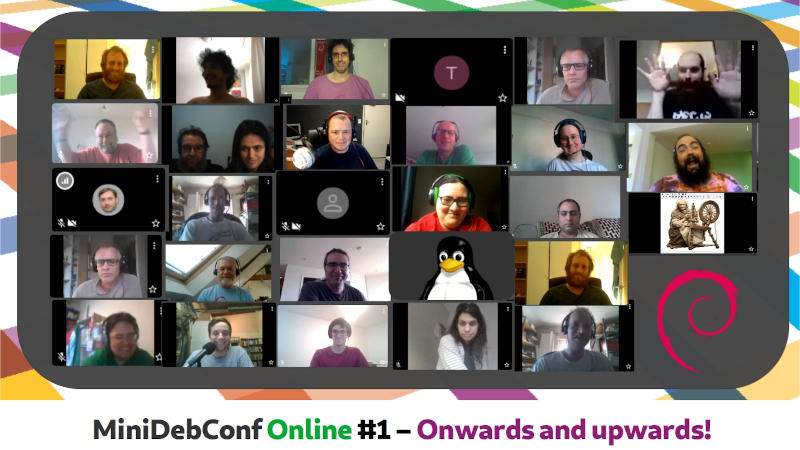
For about two months I've been working on a new project, debplate, which currently lives at benh/debplate on Salsa. This is a template system for Debian packages, primarily intended to ease building multiple similar binary packages from a single source. With some changes, it could also be useful for making multiple source packages consistent (issue #9). I want debplate to be capable of replacing the kernel team's existing template system and a lot of its custom scripting, but it is also meant to a general tool. I believe it's already capable of supporting source packages with relatively simple needs, and there are some examples of these in the debplate source. My long-term goal is that debplate will replace most team-specific and package-specific template systems, making those source packages using it less unusual and easier to contribute to. I gave a short talk about debplate at MiniDebConf Online on Sunday.

Keith Packard: picolibc-ryu

Float/String Conversion in Picolibc: Enter Ry I recently wrote about this topic having concluded that the best route for now was to use the malloc-free, but imprecise, conversion routines in the tinystdio alternative. A few days later, Sreepathi Pai pointed me at some very recent work in this area: This is amazing! Thirty years after the papers referenced in the previous post, Ulf Adams came up with some really cool ideas and managed to reduce the math required for 64-bit conversion to 128 bit integers. This is a huge leap forward; we were doing long multi-precision computations before, and now it's all short enough to fit in registers (ok, a lot of registers, but still). Getting the Ry Code The code is available on github: https://github.com/ulfjack/ryu. Reading through it, it's very clear that the author focuses on performance with lots of tuning for common cases. Still, it's quite readable, especially compared with the newlib multi-precision based code. Picolibc String/Float conversion interface Picolibc has some pretty basic needs for the float/string conversion code, it wants four functions:
  1. __dtoa_engine
    int
    __dtoa_engine(double x, struct dtoa *dtoa, uint8_t max_digits, uint8_t max_decimals);
    
    This converts the double x to a string of decimal digits and a decimal exponent stored inside the 'dtoa' struct. It limits the total number of digits to max_digits and, optionally (when max_decimals is non-zero), limits the number of fractional digits to max_decimals - 1. This latter supports 'f' formats. Returns the number of digits stored, which is <= max_digits. Less if the number can be accurately represented in fewer digits.
  2. __ftoa_engine
    int
    __ftoa_engine(float x, struct ftoa *ftoa, uint8_t max_digits, uint8_t max_decimals);
    
    The same as __dtoa_engine, except for floats.
  3. __atod_engine
    double
    __atod_engine(uint64_t m10, int e10);
    
    To avoid needing to handle stdio inside the conversion function, __atod_engine receives fully parsed values, the base-10 significand (m10) and exponent (e10). The value to convert is m10 * pow(10, e10).
  4. __atof_engine
    float
    __atof_engine(uint32_t m10, int e10);
    
    The same as __atod_engine, except for floats.
With these, it can do printf, scanf, ecvt, fcvt, gcvt, strtod, strtof and atof. Porting Ry to Picolibc The existing Ry float-to-string code always generates the number of digits necessary for accurate output. I had to hack it up to generate correctly rounded shorter output when max_digits or max_decimals were smaller. I'm not sure I managed to do that correctly, but at least it appears to be passing all of the test cases I have. In normal operation, Ry iteratively removes digits from the answer that aren't necessary to disambiguate with neighboring values. What I changed was to keep removing digits using that method until the answer had few enough digits to fit in the desired length. There's some tricky rounding code that adjusts the final result and I had to bypass that if I'd removed extra digits. That was about the only change necessary to the core algorithm. I also trimmed the code to only include the general case and not the performance improvements, then wrapped it with code to provide the _engine interface. On the string-to-float side, most of what I needed to do was remove the string parsing bits at the start of the function and switch from performance-optimized to space-optimized versions of a couple of internal routines. Correctness Results Because these new functions are now 'exact', I was able to adjust the picolibc tests to compare all of the bits for string/float conversion instead of having to permit a bit of slop in the answers. With those changes, the picolibc test suite passes, which offers some assurance that things aren't completely broken. Size Results Snek uses the 32-bit float versions of the conversion routines, and for that, the size difference is:
   text    data     bss     dec     hex filename
  59068      44   37968   97080   17b38 snek-qemu-riscv-orig.elf
  59430      44   37968   97442   17ca2 snek-qemu-riscv-ryu.elf
    362
362 bytes added to gain accurate printf/strtof results seems like a good trade-off in this case. Performance I haven't measured performance at all, but I suspect that it won't be nearly as problematic on most platforms as the source code makes it appear. And that's because Ry is entirely integer arithmetic with no floating point at all. This avoids using the soft fp code for platforms without hardware float support. Pointers to the Code I haven't merged this to picolibc master yet, it's on the ryu branch: Review, especially of the hack above to return short results, would be greatly appreciated! Thanks again to Ulf Adams for creating this code and to Sreepathi Pai for sending me a note about it!

Dima Kogan: vnlog now functional on *BSD and OSX

So somebody finally bugged me about supporting vnlog tools on OSX. I was pretty sure that between all the redirection, process communication, and file descriptor management something was Linux-specific, but apparently not: everything just works. There were a few uninteresting issues with tool paths, core tool and linker flags and so on, but it was all really minor. I have a report that the test suite passes on OSX, and I verified it on FreeBSD. I made a new 1.28 release tag, but it exists mostly for the benefit of any OSX or *BSD people who'd want to make a package for their system. Progress!

2 June 2020

Olivier Berger: Mixing NRELab s Antidote and Eclipse Che on the same k8s cluster

You may have heard of my search for Cloud solutions to run labs in an academic context, with a focus on free an open source solutions . You may read previous installments of this blog, or for a shorter, check the presentation I ve recorded last week. I ve become quite interested, in the latest month, in 2 projects: NRELab s Antidote and Eclipse Che. Antidote is the software that powers NRELabs, a labs platform for learning network automation, which runs on top of Kubernetes (k8s). The interesting thing is that for each learner, there can be a dedicated k8s namespace with multiple virtual nodes running on a separate network. This can be used in the context of virtual classes/labs where our students will perform network labs in parallel on the same cluster. Eclipse Che powers Eclipse on the Cloud , making available software development environments, for developers, on a Kubernetes Cloud. Developers typically work from a Web page instead of installing local development tools. Both projects seem quite complementary. For one, we both teach networks and software developments. So that would naturally appeal for many professors. Furthermore, Eclipse Che provides a few features that Antidote is lacking : authenticating users (with keycloak), and persisting their work in workspaces, between work sessions. Typically what we need in our academic context where students will work on the same labs during scheduled classes, week after week, during or off-hours. Thus it would be great to have more integration between the 2 environments. I intend to work on that front, but that takes time, as running stuff on Kubernetes isn t exactly trivial, at least when you re like me and want to use a vanilla kubernetes. I ve mainly relied on running k8s inside VMs using Vagrant and/or minikube so far. A first milestone I ve achieved is making sure that Antidote and Eclipse Che aren t incompatible. Antidote s selfmedicate script was actually running inside a Vagrant VM, where I had difficulties installing Eclipse Che (probably because of old software, or particular networking setup details). I ve overcome this hurdle, as I m now able to install both environments on a single Kubernetes VM (using my own Vagrant setup). Running Eclipse Che (alongsite Antidote) on a k8s Vagrant VM. This proves only that there s no show stopper there, but a lot of work remains. Stay tuned. Update: I ve finally managed to get it to work on the antidote-selfmedicate base too. See my branch at: https://github.com/olberger/antidote-selfmedicate/tree/che

Sylvestre Ledru: Debian rebuild with clang 10 + some patches

Because of the lock-down in France and thanks to Lucas, I have been able to make some progress rebuilding Debian with clang instead of gcc.

TLDR Instead of patching clang itself, I used a different approach this time: patching Debian tools or implementing some workaround to mitigate an issue.
The percentage of packages failing drop from 4.5% to 3.6% (1400 packages to 1110 - on a total of 31014). I focused on two classes of issues:

Qmake As I have no intention to merge the patch upstream, I used a very dirty workaround. I overwrote the g++ qmake file by clang's:
https://salsa.debian.org/lucas/collab-qa-tools/-/blob/master/modes/clang10#L44-47 I dropped the number of this failure to 0, making some packages build flawlessly (example: qtcreator, chessx, fwbuilder, etc). However, some packages are still failing later and therefore increasing the number of failures in some other categories like link error. For example, qtads fails because of ordered comparison between pointer and zero or oscar fails on a -Werror,-Wdeprecated-copy error. Breaking the build later also highlighted some new classes of issues which didn't occur with clang < 10.
For example, warnings related to C++ range loop or implicit int float conversion (I fixed a bunch of them in Firefox) .

Symbol differences Historically, symbol management for C++ in Debian has been a pain. Russ Allbery wrote a blog post in 2012 explaining the situation. AFAIK, it hasn't changed much.
Once more, I took the dirty approach: if there new or missing symbols, don't fail the build.
The rational is the following: Packages in the Debian archive are supposed to build without any issue. If there is new or missing symbols, it is probably clang generating a different library but this library is very likely working as expected (and usable by a program compiled with g++ or clang). It is purely a different approach taken by the compiler developer. In order to mitigate this issue, before the build starts, I am modifying dpkg-gensymbols to transform the error into a warning.
So, the typical Debian error some new symbols appeared in the symbols file or some symbols or patterns disappeared in the symbols file will NOT fail the build. Unsurprisingly, all but one package (libktorrent) build. Even if I am pessimistic, I reported a bug on dpkg-dev to evaluate if we could improve dpkg-gensymbol not to fail on these cases.

Next steps The next offender is Imake.tmpl:2243:10: fatal error: ' X11 .rules' file not found with more than an hundred occurrences, reported upstream quite sometime ago. Then, the big issues are going to be much harder to fix as they are real issues/warnings (with -Werror) in the code of the packages. Example: -Wc++11-narrowing & Wreserved-user-defined-literal... The list is long.
I will probably work on that when llvm/clang 11 are in RC phase.

For maintainers & upstream Maintainer of Debian/Ubuntu packages? I am providing a list of failing packages per maintainer: https://clang.debian.net/maintainers.php
For upstream, it is also easy to test with clang. Usually, apt install clang && CC=clang CXX=clang++ <build step> is good enough.

Conclusion With these two changes, I have been able to fix about 290 packages. I think I will be able to get that down a bit more but we will soon reach a plateau as many warnings/issues will have to fix in the C/C++ code itself.

Lisandro Dami n Nicanor P rez Meyer: Simplified Monitoring of Patients in Situations of Mass Hospitalization (MoSimPa) - Fighting COVID-19

I have been quite absent from Debian stuff lately, but this increased since COVID-19 hits us. In this blog post I'll try to sketch what I have been doing to help fight COVID-19 this last few months.

In the beginningWhen the pandemic reached Argentina the government started a quarantine. We engineers (like engineers around the world) started to think on how to put our abilities in order to help with the situation. Some worked toward providing more protection elements to medical staff, some towards increasing the number of ventilation machines at disposal. Another group of people started thinking on another ways of helping. In Bah a Blanca arised the idea of monitoring some variables remotely and in masse.

Simplified Monitoring of Patients in Situations of Mass Hospitalization (MoSimPa)

This is where the idea of remotely monitored devices came in, and MoSimPa (from the spanish of "monitoreo simplificado de pacientes en situaci n de internaci n masiva") started to get form. The idea is simple: oximetry (SpO2), heart rate and body temperature will be recorded and, instead of being shown in a display in the device itself, they will be transmitted and monitored in one or more places. In this way medical staff doesn't has to reach a patient constantly and monitoring could be done by medical staff for more patients at the same time. In place monitoring can also happen using a cellphone or tablet.

The devices do not have a screen of their own and almost no buttons, making them more cheap to build and thus more in line with the current economic reality of Argentina.


This is where the project Para Ayudar was created. The project aims to produce the aforementioned non-invasive device to be used in health institutions, hospitals, intra hospital transports and homes.

It is worth to note that the system is designed as a complementary measure for continuous monitoring of a pacient. Care should be taken to check that symptomps and overall patient status don't mean an inmediate life threat. In other words, it is NOT designed for ICUs.

All the above done with Free/Libre/Open Source software and hardware designs. Any manufacturing company can then use them for mass production.

The importance of early pneumonia detection


We were already working in MoSimPa when an NYTimes article caught or attention: "The Infection That s Silently Killing Coronavirus Patients". From the article:

A vast majority of Covid pneumonia patients I met had remarkably low oxygen saturations at triage seemingly incompatible with life but they were using their cellphones as we put them on monitors. Although breathing fast, they had relatively minimal apparent distress, despite dangerously low oxygen levels and terrible pneumonia on chest X-rays.

This greatly reinforced the idea we were on the right track.

The project from a technical standpoint


As the project is primarily designed for and by Argentinians the current system design and software documentation is written in spanish, but the source code (or at least most of it) is written in english. Should anyone need it in english please do not hesitate in asking me.

General system description

System schema

The system is comprised of the devices, a main machine acting as a server (in our case for small setups a Raspberry Pi) and the possibility of accessing data trough cell phones, tablets or other PCs in the network.

The hardware


As of today this is the only part in which I still can't provide schematics, but I'll update this blog post and technical doc with them as soon as I get my hands into them.

Again the design is due to be built in Argentina where getting our hands on hardware is not easy. Moreover it needs to be as cheap as possible, specially now that the Argentinian currency, the peso, is every day more depreciated. So we decided on using an ESP32 as the main microprocessor and a set of Maxim sensors devices. Again, more info when I have them at hand.

The software


Here we have many more components to describe. Firstly the ESP32 code is done with the Arduino SDK. This part of the stack will receive many updates soon, as soon as the first hardware prototypes are out.

For the rest of the stack I decided to go ahead with whatever is available in Debian stable. Why? Well, Raspbian provides a Debian stable-based image and I'm a Debian Developer, so things should go just natural for me in that front. Of course each component has its own packaging. I'm one of Debian's Qt maintainers then using Qt will also be quite natural for me. Plots? Qwt, of course. And with that I have most of my necessities fulfilled. I choose PostgreSql as database server and Mosquitto as MQTT broker.

Between the database and MQTT is mosimpa-datakeeper. The piece of software from which medical staff monitor patients is unsurprisingly called mosimpa-monitor.

mosimpa-monitor
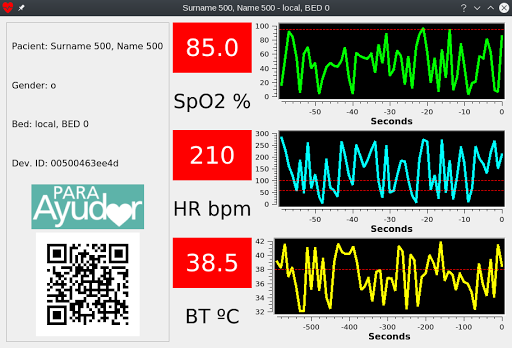
MoSimPa's monitor main screen

mosimpa-monitor plots
Plots of a patient's data


mosimpa-monitor-alarms-setup
Alarm thresholds setup


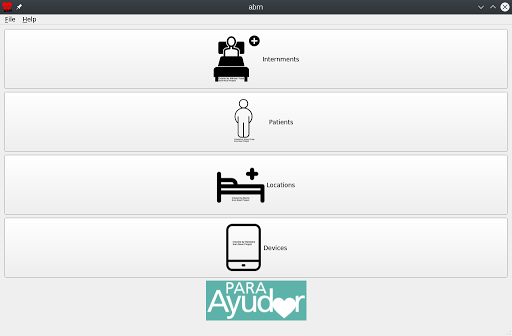
And for managing patients, devices, locations and internments (CRUD anyone?) there is currently a Qt-based application called mosimpa-abm.

mosimpa-abm
ABM main screen


mosimpa-abm-internments
ABM internments view

The idea is to replace it with a web service so it doesn't needs to be confined to the RPi or require installations in other machines. I considered using webassembly but I would have to also build PostgreSql in order to compile Qt's plugin.

Translations? Of course! As I have already mentioned the code is written in English. Qt allows to easily translate applications, so I keep a Spanish one as the code changes (and we are primarily targeting spanish-speaking people). But of course this also means it can be easily translated to whichever language is necessary.

Even if I am a packager I still have some stuff to fix from the packaging itself, like letting datakeeper run with its own user. I just haven't got to it yet.


Certifications


We are working towards getting the system certified by ANMAT, which is the Argentinian equivalent for EEUU's FDA.

Funding


While all the people involved are working ad-honorem funding is still required in order to buy materials, create the prototypes, etc. The project created payments links with Mercado Pago (in spanish and argentinian pesos) and other bank methods (PDF, also in spanish).

I repeat the links here with an aproximation to US$.

- 500 AR$ (less than 8 US$)
- 1000 AR$ (less than 15 US$)
- 2000 AR$ (less than 30 US$)
- 3000 AR$ (less than 45 US$)
- 5000 AR$ (less than 75 US$)

You can check the actual convertion rate in https://www.google.com/search?q=argentine+peso+to+us+dollars

The project was also presented at a funding call of argentinian Agencia de Promoci n de la Investigaci n, el Desarrollo Tecnol gico y la Innovaci n (Agencia I+D+i). 900+ projects where presented and 64 funded, MoSimPa between them.

1 June 2020

Jonathan Carter: Free Software Activities for 2020-05

I would say that this was a crazy month, but with everything ever escalating, does that even mean anything anymore? I lost track of tracking my activities in the second half of the month, and I m still not very good at logging the soft stuff , that is, things like non-technical work but that also takes up a lot of time, but will continue to work on it.
Towards the end of the month I spent a huge amount of time on MiniDebConf Online, I m glad it all worked out, and will write a seperate blog entry on that. Thank you again to everyone for making it a success! I m also moving DPL activities to the DPL blog, so even though it s been a busy month in the free software world my activity log here will look somewhat deceptively short this month MiniDebConf Online 2020-05-06: Help prepare initial CfP mail. 2020-05-06: Process some feedback regarding accessibility on Jitsi.

Debian Packaging 2020-05-02: Upload package gnome-shell-extension-workspaces-to-dock (53-1) to Debian unstable. 2020-05-02: Upload package tetzle (2.1.6-1) to Debian unstable. 2020-05-06: Upload package bundlewrap (3.9.0-1) to Debian unstable. 2020-05-06: Accept MR#1 for connectagram. 2020-05-06: Upload package connectagram (1.2.11-1) to Debian unstable. 2020-05-07: Upload package gnome-shell-extension-multi-monitors (20-1) to Debian unstable (Closes: #956169). 2020-05-07: Upload package tanglet (1.5.6-1) to Debian unstable. 2020-05-16: Upload package calamares (3.2.24-1) to Debian unstable. 2020-05-16: Accept MR#1 for tuxpaint-config. 2020-05-16: Accept MR#7 for debian-live. 2020-05-18: Upload package bundlewrap (3.10.0) to Debian unstable.

Debian Mentoring 2020-05-02: Sponsor package gamemode (1.5.1-3) (Games team request). 2020-05-16: Sponsor package gamemode (1.5.1-4) (Games team request).

Utkarsh Gupta: FOSS Activites in May 2020

Here s my (eighth) monthly update about the activities I ve done in the F/L/OSS world.

Debian
This month marks my 15 months of contributing to Debian. And 6th month as a DD! \o/ Whilst I love doing Debian stuff, I have started spending more time on the programming side now. And I hope to keep it this for some time now.
Of course, I ll keep doing the Debian stuff, but just lesser in amount. Anyway, the following are the things I did in May.

Uploads:

Other $things:
  • Hosted Ruby team meeting. Logs here.
  • Attended Debian Perl Sprints. Report here.
  • Sponsored git-repo-updater and mplcursors for Sudip.
  • Mentoring for newcomers.
  • FTP Trainee reviewing.
  • Moderation of -project mailing list.
  • Got selected for GSoC 20 for Debian!

Experimenting and improving Ruby libraries FTW!
I have been very heavily involved with the Debian Ruby team for over an year now.
Thanks to Antonio Terceiro (and GSoC), I ve started experimenting and taking more interest in upstream development and improvement of these libraries. This has the sole purpose of learning. It has gotten fun since I ve started doing Ruby.
And I hope it stays this way. This month, I opened some issues and proposed a few pull requests. They are:
  • Issue #802 against whenever for Ruby2.7 test failures.
  • Issue #8 against aggregate asking upstream for a release on rubygems.
  • Issue #104 against irb for asking more about Array.join("\n").
  • Issue #1391 against mail asking upstream to cut a new release.
  • Issue #1655 against rack reporting test failures in the CVE fix.
  • Issue #84 against ruby-dbus for help with Debian bug #836296.
  • Issue #85 against ruby-dbus asking if they still use rDoc for doc generation.
  • PR #9 against aggregate for dropping git from gemspec.
  • PR #804 against whenever for dropping git from gemspec.
  • Packaged ruby-cmath as it was split from Ruby2.7; cf: (#961213).

Debian LTS
Debian Long Term Support (LTS) is a project to extend the lifetime of all Debian stable releases to (at least) 5 years. Debian LTS is not handled by the Debian security team, but by a separate group of volunteers and companies interested in making it a success. This was my eighth month as a Debian LTS paid contributor. I was assigned 17.25 hours and worked on the following things:

CVE Fixes and Announcements:

Other LTS Work:
  • Triaged tika, freerdp, and apache2.
  • Mark CVE-2020-12105/openconnect as no-dsa not-affected for Jessie.
  • Mark CVE-2020-9489/tika as no-dsa ignored for Jessie.
  • Mark CVE-2020-11025/wordpres as not-affected for Jessie.
  • Add fix for Add fix for CVE-2019-18823/condor.
  • Requested CVE for bug#60251 against apache2.
  • Raised issue #947 against sympa reporting an incomplete patch for CVE-2020-10936.
  • Created the LTS Survey on the self-hosted LimeSurvey instance.
  • Attended the second LTS meeting. Logs here.
  • General discussion on LTS private and public mailing list.

Other(s)
Sometimes it gets hard to categorize work/things into a particular category.
That s why I am writing all of those things inside this category.
This includes two sub-categories and they are as follows.

Personal: This month I could get the following things done:
  • Wrote and published my first Ruby gem/library/tool on RubyGems!
    It s open-sourced and the repository is here.
    Bug reports and pull requests are welcomed!
  • Wrote a small Ruby script (available here) to install Ruby gems from Gemfile(.lock).
    Needed this when I hit a bug while using ruby-standalone, which Antonio fixed pretty quickly!
  • Had a coffee chat with John Coghlan!
    Tweet here.

Open Source: Again, this contains all the things that I couldn t categorize earlier.
Opened several issues and did a PR review:
  • Issue #15434 against phantomjs, asking to look into CVE-2019-17221. Still no action :/
  • Issue #947 against sympa, reporting an incomplete patch for CVE-2020-10936.
  • Issue #2102 against polybar, mentioning that the build is not reproducible.
  • Issue #5521 against libgit2, mentioning that the build is not reproducible.
  • Reviewed PR #5523 for polybar, which was a fix for the above issue.

Until next time.
:wq for today.

Paul Wise: FLOSS Activities May 2020

Focus This month I didn't have any particular focus. I just worked on issues in my info bubble.

Changes

Issues

Review

Administration
  • nsntrace: talk to upstream about collaborative maintenance
  • Debian: deploy changes, debug issue with GPS markers file generation, migrate bls/DUCK from alioth-archive to salsa
  • Debian website: ran map cron job, synced mirrors
  • Debian wiki: approve accounts, ping folks with bouncing email

Communication

Sponsors The apt-offline work and the libfile-libmagic-perl backports were sponsored. All other work was done on a volunteer basis.

31 May 2020

Chris Lamb: Free software activities in May 2020

Here is my monthly update covering what I have been doing in the free software world during May 2020 (previous month): In Lintian, the static analysis tool for Debian packages:
Reproducible builds One of the original promises of open source software is that distributed peer review and transparency of process results in enhanced end-user security. However, whilst anyone may inspect the source code of free and open source software for malicious flaws, almost all software today is distributed as pre-compiled binaries. This allows nefarious third-parties to compromise systems by injecting malicious code into ostensibly secure software during the various compilation and distribution processes. The motivation behind the Reproducible Builds effort is to ensure no flaws have been introduced during this compilation process by promising identical results are always generated from a given source, thus allowing multiple third-parties to come to a consensus on whether a build was compromised. The initiative is proud to be a member project of the Software Freedom Conservancy, a not-for-profit 501(c)(3) charity focused on ethical technology and user freedom. Conservancy acts as a corporate umbrella allowing projects to operate as non-profit initiatives without managing their own corporate structure. If you like the work of the Conservancy or the Reproducible Builds project, please consider becoming an official supporter.
Elsewhere in our tooling, I made the following changes to diffoscope, our in-depth and content-aware diff utility that can locate and diagnose reproducibility issues, including preparing and uploading versions 142, 143, 144, 145 and 146 to Debian: I also performed a huge overhaul of diffoscope's website:
Lastly, I made a large number of changes to the main Reproducible Builds website and documentation:
Debian LTS This month I contributed 17 hours to Debian Long Term Support (LTS) and 9 hours on its sister Extended LTS project. You can find out more about the two projects via the following video:
Debian I filed the following bug reports in Debian this month: I also filed a number of bugs against packages that are not compatible with Django 3.x, (organised around a single master bug) including django-taggit, sorl-thumbnail, django-simple-captcha, django-cas-server, django-cors-headers, python-django-csp, django-pipeline, python-django-jsonfield, python-django-contact-form, django-model-utils, django-fsm, django-modeltranslation, django-oauth-toolkit, libthumbor, python-django-extensions, python-django-imagekit, python-django-navtag, python-django-tagging, djangorestframework, django-haystack, django-taggit, django-simple-captcha, python-django-registration, python-django-pyscss, python-django-compressor, python-django-crispy-forms & python-django-mptt,
Lastly, I made the following uploads to Debian: I also sponsored an upload for adminer (4.7.7-1), also uploading it to buster-backports.

Jonathan Dowland: Golf Peaks

tricky tricky
This one was a bit of a surprise hit. Golf Peaks is a Golf-themed puzzle game. The objective is to get the golf ball into the hole, obviously, but how you do that is by choosing from a set of fixed moves (e.g., move one square; jump one square; etc.) and a direction. This works well with my eldest daughter. She takes one joy-con and I take the other. I typically am responsible for direction, and she hits 'A' to move the ball. We discuss which move to make, which has been a good test of her numeracy.

30 May 2020

Sean Whitton: GNU Emacs' Transient Mark mode

Something I ve found myself doing as the pandemic rolls on is picking out and (re-)reading through sections of the GNU Emacs manual and the GNU Emacs Lisp reference manual. This has got me (too) interested in some of the recent history of Emacs development, and I did some digging into archives of emacs-devel from 2008 (15M mbox) regarding the change to turn Transient Mark mode on by default and set mark-even-if-inactive to true by default in Emacs 23.1. It s not always clear which objections to turning on Transient Mark mode by default take into account the mark-even-if-inactive change. I think that turning on Transient Mark mode along with mark-even-if-inactive is a good default. The question that remains is whether the disadvantages of Transient Mark mode are significant enough that experienced Emacs users should consider altering Emacs default behaviour to mitigate them. Here s one popular blog arguing for some mitigations. How might Transient Mark mode be disadvantageous? The suggestion is that it makes using the mark for navigation rather than for acting on regions less convenient:
  1. setting a mark just so you can jump back to it (i) is a distinct operation you have to think of separately; and (ii) requires two keypresses, C-SPC C-SPC, rather than just one keypress
  2. using exchange-point-and-mark activates the region, so to use it for navigation you need to use either C-u C-x C-x or C-x C-x C-g, neither of which are convenient to type, or else it will be difficult to set regions at the place you ve just jumped to because you ll already have one active.
There are two other disadvantages that people bring up which I am disregarding. The first is that it makes it harder for new users to learn useful ways in which to use the mark when it s deactivated. This happened to me, but it can be mitigated without making any behavioural changes to Emacs. The second is that the visual highlighting of the region can be distracting. So far as I can tell, this is only a problem with exchange-point-and-mark, and it s subsumed by the problem of that command actually activating the region. The rest of the time Emacs automatic deactivation of the region seems sufficient. How might disabling Transient Mark mode be disadvantageous? When Transient Mark mode is on, many commands will do something usefully different when the mark is active. The number of commands in Emacs which work this way is only going to increase now that Transient Mark mode is the default. If you disable Transient Mark mode, then to use those features you need to temporarily activate Transient Mark mode. This can be fiddly and/or require a lot of keypresses, depending on exactly where you want to put the region. Without being able to see the region, it might be harder to know where it is. Indeed, this is one of the main reasons for wanting Transient Mark mode to be the default, to avoid confusing new users. I don t think this is likely to affect experienced Emacs users often, however, and on occasions when more precision is really needed, C-u C-x C-x will make the region visible. So I m not counting this as a disadvantage. How might we mitigate these two sets of disadvantages? Here are the two middle grounds I m considering. Mitigation #1: Transient Mark mode, but hack C-x C-x behaviour
(defun spw/exchange-point-and-mark (arg)
  "Exchange point and mark, but reactivate mark a bit less often.

Specifically, invert the meaning of ARG in the case where
Transient Mark mode is on but the region is inactive."
  (interactive "P")
  (exchange-point-and-mark
   (if (and transient-mark-mode (not mark-active))
       (not arg)
     arg)))
(global-set-key [remap exchange-point-and-mark] &aposspw/exchange-point-and-mark)
We avoid turning Transient Mark mode off, but mitigate the second of the two disadvantages given above. I can t figure out why it was thought to be a good idea to make C-x C-x reactivate the mark and require C-u C-x C-x to use the action of exchanging point and mark as a means of navigation. There needs to a binding to reactivate the mark, but in roughly ten years of having Transient Mark mode turned on, I ve found that the need to reactivate the mark doesn t come up often, so the shorter and longer bindings seem the wrong way around. Not sure what I m missing here. Mitigation #2: disable Transient Mark mode, but enable it temporarily more often
(setq transient-mark-mode nil)
(defun spw/remap-mark-command (command &optional map)
  "Remap a mark-* command to temporarily activate Transient Mark mode."
  (let* ((cmd (symbol-name command))
         (fun (intern (concat "spw/" cmd)))
         (doc (concat "Call  "
                      cmd
                      "&apos and temporarily activate Transient Mark mode.")))
    (fset fun  (lambda ()
                 ,doc
                 (interactive)
                 (call-interactively #&apos,command)
                 (activate-mark)))
    (if map
        (define-key map (vector &aposremap command) fun)
      (global-set-key (vector &aposremap command) fun))))
(dolist (command &apos(mark-word
                   mark-sexp
                   mark-paragraph
                   mark-defun
                   mark-page
                   mark-whole-buffer))
  (spw/remap-mark-command command))
(with-eval-after-load &aposorg
  (spw/remap-mark-command &aposorg-mark-element org-mode-map)
  (spw/remap-mark-command &aposorg-mark-subtree org-mode-map))
;; optional
(global-set-key "\M-=" (lambda () (interactive) (activate-mark)))
;; resettle the previous occupant
(global-set-key "\C-cw" &aposcount-words-region)
Here we remove both of the disadvantages of Transient Mark mode given above, and mitigate the main disadvantage of not activating Transient Mark mode by making it more convenient to activate it temporarily. For example, this enables using C-M-SPC C-M-SPC M-( to wrap the following two function arguments in parentheses. And you can hit M-h a few times to mark some blocks of text or code, then operate on them with commands like M-% and C-/ which behave differently when the region is active.1 Comparing these mitigations Both of these mitigations handle the second of the two disadvantages of Transient Mark mode given above. What remains, then, is
  1. under the effects of mitigation #1, how much of a barrier to using marks for navigational purposes is it to have to press C-SPC C-SPC instead of having a single binding, C-SPC, for all manual mark setting2
  2. under the effects of mitigation #2, how much of a barrier to taking advantage of commands which act differently when the region is active is it to have to temporarily enable Transient Mark mode with C-SPC C-SPC, M-= or one of the mark-* commands?
These are unknowns.3 So I m going to have to experiment, I think, to determine which mitigation to use, if either. In particular, I don t know whether it s really significant that setting a mark for navigational purposes and for region marking purposes are distinct operations under mitigation #1. My plan is to start with mitigation #2 because that has the additional advantage of allowing me to confirm or disconfirm my belief that not being able to see where the region is will only rarely get in my way.

  1. The idea of making the mark-* commands activate the mark comes from an emacs-devel post by Stefan Monnier in the archives linked above.
  2. One remaining possibility I m not considering is mitigation #1 plus binding something else to do the same as C-SPC C-SPC. I don t believe there are any easily rebindable keys which are easier to type than typing C-SPC twice. And this does not deal with the two distinct mark-setting operations problem.
  3. Another way to look at this is the question of which of setting a mark for navigational purposes and activating a mark should get C-SPC and which should get C-SPC C-SPC.

29 May 2020

Gunnar Wolf: Heads up Online MiniDebConf is Online

I know most Debian people know about this already But in case you don t follow the usual Debian communications channels, this might interest you! Given most of the world is still under COVID-19 restrictions, and that we want to work on Debian, given there is no certainty as to what the future holds in store for us Our DPL fearless as they always are had the bold initiative to make this weekend into the first-ever miniDebConf Online (MDCO)! miniDebConf Online So, we are already halfway through DebCamp (which means, you can come and hang out with us in the debian.social DebCamp Jitsi lounge, where some impromptu presentations might happen (or not). Starting tomorrow morning (11AM UTC), we will have a quite interesting set of talks. I am reproducing the schedule here:

Saturday 2020.05.30
Time (UTC) Speaker Talk
11:00 - 11:10 MDCO team members Hello + Welcome
11:30 - 11:50 Wouter Verhelst Extrepo
12:00 - 12:45 JP Mengual Debian France, trust european organization
13:00 - 13:20 Arnaud Ferraris Bringing Debian to mobile phones, one package at a time
13:30 - 15:00 Lunch Break A chance for the teams to catch some air
15:00 - 15:45 JP Mengual The community team, United Nations Organizations of Debian?
16:00 - 16:45 Christoph Biedl Clevis and tang - overcoming the disk unlocking problem
17:00 - 17:45 Antonio Terceiro I m a programmer, how can I help Debian

Sunday 2020.05.31
Time (UTC) Speaker Talk
11:00 - 11:45 Andreas Tille The effect of Covid-19 on the Debian Med project
12:00 - 12:45 Paul Gevers BoF: running autopkgtest for your package
13:00 - 13:20 Ben Hutchings debplate: Build many binary packages with templates
13:30 - 15:00 Lunch break A chance for the teams to catch some air
15:00 - 15:45 Holger Levsen Reproducing bullseye in practice
16:00 - 16:45 Jonathan Carter Striving towards excellence
17:00 - 17:45 Delib* Organizing Peer-to-Peer Debian Facilitation Training
18:00 - 18:15 MDCO team members Closing
  • subject to confirmation

Timezone Remember this is an online event, meant for all of the world! Yes, the chosen times seem quite Europe-centric (but they are mostly a function of the times the talk submitters requested). Talks are 11:00 18:00UTC, which means, 06:00 13:00 Mexico (GMT-5), 20:00 03:00 Japan (GMT+9), 04:00 11:00 Western Canada/USA/Mexico (GMT-7) and the rest of the world, somewhere in between. (No, this was clearly not optimized for our dear usual beer team. Sorry! I guess we need you to be fully awake at beertime!)

[update] Connecting! Of course, I didn t make it clear at first how to connect to the Online miniDebConf, silly me!
  • The video streams are available at: https://video.debconf.org/
  • Suggested: tune in to the #minidebconf-online IRC channel in OFTC.
That should be it. Hope to see you there! (Stay home, stay safe )

Keith Packard: picolibc-string-float

Float/String Conversion in Picolibc Exact conversion between strings and floats seems like a fairly straightforward problem. There are two related problems:
  1. String to Float conversion. In this case, the goal is to construct the floating point number which most closely approximates the number represented by the string.
  2. Float to String conversion. Here, the goal is to generate the shortest string which, when fed back into the String to Float conversion code, exactly reproduces the original value.
When linked together, getting from float to string and back to float is a round trip , and an exact pair of algorithms does this for every floating point value. Solutions for both directions were published in the proceedings of the ACM SIGPLAN 1990 conference on Programming language design and implementation, with the string-to-float version written by William Clinger and the float-to-string version written by Guy Steele and Jon White. These solutions rely on very high precision integer arithmetic to get every case correct, with float-to-string requiring up to 1050 bits for the 64-bit IEEE floating point format. That's a lot of bits. Newlib Float/String Conversion The original newlib code, written in 1998 by David M. Gay, has arbitrary-precision numeric code for these functions to get exact results. However, it has the disadvantages of performing numerous memory allocations, consuming considerable space for the code, and taking a long time for conversions. The first disadvantage, using malloc during conversion, ended up causing a number of CVEs because the results of malloc were not being checked. That's bad on all platforms, but especially bad for embedded systems where reading and writing through NULL pointers may have unknown effects. Upstream newlib applied a quick fix to check the allocations and call abort. Again, on platforms with an OS, that at least provides a way to shut down the program and let the operating environment figure out what to do next. On tiny embedded systems, there may not be any way to log an error message or even restart the system. Ok, so we want to get rid of the calls to abort and have the error reported back through the API call which caused the problem. That's got two issues, one mere technical work, and another mere re-interpretation of specifications. Let's review the specification issue. The libc APIs involved here are: Input: Output: Scanf and printf are both documented to set errno to ENOMEM when they run out of memory, but none of the other functions takes that possibility into account. So we'll make some stuff up and hope it works out: Now, looking back at the technical challenge. That's a simple matter of inserting checks at each allocation, or call which may result in an allocation, and reporting failure back up the call stack, unwinding any intermediate state to avoid leaking memory. Testing Every Possible Allocation Failure There are a lot of allocation calls in the newlib code. And the call stack can get pretty deep. A simple visual inspection of the code didn't seem sufficient to me to validate the allocation checking code. So I instrumented malloc, making it count the number of allocations and fail at a specific one. Now I can count the total number of allocations done over the entire test suite run for each API involved and then run the test suite that many times, failing each allocation in turn and checking to make sure we recover correctly. By that, I mean: There were about 60000 allocations to track, so I ran the test suite that many times, which (with the added malloc tracing enabled) took about 12 hours. Bits Pushed to the Repository With the testing complete, I'm reasonably confident that the code is now working, and that these CVEs are more completely squashed. If someone is interested in back-porting the newlib fixes upstream to newlib, that would be awesome. It's not completely trivial as this part of picolibc has diverged a bit due to the elimination of the reent structure. Picolibc's Tinystdio Float/String Conversion Picolibc contains a complete replacement for stdio which was originally adopted from avr libc. That's a stdio implementation designed to run on 8-bit Atmel processors and focuses on very limited memory use and small code size. It does this while maintaining surprisingly complete support for C99 printf and scanf support. However, it also does this without any arbitrary precision arithmetic, which means it doesn't get the right answer all of the time. For most embedded systems, this is usually a good trade off -- floating point input and output are likely to be largely used for diagnostics and debugging, so mostly correct answers are probably sufficient. The original avr-libc code only supports 32-bit floats, as that's all the ABI on those processors has. I extended that to 64-, 80- and 128- bit floats to cover double and long double on x86 and RISC-V processors. Then I spent a bunch of time adjusting the code to get it to more accurately support C99 standards. Tinystdio also had strtod support, but it was missing ecvt, fcvt and gcvt. For those, picolibc was just falling back to the old newlib code, which introduced all of the memory allocation issues we've just read about. Fixing that so that tinystdio was self-contained and did ecvt, fcvt and gcvt internally required writing those functions in terms of the float-to-string primitives already provided in tinystdio to support printf. gcvt is most easily supported by just calling sprintf. Once complete, the default picolibc build, using tinystdio, no longer does any memory allocation for float/string conversions.

28 May 2020

Antoine Beaupr : Upgrading my home server uplink

For more than a few decades now (!), I've been running my own server. First it was just my old Pentium 1 squatting on university networks, but eventually grew into a real server somewhere at the dawn of the millenia. Apart from the university days, the server was mostly hosted over ADSL links, first a handful of megabits, up to the current 25 Mbps down, 6 Mbps up that the Bell Canada network seems to allow to its resellers (currently Teksavvy Internet, or TSI).

Why change? Obviously, this speed is showing its age, and especially in this age of Pandemia where everyone is on videoconferencing all the time. But it's also inconvenient when I need to upload large files on the network. I also host a variety of services on this network, and I always worry that any idiot can (rather trivially) DoS my server, so I often feel I should pack a little more punch at home (although I have no illusions about my capacity of resisting any sort of DoS attack at home of course). Also, the idea of having gigabit links at home brings back the idea of the original internet, that everyone on the internet is a "peer". "Client" and "servers" are just a technical distinction and everyone should be able to run a server.

Requirements So I'm shopping for a replacement. The requirements are:
  1. higher speed than 25/6, preferably 100mbps down, 30mbps up, or more. ideally 1gbps symmetric.
  2. static or near-static IP address: I run a DNS server with its IP in the glue records (although the latter could possibly be relaxed). ideally a /29 or more.
  3. all ports open: I run an SMTP server (incoming and outgoing) along with a webserver and other experiments. ideally, no firewall or policy should be blocking me from hosting stuff, unless there's an attack or security issue, obviously.
  4. clean IP address: the SMTP server needs to have a good reputation, so the IP address should not be in a "residential space" pool.
  5. IPv6 support: TSI offers IPv6 support, but it is buggy (I frequently have to restart the IPv6 interface on the router because the delegated block stops routing, and they haven't been able to figure out the problem). ideally, a /56.
  6. less than 100$/mth, ideally close to the current 60$/mth I pay.
(All amounts in $CAD.)

Contestants I wrote a similar message asking major ISPs in my city for those services, including business service if necessary: I have not contacted those providers:
  • Bell Canada: i have sworn, two decades ago, never to do business with that company ever again. They have a near-monopoly on almost all telcos in Canada and I want to give them as little money as possible.
  • Videotron: I know for a fact they do not allow servers on their network, and their IPv6 has been in beta for so long it has become somewhat of a joke now
I might have forgotten some, let me know if you're in the area and have a good recommendation. I'll update this post with findings as they come in. Keep in mind that I am in a major Canadian city, less than a kilometer from a major telco exchange site, so it's not like I'm in a rural community. This should just work.

TSI First answer from TSI was "we do not provide 30mbps upload on residential services", even though they seem to have that package on their website. They confirmed that they "don't have a option more than 10 mbps upload." TSI were the first to respond, within 24h.

Oricom They offer a 100/30 link for 65$ plus 25$ for a static IP. No IPv6 yet, unlikely to come soon. No services blocked, they have their own PoP within Videotron's datacenters so clients come out from their IP address space. I can confirm that the IP is fairly static from the office. Oricom were the second to respond, within 24h, but required a phone call instead of an email exchange. Responded within 6 hours after leaving a voicemail.

Ebox Ebox claims my neighborhood supports 400mbps down, but offered me a 100/30 package with 350Go bandwidth per month for 54.95$/mth or unlimited for 65$/mth. Many ports are blocked, which makes it impossible for me to use their service:
  • port 25 blocked incoming
  • port 25 filtered outgoing (only allowed to their servers)
  • port 53 blocked incoming (!)
No static IP addressing, shared dynamic space so no garantee on reputation. IPv6 only on DSL, so no high speed IPv6. Ebox took the longest to respond, about 48 hours.

Beanfield / Openface Even though they have a really interesting service (50$/mth for unlimited 1gbps), they are not in my building. I did try to contact them over chat, they told me to call, and I left a message. They responded saying they mostly offer business services for now, no residential in Montreal.

Elana Hashman: Presenter mode in LibreOffice Impress without an external display

I typically use LibreOffice Impress for my talks, much to some folks' surprise. Yes, you can make slides look okay with free software! But there's one annoying caveat that has bothered me for ages. Impress makes it nearly impossible to enter presenter mode with a single display, while also displaying slides. I have never understood this limitation, but it's existed for a minimum of seven years. I've tried all sorts of workarounds over the years, including a macro that forces LibreOffice into presenter mode, which I never was able to figure out how to reverse once I ran it... This has previously been an annoyance but never posed a big problem, because when push came to shove I could leave my house and use an external monitor or screen when presenting at meetups. But now, everything's virtual, I'm in lockdown indefinitely, and I don't have another display available at home. And about 8 hours before speaking at a meetup today, I realized I didn't have a way to share my slides while seeing my speaker notes. Uh oh. So I got this stupid idea. ...why don't I just placate LibreOffice with a FAKE display? Virtual displays with xrandr My GPU had this capability innately, it turns out, if I could just whisper the right incantations to unlock its secrets:
ehashman@red-dot:~$ cat /usr/share/X11/xorg.conf.d/20-intel.conf 
Section "Device"
    Identifier "intelgpu0"
    Driver "intel"
    Option "VirtualHeads" "1"
EndSection
After restarting X to allow this newly created config to take effect, I now could see two new virtual displays available for use:
ehashman@red-dot:~$ xrandr
Screen 0: minimum 8 x 8, current 3840 x 1080, maximum 32767 x 32767
eDP1 connected primary 1920x1080+0+0 (normal left inverted right x axis y axis) 310mm x 170mm
   1920x1080     60.01*+  59.93  
   ...
   640x360       59.84    59.32    60.00  
DP1 disconnected (normal left inverted right x axis y axis)
DP2 disconnected (normal left inverted right x axis y axis)
HDMI1 disconnected (normal left inverted right x axis y axis)
HDMI2 disconnected (normal left inverted right x axis y axis)
VIRTUAL1 disconnected (normal left inverted right x axis y axis)
VIRTUAL2 disconnected (normal left inverted right x axis y axis)
Nice. Now, to actually use it:
ehashman@red-dot:~$ xrandr --addmode VIRTUAL1 1920x1080
ehashman@red-dot:~$ xrandr --output VIRTUAL1 --mode 1920x1080 --right-of eDP1
And indeed, after running these commands, I found myself with a virtual display, very happy to black hole all my windows, available to the imaginary right of my laptop screen. This allowed me to mash that "Present" button in LibreOffice and get my presenter notes on my laptop display, while putting my actual slides in a virtual time-out that I could still screenshare! Wouldn't it be nice if LibreOffice just fixed the actual bug? Well, actually... I must forgive myself for my stage panic. The talk ended up going great, and the immediate problem was solved. But it turns out this bug has been addressed upstream! It's just... not well-documented. A couple years ago, there was a forum post on ask.libreoffice.org that featured this exact question, and a solution was provided!
Yes, use Open Expert Configuration via Tools > Options > LibreOffice > Advanced. Search for StartAlways. You should get a node org.openoffice.Office.PresenterScreen with line Presenter. Double-click that line to toggle the boolean value to true.
I tested this out locally and... yeah that works. But it turns out the bug from 2013 had not been updated with this solution until just a few months ago. There are very limited search results for this configuration property. I wish this was much better documented. But so it goes with free software; here's a hack and a real solution as we all try to improve things :)

27 May 2020

Kees Cook: security things in Linux v5.5

Previously: v5.4. I got a bit behind on this blog post series! Let s get caught up. Here are a bunch of security things I found interesting in the Linux kernel v5.5 release: restrict perf_event_open() from LSM
Given the recurring flaws in the perf subsystem, there has been a strong desire to be able to entirely disable the interface. While the kernel.perf_event_paranoid sysctl knob has existed for a while, attempts to extend its control to block all perf_event_open() calls have failed in the past. Distribution kernels have carried the rejected sysctl patch for many years, but now Joel Fernandes has implemented a solution that was deemed acceptable: instead of extending the sysctl, add LSM hooks so that LSMs (e.g. SELinux, Apparmor, etc) can make these choices as part of their overall system policy. generic fast full refcount_t
Will Deacon took the recent refcount_t hardening work for both x86 and arm64 and distilled the implementations into a single architecture-agnostic C version. The result was almost as fast as the x86 assembly version, but it covered more cases (e.g. increment-from-zero), and is now available by default for all architectures. (There is no longer any Kconfig associated with refcount_t; the use of the primitive provides full coverage.) linker script cleanup for exception tables
When Rick Edgecombe presented his work on building Execute-Only memory under a hypervisor, he noted a region of memory that the kernel was attempting to read directly (instead of execute). He rearranged things for his x86-only patch series to work around the issue. Since I d just been working in this area, I realized the root cause of this problem was the location of the exception table (which is strictly a lookup table and is never executed) and built a fix for the issue and applied it to all architectures, since it turns out the exception tables for almost all architectures are just a data table. Hopefully this will help clear the path for more Execute-Only memory work on all architectures. In the process of this, I also updated the section fill bytes on x86 to be a trap (0xCC, int3), instead of a NOP instruction so functions would need to be targeted more precisely by attacks. KASLR for 32-bit PowerPC
Joining many other architectures, Jason Yan added kernel text base-address offset randomization (KASLR) to 32-bit PowerPC. seccomp for RISC-V
After a bit of long road, David Abdurachmanov has added seccomp support to the RISC-V architecture. The series uncovered some more corner cases in the seccomp self tests code, which is always nice since then we get to make it more robust for the future! seccomp USER_NOTIF continuation
When the seccomp SECCOMP_RET_USER_NOTIF interface was added, it seemed like it would only be used in very limited conditions, so the idea of needing to handle normal requests didn t seem very onerous. However, since then, it has become clear that the overhead of a monitor process needing to perform lots of normal open() calls on behalf of the monitored process started to look more and more slow and fragile. To deal with this, it became clear that there needed to be a way for the USER_NOTIF interface to indicate that seccomp should just continue as normal and allow the syscall without any special handling. Christian Brauner implemented SECCOMP_USER_NOTIF_FLAG_CONTINUE to get this done. It comes with a bit of a disclaimer due to the chance that monitors may use it in places where ToCToU is a risk, and for possible conflicts with SECCOMP_RET_TRACE. But overall, this is a net win for container monitoring tools. EFI_RNG_PROTOCOL for x86
Some EFI systems provide a Random Number Generator interface, which is useful for gaining some entropy in the kernel during very early boot. The arm64 boot stub has been using this for a while now, but Dominik Brodowski has now added support for x86 to do the same. This entropy is useful for kernel subsystems performing very earlier initialization whre random numbers are needed (like randomizing aspects of the SLUB memory allocator). FORTIFY_SOURCE for MIPS
As has been enabled on many other architectures, Dmitry Korotin got MIPS building with CONFIG_FORTIFY_SOURCE, so compile-time (and some run-time) buffer overflows during calls to the memcpy() and strcpy() families of functions will be detected. limit copy_ to,from _user() size to INT_MAX
As done for VFS, vsnprintf(), and strscpy(), I went ahead and limited the size of copy_to_user() and copy_from_user() calls to INT_MAX in order to catch any weird overflows in size calculations. Other things
Alexander Popov pointed out some more v5.5 features that I missed in this blog post. I m repeating them here, with some minor edits/clarifications. Thank you Alexander! Edit: added Alexander Popov s notes That s it for v5.5! Let me know if there s anything else that I should call out here. Next up: Linux v5.6.

2020, Kees Cook. This work is licensed under a Creative Commons Attribution-ShareAlike 3.0 License.
Creative Commons License

Russ Allbery: Review: Middlegame

Review: Middlegame, by Seanan McGuire
Publisher: Tor
Copyright: May 2019
ISBN: 1-250-19551-9
Format: Kindle
Pages: 528
Roger and Dodger are cuckoo children, alchemical constructs created by other alchemical constructs masquerading as humans. They are halves of the primal force of the universe, the Doctrine of Ethos (which is not what the Doctrine of Ethos is, but that is one of my lesser problems with this book), divided into language and math and kept separate to properly mature. In this case, separate means being adopted by families on opposite coasts of the United States, ignorant of each other's existence and closely monitored by agents Reed controls. None of that prevents Roger and Dodger from becoming each other's invisible friends at the age of seven, effortlessly communicating psychically even though they've never met. That could have been the start of an enjoyable story that hearkened back to an earlier age of science fiction: the secret science experiments discover that they have more power than their creators expected, form a clandestine alliance, and fight back against the people who are trying to control them. I have fond memories of Escape to Witch Mountain and would have happily read that book. Unfortunately, that isn't the story McGuire wanted to tell. The story she told involves ripping Roger and Dodger apart, breaking Dodger, and turning Roger into an abusive asshole. Whooboy, where to start. This book made me very angry, in a way that I would not have been if it didn't contain the bones of a much better novel. Four of them, to be precise: four other books that would have felt less gratuitously cruel and less apparently oblivious to just how bad Roger's behavior is. There are some things to like. One of them is that the structure of this book is clever. I can't tell you how it's clever because the structure doesn't become clear until more than halfway through and it completely changes the story in a way that would be a massive spoiler. But it's an interesting spin on an old idea, one that gave Roger and Dodger a type of agency in the story that has far-ranging implications. I enjoyed thinking about it. That leads me to another element I liked: Erin. She makes only fleeting appearances until well into the story, but I thought she competed with Dodger for being the best character of the book. The second of the better novels I saw in the bones of Middlegame was the same story told from Erin's perspective. I found myself guessing at her motives and paying close attention to hints that led to a story with a much different emotional tone. Viewing the ending of the book through her eyes instead of Roger and Dodger's puts it in a different, more complicated, and more thought-provoking light. Unfortunately, she's not McGuire's protagonist. She instead is one of the monsters of this book, which leads to my first, although not my strongest, complaint. It felt like McGuire was trying too hard to write horror, packing Middlegame with the visuals of horror movies without the underlying structure required to make them effective. I'm not a fan of horror personally, so to some extent I'm grateful that the horrific elements were ineffective, but it makes for some frustratingly bad writing. For example, one of the longest horror scenes in the book features Erin, and should be a defining moment for the character. Unfortunately, it's so heavy on visuals and so focused on what McGuire wants the reader to be thinking that it doesn't show any of the psychology underlying Erin's decisions. The camera is pointed the wrong way; all the interesting storytelling work, moral complexity, and world-building darkness is happening in the character we don't get to see. And, on top of that, McGuire overuses foreshadowing so much that it robs the scene of suspense and terror. Again, I'm partly grateful, since I don't read books for suspense and terror, but it means the scene does only a fraction of the work it could. This problem of trying too hard extends to the writing. McGuire has a bit of a tendency in all of her books to overdo the descriptions, but is usually saved by narrative momentum. Unfortunately, that's not true here, and her prose often seems overwrought. She also resorts to this style of description, which never fails to irritate me:
The thought has barely formed when a different shape looms over him, grinning widely enough to show every tooth in its head. They are even, white, and perfect, and yet he somehow can't stop himself from thinking there's something wrong with them, that they're mismatched, that this assortment of teeth was never meant to share a single jaw, a single terrible smile.
This isn't effective. This is telling the reader how they're supposed to feel about the thing you're describing, without doing the work of writing a description that makes them feel that way. (Also, you may see what I mean by overwrought.) That leads me to my next complaint: the villains. My problem is not so much with Leigh, who I thought was an adequate monster, if a bit single-note. There's some thought and depth behind her arguments with Reed, a few hints of her own motives that were more convincing for not being fully shown. The descriptions of how dangerous she is were reasonably effective. She's a good villain for this type of dark fantasy story where the world is dangerous and full of terrors (and reminded me of some of the villains from McGuire's October Daye series). Reed, though, is a storytelling train wreck. The Big Bad of the novel is the least interesting character in it. He is a stuffed tailcoat full of malicious incompetence who is only dangerous because the author proclaims him to be. It only adds insult to injury that he kills off a far more nuanced and creative villain before the novel starts, replacing her ambiguous goals with Snidely Whiplash mustache-twirling. The reader has to suffer through extended scenes focused on him as he brags, monologues, and obsesses over his eventual victory without an ounce of nuance or subtlety. Worse is the dynamic between him and Leigh, which is only one symptom of the problem with Middlegame that made me the most angry: the degree to this book oozes patriarchy. Every man in this book, including the supposed hero, orders around the women, who are forced in various ways to obey. This is the most obvious between Leigh and Reed, but it's the most toxic, if generally more subtle, between Roger and Dodger. Dodger is great. I had absolutely no trouble identifying with and rooting for her as a character. The nasty things that McGuire does to her over the course of the book (and wow does that never let up) made me like her more when she tenaciously refuses to give up. Dodger is the math component of the Doctrine of Ethos, and early in the book I thought McGuire handled that well, particularly given how difficult it is to write a preternatural genius. Towards the end of this book, her math sadly turns into a very non-mathematical magic (more on this in a moment), but her character holds all the way through. It felt like she carved her personality out of this story through sheer force of will and clung to it despite the plot. I wanted to rescue her from this novel and put her into a better book, such as the one in which her college friends (who are great; McGuire is very good at female friendships when she writes them) stage an intervention, kick a few people out of her life, and convince her to trust them. Unfortunately, Dodger is, by authorial fiat, half of a bound pair, and the other half of that pair is Roger, who is the sort of nice guy everyone likes and thinks is sweet and charming until he turns into an emotional trap door right when you need him the most and dumps you into the ocean to drown. And then somehow makes you do all the work of helping him feel better about his betrayal. The most egregious (and most patriarchal) thing Roger does in this book is late in the book and a fairly substantial spoiler, so I can't rant about that properly. But even before that, Roger keeps doing the the same damn emotional abandonment trick, and the book is heavily invested into justifying it and making excuses for him. Excuses that, I should note, are not made for Dodger; her failings are due to her mistakes and weaknesses, whereas Roger's are natural reactions to outside forces. I got very, very tired of this, and I'm upset by how little awareness the narrative voice showed for how dysfunctional and abusive this relationship is. The solution is always for Dodger to reunite with Roger; it's built into the structure of the story. I have a weakness for the soul-bound pair, in part from reading a lot of Mercedes Lackey at an impressionable age, but one of the dangerous pitfalls of the concept is that the characters then have to have an almost flawless relationship. If not, it can turn abusive very quickly, since the characters by definition cannot leave each other. It's essentially coercive, so as soon as the relationship shows a dark side, the author needs to be extremely careful. McGuire was not. There is an attempted partial patch, late in the book, for the patriarchal structure. One of the characters complains about it, and another says that the gender of the language and math pairs is random and went either way in other pairs. Given that both of the pairs that we meet in this story have the same male-dominant gender dynamic, what I took from this is that McGuire realized there was a problem but wasn't able to fix it. (I'm also reminded of David R. Henry's old line that it's never a good sign when the characters start complaining about the plot.) The structural problems are all the more frustrating because I think there were ways out of them. Roger is supposedly the embodiment of language, not that you'd be able to tell from most scenes in this novel. For reasons that I do not understand, McGuire expressed that as a love of words: lexicography, translation, and synonyms. This makes no sense to me. Those are some of the more structured and rules-based (and hence mathematical) parts of language. If Roger had instead been focused on stories collecting them, telling them, and understanding why and how they're told he would have had a clearer contrast with Dodger. More importantly, it would have solved the plot problem that McGuire solved with a nasty bit of patriarchy. So much could have been done with Dodger building a structure of math around Roger's story-based expansion of the possible, and it would have grounded Dodger's mathematics in something more interesting than symbolic magic. To me, it's such an obvious lost opportunity. I'm still upset about this book. McGuire does a lovely bit of world-building with Asphodel Baker, what little we see of her. I found the hidden alchemical war against her work by L. Frank Baum delightful, and enjoyed every excerpt from the fictional Over the Woodward Wall scattered throughout Middlegame. But a problem with inventing a fictional book to excerpt in a real novel is that the reader may decide that the fictional book sounds a lot better than the book they're reading, and start wishing they could just read that book instead. That was certainly the case for me. I'm sad that Over the Woodward Wall doesn't exist, and am mostly infuriated by Middlegame. Dodger and Erin deserved to live in a better book. Should you want to read this anyway (and I do know people who liked it), serious content warning for self-harm. Rating: 4 out of 10

26 May 2020

Russell Coker: Cruises and Covid19

Problems With Cruises GQ has an insightful and detailed article about Covid19 and the Diamond Princess [1], I recommend reading it. FastCompany has a brief article about bookings for cruises in August [2]. There have been many negative comments about this online. The first thing to note is that the cancellation policies on those cruises are more lenient than usual and the prices are lower. So it s not unreasonable for someone to put down a deposit on a half price holiday in the hope that Covid19 goes away (as so many prominent people have been saying it will) in the knowledge that they will get it refunded if things don t work out. Of course if the cruise line goes bankrupt then no-one will get a refund, but I think people are expecting that won t happen. The GQ article highlights some serious problems with the way cruise ships operate. They have staff crammed in to small cabins and the working areas allow transmission of disease. These problems can be alleviated, they could allocate more space to staff quarters and have more capable air conditioning systems to put in more fresh air. During the life of a cruise ship significant changes are often made, replacing engines with newer more efficient models, changing the size of various rooms for entertainment, installing new waterslides, and many other changes are routinely made. Changing the staff only areas to have better ventilation and more separate space (maybe capsule-hotel style cabins with fresh air piped in) would not be a difficult change. It would take some money and some dry-dock time which would be a significant expense for cruise companies. Cruises Are Great People like social environments, they want to have situations where there are as many people as possible without it becoming impossible to move. Cruise ships are carefully designed for the flow of passengers. Both the layout of the ship and the schedule of events are carefully planned to avoid excessive crowds. In terms of meeting the requirement of having as many people as possible in a small area without being unable to move cruise ships are probably ideal. Because there is a large number of people in a restricted space there are economies of scale on a cruise ship that aren t available anywhere else. For example the main items on the menu are made in a production line process, this can only be done when you have hundreds of people sitting down to order at the same time. The same applies to all forms of entertainment on board, they plan the events based on statistical knowledge of what people want to attend. This makes it more economical to run than land based entertainment where people can decide to go elsewhere. On a ship a certain portion of the passengers will see whatever show is presented each night, regardless of whether it s singing, dancing, or magic. One major advantage of cruises is that they are all inclusive. If you are on a regular holiday would you pay to see a singing or dancing show? Probably not, but if it s included then you might as well do it and it will be pretty good. This benefit is really appreciated by people taking kids on holidays, if kids do things like refuse to attend a performance that you were going to see or reject food once it s served then it won t cost any extra. People Who Criticise Cruises For the people who sneer at cruises, do you like going to bars? Do you like going to restaurants? Live music shows? Visiting foreign beaches? A cruise gets you all that and more for a discount price. If Groupon had a deal that gave you a cheap hotel stay with all meals included, free non-alcoholic drinks at bars, day long entertainment for kids at the kids clubs, and two live performances every evening how many of the people who reject cruises would buy it? A typical cruise is just like a Groupon deal for non-stop entertainment from 8AM to 11PM. Will Cruises Restart? The entertainment options that cruises offer are greatly desired by many people. Most cruises are aimed at budget travellers, the price is cheaper than a hotel in a major city. Such cruises greatly depend on economies of scale, if they can t get the ships filled then they would need to raise prices (thus decreasing demand) to try to make a profit. I think that some older cruise ships will be scrapped in the near future and some of the newer ships will be sold to cruise lines that cater to cheap travel (IE P&O may scrap some ships and some of the older Princess ships may be transferred to them). Overall I predict a decrease in the number of middle-class cruise ships. For the expensive cruises (where the cheapest cabins cost over $1000US per person per night) I don t expect any real changes, maybe they will have fewer passengers and higher prices to allow more social distancing or something. I am certain that cruises will start again, but it s too early to predict when. Going on a cruise is about as safe as going to a concert or a major sporting event. No-one is predicting that sporting stadiums will be closed forever or live concerts will be cancelled forever, so really no-one should expect that cruises will be cancelled forever. Whether companies that own ships or stadiums go bankrupt in the mean time is yet to be determined. One thing that s been happening for years is themed cruises. A group can book out an entire ship or part of a ship for a themed cruise. I expect this to become much more popular when cruises start again as it will make it easier to fill ships. In the past it seems that cruise lines let companies book their ships for events but didn t take much of an active role in the process. I think that the management of cruise lines will look to aggressively market themed cruises to anyone who might help, for starters they could reach out to every 80s and 90s pop group those fans are all old enough to be interested in themed cruises and the musicians won t be asking for too much money. Conclusion Humans are social creatures. People want to attend events with many other people. Covid 19 won t be the last pandemic, and it may not even be eradicated in the near future. The possibility of having a society where no-one leaves home unless they are in a hazmat suit has been explored in science fiction, but I don t think that s a plausible scenario for the near future and I don t think that it s something that will be caused by Covid 19.

Next.

Previous.